
AVENT SCD499 - Baby monitors PHILIPS - Free user manual and instructions
Find the device manual for free AVENT SCD499 PHILIPS in PDF.
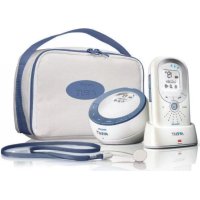



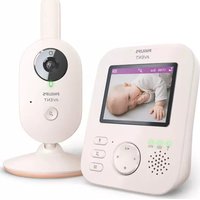
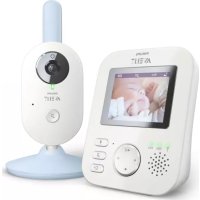
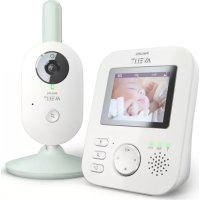
| Product Type | Babyphone (baby monitor) |
| Brand | Philips |
| Model | AVENT SCD499 |
| Technology | DECT (no interference or eavesdropping) |
| Outdoor range | 300 meters |
| Indoor range | Up to 50 meters (depending on obstacles) |
| Baby unit power supply | 220-240V mains adapter or 4 AA R6 1.5 V batteries (not included) |
| Parent unit power supply | 2 NiMH AAA 1.2 V rechargeable batteries (included) or mains charger |
| Parent unit battery life | Up to 24 hours (after 4 charge/discharge cycles) |
| Display | Digital displays on both units |
| Talk function | Yes |
| Built-in lullabies | 5 lullabies |
| Night light | Yes, built into baby unit |
| Page function | Yes (locating parent unit) |
| Temperature sensor | Yes, with adjustable alerts (range 7°C-33°C) |
| Microphone sensitivity | Adjustable |
| Silent mode | Yes |
| Included accessories | Belt clip, neck strap, travel pouch |
| Cleaning and maintenance | Damp cloth, do not immerse, avoid chemicals |
| Operating temperature | 10°C to 40°C |
| Warranty | International (see leaflet) |
Frequently Asked Questions - AVENT SCD499 PHILIPS
User questions about AVENT SCD499 PHILIPS
0 question about this device. Answer the ones you know or ask your own.
Ask a new question about this device
Download the instructions for your Baby monitors in PDF format for free! Find your manual AVENT SCD499 - PHILIPS and take your electronic device back in hand. On this page are published all the documents necessary for the use of your device. AVENT SCD499 by PHILIPS.
USER MANUAL AVENT SCD499 PHILIPS
PHILIPS
AVENT
⑦—High 8-Low 9-Not Linked 10—Volume 11—Paused

ENGLISH 6
DANSK 18
DEUTSCH 30
ΕΛΛΗΝΙΚΑ 43
ESPAÑOL 57
SUOMI 69
FRANÇAIS 81
ITALIANO 93
NEDERLANDS 105
NORSK 117
PORTUGUÊS 128
SVENSKA 141
Introduction
Philips Avent is dedicated to producing caring, reliable products that give parents the reassurance they need. This Philips Avent baby monitor provides round-the-clock support by ensuring you can always hear your baby clearly without any distracting noise. The DECT technology guarantees zero interference from other wireless appliances and a clear signal between the baby unit and the parent unit.
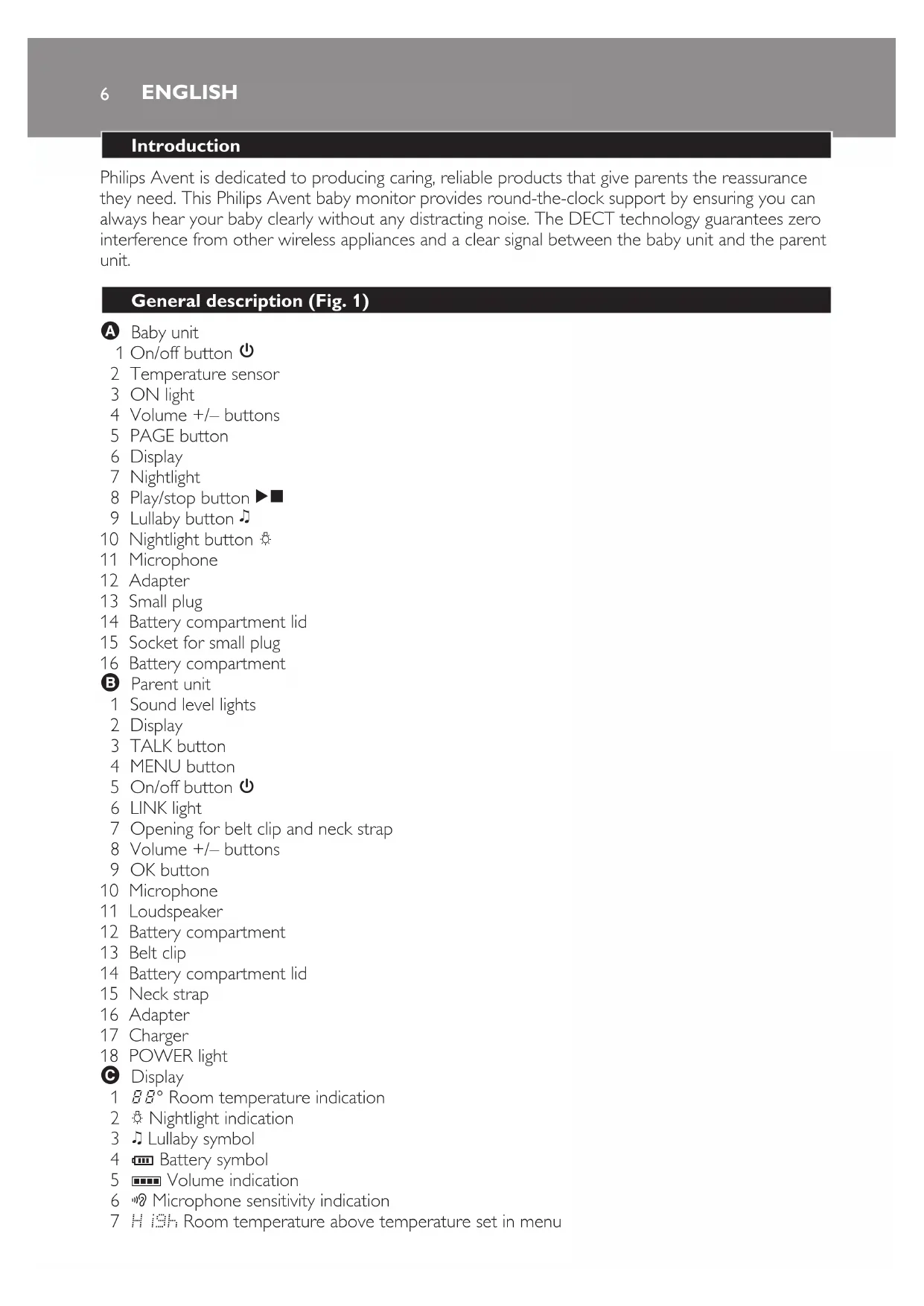
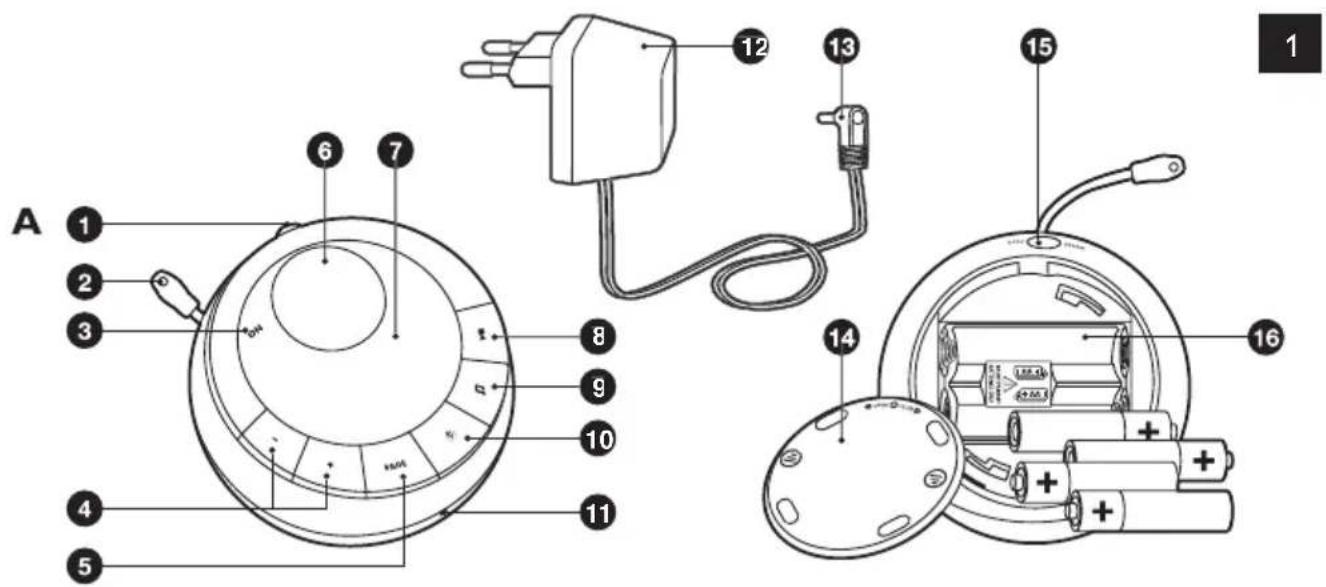
General description (Fig. 1)
A Baby unit
1 On/off button ⏻
2 Temperature sensor
3 ON light
4 Volume +/- buttons
5 PAGE button
6 Display
7 Nightlight
8 Play/stop button ▶■
9 Lullaby button ♪
10 Nightlight button ⚙
11 Microphone
12 Adapter
13 Small plug
14 Battery compartment lid
15 Socket for small plug
16 Battery compartment
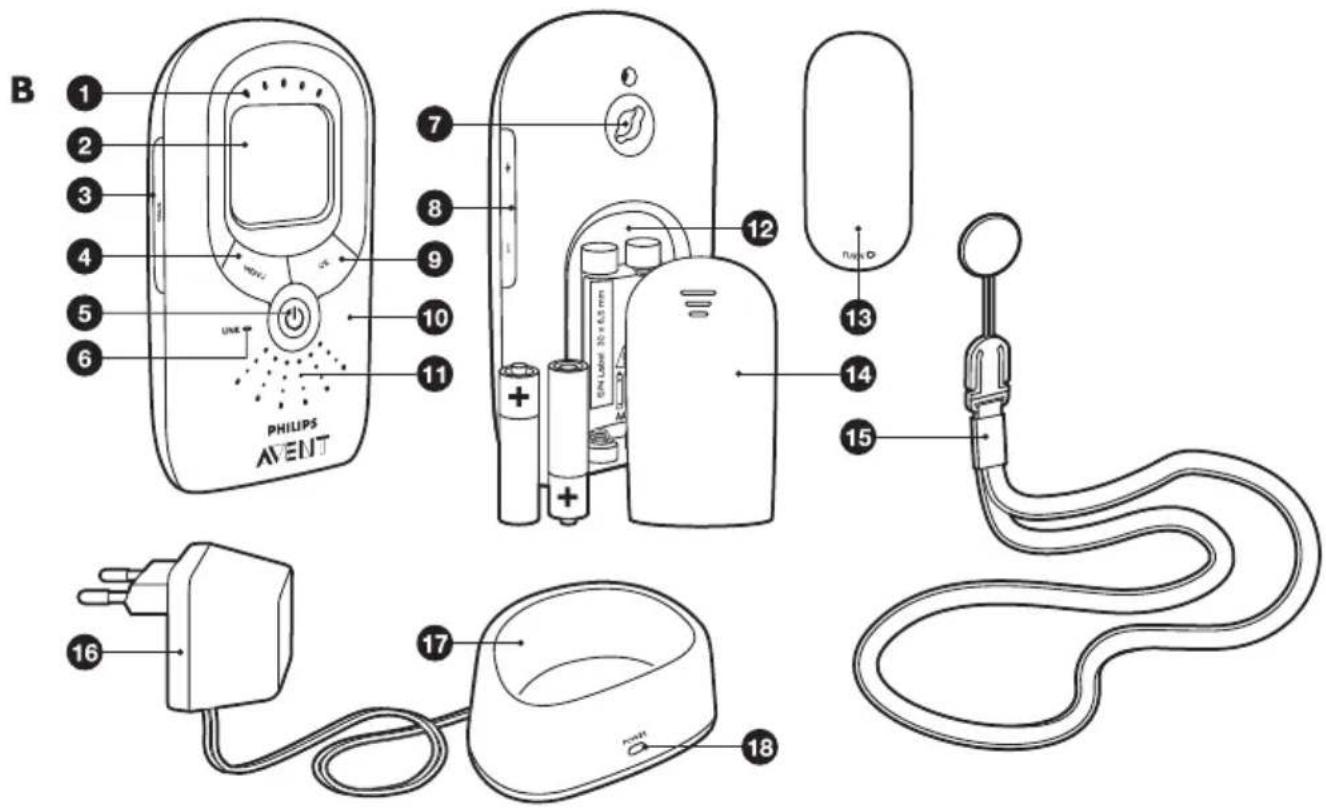
B Parent unit
1 Sound level lights
2 Display
3 TALK button
4 MENU button
5 On/off button ⏻
6 LINK light
7 Opening for belt clip and neck strap
8 Volume +/- buttons
9 OK button
10 Microphone
11 Loudspeaker
12 Battery compartment
13 Belt clip
14 Battery compartment lid
15 Neck strap
16 Adapter
17 Charger
18 POWER light
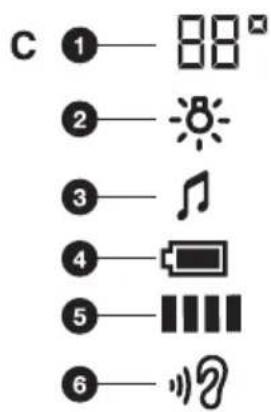
© Display
1 88° Room temperature indication
2 ⚙ Nightlight indication
3 ♪ Lullaby symbol
4 Battery symbol
5 Volume indication
6 Microphone sensitivity indication
7 High Room temperature above temperature set in menu
8 Low Room temperature below temperature set in menu 9 Not linked 'No connection between units' message 10 Volume ■ ■ ■ 'Volume level' message 11 Paused Message when lullaby is interrupted D Travel pouch
Important
Read this user manual carefully before you use the appliance and save it for future reference.
This baby monitor is intended as an aid. It is not a substitute for responsible and proper adult supervision and should not be used as such. Check if the voltage indicated on the adapters of the baby unit and the charger corresponds to the local mains voltage before you connect the appliance. Use and store the appliance at a temperature between 10°C and 40°C. The appliance is suitable for mains voltages from 220 to 240V. Do not expose the baby monitor to extreme cold or heat or to direct sunlight. Make sure the baby unit and the cord are always out of reach of the baby (at least 1 metre/3 feet away). Never place the baby unit inside the baby's bed or playpen. Never cover the baby monitor with a towel or blanket. Never immerse any part of the baby monitor in water or any other liquid. Never use the baby monitor in moist places or close to water. Except for the battery compartments, do not open the housing of the baby unit and parent unit in order to prevent electric shock. Only use the adapter supplied to connect the baby unit to the mains. Only use the charger supplied to charge the parent unit. The adapters contain a transformer. Do not cut off the adapters to replace them with other plugs, as this causes a hazardous situation. If the adapter of the baby unit is damaged, always have it replaced with one of the original type in order to avoid a hazard. If the charger or the adapter of the charger is damaged, always have the charger replaced with one of the original type in order to avoid a hazard. Always place non-rechargeable batteries of the correct type in the baby unit to avoid the risk of explosion. Always use rechargeable batteries of the correct type for the parent unit. Since continuous transmission is prohibited, you only hear your baby when it makes sounds.
Electromagnetic fields (EMF)
This Philips Avent appliance complies with all standards regarding electromagnetic fields (EMF). If handled properly and according to the instructions in this user manual, the appliance is safe to use based on scientific evidence available today.
Preparing for use
Baby unit
You can use the baby unit from the mains or on batteries. Even if you are going to use the unit from the mains, we advise you to insert batteries. This guarantees automatic back-up in case of mains failure.
Mains operation
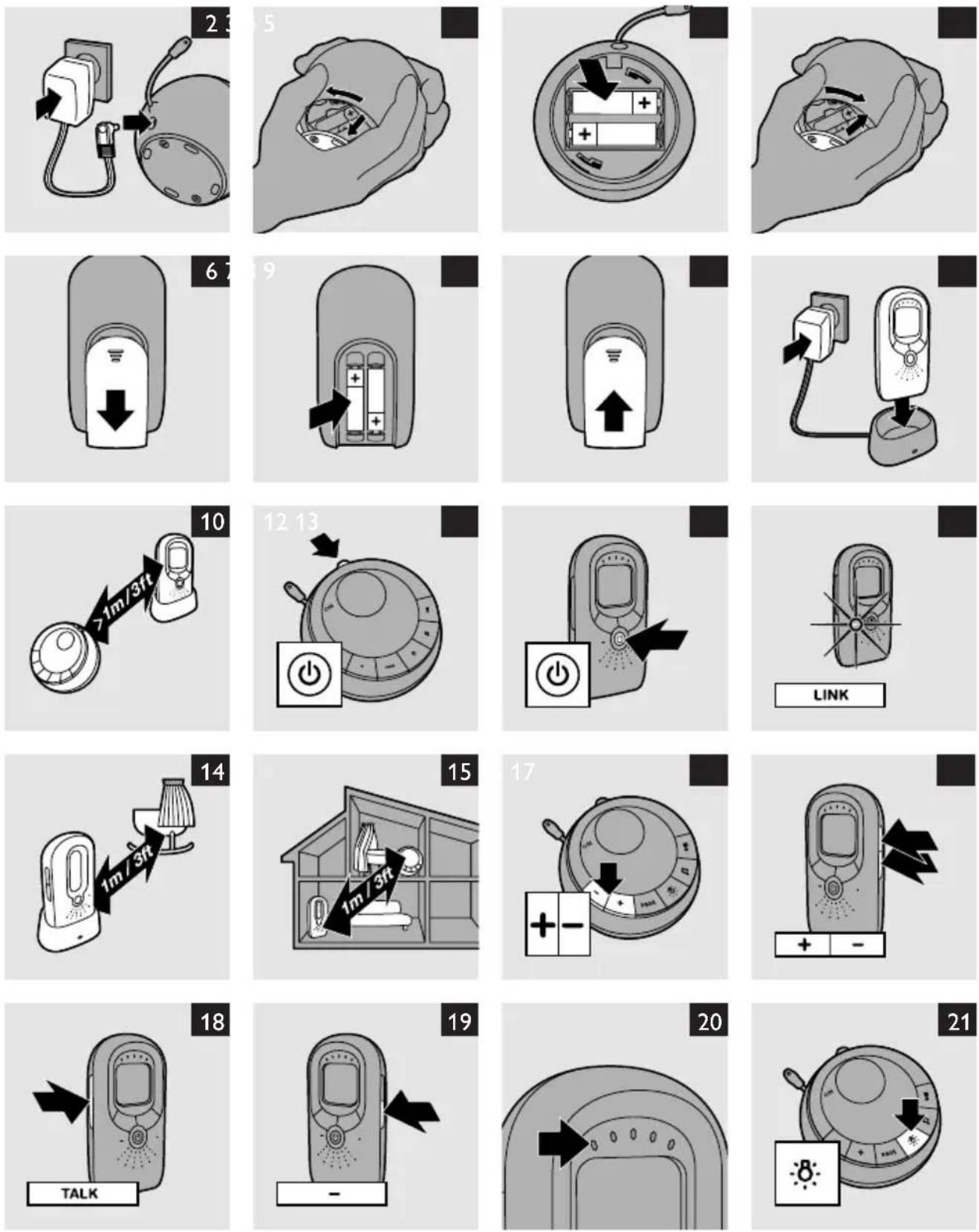
1 Put the small plug in the baby unit and put the adapter in a wall socket (Fig. 2).
Battery operation
The baby unit runs on four 1.5V R6 AA batteries (not included). We strongly advise you to use Philips LR6 PowerLife batteries.
Make sure your hands and the unit are dry when you insert the batteries.
1 Turn the battery compartment lid to the left (◀ OPEN) with the palm of your hand. (Fig. 3) 2 Remove the lid. 3 Insert four 1.5V R6 AA batteries (Fig. 4). Place two batteries on top of each other and make sure the + and - poles of the batteries point in the right direction. 4 Put the battery compartment lid back onto the unit and turn it to the right (CLOSE ▶) with the palm of your hand to close it. (Fig. 5)
Note: When the batteries are running low, the battery symbol appears on the display.
Parent unit
Battery operation
The parent unit runs on two rechargeable 1.2V AAA NiMh batteries that are supplied with the appliance.
Make sure your hands and the unit are dry when you insert the batteries.
1 Slide the battery compartment lid downwards to remove it (Fig. 6). 2 Insert the two rechargeable batteries (Fig. 7). Make sure the + and – poles of the batteries point in the right direction. 3 Slide the battery compartment lid back onto the back of the parent unit until it locks into position ('click') (Fig. 8). 4 Put the adapter in a wall socket and place the parent unit in the charger (Fig. 9). The POWER light on the charger lights up. 5 Leave the parent unit in the charger until the batteries are fully charged. When charging for the first time or after a long period of disuse: switch off the parent unit and let it charge continuously for at least 10 hours. Charging normally takes 8 hours, but it takes longer when the parent unit is switched on while charging. To keep the charging time as short as possible, switch off the parent unit during charging. The POWER light on the charger stays on, even when the batteries are fully charged. When the batteries are fully charged, the parent unit can be used cordlessly for at least 24 hours.
Note: The operating time of 24 hours is based on the assumption that the baby unit transmits 25% of the time and is in standby mode for the rest of the time (when the baby does not make any sound).
Note: When the parent unit batteries are charged for the first time, the operating time is less than 24 hours. The batteries only reach their full capacity after you have charged and discharged them four times.
Note: When the battery symbol on the display is empty and the parent unit beeps, the batteries are running low. Place the parent unit in the charger.
Note: When the parent unit is not in the charger, the batteries gradually discharge, even when the parent unit is switched off.
Mains operation
1 Make sure you have inserted the rechargeable batteries in the parent unit. 2 Put the adapter of the charger in the wall socket and place the parent unit in the charger (Fig. 9).
The POWER light on the charger lights up.
Using the appliance
1 Place the parent unit and the baby unit in the same room to test the connection (Fig. 10). Make sure the baby unit is at least 1 metre/3 feet away from the parent unit. 2 Press and hold the on/off button ⏻ on the baby unit for 2 seconds. (Fig. 11)
The nightlight lights up briefly. The display lights up and indicates the current room temperature. The ON light lights up.
3 Press and hold the on/off button ⏻ on the parent unit for 2 seconds. (Fig. 12)
The sound level lights light up blue briefly. The display lights up and the battery symbol and the temperature indication appear on the display. The LINK light flashes red briefly and then starts to flash green while the parent unit tries to establish connection with the baby unit. The LINK light on the parent unit flashes green until connection has been established. This takes up to 30 seconds. The LINK light on the parent unit then lights up green continuously (Fig. 13). If no link is established after 30 seconds, the LINK light on the parent unit flashes red, the parent unit beeps from time to time and the message Not L inkEd appears on the display of the parent unit.
4 Place the baby unit at least 1 metre/3 feet away from your baby (Fig. 14). 5 Position the parent unit within the operating range of the baby unit. Make sure it is at least 1 metre/3 feet away from the baby unit (Fig. 15).
For more information on the operating range, see section 'Operating range' below.
Operating range
The operating range of the baby monitor is 300 metres/900 feet in open air. Depending on the surroundings and other disturbing factors, this range may be smaller. Indoors the operating range is up to 50 metres/150 feet.
Dry materials Material thickness Loss of range
Wood, plaster, cardboard, glass < 30cm/12in 0-10% (without metal, wires or lead)
Brick, plywood < 30cm/12in 5-35%
Reinforced concrete < 30cm/12in 30-100%
Metal grilles or bars < 1cm /0.4in 90-100%
Metal or aluminium sheets < 1cm/0.4in 100%
For wet and moist materials, the range loss may be up to 100%.
Features
Adjusting loudspeaker volume
1 Briefly press the volume + and – buttons on the baby unit until the desired loudspeaker volume for the baby unit has been reached (Fig. 16).
ENGLISH10
2 Briefly press the volume + and – buttons on the parent unit until the desired loudspeaker volume for the parent unit has been reached (Fig. 17).
The displays give visual feedback on the volume settings of the units:
- Volume OFF: parent unit volume switched off / monitoring baby silently;
- Vol one ■ : minimum volume (parent unit and baby unit);
- Vol one ■ ■ ■ ■ ■: maximum volume (parent unit and baby unit).
Note: If you press the volume + and - buttons too long, the volume is not adjusted.
Note: You only have to adjust the baby unit volume when you use the talk function (see below).
Note: If the volume is set to a high level, the units consume more power.
Talk function
You can use the TALK button on the parent unit to talk to your baby (e.g. to comfort your baby).
1 Press and hold the TALK button and talk clearly into the microphone (Fig. 18).
2 Release the TALK button when you have finished talking.
Note: When you press the TALK button, you can no longer hear your baby.
Silent baby monitoring
1 Briefly press the volume down (−) button on the parent unit until the volume is switched off completely (Fig. 19).
The volume is completely switched off when all sound level lights are out.
As long as the baby unit does not detect a sound, all sound level lights on the parent unit are out (Fig. 20).
When the baby unit picks up a sound, one or more sound level lights on the parent unit come on. The louder the sound, the more lights come on.
Nightlight
1 Briefly press the nightlight button ⚙ on the baby unit to switch on the nightlight. (Fig. 21)
appears on both displays.
2 Press the nightlight button 🌐 again briefly to switch off the nightlight.
The nightlight dims gradually before it goes out completely.
disappears from both displays.
Note: If you press the nightlight button ⚙ too long, the nightlight does not come on or go out.
Tip: Switch off the nightlight when you operate the baby unit on batteries. This saves power.
Paging the parent unit
If you have misplaced the parent unit and its volume is switched off, you can use the PAGE button on the baby unit to locate the parent unit.
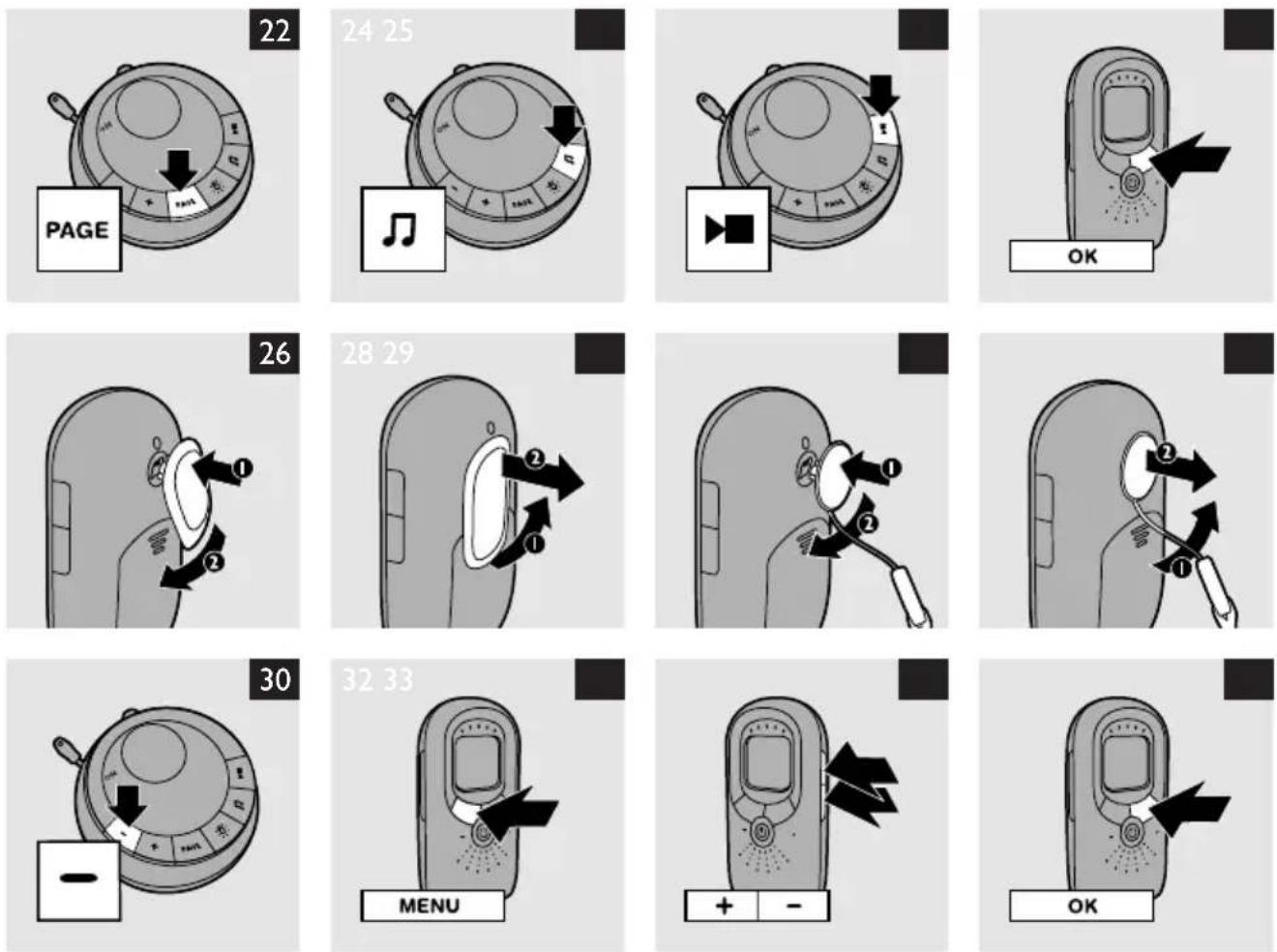
1. Briefly press the PAGE button on the baby unit (Fig. 22).
P39 in9 appears on both displays.
The parent unit automatically resets to medium volume level and produces a paging alert tone.
2. To stop the paging alert tone, press the PAGE button again briefly or press any button on the parent unit.
Note: If you press the PAGE button too long, the parent unit does not produce the paging alert tone.
Lullaby function
1. Briefly press the lullaby button ♩ on the baby unit to select one of the five lullabies available. (Fig. 23) 2. Briefly press the play/stop button ▶■ to play the selected lullaby. (Fig. 24) 3. Briefly press the OK button on the parent unit to interrupt the lullaby. Press the OK button on the parent unit again to continue the lullaby (Fig. 25). If you do not continue the lullaby within 60 seconds, the lullaby function switches off automatically. 4. Briefly press the play/stop button ▶■ on the baby unit again to stop the lullaby. (Fig. 24)
Note: If you press the lullaby button ♪ too long, no lullaby is selected.
Belt clip and neck strap
If the batteries of the parent unit are sufficiently charged, you can take the unit with you inside and outside the house if you attach the unit to your belt or waistband with the belt clip or if you hang it round your neck with the neck strap. This allows you to monitor your baby while you are moving around.
Connecting the belt clip
1 Insert the small pin on the back of the belt clip into the opening on the back of the parent unit (1). Turn the belt clip to the left (2) until it locks into position ('click') (Fig. 26).
Disconnecting the belt clip
1 Turn the belt clip to the right (1) and take it out of the opening (2) (Fig. 27).
Connecting the neck strap
1 Insert the small pin at the end of the neck strap into the opening on the back of the parent unit (1). Turn the neck strap to the left (2) until it locks into position ('click') (Fig. 28).
Disconnecting the neck strap
1 Turn the neck strap to the right (1) and take it out of the opening (2) (Fig. 29).
Reset function
This function allows you to reset the parent unit and baby unit to the default settings. You can use this function if problems occur that cannot be solved by following the suggestions in chapter 'Frequently asked questions'. You have to reset each unit separately.
1 Press and hold the on/off button ⏻ for 2 seconds to switch on the unit. (Fig. 11) 2 Then immediately press and hold the volume down (-) button until the message 'Reset' is shown on the display (Fig. 30). The unit has now been reset to the default factory settings.
Now do the same for the other unit.
Default settings
Parent unit
- Loudspeaker volume: 1
- Microphone sensitivity: 3
- Sound alert: on
- Temperature alert: on
- 'Temperature low' alert: 14°C
- 'Temperature high' alert: 30°C
Baby unit
- Loudspeaker volume: 3
- Nightlight: off
- Lullaby: 1
Menu options
Most functions can be operated on both the baby unit and the parent unit, but there are some functions that can only be set via the menu options available on the parent unit.
Menu operation - general explanation
1 Press the MENU button to open the menu (Fig. 31). The first menu option appears on the display. 2 Use the - and + buttons to select the desired menu option (Fig. 32). 3 Press the OK button to confirm your choice (Fig. 33). 4 Use the + and - buttons to select the desired setting. 5 Press the OK button to confirm your choice. ▶ Saved appears on the display. 6 Press the MENU button again to exit the menu (Fig. 31).
Note: Always press the MENU button, the - and + buttons and the OK button briefly. If you press the buttons too long, they do not work.
Nightlight on/off
1 Select LIGHT ON or LIGHT OFF by pressing the - and + buttons. Confirm the selected setting by pressing the OK button.
Playing lullabies
To play or stop a lullaby:
1 Select LULLABY by pressing the – and + buttons and confirm by pressing the OK button. 2 Select PLAY to play the last played lullaby again or STOP PLAY to stop playing. Confirm by pressing the OK button. To select a different lullaby:
1 Select LULLABY by pressing the – and + buttons and confirm by pressing the OK button. 2 Select SELECT NEW by pressing the - and + buttons and confirm by pressing the OK button. 3 Select the desired lullaby by pressing the – and + buttons and confirm by pressing the OK button.
Adjusting microphone sensitivity
You can set the microphone sensitivity of the baby unit to the desired level. You can only change the microphone sensitivity when a connection between the baby unit and the parent unit has been established, i.e. when the LINK light on the parent unit lights up green continuously.
1 Select SENSITIVITY by pressing the - and + buttons and confirm by pressing the OK button.
2 Select the desired microphone sensitivity level for the baby unit by pressing the - and + buttons and confirm by pressing the OK button.
▶ one light on = minimum sensitivity level, all lights on = maximum sensitivity level
Note: When the microphone sensitivity of the baby unit is set to a high level, it picks up more sounds and therefore transmits more often. As a result, the units consume more power.
Sound alert on/off
If the sound alert is switched on, the parent unit beeps as soon as the fifth sound level light lights up blue while the volume is switched off.
1 Select SOUND ALERT by pressing the – and + buttons and confirm by pressing the OK button. 2 Select ALERT ON or ALERT OFF and confirm by pressing the OK button.
Setting room temperature range
You can set the temperature range (minimum and maximum temperature) for your baby's room.
1. Select TEMPERATURE—° by pressing the – and + buttons and confirm by pressing the OK button. The range appears on the display. 2. Confirm by pressing the OK button. 3. Set the desired minimum temperature by pressing the – and + buttons and confirm by pressing the OK button. 4. Set the desired maximum temperature by pressing the – and + buttons and confirm by pressing the OK button.
Note: When the maximum temperature selected is lower than the room temperature, the unit consumes more power because the display is on continuously. This is also the case when the minimum temperature set is higher than the room temperature.
Temperature alert on/off
If the temperature alert is switched on, the parent unit beeps if the actual room temperature exceeds the set maximum temperature or drops below the set minimum temperature. If no minimum and maximum temperatures have been set, the temperature alert goes off when the room temperature drops below 7°C or rises above 33°C.
1. Select TEMPERATURE—° by pressing the – and + buttons and confirm by pressing the OK button. 2. Select A1 B3 on/OFF by pressing the – and + buttons and confirm by pressing the OK button. 3. Select Alert on? or Alert off? and confirm by pressing the OK button.
Cleaning and maintenance
Do not immerse the parent unit and the baby unit in water and do not clean them under the tap.
Do not use a cleaning spray and/or liquid cleaners.
1. Unplug the baby unit if it is connected to the mains and take the parent unit out of the charger. 2. Clean the parent unit and the baby unit with a damp cloth.
Make sure the parent unit is dry before you put it back into the charger.
3. Clean the charger with a dry cloth.
Storage
You can use the travel pouch to store the baby monitor while you travel. When you are not going to use the baby monitor for some time, remove the batteries and store the parent unit, the baby unit, the adapter of the baby unit and the charger in the travel pouch supplied.
Environment
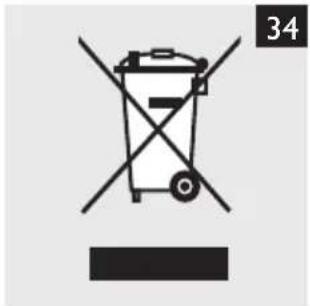
Do not throw away the appliance with the normal household waste at the end of its life, but hand it in at an official collection point for recycling. By doing this, you help to preserve the environment (Fig. 34). Batteries contain substances that may pollute the environment. Do not throw away batteries with the normal household waste, but hand them in at an official collection point. Always remove the batteries before you discard and hand in the appliance at an official collection point.
Guarantee and service
If you need information or if you have a problem, please visit the Philips website at www.philips.com or contact the Philips Customer Care Centre in your country (you find its phone number in the worldwide guarantee leaflet). If there is no Customer Care Centre in your country, go to your local Philips dealer or contact the Service Department of Philips Domestic Appliances and Personal Care BV.
Frequently asked questions
This chapter lists the questions most frequently asked about the appliance. If you cannot find the answer to your question, contact the Customer Care Centre in your country.
Question Answer
Why don't the ON light of the baby unit and the LINK light of the parent unit come on when I press the on/off buttons of the units?
Perhaps the batteries of the parent unit are empty and the parent unit is not in the plugged-in charger. Put the adapter of the charger in the wall socket and place the parent unit in the charger. Then press the on/off button to establish connection with the baby unit.
Perhaps the batteries of the baby unit are empty and the baby unit is not connected to the mains. Replace the batteries or put the small plug in the baby unit and put the adapter in a wall socket. Then press the on/off button to establish connection with the parent unit.
The baby unit and the parent unit may be out of range of each other. Move the parent unit closer to the baby unit, but not closer than 1 metre/3 feet.
If the LINK light on the parent unit still does not start to flash, use the reset function to reset the units to their default settings.
| Question Answer | |
| Why does the LINK light on the parent unit flash red and why is the message (Not L inKEd) shown on the display? | The baby unit and the parent unit are out of range of each other. Move the parent unit closer to the baby unit. |
| Why does the LINK light on the parent unit flash red? | The batteries of the baby unit are running low. Replace the batteries or connect the baby unit to the mains (see chapter ‘Preparing for use’). |
| Why does the parent unit beep? | If the parent unit beeps while the LINK light flashes red and the message (Not L inKEd) is shown on the display, the connection with the baby unit is lost. Move the parent unit closer to the baby unit. |
| If the parent unit beeps and the battery symbol on the display is empty, the batteries are running low. Recharge the batteries. | |
| If you have switched off the volume while the sound alert is on, the parent unit beeps whenever the fifth sound level light lights up blue because the baby unit has picked up a sound. | |
| If you have set the room temperature on the parent unit and the temperature alert is on, the parent unit beeps when the temperature drops below the set level or below 7°C or when the temperature rises above the set level or above 33°C. | |
| Why does the appliance produce a high-pitched noise? | The units may be too close to each other. Make sure the parent unit and the baby unit are at least 1 metre/3 feet away from each other. |
| The volume of the parent unit may be set too high. Decrease the volume of the parent unit. | |
| Why don't I hear a sound/ Why can't I hear my baby cry? | The volume of the parent unit may be set too low or may be switched off. Increase the volume of the parent unit. |
| The microphone sensitivity level of the baby unit may be set too low. Set the microphone sensitivity level to a higher level in the menu of the parent unit. | |
| The baby unit and the parent unit may be out of range of each other. Reduce the distance between the units. | |
| Why does the parent unit react too quickly to other sounds? | The baby unit also picks up other sounds than those of your baby. Move the baby unit closer to the baby (but observe the minimum distance of 1 metre/3 feet). |
| The microphone sensitivity level of the baby unit may be set too high. Decrease the microphone sensitivity level in the menu of the parent unit. | |
| Why does the parent unit react slowly to the baby's crying? | The microphone sensitivity level of the baby unit may be set too low. Increase the microphone sensitivity level of in the menu of the parent unit. |
Question Answer
| Why do the batteries of the baby unit run low quickly? | The microphone sensitivity level of the baby unit may be set too high, which causes the baby unit to transmit more often. Decrease the microphone sensitivity level in the menu of the parent unit. |
| The volume on the baby unit may be set too high, which causes the baby unit to consume a lot of energy. Decrease the volume of the baby unit. | |
| You may have set a maximum room temperature that is lower than the actual room temperature or a minimum room temperature that is higher than the actual room temperature. This causes the display to be lit all the time, which results in higher power consumption and batteries that run low quickly. | |
| Perhaps you have switched on the nightlight. If you want to use the nightlight, we advise you to run the baby unit on mains power. | |
| Why does the charging time of the parent unit exceed 8 hours? | The parent unit may be switched on during charging. Switch off the parent unit during charging. |
| The specified operating range of the baby monitor is 300 metres/900 feet. Why does my baby monitor manage a much smaller distance than that? | The specified range is only valid outdoors in open air. Inside your house, the operating range is limited by the number type of walls and/or ceilings in between. Inside the house, the operating range is up to 50 metres/150 feet. |
| Why is the connection lost every now and then? Why are there sound interruptions? | The baby unit and the parent unit are probably close to the outer limits of the operating range. Try a different location or decrease the distance between the units. Please note that it takes about 30 seconds each time before a connection between the units is established. |
| What happens during a power failure? | If the parent unit is sufficiently charged, it continues to operate during a power failure, both inside and outside the charger. If there are batteries in the baby unit, it automatically switches to battery operation in case of power failure. |
| Is my baby monitor secure from eavesdropping and interference? | The DECT technology of this baby monitor guarantees no interference from other equipment and no eavesdropping. |
| Some buttons do not seem to work when I press them. What do I do wrong? | You should press all buttons (except the on/off buttons and the TALK button) briefly. If you press them too long, they do not work. |
| The operating time of the parent unit is supposed to be at least 24 hours. Why is the operating time of my parent unit shorter? | When the parent unit batteries have been charged for the first time, the operating time is less than 24 hours. The batteries only reach their full capacity after you have charged and discharged them at least four times. |
| Question Answer | |
| The volume of the parent unit may be set too high, which causes the parent unit to consume a lot of energy. Decrease the volume of the parent unit | |
| The microphone sensitivity level of the baby unit may be set too high, which causes the parent unit to consume a lot of energy. Decrease the microphone sensitivity level in the menu of the parent unit. | |
| Why doesn't battery symbol appear on the display of the parent unit when I start to recharge the parent unit? | It may take a few minutes before the battery symbol appears on the display of the parent unit when you charge the parent for the first time or after a long period of disuse. |
Introduction
4 MENU button
5 Power button ⏻
8 Play/pause button ▶■
| Steen, triplex < 30 cm 5-35% |
| Gewapend beton < 30 cm 30-100% |
| Metalen roosters of stangen < 1 cm 90-100% |
| Metaal- of aluminiumplaten < 1 cm 100% |
Default settings
Parent unit
- Speaker volume: 1
Declaration of Conformity
We, PHILIPS DAP B.V.
(manufacturer's name)
P.O. Box 20100, 9200 CA Drachten, The Netherlands
(manufacturer's address)
declare under our responsibility that the radio product
Philips SCD496, SCD497, SCD498, SCD499
(type ID)
(DECT babyphone)
(description of appliance)
to which this declaration relates, is in conformity with the following standards:
EMC
ETSI EN 301 489-1 V 1.6.1 (2005-09)
ETSI EN 301 489-6 V 1.2.1 (2002-08)
RF
ETSI EN 301 406 V 1.5.1 (2003-07)
SAR
EN 50392 : 2004
safety
EN 60950-1:2001+am 11:2004
(number and issue-date of standard)
following the provisions of 1999/5/EC (R&TTE Directive)

Drachten, 2006-12-01
(place, date)
H. de Beurs
Product Quality Manager
( signature, name and function )


- PHILIPS
- AVENT
- INTRODUCTION
- GENERAL DESCRIPTION (FIG. 1)
- A BABY UNIT
- B PARENT UNIT
- © DISPLAY
- IMPORTANT
- ELECTROMAGNETIC FIELDS (EMF)
- PREPARING FOR USE
- BABY UNIT
- MAINS OPERATION
- BATTERY OPERATION
- PARENT UNIT
- USING THE APPLIANCE
- OPERATING RANGE
- DRY MATERIALS MATERIAL THICKNESS LOSS OF RANGE
- FEATURES
- ADJUSTING LOUDSPEAKER VOLUME
- ENGLISH
- TALK FUNCTION
- SILENT BABY MONITORING
- NIGHTLIGHT
- PAGING THE PARENT UNIT
- LULLABY FUNCTION
- BELT CLIP AND NECK STRAP
- CONNECTING THE BELT CLIP
- DISCONNECTING THE BELT CLIP
- CONNECTING THE NECK STRAP
- DISCONNECTING THE NECK STRAP
- RESET FUNCTION
- DEFAULT SETTINGS
- MENU OPTIONS
- MENU OPERATION - GENERAL EXPLANATION
- NIGHTLIGHT ON/OFF
- PLAYING LULLABIES
- ADJUSTING MICROPHONE SENSITIVITY
- SOUND ALERT ON/OFF
- SETTING ROOM TEMPERATURE RANGE
- TEMPERATURE ALERT ON/OFF
- CLEANING AND MAINTENANCE
- STORAGE
- ENVIRONMENT
- GUARANTEE AND SERVICE
- FREQUENTLY ASKED QUESTIONS
- QUESTION ANSWER
- DECLARATION OF CONFORMITY
Brand : PHILIPS
Model : AVENT SCD499
Category : Baby monitors