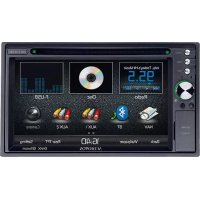
VME 9725 NAV - Car radio AUDIOVOX - Free user manual and instructions
Find the device manual for free VME 9725 NAV AUDIOVOX in PDF.



| Product type | Multimedia car stereo with GPS navigation |
| Brand | Audiovox |
| Model | VME 9725 NAV |
| Category | Car stereo |
| Screen | 6.2 inches (16 cm) high-definition TFT LCD |
| Screen resolution | 800 × 480 pixels (1,152,000 sub-pixels) |
| FM radio | Range 87.5 - 107.9 MHz, 30 presets (18 FM / 12 AM) |
| AM radio | Range 522 - 1620 kHz |
| Audio formats | CD-DA, MP3, WMA |
| Video formats | DVD, VCD, DivX, Xvid, AVI, MPEG1/2 |
| Bluetooth | Built-in, HFP and A2DP profiles |
| Navigation | GPS with Tele Atlas Europe maps, 5.5 million POIs, 4 GB SD card included |
| Rear view camera | Dedicated input, mirror and normal modes |
| Connectivity | Front/rear USB, SD slot, front AV input, composite video output, front/rear/subwoofer RCA outputs |
| Output power | 4 × 40 watts max |
| Power supply | 11-16 V DC, negative ground |
| Dimensions (standard) | 2 DIN (approx 178 × 100 mm) |
| Weight (estimated) | Approximately 2 kg |
| Safety | Parking brake required for front video display |
| Maintenance | Clean with a silicone cloth, do not use alcohol |
Frequently Asked Questions - VME 9725 NAV AUDIOVOX
User questions about VME 9725 NAV AUDIOVOX
0 question about this device. Answer the ones you know or ask your own.
Ask a new question about this device
Download the instructions for your Car radio in PDF format for free! Find your manual VME 9725 NAV - AUDIOVOX and take your electronic device back in hand. On this page are published all the documents necessary for the use of your device. VME 9725 NAV by AUDIOVOX.
USER MANUAL VME 9725 NAV AUDIOVOX
"Made for iPod," and "Made for iPhone" mean that an electronic accessory has been designed to connect specifically to iPod or iPhone, respectively, and has been certified by the developer to meet Apple performance standards. Apple is not responsible for the operation of this device or its compliance with safety and regulatory standards. Please note that the use of this accessory with iPod or iPhone may affect wireless performance.
iPhone,iPod classic, iPod nano, and iPod touch are trademarks of Apple Inc., registered in the U.S. and other countries.
Bluetooth® is a trademark of Bluetooth Special Interest Group (SIG) Inc.
iGo Primo is a trademark of NNG Kft.
DIVX
ABOUT DIVX VIDEO: DivX® is a digital video format created by DivX, LLC, a subsidiary of Rovi Corporation. This is an official DivX Certified® device that plays DivXvideo. Visit divx.com for more information and software tools to convert your files into DivX videos.
ABOUT DIVX VIDEO-ON-DEMAND: This DivX Certified® device must be registered in order to play purchased DivX Video-on-Demand (VOD) movies. To obtain your registration code, locate the DivX VOD section in your device setup menu. Go to vod.divx.com for more information on how to complete your registration.
At the end of the product's useful life, please dispose of it at appropriate collection points provided in your country.
Please engage parking brake to watch video.
Warning !!!
Thesee listened to the voices of the men who were standing in front of them. The women were not yet ready to speak, but they had already begun to do so. These were the women who had been waiting for their mothers to come and who had been waiting for their fathers to come.
Sigma-Delta Modulator
Video
Format: NTSC, PAL (auto-detection)
Thank you for choosing an Audiovox product. We hope you will find the instructions in this owner's manual clear and easy to follow. If you take a few minutes to look through it, you'll learn how to use all the features of your new Audiovox VME 9725 NAV Mobile Multimedia Receiver for maximum enjoyment.
CONTENTS
Features. 77
Warnings 79
Remote Control 80
Operating Instructions 88
Playing Source Selections 89
Steering Wheel Controls 95
Settings Menu 96
Tuner Operation 103
DVD/VCD Video Operation 110
DVD/CD Audio Operation 116
MP3/WMA/Xvid/DivX Operation 120
iPod/iPhone Operation 126
Bluetooth Operation 130
Rear Camera Operation 139
Troubleshooting 140
Care and Maintenance 144
Specifications 145
FEATURES
Congratulations on your purchase of the Audiovox VME 9725 NAV Mobile Multimedia Receiver. It's a good idea to read all of the instructions before beginning the installation. We recommend having your Audiovox VME 9725 NAV installed by a reputable installation shop.
DVD
- Fast Forward/Reverse - 2X, 4X, 8X, and 20X
- Slow Motion Forward/Reverse - 1/2, 1/4, 1/6, and 1/8
- Play, Pause, Stop, Next Chapter, and Previous Chapter
CD / MP3 / WMA
- CD-Text Compatible
- ID3 Tag Compatible
- Directory Search (MP3 / WMA Only)
- Burn up to 1500 MP3 and WMA Files onto a DVD+R / RW
- Audible Forward / Reverse Track Search (CD-DA Only)
- Random, Repeat and Intro
- Play, Pause, Stop, Next Track, and Previous Track
AM-FM
- Europe Frequency Spacing
30 Station Presets (18 FM / 12 AM) - Auto Stereo / Mono
- Local / Distance
- Auto Store / Preview Scan
iPod/iPhone
- iPod/ iPhone via USB
- High Speed Direct Connect Interface to Access iPod Playlists, Artists, Albums and Songs. Play music and view video/photo files from your iPod. Video/photo playback requires Audiovox jLink4 cable (included).
- Power Management charges iPod while connected
Chassis
- 2.0 DIN (Import / ISO-DIN Mountable)
- Fixed Front Panel
- 6.2" / 16 cm High Definition TFT LCD
1,152,000 Sub Pixels (800 x 3 X 480) - Beep Tone Confirmation (ON-OFF Option)
- Heat Management System - Forced-Air Cooling To Keep The Chip-Sets Operating at Nominal Temperatures
General
- Built-In Bluetooth® with external microphone, providing Hands-Free operation for safety and convenience and A2DP for streaming music from your smartphone or other Bluetooth® device.
One Composite Video Output for Additional Screens - Front Panel Audio/Video Input
- Three-Band Tone control (Bass, Mid and Treble) with Eight Preset EQ Curves
- Front Panel A/V Aux Input for Portable Media Devices
Rear Subwoofer Line Output
Programmable Volume Control - Rear Camera Input (Normal and Mirror Image View)
- Touch Screen Calibration Mode
4VRMS Line Output - All Channels - Rotary Encoder Audio Control
- Front / Rear / Sub Line Output
Rear USB Input
Navigation
TTS Voice Guidance - Street Names Announced
15 TTS Voices
- Tele Atlas Map Data
5.5 Million Points of Interest
4GB SD Card with Continental Europe
- Latest Map Guarantee
Rear Camera
The VME 9725 NAV is "camera ready." Before accessing any camera features, you must purchase and install a rear video camera. Once the camera is connected and operating properly, the CAMERA source mode will become active. While the camera is not installed, the CAMERA option appears gray, indicating the function is not available.
WARNING!
Never install this unit where operation and viewing could interfere with safe driving conditions.
WARNING!
To reduce the risk of a traffic accident (except when using for rear view video camera) never use the video display function while driving the vehicle. This is a violation of federal law.
WARNING!
To prevent injury from shock or fire, never expose this unit to moisture or water.
WARNING!
Never disassemble the unit.
WARNING!
Never use irregular discs.
WARNING!
To prevent damage to the mechanism inside this unit, avoid impact to the unit's monitor.
WARNING!
Using an improper fuse may cause damage to the unit and result in a fire.
CONTROLS AND INDICATORS
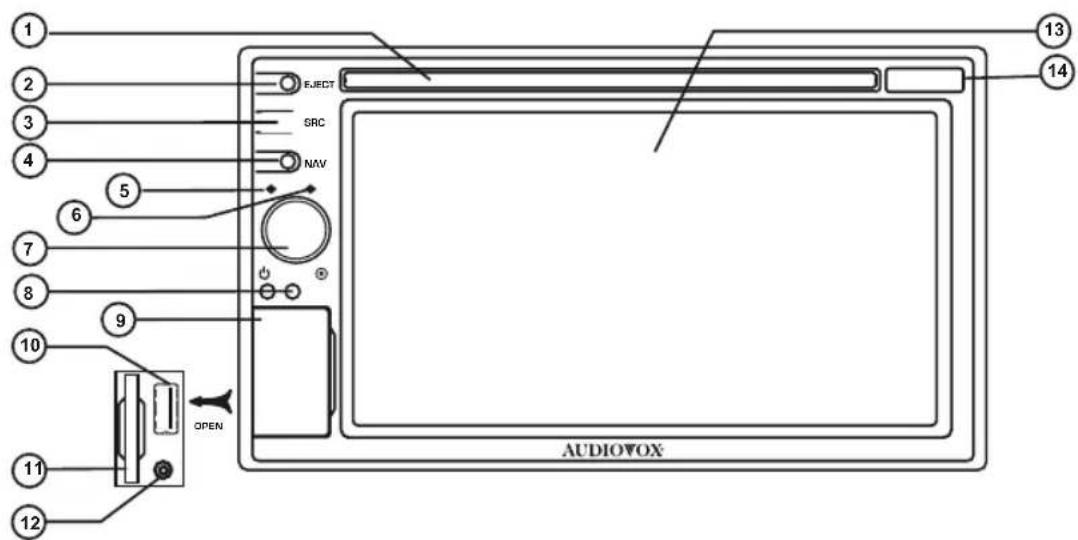
- Disc Slot
- EJECT Button
Press to eject a disc.
- SRC Button
Press to switch between the available audio/video sources applied to the unit.
- NAV Button
Press to toggle back and forth between the navigation and currently selected source.
- Internal Microphone
Internal microphone for Bluetooth calls.
- Reset Button
Press to reset system settings to factory default (except password setting).
- Rotary Encoder / Power On/Off Button
Rotate to adjust the volume. Press momentarily to activate the MUTE function.
Press again to resume normal listening.
Press to turn the unit ON. Press and hold to turn the unit OFF.
- Remote Sensor
- USB/SD/AV Interface Connector Cover
- USB Interface Connector
Connect a USB device for playback of music/video files.
- SD Interface Connector
Insert an SD card for playback of music/video files.
- A/V Input
Accepts a 3.5mm jack through which signals from various audio/video devices can be applied to the unit.
-
TFT Display
-
Map Cover
Covers the Mini SD card slot. The Mini SD card is used for the Navigation Map only, not for music or other files. This may be used for firmware updates if required.
REMOTE CONTROL
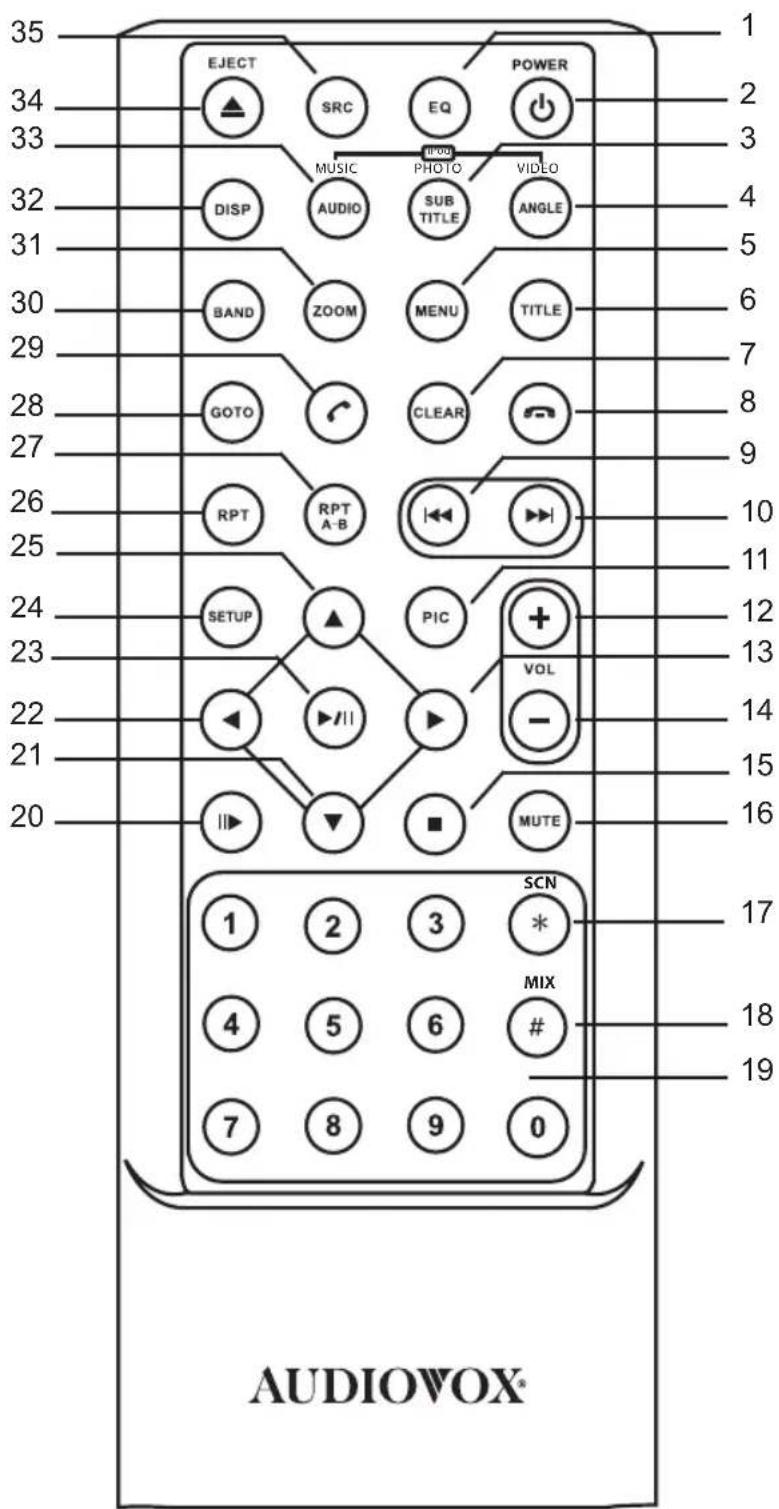
Remote Control Functions
| Button Function | ||||||
| Name # DVD | VCD | TUNER CD | MP3/ | USB | iPod | |
| EQ 1 Accesses | equalizer menu. | Accesses equalizer menu. | Accesses equalizer menu. | Accesses equalizer menu. | Accesses equalizer menu. | |
| POWER (Φ) | 2 Turns the power on/off. | Turns the power on/off. | Turns the power on/off. | Turns the power on/off. | Turns the power on/off. | |
| PHOTO/SUBTITLE | 3 Language selection for subtitle. | Selects Photo mode. | ||||
| VIDEO/ANGLE | 4 Plays back disc in different angle for a scene. | Plays back Picture CD with different angle of picture displayed. | Selects Video mode. | |||
| MENU 5 Enters the main menu of the disc. | Turns on/off PBC when playing VCD. | Selects Photo mode. | ||||
| TITLE 6 Enters the title menu of the disc. | Plays the first ten seconds of each chapter/title. | Selects Music mode. | ||||
| CLEAR 7 Delete entry or move backwards to correct error in Direct Access mode. | Delete entry or move backwards to correct error in Direct Access mode. | Delete entry or move backwards to correct error in Direct Access mode. | Delete entry or move backwards to correct error in Direct Access mode. | Delete entry or move backwards to correct error in Direct Access mode. | ||
Remote Control Functions
| Button Function | ||||||
| Name # | DVD | VCD TUNER | CD/MP3/ | USB | iPod | |
| 8 | ||||||
| 9 S | Selects the previous chapter for playback. | Selects the previous chapter for playback. | Searches for an available radio station by decreasing tuning frequency. | Selects the previous track for playback. | Pauses playback/starts playback. | |
| 10 | Selects the next chapter for playback. | Selects the next chapter for playback. | Searches an available radio station by increasing the tuning frequency. | Selects the next track for playback. | Selects the next track for playback. | |
| PIC 11 D | splays set-up parameters. | Displays set-up parameters. | ||||
| VOL + 12 | Increases volume. | Increases volume. | Increases volume. | Increases volume. | Increases volume. | |
| 13 Fast forwards the disc content. | Fast forwards the disc content. | Fast forwards the disc content. | Accesses iPod Menu. | |||
| VOL - 14 | Decreases volume. | Decreases volume. | Decreases volume. | Decreases volume. | Decreases volume. | |
| 15 Stops | playback. | Stops playback. | Stops playback. | |||
Remote Control Functions
| Button Function | ||||||
| Name # DV | D VCD | D TUNER CD | MP3/ | USB | iPod | |
| MUTE 16 Toggle | on/off audio output. | Toggles on/off audio output. | Toggles on/off audio output. | Toggles on/off audio output. | Toggles on/off audio output. | |
| SCN /* | 17 P | ays the | first ten seconds of each track. | |||
| MIX /# | 18 P | ays all chapters in random order. | Plays all tracks in random order. | Plays all tracks in random order | ||
| 1,2,3,4,5,6,7,8,9,0 (Numeric Keypad) | 19 D | directly accesses chapter. | 1-6 selects preset for current band. | Directly accesses track. | ||
| II▶ | 20 P | press repeatedly for slow motion forward/backward. | Press repeatedly for slow motion forward/backward. | |||
| PRESET 2 | 1 Navigates | the preset station list. | ||||
| ← | 22 S | slow playback/slow rewind playback. | Slow playback/slow rewind playback. | |||
Remote Control Functions
| Button Function | ||||||
| Name # DVD VCD TUNER CD/MP3/ | USB | iPod | ||||
| II /II | 23 Pauses playback/starts playback. | Pauses playback/starts playback. | Pauses playback/starts playback. | |||
| SETUP 24 | Displays Setup menu. | Displays Setup menu. | Displays Setup menu. | Displays Setup menu. | Displays Setup menu. | |
| PRESET 25 Navigates | the preset station list. | |||||
| RPT 26 Repeats | playback of current chapter. | Repeats playback of current chapter. | Repeats playback of current track. | Repeats playback of current track. | ||
| REPT A-B | 27 Setup to repeat playback from time frame A to time frame B. | Setup to repeat playback from time frame A to time frame B. | ||||
| GOTO 28 Open direct entry search screen. | Open direct entry search screen. | |||||
| 29 | ||||||
| BAND 30 Selects | FM/AM band. | |||||
Remote Control Functions
| Button Function | ||||||
| Name # | DVD | VCD TUNER | CD/MP3/ | USB | iPod | |
| ZOOM 31 | Zooms in/out on an image. | Zooms in/out on an image. | ||||
| DISP 32 | Displays playing information. | Displays playing information. | Displays playing information. | Display playing information. | Displays playing information. | |
| MUSIC/AUDIO | 33 Changes the audio language for disc playback. | Selects Music mode. | ||||
| EJECT (▲) | 34 Ejects the disc. | Ejects the disc. | Ejects the disc. | Ejects the disc. | Ejects the disc. | |
| SRC 35 | Selects playing mode. | Selects playing mode. | Selects playing mode. | Selects playing mode. | Selects playing mode. | |
OPERATING INSTRUCTIONS
Power On / Off
Press the Power On/Off ( ) button to turn the unit on. The buttons on the front of the unit light up and the current mode status appears on the LCD. Press and hold the button to Power On/Off ( ) power off the unit.
Audible Beep Confirmation
An audible beep tone confirms each function selection. The Beep tone can be disabled through the Setup menu.
Mute
Momentarily press the rotary encoder to activate the MUTE function. Press again to resume normal listening. If the MUTE wire is connected, audio output mutes when a phone call is received by the mobile phone.
Playing Source Selections
Front Source Menu
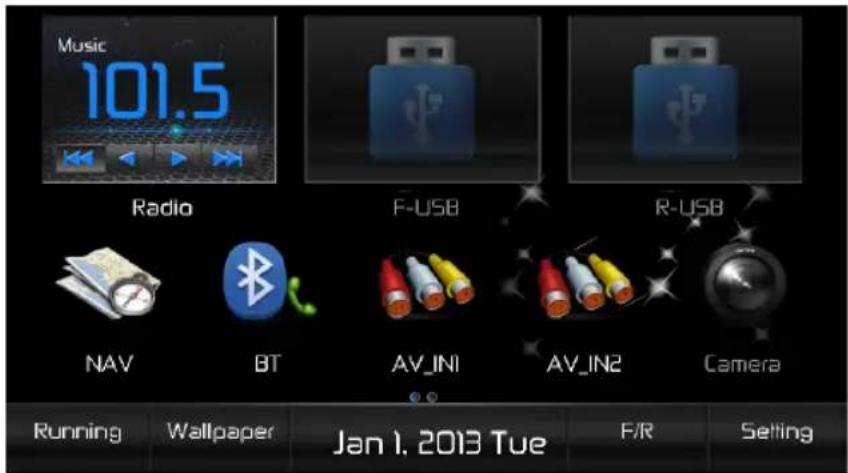
Source Menu Page1
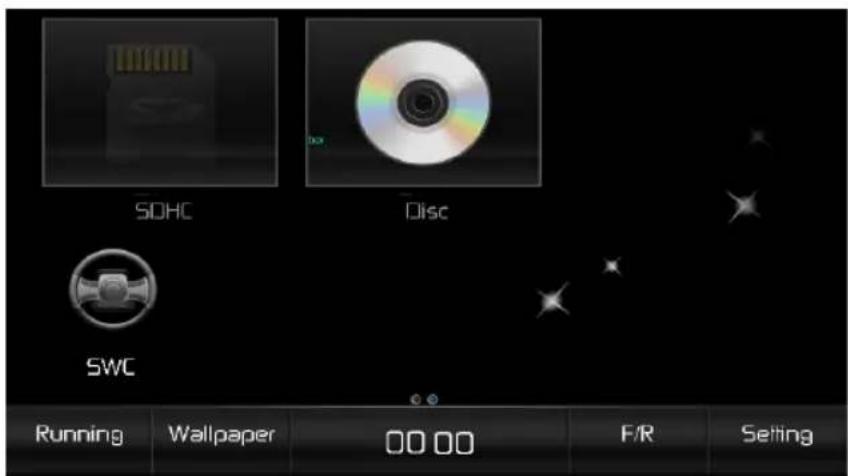
Source Menu Page 2
You can use the touch screen to change the source through the SOURCE MENU. To access the SOURCE MENU, touch the top left corner of the screen or press the SRC button. The SOURCE MENU consists of two pages. Swipe across the screen to go from one page to another. Touch the Radio, F-USB (Front USB), R-USB (Rear USB), NAV, BT (Bluetooth), AV_IN1, AV_IN2, Camera, SOHC, Disc, or SWC (Steering Wheel Controls) icons to select the corresponding source.
NOTE: If an iPod is attached to a USB port, "iPOD" appears instead of the text "F-USB" or "R-USB."
Rear Source Menu
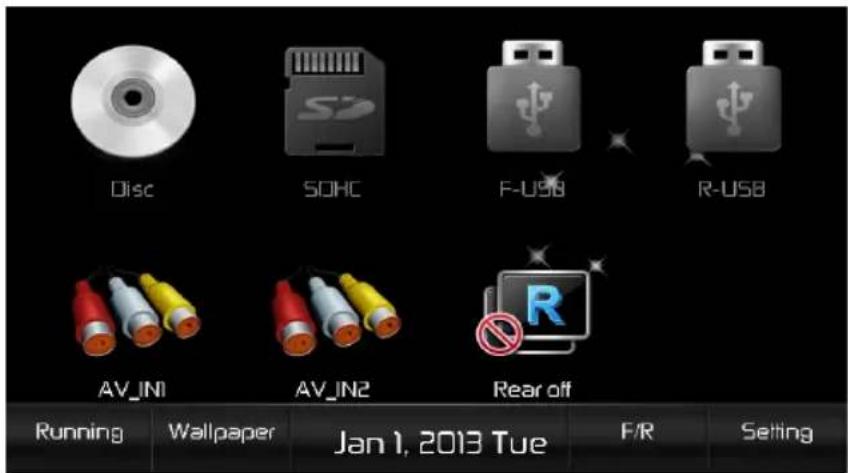
The Rear Source Menu Screen allows you to select an audio/video source for your vehicle's rear zone. Touch the Disc, SOHC, F-USB (Front USB), R-USB (Rear USB), AUX1 or AUX2 icons to select the corresponding source.
NOTE: If an iPod is attached to a USB port, "iPOD" appears instead of the text "F-USB" or "R-USB."
External Devices
External peripheral devices, including a game console, camcorder, navigation unit, iPod, Zune, etc. can be connected to this unit via RCA output using an A/V Media Adapter Cable (not included).
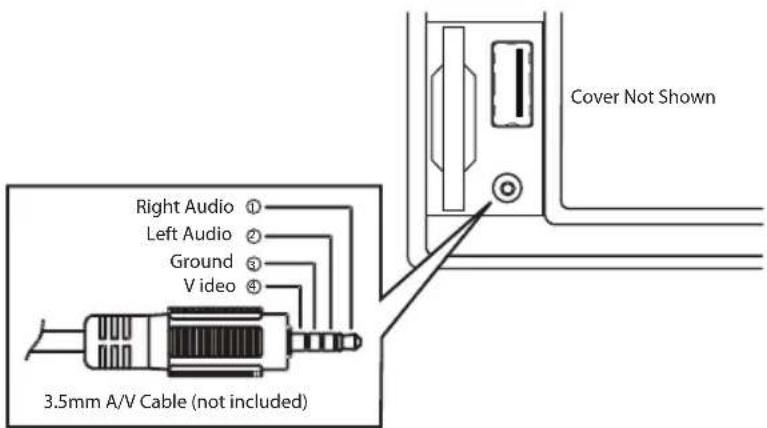
Connect the external device to the A/V Media Adapter Cable and then plug the cable into the A/V INPUT connector on the front of the radio. Select "AUX IN" mode to access auxiliary devices. You cannot directly control external devices connected to the A/V INPUT. For information regarding the use of USB devices, see "Inserting a USB Device or SD Card".
Volume Adjustment
Volume Increase/Decrease
To increase or decrease the volume level, turn the rotary encoder on the front panel. When the volume level reaches "0" or "50", a beep sounds, indicating that the adjustment limit has been reached. The TFT screen displays the volume level for 3 seconds.
Programmable Turn-On Volume
This feature allows the user to select a turn-on volume setting regardless of the volume setting prior to turning the unit off. To program a specific turn-on volume level, turn the rotary encoder to adjust the volume to the desired turn-on volume. Push and hold the rotary encoder while the speaker icon and level indication is displayed on the screen. The unit will beep to confirm your turn-on volume setting.
Equalizer and Balance/Fader Controls
The equalizer and balance/fader controls allow you to easily adjust your audio system to meet the acoustical characteristics of your vehicle, which vary depending on the type of vehicle and its measurements. Proper setting of the Fader and Balance boosts the effects of the cabin equalizer.
Equalizer Screen
Touch the EQ button display the equalizer screen.
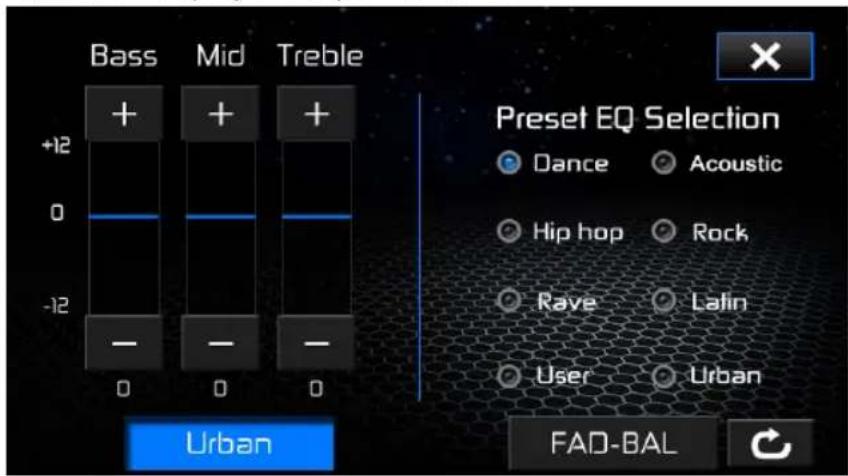
Equalizer Adjustments
| Setting | Adjustable Range | Function |
| BASS -12 | to +12 Reduces or increases the bass frequency sound level. Touch the + or - buttons to adjust the settings. | |
| MID -12 to +12 Reduces or increases the mid-range frequency sound level. Touch the + or - buttons to adjust the settings. | ||
| TREBLE -12 to +12 Reduces or increases the high frequency sound levels. Touch the + or - buttons to adjust the settings. | ||
Preset EQ Selection
Equalizer presets apply a preset sound level to the unit's audio output signal. Touch the User, Acoustic, Urban, Rave, Latin, Dance, Hip Hop or Rock button to change the setting.
NOTE: The equalizer will automatically change to "USER" when individual audio functions are adjusted.
To Exit the Equalizer:
- Touch the X button on the top right corner of the screen to return to the source screen.
- Touch the BAL-FAD button to display the balance/fader screen.
Balance/Fader Screen
Touch the BAL-FAD button on the left side of the equalizer screen to display the balance/fader screen.
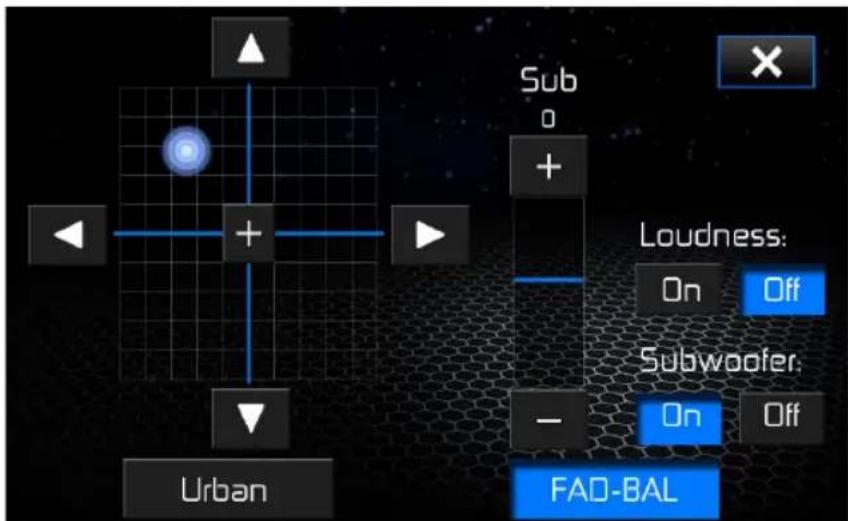
or Balance) icon:
Balances the audio output levels between the left and right side of the vehicle. Touch the or icon to change the setting.
- or▲(Fade) icon:
Balances the audio output levels between the front and back side of the vehicle. Touch the or con to change the setting.
- Sub icon:
Reduces or increases the subwoofer sound level. Touch the + or - buttons to adjust the settings.
- Loudness On/Off icon:
Loudness automatically alters the frequency response curve of audio to make it sound more natural when played at a lower volume level. Press the On icon to turn loudness compensation on. Press the Off icon to turn loudness compensation off.
- Subwoofer On/Off icon:
Press the On icon to turn the vehicle's subwoofer on (if equipped). Press the Off icon to turn the vehicle's subwoofer off.
To Exit the Balance-Fader:
-
Touch the X button on the top right corner of the screen to return to the source screen.
-
Touch the EQ button to display the equalizer screen.
System Reset
To correct a system halt or other illegal operation, use the tip of a pen to press the reset button located over the rotary encoder. After a system reset, the unit restores all factory default settings.

[RESET]Button
NOTE: If the unit is reset while a DVD is playing, the DVD resumes play once the reset is complete.
Image/Display Settings
Video Output Modes
The following table shows the video output mode for each playing source.
Video Output Modes
| Playing Source Video Output Modes | |
| AM/FM TUNER RGB Mode | |
| DVD YCbCr Mode | |
| AUX IN CVBS* Mode |
*CVBS - Composite Video Baseband Signal
Parking Brake Inhibit
When the pink "Parking" wire is connected to the vehicle Parking Brake circuit, the front TFT monitor will display video when the Parking Brake is engaged. (When the pink wire is grounded via the Parking Brake circuit, video will be displayed.)
STEERING WHEEL CONTROLS (SWC)
(if equipped)
The VME 9725 NAV is compatible with following steering wheel control adapters: Dietz UNICO DUAL PLUS + cable, PAC (Pacific Accessory Corporation) SWI-PS and Metra ASWC. A 3.5mm female connector (labeled "SWC Interface") on the back of the head unit allows connectivity to the adapters. Please refer to the instructions included with the adapters for detailed installation information.
SWC Functions
The following controls are available for most vehicles:
- Volume Up
- Volume Down
- Mute
- Seek Up
- Seek Down
- Source
- Band
- Bluetooth Send
- Bluetooth End
**All SWC functions may not be available on some vehicles.
SETTINGSMENU
When using the VME 9725 NAV for the first time, it is recommended that you customize the system settings to suit your preferences. You may also change the settings at any time.
To access system settings:
- Touch the Settings button on the Source Menu screen to enter the SETTINGS MENU. The General Sub-menu appears highlighted in blue.
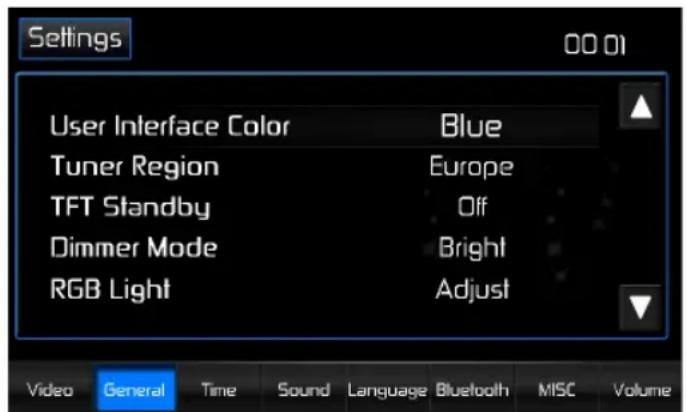
- Touch a sub-menu name icon (Video, General, Time, etc.) to select a sub-menu. The settings available for adjustment under the highlighted sub-menu option will appear in the left of the screen.
- Touch an item on the touchscreen to select the setting to be adjusted. Touch the or icon to scroll up or down the settings list page, if applicable. An options field, showing the current selected option, appears on the right.
- Touch the option field to change the setting you want to adjust. The setting option is updated.
Video Sub-menu Settings
| Setting Options Function | ||
| Aspect Ratio Full The entire screen is extended horizontally to the aspect ratio of 16 to 9. The extension ratio is the same at any point. | ||
| Normal The conventional display image has a 4 to 3 ratio of horizontal to vertical, leaving a blank area on the right and left sides of the display. | ||
| Rear Camera Mirror Reverse the camera image as if looking through a rear-view mirror. | ||
| Normal | ||
| Rear Camera Audio | On Enable rear camera audio function. | |
| Off Disable rear camera audio function. | ||
NOTE: If the rear-view video camera is connected and the unit is on, Camera mode is selected upon shifting into REVERSE gear. If the monitor is in display mode, the monitor automatically switches to CAMERA mode upon reverse driving. When the reverse driving stops, the monitor returns to its original input mode.
General Sub-menu Settings
| Setting Options | Function | |
| User Interface Color | Aqua This setting | ing allows the user to select five pre-defined LED colors for the front panel illumination. |
| Red | ||
| Blue | ||
| Amber | ||
| Green | ||
| Tuner Region Europe • AM Frequency Spacing - 9 kHzAM Frequency Band - 522 kHz ~ 1620 kHzFM Frequency Spacing - 50 kHzFM Frequency Band - 87.5 MHz ~ 107.9 MHz | ||
| TFT Standby OfScreen remains on continuously. | ||
| 10s Screen goes blank (standby mode) after 10seconds of inactivity. Touch the screen to exitstandby and view the display. | ||
| 20s Screen goes blank (standby mode) after 20seconds of inactivity. Touch the screen to exitstandby and view the display. | ||
| Dimmer Mode Auto This setting | dims the LCD screen when thevehicle's headlights are turned on. Five settingsare pre-defined. | |
| Night | ||
| Dark | ||
| Normal | ||
| Bright | ||
| RGB Light Adjust This setting aows the user to tune the RGB colorsof the LEDs to obtain an exact match for theirvehicle. | ||
| Beep Off No beep sounds. | ||
| On | When turned on, an audible beep tone confirmseach function selection. | |
| Background Anim | mation Star | Allows the user to select a screen background. The Wallpaper will not appear on the Main Source Menu, Camera source or EQ settings page. |
| Starry Sky | ||
| Black | ||
| Animation Fireworks | ||
| Animation Wave | ||
| User Defined | ||
| Calibration Start | Press to access | the touch screen calibration function. |
| Demo On Display | y various user | interface TFT display pages. Displays the Equalizer and Settings menu pages. |
| Off | ||
Touch Screen Calibration
To access the "Touch Screen Calibration" function from the General sub-menu:
- Select the "Calibration" Start option. A calibration test pattern appears on the screen.
- To begin calibration, touch and hold the crosshair (+) that appears in the "1" icon in the center of the screen. After about one second, the crosshair moves to the "2" icon in the quadrant.
- Continue for each quadrant until the calibration is completed.
Demo Mode Features
The Demo mode is to On (Auto run) by default. The Demo mode will display various user interface TFT display pages such as the Radio, Disc, Aux In, and Camera sources. The Demo mode will also display the Equalizer and Settings menu pages. Touching any portion of the touch screen will pause the Demo mode temporarily. If the touch screen is not pressed again (within 30 seconds) the Demo mode will resume. To turn the Demo mode off, access the General Sub-menu Settings and turn Demo to Off.
Time Sub-M Menu Settings
| Setting Options | Function | |
| Date mm/dd/yyyy | ||
| Clock Mode 12Hr | Clock displays | 12 hour time using AM and PM. |
| 24Hr Clock displays | 24 hour time up to 23:59. | |
| Time (HH:MM) C | clock appears in the top right corner of the screen during certain operations. NOTE: The AM/PM indication will change as you continue to adjust the hour past 12. | |
Sound Sub-menu Settings
| Setting Options | Function | |
| Subwoofer Filter | 80 Hz Select | a crossover frequency to set a cut-off frequency for the subwoofer's LPF (low-pass filter). |
| 120 Hz | ||
| 160 Hz | ||
| DRC Off Employ | the Dynamic Range Control for better playback for low volumes. | |
| On | ||
Language Sub-menu Settings
If a DVD supports more than one subtitle or audio language, all the languages are available for selection during playback. If the selected language is not supported by the DVD, then the default language is used.
| Setting Options | Function | |
| OSD English On | Screen Display | appears in English. |
| French On Screen | screen Display appears in French. | |
| German On Screen | screen Display appears in German. | |
| DVD Audio English | Audio is heard in English when the option is available. | |
| French Audio | is heard in French when the option is available. | |
| German Audio | is heard in German when the option is available. | |
| DVD Subtitle English | lish DVD subtitles automatically appear in English when available. | |
| French DVD subtitles automatically appear in French when available. | ||
| German DVD subtitles automatically appear in German when available. | ||
| Off DVD subtitles do not appear. | ||
| Disc Menu English | DVD menu (if applicable) is displayed in English. | |
| French DVD menu (if applicable) is displayed in French. | ||
| German DVD menu (if applicable) is displayed in German. | ||
Bluetooth Sub-Menu Settings
| Setting Options | Function | |
| Bluetooth On Enable | Bluetooth function. | |
| Off Disable Bluetooth function. | ||
| Auto Connect On | Automatically | connect when your paired phone is in range. |
| Off Connect the last active mobile phone by touching the Pair icon when disconnected. | ||
| Auto Answer On | The unit automatically answers all incoming calls. | |
| Off | Manually answer calls by touching the call icon. | |
| Microphone Internal Selects internal microphone for Bluetooth calls. | ||
| External Selects external microphone for Bluetooth calls (if installed). | ||
| Pairing Code xxx The default code is “1234” or “0000” depending on the phone. Touch the keypad icon to open the keypad and enter the pairing code or pass key required for Bluetooth connection to your mobile phone. Not all phones/devices require a pairing code. | ||
MISC-menu Settings
| Setting Options Function | ||
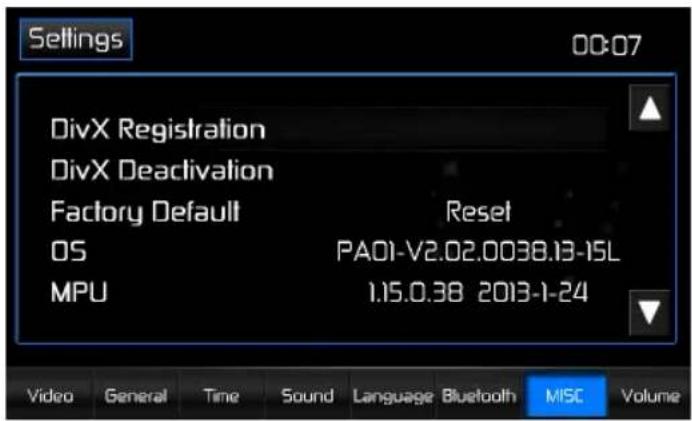
| DivX Registration Shows DivX® registration code. | ||
| DivX Deactivation Deactivates DivX® registration. | ||
| Factory Default Reset Select “Reset” | to restore the factory default settings. | |
| OS Current OS version. | ||
| MPU Current MPU version. | ||
| MCU Current MCU version. | ||
| MPEG Current MPEG version. | ||
Volume Sub-menu Settings
| Setting Options Function | ||
| DVD 0 - 12 Increase or reduce the USB 0 - 12 Increase or reduce the SD 0 - 12 Increase or reduce the Radio | relative DVD volume. or reduce the relative USB volume. | relative SD volume. |
| 0 - 12 Increase or reduce the relative radio volume. | or reduce the relative radio volume. | |
| Bluetooth | 0 - 12 Increase or reduce the AV-IN1 volume. | or reduce the relative Bluetooth volume. |
| 0 - 12 | Increase or reduce the relative AV-IN1 volume. | |
| AV-IN2 | 0 - 12 | Increase or reduce the relative AV-IN2 volume. |
| Navigation | 0 - 12 Increase or reduce the AV-IN2 volume. | or reduce the relative navigation volume. |
| iPod | 0 - 12 Increase or reduce the relative iPod volume. | or reduce the relative iPod volume. |
Exiting the System Settings Menu
To exit setup mode and resume normal playback, touch the Setting button on the screen.
TUNER OPERATION
Tuner TFT Display Screen
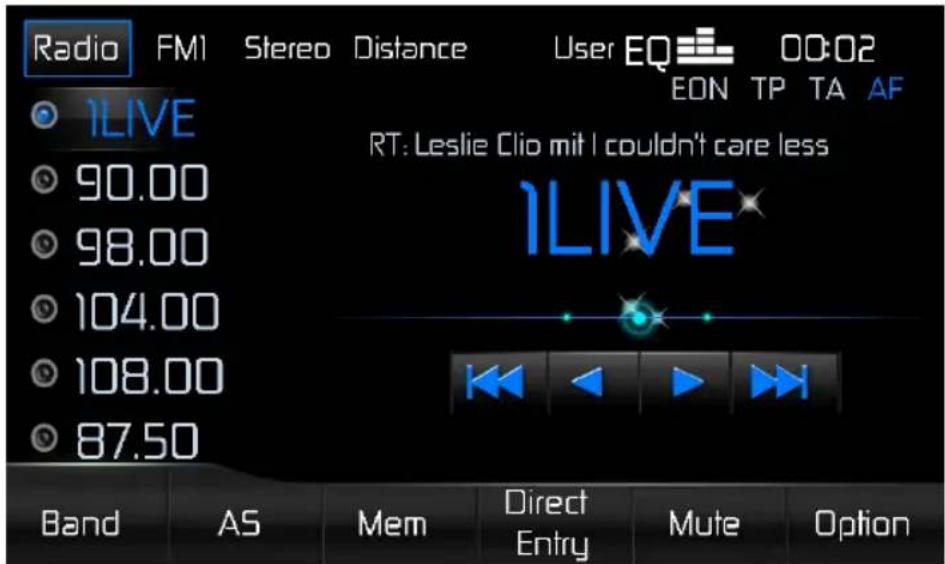
- RADIO icon: Touch to view the SOURCE MENU and select a new playback source.
- Current radio band indicator.
- Local/Distance Indicator: Strong local signal broadcasting indicator.
- Equalizer setting indicator: Displays the current equalizer preset setting.
- EQ icon: Touch for quick access to Equalizer level settings screen.
- Clock: Displays the time as entered by the user in the settings menu.
- TA: Traffic Announcement indicator
- TP: Traffic Program indicator
- AF: Indicates the AF function is activated.
- Program Information: This indicator provides three types of information: PS, RT, and PTY. PTY displays the program category of the current station such as category (news, sports, talk etc.). RT/PS provide the current song title, current song title, performing artist, and station call letters.
- Radio frequency indicator.
- Touch to seek forward.
- ison: Touch to tune forward one step.
-ikon: Touch to tune backward one step. - icon: Touch to seek backward.
- Option icon: Touch to display the Options Screen.
- Mute icon: Press this icon to mute the audio output of the unit. Press again to unmute the volume.
- Direct Entry icon: Touch to access the direct entry screen.
- AS: Touch to automatically store stations.
- Band icon: Touch to change between AM/FM bands.
- Presets provides a display of the preset frequencies. Touch to recall preset stations.
TA
Press the TA ON/OFF button to switch the priority for traffic announcements on or off.
TA Volume
In the OPTION menu, press the TA VOL button. Adjust the desired volume with the or button. Press the OPTION button. The radio menu is displayed again, the set volume is stored.
AF
The receiver can automatically switch to an alternative frequency (AF) of the same station if the reception becomes poor. Press the OFF/ON touch-point to turn the automatic scanning for alternative frequencies of an RDS broadcast station off and on.
Options Screen
Touch the Options icon to display the Options Screen.
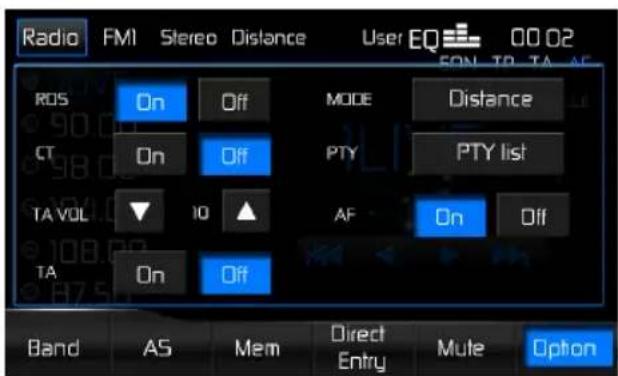
RDS ON/OFF:
Radio Data System (RDS) enables traffic reports to be received and provides many facilities, including enabling the radio station name to be displayed on the radio display.
CT ON/OFF:
(Clock Time, RDS feature) When enabled the radio system clock is synchronized with broadcasters time signal setting the clock automatically. In some regions where daylight savings time is not adhered to, the system clock will be off by 1 hour. In these cases, set CT to OFF and manually set the clock.
Mode Local/Distance:
This allows the user to activate local station reception function. When the Local function is on, only a stations with a strong local radio signal are played.
PTY List:
Program type (PTY) allows users to find similar programming by genre. Touch to access the program type search screen.
Switching to Radio Tuner Source
- Touch the top left corner of the screen (the RADIO box) to view the SOURCE MENU. Touch "Radio".
- Press the SRC button on the front panel to switch to the AM/FM or RADIO source.
Selecting FM/AM Band
Touch the BAND icon on the screen to change between the following bands: FM1, FM2, FM3, AM1, and AM2.
Tuning to a Station
Seek Tuning
To seek the next higher station, touch the icon.
To seek the next lower station, touch the icon.
Manual Tuning
To increase or decrease the tuning frequency one step, touch the or icon.
Direct Tuning
- To enter a radio station directly, touch Direct Entry to display the Direct Entry Menu.
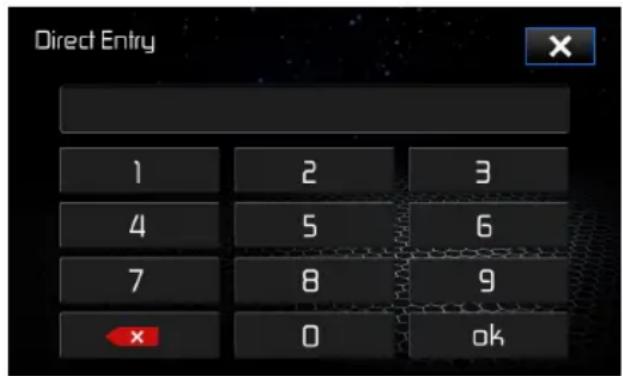
- Enter the desired radio station frequency using the on-screen number pad. If you wish to delete an entry number touch the red X on the keypad. Press ok to tune to the selected station. To exit the screen without changing the station, touch the X in the upper right corner.
Using Preset Stations
Six numbered preset buttons store and recall stations for each band. All six stored stations (P1-P6) for the current band appear on the screen.
Storing a Station
- Select a band (if needed), then select a station.
- Touch the on-screen Mem icon to access the Preset Screen.
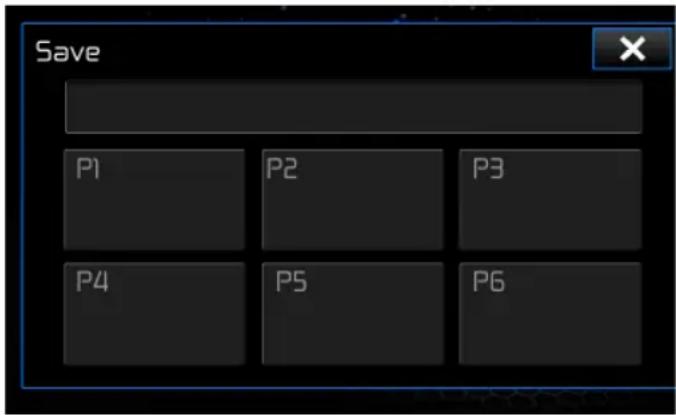
- Touch the preset number in which you would like to store the current station (or touch X to cancel and close the menu). The station frequency is displayed at the top of the menu. The preset number will appear highlighted. The station frequency will be stored in the highlighted preset. The station will be displayed on the Tuner TFT Display Screen.
Recalling a Station
- Select a band (if needed).
- Touch an on-screen preset icon to select the corresponding stored station.
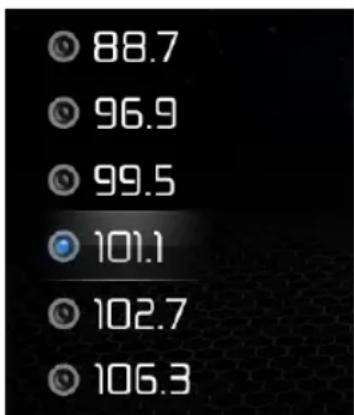
Auto Store (AS)
Auto Store is most useful when travelling in an area where you are not familiar with the local stations. The Auto-Store Tuning feature will automatically scan and enter up to eighteen FM strong stations into the preset memory locations for the FM1, FM2 and FM3 bands or twelve strong AM stations into the preset memory locations for the AM1 and AM2 bands. Each band stores up to six preset stations.
To select six strong stations and store them in the current band:
- Select a band (if needed).
- Touch the AS icon on the on-screen controls to activate the Auto Store function. The Auto Store Search Screen appears.
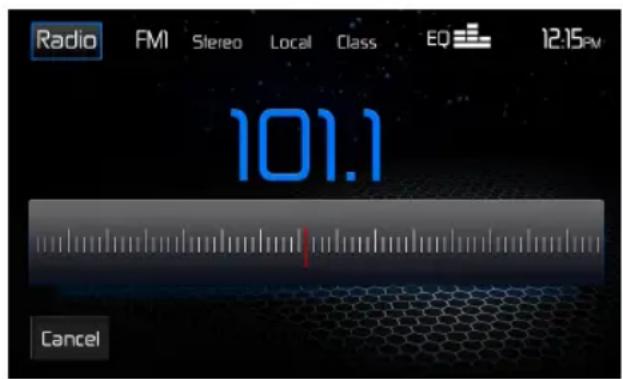
The radio searches from the current frequency and checks the signal strength until one cycle search is finished. The new stations replace stations already stored in that band. If you have already set the preset memories to your favorite stations, activating the Auto-Store feature will erase those stations and enter the new strong stations.
Search for Station by Program Type
Program type (PTY) allows users to find similar programming by genre.
- From the Tuner TFT Display, touch the Options icon to display the Options Screen.
- Touch the PTY List icon to display the Program Type Screen.
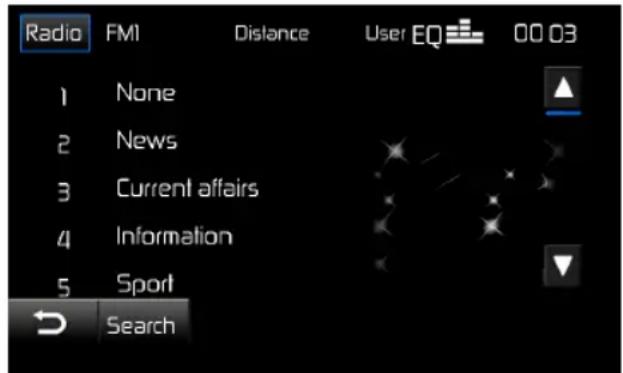
- Touch a program type, then touch the Search icon. The unit searches for the respective stations and stops when a station is found.
Note: Touch the ▲or ▼con to scroll up or down the page.
Local Radio Station Seeking
When the Local function is on, only radio stations with a strong local radio signal are played.
To activate the Local function in the AM/FM tuner mode:
- Touch the Options icon on the Tuner TFT Display Screen. The Options Screen appears.
- Touch the Mode Local/Distance icon to turn the local function on or off.
When the Local function is active, the Local indicator at the top of the screen is illuminated. When the Distant function is active, the Distance indicator at the top of the screen is illuminated.
NOTE: When properly installed, DVD video cannot be displayed on the main TFT screen unless the parking brake is applied. If you attempt to play a DVD while the vehicle is moving, the TFT screen displays:
Please engage parking brake to watch video.
WARNING !!!
It is illegal to view video while driving or operating a motor vehicle. Set the parking brake to view video.
To access the on-screen controls, touch the bottom 1/3 of the screen while a DVD is playing. Touch to view a second page of controls.
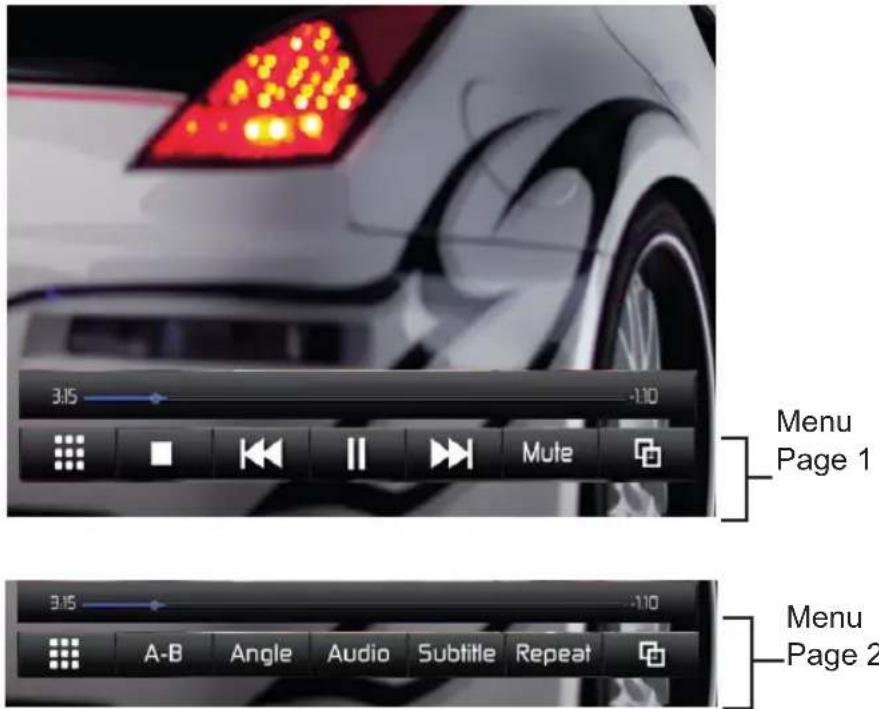
Menu Page 1
- Elapsed Time Indicator: Displays the total playing time and elapsed of the current movie playing.
- ■on: Touch to select a chapter/track directly using the on-screen display direct entry menu display.
- iOpn: Touch to stop DVD playback.
- iben: Touch to move to previous chapter.
- / (Pause/Play) icon: Touch the icon to pause playback. Touch the icon to begin playback.
- Touch to advance to the next chapter on the DVD.
- Mute icon: Press this icon to mute the audio output of the unit. Press again to un-mute the volume.
- iE: Touch to go to Menu Page 2.
Menu Page 2
- ■on: Touch to select a chapter/track directly using the on-screen display direct entry menu display.
A-B icon: Touch to repeat a specific portion from point A to point B of the DVD disc. - Angle icon: Touch to view angles if the DVD contains scenes shot from different angles.
- Audio icon: Touch during playback to select to select the audio language. Each time the icon is touched a different audio language is selected if you are watching a disc recorded in multiple languages.
- Subtitle icon: Touch during playback to select the subtitle language if the disc is recorded in multiple languages. Each time the icon is touched a different subtitle language is selected. The subtitle function can also be turned on or off.
- Repeat icon: Touch during playback to repeat the current chapter. Touch the icon a second time to repeat the current title. Touch the icon a third time to turn the repeat function off.
- iE: Touch to go to Menu Page 1.
ControllingPlayback
Inserting a Disc
Upon inserting a DVD disc, DVD mode is entered and disc play begins.
You cannot insert a disc if there is already a disc in the unit or if the power is off.
NOTE: DVD-R and DVD-RW will not play unless the recording session is finalized and the DVD is closed.
Ejecting a Disc
Press the EJECT (▲) button on the front of the unit to eject the disc. The unit automatically reverts to Tuner mode. You may eject a disc with the unit powered off. The unit will remain off after the disc is ejected.
Resetting the Loading Mechanism
If the disc loads abnormally or an abnormal core mechanism operation occurs, touch and hold the EJECT (▲) button to reset the loading mechanism. Normal operation resumes.
Accessing DVD Mode
To switch to DVD mode when a disc is already inserted, touch SRC on the front panel to access the source menu. Touch the disc icon.
Repeat Playback
Touch the Repeat icon to alter repeat mode in the following sequence:
DVD: Repeat Chapter, Repeat Title, Repeat Off
VCD (PBC Off): Repeat Single, Repeat Off
NOTE: For VCD play, the repeat function is not available if PBC is on.
Sectional Repeat Function (A-B)
Use the A-B function to define a specific area of a disc to repeat.
- Touch A-B on the second page of DVD on-screen controls to set the start point (A) of the repeated section.
- Touch A-B again once you reach the desired end point (B) of the repeated section. The selected portion of the DVD will now repeat continuously.
- Touch A-B a third time to cancel the A-B section setting and stop repeat play.
Accessing the DVD Source Menu
- Press the MENU button on the remote control to recall the DVD source menu. Touch to select a title from the menu.
- Touch the TITLE button on the remote control to select a different title for playback.
- Select a title using the touch screen.
Moving Through Chapters
Touch the on to advance to the next chapter.
Touch theikon to move to the previous chapter.
Direct Chapter / Track Selection
To select a chapter/track directly, touch the on-screen icon to display the direct entry menu.
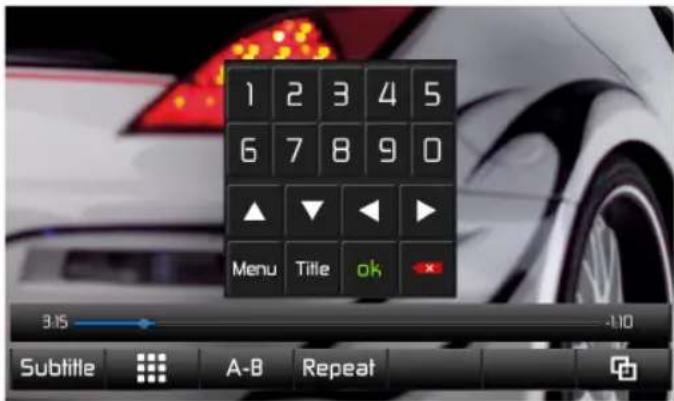
Enter the desired chapter/track using the on-screen number pad. Touch the ok icon to enter your selection. To clear an entry and start over, touch the red X icon.
Viewing an Alternate Picture Angle (DVD Only)
Some DVDs contain scenes that have been shot simultaneously from different angles. For discs recorded with multiple angles, touch Angle on the second page of DVD on-screen controls to toggle available angles of the on-screen image.
Multi-Language Discs (DVD Only)
Changing Audio Language
If you are watching a disc recorded in multiple languages, touch Audio on the second page of DVD on-screen controls to choose a language. Each time the icon is touched the language will change.
Changing Subtitle Language
If you are watching a disc recorded in multiple languages with subtitles, touch
Subtitle on the second page of DVD on-screen controls to choose the language in which you would like the subtitles to appear.
NOTE: During VCD playback, touch the AUDIO on the second page of DVD on-screen controls to choose between Left Channel, Right Channel, and Stereo.
PBC - Play Back Control (VCD Only)
For VCDs with play back functionality, play back control (PBC) provides additional controls for VCD playback.
Touch PBC on the first page of DVD on-screen controls to toggle the PBC function "On"/"Off". Once PBC is on, playback starts from track one of the play list.
NOTE: When PBC is activated, fast forward, slow playback, and previous/next track are available. Repeat and direct track selection are not available.
When PBC is activated, selecting random, scan or search playback automatically deactivates PBC.
Playback Information
During DVD and VCD playback, touch the center of the screen to display playback information on the screen, including the media playing and current playback time.
DVD Playback Information
DVD Video - Format of current disc.
- Time 00:01:30/00:36:10 - Indicates the playback time of the current track.
- Title 5/08 - Indicates the fifth of 8 titles on the DVD is currently playing.
- Chapter 2/16 – Indicates that the second of 16 chapters on the DVD is currently playing.
VCD Playback Information
VCD2.0 - Format of current disc.
- Time 00:01:30/00:36:10 - Indicates the playback time of the current track.
- PBC On/Off - Indicates whether Play Back Control is On or Off.
General Disc Information
Disc Properties
| Symbol 12 cm Disc | Properties Max Play Time | |
| DVD VIDEO | Single side single layer (DVD-5) | (MPEG 2 Method) |
| Single side double layer (DVD-9) | 133 minutes | |
| Double side single layer (DVD-10) | 242 minutes | |
| Double side double layer (DVD-18) | 266 minutes | |
| 484 minutes | ||
| COMPACT DISC | Single side single layer (VCD) (MPEG | 1 Method) |
| 74 minutes | ||
| COMPACT DISC COMPACT VIDEO | Single side single layer 74 minutes |
Disc Symbols
| Symbol | Meaning |
| 8) | Number of voice languages recorded. The number inside the icon indicates the number languages on the disc (maximum of 8). |
| 32 | Number of subtitle languages available on the disc (maximum of 32). |
| 9 | Number of angles provided (maximum of 9). |
| 16:9 LB | Aspect ratios available. "LB" stands for Letter Box and "PS" stands for Pan/Scan. In the example on the left, the 16:9 video can be converted to Letter Box video. |
| Indicates the region code where the disc can be played. • Region 1: USA, Canada, East Pacific Ocean Islands • Region 2: Japan, Western Europe, Northern Europe, Egypt, South Africa, Middle East • Region 3: Taiwan, Hong Kong, South Korea, Thailand, Indonesia, South-East Asia • Region 4: Australia, New Zealand, Middle and South America, South Pacific Ocean Islands/Oceania • Region 5: Russia, Mongolia, India, Middle Asia, Eastern Europe, North Korea, North Africa, North-West Asia • Region 6: Mainland China • ALL: All regions |
Instructions for TFT control and Insert/Eject are the same for DVD and CD operation. Please see the DVD/Disc Video Operation section for information about these topics.
Media Requirements
The VME 9725 NAV will play music or other audio files from the following disc media:
CD-DA
CD-R/RW
DVD
DVD+R/BW
DVD-R/RW
Upon inserting a disc, the disc and track title (if available), along with the track number and playing time appear on the screen.
CD TFT Display
The on-screen indicators and touch key areas for CD playback are outlined below.
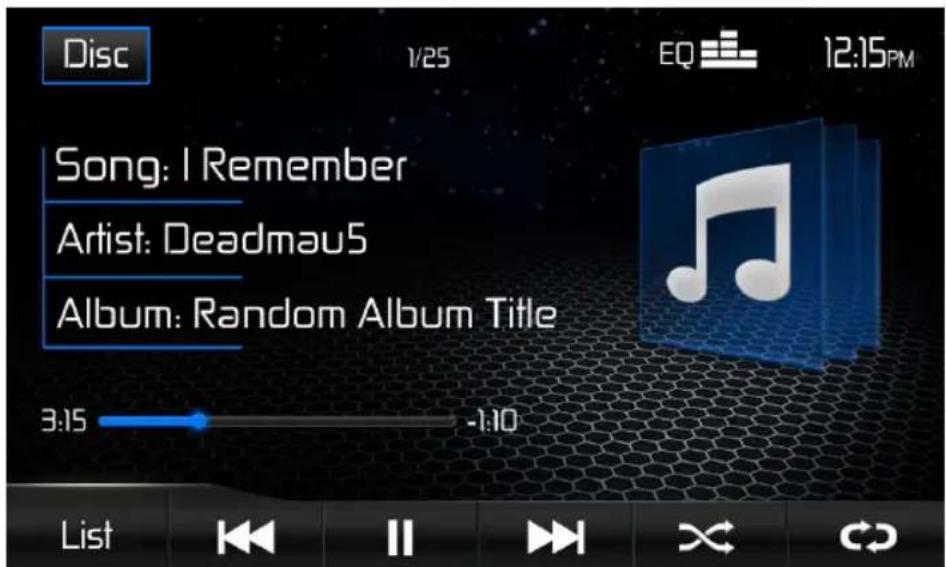
- Disc icon: Touch to view the SOURCE MENU and select a new playback source.
- Track Indicator: Displays the current track number playing and total number of tracks on disc.
- EQ : Tach for quick access to the Equalizer level settings menu.
- Clock: Displays the time as entered by the user in the settings menu.
- (Repeat) icon: Touch to alter repeat mode as follows: Repeat Single > Repeat Folder > Repeat All > Repeat Off
- (Random) icon: Touch to alter random mode as follows: Random On > Random Off
- (Next) icon: Touch to play the next track.
- / (Pause/Play)icon:Touch the icon to pause playback. Touch the icon to begin playback.
- (Previous) icon: Touch to play the previous track.
- List icon: Touch to display the Playlist screen.
- Elapsed time Indicator: Displays the elapsed and total playing time of the current track playing.
- Playback Information Display: Displays song, artist, and album information.
[ \text{Playlist Screen} ]
The Playlist screen allows you to directly search for music on your disc.
![AUDIOVOX VME 9725 NAV - [ \text{Playlist Screen} ] - 1](/content/2026/02/353697/images/e07bc49cb51891c9cc6277a50685c908cb336f28bec698bb3db12720f6937baa.jpg)
- Touch a track title (if available) or track number to begin playback of that track.
- Touch the or con to scroll up or down the page.
- Touch the Search icon to access the Disc Search Screen.
Disc Search Screen
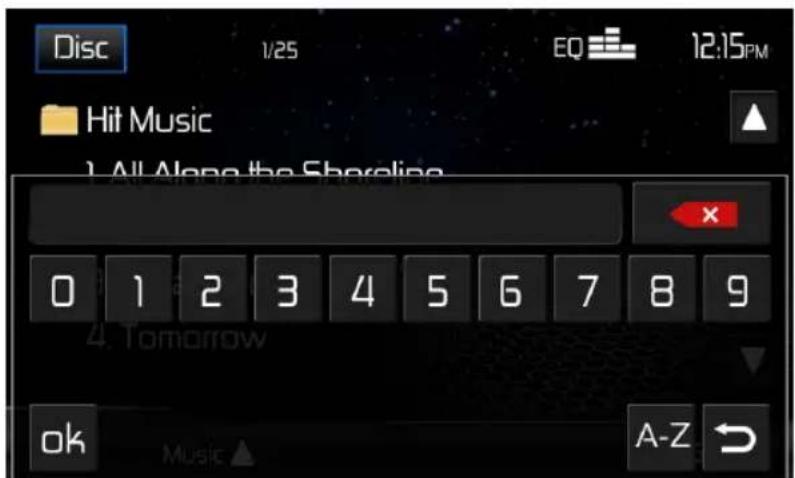
Enter the desired track the on-screen number pad. If you wish to delete an entry number touch the red X on the keypad. Press OK to play to the selected track. To exit the screen, touch the return button
ControllingPlayback
Inserting a Disc
Upon inserting a CD, disc play begins. You cannot insert a disc if there is already a disc in the unit or if the power is off.
Ejecting a Disc
Press the EJECT (▲) button on the front of the unit to eject the disc. The unit automatically reverts to Tuner mode.
You may eject a disc with the unit powered off. The unit will remain off after the disc is ejected.
Resetting the Loading Mechanism
If the disc loads abnormally or an abnormal core mechanism operation occurs, press and hold the EJECT (▲) button to reset the loading mechanism. Normal operation resumes.
Pausing/Resuming Playback
Touch the icon to pause playback. Touch the icon to resume playback.
Moving Through Tracks
Touch the icon to advance to the next track on the disc.
Touch the icon to move to the previous track.
Repeat Playback
Touch the icon to alter repeat mode according to the following:
DVD: Repeat Single > Repeat Folder > Repeat All > Repeat Off
- CD-DA: Repeat Single > Repeat Folder > Repeat All > Repeat Off
- CD-R/RW: Repeat Single > Repeat Folder > Repeat All > Repeat Off
DVD-R/RW: Repeat Single > Repeat Folder > Repeat All > Repeat Off
Random Play Select
Touch the icon to play the tracks on the disc in a random, shuffled order. Touch the icon again to cancel Random Play mode.
NOTE: CD-R and CD-RW will not play unless the recording session is finalized.
Instructions for TFT control and Insert/Eject are the same for DVD and MP3 operation. Please see the DVD/Disc Video Operation section for information about these topics.
Media and File Requirements
This player allows you to play back MP3 and WMA files recorded onto CD-R/RWs, DVD+R/RWs, and DVD-R/RWs. For CD-RW discs, please make sure it is formatted using the full method and not the quick method to prevent illegal disc operation.
For the greatest file capacity, Dual Layer DVD's can be used when burning music to a disc.
MP3 Format Compatibility
The file naming formats listed below are compatible with this unit:
ISO 9660 - file name: 12 characters, file extension: 3 characters
ISO 9660 - file name: 31 characters, file extension: 3 characters
Joliet-64 characters
If the file or folder name does not conform to ISO 9660 file system standards, it may not be displayed or played back correctly. Use the following settings when compressing audio data for your MP3 disc:
- Transfer Bit Rate: 128 kbps
- Sampling Frequency: 48 kHz
When recording MP3 up to the maximum disc capacity, disable additional writing.
For recording on an empty disc up to maximum disc capacity, use the "Disc at once" setting.
MP3 Playing Order
When selected for play, files and folders (Folder Search, File Search or Folder Select) are accessed in the order they were written by the CD writer. As a result, the order in which they are expected to be played may not match the order in which they are actually played. You may be able to set the order in which MP3/WMA files are to be played by writing them onto a medium such as a CD-R with their file names beginning with play sequence numbers such as "01" to "99".
For example, a medium with the following folder/file hierarchy is subject to Folder Search, File Search or Folder Select, as shown below.
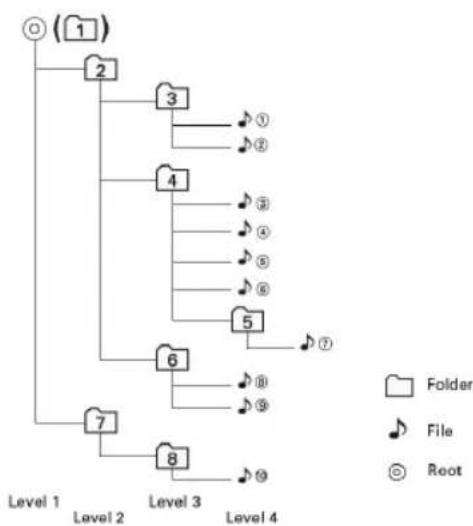
The VME 9725 NAV player will only recognize three folder levels and does not display folders containing only other folders. In the example above, the unit will display folders 3, 4, 6, and 8, but not 2 and 7 since they do not contain any tracks directly. Folder 5 is not recognized at all since it is at the fourth level.
Inserting a USB/SD Card Device
NOTE: Front and rear USB ports are for either Apple iPod / iPhone devices, USB memory sticks or portable HDD. The rear 3.5 mm connector (bundled with the USB port) is for iPod / iPhone video only. The USB/SD ports will recognize most USB/SD flash memory devices and portable hard drives. The unit supports 8GB SD cards (however SD cards larger than 8GB may not be recognized) and portable hard drives (hard drives must be formatted to FAT32 and NTFS is not supported).
- Locate the USB/SD connector on the front of the radio.
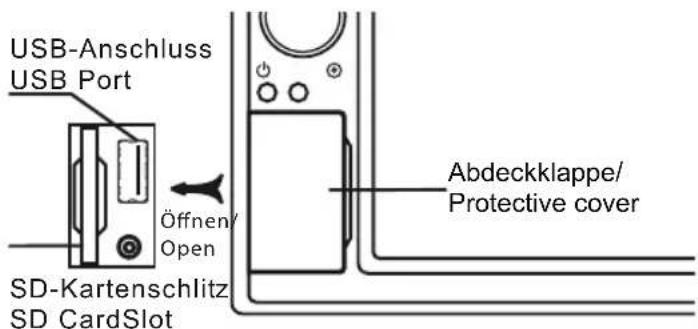
- Lift the protective cover to reveal the USB/SD slots.
- Insert the USB/SD device into the USB/SD connectors. The unit will read the audio/video files on the USB/SD device automatically.
To remove the USB/SD device, press the SRC button or use the SOURCE MENU to switch to another mode, and then remove the USB/SD device from the connector.
DIVX
This device is certified in accordance with DivX® Home Theater Version 3.0. DivX® is a digital video format which has been developed by DivX, Inc. to provide a high-quality viewing experience on various platforms, for example, on mobile phones and DVD players. DivX®, DivX Certified® and associated logos are registered trademarks of DivX, Inc. and are used under licence.
This DivX Certified® device must be registered in order to play purchased DivX Video-on-Demand (VOD) movies.
Please note the online information www.divx.com/vod .
This device is able to play DivX® video files that have been recorded on CD-R/RW, DVD-R/RW and DVD+R/RW discs and USB sticks.
This device plays all versions of DivX® video (incl. DivX®8), with standard playback of DivX® media files.
Unauthorised DivX® files may not play properly. File extensions such as .avi or .divx must be used properly.
You can obtain further information on DivX® video files and software tools at www.divx.com.
MP3/WMA TFT Display
The on-screen indicators and touch key areas for MP3/WMA playback are outlined below.
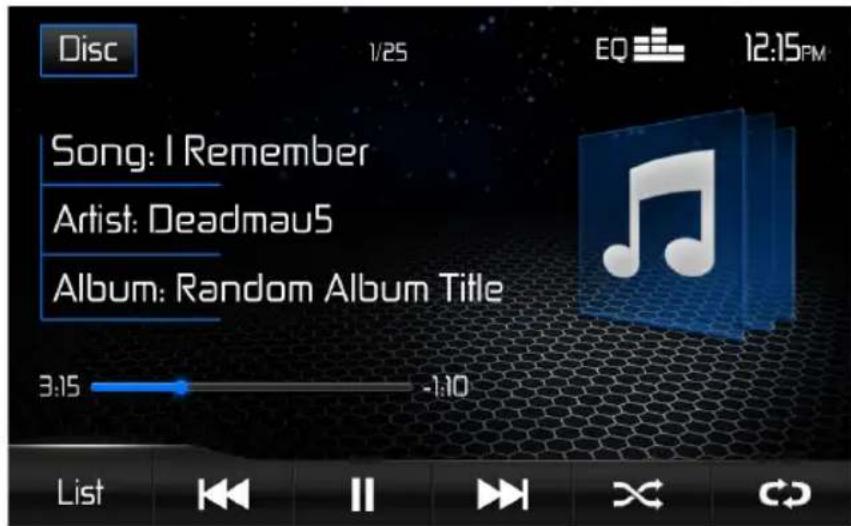
Disc icon: Touch to view the SOURCE MENU and select a new playback source.
- Track Indicator: Displays the current track number playing and total number of tracks on disc.
- EQ : much for quick access to the Equalizer level settings menu.
- Clock: Displays the time as entered by the user in the settings menu.
- (Repeat) icon: Touch to alter repeat mode as follows: Repeat Single > Repeat Folder > Repeat All > Repeat Off
- Random) icon: Touch to alter random mode as follows: Random On > Random Off
- (Next) icon: Touch to play the next track.
- /> (Pause / Play) icon: Touch the icon to pause playback. Touch the icon to begin playback.
- (Previous) icon: Touch to play the previous track.
- List icon: Touch to display the Playlist screen.
- Elapsed time Indicator: Displays the elapsed and total playing time of the current track playing.
- Playback Information Display: Displays song, artist, and album information.
[ \text{Playlist Screen} ]
The Playlist screen allows you to directly search for music, video or photo files stored on your MP3 disc/USB device.
![AUDIOVOX VME 9725 NAV - [ \text{Playlist Screen} ] - 1](/content/2026/02/353697/images/27a8624d0ad268b52a3d4dc5e3ee13301eaa8a71cc66c3ec8178cf5e87ab0226.jpg)
- Touch a folder to view the contents of the directory or touch a track title/file name to begin playback of that file.
- Touch the or con to scroll up or down the page.
- Touch the Search icon to access the Disc Search Screen.
Disc Search Screen
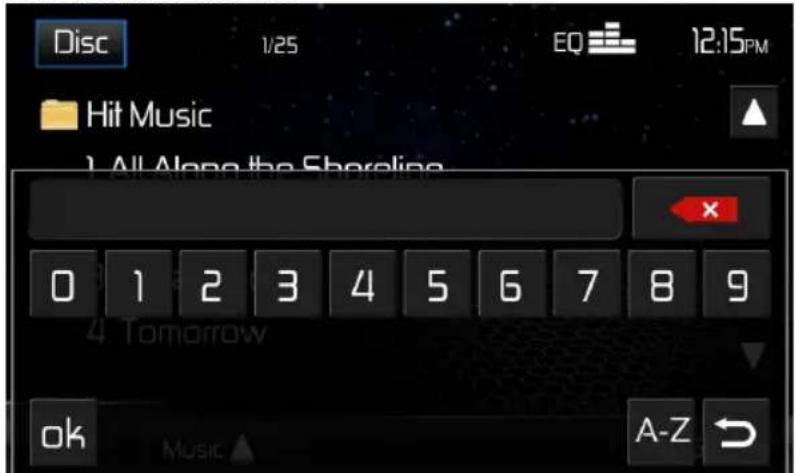
Enter the desired track the on-screen number pad. If you wish to delete an entry number touch the red X on the keypad. Press OK to play to the selected track. To exit the screen, touch the return button
Search Playlist by File Type
-
TouchtheMUSIC icon.
-
Touch "MUSIC," "PHOTO" or "VIDEO". The list of files that appear will be filtered by the type of file selected.
ControllingPlayback
Inserting a Disc
Upon inserting a MP3/WMA disc, disc play begins. You cannot insert a disc if there is already a disc in the unit or if the power is off.
Ejecting a Disc
Press the EJECT (▲) button on the front of the unit to eject the disc. The unit automatically reverts to Tuner mode.
You may eject a disc with the unit powered off. The unit will remain off after the disc is ejected.
Resetting the Loading Mechanism
If the disc loads abnormally or an abnormal core mechanism operation occurs, press and hold the EJECT (▲) button to reset the loading mechanism. Normal operation resumes.
Playing MP3/WMA Files
After inserting a MP3/WMA disc, files will play in the sequence of the "Root" directory. NOTE: When burning MP3 / WMA files onto a DVD disc, use the 2X or 4X burning option, if available. This slower burning speed will help eliminate buffer errors and increase disc reading reliability. Also, use folders when burning large numbers of songs / files to a disc for easy music navigation. Select the "Disc at Once" option and close your disc.
Pausing/Resuming Playback
Touch the icon to pause playback. Touch the icon to resume playback.
Moving Through Tracks
Touch the Next (▶) icon to advance to the next track on the MP3 disc/USB device. Touch the Previous (▶) button to move to the previous track on the MP3 disc/USB device.
Repeat Playback
Touch the (Repeat) icon to alter repeat mode as follows: Repeat Single > Repeat Folder > Repeat All > Repeat Off
NOTE: CD-R and CD-RW will not play unless the recording session is finalized.
Random Play Select
Touch the x (Random) icon to play the tracks on the MP3 disc/USB device in a random, shuffled order. Touch the x icon again to cancel Random Play mode.
NOTE: Be sure your iPod has the latest Apple firmware installed to avoid connectivity issues.
Accessing iPod Mode
This unit is Made for iPod and iPhone. You can control your iPod via touch screen to access Playlist, Artist, Albums, Songs, etc. Supported models include, but are not limited to the following:
iPhone 4S / 4 / 3GS/
- iPodtouch 5th and 4th Generation
- iPod nano 6th and 5th Generation
- iPod classic
The unit will automatically switch to iPod mode when an iPod, iPod touch or iPhone is plugged into the front or rear USB connector.
NOTE: For basic iPod connectivity, you can use the white 30-pin to USB iPod cable that came with your Apple device. For iPod video or photo playback, you must use the Audiovox jLink4 cable.
To return to the iPod menu from any other source menu, touch SRC on the front panel until the iPod menu appears on the screen, or choose the iPod icon from the source menu (only available when an iPod or iPhone is connected to the USB connector).
NOTE: To transmit the video from your iPod to the VME 9725 NAV screen, you must set the following options through the iPod video settings menu: TV Out = On, TV Signal = NTSC, and Widescreen = On.
NOTE: After disconnecting your iPod, the VME 9725 NAV will always return to the last mode accessed.
Indicators/Controls
The on-screen indicators and touch key areas for iPod playback are outlined below.
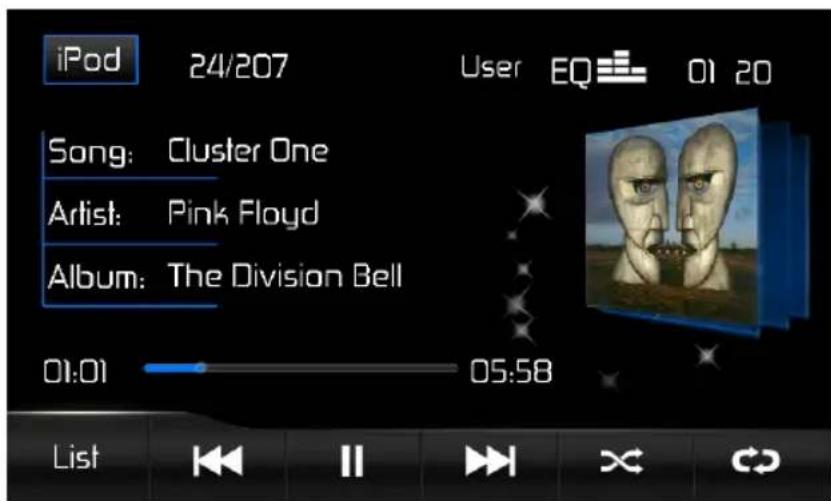
- iPod icon: Touch to view the SOURCE MENU and select a new playback source.
1/25 indicator: File number and total number of files on the disc. - EQ: Touch for quick access to Equalizer level settings.
- Clock: Displays the time as entered by the user in the settings menu.
- (Repeat) icon: Indicates the repeat function is enabled. Touch to alter repeat mode as follows: Repeat Once > Repeat All > Repeat Off.
- (Random) icon: Indicates the random function is enabled. Touch to alter random mode as follows: Random On > Random Off.
- (Next) icon: Touch to play the next track.
- /> (Pause / Play ) icon: Touch the icon to pause playback. Touch the icon to begin playback.
- (Previous) icon: Touch to play the previous track.
- List icon: Touch to access the Search Screen.
- Elapsed time Indicator: Displays the elapsed and total playing time of the current track playing.
- Track information: Song title, album, and performing artist.
Search Menu
The Search Menu allows you to search for playlists, artists, albums, songs, genres, composer, podcast or audio book.
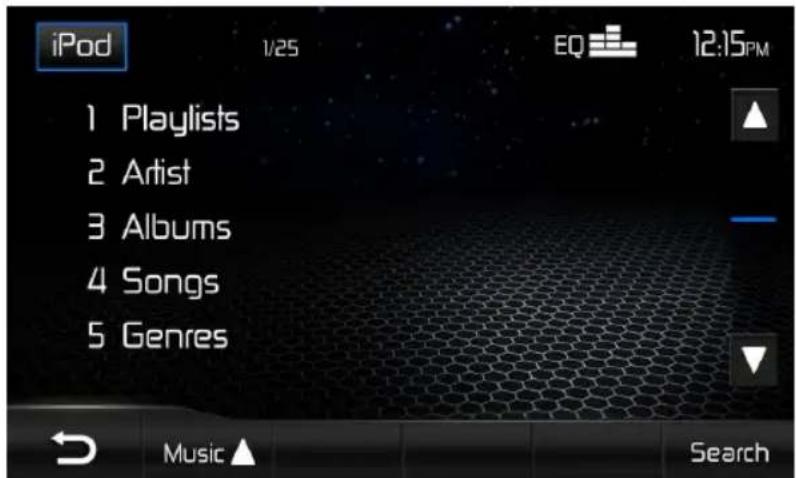
- iPod icon: Touch to view the SOURCE MENU and select a new playback source.
1/25 indicator: Indicates the file number playing and total number of files in the category. - EQ icon: Touch for quick access to Equalizer level settings.
- Clock. Displays the time as entered by the user in the settings menu.
- Scroll Bar icon: Touch t scroll up or down the page.
- Search icon: Touch to display the Direct Track Entry screen.
- Music icon: Touch Music , then touch Music , Photo or Video . The list of files that appear will be filtered by the type of file selected.
- ton: Touch to return to a previous menu.
Direct Track Entry
To select a track directly:
- Touch the Search icon on the Search Menu to display the direct entry menu.
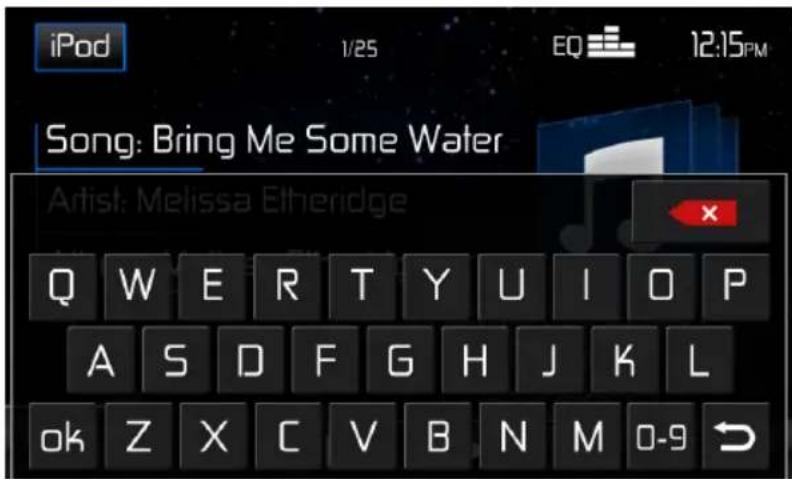
- Enter the desired track the on-screen key pad. If you wish to delete an entry number touch the red X on the keypad. Press OK to play to the selected track. To exit the screen, touch the return button
BLUETOOTH OPERATION
Bluetooth® technology has the capability to wirelessly synchronize and transfer data among devices. The Bluetooth audio capabilities can be used for wireless phones hands free applications. Before attempting to use the Bluetooth functions on the unit, please make sure your wireless phone supports Bluetooth functions.
We use the latest Parrot Bluetooth Technology in order to offer you the best connection, most features, and easiest pairing, but all phones operate differently. Please read your phone's owner's manual and familiarize yourself with its available Bluetooth features and functions. Not all features will work with all phones.
NOTE: The distance between this unit and your cellular phone must be 8 feet (2.4 meters) or less for sending and receiving voice and data via Bluetooth wireless technology.
Please make sure your mobile phone supports Bluetooth® functions (Headset or Handsfree profiles or both). Adhere to the following guidelines for successful operation.
- Before using Bluetooth® functions, you must pair your mobile phone to the VME 9725 NAV head unit (see "Pairing the Bluetooth® System with Your Mobile Phone and Head Unit"). To ensure the best reception for pairing and re-connection, please make sure the mobile phone battery is fully charged before you begin.
- Try to perform pairing within a few minutes of the mobile phone being turned on.
- Once the unit has been paired with the mobile phone, the unit's model number, "VME 9725 NAV", will be displayed on the mobile phone.
- To achieve the best performance, always keep the mobile phone within 3 meters of the head unit.
- Always keep a clear path between the mobile phone and the head unit. Never place a metal object or any other obstacle between the mobile phone and the head unit.
- Some mobile phones (like Sony Ericsson) may have a "Power Saving Mode" option. PLEASE DO NOT use the power saving mode with the VME 9725 NAV.
- Before accepting or making a call, make sure your mobile phone's "Bluetooth® function" is turned on.
- To ensure the best conversation quality/performance, stay within one meter of the microphone when talking.
- To manually disconnect the mobile phone from the head unit, press the "Chain Link" icon on the Bluetooth® user interface (next to the mobile phone name) and the Bluetooth® will be "disconnected", but still paired.
Bluetooth User Interface
The on-screen indicators and touch key areas for Bluetooth® functions are outlined below.
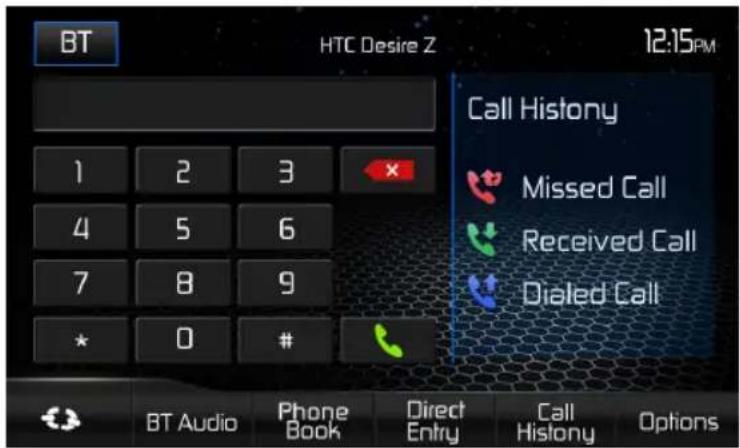
- BT icon: Touch to view the SOURCE MENU and select a new playback source.
- HTC Desire Z indicator: Name of the connected device.
- Clock: Displays the time as entered by the user in the settings menu.
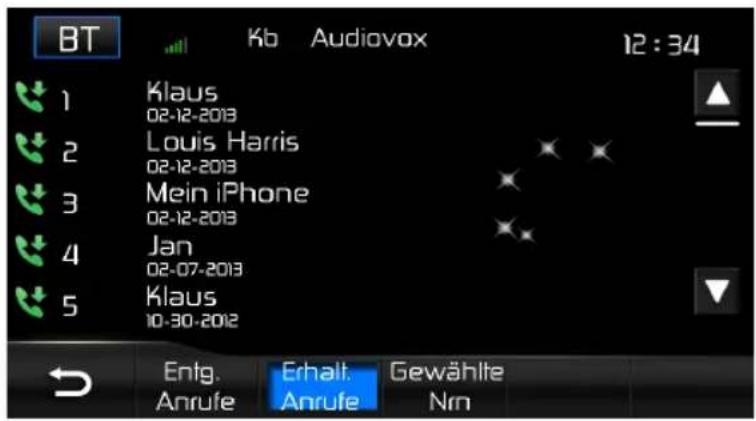
Missed Call icon: Touch to access the missed calls list. - Received Call icon: Touch to access the received calls list.
- Dialed Call icon: Touch to access the dialed calls list.
- Options icon: Touch to configure Bluetooth® parameters and options.
- Call History icon: The call history consists of dialed numbers, received calls, and missed calls.
- Direct Entry icon: Touch to access the Direct Entry Screen.
- Phone Book icon: Touch to access the contacts list.
- BT Audio icon: Touch to access the Bluetooth® music function.
- /: Indicates whether the unit is disconnected/connected with a Bluetooth® device.
- Keypad: Touch 0-9,*, # to enter the phone number you wish to dial. Once the correct number appears on the screen touch the icon. If you enter an incorrect number, touch the red X icon to delete the incorrect number.
Hands Free Profile (HFP)
To use a mobile phone with this unit, it is necessary to first establish a connection using Bluetooth® wireless technology. The connection is normally established using Hands Free Profile (HFP), which gives you full control of functions available on the mobile phone source. However, depending on your mobile phone, the connection may be made using Head Set Profile (HSP), making some functions unavailable. This is a limitation of your mobile phone, not the VME 9725 NAV.
Since there are a number of Bluetooth® mobile phone implementations available on the market, operations with your Bluetooth® mobile phone using this unit vary greatly.
Please refer to the instruction manual that came with your Bluetooth® mobile phone along with this manual while operating your mobile phone with this unit.
Pairing Your Mobile Phone with the Head Unit
Your mobile phone can initiate a search for new devices and pair to the unit. The following paragraphs describe the pairing process.
NOTE: The following procedures are generic. Procedures for pairing mobile phones may vary slightly from mobile phone manufacturer to mobile phone manufacturer.
- Press the SRC button on the front panel to access the Source Menu.
- Touch the BT (Bluetooth) icon. The following screen will appear:
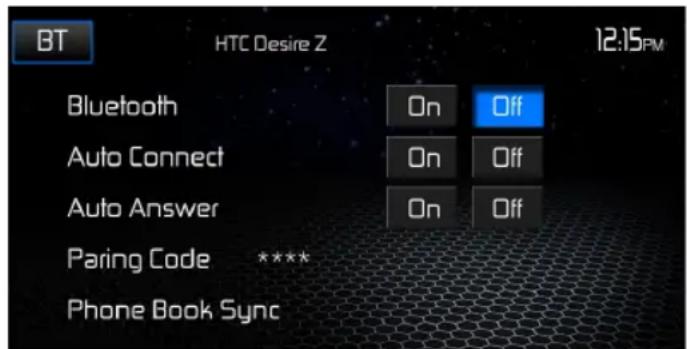
- Set the Bluetooth function to ON.
- Set the Auto Connect function to ON.
- Access the mobile phone Bluetooth® function and set the function to ON.
- Set the mobile phone Bluetooth® discover mode to ON.
NOTE: Some discovery modes have a time limit usually a minute before they are automatically turned off.
-
Use the mobile phone's add a new device feature. A device or devices will appear on your mobile phone display.
-
A prompt to pair or bond should appear on your mobile phone. Accept the request and initiate the process.
NOTE: Some mobile phones require a "pass key" or pairing code to connect. If your phone requires a pass key or pairing code, you will need to enter this number. The default pairing code for many mobile phones is "0000". The default code for the unit is "1234".
- A prompt to enter a PIN number or passkey for the unit should appear. The default passkey for the unit is "1234".
- At this point a prompt stating pairing successful should appear. Another prompt should appear asking connect to the unit, Yes or No. Press Yes. The mobile phone and the unit should connect. The mobile phone should display a message similar to "Device Connected" and the mobile phone and the unit are now connected. VME 9725 NAV will appear on the mobile phone list of devices.
Managing Incoming Calls
When connected to a Bluetooth® mobile phone, the unit will mute audio output, pause CD play, and change to the Bluetooth® screen below when a call is received. The incoming phone number or assigned name for that number will appear in the middle of the screen. An audible tone will sound from the unit and a graphic display will appear on the front panel.
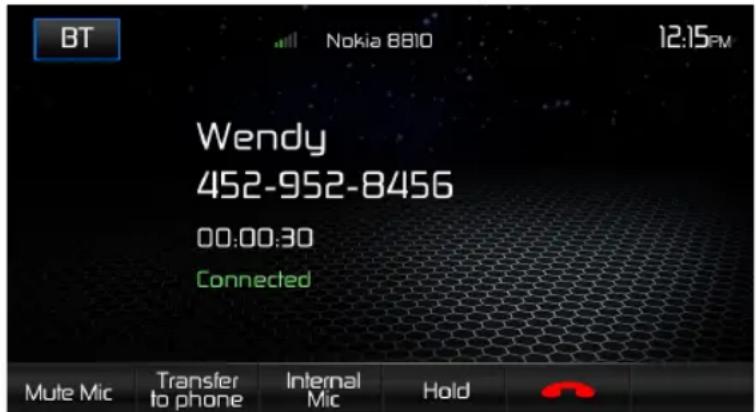
- Mute Mic icon: Touch to mute the microphone audio from the unit. Touch the icon again to restore the microphone and audio from the unit.
- Transfer to Phone icon: Touch to transfer a call back to the mobile phone.
- Internal Mic / External Mic icon: Touch to toggle between the internal microphone and an external microphone.
- Hold icon: Touch to place a call on hold.
- 1con: Touch to end an in coming call.
Answering an Incoming Call
To answer an incoming call touch the icon. For best reception, speak loudly and clearly into the microphone. To end the conversation, touch the icon.
Rejecting an Incoming Call
Press the Transfer to Phone icon to reject an incoming call. The call will revert to your mobile phone and be left for voice mail.
Volume Control
To increase or decrease the volume level of an incoming call, turn the rotary knob on the front panel or press the VOL +/ - buttons on the remote control.
Audio Mute
To mute the phone call audio from the unit when a call is received, press the front panel rotary knob. Press the front panel rotary knob again and phone call audio will be restored to the unit.
Making an Outgoing Call
Outgoing calls can be performed by direct dialing using the unit's touch screen keypad. The keypad screen is accessed by touching the Direct Entry icon.
Direct Dialing
- Touch the Direct Entry icon and the following screen will appear:
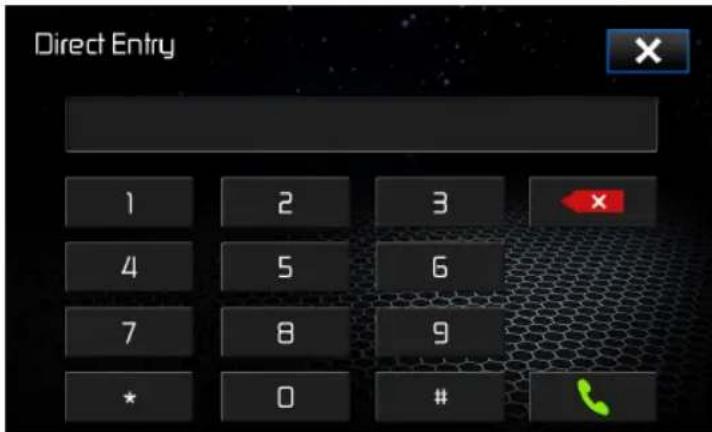
-
Using the keypad, touch 0-9,*, # to enter the phone number you wish to dial. If you enter an incorrect number touch the red X icon on the keypad to delete the incorrect number.
-
Once the correct number appears on the screen touch the icon. To exit the direct entry screen touch the X icon in the upper right corner of the screen.
-
To end the call touch the icon on the previous screen.
Call Transfer
While talking, to transfer audio from the unit back to the mobile phone, touch the Transfer to Phone icon and the following screen will appear:
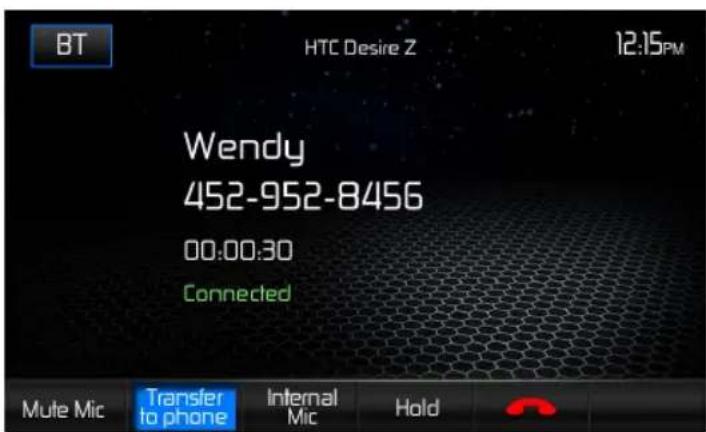
Pressing the Transfer to Phone icon again will return the audio from the mobile phone to the unit.
Missed Calls
The missed calls list retrieves the list of missed numbers from your mobile phone if your mobile phone allows the function. The last missed number is the first number on the list.
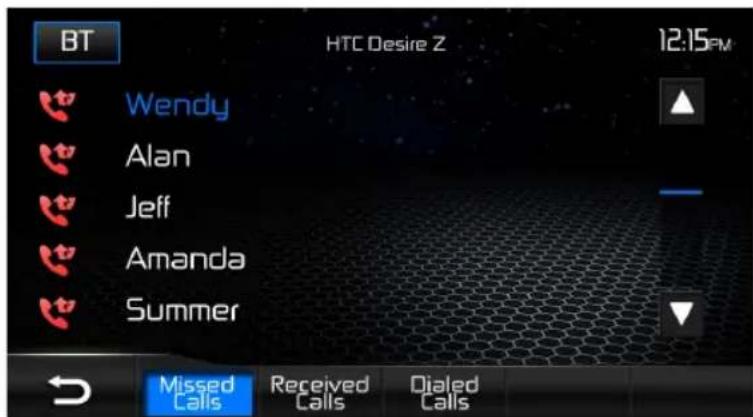
To make a call from the missed calls list, touch the call's name and it will be dialed.
Received Calls
The received calls list retrieves the list of numbers from your mobile phone if your mobile phone allows the function. The last received number is the first number on the list.
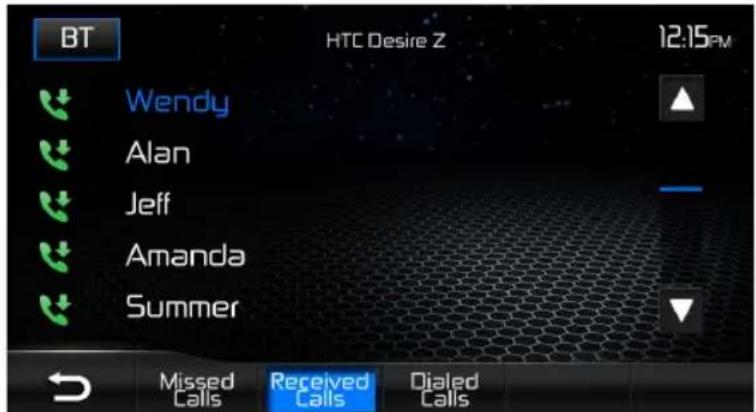
To make a call from the received calls list, touch the call's name and it will be dialed.
Dialed Calls
The dialed calls list retrieves the list of dialed numbers from your mobile phone if your mobile phone allows the function. The last dialed number is the first number on the list.
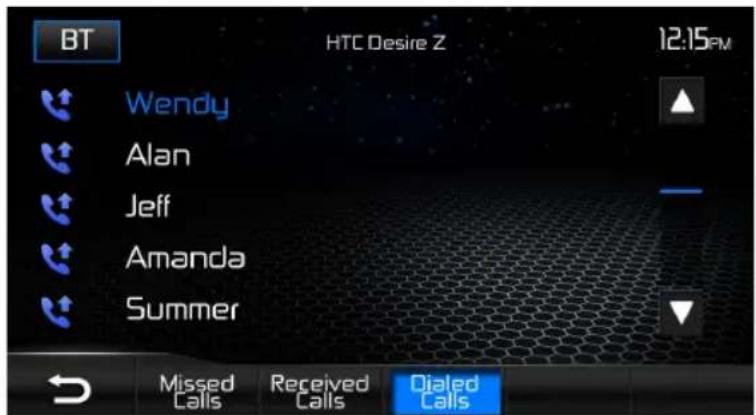
To make a call from the dialed calls list, touch the call's name and it will be dialed.
Phone Book
The phone book is a copy of the contact list on your mobile phone which contains a listing of your important names and phone numbers. Touch the ▲or √con to scroll up or down the contact list page.
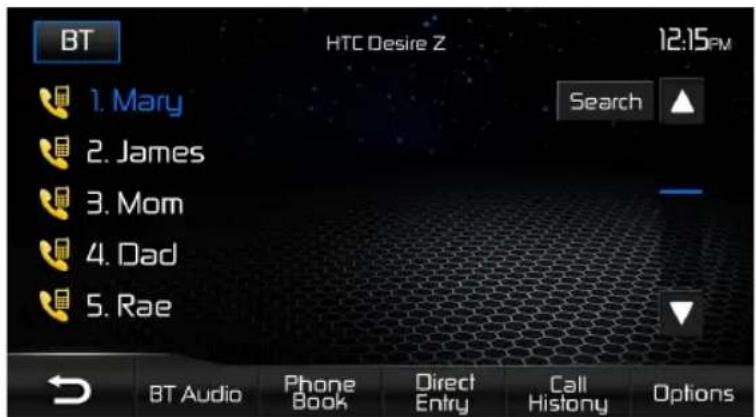
To make a call from the phone book, touch the contact's name. Touch the icon on the next screen and it will be dialed.
Bluetooth Music Function
Bluetooth® provides an Advanced Audio Distribution Profile (A2DP) profile for streaming music from a mobile phone or a portable multimedia player (PMP), sometimes referred to as a MP3 player. The unit allows you to play back audio files from your mobile phone or a PMP using a Bluetooth® connection.
NOTE: Please quit A2DP mode before attempting to make a phone call, as unexpected results may occur depending on your mobile phone model.
The unit can control a Bluetooth® audio player via Advanced Audio Distribution Profile (A2DP) or Audio/Video Remote Control Profile (AVRCP). Bluetooth® audio players (or Bluetooth® adapters) compatible with these profiles can be connected to this unit. Touch the BT Audio icon and the following screen will appear:
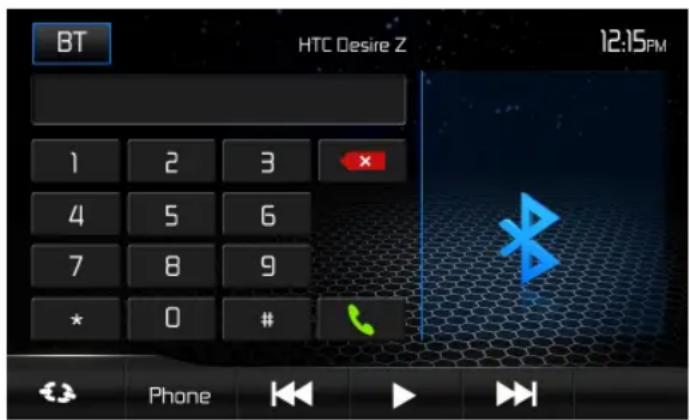
While listening to audio the following functions are available:
- Pause/Play( )n: Touch to pause playback. Touch again to resume playback.
- Previous ( )icon: Touch to play the previous track.
- Next ( icon: Touch to play the next track.
Functionality varies depending on the profile used:
- A2DP: Stream audio from your Bluetooth® compatible audio player and listen to the music through the unit.
- AVRCP: Play back, pause, select songs, etc. while streaming audio from your Bluetooth® compatible audio player to the unit.
NOTE: Song information (e.g. elapsed playing time, song title, song index, etc.) cannot be displayed on this unit. Since there are a number of Bluetooth® audio players available on the market, operations with your Bluetooth® audio player while using this unit may vary greatly. Please refer to the instruction manual that came with your Bluetooth® audio player.
When there is an incoming call, the song will be paused. After the incoming call is finished, the screen will return to the music function screen and playback will continue.
This unit is "camera ready." Before accessing any camera features, you must install a rear video camera.
When the camera is not installed and the function is accessed by the gear selector being placed in reverse or by the unit's menu, the message "VIDEO NOT DETECTED" will appear, indicating the function is not available.
When the camera is installed, the rear view image of what is behind the vehicle will appear when the vehicle is placed in reverse gear. When leaving reverse gear, the unit displays the previous screen.
The rear camera image can be adjusted from Normal to Mirror using the "Setup" menu ("see Video Sub-menu Features").
TROUBLESHOOTING
| Problem Cause Corrective Action | ||
| GENERAL | ||
| Unit will not power on | Radio Fuse blown Install a new fuse | with the correct rating |
| Car battery fuse blown Install a new fuse with the correct rating | fuse with the correct rating | |
| Illegal operation Press the RESET | button located over the rotary encoder on the front panel | |
| No/low audio output Improper audio output connection Check wiring and correct | ||
| Volume set too low Increase volume level | ||
| Improper “MUTE” connection Review wiring diagram and check “MUTE” connection | ||
| Speakers damaged Replace speakers | ||
| Heavily biased volume balance Adjust the channel balance to the center position | ||
| Speaker wiring is in contact with metal part of car | Insulate all speaker wiring connections | |
| Poor sound quality or distortion | Pirated disc is in use Use original copy | |
| Speaker power rating not compatible with unit | Connect proper speakers | |
| Speaker is shorted Check speaker | contact | |
| Unit resets itself when engine is off | Incorrect connection between ACC and positive battery wire | Check wiring and correct |
| TFT Monitor | ||
| No image Incorrect con | rection to parking brake wire | Check wiring and correct |
| Parking brake is not engaged Stop | vehicle in safe place and apply parking brake | |
| Flashing image or interference appears on screen | DVD is not compatible with current TV system settings | Change setup to accommodate disc |
| Improper video signal connections | Check wiring and correct | |
| Prolonged image or improper height/width ratio display | Improper aspect ratio setup Use correct | correct aspect ratio setting |
| TUNER | ||
| Weak station searching | Auto antenna is not fully extended | Connect the auto antenna control cable properly |
| Auto antenna not properly connected | Connect the auto antenna control cable properly | |
| LOCAL function is activated Turn L | LOCAL function off | |
| DISC | ||
| Cannot insert disc Disc | already inside unit Eject current disc | insert new one |
| Image blurred, distorted or dark | Disc is illegally copied Use original disc | |
| Disc does not play back | Disc is warped or scratched Use disc | sc in good condition |
| Disc is dirty or wet | Clean disc with soft cloth | |
| Laser pickup is dirty Clean laser pick up with cleaning disc | ||
| Incompatible disc is used Use compatible disc | ||
| Disc region code is not compatible with unit | Use disc with proper region code | |
| Disc is inserted upside down Insert | disc with label side up | |
| PBC cannot be used during VCD playback | PBC is not available on the disc | |
| No repeat or searching while playing VCD | PBC is on Turn PBC off | |
| MP3 | ||
| Interruption occurred during playback | Disc is dirty or scratched Clean disc | or replace |
| File is damaged/bad recording Recreate disc with good files | ||
Disc Error Messages
| Message Displayed Cause | Corrective Action | |
| Loading Disc is being read | ||
| No Disc Disc is dirty Clean | disc with soft cloth | |
| Disc is upside down Insert disc | disc with label side up | |
| Disc not present in loading compartment | Insert disc | |
| Bad Disc Disc is dirty Clean | disc with soft cloth | |
| Disc is upside down Insert disc | disc with label side up | |
| Unknown disc Disc format is compatible with this unit | Use compatible disc | |
| Region Error DVD is not compatible with region code of unit | Use disc with proper region code | |
| Error Illegal mechanism | operation | Press EJECT key for 5 seconds to reset loading mechanism |
Care and Maintenance
- Use only a clean silicone cloth and neutral detergent to clean the front panel or monitor. A rough cloth and non-neutral detergent (such as alcohol) may result in scratching or discoloration.
- Do not get water or cleaning fluids on the unit.
- If the temperature inside the player gets too hot, a protective circuit automatically stops play of the disc. If this occurs, allow the unit to cool before operating the player again.
- Never insert anything other than a 5" (12 cm) compact disc into the player as the mechanism can be damaged by foreign objects.
- Do not attempt to use a 3" (8 cm) CD-Single disc in this unit, either with or without an adaptor, as damage to the player and/or disc may occur. Such damage is not covered by the Warranty on this product.
- The CD player may not operate properly in extreme hot or cold. If such conditions occur, allow the interior of the vehicle to reach a normal temperature before using player.
- When the vehicle warms up during cold weather or under damp conditions, condensation may appear on the LCD panel. Should this occur, the screen will not operate properly until the moisture has evaporated.
- We suggest you use a cleaning disc in this unit more frequently than in the unit in your home due to the environmental conditions of the vehicle.
SPECIFICATIONS
DVD/CD Player
Compatible Disc Media: DVD + R / RW (Single and Dual Layer) and CD-R / RW
Compatible Media Formats: CD-DA, MP3, WMA, VCD, SVCD, Xvid, DivX, AVI, MPEG 1/2
Signal to Noise Ratio: >95dBA
Dynamic Range: >95dB
Frequency Response: 20Hz to 20kHz , -3dB
Channel Separation: > 60dB @ 1 kHz
D/A Converter: High performance 24-bit / 192 kHz sample rate, Multi-Bit Sigma-Delta
Modulator
Video
Format: NTSC, PAL (auto-detection)
Output: 1Vp-p (75-ohm)
Input: 1Vp-p (75-ohm)
FM Tuner
Tuning Range: 87.5MHz - 107.9MHz
Mono Sensitivity (-30dB): 9dBf
Quieting Sensitivity (-50dB): 15dBf
Alternate Channel Selectivity: 70dB
Signal to Noise Ratio @ 1 kHz: 58dB
Image Rejection: 80dB
Stereo Separation @ 1 kHz: >30dB
Frequency Response: 30Hz - 15 kHz, -3d
AM Tuner
Tuning Range: 522 kHz - 1620 kHz
Sensitivity (-20dB): 15uV
Signal to Noise Ratio @ 1 kHz: 50dB
Image Rejection: 60dB
Frequency Response: 50Hz - 2kHz -3dB
Monitor
Screen Size: 6.2"/16 cm (Measured diagonally), 16:9 Widescreen
Screen Type: TFT Liquid Crystal Display (LCD) active matrix
Resolution: 1,152,000 sub pixels, 800× 3 W × 480 H
General
Auxiliary Input impedance: 10k
Power Supply: 11 to 16VDC, negative ground
Power Antenna (Blue): 500mA max, current limited protection
Amplifier Remote (Blue/White): 500mA max, current limited protection
Operating Temperature: -20C ~ 65C
Signal to Noise Ratio: 70 dBA below reference (Reference: 1 Watt, 4-Ohms)
Frequency Response: 20Hz - 20kHz ,-3dB. (Aux Input used as reference input)
Reference Supply Voltage: 14.4VDC
*Specifications subject to change without notice
-
- 一
Icône SUBWOOFER ON/OFF:
Mode Locale/Distance:
Please engage parking brake to watch video.
Avertissement !!!
Commander la reproduction
Insérer un disque
Commander la reproduction
Insérer un disque
Entree: 1 Vp-p (75 ohms)
Congratulations! You have made a wise selection in becoming the owner of a AUDIOVOX Mobile Video equipment. Due to high quality AUDIOVOX Mobile Video products have earned an excellent reputation through the western world. And this high quality standard enables us to grant a 2-years warranty for AUDIOVOX Mobile Video products.
The equipments are checked and tested continuously during the entire production process. In case you have problems with your AUDIOVOX HiFi equipment, kindly observe the following:
- The guarantee period commences with the purchase of the component and is applicable only to the original owner.
- During the guarantee period we will rectify any defects due to faulty material or workmanship by replacing or repairing the defective part at our discretion. Further claims, and in particular those for price reduction, cancellation of sale, compensation for damages or subsequent damages, are excluded. The guarantee period is not altered by the fact that we have carried out guarantee work.
- Unauthorized tampering with the equipment will invalidate this guarantee.
- Consult your authorized dealer first, if guarantee service is needed. Should it prove necessary to return the component to the factory, please insure that the component is packed in original factory packing in good condition • the quality control card has been filled out and enclosed with the component • your enclose your receipt as proof of purchase.
- Excluded from the guarantee are: - Illuminates - Wear parts - Shipping damages, either readily apparent or concealed (claims for such damages must be lodged immediately with forwarding agent, the railway express office or post office). - Scratches in cases, metal components, front panels, etc. (You must notify your dealer directly of such defects within three days of purchase.) - Defects caused by incorrect installation or connection, by operation errors (see operating instructions), by overloading or by external force. Equipments which have been repaired incorrectly or modified or where the case has been opened by persons other than us. Consequential damages to other equipments. Reimbursement of cools, without our prior consent, when repairing damages by third parties - Batteries and battery packs.
F
Name and address of the dealer/stamp
Käufer/Customer
Name/Name
Straße/Street
PLZ, Ort/City
Land/Country
Kaufdatum/buying date
No warranty without receipt!
AUDIOVOX


- DIVX
- Video
- CONTENTS
- FEATURES
- DVD
- CD / MP3 / WMA
- AM-FM
- iPod/iPhone
- Chassis
- General
- Navigation
- Rear Camera
- WARNING!
- CONTROLS AND INDICATORS
- REMOTE CONTROL
- OPERATING INSTRUCTIONS
- Audible Beep Confirmation
- Mute
- Playing Source Selections
- Front Source Menu
- Source Menu Page 2
- Rear Source Menu
- External Devices
- Volume Adjustment
- Volume Increase/Decrease
- Programmable Turn-On Volume
- Equalizer and Balance/Fader Controls
- Equalizer Screen
- Preset EQ Selection
- To Exit the Equalizer:
- Balance/Fader Screen
- To Exit the Balance-Fader:
- System Reset
- Image/Display Settings
- Video Output Modes
- Parking Brake Inhibit
- STEERING WHEEL CONTROLS (SWC)
- (if equipped)
- SWC Functions
- SETTINGSMENU
- To access system settings:
- Touch Screen Calibration
- Demo Mode Features
- Time Sub-M Menu Settings
- Sound Sub-menu Settings
- Language Sub-menu Settings
- Exiting the System Settings Menu
- TUNER OPERATION
- Tuner TFT Display Screen
- TA
- TA Volume
- AF
- Options Screen
- RDS ON/OFF:
- CT ON/OFF:
- Mode Local/Distance:
- PTY List:
- Switching to Radio Tuner Source
- Selecting FM/AM Band
- Tuning to a Station
- Seek Tuning
- Manual Tuning
- Direct Tuning
- Using Preset Stations
- Storing a Station
- Recalling a Station
- Auto Store (AS)
- Search for Station by Program Type
- Local Radio Station Seeking
- WARNING !!!
- Menu Page 1
- Menu Page 2
- ControllingPlayback
- Inserting a Disc
- NOTE: DVD-R and DVD-RW will not play unless the recording session is finalized and the DVD is closed.
- Ejecting a Disc
- Resetting the Loading Mechanism
- Accessing DVD Mode
- Repeat Playback
- NOTE: For VCD play, the repeat function is not available if PBC is on.
- Sectional Repeat Function (A-B)
- Accessing the DVD Source Menu
- Moving Through Chapters
- Direct Chapter / Track Selection
- Viewing an Alternate Picture Angle (DVD Only)
- Multi-Language Discs (DVD Only)
- Changing Audio Language
- Changing Subtitle Language
- PBC - Play Back Control (VCD Only)
- Playback Information
- DVD Playback Information
- VCD Playback Information
- General Disc Information
- Media Requirements
- CD TFT Display
- [ \text{Playlist Screen} ]
- Disc Search Screen
- Pausing/Resuming Playback
- Moving Through Tracks
- Random Play Select
- Media and File Requirements
- MP3 Format Compatibility
- MP3 Playing Order
- Inserting a USB/SD Card Device
- MP3/WMA TFT Display
- Search Playlist by File Type
- Playing MP3/WMA Files
- Accessing iPod Mode
- Indicators/Controls
- Search Menu
- Direct Track Entry
- BLUETOOTH OPERATION
- Bluetooth User Interface
- Hands Free Profile (HFP)
- Pairing Your Mobile Phone with the Head Unit
- Managing Incoming Calls
- Answering an Incoming Call
- Rejecting an Incoming Call
- Volume Control
- Audio Mute
- Making an Outgoing Call
- Direct Dialing
- Call Transfer
- Missed Calls
- Received Calls
- Dialed Calls
- Phone Book
- Bluetooth Music Function
- Care and Maintenance
- SPECIFICATIONS
- DVD/CD Player
- FM Tuner
- AM Tuner
- Monitor
- Icône SUBWOOFER ON/OFF:
- Mode Locale/Distance:
- Commander la reproduction
- Insérer un disque
- F
Brand : AUDIOVOX
Model : VME 9725 NAV
Category : Car radio