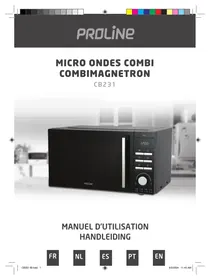
USER MANUAL CB231 PROLINE
(Micro-ondes): 1280W
Puisance nominale d'entree: (Gril): 1200W
(Convection): 1200W
Hotline Darty France
LIMPEZA E MANUTENÇÂO
IMPORTANT SAFETY INSTRUCTIONS READ CAREFULLY AND KEEP FOR FUTURE REFERENCE
WARNING
-
This appliance is intended to be used in household and similar applications such as:
-
staff kitchen areas in shops, offices and other working environments;
- farm houses;
- by clients in hotels, motels and other residential type environments;
-
bed and breakfast type environments.
-
If the supply cord is damaged, it must be replaced by the manufacturer, its service agent or similarly qualified persons in order to avoid a hazard.
- WARNING: If the door or door seals are damaged, the oven must not be operated until it has been repaired by a competent person.
- WARNING: It is hazardous for anyone other than a competent person to carry out any service or repair operation that involves the removal of a cover which gives protection against exposure to microwave energy.
WARNING: Liquids and other foods must not be heated in sealed containers since they are liable to explode.
WARNING: When the appliance is operated in the combination mode, children should only use the oven under adult supervision due to the temperatures generated.
- Keep a minimum free space 30~cm above the top surface of the oven.
- Only use utensils that are suitable for use in microwave ovens.
Metallic containers for food and beverages are not allowed during microwave cooking.
- When heating food in plastic or paper containers, keep an eye on the oven due to the possibility of ignition.
- The microwave oven is intended for heating food and beverages. Drying of food or clothing and heating of warming pads, slippers,
114

sponges, damp cloth and similar may lead to risk of injury, ignition or fire.
- If smoke is observed, switch off or unplug the appliance and keep the door closed in order to stifle any flames.
- Microwave heating of beverages can result in delayed eruptive boiling, therefore care must be taken when handling the container.
- The contents of feeding bottles and baby food jars shall be stirred or shaken and the temperature checked before consumption, in order to avoid burns.
- Eggs in their shell and whole hard-boiled eggs should not be heated in microwave ovens since they may explode, even after microwave heating has ended.
- Regarding the instructions of the details for cleaning the door seals, cavities, adjacent parts and the surfaces in contact with food, refer to the section "Cleaning and Maintenance" on pages 134-135 of the manual.
- The oven should be cleaned regularly and any food deposits removed.
- Failure to maintain the oven in a clean condition could lead to deterioration of the surface that could adversely affect the life of the appliance and possibly result in a hazardous situation.
The appliance shall not be cleaned with a steam cleaner.
The microwave oven is intended to be used freestanding.
- Group 2, Class B equipment
- This equipment is Group 2 equipment as it intentionally generates radio-frequency energy for treating material and is designed to the low voltage electricity distribution network supplying buildings used for domestic purposes (Class B).
The appliance must not be placed in a cabinet.
- This appliance can be used by children aged from 8 years and above and persons with reduced physical, sensory or mental capabilities or lack of experience and knowledge if they have been given supervision or instruction concerning use of the
FR
NL
ES
PT
EN
115
appliance in a safe way and understand the hazards involved. Children shall not play with the appliance. Cleaning and user maintenance shall not be made by children unless they are older than 8 and supervised.
- Keep the appliance and its cord out of reach of children less than 8 years.
- The appliance is not intended to be operated by means of an external timer or separate remote-control system.
- The temperature of accessible surfaces may be high when the appliance is operating.
- The door or the outer surface may get hot when the appliance is operating.
The surfaces are liable to get hot during use.
The rear side of the oven must be against the wall.
- Do not place the appliance in or near hot gas or electric burner, or permit to touch a heated oven or mini oven.
- When you will not use the microwave oven for a long period of time, please disconnect it from the supply mains, to do this you must remove the plug from the supply outlet.
- The plug shall be the main disconnection device and shall remain accessible at all times.
- The microwave oven cannot be operated with the door open due to the safety interlocks built into the door mechanism which switch off the cooking functions when the door is opened. Operating the microwave oven with the door open could result in harmful exposure to microwave energy. It is important not to tamper with the door mechanism.
- Do not let water or any other liquid enter the oven through the ventilation slots.
- Do not place any object between the oven front face and the door or allow soil or cleaner residue to accumulate on sealing surfaces.
- Avoid using straight-sided containers with narrow necks.
116
FR
NL
ES
PT
EN



- Stir any liquid before placing the container back into the microwave oven half way through the heating time.
- After heating, always allow standing time, stir or shake the contents and carefully check the temperatures before consumption.


FR
NL
ES
PT
EN
117

COOKING UTENSILS
Utensils should be checked to ensure that they are suitable for use in the microwave oven.
Materials you can use in microwave oven
| Utensils | Remarks |
| Browning dish | Follow manufacturer's instructions. The bottom of browning dish must be at least 5mm above the turntable. Incorrect usage may cause the turntable to break. |
| Dinnerware | Microwave-safe only. Follow manufacturer's instructions. Do not use cracked or chipped dishes. |
| Glass jars | Always remove lid. Use only to heat food until it's warm.
Most glass jars are not heat resistant and may break. |
| Glassware | Heat-resistant oven glassware only. Make sure there is no metallic trim. Do not use cracked or chipped dishes. |
| Oven cooking bags | Follow manufacturer's instructions. Do not close with metal tie. Make slits to allow steam to escape. |
| Paper plates and cups | Use for short-term cooking/warming only. Do not leave oven unattended while cooking. |
| Paper towels | Use to cover food for reheating and absorbing fat. Use with supervision for a short-term cooking only. |
| Parchment paper | Use as a cover to prevent splattering or a wrap for steaming. |
| Plastic | Microwave-safe only. Follow the manufacturer's instructions. Should be labelled “Microwave Safe”. Some plastic containers soften, as the food inside gets hot. “Boiling bags” and tightly closed plastic bags should be slit, pierced or vented as directed by package. |
| Plastic wrap | Microwave-safe only. Use to cover food during cooking to retain moisture. Do not allow plastic wrap to touch food. |
| Thermometers | Microwave-safe only (meat and candy thermometers). |
| Wax paper | Use as a cover to prevent splattering and retain moisture. |
118
FR
NL
ES
PT
EN
Materials to be avoided in microwave oven
| Utensils | Remarks |
| Aluminium tray | May cause arcing. Transfer food into microwave-safe dish. |
| Food carton with | May cause arcing. Transfer food into microwave-safe dish. |
| Metal or metal-trimmed utensils | Metal shields the food from microwave energy. Metal trim may cause arcing. |
| Metal twist ties | May cause arcing and could cause a fire in the oven. |
| Paper bags | May cause a fire in the oven. |
| Plastic foam | Plastic foam may melt or contaminate the liquid inside when exposed to high tempera-ture. |
| Wood | Wood will dry out when used in the microwave oven and may split or crack. |
NOTES:
- Care should be taken when removing utensils or the glass turntable, as they may become hot during cooking.
- Only use a thermometer that is designed for use in the microwave oven.
- Ensure the turntable is in place when you operate the oven.
UTENSILS GUIDELINE
Depending on the cooking method, it is necessary to choose a safe and suitable vessel. If it is not properly selected, it will not only affect the cooking effect, but also cause damage to the vessel or microwave oven. Please refer to the table below for use.
FR
NL
ES
PT
EN
119
| Material of container | Microwave | Grill | Convection | Combi | Notes |
| Heat-resistant ceramic | Yes | Yes | Yes | Yes | Never use the ceramics which are decorated with metal rim or glazed. |
| Heat-resistant plastic | Yes | No | No | No | Cannot be used for long time microwave cooking. |
| Heat-resistant glass | Yes | Yes | Yes | Yes | |
| Plastic film | Yes | No | No | No | It should not be used when cooking meat or chops as the over-temperature may do damage to the film. |
| Grill rack | No | Yes | Yes | Yes | |
| Metal container | No | No | No | No | It should not be used in microwave oven. Microwave cannot penetrate through metal. |
| Lacquer | No | No | No | No | Poor heat resistant.
Cannot be used for high temperature cooking. |
| Bamboo wood and paper | No | No | No | No | Poor heat resistant.
Cannot be used for high temperature cooking. |
120
CB231 IB.indd 120
FR
NL
ES
PT
EN
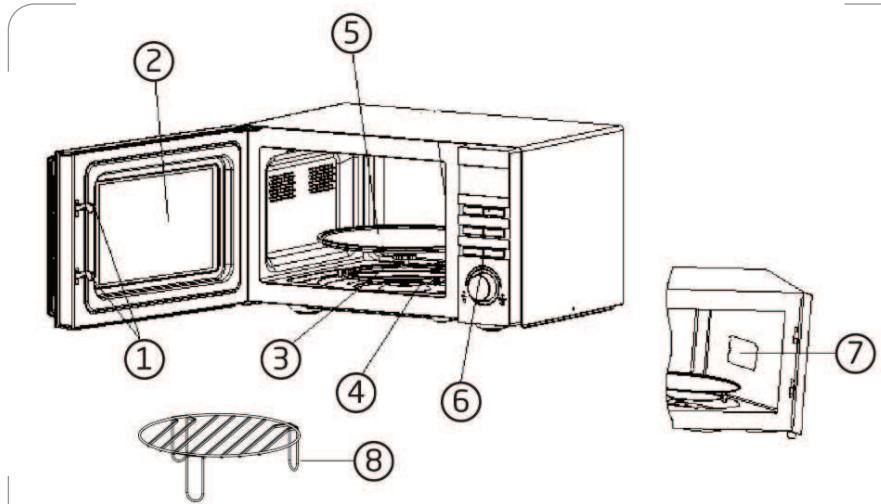
OVEN OVERVIEW
1. Door lock
Microwave oven door must be properly closed in order for it to operate.
2. Viewing window
Allow user to see the cooking status.
3. Rotating axis
The glass turntable sits on the axis; the motor underneath it drives the turntable to rotate.
4. Rotating ring
The glass turntable sits on its wheels; it supports the turntable and helps it to balance when rotating.
5. Turntable
The food sits on the turntable, its rotation during operation helps to cook food evenly.

CAUTION
- Place the rotating ring first.
- Fit the turntable onto the rotating axis and make sure that it is geared in properly.
6. Control panel
See below in details.
7. Wave guide cover
It is inside the microwave oven, next to the wall of control panel.

Never remove the wave guide cover.
-
Grill rack
-
Never place the turntable upside down. The turntable should never be restricted.
- Both turntable and rotating ring must always be used during cooking.
- All food and containers of food must always be placed on the turntable for cooking.
- If turntable or rotating ring cracks or breaks, stop using your microwave oven and contact a nearest authorised service centre.
FR
NL
ES
PT
EN
121

INSTALLATION
PREPARATION
Remove all packing material and accessories. Examine the oven for any damage such as dents or broken door. Do not install the microwave oven if it is damaged. Cabinet: Remove any protective film found on the microwave oven cabinet surface.
Do not remove the light brown Mica cover that is attached to the inside of the oven cavity to protect the magnetron.
Position
- Select a level surface that provides enough open space for the intake and/or outlet vents.
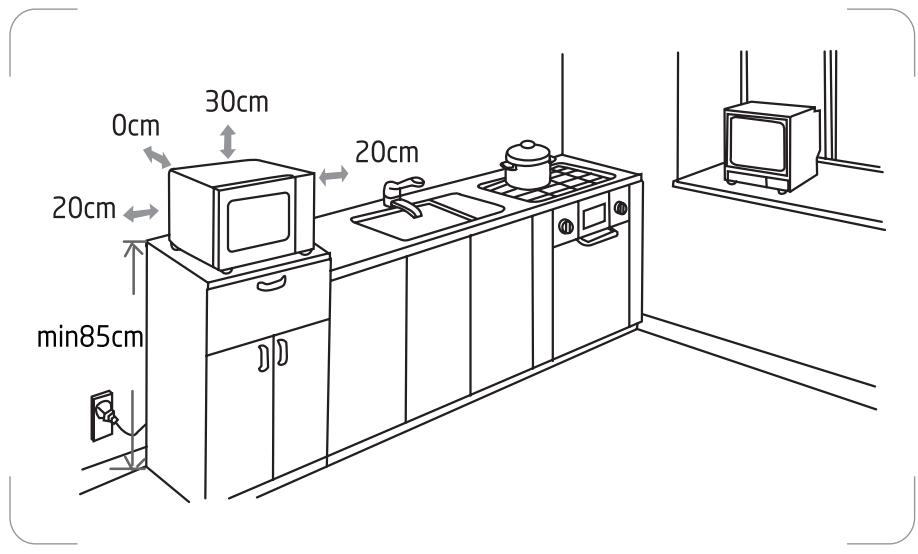
- The microwave oven must be placed on a surface with height more than 85 cm above the floor.
A minimum clearance of 20~cm is required on both sides of the oven.
- The minimum height of free space above the top surface of the oven is 30 cm.
- Do not remove the feet from the bottom of the oven.
- Blocking the intake and/or outlet openings can damage the oven.
- Place the oven as far away from radios and TV as possible.
122
FR
NL
ES
PT
EN



Operation of microwave oven may cause interference to your radio or TV reception.
- Plug your oven into a standard grounded outlet. Be sure the voltage and the frequency are the same as the voltage and the frequency on the rating label.
- WARNING: Do not install the oven over a range cooktop or other heat-producing appliance. If installed near or over a heat source, the oven could be damaged.


CONTROL PANEL
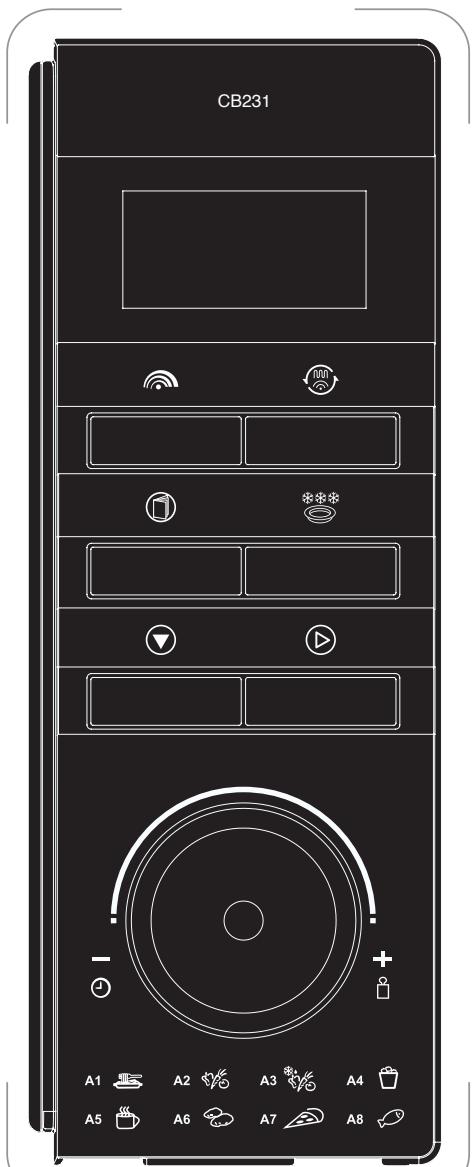
Display
Cooking time, power, indicators and present time are displayed.

Microwave cooking
Press this button to set microwave power level.

Convection / Microwave + Convection
cooking / Grill / Microwave + Grill cooking
Press this button to set a convection or grill cooking program or one of two microwave + convection/grill cooking modes.

Press this button to set the auto cook menu.

Press this button to defrost food by weight, set the clock or temperature.

Press this button to cancel setting or reset the oven before setting a cooking program.
Press once to temporarily stop cooking or press twice to cancel cooking completely.
This button is also used to activate/deactivate child lock function.

Press this button to start a cooking program or set speed cooking program.
Press this button to confirm the setting.

Time/Weight dial
Rotate this dial to select time, weight or number of servings.
124
FR
NL
ES
PT
EN

OPERATION
The display flashes 3 times when plugging in the microwave oven. Then it flashes "1:00", indicating that the appliance is in the default standby status.
General
- Press once to temporarily stop cooking. You can resume cooking by pressing, or press twice to cancel the cooking program.
After the cooking time has elapsed, the oven will beep a few times.
Setting the Clock
- In standby state, press and hold for about 3 seconds to enter the clock setting status.
The hour digits will flash on the display.
- While the hour digits are flashing, turn to adjust the hour digits, the input hour should be a 24-hour time value.
- Press to confirm. The minute digits will flash.
- While the minute digits are flashing, turn to adjust the minute digits.
- Press to confirm the setting. ":" will flash on the display.
Microwave Cooking
This function is used for cooking and heating food. Repeatedly press ⑥ and the display will cycle to show 100P – 80P – 60P – 40P – 20P.
| High power | 100% microwave power.
Applicable for quick and thorough cooking. |
| Medium | 80% microwave power. |
| High power | Applicable for medium express cooking. |
| Medium power | 60% microwave power.
Applicable for steaming food. |
| Medium | 40% microwave power. |
| Low power | Applicable for defrosting food. |
| Low power | 20% microwave power.
Applicable for keeping warm. |
FR
NL
ES
PT
EN
125

CAUTION
a. Never operate the oven empty.
b. If you turn the food during operation, press the Instant/Start button once and the preset cooking procedure will continue.
c. If you intend to remove the food before the set time, you must press once to clear the set procedure to avoid unintended operation of next time use.
d. At the maximum microwave power, the oven will automatically lower the power after a certain time of cooking to lengthen the service life.
The longest cooking time is 60 minutes. Suppose you want to cook for 1 minute at 60% of microwave power.
- Press three times.
| Number of pressing | Display | Cooking Power |
| Once | 100P | 100% |
| Twice | 80P | 80% |
| 3 times | 60P | 60% |
| 4 times | 40P | 40% |
| 5 times | 20P | 20% |
- Turn to 1:00.
- Press
Convection Cooking
- Press The display will show "C".
- Repeatedly press to set the operating temperature 100^, 120^, 140^, 160^ or 180^ .
- Turn to select the desired cooking time. The longest cooking time is 60 minutes.
- Press
126
FR
NL
ES
PT
EN
Microwave + Convection Combination Cooking
In this mode, hot air is circulated throughout the oven cavity to brown and crisp foods quickly and evenly.
C1: 30% time for microwave cooking and 70% for convection cooking.
Suppose you want to set combination cooking for 25 minutes.
- Press twice.
- Repeatedly press to set the operating temperature 100^, 120^, 140^, 160^ or 180^ .
- Turn to 25:00. The longest cooking time is 60 minutes.
- Press
C2: 55% time for microwave cooking and 45% for convection cooking.
Suppose you want to set combination cooking for 12 minutes.
- Press three times.
- Repeatedly press to set the operating temperature 100^, 120^, 140^, 160^ or 180^ .
- Turn to 12:00. The longest cooking time is 60 minutes.
- Press
Grill Cooking
The grill cooking is particularly useful for thin slices of meat, steaks, chops, kebabs, sausages of piece of chicken. It is also suitable for hot sandwiches and au gratin dishes. The longest cooking time is 60 minutes.
- Repeatedly press until the displays shows "G".
- Turn to select the desired cooking time.
- Press
Microwave + Grill Combination Cooking
G1: 30% time for microwave cooking and 70% for grill cooking.
FR
NL
ES
PT
EN
127
Suppose you want to set combination cooking for 25 minutes.
- Repeatedly press until the display shows G1.
- Turni to 25:00. The longest cooking time is 60 minutes.
- Press
G2 : 55 % time for microwave cooking and 45 % for grill cooking. Suppose you want to set combination cooking for 12 minutes.
- Repeatedly press until the display shows G2.
- Turn to 12:00. The longest cooking time is 60 minutes.
- Press
Quick Start
The oven will operate at high microwave power for quick start cooking program. To do this, press in quick secession to set cooking time, the oven will start immediately at full power. The longest cooking time is 60 minutes.
NOTE: The cooking time can be increased in the following increments:
| Cooking Time | Increments |
| 0 - 5 min : | 10 seconds |
| 5 - 10 min : | 30 seconds |
| 10 - 60 min : | 60 seconds |
Defrosting Food
- Repeatedly press to select a desired mode among Ad-1, Ad-2 and Ad-3.
-
Turn to set the defrost weight.
-
Ad-1: for defrosting meat, the weight ranges from 0.1 to 2.0kg .
- Ad-2: for defrosting poultry, the weight ranges from 0.2 to 3.0kg .
-
Ad-3: for defrosting seafood, the weight ranges from 0.1 to 0.9 kg .
-
Press
128
CB231 IB.indd 128
FR
NL
ES
PT
EN
NOTE: During defrosting, the system will beep to remind you of turning over the food. After turning over the food, close the door and press ⑥ to resume.

CAUTION
a. It is necessary to turn over the food during operation to obtain uniform effect.
b. Usually defrosting will need longer time than that of cooking the food.
c. If the food can be cut by knife, the defrosting process can be considered completed.
d. Microwave penetrates around 4cm into most food.
e. Defrosted food should be consumed as soon as possible, it is not advised to put back to freezer and freeze again.
The oven has default cooking menu for simple operation. When the display flashes colon ":" repeatedly press l and the display will cycle to show AC-1, AC-2 .... AC-8.
Turn to select the desired weight or servings. Press
Choose the appropriate menu according to the food type and weight and strictly observe the directions in below table, otherwise the cooking effect will be largely influenced.
| Display | Food | Cooking Weight |
| AC-1 | Pasta | 0.1, 0.2, 0.3kg |
| AC-2 | Fresh vegetable | 0.2 ~ 0.8kg |
| AC-3 | Frozen vegetable | 0.2 ~ 0.8kg |
| AC-4 | Popcorn | 0.1kg |
| AC-5 | Beverage | 1 or 2 cups |
| AC-6 | Potato | 0.45kg, 0.65kg |
| AC-7 | Pizza | 1 or 2 pieces |
| AC-8 | Fish | 0.2 ~ 0.7kg |


CAUTION
a. The temperature of food before cooking would be 20^ - 25^ . Higher or lower temperature of the food before cooking would require increase or decrease of cooking time.
b. The temperature, weight and shape of food will largely influence the cooking effect. If any deviation has been found to the factor noted on above menu, you can adjust the cooking time for best result.
c. When cooking potatoes, it is recommended to wrap a damp paper towel loosely around each potato and microwave. The paper towel will create a steaming effect on the baked potato, ensuring that the potato remains moist and does not dry out during the cooking process.
Preset Function
Suppose the present time is 8:00 in the morning, and you want the oven to start a microwave at 11:30 for cooking 30 minutes with 80% power level automatically.
- Press twice.
- Turn until the display shows 30:00.
- Press and hold for about 3 seconds until the hour digits are flashing.
- Turn until the display shows 11:00.
- Press *** to confirm. The minute digits will flash.
- Turn until the display shows 11:30.
- Press *** to confirm.
NOTE: You can check the preset time by pressing
Child Lock
The child lock prevents the oven from being operated unintentionally or by unsupervised children.
NOTE: This function is only available when the oven is not in operation.
- To set the child lock, press and hold for about 3 seconds. A beep will sound and the display will show LOC. In the lock state, all buttons are disabled.
130
FR
NL
ES
PT
EN
- To cancel the child lock, press and hold for about 3 seconds. A beep will sound and the lock and LOC will disappear from the display.
Multi-sequence Cooking
To obtain best cooking result, some recipes call for different cook mode and time. You may program your personalized menu as follows:
Example: You want cook food with 100P microwave for 3 minutes then 20P for 9 minutes. This is 2 sequence setting.
- Press to select the power level 100P.
- Turn the knob to set cooking time until the display shows 3:00.
- Repeatedly press to select the power level until the display shows 20P.
- Turn the knob to set cooking time until the display shows 9:00.
- Start cooking by pressing

CAUTION
- When microwave 100 power cooking is finished, the microwave oven will begin next operation automatically.
Max 4 sequences can be set at one time, repeat the steps.
Auto Reminder
When your preset cooking procedure has finished, three beeps will be heard to prompt you to take out the food.
If you do not press once or open the door, the beep will sound at an interval of 3 minutes.
Cooking Tips
The following factors may affect the cooking result:
Food arrangement
Place thicker areas towards outside of dish, the thinner part towards the center and spread it evenly. Do not overlap if possible.
FR
NL
ES
PT
EN
131
Cooking time length
Start cooking with a short time setting, evaluate it after it times out and extend it according to the actual need. Over cooking may result in smoke and burns.
Cooking food evenly
Food such as chicken, hamburger or steak should be turned once during cooking. Depending on the type of food, if applicable, stir it from outside to center of dish once or twice during cooking.
Allow standing time
After cooking times out, leave the food in the oven for an adequate length of time, this allows it to complete its cooking cycle and cooling it down in a gradual manner.
Whether the food is done
Color and hardness of food help to determine if it is done, these include:
- Steam coming out from all parts of food, not just the edge;
- Joints of poultry can be moved easily;
- Pork or poultry shows no signs of blood;
- Fish is opaque and can be sliced easily with a fork.
Browning dish
When using a browning dish or self-heating container, always place a heat-resistant insulator such as a porcelain plate under it to prevent damage to the turntable and rotating ring.
Microwave safe plastic wrap
When cooking food with high fat content, do not allow the plastic wrap come into contact with food as it may melt.
Microwave safe plastic cookware
Some microwave safe plastic cookware might not be suitable for cooking foods with high fat and sugar content. Also, the preheating time specified in the dish instruction manual must not be exceeded.
132
FR
NL
ES
PT
EN
Foods
Forbidden foods
If you choose a cooking method using microwaves, you should never:
- Attempt to fry food - it is impossible to control the temperature of the oil and other fats- fire-risk.
- Attempt to cook or warm up eggs in their shells, hard-boiled eggs with or without their shells or snails - they may explode.
- Attempt to cook food in an intact shell (e.g. chestnuts) or hard skin (tomatoes, potatoes, sausages) - always make a slit.
Food temperatures
The action of microwaves is such that only the food is heated. The container may, therefore, remain cold or cool while the food that it contains is burning hot. To avoid any risk of burning, always stir before serving and check the temperature carefully before serving - especially to children.
Shake feeding bottles well and try a few drops on the back of your wrist to check the temperature.
Preparing food for cooking
Before warming feeding bottles and small pots, remove teats and covers.
Remember to cover the food in order to:
Heating liquids
When heating liquids, a sudden overflow may occur when you take the container to remove it from the appliance. In fact, when the temperature reaches boiling point, steam tends to remain trapped in the liquid until it is disturbed.
To avoid this superheating effect and the consequent risk of scalding, always place a plastic spoon in the liquid to be heated.
A container can easily be tested for microwave "transparency":
Place the empty container on the turntable together with a glass of water and run the oven for one minute at maximum power.
FR
NL
ES
PT
EN
133
After one minute:
- if the container is cold, it is "transparent" and can be used for microwave cooking,
- if the container is warm or hot it is absorbent and must not be used for microwave cooking.

CLEANING AND MAINTENANCE
Before any cleaning or maintenance operation, disconnect the microwave oven from the mains supply and allow it to cool to room temperature.
General Advice
Frequent cleaning prevents the formation of smoke and bad odours during cooking and also sparking in the oven cavity and around the door seal.
Do not let food deposits or grease accumulate inside the oven cavity or on the door seal.
Make sure that the waveguide cover is kept clean at all times. Should food deposits or grease be allowed to accumulate on the cover, sparking will occur and may damage your oven invalidating the warranty.
Oven Door
Remove any food deposits and grease between the door seal and oven cavity using a damp cloth, it is important to keep this area clean at all times.
Interior Walls
Remove any grease splashes from the oven cavity walls with soap and water, then rinse and dry.
The door seal and oven cavity have to be particularly well cleaned to ensure the door will close properly and to avoid sparking between the oven cavity and door assembly.
Do not use abrasive products such as scouring pads which will damage the surfaces of the oven cavity and door.
134
FR
NL
ES
PT
EN
Outer Surfaces
To clean the outside surface, use a damp cloth.
Avoid using abrasive products such as scouring pads that may damage the cosmetic surfaces. Make sure water does not seep into the ventilation slots.
Accessories should be washed in warm soapy water by hand.
CAUTION:
Some waveguide covers can be easily damaged, take care when cleaning.
Do not wash accessories in a dishwasher.
For hygiene safety the glass tray should be cleaned regularly as it may come into contact with food.
It should be cleaned with warm soapy water and dried thoroughly.
If the inside of the oven cavity and door seal are not kept perfectly clean, there is a danger of damage due to sparking inside the oven cavity invalidating the warranty.
Never scrape the oven cavity walls with sharp objects.


SPECIFICATIONS
Rated voltage and frequency: 230V\~, 50Hz
(Microwave): 1280W
Rated input (Grill): 1200W
(Convection): 1200W
Rated output power (Microwave): 800W
Microwave frequency: 2450MHz
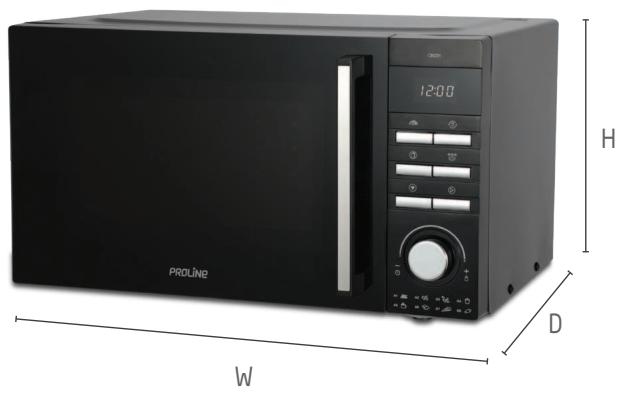
| Dimensions (outer dimensions) | (W) 482 x (D) 382 x (H) 282 mm |
| Dimensions (cavity / Inner dimensions) | (W) 340 x (D) 310 x (H) 230 mm |
| Weight (approx.) | 13 kg |
Power consumption in standby mode: 0,4W
The period after which the equipment reaches automatically standby mode:
15 minutes
136
CB231 IB.indd 136
FR
NL
ES
PT
EN
6/2/2024 11:45 AM

TROUBLESHOOTING
| Normal Phenomena |
| Microwave oven interfering TV reception | Radio and TV reception may be affected when the microwave oven is operating. It is similar to the interference of small electrical appliances, like mixer, vacuum cleaner and electric fan. It is normal. |
| Dim oven light | During low power microwave cooking, the oven light may become dim. It is normal. |
| Steam accumulating on door, hot air out of vents | During cooking, steam may come out of food. Most of steam will escape from the vents. But some of them may accumulate on positions like the oven door. It is normal. |
| Oven operated accidentally with no food in. | It is forbidden to operate the appliance without any food inside. It is very DANGEROUS. |
| Problem | Possible Cause | Solution |
| Oven cannot be operated. | Power cord not plugged in tightly. | Unplug the appliance then plug it in again after 10 seconds. |
| There is something wrong with the mains socket. | Test the mains socket by plugging another appliance in. |
| Oven does not heat up. | Door not closed well. | Close door well. |
| Glass tray makes noise when microwave oven operates. | Dirty roller and oven bottom. | Refer to ‘CLEANING AND MAINTENANCE’ to clean dirty parts. |
| Glass tray is not positioned properly. | Position the glass tray properly. |


SERVICING SAFEGUARDS
Caution: MICROWAVE RADIATION
- The high voltage capacitor remains charge after disconnection; short the negative terminal of H. V capacitor to the oven chassis (use a screwdriver) to discharge before touching.
-
During servicing below listed parts are liable to be removed and give access to potentials above 250V to earth.
-
Magnetron
High voltage transformer
High voltage capacitor
High voltage diode
High voltage fuse
-
The following conditions may cause undue microwave exposure during servicing.
Improper fitting of magnetron;
Improper matching of door interlock, door hinge and door;
Improper fitting of switch support;
Door, door seal or enclosure has been damaged.
138

DISPOSAL
As a responsible retailer we care about the environment. As such we urge you to follow the correct disposal procedure for the appliance and packaging materials. This will help conserve natural resources and ensure that it is recycled in a manner that protects health and the environment.
You must dispose of this appliance and its packaging according to local laws and regulations.
Because this appliance contains electronic components, the appliance and its accessories must be disposed of separately from household waste when the appliance reaches its end of life.
Contact your local authority to learn about disposal and recycling.
The appliance should be taken to your local collection point for recycling. Some collection points accept appliance free of charge.
We apologise for any inconvenience caused by minor inconsistencies in these instructions, which may occur as a result of product improvement and development.
EU Declaration of Conformity
Product Description:
The object of the declaration described above is in conformity with the relevant Union
harmonisation legislation:
Low Voltage Directive (LVD)
Eco design requirements for energy-related products (ErP)
RoHS
EMC:
EN 55011:2016+A1:2017+A11:2020+A2:2021
EN IEC 55014-1:2021
EN IEC 61000-3-2:2019+A1:2021
EN 61000-3-3:2013+A1:2019
ENIEC55014-2:2021
LVD:
EN IEC 60335-2-25:2021 + A11:2021
EN 60335-2-9: 2003 + A1: 2004 + A2: 2006 + A12: 2007 + A13: 2010 + AC: 2011 + AC: 2012
EN 60335-1:2012 + A11:2014+A13:2017+A1:2019+A2:2019+A14:2019+A15:2021+A16:2023
EN 62233:2008
ErP:
(EU) 2023/826
EN 50564:2011
This declaration of conformity is drawn up under the sole responsibility of the manufacturer.
The person responsible for this declaration is:
Place, Date / Lieu :