PMG20WS - Microwaves PROLINE - Free user manual and instructions
Find the device manual for free PMG20WS PROLINE in PDF.


| Product type | Microwave |
| Brand | PROLINE |
| Model | PMG20WS |
| Power supply | 230 V ~ 50 Hz |
| Microwave power | 1300 W (consumption) / 800 W (output) |
| Grill power | 1000 W |
| Capacity | 20 liters |
| Dimensions (L × l × H) | 433 mm × 345 mm × 258 mm |
| Net weight | Approx. 10.5 kg |
| Turntable diameter | 245 mm |
| Cooking functions | Microwave, Grill, Combi 1, Combi 2, Combi 3 |
| Microwave power levels | Low (17 %), Low+ (33 %), Medium (55 %), Medium+ (77 %), High (100 %) |
| Timer | Mechanical, up to 30 minutes (estimation) |
| Automatic stop at end of cooking | Yes, with beep |
| Safety | Door lock, stop on opening |
| Interior light | Yes (replaceable bulb) |
| Exterior material | Stainless steel |
| Cleaning | Unplug before cleaning; soapy water, no abrasives |
| Spare parts | Glass tray, ring, roller crown, grill rack |
| Repair | Qualified technician only |
| Use | Domestic only |
| Installation | Flat surface, min. free space 7.5 cm on sides, 30 cm above |
Frequently Asked Questions - PMG20WS PROLINE
User questions about PMG20WS PROLINE
0 question about this device. Answer the ones you know or ask your own.
Ask a new question about this device
Download the instructions for your Microwaves in PDF format for free! Find your manual PMG20WS - PROLINE and take your electronic device back in hand. On this page are published all the documents necessary for the use of your device. PMG20WS by PROLINE.
USER MANUAL PMG20WS PROLINE
Downloaded from www.radesphor.com
Table of Contents
PRECAUTIONS TO AVOID POSSIBLE EXPOSURE
TO EXCESSIVE MICROWAVE ENERGY 2
IMPORTANT SAFETY INSTRUCTIONS 3
COOKING UTENSILS 5
OTHER HELPFUL INSTRUCTIONS 6
OVEN OVERVIEW 7
TURNTABLE INSTALLATION 7
COUNTERTOP INSTALLATION 8
MICROWAVE OVEN INSTALLATION 8
CONTROL PANEL 9
OPERATION 9
CLEANING AND CARE 10
SPECIFICATIONS 11
QUESTIONS AND ANSWERS 11
TROUBLESHOOTING 12
BEFORE YOU CALL FOR SERVICE 13
IMPORTANT DISPOSAL INSTRUCTIONS 14
PRECAUTIONS TO AVOID POSSIBLE EXPOSURE TO EXCESSIVE MICROWAVE ENERGY
The oven cannot be operated with the door open due to the safety interlocks built in the door mechanism which switch off cooking functions when the door is opened. Operating the oven with the door open could result in harmful exposure to microwave energy. It is important not to tamper with the door mechanism.
Do not place any object between the oven front face and the door or allow soil or cleaner residue to accumulate on sealing surfaces.
Do not operate the oven if it is damaged. It is particularly important that the oven door closes properly and that there is no damage to the (1) door(bent), (2) hinges and latches (broken or loosened), (3) door seals and sealing surfaces.
The oven should not be adjusted or repaired by anyone except qualified personnel.
WARNING
- When heating liquids, e.g. soups, sauces and beverages in your microwave oven, delayed eruptive boiling can occur without evidence of bubbling. This could result in a sudden boil over of the hot liquid. To prevent this possibility the following steps should be taken.
- Avoid using straight-sided containers with narrow necks.
- Do not overheat.
- Stir the liquid before placing the container in the oven and again halfway through the heating time.
- After heating, allow to stand in the oven for a short time. Stir or shake the contents (especially feeding bottles and baby foods) and carefully check the temperature before use.
- If the door or door seals are damaged, the oven must not be operated until it has been repaired by a competent person.
- It is hazardous for anyone other than a competent person to carry out any service or repair that involves the removal of a cover which gives protection against exposure to microwave energy.
- Liquids or other foods must not be heated in a sealed container since they are liable to explode.
- Only allow children to use the oven without supervision when adequate instructions have been given so that the child is able to use the oven in a safe way and understands the hazards of improper use.
- This appliance is intended for domestic use only, any other use may invalidate the warranty and might be dangerous.
IMPORTANT SAFETY INSTRUCTIONS
READ CAREFULLY AND KEEP FOR FUTURE REFERENCE
- Read all instructions before using the appliance and keep for future reference.
- Use this appliance only for its intended use as described in this manual. Do not use corrosive chemicals or vapours in this appliance. This type of oven is specifically designed to heat, cook or dry food. It is not designed for industrial or laboratory use.
- Do not operate the oven when empty. It is best to leave a glass of water in the oven when not in use. The water will safely absorb all microwave energy if the oven is accidentally started.
- Do not operate this appliance if it has a damaged cord or plug, if it is not working properly or if it has been damaged or dropped. If the mains lead is damaged, it must be replaced by the manufacturer, its service agent or similarly qualified person with a lead of the same type and rating to avoid a hazard.
- Do not let power cord hang over the edge of table or countertop.
- Do not dry clothes in the oven. They may become carbonised or burned if heated too long.
- Do not cook food wrapped in paper towels, unless your cookbook contains instructions for the food you are cooking.
- Do not use the oven for drying kitchen towels or paper products. They may burn.
- Only use utensils suitable for use
in microwave ovens. (See 'COOKING UTENSILS')
- Do not use wooden or cardboard containers. They may heat up and char.
- Do not use recycled paper products since they may contain impurities which may cause sparks and / or fires when used in cooking.
- Allow the turntable to cool before cleaning.
- Small amounts of food require shorter cooking or heating time. If normal time is allowed they may overheat and burn.
- Before cooking, pierce the skin of fruit and vegetables.
- Eggs in their shell and whole hard boiled eggs should not be heated in microwave ovens since they may explode, even after heating has ended.
- Do not attempt deep fat frying in your oven.
- Remove plastic wrapping from food before cooking or defrosting. Note though that in some cases food should be covered with plastic film, for heating or cooking, as detailed in microwave cookbooks.
- When heating food in plastic or paper containers, keep an eye on the oven due to the possibility of ignition.
-
If smoke is observed, switch off or disconnect the oven from the power supply and keep the oven door closed in order to stifle any flames.
-
Do not overcook food.
- Do not use the oven cavity for storage purposes. Do not store items, such as bread, cookies, etc. inside the oven.
- When food is heated or cooked in disposable containers of plastic, paper or other combustible materials, check the oven frequently due to the possibility of ignition.
- Install or locate this oven only in accordance with the installation instructions provided.
- This appliance is not intended for use by persons (including children) with reduced physical, sensory or mental capabilities, or lack of experience and knowledge, unless they have been given supervision or instruction concerning use of the appliance by a person responsible for their safety.
- The oven should be cleaned regularly and any food deposits should be removed.
- Do not store or use this appliance outdoors.
- Do not use this oven near water, in a wet basement or near a
swimming pool.
- The temperature of accessible surfaces may be high when the appliance is operating. Keep power cord away from heated surfaces, and do not cover any items on the oven.
- Failure to maintain the oven in a clean condition could lead to deterioration of the surface that could adversely affect the life of the appliance and possibly result in a hazardous situation.
- The contents of feeding bottles and baby food jars shall be stirred or shaken and the temperature checked before consumption, in order to avoid burns.
- Microwave heating or beverages can result in delayed eruptive boiling, therefore take care when handling the container.
- The microwave oven shall not be placed in a cabinet.
WARNING: Do not attempt to tamper with, or make any adjustments or repairs to the door, control panel, safety interlock switches or any other part of the oven.
COOKING UTENSILS
Utensils should be checked to ensure that they are suitable for use in the microwave oven. The following charts summarise the proper use of cooking utensils in your oven.
Materials you can use in microwave oven
| Utensils Remarks | |
| Aluminium foil | Shielding only. Small smooth pieces can be used to cover thin parts of meat or poultry to prevent overcooking. Arcing can occur if foil is too close to oven walls. The foil should be at least 2.5cm away from oven walls. |
| Browning dish | Follow manufacturer's instructions. The bottom of browning dish must be at least 5cm away above the turntable. Incorrect usage may cause the turntable to break. |
| Dinnerware | Microwave-safe only. Follow manufacturer's instructions. Do not use cracked or chipped dishes. |
| Glass jars | Always remove lid. Use only to heat food until it's warm. Most glass jars are not heat resistant and may break. |
| Glassware | Heat-resistant oven glassware only. Make sure there is no metallic trim. Do not use cracked or chipped dishes. |
| Oven cooking bags | Follow manufacturer's instructions. Do not close with metal tie. Make slits to allow steam to escape. |
| Paper plates and cups | Use for short-term cooking/warming only. Do not leave oven unattended while cooking. |
| Paper towels | Use to cover food for reheating and absorbing fat. Use with supervision for a short-term cooking only. |
| Parchment paper | Use as a cover to prevent splattering or a wrap for steaming. |
| Plastic | Microwave-safe only. Follow the manufacturer's instructions. Should be labelled “Microwave Safe”. Some plastic containers soften, as the food inside gets hot. “Boiling bags” and tightly closed plastic bags should be slit, pierced or vented as directed by package. |
| Plastic wrap | Microwave-safe only. Use to cover food during cooking to retain moisture. Do not allow plastic wrap to touch food. |
| Thermometers | Microwave-safe only (meat and candy thermometers). |
| Wax paper | Use as a cover to prevent splattering and retain moisture. |
Materials to be avoided in microwave oven
| Utensils Remarks | |
| Aluminium tray | May cause arcing. Transfer food into microwave-safe dish. |
| Food carton with metal handle | May cause arcing. Transfer food into microwave-safe dish. |
| Metal or metal-trimmed utensils | Metal shields the food from microwave energy. Metal trim may cause arcing. |
| Metal twist ties | May cause arcing and could cause a fire in the oven. |
| Paper bags | May cause a fire in the oven. |
| Plastic foam | Plastic foam may melt or contaminate the liquid inside when exposed to high temperature. |
| Wood | Dry out when used in the microwave oven and may split or crack. |
Notes:
- Care should be taken when removing utensils or the glass turntable, as they may become hot during cooking.
- Only use a thermometer that is designed for use in the microwave oven.
- Ensure the turntable is in place when you operate the oven.
OTHER HELPFUL INSTRUCTIONS
For best results and more enjoyable cooking, please read these comments thoroughly.
For Best Results:
- When determining the time for a particular food, begin by using minimum time and checking condition occasionally. It is easy to overcook food because microwaves cook very quickly.
- Small quantities of food or foods with low water content may dry out and become hard if cooked too long.
Defrosting Frozen Food:
- Foods that have been frozen can be placed directly in the oven for thawing. (Be certain to remove any metallic ties or wraps).
- Defrost according to the Defrosting instructions found in this manual.
- For areas of the food thawing faster than others, cover with small pieces of aluminium foil. This helps slow down or stop the defrosting process.
- Some foods should not be completely thawed before cooking. For example, fish cooks so quickly that it is sometimes better to begin cooking while still slightly frozen.
- It may be necessary to increase or decrease the cooking time in some recipes, depending on the starting temperature of the food.
NOTE:
Air from the vent may become warm during cooking.
Browning:
There are a few foods which are not cooked long enough in the microwave oven to brown and may need additional colour.
Coatings such as paprika and browning agents such as Worcestershire sauce may be used on chops, meat patties or chicken pieces.
Roasts, poultry or ham, cooked for 10-15 minutes or longer, will brown without extra additives.
OVEN OVERVIEW
Names of Oven Parts
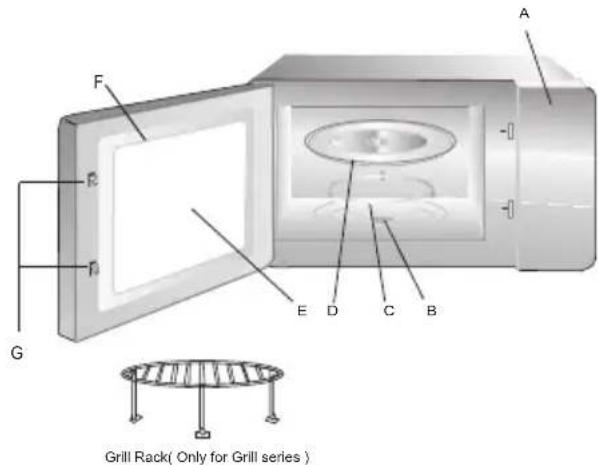
A. Control Panel
B. Shaft
C. Roller Ring
D. Glass Tray
E. Oven Window
F. Door Assembly
G. Door Safety Lock
The oven will shut off if the door is opened during operation.
TURNTABLE INSTALLATION
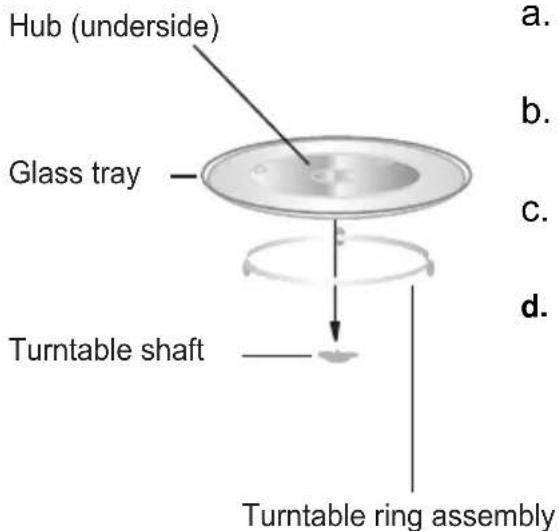
a. Never place the glass tray upside down. The glass tray should never be restricted.
b. Both glass tray and turntable ring assembly must always be used during cooking.
c. All food and containers of food are always placed on the glass tray for cooking.
d. If glass tray or turntable ring assembly cracks or breaks, contact your nearest authorised service centre.
COUNTERTOP INSTALLATION
Remove all packing material and accessories. Examine the oven for any damage such as dents or broken door. Do not install if the oven is damaged.
Cabinet: Remove any protective film found on the microwave oven cabinet surface.
Do not remove the light brown Mica cover that is attached to the inside of the oven cavity to protect the magnetron.
- Select a level surface that provides enough open space for the intake and/or outlet vents.
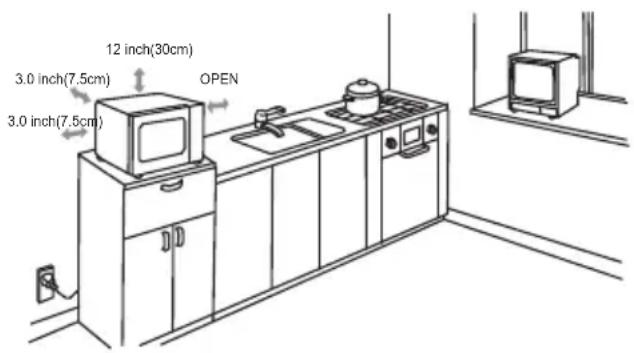
A minimum clearance of 3.0 inches (7.5cm) is required between the oven and any adjacent walls. One side must be open.
(1) Leave a minimum clearance of 12 inches (30cm) above the oven.
(2) Do not remove the feet from the bottom of the oven.
(3) Blocking the intake and/or outlet
openings can damage the oven.
(4) Place the oven as far away from radios and TV as possible.
Operation of microwave oven may cause interference to your radio or TV reception.
- Plug your oven into a standard household outlet. Be sure the voltage and the frequency is the same as the voltage and the frequency on the rating label.
WARNING: Do not install the oven over a range cooktop or other heat-producing appliance. If installed near or over a heat source, the oven could be damaged and the warranty would be void.
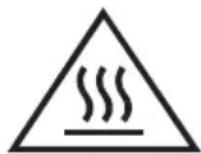
Accessible surfaces may get hot during operation.
CONTROL PANEL
OPERATION
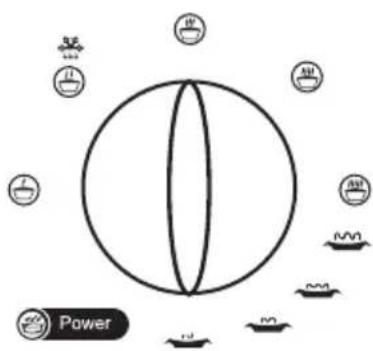
- Set the cooking power by turning the power knob to the desired level.
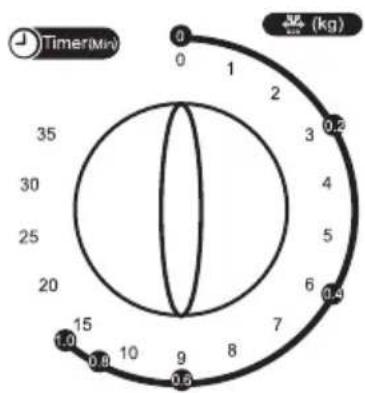
- Set the cooking time by turning the timer knob to the desired time.
- The microwave oven will automatically start cooking after the power level and cooking times are set.
- After the cooking time has elapsed, a tone will sound and cooking will stop.
- If the oven is not in use, always set the timer knob to "0".
| Function / Power Output Application | ||
| Low | 17% micro. | Soften ice cream. |
| Med. Low (Defrost) | 33% micro. | Soup, stew, soften butter or defrost |
| Med. | 55% micro. | Stew, fish |
| Med. High | 77% micro. | Rice, fish, chicken, ground meat |
| High | 100% micro. | Reheat, milk, boil water, vegetables, beverage |
| Combi. 1 | 80% grill | Sausage, lamb, kebabs, seafood, steak |
| 20% micro. | ||
| Combi. 2 | 70% grill 30% micro. | Chicken pieces, chicken breasts, pork chops |
| Combi. 3 | 60% grill 40% micro. | Whole chicken |
| Grill | 100% grill Bakéd bread, slice food | |
Note: when removing food from the oven, please ensure that the oven is switched off by turning the timer knob to "0". Failure to do so and operating the microwave oven with no food in it can result in overheating and damage the magnetron.
CLEANING AND CARE
Disconnect the electrical supply to the oven before cleaning.
Interior walls
Remove any crumbs and food remains between the door and oven using a damp cloth. This area has to be particularly well cleaned to ensure the door will close properly. Remove any grease splashes with a soapy cloth then rinse and dry. Do not use abrasive cleaners which may damage the surface of the oven. Only warm soapy water must be used to clean stainless steel surfaces.
Roller rest
The roller rest should be removed and cleaned in hot soapy water at least once a week to prevent grease restricting the rotation of the wheels.
Door
The door and door seals should be kept clean at all times. Use only warm soapy water rinse then dry thoroughly.
DO NOT USE ABRASIVE MATERIALS, SUCH AS CLEANING POWDERS OR STEEL AND PLASTIC PADS.
Metal parts will be easier to maintain if wiped frequently with a damp cloth.
Exterior
Clean with mild soap and warm water, rinse and dry with a soft cloth. Do not use abrasive materials. Do not spill water in the vents. If the power lead becomes soiled wipe it with a damp cloth.
Only warm soapy water must be used to clean stainless steel surfaces.
Failure to maintain the oven in a clean condition could lead to deterioration of the surface that could adversely affect the life of the appliance and possibly result in a hazardous situation.
SPECIFICATIONS
| Power Consumption: | 230V~50Hz 1300W (Microwave) 1000W (Grill) |
| Rated Microwave Power Output: | 800W |
| Outside Dimensions: | 433mm(L)×345mm(W)×258mm(H) |
| Oven Capacity: | 20 Litres |
| Cooking Uniformity: | Turntable System |
| Turntable Diameter: | Φ245mm |
| Net Weight: | Approx. 10.5kg |
Specifications are subject to change without prior notice.
QUESTIONS AND ANSWERS
Q. What is wrong when the oven light will not glow?
A. * Light bulb has blown.
*Door not closed.
Q. Why is steam coming out of the air exhaust vent and/or why is water dripping from the bottom of the door?
A. Steam is normally produced during cooking operations. This microwave oven has been made to vent this steam out of the side and top vents, occasionally this steam condenses on the door and water then drips out at the bottom of the door. This is quite normal and safe.
Q. Does microwave energy pass through the viewing screen in the door?
A. No. The screen reflects the energy to the oven cavity, the holes, or ports are made to allow light to pass, they do not let microwave energy through.
Q. Will the microwave oven be damaged if it operates while empty?
A. Yes. Never run it empty.
Q. Why do eggs sometimes pop?
A. When baking or poaching eggs, the yolk may pop due to steam build-up inside the yolk membrane. To prevent this, simply pierce the yolk with a toothpick before cooking. Never cook eggs without piercing their shells.
Q. Why is standing time recommended after the cooking operation has been completed?
A. Standing time is very important. With microwave cooking, the heat is in the food, not in the oven. Many foods
build up enough internal heat to allow the cooking process to continue, even after the food is removed from the oven. Standing time for joints of meat, large vegetables and cakes is to allow the inside to cook completely, without overcooking the outside.
Q. Why does my oven not always cook fast as the microwave cooking guide says?
A. Check your cooking guide again, to make sure you've followed directions exactly and to see what might cause variations in cooking times. Cooking guide times and heat settings are suggestions, to help prevent overcooking the most common problem in getting used to a microwave oven. Variations in the size, shape and weights could require longer cooking time. Use your own judgement along with the cooking guide suggestions to check whether the food has been properly cooked just as you would do with a conventional cooker.
Q. Why do sparks and crackling (arcing) occur in the oven?
A. There may be several reasons why sparks and crackling (arcing) within the cavity happens.
- You have left a fork or other metal utensils in the oven.
- You are using dishes with metal parts or trim (silver or gold).
- You are using a large amount of metal foil.
- You are using a metal twist tie.
TROUBLESHOOTING
| Normal | |
| Microwave oven interfering TV reception | Radio and TV reception may be affected when the microwave oven is operating. It is similar to the interference of small electrical appliances, like mixer, vacuum cleaner and electric fan. It is normal. |
| Dim oven light In low power m | microwave cooking, the oven light may become dim. It is normal. |
| Steam accumulating on door, hot air out of vents | In cooking, steam may come out of food. Most will escape from the vents. But some may accumulate on a cool place like the oven door. It is normal. |
| Oven started accidentally with no food in. | It is forbidden to run the unit without any food inside. It is very dangerous. |
| Trouble | Possible | Cause Remedy |
| Oven can not be started. | (1) Power cord not plugged in tightly. | Unplug. Then plug in again after 10 seconds. |
| (2) Fuse blowing or circuit breaker works. | Replace fuse or reset circuit breaker (repaired by professional personnel of authorised agent) | |
| (3) Trouble with outlet. Test outlet with other electrical appliances. | ||
| Oven does not heat. Door not closed well. Close door well. | ||
| Glass turntable makes noise when microwave oven operates. | Dirty roller rest and oven bottom. | Refer to ‘CLEANING AND CARE’ to clean dirty parts. |
BEFORE YOU CALL FOR SERVICE
Refer to the following short checklist. You may find that the problem you are experiencing has nothing to do with the microwave oven itself. A couple of quick checks may save you an unnecessary service call.
Problem
The oven doesn't work at all.
Check the following
- The mains plug is securely plugged into the mains socket.
- The door is firmly closed and the door hooks are not broken.
- The cooking time is set on the timer selector control.
- The fuse in the mains plug has blown.
- The mains circuit breaker in the home has tripped.
Problem
"Arcing" or sparking in the oven interior.
Check the following
- Any dishes, trays etc which are made of metal or have metal trims must not be used in the microwave oven.
- Metal skewers should be covered with food and make sure they don't touch the sides of the oven interior when rotating. If "arcing" occurs again, remove skewers until food is cooked.
- Remove any other metal cookware.
IMPORTANT DISPOSAL INSTRUCTIONS
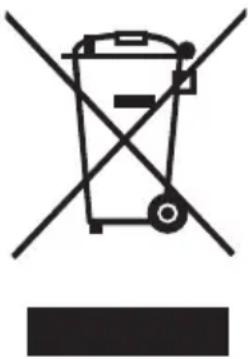
As a responsible retailer we care about the environment.
As such we urge you to follow the correct disposal procedure for your product and packaging materials. This will help conserve natural resources and ensure that it is recycled in a manner that protects health and the environment.
You must dispose of this product and its packaging according to local laws and regulations. Because this product contains electronic components, the product and its accessories must be disposed of separately from household waste when the product reaches its end of life.
Contact your local authority to learn about disposal and recycling.
The product should be taken to your local collection point for recycling. Some collection points accept products free of charge.
If something doesn't seem to work
If there is something about your appliance which you do not understand and you live in the UK you can phone our help line during normal office hours on: 0844 8009595.
Calls are charged at standard rates.
We apologise for any inconvenience caused by minor inconsistencies in these instructions, which may occur as a result of product improvement and development.
Kesa U.K HU1 3AU 09/10/2008
Sommaire
PRECAUTIONS POUR EVITER UNE EXPOSITION
EXCESSIVE AUX MICRO-ONDES 2
INSTRUCTIONS DE SECURITE IMPORTANTES 3
USTENSILES DE CUISSON 5
AUTRES INSTRUCTIONS UTILES 6
PRÉSENTATION DU FOUR
INSTALLATION DU PLATEAU TOURNANT 7
DEBALLAGE 8
INSTALLATION DU FOUR 8
INSTALLATION DU FOUR


- Table of Contents
- PRECAUTIONS TO AVOID POSSIBLE EXPOSURE
- PRECAUTIONS TO AVOID POSSIBLE EXPOSURE TO EXCESSIVE MICROWAVE ENERGY
- WARNING
- IMPORTANT SAFETY INSTRUCTIONS
- READ CAREFULLY AND KEEP FOR FUTURE REFERENCE
- COOKING UTENSILS
- Notes:
- OTHER HELPFUL INSTRUCTIONS
- For Best Results:
- Defrosting Frozen Food:
- NOTE:
- Browning:
- OVEN OVERVIEW
- Names of Oven Parts
- TURNTABLE INSTALLATION
- COUNTERTOP INSTALLATION
- CONTROL PANEL
- OPERATION
- CLEANING AND CARE
- Interior walls
- Roller rest
- Door
- Exterior
- SPECIFICATIONS
- QUESTIONS AND ANSWERS
- BEFORE YOU CALL FOR SERVICE
- Problem
- Check the following
- IMPORTANT DISPOSAL INSTRUCTIONS
- As a responsible retailer we care about the environment.
- If something doesn't seem to work
- Calls are charged at standard rates.
- Sommaire
- INSTALLATION DU FOUR
Brand : PROLINE
Model : PMG20WS
Category : Microwaves