USER MANUAL SBS 442 E W742C VALBERG
This product is guaranteed for a period of 2 years from the date of purchase* against any failure resulting from a manufacturing or material defect. This warranty does not cover defects or damage resulting from incorrect installation, improper use or abnormal wear of the product.
*as shown on the sales receipt.
WARRANTY CONDITIONS
FR
Thank you for choosing this VALBERG product. Chosen, tested and recommended by ELECTRO DEPOT, VALBERG branded products are easy to use, reliable, and of an impeccable standard. With every use of this appliance, you can be sure of complete satisfaction.
Welcome to ELECTRO DEPOT.
Visit our website: www.electrodepot.fr

Overview of the appliance
Recommended ambient temperature Temperature control adjustment Description of the appliance Control panel

Using the appliance
Installation Use Useful hints and tips

Useful information
Cleaning and maintenance Troubleshooting Disposing of your old appliance
Recommended ambient temperature
Install this appliance at a location where the ambient temperature corresponds to the climate class indicated on the rating plate of the appliance:
for refrigerating appliances with climate class:
- extended temperate: this refrigerating appliance is intended to be used at ambient temperatures ranging from 10°C to 32°C; (SN)
- temperate: this refrigerating appliance is intended to be used at ambient temperatures ranging from 16°C to 32°C; (N)
- subtropical: this refrigerating appliance is intended to be used at ambient temperatures ranging from 16°C to 38°C; (ST)
- tropical: this refrigerating appliance is intended to be used at ambient temperatures ranging from 16°C to 43°C; (T)
A multi-class appliance can handle the lowest and highest temperature of all classes covered. Using the appliance outside the recommended temperature range will lead to inferior performance and premature ageing.
Adjusting the thermostat
For optimal use and energy savings, adjust the temperature control(s) of the appliance according to the ambient temperature of the room in which it is being used, and respect the climate class.
Refer to the product sheet to find out the climate class associated with the minimum and maximum recommended ambient temperatures for the appliance as well as the temperature setting recommended for storing food under optimal conditions.
The ambient temperatures in °C are given as a rough guide.
The set positions can be affected by the location of the appliance in the room, how often the door is opened, or the load of food inside.
The temperature control position(s) may need to be changed to compensate for these factors.
Examples of locations:
- Unheated room in winter like a garage in a cold region.
- Kitchen/lounge area with normal heating.
- Room that is not air-conditioned in summer in a hot region.
Description of the appliance
1 LED lighting 6 Refrigerator shelves Door rack 7 Refrigerator door racks 3 Freezer shelves 8 Refrigerator drawers Freezer door racks 9 Adjustment foot Freezer drawer(s)
NOTE
The image opposite is provided for information purposes only. Your model may differ from the illustration.
Control panel
Press this button to set the freezer (left-hand side) compartment temperature from -14°C to -22°C. Press this button to adjust the temperature of the refrigeration compartment (right-hand side) between 2°C and 8°C or to switch it off (OFF). If you choose "OFF", the refrigeration compartment will be turned off. Press this button to select the operating mode: SMART, ECO, SUPER COOLING, SUPER FREEZING or USER ADJUSTMENTS (no symbol displayed). Press and hold this button for 3 seconds to lock the other 3 buttons. Press this button for 1 second to unlock the other 3 buttons. In mode, the refrigerator automatically adjusts the temperature of the two compartments depending on the internal and ambient temperatures. In mode, the refrigerator selects the setting which will consume the minimum amount of energy. In mode, the cooling compartment operates at its lowest temperature for approximately 2.5 hours. At the end of this time, the temperature set before activating this mode is automatically re-established. In mode, the freezing compartment operates at its lowest temperature for approximately 50 hours. At the end of this time, the temperature set before activating this mode is automatically re-established. 5 LOCK, this symbol lights up if the buttons are locked. 6 Displays the temperature set for the freezer compartment 7 Displays the temperature set for the refrigeration compartment
When any door is left open or not closed completely for about 60 seconds, the appliance will sound an alarm. Close the fridge door then the alarm will stop.
If the door is not well closed, then the alarm will sound every 35 seconds until the doors are well closed.
If doors are open for 10 continuous minutes without closing, the internal LED light would be turned off automatically.
Installation
NOTE Follow the instructions provided in the corresponding paragraphs for all electrical connections.
- Unpack the appliance and check that it is not damaged. Do not connect the appliance if it is damaged. Notify the sales outlet from which you purchased the appliance immediately in case of damage. Keep the packaging in this case.
- We recommend waiting for at least four hours before connecting the appliance to allow the oil to return to the compressor.
- Make sure that air can circulate freely around the appliance to prevent overheating. Follow the installation instructions to guarantee sufficient ventilation.
- Wherever possible, the product spacers should be installed against a wall so that users are not at risk of touching or catching hot parts (compressor, condenser) and therefore not at risk of burns.
- The appliance must not be installed in the vicinity of radiators or cookers.
- Make sure that the mains socket remains accessible once the appliance has been installed. Any electrical operations required when maintaining the appliance should be carried out
by a qualified electrician or other competent person.
- An approved maintenance centre should carry out maintenance on this appliance; Only original spare parts may be used. Do not put hot food in the appliance.
- Do not pile food up; this prevents the air from circulating properly;
- Make sure that food does not touch the back of the compartment(s). In the event of a power cut, do not open the door(s).
- Do not open the door(s) too often.
- Do not leave the door(s) open for too long.
- Do not adjust the thermostat to excessively cold temperatures.
- Certain accessories, such as the trays, can be removed to obtain a larger storage volume and consume less energy.
Removing the doors
Tool required: cross-head screwdriver, flat screwdriver.
Make sure that the appliance is unplugged and empty. - To remove the door, you need to tilt the appliance backwards. It must rest on a solid surface, to prevent it sliding while the door is removed. - All the parts that have been removed must be kept in a safe place so that the door can be replaced. - Do not lie the appliance flat; this could damage the cooling system. It is preferable for 2 people to handle the appliance during assembly
- Unscrew the hinge cover using the cross-head screwdriver.
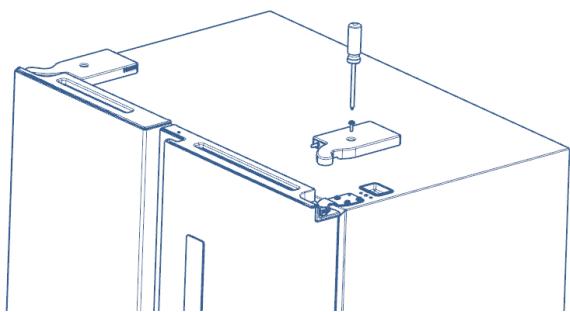
- Disconnect the cable bundle.
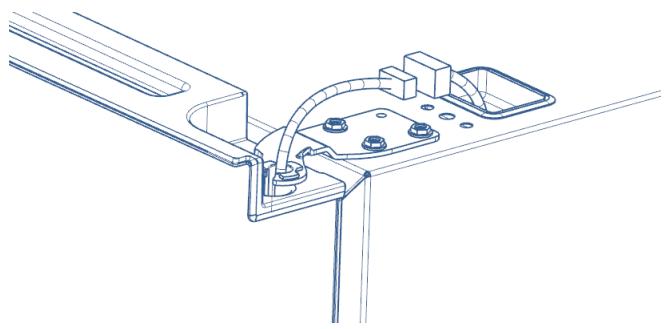
- Unscrew the upper hinge.
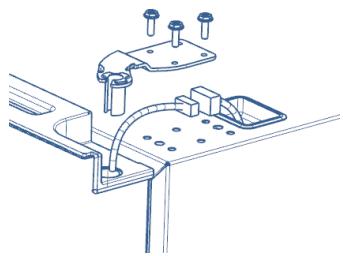
- Lift the door and place on a soft, padded surface. Then remove the other door following the same procedure.
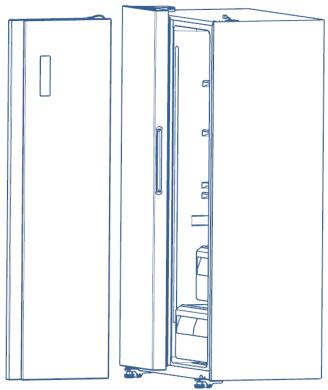
- Unscrew the lower hinges.
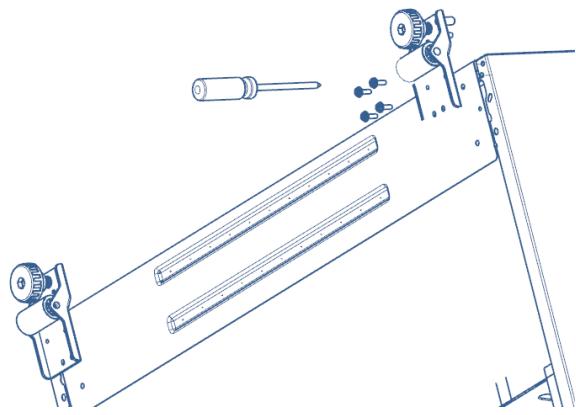
- Once the appliance is in position, replace the doors following the procedure in reverse.
Space required
- Choose a location which is not directly exposed to sunlight.
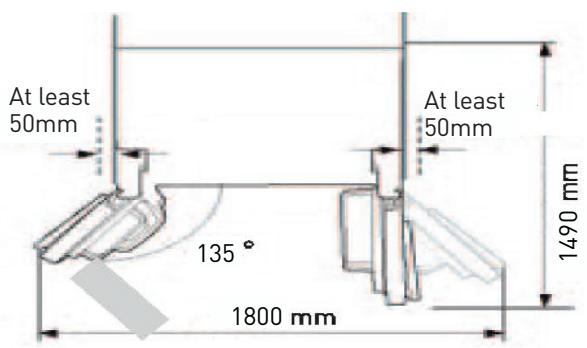
- Make sure that sufficient space is available so that the doors can be opened easily.
- Choose a place in which the ground is level (or almost level).
- Make sure that there is sufficient space for the refrigerator to be installed on a level surface.
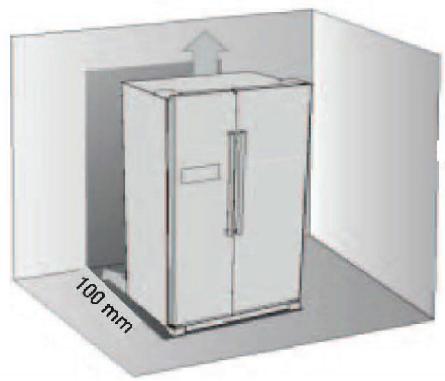
- Allow space to the right, left, rear and above the appliance when you install it. This will help to reduce its electricity consumption and thus your energy bills.
Levelling and stabilizing the refrigerator
B Using the appliance
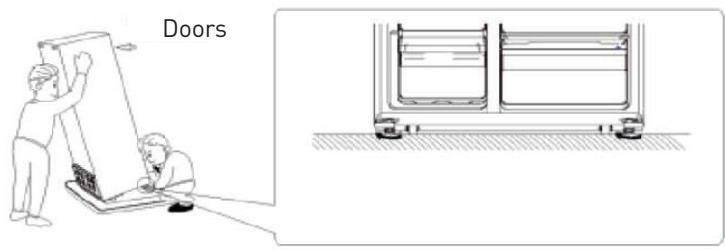
- Level and stabilize the refrigerator by adjusting the feet.
- Turn the feet clockwise to raise them manually.
- Turn the feet anticlockwise to lower them manually.
Environment
Install this appliance in a place in which the ambient temperature corresponds to the climate class indicated on the nameplate.
Location
- The appliance must be installed at a distance from heat sources, such as radiators, boilers, direct sunlight, etc. Ensure that air can circulate freely at the rear of the appliance. If the appliance is positioned underneath a wall unit, the distance between the top of the appliance and the wall unit should be at least 100mm for optimum efficiency. In as far as possible, it is always preferable not to position the appliance under wall cabinets. The appliance can be levelled precisely thanks to one or more adjustable feet at the bottom.
CAUTION
It must be possible to disconnect the appliance from the electricity supply; The plug must be easily accessible after installation.
Electrical connections
Before connecting the appliance, check that the voltage and frequency indicated on the nameplate correspond to your domestic power supply. The appliance must be earthed. There is a contact in the plug on the supply cable for this purpose. If your domestic power supply is not earthed, connect the appliance to the earth by another means according to the regulations in force and following the recommendations of a qualified electrician.
The manufacturer accepts no liability if the above-mentioned safety measures are not respected.
The appliance is compliant with European directives.
Use
Before using the appliance for the first time
Cleaning the interior
Before using the appliance for the first time, wash the interior and all internal accessories with lukewarm water and a neutral soap to remove the characteristic odour of new products. Then dry thoroughly.
NOTE
Do not use abrasive powders or detergents as they will damage the finish of the appliance.
Daily use
Freezing fresh food
- The freezing compartment is used to freeze fresh food and to keep food frozen and deep-frozen for a long period of time.
- Place the fresh food that you wish to freeze in the lower compartment. The maximum quantity of food that can be frozen in 24 hours is indicated on the nameplate.
- The freezing process takes 24 hours; do not add any other food to be frozen during this period.
Storing deep-frozen food
When using for the first time or after an extended period of downtime, allow the appliance to run at the lowest temperature setting for at least 2 hours before placing products in the compartment.
NOTE
In the event of accidental defrosting (for example, if the power is cut for a period longer than shown in the technical specifications table under the heading "Rise in temperature period"), the defrosted food must be eaten quickly or cooked immediately and then refrozen (after cooking).
CAUTION
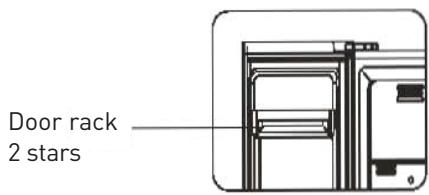
The 2 star door rack, whose temperature is between -12°C and -18°C, is not suitable for storing ice-cream.
Defrosting
Frozen or deep-frozen food can be defrosted in the refrigeration compartment or at room temperature, depending on the time available, before they are used. Small amounts or pieces of food can be cooked from frozen as soon as they are taken out of the freezer. In this case, they will take longer to cook.
Accessories
Removable shelves
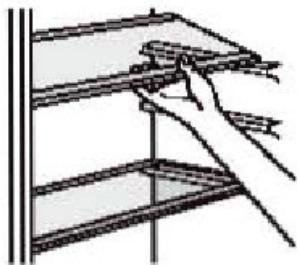
The refrigerant walls are fitted with different runners so that you can position the shelves as you wish.
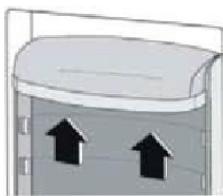
Positioning the door racks
The door racks can be positioned at different heights to allow you to store food packaging of different sizes. Follow the method outlined below to make these adjustments: pull the tray gradually in the direction of the arrows until this comes away completely. Then reposition these to suit your needs.
Useful hints and tips
Tips for freezing
Here is some important advice in order to optimise the freezing process:
The maximum quantity of food that can be frozen in 24 hours is indicated on the nameplate. - The freezing process lasts 24 hours. Additional food products should not be added during this period. - You should only freeze fresh, perfectly clean, high-quality food products. - Prepare small portions so that they can freeze through quickly and so that you have the option of only defrosting the quantity that you need. - Wrap food in aluminium foil or cling film and make sure that the parcels are airtight. - Do not allow fresh, unfrozen food to come into contact with food which is already frozen as this would increase the temperature of the latter. - Food which is low in fat keeps better and for longer periods than fatty foods. Salt reduces the storage time of food. - Ice cubes can cause burns linked to the cold if consumed straight from the freezer compartment. - Frozen food can cause burns linked to the cold if consumed just after they have been removed from the freezer compartment. - It is advisable to make sure that the date is visible on each individual frozen portion so that its storage time can be monitored.
Advice for the storage of frozen food.
To optimise the performance of this appliance, you must:
- Ensure that deep-frozen food products have been stored correctly by the retailer;
- Ensure that deep-frozen food is transferred from the food store to your freezer as quickly as possible;
- Avoid opening the door too often or leaving it open for longer than is necessary;
- Avoid re-freezing defrosted food, as it will spoil quickly;
- Avoid exceeding the use-by date indicated by the manufacturer.
Advice for the refrigeration of fresh food
For optimum performance:
- Do not put hot food or liquids which evaporate in the refrigerator. Cover or wrap food, particularly if it has a strong flavour.
Refrigeration advice
Useful tips:
- Make sure that food is wrapped in polythene bags and placed on the glass shelves above the vegetable compartment.
- As a precaution, only keep food in this way for a maximum of one or two days. Cooked food, cold dishes, etc.: these products should be covered and may be placed on any of the shelves.
- Fruits and vegetables: these products must be washed thoroughly and placed in the specific compartment(s) provided.
- Butter and cheese: these products must be placed in special, airtight containers or wrapped in aluminium foil or polythene bags to expel as much air as possible.
- Bottles of milk: these products must be fitted with a lid and kept in the door racks.
- Bananas, potatoes, onions and garlic should not be kept in the refrigerator unless they are wrapped.
Temperature Setting Recommendation
| Environment Temperature | Temperature Setting |
| Thermostat setting for ambient T°C: | Fridge set on 3°C |
| NORMAL ≈ +24°C (± 4°C) | Freezer set on -18°C |
| Thermostat setting for ambient T°C: | Fridge set on 3°C |
| COLD ≈ +16°C (± 4°C) | Freezer set on -18°C |
| Thermostat setting for ambient T°C: | Fridge set on 3°C |
| WARM ≈ +32C (± 4°C) | Freezer set on -19°C |
- Information above gives users recommendation of temperature setting.
Impact on Food Storage
- Under Recommended setting, the best storage time of fridge is no more than 3 days.
- Under Recommended setting, the best storage time of freezer is no more than 1 month.
- The best storage time may reduce under other settings.
CAUTION
When you adjust the temperature, this will be an average temperature inside the entire refrigerator unit.
CAUTION
The temperatures inside each compartment may therefore differ from the temperature values indicated on the panel, depending on the quantity of food stored and the way it has been positioned. The ambient temperature may also cause the temperature inside the appliance to vary.
Cleaning and maintenance
For hygiene reasons, the interior of the appliance and its interior accessories should be cleaned regularly.
CAUTION

Risk of electric shock! The appliance must not be connected to the mains during cleaning. Before cleaning, switch off the appliance and disconnect
the plug from the power supply or turn off the circuit breaker or remove the fuse.
CAUTION
Never clean the appliance using a steam cleaner. Moisture could accumulate in the electrical components which could create a risk of electric shock! Hot vapour could damage plastic parts. The appliance must be completely dry before it is switched on again.
CAUTION
Essential oils and organic solvents, such as lemon juice or juice from orange rind, butyric acid and cleaning products containing acetic acid can attack plastic parts.
- Do not allow these substances to come into contact with appliance parts.
- Do not use any abrasive product.
- Remove food from the freezer. Cover and place them in a cool place.
- Switch off the appliance and remove the mains plug or switch off the appliance and turn off the circuit breaker or remove the fuse.
- Clean the appliance and interior accessories using a cloth soaked in lukewarm water. After cleaning, rinse with clean water and dry with a cloth.
- Once everything is dry, you can switch the appliance back on again.
Troubleshooting
CAUTION
Disconnect the power supply before carrying out any repair work. Only an authorised electrician or other qualified individual may carry out repair work which is not described in this manual.
NOTE
Certain noises can be heard during normal use (compressor, coolant circulation).
NOTE
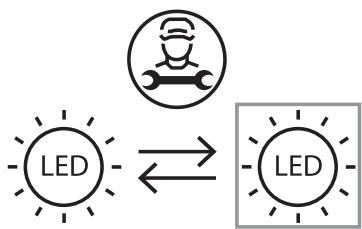
LED bulbs cannot be replaced by the user. Contact the after-sales service in the event of a malfunction.
| Problems | Potential causes | Solutions |
| The appliance does not work. | The mains plug is not connected or has not been inserted properly. | Insert the mains plug properly. |
| The fuse has blown or is faulty. | Check the fuse and replace if necessary. |
| The power point is faulty. | Malfunctions in the mains much be repaired by an electrician. |
| The food is too warm. | The temperature has not been adjusted properly. | Please consult the initial section relating to temperature adjustments. |
| The door was left open for a prolonged period of time. | Do not leave the door open for longer than is necessary. |
| A large amount of warm food has been placed in the appliance during the past 24 hours. | Set the appliance temporarily to a colder temperature. |
| The appliance is near a heat source. | Please consult the section relating to the installation position of the appliance. |
| The appliance cools too much. | The temperature adjustment is too cold. | Turn the temperature button temporarily to a warmer setting. |
| Unusual noises. | The appliance is not straight. | Readjust the feet of the appliance. |
| The appliance is touching the wall or other objects. | Shift the appliance slightly. |
| A component, e.g. a pipe at the back of the appliance, has come into contact with another part of the appliance or the wall. | If necessary, bend the part carefully to move it away. |
| Presence of water on the floor. | The water outlet is blocked. | Refer to the “Cleaning and maintenance” chapter. |
| The side panels are hot. | This is normal. Heat is exchanged inside the side panels. | Wear gloves to touch the side panels if necessary. |
If the malfunction persists, contact the maintenance centre.
Changing the Light
This product contains a light source of energy efficiency class G.
Light source in this product can only be replaced by qualified professionals.
Please contact after-sales service if the light source fails.
The light source shall be removed at the end of the product's useful life, with sorting and recycling done separately.
Thank you!