 ManualGo.com
 CALVI LATTE XP345810 - Machine à café KRUPS - Free user manual and instructions
Find the device manual for free CALVI LATTE XP345810 KRUPS in PDF.


Download the instructions for your Machine à café in PDF format for free! Find your manual CALVI LATTE XP345810 - KRUPS and take your electronic device back in hand. On this page are published all the documents necessary for the use of your device. CALVI LATTE XP345810 by KRUPS.
USER MANUAL CALVI LATTE XP345810 KRUPS
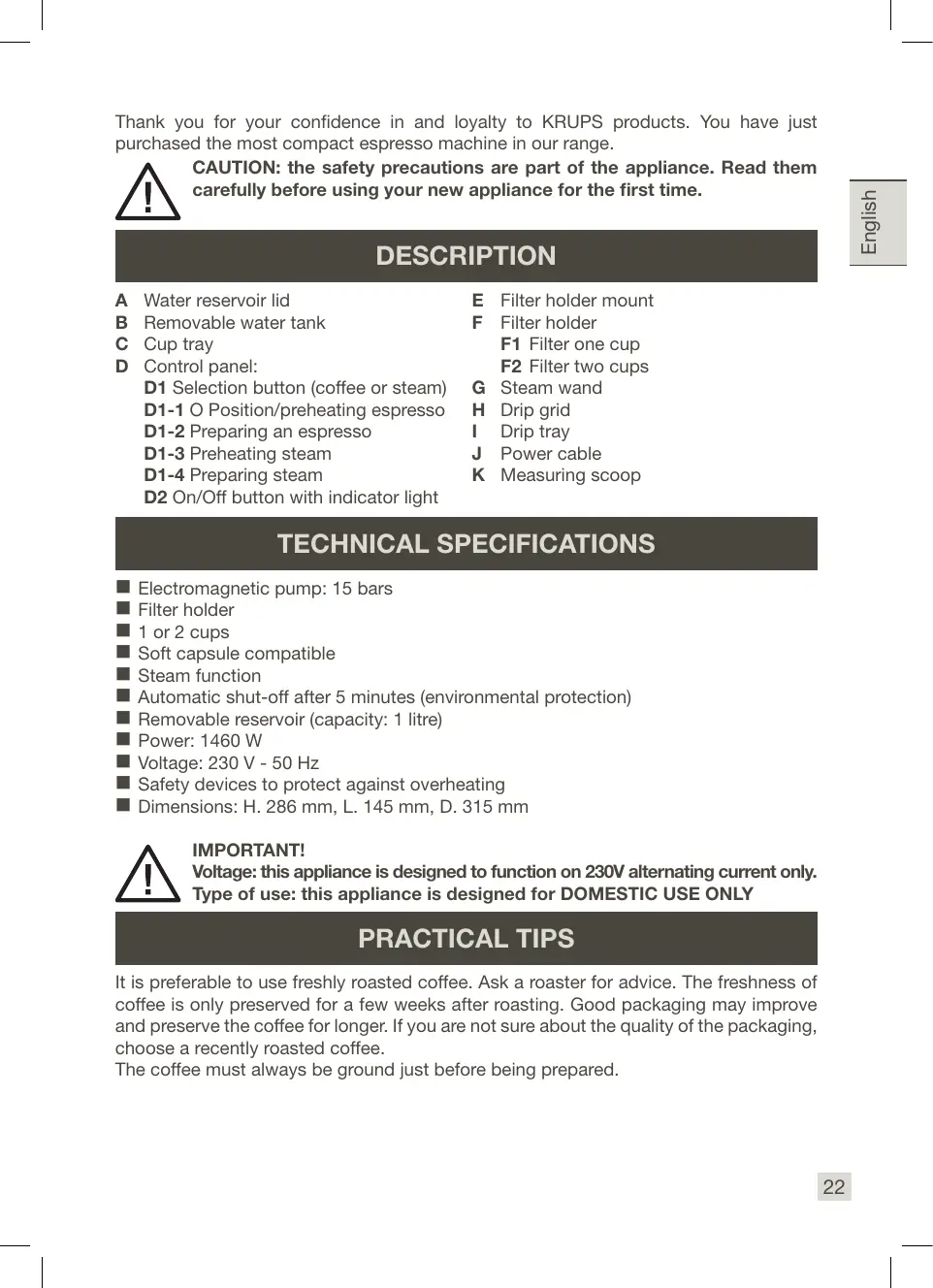
Thank you for your confidence in and loyalty to KRUPS products. You have just purchased the most compact espresso machine in our range. CAUTION: the safety precautions are part of the appliance. Read them carefully before using your new appliance for the first time.
Removable water tank Cup tray Control panel: D1 Selection button (coffee or steam) D1-1 O Position/preheating espresso D1-2 Preparing an espresso D1-3 Preheating steam D1-4 Preparing steam D2 On/Off button with indicator light
E Filter holder mount
F Filter holder F1 Filter one cup F2 Filter two cups G Steam wand H Drip grid I Drip tray J Power cable K Measuring scoop
TECHNICAL SPECIFICATIONS
Electromagnetic pump: 15 bars Filter holder 1 or 2 cups Soft capsule compatible Steam function Automatic shut-off after 5 minutes (environmental protection) Removable reservoir (capacity: 1 litre) Power: 1460 W Voltage: 230 V - 50 Hz Safety devices to protect against overheating Dimensions: H. 286 mm, L. 145 mm, D. 315 mm IMPORTANT! Voltage: this appliance is designed to function on 230V alternating current only.
Type of use: this appliance is designed for DOMESTIC USE ONLY PRACTICAL TIPS It is preferable to use freshly roasted coffee. Ask a roaster for advice. The freshness of coffee is only preserved for a few weeks after roasting. Good packaging may improve and preserve the coffee for longer. If you are not sure about the quality of the packaging, choose a recently roasted coffee.
The coffee must always be ground just before being prepared.
What type of coffee should i choose?
For a coffee rich in aroma
Choose pure Arabica coffee or those made from a majority of Arabica coffee.
Artisan roasted coffees are the best as they offer more complex and refined aromas. To vary the flavours, try pure origin coffees.
For a full-bodied coffee
Choose Robusta blended coffees - not specified 100% Arabica - Italian roasted coffees, or those specified as Italian.
Keep ground coffee in the fridge to maintain its flavour for longer. Do not fill your filter holder to the top, but use the measuring scoop (1 scoop for a 50ml cup, 2 scoops for two 50ml cups). Remove excess coffee from the rim of the filter holder. If you do not use the appliance for longer than 5 days, empty and rinse the water tank. Before removing the tank to fill or empty it, always ensure that the appliance is switched off. Always place the appliance on a flat, stable surface.
USING FOR THE FIRST TIME - or after long periods of not using your Espresso maker.
Rinsing and preparing the system before first use.
Before using your coffee machine, clean all the accessories in soapy water and then dry.
Rinse the system following the procedure below: Plug your machine in (1). Open the lid (A) and remove the water tank (B) (2). Fill the tank with water at room temperature and place it back on the appliance, ensuring that it is positioned correctly. Close the lid (3-4). Ensure that the selection button (D1) is in the O position (D1-1) (5). Switch on the appliance by pressing the on/off button (D2). A short beep will sound, this is completely normal. This corresponds to the switching on/off of the pump (6). The temperature light flashes and then remains on (7). Insert the filter holder (F) (without coffee) into the appliance: turn it to the right as far as it will go (8). Place a container with a volume greater than 1/2 litre under the steam wand (9). Turn the selection button to Steam preheat (D1-3) (10). The button flashes and then remains on: you can now turn the selection button to the Steam position (D1-4) for approximately 20 seconds (11). Turn the selection button to the O position (D1-1) (12). Then place a 1/2 litre container under the filter holder (13). Turn the selection button to the Espresso position (D1-2) (14). Allow water to flow from the tank, equivalent to four 50ml espresso cups To stop the water flowing through, turn the selection button to the O position (15). If the water doesn't flow through (pump initiation) repeat the procedure from the beginning without the filter holder. Leave to cool and repeat this procedure four times making sure that the tank contains enough water. Leave your appliance to cool between each operation. Remove the tank, empty, rinse carefully and place back in the appliance.
After five minute of non-use, your appliance will switch off automatically in order to help protect the environment. IMPORTANT! A beep will sound each time the appliance is switched on or off (when pressing the on/off button (D2)). This is completely normal. This corresponds to the switching on/off of the pump (4).
PREPARING ESPRESSO IMPORTANT!
If the espresso machine is being used for the first time, the appliance must be cleaned as described in the paragraph "USING FOR THE FIRST TIME".
The type of ground coffee you choose will determine the strength and flavour of your espresso: the finer the coffee, the more intense the espresso.
Fill the tank with water at room temperature and place it back on the appliance, ensuring that it is positioned correctly (3-4). Plug your machine in (1). Switch on the appliance by pressing the on/off button. A short beep will sound, this is completely normal. This corresponds to the switching on of the pump (6). The temperature light flashes while it is heating up and then remains on (7). The appliance is now ready to use. Unlock the filter holder by turning it to the left (16). Add the filter for 1 cup or the filter for 2 cups to the filter holder (17). Using the measuring scoop, add your ground coffee. (1 scoop = 1 cup, 2 scoops = 2 cups) to the filter (18). Remove excess coffee from the rim of the filter holder. Insert the filter holder into the appliance, pushing it firmly to the right as far as it will go (8). Place one or two cups on the drip tray grid under the filter holder (19). Turn the selection button to the espresso position (D1-2) (19). After a few moments, the coffee will flow through. When the cup(s) is/are full, return the selection button to the O position (15). Remove the cup(s). Unlock the filter holder by turning it to the left. Remove it from the appliance (16). To discard the grounds, turn the filter holder over while holding the filter in place using the tab to allow just the coffee grounds to fall out (20). Wash the filter holder and filter under running water to remove any remaining grounds (21). For best results, we recommend that you preheat the accessories in advance (filter holder, filter and cup) following the steps below without adding coffee. Leave your appliance to cool if you have made five 50ml coffees consecutively.
Your machine is compatible with soft capsules (generally 60mm in diameter). Given that this type of capsule is not specifically designed for espresso machines, you will obtain a less intense coffee than with ground coffee.
Fill the water tank with water at room temperature and place it back on the appliance (3-4). Switch on the appliance by pressing the on/off button (6). The light flashes while it is preheating and then remains on. The appliance is now ready to use (7). Unlock the filter holder by turning it to the left (16). Place a soft capsule in the filter one cup. Capsules are designed to make one cup of coffee. Using two capsules on top of each other is not recommended (22). Insert the filter holder into the appliance, pushing it firmly to the right as far as it will go (8). To prepare your espresso, follow the procedure for preparing an espresso with ground coffee. Leave your appliance to cool if you have made five coffees consecutively.
STEAM FUNCTION Steam is used to foam milk (to prepare cappuccinos, for example).
To produce steam, turn the selection button to the Preheat position (D1-3). (10). The on/off light will flash again and then remain on. The appliance is now ready to use (7). Add 60 to 100ml milk to a container. For best results, we recommend that you use a narrow, fairly short container to fit under the steam wand. The milk and its container must be very cold for optimal results. As soon as the light stays on, plunge the steam wand into the milk without touching the bottom of the container (23). Turn the selection button to the steam position (D1-4) (24). For best results, foam the milk from the bottom of the container but without touching the bottom, for about 10 seconds. Next, tilt and move the container up progressively such that the wand comes to the surface of the milk. Ensure that the wand does not come out of the milk. For best foaming results, make circular movements (25). In order to obtain good quality milk froth, we recommend that you use pasteurised or UHT milk and avoid using unpasteurised or skimmed milk. Once you have foamed the milk, turn the selection button to the O position (12). At this time the appliance will cool automatically, starting two to three pump cycles intermittently. Once this automatic operation has finished, you can prepare an espresso. After turning off the steam, quickly and carefully clean the steam wand using a damp sponge (to ensure that residues do not remain stuck). Place a container containing water under the steam wand and repeat the milk foaming procedure exactly, in order to clean the wand. To avoid overheating the milk, do not foam for longer than 60 seconds. The steam wand is limited to 75 second of use in order to avoid overheating.
Warning! To avoid splashing milk, do not let the wand move above the surface of the milk when using the steam function. IMPORTANT! Warning! The steam wand is still hot! Take care not to burn yourself! IMPORTANT! After switching off the steam, immediately and carefully clean the steam wand as described in the paragraph on: CLEANING AND SERVICING.
CLEANING AND SERVICING A. The appliance
Unplug the appliance from the power socket each time you clean it, and leave to cool. Clean the outside of the appliance from time to time with a damp sponge. Clean and dry the tank, drip tray and grid regularly.
Rinse the inside of the tank regularly. When a fine white layer clouds your tank, follow the descaling process (see paragraph DESCALING).
Do not use alcohol-based cleaning products or solvents. After you have unplugged the appliance, regularly clean the grid through which the water passes, as well as the watertight seal, using a damp sponge (26).
Clean using only a damp cloth without any detergent or scourer.
B. The filter holder
Using a damp cloth, clean the filter holder mount regularly in order to remove possible coffee residues stuck to the surface (26).
In order to prolong the useful life of the watertight seal on the brewing head, do
not put the filter holder back in place if the coffee machine has not been used for extended periods.
To remove any deposits that could block the flow of your 1 or 2 cup filter, you may use the needle (32).
This must be emptied each time the appliance is used. If several espressos are prepared consecutively, it is recommended that you empty it regularly (27-28) (approximately every five cups). The presence of water is normal and is not a sign of leakage. If necessary, clean the drip tray and the grid with water and a small amount of mild washing up liquid.
Place a container containing water under the steam wand. To produce steam, turn the selection button to the Preheat position (D1-3) (10). The on/off light will flash again and then remain on. The appliance is now ready to follow the steam cleaning cycle.
As soon as the light stays on, plunge the steam wand into the water without touching the bottom of the container.
Turn the selection button to the steam position (D1-4) (24). Turn on for 20 seconds. After turning off the steam, quickly and carefully clean the steam wand using a damp sponge (in order to remove any residue).
The end of the wand can be removed using the measuring scoop for a deeper clean. Take care not to lose the watertight seal on this end piece (29).
Rinse it under the tap and then remove any residues using a damp sponge (30). You can unblock the wand outlet using a needle. Screw it back on using the measuring scoop, checking that the seal is still there, and making sure that the end piece is screwed on correctly (31).
Warning! Do not clean any parts of this appliance in a dishwasher.
DESCALING Regularly descaling your appliance, as described in paragraphs A and B for coffee and steam function, is the main factor in prolonging its useful life. The frequency with which you descale the appliance is related to the hardness of your water. Get advice from your water supplier.
During this procedure, do not place your appliance on a marble work surface. The descaler might alter it. To help you, below is a table indicating the frequency with which you should descale the appliance depending on the hardness of the water used in the machine: DESCALING FREQUENCY Average number of coffees per week
If in doubt, monthly descaling is recommended.
No repairs on the coffee machine in the case of: no descaling carried out, limescale build-up, accessories cleaned in a dishwasher, will be covered by the guarantee.
A. Descaling the system
Unplug the appliance. Insert the filter holder (without coffee) into the appliance and lock it in place, turning it to the right as far as it will go (8).
Place a container with a volume greater than 1/2 litre under the filter holder (13). Ensure that the selection button (D1) is in the O position (D1-1) (5). Fill the tank with a mixture of three parts water to one part vinegar or citric/sulfamic acid. Plug the appliance in (1). Switch on the appliance by pressing the on/off button (6). 27
When the temperature light on the on/off button remains on, you can then move the selection button (D1) to the Espresso position (D1-2).
Leave the mixture to cool (1/4 of the volume). Switch the appliance off by pressing the on/off button and leaving the selection button (D1) in the Espresso position (D1-2).
Wait 5 to 10 minutes, then repeat the procedure twice. Ensure that you do not empty the tank completely (in the case of deactivation, see paragraph: USING FOR THE FIRST TIME).
Now follow the descaling instructions for the steam function.
B. Descaling the steam system
Place a container under the steam wand (9). Turn the selection button (D1) to the steam position (D1-4) (without switching off the preheat function (D1-3).
Switch on the appliance by pressing the on/off button (6). Leave the mixture to flow through the wand until steam appears. Turn the selection button to the O position (D1-1) (12). At this time the appliance will cool automatically, starting two to three pump cycles intermittently. Hot water and/or steam will flow into the drip tray.
Wait 2 to 4 minutes, then repeat the procedure. Ensure that you do not empty the tank completely (in the case of deactivation, see paragraph: USING FOR THE FIRST TIME).
IMPORTANT! After descaling, rinse two or three times with clean water (without coffee), as described in the paragraph on " USING FOR THE FIRST TIME". Do not forget to rinse the steam wand. The appliance has been descaled and is ready to use again.
GUARANTEE Your appliance is guaranteed, however, any connection or handling error, or use other that that described in the instructions will render the guarantee void.
This appliance is guaranteed for domestic use only, any other type of use will render the guarantee void. No repairs due to a build-up of limescale shall be covered by the guarantee. For any after-sales problem or for spare parts, please contact your retailer or an approved service centre.
SOLUTIONS TO POSSIBLE PROBLEMS PROBLEMS The grounds damp.
The espresso through too slowly.
POSSIBLE CAUSES SOLUTIONS
very You haven't added enough Add more coffee. ground coffee. flows The ground coffee is too Choose a slightly more fine, too greasy or floury. granular coffee.
The filter holder is dirty.
Clean the filter holder according to the instructions in paragraph CLEANING AND SERVICING - B. The filter holder. Clean also the filter.
The grid through which the When the appliance has water passes is clogged. cooled, clean the grid with a damp sponge.
Your appliance has a build- Descale your machine up of limescale. according to the instructions in the user manual. The user sees prolonged Scale build-up is occurring Immediately descale water flow from the filter on your machine because your machine as per the directions for use. holder after making an of particularly hard water. espresso. Presence of coffee grounds The filter holder is clogged. Clean the filter holder with in the cup. hot water. The coffee is too fine.
Use a slightly granular coffee.
The hinge on which the Clean the filter holder filter holder is mounted is mount and hinge with a clogged. damp sponge.
No crema on the espresso. The coffee is too old.
Use freshly ground coffee.
The coffee is not suitable Use finer ground coffee. for espresso.
There is too little coffee in Add ground coffee. the filter. The water tank leaks when The valve at the bottom Clean the water tank and carried. of the tank is dirty or open the valve at the bottom defective. of the tank with a finger. The valve is blocked by Descale your machine limescale. according to the instructions in the user manual.
POSSIBLE CAUSES Water is leaking under the There's an internal leak. appliance.
SOLUTIONS Check that the tank is fitted correctly. If the leak continues, do not use the appliance, contact an approved service centre.
PROBLEMS The drip tray has not been Check that the drip tray is fitted correctly. pushed to the back of the appliance.
The drip tray is overflowing. Empty and carefully rinse the drip tray and replace. The cups have been filled The filter holder is clogged. Please refer to the unequally. paragraph on CLEANING AND SERVICING for servicing your filter holder. The pump is abnormally There is no water in the Fill the tank with water hot. tank. and re-initiate the pump (see paragraph: USING FOR THE FIRST TIME). Avoid emptying the tank completely. The espresso leaks over The filter holder is not Put the filter holder in place the edges of the filter. positioned correctly. and lock it (turning it from left to right as far as it will go). Remove excessive coffee grounds that prevent the filter holder to be locked. The rim of the filter holder Remove excessive coffee is encrusted with coffee grounds and clean the grid grounds. through which water passes with a damp sponge. The soft capsule positioned incorrectly.
is Check that the soft capsule has been inserted correctly: the paper must not protrude out of the filter.
The appliance was not Rinse the appliance rinsed correctly after according to the descaling. instructions and check the quality of the coffee.
PROBLEMS The appliance work
POSSIBLE CAUSES SOLUTIONS
doesn't The pump has been Fill the tank with water deactivated due to a lack and re-initiate the pump of water.
(see paragraph: USING FOR THE FIRST TIME). Avoid emptying the tank completely. The removable water tank Position the water tank has been fitted incorrectly. correctly.
The steam wand does not The steam wand is Descale the steam wand foam the milk. blocked or has an excess according to the paragraph of limescale. on Descaling or unblock it using a needle.
The milk is too hot.
The shape of the container Use a small jug. is not suitable.
Follow the milk foaming instructions (paragraph on STEAM FUNCTION). If it is not possible to identify the cause of a malfunction, please contact an approved service centre. Never disassemble the appliance. (if the appliance has been disassembled, the guarantee may no longer be valid).
ELECTRIC OR ELECTRONIC PRODUCT AT END OF LIFE We participate in the protection of the environment!
Your appliance contains a number of materials that can be reused or recycled. Take it to a collection point or an approved service centre so that it can be dealt with appropriately.