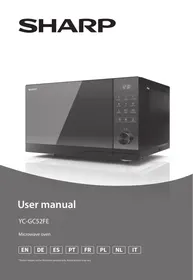
USER MANUAL YC-GC52BE-B - YC-GC52BE-B SHARP
Your product is marked with this symbol. It means that used electrical and electronic products should not be mixed with general household waste. There is a separate collection system for these products.
1. In the European Union
Attention: If you want to dispose of this equipment, please do not use the ordinary dustbin!
Used electrical and electronic equipment must be treated separately and in accordance with legislation that requires proper treatment, recovery and recycling of used electrical and electronic equipment.
Following the implementation by member states, private households within the EU states may return their used electrical and electronic equipment to designated collection facilities free of charge*.
In some countries* your local retailer may also take back your old product free of charge if you purchase a similar new one.
*) Please contact your local authority for further details.
If your used electrical or electronic equipment has batteries or accumulators, please dispose of these separately beforehand according to local requirements. By disposing of this product correctly you will help ensure that the waste undergoes the necessary treatment, recovery and recycling and thus prevent potential negative effects on the environment and human health which could otherwise arise due to inappropriate waste handling.
2. In other Countries outside the EU
If you wish to discard this product, please contact your local authorities and ask for the correct method of disposal.
For Switzerland: Used electrical or electronic equipment can be returned free of charge to the dealer, even if you don't purchase a new product.
Further collection facilities are listed on the homepage of www.swico.ch or www.sens.ch.
1. In the European Union
If the product is used for business purposes and you want to discard it: Please contact your SHARP dealer who will inform you about the take-back of the product. You might be charged for the costs arising from take-back and recycling. Small products (and small amounts) might be taken back by your local collection facilities.
For Spain: Please contact the established collection system or your local authority for take-back of your used products.
2. In other Countries outside the EU
If you wish to discard of this product, please contact your local authorities and ask for the correct method of disposal.
PRECAUTIONS TO AVOID POSSIBLE EXPOSURE TO MICROWAVE ENERGY
- Do not attempt to operate this oven with the door open as this can result in harmful exposure to microwave energy. It is important not to defeat or tamper with the safety interlocks.
- Do not insert anything between the oven front face and the door or allow debris or cleaner residue to accumulate on sealing surfaces.
- Do not operate the oven if it is damaged. It is very important that the oven door closes properly and that there is no damage to the door, hinges, latches or door seals and sealing surfaces.
- Do not attempt to repair or adjust the oven.
CONTENTS
IMPORTANT SAFETY INSTRUCTIONS 3 INSTALLATION 12 SPECIFICATIONS 14 OVEN AND ACCESSORIES 15 CONTROL PANEL. 16 BEFORE OPERATION 17 SETTING THE CLOCK. 17 EXPRESS COOKING 17 MICROWAVE COOKING 17 GRILL 17 MICROWAVE+GRILL 18 CONVECTION 18 MICROWAVE+CONVECTION 18 WEIGHT DEFROST 18 TIMEDEFROST 19 KITCHEN TIMER 19 FAVOURITE FUNCTION 19 POWERSAVINGFUNCTION. 19 MUTE FUNCTION 19 CHILD LOCK. 20 SAFETY LOCK 20 AUTOMATIC PROTECTION MECHANISM 20 AUTO COOK 20 CLEANING AND CARE 21 SUITABLE OVENWARE 22 MICROWAVE COOKING ADVICE 23 DEFROSTING ADVICE 25 REHEATING ADVICE 26 TROUBLESHOOTING 27 RADIO INTERFERENCE 28 BEFORE CALLING FOR ASSISTANCE 28
IMPORTANT SAFETY INSTRUCTIONS
READ CAREFULLY AND KEEP FOR FUTURE REFERENCE
To avoid the danger of fire.
The microwave oven should not be left unattended during operation. Power levels that are too high, or cooking times that are too long, may overheat foods resulting in a fire.
This oven is designed to be used on a countertop only. It is not designed to be built into a kitchen unit.
Do not place the oven in a cabinet.
The electrical outlet must be readily accessible so that the unit can be unplugged easily in an emergency.
The AC power supply must be 230-240 V, 50 Hz, with a minimum 10 A distribution line fuse, or a minimum 10
A distribution circuit breaker.
A separate circuit serving only this appliance should be provided.
Do not place the oven in areas where heat is generated.
For example, close to a conventional oven.
Do not install the oven in an area of high humidity or where moisture may collect.
Do not store or use the oven outdoors.
If smoke is observed, switch off or unplug the oven and keep the door closed in order to stifle any flames.
Use only microwave-safe containers and utensils.
Utensils should be checked to ensure that they are suitable for use in microwave ovens.
When heating food in plastic or paper containers, keep an eye on the oven due to the possibility of ignition.
Clean the waveguide cover and the oven cavity. These must be dry and free from grease. Built-up grease may overheat and begin to smoke or catch fire.
Do not place flammable materials near the oven or ventilation openings.
Do not block the ventilation openings.
Remove all metallic seals, wire twists, etc., from food and food packages. Arcing on metallic surfaces may cause a fire.
Do not use the microwave oven to heat oil for deep frying. The temperature cannot be controlled and the oil may catch fire.
To make popcorn, use only special microwave popcorn makers.
Do not store food or any other items inside the oven.
Check the settings after you start the oven to ensure the oven is operating as desired.
Do not leave the oven unattended while it is operating. To avoid overheating and fire, special care must be taken when cooking or reheating foods with a high sugar or fat content, for example, sausage rolls, pies, or Christmas pudding.
See the corresponding hints in the operation manual.
To avoid the possibility of injury.
WARNING:
Do not operate the oven if it is damaged or malfunctioning. Check the following before use:
a) Make sure the door closes properly and ensure it is not misaligned or warped. b) Check to make sure the hinges and safety door latches are not broken or loose. c) Ensure that the door seals and sealing surfaces have not been damaged. d) Make sure inside the oven cavity or on the door there are no dents. e) Ensure that the power supply cord and plug are not damaged.
If the door or door seals are damaged, the oven must not be operated until it has been repaired by a competent person.
Never adjust, repair, or modify the oven yourself. It is hazardous for anyone other than a competent person to carry out any service or repair operation which involves the removal of a cover that gives protection against exposure to microwave energy.
Do not operate the oven with the door open or alter the door safety latches in any way. Do not operate the oven if there is an object between the door seals and sealing surfaces.
Do not allow grease or dirt to build up on the door seals and adjacent parts. Clean the oven at regular intervals and remove any food deposits.
Follow the instructions for "Care and Cleaning". Failure to maintain the oven in a clean condition could lead to a deterioration of the surface that could adversely affect the life of the appliance and possibly result in a hazardous situation.
Individuals with PACEMAKERS should check with their doctor or the manufacturer of the pacemaker for precautions regarding microwave ovens.
To avoid the possibility of electric shock.
Under no circumstances should you remove the outer cabinet.
Never spill or insert any objects into the door lock openings or ventilation openings. In the event of a spill, turn off and unplug the oven immediately, and call an authorised SHARP service agent.
Do not immerse the power supply cord or plug in water or any other liquid.
Do not let the power supply cord hang over the edge of a table or work surface.
Keep the power supply cord away from heated surfaces, including the rear of the oven.
Keep the appliance and its cord out of reach of children less than 8 years.
Do not attempt to replace the oven lamp yourself or allow anyone who is not an electrician authorised by SHARP to do so. If the oven lamp fails, please consult your dealer or an authorised SHARP service agent.
If the power supply cord of this appliance is damaged, it must be replaced with a special cord.
The exchange must be made by an authorised SHARP service agent.
To avoid the possibility of explosion and sudden boiling:
WARNING: Liquids and other foods must not be heated in sealed containers since they are liable to explode.
Microwave heating of beverages can result in delayed eruptive boiling, therefore care must be taken when handling the container.
Never use sealed containers. Remove seals and lids before use. Sealed containers can explode due to a build up of pressure even after the oven has been turned off.
Take care when microwaving liquids. Use a wide mouthed container to allow bubbles to escape.
Never heat liquids in narrow necked containers such as baby bottles, as this may result in the contents erupting from the container when heated and cause burns.
To prevent sudden eruption of boiling liquid and possible scalding:
- Do not use excessive amount of time.
- Stir liquid prior to heating/reheating.
- It is advisable to insert a glass rod or similar utensil (not metal) into the liquid whilst reheating.
- Let liquid stand for at least 20 seconds in the oven at
the end of cooking time to prevent delayed eruptive boiling.
Do not cook eggs in their shells, and whole hard boiled eggs should not be heated in microwave ovens since they may explode even after microwave cooking has ended. To cook or reheat eggs which have not been scrambled or mixed, pierce the yolks and the whites, or the eggs may explode. Shell and slice hard boiled eggs before reheating them in the microwave oven.
Pierce the skin of such foods as potatoes, sausages and fruit before cooking, or they may explode.
To avoid the possibility of burns.
WARNING: The contents of feeding bottles and baby food jars must be stirred or shaken and the temperature checked before consumption, in order to avoid burns.
Use pot holders or oven gloves when removing food from the oven to prevent burns.
Always open containers, popcorn makers, oven cooking bags, etc., away from the face and hands to avoid steam burns and eruption of boiling.
To avoid burns, always test food temperature and stir before serving and pay special attention to the temperature of food and drink given to babies, children or the elderly. Accessible parts may become hot during use. Young children should be kept away. Temperature of the container is not a true indication of
the temperature of the food or drink; always check the food temperature.
Always stand back from the oven door when opening it to avoid burns from escaping steam and heat.
Slice stuffed baked foods after heating to release steam and avoid burns.
Keep children away from the door to prevent them burning themselves.
To avoid misuse by children.
WARNING: Only allow children aged from 8 years and above to use the oven without supervision when adequate instructions have been given so that the child is able to use the oven in a safe way and understands the hazards of improper use.
When the appliance is operated in the GRILL, MIX GRILL and AUTO MENU operation, children should only use the oven under adult supervision due to the temperature generated.
This appliance is not intended for use by persons (including children) with reduced physical, sensory or mental capabilities, or lack of experience and knowledge, unless they have been given supervision or instruction concerning use of the appliance by a person responsible for their safety. Children should be supervised to ensure that they do not play with the appliance. Models with Electronic touch panel are enabled with a child lock mode.
Do not lean or swing on the oven door. Do not play
with the oven or use it as a toy.
Children should be taught all important safety instructions: use of pot holders, careful removal of food coverings - paying special attention to packaging (e.g. self-heating materials) designed to make food crisp, as they may be extra hot.
Other warnings
Never modify the oven in any way.
Do not move the oven while it is in operation.
This appliance is intended to be used in household.
This oven is for home food preparation only and may only be used for cooking food and beverages. Drying of food or clothing and heating of warming pads, slippers, sponges, damp cloth and similar may lead to risk of injury, ignition or fire. It is not suitable for commercial or laboratory use.
Never operate the oven when it is empty. When using a browning dish or self-heating material, always place a heat-resistant insulator such as a porcelain plate under it to prevent damage to the oven base due to heat stress. The preheating time specified in the dishes instructions must not be exceeded.
Do not use metal utensils, which reflect microwaves and may cause electrical arcing. Do not put cans in the oven.
To prevent the base of the oven breaking:
a) Before cleaning the oven base with water, leave the flat-bed to cool. b) Do not put hot foods or hot utensils on a cold oven base. c) Do not put cold foods or cold utensils on a hot oven base.
Do not place anything on the outer cabinet during operation.
NOTE:
Do not use plastic containers for microwaving if the oven is still hot from using the GRILL and MIX GRILL operation because they may melt.
Plastic containers must not be used during above modes unless the container manufacturer says they are suitable.
If you are unsure how to connect your oven, please consult an authorised, qualified electrician.
Neither the manufacturer nor the dealer can accept any liability for damage to the oven or personal injury resulting from failure to observe the correct electrical connection procedure.
Water vapour or drops may occasionally form on the oven walls or around the door seals and sealing surfaces. This is a normal occurrence and is not an indication of microwave leakage or a malfunction.

This symbol means that the surfaces are liable to get hot during use.
INSTALLATION
- Remove all packing materials from the inside of the oven cavity and remove any protective film found on the microwave oven cabinet surface.
- Check the oven carefully for any signs of damage.
- Place the oven on a secure, level surface, strong enough to take the oven weight, plus the heaviest item likely to be cooked in the oven. Do not place the oven in a cabinet.
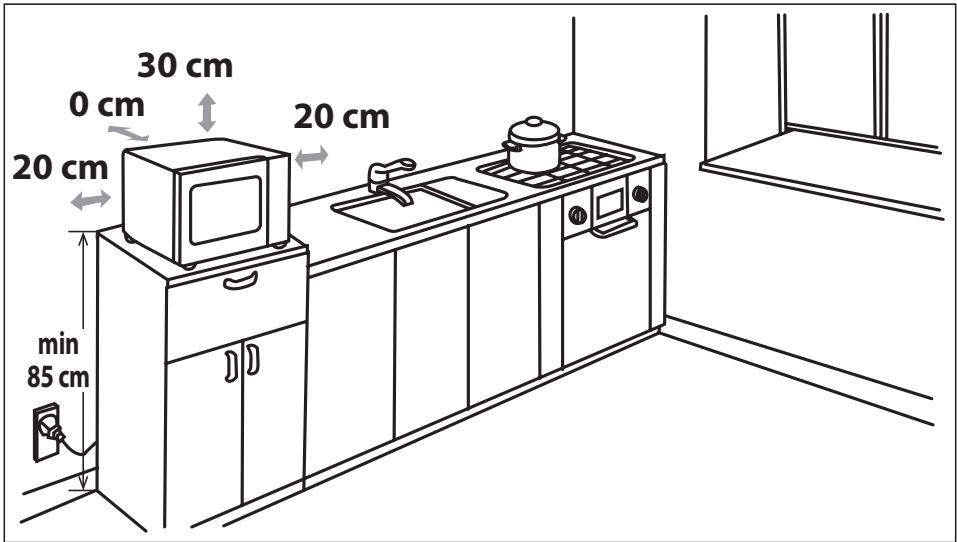
- Select a level surface that provides enough open space for the intake and/or outlet vents. See picture on the first page.
The rear surface of the appliance can be placed against a wall.
- The minimum installation height is 85 cm.
- A minimum space of 20 cm is required between the sides of the microwave oven and any adjacent walls or objects.
- Leave a minimum space of 30 cm above the oven.
- Do not remove the feet from the bottom of the oven.
- Blocking the intake and/or outlet openings can damage the oven.
- Place the oven as far away from radios and TV as possible. Operation of the microwave oven may cause interference to your radio or TV reception.
- Securely connect the plug of the oven to a standard earthed (grounded) household electrical outlet.
WARNING: Do not place the oven where heat, moisture or high humidity are generated, (for example, near or above a conventional oven) or near combustible materials (for example, curtains). Do not block or obstruct air vent openings. Do not place objects on top of the oven. Do not touch the exterior of the microwave oven during or shortly after operation as it will be hot.
SPECIFICATIONS
| Model name | YC-GC52FE |
| AC Line Voltage | 230-240V/50 Hz single phase |
| Distribution line fuse/circuit breaker | 10 A |
| AC Power required | 1400 W |
| Output power: | Microwave | 900 W |
| Grill | 1200 W |
| Convection | 2050 W |
| Standby | < 1,0 W |
| Energy Save Mode | < 0,5 W |
| Microwave Frequency | 2450 MHz* |
| Outside Dimensions (W) x (H) x (D) mm | 490 x 287 x 495 |
| Cavity Dimensions (W) x (H) x (D)** mm | 330 x 220 x 335 |
| Oven Capacity | 25 litres** |
| Grill Rack | ø 220 mm, H: 85 mm |
| Baking tray | ø 280 mm, H: 49 mm |
| Weight | approx. 18,6 kg |
| Oven Bulb (LED type) | 1,5 W |
- This product fulfils the requirement of the European standard EN55011. In conformity with this standard, this product is classified as group 2 class B equipment. Group 2 means that the equipment intentionally generates radio-frequency energy in the form of electromagnetic radiation for the heat treatment of food. Class B equipment means that the equipment is suitable to be used in domestic establishments. **- Internal capacity is calculated by measuring maximum width, depth and height. Actual capacity for holding food is less. AS PART OF A POLICY OF CONTINUOUS IMPROVEMENT, WE RESERVE THE RIGHT TO ALTER DESIGN AND SPECIFICATIONS WITHOUT NOTICE.
OVEN AND ACCESSORIES
- Door Safety Lock System
- Oven Window
- Cavity Base Plate
- Control Panel
- Grill Heater
- Grill Rack
- Baking Tray
- Ventilation openings
- Outer cabinet
- Power supply cord
- Opening handle
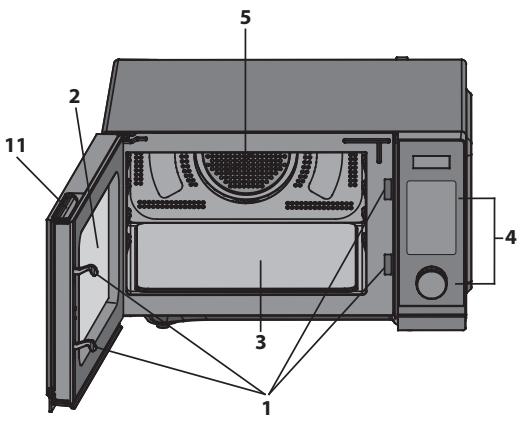
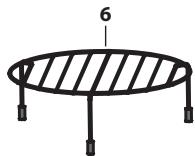
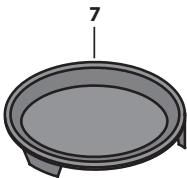
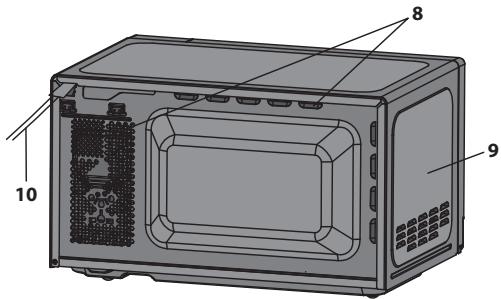
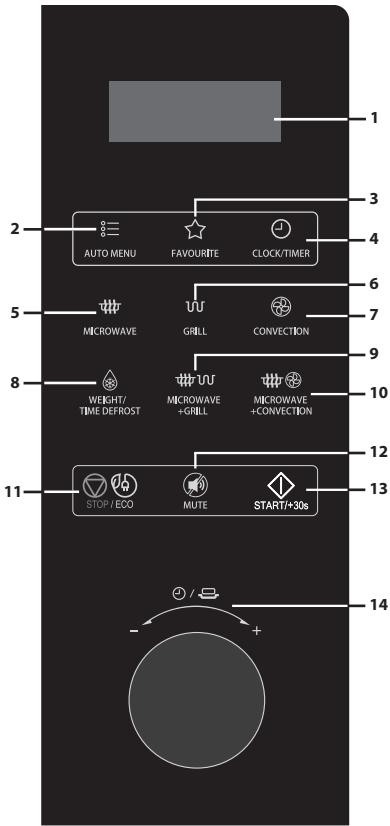
CONTROL PANEL
- DISPLAY - Cooking time, power, indicators and clock time are displayed.
- AUTO MENU - Press to select auto cooking menu.
- FAVOURITE - Use to store programs.
- CLOCK/TIMER - Use to set clock time. Use to set timer function.
- MICROWAVE - Press to select microwave power level.
- GRILL - Press to set grill cooking program.
- CONVECTION - Press to set convection cooking program.
- WEIGHT/TIME DEFROST - Press once to defrost based on weight. Press twice to defrost based on time.
- MICROWAVE+GRILL - Press to set microwave and grill combination cooking program.
- MICROWAVE+CONVECTION - Press to set microwave and convection combination cooking program.
- STOP/ECO - Press once to temporarily stop cooking, or twice to cancel cooking altogether. Use to set power saving mode.
- MUTE - Press once to set mute function, press again to deactivate mute function. Press and hold (for 3 sec.) to activate CHILD LOCK function. press and hold again to deactivate it.
- START+/30s - Press to start cooking and defrosting programs. Simply press it a number of times to set cooking time and cook immediately at full power level.
- TIME/WEIGHT (knob) - Turn to set time, food weight or servings.
BEFORE OPERATION
- When the oven is first plugged in, a beep will sound and the display will show "1:01".
- While in the set up mode and no buttons are pressed for 30 seconds, the unit will enter the standby mode.
- During cooking, press STOP/ECO button once to pause the program, then press START/+30s button to resume. When the STOP/ECO button is pressed twice, the program will be cancelled.
- When the cooking cycle has been completed, the screen will display End and a beep will sound every two minutes until the door is opened or a button is pressed.
SETTING THE CLOCK
To set the clock, follow the instructions given below:
- In standby mode, press and hold CLOCK/TIMER button for 3 seconds to select 12-hour clock, press the button again to select 24-hour clock.
- Turn TIME/WEIGHT knob to set hour digit.
- Press START/+30s once.
- Turn TIME/WEIGHT knob to set minute digit.
- Press CLOCK button to confirm.
EXPRESS COOKING
Use this feature to program the oven to start at 100% power conveniently. In standby mode, press START/+30s button repeatedly to set cooking time (each press increases 30 seconds, up to 10 minutes). The oven will auto-start immediately.
MICROWAVE COOKING
- In standby mode, press the MICROWAVE button repeatedly to select the power level.
- Turn the TIME/WEIGHT knob to set the cooking time. The longest time is 95 minutes.
- Press START/+30s to confirm.
Press the MICROWAVE button repeatedly to select the power level.
| Press MICROWAVE button | Power (Display) | Press MICROWAVE button | Power (Display) |
| Once | 100% (P100) | 7 times | 40% (P-40) |
| Twice | 90% (P-90) | 8 times | 30% (P-30) |
| 3 times | 80% (P-80) | 9 times | 20% (P-20) |
| 4 times | 70% (P-70) | 10 times | 10% (P-10) |
| 5 times | 60% (P-60) | 11 times | 0% (P-00) |
| 6 times | 50% (P-50) | | |
NOTE: During cooking, you can check the power by pressing the MICROWAVE button.
GRILL
Grill cooking is particularly useful for thin slices of meat, steaks, chops, kebabs, sausages, and pieces of chicken. It is also suitable for hot sandwiches and au gratin dishes.
- In standby mode, press the GRILL button once.
- Turn the TIME/WEIGHT knob to set the cooking time. The longest time is 95 minutes.
- Press the START/+30s button to start.
MICROWAVE+GRILL
Combination 1: 30% time for microwave cooking, 70% for grill cooking. Use for fish or au gratin.
Combination 2: 55% time for microwave cooking, 45% for grill cooking. Use for puddings, omelettes, baked potatoes, and poultry.
- In standby mode, press the MICROWAVE+GRILL button once or twice to select "Co-1" or "Co-2".
- Turn TIME/WEIGHT knob to set cooking time. The longest time is 95 minutes.
- Press START/+30s button to start.
NOTE: During cooking, you can check the combination mode by pressing the MICROWAVE+GRILL button.
CONVECTION
During convection cooking, hot air is circulated throughout the oven cavity to brown and make crisp foods quickly and evenly. This oven can be programmed for thirteen different cooking temperatures (230°C, 220°C, 210°C, 200°C, 190°C, 180°C, 170°C, 160°C, 150°C, 140°C, 130°C, 120°C, 110°C).
To preheat and cook using the convection function, follow the instructions given below:
Your oven can be programmed to combine preheating and convection cooking operations.
- In standby mode, press CONVECTION button repeatedly to select convection temperature.
- Press START/+30s button to start. Beeps will sound when the designated temperature is reached.
- Open the door and place container of food at the center of the flat-bed.
- Turn TIME/WEIGHT knob to set cooking time. The longest time is 95 minutes.
- Press START/+30s button to start.
NOTE: When the convection preheat temperature is reached, the oven will bleep every two seconds, The preheat temperature will be maintained for 30 minutes.
MICROWAVE+CONVECTION
The Microwave+Convection mode makes cooking easier and faster.
There are four pre-programmed settings for this function as described below:
230°C - this is suitable for meat which is thick and difficult to cook, such as chicken, whole, leg or wing.
200°C - can be used for meat which is thin and cooks faster, such as fish or steak.
170°C and 140°C - these modes are suitable for sliced meat and semi-finished food, for example bacon and sausage.
- In standby mode, press MICROWAVE+CONVECTION button repeatedly to select convection temperature (230°C, 200°C, 170°C, 140°C).
- Turn TIME/WEIGHT knob to set cooking time. The longest time is 95 minutes.
- Press START/+30s button to start.
NOTE: During cooking, you can check the convection temperature by pressing MICROWAVE+CONVECTION button.
WEIGHT DEFROST
- In standby mode, press WEIGHT/TIME DEFROST button once.
- Turn TIME/WEIGHT knob to set food weight. The weight ranges from 100g to 2000g.
- Press START/+30s button to confirm.
NOTE: During defrosting, the system will pause and sound to remind you to turn over the food. After that, press
START/+30s button to resume.
Weight defrost table
- In standby mode, press the WEIGHT/TIME DEFROST button twice.
- Turn the TIME/WEIGHT knob to set the defrosting time. The maximum time is 95 minutes.
- Press the START/+30s button to confirm.
NOTE: When using the Time Defrost function, the microwave will cook at 40% power, then at 30% power, at which point it will stop to allow the door to be opened and the food turned over. When cooking recommences when the
START/+30s button is pressed, it will cook at 20% power.
KITCHEN TIMER
- Press the CLOCK/TIMER button once.
- Turn the TIME/WEIGHT knob to set the desired time. The maximum time is 95 minutes.
- Press the START/+30s button to confirm.
To cancel the TIMER program, press the STOP/ECO button and the display shows the time.
FAVOURITE FUNCTION
There are 3 favorites in this function, each of which can be set with 1 cooking sequence.
To store:
- In standby mode, press the FAVOURITE button once, twice, or 3 times.
- Input the desired cooking program (including multistage cooking).
- Press START/+30s button to confirm.
To start:
- In standby mode, press FAVOURITE button once, twice or 3 times to select cooking program.
- Press START/+30s button to start.
To clear:
In standby mode, press FAVOURITE button once, twice or 3 times.
Press and hold FAVOURITE button for 3 seconds, the display will show "CLr" for 5 seconds and the oven will return to standby mode.
NOTE:
- Only microwave, grill, convection, microwave and grill, microwave and convection can be stored.
- Favourite programming will be kept in the memory even when the power is disconnected.
- It is only possible to store 3 favourite programmes. If you wish to change, delete one.
- If the content of the favorites is empty, the favorite code will flash. If there is any content in the favorites, the favorite code will always be displayed.
POWER SAVING FUNCTION
To set: In standby mode, press and hold STOP/ECO button for 3 seconds, the display will turn off. The oven will enter power saving mode.
To cancel: In the power saving mode, the function can be cancelled by pressing any button or opening and closing the oven door once.
MUTE FUNCTION
To set the mute function, press the MUTE button once. The display will show "OFF" for 3 seconds. While in mute mode, there will be no sound when buttons are pressed.
To cancel the mute function, press the MUTE button once. The display will show "On" for 3 seconds.
CHILD LOCK
- To set the CHILD LOCK, press and hold the MUTE key for 3 seconds. A long beep will be heard and the display will indicate "LOC". The oven is now in CHILD LOCK mode. While in this mode, the display will show the clock. If any key is pressed or the door is opened, "LOC" will be displayed for ten seconds.
- To cancel the CHILD LOCK, press and hold the MUTE key for 3 seconds until a long beep is heard.
SAFETY LOCK
Use to prevent unsupervised operation of the oven by children.
To set: In standby mode, if there is no operation within one minute, the oven will automatically enter Safety Lock mode and the lock indicator light will turn on. In the lock state, all buttons are disabled. Press any button, and the lock indication appears on the display for 5 seconds to remind the user to cancel the Safety Lock.
To turn the Safety Lock off, simply open the door of the microwave and the keypad will become active again, and the lock indicator light will turn off.
AUTOMATIC PROTECTION MECHANISM
OVERHEATING PROTECTION - When the oven senses a high temperature, the display will indicate "E01" and stop operating. This can be canceled by pressing the STOP/ECO button.
LOW TEMPERATURE PROTECTION - When the oven enters low temperature protection mode, the display will indicate "E02" and stop operating. This can be canceled by pressing the STOP/ECO button.
SENSOR MALFUNCTION PROTECTION - When the oven senses an issue with one of the sensors, "E03" or "E04" will be displayed and the oven will stop operating. In addition, the oven will emit a warning tone. This can be canceled by pressing the STOP/ECO button.
AUTO COOK
For food or the following cooking mode, it is not necessary to program the cooking time and power. It is sufficient to indicate the type of food that you want to cook as well as the weight or the number of servings of this food.
- In standby mode, press AUTO MENU button repeatedly to select menu code.
- Turn TIME/WEIGHT knob to set food weight or servings.
- Press START/+30s button to start.
Auto cook menus:
| Code | Food | Note |
| A-01 | Beverage (200 ml/cup, 1 - 3 cups) | 1. For items "A07" ~ "A09", "A-13", the oven will pause and sound to remind user to turn food over and then press START/+30s button to resume. |
| A-02 | Jacket Potatoes (230 ±10 g/serving, 1 - 2 servings) |
| A-03 | Vegetable (200 - 600 g) |
| A-04 | Auto Reheat (200 - 800 g) |
| A-05 | Soup (300 ml/bowl, 1 - 3 bowls) | 2. When using the auto cook function, food may not be cooked as expected. This could be due to various reasons such as personal preference, size/shape of the food, the ambient temperature, mains voltage variations, if the food has been placed correctly on the base of the oven etc. Should the food not be cooked to your preference, adjust the time accordingly to correct for this. |
| A-06 | Rice (150 - 600 g) |
| A-07 | Roast Beef/Lamb (200 - 600 g) |
| A-08 | Grilled Fish Pieces (200 - 600 g) |
| A-09 | Grilled Bacon (100 g, 200 g, 300 g) |
| A-10 | Oven Chips (200 g) |
| A-11 | Pizza (150 g, 300 g, 450 g) |
| A-12 | Cake (475 g) |
| A-13 | Roast Chicken (800 - 1400 g) |
CLEANING AND CARE
- Turn off the oven and unplug the power cord from the wall when cleaning.
- Keep the inside of the oven clean. When food splatters or spilled liquids adhere to oven walls, wipe with a damp cloth. Mild detergents may be used if the oven gets very dirty. Avoid using spray or other harsh cleaners. They may stain, streak or dull the door surface.
- The outside of the oven should be cleaned with a damp cloth. To prevent damage to the operating parts inside the oven, water should not be allowed to seep into the ventilation openings.
- Wipe the door and window on both sides, the door seals and adjacent parts frequently with a damp cloth to remove any spills or spatters. Do not use abrasive cleaner.
- Do not steam clean.
- Do not allow the control panel to become wet. Clean with a soft, damp cloth. When cleaning the control panel, leave oven door open to prevent oven from accidentally turning on.
- If steam accumulates inside or around the outside of the oven door, wipe with a soft cloth. This may occur when the microwave oven is operated under high humidity condition. This is not a fault.
- The oven floor should be cleaned regularly to avoid contamination and potential arcing/damage. Simply wipe the bottom surface of the oven with mild detergent.
- Remove odors from your oven by combining a cup of water with the juice and skin of one lemon in a microwaveable bowl. Microwave for 5 minutes. Wipe thoroughly and dry with a soft cloth.
- If the light bulb fails, please contact customer service for advice.
- The oven should be cleaned regularly and any food deposits should be removed. Failure to maintain the oven in a clean condition could lead to deterioration of the surface that could adversely affect the life of the unit and could possibly result in a hazardous situation.
- Please do not dispose of this appliance into the domestic rubbish bin; it should be disposed of at the particular disposal center provided by the municipalities.
- When the microwave oven with grill function is first used, it may produce slight smoke and smell. This is a normal phenomenon, because the oven is made of a steel plate coated with lubricating oil, and the new oven will produce fumes and odor generated by burning the lubricating oil. This phenomenon will disappear after a period of use.
SUITABLE OVENWARE
To cook/defrost food in a microwave oven, the microwave energy must be able to pass through the container to penetrate the food. Therefore it is important to choose suitable cookware.
Round/oval dishes are preferable to square/oblong ones, as the food in the corners tends to overcook. A variety of cookware can be used as listed below.
| Cookware | Microwave Safe | Grill/ Convection | Comment |
| Aluminium foil Foil Containers | ✓ / X | ✓ | Small pieces of aluminium foil can be used to shield food from overheating. Keep foil at least 2cm from the oven walls, as arcing may occur. Foil containers are not recommended unless specified by the manufacturer, e.g. Microfoil®, follow instructions carefully. |
| Browning dishes | ✓ / X | X | Always follow the manufacturers instructions. Do not exceed heating times given. Be very careful as these dishes become very hot. |
| China and ceramics | ✓ / X | X | Porcelain, pottery, glazed earthenware and bone china are usually suitable, except for those with metallic decoration. |
| Glassware e.g. Pyrex® | ✓ | ✓ | Care should be taken if using fine glassware as it can break or crack if heated suddenly. |
| Metal | X | ✓ | It is not recommended to use metal cookware as it will arc, which can lead to fire. |
| Plastic/Polystyrene e.g fast food containers | ✓ | X | Care must be taken as some containers warp, melt or discolour at high temperatures. |
| Cling film | ✓ | X | It should not touch the food and must be pierced to let the steam escape. |
| Freezer/Roasting bags | ✓ | X | Must be pierced to let steam escape. Ensure bags are suitable for microwave use. |
| Paper - Plates, cups and kitchen paper | ✓ | X | Do not use plastic or metal ties, as they may melt or catch fire due to the metal 'arcing'. |
| Straw and wooden Containers | ✓ | X | Only use for warming or to absorb moisture. Care must be taken as overheating may cause fire. |
| Recycled paper and newspaper | X | ✓ | Always attend the oven when using these materials as overheating may cause fire. May contain extracts of metal which will cause 'arcing' and may lead to fire. |

WARNING: When heating food in plastic or paper containers, monitor the oven due to the possibility of ignition.
NOTE: Do not leave your oven unattended while in use.
Microwaves cook food faster than conventional cooking. It is therefore essential that certain techniques are followed to ensure good results. Many of the following techniques are similar to those used in conventional cooking.

WARNING: Liquids and foods must not be heated in sealed containers or jars/containers with lids on, as pressure will build up inside and may cause the jar/container to explode.
COOKING ADVICE NOTES:
- Always attend the oven when in use.
- Ensure that the utensils are suitable for use in a microwave oven.
- Refer to the charts in the cookbook section for recommended cooking times and power levels.
- Do not place hot foods/utensils on a cold flat-bed or cold foods/utensils on a hot flat-bed.
- Only use microwave popcorn within the recommended packaging (follow the manufacturers instructions). Never use oil unless specified by the manufacturer and never cook for longer than instructed.

WARNING: Follow instructions in the SHARP operation manual at all times. If you exceed recommended cooking times and use power levels that are too high, food may overheat, burn and, in extreme circumstances, catch fire and damage the oven.
Arrange
Place the thickest parts of food towards the outside of the dish. e.g. Chicken drumsticks.
Foods that are placed towards the outside of the dish will receive more energy, so cook quicker, than those in the centre.
Cover
Certain foods benefit from being covered during microwave cooking.
Use vented microwave cling film or a suitable lid.
Pierce
Foods with a shell, skin or membrane must be pierced in several places before cooking or reheating as steam will build up and may cause food to explode. e.g. Potatoes, Fish, Chicken, Sausages.
NOTE: Eggs should not be heated using microwave power as they may explode, even after cooking has ended. e.g. poached, fried, hard boiled.
Stir, turn and rearrange
For even cooking it is essential to stir, turn and rearrange food during cooking. Always stir and rearrange from the outside towards the centre.
Stand
Standing time is necessary after cooking so it enables the heat to disperse equally throughout the food.
| Food Characteristics |
| Composition | Foods high in fat or sugar (e.g. Christmas pudding, mince pies) require less heating time.
Care should be taken as overheating can lead to fire.
Bones in food conduct heat, making the food cook more quickly. Care must be taken so that the food is cooked evenly. |
| Density | Food density will affect the amount of cooking time needed.
Light porous foods, such as cakes or bread, cook more quickly than heavy, dense foods, such as roasts and casseroles. |
| Quantity | The number of microwaves in your oven remains the same regardless of how much food is being cooked. The cooking time must be increased as the amount of food placed in the oven increases.
e.g. Four potatoes will take longer to cook than two. |
| Size | Small foods and small pieces cook faster than large ones, as microwaves can penetrate from all sides to the centre. For even cooking make all the pieces the same size. |
| Shape | Foods which are irregular in shape, such as chicken breasts or drumsticks, take longer to cook in the thicker parts. For even cooking, place the thickest parts to the outside of the dish where they will receive more energy.
Round shapes cook more evenly than square shapes when microwave cooking. |
| Temperature of food | The initial temperature of food affects the amount of cooking time needed.
Chilled foods will take longer to cook than food at room temperature.
The temperature of the container is not a true indication of the temperature of the food or drink. Cut into foods with fillings, for example jam doughnuts, to release heat or steam. |

WARNING: Face & Hands: Always use oven gloves to remove food or cookware from the oven. Stand back when opening the oven door to allow heat or steam to disperse. When removing covers (such as cling film), opening roasting bags or popcorn packaging, direct steam away from face and hands.

WARNING: Check the temperature of food and drink, stir before serving. Take special care when serving to babies, children or the elderly. The contents of feeding bottles and baby food jars are to be stirred or shaken and the temperature is to be checked before consumption to avoid burns.
DEFROSTING ADVICE
Using your microwave oven is the quickest defrosting method. It is a simple process but the following instructions are essential to ensure the food is thoroughly defrosted.
- Remove all packaging and wrapping before defrosting.
- To defrost food, use microwave power levels 30P or 10P.
- Please refer to the further information below.
Rearrange
Foods that are placed towards the outside of the dish will defrost quicker than foods in the centre. It is therefore essential that the food is rearranged up to 4 times during defrosting.
Move closely packed pieces from the outside to the centre and rearrange over-lapping areas.
This will ensure that all parts of the food defrosts evenly.
Separate
Foods may be stuck together when removed from the freezer. It is important to separate foods as soon as it is possible during defrosting.
e.g. bacon rashers, chicken fillets.
Shield
Some areas of food being defrosted may become warm. To prevent them from becoming warmer and starting to cook, these areas can be shielded with small pieces of foil, which reflect microwaves, e.g., legs and wings on a chicken.
Stand
Standing time is necessary to ensure food is thoroughly defrosted.
Defrosting is not complete once the food is removed from the microwave oven. Food must stand, covered, for a length of time to ensure the center has completely defrosted.
Turn over
It is essential that all foods are turned over up to 4 times during defrosting.
This is important to ensure thorough defrosting.
REHEATING ADVICE
For the reheating of foods, follow the advice and guidelines below to ensure food is thoroughly reheated before serving.
Plated meals
Remove any poultry or meat portions, reheat these separately, see below.
Place smaller items of food to the center of the plate, larger and thicker foods to the edge. Cover with vented microwave cling film and reheat on 50P, stir/rearrange halfway through reheating.
NOTE: Ensure the food is thoroughly reheated before serving.
Sliced meat
Cover with vented microwave cling film and reheat on 50P. Rearrange at least once to ensure even reheating.
NOTE: Ensure the meat is thoroughly reheated before serving.
Poultry portions
Place thickest parts of the portions to the outside of the dish, cover with vented microwave cling film and reheat on 70P.
Turn over halfway through reheating.
NOTE: Ensure the poultry is thoroughly reheated before serving.
Casseroles
Cover with vented microwave cling film or a suitable lid and reheat on 50P.
Stir frequently to ensure even reheating.
NOTE: Ensure the food is thoroughly reheated before serving.
To achieve the best results when reheating, select a suitable microwave power level appropriate to the type of food. e.g. A bowl of vegetables can be reheated using 100P, while a lasagne which contains ingredients that cannot be stirred, should be reheated using 50P.
NOTES:
- Remove food from foil or metal containers before reheating.
- Reheating times will be affected by the shape, depth, quantity and temperature of food together with the size, shape and material of the container.

WARNING: Never heat liquids in narrow-necked containers, as this could result in the contents erupting from the container and may cause burns.
- To avoid overheating and fire, special care must be taken when reheating foods with a high sugar or fat content, e.g. mince pies or Christmas pudding.
- Never heat oil or fat for deep frying as this may lead to overheating and fire.
- Canned potatoes should not be heated in the microwave oven, follow the manufacturer's instructions on the can.

WARNING: The contents of feeding bottles and baby food jars are to be stirred or shaken and the temperature is to be checked before consumption to avoid burns.
TROUBLESHOOTING
If you think the oven is not working properly there are some simple checks you can carry out yourself before calling an engineer. This will help prevent unnecessary service calls if the fault is something simple.
Follow this simple check below:
Place half a cup of water on the flat-bed and close the door. Programme the oven to cook for 1 minute using 100P microwave power.
- Does the oven lamp come on when it is cooking?
- Does the cooling fan work? (Check by placing your hand above the air vent openings).
- After 1 minute does the audible signal sound?
- Is the water in the cup hot?
Take the cup of water out of the oven and close the door. Programme the oven to cook for 3 minutes using the grill.
- After 3 minutes, does the grill heating element become red?
If you answer "NO" to any question first check that the oven is plugged in properly and the fuse has not blown. If there is no fault with either, check against the troubleshooting chart below.

WARNING: Never adjust, repair or modify the oven yourself. It is hazardous for anyone other than a SHARP trained engineer to carry out servicing or repairs. This is important as it may involve the removal of covers that provide protection against microwave energy.
- The door seal stops microwave leakage during oven operation, but does not form an airtight seal. It is normal to see drops of water, light or feel warm air around the oven door. Food with a high moisture content will release steam and cause condensation inside the door which may drip from the oven.
- Repairs and Modifications: Do not attempt to operate the oven if it is not working properly.
- Outer Cabinet & Lamp Access: Never remove the outer cabinet. This is very dangerous due to high voltage parts inside which must never be touched, as this could be fatal.
Your oven is not fitted with a lamp access cover. If the lamp fails, do not attempt to replace the lamp yourself, call a SHARP approved service facility.
TROUBLESHOOTING CHART
| QUERY | ANSWER |
| Draught circulates around the door. | When the oven is working, air circulates within the cavity.
The door does not form an airtight seal so air may escape from the door. |
| Condensation forms in the oven, and may drip from the door. | The oven cavity will normally be colder than the food being cooked, and so steam produced when cooking will condense on the colder surface.
The amount of steam produced depends on the water content of the food being cooked. Some foods, such as potatoes have a high moisture content.
Condensation trapped in the door glass should clear after a few hours. |
| Flashing or arcing from within the cavity when cooking. | Arcing will occur when a metallic object comes into close proximity to the oven cavity during cooking. This may possibly roughen the surface of the cavity, but would not otherwise damage the oven. |
| Arcing potatoes. | Ensure all "eyes" are removed from the potatoes and that they have been pierced, place directly onto the flat-bed or in a heat resistant flan dish or similar. |
| The display is lit but the control panel will not work when pressed. | Check the door is closed properly. |
| Oven cooks too slowly. | Ensure correct power level has been selected. |
| Oven makes a noise. | The microwave energy pulses ON and OFF during cooking/defrosting. |
| Outer cabinet is hot. | The cabinet may become warm to the touch - keep children away. |
RADIO INTERFERENCE
Operation of the microwave oven can cause interference to your radio, TV, or similar equipment. When there is interference, it may be reduced or eliminated by taking the following measures:
- Clean door and sealing surface of the oven.
- Reorient the receiving antenna of radio or television.
- Relocate the microwave oven with respect to the receiver.
- Move the microwave oven away from the receiver.
- Plug the microwave oven into a different outlet so that microwave oven and receiver are on different circuits.
BEFORE CALLING FOR ASSISTANCE
Before asking for service, please check each item below:
- Check to ensure the oven is plugged in securely. If not, remove the plug from the outlet, wait 10 seconds, and plug it in again securely.
- Check for a blown circuit fuse or a tripped main circuit breaker. If these seem to be operating properly, test the outlet with another appliance.
- Check to ensure the control panel is programmed correctly and the timer is set.
- Check to ensure the door is securely closed, engaging the door lock system. If the door is not properly closed, the microwave will not operate.
IF NONE OF THE ABOVE RECTIFIES THE SITUATION, THEN CONTACT THE SHARP HELPLINE. DO NOT TRY TO ADJUST OR REPAIR THE OVEN YOURSELF.
CLEANING AND MAINTENANCE
Sharp Consumer Electronics Poland sp. z o.o.
Ostaszewo 57B, 87-148 Lysomice, Poland
SHARP CORPORATION
1 Takumi-cho, Sakai-ku
Sakai City, Osaka
590-8522, Japan
SDA/MAN/0116