
MD 10259 - Bread maker GALA - Free user manual and instructions
Find the device manual for free MD 10259 GALA in PDF.



User questions about MD 10259 GALA
0 question about this device. Answer the ones you know or ask your own.
Ask a new question about this device
Download the instructions for your Bread maker in PDF format for free! Find your manual MD 10259 - GALA and take your electronic device back in hand. On this page are published all the documents necessary for the use of your device. MD 10259 by GALA.
USER MANUAL MD 10259 GALA
Before using the electrical appliance, the following basic precautions should always be followed:
- Read all instructions before using the appliance.
- Unwind the cord fully before use.
- Before using the appliance, check that the specifications on the rating plate agree with the type of current and voltage in your household.
- This appliance is not intended for use by young children or infirm persons unless they have been adequately supervised by a responsible person to ensure they can use the appliance correctly. Young children must be supervised to ensure that they do not play with the appliance.
- This appliance is for household use only. Do not use this appliance for anything other than its intended use. Do not use in moving vehicles or boats. Do not use outdoors.
- Never beat the bread pan on the top or edge to remove the pan, this may damage the bread pan.
- Remove any packaging material and stickers before using the appliance.
- Do not place the appliance near the edge of a bench or table during operation. Ensure the surface is leveled, clean and free of water, flour, etc.
- Do not place the appliance on or near a hot gas or electric burner, or where it could touch a heated oven.
- Always operate the appliance on a stable, heatresistant surface. Do not use on a cloth-covered surface, near curtains or other flammable materials. Do not use on a metal surface, for example, a sink drain board.
- When operating the appliance, ensure the power cord is kept away from any heat source including the surface of the appliance. Ensure the power cord does not become trapped between the lid and base of the appliance.
- When operating the appliance, allow a minimum distance of 15cm on all sides of the appliance. This will provide adequate air circulation.
- When operating the appliance, insert the power plug into a single power outlet. Do not plug into a double adaptor, or similar, or use with other appliances.
- Do not place cardboard, plastic, paper, or other flammable materials near or in the appliance.
-
To protect against electric shock do not immerse the appliance, its cord or power plug in water or any other liquid.
-
Do not touch any moving or spinning parts of the appliance when in use.
- Do not apply excessive force to remove the baking pan from the appliance. This will damage the baking pan.
Metal foils or other materials must not be inserted into the bread maker as this can give rise to the risk of a fire or short circuit. - Never cover the bread maker with a towel or any other material. Heat and steam are being produced during operation and must me able to escape freely.
- The outer surface of the appliance may become hot when operating at high temperatures. Always wear protective, insulated oven gloves when inserting, removing or handling items from the appliance when hot. Alternatively, allow the appliance to cool before handling.
- Do not place anything on top of the appliance.
- Do not place hands inside the appliance during operation.
- Use only the accessories supplied with the appliance.
- Do not store any materials other than the supplied accessories in the appliance when not in use.
- Do not attempt to operate the appliance by any method other than those described in this booklet
- Always ensure the appliance has cooled, is turned off at the power outlet and the cord is unplugged before attempting to move the appliance, when not in use, if left unattended and before disassembling, cleaning or storing.
- Keep the appliance clean. Follow the cleaning instructions provided in this book.
- It is recommended to regularly inspect the appliance. Do not use the appliance if power supply cord, plug or appliance becomes damaged in any way. Return the entire appliance to the nearest authorised service centre for examination and/or repair.
- Any maintenance, other than cleaning, should be performed at an authorised service centre.
- Keep this manual.
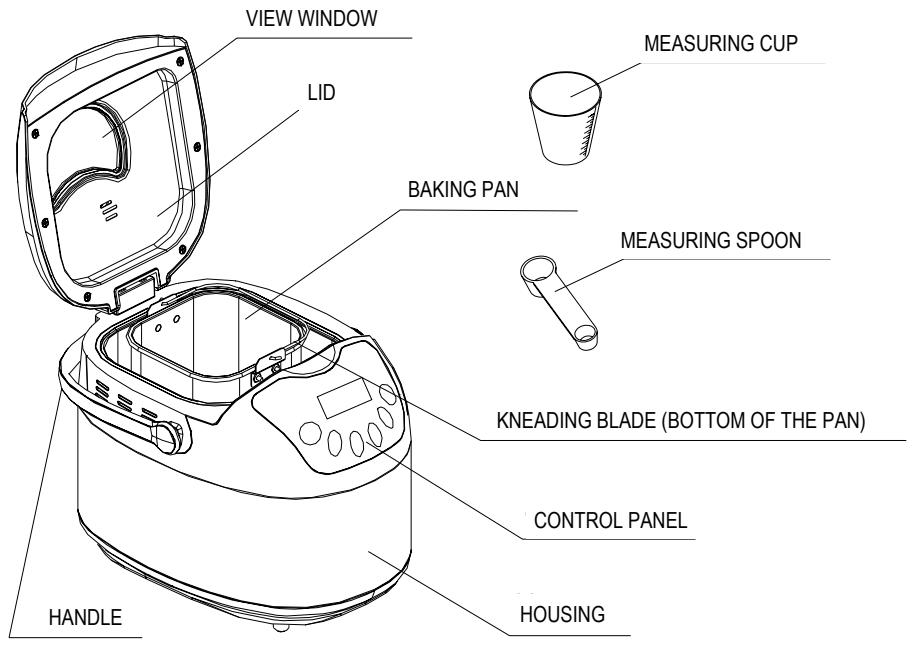
Know your bread maker
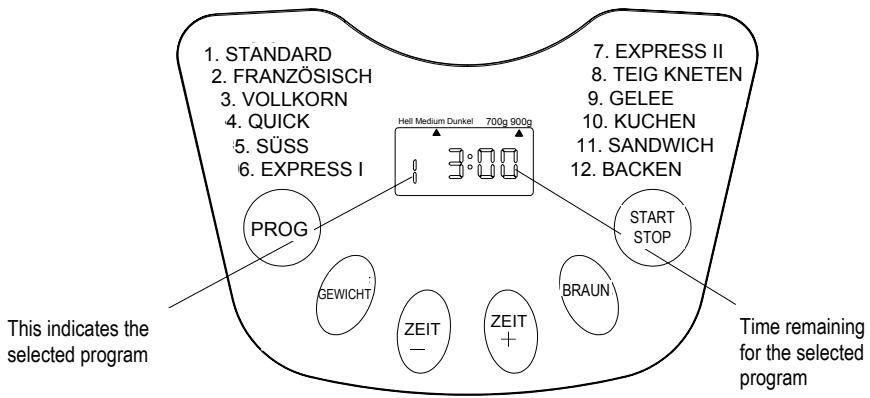
Function Introduction
AFTER POWER-UP
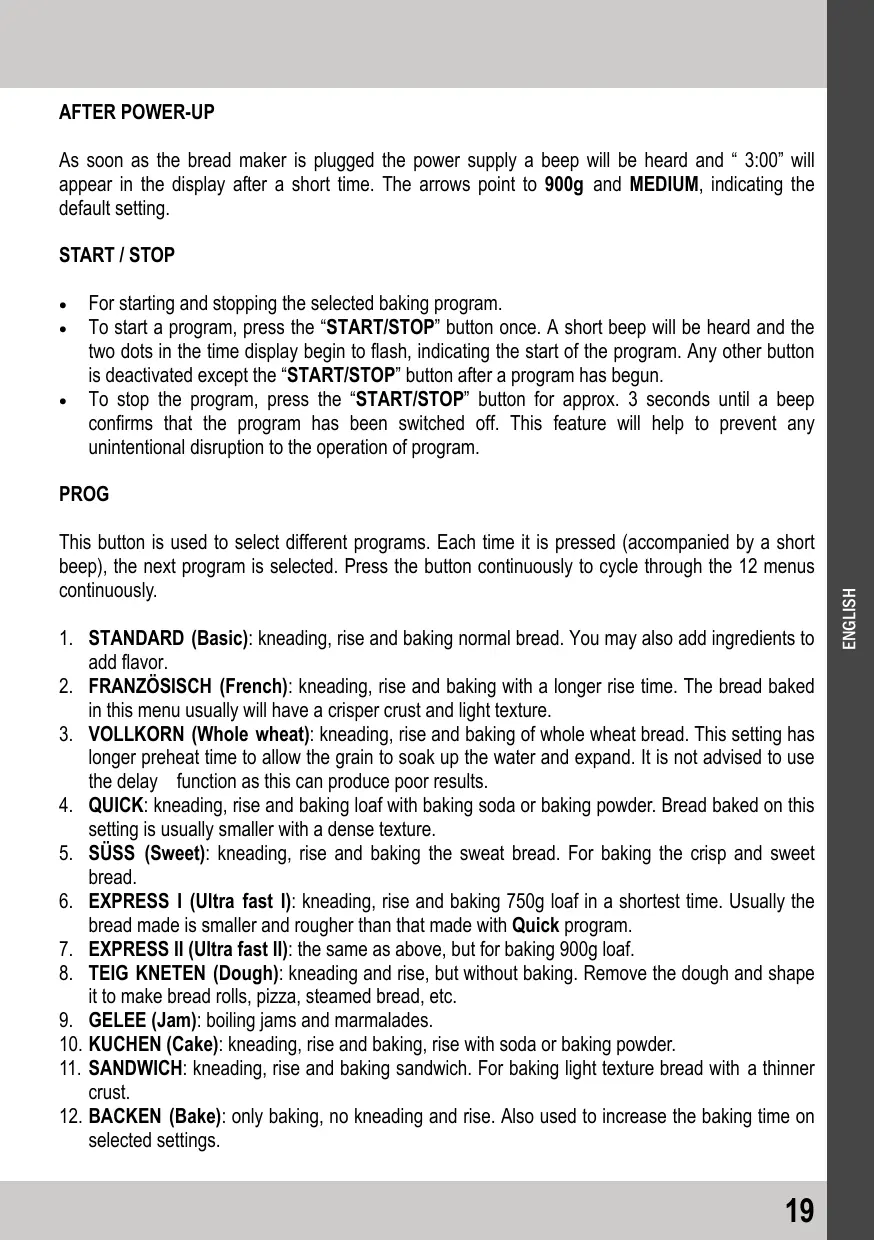
As soon as the bread maker is plugged the power supply a beep will be heard and " 3:00" will appear in the display after a short time. The arrows point to 900g and MEDIUM, indicating the default setting.
START/STOP
- For starting and stopping the selected baking program.
- To start a program, press the "START/STOP" button once. A short beep will be heard and the two dots in the time display begin to flash, indicating the start of the program. Any other button is deactivated except the "START/STOP" button after a program has begun.
- To stop the program, press the "START/STOP" button for approx. 3 seconds until a beep confirms that the program has been switched off. This feature will help to prevent any unintentional disruption to the operation of program.
PROG
This button is used to select different programs. Each time it is pressed (accompanied by a short beep), the next program is selected. Press the button continuously to cycle through the 12 menus continuously.
- STANDARD (Basic): kneading, rise and baking normal bread. You may also add ingredients to add flavor.
- FRANZÖSISCH (French): kneading, rise and baking with a longer rise time. The bread baked in this menu usually will have a crisper crust and light texture.
- VOLLKORN (Whole wheat): kneading, rise and baking of whole wheat bread. This setting has longer preheat time to allow the grain to soak up the water and expand. It is not advised to use the delay function as this can produce poor results.
- QUICK: kneading, rise and baking loaf with baking soda or baking powder. Bread baked on this setting is usually smaller with a dense texture.
- SÜSS (Sweet): kneading, rise and baking the sweat bread. For baking the crisp and sweet bread.
- EXPRESS I (Ultra fast I): kneading, rise and baking 750g loaf in a shortest time. Usually the bread made is smaller and rougher than that made with Quick program.
- EXPRESS II (Ultra fast II): the same as above, but for baking 900g loaf.
- TEIG KNETEN (Dough): kneading and rise, but without baking. Remove the dough and shape it to make bread rolls, pizza, steamed bread, etc.
- GELEE (Jam): boiling jams and marmalades.
- KUCHEN (Cake): kneading, rise and baking, rise with soda or baking powder.
- SANDWICH: kneading, rise and baking sandwich. For baking light texture bread with a thinner crust.
- BACKEN (Bake): only baking, no kneading and rise. Also used to increase the baking time on selected settings.
BRAUN (Color)
With the button you can select a LIGHT, MEDIUM or DARK color for the crust.
Press this button to select your desired color.
GEWICHT (Loaf size)
Press this button to select the Loaf size of the bread.
Please note the total operation time may vary with the different loaf size.
ZEIT (TIME) + / -
If you want the appliance do not start working immediately you can use this button to set the delay time.
You must decide how long it will be before your bread is ready by pressing the TIME + or TIME - Please note the delay time should include the baking time of program. That is, at the completion of delay time, there is hot bread can be serviced. At first the program and degree of browning must be selected, then pressing TIME + or TIME - to increase or decrease the delay time at the increment of 10 minutes. The maximum delay is 13 hours.
Example: Now it is 8:30p.m, if you would like your bread to be ready in the next morning at 7 o'clock, i.e. in 10 hours and 30 minutes. Select your menu, color, loaf size then press the TIME + or TIME - to add the time until 10:30 appears on the LCD. Then press the STOP/START button to activate this delay program. You can see the dot flashing and LCD will count down to show the remaining time. You will get fresh bread at 7:00 in the morning, If You don't want to take out the bread immediately, the keeping warm time of 1 hour starts.
Note: For time delayed baking, do not use any easily perishable ingredients such as eggs, fresh milk, fruits, onions, etc.
KEEP WARM
Bread is automatically kept warm for 60 minutes after baking.
If you would like to take the bread out, switch the program off with the START/STOP button.
MEMORY
If the power supply has been interrupted during the process of bread making, the process will continue automatically, if the power is back on within 15 minutes, even without pressing START/STOP. If interruption time exceeds 15 minutes, the memory cannot be kept and the bread maker must be restarted. But if the dough is not beyond the kneading phase when the power supply breaks off, you can press the START/STOP to restart the program from the beginning.
ENVIRONMENT
The machine may work well in a wide range of temperatures, but there could be a difference in loaf size between a very warm room and a very cold room. We suggest the room temperature should be between 15^ and 34^
WARNING DISPLAY:
- If the display shows "H:HH" after the program has been started, (see below figure 1) the temperature inside is still too high. Then the program has to be stopped. Open the lid and let the machine cool down for 10 to 20 minutes.
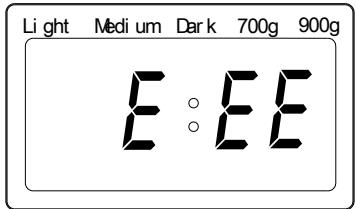
- If the display shows "E:EE" after you have pressed START/STOP, (see below figure 2) the temperature sensor is disconnected please check the sensor carefully by the service center.
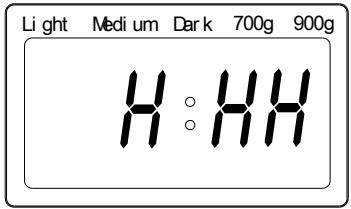
(1)
(2)
BEFORE FIRST USE:
- Please check if all parts and accessories are complete and free of damage.
- Clean all the parts according to the latter section „Cleaning and Maintenance"
- set the bread maker in baking mode and bake empty for about 10 minutes. Let it cool down and clean once more.
- Dry all parts thoroughly and assembly them. Now the appliance is ready for using.
How to make bread
- Place the pan in position, then turn it clockwise until they click in correct position. Fix the kneading blade onto the drive shafts. Turn the kneaders clockwise until they click into place. It is recommended to fill the holes with margarine prior to placing the kneaders, this avoids the dough to stick below the kneaders and the kneaders could be removed from bread easily after baking.
- Place ingredients into the baking pan. Please keep to the order mentioned in the recipe. Usually water and any other liquids should be poured in first, then add sugar, salt and flour, always add yeast or baking powder as the last ingredient. In case of heavy dough with high Rye or wholemeal portion we advise to reverse the order of ingredients. i.e. to fill in first the dry yeast and flour, and finally the liquid to get a better kneading result.
- Make a small hole on one side of the flour with you finger. Add yeast to the small hole and make sure it does not come into contact with the liquid ingredients or salt.
- Close the lid gently and plug the power cord into a wall outlet.
- Press the PROG button to select your desired program.
- Press the COLOR button to select the desired crust color.
- Press the LOAF SIZE button to select the desired size (750g or 900g).
- Set the delay time by pressing TIME + or TIME - button. This step may be skipped if you want the bread maker to start working immediately.
- Press the START/STOP button to start.
- For the program BASIC, FRENCH, WHOLE WHEAT, SWEET, SANDWICH, a long beep sound will be heard during operation. This is to prompt you to add the ingredients. Open the lid and put in some ingredients. It is possible that steam will escape through the vent slits in the lid during baking. This is normal.
- Once the process has been completed 10 beeps will sound. You can press START/STOP button for approx. 3-5 seconds to stop the process and take out the bread. Open the lid and firmly grab the baking pan handle using oven mitts. Slightly turn the pan anti-clockwise and gently pull the pan straight up and out of the machine.
- Use non-stick spatula to gently loosen the sides of the bread from the pan.
Caution: the baking pan and bread may be very hot! Always handle with care and use oven mitts.
- Turn the baking pan upside down onto a clean cooking surface and gently shake until the bread falls out onto the rack.
- Remove the bread carefully from the pan and let it cool down for about 20 minutes before slicing.
- If you are absent or have not pressed START/STOP button at the end of operation, the bread will be kept warm automatically for 1 hour and then shut off.
- After use, unplug the power cord.
Note:
Before slicing the loaf, use the hook to remove the kneading blade hidden in the bottom of loaf.
The loaf is hot, never use the hand to remove the kneading blade.
Special introduction
Quick breads
Quick breads are made with baking powder and baking soda that is activated by moisture and heat. For perfect quick breads, it is recommended that all liquids are placed in the bottom of the bread pan and dry ingredients on top. During the initial mixing of quick bread batter, dry ingredients may collect in the corners of the pan and it will be necessary to help the machine mix to avoid flour lumps. Use a rubber spatula to remove the dry ingredients from the corners back into the batter.
Ultra fast program
The bread maker can bake loaf within 1 hour using the ULTRA FAST programs. These 2 programs can bake bread in 58 minutes, the bread will be slightly more dense in texture. ULTRA FAST-I is for baking 750g bread while ULTRA FAST-II is for 900g . Please note that as an ingredient, hot water of 48 - 50^ should be used. Check the water temperature with a cooking thermometer as the temperature is very critical for the baking process. If the water temperature is too low, the bread will not rise up to expected size; if the water temperature is too high, it will kill the yeast prior to rising, which also will largely affect the baking performance.
Cleaning and Maintenance
Disconnect the machine from the power and let it cool down prior to cleaning.
- Baking pan: Rub the inside and outside with a damp cloth. Do not use any sharp or abrasive cleaners as they will damage the non-stick coating. Let the pan dry completely before inserting into the machine.
- Kneading blade: If the kneading blade is difficult to remove from the axle, fill the pan with warm water and allow it to soak for approx. 30 minutes. After this, the kneader can be easily removed for cleaning. Wipe the blade carefully with a cotton damp cloth.
- Lid and window: clean the lid inside and outside with a slightly damp cloth.
- Housing: gently wipe the outer surface of housing with a wet cloth. Do not use any abrasive cleaner to clean as this would degrade the high polish of the surface. Never immerse the housing into water for cleaning.
Note:
The baking pan and the kneading blade are dishwasher-safe components.
Before the bread maker is packed away for storage, ensure that it has completely cooled down and that it is clean and dry. The spoon, cup and kneading blade can be stored inside the baking pan.
1. Bread flour
Bread flour has high content of high gluten (so it can also be called high-gluten flour which contains high protein), it has good elastic and can keep the size of the bread from collapsing after rising. As the gluten content is higher than the common flour, it can be used for making bread with large size and more fiber. Bread flour is the most important ingredients of making bread.
2. Plain flour
Plain flour is made by mixing well-chosen soft and hard wheat and is generally applicable for making express bread or cakes.
3. Whole wheat flour
Whole wheat flour is made by grinding whole wheat, containing wheat skin and gluten. Whole wheat flour is heavier and more nutrient than common flour. Bread made with whole wheat flour is usually smaller in size. Many recipes usually combine the whole wheat flour and bread flour to achieve best results.
4. Black wheat flour
Black wheat flour, also named by "rough flour", is a kind of high fiber flour that is similar to whole wheat flour. To obtain the large size after rising it must be used in combination with high proportion of bread flour.
5. Cake powder
Cake powder is made by grinding soft wheat or low protein wheat, which is specially used for making cakes. Different flour seems to be alike, Actually yeast performance or absorbability of various flour differs largely for growing areas, growth reasons, grinding process and storage life. You may choose flour with different trademark to test, taste and compare in local market, and select the one which could produce the best result according to your own experiences and taste.
6. Corn flour and oatmeal flour
Corn flour and oat flour are made by grinding corn and oatmeal respectively, they both are additive ingredients in making rough bread, enhancing the flavor and texture.
7. Sugar
Sugar is a very important ingredient to add sweet taste and color to the bread. It acts as active nourishment for the yeast. White sugar is generally used, brown sugar, powdered sugar or cotton sugar may also be used by special requirements.
8. Yeast
Yeast is the active, living ingredient in the process of making bread, as it produces carbon dioxide, making making bread expand (rise) and soft inner texture and fibre. For this, yeast requires carbohydrate in sugar and flour as nourishment.
1 TL. active dry yeast = 3/4 TL. instant yeast
5 TL. active dry yeast = 1 TL. instant yeast
2 TL. active dry yeast = 1.5 TL. instant yeast
Yeast needs to be stored in the refrigerator as it will be killed at high temperature. Check the date and storage life of your yeast before use. Put it back in the refrigerator for storage as soon as possible after each use. Usually the failure of bread rising is caused by dead yeast.
Here is how you can determine if your yeast is fresh and active:
- pour 1/2 cup warm water (45 - 50^) into a measuring cup.
- Put 1 TL. white sugar into the cup and stir, then sprinkle 2 TL. yeast over the water.
- Place the measuring cup in a warm place for about 10 min. Do not stir the water.
- If the froth reaches the full cup, the yeast is fresh and active. If not, then the yeast is dead.
9. Salt
Salt is necessary to improve the bread flavor and crust color. But salt can also restrain yeast from rising. Never use too much salt in a recipe. if you don't want to use salt, omit it. Without salt, bread will be larger.
10. Egg
Eggs can improve bread texture, make the bread more nourish and larger in size, and add special egg flavor to bread. The eggs must be stirred evenly when used.
11. Grease, butter and vegetable oil
Grease can make bread softer and provide longer storage life. If used straight from the refrigerator, butter should be melted or chopped into small pieces for use to distribute it evenly in the batter.
12. Baking powder
Baking powder is mainly used to give rise to the Ultra Fast bread and cake, as it does not need any rise time before baking, producing gas to form bubbles and to soften the texture of the bread utilizing chemical principles.
13. Soda
Used in the same way as baking powder. It can be used in combination with baking powder.
14. Water and other liquid
Water is an essential ingredient for making bread. For normal baking, cold water of a temperature between 20^ and 25^ is generally used. But the water temperature should be within 45 - 50^ for achieving the adequate rising speed for Ultra Fast bread. The water may be replaced by fresh milk or water mixed with 2% milk powder, which may enhance bread flavor and improve crust color. Some recipes may call for juice for the purpose of enhancing bread flavor, eg. apple juice, orange juice, lemon juice and so on.
Ingredients weight
One of important step for making good bread is using the proper amount of ingredients.
It is strongly recommended to use the measuring cup and measuring spoon to measure the accurate ingredient amount, otherwise the bread will be largely influenced.
1. Weighing liquid ingredients
Water, fresh milk or milk powder solution should be measured with measuring cups. Observe the level of the measuring cup with your eyes horizontally.
When you measure cooking oil or other ingredients, clean the measuring cup thoroughly without any other ingredients.
2. Measure dry powder
Dry powder should be kept in natural and loose conditions, level the cup mouth gently by blade to ensure accurate measure.
3. Ingredient sequence
The sequence of adding the ingredients should be followed in the proper order.
Liquid ingredients, eggs, salt, milk powder etc.
dry ingredients, like flour, baking powder etc.
When adding the ingredients, the flour cannot be completely wet by the liquids. The yeast can only be placed on the dry flour. Exclusively, yeast must not touch salt. After the flour has been kneaded for some time there will be a beep to remind you to put fruit ingredients into the mixture. If the fruit ingredients are added too early, the flavor will be diminished after long time mixing. When you use the delay function for a long time, never add the perishable ingredients such as eggs or fruit.
| No. | Problem | Course | Solution |
| 1 | Smoke from ventilation hole when baking | Some ingredients adhere to the heat element or nearby, for the first use, oil remained on the surface of heat element | Unplug the bread maker and clean the heat element, but be careful not to burn you, during the first use, dry operating and open the lid. |
| 2 | Bread bottom crust is too thick | Keep bread warm and leave bread in the bread pan for a long time so that water is losing too much | Take bread out soon without keeping it warm |
| 3 | It is very difficult to take bread out | Kneader adheres tightly to the shaft in bread pan | After taking bread out, put hot water into bread pan and immerse kneader for 10 minutes, then take it out and clean. |
| 4 | Stir ingredients not evenly and bake badly | 1. selected program menu is improper | Select the proper program menu |
| 2. after operating, open cover several times and bread is dry, no brown crust color | Don't open cover at the last rise | ||
| 3. Stir resistance is too large so that kneder almost can't rotate and stir adequately | Check kneder hole, then take bread pan out and operate without load, if not normal, contact with the authorized service facility. | ||
| 5 | Display "H:HH" after pressing "start/stop" button | The temperature in bread maker is too high to make bread. | Press "start/stop" button and unplug bread maker, then take bread pan out and open cover until the bread maker cools down |
| 6 | Hear the motor noises but dough isn't stirred | Bread pan is fixed improperly or dough is too large to be stirred | Check whether bread pan is fixed properly and dough is made according to recipe and the ingredients is weighed accurately |
| 7 | Bread size is so large as to push cover | Yeast is too much or flour is excessive or water is too much or environment temperature is too high | Check the above factors, reduce properly the amount according to the true reasons |
| 8 | Bread size is too small or bread has no rise | No yeast or the amount of yeast is not enough, moreover, yeast may have a poor activity as water temperature is too high or yeast is mixed together with salt, or the environment temperature is lower. | Check the amount and performance of yeast, increase the environment temperature properly. |
| 9 | Dough is so large to overflow bread pan | The amount of liquids is so much as to make dough soft and yeast is also excessive. | Reduce the amount of liquids and improve dough rigidity |
| 10 | Bread collapses in the middle parts when baking dough | 1. used flour is not strong powder and can't make dough rise | Use bread flour or strong powder. |
| 2. yeast rate is too rapid or yeast temperature is too high | Yeast is used under room temperature | ||
| 2. Excessive water makes dough too wet and soft. | According to the ability of absorbing water, adjust water on recipe | ||
| 11 | Bread weight is very large and organization construct is too dense | 1. too much flour or short of water | Reduce flour or increase water |
| 2. too many fruit ingredients or too much whole wheat flour | Reduce the amount of corresponding ingredients and increase yeast | ||
| 12 | Middle parts are hollow after cutting bread | 1. Excessive water or yeast or no salt | Reduce properly water or yeast and check salt |
| 2. water temperature is too high | Check water temperature | ||
| 13 | Bread surface is adhered to dry powder | 1. there is strong glutinosity ingredients in bread such as butter and bananas etc. | Do not add strong glutinosity ingredients into bread. |
| 2. stir not adequately for short of water | Check water and mechanical construct of bread maker | ||
| 14 | Crust is too thick and baking color is too dark when making cakes or food with excessive sugar | Different recipes or ingredients have great effect on making bread, baking color will become very dark because of much sugar | If baking color is too dark for the recipe with excessive sugar, press start/stop to interrupt the program ahead 5-10 min of intended finishing time. Before removing out the bread you should keep the bread or cake in bread pan for about 20 minutes with cover closed |
BREADMAKER COOKBOOK
| 1 CUP =250 ml | 1 tsp = 3 tsp |
| 1 tbsp =15 ml | 1 tsp = 5 ml |
| 1 Packet Dry yeast = 8 |
- White Bread
| LOAF SIZE | 750g | 900g |
| Water | 250ml | 300ml |
| Salt | 1 1/2 tsp | 2 tsp |
| Sugar | 2 tbsp | 2 1/2 tbsp |
| Durum wheat semolina | 120g | 150g |
| Bread flour | 270g | 350g |
| Dry yeast | 1 1/4 tsp | 1 1/2 tsp |
| Oil | 2 tbsp | 2 1/2 tbsp |
Program: FRENCH
- Nut & raisin bread
| LOAF SIZE | 750g | 900g |
| Water or milk | 250ml | 330ml |
| Margarine or butter | 2 tbsp | 2 1/2 tbsp |
| Salt | 1 1/2 tsp | 2 tsp |
| Sugar | 2 tbsp | 2 1/2 tbsp |
| Bread flour | 450g | 520g |
| Dry yeast | 1 1/4 tsp | 1 1/2 tsp |
| Raisins | 50g | 75g |
| Crushed walnuts | 30g | 40g |
Program: BASIC
- Coarse white bread
| LOAF SIZE | 750g | 900g |
| Milk | 280ml | 330ml |
| Margarine or butter | 1 1/2 tbsp | 2 tbsp |
| Salt | 1 tsp | 1 tsp |
| Sugar | 2 tbsp | 3 tbsp |
| Coarse bread flour | 380g | 510g |
| Dry yeast | 1 tsp | 1 1/4 tsp |
Program: BASIC
- Wholemeal bread
| LOAF SIZE | 750g | 900g |
| Water | 250ml | 320ml |
| Margarine or butter | 1 1/2 tbsp | 2 tbsp |
| Salt | 1 tsp | 1 tsp |
| Sugar | 1 tbsp | 1 tbsp |
| Bread flour | 200g | 260g |
| Wheat wholemeal flour | 200g | 260g |
| Dry yeast | 1 tsp | 1 1/4 tsp |
Program: WHOLE-WHEAT
- Traditional white bread
| LOAF SIZE | 750g | 900g |
| Water | 250ml | 330ml |
| Margarine or butter | 1 tbsp | 1 1/2 tbsp |
| Salt | 1 tsp | 1 3/4 tsp |
| Sugar | 1 1/2 tbsp | 2 tbsp |
| Dry milk | 1 1/2 tbsp | 2 tbsp |
| Bread flour | 450g | 520g |
| Dry yeast | 1 1/4 tsp | 1 1/2 tsp |
Program: BASIC
- Italian white bread
| LOAF SIZE | 750g | 900g |
| Water | 220ml | 280ml |
| Margarine or butter | 2 tbsp | 2 1/2 tbsp |
| Salt | 1 tsp | 1 tsp |
| Sugar | 2 1/2 tbsp | 3 tbsp |
| Bread flour | 300g | 400g |
| Corn semolina | 80g | 100g |
| Dry yeast | 1 1/2 tsp | 1 3/4 tsp |
Program: SANDWICH
- Sweet bread
| LOAF SIZE | 750g | 900g |
| Fresh milk | 210ml | 230ml |
| Margarine or butter | 1 1/2 tbsp | 2 tbsp |
| Eggs | 1 | 2 |
| Salt | 1 tsp | 1 tsp |
| Honey | 1 1/2 tbsp | 2 tbsp |
| Sugar | 3 tbsp | 4 tbsp |
| Bread flour | 450g | 520g |
| Dry yeast | 1 tsp | 1 1/4 tsp |
Program: SWEET
- Potatoe bread
| LOAF SIZE | 750g | 900g |
| Water or milk | 170ml | 230ml |
| Margarine or butter | 1 1/2 tbsp | 2 tbsp |
| Eggs | 1 | 2 |
| Mashed boiled potatoes | 120g | 150g |
| Salt | 1 tsp | 1 1/2 tsp |
| Sugar | 2 tbsp | 3 tsp |
| Bread flour | 380g | 460g |
| Dry yeast | 1 tsp | 1 1/4 tsp |
Program: BASIC
| 9. Coarse Bread | ||
| LOAF SIZE | 750g | 900g |
| Water | 240ml | 310ml |
| Salt | 1 tsp | 1 tsp |
| Oil | 1 1/2 tbsp | 2 tbsp |
| Course bread flour | 380g | 500g |
| Sugar | 3/4 tbsp | 1 tbsp |
| Dry yeast | 1 1/4 tsp | 1 1/2 tsp |
Program: FRENCH
| 10. Irish soda bread | |
| LOAF SIZE | 750g |
| Buttermilk | 220ml |
| Eggs | 2 |
| Oil | 2 tbsp |
| All-purpose flour | 500g |
| Sugar | 1/2 cup |
| Baking Soda | 1 tbsp |
| Salt | 1/2 tbsp |
| Raisins | 1 cup |
Program: QUICK
| 11. Rice bread | ||
| LOAF SIZE | 750g | 900g |
| Rice cooking water | 230ml | 300ml |
| Bread flour | 400g | 520g |
| Round grain rice (raw weight) | 35g | 50g |
| Sugar | 3 tbsp | 4 tbsp |
| Coarse bread flour | 380g | 510g |
| Dry yeast | 0,9 tsp | 1 tsp |
Program: BASIC
| 12. Carrot bread | ||
| LOAF SIZE | 750g | 900g |
| Water | 250ml | 310ml |
| Butter | 1 1/2 tbsp | 2 tbsp |
| Bread flour | 420g | 520g |
| Finely diced carrots | 56g | 70g |
| Salt | 1 tsp | 1 tsp |
| Sugar | 2 tbsp | 2 1/2 tbsp |
| Dry yeast | 1 tsp | 1 1/4 tsp |
Program: BASIC
| 13. Ultra-Fast pesto bread | ||
| LOAF SIZE | 750g | 900g |
| Water (48°C) | 270ml | 340ml |
| Prepared pesto | 3 tbsp | 1/2 cup |
| Dry milk | 1 1/3 tbsp | 2 tbsp |
| Sugar | 1 1/3 tbsp | 2 tbsp |
| Salt | 1/ tsp | 2/3 tsp |
| Bread flour | 450g | 520g |
| Dry yeast | 3 tsp | 4 tsp |
Program: ULTRA-FAST
| 14. Cranberry walnut bread | ||
| LOAF SIZE | 750g | 900g |
| Milk | 120ml | 160ml |
| Eggs | 2 | 2 |
| Butter oil | 4 tbsp | 5 tbsp |
| Sugar | 4 tbsp | 5 tbsp |
| Salt | 1 1/2 tsp | 2 tsp |
| Lemon peel | 3/4 tbsp | 1 tbsp |
| Bread flour | 380g | 500g |
| Chopped walnuts | 40g | 60g |
| Dry yeast | 1 tsp | 1 1/4 tsp |
Program: SWEET
| 15. Wheat bread | ||
| LOAF SIZE | 750g | 900g |
| Water | 150ml | 220ml |
| Sugar | 2 1/2 tbsp | 3 tbsp |
| Salt | 1 tsp | 1 tsp |
| Margarine or butter | 1 1/2 tbsp | 2 tbsp |
| Honey | 1 1/2 tbsp | 2 tbsp |
| Eggs | 2 | 2 |
| Wheat wholemeal flour | 380g | 500g |
| Dry yeast | 2 1/2 tsp | 4 tsp |
Program: WHOLE-WHEAT
| 10. Irish soda bread | |
| LOAF SIZE | 750g |
| Milk | 120ml |
| Eggs | 3 |
| Margarine or butter | 1/3 cup |
| Sugar | 1/4 cup |
| Salt | 1 tbsp |
| All-purpose flour | 350g |
| Corn meal | 140g |
| Baking powder | 5 tsp |
Program: QUICK
- Fig & walnut Bread
| LOAF SIZE | 750g | 900g |
| Water | 250ml | 310ml |
| Bread flour | 330g | 460g |
| Rye flour | 75g | 100g |
| Salt | 1 tsp | 1 tsp |
| Oil | 1 tbsp | 2 tbsp |
| Finely cut dry figs | 35g | 50g |
| Chopped walnuts | 35g | 50g |
| Dry yeast | 1 1/4 tsp | 1 1/2 tsp |
Program: BASIC
- Classic french bread
| LOAF SIZE | 750g | 900g |
| Water | 230ml | 300ml |
| Salt | 1 tsp | 1 1/3 tsp |
| Sugar | 3/4 tbsp | 1 tbsp |
| Bread flour | 390g | 500g |
| Oil | 1 tbsp | 2 tbsp |
| Dry yeast | 1 1/4 tsp | 1 1/2 tsp |
Program: FRENCH
- Ultra-Fast cheese-cracked pepper bread
| LOAF SIZE | 750g | 900g |
| Water (48°C) | 230ml | 300ml |
| Soft goat cheese | 40g | 55g |
| Dry milk | 2 tbsp | 3 tbsp |
| Salt | 2/3 tsp | 1 tsp |
| Sugar | 2 tbsp | 3 tbsp |
| Cracked black pepper | 1 tbsp | 1 1/3 tbsp |
| Bread flour | 410g | 520g |
| Oil | 1 tbsp | 2 tbsp |
| Dry yeast | 3 tsp | 4 tsp |
Program: ULTRA-FAST
- Rich sweet bread
| LOAF SIZE | 750g | 900g |
| Water | 120ml | 190ml |
| Eggs | 2 | 3 |
| Oil | 2 tbsp | 3 tbsp |
| Sugar | 2 tbsp | 3 tbsp |
| Salt | 1 1/2 tsp | 2 tsp |
| Bread flour | 400g | 520g |
| Raisins | 50g | 75g |
| Dry yeast | 1 tsp | 1 1/2 tsp |
Program: SWEET
- Cinnamon raisin nut bread
| LOAF SIZE | 750g | 900g |
| Water | 220ml | 270ml |
| Oil | 2 tbsp | 3 tbsp |
| Cinnamon | 3/4 tsp | 1 tsp |
| Dark brown sugar | 1 tbsp | 1 1/3 tbsp |
| Raisins | 60g | 80g |
| Nuts | 60g | 80g |
| Salt | 1 1/2 tsp | 2 tsp |
| Bread flour | 350g | 460g |
| Dry yeast | 1 tsp | 1 1/4 tsp |
Program: SWEET
- Sandwich bread
| LOAF SIZE | 750g | 900g |
| Water | 220ml | 300ml |
| Margarine or butter | 1 1/2 tbsp | 2 tbsp |
| Salt | 1 1/2 tsp | 2 tsp |
| Sugar | 1 tbsp | 1 1/2 tbsp |
| Bread flour | 380g | 500g |
| Dry yeast | 1 1/4 tsp | 1 1/2 tsp |
Program: SWEET
- Holiday bread
| LOAF SIZE | 750g | 900g |
| Water | 100ml | 120ml |
| Milk | 140ml | 180ml |
| Oil | 2 tbsp | 3 tbsp |
| Salt | 1 1/2 tsp | 2 tsp |
| Sugar | 4 tbsp | 5 tbsp |
| Bread flour | 380g | 500g |
| Chopped walnuts | 60g | 80g |
| Dry yeast | 1 1/2 tsp | 1 3/4 tsp |
Program: SWEET
Marmalade and Jam
It is easy to make jams or marmalades with the bread baking machine. Even if you have never made marmalade before, it is worth giving it a try. You can be sure to make especially tasty marmalades
Proceed as follows:
- Wash fresh, ripe fruit. Peel the apples, peaches, pears and other hard-peeled fruits.
- Always use the recommended amount of ingredients, as these are precisely determined for the JAM program. Otherwise the marmalade risks to boil too early or to spill over.
- Weigh the fruit, cut it into small pieces (max 1cm). Add the 2:1 jellifying sugar in the specified quantities.
- Never use normal sugar or 1:1 jellifying sugar, as the jam will not be thick enough.
- Mix the fruit with the sugar and start the program which will run completely automatic.
- After approx 80 minutes the acoustic signal is given, you can fill the marmalade into glass jars. Close the jars well
24. Strawberry Jam
Ingredients:
- 900g washed and cleaned fresh strawberries, either cut into pieces or pureed
500g 2:1 jellifying sugar -
1 tbsp Lemon juice
-
Mix all the ingredients in the container with a plastic scraper.
- Select the JAM program and start.
- Remove the sugar remains on the side of the container with a spatula
- When the acoustic signal is given, take the container out of the appliance with oven cloths.
- Fill the marmalade into glass jars and close them well.
25. Berry Jam
Ingredients:
950g thawed, deep-frozen berries
- 500g 2:1 jellifying sugar
- 1 tbsp Lemon juice
- Mix all the ingredients in the container with a plastic scraper.
- Select the JAM program and start.
- Remove the sugar remains on the side of the container with a spatula
- When the acoustic signal is given, take the container out of the appliance with oven cloths.
- Fill the marmalade into glass jars and close them well.
26. Orange jam
Ingredients:
900g peeled and thinly diced oranges
100g peeled and thinly diced lemons
- 500g 2:1 jellifying sugar
- Peel the oranges and lemons and cut them into pieces
- Add the sugar and mix all the ingredients in the container
- Select the JAM program and start.
- Remove the sugar remains on the side of the container with a spatula
- When the acoustic signal is given, take the container out of the appliance with oven cloths.
- Fill the marmalade into glass jars and close them well.
Technical specifications
Product:
Gala Bread maker
Model no.:
GB600
Art.no.:
093 30 3000
Voltage rating:
AC 230V, 50Hz
Power consumption:
600 Watt
SPECIFICATIONS SUBJECT TO CHANGE WITHOUT NOTICE

Disposal
Dispose of the packaging in the proper manner.
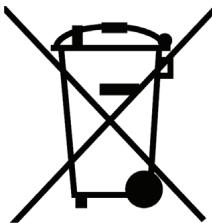
If at any time in the future you should need to dispose of this product please note that Waste electrical products should not be disposed of with household waste. Please recycle where facilities exist. Check with your Local Authority or retailer for recycling advice.
(Waste Electrical and Electronic Equipment Directive)
If this product should be defective, despite our high standard quality control, please contact the service & support hotline. The hotline is available Monday through Friday from 10am to 6pm at this number:
0180 5 - 22 17 98 (€ 0,14 / Min. Germany only)
If the product needs to be sent to the servicecenter, please call service & support.