USER MANUAL RFT 5577 AV ROSIERES
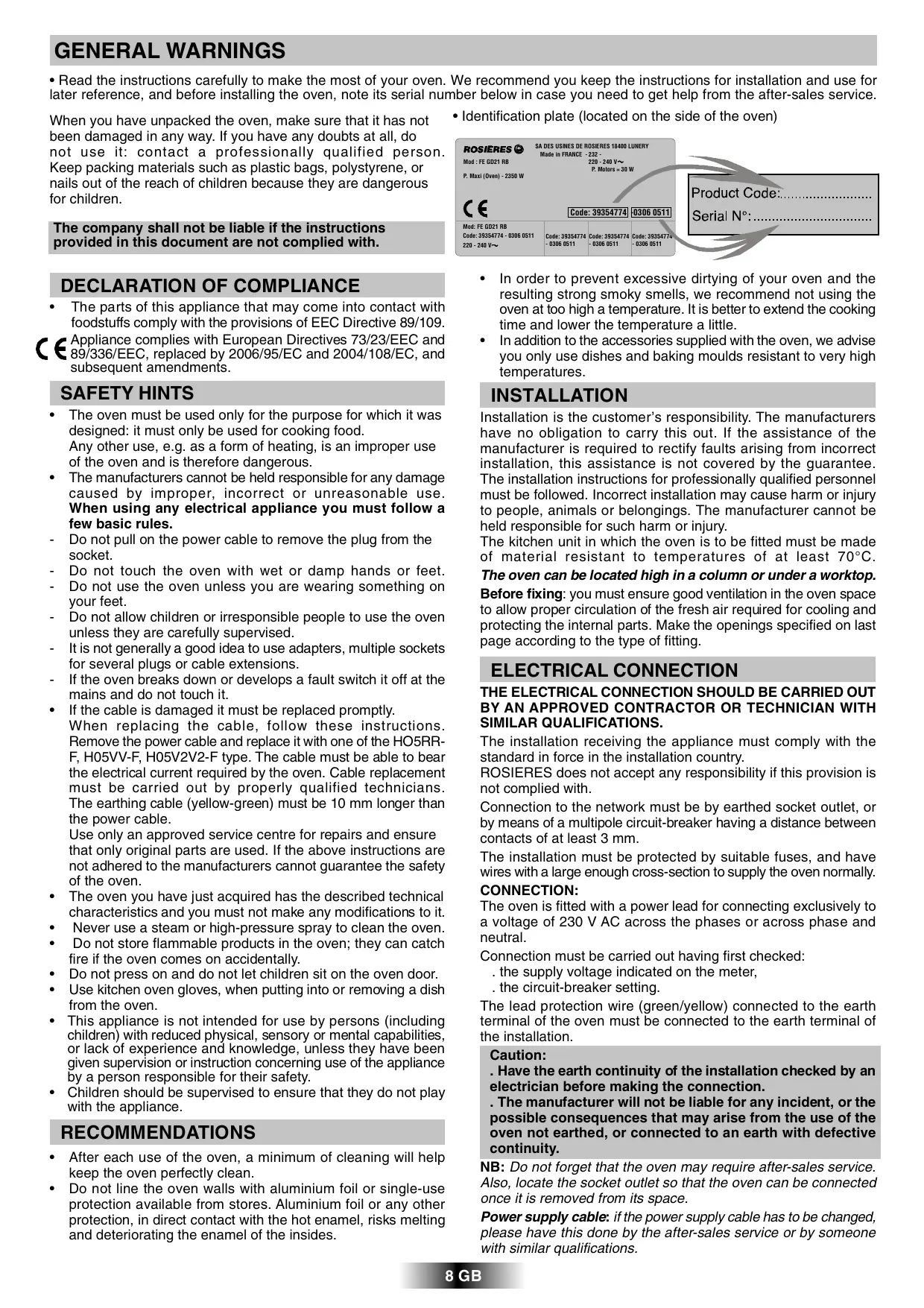
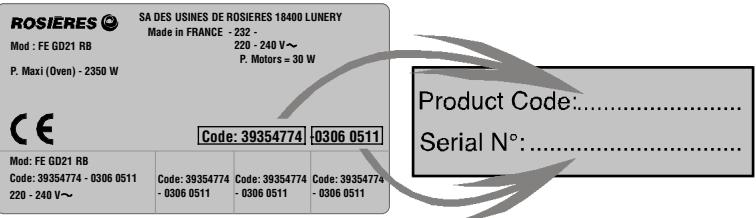
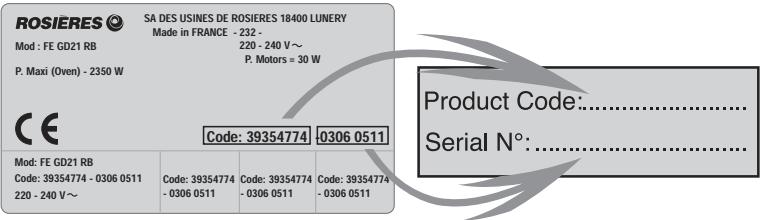
- Read the instructions carefully to make the most of your oven. We recommend you keep the instructions for installation and use for later reference, and before installing the oven, note its serial number below in case you need to get help from the after-sales service.
When you have unpacked the oven, make sure that it has not been damaged in any way. If you have any doubts at all, do not use it: contact a professionally qualified person. Keep packing materials such as plastic bags, polystyrene, or nails out of the reach of children because they are dangerous for children.
The company shall not be liable if the instructions provided in this document are not complied with.
DECLARATION OF COMPLIANCE
- The parts of this appliance that may come into contact with foodstuffs comply with the provisions of EEC Directive 89/109.
C E Appliance complies with European Directives 73/23/EEC and 89/336/EEC, replaced by 2006/95/EC and 2004/108/EC, and subsequent amendments.
SAFETY HINTS
- The oven must be used only for the purpose for which it was designed: it must only be used for cooking food.
Any other use, e.g. as a form of heating, is an improper use of the oven and is therefore dangerous.
- The manufacturers cannot be held responsible for any damage caused by improper, incorrect or unreasonable use. When using any electrical appliance you must follow a few basic rules.
- Do not pull on the power cable to remove the plug from the socket.
- Do not touch the oven with wet or damp hands or feet.
- Do not use the oven unless you are wearing something on your feet.
- Do not allow children or irresponsible people to use the oven unless they are carefully supervised.
- It is not generally a good idea to use adapters, multiple sockets for several plugs or cable extensions.
- If the oven breaks down or develops a fault switch it off at the mains and do not touch it.
- If the cable is damaged it must be replaced promptly. When replacing the cable, follow these instructions. Remove the power cable and replace it with one of the HO5RR-F, H05VV-F, H05V2V2-F type. The cable must be able to bear the electrical current required by the oven. Cable replacement must be carried out by properly qualified technicians. The earthing cable (yellow-green) must be 10mm longer than the power cable.
Use only an approved service centre for repairs and ensure that only original parts are used. If the above instructions are not adhered to the manufacturers cannot guarantee the safety of the oven.
- The oven you have just acquired has the described technical characteristics and you must not make any modifications to it.
- Never use a steam or high-pressure spray to clean the oven.
- Do not store flammable products in the oven; they can catch fire if the oven comes on accidentally.
- Do not press on and do not let children sit on the oven door.
- Use kitchen oven gloves, when putting into or removing a dish from the oven.
- This appliance is not intended for use by persons (including children) with reduced physical, sensory or mental capabilities, or lack of experience and knowledge, unless they have been given supervision or instruction concerning use of the appliance by a person responsible for their safety.
- Children should be supervised to ensure that they do not play with the appliance.
RECOMMENDATIONS
- After each use of the oven, a minimum of cleaning will help keep the oven perfectly clean.
-
Do not line the oven walls with aluminium foil or single-use protection available from stores. Aluminium foil or any other protection, in direct contact with the hot enamel, risks melting and deteriorating the enamel of the insides.
-
Identification plate (located on the side of the oven)
- In order to prevent excessive dirtying of your oven and the resulting strong smoky smells, we recommend not using the oven at too high a temperature. It is better to extend the cooking time and lower the temperature a little.
- In addition to the accessories supplied with the oven, we advise you only use dishes and baking moulds resistant to very high temperatures.
INSTALLATION
Installation is the customer's responsibility. The manufacturers have no obligation to carry this out. If the assistance of the manufacturer is required to rectify faults arising from incorrect installation, this assistance is not covered by the guarantee. The installation instructions for professionally qualified personnel must be followed. Incorrect installation may cause harm or injury to people, animals or belongings. The manufacturer cannot be held responsible for such harm or injury.
The kitchen unit in which the oven is to be fitted must be made of material resistant to temperatures of at least 70^ .
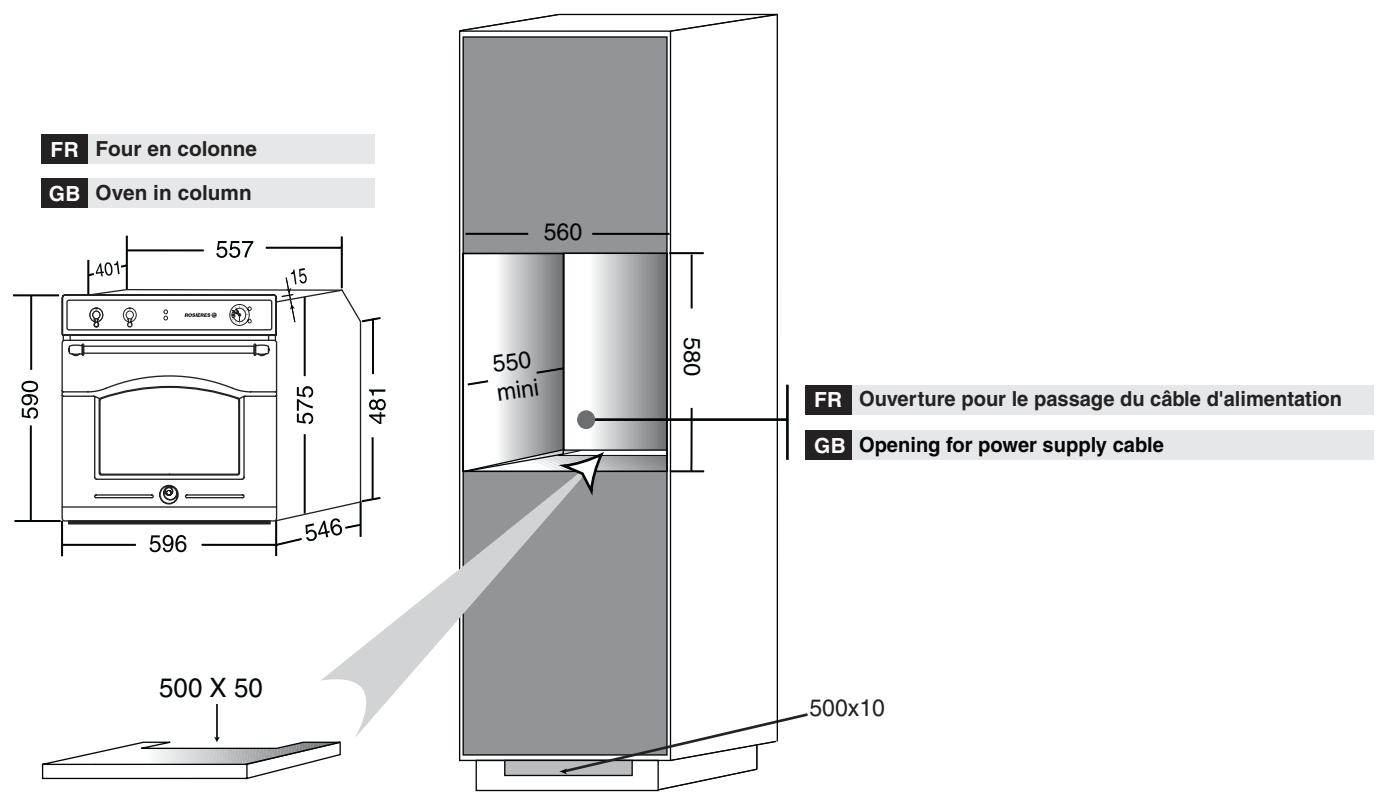
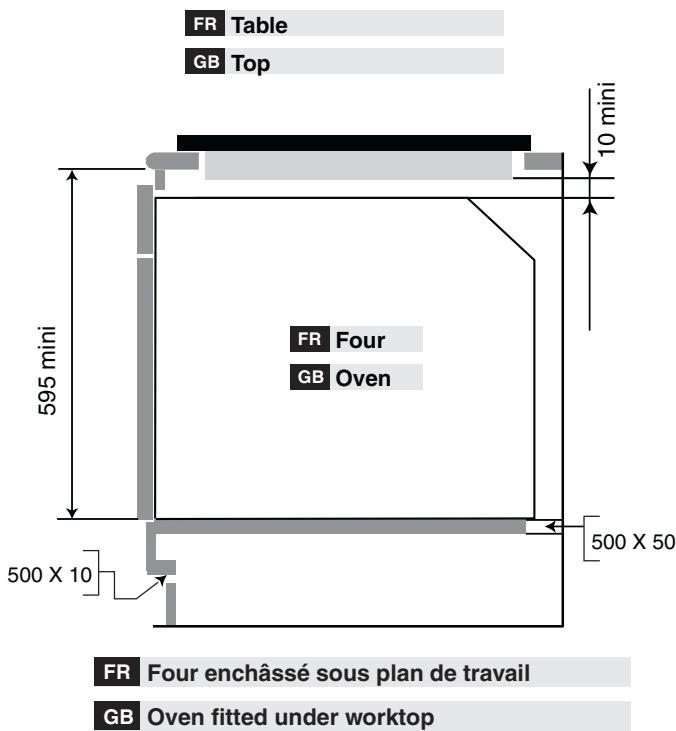
The oven can be located high in a column or under a worktop.
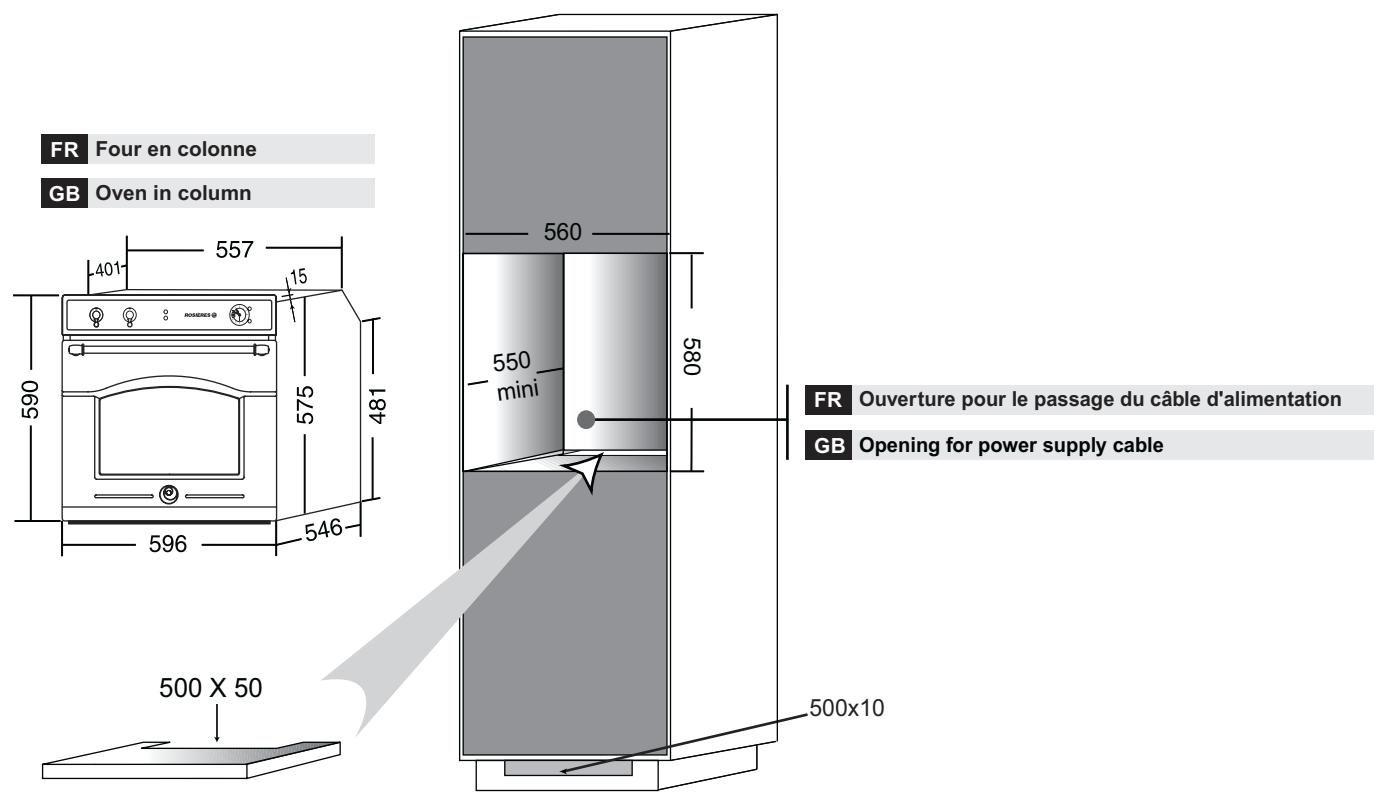
Before fixing: you must ensure good ventilation in the oven space to allow proper circulation of the fresh air required for cooling and protecting the internal parts. Make the openings specified on last page according to the type of fitting.
ELECTRICAL CONNECTION
THE ELECTRICAL CONNECTION SHOULD BE CARRIED OUT BY AN APPROVED CONTRACTOR OR TECHNICIAN WITH SIMILAR QUALIFICATIONS.
The installation receiving the appliance must comply with the standard in force in the installation country.
ROSIERES does not accept any responsibility if this provision is not complied with.
Connection to the network must be by earthed socket outlet, or by means of a multipole circuit-breaker having a distance between contacts of at least 3mm .
The installation must be protected by suitable fuses, and have wires with a large enough cross-section to supply the oven normally.
CONNECTION:
The oven is fitted with a power lead for connecting exclusively to a voltage of 230 V AC across the phases or across phase and neutral.
Connection must be carried out having first checked:
. the supply voltage indicated on the meter, . the circuit-breaker setting.
The lead protection wire (green/yellow) connected to the earth terminal of the oven must be connected to the earth terminal of the installation.
Caution:
. Have the earth continuity of the installation checked by an electrician before making the connection.
. The manufacturer will not be liable for any incident, or the possible consequences that may arise from the use of the oven not earthed, or connected to an earth with defective continuity.
NB: Do not forget that the oven may require after-sales service. Also, locate the socket outlet so that the oven can be connected once it is removed from its space.
Power supply cable: if the power supply cable has to be changed, please have this done by the after-sales service or by someone with similar qualifications.
OVEN EQUIPMENT
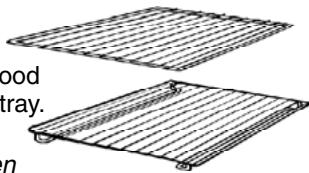
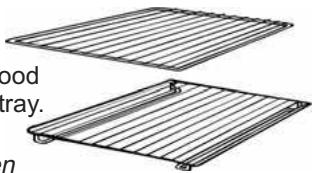
The simple shelf can take moulds and dishes.
The tray holder shelf is especially good for grilling things. Use it with the drip tray.
The special profile of the shelves means they stay horizontal even when pulled right out. There is no risk of a dish sliding or spilling.
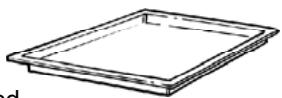
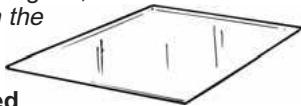
The drip tray catches the juices from grilled foods. It can be put on a shelf, or slid under the rails. It is only used with the Grill, Rotisserie, or Fan Assis
Grill; remove it from the oven for other cooking methods. Never use the drip tray as a roasting tray as this creates smoke and fat will spatter your oven making it dirty.
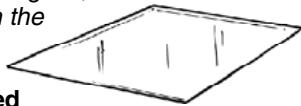
The pastry tray must be placed on the shelf. It is for cooking small pastries like choux, biscuits, meringues, etc...
Never place the pastry tray directly on the oven bottom.
When the oven is in use, any unused accessories should be removed from the oven.
GRILLING
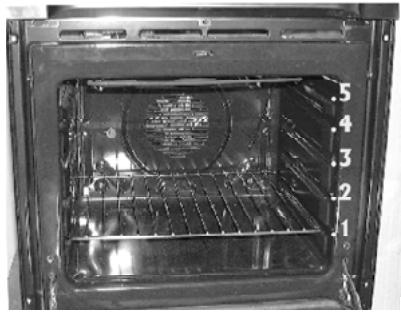
Grilling makes it possible to give food a rich brown colour quickly. For browning we recommend that you insert the grill onto the fourth level, depending on the proportions of the food (see fig. page 13).
Almost all food can be cooked under the grill except for very lean game and meat rolls.
Meat and fish that are going to be grilled should first be lightly doused with oil.
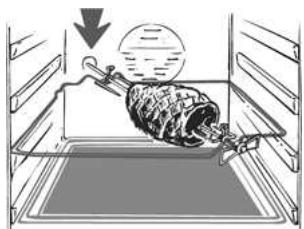
THE TURNSPIT
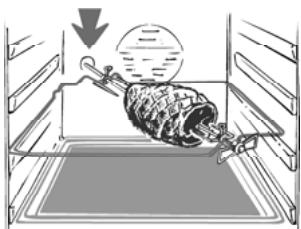
No preheating is required for Rotisserie cooking. Rotisserie cooking is done with the door closed.
COOKING TIME
For recommended cooking times and temperatures the first time you use the oven, refer to the tables on pages 13, 14. You may then wish to vary these times and settings in the light of your own experience.
CLEANING THE OVEN
- Wait for the oven to cool down before doing any cleaning by hand.
- Never clean your oven with abrasive cleaners, wire wool or sharp objects, or the enamel may be damaged beyond repair.
- Only use soapy water or bleach (ammonia) cleaners.
GLASS PARTS
We recommend you wipe clean the glass door with absorbent kitchen paper every time you use the oven. If the spattering is heavy, then you can clean with a well squeezed sponge and detergent, and rinse. Never use abrasive cleaners or sharp objects.
OVEN DOOR SEAL
If this gets dirty, clean the oven seal with a slightly damp sponge.
ACCESSIONS
Clean them with a sponge soaked in soapy water. Rinse with clean water and dry off. Avoid abrasive cleaners.
DRIP TRAY
After grilling, remove the drip tray from the oven. Take care to pour the warm grease into a container. Wash and rinse the drip tray in hot water with a sponge soaked in washing up liquid. If residues remain attached, soak them off in water and detergent. It can also go in a dish washer or be cleaned with a commercial oven cleaner.
Never placer a soiled drip tray in the oven.
Never leave the drip tray in during pyrolysis.
OVEN LIGHTING
Disconnect the power supply from the oven before cleaning or replacing the lamp.
The bulb and its cover are made of material resistant to high temperatures.
Bulb characteristics:
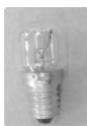
230 V AC - 25 W - E 14 base -
Temperature 300^
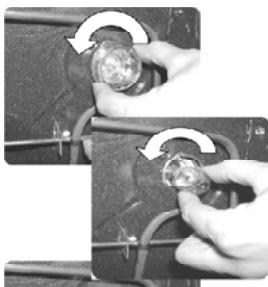
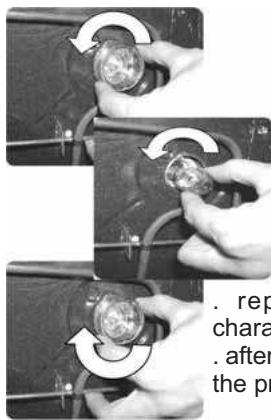
To change a defective bulb, just unscrew the glass cover, unscrew the bulb,
. replace it with the same type: see characteristics above,
. after replacing the defective bulb, screw back the protective glass cover.
SELF-CLEANING OVEN WITH CATALYTIC
Special self-cleaning panels covered in a micro-porous coating are fitted, the oven no longer needs to be cleaned by hand. The fat that is splattered onto the sides of the oven during roasting is eliminated by the microporous coating which breaks the fat down by catalysis and transforms it into gas.
Excessive splattering may nevertheless block the pores and therefore hinder self-cleaning. The self-cleaning capacity may be restored by switching on the empty oven to maximum for about 10-20 minutes.
Do not use abrasive products, metal cleaning wads, sharp objects, rough cloths, or chemical products and detergents that may permanently damage the catalytic lining.
It is a good idea to use deep roasting trays to roast fatty foods such as joints of meat etc. and to put a tray underneath the grill to catch surplus fat.
If the walls of the oven are so thickly coated in grease that the catalytic lining is no longer effective remove surplus grease with a soft cloth or sponge soaked in hot water.
The lining must be porous for self-cleaning to be effective.
N.B.: All catalytic linings currently on the market have a working life of about 300 hours. They should therefore be replaced after about 300 hours.
CLEANING THE OVEN : PYROLYSIS
Pyrolysis is a cleaning method that uses high temperatures to destroy dirt.
The resulting smoke is cleaned by the passage of a catalyser. The oven door is provided with a safety lock that prevents it being opened during pyrolysis due to the necessity of high temperatures. The pyrolysis cycle may result in a slight odour in the kitchen which will be more or less noticeable depending on the latter's aeration.
IMPORTANT:
Before carrying out pyrolysis:
- Take all accessories out of the oven as they will be damaged in the high pyrolysis temperatures;
- Clean away all excess food spills or large scraps of food which would take too long to be destroyed. Effectively, large amounts of grease may catch fire under the intense heat emitted by pyrolysis.
- Close the oven door.
. If you have an hob top installed above the oven, never use the gas burners or the electric plates during pyrolysis to avoid excessive heating of the oven's control panel.
. It is strongly advised not to use detergents or any other recommended product for cleaning ovens.
- Open the oven door.
Pyrolysis leaves a white residue on the oven walls. Wait for the oven to cool completely then clean the inside of the oven with a damp sponge to wipe off the residue.
ACTIVATING THE PYROLYSIS CYCLE
- Leave the thermostat knob in position '0'.
- Rotate the function selector to the position P.
- The door is locked.
- According to the degree of staining :
. On the circuit-breaker timer : set a time.
. On the programmer : set the pyrolysis time; a delayed start can be setted (look at the programmer paragraph).
ATTENTION: if a pyrolysis cycle time is not settet the pyrolyses will not start.
90 minutes
105 minutes
Oven very dirty
120 minutes
- At the end of the pyrolysis cycle the oven will automatically switch off.
- Rotate the function selector to the position '0'.
The oven temperature will decrease, the door will be unlocked once the temperature will be under 320^ .
SERVICE CENTRE
Before calling the Service Centre
If the oven is not working, we recommend that:
- you check that the oven is properly plugged into the power supply.
If the cause of the fault cannot be detected:
disconnect the oven from the mains, do not touch the oven and call the after sales service.
Before calling the Service Centre remember to make a note of the serial number on the serial number specifications plate. The oven is supplied with a guarantee certificate that ensures that it will be repaired free of charge by the Service Centre whilst under guarantee.
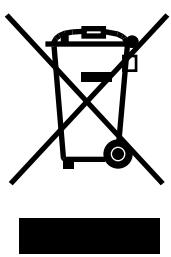
This appliance is marked according to the European directive 2002/96/EC on Waste Electrical and Electronic Equipment (WEEE). By ensuring this product is disposed of correctly, you will help prevent potential negative consequences for the environment and human health, which could otherwise be caused by inappropriate waste handling of this product. The symbol on the product indicates that this
product may not be treated as household waste. Instead it shall be handed over to the applicable collection point for the recycling of electrical and electronic equipment.
Disposal must be carried out in accordance with local environmental regulations for waste disposal.
For more detailed information about treatment, recovery and recycling of this product, please contact your local city office, your household waste disposal service or the shop where you purchased the product.
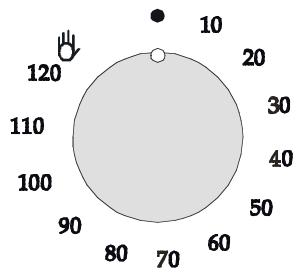
It takes in charge the functioning of the oven in cooking mode, or in pyrolytic mode, for between 1 and 120 minutes, with immediate start and automatic stop. When the time is up, the timer automatically cuts off the power supply to the oven.
However, in cooking mode, the oven could be used without programming. In this case, turn the control knob to the Hand position .
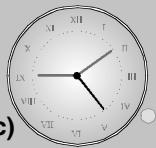
USE OF ANALOGUE CLOCK/PROGRAMMER
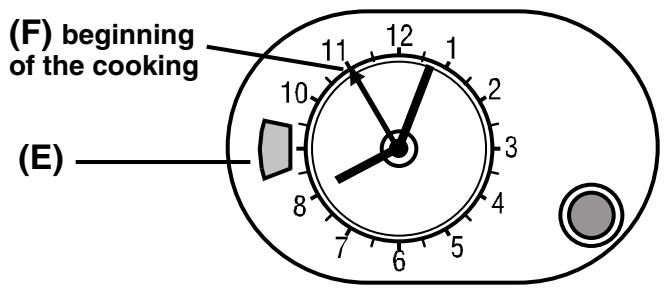
SETTING THE CORRECT TIME
To set the correct time push and turn clockwise the button until the clock shows the correct time. Once this is done release the control.
ATTENTION : the oven only operates if set on manual function or preset time.
| FUNCTION | HOW TO ACTIVATE IT | HOW TO SWITCH IT OFF | WHAT IT DOES | WHAT IT IS FOR |
| MANUAL FUNCTION | ·Turn the button clockwise, without pushing, until the symbol appears in the window (E) | ·Turn the oven function selector to position O. | ·Enables you to operate the oven. | ·For cooking the desired recipes |
| COOKING TIME
(To be used even for the pyrolysis cycle) | ·First of all select the cooking function and the temperature required
·Set the length of cooking required by turning the button clockwise until the time matches the length of time shown in the window (E)
·The oven will start immediately and it will switch off automatically at the end of the preset time
·Max time 180 minutes (3 hours) | ·At the end of the set time the oven switches off automatically, this is indicated by an audible alarm.
·To cancel the setting turn the control knob until the symbol appears in the window (E) | ·It allows you to preset the cooking time required for the recipe chosen. | ·At the end of the cooking time set, the oven will switch off automatically and an audible alarm will ring. |
| END OF COOKING
(To be used even for the pyrolysis cycle) | ·First of all select the cooking function and the temperature required.
·Turn the button clockwise, without pushing, until the symbol appears in the window (E)
·To set the cooking start time pull and turn the button clockwise until the hand F is in the position indicating the start time required.
·To set the length of cooking required turn clockwise the button knob without pushing it, until the time required appears in the window (E). | ·At the end of cooking time set the oven will switch off automatically and an audible alarm will ring.
·To cancel the set function turn the button clockwise until the symbol appears in the window (E)
·The alarm have to be stopped by turning the control knob until the symbol appears in the window (E) | ·Enables to program the oven so that the recipe is ready at the desired time | ·Example: if the dish has to be cooked for 45 minutes and needs to be ready by 12:30;
- Select the required function
- Set start cooking time at 11:45 (12:30 minus 45 minutes)
- Set cooking time at 45 minutes
At the end of cooking the oven will automatically switch off. |
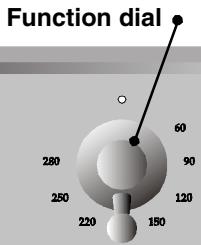
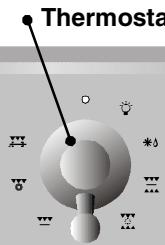
Our range includes many different styles and colours. To find the technical specifications and functions of the model which you have bought, study the diagrams below.
During oven operation the internal lamp is on.

ROSIERES
Main supply indicator lamp (catalitic) Door lock lamp (pyrolytic)
Model with clock programmer
| Function dial | Thermostat dial | Function according to the model |
| | Turns on the oven lightThis will automatically activate the cooling fan |
| | DEFROSTThe cooking fan runs to circulate the air inside the oven. Ideal for defrosting before cooking. |
| | CONVENTIONAL COOKINGBoth top and bottom heating elements are used. Preheat the oven for about ten minutes. This method is ideal for all traditional roasting and baking. For seizing red meats, roast beef, leg of lamb, game, bread, foilwrapped food (papillotes), flaky pastry. Place the food and its dish on a shelf in mid position. |
| | FAN COOKINGBoth top and bottom heating elements are used with the fan circulating the air inside the oven. We recommend you use this method for poultry, pastries, fish and vegetables. Heat penetrates into the food better and both the cooking and preheating times are reduced. You can cook different foods at the same time with or without the same preparation in one or more positions. This cooking method gives even heat distribution and the smells are not mixed. Allow about ten minutes extra when cooking foods at the same time. |
| | LOWER ELEMENT:Using the lower element. Ideal for cooking all pastry based dishes. This allows you to cook dry tart pastry without over cooking the fruit filling. Use this for flans, quiches, tarts, pâté and any cooking that needs more heat and radiation from below. |
| | FAN + LOWER ELEMENTThe bottom heating element is used with the fan circulating the air inside the oven. This method is ideal for juicy fruit flans, tarts, quiches and pâté. It prevents food from drying and encourages rising in cakes, bread dough and other bottom-cooked food. Place the shelf in the bottom position. |
| | GRILL: use the grill with the door closed. The top heating element is used alone and you can adjust the temperature. Five minutes preheating is required to get the elements red-hot. Success is guaranteed for grills, kebabs and au gratin dishes. White meats should be put at a distance from the grill; the cooking time is longer, but the meat will be tastier. You can put red meats and fish fillets on the shelf with the drip tray underneath. |
| | FAN ASSISTED GRILL: use the turbo-grill with the door closed. The top heating element is used with the fan circulating the air inside the oven. Preheating is necessary for red meats but not for white meats. Ideal for cooking thick food items, whole pieces such as roast pork, poultry, etc. Place the food to be grilled directly on the shelf centrally, at the middle level. Slide the drip tray under the shelf to collect the juices. Make sure that the food is not too close to the grill. Turn the food over halfway through cooking. |
| | ROTISSERIE: use the turnspit with the door closed. The top heating element is used with the turnspit rotating the food to be cooked. The heating temperature can be adjusted as required. Ideal for rediscovering the taste of traditional roast. No preheating is required for turnspit cooking. |
| | Pyrolysis |
- Tested in accordance with the CENELEC EN 50304.
** Tested in accordance with the CENELEC EN 50304 used for definition of energy class.
COOKING TIPS
Temperatures and cooking times are given for information only to facilitate using the oven. Personal experience should then let you adapt these settings to your taste and habits. Remember that cooking at higher temperatures causes more spattering, and the oven can become dirty and smokey. It is better to slightly reduce the cooking temperature, even if it means increasing the cooking time.
The sides of the oven are equipped with different positions numbered from the bottom.
FISH
| Recipes | Cooking method | Quantity | Cooking °C | Cooking time | Shelf level |
| Tilefish or bream | Conv cooking | 1kg whole | 220°C | 30 min | 1 |
| Monk fish or Salmon | Conv cooking | 1kg braised | 220°C | 30 min | 1 |
| Fillet of sole | Fan cooking | 6 pieces | 160°C | 15-20 min | 1 |
| Grilled fish | Grill | 6 fillets | 275°C | 2x5 min | 4 |
VEGETABLES - OTHERS
| Recipes | Cooking method | Quantity | Cooking °C | Cooking time | Tips |
| Braised cabbage | Conv cooking | for 6 | 200-220°C | 1 hour | |
| Pâté en croûte | Conv cooking | | 200-220°C | 1 hour/kg | |
| Chicory with gruyere | Fan cooking | for 6 | 180-200°C | 25-30 min | |
| Potatoes in their jackets | Fan cooking | for 6 | 200-220° | about 1 hour | |
| Soufflé savoury/sweet | Fan cooking | for 6 | 180-200°C | 50-60 min | Ø 22 |
| Stuffed tomatoes | Fan cooking | 6-8 pieces | 200-220°C | 40-45 min | |
| Leek flan | Fan + lower element | for 6 | 220°C | 35-40 min | |
| Quiche Lorraine | Fan + lower element | for 6 | 220°C | 45-50 min | |
| Toast with crottin* | Turbo grill | 6 pieces | 210°C | 3 min to toast one side + 4 min/crottin | Flat steak pan |
All the cooking was done at shelf position "1" except cooking marked thus **, which requires cooking at a middle position.
MEAT
It is better not to salt meats until after cooking as salt encourages the meat to spatter fat. This will dirty the oven and make a lot of smoke. Joints of white meat, pork, veal, lamb and fish can be put into the oven cold. The cooking time is longer than in a preheated oven, but it cooks through to the centre better as the heat has more time to penetrate the joint.
Correct preheating is the basis of successful red meat cookery.
GRILLS
- Before loading the grill: remove the meat from the refrigerator a few hours before grilling. Lay it on several layers of kitchen paper: this improves seizing, making it tastier and avoids it staying cold at the centre.
Add pepper and spices to the meat before grilling, but add any salt after cooking. This way it will seize better and stay juicy. Baste all the food to be cooked with a little oil. This is best done with a wide flatasting brush. Then sprinkle with more pepper and herbs (thyme, etc.).
- During cooking: never pierce the food during cooking even when you turn it. This lets the juice out and it becomes dry.
| Recipes | Cooking method | Quantity | Cooking °C | Cooking time | Tips |
| Beef with carrots | Conv cooking | for 6 | 200-220°C | about 1 hours | |
| Duck | Conv cooking | 1,5 kg | 200-220°C | 1½hours | |
| Turkey | Conv cooking | 5/6 kg | 160-180°C | 2½- 3 hours | |
| Goose | Conv cooking | 3/4 kg | 160-180°C | 2 - 2½hours | |
| Leg of lamb | Conv cooking | | 200-220°C | 15 min/pound | |
| Roast chicken | Conv cooking | 1/1,5 kg | 220°C | about 1 hour | |
| Roast beef | Conv cooking | | 240°C | 15 min/pound | |
| Roast rabbit | Fan cooking | 800-1 kg | 200-220°C | 50-60 mins | |
| Beef | Rotisserie | 1kg | 275°C | 15-20 min | No preheat |
| Lamb / Mutton | Rotisserie | 1 kg | 275°C | 20-25 min | No preheat |
| Kebabs | Grill | 6 pieces | 275°C | 2x8 min | Turn over in mid cooking |
| Pork chop | Grill | 6 pieces | 275°C | 2x8 min | Turn over in mid cooking |
- All cooking was done at shelf position "1".
BAKING
Avoid using shiny tins, they reflect the heat and can spoil your cakes. If your cakes brown too quickly, cover them with grease-proof paper or aluminium foil. Caution: the correct way to use foil is with the shiny side in towards the cake. If not the heat is reflected by the shiny surface and does not penetrate the food. Avoid opening the door during the first 20 to 25 minutes of cooking: souffles, brioches, sponge cakes, etc. will tend to fall. You can check if cakes are done by pricking the centre with a knife blade or metal knitting needle. If the blade comes out nice and dry, your cake is ready and you can stop cooking. If the blade comes out moist or with bits of cake attached, continue baking but slightly lower the thermostat so that it is finished off without burning.
| Recipes | Cooking method | Quantity | Cooking °C | Cooking time | Shelf level | Tips |
| Brioche | Fan cooking | 800 grs | 200°C | 40-40 min | 1 | |
| Choux pastry | Fan cooking | 40 pieces | 190°C | 35 min | 1 / 3 | 2 trays |
| Pastry base | Fan cooking | for 6 | 180-200°C | 20-30 min | 1 | Ø 27 |
| Puff pastry | Fan cooking | 6 pieces | 200°C | 15-20 min | 1 | e.g. Bouchée |
| Meringues | Fan+Lower element* | 1 tray | 80-85°C | 4 1/2 hours | 1 | Ø profiteroles |
| Fruit tart | Fan+Lower element* | for 6 | 220°C | 35-40 min | 1 | |
| St Honoré | Fan+Lower element* | 6 pieces | 190°C | 30-35 min | 1 | |
- with fan and lower element, we recommend preheating with fan cooking to save time.
-
en sole seule, comme en sole brassée, nous recommendons un préchauffage en chaleur brassée, pour gagner du temps.
-
Read the instructions carefully to make the most of your oven. We recommend you keep the instructions for installation and use for later reference, and before installing the oven, note its serial number below in case you need to get help from the after-sales service.
When you have unpacked the oven, make sure that it has not been damaged in any way. If you have any doubts at all, do not use it: contact a professionally qualified person. Keep packing materials such as plastic bags, polystyrene, or nails out of the reach of children because they are dangerous for children.
The company shall not be liable if the instructions provided in this document are not complied with.
DECLARATION OF COMPLIANCE
- The parts of this appliance that may come into contact with foodstuffs comply with the provisions of EEC Directive 89/109.
This appliances complies with Directives 89/336/EEC, 73/23/EEC and following changes.
SAFETY HINTS
- The oven must be used only for the purpose for which it was designed: it must only be used for cooking food.
Any other use, e.g. as a form of heating, is an improper use of the oven and is therefore dangerous.
- The manufacturers cannot be held responsible for any damage caused by improper, incorrect or unreasonable use.
When using any electrical appliance you must follow a few basic rules.
- Do not pull on the power cable to remove the plug from the socket.
- Do not touch the oven with wet or damp hands or feet.
- Do not use the oven unless you are wearing something on your feet.
- Do not allow children or irresponsible people to use the oven unless they are carefully supervised.
- It is not generally a good idea to use adapters, multiple sockets for several plugs or cable extensions.
- If the oven breaks down or develops a fault switch it off at the mains and do not touch it.
- If the cable is damaged it must be replaced promptly. When replacing the cable, follow these instructions. Remove the power cable and replace it with one of the HO5RR-F, H05VV-F, H05V2V2-F type. The cable must be able to bear the electrical current required by the oven. Cable replacement must be carried out by properly qualified technicians. The earthing cable (yellow-green) must be 10mm longer than the power cable.
Use only an approved service centre for repairs and ensure that only original parts are used. If the above instructions are not adhered to the manufacturers cannot guarantee the safety of the oven.
- The oven you have just acquired has the described technical characteristics and you must not make any modifications to it.
- Never use a steam or high-pressure spray to clean the oven.
- Do not store flammable products in the oven; they can catch fire if the oven comes on accidentally.
- Do not press on and do not let children sit on the oven door.
- Use kitchen oven gloves, when putting into or removing a dish from the oven.
RECOMMENDATIONS
After each use of the oven, a minimum of cleaning will help keep the oven perfectly clean.
- Do not line the oven walls with aluminium foil or single-use protection available from stores. Aluminium foil or any other protection, in direct contact with the hot enamel, risks melting and deteriorating the enamel of the insides.
- In order to prevent excessive dirtying of your oven and the resulting strong smoky smells, we recommend not using the oven at too high a temperature. It is better to extend the cooking time and lower the temperature a little.
- In addition to the accessories supplied with the oven, we advise you only use dishes and baking moulds resistant to very high temperatures.
- Identification plate (located on the side of the oven)
INSTALLATION
Installation is the customer's responsibility. The manufacturers have no obligation to carry this out. If the assistance of the manufacturer is required to rectify faults arising from incorrect installation, this assistance is not covered by the guarantee. The installation instructions for professionally qualified personnel must be followed. Incorrect installation may cause harm or injury to people, animals or belongings. The manufacturer cannot be held responsible for such harm or injury.
The kitchen unit in which the oven is to be fitted must be made of material resistant to temperatures of at least 70^ .
The oven can be located high in a column or under a worktop.
Before fixing: you must ensure good ventilation in the oven space to allow proper circulation of the fresh air required for cooling and protecting the internal parts. Make the openings specified on last page according to the type of fitting.
ELECTRICAL CONNECTION
THE ELECTRICAL CONNECTION SHOULD BE CARRIED OUT BY AN APPROVED CONTRACTOR OR TECHNICIAN WITH SIMILAR QUALIFICATIONS.
The installation receiving the appliance must comply with the standard in force in the installation country.
ROSIERES does not accept any responsibility if this provision is not complied with.
Connection to the network must be by earthed socket outlet, or by means of a multipole circuit-breaker having a distance between contacts of at least 3mm .
The installation must be protected by suitable fuses, and have wires with a large enough cross-section to supply the oven normally.
CONNECTION:
The oven is fitted with a power lead for connecting exclusively to a voltage of 230 V AC across the phases or across phase and neutral.
Connection must be carried out having first checked:
. the supply voltage indicated on the meter,
. the circuit-breaker setting.
The lead protection wire (green/yellow) connected to the earth terminal of the oven must be connected to the earth terminal of the installation.
Caution:
. Have the earth continuity of the installation checked by an electrician before making the connection.
. The manufacturer will not be liable for any incident, or the possible consequences that may arise from the use of the oven not earthed, or connected to an earth with defective continuity.
NB: Do not forget that the oven may require after-sales service. Also, locate the socket outlet so that the oven can be connected once it is removed from its space.
Power supply cable: if the power supply cable has to be changed, please have this done by the after-sales service or by someone with similar qualifications.
OVEN EQUIPMENT
The simple shelf can take moulds and dishes.
The tray holder shelf is especially good for grilling things. Use it with the drip tray.
The special profile of the shelves means they stay horizontal even when pulled right out. There is no risk of a dish sliding or spilling.
The drip tray catches the juices from grilled foods. It can be put on a shelf, or slid under the rails. It is only used with the Grill, Rotisserie, or Fan Assis
Grill; remove it from the oven for other cooking methods. Never use the drip tray as a roasting tray as this creates smoke and fat will spatter your oven making it dirty.
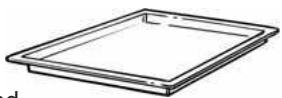
The pastry tray must be placed on the shelf. It is for cooking small pastries like choux, biscuits, meringues, etc...
Never place the pastry tray directly on the oven bottom.
When the oven is in use, any unused accessories should be removed from the oven.
GRILLING
Grilling makes it possible to give food a rich brown colour quickly. For browning we recommend that you insert the grill onto the fourth level, depending on the proportions of the food (see fig. page 13).
Almost all food can be cooked under the grill except for very lean game and meat rolls.
Meat and fish that are going to be grilled should first be lightly doused with oil.
THE TURNSPIT
No preheating is required for Rotisserie cooking. Rotisserie cooking is done with the door closed.
COOKING TIME
For recommended cooking times and temperatures the first time you use the oven, refer to the tables on pages 13, 14. You may then wish to vary these times and settings in the light of your own experience.
CLEANING THE OVEN
- Wait for the oven to cool down before doing any cleaning by hand.
- Never clean your oven with abrasive cleaners, wire wool or sharp objects, or the enamel may be damaged beyond repair.
- Only use soapy water or bleach (ammonia) cleaners.
GLASS PARTS
We recommend you wipe clean the glass door with absorbent kitchen paper every time you use the oven. If the spattering is heavy, then you can clean with a well squeezed sponge and detergent, and rinse. Never use abrasive cleaners or sharp objects.
OVEN DOOR SEAL
If this gets dirty, clean the oven seal with a slightly damp sponge.
ACCESSIONS
Clean them with a sponge soaked in soapy water. Rinse with clean water and dry off. Avoid abrasive cleaners.
DRIP TRAY
After grilling, remove the drip tray from the oven. Take care to pour the warm grease into a container. Wash and rinse the drip tray in hot water with a sponge soaked in washing up liquid. If residues remain attached, soak them off in water and detergent. It can also go in a dish washer or be cleaned with a commercial oven cleaner.
Never placer a soiled drip tray in the oven.
Never leave the drip tray in during pyrolysis.
OVEN LIGHTING
Disconnect the power supply from the oven before cleaning or replacing the lamp.
The bulb and its cover are made of material resistant to high temperatures.
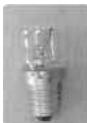
Bulb characteristics:
230 V AC - 25 W - E 14 base -
Temperature 300^
To change a defective bulb, just. unscrew the glass cover,. unscrew the bulb,
. replace it with the same type: see characteristics above,
. after replacing the defective bulb, screw back the protective glass cover.
SELF-CLEANING OVEN WITH CATALYTIC
Special self-cleaning panels covered in a micro-porous coating are fitted, the oven no longer needs to be cleaned by hand. The fat that is splattered onto the sides of the oven during roasting is eliminated by the microporous coating which breaks the fat down by catalysis and transforms it into gas.
Excessive splattering may nevertheless block the pores and therefore hinder self-cleaning. The self-cleaning capacity may be restored by switching on the empty oven to maximum for about 10-20 minutes.
Do not use abrasive products, metal cleaning wads, sharp objects, rough cloths, or chemical products and detergents that may permanently damage the catalytic lining.
It is a good idea to use deep roasting trays to roast fatty foods such as joints of meat etc. and to put a tray underneath the grill to catch surplus fat.
If the walls of the oven are so thickly coated in grease that the catalytic lining is no longer effective remove surplus grease with a soft cloth or sponge soaked in hot water.
The lining must be porous for self-cleaning to be effective.
N.B.: All catalytic linings currently on the market have a working life of about 300 hours. They should therefore be replaced after about 300 hours.
CLEANING THE OVEN : PYROLYSIS
Pyrolysis is a cleaning method that uses high temperatures to destroy dirt.
The resulting smoke is cleaned by the passage of a catalyser. The oven door is provided with a safety lock that prevents it being opened during pyrolysis due to the necessity of high temperatures. The pyrolysis cycle may result in a slight odour in the kitchen which will be more or less noticeable depending on the latter's aeration.
IMPORTANT:
Before carrying out pyrolysis:
- Take all accessories out of the oven as they will be damaged in the high pyrolysis temperatures;
- Clean away all excess food spills or large scraps of food which would take too long to be destroyed. Effectively, large amounts of grease may catch fire under the intense heat emitted by pyrolysis.
- Close the oven door.
. If you have an hob top installed above the oven, never use the gas burners or the electric plates during pyrolysis to avoid excessive heating of the oven's control panel.
It is strongly advised not to use detergents or any other recommended product for cleaning ovens.
- Open the oven door.
Pyrolysis leaves a white residue on the oven walls. Wait for the oven to cool completely then clean the inside of the oven with a damp sponge to wipe off the residue.
ACTIVATING THE PYROLYSIS CYCLE
- Leave the thermostat knob in position '0'
- Rotate the function selector to the position P
- The door is locked
- Using the programmer set the pyrolysis time; a delayed start can be setted (look at the programmer paragraph)
ATTENTION: if a pyrolysis cycle time is not settet the pyrolyses will not start
Oven moderately dirty 90 minutes
Oven normally dirty 105 minutes
Oven very dirty 120 minutes
- At the end of the pyrolysis cycle the oven will automatically switch off.
- Rotate the function selector to the position '0'
The oven temperature will decrease, the door will be unlocked once the temperature will be under 320^ .
SERVICE CENTRE
Before calling the Service Centre
If the oven is not working, we recommend that:
- you check that the oven is properly plugged into the power supply.
If the cause of the fault cannot be detected:
disconnect the oven from the mains, do not touch the oven and call the after sales service.
Before calling the Service Centre remember to make a note of the serial number on the serial number specifications plate.
The oven is supplied with a guarantee certificate that ensures that it will be repaired free of charge by the Service Centre whilst under guarantee.
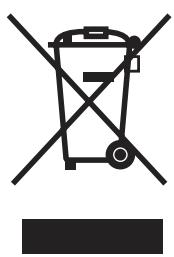
This appliance is marked according to the European directive 2002/96/EC on Waste Electrical and Electronic Equipment (WEEE). By ensuring this product is disposed of correctly, you will help prevent potential negative consequences for the environment and human health, which could otherwise be caused by inappropriate waste handling of this product. The symbol on the product indicates that this
product may not be treated as household waste. Instead it shall be handed over to the applicable collection point for the recycling of electrical and electronic equipment.
Disposal must be carried out in accordance with local environmental regulations for waste disposal.
For more detailed information about treatment, recovery and recycling of this product, please contact your local city office, your household waste disposal service or the shop where you purchased the product.
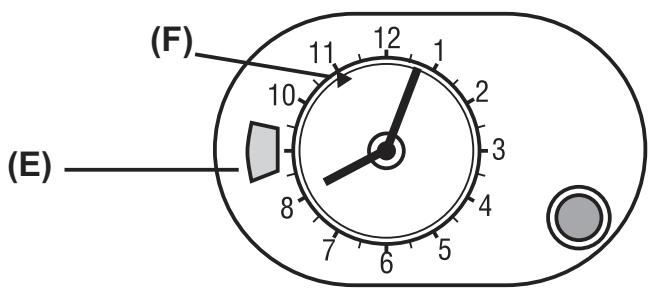
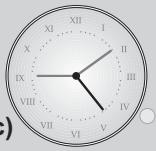
SETTING THE CORRECT TIME
To set the correct time push and turn anti-clockwise the knob until the clock shows the correct time. Once this is done release the control.
ATTENTION : the oven only operates if set on manual function or preset time.
| FUNCTION | HOW TO ACTIVATE IT | HOW TO SWITCH IT OFF | WHAT IT DOES | WHAT IT IS FOR |
| MANUAL FUNCTION | ·Turn the control knob anticlockwise, without pushing, until the symbol appears in the window (E) | ·Turn the oven function selector to position O. | ·Enables you to operate the oven. | ·For cooking the desired recipes |
| COOKING TIME
(To be used even for the pyrolysis cycle) | ·First of all select the cooking function and the temperature required
·Set the length of cooking required by turning the control knob anticlockwise until the time matches the length of time shown in the window (E)
·The oven will start immediately and it will switch off automatically at the end of the preset time
·Max time 180 minutes (3 hours) | ·At the end of the set time the oven switches off automatically, this is indicated by an audible alarm.
·To cancel the setting turn the control knob until the symbol appears in the window (E) | ·It allows you to preset the cooking time required for the recipe chosen. | ·At the end of the cooking time set, the oven will switch off automatically and an audible alarm will ring. |
| END OF COOKING
(To be used even for the pyrolysis cycle) | ·First of all select the cooking function and the temperature required.
·To set the cooking start time pull and turn the control knob anticlockwise until the hand F is in the position indicating the start time required.
·To set the length of cooking required turn anticlockwise the control knob without pushing it, until the time required appears in the window (E). | ·At the end of cooking time set the oven will switch off automatically and an audible alarm will ring.
·To cancel the set function turn the control knob anticlockwise until the symbol appears in the window (E)
·The alarm have to be stopped by turning the control knob until the symbol appears in the window (E) | ·Enables to program the oven so that the recipe is ready at the desired time | ·Example: if the dish has to be cooked for 45 minutes and needs to be ready by 12:30;
- Select the required function
- Set start cooking time at 11:45 (12:30 minus 45 minutes)
- Set cooking time at 45 minutes
At the end of cooking the oven will automatically switch off. |
Our range includes many different styles and colours. To find the technical specifications and functions of the model which you have bought, study the diagrams below.
During oven operation the internal lamp is on.
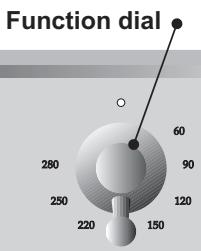
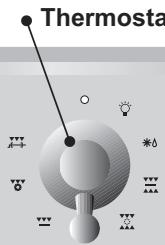

ROSIÈRES
Main supply indicator lamp (catalitic) Door lock lamp (pyrolityc)
| Function dial | Thermostat dial | Function |
| | Turns on the oven lightThis will automatically activate the cooling fan |
| | DEFROSTThe cooking fan runs to circulate the air inside the oven. Ideal for defrosting before cooking. |
| 60÷280 | CONVENTIONAL COOKINGBoth top and bottom heating elements are used. Preheat the oven for about ten minutes. This method is ideal for all traditional roasting and baking. For seizing red meats, roast beef, leg of lamb, game, bread, foilwrapped food (papillotes), flaky pastry. Place the food and its dish on a shelf in mid position. |
| 60÷280 | FAN COOKINGBoth top and bottom heating elements are used with the fan circulating the air inside the oven. We recommend you use this method for poultry, pastries, fish and vegetables. Heat penetrates into the food better and both the cooking and preheating times are reduced. You can cook different foods at the same time with or without the same preparation in one or more positions. This cooking method gives even heat distribution and the smells are not mixed. Allow about ten minutes extra when cooking foods at the same time. |
| 60÷280 | LOWER ELEMENT:Using the lower element. Ideal for cooking all pastry based dishes. This allows you to cook dry tart pastry without over cooking the fruit filling. Use this for flans, quiches, tarts, pâté and any cooking that needs more heat and radiation from below. |
| 60÷280 | FAN + LOWER ELEMENTThe bottom heating element is used with the fan circulating the air inside the oven. This method is ideal for juicy fruit flans, tarts, quiches and pâté. It prevents food from drying and encourages rising in cakes, bread dough and other bottom-cooked food. Place the shelf in the bottom position. |
| 220÷275 | GRILL: use the grill with the door closed. The top heating element is used alone and you can adjust the temperature. Five minutes preheating is required to get the elements red-hot. Success is guaranteed for grills, kebabs and au gratin dishes. White meats should be put at a distance from the grill; the cooking time is longer, but the meat will be tastier. You can put red meats and fish fillets on the shelf with the drip tray underneath. |
| 60÷280 | FAN ASSISTED GRILL: use the turbo-grill with the door closed. The top heating element is used with the fan circulating the air inside the oven. Preheating is necessary for red meats but not for white meats. Ideal for cooking thick food items, whole pieces such as roast pork, poultry, etc. Place the food to be grilled directly on the shelf centrally, at the middle level. Slide the drip tray under the shelf to collect the juices. Make sure that the food is not too close to the grill. Turn the food over halfway through cooking. |
| 220÷275 | ROTISSERIE: use the turnspit with the door closed. The top heating element is used with the turnspit rotating the food to be cooked. The heating temperature can be adjusted as required. Ideal for rediscovering the taste of traditional roast. No preheating is required for turnspit cooking. |
| | Pyrolysis |
- Tested in accordance with the CENELEC EN 50304.
** Tested in accordance with the CENELEC EN 50304 used for definition of energy class.
COOKING TIPS
Temperatures and cooking times are given for information only to facilitate using the oven. Personal experience should then let you adapt these settings to your taste and habits. Remember that cooking at higher temperatures causes more spattering, and the oven can become dirty and smokey. It is better to slightly reduce the cooking temperature, even if it means increasing the cooking time.
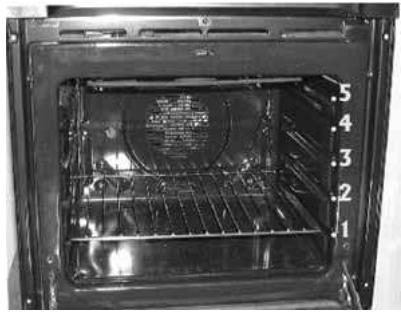
The sides of the oven are equipped with different positions numbered from the bottom.
FISH
| Recipes | Cooking method | Quantity | Cooking °C | Cooking time | Shelf level |
| Tilefish or bream | Conv cooking | 1kg whole | 220°C | 30 min | 1 |
| Monk fish or Salmon | Conv cooking | 1kg braised | 220°C | 30 min | 1 |
| Fillet of sole | Fan cooking | 6 pieces | 160°C | 15-20 min | 1 |
| Grilled fish | Grill | 6 fillets | 275°C | 2x5 min | 4 |
VEGETABLES - OTHERS
| Recipes | Cooking method | Quantity | Cooking °C | Cooking time | Tips |
| Braised cabbage | Conv cooking | for 6 | 200-220°C | 1 hour | |
| Pâté en croûte | Conv cooking | | 200-220°C | 1 hour/kg | |
| Chicory with gruyere | Fan cooking | for 6 | 180-200°C | 25-30 min | |
| Potatoes in their jackets | Fan cooking | for 6 | 200-220° | about 1 hour | |
| Soufflé savoury/sweet | Fan cooking | for 6 | 180-200°C | 50-60 min | Ø 22 |
| Stuffed tomatoes | Fan cooking | 6-8 pieces | 200-220°C | 40-45 min | |
| Leek flan | Fan + lower element | for 6 | 220°C | 35-40 min | |
| Quiche Lorraine | Fan + lower element | for 6 | 220°C | 45-50 min | |
| Toast with crottin* | Turbo grill | 6 pieces | 210°C | 3 min to toast one side + 4 min/crottin | Flat steak pan |
All the cooking was done at shelf position "1" except cooking marked thus ***, which requires cooking at a middle position.
MEAT
It is better not to salt meats until after cooking as salt encourages the meat to spatter fat. This will dirty the oven and make a lot of smoke. Joints of white meat, pork, veal, lamb and fish can be put into the oven cold. The cooking time is longer than in a preheated oven, but it cooks through to the centre better as the heat has more time to penetrate the joint.
Correct preheating is the basis of successful red meat cookery.
GRILLS
- Before loading the grill: remove the meat from the refrigerator a few hours before grilling. Lay it on several layers of kitchen paper: this improves seizing, making it tastier and avoids it staying cold at the centre.
Add pepper and spices to the meat before grilling, but add any salt after cooking. This way it will seize better and stay juicy. Baste all the food to be cooked with a little oil. This is best done with a wide flat blasting brush. Then sprinkle with more pepper and herbs (thyme, etc.).
- During cooking: never pierce the food during cooking even when you turn it. This lets the juice out and it becomes dry.
| Recipes | Cooking method | Quantity | Cooking °C | Cooking time | Tips |
| Beef with carrots | Conv cooking | for 6 | 200-220°C | about 1 hours | |
| Duck | Conv cooking | 1,5 kg | 200-220°C | 1½ hours | |
| Turkey | Conv cooking | 5/6 kg | 160-180°C | 2½ - 3 hours | |
| Goose | Conv cooking | 3/4 kg | 160-180°C | 2 - 2½ hours | |
| Leg of lamb | Conv cooking | | 200-220°C | 15 min/pound | |
| Roast chicken | Conv cooking | 1/1,5 kg | 220°C | about 1 hour | |
| Roast beef | Conv cooking | | 240°C | 15 min/pound | |
| Roast rabbit | Fan cooking | 800-1 kg | 200-220°C | 50-60 mins | |
| Beef | Rotisserie | 1kg | 275°C | 15-20 min | No preheat |
| Lamb / Mutton | Rotisserie | 1 kg | 275°C | 20-25 min | No preheat |
| Kebabs | Grill | 6 pieces | 275°C | 2x8 min | Turn over in mid cooking |
| Pork chop | Grill | 6 pieces | 275°C | 2x8 min | Turn over in mid cooking |
- All cooking was done at shelf position "1".
BAKING
Avoid using shiny tins, they reflect the heat and can spoil your cakes. If your cakes brown too quickly, cover them with grease-proof paper or aluminium foil. Caution: the correct way to use foil is with the shiny side in towards the cake. If not the heat is reflected by the shiny surface and does not penetrate the food. Avoid opening the door during the first 20 to 25 minutes of cooking: soufflés, brioches, sponge cakes, etc. will tend to fall. You can check if cakes are done by pricking the centre with a knife blade or metal knitting needle. If the blade comes out nice and dry, your cake is ready and you can stop cooking. If the blade comes out moist or with bits of cake attached, continue baking but slightly lower the thermostat so that it is finished off without burning.
| Recipes | Cooking method | Quantity | Cooking °C | Cooking time | Shelf level | Tips |
| Brioche | Fan cooking | 800 grs | 200°C | 40-40 min | 1 | |
| Choux pastry | Fan cooking | 40 pieces | 190°C | 35 min | 1 / 3 | 2 trays |
| Pastry base | Fan cooking | for 6 | 180-200°C | 20-30 min | 1 | Ø 27 |
| Puff pastry | Fan cooking | 6 pieces | 200°C | 15-20 min | 1 | e.g. Bouchée |
| Meringues | Fan+Lower element* | 1 tray | 80-85°C | 4 1/2 hours | 1 | Ø profiteroles |
| Fruit tart | Fan+Lower element* | for 6 | 220°C | 35-40 min | 1 | |
| St Honoré | Fan+Lower element* | 6 pieces | 190°C | 30-35 min | 1 | |
- with fan and lower element, we recommend preheating with fan cooking to save time.