LT180 - Projector NEC - Free user manual and instructions

Find the device manual for free LT180 NEC in PDF.

📄 73 pages English EN 💬 AI Question
Notice NEC LT180 - page 2
View the manual : Français FR English EN
Manual assistant
Powered by ChatGPT
Waiting for your message
Product information

Brand : NEC

Model : LT180

Category : Projector

Download the instructions for your Projector in PDF format for free! Find your manual LT180 - NEC and take your electronic device back in hand. On this page are published all the documents necessary for the use of your device. LT180 by NEC.

USER MANUAL LT180 NEC

IMPORTANT INFORMATION IMPORTANT INFORMATION Safety Cautions Precautions Please read this manual carefully before using your NEC LT180 Projector and keep the manual handy for future reference. Your serial number is located on the bottom of your projector. Record it here: CAUTION À To tum off main power, be sure to remove the plug from power outiet. The power outiet socket should be installed as near to the equipment as possible, and should be easily accessible. CAUTION À TO PREVENT SHOCK, DO NOT OPEN THE CABINET. NO USER-SERVICEABLE PARTS INSIDE.

REFER SERVICING TO QUALIFIED SERVICE PERSONNEL

This symbol wams the user that uninsulated voltage within the unit may be suficientto cause electrical À shock Therefore is dangerous to make any kind of contact with any part inside of the unit This symbol alerts the user that important information conceming the operation and maintenance of AA. this unit has been provided. The information should be read carefully to avoid problems. WARNING TO PREVENT FIRE OR SHOCK, DO NOT EXPOSE THIS UNIT TO RAIN OR MOISTURE. DO NOT USE THIS UNIT'S PLUG WITH AN EXTENSION CORD OR IN AN OUTLET UNLESS ALL THE PRONGS CAN BE FULLY INSERTED. DO NOT OPEN THE CABINET. THERE ARE HIGH-VOLTAGE COMPONENTS INSIDE. ALL SERVICING MUST BE DONE BY QUALIFIED SERVICE PERSONNEL. DOC Compliance Notice This Class B digital apparatus meets all requirements of the Canadian Interference-Causing Equipment Regu- lations Acoustic Noise Information Ordinance-3. GSGV: The sound pressure level is less than 70 dB (A) according to ISO 3744 orlSO 7779. WARNING TO CALIFORNIA RESIDENTS: Handling the cables supplied with this product will expose you to lead, a chemical known to the State of California to cause birth defects or other reproductive harm. Wash hands after handling. CAUTION Do not put the projector on its side when the lamp is tumed on. Doing so may cause damage to the projector. Copyright: 2005 by NEC Viewtechnology, Ltd E-i

IMPORTANT INFORMATION RF Interference WARNING The Federal Communications Commission does not allow any modifications or changes to the unit EXCEPT those specified by NEC Solutions (America), Inc. in this manual. Failure to comply with this govemment regulation could void your right to operate this equipment. This equipment has been tested and found to comply with the limits for a Class B digital device, pursuant to Part 15 ofthe FCC Rules. These limits are designed to provide reasonable protection against harmful interference in a residential installation. This equipment generates, uses, and can radiate radio frequency energy and, ifnotinstalled and used in accordance with the instructions, may cause harmful interference to radio communications. However, there is no guarantee that interference will not occur in a particular in- stallation. If this equipment does cause harmful interference to radio or television reception, which can be determined by tuning the equipment off and on, the user is encouraged to try to correct the interference by one or more of the following measures: + _Reorient or relocate the receiving antenna +_ Increase the separation between the equipment and receiver. + Connect the equipment into an outiet on a circuit different from that to which the receiver is connected. + Consul the dealer or an experienced radio / TV technician for help. In UK, a BS approved power cable with moulded plug has a Black (five Amps) fuse installed for use with this equipment. Ia power cable is not supplied with this equipment please contact your supplier. Important Safeguards These safety instructions are to ensure the long life of your projector and to prevent fire and shock. Please read them carefully and heed all warnings: Installation

1. Forbest results, use your projector in a darkened room

2. Place the projector on a flat, level surface in à dry area away from dust and moisture.

To avoid premature lamp failure, do nottilt the front of the projector up or down by more than 15° from level. Do not place your projector in direct sunlight, near heaters or heat radiating appliances. Exposure to direct sunlight, smoke or steam can harm intemal components. Handle your projector carefully. Dropping or jarring can damage intermal components. Do not place heavy objects on top ofthe projector. sous uw If you wish to have the projector installed on the ceiling a. Do not attempt to install the projector yourself. b.. The projector must be installed by qualiied technicians in order to ensure proper operation and reduce te risk of bodily injury. €. In addition, the ceiling must be strong enough to support the projector and the installation must be in accordance with any local building codes. d. Please consult your dealer for more information.

IMPORTANT INFORMATION Fire and Shock Precautions

1. Ensure that there is sufficient ventilation and that vents are unobstucted to prevent the build-up of heat

inside your projector. Allow at least 4 inches (10 cm) of space between your projector and a wall Prevent foreign objects such as paper clips and bits of paper from falling into your projector. Do not attempt to retrieve any objects that might fall into your projector. Do notinsert any metal objects such as a wire or screwdriver into your projector. If something should fall into your projector, disconnectitimmedi- ately and have the object removed by a qualiied service personnel. Do not place any liquids on top of your projector.

4. Do notlook into the lens while the projector is on. Serious damage to your eyes could result.

Keep any items such as magnifying glass out ofthe light path of the projector. The lightbeing projected from the lens is extensive, therefore any kind of abnormal objects that can redirect light coming out of the lens, can cause unpredictable outcome such as fire or injury to the eyes.

6. Do not coverthe lens with the supplied lens cap or equivalent while the projector is on. Doing so can lead to

melting of the cap and possibly buming your hands due to the heat emitted from the light output.

7. Do not place any objects, which are easily affected by heat, in front of the projector lens or a projector

exhaust vent. Doing so could lead to the object melting or getting your hands burned from the heatthat is emitted from the light output and exhaust.

8. The projector is designed to operate on a power supply of 100-240 V 50/60 Hz AC. Ensure that your power

supply fits this requirement before attempting to use your projector.

9. Handie the power cable carefully and avoid excessive bending.

A damaged cord can cause electric shock or fire.

10. the projector is notto be used for an extended period of time, disconnect the plug from the power outiet.

11. Do not touch the power plug during a thunderstorm. Doing so can cause electrical shock or fire.

12.Do not handle the power plug with wet hands. CAUTION

1. Do not ty to touch the ventilation outiet on the right and rear side (when seen from the front) as it can

become heated while the projector is turned on.

2. Do not use the tit-foot for purposes other than originally intended. Misuses such as gripping the tit-foot or

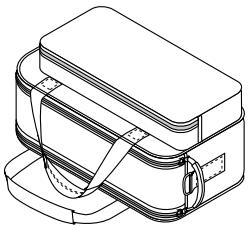
hanging on the wall can cause damage to the projector. Before puttng the projector in the soft case, be sure to retract the feet. Failure to do so may cause damage to the projector.

3. When carying the projector, heed the following:

+ Ensure that the power cable and any other cables are disconnected before moving the projector. + Cover the lens with the supplied lens cap so as notto scratch the lens surface.

4. Do notsend the projector in the soft case by parcel delivery service or cargo shipment. The projector inside

the soft case could be damaged.

5. Select “High” in the Fan mode if you continue to use the projector for consecutive days. (From the menu,

select [Advanced] - [Fan Mode] -» [High]

6. Do not unplug the power cable from the wall outlet under any one ofthe following circumstances.

Doing so can cause damage to the projector: + While the projector is turned on. + While the cooling fans are running. (The cooling fans continue to work for 60 seconds after the projector is tumed off].

7. you accidentally turn offthe main power by disconnecting the power cable or press the main power switch

during cooling down, wait 10 minutes and then tum on the projector to resume. This is to protect the lamp.

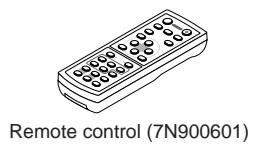
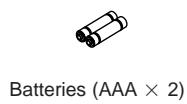
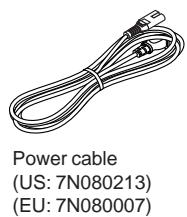
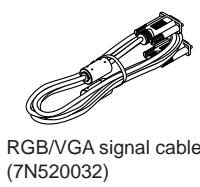
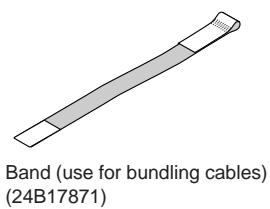
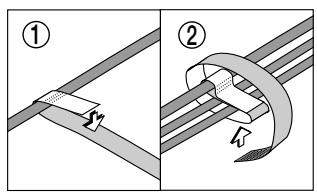
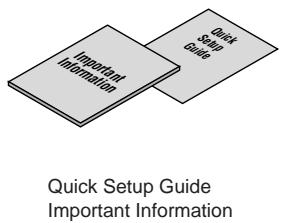
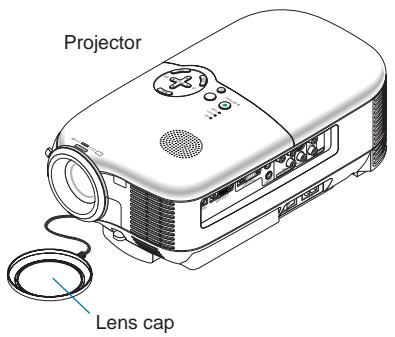
IMPORTANT INFORMATION Lamp Replacement + To replace the lamp, follow al instructions provided on page E-44. + Be sure to replace the lamp when the message “The lamp has reached the end of its usable life. Please replace the lamp." appears. If you continue to use the lamp after the lamp has reached the end of its usable lie, the lamp bulb may shatter, and pieces of glass may be scattered in the lamp case. Do nottouch them as the pieces of glass may cause injury. Ifthis happens, contact your dealer for lamp replacement. + Allow a minimum of 60 seconds to elapse after tuming offthe projector. Then turn offthe main power switch, disconnectthe power cable and allow 60 minutes to cool the projector before replacing the lamp. What's in the Box? Make sure your box contains everything listed. If any pieces are missing, contact your dealer. Please save the original box and packing materials if you ever need to ship your Projector. Projector Remote control (7N900601) Batteries (AAA x 2)
Setting Up the Screen and the Projector Selecting a Location Throw Distance and Screen Size Making Connections Gonnecting Your PC or Macintosh Computer E14 To connect SCART output (RGB) E15 Connecting an External Monitor E16 Gonnecting Your DVD Player E17 Gonnecting Your VCR or Laser Disc Player E18 Gonnecting the Supplied Pour Cable E19

3. PROJECTING AN IMAGE (BASIC OPERATION) … . E-20

‘Turing on the Projector E-20 Selecting a Source E2 Adjusting the Picture Size and Position E2 Correctng the Vertical Keystone Distortion E25 Optimiing an RGB Image Automaticalhy E26 Tuming Up or Down Volume E26 Turing of the Projector E27 After Use E28

4. CONVENIENT FEATURES … . E-29

‘Tuming Of the Image and Sound E29 Fregzing a Picture E29 Reducing Video Noise (Noise Reduction) E29 Getting the Information on Lamp Usage and Projector Usage E-30

Using the Menus Est List of Menu Items E33 Menu Descriptions & Functions. E34 Picture E34 Adjustment E34 Image E35 Setup E37 Advanced E3 Information E42 Reset E43

Replacing the Lamp E44 Cleaning the Cabinet and the Lens E47

Introduction to the Projector This section introduces you to your new NEC LT180 Projector and describes its features and controls. Congratulations on Your Purchase of The LT180 Projector The LT180 is one of the very best projectors available today. The LT180 enables you to project precise images up to 200 inches (measured diagonally) from your PC or Macintosh computer (desktop or notebook), VCR, DVD player, document camera, or a laser disc player. You can use the projector on a tabletop or cart, you can use the projector to project images from behind the screen, and the projector can be permanentiy mounted on a ceiling*i. The remote control can be used wirelessly. Features you'll enjoy on the LT180 projector: +_4:3 native screen display Exceptionally quiet - as low as 34dB fan noise in Eco-Mode High resolution images - 1024 x 768 display HDTV (1080i, 720p) and SDTV (576p, 480p) compatibility Adjustable rear foot for enhanced projector placement and alignment to the screen Eco-Mode” technology - increases lamp life by up to 50% and reduces noise level to <34dB 3 video inputs - 1 component, 1 S-Video and 1 video for multiple video source connectivity 1 monitor out- 1 RGB and 1 stereo mini jack for audio connectivity Integrated deinterlace video processing technology Display popular wide screen and full screen aspect ratios - 16:9 and 4:3 Built in speaker for an integrated audio solution Easy setup and operation High performance long life lamp for low total operating costs Wireless remote control operation Multiple video mode selections depending on your source Control the unit with a PC using the PC Control port NEC" s exclusive intelligent scaling and pixel blending technology provides for extremely accurate image compression up to HDTV (1920 x 1080) and SXGA+ (1400 x 1050) display resolution? Supports most IBM VGA, SVGA, XGA, Macintosh, component signal (YCCHY PbPr) or other RGB signals within a horizontal frequency range of 24 to 100 kHz and a vertical frequency range of 50 to 85 Hz. This includes NTSC, NTSCA4.43, PAL, PAL-M, PAL-N, PAL60 and SECAM standard video signals NOTE: Composite video standards are as follows: NTSC: U.S. TV standard for video in U.S. and Canada. PAL: TV standard used in Westem Europe. PAL-N: TV standard used in Argentine, Paraguay and Uruguay. PAL-M: TV standard used in Brazil. PAL6O: TV standard used or NTSC playback on PAL TV. SECAM: TV standard used in France and Eastern Europe. NTSCA.43: TV standard used in Middle East countries. # Do not attempt to mount the projector on a ceiling yourself. The projector must be installed by qualied technicians in order to ensure proper operation and reduce the risk of bodiy injury. In addition, the ceiling must be strong enough to support the projector and the installation must be in accordance with any local building codes. Please consult your dealer for more information.

About this user's manual The fastest way to get started is to take your time and do everything rightthe first time. Take a few minutes now to review the users manual. This may save you time later on. Atthe beginning of each section of the manual you'l find an overview. the section doesn't apply, you can skip it. Digital Light Processing and DLP are trademarks of Texas Instruments IBM is a trademark or registered trademark of Intemational Business Machines Corporation: Mac and PowerBook are trademarks of Apple Computer, nc., registered in the U.S. and other countries. Other product and company names mentioned in this user's manual may be the trademarks or registered trademarks of their respective holders.

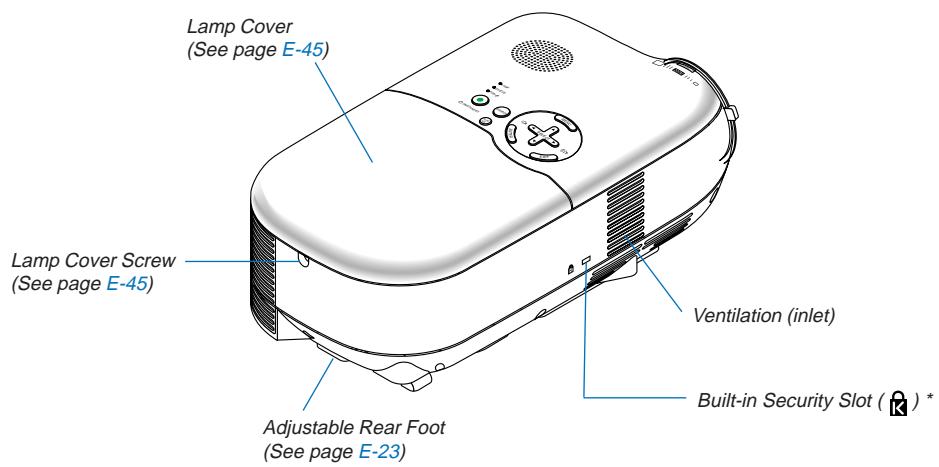
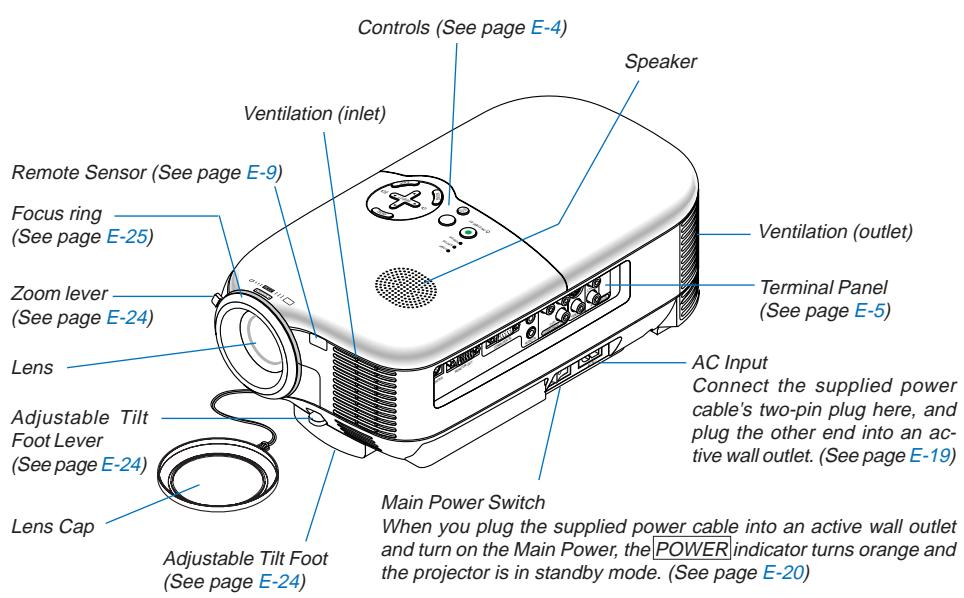
Part Names of the Projector Controls (See page E-4) Speaker Focus ring (See page E-25) S- Ventilation (outiet) Zoom lever : ? Terminal Panel (See page E-24) Î = > (See page E-5) AC Input Connect the supplied power cables two-pin plug here, and plug the other end into an ac- ve walloutlet (See page E-19) Lens Adjustable Tilt FootLever (See page E-24) Main Power Switch When you plug the supplied power cable into an active wall outlet Adjustable TitFoot and um on the Main Power, the indicator turns orange and Fe page EM the projector is in standby mode. (See page E-20) Lens Cap Lamp Cover (See page E-45) Lamp Cover Screw (See page E-45) Ventilation (inlet) Built-in Security Slot ( @ ) * Adjustable Rear Foot (See page E-23)
  • This security slot supports the MicroSaver® Security System. MicroSaver® is à registered trademark of Kensington Microware Inc. The logo is trademarked and owned by Kensington Microware Inc. E-3

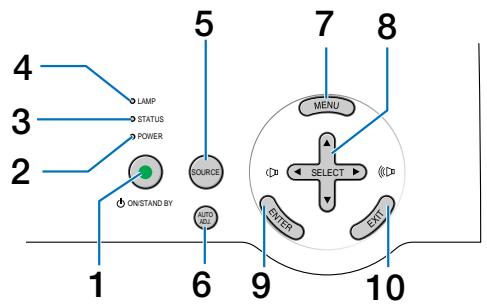
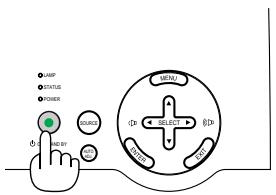
Top Features LIONSTAND EVbutton ( © ) Use this button to turn the power on and off when the main power is supplied and the projector is in standby mode. To tum on the projector, press and hold this button for a minimum of two seconds. To tum off the projector, press this button twice POWER] indicator (LED) When this indicator is green, the projector is on; when this indicator is orange, itis in standby mode. See the power Indicator section on page E-48 for more details. 3.BTATUSJindicator (LED) IFthis light blinks red rapidiy, itindicates that an error has occurred, the lamp covers not attached properiy or the projector has overheated. If this light remains orange, it indicate that you have pressed a cabinet key while the Cabinet Button is locked. See the Status Indicator section on page E-48 for more details. dicator (LED) HFthis light blinks red rapidiy, its waming you thatthe lamp has reached the end of its usable life. After this light appears, replace the lamp as soon as possible (See page E-44). See the Lamp Indicator section on page E- 48 for more details 5 SOURCE button This button will allow you to select a video source such as a PC, VCR or DVD player. Press and quickly release this button to display the Source list. Each time this button is pressed, eal name will be highlighted in sequence. Highlighting a source name for 2 seconds without pressing th button will display the selected source 6.AUTO AD]. button Use this button to adjust an RGB source for an optimal picture (See page E-26). Displays the menu. 8[SETECTJAV<R / volume +- buttons AY: Use these buttons to select the menu of the item you wish to adjust. > : Use these buttons to change the level of a selected menu item. When no menus appear, these buttons work as à volume control. 9ÆNTERIbutton Executes your menu selection and activates items selected from the menu. 10.{EXTIbutton Pressing this button will return to the previous menu While you are in the main menu, pressing this button will close the menu E-4

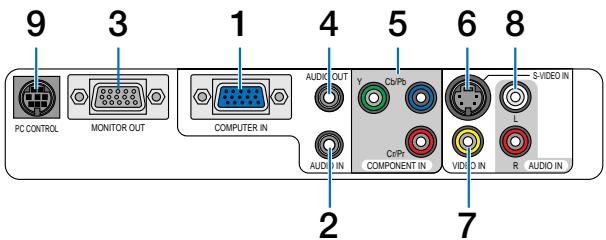
Connect your computer or other analog RGB equipment such as IBM compatible or Macintosh computers. Use the supplied RGB/VGA cable to connect to your computer. This also serves as a component input con- nector that allows you to connect a component video output of component equipment such as à DVD player {optional adapter ADP-CV1 required).

2. AUDIO IN mini jack (Stereo Mini)

This is where you connectthe audio output from your computer or DVD player when connected to the COM- PUTER IN or COMPONENT IN MONITOR OUT Connector (Mini D-Sub 15 Pin) You can use this connector to loop your computer image to an external monitor from the RGB input source This connector outputs RGB signal in standby mode.

4. AUDIO OUT Mini] ack (Stereo Mini)

You can use this jack to output sound from the currently selected source (COMPUTER, COMPONENT, VIDEO or $-VIDEO). Output sound level can be adjusted in accordance with the sound level of the internal speaker. Note that this cannot be used as a headphone jack. (When audio equipment is connected, the projector speaker is disabled.) When à cable mini-plug is inserted into this jack, both the right and left audio signals are not mixed, but separate. For example, when a cable mini-plug is inserted into the left AUDIO IN jack only, only left sound is output.

5. COMPONENT IN (Y, Cb/Pb, CrfPr) connectors (RCA)

Connect component video outputs (Y/Cb/Cr, Y/P JP r) here from extemal equipment such as à DVD player. S-VIDEO IN connector (Mini DIN 4 Pin) Here is where you connectthe S-Video output from an external source like a VCR NOTE: S-Video provides more vivid color and higher resolution than the traditional composite video format.

7. VIDEO IN connector (RCA)

Connect a VCR, DVD player, laser disc player, or document camera here to project video.

8. AUDIO IN jacks L & R (RCA)

These are your left and right channel audio inputs for stereo sound from a Video or S-Video source.

PC CONTROL Port (Mini DIN 8 Pin) Use this portto connecta PC or control system. This enables you to control the projector using serial commu- nication protocol. If you are writing your own program, typical PC control codes are on page E-56

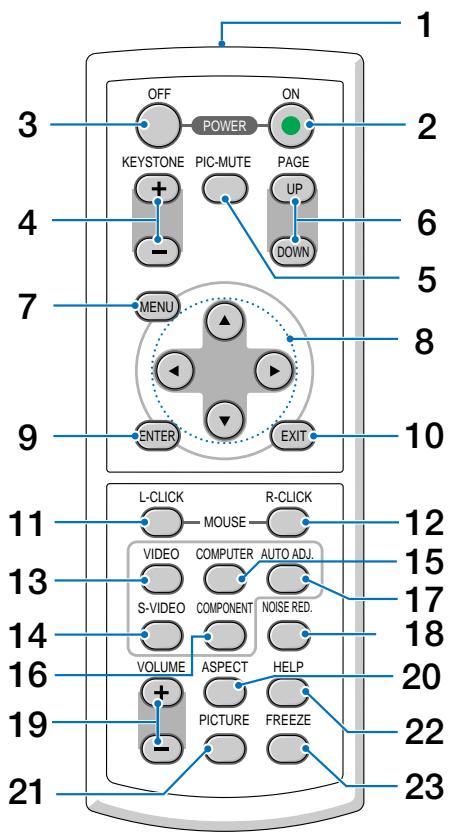
Part Names of the Remote Control

KEYSTONE PICHUTE PAGE

[e) Cm) LEUEX RCUEK 115-012 14 DD [e 18 CR UE 19 pes re tt 99 nl 23 Infrared Transmitter Direct the remote control toward the remote sensor on the projector cabinet. POWER ONJButton When the main power is on, you can use this button to tum your projector on. NOTE: To turn on the projector press and hold the[POWER OMbuiton for a minimum of ho seconds. POWER OFF]Button You can use this button to turn your projector off. NOTE: To turn off he projector. press the POWER OFF button tnice.

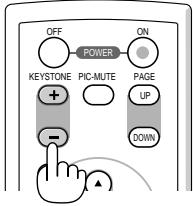
4. [KEYSTONE](+) (-) Button

Press this button to correctthe keystone (trapezoidal) distortion, and make the image square. See page E-25.

This button turns off the image and sound for a short period of time. Press again to restore the image and sound. PAGE UPJDOWN]Button Not available on this model.

Displays the menu for various settings and adjustments

8. BELECTJAv 4 Button

AY : Use these buttons to selectthe menu of the item you wish to adjust. > : Use these buttons to change the level of a selected menu item.

Use this button to enter your menu selection. It works the same as the[ENTERJbutton on the cabinet. See page E-4 IEworks the same as the

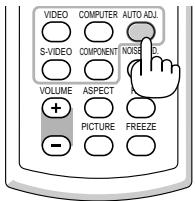
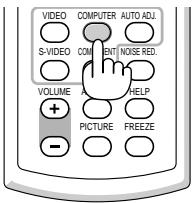
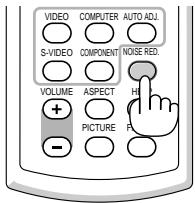
Press this button to select a video source from computer or component equipment connected to your COM- PUTER IN port. 16.[COMPONENT/Button Press this button to selecta video source from component equipment connected to the COMPONENT input. 17.[AUTO AD] JButton Use this button to adjust an RGB source for an optimal picture. See page E-26. 18.[N0ISE RED]Button This button will turn on the noise reduction feature to reduce video noise.

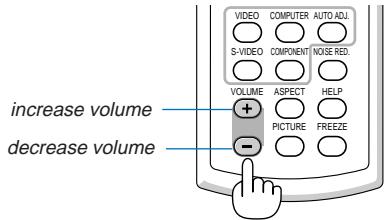
19. [VOLUME | +) (-) Button

Press (+) to increase the volume and (-) to decrease it. 20.(ASPECTJButton Press this button once to display the Aspect Ratio select menu. Continue pressing to change aspect ratios. See page E-36 21.(FICTURE Button Press this button to display the Picture menu. E ach time this button is pressed, the option will be changed. See page E-34 rovides the information about the status ofthe projector. 23.(FREEZE Button This button will freeze a picture. Press again to resume motion. E-7

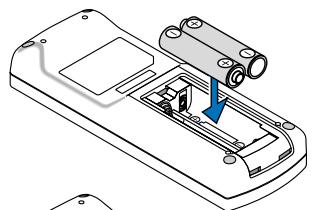
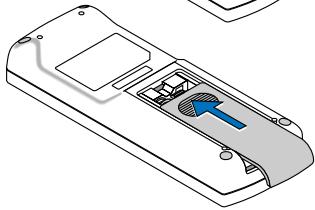
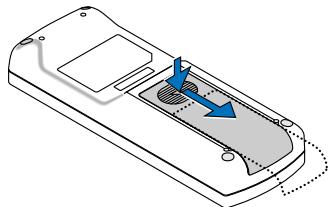
Battery Installation rss fm and siide the battery cover of. Remove both old batteries and install new ones (AAA). Ensure that you have the batteries" polarity {/-) aligned correctiy. Slip the cover back over the batteries untl i snaps into place. Do not mix different types of batteries or new and old batteries. Remote Control Precautions Handle the remote control carefull. Ifthe remote control gets wet, wipe it dry immediately. Avoid excessive heat and humidity. If you will not be using the remote control for a long time, remove the batteries Do not place the batteries upside down. Do not use new and old batteries together, or use different types of batteries together. Dispose of used batteries according to your local regulations.
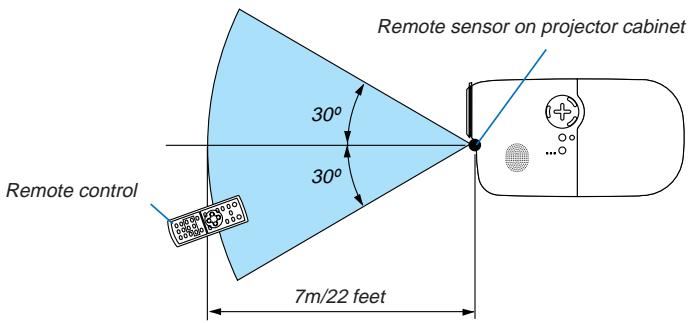
Operating Range for Wireless Remote Control Remote sensor on projector cabinet Remote control 7m/22 feet The infrared signal operates by line-of-sight up to a distance of about 22 feet/7 m and within à 60-degree angle ofthe remote sensor on the projector cabinet. The projector will notrespond ifthere are objects between the remote control and the sensor, or if strong light falls on the sensor. Weak batteries will also prevent the remote control from properiy operating the projector. E-9
This section describes how to set up your projector and how to connect PCs, video and audio sources. Your projector is simple to set up and use. But before you get started, you must first. 1|Setup a screen and the projector. 2| Connect your video equipment or computer to the projector. See page E-14 to E-18 8 Comnectthe supplied power cable. See page E-19 NOTE: Ensure that the power cable and any other cables are disconnected before moving the projector. When moving the projector or when it is not in use, cover the lens with the lens cap. E-10
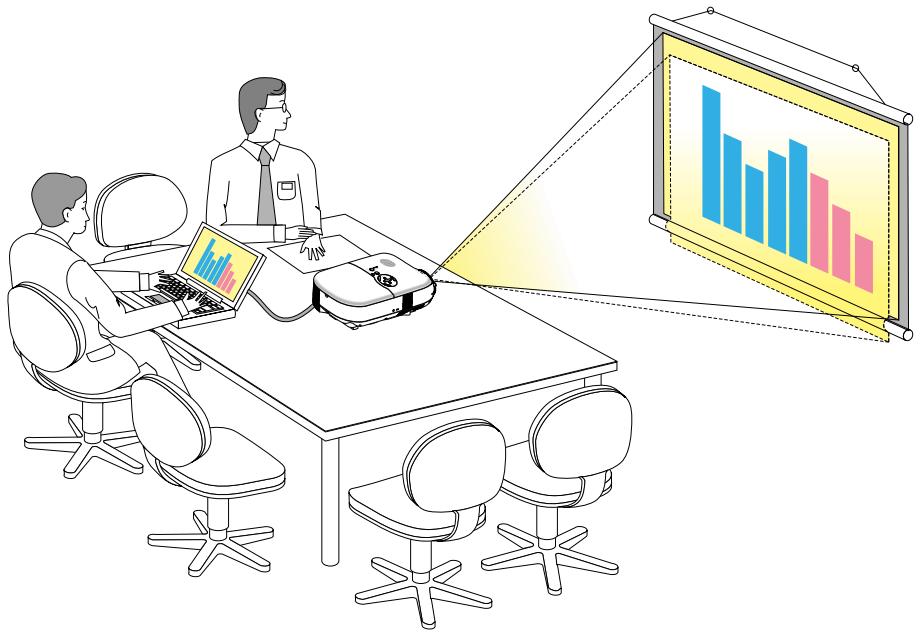
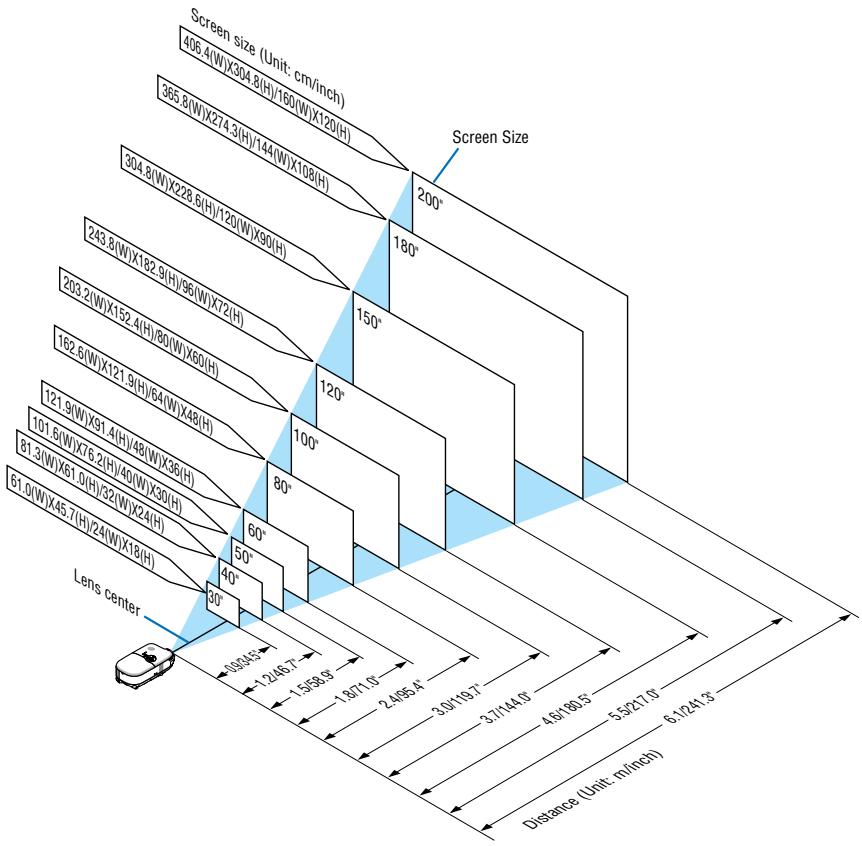
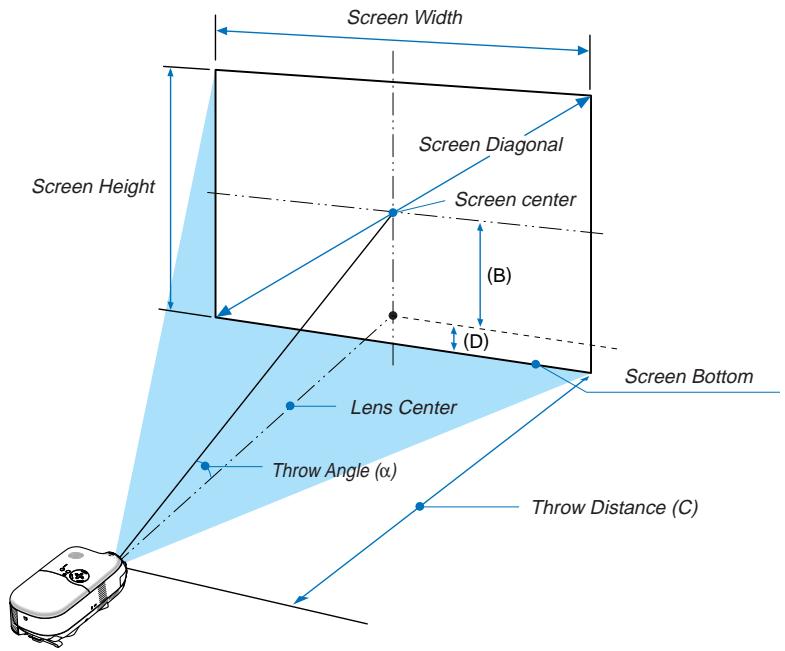
Setting Up the Screen and the Projector Selecting a Location The further your projector is from the screen or wall, the larger the image. The minimum size the image can be is approximately 30" (0.76 m) measured diagonally when the projector is roughly 0.9 m/35 inches from the wall orscreen. The largestthe image can be is 200" (5.0 m) when the projector is roughly 6.1 m/241 inches from the wall or screen. Use the drawing below as à guide. NOTE: The distances are indicated by intermediate values between tele and wide, Use as à rule of thumb. E-11

Throw Distance and Screen Size The following shows the proper relative positions ofthe projector and screen. Refer to the table to determine the position of installation. tance Chart | Screen Width Screen Height Screen Bottom

g your projector on the ceï dealer for more information. *_Do notattempt to install the projector yourself. + Onlyuse your projector on a solid, level surface. Ifthe projector falls to the ground, you can be injured and the projector severely damaged. Do notuse the projector where temperatures vary greatiy. The projector must be used at temperatures be- tween 41'F (5°C) and 95°F (35°C). + Do not expose the projector to moisture, dust, or smoke. This will harm the screen image. g must be done by a qualified techni . Contact your NEC Ensure that you have adequate ventilation around your projector so heat can dissipate. Do not cover the vents on the side or the front of the projector. Rear Projection Applications The projector has the ability to be used in a rear projection application. When used with a third party mirror and frame system, rear projection allows you to achieve a larger image size in less distance than a traditional front projection installation. If space constraints exist, please contact your authorized NEC reseller regarding a rear projection solution. Refer to page E-38 on how to change the projector orientation for use in a rear projection application. E-13

Making Connections Connecting Your PC or Macintosh Computer NOTE: When using with a notebook PC, be sure to connect between the projector and the notebook PC before turning on the power to the notebook PC. In most cases signal cannot be output from RGB output unless the notebook PC is turned on after connecting with the projector.

  • HFthe screen goes blank while using your remote control, it may be the result of the computer's screen-saver or power management software. COMPUTER IN —— AUDIO IN
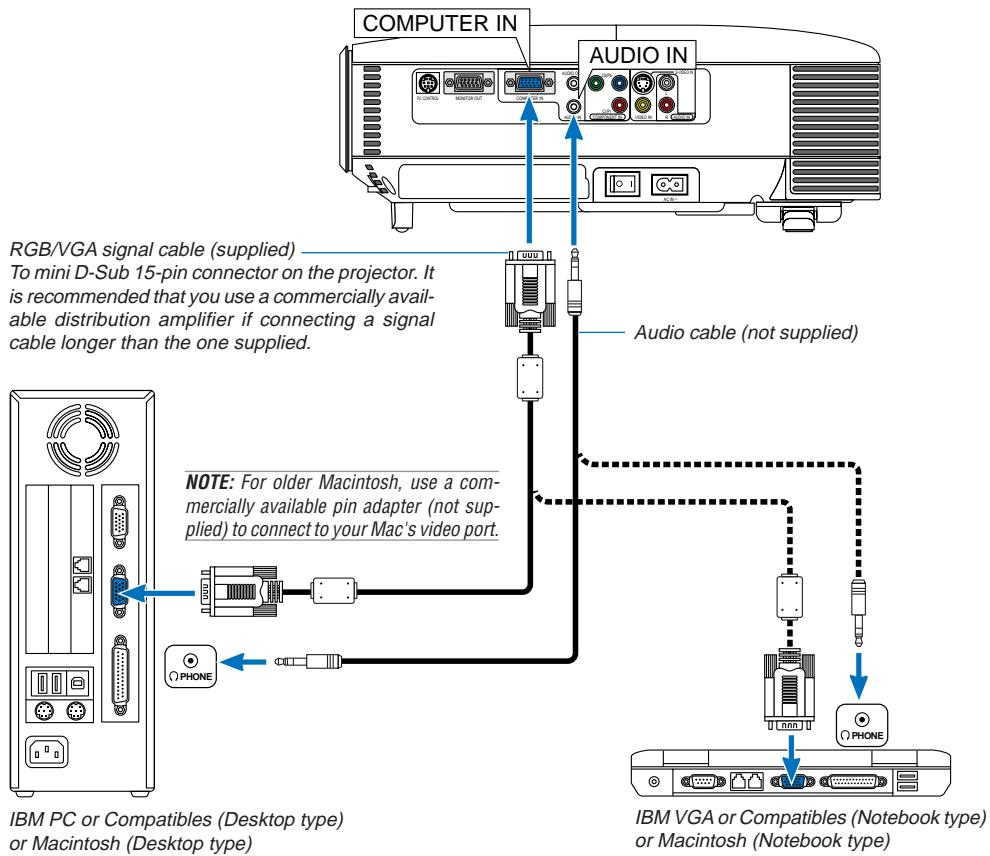
RGB/VGA signal cable (supplied) To mini D-Sub 15-pin connector on the projector. le is recommended that you use a commercially avail able distribution amplifier if connecting à signal - cable longer than the one supplied. Audio cable (notsupplied} NOTE: For older Macintosh, use à com- mercially available pin adapter (not si led) to connect to your Mac's video port. Ag {=} Ut] & 8 IBM PC or Compatibles (Desktop type) 18M VGA or Compatibles (Notebook type) or Macintosh (Desktop type) or Macintosh (Notebook type) Connecting your PC or Macintosh computer to your projector will enable you to project your computer screen image for an impressive presentation. To connect to a PC or Macintosh, simply

1. Tum offthe power to your projector and computer.

2. Use the supplied RGB/VGA signal cable to connect your PC or Macintosh to the projector.

3. Tum on the projector and the computer.

4. the projector goes blank after à period of inactivit, it may be caused by a screen saver installed on the

computer you ve connected to the projector. E-14

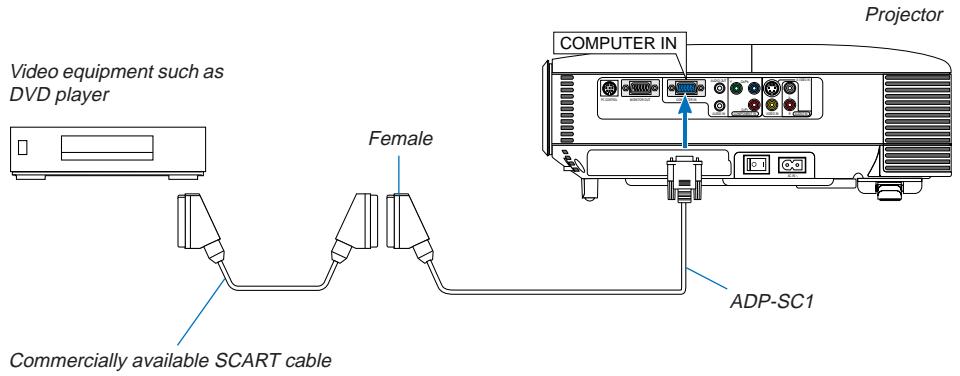
To connect SCART output (RGB) Projector Video equipment such as DVD player ADP-SC1 Commercially available SCART cable Before connections: An exclusive SCART adapter (ADP-SC1) and a commercially available SCART cable are required for this connection: NOTE: Audio signal is not available for this connection.

1. Tum offthe power to the projector and your video equipment.

2. Use the NEC ADP-SC1 SCART adapter and a commercially available SCART cable to connectthe COMPUTER

input of your projector and à SCART output (RGB) of your video equipment. Connectthe supplied power cable. See page E-19. Tum on the power to the projector and your video equipment. Use the[SOURCE button on the projector cabinet to selectthe COMPUTER input. utton on the projector cabinet to display the menu. From the menu, select [Advanced] [Signal Select] [Computer] [Scart]. SCART is à standard European audio-visual connector for TVs, VCRS and DVD players. Itis also referred to as Euro-connector. SSuwEs NOTE: The ADP-SCT SCART adapter is obtainable from your NEC dealer in Europe. Contact your NEC dealer in Europe for more information. E-15

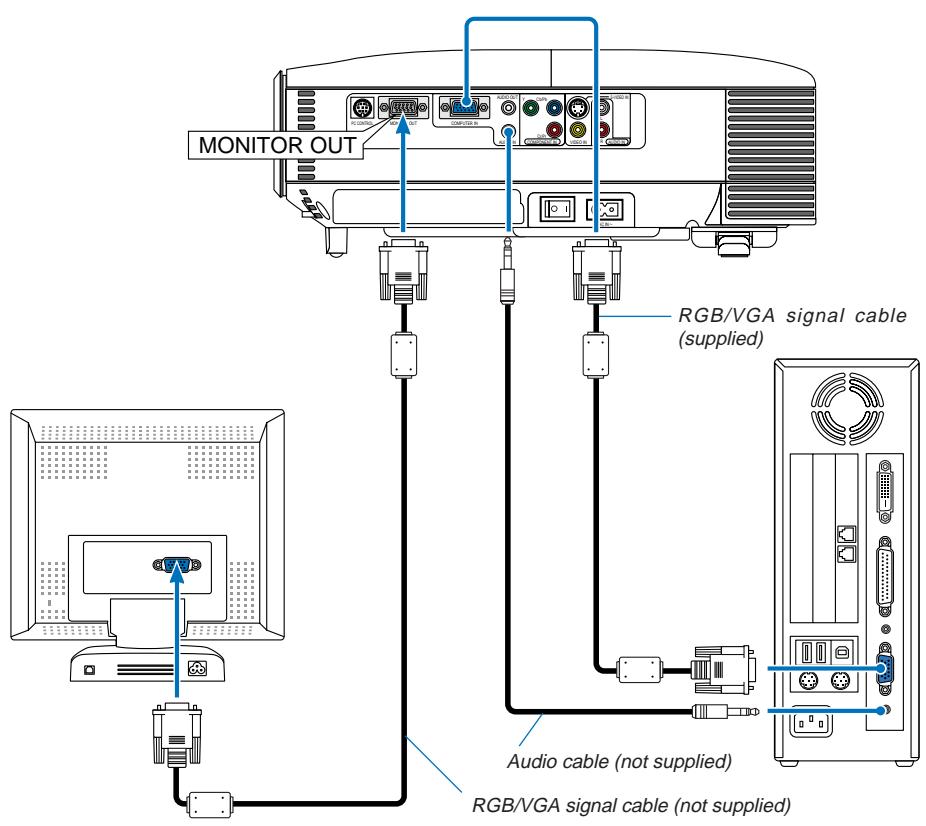
Connecting an External Monitor

RGB/VGA signal cable (supplied) fars] as D Es 0 D 5

Audio cable (not supplied) K RGB/VGA signal cable (not supplied) You can connect a separate, external monitor to your projector to simultaneously view on a monitor the RGB analog image you're projecting, To do so:

1. Tum offthe power to your projector, monitor and computer.

2. Use an RGB/VGA cable to connect your monitor to the MONITOR OUT (Mini D-Sub 15 pin) connector on

3. Connectthe supplied power cable. See page E-19.

4. Tum on the projector, monitor and the computer.

NOTE: Daisy chain connection is not possible. E-16

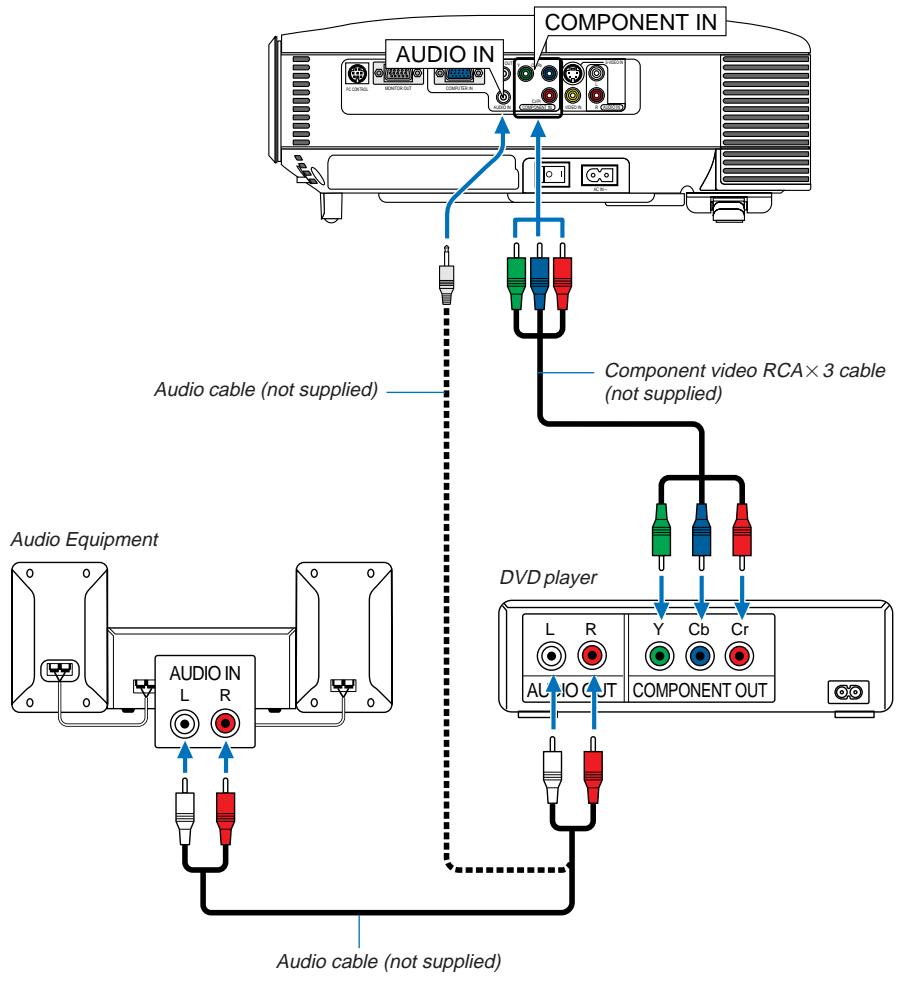
Connecting Your DVD Player

Audio cable (not supplied) —# Audio Equipment DVD player I Audio cable (not supplied) You can connect your projector to a DVD player with component output or Video output. To do so, simply:

1. Tum offthe power to your projector and DVD player.

f your DVD player has the component video (Y,Cb,Cr) output, use a component video cable (RCA X 3) to connect your DVD player to the COMPONENT IN connectors on the projector. For a DVD player without component video (Y,Cb,Cr) output, use the S-Video cable to connect the S-Video output of the DVD player to the S-VIDEO Input of the projector. Use an audio cable to connectthe audio from your DVD player to your audio equipment (if your DVD player has this capabilty). Be careful to keep your right and left channel connections correct for stereo sound. Tu on the projector and DVD player.

NOTE: Refer to your DVD players owners manual for more information about your DVD players video ouiput requirements. E-17

Connecting Your VCR or Laser Disc Player
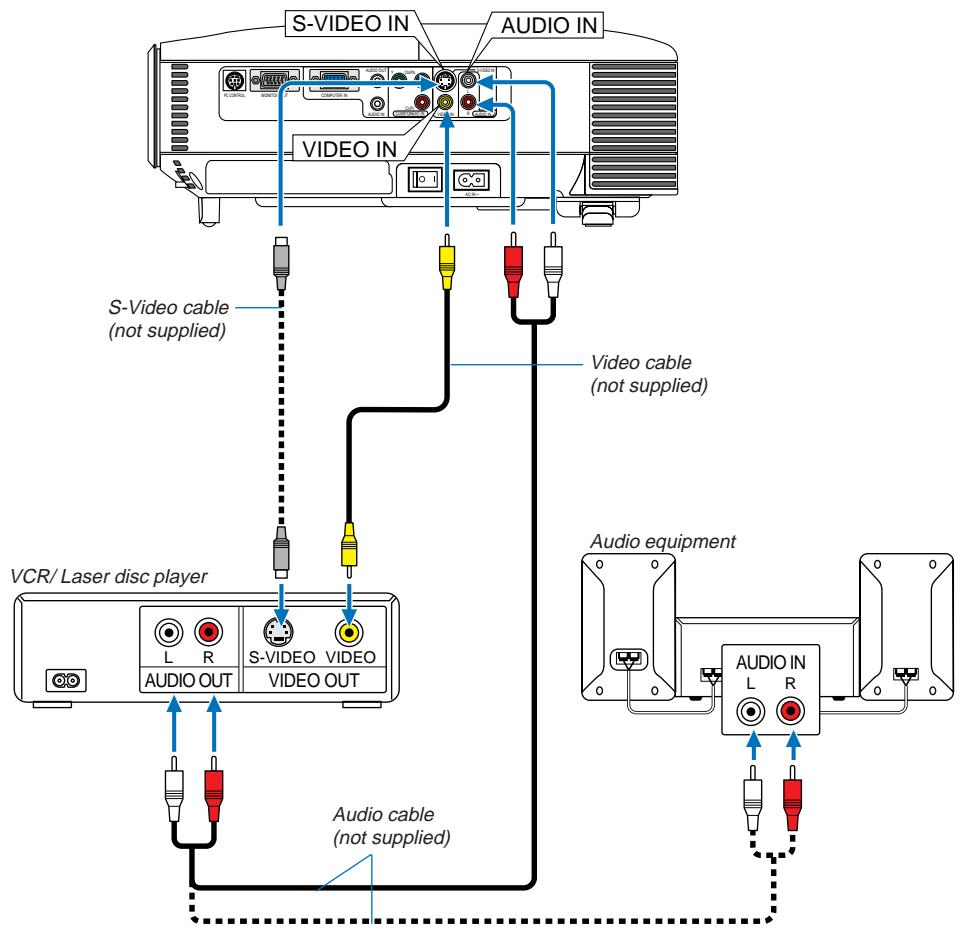
S-Video cable —# {not supplied) Video cable (not supplied) VCR/ Laser disc player ô [o® © [auDIO OUT || VIDEO OUT

Audio cable (not supplied) Use S-Video or RCA cables to connect your VCR, laser disc player or document camera to your projector. To make these connections, simply:

1. Tum offthe power to the projector and VCR, laser disc player or document camera.

2. Connect one end of your RCA or S-Video cable to the video output connector on the back of your VCR or

laser disc player, connectthe other end to the VIDEO IN or S-VIDEO IN on your projector. Use an audio cable to connect the audio from your VCR or laser disc player to your audio equipment (if your VCR or laser disc player has this capabilty). Be careful to keep your right and left channel connections correct for stereo sound.

3. Tum on the projector and the VCR or laser disc player.

NOTE: Refer to your VCR or laser disc player owners manual for more information about your equipment video output requirements. NOTE: An image may not be displayed correctiy when a Video or S-Video source is played back in tast-forward or fast-rewind via à Scan converter. E-18

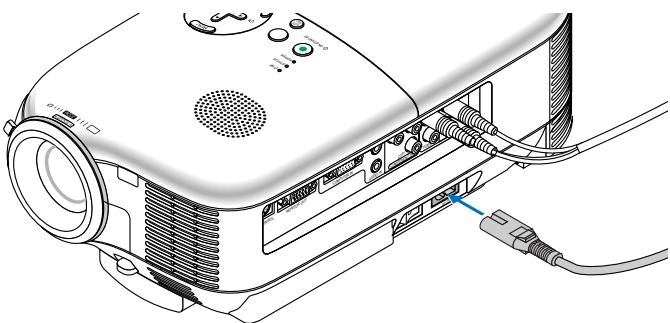
Connecting the Supplied Power Cable Connectthe supplied power cable to the projector. First connect the supplied power cable's two-pin plug to the AC IN of the projector, and then connect the other plug ofthe supplied power cable in the wall outiet. CAUTION Do not unplug the power cable from the wall outiet under any one of the following circumstances. Doing so can cause damage to the projector:

  • While the projector is tumed on.
  • While the cooling fans are running. (The cooling fans continue to work for 60 seconds afterthe projector is tumed off) E-19

3. PROJECTING AN IMAGE (BASIC OPERATION)

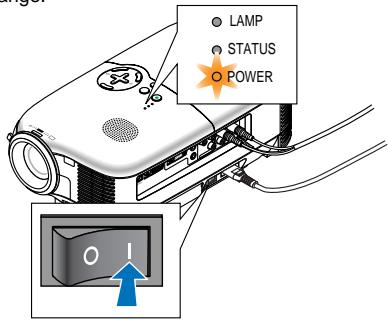
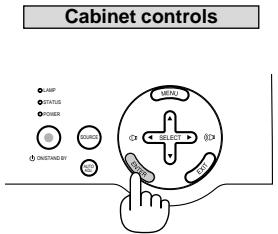
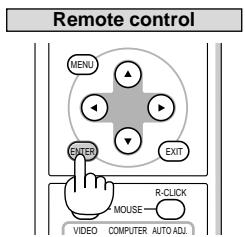
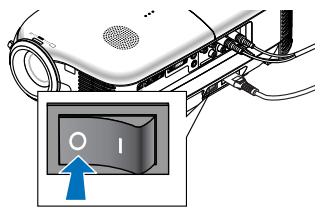
This section describes how to tu on the projector and to project a picture onto the screen. Turning on the Projector NOTE: + The projector has two power switches: a main power switch and an[OIVSTAND EVbutton. + When plugging in or unplugging the supplied power cable, make sure that the main power switch is pushed to the of (0) position. Failure to do so may cause damage to the projector. To turn on the main power to the projector, press the Main Power switch to the on { 1) position. The[POWERJindicator wil light orange. eo Lur © STATUS Before you turn on your projector, ensure thatthe computer or video source is tumed on and that your lens cap is removed. Oniy after you press the NISTAND BY]Jbutton on the projector cabinet or[POWER ON] button on the remote control for à minimum of 2 seconds will he[POWER]indicator tum to green and the projector become ready to use [ENCabinetcontrols 1] [Remote control] oO © CE ® À Standby Blinking PowerOn

© LAMP © LAMP © LAMP

© STATUS © STATUS © STATUS

ICE power (©rower JE rourr Steady orange light Blinking green Steady green light light See page E-48 for more details NOTE: The[POWER ana[STATUSI(LED) indicators blinking green at the same time indicates the main power was interrupted during previous operation. Wait for 60 seconds (cooling period) to see if the lamp turns on by itself. E-20

Note on Startup screen (Menu Language Select screen) When you first turn on the projector, you will get the Startup screen. This screen gives you the opportunity to select one ofthe 9 menu languages. To select a menu language, follow these steps

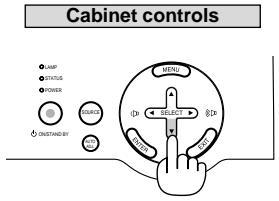
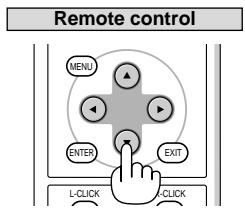
1. Use the SELECTIA or w button to select one ofthe 9 languages for the menu.

[ENCabinetcontrols 7] [Remote control]

2. Press the[ENTER]button to execute the selection.

[Cabinet controls 7] Remote control |

After this has been done, you can proceed to the menu operation. you want, you can selectthe menu language later. See "Language" on page E-37. NOTE: immediately after tuning on the projector screen ficker may occur. This is not à fault. Waï 3 fo 5 minutes unë he lamp lighting is stabilizeo. When the Lamp mode is setto Eco, the ndicator wil light green one ofthe following things happens, the projector will not turn on *_Ifthe internal temperature ofthe projector is too high, the projector detects abnormal high temperature. In this condition the projector will not turn on to protect the internal system. If this happens, wait for the projectors intemal components to cool down. When the lemp reaches its end of usable life, the projector will notturn on. this happens, replace the lamp. Ifthe lemp fails to light, and ifthe BTATUSJindicator flashes on and offin a cycle of six times, waita full minute and then turn on the power. E-21

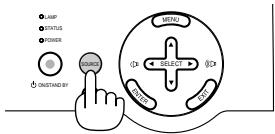
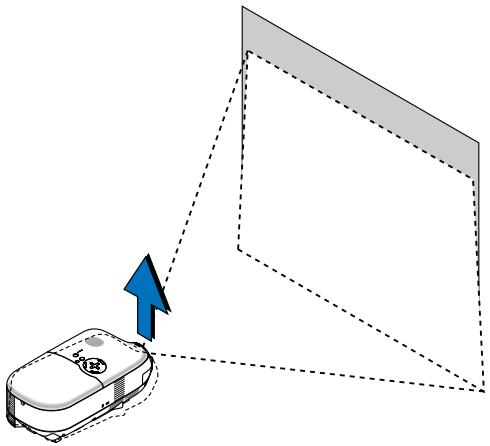
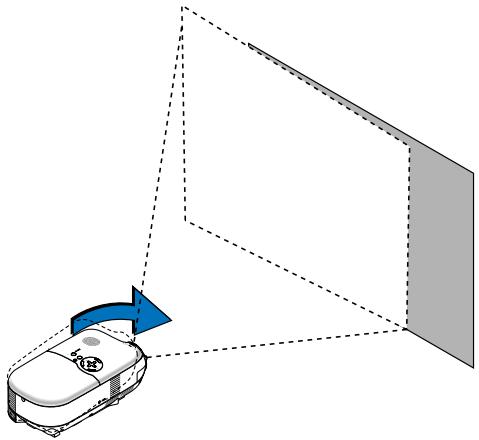
Selecting a Source Selecting the computer or video source Using the cabinet buttons O Component © Video © S-Video Press the[SOURCE Jbutton. Press and quickly release theSOURCE]button on the projector cabinetto display the Source list. Each time the [SOURCE Jbutton is pressed, each source name will be highlighted in sequence. Using the Remote Control Press any one of the[VIDEO], E-VIDEO],(COMPUTER]JorCOMPONENT buttons. Place your projector on a flat level surface and ensure that the projector is square to the screen: Liftthe front edge ofthe projector to center the image vertically. +_Ifthe projected image does not appear square to the screen then use the Keystone feature for proper adjust- ment. See page E-25 E-22
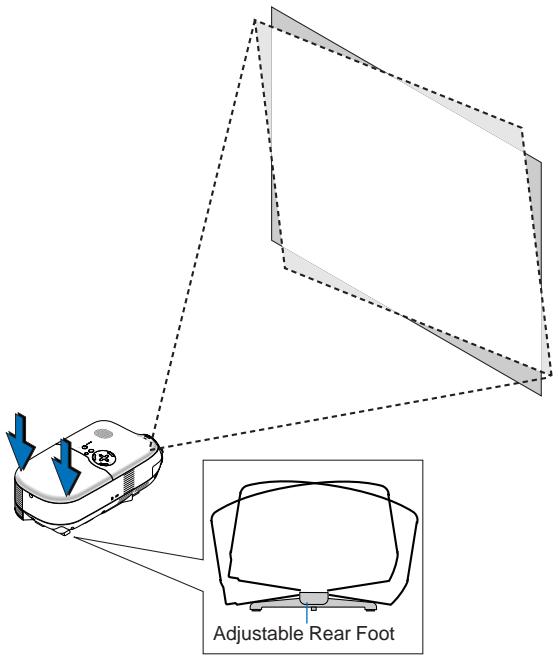
Move the projector left to center the image horizontally on the screen. Using the Adjustable Rear Foot The adjustable rear foot provides the projector with a horizontal tit adjustment. Ifthe projector is placed on an uneven surface, keep the projector level by pushing down the leftor right rear part ofthe top cabinet with both hands NOTE: À spacer is attached to Îne adjustable rear foot to provide stabiliÿ. Remove the spacer before using the adjustable rear foot. Save the spacer to use when replacing the lamp as it will keep the projector from tilting in the process (See page E-44). Adjustable Rear Foot CAUTION: Use care in handling the adjustable rear foot to avoid possible injury to fingers or hands. Using the adjustable rear foot could pinch fingers or hands between the projector bottom and the ajustable rear foot. E-23
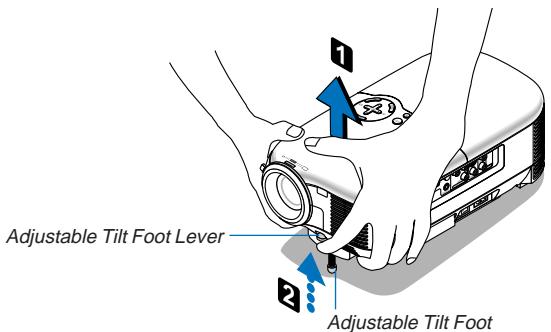
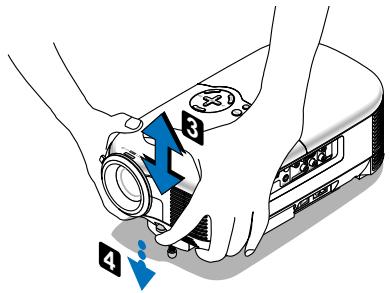
Adjusting the Tilt Foot

2. Push up the Adjustable Tilt Foot Lever on the front side of the projector to extend the adjustable tit foot

4. Lower the front of the projector to the desired height and release the Adjustable Tilt Foot Lever to lock the

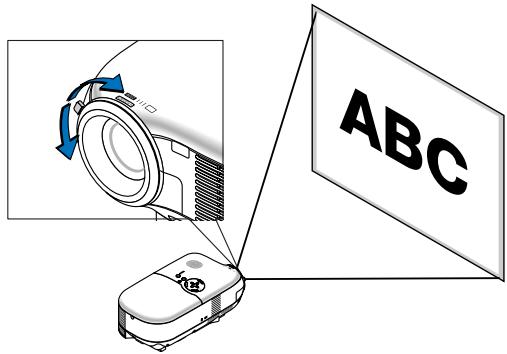
Adjustable tit foot There is approximately 10 degrees of tit “UP adjustment for the front of the projector. CAUTION Do not use the ti-foot for purposes other than originally intended. Misuses such as gripping the tit-foot or hanging on the wall can cause damage to the projector. Zoom Use the Zoom lever to finely adjust the image size on the screen
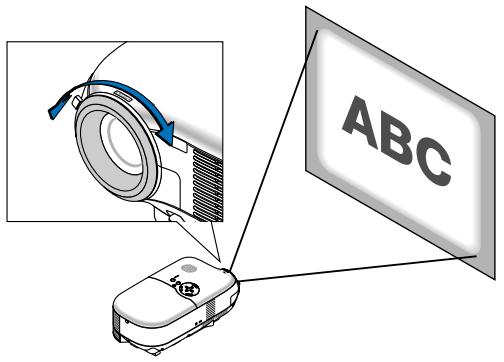
Focus Use the Focus ring to obtain the best focus. Correcting the Vertical Keystone Distortion The Keystone correction feature will correct the vertical distortion of a projected image on the screen.
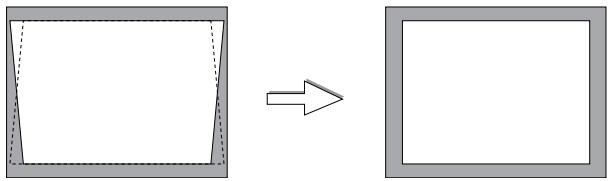
NOTE: Keystone angle can be corrected between 15 degrees upward and 15 degrees downward of projector ti from level. To correct keystone distortion using the[KEYSTONE]+/ button:

1. Press the KEYSTONE |#- button once to display the slide bar for adjustment.

2. Press the[REYSTONE]+ or - to correctthe keystone distortion. de reun

You can also correct keystone distortion by using the menu.

NOTE: You can save changes by using Keystone Save” feature when you turn off he projector. See page E-35. E-25

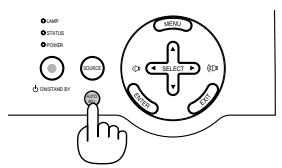
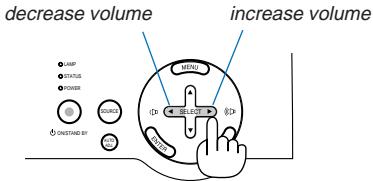
ing an RGB Image Automatically ing the Image Using Auto Adjust Optimizing an RGB image automatically Press the(AUTO ADJ Jbutton to optimize an RGB image automatically. IPoor picture] [Csbinetcontrols ] [Remote control] RUES INormal picture] Press the [AUTO AD] button to fine-tune the computer image or to remove any vertical banding that might appear and to reduce video noise, dotinterference or cross talk (this is evident when partof your image appears to be shimmering). This function adjusts the clock frequencies that eliminate the horizontal banding in the image. This function also adjusts the clock phase to reduce video noise, dot interference or cross talk. (This is evident when part of your image appears to be shimmering.) This adjustment may be necessary when you connect your computer for the first time. NOTE: + Some signals may not be displayed correct} or take time. + The Auto Adjust function does not work for component and video signals. + Hfthe Auto Adjust operation cannot optimize the RGB signal, try to adjust Clock and Phase manual. See page E-37. Turning Up or Down Volume Sound level from the speaker can be adjusted. Cabinet contro! Remote control O OO increase volume O decrease volume increase volume decrease volume = NOTE: When no menus appear theISELECTR and butions on the projector cabinet work as a volume control. E-26
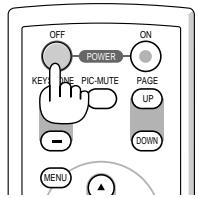
Turning off the Projector To turn off the projector: First, press the[ON/STAND EY]button on the projector cabinet or the[POWER OFFJbutton on the remote control The ‘Power Off /Are you sure?” message will appear. Cabinetcontrols | [Remote control]

so) (Ô) Power Off Are you sure ? _Yes| No | Second, press the[ÆNTERJbutton or press the [ONSTAND BYlor the[POWER OFF]button again, The POWER] indicator will glow orange. After the projector turns off, the cooling fans keep operating for 60 seconds (Cooling-off time) immediately after turing on the projector and displaying an image, you cannot turn off the projector for 60 seconds Third, tum off the Main Power switch. The[POWER]indicator will go out. PowerOn Fan running Standby

© LAMP © LAMP © LAMP

© STATUS © STATUS © STATUS

XL rouen (©rouer 10X roueR Steady green light Blinking orange Steady orange light light NOTE: To avoid premature lamp failure, waïtat least 5 minutes before turning on or of the projector. CAUTION Do notunplug the power cable from the wall outietor do nottun offthe main power under any one ofthe fol wing circumstances. Doing so can cause damage to the projector: + Whi the projector turned on. + Whilethe cooling fans are running. (The cooling fans continue to work for 60 seconds after the projec- tor is turned off). E-27

After Use Preparation: Make sure that the projectors main power is off.

4. Cover the lens with the lens cap.

5. Putthe projector and its accessories in the supplied soft case.

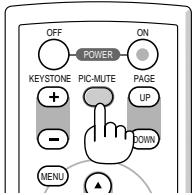
Turning Off the Image and Sound Press the PIC-MUTEJbutton to tum offthe image and sound for a short period of time. Press again to restore the image and sound

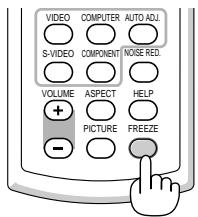
® À Freezing a Picture Press the[FREEZE button to freeze a picture. Press again to resume motion.
g Video Noise (N e Reduction) You can reduce video noise by using the[NOISE RED] button on the remote control. To reduce video noise, press he[NOISE RED.Jbutton to turn on the Noise Reduction feature. You can also reduce video noise by using the menu. See page E-34. E-29
Getting the Information on Lamp Usage and Projector Usage You can view various information such as status of the remaining lamp time, lamp hour meter and projector usage E-30

Using the Menus NOTE: The on-screen menu may not be displayed correci wie interlaced motion video image is projected. utton on the remote control or projector cabinet to display the main menu. Adjustment Image © Setur © Advanced Information Reset

2. Press the[SELECT A V]buttons on the remote control or the projector cabinet to highlight the menu for the

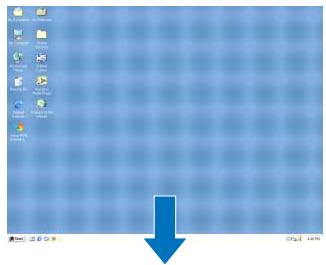
item you want to adjust or set. Picture Æ | Adiustment se | hicit © L Setup Indicates the selected menu or item. o KŸ Advanced di Information Reset Keystone off Aspect Ratio Normal 2 EE | Position/Clock Horizontal — [| Vertical — (0 Clack 1344 Phase = [>| Computer |

4. Use He[SELECT AW]buttons on the remote control or the projector cabinet to select the item you want to

5. Adjusting the level of a selected item or selecting an item.

Slide bar Solid triangle [ L- Retum key symbol C5] Radio button For Adjusting items (Slide bar) Slide bar …… Indicates settings or the direction of adjustment. + Use the[SELECT p]buttons to adjust the item. For Selecting items (Solid triangle) Solid triangle .. Indicates further choices are available. À highlighted triangle indicates the item is active.

  • Use the[SELECT buttons to select the item. For Selecting items (Return key symbol, Radio button) Retum key symbol …… Indicates further choices are available. Radio button … Use this round button to select an option in a dialog box.

1) Press the button. The selected item will be displayed.

2) Use the BELECT AVlbuttons to highlight the item you want to set.

Changes are stored until you adjust it again. ution to return to the previous screen.

6. Repeat steps 2-5 to adjust an additional item, or press the EXTTbutton several times to close the menu.

NOTE: Menu windows have the following elements.

Indicates the currently selected source. Indicates the remaining countdown time when the Off Timer is preset. Indicates the Cabinet Button is locked. E-32 © Source @ Of Timer remaining tm © Key symbol

Menu Descriptions & Functions Picture You can adjust brightness, contrast, sharpness, color, hue, noise reduction and Telecine. NOTE: When one of Brighiness, Contrasi, Sharpness, Color or Aue is highlighted, pressing the ENTER utton wil display its slide bar for adjustment. Brightness Adjusts the brightness level or the black level of the image. Contrast ……. Adjusts the intensity of the image according to the incoming signal (White level ofthe image). Sharpness …. Controls the detail of the image for Video. Increases or decreases the color saturation level (not valid for RGB). Varies the color level from #- green to +/-blue. The red level is used as reference. This adjustment is only valid for Video and Component inputs (not valid for RGB). Noise Reduction … Turn on or off the noise reduction feature. To reduce video noise, select On: NOTE: + This feature is not available for 480p, 576p, 720p and non-1080i HDTV and RGB signals + Noise reduction set to off gives best image quality by way of higher bandwidth. Noise reduction set to on softens the image. Telecine …… Use 3:2 pull down correction to eliminate jitter and artfacts in video. Auto: For film source such as a DVD player. Off: For signals other than film sources. NOTE: This feature Is not avaïlable for 480p, 576p. 720p and non-1080i HDTV and RGB signals Adjustment You can adjust Wall Color, Color Management, Gamma Correction, Color Temperature and White P eaking. Selecting Wall Color Correction Mode [Wall Color] This function allows for quick adaptive color correction in applications where the screen material is not white. The following eight options are available: Off, Blackboard, Light yellow, Light green, Light blue, Sky blue, Light rose and Pink. E-34

Adjusting Color Management [Color Management] This option allows you to adjust neutral tint for yellow, cyan or magenta. There are 5 factory presets optimized for various types of images, you can set user adjustable settings. Presentation . Recommended for making a presentation using a PowerP oint file. Video Recommended for standard video such as a TV program Movie Recommended for film based video such as à movie (DVD or HDTV). Graphic Recommended for viewing accurate colors in graphics. SRGB ……… Standard color values. Selecting Gamma Correction Mode [Gamma Correction] Each mode is recommended for: Dynamic ……. Creates à high-contrast picture. Natural Natural reproduction of the picture. Black Detail. Emphasizes detail in dark areas ofthe picture. Adjusting Color Temperature [Color Temperature] This option allows you to adjustthe color temperature using the slide bar. Move the slide bar to the rightto increase the color temperature for a bluish image: to the leftto decrease itfor à reddish image. NOTE: The adjustable range may vary depending on White Peaking adjustment. Adjusting White Peaking [White Peaking] This allows you to adjustthe drive level ofthe white areas. As the picture becomes dim, itlooks more natural. NOTE: When this option is highlighted, pressing he ENTER button wil display is slide bar for adjustment. Correcting Vertical Keystone Distortion Manually [Keystone] You can correct vertical distortion manually. NOTE: When this option is highlighted. pressing the ENTER button wi display ts slide bar for adjustment. Saving Vertical Keystone Correction [Keystone Save] This option enables you to save your current keystone settings: of. Does not save current keystone correction settings on. … Saves current keystone correction settings Saving your change once affects all sources. The changes are saved when the projector is off. E-35

Selecting Aspect Ratio [Aspect Ratio] Aspect Ratio allows you to select the best Aspect mode to display your source image. You can also display the Aspect Ratio window by pressing the[ASPECTIbutton on the remote control. (See page E-7). Normal Cinema Nate When 4:3 is selected fomüe source (Le.DVD RD © le) e player), the following @ CD sekconsnilésph LS d © e Standard Left and right 4:3 Aspect stretched Normal Cinema When 16:9 is selected PT Ü from the source (.e. DVD [e] | player), the following e d Sections vil spy: |) o 16:9 image Left and right displayed in 4:3 … stretched to display mode the true aspect Native (RGB only): Tums off the Advanced AccuBlend feature. The projector displays the current image in its true resolution. NOTE: + When you are displaying an RGB image with a higher resolution than the projector‘s native resolution, the image will be displayed in ‘Normal even i Native” is selected. (Advanced Accublend wil be incorporated) On when displaying an RGB image with a lower resolution than the projector s native resolution, will he image be able to be displayed in it true resolution “Native” + When ‘Normal is selected, an HDTV (1080i/720p) signal will be shown in its true aspect, as is the case when selecting “Cinema” + You can adjust the image position for Cinema aspect. See “Cinema Position” for setting the image position. Copyright Please note that using this projector for the purpose of commercial gain or the attraction of public attention in a venue such as à coffee shop or hotel and employing compression or expansion of the screen image with a ‘Aspect Ratio’ setting may raise concern about the infringement of copyrights which are protected by copyright law. Adjusting the Vertical Position of Image [Cinema Position] (for Cinema only) This feature adjusts the vertical position of the image when viewing video with Cinema aspect ratio selected When “Cinema” is selected in ‘Aspect Ratio”, the image is displayed with black borders on the top and bottom. You can adjustthe vertical position between top and bottom. NOTE: This option is avaïlable onÿy when Cinema” is selected in Aspect Ratio E-36

Adjusting Horizontal Vertical Position, Clock and Phase [Position/Clock] You can adjust the image manually for position and stability ‘Horizontal “Vertical”, “Clock” and Phase”. HHorizontallVertical] Adjusts the image location horizontally and vertically [Clock] (available for RGB signal only) Use this item to fine tune the computer image or to remove any vertical banding that might appear. This function adjusts the clock frequencies that eliminate the horizontal banding in the image. This adjustment may be necessary when you connect your computer for the first time. [Phase] (available for RGB signal only) Use this item to adjustthe clock phase orto reduce video noise, dotinterference or cross talk. (This is evident when part of your image appears to be shimmering.) Use “Phase” only after the “Clock” is complete Setup Lamp Mode Language F Menu Color Select Menu Display Time Background Orientation Communication Speed Computer Setting Off Timer [Off Timer] You can use the Off Timer feature to turn off the projector automatically at a preset time. Eight preset times can be selected:Off, 0:30, 1:00, 2:00, 4:00, 8:00, 12:00 and 16:00. Selecting Lamp Mode [Lamp Mode] This feature enables you to select two brightness modes ofthe lamp: Normal and Eco modes. The lamp life can be extended by using the Eco mode Normal Mode … This is the default setting (100% Brightness). Eco Mode …. Select this mode to increase the lamp life and reduce fan noise (80% Brightness). Selecting Menu Language [Language] You can choose one of 20 languages for the on-screen menu. Selecting Menu Color [Menu Color Select] You can choose between two color modes for menu color: color and monochrome. Selecting Menu Display Time [Menu Display Time] This option allows you to select how long the projector waits after the last touch of a button to turn off the menu The preset choices are ‘Manual’, ‘Auto 5 sec”, ‘Auto 15 sec”, and ‘Auto 45 sec”. The ‘Auto 45 sec” is the factory preset. Selecting a Color for Background [Background] Use this feature to display a blue/black screen when no signal is available. E-37

Selecting Projector Orientation [Orientation] This sets your image for your type of projection application. The options are: desktop front projection, ceiling rear projection, desktop rear projection, and ceilng front projection. Selecting Communication Speed [Communication Speed] This feature sets the baud rate of the PC Control port (Mini DIN 8 Pin). It supports data rates from 4800 to 38400 bps. The default is 38400 bps. Select the appropriate baud rate for your equipment to be connected (depending on the equipment, a lower baud rate may be recommended for long cable runs). Advanced Off Unlock Auto Off RGB/Component Auto Auto Preventing the Unauthorized use of the projector [Security] A keyword can be set for your projector to avoid operation by an unauthorized user using the Menu. When a Keyword is set, tuming on the projector will display the Keyword input screen. Unless the correct keyword is entered, the projector cannot project an image. To enable the Security function: . Select [Advanced] [Security] and press the [ENTER button. Off Unlock Auto Off RGB/Component Auto Auto The OffOn menu wil be displayed. E-38

Select ‘On"and press the The [Keyword] screen will be displayed.

Type in a combination of the four(SELECT AV-4]buttons and press th NOTE: À Keyword must be four to 10 digits in length. The [Confirm Keyword] screen will be displayed. Type in the same combination ofSELECT AV) buttons and press the[ENTER button.

The confirmation screen will be displayed.

Select Yes” and press he[ENTERJbutton. vs | No | The Security function has been enabled. E-39

To disable the Security function: 1 Select [Advanced] [Security] and press the [ENTER Jbutton. The Off/On menu will be displayed.

Type in your keyword and press the[ENTER button. When the correct keyword is entered, the Security function will be disabled. When the Security function is enabled and the projector is turned on, the projector will display a blue back- ground. To display an image at this time, press the[MENU button to display the Keyword input screen. Type in the correct keyword and press the ENTER Jbutton. The projector will display an image. E-40

NOTE: + The security disable mode is maintained until he main power is turned off (by setting the main power switch to “0” or unplugging the power cable). + you forget your keyword, contact your dealer. Your dealer wil provide you with your keyword in exchange for your request code. Your request code is displayed in the Keyword Confirmation screen. In this example “KO92-45L8-JNGJ- AXU9-1YAT-EEA2" is a request code. Disabling the Cabinet Buttons [Cabinet Button] This option tums on or off the Key Lock function for cabinet buttons. NOTE: + The Cabinet Buttons setting wil not affect the remote control or PG Control Functions. + When the cabinet buttons are disabled, pressing and holding the[EXTTbutton for about 10 seconds will change the setting to enable. Enabling Fan Speed Mode [Fan Mode] This option allows you to select two modes for fan speed: Auto mode and High speed mode. Auto The builtin fans automatically run at a variable speed according to the intemal temperature. High . The builtin fans run at a fixed high speed. When you wish to cool down the temperature inside the projector quickly, select “High” NOTE: ris recommended that you select High speed mode you continue to use the projector for consecutive days. Enabling Power Management [Power Management] When this option is selected you can enable the projector to automatically tum off (at the selected time) if there is no signal received by any input. Selecting Signal Format [Signal Select] IComputer] Normally select'R GB/Component' and the projector automatically detects a component signal. Select*S cart” for the European Scart signal. Video & S-Video System Select] This feature enables you to select composite video standards automatically or manually Normally select “Auto” and the projector will automatically detect the video standard. In the case where the projector has dificulty detecting the video standard, selectthe appropriate video stan- dard from the menu. This must be done for Video and S-Video respectively E-41

Information Displays the status ofthe current signal and lamp usage. This item has three pages. The information included is as follows: [Page 1] [Page 2] Remaining Lamp Time (%)* Horizontal Frequency Lamp Hour Meter (H) Vertical Frequency Projector Usage (H) Sync Polarity + The progress indicator shows the percentage Video Type ofremaining bulb life. Sync Type The value informs you of the amount of lamp Interlace usage. When the remaining lamp time reaches 0, the Remaining Lamp Time bar in- [Page 3] dicator changes from 0% to 100 Hours and BIOS Version starts counting down Firmware Version Ifthe remaining lamp time reaches 0 hours, Data Version the projector will not tum on regardless of whether the lamp mode is set to Normal or Eco. E-42

Returning to Factory Default [Factory Default] The Factory Default feature allows you to change adjustments and settings to the factory preset for a (all) source (s) exceptthe following: [Current Signal] Resets the adjustments for the current signal t the factory preset levels. Allthe items in “Picture”, ‘Adjustment (except “Wall Color)" and ‘Image (except Keystone” and “Keystone Save")" can be reset. IAII Data] Reset all the adjustments and settings for all the signals to the factory preset. All items can be reset except Language, Background, Communication Speed, Security, Remaining Lamp Time, Lamp Hour Meter, and Projector Usage. To resetthe lamp usage time, see “Clear Lamp Hour Meter”. Clearing Lamp Hour Meter [Clear Lamp Hour Meter] Resets the lamp clock back to zero. Selecting this option displays submenu for a confirmation. NOTE: The projector wi un off and go into standby mode after 2100 hours (up to 3100 hours in Eco mode) of service. utton on the remote control for ten seconds to reset the lamp clock back to zero. Do this on after replacing the lamp.

This section describes the simple maintenance procedures you should follow to replace the lamp and clean the projector cabinet. Replacing the Lamp After your lamp has been operating for 2000 hours (up to 3000 hours in Eco mode) or longer, th ndicator inthe cabinetwil blink red and the message ‘The lamp has reached the end of ts usable life. PI place the lamp." will appear. Even though the lamp may stil be working, replace itat 2000 (up to 3000 hours in Eco mode) hours to maintain optimal projector performance. CAUTION DO NOT TOUCH THE LAMP immediately after ithas been used. Itwill be extremely hot. Turn the projec- tor off, wait 60 seconds, turn offthe main power switch and then disconnectthe power cable. Allow at least one hour for the lamp to cool before handling. DO NOT REMOVE ANY SCREWS except the lamp cover screw and two lamp case screws. You could receive an electric shock. Do not break the glass on the lamp housing. Keep finger prints off the glass surface on the lamp housing. Leaving finger prints in the glass sur- face might cause an unwanted shadow and poor picture quality. The projector will turn off and go into standby mode after 2100 (up to 3100 hours in Eco mode) hours of service. If this happens, be sure to replace the lamp. If you continue to use the lamp after 2000 hours (up to 3000 hours in Eco mode) of use, the lamp bulb may shatter, and pieces of glass may be scattered in the lamp case. Do not touch them as the pieces of glass may cause injury. If this hap- pens, contact your NEC dealer for lamp replacement. To replace the lamp: Preparation: Be sure to insertthe included spacer between the rear foot and the projector's bottom to prevent the projector from accidentally titing when inserting the lamp house. E-44

1. Loosen the lamp cover screw until the screwdriver goes into a freewheeling condition and remove the lamp

cover. The lamp cover screw is notremovable.

2. Loosen the two screws securing the lamp housing until the screwdriver goes into a freewheeling condition.

The to screws are not removable. Remove the lamp housing by holding it NOTE: There is an interlock on this case to prevent the risk of electrical shock. Do not attempt to circumvent this interlock. Interlock E-45

3. Insert a new lamp housing until the lamp housing is plugged into the socket.

Secure itin place with the two screws. Be sure to tighten the screws. CAUTION + Do not use a lamp other than the replacement lamp (LHO2LP). Order this from your dealer. (%) Push here. NOTE: + Align the lamp housing with the guide rail. Make sure the lamp housing plug goes to the socket correct. + Hf both screws are not tightened secure), an image may not be displayed correct. In this case, apply firm pressure to the portion of asterisk (4%) in the above drawing to seat the lamp housing into the case.

Reattach the lamp cover. Tighten the lamp cover screw. Be sure to tighten the screw.

After you install a new lamp, selectthe menu - [Reset] [Clear Lamp Hour Meter] to resetthe lamp usage hours. NOTE: When the lamp exceeds 2100 hours (up to 3100 hours in Eco mode} of service, the projector cannot turn on and the menu is not displayed. Ifthis happens, press the[HELPlbutton on the remote control for a minimum of 10 seconds while in Standby mode. When the lamp time clock is reset to zero, the[[AMPlindicator goes out. E-46

Cleaning the Cabinet and the Lens

1. Tum offthe projector before cleaning.

2. Clean the cabinet periodically with à damp cloth. If heavily soiled, use a mild detergent Never use strong

detergents or solvents such as alcohol or thinner.

3. Use a blower or lens paper to clean the lens, and be careful not to scratch or mar the lens.

This section helps you resoive problems you may encounter while setting up or using the projector. Power Indicator Indicator Condition Projector Condition Note Off The main power is off. = Blinking light! Green 0.5 sec On, |The projector is getting ready | Wait for a moment.

0.5 sec Off |toturn on.

2.5 sec On, |Off Timer is enabled -

Orange 0.5 sec On, |The projector is cooling down. | Wait for a moment.

Steady light | Green The projector is turned on. = Orange The projector is in Standby. - Status Indicator Indicator Condition Projector Condition Note of Normal = Blinking light! Red 1 cycle Lamp cover error or lamp hous- | Replace the lamp cover or lamp (0.5 sec On, | ing error housing correctly.

2 cycle Temperature error The projector is overheated. (0.5 sec On, Move the projector to a cooler

0.5 sec Off) location.

4 cycle Fan error Fans will not work correctiy. (0.5 sec On,

6 cycle Lamp error Lamp fails to light. Wait a full (0.5 sec On, minute and then turn on again.

Green Re-firing the lamp The projector is re-firing. Steady light | Orange Cabinet button locked You have pressed cabinet but- ton when Cabinet Button is locked. Lamp Indicator Indicator Condition Projector Condition Note oi Normal = Blinking light! Red Lamp has reached its end of life. | Replace the lamp. Lamp replacement message will be displayed. Steady light | Red Lamp has been used beyondits | Replace the lamp limit. The projector will not turn on until the lamp is replaced Green Lamp mode is set to Eco mode. | - E-48

Common Problems & Solutions Problem CheckThese Items Does not turn on Check that the power cable is plugged in and that the power button on the projector cabinet or the remote control is on. See pages E-19 and E-20. Ensure that the lamp cover or lamp housing is installed correctly. See page E-46. Check to see ifthe projector has overheated or the lamp has reached the end of its usable life. If there is insufficient ventilation around the projector or if the room where you're presenting is particularly warm, move the projector to a cooler location. The lamp may fail to light. Wait a full minute and then turn on the power again The lamp has reached the end of its usable life. Replace the lamp. Lamp does not turn on; FUWER] and [STATUS] ‘Wait for 60 seconds (cooling period)to see if the lamp turns on by itself. POWER] and STATUS]LEDS blinking green at the same time indicates the LEDs are blinking green at the same time main power was interrupted during previous operation. Will turn off Ensure that the Power Management is off. See page E-41. No picture Use the [VIDEO] S-VIDEU, COMPUTER] or COMPONENT button on the re- mote control or the[SUURCE] button on the cabinet to select your source (Video, S-Video, Component or Computer). See page E-22. Ensure your cables are connected properly. Use menus to adjust the brightness and contrast. See page E-34. Reset the settings or adjustments to factory preset levels using “Reset” in the menu. See page E-43. Enter your registered keyword if the Security function is enabled. See page E-38. When using with a notebook PC, be sure to connect between the projector and the notebook PC before turning on the power to the notebook PC. In most cases signal cannot be output from RGB output unless the notebook PC is turned on after connecting with the projector.

  • Ifthe screen goes blank while using your remote control, it may be the result of the computer's screensaver or power management software.
  • For more detailed, see page E-51. Image isn't square to the screen Reposition the projector to improve its angle to the screen. See pages E-22 and E-23. Use the Keystone correction function to correct the trapezoid distortion. See page E-25 Color tone or hue is un- usual Check if an appropriate color is selected in “Wall Color”. If so, select an appropriate option. See page E-34. Adjust “Hue” in “Picture”. See page E-34. E-49

Problem Check These Items Picture is blurred Remove the lens cap. Adjust the focus. See page E-25 Reposition the projector to improve its angle to the screen. See pages E-22 and E-23. Ensure that the distance between the projector and screen is within the ad- justment range of the lens. See pages E-11 and E-12. Condensation may form on the lens if the projector is cold, brought into a warm place and is then turned on. Should this happen, let the projector stand until there is no condensation on the lens: Image is scrolling verti- cally, horizontally or both Use the [VIDEO] [S-VIDEO] COMPUTER] or COMPONENTI button on the re- mote control or theSOURCEIbutton on the cabinet to select the source you want to input. Adjust the computer image manually with the Horizontal Vertical Position. See page E-37. Connect a source the projector supports. See Compatible Input Signal List on page E-57. Remote control does not work Install new batteries. See page E-8. Make sure there are no obstacles between you and the projector. Stand within 22 feet (7 m) of the projector. See page E-9. Indicator is lit or blink- ing See the Power/Status/Lamp Indicator on page E-48. Cross color in RGB mode Press the[AUTO ADJ] button on the projector cabinet or the remote control See page E-26. Adjust the computer image manually with the Clock and Phase in “Image” of the menu. See page E-37. E-50

If there is no picture, or the picture is not displayed correctly. Power on process for the projector and the PC. Be sure to connectthe RGB cable between the projector and the computer before tuming on the computer. There are some notebook PCS, which do not output signal unless there is à projector or monitor connected first. NOTE: You can check the horizontal frequency of the current signalin the projectors menu under Information. Ii reads “0 kHz”, this means there is no signal being output from the computer. See page E-42 or go to next step. Enabling the computer's external display. Displaying an image on the notebook PC's screen does not necessarily mean it outputs a signal to the projector. When using à PC compatible laptop, a combination of function keys will enable/disable the external display. Usuall, the combination of the ‘Fn” key along with one of the 12 function keys gets the external display to come on or off. For exemple, NEC laptops use Fn +F3, while Dell laptops use Fn +F8 key combi- nations to toggle through external display selections. Non-standard signal output from the computer Ifthe output signal from a notebook PC is notan industry standard, the projected image may notbe displayed correctiy. Should this happen, deactivate the notebook PC's LCD screen when the projector display is in use. Each notebook PC has a different way of deactivate/reactivate the local LCD screens as described in the previous step. Referto your computer's documentation for detailed information. Image displayed is incorrect when using à Macintosh When using a Macintosh with the projector, set the DIPswitch of the Mac adapter (not supplied with the projector) according to your resolution. After setting, restart your Macintosh for the changes to take affect. Forsettng display modes other than those supported by your Macintosh and the projector, changing the DIP switch on à Mac adapter may bounce an image slightiy or may display nothing. Should this happen, setthe DIP switch to the 13" fixed mode and then restart your Macintosh. After that, restore the DIP switches to à displayable mode and then restartthe Macintosh again. NOTE: À Video Adapter cable manufactured by Apple Computer is needed for a PowerBook which does not have a mini D- Sub 15-pin connector. Mirroring on à PowerBook

  • When using the projector with a Macintosh PowerBook, output may notbe setto 1024 x 768 unless “mirror- ing"is off on our PowerBook. Refer to owners manual supplied with your Macintosh computer for miroring. Folders or icons are hidden on the Macintosh screen Folders oricons may notbe seen on the screen. Should this happen, select(View] -+ [Arrange]from the Apple menu and arrange icons E-51

32-154 280W in Lamp Normal mode 220W in Lamp Eco mode 7.0W in Standby mode

  • Effective pixels are more than 99.99% E-52

Mechanical Installation Orientation Dimensions Net Weight Environmental Considerations Regulations For additional information visit. Desktop/Front, Desktop/Rear, Ceiling/Front, Ceiling/Rear 7.4" (W)x 4.4" (H)x13.3" (D) 187mm (W) x 113mm (H) x 337mm (D) {not including protrusions) 64 lbs / 2.9 kg Operational Temperatures: 41°F to 95°F (5°C to 35°C), 20% to 80% humidity {non-condensing) Storage Temperature: 14°F to 122°F (-10°C to 50°C), 20% to 80% humidity {non-condensing) ULIC-UL Approved (UL 60950, CSA 60950) Meets DOC Canada Class B requirements Meets FCC Class B requirements Meets AS/NZS CISPR 22 Class B Meets EMC Directive (EN55022, EN55024, EN61000-3-2, EN61000-3-3) Meets Low Voltage Directive (EN60950, TÜV GS Approved)

44°113.0 Bu70, Unit =inch/mm

Green or Sync on Green

Ground Ground Red Ground CrGround Green Ground Ÿ Ground Blue Ground Cb Ground No Connection Sync Signal Ground SCART Sync Bi-directional DATA (SDA) Horizontal Sync or Composite Sync Vertical Sync Data Clock E-55

To TxD of PC D THD of PC NOTE: Pins 2, 3, 5, 6 and 8 are used inside the projector. E-56

Troubleshooting Check List Before contacting your dealer or service personnel, check the following listto be sure repairs are needed also by referring to the ‘Troubleshooting" section in your user's manual. This checklist below wi help us solve your problem more efficientiy.

  • Printthe following pages. Frequency of occurrence L]always C] sometimes (How often? Power ) Cother ( ) Co power (POWER indicatr does nat ight green). See also “Sta- tus Indicator (STATUS) EXC Power cables plug is fuly inserted into the wall outlet FC Main power switch is pressed to the ON position. EC Lamp cover is installed correct LC Lamp Hour Meter (lamp operation hours) was cleared after lamp replacement LE no power even though you press and hod he POWER button for a minimum of 2 saconds Video and Audio LT Shut down during operation. Pour cables plug is fuly inserted into the wall outlet. Lamp cover is installed correctiy Power Management is turned off (only models with the Power Management function) Sleep Timer is turned off (only models with the Sleep Timer function bdd [1 No image is displayed from your PC or video equipment to the projectar. F1 Still no image even though you connect the projector to the PC first, then Start the PC. Enabling your notebook PC's signal output to the projector. + A combination of function keys will enable/disable the ex ternal display. Usualy the combination ofthe “Fn” key along with one of the 12 function keys turns the external display on or oft No image (blue background, logo, no displaÿ) St no image even though vou press the AUTO ADJUST but- ton.

Still no image even though you carry out * projectars menu Signal cables plug is fully inserted int the input connector ‘A message appears on the screen.

‘The source connected ta the projector is active and available. St no image even though you adjust the brighiness and/or he contrast. LC input source's resolution and frequency are supported by the projectar. Image is too dark Remains unchanged even though you adjust the brighiness and/or the contrast. dé dé à dd Image is distorted Image appears to be trapezoidal (unchanged even though you carry out the “Keystone” or "3D Reform” adjustment) Other LI Parts of the image are lost: C1 Still unchanged even though you press ne AUTO ADJUST but- ton. —[1 Still unchanged even though you carry out “Reset” in the projectors menu [image is shted in the vertical or horizontal direction Ê [3 Horizontal and vertical positions are correctiy adjusted on à computer signal. EC input sources resolution and frequency are supported by the projector. LC Some pixels are lost. [1 Image is tckering LC Still unchanged even though you press ne AUTO ADJUST but- ton. FC Still unchanged even though you carry out “Reset projectars menu. LC image shows tickering or color rit on a computer signal. [Image appears blurry or out of focus. LE St unchanged even though you checked the signals resolu- tion on PC and changed ito projectar native resolution. 1] Still unchanged even though you adjusted the focus. [1 o sound. Î-[3 Audio cable is correctiy connected to the audio input of tne projectar. F2 til unchanged even though you adjusted the volume level LES AUDIO our is connected to your audio equipment (only mod- es with the AUDIO OUT connector in the Remote control does nat work. Na obstacles between {ne sensor of tne projector and the re- mote control, Projector is placed near a fluorescent light that can disturb the infrared remote controls. One or more remote sensors are enabled (only models with the Remote Sensor Selection function) Batteries are new and are not raversed in instalation. A present on the remote control, projector selector suitch is not used 1] Buttons on the proector cabinet do not work ( only models with the Key Lock function) LC cabinet Button Lockis not turned on ris disabled in the menu LC] sti unchanged even though you press and hold the EXIT but- ton for a minimum of 10 seconds E-58

In the space below please describe your problem in detail. Information on application and environment where your projector is used Projector Model number: Serial No. Date of purchase Lamp operating time (hours) Lamp Mode: [I Normal C] Eco Information on input signal: Horizontal synch frequency [ ]kHz Vertical synch frequency [ ]Hz Synch polarity HÜ() D VO 0 Synch type [Separate CI Composite [I Sync on Green STATUS Indicator: Steady light [I Orange C] Green Flashing light [ Joyces Remote control model number: Installation environment Screen size: inch Screentype: CJWhite matte CI Beads CI Polarization [Wide angle CI High contrast Throw distance: feetinch/m Orientation: _ CI Geïling mount C1 Desktop Power outlet connection: [1 Gonnected directly to wall outiet [1 Gonnected to power cord extender or other (the num ber of connected equipment [1 Gonnected to a power cord reel or other (the number of connected equipment Projector Computer Manufacturer: Model number: Notebook PC C]/ Desktop C1 Native resolution: Refresh rate: Video adapter: Other: DVD player Signal cable NEC standard or other manufacturer's cable? Model number: Length: inch/m Distribution amplifier Model number: Switcher Model number: Adapter Model number: Video equipment VCR, DVD player, Video camera, Video game or other Manufacturer: Model number: E-59

TravelCare Guide TravelCare - a service for international travelers This productis eligible for “TravelCare", NEC's unique international warranty. Please note that TravelC are coverage differs in partfrom coverage underthe warranty included with the product. Services offered with TravelCare This warranty allows customers to receive service on their product at the NEC and NEC-designated service stations in the countries listed herein when temporarly traveling internationally for business or pleasure. For details on services offered by the different service stations, please refer to the "List of TravelCare Outiets" below. 1 Repair services The product will be repaired and delivered within 10 business days, not including shipping time. During the term of warranty, the cost of maintenance parts, labor costs for repairs and shipping costs within the service station's coverage area are covered by the warranty. 2 Replacement product rental service Ifthe customer desires, he or she can renta replacementproduct while the original product is being repaired. Fee: US $200 for 12 days This fee must be paid atthe local service station in cash or credit card. The $200 rental fee is non-refundable even ifthe customer rents itless than 12 days before returning. The replacement product wi be delivered within 3 business days Ifthe customer did not return the replacement product within 12 days, the customer will be charged the price ofthe unit. Ithe customer retumed the replacement product in à faulty or damaged condition, the repair cost will be charged to the customer. Note thatthis service is notoffered in all countries and regions. Please refer to the “ListofTravelCare Outiets". In addition, this replacement product rental service is not offered after the products warranty has expired. Term of warranty

3. Upon presentation of the warranty or receipt received upon purchase:

Valid for the term indicated on the warranty or the normal term of warranty for the country of purchase. b.. When only the product is brought in. Valid for a period of within 14 months ofthe date ofmanufacture indicated by the serial number attached to the product. 2 When a product whose term of warranty is expired is brought in: Repairs will be offered for a fee. In this case the customer is not eligible for the replacement product rental service 3 Inthe following cases, repairs may be charged, even ifthe products warranty is st in effect:

Ifthe term of warranty, model name, serial number and name of the store of purchase are not indicated on the warranty or have been altered. Problems or damage caused by dropping or shocks during shipmentor movement by the customer or by improper handling by the customers. Problems or damage caused by improper usage or unwarrantable alterations or repairs by the customer.

Problems or damage caused by fire, saltdamage, gas damage, earthquakes, lightning damage, storm or food damage or other natural disasters or such extemal factors as dust, cigarette smoke, abnormal voltage, etc.

5) Problems or damage caused by use in hot or humid places, in vehicles, boats or ships, etc.

Problems or damage caused by expendable supplies or devices connected to the product other than those designated by NEC.

7) Problems caused by natural consumption, wear or deterioration of parts under normal usage conditions.

Problems or damage to lamps and other expendable supplies, included parts or optional parts Other conditions stipulated in the warranty included with the product also apply. E-60

NOTE: The product can be used overseas with volfages of 100 to 120V and 200 to 240V by using a power cable suited for he Standards and power source voltage of the country in which the product is being used. List of TravelCare Outlets This list applies as of December 1, 2004. Forthe most up-to-date information, please refer to the websites of the service stations in the various countries on the List of TravelCare Outiets or to the NEC website at http:/www.nec-pj.com: In Europe NEC Europe, Ltd. / European Technical Centre Address: Unit G, Stafford Park 12, Telford TF3 38], UK Telephone: +44 1952 237000 Fax Line: +44 1952 237006 Email Address: AFR@uk.neceur.com WEB Address: htip/Imww.neceur.com {Regions Covered) EU: Austria’, Belgium*, Denmark’, Finland*, France*, Germany*, Greece*, Ireland”, Italy, Luxembourg*, The Netherlands”, Portugal”, Spain*, Sweden” and the United Kingdom* EEA: Norway*, Iceland and Liechtenstein In North America NEC Solutions (America), Inc. Address: 1250 N. Arlngton Heights Road, Suite 400 Itasca, Ilinois 60143, USA Telephone: +1 800 836 0655 Fax Line: +1 800 356 2415 Email Address: vsd.tech-support@ necsam.com WEB Address: htip:/Iwww.necvisualsystems.com {Regions Covered) US A. *, Canada* In Oceania NEC Australia Pty., Ltd Address: New South Wales; 184 Milperra Road, Reversby 2212 Victoria; 480 Princess Hwy Noble Park 3174 South Australia; 84A Richmond Road, Keswick 5035 Queensland; 116 Ipswich Road, Woollongabba 4102 Western Australia; 45 Sarich Court Osborne P ark 6017 Telephone: 131 632 (from domestic) +61 8 8375 5706 (from overseas) Fax Line: +61 8 8375 5757 Email Address: lee.gramola@ nec.com.au WEB Address: http:/www.nec.com.au {Regions Covered) Australia*, New Zealand E-61

Date: / |, Puy, TO: NEC or NEC's Authorized Service Station: FM: (Company & Name with signature) Dear Sir (s), Lwould like to apply your TravelCare Service P rogram based on attached registration and qualification sheet and agree with your following conditions, and also the Service fee will be charged to my credit card account, if| don't return the Loan units within the specified period. ! also confirm following information is correct. Regards Application Sheet for TravelCare Service Program Country, product purchased : Users Company Name Users Company Address Phone No, Fax No. Users Name : Users Address Phone No., Fax No. Local Contact office Local Contact office Address : Phone No., Fax No. Users Model Name : Date of Purchase : Serial No. on cabinet Problem of units per User Required Service (1) Repair and Retum (2) Loan unit Requested period of Loan unit : Payment method (D) CreditCard (2) Travelers Cheque (3) Cash In Case of Credit Card Card No. wWValid Date :

Condition of your TravelCare Service Program Enduseris requested to understand following condition of TravelCare Service Program and complete the neces- sary information on the application sheet. L. Service Options: There are 3 types of "Service" available. Enduser has to understand following condition and is required to fill in the Application Sheet.

1) Repair and Return:

The ‘Faulty unit is sent or collected from the customer. it is repaired and returned within 10 days to the customer, excluding transport time. There may have à case, repair and retum can't be done by NEC Authorized Service Station, because of shortage of spare parts due to same model is not sold in the territory.

2) Repair and Retum with Loan: (This service is limited to some Service Stations)

This service is offered to the Enduser, who cannot wait until their unit is repaired The customer can borrow a unit for $200 up to 12 days. Customer then sends in inoperable unit to nearest NEC Authorized Service Station for service. In order to prevent collection problem, Enduser is required to fil in Application Sheet. Enduser needs to confirm the availabilty ofthe Service to NEC Authorized Service Stations.

Forthis service, NEC Authorized Service Station supplies the customer with a loan unit for US $200 up to 12 days. Customer keeps the inoperable unit and when customer retumns home, customer arranges to have the projector serviced in the home country.

2. Warranty Exclusions:

This program does not apply ifthe Projector's serial number has been defaced, modified or removed ff, in the judgement of NEC Authorized Service Station or its agent the defects or failures result from any cause other than fair wear and tear or NEC neglect, or fau including the following without limitation:

1) Accidents, transportation, neglect, misuse, abuse, water, dust, smoke or default of or by the Customer its

employees or agents or any third party; 2) Failure or fluctuation of electrical power, electrical circuitry, air conditioning, humidity control or other environ- mental conditions such as use itin smoking area;

3) Any fault in the attachments or associated products or components (whether or not supplied by NEC or its

agents which do not form part of the Product covered by this warranty);

4) Any act of God, fire, flood, war, act of violence or any similar occurrence;

5) Any attempt by any person other than any person authorized by NEC to adjust, modify, repair, install or

service the product.

6) Any Cross-border charges such as, duty, insurance, tax etc.

3. Charges for Warranty Exclusions and Out of Warranty Case:

In case faulty unit is under warranty exclusions case or under Out of Warranty period, NEC Authorized Service Station will Inform estimation of actual service cost to the Enduser with reason.

4. Dead on Arrival (DOA}:

Enduser must take this issue up with their original supplier in the country of purchase. NEC Authorized Service Station will repair the DOA unit as a Warranty repair, but will not exchange DOA unit with new units. E-65

5. Loan Service Charges and Conditions:

Upon acceptance ofthis NEC Projector, Customer agrees to assume liability for this loan unit The current cost of use of this loan unit is $200.00 USD for 12 calendar days. If Customer does notreturn the unit within the 12 calendar days, Customer will be charged the nexthighest cost up to and including the full list price to Credit Cards, which price will be informed by NEC Authorized Service Stations. Please see the attached listing of contacts for each country to arrange for pickup of the loan unit. If you return to their country of origin with the loan unit, you will be charged additional freightto retum the unit to the loaning country. Thank you for your understanding of this program E-66