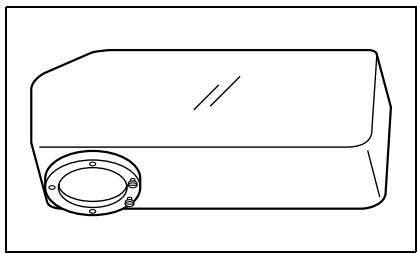
KONICA CM-2600D - Spectrophotometer

CM-2600D - Spectrophotometer KONICA - Free user manual and instructions

Find the device manual for free CM-2600D KONICA in PDF.

📄 127 pages English EN Download 💬 AI Question 10 questions ⚙️ Specs
Notice KONICA CM-2600D - page 2
View the manual : Français FR English EN
Pick your language and provide your email: we'll send you a specifically translated version.
Product type Spectrophotometer
Brand KONICA MINOLTA
Model CM-2600D
Illumination/viewing system d/8 (diffuse illumination, viewing angle 8°) with simultaneous SCI/SCE measurement
Light source 3 pulsed xenon lamps
Wavelength range 360 to 740 nm, 10 nm interval
Measurement area MAV: ø8 mm / ø11 mm; SAV: ø3 mm / ø6 mm (selectable)
Repeatability Standard deviation ΔE*ab ≤ 0.04 (white plate measurement 30 times)
Inter-instrument agreement ΔE*ab ≤ 0.2 (MAV/SCI, average of 12 BCRA tiles)
Display LCD backlit screen
Available languages English, Japanese, German, French, Spanish, Italian
Storage capacity 1700 data (data key mode) / 700 data (COND defined mode)
Power supply 4 AA batteries (alkaline recommended) or AC adapter AC-A17 (100-240 V)
Dimensions 69 × 96 × 193 mm
Weight Approx. 670 g (without batteries, with measurement base)
Operating temperature 5 to 40 °C, relative humidity ≤ 80% (no condensation)
Maintenance and cleaning Clean with a soft, dry cloth; do not use solvents. For the calibration plate, use a soft dry or slightly damp cloth.
Safety Do not use in the presence of flammable gases; do not disassemble; use only the supplied AC adapter; avoid shocks and vibrations.
Spare parts and repairability White calibration plate, measurement caps (ø8 mm, ø3 mm), RS-232C cable, AC adapter. Do not replace the backup battery yourself; contact an authorized service center.

Frequently Asked Questions - CM-2600D KONICA

How to perform zero calibration?
Point the measurement opening to air (without obstacle) and press the MEAS key. Preferably use the optional zero calibration box. Zero calibration must be performed at first use or after a change in measurement conditions.
How to change the measurement cap?
For the CM-2600D, place the cap on the measurement opening, align the latch mark with the instrument mark, then turn clockwise until aligned with the 'o' mark. To remove, turn counterclockwise. Be careful not to dirty the inner surface.
How to select the measurement area (MAV/SAV)?
Use the measurement area selector located on the side of the instrument (CM-2600D). Slide the switch to MAV (ø8 mm) or SAV (ø3 mm). Ensure you use the corresponding measurement cap and set the MASK/GLOSS parameter in the condition file.
What to do if the screen is blank?
Check that batteries are inserted or the AC adapter is connected. Adjust LCD contrast via the INITIAL > LCD CONTRAST menu. If the low battery icon appears, replace the batteries.
How to adjust the LCD contrast?
Turn on the device, turn the dial to select MENU, then INITIAL, then LCD CONTRAST. Turn the dial to adjust contrast (adjustment bar), then press to confirm. If the screen becomes unreadable, turn off the device and turn it back on while holding down the dial to restore default contrast.
How to connect the device to a PC?
Use the supplied RS-232C cable (IF-A16). Connect the connector to the external output terminal of the instrument and to the PC's serial port. Configure communication settings (REMOTE) in the INITIAL menu. Use SpectraMagic NX software to control the instrument.
How to define a target color for color difference?
In the screen, select TARGET, then use ▲▶ to choose the target number (T*). Place the instrument on the reference sample and press MEAS. The measurement will be saved as target. You can then measure other samples to display the color difference.
What do error messages ER22, ER24, ER25 mean?
ER22: The backup battery is discharged; charge it by leaving the device on. ER24: White calibration has not been performed; perform white calibration after turning on or changing the measurement area. ER25: The selected measurement area does not match the selector; adjust the selector or the setting in the file.
How to clean the white calibration plate?
Gently wipe the plate with a soft, dry cloth. If dirt persists, moisten a cloth with lens cleaner, wipe, then remove liquid with a damp cloth and let dry. Do not scratch the surface.
What is the lifespan of the backup battery?
The backup battery (model VL2020, 3V) has an expected lifespan of approximately 10 years. If the device does not retain data in memory after a full 25-hour charge, contact an authorized KONICA MINOLTA SENSING service center for replacement.

User questions about CM-2600D KONICA

0 question about this device. Answer the ones you know or ask your own.

Ask a new question about this device

The email remains private: it is only used to notify you if someone responds to your question.

No questions yet. Be the first to ask one.

Download the instructions for your Spectrophotometer in PDF format for free! Find your manual CM-2600D - KONICA and take your electronic device back in hand. On this page are published all the documents necessary for the use of your device. CM-2600D by KONICA.

USER MANUAL CM-2600D KONICA

Spectrophotometer CM-2600d/2500d

KONICA CM-2600D - Spectrophotometer CM-2600d/2500d - 1

Instruction Manual

KONICA CM-2600D - Spectrophotometer CM-2600d/2500d - 2

The following symbols are used in this manual to prevent accidents which may occur as a result of incorrect use of the instrument.

KONICA CM-2600D - Spectrophotometer CM-2600d/2500d - 3

Denotes a sentence regarding a safety warning or note. Read the sentence carefully to ensure safe and correct use.

KONICA CM-2600D - Spectrophotometer CM-2600d/2500d - 4

Denotes a prohibited operation. The operation must never been performed.

KONICA CM-2600D - Spectrophotometer CM-2600d/2500d - 5

Denotes an instruction.
The instruction must be strictly adhered to.

KONICA CM-2600D - Spectrophotometer CM-2600d/2500d - 6

Denotes a prohibited operation. Never disassemble the instrument.

KONICA CM-2600D - Spectrophotometer CM-2600d/2500d - 7

Denotes an instruction. Disconnect the AC power cord from the AC outlet.

Notes on this Manual

  • Copying or reproduction of all or any part of the contents of this manual without KONICA MINOLTA SENSING's permission is strictly prohibited.
  • The contents of this manual are subject to change without prior notice.
  • Every effort has been made in the preparation of this manual to ensure the accuracy of its contents. However, should you have any questions or find any errors, please contact a KONICA MINOLTA SENSING -authorized service facility.
  • KONICA MINOLTA SENSING will not accept any responsibility for consequences arising from the use of the instrument.

Safety Precautions

To ensure correct use of this instrument, read the following points carefully and adhere to them. After you have read this manual, keep it in a safe place where it can be referred to anytime a question arises.

WARNING (Failure to adhere to the following points may result in death or serious injury.)
Do not use the instrument in places where flammable or combustible gases (gasoline etc.) are present. Doing so may cause a fire.Do not disassemble or modify the in-strument or the AC adapter. Doing so may cause a fire or electric shock.
Always use the AC adapter supplied as a standard accessory or the optional AC adapter, and connect it to an AC outlet of the rated voltage and frequency. If the AC adapters other than those specified by KONICA MINOLTA SENSING, this may result in damage to the unit, fire or electric shockThe instrument should not be operated if it is damaged or AC adapter is damaged, or if smoke or odd smells occur. Doing so may result in a fire. In such situations, turn the power OFF immediately, disconnect the AC adapter from the AC outlet (or remove the batteries if they are used) and contact the nearest KONICA MINOLTA SENSING-authorized service facility.
If the instrument will not be used for a long time, disconnect the AC adapter from the AC outlet. Accumulated dirt or water on the prongs of the AC adapter's plug may cause a fire and should be removed.Do not insert or disconnect the AC adapter with wet hands. Doing so may cause electric shock.
Take special care not to allow liquid or metal objects to enter the instrument. Doing so may cause a fire or electric shock. Should liquid or metal objects enter the instrument, turn the power OFF immediately, disconnect the AC adapter from the AC outlet (or remove the batteries if they are used), and contact the nearest KONICA MINOLTA SENSING-authorized service facility.Do not dispose of batteries in fire, short their terminals, apply heat to them, or disassemble them. Also, do not recharge them (if they are not chargeable). Doing so may cause explosion or heat generation, resulting in fire or injury.
CAUTION (Falling to adhere to the following points may result in injury or damage to the instrument or other property.)
Do not perform measurement which the measurement aperture directed towards your face. Doing so may damage them.Do not place the instrument on an unstable or sloping surface. Doing so may result in its dropping or overturning, causing injury. Take care not to drop the instrument when carrying it.
Do not use batteries other than those specified by KONICA MINOLTA SENSING. When installing batteries in the instrument, make sure that they are correctly oriented according to the (+) and (-) marks. Failure to adhere to these instructions may cause batteries to explode or leakage of electrolyte, resulting in fire, injury or air pollution.When using the AC adapter, make sure that the AC outlet is located near the in-strument and that the AC adapter can be connected to and disconnected from the AC outlet easily.

  • This instrument and the AC adapter supplied as a standard accessory have been designed exclusively for indoor use.
  • Do not leave the CM-2600d/2500d in direct sunlight or near sources of heat, such as stoves etc. The internal temperature of the instrument may become much higher than the ambient temperature in such cases.
  • Do not use the CM-2600d/2500d in areas where dust, cigarette smoke or chemical gases are present. Doing so may cause deterioration in performance or breakdown.
  • Do not use the CM-2600d/2500d near equipment which produces a strong magnetic field (such as speakers etc.)
  • The CM-2600d/2500d belongs to installation category II products (equipment which is powered by an AC adapter connected to a commercially available power).
  • The CM-2600d/2500d belongs to pollution level 2 products (equipment which may cause temporary electrical hazards due to contamination or condensation or products which are used in such an environment).
  • Do not use the CM-2600d/2500d at altitudes of higher than 2000m .
  • Use this instrument at ambient temperature between 5 and 40^ and relative humidity 80% or less (at 35^ ) with no condensation (^*1) . Operating this instrument outside specified temperature and humidity range may unsatisfy its original performance.

*1 Operating temperature/humidity range of products for North America: between 5 and 40^ and relative humidity 80% or less (at 31^ ) with no condensation

  • When using the instrument upside-down, make sure no dirt or dust get into the aperture.
  • When using the instrument for long periods of time, the displayed value may change depending on changes in the environment. Therefore, in order to achieve accurate measurements, we recommend that white calibration be done regularly using the White Calibration Plate.

  • The calibration data for the White Calibration Plate was measured at 23^ . To achieve the highest accuracy when measuring absolute values (colorimetric values), calibration and measurement should be performed at 23^ .
  • Do not allow the White Calibration Plate to get scratched or stained.
  • If you are not going to use the White Calibration Plate, attach the cap to the White Calibration Plate to prevent entry of ambient light.

  • Do not touch the Target Mask's inner surface by hand, scratch it or make it dirty.
  • When the Target Mask is not in use, install it on the White Calibration Plate (CM-A145) to prevent exposure to external light.

  • When removing the "Measuring Base", make sure that the screws used to attach the base to the instrument are stored properly and are not mislaid. If the screws do become misplaced, use M3 cross-headed screws that are 4 to 5mm long as replacements. (For details, see page E-16.)
  • Do not tighten the screws too tightly when attaching the "Measuring Base". This could damage the "Measuring Base" or the instrument itself.
  • Remove the "Measuring Base" before using the optional Zero Calibration Box or Dust Cover Set.

  • Make sure that the power switch is set to OFF ("O") when the CM-2600d/2500d is not in use.
  • Always use the AC adaptor (AC-A17) supplied as a standard accessory and connect it to an AC outlet of the rated voltage and frequency. Use the AC power supply voltage of the rated supply voltage (within ± 10% ).

  • Do not subject the CM-2600d/2500d to strong impact or vibration. Doing so may cause deterioration in performance or breakdown.
  • Since the specimen measuring port and integrating sphere are extremely precise optical components, great care should be taken to prevent them getting dirty or exposing them to impact. If you are not going to use the CM-2600d/2500d, put it on the White Calibration Plate (CM-A145).
  • The CM-2600d/2500d may cause interference if used near a television, radio, etc.
  • Since the CM-2600d/2500d uses a microcomputer, the LCD may go blank if it is exposed to strong static electricity. In this case, turn the power OFF, then turn it ON again. If black smudges appear on the LCD, wait until they disappear naturally.
  • When turning the power OFF and then ON again, wait several seconds after turning the power OFF.

  • Measured data and various settings are stored in the memory backed up by batteries. The backup batteries are automatically charged during operation of this instrument, and can retain the contents of the memory for 4.5 months if they have been fully charged. At the time of purchase, the backup battery may not be fully charged. To charge the backup battery, set the power switch to ON. Charging of the backup battery is performed continuously while the instrument is switched on, even while the instrument is being used. Full charging is completed in 25 hours, and there is no danger of overcharging.
  • It is recommended to keep a backup of your important data in another recording medium using optional Color Data Software (sold separately).

Note

  • The backup batteries' model number is VL2020 (3V).
  • Do not try to replace the backup batteries by yourself. Contact a KONICA MINOLTA SENSING-authorised service facility.

Notes on Storage

  • The CM-2600d/2500d should be stored at temperatures between 0^ and 45^ , and at a relative humidity of 80% or less (35^) , without condensation. Do not store the instrument in areas subject to high temperatures, high humidity, sudden changes in temperature, or where freezing or condensation may occur, because these circumstances may cause breakdown. It is more reliable to store the CM-2600d/2500d with a drying agent (such as silica gel) at a temperature around 20^ .
  • Do not leave the CM-2600d/2500d inside a car such as in the cab or trunk. Otherwise, the temperature and/or humidity may go leave the allowable range for storage during midsummer or midwinter, resulting in breakdown.
  • Keep the packing materials used for shipment and use it to transport the CM-2600d/2500d. This protects the instrument from sudden changes in temperature, vibration, and shock.
  • Do not store the CM-2600d/2500d in areas where dust, cigarette smoke or chemical gases are present. Doing so may cause deterioration in performance or breakdown.
  • Entry of dust into the measuring aperture will hinder accurate measurement. Block the measuring port to prevent entry of the dust.
  • The White Calibration Plate may become discolored if left exposed to light. Therefore, make sure that the lid is closed to prevent entry of ambient light when it is not in use.
  • The Target Masks may discolor if they are left exposed to light. When they are not in use, keep them in a safe place to prevent exposure to light and to protect them from scratches and dust.
  • Be sure to keep all packing materials (cardboard box, cushioning material, plastic bags, etc.). They can be used to protect the instrument during transportation to service facility for maintenance (re-calibration etc.).
  • If you are not going to use the CM-2600d/2500d for more than two weeks, the batteries must be removed. If the batteries are left in the instrument, leakage may occur resulting in damage to the instrument.

Notes on Cleaning

  • If the CM-2600d/2500d becomes dirty, wipe it with a soft, clean dry cloth. Never use solvents such as thinner and benzene.
  • If the White Calibration Plate becomes dirty, wipe it gently with a soft, clean dry cloth. If dirt is difficult to remove, contact the nearest service facility listed on the attached sheet.
  • If the inner surface of the Target Masks or the inside of the integrating sphere get dirty, contact a KONICA MINOLTA SENSING-authorized service facility.
  • Should the CM-2600d/2500d break down, do not try to disassemble and repair it by yourself. Contact a KONICA MINOLTA SENSING-authorized service facility.

Contents

Safety Precautions E-1

Notes on Use E-2

Notes on Storage. E-3

Notes on Cleaning. E-4

Conventions 8

Chapter 1 Before Using the Instrument

Accessories. E-10

Standard Accessories E-10

Optional Accessories E-11

Names and Functions of Parts. E-12

Preparation E-14

Attaching/Removing a Target Mask. E-14

Attaching/Removing the "Measuring Base" E-16

Cleaning Each Part. E-17

Inserting the Batteries E-18

Connecting the AC Adapter. E-19

Turning Power ON. E-20

Turning Power OFF. E-20

System Configuration. E-21

Items You Must Know E-22

Language Mode E-22

Measurement Mode E-22

Target Modes. E-23

Screen Display E-23

Battery Alarm E-23

Data Saving. E-23

Chapter 2 Preparation for Measurement

Flow of Measurement. E-26

Turning Power On for the First Time. E-27

Setting the Language Mode and Measurement Mode E-27

Selecting the Target Mode. E-28

Initial Setting. E-29

Setting the Date and Time E-30

Setting the Display Direction. E-31

Setting the LCD Contrast. E-32

Selecting a Measurement Condition E-33

Setting a Measurement Condition E-34

Setting the Measurement Area and Specular Component Mode. E-35

Setting the UV. E-36

SelectingIlluminant1 E-36

SelectingIlluminant2 E-37

Selecting the Observer. E-37

Selecting the Display Mode. E-38

Selecting a Color Space. E-39

Setting the Number of Measurements for Manual Averaging. E-40

Setting the Standard Deviation for Manual Averaging. E-40

Setting the Number of Measurements for Auto Averaging. E-40

Setting the Delay Time. E-41

Zero Calibration E-44

White Calibration. E-46

Setting a Color Difference Target Data. E-48

Selecting a Color Difference Target Data E-50

Deleting a Color Difference Target Data. E-51

Setting Color Difference Tolerances E-52

Box Tolerance. E-52

Elliptical Tolerance. E-55

Chapter 3 Measurement

Measurement. E-64

Displaying the Measurement Results. E-66

Measured Data. E-66

Pass/Fail Judgment E-67

Color Difference Graph E-68

Spectral Reflectance Graph E-69

Assessments E-70

Switching the Display Contents of the Measurement Results. E-72

Deleting Measured Data E-74

Abbreviations on LCD Display E-76

Measurement Results for "linked to each data." E-77

Chapter 4 Other Functions

Measuring the Average 80

Manual Averaging E-80

Auto Averaging. E-82

Pass/Fail Judgment for Color Difference E-83

Pass/Fail Judgment Based on Box Tolerances E-83

Pass/Fail Judgment Based on Elliptical Tolerances E-85

Assessments E-87

Assessment by Box Tolerances E-87

Assessment by Elliptical Tolerances E-89

Connecting to an External Device. E-92

Connecting a Personal Computer E-92

Outputting to a Printer E-95

TASK Mode E-101

What is TASK Mode? E-101

Downloading a Task. E-101

Performing Measurement in TASK Mode. E-102

Chapter 5 Troubleshooting

Error Messages E-110

Troubleshooting E-112

Chapter 6 Appendix

Principles of Measurement E-116

Illuminating/Viewing System E-116

Illumination Area and Measurement Area. E-117

Simultaneous SCI/SCE Measurement E-118

UV Control E-118

Target Mode. E-119

Relation Between Measured Data and Target Color. E-119

Deleting a Color Difference Target Data. E-119

Notes on Changing the Target Mode. E-119

Specifications. E-123

Dimensions E-125

Menu Structure. E-126

Reading the menu structure diagram E-126

Menu Structure diagram E-127

Conventions

This manual describes how to setup the CM-2600d/2500d which the firmware version is 1.40 or higher and use it to take measurements.

- Organization

The CM-2600d/2500d (Ver. 1.30 or higher) supports two types of the target mode, "linked to each data." and "defined in COND."; the procedure and details for these types varies slightly.

This manual describes the procedures for the default target mode, which is "linked to each data." It only includes information for the "defined in COND." mode where it differs from the default.

- Page layout

Symbols used in this manual are explained below.

*Note that the page shown in the illustration is for explanatory purposes only, and is not an actual page from this manual.
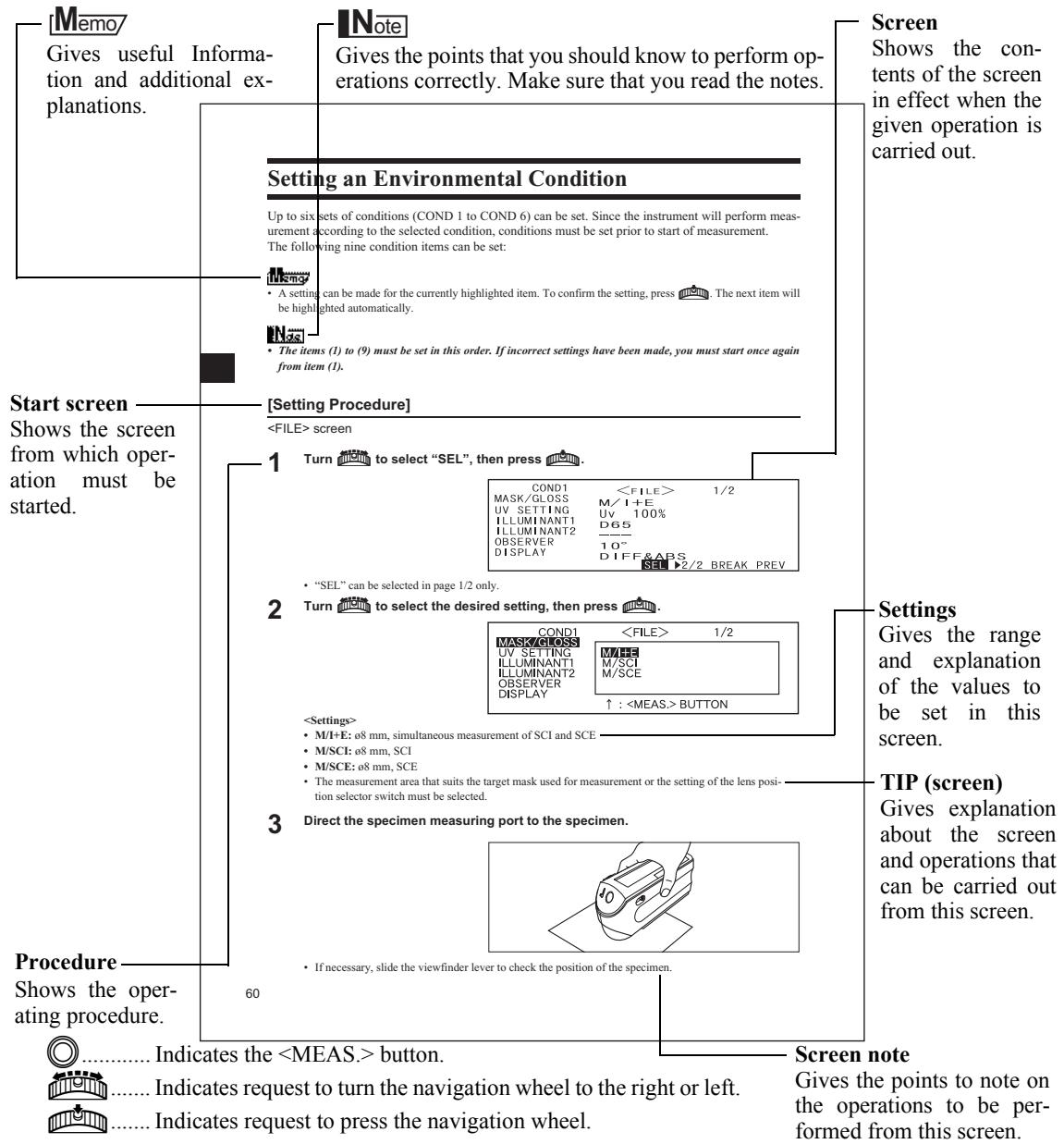
KONICA CM-2600D - - Page layout - 1

For the version of the instrument firmware

The version of the instrument firmware can be confirmed on the screen which is displayed first after switching power on.

Chapter 1

Before Using the Instrument

Standard and optional accessories are available with the instrument.

Standard Accessories

Make sure that all the following items are present.

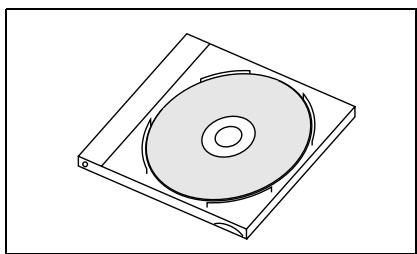
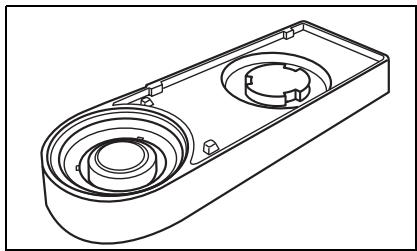
White Calibration Plate CM-A145

Used to perform white calibration.

A data disk containing white calibration data is supplied with this accessory.

Memo

  • This accessory can be used as a table on which to store the CM-2600d/ 2500d.
  • In the case of the CM-2600d, a Target Mask that is not in use can be stored on this accessory.

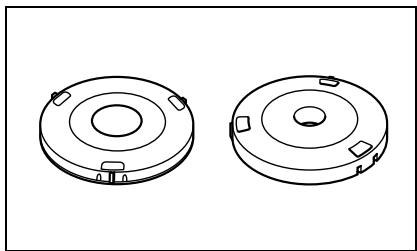
Target Mask

CM-A146 (for 8mm CM-A147 (for 3mm

Used to switch the illumination area (specimen measuring port area) according to the specimen.

Memo

  • CM-A146 (for 8mm ) is already attached to the CM-2600d/2500d when it is supplied.
  • CM-A147 (for 3mm ) can be used for the CM-2600d only, and it is already attached to the White Calibration Plate (CM-A145) when it is supplied.

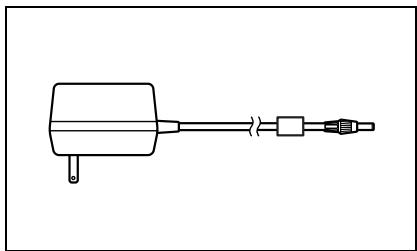
AC Adapter AC-A17

Used to supply power from an AC outlet to the instrument.

Input: Voltage 100 to 240 VAC (50-60 Hz)

Output: Voltage 5 VDC Current 2.8 A (Max.)

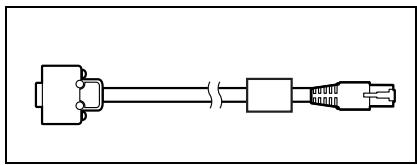
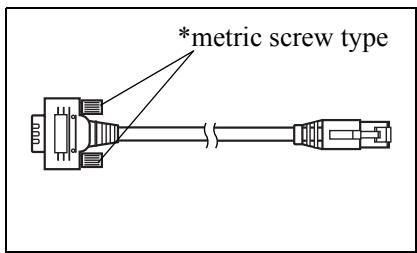
RS-232C Cable IF-A16

(for IBM PC/AT, 9-pin, 2 m)

Used to connect the instrument to a personal computer (PC).

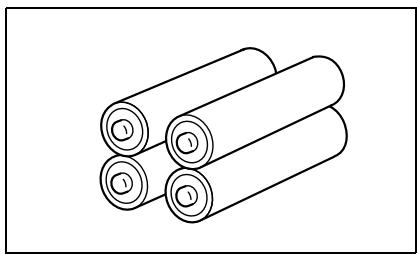
AA-size battery (× 4)
KONICA CM-2600D - AA-size battery (× 4) - 1

KONICA CM-2600D - AA-size battery (× 4) - 2

KONICA CM-2600D - AA-size battery (× 4) - 3

KONICA CM-2600D - AA-size battery (× 4) - 4

KONICA CM-2600D - AA-size battery (× 4) - 5

Zero Calibration Box (CM-A32)

Used to perform zero calibration.

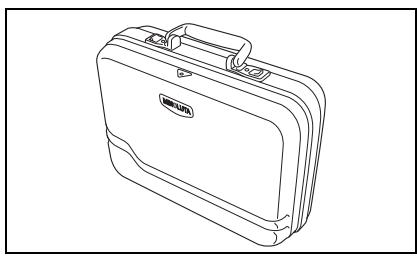
Hard Case (CM-A148)

Can be used for storing the CM-2600d/2500d, the instruction manual and standard accessories, such as the White Calibration Plate and AC adapter.

KONICA CM-2600D - Hard Case (CM-A148) - 1

The Hard Case is designed purely for storing the above items and must not be used for transportation purposes.

Dust Cover Set (CM-A149)

Used when measuring powder or wet surfaces.

It can also be used when woven fabric needs to be laid flat and measured.

KONICA CM-2600D - Dust Cover Set (CM-A149) - 1

The Dust Cover (CM-A152) can be used as a vinyl cover for the replacement.

Color Data Software "SpectraMagic NX" (CM-S100w)

This software supports the two types of the target-mode, "linked to each data." and "defined in COND.", provided by this instrument. It allows you to operate the instrument from your PC, and to process data and manage files.

Printer Cable (CR-A75)

Used to transfer data to a printer. Connect a printer to the external output terminal on the instrument with this cable. The D-sub connector (9-pin) of the cable must be connected to the printer.
KONICA CM-2600D - Printer Cable (CR-A75) - 1

KONICA CM-2600D - Printer Cable (CR-A75) - 2

KONICA CM-2600D - Printer Cable (CR-A75) - 3

KONICA CM-2600D - Printer Cable (CR-A75) - 4

KONICA CM-2600D - Printer Cable (CR-A75) - 5

Names and Functions of Parts

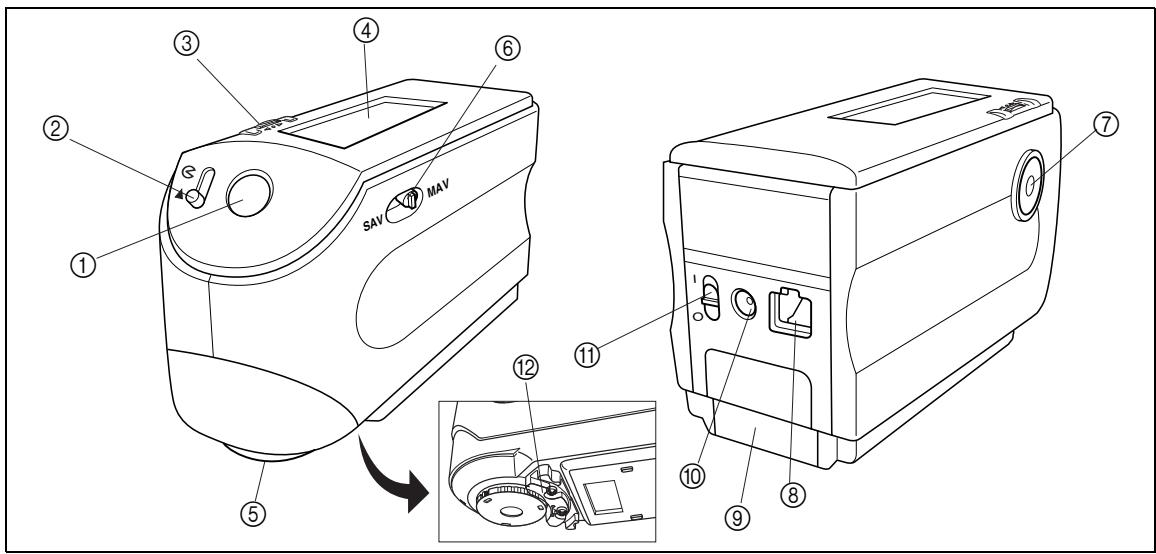
KONICA CM-2600D - Names and Functions of Parts - 1

① Viewfinder

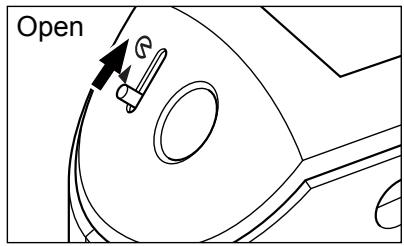
Used to check the position of the specimen. By sliding the lever you can check whether the specimen is set correctly.

② Viewfinder lever

Used to open/close the viewfinder. By sliding the lever in the direction of the arrow, the white LED will light up and illuminate the specimen, so the specimen can be seen through the viewfinder to check that it is set correctly.
KONICA CM-2600D - ② Viewfinder lever - 1

Memo

The specimen cannot be measured if the viewfinder is open and the white LED is lit.

③ Navigation wheel

Use this navigation wheel to select an item or set the selected item.

To select an item, turn it to the right or left until the desired item is shown. To set the selected item, press it.
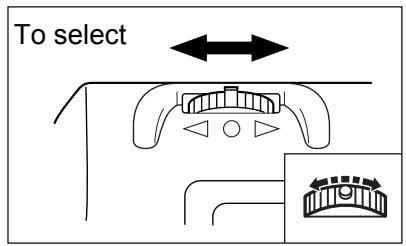
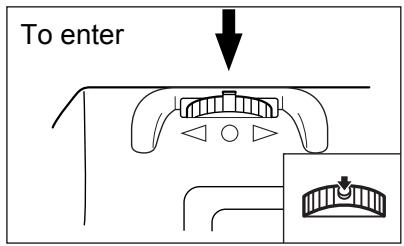
KONICA CM-2600D - ③ Navigation wheel - 1

KONICA CM-2600D - ③ Navigation wheel - 2

Memo No. 10

When selecting an item or setting a value, holding down the jog dial will switch the item or value from one to another continuously.

④ LCD display

Displays the setting items and measured data.

⑤ Specimen measuring port

A port provided to measure the specimen.

With the CM-2600d, a Target Mask must be attached to this port, according to the measurement area selector position.

⑥ Measurement area selector

Used to change the lens position according to the measurement area.

Memo

This switch is not available with the CM-2500d.
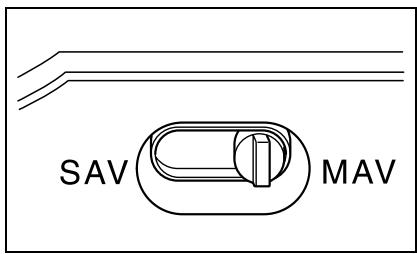
KONICA CM-2600D - ⑤ Specimen measuring port - 1

⑦ Measuring button (MEAS. button)

Press this button to perform calibration or measurement.

Memo No. 10

When setting measurement conditions or tolerances, this button can be used as UNDO button to return to the previous item.

External output terminal

To transfer data to an external device, connect the RS-232C cable (IF-A16) or printer cable (CR-A75) to this terminal.

⑨ Battery cover

A cover for the battery chamber. Four AA-size batteries must be set in the battery chamber in the correct polarity direction.

AC adapter terminal

When using the AC adapter (AC-A17), connect the adapter's plug to this terminal.

⑪ POWER switch

Used to turn ON/OFF power. Setting this switch to “ ” turns the power OFF, and setting it to “ | ” turns the power ON.

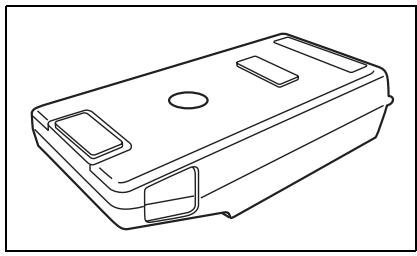
② Measuring Base

Use this base to attach the specimen securely to the instrument when analyzing small specimens.

White Calibration Plate CM-A145
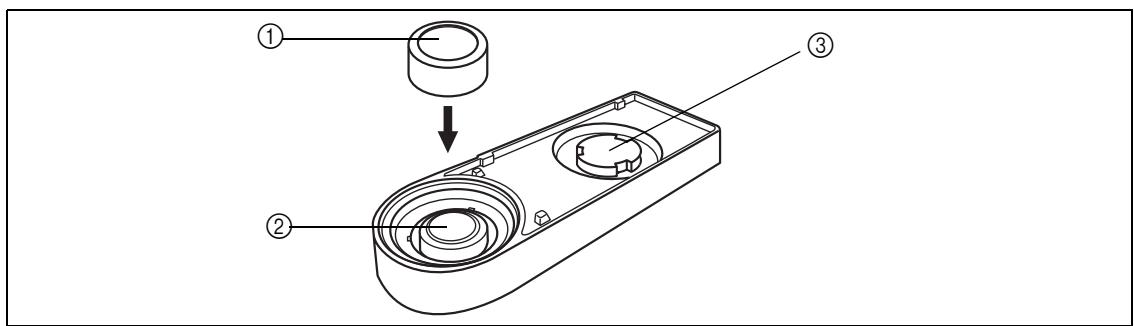
KONICA CM-2600D - White Calibration Plate CM-A145 - 1

(1) Cap

A cap provided to protect the White Calibration Plate.

Note

If you are not going to use the White Calibration Plate, attach the cap to the White Calibration Plate to prevent exposure to ambient light and protect it from scratches and dust.

② White Calibration Plate

Used to perform white calibration of the CM-2600d/2500d.

If you are not going to use it, attach the cap to prevent exposure to ambient light and protect it from scratches and dust.

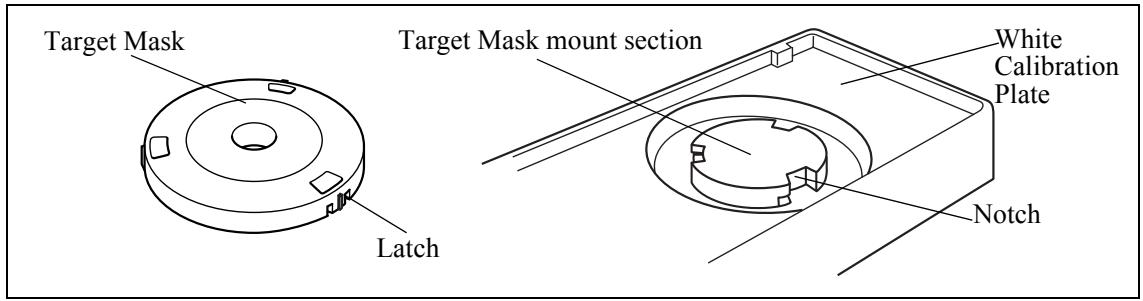
③ Target Mask mount section

Used for storing a Target Mask that is not in use.

Memo No. 10

For attaching/removing a Target Mask, refer to "Attaching/Removing a Target Mask" (page E-14).

Attaching/Removing a Target Mask

With the CM-2600d, a Target Mask conforming to the selected lens position and measurement condition must be used. A Target Mask that is not in use can be attached to the Target Mask mount section of the White Calibration Plate, so that it can be stored together with the instrument.

To attach/remove a Target Mask, follow the procedure given below.

Memo

To facilitate attaching/removing a Target Mask, turn the instrument over so that the specimen measuring port is face up.

Note

  • When attaching/removing a Target Mask, take care not to allow dirt and dust to enter the integrating sphere though the measuring port.
  • Do not exert excessive force on the latch of the Target Mask. Doing so may damage the latch, disabling use of the Target Mask.

Attaching/Removing a Target Mask to/from the Instrument
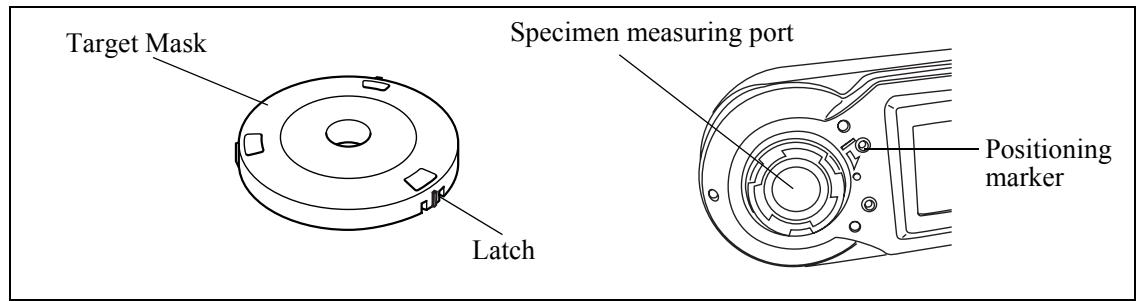
KONICA CM-2600D - Attaching/Removing a Target Mask to/from the Instrument - 1

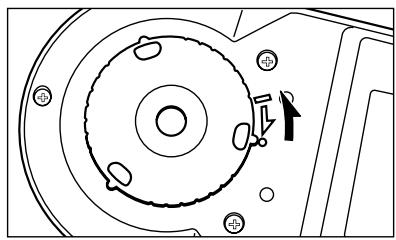
Attaching a Target Mask

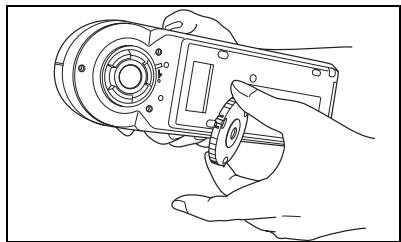
  1. Place the Target Mask on the specimen measuring port so that the marker on the latch is aligned with the “ ” marker on the port.
  2. Hold the outer edge of the mask, and turn it in the direction of the arrow (clockwise) until the marker on the latch is aligned with the "o" marker on the port.

Removing the Target Mask

  1. Hold the outer edge of the mask, and turn it in the opposite direction to the arrow (counter-clockwise) until the marker on the latch is aligned with the " " marker.
  2. Hold the outer edge of the mask and remove it.
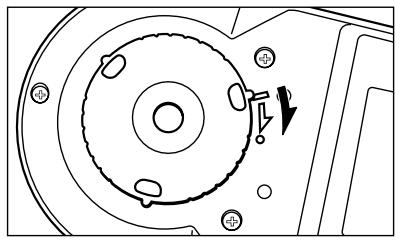
KONICA CM-2600D - Removing the Target Mask - 1

KONICA CM-2600D - Removing the Target Mask - 2

In the case of the CM-2600d, a Target Mask that is not in use can be attached to the Target Mask mount section of the White Calibration Plate, so that it can be stored together with the instrument.

Memo

Even in the case of the CM-2500d, when the Target Mask is removed for cleaning the integrating sphere, it can be attached to the Target Mask mount section of the White Calibration Plate to prevent loss and damage.

Note

  • Do not touch the inner surface of the Target Mask or allow it to get dirty and scratched.
  • Do not exert excessive force on the latch of the Target Mask. Doing so may damage the latch, disabling use of the Target Mask.

KONICA CM-2600D - Note - 1

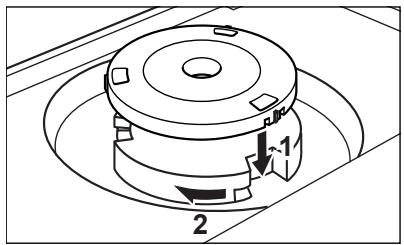
Attaching a Target Mask

  1. Place the Target Mask on the Target Mask mount section so that the inner surface of the latch is aligned with the notch on the White Calibration Plate.
  2. Hold the outer edge of the mask and turn it clockwise to secure it.

KONICA CM-2600D - Attaching a Target Mask - 1

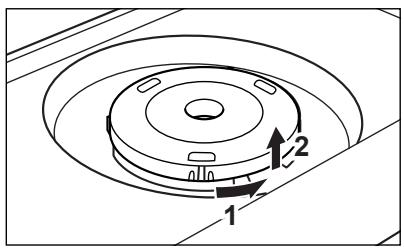
Removing the Target Mask

  1. Hold the outer edge of the mask and turn it counter-clockwise until the inner surface of the latch is aligned with the notch on the White Calibration Plate.
  2. Hold the outer edge of the mask and remove it.
KONICA CM-2600D - Removing the Target Mask - 1

Attaching/Removing the "Measuring Base"

A "Measuring Base" has been included with the Spectrophotometer CM-2600d/2500d.

This allows small specimens to be attached securely to the instrument when they are being measured, and this enables more accurate measurements to be made.

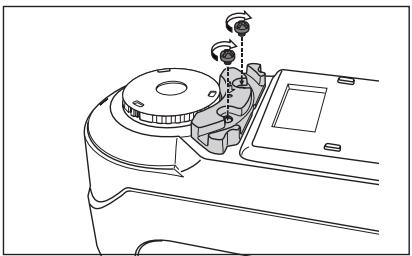
The "Measuring Base" is shown in the illustration to the right, and is attached to the base of the CM-2600d/2500d with two screws.

Note

  • Make sure that the "Measuring Base" is securely attached to the instrument before calibrating the instrument or taking measurements.
  • You must remove the "Measuring Base" before using the optional Zero Calibration Box or Dust Cover Set.
  • When removing the "Measuring Base", make sure that the screws used to attach the base to the instrument are stored properly and are not misplaced.

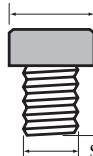
If the screws do become mislaid, replace them with screws that meet the specifications shown to the right.

[Screw name]

Cross-Recessed Pan Head Machine Screw M3, Nominal Length 4-5 mm
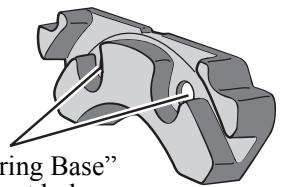
KONICA CM-2600D - Note - 1
Measuring Base

"Measuring Base" attachment hole

Specifications for "Measuring Base" attachment screws Diameter of screw head (head diameter): 5 - 6.5mm
KONICA CM-2600D - Note - 2

Thickness of screw head (head height): less than 3mm

Length of screw body (body length): 4-5 mm

Terms in parenthesis () are JIS defined terms for parts of screws

Attaching/Removing the "Measuring Base" to/from the Instrument

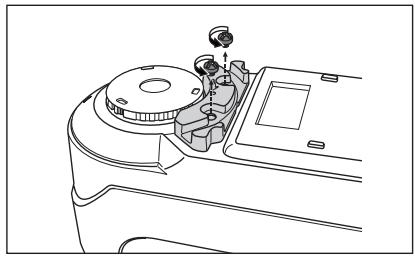
Removing the "Measuring Base"

  1. Place the CM-2600d/2500d so that its base is facing up and it is stable.
  2. Using a crosshead screwdriver, turn the two attachment screws counterclockwise and remove them.

Use a crosshead screwdriver that is a suitable size for the screws.

Attaching the "Measuring Base"

  1. Place the CM-2600d/2500d so that its base is facing up and it is stable.
  2. Place the "Measuring Base" on the base of the CM-2600d/2500d as shown in the illustration.

Place the "Measuring Base" so that it is aligned with the attachment holes in the base of the CM-2600d/2500d. When placing the "Measuring Base" on the base of the CM-2600d/2500d, make sure that nothing is trapped between the instrument and the base.

  1. Using a crosshead screwdriver, turn the two attachment screws clockwise and tighten them securely.

Do not tighten the screws too tightly.
KONICA CM-2600D - Attaching the "Measuring Base" - 1

KONICA CM-2600D - Attaching the "Measuring Base" - 2

Cleaning Each Part

This section explains how to clean the White Calibration Plate, Target Mask and inside of the integrating sphere.

White Calibration Plate

Gently wipe off dirt with a soft dry cloth. If dirt is difficult to remove, dampen a cloth with commercially available lens cleaning liquid and wipe. Then remove the liquid with a cloth dampened with water, and leave it to dry.

Note

Take care not to scratch the White Calibration Plate.

Target Mask

Use a blower to remove dirt and dust from the Target Masks.

Note

Do not touch the inner surface of the Target Masks with your fingers or wipe them with a cloth. If the Target Masks are so dirty that dirt cannot be removed with a blower, contact the nearest KONICA MINOLTA SENSING-authorized service facility.

Inside the Integrating Sphere

Memo

For attaching/removing a Target Mask, refer to "Attaching/Removing a Target Mask" (page E-14).

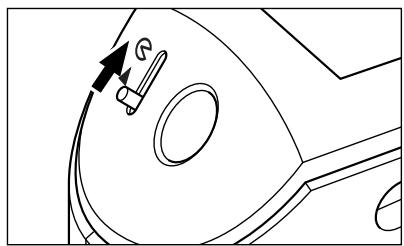
  1. To prevent dust and dirt entering the optics section from the integrating sphere, slide the viewfinder lever to open the viewfinder.
KONICA CM-2600D - Memo - 1

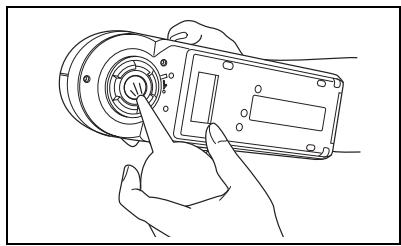
  1. Remove the Target Mask.

KONICA CM-2600D - Memo - 2

  1. Use a blower to remove dirt and dust from the integrating sphere.
KONICA CM-2600D - Memo - 3

Note

Do not touch the white-coated inner surface of the integrating sphere, wipe it with a cloth or put any object inside it. If the surface is so dirty that dirt cannot be removed with a blower, contact the nearest KONICA MINOLTA SENSING-authorized service facility.

Inserting the Batteries

To supply power to the instrument, the AC adapter (AC-A17) or four AA-size batteries (Alkaline or NiMH battery is recommended for better service life) must be used. Use either the AC adapter or batteries, according to which suits your application.

Note

  • If you are not going to use the instrument for more than two weeks, make sure that the batteries are removed. If the batteries are left in the instrument for long periods of time, battery electrolyte may leak and damage the instrument.
  • Do not use batteries of different types or mix new batteries with old ones. Doing so may result in battery explosion or reduction of battery life.
  • Do not touch or short-circuit the terminals inside the battery chamber. Doing so may result in breakdown of the instrument.

[Operating Procedure]

1 Make sure that power is OFF (i.e. the POWER switch is set to "O").

KONICA CM-2600D - [Operating Procedure] - 1

2 Slide the battery cover on the rear of the instrument to open it.

KONICA CM-2600D - [Operating Procedure] - 2

3 Place four AA-size batteries in the battery chamber. Make sure that the batteries are placed in the correct direction.

KONICA CM-2600D - [Operating Procedure] - 3

4 Align the marker on the battery cover with that on the instrument, and slide the battery cover to close it.

KONICA CM-2600D - [Operating Procedure] - 4

Connecting the AC Adapter

Memo

Use of the AC adapter (AC-A17) rather than batteries is recommended, since more power will be required when the external output terminal is used to output data to an external device or print it.

Note

  • To supply AC power to the instrument, always use the AC adapter (AC-A17) supplied with the instrument.(Rated: 5 V, 2.8 A)
  • Before connecting or removing the AC adapter, make sure that power is turned OFF.

[Operating Procedure]

1 Make sure that power is OFF (i.e. the power switch is set to "O").

KONICA CM-2600D - [Operating Procedure] - 1

2 Connect the AC adapter's connector plug to the AC adapter terminal on the rear of the instrument.

KONICA CM-2600D - [Operating Procedure] - 2

3 Insert the AC adapter's power plug to an AC outlet (100-240 VAC, 50-60 Hz).

KONICA CM-2600D - [Operating Procedure] - 3

KONICA CM-2600D - [Operating Procedure] - 4

When turning the power ON for the first time, the display language and measurement mode must be set.

For details, refer to page E-27.

[Operating Procedure]

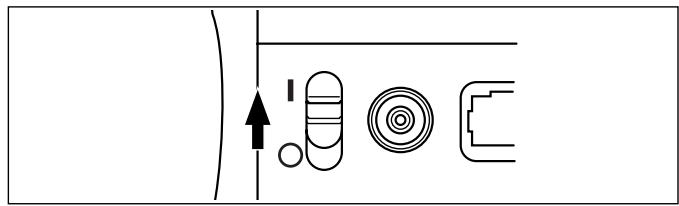
1 Set the POWER switch to "I".

The power will be turned ON.
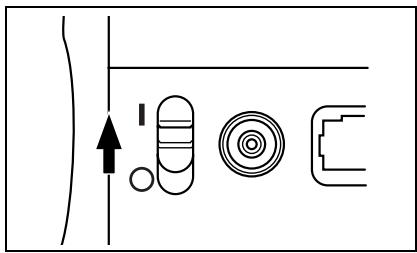
KONICA CM-2600D - Set the POWER switch to "I". - 1

Turning Power OFF

[Operating Procedure]

1 Set the POWER switch to “○”.

The power will be turned OFF.
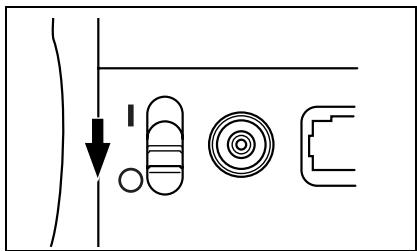
KONICA CM-2600D - Set the POWER switch to “○”. - 1

Auto Power Save Function

Power save mode will be activated if the MEAS. button and navigation wheel are not operated for more than three minutes. During power save mode, the flash circuit will not be charged. To cancel power save mode, press the MEAS. button to start measurement.

KONICA CM-2600D - Auto Power Save Function - 1

  • If the MEAS. button is pressed to cancel power save mode, start of measurement will be delayed by a few seconds, so keep the instrument still until the lamp flashes and measurement is taken.
  • The auto power save function is not available in remote mode (see page E-89).

System Configuration
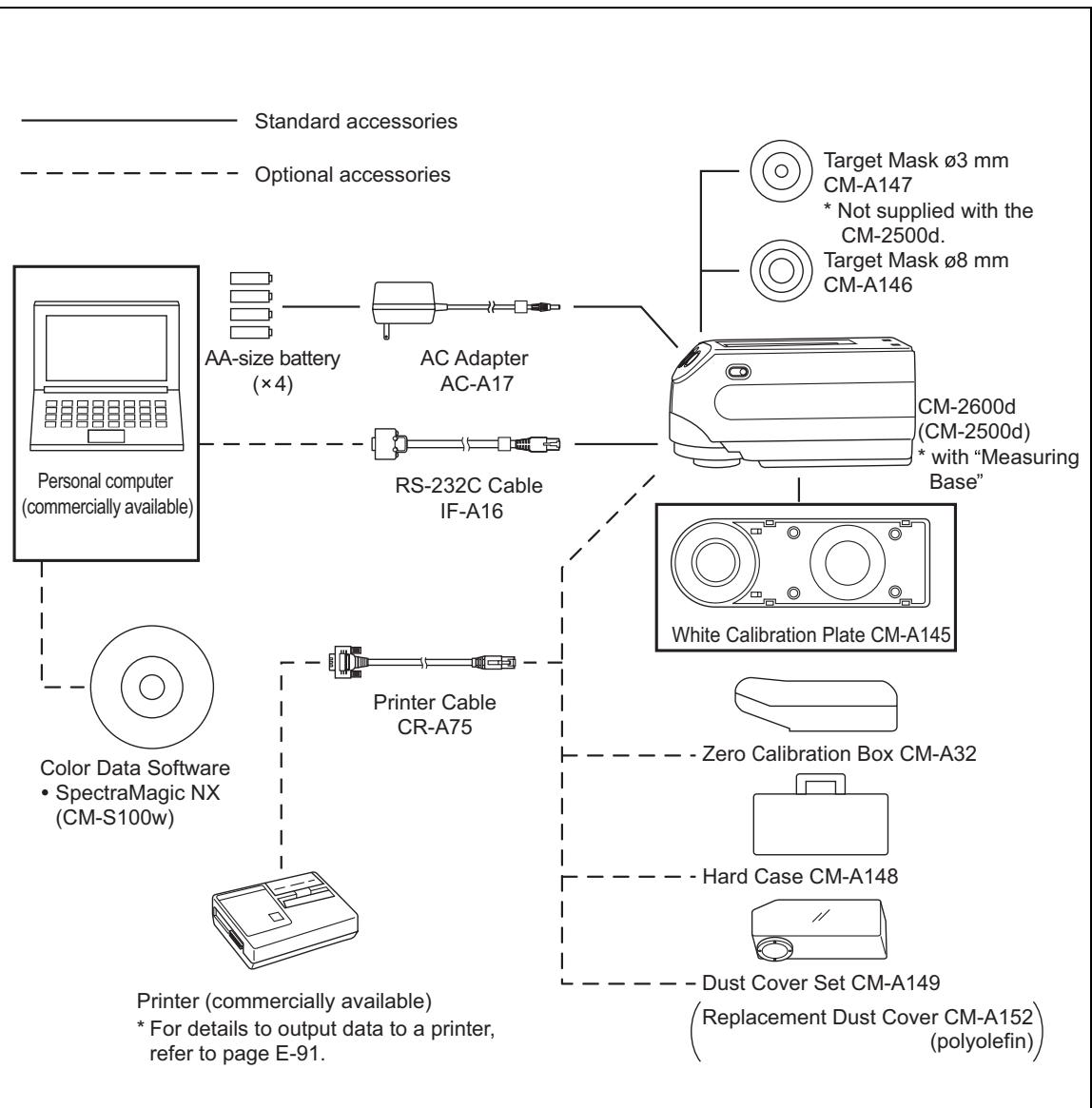
KONICA CM-2600D - System Configuration - 1

Language Mode

Contents on the LCD screen can be displayed in English, Japanese, German, French, Spanish or Italian. In this manual, explanation of operating methods and display is given for English mode.

Measurement Mode

Two measurement modes (COND and TASK) are available with this instrument, and can be switched from one to another.

Application
COND modeNormal measurement mode. Measurement can be performed while the conditions are changed. In this mode, up to six sets of conditions (illuminant, observer angle, color space etc.) can be registered.
TASK modeSpecial measurement mode. For continuous inspection, this mode allows you to perform measurement while messages indicating the measurement procedure are displayed on the LCD. The messages can be created by use of the previously used software SpectraMagic (Ver.3.2 or higher; except for Ver.3.5) with your PC. In this mode, color differences can be calculated one by one against up to 10 color difference target data. ■Note ·Before starting measurement, tasks (measurement procedure) must be down-loaded from the PC using SpectraMagic (Ver.3.2 or higher; except for Ver.3.5). TASK mode cannot be selected if no tasks have been downloaded. ·During TASK mode, only the data measured last is displayed. Use of SpectraMagic (Ver.3.2 or higher; except for Ver.3.5) allow you to access to previous data in the memory.

Up to six sets of conditions can be registered either in COND or TASK mode.
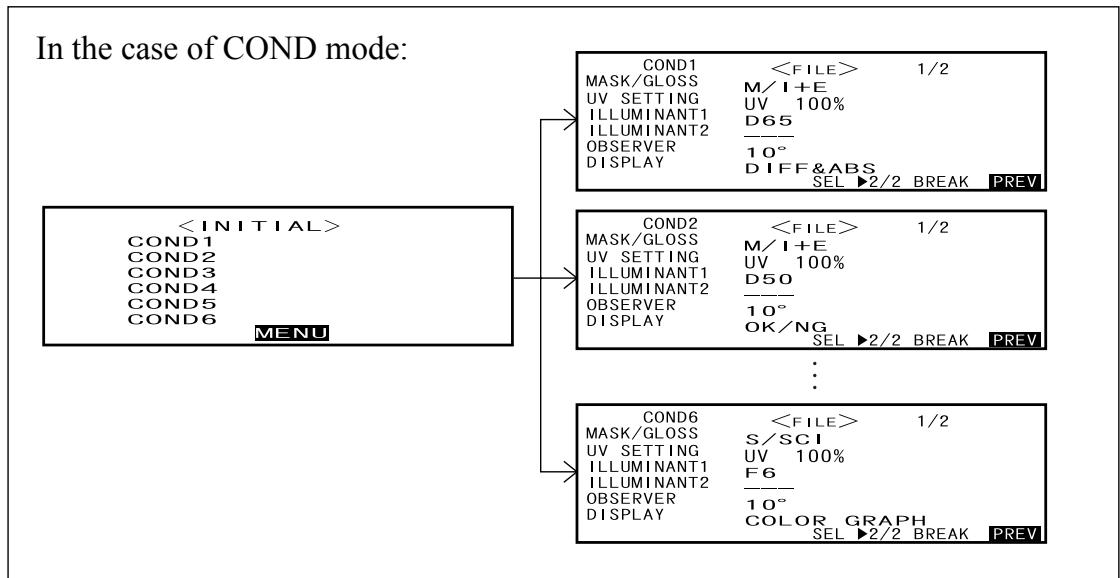
KONICA CM-2600D - Measurement Mode - 1

Target Modes

  • The CM-2600d/2500d supports two Target Modes, "defined in COND." mode and "linked to each data." mode, to analyze both measurement data and color difference. As with Language Mode and Measurement Mode, you can select the desired mode when you turn the power ON.
  • The default setting is "linked to each data." mode. To switch to "defined in COND." mode or switch between the target modes, you need to follow the procedure to select target mode.
  • Depending on the target mode selected, the display and the procedure for some operation for the instrument are different.

Below are some examples of these differences. (For details, see Target Mode in the Appendix.)

  • In "linked to each data." mode, the next color difference data number is displayed next to the currently selected color difference data number in the initial settings screen.

When "defined in COND." mode is selected, it is not displayed.

  • In "linked with each data" mode, to display the color difference for measurement data, you can only select the color difference for the currently selected measurement data. When "defined in COND." mode is selected, you can freely select the color difference data number after making measurements. You can also display the results of the selection.
  • Data storage capacity for the "linked to each data." mode is 1700 pieces, and that for the "defined in COND." mode is 700 pieces.

Note

Once the target mode is changed, previous data will be cleared. It is recommended that you save previous data into other storage media in advance by using the Color Data Software that is optionally available.

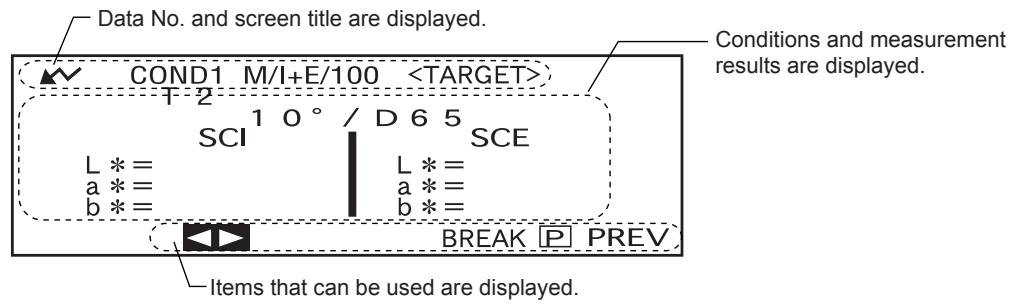
Screen Display

The basic screen structure is shown below.
KONICA CM-2600D - Screen Display - 1

Battery Alarm

When using CM-2600d/2500d with batteries, battery alarm indication appears when their power level lowers.

[Half battery indication]

If this indication (Half battery indication) appears, new batteries should be prepared for replacement in near future. Even with this indication displayed, measurements are still possible.

[Empty battery indication]

If this indication (Empty battery indication) appears, measurement or calibration is no longer possible. Replace batteries with new ones.

Data Saving

Data used with this instrument is saved automatically. Although white calibration data is retained in internal memory even after power is turned off, it is still necessary to repeat white calibration each time you switch the power back on.

Chapter 2

Preparation for Measurement
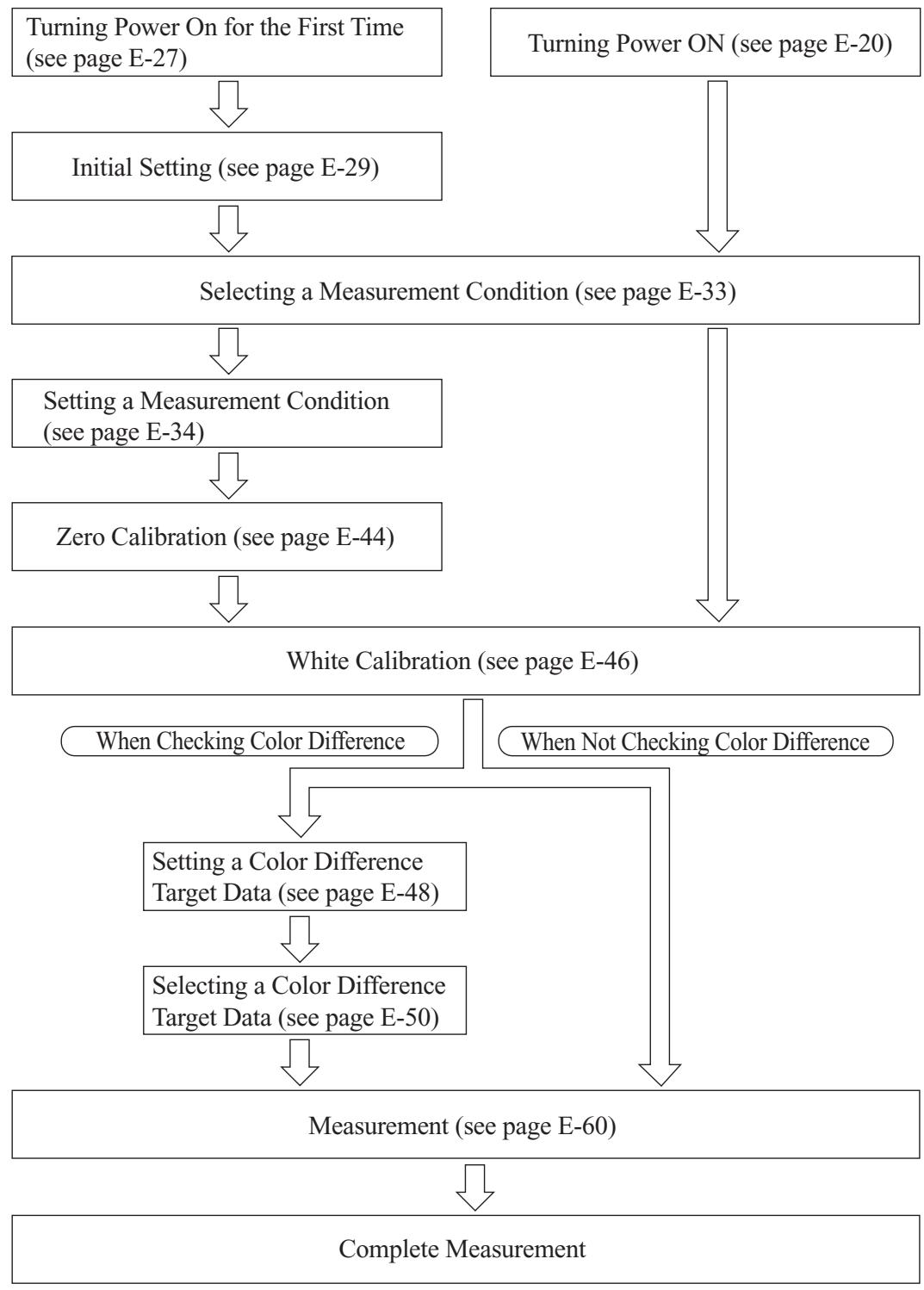
KONICA CM-2600D - Preparation for Measurement - 1
For the first time
For the second and subsequent times

Turning Power On for the First Time

When turning the power ON for the first time, the display language and measurement mode must be set.

Setting the Language Mode and Measurement Mode

Set the language and measurement mode as follows:

[Setting Procedure]

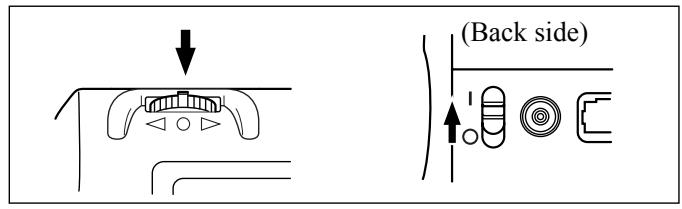
1 While pressing, turn the power ON.

The screen will appear, with the item "LANGUAGE" highlighted.
KONICA CM-2600D - While pressing, turn the power ON. - 1

KONICA CM-2600D - While pressing, turn the power ON. - 2

2 Turn to select the desired language, then press

KONICA CM-2600D - Turn to select the desired language, then press - 1

  • When the cursor moves to the desired language, all the text will be displayed in the selected language.

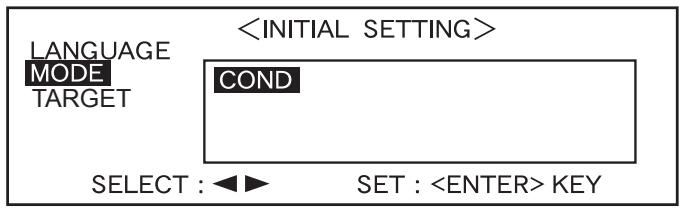
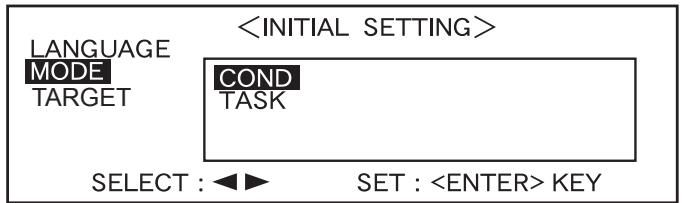
3 Turn to select the desired measurement mode, then press

KONICA CM-2600D - Turn to select the desired measurement mode, then press - 1

  • If no tasks have been downloaded to the instrument, only "COND" will be displayed.

KONICA CM-2600D - Turn to select the desired measurement mode, then press - 2

  • If a task(s) has been downloaded to the instrument, both "COND" and "TASK" will be displayed.
  • Select "COND".

Selecting the Target Mode

The default setting is "linked to each data." mode. The following procedure is required only if you want to switch the target mode.

Note

  • If the Color Data Software "SpectraMagic CM-S9w" is used, switch the target mode to "defined in COND." mode.
  • Once the target mode is changed, previous data will be cleared. It is recommended that you save previous data into other storage media in advance by using the Color Data Software that is optionally available.

[Setting Procedure]

1 Turn to select the desired target mode, then press

Memo

If you do not want to change the target mode, press

KONICA CM-2600D - Memo - 1

  • The default setting is "linked to each data".

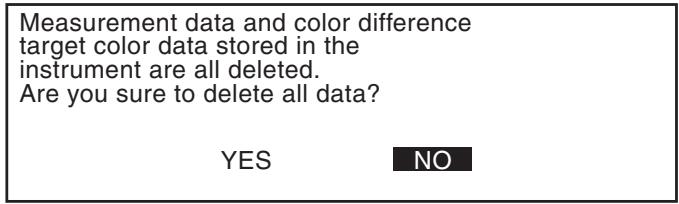
A warning message is displayed.

KONICA CM-2600D - Memo - 2

2 Turn to select "Yes", then press

The screen will appear.

KONICA CM-2600D - Turn to select "Yes", then press - 1

Memo

If you select "No" and press OK, you will return to the screen shown in 1.

Initial Setting

The following five initial setting items are available.

(1) REMOTE.. Connects the instrument to the PC to enable bi-directional communications.
(2) AUTO PRINT............ If the instrument is connected to a printer, measured data will be printed automatically each time measurement is taken.
(3) CLOCK.... Adjusts the instrument's built-in clock.
(4) DISPLAY INVERT.... Reverses the display direction.
(5) LCD CONTRAST.... Adjusts the LED's contrast.

Memo

(1) REMOTE" and " (2) AUTO PRINT" can be used when connecting the instrument to a PC or printer.

The settings will be kept even if the power is turned OFF.

To make initial settings, follow the procedure given below:

[Setting Procedure]

1 Turn the power ON.

KONICA CM-2600D - Turn the power ON. - 1

2 Turn to select "MENU", then press

KONICA CM-2600D - Turn to select "MENU", then press - 1

The

screen will appear. The initial settings can be made in this screen.

KONICA CM-2600D - Turn to select "MENU", then press - 2

[Setting Procedure]

screen 1 Turn to select "CLOCK", then press ![](images/3d944bfb9787c758f65414152fc9a6e4b550d1a2d9f40c7d809d153cc03a64d0.jpg) 2 Turn to select "ADJUST", then press The cursor will move to the currently set date, allowing you to change it. ![](images/336042be5187af6131b8e345cadf05c60481f2661e9769fd621fc1e702898bdf.jpg) 3 Turn to select the desired date and time, then press The selected date and time will be set. ![](images/682728f1be8363e743cddf964122785b3482d0ed80229312cdcf1811bfbe048e.jpg) Each time is pressed, the cursor will move as follows: “day” “month” “year” “hour” “minute” “second” “PREV” - Keeping held down to left or right will cause the date/time to change continuously. - To change the entries, restart from step 2.

- Day: 01 to 28, 29, 30, 31 (varies with the selected month) - Month: 01 to 12 - Year: 00 to 99 (lower two digits) - Hour: 00 to 23 - Minute: 00 to 59 Second: 00 to 59 4 Turn to select "PREV", then press The settings you made at step 3 will be confirmed, and the screen will reappear. ![](images/bc6c0162b2f9184e72f2c2aaa10a4b7d69286b4309ded4a5b6cb09a567a6d21e.jpg)

[Setting Procedure]

screen 1 Turn to select "DISPLAY INVERT", then press ![](images/70c4c836d38148d2fcbc00f3cf656f96e1e078b1eb398f5cbea1d1d0effaf46a.jpg) The contents displayed on the LCD will be reversed each time is pressed. A3d ![](images/a5d16d8f40583a2b15cd4747e587a2376623c316bfb0d001cca7eca59756980a.jpg)

[Setting Procedure]

screen 1 Turn to select "LCD CONTRAST", then press ![](images/07a6c8a2c22554c7669646f06722e5a6b662b127e365c303f912e351ecc2ba23.jpg) 2 Turn to adjust the LCD contrast, then press The contrast you set will be confirmed, and the screen will reappear. ![](images/4e45724d7dccee6816dee4d686e7cf3731b25a13a162ab46d40831258ce2d06f.jpg) - Turning to the right will move the contrast adjuster bar to the right, increasing the contrast. - turning to the left will move the contrast adjuster bar to the left, decreasing the contrast. - Keeping held down to left or right will cause the contrast adjuster bar to move continuously.

Note

On the LCD of this instrument, the display looks darker in a high temperature environment, and looks paler in a low temperature environment. When this occurs, adjust the display level so that the display shows its contents properly. If the contrast is too high or too low, the contents displayed on the LCD cannot be viewed properly. In this case, turn the power OFF, and then turn it ON again while pressing . The default contrast will be stored and the screen shown in "Setting the Language and Measurement Mode" (page E-27) will appear. Adjust the LCD contrast again as explained in "Initial Setting" (from page E-29) if necessary.

Selecting a Measurement Condition

Before starting measurement, the desired measurement condition (COND1 to COND6) must be selected.

Memo No. 10

- Up to six sets of measurement conditions (COND1 to COND6) can be set. - Measurement conditions must be set before start of measurement. For details, refer to page E-34.

[Setting Procedure]

screen

1 Turn to select one of the conditions (COND1 to COND6), then press

![](images/5dcbad230ea7242e5466345f8abdd7389bb02497a8feb8c65cd04b3cc963d797.jpg)

2 Turn to select "FILE", then press

![](images/48bcbbfa9ed68eeb3519417beeb86185a625181624272070dbc99561c7d5788e.jpg) - "T*" is the number of the color difference target data for the next measurement. If nothing is selected, "T---" appears. - "T*" does not appear if "defined in COND." mode is selected. The currently selected measurement condition will be displayed. ![](images/08243e4f88108c10afd2bef2e9e2b6606c7730c997ccfbccc0e866ef981fd586.jpg) - The FILE screen consists of two pages (1/2 and 2/2). - The pages can be switched from one to another by turning to select “ 2/2 ” (or “ 1/2 ”) and then pressing.

Memo

- To set a new condition or change an existing condition, refer to "Setting a Measurement Condition" on the following page. - If an measurement condition has been set, calibration and measurement can be performed under that condition.

Setting a Measurement Condition

Up to six sets of conditions (COND1 to COND6) can be set. Since the instrument will perform measurement according to the selected condition, conditions must be set before start of measurement. The following nine condition items can be set: (1) Measurement area and specular component "MASK/GLOSS" (2) UV setting (UV SETTING) (3) Illuminant 1, illuminant 2 "ILLUMINANT 1, ILLUMINANT 2" (4) Observer "OBSERVER" (5) Display contents "DISPLAY" (6) Color space "COLOR SPACE" (7) Measurement times and standard deviation for manual averaging "MANUAL AVG. TIMES" and "DEVIATION" (8) Auto averaging times "AUTO AVG." (9) Delay time "DELAY TIME"

Memo

- A setting can be made for the currently highlighted item. To confirm the setting, press The next item will be highlighted automatically. - For the items for which no setting needs to be made, press to skip them. - If an incorrect setting has been made for items (1) to (9), press the MEAS. button. This will take you to the previous items and allow you to make a correct setting.

[Setting Procedure]

screen

1 Turn to select "SEL", then press

![](images/68c390d7ccba9953ea8f747917200926fdac86c0b88b2185c1438faaf5daf6a4.jpg) For CM-2600d "MASK/GLOSS" will be highlighted. ![](images/ad9e8b2554feb43816cfbb72841bd3a6c6cd004dfc309da5aed2f16b7dbf6203.jpg) ![](images/98322fd31e71f8e1941e218990a0738a1dc6d4a7d036c66491231bef68c263e1.jpg) For CM-2500d

Setting the Measurement Area and Specular Component Mode

2 Turn to select the desired setting, then press

![](images/1f8b7003a3c6b51ae2ff130c375adaa0ec7a32f8662a83ecc3d95f0f3854c133.jpg)

- M / I + E : Measurement area: 0.8mm , simultaneous measurement of SCI (Specular Component Included) and SCE (Specular Component Excluded) - M/SCI: Measurement area: 0.8 ~mm , SCI (Specular Component Included) - M/SCE: Measurement area: 0.8 ~mm , SCE (Specular Component Excluded) - S/I+E: Measurement area: 3 mm ,simultaneous measurement of SCI (Specular Component Included) and SCE (Specular Component Excluded) - S/SCI: Measurement area: 0.3mm , SCI (Specular Component Included) S/SCE: Measurement area:03 mm, SCE (Specular Component Excluded) - The measurement area that suits the Target Mask used for measurement or the setting of the lens position selector switch must be selected. - With the CM-2500d, only "M/****" can be selected. If the mask type has been changed from "M/****" to "S/****" or vice versa, a message will appear when is pressed, inform you that the mask (measurement area) has been changed. The next item will then appear automatically. DIFFERENT CONDITION SELECTED. PLEASE CHECK TARGET MASK AND POSITIONING OF LENS.

Setting the UV

3 Turn to select "UV SETTING", then press

For CM-2600d ![](images/ce0ab71a779663243bc50b4a45fdf84e0056ba8b516b99dfde23eda3e679cefb.jpg)

- UV100%: Measurement is performed with an illumination that contains all UV components of Xe flash light source. - UV0%: Measurement is performed with an illumination that contains no UV components of Xe flash light source. - UVADJUSTED: This item can be selected only if UV coefficients have been downloaded from SpectraMagic (Ver.3.2 or higher; excluded Ver.3.5). For CM-2500d ![](images/7911acdf0a361915be7c263d1adef967a59bad1718351b58c0e7c2279bc0aa52.jpg) - Only "UV100%" can be selected.

Selecting Illuminant 1

4 Turn to select the desired illuminant, then press

![](images/9acebb17f0236a27b101cac911cf3173bad2cc5a380588d1eba3897181eee8f7.jpg)

D65: Standard illuminant D65; daylight, Color temperature: 6504K D50: Complementary illuminant D50; daylight, Color temperature: 5003K - C: Complementary illuminant C; daylight (Ultraviolet part is small in comparison with the daylight), Color temperature: 6774K A: Standard illuminant A; Incandescent lamp, Color temperature: 2856K F2: Cool white (fluorescent lamp) F6: Cool white (fluorescent lamp) - F7: Color rendering A daylight white (fluorescent lamp) F8: Color rendering AAA natural white (fluorescent lamp) F10: 3-band type natural white (fluorescent lamp) F11: 3-band type cool white (fluorescent lamp) F12: 3-band type warm white (fluorescent lamp) - ---: None (Not selectable "ILLUMINANT 1") 5 As explained in "Selecting Illuminant 1", select the desired illuminant, then press ![](images/594ad31cf3ac374c521b239e541dc5d6f5d5db9ca1dfa6086f8b884d72209b6d.jpg) - Same as those given in "Selecting Illuminant 1" - To display MI (metamerism index), an illuminant must be selected for ILLUMINANT 2.

Selecting the Observer

6 Turn to select the desired observer angle, then press ![](images/7a91b78c4bc9e3aa59350509f477600e241fb7898df543f85fa98eac591e6f83.jpg) 10^ : 10^ observer (CIE1964) 2^ : 2^ observer (CIE1931)

Selecting the Display Mode

7 Turn to select the desired display mode, then press

![](images/f475a59822d6e95f3164c5e7212b199f226dc52906858d16d3ad4a4e8493a453.jpg)

DIFF&ABS:

Displays the absolute value and the color difference in relation to the target color. (Only absolute value or only color difference can be displayed.) If pass/fail judgment is made according to the specified box color difference tolerances, the failed factor of the measured data will be highlighted.

PASS/FAIL:

Whether color difference from the target colors is within the specified color difference limit is judged. "PASS" will be displayed if the color difference is within the specified limit for all items of the measured data, and "FAIL" will be displayed if not within the specified limit for any factor of the measured data.

COLOR GRAPH:

Displays the color difference from the target value in a graph. (Only for illuminant 1, box tolerance and L^*a^*b^* )

SPECT. GRAPH:

Displays a spectral reflectance graph.

ASSESSMENTS

The color difference from the target color, pass/fail judgment result made based on the specified tolerances and direction of deviation from the target color for each axis in the L^*a^*b^* or L^*C^*h color space are displayed. - If no color target has been selected, the color difference, pass/fail judgment result and tint deviation direction will not be displayed even if "ASSESSMENTS" is selected. Furthermore, if no tolerances are selected, the pass/fail judgment result and deviation direction will not be displayed even if the target color is selected. - Even if "DIFF&ABS" or "COLOR GRAPH" is selected, no color difference values will be displayed if no color difference target data have been selected.

8 Turn to select the desired color space, then press

![](images/038f8c12a89614dd91e4101b899e42bad31133ce61776ab6c187121d048f8c8a.jpg) Locating the highlighted cursor to by turning will display the next page of the color space list. ![](images/e83c6a72a1842489ad0df0cfe48486f721a13477d9a769d18ceaf7dd478584f6.jpg) Locating the highlighted cursor to by turning will display the previous page of the color space list. ![](images/d2a85d427b61ef7c7f618948bdba553b3fe32ced4c479b4a780b4837a01175b3.jpg)

- L^*a^*b^*, E^* : L^*a^*b^* color space and color difference by “ E^*ab (CIE1976)” color-difference formula - L^*C^*h,^* : E^* : L\*C\*h color space and color difference by “ E\*ab (CIE1976)” color-difference formula - L*C*h, CMC1:1: L*C*h color space and color difference by "CMC1:1" color-difference formula - L*C*h, CMC2:1: L*C*h color space and color difference by "CMC2:1" color-difference formula XYZ:XYZ color space - L^*C^*h , CIE94: L^*C^*h color space and color difference by “ E^*94 (CIE1994)” color-difference formula - Hunter Lab: Hunter Lab - Yxy: Yxz color space MUNSELL: Munsell color notation WI ASTM E313: Whiteness (ASTM E313-73) WI CIE: Whiteness Index - YI ASTM E313: Yellowness Index (ASTM E313-73) - YI ASTM D1925: Yellowness Index (ASTM D1925) - B ISO 2470: ISO Brightness - DENSITY (A): Density (status A) - DENSITY (T): Density (status T) - Wl, Tint Ganz: Whiteness Index and Tint value (Ganz & Griesser) - Wl, Tint CIE: Whiteness Index and Tint value (CIE) L^*a^*b^* , CIE00: L^*a^*b^* color space and color difference by E^00 (CIE2000)" color-difference formula - L*C*h, CIE00: L*C*h color space and color difference by “ E*00 (CIE2000)” color-difference formula - If L^*a^*b^* or L^*C^*h is selected as the color space, DIFF&ABS or PASS/FAIL as the display mode and ILLUMINANT 1 or ILLUMINAT 2 as the illuminant, it will be possible to calculate MI (metamerism index) and display the result. - Even if "WI, Tint Ganz" is selected, no data for WI and Tint (Ganz/Griesser) will be displayed when using SpectraMagic NX or the previously used software SpectraMagic Ver.3.2 or higher (except for Ver. 3.5), unless the proper Ganz coefficient has been specified and UV ADJUSTED is selected in the UV SETTING in the Measurement Condition Setting. In addition, if the Ganz coefficient is re-specified after measurement, the measurement data will be replaced with the one that is calculated based on that Ganz coefficient. - The coefficient for CIE00 (kl:kc:kh) is (1:1:1). This can be changed using SpectraMagic NX (except for Ver. 1.50 or earlier). If the coefficient (kl:kc:kh) is re-specified after measurement, the measurement data will be replaced with data calculated based on the new coefficient.

Setting the Number of Measurements for Manual Averaging

Manual averaging settings can be made as follows: For details, refer to "Manual Averaging" (page E-76).

9 Turn to select the number of measurements to be performed, then press

![](images/997ce1b3c22167b38d91d87ac9be80356f459fece03b25be7d753167cc1d5cea.jpg)

TIMES: Specify the number of measurements to be performed (2 to 30). If “- -” is selected, manual averaging will not be performed. - Keeping held down to left or right will cause the value to change continuously.

Setting the Standard Deviation for Manual Averaging

10 Turn to set the desired standard deviation, then press

![](images/bae1d0b1862b79941a9ae289fefd9a5c34309fc956c4fe09476676dae3b2ff94.jpg)

- DEVIATION: Set the desired standard deviation (0.01 to 2.00). When the standard deviation is below the specified value, the average of the measured values taken so far will be calculated and used as the measurement result. If “- -” is selected, manual averaging by the standard deviation will not be performed. - If “- - ” has been set for TIMES, “- - - - ” will also be set for DEVIATION and cannot be changed. - If the spectral graph has been selected as the display mode, “- - - - ” will be set for DEVIATION and can not be changed. - The standard deviation can be set only if L^*a^*b^* or L^*C^*h has been set as the color space. - The standard deviation cannot be set if "SPECT. GRAPH" has been selected as the display mode. - Manual averaging will end when either the specified number of measurements (TIMES) or the specified standard deviation (DEVIATION) is reached. - Keeping held down to left or right will cause the value to change continuously.

Setting the Number of Measurements for Auto Averaging

11 Turn to select the number of measurements to be performed, then press

![](images/b921d8016beaff34c2627bb2c67c02b3fc682d4eccaba1b948744c2234a2b1b5.jpg)

- Specify the number of measurements to be performed (1, 3, 5 or 8).

12 Turn to set the desired delay time, then press

COND1<FILE>2/2
COLOR SPACEL*a*b*, ∠E*
MANUAL AVG.
TIMES3
DEVIATIONSCI 0.20 SCE ----
AUTO AVG.3
DELAY TIME0.0s
↑: <MEAS.> BUTTON

- DELAY TIME:

The delay time is used to prevent influences caused by movement of the hands, and is the duration from when the MEAS. button is pressed until the lamp flashes and measurement is performed. Specify the desired delay time (0.1 to 3.0 seconds in steps of 0.1 seconds). If "0.0" (second) is specified, no delay time will be provided. - Keeping held down to left or right will cause the value to change continuously. "BREAK" will be highlighted.
COND1<FILE>2/2
COLOR SPACEL*a*b*c,∠E*
MANUAL AVG.
TIMES3
DEVIATIONSCI O.2OSCE----
AUTO AVG.3
DELAY TIMEO.Os
SEL ▷1/2BREAK PREV

13

Turn to select "PREV", then press

COND1<FILE>2/2
COLOR SPACEL*a*b*c, △E*
MANUAL AVG.
TIMES3
DEVIATIONSCI 0.20SCE----
AUTO AVG.3
DELAY TIMEO.Os
SEL ▲1/2BREAK PREV
Setting will be completed and the screen will appear.
<COND1>CALIBRATIONTARGET T*FILEDATA DELETEBREAK PREV
- "T*" is the number of the color difference target data for the next measurement. If nothing is selected, "T---" appears.
<COND1>CALIBRATIONTARGETFILEDATA DELETEBREAK PREV
- "T*" does not appear if "defined in COND." mode is selected.

Memo

Selecting "CALIBRATION" by turning and pressing will display the screen. So, perform the desired calibration according to step 3 and subsequent steps given in "Zero Calibration" (from page E-44) or "White Calibration" (from page E-46).

Note

Depending on the target mode selected, some of the options displayed will be different.

Turn to select "BREAK", then press
COND1<FILE>2/2
COLOR SPACEL*a*b*c,∠E*
MANUAL AVG.
TIMES3
DEVIATIONSCI 0.20SCE----
AUTO AVG.3
DELAY TIMEO.Os
SEL ▲1/2BREAK PREV
The screen will appear.
COND1 M/I+E/100 NO DATA T2
SCI 10° / D 6 5 SCE
L* =∠L* =L* = ∠L* =
a* =△a* =a* = ∠a* =
b* =△b* =b* = ∠b* =
△E* =△E* =
DISP ☐ P PREV

Turn to select "PREV", then press Measurement condition setting will be complete, and the screen will reappear.
COND1<FILE>2/2
COLOR SPACEL*a*b*,ΔE*
MANUAL AVG.
TIMES3
DEVIATIONSCI O.20SCE----
AUTO AVG.3
DELAY TIMEO.Os
SEL ▷1/2BREAK PREV
<COND1>
CALIBRATION
TARGET T*
FILE
DATA DELETE
BREAK PREV
- "T*" is the number of the color difference target data for the next measurement. If nothing is selected, "T---" appears.
<COND1>CALIBRATIONTARGETFILEDATA DELETE
BREAK PREV

Selecting "PREV" by turning and pressing again will cause the screen to reappear.

So, set another measurement condition according to the procedure given in "Selecting a Measurement Condition" and "Setting a Measurement Condition" (from page E-34). ![](images/cb2d2c49b3cfd086354afb824dc65557b1ef3104e8fb99ecece5f90e5b9a8303.jpg)

Zero Calibration

When you use this instrument for the first time or when you have initialized it, zero calibration must be performed. Zero calibration is also sometimes required when measurement conditions are changed. Once zero calibration is completed, the zero calibration data will be kept even if the power is turned OFF. Thus, it is not necessary to perform zero calibration each time the power is turned ON.

Memo

- The effects of stray light inside the measuring part (i.e. light generated due to the flare characteristics of the optical system) will be compensated automatically by the zero calibration data. - The amount of stray light may change because of dust or dirt which has collected in the optical system, temperature, repeated operation, vibration and shock exerted on the instrument. In this case, performing zero calibration periodically is recommended.

Note

- If the instrument is not used for long periods of time, the zero calibration data stored in the instrument may be lost. If the data is lost, zero calibration must be performed again. - Before starting zero calibration, select the desired MASK/GLOSS setting from M/I + E , M/SCI , M/SCE , S/I + E , S/SCI and S/SCE in the screen. If M/**** is selected, set MAV to the instrument. If S/**** is selected, set SAV to the instrument. For MAV, set the lens position selector switch and Target Mask to MAV. For SAV, set them to SAV. - A lens position error will occur if the lens position does not match the one set in the file, and a calibration error will occur if the Target Mask does not match.

[Setting Procedure]

screen

1 Turn to select one of the conditions (COND1 to COND6), then press

![](images/74d04bdfaa942b8f41883f39abad59edf8e41d9439d56388ed3a7e2647a4cf49.jpg)

2 Turn to select "CALIBRATION", then press

![](images/448be1e878ec734b80eaf90baf61ac4e9dc2347d75dc5430a9e42ecc680f30d2.jpg) - "T*" is the number of the color difference target data for the next measurement. If nothing is selected, "T---" appears. - "T*" does not appear if "defined in COND." mode is selected.

3 Turn to select "ZERO".

![](images/c09a4040599f71d89c17807cc2fb852c9db5b12624d633fe78d735e6dcf6fcd1.jpg)

4 Direct the specimen measuring port into the air.

![](images/0076d6c95651537055557640fe9e6e48fdb8ee13cc223808684ad0193eecb9ec.jpg) - Never place the specimen measuring port toward a light source. - Keep the specimen measuring port more than 1m away from any reflective items (hands, desks, walls etc.).

5 Make sure that is displayed, then press (MEAS. button).

Zero calibration will be performed. When zero calibration is complete the <CALIBRAITION> screen wil reappear. ![](images/24244d0dbb85983e5308fb61719fdd332498927c96eaf8679d4bd6087828b357.jpg)

Memo

- Use of the optional Zero Calibration Box ensures proper zero calibration. If Zero Calibration Box is used, remove "Measuring Base". - If does not appear due to the auto power save function, this may be due the fact that it can take time to start zero calibration after is pressed.

Note

- When zero calibration is complete, perform white calibration. Measurement cannot be performed if white calibration has not been completed. - Even though white calibration has been performed after the power is turned ON, if zero calibration has also been performed after that, white calibration must be performed again.

White Calibration

White calibration must be performed prior to start of measurement after the power is turned ON.

Memo

- Own calibration data has been registered to the White Calibration Plate supplied with the instrument. - Although white calibration data is retained in internal memory even after power is turned off, it is still necessary to repeat white calibration each time you switch the power back on. - The reading may fluctuate slightly due to changes in the ambient temperature or due to heat generation caused by repeated operation of the instrument. In this case, make sure to perform white calibration regularly. - White calibration is not required if you just want to see the measured data without performing measurement.

Note

- White calibration must be performed at the same temperature as the one at which measurement will be performed. - Before starting white calibration, make sure that the instrument is sufficiently acclimatized to the ambient temperature. - Before starting white calibration, select the desired MASK/GLOSS setting from M/I+E , M/SCI , M/SCE , S/I+E , S/SCI and S/SCE in the screen. If M/*** is selected, set MAV to the instrument. If S/*** is selected, set SAV to the instrument. For MAV, set the measurement area selector switch and Target Mask to MAV. For SAV, set them to SAV. - A lens position error will occur if the lens position does not match the one set in the screen, and a calibration error will occur if the Target Mask does not match.

[Setting Procedure]

screen 1 Turn to select one of th3e conditions (COND1 to COND6), then press ![](images/2ce5f263307988613bb153fc3bf82b7fc722605c9eee2d2216024b269adf8e2f.jpg) 2 Turn to select "CALIBRATION", then press ![](images/b1ca282454b905a31b0da1c2933a0a1db03067ea93ee334ccd7919726a7567f9.jpg) - "T*" is the number of the color difference target data for the next measurement. If nothing is selected, "T---" appears. ![](images/25cabac4553f53d77c8551258f33acabdf77f9298751069872f67316affb2ff2.jpg) - "T*" does not appear if "defined in COND." mode is selected.

3 Turn to select "WHITE".

Note that the White Calibration Plate No. is displayed. ![](images/eb6e6de5a1e16abdf808a722158ce13646b8f7b9b7a421ffa2653e282e874e09.jpg)

4 Place the instrument on the correct White Calibration Plate (i.e. the calibration plate whose plate No. is displayed in the screen).

![](images/17b8dca5a827eded6c1cb3a69ca3eb04a2ab181c5443fb6ec5cbe324e09849cf.jpg)

5 Make sure that is displayed, then press (MEAS. button).

White calibration will be performed. When white calibration is complete, the measurement screen will reappear. ![](images/acfbcfcc223985397331d14547f2193ba8c2431387236e52579d8c021d97d727.jpg) ![](images/a640eb555bfb26c4e0b39df8b1750c8b73e319d05978af0678cfb8cb47522006.jpg)

Note

The instrument's memory contains the calibration data of the White Calibration Plate supplied with instrument. Therefore, to execute white calibration, be sure to use the White Calibration Plate of the same serial number as the number displayed on the screen.

Memo

- In COND mode, the measurement screen can still be displayed even if white calibration has not been completed. However, it will not be possible to take measurement. (Measured data can still be viewed.) - White calibration must be performed each time the power is turned ON. - To perform white calibration again after the measurement screen is displayed, select "PREV" to return to screen, then restart the procedure from step 2. - If the measurement area or specular component mode is changed in the screen following white calibration, it is necessary to perform white calibration again under those new conditions (i.e. with the newly selected measurement area or specular component mode). - Even if the conditions are changed (e.g. switched from COND2 to COND3) following white calibration, it will be not necessary to perform white calibration again if the measurement area and specular component mode remain unchanged. - If does not appear due to the auto power save function, this may be due the fact that it can take time to start white calibration after is pressed.

Setting a Color Difference Target Data

To measure the color difference between two specimens, the color of one of the specimens must be set as the target color. Up to 1700 target colors can be set for color difference measurement. (700 can be set in the "defined in COND" mode.) To set a target color, follow the procedure given below.

Memo No. 10

- Since tolerances for pass/fail judgment need to be set for each target color, target color data must be set before setting tolerances. - The memory of this instrument can store up to 1700 pieces of data in total, (700 in the "defined in COND" mode). This amount includes the sample data for the COND and TASK modes as well as color difference target data. When some sample data have already been stored, the number of target colors which can be set will be reduced by the number of the sample data.

Note

- Before setting target colors, a measurement condition (COND1 to COND6) must be selected and white calibration performed. - For accurate measurement, make sure to keep measurement conditions (ambient temperature etc.) constant.

[Setting Procedure]

screen 1 Turn to select "TARGET", then press ![](images/dfe28d22dd06b61631626300fc47b12f154309b5f394debae02fa49063b9f752.jpg) - "T*" is the number of the color difference target data for the next measurement. If nothing is selected, "T---" appears. - "T*" does not appear if "defined in COND." mode is selected. 2 Turn to select , then press will change to ![](images/2d75e9f6ccf65d0f329dfe8d2312ff16780ffe5efcdc6f8a30a44e5efca8ea83.jpg) - "T1" appears instead of "T---" if "defined in COND." mode is selected. 3 Turn to select the desired target color no. (T*) , then press will return to ![](images/112aaf3a80aa7b39cbf27141c7abd9872baea82a9a9177c0aaf13646f16c07b2.jpg) - Keeping held down to left or right will cause the target color No. to change continuously.

4 Place the specimen measuring port to the specimen.

![](images/2ed4a3bf8e4ccaca677daa9701e0875b15cf9191b726cb699c4c8fd69544b4b8.jpg)

5 Make sure that is displayed, then press (MEAS. button).

The lamp will flash, measurement will be taken, then the result will appear on the LCD. ![](images/98dfd0fb8b6f0206e6107ceafba4829020dee1d970b8100b08cf6698cc920e95.jpg)

Memo

- The navigation wheel and MEAS. button cannot be used for three seconds after the MEAS. button is pressed, if "UV100%" has been set for "UV SETTING", or for four seconds if "UV0%" or "ADJUSTED" has been set. - If does not appear due to the auto power save function, this may be due the fact that it can take time to start measurement after is pressed.

6 Turn to select "BREAK" or "PREV", then press

To set the next target color, repeat steps 2 to 5. To exit target color setting, select "PREV". ![](images/d2d8cbcb0d4926ba2f65e5d2263af83e4a89e8bb2dbcd8cbfbc0ffe9dcc170e5.jpg)

Memo

- If a target color has already been set for the selected target color no., a message asking you whether you wish to overwrite the target color data will appear. Select "YES" to overwrite (or select "NO" if not) using , then press - If "MUNSELL", "DENSITY (A)" or "DENSITY (T)" has been selected as the color space, it will be possible to set target colors, but no color difference data will be displayed in the measurement screen. In addition, it is not possible to set color difference tolerances. - If "COLOR GRAPH" has been selected as the display mode, it will be possible to set target colors, but color difference cannot be displayed in the measurement screen. - Measurement will no longer be possible once the total number of target color data and measured data reaches 1700 (700 in the "defined in COND." mode). In this case, delete some target color data or measured data.

Switching between the Measured Data screen and the screen

Turning to select "T" and then pressing will cause the measured data screen to change to the screen showing the color difference target data for the currently selected target number which is the target will be used for the next measurement.

Note

If "SPECT. GRAPH" has been selected as the display mode, "T" will not be displayed in the Measured Data screen. Similarly, "BREAK" will not be displayed in the screen. Thus, switching from the Measured Data screen to screen or vice versa, back to the screen once, must be carried out by the method to select the desired screen.

Selecting a Color Difference Target Data

To measure the color difference between two specimens, the target color to be used for measurement must be selected from those set in "Setting a Color Difference Target Data". To select a target color, follow the procedure given below.

[Setting Procedure]

screen

1 Turn to select "TARGET", then press

![](images/37322d3cca4615d93931d19202ce7de08a069c3f889cde6871dd02fdf91ead05.jpg) - "T*" is the number of the color difference target data for the next measurement. If nothing is selected, "T---" appears. - "T*" does not appear if "defined in COND." mode is selected.

2 Turn to select "▲▶", then press

"△” will change to "▼▲". ![](images/fa71d0649473a56bb6b07a5729b366bc555d1a8a51373b0446f33a402f05b8c1.jpg)

3 Turn to select the desired target color no. (T*) , then press

"▼▲" will return to "▲▶". ![](images/7b38aa05867e6059865c598970af66bab809cb2020c1c50397b69ce55836378e.jpg) - Keeping held down to left or right will cause the target color No. to change continuously.

4

Turn to select "BREAK", then press

The measurement screen will appear. ![](images/9cbdb133cd2887f0d3509a509a25656c39b8f45d44bde0c55b08c24efaf03f74.jpg)

Deleting a Color Difference Target Data

There are two methods for deleting target color data. One is to delete the target color data set in "T*" of the measurement conditions (COND 1 to COND 6) one by one. The other is to delete all the target color data set in the instrument.

Note

- When target color data is deleted, its tolerances will also be deleted. - You will not be able to view the color difference for measurement data that used the deleted target color data.

[Setting Procedure]

Display the target color data to be deleted, as explained in "Setting a Color Difference Target Data". 1 Turn to select "DEL", then press ![](images/a986bd9b82cd8152ee77aa9dc40888f17a1480a86fe4de5af6fd6bb8f38d6aae.jpg) 2 Turn to select the desired deletion method, then press ![](images/448b9ea36301a526b2868bfe40e62c628e714c068898c3c22e7d9a1d4de5c30c.jpg)

Deletion Method

- T\* DELETE: Deletes the currently displayed target color data. - If the target color data to be deleted by another "COND*" or "TASK*" has been selected, a message "THIS TARGET IS USED IN OTHER COND OR TASK. DO YOU DELETE IT?" will appear. Select "YES" if you want to delete or select "NO" if not, using , then press - The target color data nos. next to that of the deleted target color data will scroll up automatically. - ALL DELETE: Deletes all the target color data currently set in the instrument. All the target color data will be deleted without a confirmation message.

Note

If the target mode is "linked to each data.", "T--" is displayed for target color number if the target color linked at the time of measurement is deleted, and the color difference for that data cannot be displayed.

Setting Color Difference Tolerances

This instrument allows you to set tolerances for the measured color difference, to make pass/fail judgment. Pass/fail judgment is made based on two types of tolerances: box tolerances and elliptical tolerances. Prior to start of measurement, tolerances must be set.

Memo

- Two types of tolerances are available (box tolerances and elliptical tolerances). With this instrument, either box or elliptical tolerances can be set for each target color. However, the following restrictions apply to the tolerance type that can be set, depending on the selected color space. - In the case of "MUNSELL" and "DENSITY" as the Color Space, neither box nor elliptical tolerances can be set. - In the case of "WI", "YI", "ISO BRIGHTNESS" and "WI/Tint" as the Color Space, only box tolerances can be set. - In the case of "Spect. Graph" as the Display Mode, neither box nor elliptical tolerance can be set.

Note

Once tolerances are set, the tolerance type cannot be changed. To change the tolerance type, the currently set tolerances must be cleared.

Box Tolerance

If the measured color difference is outside the specified tolerances set for the target color, it will be highlighted to indicate that the pass/fail judgment result is FAIL. Both + and - box tolerances can be set for each target color.

Note

Target colors must be set before setting tolerances.

[Setting Procedure]

screen

1 Turn to select "TARGET", then press

![](images/49d1ea3ede10ae2e0d0a8bf8de2da88254fa21b9b63f44aaa272e564c3135ea8.jpg) - "T*" is the number of the color difference target data for the next measurement. If nothing is selected, "T---" appears. - "T*" does not appear if "defined in COND." mode is selected.

2 Turn to select "▲▶", then press

"△”will change to " " ![](images/4d1ff18d8521c64e91ee7f3f1c65ba419c27ee2d772004c5e6240fa78fae1639.jpg)

3 Turn to select the desired target color no. (T*) , then press

"▼▲" will return to "▲▶". ![](images/c7db0e1392d543890c4b6606e6af28f407d8f3a1432e8b30cb1ec1587a94001b.jpg) - Keeping held down to left or right will cause the target color No. to change continuously.

4 Turn to select "TOLERANCE", then press

A screen that allows selection of the tolerance type will appear. If tolerances have already been set, they will be displayed, so skip to step 6. ![](images/c215ada9f979dcc39d5e0b05c1b05f3175167fe4fa348759575b0142c4e2bee2.jpg) - Example when "M/I+E" is set for "MASK/GLOSS" condition item. ![](images/3bf2e339219da2ccbcd8a8ca841336e107b82a4c2cab99505219745a834b54eb.jpg) - Example when "M/SCI" is set for "MASK/GLOSS" condition item.

5 Turn to select "BOX", then press

![](images/864e75f2aa5b66d0a69d74c3c206df52097fd44efd9d9153192b9f7440635cd2.jpg)

6 Turn to select "ADJUST", then press

![](images/dcbfe1f706ec38d2b1d0b36d69a9406b92eb37bf6dae9b9b2196a96c43c95252.jpg)

7 Turn to select the value for an item to be set, then press

The selected value will be set, and the cursor will move to the next value.

Memo No. 10

Keeping held down will cause the cursor to move from one value to another continuously. The cursor will stop when it reaches "ADJUST". ![](images/9923e667f47c7c9556efd98e5a8bb0d9cdf340225fded2588ad5c829755bd829.jpg)

- + (“+” tolerance range): “———” (No setting), 0.1 to 20.0 - - : ("-" tolerance range) : "-----" (No setting), 0.1 to 20.0 - Keeping held down to left or right will cause the value to change continuously. - To change a value that has been set, press (MEAS. button) in the screen where “↑ : ” is displayed. This will take you to the previous items, so change the value. - Pressing the MEAS. button after the cursor has returned to the first item ( L^*) will exit from the setting screen and the cursor will locate on "ADJUST".

If illuminant 2 has been selected, the observer and illuminant conditions for illuminant 2 set in the measurement condition (COND1 to COND6) will be displayed. Turn to select it and press to switch to the screen that allows setting of box tolerances for illuminant 2. Set the desired box tolerances in the same way as in steps 6 and 7.

![](images/01822b77aa5b4df1d7f34f69113c97c935d9ac566e9b5fb125f744cfb754939c.jpg) - Example when illuminant 2 is not selected. ![](images/a92af39f246ff1c788cb8a11184152e76975215568d9a9b4dc1bff40ca2532b9.jpg) - Example when illuminant 2 is selected.

9 Turn to select "PREV", and then press

The screen will reappear. ![](images/7d3f7a13ba036a0ffd3403f1fc6fa9be566588c10f17da623ff15c2d56c4fefc.jpg)

Elliptical Tolerance

Provided to judge whether the measured color difference is within the ellipse set for the target color.

Memo

- Elliptical tolerances must be set using the “L*a*b*” color space axis if “L*C*h” has been selected as the color space. - After elliptical tolerances have been set, if the color space is switched to another (e.g. "WI") that does not allow setting of elliptical tolerances, a message will appear informing you that the specified elliptical tolerances are no longer valid, and no pass/fail judgment based on the specified tolerances will be made.

Note

Target colors must be set before setting tolerances.

[Setting Procedure]

screen

1 Turn to select "TARGET", then press

![](images/cbad7a079e2ca6e52a2a9d1bb42fa9d86bd04cfd7968990514c5095c5777c2d0.jpg) - "T*" is the number of the color difference target data for the next measurement. If nothing is selected, "T---" appears. - "T*" does not appear if "defined in COND." mode is selected.

2 Turn to select "▲▶", then press

"▶” will change to “▼▲”. ![](images/22a2f32877e51ef68887d1fc8e30a046436b9b38a6d9847e28516a6a1b064fdb.jpg)

3 Turn to select the desired target color no. (T*) , then press

"▼▲" will return to "▲▶". ![](images/2419ee103c42a6ba0a6f2460bb0448d94e1f14fa8a48a312dd4241fb4eb3445a.jpg) - Keeping held down to left or right will cause the target color No. to change continuously.

4 Turn to select "TOLERANCE", then press

A screen that allows selection of the tolerance type will appear. If tolerances have already been set, they will be displayed, so skip to step 6. ![](images/ff01e7e9c536709570dcca19434668fecd92c0d4142e196f3d84a498524d52d8.jpg)

5 Turn to select "ELLiptical", then press

![](images/76bc8c2b57149fa36e445b742523f4e485b09d02666a811508f93488f75b4618.jpg)

6 Turn to select "ADJUST", then press

![](images/ab0b236a9816b5371abdf4668f885c6fe520ec8aeb386c7211df262b79868ef4.jpg)

7 Select the value for an item to be set, starting from the top, then press

The selected value will be set, and the cursor will move to the next value. Memo Keeping held down will cause the cursor to move from one value to another continuously. The cursor will stop when it reaches "ADJUST". ![](images/2ff8ecfaad483c89030f9c2a8d54a875478a361f347eedce5d49fcf5e4b4c319.jpg)

- (Tolerance range): 0.1 to 20.0 The tolerance range for "MINOR" must be smaller than that for "MAJOR". - OFFS.: Below the specified +/- tolerances - ROTAT.: 0.0 to 179.9 - Keeping held down to left or right will cause the value to change continuously. - “MAJOR” in the L*a*b* color space will be “a*” axis when “OFFS.” and “ROTAT.” on the “a*b*” plane are “0” (ZERO). - To change a value that has been set, press (MEAS. button) in the screen where “↑ : ” is displayed. This will take you to the previous items, so change the value. ![](images/e77f3c60c94451de1ca41039be06d48cdb183993209692a0fa2c89857d051a25.jpg) 8 If the measurement conditions (illuminant 2, observer, specular component mode, etc.) are displayed, turn to select it and press to switch to the screen that allows setting elliptical tolerances for illuminant 2. Set the desired elliptical tolerances in the same way as in steps 6 and 7. ![](images/5ded847adeefbb4afcface6ac4719f0b8533bb71ee1c92301c50a8cc901effe3.jpg) - Example when “ * / I + E ” is set for “MASK/GLOSS” and illuminant 2 is selected. 9 Turn to select "PREV", then press The screen will reappear. ![](images/50c3a0eb71fecf604df8d6650d0aa38299e6077f0818fa6c906e88bc0923e756.jpg)

Memo

Use of the optional Color Data Software "SpectraMagic" (Ver.3.2 or higher; excluded Ver.3.5) allows you to set elliptical tolerances using CMC coefficients or automatically set them using the target colors and some preset values.

Clearing Tolerances

To change the tolerance type, it is necessary to clear the currently set tolerances. To clear the currently set tolerances, follow the procedure given below:

[Setting Procedure]

screen

1. Turn to select "TOLERANCE", then press

The currently set tolerances will be displayed. ![](images/3e68c0cb276d0c193273b97a3900cedf55c78eeb59249c519243306ce09b4809.jpg)

2. Turn to select "RESET", then press

A message confirming you whether to clear the tolerances will appear. ![](images/98d5d23fc53cdaf86fed14d9ce0972e01861584d878edae2220ecf19995d0ea7.jpg)

3. Turn to select "OK" or "CANCEL", then press

- If "OK" is selected, the currently set tolerances will be cleared, and a screen that allows selection of the tolerance type will appear. If a color space that does not allow setting of elliptical tolerances has been selected, a screen that allows setting of box tolerances will appear automatically. To make pass/fail judgment, it is necessary to set tolerances again. - If "CANCEL" is selected, clearing of tolerances will be canceled and the previous screen will reappear. ![](images/1ed6b28753ad704cd9198beb80660df590d399dab8b91ff4bbcdec55a3422375.jpg)

Chapter 3

Measurement

Measurement

To perform measurement, you need to switch from a screen in which "BREAK" is displayed to the measurement screen. To perform measurement, follow the procedure given below:

Note

- Prior to start of measurement, be sure to perform white calibration. For details, refer to "White Calibration" (page E-46). - To measure color difference, it is necessary to set target colors first and then select the one to be used for measurement. - For accurate measurement, make sure to keep measurement conditions (ambient temperature etc.) constant.

[Operating Procedure]

1 Turn to select "BREAK", then press CALIBRATION TARGET T* FILE DATA DELETE BREAK PREV Example for <COND1> screen. - "T*" is the number of the color difference target data for the next measurement. If nothing is selected, "T---" appears. - "T*" does not appear if "defined in COND." mode is selected. 2 Place the specimen measuring port to the specimen. ![](images/d89c68f594363f43c6cbe7cdc1a0b5999caf76cff228dab3c480b22480dd4c3e.jpg) - If necessary, slide the viewfinder lever to check the position of the specimen. 3 Make sure that is displayed, then press (MEAS. button). ![](images/75b0c55c7d4a128bf008d3215bf4ac9613322c105e7eed1c5caf78a5d449d172.jpg) The lamp will flash, measurement will be taken, then the result will appear on the LCD. ![](images/0e13f4bbc08018cd981b3853e51cbd072d1f811fc9b563dbb6f6d7c7dfe108c7.jpg) - Example when "DIFF&ABS" is selected as the display mode.

Memo

- Measurement will no longer be possible once the total number of target color data and measured data reaches 1700 (700 in the "defined in COND." mode). In this case, delete some target color data or measured data. - The navigation wheel and MEAS. button cannot be used for three seconds after the MEAS. button is pressed, if "UV100%" has been set for "UV SETTING", or for four seconds if "UV0%" or "ADJUSTED" has been set. - If the Ganz coefficient is re-download and overwritten after measurement when "WI, Tint Ganz" has been selected as the display mode, the measurement data will be replaced with the one that is calculated based on that Ganz coefficient. - If does not appear due to the auto power save function, this may be due the fact that it can take time to start measurement after is pressed.

Displaying the Measurement Results

At the end of measurement, the measurement results will be displayed on the LCD according to the specified measurement condition. Typical measurement result screens are shown hereafter. To change LCD's display contents, change them in the corresponding <COND *> screen. For details, refer to "Setting a Measurement Condition" (from page E-34).

Measured Data

The following screen appears if "DIFF&ABS" has been selected for "DISPLAY" mode.

Note

- Color difference will not be displayed if no target color has been selected. - If the target mode is "linked to each data", you will not be able to view the color difference for measurement data that uses the deleted color difference target data.

Memo

"#####" will be displayed if the color difference data has two or more decimal places. ![](images/79d01c82e30ce995d61bec6a52c1961ca87c9ee4d47b9079ae09a90f892a9072.jpg) ① Ready to measure. ② Currently selected COND* no. ③ Mask/gloss/UV at the time of measurement ④ Currently selected observer/illuminant ⑤ Currently selected measured data no. ⑥ Currently selected target color data no. ⑦ Measured data Measurement date. For the year, only the lower two digits are displayed. ⑨ Displays the relative gloss value. If the gloss value exceeds 200, the screen will display "G#####" in place of the value. © Deletes the currently displayed measured data. ⑪ Displays other measured data. ⑫ Switches the screen page from one to another (when there are two pages or more). ③ Switches to the screen for the currently selected no. (T*). ④ Outputs the currently displayed measured data to the printer. 15 Returns to the <COND *> screen. Appears if there is insufficient battery power when the instrument is powered by the battery. If appears, replace the batteries with new ones.

Pass/Fail Judgment

The following screen appears if "PASS/FAIL" has been selected for "DISPLAY" mode and tolerances have been set.

- When the result is "PASS"

![](images/6954c11c8d9d9106392510cd7ecdad79ff24674d40c05618484d68a30b967766.jpg) ① Ready to measure. ② Currently selected < COND* no. ③ Mask/gloss/UV at the time of measurement ④ Currently selected observer/illuminant ⑤ Currently selected measured data no. ⑥ Currently selected target color data no. ⑦ PASS/FAIL judgment result. Measurement date. For the year, only the lower two digits are displayed. ⑨ Displays the relative gloss value. If the gloss value exceeds 200, the screen will display "G#####" in place of the value. 念 Deletes the currently displayed measured data. ⑪ Displays other measured data. ⑫ Switches the screen page from one to another (when there are two pages or more). ③ Switches to the screen for the currently selected no. (T*). (4) Outputs the currently displayed measured data to the printer. 15 Returns to the <COND *> screen. Appears if there is insufficient battery power when the instrument is powered by the battery. If appears, replace the batteries with new ones.

- When the result is "FAIL"

![](images/4137d44ede71c95edc8862d62f1edb05c7ef24cd1305e974ee81e99ca5812bc2.jpg)

Color Difference Graph

The following screen appears if "COLOR GRAPH" has been selected for "DISPLAY" mode. The L*a*b* color difference value and the assessment message will be displayed in this screen regardless of the color space selected for "COLOR SPACE" condition item. The data will be plotted in a color difference graph with the selected target color as the origin. (If * / I + E has been selected as specular component mode, only the graph will be displayed. Color difference value and assessment message will not be displayed.)

Note

- If no target color has been selected, no color difference will be displayed and the graph will be blank. - If the target mode is "linked to each data", you will not be able to view the color difference for measurement data that uses the deleted color difference target data.

Memo

"#####" will be displayed if the color difference data has two or more decimal places. ![](images/8ee2114a54e20e434386832d5594f312dc30d12066d5cd04a01c9ae45f2ef902.jpg) ① Ready to measure. ② Currently selected COND* no. ③ Mask/gloss/UV at the time of measurement ④ Currently selected target color data no. ⑤ Measured data. ⑥ Color difference graph ⑦ Currently selected measured data no. ⑧ Currently selected observer/illuminant ⑨ Measurement date. For the year, only the lower two digits are displayed. ⑩ Displays the relative gloss value. If the gloss value exceeds 200, the screen will display "G#####" in place of the value. Deletes the currently displayed measured data. ② Displays other measured data. ③ Switches the screen page from one to another (when there are two pages or more). ④ Switches to the screen for the currently selected no. (T*). ⑤ Outputs the currently displayed measured data to the printer. 16 Returns to the <COND *> screen. ⑦ Appears if there is insufficient battery power when the instrument is powered by the battery. If 1 appears, replace the batteries with new ones.

Color difference graph

![](images/4ca3ae947c698e60d3a8063129c662a89924d945595290f808e195a15f35b49b.jpg) 8 L^* axis (color difference graph) 19 a^* axis (color difference graph) b^* axis (color difference graph) ② Measuring point ② Scale for each axis ② Specified box tolerances ② Position of target color

Spectral Reflectance Graph

The following screen appears if "SPECT. GRAPH" has been selected for "DISPLAY" mode. ![](images/ff9969655dfb8db3a32416b97b89b46a723ad8312d50a307c5f1b0bb6389468b.jpg) ① Ready to measure. ② Currently selected < COND* no. ③ Spectral reflectance graph ④ Position of the currently selected wavelength ⑤ Mask/gloss/UV at the time of measurement ⑥ Currently selected measured data no. ⑦ Currently selected wavelength ⑧ Spectral reflectance at the currently selected wavelength data ⑨ Measurement date. For the year, only the lower two digits are displayed. ⑩ Displays the relative gloss value. If the gloss value exceeds 200, the screen will display “G#####” in place of the value. ⑪ Select the wavelength in the spectral reflectance graph. Turn to select and press to switch to . The desired wavelength can be selected by turning ^日 deletes the currently displayed measured data. ⑬ Displays other measred data. (4) Outputs the currently displayed measured data to the printer. ⑤ Returns to the <COND *> screen. ⑥ Appears if there is insufficient battery power when the instrument is powered by the battery. If □ appears, replace the batteries with new ones.

Assessments

The following screen appears if "ASSESSMENTS" has been selected for "DISPLAY" mode and tolerances have been set.

Memo

"#####" will be displayed if the color difference data has two or more decimal places.

- Displaying Assessment by Box Tolerance

![](images/d4355bffe238c04e2b7c9e8a70ab315b799d9d63d3886b1b1a838ea92f5c0e8c.jpg) ① Ready to measure. ② Currently selected COND* no. ③ Mask/gloss/UV at the time of measurement ④ Currently selected observer/illuminant ⑤ Currently selected measured data no. ⑥ Currently selected target color data no. ⑦ Color Difference from the target, result of PASS/FAIL judgment and message indicating the deviation direction Measurement date. For the year, only the lower two digits are displayed. ⑨ Displays the relative gloss value. If the gloss value exceeds 200, the screen will display "G#####" in place of the value. deletes the currently displayed measured data. ⑪ Displays other measured data. ⑫ Switches the screen page from one to another (when there are two pages or more). ③ Switches to the screen for the currently selected no. (T*). ④ Outputs the currently displayed measured data to the printer. ⑤ Returns to the screen. ⑥ Appears if there is insufficient battery power when the instrument is powered by the battery. If ① appears, replace the batteries with new ones.

- Displaying Assessment by Elliptical Tolerance

![](images/2bbd7ad1e46fc1c1f344f41c629cbce86204e5d05a6708eb4db26da1cc0b08c3.jpg) ① Ready to measure. ② Currently selected COND* no. ③ Mask/gloss/UV at the time of measurement ④ Currently selected observer/illuminant ⑤ Currently selected measured data no. ⑥ Currently selected target color data no. ⑦ Color Difference from the target, result of PASS/FAIL judgment and message indicating the deviation direction Measurement date. For the year, only the lower two digits are displayed. ⑨ Displays the relative gloss value. If the gloss value exceeds 200, the screen will display "G#####" in place of the value. 回 Deletes the currently displayed measured data. ⑪ Displays other measured data. ⑫ Switches the screen page from one to another (when there are two pages or more). ③ Switches to the screen for the currently selected no. (T*). (4) Outputs the currently displayed measured data to the printer. ⑤ Returns to the <COND *> screen. Appears if there is insufficient battery power when the instrument is powered by the battery. If appears, replace the batteries with new ones.

Switching the Display Contents of the Measurement Results

In the measurement screen that appears at the end of measurement, the following data will be displayed according to the settings made in the screen. The display contents can also be changed.

Memo

Selecting "DISP" by turning in a measurement screen in which "DISP" is displayed and then pressing will allow you to switch the display contents of the measurement results.
Settings in <FILE> Screen
Display Mode (P. E-38)Color Space (P. E-39)Specular component (P. E-35)Other Conditions
DIFF&ABS (Color difference & absolute value)L*a*b*, L*C*h, XYZ, Yxy etc.I + EOnly illuminant 1 is set.
SCI or SCE
I + EBoth illuminants 1 and 2 are set.
SCI or SCE
WI, YI etc.I + E
SCI or SCE
Munsell, density
PASS/FAILL*a*b*, L*C*h, XYZ, Yxy etc.Only illuminant 1 is set.
I + EBoth illuminants 1 and 2 are set.
SCI or SCE
WI, YI etc.
Munsell, density
COLOR GRAPH (Color difference graph)L*a*b* onlyI + E
SCI or SCEJapanese only
SPECT. GRAPH (Spectral graph)
ASSESSMENTL*a*b*, L*C*h onlyI + EBox tolerance
SCI or SCE
Elliptical tolerance

Note

- Metamerism index is displayed only if L^*a^*b^* or L^*C^*h is selected as the color space. - “Deviation A ” indicates that the direction in relation to the target color is displayed, irrespective of whether the results are PASS or FAIL. “Deviation B ” indicates that “PASS” is displayed when the result is PASS and the direction is displayed only when the result is FAIL. - Items enclosed by are not displayed in English. - If the display mode is set to "COLOR GRAPH" and the MASK/GLOSS is set to ^**I + E^* , the system will display graphs for light source #1 only. If you set the system to use two different sources, only graphs for source #1 will be shown.
Screen Switching
Measurement Screen 1Measurement Screen 2Measurement Screen 3
Color difference, absolute valueColor difference onlyAbsolute value only
Color difference, absolute value
Metamerism index (MI)*Color difference onlyAbsolute value only
Metamerism index (MI)*Color difference, absolute value
Color difference, absolute valueColor difference onlyAbsolute value only
Color difference, absolute value
Absolute value only
PASS or FAILMetamerism index (MI), color difference & absolute value
PASS or FAILColor difference onlyMetamerism index (MI), absolute value
PASS or FAILMetamerism index (MI), color difference & absolute value
PASS or FAILColor difference, absolute value
Absolute value only
Color difference graphColor difference, absolute value
Color difference graph, color difference, absolute valueColor difference, absolute value
Color difference graph, color difference, deviation AColor difference, absolute value
Spectral graph, reflectance of selected wavelength
Color difference, deviation BColor difference, absolute value
Color difference, deviation A, PASS or FAILColor difference, absolute value
* Metamerism index (MI) is displayed only if L^*a^*b^* or L^*C^*h is selected as the color space.

Deleting Measured Data

There are two methods of deleting measured data. One is to delete the data items displayed on the LCD one by one. The other is to delete all the data items for the selected measurement condition (COND1 to COND6).

Deleting Data One by One

Data currently displayed on the LCD can be deleted. This can be done in the measurement screen. 1. Turn to select “ ”, and then press "△”will change to“▼▲”. ![](images/eb62b33c35545cb81a9d85cb664f899d51f80a6f736160cd2f72f32939e6d04f.jpg) 2. Turn to select the data to be deleted, and then press "▼▲" will return to "▲▶". ![](images/d3f3f9c72c75f6834340505705d225066942cda4af76a17f28ef71bc08b267e1.jpg) - Keeping held down to left or right will cause the preset data No. (No.*) to change continuously. 3. Turn to select "DEL", and then hold down for more than one second. ![](images/c104506d426dc87f06d688ae9d910158e11698218a11faf32d3e1ae8a179b5ed.jpg) A confirmation message will appear. ![](images/ea68a8b580187ec67e926a9bff2140ea69e0f18154691e98c1ad2ab1d101a886.jpg) 4. To delete the data, select "OK" with and press . The selected data will be deleted, and the data below the delected one will scroll up. To cancel deletion, select "CANCEL" with and press . Deletion of the data will be canceled, and the previous screen will reappear. All the data items for the selected measurement condition (COND1 to COND6) can be deleted at once.

Note

- Never turn OFF the instrument while global deletion is in progress. - Should the instrument be turned OFF during global deletion, the measured data for all the measurement conditions (COND1 to COND6) as well as for all the tasks will be deleted. However, measurement conditions (e.g. color space) and target color data will be retained. This can be done in the screen. 1. Turn to select the measurement condition (COND*) of which all the measured data is to be deleted globally, then press ![](images/f3fa2ea0448914f394c3e4aca1ee5f085dff66a3cd83ab4fc41e4412533091ec.jpg) 2. Turn to select "DATA DELETE", then press A confirmation screen will appear. ![](images/9aea2e92e7554c4bb5a7679d2476664e558259a2af81daefe4109ede049bb825.jpg) - "T*" does not appear if "defined in COND." mode is selected. 3. Turn to select "OK", then press All the measured data will be globally deleted. ![](images/5ccb156b9ab44348a90b76d3a031c0afff3329a8514d47461835f8d7094eb0fd.jpg) During global deletion, the amount of deleted measured data will be displayed in a percentage. ![](images/e7ba9e56ff0ff4ce32a8f25c0cfbd2605efed00b677909ec3cfce8d49baa5f4f.jpg) When data deletion is complete, the screen will reappear.

Memo

To cancel deletion, select "CANCEL" and press Global deletion will be canceled. CALIBRATION TARGET T* FILE DATA DELETE BREAK PREV

Abbreviations on LCD Display

To facilitate the user's understanding of various types of information displayed on the instrument's LCD, the following abbreviations are commonly used. - For notation of values to be set in each setting screen (e.g. measurement conditions), refer to the description given in the corresponding operating procedure.
Screen/ItemNotationMeaning
<FILE> screen Screens appearing during calibration <TARGET> screen <TOLERANCE> screen Screens in following Dis-play mode ·“DIFF&ABS” ·“PASS/FAIL” ·“COLOR GRAPH” ·“SPECT. GRAPH”Mask (measurement area)MMAV
SSAV
Gloss (spectral component)I+ESCI (specular component included) and SCE (specular component excluded)
UV adjustment100UV 100%
0UV 0% (no specular component)
ADJUV adjustment required
Screens in following Dis-play mode ·“DIFF&ABS” ·“PASS/FAIL”Color space, colorimetric dataCMC1CMC1:1
CMC2CMC2:1
ΔL4ΔL for CIE94
ΔC4ΔC for CIE94
ΔH4ΔH for CIE94
ΔE94ΔE for CIE94
ΔLcΔL for CMC1:1 or CMC2:1
ΔCcΔC for CMC1:1 or CMC2:1
ΔHcΔH for CMC1:1 or CMC2:1
TwTint value
ΔE00ΔE when CIE00 is set

Measurement Results for "linked to each data."

This instrument can set multiple target color data numbers and select one of those for displaying the results for the color difference. It can also easily switch the selected target color number using the navigation wheel. The "defined in COND." target mode can use these functions to calculate multiple color differences for measurement data, and make pass/fail judgments based on this. However, the pass/fail judgment is based on a standard color difference setting for the selected target color data number and the color difference. The differences between the target color data and the color difference is not always standard. The other target mode supported by this instrument, "linked to each data," can store the target color data number with the selected measurement data and display the results using the associated target color data number. In addition to absolute values, it can also be used for general color differences. This section describes how the results are affected when using "linked to each data." target mode and the specified target color data has been changed or deleted. It also compares the difference to the results displayed for "defined in COND." target mode.

When the Color Difference Target Data No. has Been Changed

When "T" is selected in the measurement results screen, the target color screen will be changed to the currently selected number to be used for next measurement. The navigation wheel can also be used in this screen to recall a target color number that has been stored in the instrument's memory. If "BREAK" is selected in the target color data screen, you can revert to the originally selected target color number. For details, see "Switching between the Measured Data screen and the screen" on page E-49. ![](images/c2b0687a29f9fc01825b4cdd1a5f8d4fd70d98b2397cebc0cac368f6a5224276.jpg)

When the Target Color Data No. has Been Deleted

If the target color data for a number is deleted, the target color for data to which that number was associated is set to that of the next highest number. The target color number is reset to that of the number for which there is a target color data number. With "linked to each data." target-mode, the measured data is saved with target color number that was specified for it at the time of measurement. If the number for the target color that was set at the time of measurement is deleted, the link between the data and target color data number is cut when the number is deleted. The measurement data is saved with information that states that there is no target color for that data, "T---" is displayed for the target color, and "----" for the color difference and pass/fail judgment. In addition, no points appear on the graph. With "defined in COND." the color difference and pass/fail judgments for the reset target color data and its data are recalculated based on the associated color difference. ![](images/2faf2f600e20c7d7a9381961231cefa8f9e735e3d94bf1ff2497356579386c48.jpg) ![](images/ce632d50fc0d35f7bbb43cedf552ea23d90afff09852f49928dac2456185efc9.jpg) If a number for target color data is deleted, the target color is set to the next target color, but set as the target color of the deleted number. * In the example above, target color T2 has been set to number T1.

Chapter 4

Other Functions

Measuring the Average

When taking measurements or setting target colors, more accurate data can be obtained if the averaging function is used. The following two averaging functions are available. - Manual Averaging: When the color of the specimen is not uniform, measurements are performed at different positions on the specimen and then the average of the measured reflectance data is calculated. This gives the average data of the entire specimen. - Auto Averaging: Specified number of measurement are repeated at the same position on the specimen and then the average of the measured spectral reflectance data is calculated. This will improve the accuracy of the measured data. These two functions can be used in combination. In this case, it is necessary to make settings for both auto and manual averaging. For details, refer to "Setting a Measurement Condition" (from page E-34).

Note

For average measurement, the average of the measured spectral reflectance data is calculated first, then colorimetric data is calculated based on that calculated average. Thus, the result may not match the average of colorimetric data.

Manual Averaging

This method is used when the color of the specimen is not uniform. Measurements are performed at different positions on the specimen and then the average of the measured reflectance data is calculated, to obtain the average data of the entire specimen. Set the number of measurements to be performed and the standard deviation, and then start measurement.

Note

Before starting manual averaging, make sure that the number of measurements to be performed and standard deviation are set. For details, refer to "Setting an Measurement Condition" (from page E-34).

[Setting Procedure]

This operation can be started from a screen in which "BREAK" is displayed.

1 Make sure that "BREAK" is highlighted, then press

Turn to select "BREAK", if it is not highlighted. ![](images/d837f54de0ece44d62e537c6bfbadd4ca6f3036f094a28533f66e3a2ef456ca5.jpg) - Example when "COND1" is selected.

2 Place the specimen measuring port to the specimen to be measured, and then press (MEAS. button).

If 2 is set for "MANUAL AVG. TIMES" or if 3 or a higher value is set and the standard deviation is not below the specified one, place the specimen measuring port to the next place and then press (MEAS. button). ![](images/52e9812435badd7d125558a7a7fa79deea8768c4413d6abca3ebbaf596a863ae.jpg) ![](images/253585206430e77e71f3d3b3e8e54d1a9c9118121312e951a1315c5b4d15cf76.jpg) - The number of completed measurements including the one currently in progress and standard deviation will be displayed during measurement. When the specified number of measurements has been completed or the standard deviation drops below the specified one, the averaging result will be displayed on the LCD. ![](images/1cc6789d5de38e605ed14ef53d0b614db901c88cc2869f464cc1b3655b08c718.jpg)

Memo

- To exit manual averaging and display the results before the specified number of measurements is completed or before the specified standard deviation is reached, press - If does not appear due to the auto power save function, this may be due the fact that it can take time to start measurement after is pressed.

Auto Averaging

Measurement is repeated the specified number of times in the same position on the specimen and then the average of the measured reflectance data is calculated. This will improve the accuracy of the measured data. Set the number of measurements to be performed and the standard deviation, and then start measurement.

Note

Before starting auto averaging, make sure that the number of measurements to be performed is set. For details, refer to "Setting a Measurement Condition" (from page E-34).

[Setting Procedure]

This operation must be started from a screen in which "BREAK" is displayed.

1 Make sure that "BREAK" is highlighted, then press

Turn to select "BREAK", if it is not highlighted. ![](images/f81b3868ef3fec53e34e4597101a6b496354dbefd7ce91ae85c539c60dbe0a89.jpg) Example when "COND1" is selected

2 Place the spimen measuring port to the specimen, and then press (MEAS. button).

![](images/37deb2a3fef65c26fddb6d5c204121f31005fb23b1ebffb17c001494c4469ae0.jpg) - Take care to keep the instrument still during measurement. The number of lamp flashing will be highlighted during auto averaging. ![](images/a4c66c7b9c532fc6097f922efcb6f18330b426c0afc9b7fdf9fee571fa3e4469.jpg) When the specified number of measurements has been completed, the averaging result will be displayed on the LCD. ![](images/e81b36efe9edfeecd446d395579dec30bd2fe454603e280cf91fbcae4a72d50c.jpg)

Memo

If does not appear due to the auto power save function, this may be due the fact that it can take time to start measurement after is pressed.

Pass/Fail Judgment for Color Difference

This instrument allows you to set tolerances for the measured color difference, to make pass/fail judgment. Two kinds of pass/fail judgment methods are available. One is based on the specified box tolerances, and the other is based on the specified elliptical tolerances. In "linked to each data." mode, the number of the target color data selected at the time of measurement or the measured data are passed/failed based on the tolerances. If the target color data has been deleted, the color difference displayed for that color target and based on the tolerances for the color target cannot be performed. In addition, if other target color data is selected, recalculations and pass/fail judgments cannot take place.

Pass/Fail Judgment Based on Box Tolerances

If the measured color difference is outside the specified tolerances, it will be highlighted to indicate that the pass/fail judgment result is FAIL. Both + and - tolerances can be set for each target color. To perform pass/fail judgment based on the specified box tolerances, follow the procedure given below: ![](images/45763b0e8919a069f5d34bf841208d1c83ba5926279d8bc2584becf145b23893.jpg) To use this function, make sure that the target color to be used is set.

[Setting Procedure]

screen 1 Turn to select "TARGET", then press ![](images/2ce5dc9266eeb54923b20c5f8020d5811e33173ef3bea15e332298647aafce44.jpg) - "T* does not appear if "defined in COND." mode is selected. 2 Turn to select "▲▼", then press "△”will change to " " ![](images/df870bc66a2a4416a56d08d3e40f2e645066bb0db7c1fbb463e1179515f6b958.jpg) 3 Turn to select the desired target color no. (T*) , then press "▼▲" will return to "▲▶". ![](images/7bfc83de28de1684017811582f187a1b70f5fc84a9fbd8767d6aad321ee7fa04.jpg) - Keeping held down to left or right will cause the target color No. to change continuously.

4 Turn to select "TOLERANCE", then press

The currently set tolerances will be displayed. ![](images/429ef24fa4f492ad20603d052f60bb02f09dd8cd105d21f294a7da2f24f08885.jpg)

5 If they are satisfactory, turn to select "BREAK", then press

The measurement screen will appear. ![](images/e91c3dd1a1e6397d752f4ac1b11f4d624427c9cc8ae74ba099f61c477c0b10fe.jpg)

6 Place the specimen measuring port to the specimen, and then press (MEAS. button).

![](images/22ce6b72f209df971e136a6781bfa1f2fd813dde0db04ab86406b19ac629ab92.jpg)

Values for the items that have failed will be highlighted. ![](images/3e27391a4b2c8845ed41d4584891a7e96e38876180c9b76aad43fbf25d61cea6.jpg) - “#####” will be displayed if the color difference data has two or more decimal places.

"FAIL" will be displayed and highlighted if any of the items has failed, and "PASS" will be displayed if all the items have passed. ![](images/e0667ef82c54c22af11f9db7d1587e34e810534092934d8c43279aef6e7c0b55.jpg) - Here the judgment result is "PASS", and the results are displayed as shown above according to the conditions when the data was measured. ![](images/a5950672977e0a3a8308bee53e773dbd38d256c69a252390048d3ebdeac1caaa.jpg) - Here the judgment result is "FAIL", and the results are displayed as shown above according to the conditions when the data was measured.

Memo

- If "PASS/FAIL" has been selected as the display mode, "PASS" will be displayed only when all the items have passed. - If "DIFF/ABS" has been selected as the display mode, the values for the items which have failed will be highlighted - If a color difference has not been set, when the target mode is "linked to each data", and the target color data number set at the time of measurement is deleted, "----" appears instead of "PASS/FAIL". - If does not appear due to the auto power save function, this may be due the fact that it can take time to start measurement after is pressed.

Pass/Fail Judgment Based on Elliptical Tolerances

This function is used to judge whether the measured color difference is within the elliptical tolerances specified for the target color. To perform pass/fail judgment based on the specified elliptical tolerances, follow the procedure given below:

Note

- To use this function, make sure that elliptical tolerances are set. - “PASS” or “FAIL” is displayed only if “PASS/FAIL” has been selected as the display mode.

[Setting Procedure]

screen

1 Turn to select "TARGET", then press

![](images/7246c3ffe59c9b82971f348ea006d26c3ba9c95636c37f917841a6b6d1449406.jpg) - "T*" does not appear if "defined in COND." mode is selected.

2 Turn to select "▲▶", then press

"△”will change to " " ![](images/3a395253430ebee1d92c3c7b449c8ef000bff0c046aa6ec3170ff3f7bade5e9e.jpg)

3 Turn to select the desired target color no. (T*) , then press

"▼▲" will return to "▲▶". ![](images/38c7b5b84c11f05889b4a0733db50ef815b0952a6dec978a1835d0f2921d2084.jpg) - Keeping held down to left or right will cause the target color No. to change continuously.

4 Turn to select "TOLERANCE", then press

The currently set tolerances will be displayed. ![](images/9114adc71f03ffb02d53a8f9d7c690141ce05341ea9bb8a79704381a456f85e7.jpg)

5 If they are satisfactory, turn to select "BREAK", then press

The measurement screen will appear. ![](images/3f23b0df6bb9afd1251e5123621c75f50aeb58f7a4ad682e758401d25cabfc09.jpg)

6 Place the specimen measuring port to the specimen, and then press (MEAS. button).

![](images/87802bc8de4e222ca45521801849be513b1e6d318135c5b006bb8e6db19cb1ec.jpg) If "PASS/FAIL" has been selected as the display mode, a judgment will be made to check whether the measurement result is within the specified ellipse, and "PASS" or "FAIL" will be displayed accordingly. ![](images/685d70dba6d4c72794a149df45051ce4b276ceffd5e9541c38b83fbe01e95aa0.jpg) Example when the result is "PASS". ![](images/8a2fb0f9d09d9d8743d8fceed3f4eccc9a93bc1dd2a3e4d08ef810fdd37e9f0e.jpg) - Example when the result is "FAIL".

Memo

- If "PASS/FAIL" has been selected as the display mode, "PASS" will be displayed only when the color difference between the measured value and the target color is within each specified elliptical tolerance (up to four tolerances). - If "DIFF/ABS" has been selected as the display mode, the measured results will not be highlighted even if they are "FAIL". - If a color difference has not been set, when the target mode is "linked to each data", and the target color data number set at the time of measurement is deleted, "----" appears instead of "PASS/FAIL". - If does not appear due to the auto power save function, this may be due the fact that it can take time to start measurement after is pressed.

Assessments

This instrument allows assessment of measurement results by simultaneously displaying the direction of tint deviation from the target color, the color difference from the target color and pass/fail judgment based on the specified tolerances. Note To use this function, make sure that color difference tolerances are set in advance.

Assessment by Box Tolerances

[Setting Procedure]

screen 1 Turn to select "TARGET", then press ![](images/6dbceccecdf0d3ab1fbfb93caa006bf4d8d637c9248825e0e5a994188419f16a.jpg) 2 Turn to select "▲▼", then press "△” will change to "▼▲". ![](images/ae68d4d3ee7cddf10827836d8660b13c0f1d7d1a946c65193649bf51761833dd.jpg) 3 Turn to select the desired target color no. (T*) , then press "▼▲" will return to "▲▶". ![](images/e0cac701d98daf3faaaba7bf155dec7a27184b9dc94df804f5556731ac8c9c9a.jpg) - Keeping held down to left or right will cause the target color No. to change continuously. 4 Turn to select "TOLERANCE", then press The currently set tolerances will be displayed. ![](images/8cb4a1c882403f5f711ef8b26a664c6b3e03362850d629ed2f4d7b25a1e66c44.jpg)

If they are satisfactory, turn to select "BREAK", then press

The measurement screen will appear. ![](images/4184400f8ae27d52f5fab5a4d5830d16bea85f6fa3ac558836e2978dfd3aed35.jpg)

6 Place the specimen measuring port to the specimen, and then press (MEAS. button).

The color difference from the target color, pass/fail judgment result based on the specified box tolerances and direction of tint and brightness deviation will be displayed. ![](images/f59066a87bd07ee2b111d903578c507df41ce9a975a6760e4c2ab331f836ff86.jpg) - The color space to be used as the assessment axis differs depending on the selected color space. When “L*C*h, ∠E”, “L*C*h, CMC1:1”, “L*C*h, CMC2:1” or “L*C*h, CIE94” is selected, assessment will be made based on the direction of tint and lightness deviation and color difference from the target color in the L*C*h axis. When a color space other than those given above is selected, assessment will be made based on the direction of tint and lightness deviation and color difference from the target color in the L^*a^*b^* axis.

Memo

- Assessment results differ as shown in the table below depending on the type of specified color difference tolerances and pass/fail judgment result.
TypeSpecular componentDisplayed valuePass/fail judgmentDisplay content
Box toleranceI+EColor differencePASSMeasured value, with “PASS” to the right
FAILHighlighted measured value, with highlighted message to the right
ΔE*PASSMeasured value, with “PASS” to the right
FAILHighlighted measured value, with highlighted “FAIL” to the right
SCI or SCEColor differencePASSMeasured value, with “PASS” to the right.
FAILHighlighted measured value, with highlighted “FAIL” and message to the right
ΔE*PASSMeasured value, with “PASS” to the right
FAILHighlighted measured value, with highlighted “FAIL” to the right
Elliptical toleranceI+ESCI or SCEColor differenceNo judgmentMeasured value, with message to the right
ΔE*PASSMeasured value, with “PASS” to the right
FAILMeasured value, with highlighted “FAIL” to the right
- The following deviation directions can be indicated by a message. L^* : LIGHTER/DARKER a^* : +RED (stronger red)/-RED (weaker red) / +GREEN (stronger green)/-GREEN (weaker green) b^* : +YELLOW (stronger yellow)/-YELLOW (weaker yellow) /+BLUE (stronger blue)/-BLUE (weaker blue) C^* : DULLER/VIVID H^* : +RED (stronger red)/+YELLOW (stronger yellow) / +GREEN (stronger green)/+BLUE (stronger blue) For E^* , only the pass/fail judgment result will be displayed by "PASS" or "FAIL".

Note

- If color difference tolerances have not been specified, pass/fail judgment result ("PASS" or "FAIL") will not be displayed. - If no color target has been selected, the tint and brightness deviation direction and color difference will not be displayed. - In the case of L^*C^*h , “----” will be displayed for H^* if “ C^* ” value of the color target or measured value is excessively low. - No message may appear if the color difference is excessively small.

Assessment by Elliptical Tolerances

[Setting Procedure]

screen

1 Turn to select "TARGET", then press

![](images/ea53c95f94dfb7bd52a36c2fdb25f05b142822293c8d0df98e72e0b7253dbb3e.jpg)

2 Turn to select "▲▶", then press

"△” will change to “▼▲”. ![](images/7097778861a2bb04fe094dd9149723c42e3c6037e9363aac7494f379b7e4b0d4.jpg)

3 Turn to select the desired target color no. (T*) , then press

"▼▲" will return to "▲▶". ![](images/c129b4153e50f934bab6f40c9e3d3f29cc812312857084c3fbb5b77d2f959316.jpg) - Keeping held down to left or right will cause the target color No. to change continuously.

4 Turn to select "TOLERANCE", then press

The currently set tolerances will be displayed. ![](images/40207b3aa57a18153b96656b98227b366a5d24d42395067d278ee736e0e95dca.jpg)

If they are satisfactory, turn to select "BREAK", then press

The measurement screen will appear. ![](images/49ff436b140c91cd8aa0279d6044f48c885bca28c41ccf1433a95df312c72026.jpg)

6 Place the specimen measuring port to the specimen, and then press (MEAS. button).

The color difference, direction and amount of tint and brightness deviation from the target color will be displayed. In addition, on the right of “ E^ ” value, a pass/fail judgment result made based on the specified elliptical tolerances will be displayed. ![](images/8f4da61375e9c7993c69df4aa4f72ccc6d5186f0abba9a31a03ed24a8541581d.jpg) - The color space to be used as the assessment axis differs depending on the selected color space. When “L*C*h, E , “L*C*h, CMC1:1”, “L*C*h, CMC2:1” or “L*C*h, CIE94” is selected: Assessment will be made based on the direction of tint and lightness deviation and color difference from the target color in the L*C*h axis. When a color space other than those given above is selected, assessment will be made based on the direction of tint and lightness deviation and color difference from the target color in the L*a*b* axis.

Memo

- Assessment results differ as shown in the table in page E-84 depending on the type of specified color difference tolerances and pass/fail judgment result.
TypeSpecular componentDisplayed valuePass/fail judgmentDisplay content
Box toleranceI+EColor differencePASSMeasured value, with “PASS” to the right
ΔE*FAILHighlighted measured value, with highlighted message to the right
Color differencePASSMeasured value, with “PASS” to the right
ΔE*FAILHighlighted measured value, with highlighted “FAIL” to the right
SCI or SCEColor differencePASSMeasured value, with “PASS” to the right.
FAILHighlighted measured value, with highlighted “FAIL” and message to the right
ΔE*PASSMeasured value, with “PASS” to the right
FAILHighlighted measured value, with highlighted “FAIL” to the right
Elliptical toleranceI+EColor differenceNo judgmentMeasured value, with message to the right
SCI or SCEΔE*PASSMeasured value, with “PASS” to the right
FAILMeasured value, with highlighted “FAIL” to the right
- The following deviation directions can be indicated by a message. L^* : LIGHTER/DARKER a^* : +RED (stronger red)/-RED (weaker red)/+GREEN (stronger green)/GREEN (weaker green) b^* : +YELLOW (stronger yellow)/-YELLOW (weaker yellow)/BLUE (stronger blue)/-BLUE (weaker blue) C^* DULLER/VIVID H^* : +RED (stronger red)/+YELLOW (stronger yellow/+GREEN (stronger green)/+BLUE (stronger blue) The pass/fail judgment made based on the specified elliptical tolerances will be displayed by "PASS" or "FAIL" on the right of " E^* ".

Note

- If color difference tolerances have not been specified, pass/fail judgment result ("PASS" or "FAIL") will not be displayed. - If no color target has been selected, the tint and brightness deviation direction and color difference will not be displayed. - No message may appear if the color difference is excessively small.

Connecting to an External Device

Connecting a PC or printer to the external output terminal on the instrument allows the transfer of data between the instrument and PC or printing of the measurement results.

Connecting a Personal Computer

Connecting a PC (PC-AT compatible) to the instrument with a RS-232C cable will allow uploading the data stored in the instrument's memory to the PC or downloading data from the PC to the instrument. When connecting this instrument to the PC, use of the optional Color Data Software "SpectraMagic NX" (CM-S100w) is recommended.

Memo

When the instrument is connected to the PC, make sure that the instrument is set in remote mode. Remote mode allows the following functions: 1. Outputting measured data and target color data to the PC 2. Downloading target data from the PC 3. Downloading tasks For details, refer to "Switching to Remote Mode" (page E-89).

Note

- When connecting, make sure that the connectors are correctly oriented and fastened securely with screws. - Before connecting, make sure that the power to both the instrument and PC is turned OFF. - When disconnecting the cable, be sure to grip the plug or connector and pull it. Do not pull on or forcibly bend the cable. - Do not touch the connector terminals with your hand. Doing so may cause them to get dirty or apply excessive force to them. - Make sure that the cable has a sufficient length. Tensioning the cable may cause connection failure or wire breakage. - When using a cable other than the one supplied as the standard accessory, make sure that the cable conforms to "RS-232C Pin Assignment and Cable Wiring Diagram" (page E-89). If it does not conform, a malfunction may occur or incorrect data may be transferred between the instrument and PC. Communication Parameters
Setting
Baud rate9600 bps
Character bits8 bits
ParityNone
Stop bits1 bit

SIP/SOP Connections

- Accessories equipment connected the analog and digital interfaces must be certified to the respective IEC standards (i.e. IEC 950 for data processing equipment). - Furthermore all configurations shall comply with the system standard IEC 10101-1. Everybody who connects additional equipment to the signal input part or signal output part configures a electrical equipment for measurement system, and is therefore, responsible that the system complies with the requirements of the system standard (IEC 10101-1. If in doubt, consult the technical services department or your local representative).

RS-232C Pin Assignment and Cable Wiring Diagram

![](images/d208cc381642b8e6fa8bec86819aa7a2993a8940ce9b691b1e4e61b78a7a9db3.jpg)

Switching to Remote Mode

To transfer data between the instrument and the PC, the instrument must be switched to remote mode. To switch to remote mode, follow the procedure given below.

[Setting Procedure]

Make sure that power to the instrument is turned OFF.

1. Connect the instrument to the PC with the RS-232C cable.

![](images/27c5ebf44350af3bc5aadaeba7a1d7f19495abe34bb2a35963eed994cfa15e3e.jpg)

2. Turn the power ON.

- When the power is turned ON for the first time, the screen will appear. - Normally, the screen displayed just before the power was turned OFF will appear, so turn the navigation wheel to display the screen. ![](images/54abf51b23f24a8898ba39b8b809da2fab4cff263457f550685c0ad1e813e61b.jpg) 3. Turn to select "MENU", then press ![](images/802cedb3317dff3af36a5288931f06c1e215e11eddebb33ab35c858b09a04111.jpg) The screen will appear. ![](images/01361ba4c1f674ff70db0608b626bf04856bb4e41d20feb9b641b09df16fbaa0.jpg) 4. Turn to select "REMOTE", then press ![](images/09611236ff8bb3f28bcf4d9c34d84b2e0be2919c24a855aa6dbbdff184e06352.jpg) The screen will appear. ![](images/cc62af98cc1b5c433120d4e8a836ed6c0f653c493e5bd659977bac5318920595.jpg)

Memo

To return to the screen, press

Outputting to a Printer

Connecting the instrument to a printer with a printer cable allows printing the measured data or the color difference target data stored in the instrument's memory. Two printing methods are available. One is to print automatically each time measurement is taken (this is called "Auto Print"; measured data only), and the other is to print the currently displayed measured data, pass/fail results and color difference target data.

Memo

If "SPECT.GRAPH" is selected as the display mode, the spectral reflectance data of displayed data in each screen; the measured data in the measured data screen or the color difference target data in the screen, will be printed. If "COLOR GRAPH" is selected, the color difference and absolute data will be printed. If "PASS/FAIL" is selected, either "PASS" (or "FAIL") or the color difference and absolute data will be printed.

Note

- When connecting the connectors, make sure that they are correctly oriented and fastened securely with screws. - Before connecting, make sure that the power to both the instrument and printer is turned OFF. - When disconnecting the cable, be sure to grip the plug or connector and pull it. Do not pull on or forcibly bend the cable. - Do not touch the connector terminals with your hands, allow them to get dirty or apply excessive force to them. - Make sure that the cable has a sufficient amount of slack. Pulling the cable taut may cause connection failure or wire breakage. - The instrument and printer must be connected using a printer cable that is wired as shown in "Printer Cable Wiring Diagram" (page E-92). Communication Parameters
Setting
Baud rate9600 bps
Character bits8 bits
ParityNone
Stop bits1 bit
Flow controlRTS/CTS
Applicable Printers: DPU-H245AS-A03 *serial connection/metric screw type (Seiko Instruments Inc.) In addition to the above printer, printers that meet the following specifications can be used.
ItemSpecifications
Number of print lines27 or more lines, Data input: RS-232C
Data controlBUSY
Baud rate9600
Character bits8 bits
ParityNone
Stop bits1 bit
Basic functionCR (0DH) carriage return

Printer Cable Wiring Diagram

- For D-sub, 9pin ![](images/aa7fcad0c33e764481c3eb84b6e165acde08c6109b674f16e192e3df412b7c20.jpg) Instrument ![](images/9c4a6336c8d79dc95e4d595a5f5175b29c704d65087c64f986ad2c12a8cdecc5.jpg)
Pin No.SignalSignalPin No.
3TXDDATA3
5GNDGND5
8CTSBUSY8
![](images/ca4fa9ce154d5109f6a7dfdfd2235fd0ad48cf9c6ec159e8a41ede58c4a502ec.jpg) - For D-sub, 25pin ![](images/8456a7abf21527136597e372ca861df0003c04e7c1bd0b09c7be791e1caf5e0f.jpg) Instrument Printer For D-sub, 25-pin) ![](images/6e2c2da03f26ddb52fcc3fbba0b9b2f750988cb2f1a9e3e11c8ba772158e504a.jpg)
Pin No.SignalSignalPin No.
3TXDDATA2
5GNDBUSY5
8CTSGND7

Auto Print

If Auto Print has been setup beforehand, the measurement data can be printed as each measurement is made. ![](images/63160ddd1dc0bb6f2c4de300232fc032dffd4e00115ffbe0ae84d3d67f5e4a5c.jpg) The instrument and printer must be connected using a printer cable that is wired as shown in "Printer Cable Wiring Diagram" (page E-92).

[Procedure]

Make sure that power to the instrument is turned OFF. 1. Connect the instrument to the printer with a printer cable. ![](images/f927bda351d41e7a434cc6ba54645226a8bc47fb40fcd5f1f2a23b900dcbe25f.jpg)

2. Turn the power ON.

![](images/4e1c3731bd306a677e309919801fdc56bc4efe821e19739884bd2631d9efcca5.jpg)

3. Turn to select "MENU", then press

![](images/d4e367a4438e105d808d406cfd06df395cdfee2b2f206c54c2e8c333c7acb371.jpg)

4. Turn to select "AUTO PRINT", then press

![](images/d724231b7fa37fb6cbd211111ec1832bffc8b35aaccdb24e28f0da1cbdad3fb1.jpg)

5. Turn to select "ON", then press

Measured data will be printed automatically each time measurement is taken. ![](images/8fdfd5bc24e77b003bb3352cbce54710a9de7fbc86f6d900af91c0f1769e856c.jpg)

Printing Measured Data

Memo

To print measured data, make sure that the instrument is connected to the printer with a printer cable.

Note

- The instrument and printer must be connected using a printer cable that is wired as shown in "Printer Cable Wiring Diagram" (page E-92). - Before connecting, make sure that the power to both the instrument and printer is turned OFF.

[Procedure]

This operation must be started from a screen in which measured data is displayed. 1. Turn to select “ ”, then press "△”will change to "▼▲".
COND1 M/I+E/100 No. 4 T2
SCISCE
L* = 99.39 ∠L* = 70.1L* = 97.23 ∠L* = 68.0
a* = -0.08 ∠a* = 0.81a* = -0.06 ∠a* = 0.80
b* = -0.10 ∠b* = 11.4b* = 0.06 ∠b* = 11.8
∠E* = 71.0∠E* = 69.0
27.03.02 G140 DEL DISP TIP PREV
2. Turn to select the measured data to be printed, then press "▼▲" will return to "▲▶".
COND1 M/I+E/100 No.4 T2
SCISCE
L* = 99.39 ∠L* = 70.1L* = 97.23 ∠L* = 68.0
a* = -0.08 ∠a* = 0.81a* = -0.06 ∠a* = 0.80
b* = -0.10 ∠b* = 11.4b* = 0.06 ∠b* = 11.8
∠E* = 71.0∠E* = 69.0
27.03.02 G140 DEL DISP TIP PREV
- Keeping held down to left or right will cause the measured data No. (No.*) to change continuously. 3. Turn to select "P", then press
COND1 M/I+E/100 No.4 T2
SCISCE
L* = 99.39 ∠L* = 70.1L* = 97.23 ∠L* = 68.0
a* = -0.08 ∠a* = 0.81a* = -0.06 ∠a* = 0.80
b* = -0.10 ∠b* = 11.4b* = 0.06 ∠b* = 11.8
∠E* = 71.0∠E* = 69.0
27.03.02 G140 DEL ▲▷ DISP ☐P PREV

Memo

- If "COLOR GRAPH" has been selected as the display mode, only numeric data will be printed. - If "PASS/FAIL" has been selected as the display mode, either pass/fail judgment results or color difference and absolute data will be printed. - If "SPECT.CHAIN" has been selected as the display mode, spectral reflectance data will be printed. - Print Example 1 Display mode: "ABS. & DIFF."
M/I+E/100 No.4 T2 10°/D65 SCI
L*= 99.39dL*= 70.1
a*= -0.08da*= 0.81
b*= -0.10db*= 11.4
dE* =71.0
SCE
L*= 97.23dL*= 68.0
a*= -0.06da*= 0.80
b*= 0.06db*= 11.8
dE* =69.0
27.03.02 G140
Display mode: "SPECT.GRAPH"
M/I+E/100 No.4
SCI
360nm94.53560nm98.42
370nm96.31570nm98.37
380nm97.15580nm98.39
390nm97.83590nm98.30
400nm98.47600nm98.37
410nm98.59610nm98.33
420nm98.70620nm98.19
430nm98.70630nm98.34
440nm98.58640nm98.20
450nm98.50650nm98.20
460nm98.65660nm98.23
470nm98.54670nm98.14
480nm98.61680nm98.17
490nm98.52690nm98.20
500nm98.58700nm98.27
510nm98.58710nm98.13
520nm98.50720nm98.11
530nm98.55730nm98.14
540nm98.48740nm98.08
550nm98.45
SCE
360nm88.43560nm92.99
370nm90.25570nm92.97
380nm91.13580nm93.00
390nm91.87590nm92.94
400nm92.56600nm93.01
410nm92.74610nm92.99
420nm92.90620nm92.87
430nm92.93630nm93.04
440nm92.85640nm92.89
450nm92.81650nm92.93
460nm92.99660nm92.96
470nm92.91670nm92.89
480nm93.00680nm92.91
490nm92.95690nm92.94
500nm93.04700nm93.02
510nm93.06710nm92.87
520nm93.00720nm92.85
530nm93.07730nm92.89
540nm93.01740nm92.82
550nm93.01
27.03.02 G140
Display mode: "COLOR GRAPH"
M/I+E/100 No.4 T2 10°/D65 SCI SCE L*=99.39 L*=97.23 a*=-0.08 a*=-0.06 b*=-0.10 b*=0.06 27.03.02 G140

Printing Color Difference Target

Memo

To print color difference target data, make sure that the instrument is connected to the printer with a printer cable.

Note

- The instrument and printer must be connected using a printer cable that is wired as shown in "Printer Cable Wiring Diagram" (page E-92). - Before connecting, make sure that the power to both the instrument and printer is turned OFF.

[Procedure]

This operation must be started from the screen. 1. Turn to select “ ”, then press "△”will change to“▼▲”. ![](images/b3dad8620a6a06463247f4357b17e0c0d8d31f1a7cf68dbf031f1f174009be62.jpg) 2. Turn to select the color difference target data to be printed, then press "▼▲" will return to "▲▶". ![](images/2b36379562f0ac88dbc0a0a4f12eebe3acff1426417dad471fe470fc873458a4.jpg) - Keeping held down to left or right will cause the color difference target data No. (T*) to change continuously. 3. Turn to select "P", then press ![](images/36d53bdad8a703293aa81a340a85b43dabf10b1ae69f8da9cc2068d922e409ed.jpg)

Memo

- If "SPECT.CHAIN" has been selected as the display mode, spectral reflectance data will be printed. - If a mode other than "SPECT.GRAPH" has been selected as the display mode, only colorimetric value data will be printed.

TASK Mode

What is TASK Mode?

TASK mode is the function that allows you to perform measurement according to the messages displayed in the LCD indicating the measurement procedure. The messages can be created by using the previously used software SpectraMagic (Ver. 3.2 or higher; except for Ver. 3.5) with your PC and downloading it as a TASK. Up to ten steps can be set for each task, and up to six tasks can be downloaded to the instrument. After measurements are taken, the measured data can be sent to SpectraMagic (Ver.3.2 or higher; except for Ver.3.5) for statistical color control.

Note

- It is not possible to create a task using the instrument alone. - TASK mode cannot be selected if no task has been downloaded. To use TASK mode, a task must be downloaded to the instrument in advance. - When downloading a task, if the task has the same name (No.) as that of a task already existing in the instrument, the existing task will be overwritten by the downloaded task, if no measured data is contained. If the task contains measured data, an error message will be displayed on the instrument. - If a task for which messages are set in Japanese is downloaded, the messages may not be displayed properly if a language mode other than Japanese has been selected.

Downloading a Task

Before downloading a task, set the instrument to remote mode as shown below.

Note

- For details on downloading a task, read the help file of the optional, previously used Color Data Software "SpectraMagic" (Ver. 3.2 or higher; except for Ver. 3.5). - Before connecting the instrument to the PC, make sure that the power to both the instrument and printer is turned OFF.

[Operating Procedure]

Make sure that power to the instrument is turned OFF.

1 Connect the instrument to the PC with the RS-232C cable.

![](images/09de94fc0dcde856cd00879090c1020d4ee73d00762cea739ec2668fc860b83d.jpg)

2 Turn the power ON.

![](images/3478f4ba93e1b30ea80ccc1a5a85216cffe8d16ffbc47a745ff61f0f1eda1504.jpg)

3 Turn to select "MENU", then press

The screen will appear. COND1 COND2 COND3 COND4 COND5 COND6 MENU

4 Turn to select "REMOTE", then press

The "REMOTE" screen will appear. ![](images/7a6e3d7d6bdfcacdb17030b179568127d32986ef7929c99fcc38d99bd0eb5446.jpg) ![](images/176a461d3cedcd16b7c47d2dee1ebdba154accb5a2f969210c3ee13964ade0e8.jpg)

5 Download a task using SpectraMagic (Ver.3.2 or higher; excluded Ver.3.5).

Performing Measurement in TASK Mode

The following two measurement methods are available for TASK mode. One is to perform manual average conducted by messages displaying the result after each measurement using a single target color. The measurement result obtained by this method will be the average of the measured data obtained by each measurement. The other is to perform measurements in a series using the specific target color for each measurement and obtain the measurement result for each measurement.

Note

- To perform measurement in TASK mode, a task must be downloaded to the instrument in advance. A task can be downloaded using the optional, previously used Color Data Software "SpectraMagic" (Ver. 3.2 or higher; except for Ver.3.5) from the PC connected to the instrument. - TASK mode doesn't allow you to set measurement conditions and select target colors using the instrument alone. The measurement condition for TASK mode and target color to be used for measurement must be set using SpectraMagic and downloaded in the TASK together with the task. Measurement of the target color can also be performed by the instrument alone. - Prior to start of measurement, be sure to perform white calibration. If necessary, perform zero calibration before white calibration.

Memo

If power is turned OFF during TASK mode, the screen for TASK mode (see step 4 on page E-100) will be displayed when power is turned ON next time. To perform measurement in TASK mode, follow the procedure given below.

[Setting Procedure]

Make sure that power to the instrument is turned OFF.

1 While pressing, turn the power ON.

![](images/2b54ed0ba09c05d9a0e4460eb1aa24a9374c331ecf029f57da8f4398721347cf.jpg) The screen will appear, with the item "LANGUAGE" highlighted. ![](images/e7cb7fe394c094b4b56bfe4b59cb107e3fb836568c504b5e65a4eaef14ee9578.jpg)
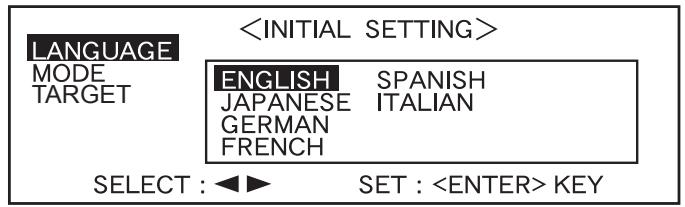
2 Turn to select the desired language, then press
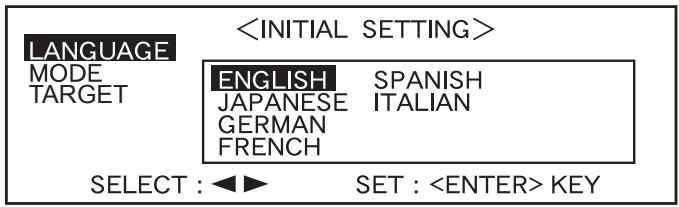
![](images/77636824d1e6bf07ba99edd333407125800586e74e25cc7888f03c1bfe4189a6.jpg) - When the cursor moves to the desired language, all the text will be displayed in the selected language.

3 Turn to select "TASK", then press

![](images/ceab547c3ba3aa268f6b306e4af174ee9b5bd5a5df4e4698c48449ca2d170f81.jpg)

4 Turn to select the desired target mode, then press

Memo If you do not want to change the target mode, press ![](images/54480441ad220b20dfc60f75ad46fa0a6b10437d4abf26f405ce4f7164ad42f3.jpg) The screen will appear. ![](images/f1c1205e321bb7d1cb32f138b745b69d080cb1208bba23213a8fa5d9602cca09.jpg) - Example when tasks 1, 2 and 5 have been downloaded.
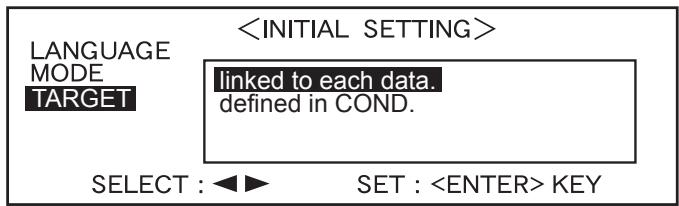
5 Turn to select "TASK*", then press

![](images/faa95902086744bf61f457e6f25dde31dd135a70b27199e8f28e08f62260958b.jpg) A message asking you to check the currently set mask and measurement area will appear. ![](images/2732d8d0fc191b7a6a41fd7eb4024b1acbb1bee0843296c4d9dfa45981407bd7.jpg)

6 Check the Target Mask and measurement area selector switch, then press

The screen will appear. Note that the White Calibration Plate No. is displayed. ![](images/d26ffd55379cc73c2b11018d8909338917eeb2ec30c0a91dc0ae70c799fd4d53.jpg) ![](images/ff9edd9e394e41dd719f7a5befb048506e0ed2fea4ea1718d16d12a1c2017dd5.jpg)

7 Turn to select "ZERO", then press (MEAS. button).

![](images/b5efe48844f034bccd2e78346319781d3317c088dd1289aefe2f1141858de015.jpg)

Memo No

For details of zero calibration, refer to page E-44.

Note

Never place the specimen measuring port toward the light source. Keep it more than 1m away from any reflective items (hands, desks, walls etc.). Turn to select "WHITE", and then press (MEAS. button).
TASK1 M/I+E/100  
WHITE CALIBRATION  
NOW CALIBRATING.. 
1 2 3

Note

Place the instrument on the correct White Calibration Plate (i.e. the calibration plate whose plate No. is displayed in the screen).

Memo No

- If the white calibration data has already been set, the procedure will move to step 8 automatically. - If does not appear due to the auto power save function, this may be due the fact that it can take time to start calibration after is pressed.

8 If a single target color has been selected for all measurement in a series, a message asking you whether to save the average will appear.

To display the average of the measured data and save it as the measurement result at the end of measurements, select "YES" and press If you want to save individual measured data without calculating the average, select "NO" and press ![](images/ddb87b893b813c9aca09790a0e62699e0aeed342c7476a6baabf7db912159d6f.jpg)

Memo

![](images/7f0e3e0966f7e444e3c6895aeb0ec68b81551e265d7eea06eeb60a0cd18cd13d.jpg) This condition will be registered in the memory of the instrument as long as data is stored for the TASK. In this case, this step will be skipped when the same TASK is selected for the next time.

9 A message "JOB 1" will appear.

![](images/a47f0c22ba6b7c5c1b95c3884376e4edefe1bf05203d4ed2eea27293d85b2ffa.jpg) 10 Place the specimen measuring port to the specimen according to the message displayed, make sure that is displayed, then press (MEAS. button). ![](images/77a4cffd80aff2c0af0f70cee4411034b9bdfe052b3458abbb3d39c685278254.jpg) Memo If does not appear due to the auto power save function, this may be due the fact that it can take time to start measurement after is pressed.

11

Turn to select "NEXT" then press ![](images/ce652fd1642cf7ba2f826f308a4b1716f81db9e60a4e2deefb86d3d0202e65d7.jpg) The message for "JOB*" displayed for the previous measurement will appear. ![](images/bbd1b20b138e113fc229e73158dceae39a27c9e528be6902f7ed24eaadec194e.jpg) Turn to select "REDO", then press ![](images/db889c3ab1a898fab6d2eb2a37f4ae28f91df38c8aa2e4a3de640eaea36f70b9.jpg) The message "JOB*" that was displayed just before the measurement was performed will appear. ![](images/d6c59d5cb2b17c83d89b8f30d26f068dd3934f54e03896c6a0ab55db0d8761ab.jpg)

Turn to select "END", then press

Measurement will be quit.
TASK1 M/I+E/100 JOB1 T1
SCISCE
L* = 16.00 ∠L* = 0.43L* = 14.68 ∠L* = 0.04
a* = -0.10 ∠a* = 0.13a* = -0.15 ∠a* = -0.12
b* = 0.79 ∠b* = 0.07b* = 0.87 ∠b* = 0.08
∠E* = 0.45∠E* = 0.15
27.03.02 G140 REDO NEXT DISP P END

Memo

If you made a setting to save the average at step 8, the average of all measurement in a series will be calculated and displayed at the end of the task's last "JOB*". In this case, only the calculated average will be stored in the instrument's memory. The measurement result for each "JOB* will not be saved. If you did not make a setting to save the average at step 8, the measurement result for individual measurement ("JOB*") will be stored in the instrument's memory.

Note

- In TASK mode, only the data taken by the previous measurement will be displayed. By using the instrument alone, it is not possible to view the data taken by the measurement performed before. - The measurement results will be saved only after a series of measurements set as a task is completed. If TASK measurement is cancelled on the way, all data in the series will not be saved.

Chapter 5

Troubleshooting

Error Messages

The following messages may appear while you are using the instrument. If such messages appear, take the necessary actions shown in the table below. If the trouble does not go away in spite of taking action, contact a KONICA MINOLTA SENSING-authorized service facility.

Memo

Messages that may be displayed on the LCD are given in the table below. For communication error check codes, refer to the separate document.
Symptom/Possible CauseCorrective Action
OK02 LOW ILLUMINATIONAmount of light from the xenon lamp has dropped to 65% of its initial level. • Deterioration of xenon lamp • Dirt on integrating sphereClean the integrating sphere as explained in “Cleaning Each Part” (page E-17). If the problem still remains, contact a KONICA MINOLTA SENSING-authorized service facility.
OK10 MAKE WHITE CALIBRATION!The reliability of the white calibration data has dropped because a certain period of time has passed since the last white calibration.Performing white calibration is recommended.
ER01 MEMORY FULLWhen operating in COND mode or TASK mode, the instrument has a total of 1700 measurement and color difference target data stored. (700 in the “defined in COND.” mode.).Delete some data for securing necessary memory space. The memory of this instrument can store up to 1700 (700 in the “defined in COND.” mode) pieces of data in total. This amount includes the sample data for the COND and TASK modes as well as color difference target data.
ER02 LOW BATTERY(When the instrument is powered by batteries) • Battery voltage dropReplace the batteries with new ones.
ER05 ERROR IN FLASHINGXenon lamp does not flash properly. • Xenon lamp has blown. • Faulty flash circuit • Faulty sensorContact a KONICA MINOLTA SENSING-authorized service facility.
ER07 ZERO CALIBRATION INCOM-PLETEDZero calibration has not been performed.Perform zero calibration.
ER11 FAILED IN CALIBRATIONZero calibration or white calibration has not been performed correctly.For zero calibration, the specimen measuring port must be directed into the air. For white calibration, the White Calibration Plate must be used.
The Target Mask is not correct.Attach the correct Target Mask.
ER13 ERROR IN A/DFailed during A/D conversion. • Faulty A/D converter • Break down of circuits relating to the A/D converterTurn the power OFF, and then turn it ON again. If this message keeps appearing, contact a KONICA MINOLTA SENSINGauthorized service facility.
ER17 INCORRECT CLOCK OPERATIONClock IC is not working correctly. • Clock IF's power voltage drop or breakdown of circuits relating to the clock IC.Contact a KONICA MINOLTA SENSING-authorized service facility.
ER24 WHITE CALIBRATION IN-COMPLETEDWhite calibration has not been performed.White calibration must be performed each time the instrument is turned ON. White calibration must also be performed when the measurement area or specular component setting is changed.
ER25 WRONG APERTUREThe measurement area set in <FILE> screen does not match the lens position selector switch on the instrument.Change the measurement area setting or the position of the measurement area selector switch according to the area to be measured.
ER27 ERROR IN CHARGINGCharging for flashing of Xenon lamp can't be completed • Breakdown of charging circuit • Battery voltage dropContact a KONICA MINOLTA SENSING-authorized service facility.
ER30 NO DATA IN MEMORYData has been lost since the memory's backup battery is exhausted.Turn the power ON to charge the memory's backup battery. The backup batteries can be fully charged in 25 hours when the power of this instrument is turned ON. After the batteries are fully charged, data backup can be stored for approximate 4.5 months.

Troubleshooting

If an abnormality has occurred with the instrument, take necessary actions as given in the table below. If the instrument still does not work properly, turn the power OFF, and then turn it ON again. If the symptom remains, contact a KONICA MINOLTA SENSING-authorized service facility.
Check PointAction
LCD is blank.Are batteries inserted? Is the AC adapter connected?Insert the batteries. Connect the AC adapter.
Is the LCD contrast appropriate?Adjust the LCD contrast. (page E-32)
Isn't displayed? Or isn't the batteries extremely low?Replace the batteries with new ones.
“✓” does not appear.Are batteries inserted? Is the AC adapter connected?Insert the batteries. Connect the AC adapter.
Isn't displayed? Or isn't the batteries extremely low?Replace the batteries with new ones.
MEAS. button is not effective.Is measurement still in progress?Wait until measurement is complete, and then press the button.
Is a measurement screen displayed?MEAS. button must be pressed while a measurement screen is displayed.
Abnormal measurement resultIs the instrument directed perpendicular to the specimen?Make sure that the instrument is directed perpendicular to the specimen, to prevent leakage of light.
Is the White Calibration Plate correct?Use the correct White Calibration Plate to perform white calibration. (page E-46)
Was white calibration performed correctly?
Was zero calibration performed correctly?Direct the specimen measuring port into the air or use the optional Zero Calibration Box and perform zero calibration.
Measurement results fluctuate.Is instrument kept stationary during measurement?Do not allow the instrument to move during measurement.
Not possible to input data to the computer.Is the RS-232C cable connected correctly?Connect the instrument's external output terminal to the computer's RS-232C connector with the RS-232C cable supplied with the instrument.
No commands from computer are accepted.Is the RS-232C cable the one supplied with the instrument used?
Commands cannot be accepted correctly.Do communications settings on the in-strument match those on the computer?Set the same communications settings as those on the instrument to the computer.
TASK mode does not function.Has a task been downloaded?Download a task from the optional Color Data Software “SpectraMagic” (Ver.3.2 or higher; except for Ver.3.5).
Not possible to print.Is the printer cable connected correctly?The printer must be connected to the external output terminal on the instrument using a printer cable that is wired as shown in “Printer Cable Wiring Diagram (page E-92).
Measurement data or settings are not held in memory, and disappear immediately.The instrument's backup batteries may be low immediately after purchase or following a period of prolonged use. Turn the power of the instrument ON to charge the backup batteries. Under this condition, the batteries can be fully charged in 25 hours.The backup batteries have an expected service life of approximately ten years. If you find that the instrument fails to retain data in memory even after the batteries have been fully charged, however, then it is likely that your batteries have reached the end of its life and requires replacement. Note that you cannot replace the batteries yourself. For information, please contact a KONICA MINOLTA SENSING-authorized service facility.
Relative gloss value is displayed as “G---” in the TASK mode.In this case of the TASK mode, if the MASK/GLOSS setting wasn’t “/I+E”, relative gloss value is not calculated and is displayed as “G---”.Change the MASK/GLOSS setting of the TASK to “*/I+E”, and redisplay the TASK from SpectraMagic (Ver.3.2 or higher; except for Ver.3.5) to the CM-2600d/2500d.

Chapter 6

Appendix

Principles of Measurement

Illuminating/Viewing System

The flow of measurement is shown below. This instrument utilizes the D/8 geometry conforming to CIE No.15, ISO 7724/1, ASTM E1164, DIN 5033 Tei17, and JIS Z8722-1982 (diffused illumination/8° viewing system) standards, and offers simultaneous SCI (specular component included) and SCE (specular component excluded) measurements. ① Illumination Light from xenon lamps diffuses in the integrating sphere and illuminates the specimen uniformly. ② Receiving a: Light reflected by the specimen is received. b: Light diffused in the integrating sphere is received. ③ Sensing Light is transmitted to the specimen-measuring and illumination-monitoring optical system, where the light in the wavelength range of 360 to 740nm is divided into 10nm-pitch components and signal proportional to the light intensity of each component are output to the analog processing circuit. ① Light from xenon lamps diffuses on the inner surface of the integrating sphere and illuminates the specimen uniformly. ② a. The light reflected by the specimen surface at an angle of 8 degrees to the normal of the surface is received by the specimen-measuring optical system. b. The diffused light in the integrating sphere is received by the illumination-monitoring optical system and guided to the sensor. ③ The light reflected by the specimen surface and the diffused light are divided into each wavelength component by the specimen-measuring optical system and illumination-monitoring optical sensor, respectively, and then signal proportional to the light intensity of each component are output to the analog processing circuit. By using the outputs from the specimen-measuring optical system and the illumination-monitoring sensor for calculation, compensation for slight fluctuation in spectral characteristic and the intensity of the illumination light is performed. (Double-beam system)

Illumination Area and Measurement Area

The CM-2600d allows selection of either SAV (ø3 mm) or MAV (ø8 mm) measurement area according to the specimen and applications. A Target Mask (illumination area) suitable for the selected measurement area must be installed.

Note

With the CM-2500d, only MAV(0.8 mm) is available.

Target Mask

Since this instrument does not have automatic Target Mask matched to the selected measurement area, it must be attached correctly. Since the condition of the inner surface of the Target Masks affects measured values, do not touch the inner surface by hand, scratch it or allow it to get dirty.

Note

With the CM-2500d, it is not possible to exchange a Target Mask since only MAV(08mm) is available.

Measurement Area

The measurement area can be switched between SAV and MAV by sliding the measurement area selector provided on the side of the instrument.

Note

With the CM-2500d, no measurement area selector is provided.

Simultaneous SCI/SCE Measurement

The CM-2600d/2500d employs simultaneous SCI/SCE measurement method. With the conventional models, SCI (Specular Component Included) and SCE (Specular Component Excluded) need to be switched mechanically by opening/closing the optical trap provided inside the integrating sphere. This means mechanical switching has to be made each time the mode is switched from SCI to SCE or vice versa, and it is not possible to start measurement in the new mode until switching is complete. With the CM-2600d/2500d, both SCI and SCE data can be obtained simultaneously by calculating the data obtained by two illuminantations.

Simultaneous SCI/SCE Measurement Method

Two light sources ① and ② are located as shown in the figure, and light source ① flashes first. Light source ① is the diffused illumination type, and SCI measured data can be obtained as it flashes. Then, light source ② flashes next. Light source ② is provided for numeric control of the specular component. The data (i.e. amount of light reflected specularly from the surface of the specimen) obtained when this light source flashes and that obtained when light source ① flashed are used to calculate SCE data. ![](images/3b113bca464b39833fa099d956765eceeef9bee7e5721cbb00dd2827eca1c034.jpg) By carrying out the above measurement and calculation during a single measurement, both SCI and SCE data can be obtained simultaneously without mechanical switching that is required in the case of the conventional models.

UV Control

With the CM-2600d, two light sources, one contains UV (Ultraviolet) component and the other doesn't, flash sequentially and a desired illumination containing the specific UV intensity is virtually created by calculation based on the two measured numeric data sets. In case of conventional models with a single light source, the position of UV cutoff filter in the flux from the light source is mechanically adjusted to control the UV intensity. The adjustment of the filter position requires repeated operations. Since the UV control in CM-2600d is performed by the calculation based on the data measured using two light sources, it is completed in a instance and the deterioration of a fluorescent standard which often happens in conventional models due to the repeated illumination during adjustment is prevented.

Mechanism of UV Control

Two light sources ① (without UV cutoff filter) and ② (with a UV cutoff filter) are located as shown below. Light sources ① and ② flash sequentially within the measurement time of approximately 2 seconds. As a result, the spectral reflectance data with and without UV component can be obtained, based on which the calculation for UV intensity control is performed. These two spectral reflectance data are compared/merged to obtain the UV intensity correction data. ![](images/a5004372c350430a4be496ae5e3cb64631e2ac33eb31469426362c4d1ea44657.jpg)

Target Mode

Relation Between Measured Data and Target Color

- In "linked to each data." mode, there is specific target color data associated with the selected number of the target color data at the time of measurement. - In "defined in COND." mode, the target color data depends on the conditions. There is a unique link for the selected number of the target color data at the time of measurement, however, if the number of the target color is changed, the results are recalculated based on the new target color number.

Deleting a Color Difference Target Data

If target color data is deleted, the numbers for other target color data is renumbered. For example, if target color data numbers T1 to T10 have been set and T2 is deleted, the date that was numbered T3 is renumbered T2 and T4 becomes T3, and so on for the other numbers. - In "linked to each data." mode, if the target color data number selected at the time of measurement is modified (deleted or change), then the link to that target color data is cut. The target color data associated with that measurement data is lost forever, and is not recalculated using other target color data. The color difference display based on the target color data does not occur and pass/fail judgments are not performed, and “----” is displayed for the color difference. “T---” is displayed for the target color data number. - In "defined in COND." mode, there is a link to the target color data number selected at the time of measurement. For example, if the current target color set for T2 was set as T3 at the time of measurement, and even if the actual target color data used at the time of measurement is deleted, the results are calculated and displayed based on the new T2 target color.

Notes on Changing the Target Mode

This instrument comes with two user selectable target modes, "linked to each data." and "defined in COND."

Note

- Once the target mode is changed, previous data will be cleared. It is recommended that you save previous data into other storage media in advance by using the Color Data Software that is optionally available. - For the target mode changing procedure, please read "Selecting the Target Mode" on page E-28. Specifications
ModelCM-2600dCM-2500d
Illuminating/viewing systemd/8 (diffused illumination, 8-degree viewing angle), equipped with simultaneous measurement (not switched mechanically) of SCI (specular component included)/SCE (specular component excluded). (Conforms to CIE No.15, ISO 7724/1, ASTM E1164, DIN 5033 Tei17, JIS Z8722 Condition c, standard.)
Size of integrating sphereø52 mm
DetectorSilicon photodiode array (dual 40 elements)
Spectral separation deviceDiffraction grating
Wavelength range360 nm to 740 nm
Wavelength pitch10 nm
Half bandwidthApprox. 10 nm
Reflectance range0 to 175%, Display resolution: 0.01%
Light sources3 pulsed xenon lamps2 pulsed xenon lamps
Measurement timeApprox. 1.5 seconds (approx. 2 seconds for fluorescent measurement)Approx. 1.5 seconds
Minimum measurement inter-val3 seconds for SCI/SCE (4 seconds for fluorescent measurement)3 seconds for SCI/SCE
Battery performanceApprox. 1000 times at 10-second intervals (when alkaline batteries used; at 23°C)
Measurement/illumination areaMAV:ø8 mm/ø11 mm SAV:ø3 mm/ø6 mm (Selectable between MAV and Sav)MAV:ø8 mm/ø11 mm
RepeatabilitySpectral Reflectance: Standard deviation within 0.1% (360 to 380 nm: Standard deviation within 0.2%) Chromaticity Value: Standard deviation ∠E*ab within 0.04 (When a White Calibration Plate is measured 30 times at 10-second intervals after white calibration)
Inter instrument agreement∠E*ab within 0.2 (MAV/SCI) (Averaged for 12 BCRA Series II color tiles compared to values measured with master body; at 23°C)
UV adjustmentInstantaneous numerical adjustment (no mechanical adjustment required) * With UV400 nm cut filterNo UV adjustment function for CM-2500d
Language modesEnglish/Japanese/German/French/Spanish/Italian
Measurement modeSingle/averaging (auto mode: 3, 5, 8 times/manual mode)
InterfaceConforms to RS-232C
Observer2/10 degrees
Observation illuminantA, C, D50, D65, F2, F6, F7, F8, F10, F11, F12 (simultaneous evaluation is possible using two light sources)
DisplaySpectral value/graph, colorimetric value, color difference value/graph, PASS/FAIL result, Assessment (except in Japanese mode), relative gloss value
Color space/colorimetric dataL*a*b*, L*C*h, CMC (1:1), CMC (2:1), CIE94, Hunter Lab, Yxy, Munsell, XYZ, MI, WI (ASTM E313), YI (ASTM E313/ASTM D1925), ISO Brightness (ISO 2470), Density status A/T, WI/Tint (CIE/Ganz), CIE00
Storable data sets1700 pieces of data (as SCI/SCE 1 data) * 700 pieces of data in the “defined in COND.” mode. * Total of the sample data for the COND and TASK modes and color difference target data
Tolerance judgmentTolerance for color difference (both box and elliptical tolerances can be set)
PowerAA-size battery (×4), AC adapter
Size69 (W) × 96 (H) × 193 (D) mm
Weightapprox. 670 g (including “Measuring Base”/excluding batteries)
Operating temperature/humidity range*15 to 40°C, less than 80% relative humidity at 35°C with no condensation
Storage temperature/humidity range0 to 45°C, less than 80% relative humidity at 35°C with no condensation
Standard accessoriesWhite Calibration Plate: CM-A145
Target Maskø8 mm: CM-A146
Target Maskø3 mm: CM-A147None
RS-232C cable (D-sub 9-pin, for IBM, PC/AT): IF-A16
AC adapter: AC-A17
E:AA(R6) alkaline battery × 4
Optional accessoriesZero Calibration Box: CM-A32
Hard Case: CM-A148
Dust Cover Set: CM-A149
Replacement Dust Cover: CM-A152 (polyolefin)
Color Data Software “SpectraMagic NX” (CM-S100w)
Printer cable (D-sub 9-pin, for serial connection): CR-A75
*1 Operating temperature/humidity range of products for North America: 5 to 40^ , less than 80% relative humidity at 31^ with no condensation

Dimensions

(mm) The measurement area selector is not available with the CM-2500d. ![](images/f0d8b2c812b610f869a8215ecaeffc068464482ddfe65a73397de1e3a2cfa644.jpg) ![](images/4cdcf5897e4fc0502161a29c0d73e18f653c5b7f2438602f6843d5f7cead7f78.jpg) ![](images/36af93b273ab4279878d4aef80ce3399f65c4c70f677214cafeea31c170bb0e9.jpg) ![](images/ca6d744c2abdcb750937582c5bde66e2e1a5637698375809a5c0d53c88ee89ff.jpg) The navigation wheel of the CM-2600d/2500d can be used to select menus and items in the LCD to set the measurement conditions and measurement results display. The following figure is the Menu Structure diagram of the CM-2600d/2500d. This is a tree diagram for the menus or the items that can be selected in the display of the instrument.

Reading the menu structure diagram

- is the display title in the diagram. Then words under the display title are the menus or items which can be selected in this display. - To the right of the menus or items is explanation of what will happen when the menu or item selected. - The number enclosed in parentheses “( )” in the display is the number of the page in this manual which explains the menu or item. For details, please refer to the indicated page. - In the following example, it is shown that selecting "COND*" in the "" display will cause the "COND*" menu for setting measurement conditions to appear.

[Shown in the menu structure]

![](images/66ce34c39de2a553c8e5a572121e473ace8f81ac4f6a869df667ac75dbc04f11.jpg)

[Real display examples]

![](images/f548bb9ff3f117ff56e9e5ac711763fba4d94dbae94233d0395d2acefb13d55b.jpg) Common for both Measurement mode (COND / TASK) ^+ Turn the power ON with navigation wheel.
<INITIAL>
LANGUAGE MODESelect the desired language (L2E/DF/E#/S) (page E-27)
TARGETSelect the desired mode (COND/TARGET) (page E-27)
Target: Select the target mode (Linked to each data).("defined in COND") (page E-28)
<INITIAL>
"COND" mode
<INITIAL>Measurement condition menu display
<COND><COND>
CALIBRATION<CALIBRATION>
ZEROExecution of Zero Calibration (page E-44)
WHITEExecution of White Calibration (page E-45) --(After settings, automatically back to measurement screen.)
<TARGET>Measurement screen
<TARGET><TARGET>
TOLERANCE<TARGET>
TOLERANCE<TARGET>
TOLERANCE= (tolerance type)<TARGET>
BOXDisplay the box tolerance menu.
<TARGET><TARGET>
<TARGET><TARGET>
<TARGET><TARGET>
<TARGET><TARGET>
<TARGET><TARGET>
<TARGET><TARGET>
<TARGET><TARGET>
<TARGET><TARGET>
<TARGET><TARGET>
<TARGET><TARGET>
<TARGET><TARGET >
<TARGET><TARGET>
<TARGET><TARGET>
<TARGET><TARGET>
<TARGET><TARGET>
<TARGET><TARGET>
<TARGET><TARGET>
<TARGET><TARGET>
<TARGET><TARGET>
<TARGET><TARGET>
<TARGET><TARGET
<TARGET><TARGET>
<TARGET><TARGET>
<TARGET><TARGET>
<TARGET><TARGET>
<TARGET><TARGET>
<TARGET><TARGET>
<TARGET><TARGET>
<TARGET><TARGET>
<TARGET><TARGET>
<TARGET><TARGET}
<TARGET><TARGET>
<TARGET><TARGET>
<TARGET><TARGET>
<TARGET><TARGET>
<TARGET><TARGET>
<TARGET><TARGET>
<TARGET><TARGET>
<TARGET><TARGET>
<TARGET><TARGET>
<TARGET><TARGET> <TARGET>
<TARGET><TARGET>
<TARGET><TARGET>
<TARGET><TARGET>
<TARGET><TARGET>
<TARGET><TARGET>
<TARGET><TARGET>
<TARGET><TARGET>
<TARGET><TARGET>
<TARGET><TARGET>
<TARGET>
<TARGET>
<TARGET>
<TARGET>
<TARGET>
<TARGET>
<TARGET>
<TARGET>
<TARGET>
<TARGET>
<TARGET>
<TARGET>
<TARGET>
<TARGET>
<TARGET>
![](images/d9cb310bb557ce95cd25a251dccec81e12377262434bb1d7b81f1b4459d381e1.jpg) KONICA MINOLTA
Table of contents Click a title to access it
Manual assistant
Powered by Anthropic
Waiting for your message
Product information

Brand : KONICA

Model : CM-2600D

Category : Spectrophotometer