DRY SUITS - Wetsuit SEAC - Free user manual and instructions
Find the device manual for free DRY SUITS SEAC in PDF.
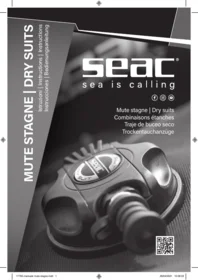


| Product type | Neoprene dry diving suit |
| Brand | SEAC |
| Model | Dry Suits |
| Category | Diving suit |
| Main material | Neoprene |
| Intended use | Underwater diving in cold, dirty, or contaminated waters |
| Waterproofing principle | Water stays outside, the body is surrounded by insulating air |
| Dimensions | Available in several sizes (from S to XXL) |
| Approximate weight | 3 to 4 kg depending on size |
| Power supply | None (non-electric equipment) |
| Main functions | Thermal insulation, water protection, increased comfort |
| Thermal insulation | The air introduced into the suit acts as insulation |
| Breathability | The skin breathes freely, unlike wetsuits |
| Water protection | Ideal for dirty or contaminated waters |
| Undergarments | Compatible with undergarments to increase warmth |
| Maintenance | Rinse with fresh water after each use |
| Cleaning | Use a mild soap, avoid solvents |
| Drying | Dry in the shade, away from heat sources |
| Storage | Hang on a wide hanger, folded without marked creases |
| Safety | Read the manual thoroughly before use |
| Warning | Do not use without prior dry suit diving training |
| Spare parts | Replaceable seals, valves, and bellows |
| Repairability | Small repairs possible with a neoprene repair kit |
| General information | Result of ongoing research and testing in real conditions |
| Warranty | Standard manufacturer's warranty |
Frequently Asked Questions - DRY SUITS SEAC
User questions about DRY SUITS SEAC
0 question about this device. Answer the ones you know or ask your own.
Ask a new question about this device
Download the instructions for your Wetsuit in PDF format for free! Find your manual DRY SUITS - SEAC and take your electronic device back in hand. On this page are published all the documents necessary for the use of your device. DRY SUITS by SEAC.
USER MANUAL DRY SUITS SEAC
- Warning: Before using this product, read the entire instruction manual very carefully.
ATTENZIONE!
Congratulations on having chosen the quality and reliability of a SEAC product. The equipment you have purchased was made with selected and tested materials. Development and constant research allow us to evolve continually. Innovative manufacturing processes, constant controls and testing, as well as testing under real conditions, as conducted in our research centre, guarantee the reliability that all SEAC products are known for.
This manual describes materials, assembly systems, use, maintenance, minor repairs and potential risks related to neoprene dry suits.
WHY CHOOSE A DRY SUIT
When diving with a wet suit, the quantity of water between your body and the wet suit worn is kept at a medium temperature, thanks to the insulating characteristics of the material from which it has been made.
The technical insulation characteristics from the outside of a dry suit mean, on the other hand, that your body is instead surrounded by the air you introduce (generally the same air as contained in the tanks). To put it simply, the water stays out.
As air is one of the best thermal insulators, not only will a dry suit keep you warmer, but it will also increase your comfort levels, reducing tire due to various factors such as excessive heat dispersion or factors present due to the thermocline.
Additionally, when you wear a dry suit, your skin is free to breathe, differently from when you wear a wet suit. You will also be protected from contact with water, making it the best choice for diving in dirty or contaminated water.
Use of an undersuit beneath the dry suit will further increase the heat supply, increasing your sensation of wellbeing.
The sensation of being dry you can enjoy with a dry suit is something that adds comfort and peace of mind – both important factors for a successful dive.
To sum up the benefits, therefore, by using a dry suit, you will be able to dive all year round, reducing fatigue and increasing comfort.
GENERAL WARNINGS
ATTENTION
This booklet is not a diving manual!
Read this entire manual before using this equipment.
IMPORTANT
Should some points of this manual prove difficult to understand or unclear, contact your retailer or instructor for clarification.
IMPORTANT
This manual must be conserved for as long as you own the product!
IMPORTANT
Should you sell the suit on, please hand this manual over to the new owner.
ATTENTION
Check that anyone diving in your suit has first read this user's manual.
ATTENTION
Failure to comply with the instructions given in this user's manual may lead to serious injury to yourself or other people.
- Before using this dry suit or any other underwater diving equipment with breathing apparatus, you must follow a course held by qualified instructors and obtain the appropriate license. The use of diving equipment by unlicensed persons i-+s dangerous and may cause serious or fatal injuries to the diver and his companions.
- Diving under ice or in water of a temperature below 5° centigrade is considered a dangerous activity. These types of activities are subject to specific awareness and use of special equipment. Do not perform these dive types without first having completed specific training courses under the supervision of qualified instructors.
-
During the assembly and finishing of the Seac dry suit, all possible provisions were made to supply a highly reliable, long-lasting product.
Nevertheless, such provisions may become ineffective if the user does not use the dry suit correctly and does not provide adequate maintenance.
SEAC denies all responsibility for any problem resulting from not observing the recommendations included in the manual. -
For any other eventuality, please contact your authorized retailer or SEAC directly.
- In order to guarantee maximum safety, every repair or maintenance intervention must be carried out only by authorized SEAC workshops.
- SEAC dry suits are a result of research conducted in close collaboration with numerous professional diving operators. Their innovative characteristics guarantee a reliability that remains unchanged even after an extensive series of dives.
- If you are not an expert in using a dry suit, we advise you to study its functions during trial dives in shallow depths and under favorable conditions accompanied by a qualified instructor and attend a course to update your skills.
SEAC dry suits have been certified under standard EN 14225-2: 2017, which calls for a long series of functional tests to a maximum depth of 50 meters.
EN 14225-2:2017 CERTIFICATION
The products described in this instruction manual have been subjected to type approval testing and certified in accordance with the EN 14225-2:2017 by Registered Test Center #0474 RINA, Via Corsica 12, 16128 GENOA.
Model EN 14225-2:2017
The EU Declaration of Conformity is available at: www.seacsub.com
MARKING
The number 0474 next to the CE mark refers to Registered Test Center #0474 RINA, Via Corsica 12, 16128 GENOA, authorized to run production checks according to EU Regulation 2016/425 of the European Parliament and the Council of March 9, 2016 regarding personal protective equipment.
REFERENCE TO EUROPEAN STANDARD EN14225-2: 2017
PURPOSE OF THE CERTIFICATION
The purpose of the requirements and tests specified by standard EN 14225-2: 2017 - Regulation: 2016/425/EU is to ensure a minimum level of safety and functionality in dry suits using SCUBA equipment (dives with a respirator) to a maximum depth of 50 meters.
The diver using a dry suit and diving with scuba equipment must have adequate thermal support for the entire length of the dive without needing to interrupt the dive itself and come to the surface due to uncontrolled heat loss caused by inadequate materials, thickness, or the design used in producing the dry suit itself.
The certification tests ascertain that the requirements for conformity with these standards are identified and noted on the product that is subjected to such testing.
In order to guarantee maximum attention to safety and to the care and maintenance of the product, a label with the following text is sewn into each dry suit:
CE EN 14225-2:2017
Definition: Dry Suit for underwater diving
' Firm: SEACSUB S.p.A.
Via D.Norero 29-16040 S.Colombano C.li (GE) Italy
- Before using this product, read the entire instruction manual very carefully.
- Always refer to the size table inserted in the instruction manual. - Wash the dry suit after every use, carefully following the instruction and warnings in the instruction manual included.
' WARNING!
- The characteristics of the material used in making this product, together with poor maintenance, may cause allergic reactions.
- Consult the instruction manual before using this product. - WARNING!
- Due to the effects of pressure, the thickness and the weights used, the buoyancy of the dry suit may vary and expose the diver to potential risks. Read the instruction manual carefully and consult a professional diving instructor before using this product.
WARNING!
The use of the dry suit requires air or other gaseous mix intake to be able to compensate and obviate the pressure effects on the diver. Therefore, the buoyancy can further vary and expose the diver to potential risks. Read the instruction manual carefully and turn to professional diving instructors before using this product. WARNING!
- In the case of the dry suit with separated hood, the certification should be considered valid only if all the components are worn together as a single complete set.
FRONT VIEW
seac
INSTRUCTIONS FOR WASHING!
WASH BY HAND IN COLD WATER
DO NOT USE BLEACH
HANG TO DRY WITHOUT WRINGING OR SPINNING
DO NOT IRON

This dry suit is produced and/or sold by SEACSUB S.p.A. and conforms to current European laws.
90% NEOPRENE
10% NYLON LINING
BATCH NUMBER
MADE IN CAMBODIA
REAR VIEW
Note: The country of origins of the product may vary according to the model you buy. SEAC guarantees the quality and reliability of the product regardless of its country of origin by constantly monitoring the production process beginning with raw materials and continuing through to the finished product.
ATTENTION
Do not remove this label from the dry suit for any reason.
IMPORTANT
For the protection of the consumer, each batch number is identified on the label.
TECHNICAL CHARACTERISTICS AND SPECIFICATIONS OF THE DRY SUIT
SEAC dry suits are studied and produced with the primary needs of the amateur-professional diver in mind. The raw materials are selected to produce a high-technology product.
Resistance to compression and wear over time, the elasticity of the material, comfort and ease of fit are some of the strong points that SEAC proposes for all the models in its catalogue.
The use of the dry suit requires specific knowledge that can be learned only by taking a scuba diving course through a training center in the specific territory. However, it is our responsibility to offer some indications or advice that must be taken seriously in order to safeguard the well-being of the diver and other persons who may be in some way involved during scuba diving.
MATERIALS USED FOR DRY SUIT
Neoprene is the main material used in the production of SEAC dry suit.
This rubber by-product is soft, elastic, and offers thermal protection, as well as being resistant to abrasions generally caused by contact with rocks, coral, and outcroppings, etc.
In order to improve its texture and make it more easily usable, neoprene is almost always lined on both sides with special coatings specifically suited to the functions for which the dry suit has been designed.
An increase in thickness results in improved thermal protection, but produces a reduction in the ease of movement.
CHARACTERISTICS AND COMPONENTS OF THE DRY SUIT
One key aspect in choosing a dry suit is that it must not allow water in.
It is well known that water is an absolute coolant (20-25 times more effective than an aerial environment), implying that a dry suit that is not specifically designed for this purpose may greatly contribute to heat loss caused by problems immediately related to exposure to cold water and in extreme cases cause hypothermia.
In addition to the potential entry of water within the suit, this could be a cause of extreme difficulty during ascent and accelerating the onset of hypothermia.
For this reason, the care in designing and producing components and characteristics of the suit are essential in order to guarantee a product that corresponds to the needs of safety and comfort required for scuba diving activities.
INTERNAL TAPES AND STITCHING
Each neoprene panel or insert of the dry suit is glued in layers with specific adhesives and sewn with blind stitching. This system allows the thread to join the parts without passing completely through the neoprene.
To make this application fully sealed, the blind stitching is only carried out externally. Inside the suit, according to the model, two different technical solutions are used.
First solution: Application of heat tapes. These keep the two parts of previously glued neoprene together.
Second solution: Gluing of a neoprene tape along the whole edge of the neoprene parts to be joined. This tape is only applied after having first removed the lining from the neoprene along the whole edge to be glued. The end result is that the neoprene solidifies with the tape applied, eliminating all possible water infiltration.
These two systems ensure that each sewn panel resists stress and is waterproof. Technically, the second system (neoprene tape glued to the suit) is preferred when neoprene thickness are less than 4 mm.
WATERTIGHT ZIPPERS
We fit totally waterproof zippers into all our dry suits. These feature stainless steel teeth and seal and assembly characteristics (sandwich gluing system) that ensure all water stays outside the dry suit. An external flap protects them from impacts or contacts with blunt objects that could affect or alter correct function.
INFLATION AND DUMP VALVES, CONNECTION HOSE
The main characteristic of the dry suit is to insulate the body from external contact with the water, supplying thermal comfort that allows you to enjoy a relaxed diving experience. As the diver is subjected to changes in pressure due to diving descent, however, this function must be controlled and compensated. To do so, air must be introduced into the dry suit.
ATTENTION
Whilst most divers use the tank air to compensate external water pressure, some professionals or technical diving experts use gas or mixes of gas other than air.
SEAC refuses all liability for the use of gas or mixes of gases other than air with the dry suit. Use of Argon type gas or oxygen-enriched mixtures can lead to accidents that would put your own safety, and that of others, at risk.
This introduction of air will be necessary to compensate the increased pressure during descent. If not compensate, this pressure will act directly on the body, creating an unpleasant compression effect.
N.B.: the inflation valve supplied with the SEAC dry suits is is a lateral sliding button type, (fig. 9). This prevents the button from being pressed accidentally due to its coming into contact with external parts.
The layer of air created within means that the compression effect vanishes immediately and the dry suit performs the task for which it has been designed.
The compensation and formation of this layer of air takes place by means of the inflation valve mid-chest. By pressing this rapidly in repeat succession, we can regulate air intake into the dry suit.
Use the dump valve on the left arm to control the increase in the air volume seen during ascent or where varying depth. In this case, excess air must be dumped.
If used correctly, these two waterproof valves will balance out the air taken in, providing the diver with the desired buoyancy and an appropriate heat supply.
A flexible connection hose resistant to 40 pressure bars is supplied with the dry suit. This is positioned between the inflation valve and the low pressure outlet of the first stage, allowing you to inflate the dry suit.
CLOSURES AT THE EXTREMITIES OF THE SUIT
Care of the closures at the wrists and neck always demands particular attention as these are the aspects mainly responsible for a correct seal of the dry suit. Created from super-elastic and highly tear resistant material, these systems insulate the suit from the outside, preventing all infiltration or water passage. The neck seal always needs to be folded within the neoprene collar (fig.1). Only the use of carefully selected materials can make this operation easy and comfortable. The wrist seals have been specifically designed to ease passage of the hand whilst putting the suit on, and are perfectly located on the wrist to allow for optimal seal.
SIZES AND MODELS
The correct size, designed for various body types, is an essential factor in the production of a dry suit, must conform to the characteristics required by European certification and offer a wide range of wearability. This particular study allows us to supply any diver with a suit that corresponds to both resistance to heat loss and correct fit.
In order to obtain all this, we have always taken various factors into account. First and foremost is to identify the correct type of neoprene used in order to obtain a fit that guarantees easy dressing, ease of movement, does not restrict respiration, and is resistant to heat loss and abrasion.
Particular attention is paid to identifying the correct direction of stretch in order to guarantee maximum comfort. The models in the catalogue all feature the characteristics listed above. The table given in this manual will assist the diver in identifying the best size according to the main personal body measurements as shown.
IMPORTANT
A dry suit that conforms to standard regulations must be comfortable and fit the shape of the body without altering or limiting movement or impeding respiration.
TABLE OF REFERENCE FOR DRY SUIT SIZING
At the end of this manual (page 86-87), we have included a specific table to allow for easy identification of the correct suit size. The list refers to the dry suits currently available and sets out the identification of the most commonly and easily reported sizes.
Please contact the following address for any further information: seacsub@seacsub.com
CONTRAINDICATIONS TO USING ASSEMBLED NEOPRENE AND RELATIVE LININGS
The materials and adhesives used in the production of SEAC dry suits are selected and conform to the current standards and regulations regarding protection, hygiene, and physical safety of all users. Nevertheless, certain individuals may have an allergic reaction caused by specific intolerance to a particular material.
People who are aware that they may suffer from these specific pathologies are requested to ask their retail dealer for more precise information concerning the suit they intend to purchase. SEAC will supply further information concerning the specific materials used upon request.
If a diver should experience the onset of an allergic reaction, it is recommended that he/she avoid using the product.
Inadequate maintenance of the dry suit may aggravate this phenomenon. The cleaning and maintenance instruction indicated below should be followed carefully.
IMPORTANT
In order to safeguard the diver with regards to all the aspects inherent to diving activities, the following warning label is sewn into the suit:
Characteristics of materials used in the production of this product, together with inadequate maintenance of the same, may cause allergic reactions. Consult the instruction manual before using this product.
SUPPLIES
All SEAC dry suits are supplied complete with connection hose, suit bag and neoprene hood.
EFFECTS OF PRESSURE IN USING THE DRY SUIT
BUOYANCY FORCE
Due to the notable buoyancy characteristics of the materials used and on the basis of the air introduced into the dry suit, it will be necessary to use ballast that allows the diver to overcome the force of buoyancy and reach the desired depth.
The amount of weights to be used may vary in function dependant upon diverse factors such as the thickness of the suit, the equipment used, the physique of the diver, environmental conditions, etc. It is recommended that the weights be tested (for a correct ratio of buoyancy and ballast to be used) while being observed by an instructor or an experienced diver before using the dry suit.
Each time we wear the undersuit, we will need to review the quantity of weights needed, testing it once again to identify the correct solution.
As a general guideline, we would suggest that the weights to be used should allow for the maintenance of neutral buoyancy at any depth and with tanks almost empty. No additional weight to this need be added. It is also generally accepted that in order to attain neutral buoyancy at depth, a Buoyancy Compensation Device (BCD) will be required.
The weights must also allow for a 5-minute safety stop at 3 meters, in neutral buoyancy and with a tank containing 50 bars or less. The diver should not have any difficulty maintaining this position.
WARNING
Excessive weights may tire the diver and be responsible for a series of incidents including serious ones.
Given the importance of this phenomenon, the following warning label is sewn into the dry suit:
ATTENTION
Due to the effect of pressure, the thickness of the dry suit, and the ballast used, the buoyancy force of the dry suit may vary and expose the diver to potential risks. Read the instruction manual carefully and consult a professional diving instructor before using this product.
EFFECTS OF PRESSURE
With the increase in pressure due to descent to various depths, the thickness of the dry suit will decrease, resulting in a decrease of the effect of the buoyancy force. Furthermore, due to the reduction in the thickness, heat loss increases, limiting the diver's exposure time at that specific depth.
The selection and use of a dry suit of the appropriate thickness will limit the above mentioned negative effects. Moreover, correct ballast weight (correct quantity of weights in relation to the dry suit used) will avoid tiring the diver and facilitate his movements on the sea bottom and during ascent.
INSTRUCTIONS FOR THE CORRECT USE OF THE DRY SUIT
PREPARING FOR THE DIVE
IMPORTANT
Read the following instructions carefully. Your safety and the safety of others, and the continual efficiency of your equipment, depend on you reading these instructions.
ATTENTION
The dry suit is not considered a flotation device and does not guarantee a position with your face out of the water!
The dry suit must always be transported with care in bags and backpacks specially designed to contain diving equipment and avoiding contact with heavy or sharp components.
Familiarization with your diving equipment in general and with the dry suit in particular is essential in order to avoid unpleasant problems or discomfort during use. From the first time you wear your dry suit it is important to understand all its features in order to put it on and use it safely. The preliminary opening of the zippers will further facilitate this phase and the identification of the front from the back will also make it easier to dress in the dry suit without any complication.
Always check that the zippers are working easily. If they appear not to be functioning properly, we advise postponing the dive. It is important that you dress under perfectly safe conditions and where your balance is not compromised. Put your dry suit on only in protected areas and where it is possible to sit down to further facilitate the operation.
We advise putting on your dry suit away from any sources of potential danger and while avoiding excessive exposure to the sun. Asking more expert divers about their experiences prior to diving will help you avoid potential risks from overheating, which in some periods of the year or in some locations may potentially cause hyperthermia.
Always have your diving companion assist you. It's the simplest and safest way to dress. Always remember that correct choice of size will prevent problems that may only worsen during the dressing phase.
The dry suit must always be the first component you put on and the last you take off. This will assist the diver reduce potential problems related to normal diving activities.
Never underestimate the value of comfort and safety that the dry suit provides during diving. The correct selection of suit is a fundamental step towards successful and enjoyable diving.
PUTTING ON THE SUIT
We recommend starting to put the suit on at the legs, taking care to insert the soled socks correctly. Then pull the suit up over the body with decisive movements. Now put on and adjust the braces (where applicable). Ensure that the braces are unrolled and positioned correctly. They must each be positioned and separated on the relevant side. Now pull the arms on, taking care to position the wrists correctly.
IMPORTANT
If having problems inserting hands through the waterproof wrists, we recommend using a little mineral talcum powder. The same goes for the neck. This will significantly reduce skin friction against the neoprene, making putting the suit on much easier.
IMPORTANT
To avoid tearing the suit, take great care when putting it on not to pinch the neoprene with nails, and particularly in the wrist and neck areas.
Now pull your head through, taking care to carefully widen the suit neck. Your diving buddy can help you correctly position the neck, folding it back inside and ensuring that it adheres perfectly all around (fig. 2).
IMPORTANT
Check that no hair or parts of the undersuit are trapped beneath the collar, as these could lead to water infiltrations.
Lastly, and again with your buddy's help, close the zipper ensuring that the slider is well positioned
at the end stop. Ask your buddy to put a finger through the slider belt, closing the zipper with a decisive movement.
Ensure that the slider slides well. If not, lubricate the teeth with specific waxes easily available from your nearest retailer.
N.B.: Once the zipper has been closed and you have checked correct wrist and neck positioning once again, it will then be easier to release any air that may have been trapped within when closing the zipper. This is necessary prior to entering the water.
Kneel down and cross your arms across your chest to widen the neck with a finger and allow the air to escape (fig. 3).
Once you have done this, put on the hood supplied.
IMPORTANT
Before dressing we advise removing all metal objects such as watches, chains and bracelets, etc.
SEAC will not be held liable for damage to property or persons deriving from the wearing of the dry suit if these instructions have been ignored. Furthermore, such objects may contribute to loss of efficiency of seals fitted around the neck and wrist or could even damage the parts allowing water to penetrate the dry suit, with potentially dangerous consequences.
Accessories like gloves and hood must be put on last, while under suits will follow a logical procedure of dressing.
Neoprene accessories or components are not subjected to the testing required for EC certification.
ATTENTION
In order to safeguard the diver and keep him informed with regards to all the aspects inherent to using a dry suit, the following warning is included on the label attached to the dry suit:
Warning!
In the case of the dry suit with separated hood, the certification should be considered valid only if all the components are worm together as a single complete set.
Following the previous instructions and selecting the correct dry suit will guarantee that during immersion the suit itself will offer necessary thermal protection.
This will allow you to proceed with diving without having to deal with problems related to excess loss of body heat.
For information regarding the effects of pressure and buoyancy force, we advise following the indications given above.
IMPORTANT
The use of the dry suit over time may result in changes in its wearability compared to when it was new. Many factors may bring about these changes: aging of the neoprene, continuous and frequent deep dives and incorrect maintenance. Moreover, changes in the weight and form of the user may further contribute to an improper fit of the dry suit. If not used frequently, we advise checking the fit of the dry suit before planning any dives. This will save the diver from having to cancel dives due to problems that may arise at the last minute. Furthermore, never underestimate how difficult and dangerous diving with uncomfortable or inappropriate equipment may be for you and your diving companions.
PUTTING ON THE SCUBA ASSEMBLY
Once you have put on the dry suit and closed the zipper, you can position the weights and then put the SCUBA assembly on. To do this, you will need to connect the inflation hose to the valve.
The hose, previously connected to a low pressure output of the first stage, must pass beneath the armpit and be inserted into the male attachment on the inflation valve (fig. 4).
Move the hose quick-release ring nut to facilitate this operation. By pulling gently on the hose, the diver will be able to ascertain successful correct connection. If inserted correctly, the hose will be properly joined to the inflation valve.
Once the hose has been connected up to the inflation valve, we can test it by checking correct air intake. Additionally, by acting on the dump valve (pressing it), we can check its correct function.
N.B.: the hose can be connected and disconnected without any loss of air or water infiltrations into the suit.
In the previous paragraphs we have dealt with subjects and phenomena (increase of pressure and buoyancy force) that mostly concern the use of the dry suit while diving. The following will
describe how to put these factors into practise, making diving safe and fun.
Always be certain that the dry suit fits properly and that every component has been applied in such a way as to prevent water from leaking in. A pre-dive check of your equipment carried out with your diving companion will assist this control. Contact with the underwater environment will facilitate adaptation of the dry suit to the diver and increase the diver's comfort during the dive. You must never, for any reason whatsoever, totally or partially open the zippers. A sudden entry of cold water inside the dry suit may cause problems upon ascent and cause the onset of hypothermia. A slight and gradual increase in the cold with increased depth is normal and is primarily caused by increase in pressure and in some cases by decrease in temperature due to the thermocline variations.
If the diver should feel excessively uncomfortable or cold due to one or more of the previously described factors, we advise informing diving companions or the dive leader and proceeding with ascent to the surface in conformity with procedures required for that dive.
Hypothermia is a pathology that, if limited and controlled from its onset, is easily resolvable. On the contrary, the serious risks related to this phenomenon may increase exponentially.
DIVING
GENERAL WARNING
ATTENTION
Do not use the dry suit without the Buoyancy Control Device (BCD). The dry suit cannot be used in lieu of the BCD. Should the dry suit flood, and you are not using a BCD, you may not manage to reach positive buoyancy to return to the surface.
ATTENTION
Do not dive in contaminated water. Use of the dry suit does not protect completely against polluting chemical agents. This type of dive requires a technical preparation and specific procedures and equipment. You will need to have completed specific training beyond sporting/recreational diving to dive in these such environments.
DANGER
Diving below ice and in temperatures below 6 degrees centigrade can be dangerous. This type of dive requires specific preparation and equipment. Do not dive in these conditions without first having completed a cold water speciality course that also includes dry suit use.
DANGER
Incorrect use of the dry suit may lead to a lack of buoyancy control. Consequent uncontrolled ascents or descents may cause decompression sickness, air embolism, pulmonary overdilation, acute problems compensating the airways.
ATTENTION
The dry suit must not be used to lift objects or weights from the sea bed. Failure to comply with this warning will lead to high risk of accident.
Whenever recovering items from the sea bed, always use specific raising balloons.
IMPORTANT
We highly recommend attending a course for the use of a dry suit. Specific learning of techniques to be applied lies at the base of safety and comfort.
ATTENTION
This manual cannot replace the instructions given in a course on the specific use of the dry suit. Do not dive if not qualified to do so and without having practiced standard emergency procedures. Refer to a qualified diving instructor to be taught specific points on the safe use of the dry suit.
IMPORTANT
We recommend starting descent along a cord or chain anchored to the sea bed. A rope is a safety element that is also important in controlling buoyancy in addition to providing psychological support and a point of reference during descent and ascent.
GENERAL GUIDELINES
- The use of the dry suit requires specific knowledge that can be learned only by taking a scuba diving course through a training center in the specific territory.
- The dry suit specialty course will help you understand how to use it correctly, making you aware of all potential dangers.
- When diving with a dry suit, you must in any case always use a BCD. The main, essential task of a BCD is to provide appropriate buoyancy in all phases of the dive.
- Use of air intake within the dry suit is for the sole purpose of keeping and controlling a correct heat supply.
- Always dive with experts on the procedures and techniques to be used with dry suits.
- Comply with the limits and rules of diving, reviewing safety procedures on a regular basis.
- Never dive in or enter the water from a height greater than one meter. Failure to comply with this guideline may cause serious damage to the dry suit.
USE IN DIVES
As soon as you enter the water, adjust buoyancy by putting air into the Buoyancy Control Device (BCD). If you feel the body starting to be constricted due to water pressure, you will need to put a little air into the dry suit, using the inflation valve, in order to compensate the external pressure effect.
As you start descent, you will need to dump both the air in the BCD and any air you have inflated into the dry suit. Total dump of air from the BCD should already allow for descent to start easily. If this is not sufficient, also dump the air within the dry suit, by acting on the dump valve. Rotate the external valve ring nut anticlockwise (from right to left) (fig. 5) and position the left elbow upwards and the wrist lower, to facilitate air dump, allowing for an easier descent (fig. 6). If you prefer, slightly widen the suit neck is just as quick to release all air from the suit (fig. 8).
Once you have reached a depth of 3-5 meters, we advise turning the ring nut 1/4 of a turn towards the closure position, three times (from left to right) (fig. 7). This will contain the air we are to introduce into the suit, without risking a pointless dump.
As you continue your descent, as water pressure increases, you will need to introduce air into the suit. This will prevent an acceleration in descent and keep a correct heat supply. At the same time, it will avoid unpleasant constrictions of the dry suit due to an increase in pressure.
Press the inflation button repeatedly to introduce small quantities of air into the suit, gradually reaching a correct balance. As soon as possible, move to a horizontal position (as is standard practice in diving). This will allow you to distribute the air within correctly over the whole body (including socks). Take great care not to position yourself fully upside down, with your head beneath your feet, as this position makes it impossible to dump sock air and can cause problems in maintaining buoyancy with the risk of uncontrolled ascents.
IMPORTANT
The specific way in which the socks and leg are cut mean that air cannot collect in large volumes at those point. However, if upside down, you may experience problems in relation to an uncontrollable ascent speed. Avoid, therefore, assuming these positions as far as possible, and practise in advance in shallow water in order to re-establish the correct position as quickly as possible. Remember that all the time you are upside down, you will not be able to dump excess air.
In descent and during the various dive phases, we recommend reaching correct buoyancy by means of the air in the BCD. Correct distribution of air both within the BCD and in the dry suit will allow the diver to reach correct buoyancy without experiencing balance difficulties or problems relating to incorrect air distribution.
Each change in pressure (depth) must be managed and controlled by means of the dry suit's inflation or dump valve and through the BCD inflator unit.
Once you have decided to ascend, it is important to control buoyancy in order to respect ascent speeds. The normal vertical position assumed by the diver during this phase, will allow air to gather towards the top of the suit. By opening the valve fully (from right to left) (fig. 5), dumping excess air due to increased volume is simple. This operation must be managed by moving the elbow from the bottom to the top (wrist lower than elbow). We can control the gradual release of air with slow, repeated movements, thereby keeping correct ascent speed without risking a 'collapse' of the suit. Air expansion within the BCD is, on the other hand, controller by means of the inflator unit.
During this particular phase, carrying correct weights is fundamental. This is why we recommend spending a little time on finalizing this important step as best possible. Correct weights will avoid all diving problems, increasing comfort and safety.
Correct weights will allow the diver to ascend without having to make any particular effort and
without wasting too much energy. They will also facilitate the safety stop necessary for all dives.
Once you reach the surface, you will need to inflate the BCD sufficiently to allow for positive buoyancy on the surface. You will also need to fully close the dump valve (rotating it from left to right). This will avoid any possible or potential water from entering due to accidental knocks to the valve.
If necessary, and to increase comfort levels, you can also inflate a little quantity of air into the dry suit.
Once you reach the boat or exit point, follow all standard procedures for leaving the water.
ATTENTION
Should the inflation valve block, we recommend immediately disconnecting the inflation hose by means of the ring nut controlling the quick release.
ATTENTION
Should the dry suit be flooded due to zipper or other breakage, we strongly recommend ascending to the surface by means of the BCD. According to the severity of the problem, in any case ensure you comply with rules governing ascent to the surface.
ATTENTION
Should the dump valve malfunction or block when closing, we recommend dumping the air through the collar or wrists. Simply assume a vertical position and insert a finger to widen the seals (fig. 9).
IMPORTANT
The dump valve is fitted with a one-way valve that will not allow water to enter even if the valve is fully open. However, by pressing the valve fully, this function is cancelled. As such, we recommend not acting repeatedly on the valve when not necessary, as repeated action when the suit has been released of air, may facilitate the entry of water within.
IMPORTANT
With the valve fully open, we have maximum sensitivity to air exit. This is why when diving, we recommend turning the ring nut 1/4 of a turn, three times, towards the closure position. This will prevent air from being released when not necessary.
AFTER DIVE
Upon conclusion of the dive a normal procedure will be followed to remove the equipment that was previously applied. The last phase of this procedure is usually removal of the dry suit.
At that time, the diver should evaluate weather conditions when deciding when to remove this final component of equipment. The presence of a companion is always important in that he or she can assist with opening any zippers and help their diving companion to maintain balance. The dry suit with braces has the added benefit of allowing you to undress the upper part of the body, whilst keeping the suit on.
Once the zippers have been opened, you will first need to pull your head through the neck seal. Take great care only to use the pads of your fingers to widen the neck, to avoid possible breakages or tears to the neoprene. Take the same care when pulling both sleeves off. After this, to fully remove the dry suit, release the braces and take the socks off your feet one by one. SEAC boots are fitted with specific heel reinforcements that make this type of operation easier.
In this last phase, your diving buddy will need to help you to avoid possibly over balancing.
Naturally, each diver will evaluate the most appropriate procedure according to his or her own experience and practicality.
CONDENSATION
Although free from infiltration, once the suit has been opened after a dive, you may note drops of water or damp inside. This is mainly due to the diver's sweating consequent to excessive activity or the use of thick undersuits.
In some cases, the very difference between the temperature inside the suit and external water temperature can also create condensation.
Careful dressing that considers these aspects will prevent future condensation from forming.
ORDINARY CARE AND MAINTENANCE
Once the dry suit has been removed, it must be subjected to normal maintenance and control operations.
We advise rinsing the dry suit and all neoprene components in fresh running water, included valves and dry zipper.
It is then best to hang it up and let it dry in a well ventilated area not in direct sun light.
In some cases, and with the help of your buddy, the use of a freshwater hose can help rinse the suit off, even if being worn.
For correct maintenance it is advisable to follow the instructions below, which are also found on the tag attached to every certified suit.
WASHING INSTRUCTIONS
HAND WASH IN COLD WATER
DO NOT BLEACH
HANG DRY WITHOUT WRINGING OR SPIN-DRYING
DO NOT IRON

This dry suit is produced and/or sold by SEAC and conforms to current European laws.
PERIODIC MAINTENANCE
Periodically or following intense use of the dry suit, we also advise soaking it in fresh water with a liquid softener commonly available. This washing will help maintain elasticity of the material.
It is also advisable to periodically clean and disinfect the dry suit by diluting a common antibacterial product in a container of fresh water and soaking the dry suit according to the times and quantities indicated on the label of the antibacterial product.
N.B.: In both the above cases, you will need to close the zipper and extremities (wrists and neck).
IMPORTANT
It is not easy to establish the exact period that must pass for proper regular maintenance. This is because various different factors can affect the need to carry out proper, regular maintenance. We would trust in the user's common sense to establish when maintenance is necessary, and generally advise at least once every 12-18 months for sports divers, and once every 6 months for professional divers.
Not following the indications and suggestions made in the two previous paragraphs may compromise the life span of the product and violate the normal procedures for safeguarding personal hygiene of the user.
IMPORTANT
If the dry suit is used as rental equipment, the above operations must be carried out each time the dry suit is used.
If these instructions are not followed it may violate current regulations pertaining to personal hygiene and health and safety.
The above declarations are intended as recommendations for all diving center operators, whether or not the regulations are applicable in the country where the activity is performed.
ZIPPER MAINTENANCE
The control and lubrication of the zipper is another important aspect not to be neglected during the periodic maintenance of the dry suit.
Always check the ease and correct opening and closing function of the zipper. If necessary and periodically lubricate it using special waxes (readily available) so that the slider body runs freely.
The zipper is not covered by warranty for accidental damages or lack of care. It must be handled carefully as it can easily be damaged if forced.
IMPORTANT
Do not use silicone spray on the dry suit zipper. Silicone permanently damages the zipper and tape on which it is applied.
VALVE MAINTENANCE
Rinse valves after each dive with running freshwater. They should be checked by an authorized laboratory once a year to check the state of wear of the internal components.
STORAGE AND TRANSPORTATION OF THE DRY SUIT
In periods of prolonged inactivity, we recommend storing the dry suit by hanging it in a dry and ventilated area. We recommend storing the dry suit folded only if it will be used again very soon. If the dry suit will not be used in the near future, always hang it.
If left folded, the dry suit may form creases that may eventually contribute to a precocious flattening of the neoprene in the areas folded.
The dry suit must always be transported with care in a bag or backpack specially designed to contain diving equipment and avoid contact with heavy or sharp components.
MINOR ORDINARY REPAIRS OR EXTRAORDINARY MAINTENANCE
During use of the dry suit, tears in the fabric and neoprene may occur due to contact with external components like rocks, coral, etc.
The application of a neoprene adhesive can help to repair these tears.
Follow the instructions on the adhesive in order adhere the parts together correctly.
⚠️ DANGER
The solvents and glue used to repair wet and dry suits can release toxic gases. Repairs must be carried out in well-ventilated environments. In closed environments the gasses could seriously injure people.
Any micro holes affecting the suit seal, must be repaired.
Other operations that require specific repairs, like the elimination of micro holes in the neoprene, larger tears, split seams, replacement of neoprene collar, neoprene wrists or dry zipper must be carried out in specialized workshops.
In order to guarantee maximum safety, every extraordinary repair must be carried out only by workshops authorized by SEAC.
The repairs described above when caused by unsuitable use or accidental damage are not covered by the warranty.
IMPORTANT
Significant alterations made to the dry suit, such as resizing, are the full responsibility of the owner.
SEAC denies any responsibility when such alterations have been made and relevant certification will no longer apply.
ATTENTION
If repairing, check that the dry suit is watertight before diving.
NORMAL PRODUCT LIFE SPAN
The materials used guarantee a high quality product that, if used properly and according to the instructions provided, offer the user a certain level of safety, durability and performance.
If ordinary and extraordinary maintenance of the product is carried out according to these instructions, the dry suit should provide an extensive period of use without any particular problems or significant changes.
The continuous effect of pressure on neoprene may influence the thickness and over time a reduction may occur. Deep and continuous dives accelerate this process and will make it irreversible over time. For this reason we advise purchasing certified dry suits of an adequate thickness in order to limit this reduction and guarantee the use of the dry suit for a long period of time without concern over standard performance.
Factors like the environment and others can alter the life span of the dry suit. We trust the responsibility and common sense of the diver to use the dry suit according to the conditions and recommendations indicated here.
DISPOSAL OF A PRODUCT THAT IS NO LONGER USABLE
Having established that the product has arrived at the end of its life span, it is recommended that it be disposed of by following any local regulations.
DANGER
The neoprene and fabrics used produce intoxicating gases when burned. Avoid this type of solution if disposing of the product personally.
For any other information, please contact our technical office by e-mail at:
seacsub@seacsub.com
CERTIFICATE OF WARRANTY
SEAC guarantees the correct functioning of the product to which this document is attached.
This guarantee has a duration of two (2) years in accordance with current European regulations.
The warranty herein can be enacted according to the conditions and limits expressly indicated below:
- The warranty will have a duration of 2 (two) years, beginning from the moment the product is acquired from an authorized SEAC dealer and does not require any preventive formality or subsequent validation.
-
This warranty is valid only for the first purchaser of the product from an authorized SEAC dealer. Being a strictly nominative warranty, it is not transferable to third parties unless previously and explicitly authorized by SEAC.
-
This warranty covers all and any functional defects caused by:
-
Intrinsic defects caused by the use of materials believed to be unsuitable
- Evident errors in the design, manufacturing, or assembling of the product or it's components
-
Incorrect or inadequate instructions and advice concerning its use
-
This warranty will terminate automatically, and effective immediately, upon the repair, modification, transformation, adaptation, or general tampering carried out on the finished product or any of its component parts that has not been previously authorized by SEAC or, in any case, carried out by a duly authorized service centre.
-
This warranty guarantees the right to intervention and repair at no cost and as soon as possible, or the total replacement or substitution of the product as incontestably decided by SEAC, or component parts at no cost, when and where SEAC acknowledges functional defects strictly regarding those of point 3 above.
-
This warranty may also be validated by shipment of the product believed to be defective to SEAC The intermediary authorized to carry out the shipment must be the SEAC dealer from where the product was purchased. If this should be impossible, any other SEAC dealer, subject to authorization, may be authorized to ship the defective product. In order for the warranty to be valid, a copy of the store receipt, invoice, or other similar proof of purchase must accompany the product where the name of the authorized SEAC dealer and the date of purchase of the product are noted.
If SEAC receives a product that:
- Is not accompanied by a proof of purchase document with the above mentioned characteristics
- Has been subject to conditions that determine the extinction of the warranty according to point 4 above
- Presents defects due to causes that are external or other than those explicitly indicated in point 3 above
- Has been used inappropriately and/or for purposes other than what the product was intentionally designed for
Absolutely no modification shall be made to the product and the sender or the authorized dealer will be notified immediately should these conditions have been breached.
If ever the sender intends to have any intervention carried out, he or she will transmit to SEAC, within the following fifteen days, a request stating so in which he or she shall explicitly agree to sustain all costs relating to the intervention itself, labor, necessary replacement parts and shipping costs.
Otherwise, SEAC will provide for the return of the product at the expense of the sender.
INTRODUCTION
FAIRE SÉCHER SUR CINTRE SANS ESSORAGE (MAIN OU MACHINE)
NE PAS REPASSER

FAIRE SÉCHER SUR CINTRE SANS ESSORAGE (MAIN OU MACHINE)
NE PAS REPASSER

VIDA NORMAL DEL PRODUCTO
DRYSUIT MAN SIZE CHART
| Taglia/ Size/Taille/ Talla/ Größe | Altezza/Height/ Hauteur/Altura/Höhe | Peso/Weight/Poids/ Peso/Gewicht | Torace/Chest/ Tour de poitrine/ Pecho/Oberweite | Vita/Waist/ Tour de poitrine/ Cintura/Taille | Bacino/Hips/ Tour de hanches/ Caderas/Hüfte | Calzari/Boots/ Chaussons/ Escarpines/ Stiefel | |||||
| cm | inch | kg | lb | cm | inch | cm | inch | cm | inch | cm | |
| S | 167-172 | 65.7-67.7 | 60-69 | 132-152 | 94-98 | 25.1-38.5 | 76-80 | 29.9-31.4 | 88-92 | 34.6-36.2 | 26 |
| M | 172-176 | 67.7-69.2 | 68-77 | 149-169 | 98-102 | 38.5-40.1 | 80-84 | 31.4-33.0 | 92-96 | 36.2-37.7 | 27 |
| L | 176-180 | 69.2-70.8 | 76-85 | 167-187 | 102-106 | 40.1-41.7 | 84-88 | 33.0-34.6 | 96-100 | 37.7-39.3 | 28 |
| L2P | 176-180 | 69.2-70.8 | 84-94 | 185-207 | 112-118 | 44.0-46.4 | 94-100 | 37.0-39.3 | 106-112 | 41.7-44.0 | 28 |
| XL | 180-184 | 70.8-72.4 | 84-94 | 185-207 | 106-110 | 41.7-43.3 | 88-92 | 34.6-36.2 | 100-104 | 39.3-40.9 | 29 |
| XL2P | 180-184 | 70.8-72.4 | 93-103 | 205-227 | 118-124 | 45.6-48.8 | 100-106 | 39.3-41.7 | 112-118 | 44.0-46.4 | 29 |
| 2XL | 184-188 | 72.4-74.0 | 93-103 | 205-227 | 112-118 | 44.0-46.4 | 94-100 | 37.0-39.3 | 106-112 | 41.7-44.0 | 30 |
| 2X2LP | 184-188 | 72.4-74.0 | 102-114 | 224-251 | 124-130 | 48.0-49.6 | 106-110 | 40.9-42.5 | 118-122 | 45.6-48.0 | 30 |
| 3XL | 188-192 | 74.0-75.5 | 102-114 | 224-251 | 118-124 | 45.6-48.8 | 100-106 | 39.3-41.7 | 112-118 | 44.0-46.4 | 31 |
| 3X2LP | 188-192 | 74.0-75.5 | 110-125 | 242-275 | 130-134 | 51.1-52.7 | 112-116 | 44.0-45.6 | 124-130 | 48.8-51.5 | 31 |
| 4XL | 192-196 | 75.5-77.1 | 110-125 | 242-275 | 124-130 | 48.8-50.1 | 106-112 | 41.7-44.0 | 118-124 | 46.8-48.8 | 31 |
DRYSUIT LADY SIZE CHART
| Taglia/ Size/Taille/ Talla/ Größe | Altezza/Height/ Hauteur/Altura/Höhe | Peso/Weight/Poids/ Peso/Gewicht | Torace/Chest/ Tour de poitrine/ Pecho/Oberweite | Vita/Waist/ Tour de poitrine/ Cintura/Taille | Bacino/Hips/ Tour de hanches/ Caderas/Hüfte | Calzari/Boots/ Chaussons/ Escarpines/ Stiefel | |||||
| cm | inch | kg | lb | cm | inch | cm | inch | cm | inch | cm | |
| XS | 156-160 | 61.4-62.9 | 40-49 | 88-108 | 84-88 | 33.0-34.6 | 68-72 | 26.7-28.3 | 84-88 | 33.0-34.6 | 22 |
| S | 160-164 | 62.9-64.5 | 47-56 | 103-123 | 88-92 | 34.6-36.2 | 72-76 | 28.3-29.9 | 88-92 | 34.6-36.2 | 23 |
| M | 164-168 | 64.5-66.1 | 54-63 | 119-138 | 92-96 | 36.2-37.7 | 76-80 | 29.9-31.4 | 92-96 | 36.2-37.7 | 24 |
| MP | 164-168 | 64.5-66.1 | 61-70 | 134-154 | 96-100 | 37.7-39.3 | 80-84 | 31.4-33.0 | 96-100 | 37.7-39.3 | 24 |
| L | 168-172 | 66.1-67.7 | 61-70 | 134-154 | 96-100 | 37.7-39.3 | 80-84 | 31.4-33.0 | 96-100 | 37.7-39.3 | 25 |
| LP | 168-172 | 66.1-67.7 | 68-77 | 149-169 | 100-104 | 39.3-40.9 | 84-88 | 33.0-34.6 | 100-104 | 39.3-40.9 | 25 |
| XL | 172-178 | 67.7-70.0 | 68-77 | 149-169 | 100-104 | 39.3-40.9 | 84-88 | 33.0-34.6 | 100-104 | 39.3-40.9 | 26 |
| XLP | 172-178 | 67.7-70.0 | 77-89 | 169-196 | 104-108 | 40.9-42.5 | 88-92 | 34.6-36.2 | 104-108 | 40.9-42.5 | 26 |
| 2XL | 176-180 | 69.2-70.8 | 77-89 | 169-196 | 104-108 | 40.9-42.5 | 88-92 | 34.6-36.2 | 104-108 | 40.9-42.5 | 27 |


1


3


5
2
6

7

8

9


seac®
sea is calling
SEACSUB S.p.a.
Via D. Norero, 29 - S. Colombano Certenoli
(GE) 16040 - Italy
Phone +39 0185 356301
Fax +39 0185 356300
seacsub@seacsub.com
www.seacsub.com
SEAC USA Corp.
Phone +1 786 580 3695
seac.usa@seacusa.com
www.seacusa.com
Istruzioni | Instructions | Instructions Instrucciones | Bedienungsanleitung
MUTE STAGNE | DRY SUITS




- ATTENZIONE
- WHY CHOOSE A DRY SUIT
- GENERAL WARNINGS
- ATTENTION
- IMPORTANT
- EN 14225-2:2017 CERTIFICATION
- MODEL EN
- MARKING
- REFERENCE TO EUROPEAN STANDARD EN
- PURPOSE OF THE CERTIFICATION
- CE EN
- WARNING
- SEAC
- INSTRUCTIONS FOR WASHING
- TECHNICAL CHARACTERISTICS AND SPECIFICATIONS OF THE DRY SUIT
- MATERIALS USED FOR DRY SUIT
- CHARACTERISTICS AND COMPONENTS OF THE DRY SUIT
- INTERNAL TAPES AND STITCHING
- WATERTIGHT ZIPPERS
- INFLATION AND DUMP VALVES, CONNECTION HOSE
- CLOSURES AT THE EXTREMITIES OF THE SUIT
- SIZES AND MODELS
- TABLE OF REFERENCE FOR DRY SUIT SIZING
- CONTRAINDICATIONS TO USING ASSEMBLED NEOPRENE AND RELATIVE LININGS
- SUPPLIES
- EFFECTS OF PRESSURE IN USING THE DRY SUIT
- BUOYANCY FORCE
- EFFECTS OF PRESSURE
- INSTRUCTIONS FOR THE CORRECT USE OF THE DRY SUIT
- PREPARING FOR THE DIVE
- PUTTING ON THE SUIT
- PUTTING ON THE SCUBA ASSEMBLY
- DIVING
- GENERAL WARNING
- DANGER
- GENERAL GUIDELINES
- USE IN DIVES
- AFTER DIVE
- CONDENSATION
- ORDINARY CARE AND MAINTENANCE
- WASHING INSTRUCTIONS
- PERIODIC MAINTENANCE
- ZIPPER MAINTENANCE
- VALVE MAINTENANCE
- STORAGE AND TRANSPORTATION OF THE DRY SUIT
- MINOR ORDINARY REPAIRS OR EXTRAORDINARY MAINTENANCE
- ⚠️ DANGER
- NORMAL PRODUCT LIFE SPAN
- DISPOSAL OF A PRODUCT THAT IS NO LONGER USABLE
- CERTIFICATE OF WARRANTY
- INTRODUCTION
- VIDA NORMAL DEL PRODUCTO
- SEAC®
- MUTE STAGNE | DRY SUITS
Brand : SEAC
Model : DRY SUITS
Category : Wetsuit