
PV 14 - Audio Mixer PEAVEY - Free user manual and instructions
Find the device manual for free PV 14 PEAVEY in PDF.


| Product Type | Compact Audio Mixer |
| Brand | Peavey |
| Model | PV 14 |
| Number of Microphone Inputs | 10 (balanced XLR) |
| Stereo Channels | 2 (6.35 mm Jack inputs) |
| Equalization | 3-band per channel (treble, mid, bass) with ±15 dB adjustment |
| Low-cut filter | 80 Hz on each microphone input |
| Effects Processor | Digital with 16 presets (reverbs, delays, vocal enhancers) |
| Phantom Power | 48 V with switch and indicator LED |
| USB Connectivity | Optional (for recording and playback) |
| Main Outputs | Balanced XLR (Right/Left) |
| Monitor and Effects Outputs | Balanced 6.35 mm TRS Jack |
| Headphone Output | 6.35 mm TRS Jack |
| Power Supply | Internal transformer, detachable power cable with ground plug |
| Dimensions (W x D x H) | 40.96 cm x 37.47 cm x 8.89 cm |
| Rack Mounting | Possible with optional kit |
| Cleaning | Use a dry cloth |
| Maintenance and Repair | Refer to a Peavey authorized technician |
| Safety | Do not open, do not expose to humidity, follow ventilation guidelines |
Frequently Asked Questions - PV 14 PEAVEY
User questions about PV 14 PEAVEY
0 question about this device. Answer the ones you know or ask your own.
Ask a new question about this device
Download the instructions for your Audio Mixer in PDF format for free! Find your manual PV 14 - PEAVEY and take your electronic device back in hand. On this page are published all the documents necessary for the use of your device. PV 14 by PEAVEY.
USER MANUAL PV 14 PEAVEY
Intended to alert the user to the presence of uninsulated "dangerous voltage" within the product's enclosure that may be of sufficient magnitude to constitute a risk of electric shock to persons.

Intended to alert the user of the presence of important operating and maintenance (servicing) instructions in the literature accompanying the product.
CAUTION: Risk of electrical shock — DO NOT OPEN!
CAUTION: To reduce the risk of electric shock, do not remove cover. No user serviceable parts inside. Refer servicing to qualified service personnel.
WARNING: To prevent electrical shock or fire hazard, this apparatus should not be exposed to rain or moisture, and objects filled with liquids, such as vases, should not be placed on this apparatus. Before using this apparatus, read the operating guide for further warnings.

WARNING: When using electrical products, basic cautions should always be followed, including the following:
- Read these instructions.
- Keep these instructions.
- Heed all warnings.
- Follow all instructions.
- Do not use this apparatus near water.
- Clean only with a dry cloth.
- Do not block any of the ventilation openings. Install in accordance with manufacturer's instructions.
- Do not install near any heat sources such as radiators, heat registers, stoves or other apparatus (including amplifiers) that produce heat.
- Do not defeat the safety purpose of the polarized or grounding-type plug. A polarized plug has two blades with one wider than the other. A grounding type plug has two blades and a third grounding plug. The wide blade or third prong is provided for your safety. If the provided plug does not fit into your outlet, consult an electrician for replacement of the obsolete outlet.
- Protect the power cord from being walked on or pinched, particularly at plugs, convenience receptacles, and the point they exit from the apparatus.
- Only use attachments/accessories provided by the manufacturer.
- Use only with a cart, stand, tripod, bracket, or table specified by the manufacturer, or sold with the apparatus. When a cart is used, use caution when moving the cart/apparatus combination to avoid injury from tip-over.
- Unplug this apparatus during lightning storms or when unused for long periods of time.
- Refer all servicing to qualified service personnel. Servicing is required when the apparatus has been damaged in any way, such as when power-supply cord or plug is damaged, liquid has been spilled or objects have fallen into the apparatus, the apparatus has been exposed to rain or moisture, does not operate normally, or has been dropped.
- Never break off the ground pin. Write for our free booklet "Shock Hazard and Grounding." Connect only to a power supply of the type marked on the unit adjacent to the power supply cord.
- If this product is to be mounted in an equipment rack, rear support should be provided.
- Note for UK only: If the colors of the wires in the mains lead of this unit do not correspond with the terminals in your plug, proceed as follows:
a) The wire that is colored green and yellow must be connected to the terminal that is marked by the letter E, the earth symbol, colored green or colored green and yellow.
b) The wire that is colored blue must be connected to the terminal that is marked with the letter N or the color black.
c) The wire that is colored brown must be connected to the terminal that is marked with the letter L or the color red.
- This electrical apparatus should not be exposed to dripping or splashing and care should be taken not to place objects containing liquids, such as vases, upon the apparatus.
- Exposure to extremely high noise levels may cause a permanent hearing loss. Individuals vary considerably in susceptibility to noise-induced hearing loss, but nearly everyone will lose some hearing if exposed to sufficiently intense noise for a sufficient time. The U.S. Government's Occupational Safety and Health Administration (OSHA) has specified the following permissible noise level exposures:
| Duration Per Day In Hours | Sound Level dBA, Slow Response |
| 8 | 90 |
| 6 | 92 |
| 4 | 95 |
| 3 | 97 |
| 2 | 100 |
| 1 1/2 | 102 |
| 1 | 105 |
| 1/2 | 110 |
| 1/4 or less | 115 |
According to OSHA, any exposure in excess of the above permissible limits could result in some hearing loss. Earplugs or protectors to the ear canals or over the ears must be worn when operating this amplification system in order to prevent a permanent hearing loss, if exposure is in excess of the limits as set forth above. To ensure against potentially dangerous exposure to high sound pressure levels, it is recommended that all persons exposed to equipment capable of producing high sound pressure levels such as this amplification system be protected by hearing protectors while this unit is in operation.
Congratulations on purchasing the Peavey PV^TM10 , PV^TM14 , or the PV^TM20 Compact Mixer. The PV^TM10 , PV^TM14 , and PV^TM20 are studio-quality mixing consoles designed to meet diverse needs while occupying a small space. These are the perfect consoles for small venue performances or home recording environments. PV series mixers feature built-in DSP effects that are useful in real-world recording and sound reinforcement, while parameter controls allow you to tailor each effect to meet your needs.
Please read this guide carefully to ensure your personal safety as well as the safety of your equipment.
FEATURES:
- Six XLR mic inputs on PV^TM10 , ten XLR mic inputs on PV^TM14 , and sixteen XLR mic inputs on the PV^TM_20
- Two stereo channels with RCA and 1 / 4'' inputs
- Three-band channel EQ
A/B stereo input selector reduces patching - Inserts on all mono channels
- 80 Hz low-cut switch on all mic inputs
- USB connectivity (standard on the PV^TM20 , optional on both PV^TM10 & PV^TM14 )
- Clip LEDs monitor the entire signal path for clipping
- Signal LEDs on every input channel
- Mute switches with LED indicator on every input channel
- 48 Volt phantom power switch
- Effects send on every channel with stereo return
- Internal digital effects with 16 selections, including reverb, delay and vocal enhancement
- Effect parameter adjustment allows you to customize each effect selection
- Monitor send on every channel
Zero latency record monitoring capabilities
Control room output with level control - Contour EQ switch
- Internal universal input power supply
- Optional rack-mount kit (PV™10 and PV™14 Only)

Installation Note:
This unit must have the following clearances from any combustible surface: top: 8", sides: 12", back: 12"
Gain
This control establishes the nominal operating level for the channel. The input gain can be adjusted over a wide range to compensate for soft voices or very loud drums. To maximize the signal-to-noise ratio, the gain should be set to the proper level, with the channel Fader (12) set to 0. If the clip LED comes on and remains lit, try reducing the gain.
80 Hz Low Cut
The low cut filter has a corner frequency of 80Hz . When engaged, it can improve clarity by removing low frequencies that make a mix sound muddy. This feature is especially useful when playing outside on a windy day or on a hollow-sounding, noisy stage. These kinds of ambient noises can rob your sound system of power. Engaging this switch will remove those frequencies from the system and restore power where needed.
Hi EQ
This active tone control (shelving type: ± 15 dB) varies the level of the high frequency range.
Mid EQ
This active tone control (peak dip: ± 15 dB) varies the level of the mid frequency range.
Low EQ
This active tone control (shelving type: ± 15 dB) varies the level of the low frequency range.
Caution: Excessive low frequency boost causes greater power consumption and increases the possibility of speaker damage.
MON Send (MON Send 2 on the PVTM20 only)
This control adjusts the level of the channel signal sent to the monitor output. The signal is taken before the channel Fader (12) but after the channel EQ.
EFX Send
This control adjusts the level of the channel signal added to the effects mix. The effects send signal is taken after the channel Fader (12) so that adjustments made to the fader will also affect the send level.
Pan
This knob controls the placement of the signal in the stereo field. When rotated completely counterclockwise, the signal is present only on the left channel; when rotated completely clockwise, only in the right channel. This control functions as a balance control to adjust the relative level of the left and right signals on stereo channels 5/6 and 7/8 on the PV^TM10 (11/12 and 13/14 on the PV^TM14 , 17/18 and 19/20 on the PV^TM20 ).
Mute
The mute button is a quick way to remove the channel signal from the left/right main mix, as well as effects and monitor sends, without disturbing the control settings.
Clip/Mute LED
This light normally indicates that the channel signal level is nearing the overload point, but it also lights when mute is engaged. The clip indicator circuit monitors the signal at many points in the channel to ensure that it catches all instances of clipping. It illuminates at +19 dBu and warns that the gain or EQ boost should be reduced. When it lights, roughly 3 dB of headroom remains.
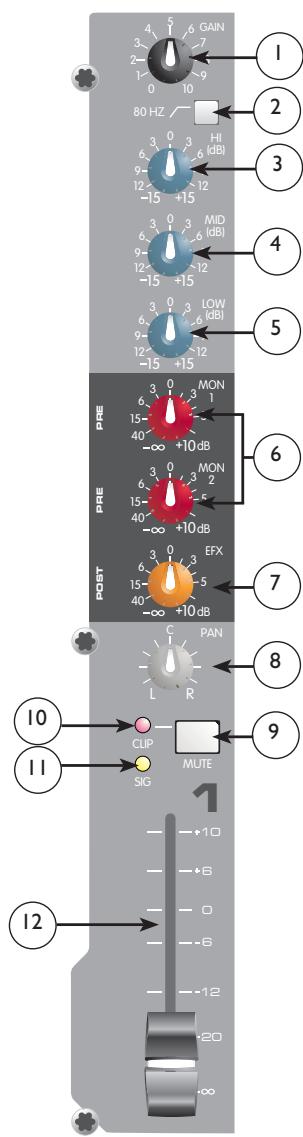
Signal LED
The signal LED lights when the channel level reaches approximately -20 dBu. This not only indicates which channels are active, but also serves as a mini level meter.
Fader
The channel Fader is the channel output control, which sets the signal level to the left and right mix and the effects send control. The optimum setting is the o (unity gain) position.
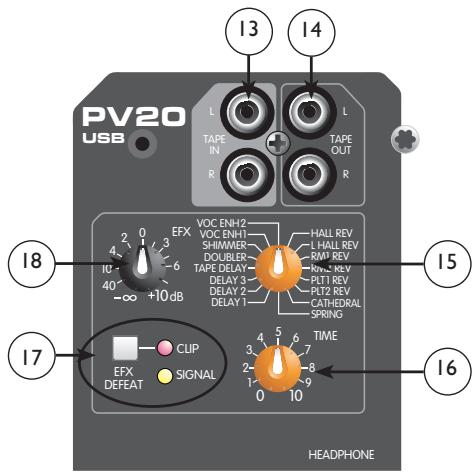
Tape In/Out
The tape input jacks are designed to accommodate tape, CD, or computer sound card output levels. The output level is +4 dBu for connecting to a recorder or sound card input. The tape inputs can be used as an additional stereo input by engaging
the Tape/USB to Main Mix switch (27). The tape input can also be used to monitor the recorder/sound card output without the risk of feedback.
NOTE: The USB input is routed to the Tape Input left/right. If another device is connected to the Tape Input, this signal will be combined with the USB input signal.
EFX Select
This rotary switch selects one of sixteen available effects. As shown in the table below.
| Effect | Description | Application | Parameter | |
| 1 | Hall Rev | Medium Concert Hall | Ensemble | Rev Time |
| 2 | Large Hall Rev | Larger Concert Hall Darker | Gen Reverb | Rev Time |
| 3 | Room 1 Rev | Intimate Room Bright | Pop Vocal | Rev Time |
| 4 | Room 2 Rev | Larger Room Darker | Drums, Rhythm | Rev Time |
| 5 | Plate 1 Rev | Bright | Pop Vocal | Rev Time |
| 6 | Plate 2 Rev | Darker | Drums | Rev Time |
| 7 | Cathedral | Large Space, Long and Darker | Choir | Rev Time |
| 8 | Spring | Classic Spring | Guitar | Rev Time |
| 9 | Delay 1 | Single Delay (Slap-back) | Voc/Inst | Dly Time |
| 10 | Delay 2 | Warm Delay with Repeats | Instruments | Dly Time |
| 11 | Delay 3 | Dark Delay with Repeats | Instruments | Dly Time |
| 12 | Tape Delay | Warm Delay | Instruments | Dly Time/Feedback |
| 13 | Doubler | Single Delay, 30-120 ms | Instruments | Dly Time |
| 14 | Shimmer | Warm Delay with Modulation | Instruments | Dly Time |
| 15 | Vocal Enhancement 1 | Brightens and Adds Room Reverb | Vocals | Rev Level |
| 16 | Vocal Enhancement 2 | Brightens and Adds Spring Reverb | Vocals | Rev Level |
16 EFX Time
This control adjusts the time of the particular reverb or delay.
Green Signal LED and Red Clip LED
The green Signal LED and red Clip LED are used to set the operating input level to the PV^TM10 , PV^TM14 , and PV^TM20 effects processors. The signal level to the processor is affected by channel Fader, the Effects Send and the Effects Send Master Controls. Start with the Master Control (20) set to 0 (12 o'clock) and adjust the channel sends so that the signal LED lights and the clip LED blinks on occasionally, if at all. The clip LED lights 6 dB below clipping. Pressing the EFX defeat mutes the effects signal and lights the clip/mute LED.
18 EFX Return
Once the input level is set (see 17) use the EFX Return control to mix the effects processor output into the main left/right outputs. Remember, a little reverb goes a long way.
MON Send Master
This is the master output level control for the monitor mix. The output level sent to the Monitor Send jack (37) is controlled by the channel Monitor Send controls (6) and by this master control.
(20) EFX Send Master
This is the master output level control for the EFX mix. The output level sent to the EFX Send jack and the internal effects processor is controlled by the channel Fader (12), the channel EFX Send controls (7), and by this master control. The o position is the recommended setting for this control.
21 Headphone Level
This knob sets the headphone and control room output levels. To avoid damage to your hearing, make sure to turn the dial fully counterclockwise before using headphones. Slowly turn the knob clockwise until you reach a comfortable listening level. Normally, the signal in the headphones is the left/right signal. If the Tape to Control Room (26) is engaged, the tape signal is also included.
(22) LED Meters
Two eight-segment LED arrays are provided to monitor the levels of the main left/right outputs. These meters range
from -30 dB to +19 dB. The o dB position on the meter corresponds to +4 dBu at the outputs.
23 Power LED
This LED indicates AC power is supplied to the unit, the power switch is on, and the unit is functioning properly.
(24) Phantom Power LED
This LED lights when the Phantom Power Switch (25) has been engaged.
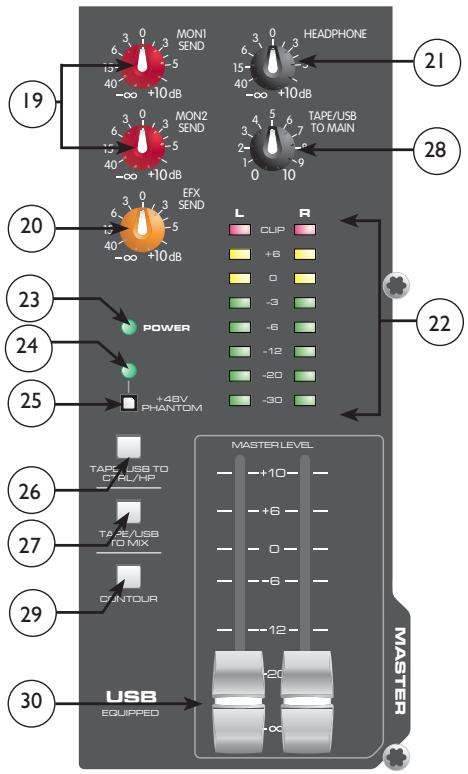

Phantom Power Switch
This Switch applies +48 VDC voltage to the input XLR connectors to power microphones requiring phantom power.
If phantom power is used, do not connect unbalanced dynamic microphones or other devices to the XLR inputs.
Tape To CTRL/HP
Depressing this switch adds the tape return to the Control Room (39) and Headphone Outputs (41) for zero latency monitoring.
Tape/to Mix (Tape/USB to Mix)
Depressing this switch routes the signal from the Tape Inputs (13) or USB Input (44) to the Left/Right Outputs (40). The USB input level is controlled by the computer volume control.
Tape/USB to Main (PV™20 only)
This knob provides a convenient way to adjust the Tape Input (13) or USB Input (44) volume. (On models PV^TM10 and PV^TM14 , adjust the USB Input (44) volume with the computer volume control.)
Contour Switch
Engaging this switch enhances the signal by adding both bass and treble frequencies. This is especially effective at lower volumes or for tape/CD playback.
Master Level Faders
These Master Faders control the levels sent to the main left/right outputs. Best results are obtained when these controls are set near the o point.
Rear Panel
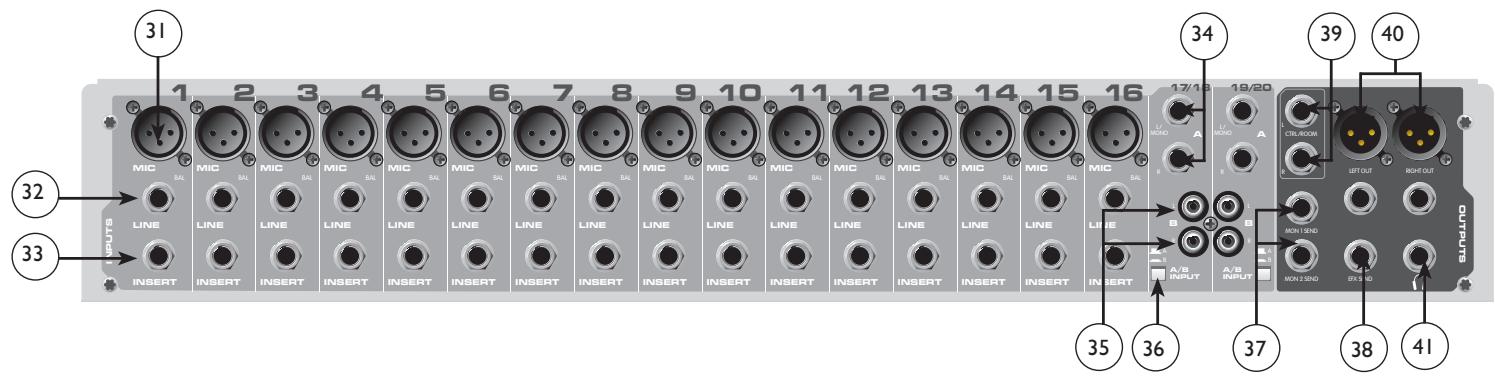
Mic (XLR) Inputs
XLR balanced inputs are optimized for a microphone or other low impedance source. Pin 2 is the positive input. Because of the wide range of gain adjustment, signal levels up to +14 dBu can be accommodated.
Line (1 / 4^ ) Inputs
Line inputs provide 14 " balanced (TRS) 10 k Ohm impedance input. The tip is the positive input and should be used for unbalanced inputs. It has 20 dB less gain than the XLR input and does not have phantom power available. The Mic and Line inputs should not be used simultaneously.
3 Insert
The 14 TRS connectors allow external signal processors to be inserted into the channel signal path. Tip=Send; Ring=Return; Sleeve=Ground.
34 Stereo (1 / 4^ ) Inputs
These 1/4 "unbalanced inputs work as a stereo line input using both jacks or as a mono input if the connection is made to the left/mono input only. The A/B input selector must be in the "A" position for these jacks to be active.
35 RCA Inputs
These RCA inputs work as stereo line inputs. The A/B input selector must be in the "B" position for these jacks to be active.
36 A/B Switch
The A/B input selector switch expands the capability of the PV^TM10 , PV^TM14 , and the PV^TM20 mixers by allowing two stereo sources to be connected to each stereo line input. Instead of repatching, the switch selects which input jacks are active.
37 MON Send
The MON Send features a 1/4 TRS Z-balanced jack in the master section. This output can be used with the Tip, Ring, Sleeve (TRS) balanced or Tip, Sleeve (TS) unbalanced connectors. The MON mix is determined by the amount of signal being sent to the MON bus in each channel and by the Monitor Master control (19).
EFX Send
The EFX Send features a 1/4 TRS Z-balanced jack in the master section. These outputs can be used with Tip, Ring, Sleeve (TRS) balanced, or Tip, Sleeve (TS) unbalanced connectors. The EFX mix is determined by the amount of signal being sent to the EFX bus in each channel and by the EFX master control.
39 Control Room Outputs
The Control Room outputs feature two 1/4 TRS Z-balanced jacks. These outputs can be used with Tip, Ring, Sleeve (TRS) balanced, or Tip, Sleeve (TS) unbalanced connectors. The Control Room output level is adjusted with the Headphone level control (21).
40 Left/Right Outputs
The left/right Outputs feature two 1/4 TRS Z-balanced jacks and two fully balanced XLR outputs. The 1/4 outputs can be used with Tip, Ring, Sleeve (TRS) balanced or Tip, Sleeve (TS) unbalanced connectors. The output level is set by the Master Level Faders (30). Both outputs can be used simultaneously.
41 Headphone Output
The Headphone Output is a 14 TRS (Tip= Left; Ring = Right; Sleeve = Ground). The signal sent to this output is normally the left/right mix. When the Tape to Control Room switch is engaged, the tape input signal is added to the left/right mix and can be monitored in the headphones.
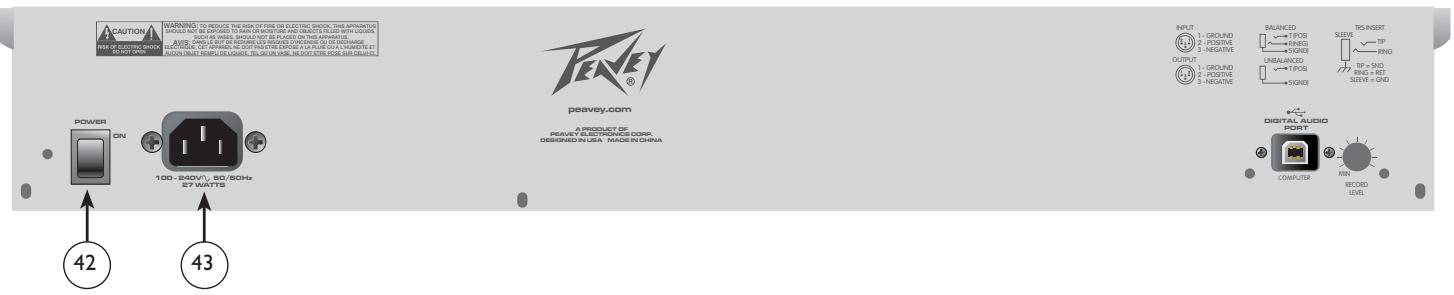

42 Power Switch
Depressing the power switch supplies power to the unit.
Warning: The power switch in this unit breaks only one side of the line. Hazardous energy may be present inside the mixer when the power switch is in the OFF position.

43 Removable Power Cord
This receptacle is for the IEC line cord (included) that provides AC power to the unit. Connect the line cord to this connector and to a properly grounded AC supply. Damage to the equipment may occur if an improper line voltage is used (see voltage marking on unit). Never remove or cut the ground pin of the line cord plug. The console is supplied with a properly rated line cord. If lost or damaged, replace this cord with one of the proper rating.
NOTE FOR UK ONLY:
If the colors of the wires in the mains lead of this unit do not correspond with the colored markings identifying terminals in your plug, proceed as follows: (1) The wire that is colored green and yellow must be connected to the terminal marked by the letter E , or by the earth symbol, or colored green or green and yellow. (2) The wire that is colored blue must be connected to the terminal that is marked with the letter N , or colored black. (3) The wire that is colored brown must be connected to the terminal that is marked with the letter L or colored red.
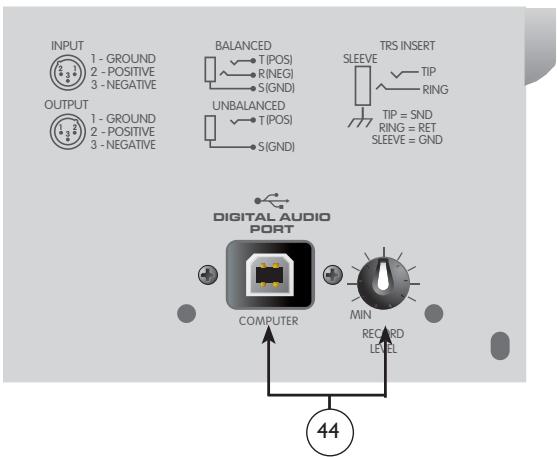
USB port and USB Record Level Control
The USB port is used to connect the PV^TM Series USB mixer to a computer for recording or playing back digital audio to/from your computer. The USB port sends the mixer's main/tape stereo out to the computer. The amount of the main mix signal being sent to the USB port can be adjusted using the Record Level control located next to the USB port. The USB port receives digital audio from the computer; it can then be assigned through the "Tape/USB to Mix" switch (27) to the main left/right output. The USB input level is controlled by the computer volume control.
Compatible with Windows® XP, ME & 2000. Also compatible with Mac OS X® 10.o or later.
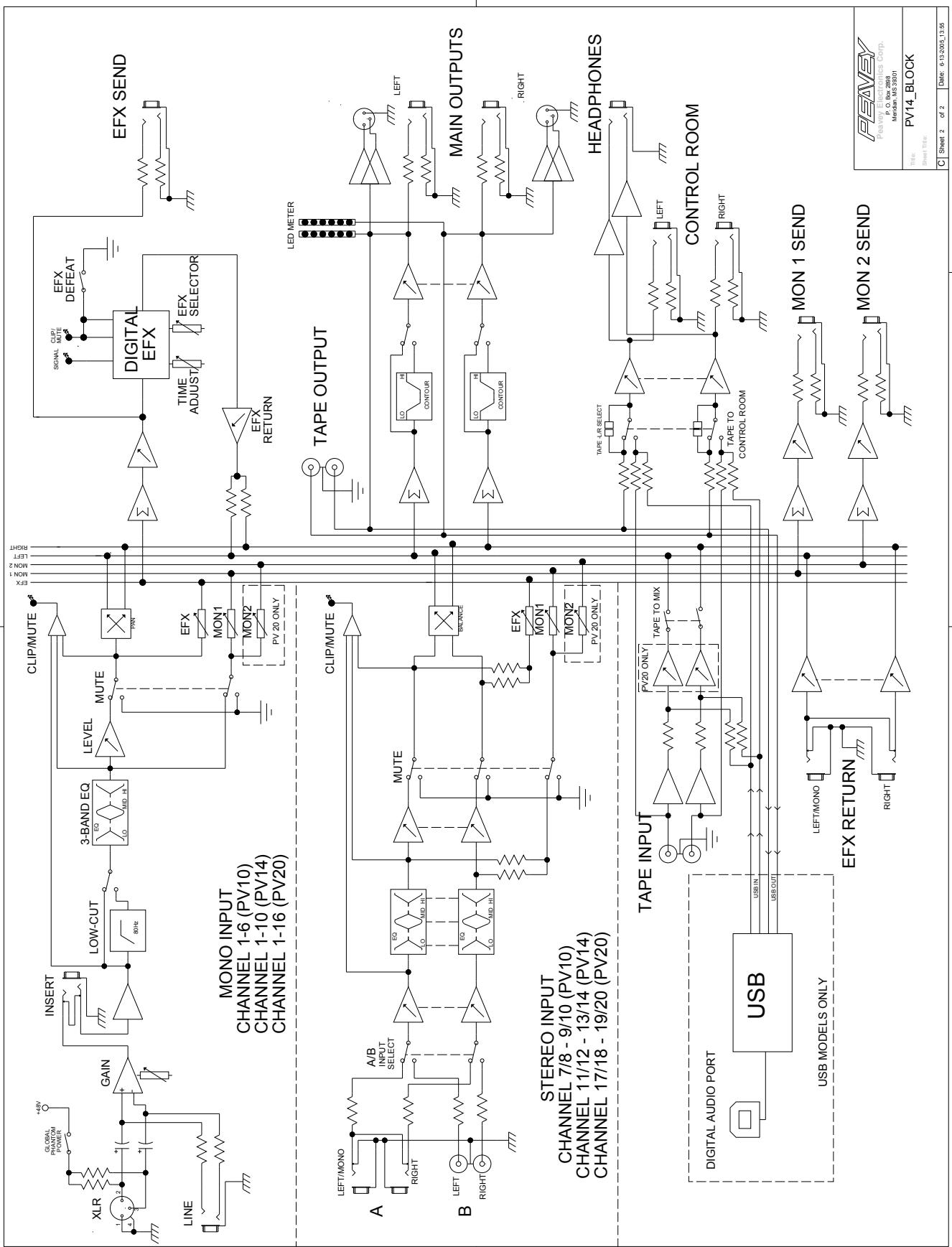
Block Diagram-PV ^TM 10, PV ^TM 14 & PV ^TM 20
PV^TM10 , PV^TM14 & PV^TM20 Series Specifications
Inputs
| Function | Input Z (ohms min) | Input Gain Setting | Min** | Input Levels | Bal/ Unbal | Connector | |
| Nominal* | Max | ||||||
| Microphone (150 ohms) | 2.2k | Max Gain (60 dB) | -76 dBu | -56 dBu | -38 dBu | Bal | XLR Pin 1 Gnd Pin 2 (+) Pin 3 (-) |
| Min Gain (10 dB) | -24 dBu | -4 dBu | +14 dBu | ||||
| Line (10 k ohms) | 10k | Max Gain (40 dB) | -56 dBu | -36 dBu | -18 dBu | Bal | 1/4" TRS; Tip (+) Ring (-) Sleeve Ground |
| Min Gain (-10 dB) | -10 dBu | +14 dBu | +32 dBu | ||||
| Stereo Line Input | 10k | Max Gain (20 dB) | -36 dBu | -16 dBu | +2 dBu | Unbal | 1/4" TS; Tip (+) Sleeve Ground |
| Nominal | -21 dBu | -1 dBu | +17 dBu | ||||
| Tape | 10k | N/A (10 dB) | -17 dBu | -10 dBV | +12 dBu | Unbal | RCA Phono |
| o dBu=0.775 V (RMS) | |||||||
** Min Input Level (sensitivity) is the smallest signal that will produce nominal output (+4 dBu) with channel and master faders set for maximum gain.
* Nominal settings are defined as all controls set at 0 dB (or 50% rotation for rotary pots) except the gain adjustment pot which is as specified.
Outputs
Gain
| Function | Min Load Z (ohms) | Output Levels | Bal/ Unbal | Connector | |
| Nominal | Max | ||||
| Main Left/Right | 600 | +4 dBu | +22 dBu | Bal | XLR Pin Ground Tip Pin 2 (+), Pin 3 (-) 1/4" TRS: Tip (+), Ring (-) Sleeve Ground |
| Effects and Monitor Sends | 600 | +4 dBu | +22 dBu | Bal | 1/4" TRS: Tip (+), Ring (-) Sleeve Ground |
| Control Room | 600 | +4 dBu | +22 dBu | Bal | 1/4" TRS: Tip (+), Ring (-) Sleeve Ground |
| Headphone | 8 | +4 dBu (no load) | +22 dBu | Unbal | 1/4" TRS; Tip Left, Ring Right Sleeve Ground |
| Tape | 2.2k | +4 dBu | +22 dBu | Unbal | RCA Phono |
| USB o dBu=0.775 V (RMS) | |||||
| Mic Input Gain Adjustment Range: | 10 dB to 60 dB |
| Mic Input to Left/Right Balance Output | 88 dB (max gain) |
| Line Input Gain Adjustment Range: | -10 dB to 40 dB |
| Line Input to Left/Right Balance Output | 60 dB (max gain) |
| Stereo Line Input Gain Adjustment Range: | Off to +20 dB |
| Stereo Line Input to Left/Right Output | 40 dB (max gain) |
Frequency Response
Mic Input to Left/Right Output
14 Hz to 25 kHz +0 dB/-1 dB
Total Harmonic Distortion
<0.02% 20 Hz to 20 kHz Mic to Left/Right Output
(10 Hz to 80 kHz BW)
<0.005% Typical
(22 Hz to 22 kHz BW)
<0.0007% Mic Pre-amp Distortion
Hum and Noise
| Output | Residual Noise | S/N Ratio (Ref: +4dBu) | Test Conditions |
| Master Left/Right | -97 dBu | 101 dB | Master Fader Down, Channel Levels Down |
| -90 dBu | 94 dB | Master Fader Nominal, Channel Levels Down | |
| -83 dBu | 87 dB | Master Fade Nominal, Channel Faders Nominal, Panned Odd Channels (left), Even Channels (right) | |
| Monitor Send | -95 dBu | 99 dB | All controls off |
| -80 dBu | 84 dB | All channel sends nominal, masters nominal | |
| Effects Sends | -100 dBu | 104 dB | All controls off |
| -80 dBu | 84 dB | All channel sends nominal, masters nominal |
(Hum and noise measurements: 22 Hz to 22 kHz BW)
Equivalent Input Noise (EIN)
-129 dBu (input terminated with 150 ohms)
Crosstalk/Attenuation
Adjacent Input Channels (1 kHz) >90 dB
Mute Button Attenuation (1 kHz) >90 dB
Left to Right Outputs (1 kHz) >75 dB
Channel Fader Kill (1 kHz) >85 dB
Common Mode Rejection Ratio (Mic Input)
50 dB minimum (20 Hz to 20 kHz)
70 dB typical @ 1 kHz
Meters
8 segment, peak reading (o db = +4 dBu)
Signal/Overload Indicators
Red LED lights 3 dB below clipping
Dimensions
PV10: 12.125" wide x 14.75" deep x 3.5" high (30.80cm x 37.47cm x 8.89cm)
PV20: 22.125" wide x 15.75" deep 3.5" high (56.2cm x 40.0cm x 8.9xm)
PV14: 16.125" wide x 14.75" deep x 3.5" high (40.96cm x 37.47cm x 8.89cm)

Installation Note:
This unit must have the following clearances from any combustible surface: top: 8", sides: 12", back: 12"
Weight
PV10: 9.3 lbs. (4.22 kg)
PV14: 12.1 lbs (5.49kg)
PV20: 16.3 lbs. (7.39kg)
Power Requirements
PV10: 100-240 VAC 50/60 Hz 13 Watts
PV14: 100-240 VAC 50/60 Hz 17 Watts
PV20: 100-240 VAC 50/60 Hz 27 Watts
ESPANOL
PV^TM10, PV^TM14 and PV^TM20
Compact Mixers
Descripción
14 Hz to 25 kHz +0 dB/-1 dB
<0.02% 20 Hz to 20 kHz Micr a Izq/Salida Dcha
(10 Hz to 80 kHz BW)
<0.005% Typical
(22 Hz to 22 kHz BW)
<0.0007% Mic Pre-amp Distortion
Hum and Noise
| Salida | Ruido Residual | S/N Ratio (Ref: +4dBu) | Condicaciones de test |
| Master Izq/Dcha | -97 dBu | 101 dB | Master Fader bajo, Niveles de Canal bajos |
| -90 dBu | 94 dB | Master Fader Nominal, Niveles de Canal bajos | |
| -83 dBu | 87 dB | Master Fader Nominal, Canales Faders Nominal, Canales Panned Odd (izq), Canales Even (dcha) | |
| Envio Monitor | -95 dBu | 99 dB | Todo los controlles apagados |
| -80 dBu | 84 dB | Todo los canales de envio nominal, masters nominal | |
| Envios Efectos | -100 dBu | 104 dB | Todo los controlles apagados |
| -80 dBu | 84 dB | Todo los canales envios nominal, masters nominal |
50 dB minimum (20 Hz to 20 kHz)
70 dB typical @ 1 kHz
Medidos
8 segment, peak reading (o db = +4 dBu)
PV10: 9.3 lbs. (4.22 kg)
PV14: 12.1 lbs (5.49kg)
PV20: 16.3 lbs. (7.39kg)
Green Signal LED and Red Clip LED
Tape to Mix (Tape/USB to Mix)
Tape/USB to Main (PV 20圭lement)
Removable Power Cord
Specifications Series PV™10, PV™14 & PV™20
Entreées
| Fonction | Entree Z (ohms min) | Réglage gain d'entrée | Niveau d'entrées | Bal/ Non bal | Connecteur | ||
| Min** | Nominal* | Max | |||||
| Microphone (150 ohms) | 2.2k | Gain Max (60 dB) | -76 dBu | -56 dBu | -38 dBu | Bal | XLR Pin 1 Gnd Pin 2 (+) Pin 3 (-) |
| Gain Min (10 dB) | -24 dBu | -4 dBu | +14 dBu | ||||
| Ligne (10 k ohms) | 1ok | Gain Max (40 dB) | -56 dBu | -36 dBu | -18 dBu | Bal | 1/4" TRS; Tip (+) Ring (-) Sleeve Ground |
| Gain Min (-10 dB) | -10 dBu | +14 dBu | +32 dBu | ||||
| Entrée ligne Stéréo | 1ok | Gain Max (20 dB) | -36 dBu | -16 dBu | +2 dBu | Non bal | 1/4" TS; Tip (+) Sleeve Ground |
| Nominal | -21 dBu | -1 dBu | +17 dBu | ||||
| Tape | 1ok | N/A (10 dB) | -17 dBu | -10 dBV | +12 dBu | Non bal | RCA Phono |
| o dBu=0.775 V (RMS) | |||||||
14 Hz to 25 kHz +0 dB/-1 dB
Distortion Harmonique Totale
<0.02% 20 Hz to 20 kHz MicroversortiesDroite/Gauche
(10 Hz to 80 kHz BW)
<0.005% Typique
(22 Hz to 22 kHz BW)
<0.0007% Distortion préampli Micro
Bruit et Ronflement
50 dB minimum (20 Hz to 20 kHz)
70 dB typique @ 1 kHz
Vue Metres
8 segment, lecture crête (o db = +4 dBu)
PV10: 9.3 lbs. (4.22 kg)
PV14: 12.1 lbs (5.49kg)
PV20: 16.3 lbs. (7.39kg)
Puisance requise
PV10: 100-240 VAC 50/60 Hz 13 Watts
PV14: 100-240 VAC 50/60 Hz 17 Watts
PV20: 100-240 VAC 50/60 Hz 27 Watts
DEUTSCH
PV™10, PV™14 Und PV™20
24 Phantomspeisung-LED
14 Hz to 25 kHz +0 dB/-1 dB
(10 Hz to 80 kHz BW)
<0.005% typisch
(22 Hz to 22 kHz BW)
What This Warranty Covers
Your Peavey Warranty covers defects in material and workmanship in Peavey products purchased and serviced in the U.S.A. and Canada.
What This Warranty Does Not Cover
The Warranty does not cover: (1) damage caused by accident, misuse, abuse, improper installation or operation, rental, product modification or neglect; (2) damage occurring during shipment; (3) damage caused by repair or service performed by persons not authorized by Peavey; (4) products on which the serial number has been altered, defaced or removed; (5) products not purchased from an Authorized Peavey Dealer.
Who This Warranty Protects
This Warranty protects only the original retail purchaser of the product.
How Long This Warranty Lasts
The Warranty begins on the date of purchase by the original retail purchaser. The duration of the Warranty is as follows:
| Product Category | Duration |
| Guitars/Basses, Amplifiers, Pre-Amplifiers, Mixers, Electronic Crossovers and Equalizers | 2 years (+ 3 years)* |
| Drums | 2 years (+ 1 year)* |
| Enclosures | 3 years (+ 2 years)* |
| Digital Effect Devices and Keyboard and MIDI Controllers | 1 year (+ 1 year)* |
| Microphones | 2 years |
| Speaker Components (incl. speakers, baskets, drivers, diaphragm replacement kits and passive crossovers) and all Accessories | 1 year |
| Tubes and Meters | 90 days |
[Denotes additional warranty period applicable if optional Warranty Registration Card is completed and returned to Peavey by original retail purchaser within 90 days of purchase.]
What Peavey Will Do
We will repair or replace (at Peavey's discretion) products covered by warranty at no charge for labor or materials. If the product or component must be shipped to Peavey for warranty service, the consumer must pay initial shipping charges. If the repairs are covered by warranty, Peavey will pay the return shipping charges.
How To Get Warranty Service
(1) Take the defective item and your sales receipt or other proof of date of purchase to your Authorized Peavey Dealer or Authorized Peavey Service Center. OR
(2) Ship the defective item, prepaid, to Peavey Electronics Corporation, International Service Center, 412 Highway 11 & 80 East, Meridian, MS 39301 or Peavey Canada Ltd., 95 Shields Court, Markham, Ontario, Canada L3R 9T5. Include a detailed description of the problem, together with a copy of your sales receipt or other proof of date of purchase as evidence of warranty coverage. Also provide a complete return address.
Limitation of Implied Warranties
ANY IMPLIED WARRANTY, INCLUDING WARRANTY OF MERCHANTABILITY AND FITNESS FOR A PARTICULAR PURPOSE, ARE LIMITED IN DURATION TO THE LENGTH OF THIS WARRANTY.
Some states do not allow limitations on how long an implied warranty lasts, so the above limitation may not apply to you.
Exclusions of Damages
PEAVEY'S LIABILITY FOR ANY DEFECTIVE PRODUCT IS LIMITED TO THE REPAIR OR REPLACEMENT OF THE PRODUCT, AT PEAVEY'S OPTION. IF WE ELECT TO REPLACE THE PRODUCT, THE REPLACEMENT MAY BE A RECONDITIONED UNIT. PEAVEY SHALL NOT BE LIABLE FOR DAMAGES BASED ON INCONVENIENCE, LOSS OF USE, LOST PROFITS, LOST SAVINGS, DAMAGE TO ANY OTHER EQUIPMENT OR OTHER ITEMS AT THE SITE OF USE, OR ANY OTHER DAMAGES WHEHTHER INCIDENTAL, CONSEQUENTIAL OR OTHERWISE, EVEN IF PEAVEY HAS BEEN ADVISED OF THE POSSIBILITY OF SUCH DAMAGES.
Some states do not allow the exclusion or limitation of incidental or consequential damages, so the above limitation or exclusion may not apply to you.
This Warranty gives you specific legal rights, and you may also have other rights which vary from state to state.
If you have any questions about this warranty or service received or if you need assistance in locating an Authorized Service Center, please contact the Peavey International Service Center at (601) 483-5365 / Peavey Canada Ltd. at (905) 475-2578.
FEATURES AND SPECIFICATIONS SUBJECT TO CHANGE WITHOUT NOTICE.

Features and specifications subject to change without notice.
Peavey Electronics Corporation • 711 A Street • Meridian, MS 39301
(601) 483-5365 • FAX (601) 486-1278 • www.peavey.com
- FEATURES:
- Gain
- Hz Low Cut
- Hi EQ
- Mid EQ
- Low EQ
- MON Send (MON Send 2 on the PVTM20 only)
- EFX Send
- Pan
- Mute
- Clip/Mute LED
- Signal LED
- Fader
- Tape In/Out
- EFX Select
- EFX Time
- Green Signal LED and Red Clip LED
- EFX Return
- MON Send Master
- EFX Send Master
- Headphone Level
- LED Meters
- Power LED
- Phantom Power LED
- Phantom Power Switch
- Tape To CTRL/HP
- Tape/to Mix (Tape/USB to Mix)
- Tape/USB to Main (PV™20 only)
- Contour Switch
- Master Level Faders
- Rear Panel
- Mic (XLR) Inputs
- Line (1 / 4^ ) Inputs
- Insert
- Stereo (1 / 4^ ) Inputs
- RCA Inputs
- A/B Switch
- MON Send
- Control Room Outputs
- Left/Right Outputs
- Headphone Output
- Power Switch
- Removable Power Cord
- NOTE FOR UK ONLY:
- USB port and USB Record Level Control
- Block Diagram-PV TM 10, PV TM 14 & PV TM 20
- PVTM10 , PVTM14 & PVTM20 Series Specifications
- Frequency Response
- Total Harmonic Distortion
- Hum and Noise
- Equivalent Input Noise (EIN)
- Crosstalk/Attenuation
- Common Mode Rejection Ratio (Mic Input)
- Meters
- Signal/Overload Indicators
- Dimensions
- Weight
- Power Requirements
- ESPANOL
- PVTM10, PVTM14 and PVTM20
- Compact Mixers
- Descripción
- Medidos
- Tape to Mix (Tape/USB to Mix)
- Tape/USB to Main (PV 20圭lement)
- Removable Power Cord
- Specifications Series PV™10, PV™14 & PV™20
- Distortion Harmonique Totale
- Bruit et Ronflement
- Vue Metres
- Puisance requise
- DEUTSCH
- PV™10, PV™14 Und PV™20
- Phantomspeisung-LED
- What This Warranty Covers
- What This Warranty Does Not Cover
- Who This Warranty Protects
- How Long This Warranty Lasts
- What Peavey Will Do
- How To Get Warranty Service
- Limitation of Implied Warranties
- Exclusions of Damages
Brand : PEAVEY
Model : PV 14
Category : Audio Mixer