
NSA-220 - NAS Server ZYXEL - Free user manual and instructions
Find the device manual for free NSA-220 ZYXEL in PDF.


| Product type | Server NAS |
| Brand | ZYXEL |
| Model | NSA-220 |
| Dimensions (W x D x H) | 200 x 120 x 150 mm |
| Weight | 2 kg |
| Power supply | External power adapter 12V / 3A |
| Main functions | Network storage, file sharing, automatic backup, media server, FTP server, print server |
| Storage capacity | 2 bays for SATA hard drives (3.5 inches) |
| Supported file systems | EXT4, FAT32, NTFS (read-only) |
| Network protocols | TCP/IP, SMB/CIFS, NFS, AFP, HTTP/HTTPS, FTP, UPnP |
| Connectivity | 2 Gigabit Ethernet ports, 2 USB 2.0 ports |
| RAID configuration | RAID 0, RAID 1, JBOD |
| Management | Web interface (HTTP/HTTPS), setup wizard |
| Security | Administrator password, built-in firewall, SSL/TLS encryption |
| Power supply | 100-240 V, 50/60 Hz |
| Power consumption | 30 W (typical) |
| Operating temperature | 0 to 40 °C |
| Operating humidity | 20 to 80 % (non-condensing) |
| Maintenance and cleaning | Unplug the device, clean with a soft dry cloth. Do not use solvents. |
| Spare parts and repairability | Replaceable hard drives (3.5 inch SATA), replaceable fan, external power supply |
| General information | Compatibility Windows, Mac OS, Linux. 2-year warranty. |
Frequently Asked Questions - NSA-220 ZYXEL
User questions about NSA-220 ZYXEL
0 question about this device. Answer the ones you know or ask your own.
Ask a new question about this device
Download the instructions for your NAS Server in PDF format for free! Find your manual NSA-220 - ZYXEL and take your electronic device back in hand. On this page are published all the documents necessary for the use of your device. NSA-220 by ZYXEL.
USER MANUAL NSA-220 ZYXEL
About This User's Guide
Intended Audience
This manual is intended for people who want to configure the NSA using the web configurator. A basic knowledge of TCP/IP networking concepts and topology will be helpful.
Related Documentation
- Quick Start Guide
- The Quick Start Guide is designed to help you get up and running right away. It contains information on setting up your network and configuring for Internet access.
- Web Configurator Online Help
- Embedded web help for descriptions of individual screens and supplementary information.
- Supporting Disk Refer to the included CD for support documents.
- ZyXEL Web Site Please refer to www.zyxel.com for additional support documentation and product certifications.
User Guide Feedback
Help us help you. Send all User Guide-related comments, questions or suggestions for improvement to the following address, or use e-mail instead. Thank you!
The Technical Writing Team, ZyXEL Communications Corp., 6 Innovation Road II, Science-Based Industrial Park, Hsinchu, 300, Taiwan.
E-mail: techwriters@zyxel.com.tw
Document Conventions
Warnings and Notes
These are how warnings and notes are shown in this User's Guide.

Warnings tell you about things that could harm you or your device.

Notes tell you other important information (for example, other things you may need to configure or helpful tips) or recommendations.
Syntax Conventions
- The NSA may be referred to as the "NSA", the "device" or the "system" in this User's Guide.
- Product labels, screen names, field labels and field choices are all in bold font.
- A key stroke is denoted by square brackets and uppercase text, for example, [ENTER] means the "enter" or "return" key on your keyboard.
- "Enter" means for you to type one or more characters and then press the [ENTER] key. "Select" or "choose" means for you to use one of the predefined choices.
- A right angle bracket (>) within a screen name denotes a mouse click. For example, Maintenance > Log > Log Setting means you first click Maintenance in the navigation panel, then the Log sub menu and finally the Log Setting tab to get to that screen.
- Units of measurement may denote the "metric" value or the "scientific" value. For example, "k" for kilo may denote "1000" or "1024", "M" for mega may denote "1000000" or "1048576" and so on.
- "e.g." is a shorthand for "for instance", and "i.e.," means "that is" or "in other words".
Icons Used in Figures
Figures in this User's Guide may use the following generic icons. The NSA icon is not an exact representation of your device.
| NSA | Computer | Notebook computer |
| Server | Television | Firewall |
| Router | Switch |
SafetyWarnings

For your safety, be sure to read and follow all warning notices and instructions.
- Do NOT use this product near water, for example, in a wet basement or near a swimming pool.
- Do NOT expose your device to dampness, dust or corrosive liquids.
- Do NOT store things on the device.
- Do NOT install, use, or service this device during a thunderstorm. There is a remote risk of electric shock from lightning.
- Connect ONLY suitable accessories to the device.
- Do NOT open the device or unit. Opening or removing covers can expose you to dangerous high voltage points or other risks. ONLY qualified service personnel should service or disassemble this device. Please contact your vendor for further information.
- ONLY qualified service personnel should service or disassemble this device.
- Make sure to connect the cables to the correct ports.
- Place connecting cables carefully so that no one will step on them or stumble over them.
- Always disconnect all cables from this device before servicing or disassembling.
- Use ONLY an appropriate power adaptor or cord for your device.
- Connect the power adaptor or cord to the right supply voltage (for example, 110V AC in North America or 230V AC in Europe).
- Do NOT allow anything to rest on the power adaptor or cord and do NOT place the product where anyone can walk on the power adaptor or cord.
- Do NOT use the device if the power adaptor or cord is damaged as it might cause electrocution.
- If the power adaptor or cord is damaged, remove it from the power outlet.
- Do NOT attempt to repair the power adaptor or cord. Contact your local vendor to order a new one.
- Do not use the device outside, and make sure all the connections are indoors. There is a remote risk of electric shock from lightning.
- CAUTION: RISK OF EXPLOSION IF BATTERY (on the motherboard) IS REPLACED BY AN INCORRECT TYPE. DISPOSE OF USED BATTERIES ACCORDING TO THE INSTRUCTIONS. Dispose them at the applicable collection point for the recycling of electrical and electronic equipment. For detailed information about recycling of this product, please contact your local city office, your household waste disposal service or the store where you purchased the product.
- Do NOT obstruct the device ventilation slots, as insufficient airflow may harm your device.
This product is recyclable. Dispose of it properly.
Contents Overview
Introduction 23
Getting to Know Your NSA 25
Web Configurator Basics 29
Tutorials 43
Status Screen 51
Status, System, Storage, and Network 55
System Setting Screens 57
Storage Screens 61
Network Screen 73
Application Screens 77
User Accounts and Shares 81
Users 83
Shares 89
Protection, Media Client, Maintenance, & Troubleshooting 95
Maintenance Screens 97
Protecting Your Data 105
Media Client Software 107
Memoo Autobackup Software 109
Troubleshooting 111
Appendices and Index 119
Table of Contents
About This User's Guide 3
Document Conventions 4
SafetyWarnings 6
Contents Overview 9
Table of Contents 11
List of Figures 17
List of Tables 21
Part I: Introduction 23
Chapter 1 Getting to Know Your NSA 25
1.1 NSA Overview 25
1.1.1 LEDs 26
1.1.2 COPY Button 28
Chapter 2 Web Configurator Basics 29
2.1 Web Configurator Overview 29
2.2 Accessing the NSA Web Configurator 29
2.2.1 Access the NSA Via NDU 29
2.2.2 Web Browser Access 30
2.3 Login 30
2.4 User-level Screens Overview 31
2.5 My NSA Screen 33
2.5.1 My NSA Share Browsing Screen 34
2.5.2 My NSA Management Overview Screen 34
2.5.3 My NSA Change Share Properties Screen 35
2.5.4 Share and Folder Names 37
2.5.5 Share Paths 38
2.5.6 Password Screen 38
2.6 Administration Screens 39
2.6.1 Global Administration Icons 40
2.6.2 Navigation Panel 40
2.6.3 Main Window 42
2.6.4 Status Messages 42
2.6.5 Common Screen Icons 42
Chapter 3
Tutorials 43
3.1 Tutorials Introduction 43
3.2 Creating a User Account 43
3.3 Creating a Share 44
3.4 Accessing a Share From Windows Explorer 46
3.5 Accessing a Share Using FTP 48
3.6 Accessing a Share Through the Web Configurator 49
Chapter 4
Status Screen 51
4.1 Status Screen 51
4.1.1 Session Example (Windows) 53
Part II: Status, System, Storage, and Network 55
Chapter 5
System Setting Screens 57
5.1 System Setting Screens 57
5.1.1 Windows/CIFS 57
5.2 Server Name 57
5.3 Date/Time 58
5.3.1 Time Lag 58
5.3.2 Date/Time Screen 59
Chapter 6
Storage Screens 61
6.1 Storage Introduction 61
6.2 Storage Overview Screen 61
6.3 Volumes and RAID 62
6.3.1 Choosing A Storage Method For a Volume 63
6.3.2 Volume Status 64
6.3.3 Resynchronizing a RAID 1 Volume 64
6.4 RAID 65
6.4.1 JBOD 66
6.4.2 RAID 0 66
6.4.3 RAID 1 67
6.4.4 RAID and Data Protection 67
6.5 Disks 68
6.5.1 External Disks 68
6.5.2 Disk Replacement Restrictions 68
6.5.3 Disk Replacement and Volume Labels 68
6.6 Creating a New Internal Volume 69
6.7 Editing an Internal Volume 70
6.8 Creating a New External Volume 70
6.9 Editing an External Volume 71
Chapter 7 Network Screen 73
7.1 Network Settings 73
7.1.1 IP Address 73
7.1.2 DNS Server Address 73
7.2 Network Config Screen 73
Chapter 8 Application Screens 77
8.1 Application Screens 77
8.2 FTP 77
8.3 FTP Screen 77
8.4 Media Server 78
8.5 Media Server Screen 79
Part III: User Accounts and Shares 81
Chapter 9 Users. 83
9.1 User Accounts Introduction 83
9.2 Users Overview Screen 83
9.2.1 User Icons 84
9.3 Adding or Editing a User Account 85
9.3.1 Add or Edit a User Account Screen 85
9.3.2 usernames 85
9.4 Change Password Screen 86
9.5 Delete Account Screen 87
Chapter 10 Shares 89
10.1 Shares Introduction 89
10.1.1 Share Icons 89
10.1.2 Shares Screen 89
10.2 Adding a New Share 90
10.2.1 Public and ANONYMOUS Share Access Rights 92
10.3 Share Path Browse Screen 92
Part IV: Protection, Media Client, Maintenance, & Troubleshooting . 95
Chapter 11
Maintenance Screens 97
11.1 Maintenance Overview 97
11.2 Log 97
11.3 Log Classes 98
11.4 Log Severity Levels 98
11.5 Log Messages 99
11.6 Configuration 100
11.7 Firmware Upgrade 101
11.8 Shutdown 102
Chapter 12
Protecting Your Data 105
12.1 Protection Methods 105
12.1.1 Configuration File Backup and Restoration 105
12.1.2 Memeo Autobackup 106
Chapter 13
Media Client Software 107
13.1 Media Client Introduction 107
13.2 Using the Media Client Software 107
Chapter 14
Memeo Autobackup Software 109
14.1 Memeo Autobackup Introduction 109
14.2 Using the Memeo Autobackup Software 109
Chapter 15
Troubleshooting 111
15.1 Troubleshooting Overview 111
15.2 Power, Hardware, Connections, and LEDs 111
15.3 NSA Login and Access 113
15.3.1 Reset the NSA 114
15.3.2 Enabling Scripting of Safe ActiveX Controls 115
15.4 I Cannot Access The NSA 116
15.5 External USB drives 117
15.6 Media Server Functions 118
Part V: Appendices and Index 119
Appendix A Product Specifications 121
Appendix B Setting up Your Computer's IP Address 129
Appendix C Pop-up Windows 143
Appendix D Open Source Licences 151
Appendix E Legal Information 181
Appendix F Customer Support 183
Index 187
List of Figures
Figure 1 Example of the NSA in a Home Network 25
Figure 2 NSA Front Panel 26
Figure 3 NSA Rear Panel 27
Figure 4 NDU Main Screen 30
Figure 5 NSA URL 30
Figure 6 NSA Login Screen 31
Figure 7 Change Password Screen 31
Figure 8 My NSA 32
Figure 9 My NSA 33
Figure 10 My NSA Share Browsing 34
Figure 11 My NSA Management Overview 35
Figure 12 My NSA Change Share Properties 36
Figure 13 Password 39
Figure 14 Status 40
Figure 15 Navigation Panel Links 41
Figure 16 My NSA 43
Figure 17 Users 44
Figure 18 Users > Create Example 44
Figure 19 Users (Account Created) 44
Figure 20 Shares 45
Figure 21 Shares > Create Example 45
Figure 22 Shares > Create > Browse > Create Folder Example 45
Figure 23 Shares > Create > Browse > New Folder Example 46
Figure 24 Shares > Create Example 46
Figure 25 NSA Top Level 46
Figure 26 Map Network Drive 47
Figure 27 Enter Network Password 47
Figure 28 Example Share Mapped (Folders View) 47
Figure 29 FTP Example: Typing the FTP Target 48
Figure 30 FTP Example: Enter the Password 48
Figure 31 FTP Example: Logged In 49
Figure 32 My NSA User Login 49
Figure 33 My NSA User Login 50
Figure 34 Status 51
Figure 35 Session Example (Windows) 53
Figure 36 System Setting > Server Name 58
Figure 37 System Setting > Date/Time 59
Figure 38 Storage 61
Figure 39 Delete a Volume Warning Screen 62
Figure 40 Create a New Internal Volume 69
Figure 41 Edit an Internal Volume 70
Figure 42 Create a New External Volume 71
Figure 43 Edit an External Volume 72
Figure 44 Network > Network Config 74
Figure 45 Applications > FTP 78
Figure 46 Applications > Media Server 79
Figure 47 Users 84
Figure 48 Users > Add or Edit an Account 85
Figure 49 Users > Change Password 86
Figure 50 Users > Delete Account 87
Figure 51 Shares 90
Figure 52 Shares > Add Share 91
Figure 53 Share Path Browse 92
Figure 54 Maintenance > Log 97
Figure 55 Maintenance > Configuration 101
Figure 56 Maintenance > FW Upgrade 101
Figure 57 Maintenance > Shutdown 102
Figure 58 Maintenance > Shutdown > Confirm Restart 102
Figure 59 Maintenance > Shutdown > Confirm Shutdown 103
Figure 60 Internet Options: Security 115
Figure 61 Security Settings - Script Safe ActiveX Controls 116
Figure 62 Windows 95/98/Me: Network: Configuration 130
Figure 63 Windows 95/98/Me: TCP/IP Properties: IP Address 131
Figure 64 Windows 95/98/Me: TCP/IP Properties: DNS Configuration 132
Figure 65 Windows XP: Start Menu 133
Figure 66 Windows XP: Control Panel 133
Figure 67 Windows XP: Control Panel: Network Connections: Properties 134
Figure 68 Windows XP: Local Area Connection Properties 134
Figure 69 Windows XP: Internet Protocol (TCP/IP) Properties 135
Figure 70 Windows XP: Advanced TCP/IP Properties 136
Figure 71 Windows XP: Internet Protocol (TCP/IP) Properties 137
Figure 72 Macintosh OS X: Apple Menu 138
Figure 73 Macintosh OS X: Network 138
Figure 74 Red Hat 9.0: KDE: Network Configuration: Devices 139
Figure 75 Red Hat 9.0: KDE: Ethernet Device: General 140
Figure 76 Red Hat 9.0: KDE: Network Configuration: DNS 140
Figure 77 Red Hat 9.0: KDE: Network Configuration: Activate 141
Figure 78 Red Hat 9.0: Dynamic IP Address Setting in ifconfig-eth0 141
Figure 79 Red Hat 9.0: Static IP Address Setting in ifconfig-eth0 141
Figure 80 Red Hat 9.0: DNS Settings in resolv.conf 142
Figure 81 Red Hat 9.0: Restart Ethernet Card 142
Figure 82 Red Hat 9.0: Checking TCP/IP Properties 142
Figure 83 Pop-up Blocker 143
Figure 84 Internet Options: Privacy 144
Figure 85 Internet Options: Privacy 145
Figure 86 Pop-up Blocker Settings 145
Figure 87 Internet Options: Security 146
Figure 88 Security Settings - Java Scripting 147
Figure 89 Security Settings - Java 147
Figure 90 Java (Sun) 148
Figure 91 Mozilla Firefox: Tools > Options 148
Figure 92 Mozilla Firefox Content Security 149
List of Tables
Table 1 LEDs 27
Table 2 User-level Global Labels and Icons 32
Table 3 My NSA 33
Table 4 My NSA Share Browsing 34
Table 5 My NSA Management Overview 35
Table 6 My NSA Change Share Properties 36
Table 7 Password 39
Table 8 Global Labels and Icons 40
Table 9 Screens Summary 41
Table 10 Common Configuration Screen Icons 42
Table 11 Status 52
Table 12 System Setting > Server Name 58
Table 13 System Setting > Date/Time 59
Table 14 Storage > Overview 62
Table 15 RAID Quick Comparison 63
Table 16 JBOD 66
Table 17 RAID 0 66
Table 18 RAID 1 67
Table 19 Create a New Internal Volume 69
Table 20 Edit an Internal Volume 70
Table 21 Create a New External Volume 71
Table 22 Edit an External Volume 72
Table 23 Network Config > Network Config 74
Table 24 Applications > FTP
Table 25 Applications > Media Server 79
Table 26 Users 84
Table 27 User Icons 84
Table 28 Users > Add or Edit an Account 85
Table 29 Users > Change Password 87
Table 30 Users > Delete Account 87
Table 31 Share Icons 89
Table 32 Shares 90
Table 33 Shares > Add Share 91
Table 34 Share Path Browse 93
Table 35 Maintenance > Log
Table 36 Log Classes 98
Table 37 Log Severity Levels 98
Table 38 Log Messages 99
Table 39 Maintenance > Configuration 101
Table 40 Maintenance > FW Upgrade 102
Table 41 Maintenance > Shutdown 102
Table 42 Overview of Protection Methods 105
Table 43 Physical Features 121
Table 44 Firmware Features 121
Table 45 NSA Hardware Specifications 122
Table 46 NSA Firmware Specifications 123
Table 47 Supported Standards and Recommendations 124
Table 48 Supported Media Server Content Formats 126
Table 49 Power Consumption in Watts (W) 127
Table 50 127
PART I
Introduction
Getting to Know Your NSA (25)
Web Configurator Basics (29)
Tutorials (43)
Status Screen (45)
Getting to Know Your NSA
This chapter covers the main features and applications of the NSA.
1.1 NSA Overview
The NSA (Network Storage Appliance) provides file sharing and data backup for your home network.
- Use SATA (Serial Advanced Technology Attachment) I or 3.0 Gbit/s hard disks.
- RAID (Redundant Array of Independent Disks) protects your data even if a hard disk fails.
- You can expand the NSA's storage capacity with USB devices (like hard drives).
- Use the COPY button to copy files directly to the NSA from USB devices like card readers, MP3 players, memory sticks, and digital cameras without using a computer.
- The NSA is a media server. Media clients can play the NSA's video, music and photo files. Use the included media client software to make your computers into media clients. You can also use hardware-based media clients like the DMA-1000.
- The NSA has a 10/100/1000 Mbps Ethernet port for connecting to your network.
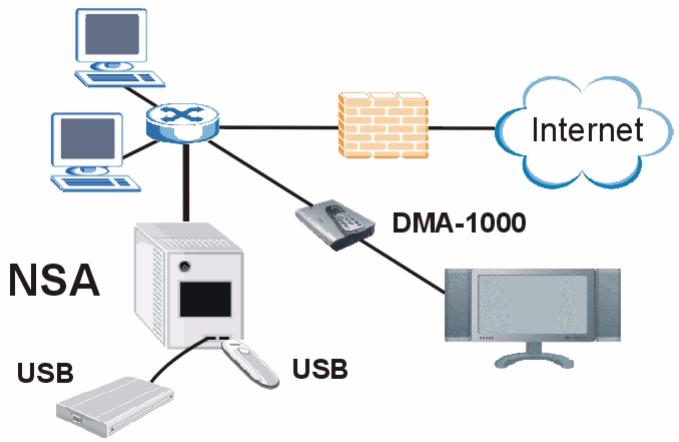
Figure 1 Example of the NSA in a Home Network
Above is the NSA in a home network. Users back up and share data on the NSA. The DMA-1000 plays the NSA's media files on the TV. A USB hard drive provides extra storage space and files are copied directly from the USB memory stick to the NSA.
Place the NSA behind a firewall and/or IDP (Intrusion Detection and Prevention) device to protect it from attacks from the Internet.

See the product specifications appendix for a more detailed list of NSA features and lists of compatible hard drives and USB devices.
Refer to the Quick Start Guide for hardware connections and how to install and remove hard drives from the disk trays.

Turn off and disconnect the NSA before you install or remove internal hard drives.
1.1.1 LEDs
The NSA LEDs (lights) tell you important information.
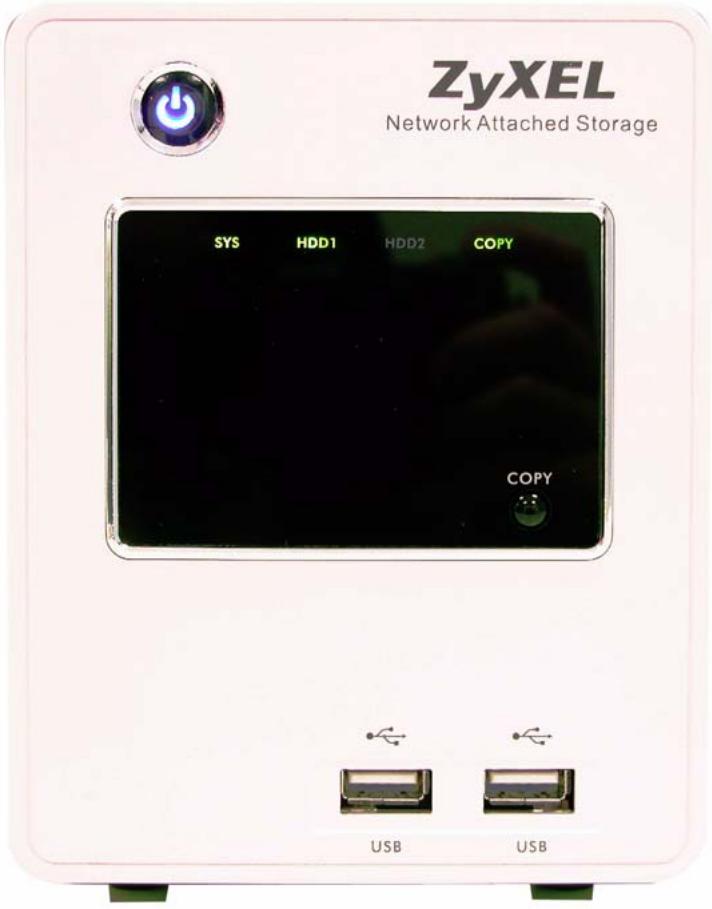
Figure 2 NSA Front Panel

Figure 3 NSA Rear Panel
This table describes the NSA's LEDs.
Table 1 LEDs
| LED | COLOR | STATUS | DESCRIPTION |
| POWER | Blue | On | The NSA is turned on and receiving power. |
| Off | The NSA is turned off. | ||
| HDD1/HDD2 | Green | On | The hard disk drive is connected properly to the NSA. |
| Blinking | The NSA is saving data to the hard disk drive. | ||
| OrangeA | On | The NSA detected an error on the hard disk drive (like a bad sector for example). The NSA automatically tries to recover a bad sector, but the LED stays orange until the NSA restarts. | |
| Blinking | The hard disk drive connection came loose or the NSA detected an error on the hard disk drive (like a bad sector for example) and is saving data to the hard disk drive. | ||
| Red | On | The hard disk drive has failed and the NSA can no longer detect it. | |
| Off | The NSA cannot detect a hard disk in the disk bay. | ||
| SYS | Green | On | The NSA has fully started and is operating normally. |
| Blinking | The NSA is starting up. | ||
| Red | On | The NSA has failed. | |
| LAN | Green | On | The NSA has a successful 10/100Mbps Ethernet connection. |
| Blinking | The 100M LAN is sending or receiving packets. | ||
| Off | The NSA does not have a 10/100Mbps Ethernet connection. | ||
| Yellow | On | The NSA has a successful 1000Mbps Ethernet connection. | |
| Blinking | The 1000M LAN is sending or receiving packets. | ||
| Off | The NSA does not have a 1000Mbps Ethernet connection. | ||
| COPY | Green | On | A USB device is connected to the NSA. |
| Blinking | The NSA is copying files from the USB device. | ||
| Red | On | Copying files from the USB device failed. | |
| Off | No USB device is connected. |
A. The HDD1 and HDD2 LEDs are dual-color (green and red). The green LED is normally on when you have a hard disk installed. If the NSA detects an error on the disk, the disk's connection comes loose, or the disk fails, the red LED also comes on. Since the green LED still stays on, the color appears to be orange. If the NSA is no longer able to detect a hard disk in the disk bay, the green LED turns off and the LED appears as red.
1.1.2 COPY Button
Use the COPY button on the front panel to copy files from a connected USB device to the NSA. The files are stored in a folder created within the public share. The name of the folder created for the copied files consists of the date and time of the copy in
year_month_day_hour Minute_second format. Up to a total of 10 GB for files can be copied. If the USB device has more than 10 GB of files, the NSA emits a long beep and does not copy any of the files.
Web Configurator Basics
This chapter describes how to access the NSA web configurator and provides an overview of its screens.
2.1 Web Configurator Overview
The web configurator is an HTML-based management interface that allows easy NSA setup and management via Internet browser. Use Internet Explorer 6.0, Mozilla Firefox 1.07, Netscape Navigator 7.0 or later versions of these browsers. The recommended screen resolution is 1024 by 768 pixels or higher.
In order to use the web configurator you need to allow:
- Web browser pop-up windows from your device. Web pop-up blocking is enabled by default in Windows XP SP (Service Pack) 2.
JavaScript (enabled by default).
2.2 Accessing the NSA Web Configurator
Make sure your NSA is properly connected and that your computer is in the same subnet as the NSA (refer to the Quick Start Guide or the appendices).
2.2.1 Access the NSA Via NDU
If you don't know the IP address of the NSA, then use the NDU to find it. Refer to the Quick Start Guide to see how to install and run the NDU.
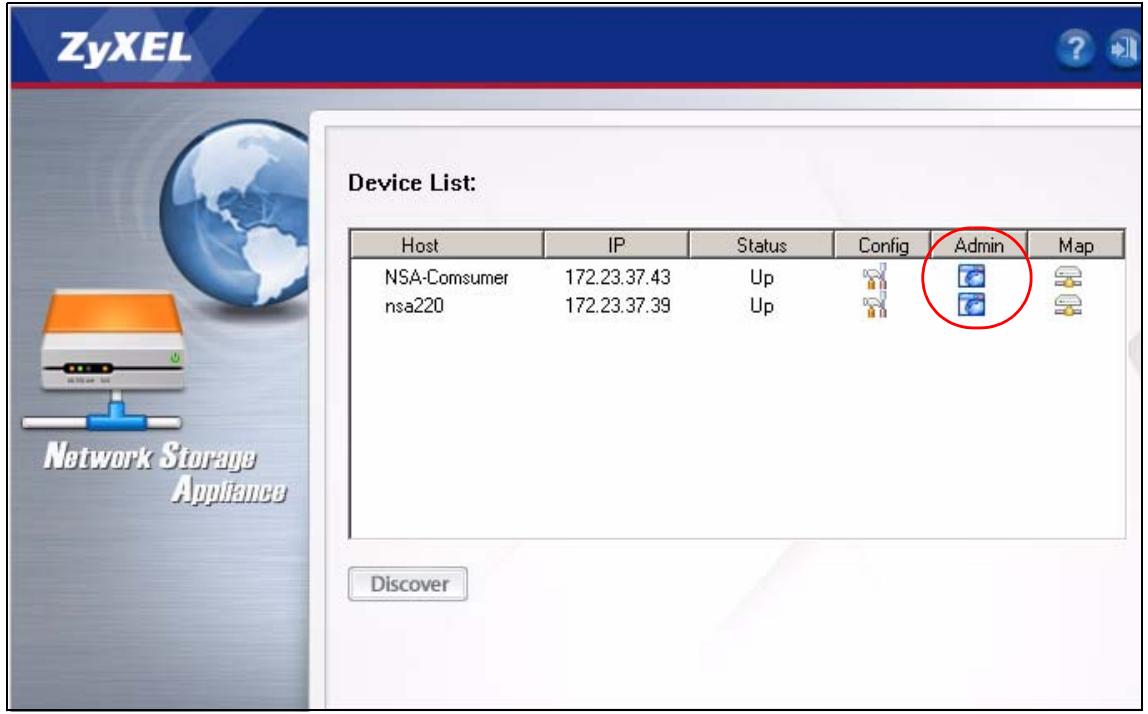
Figure 4 NDU Main Screen
From the NDU main page click an icon under Admin to see the web configurator screen login screen.
2.2.2 Web Browser Access
Open your browser and type in the server name of the NSA ("nsa220" is the default).
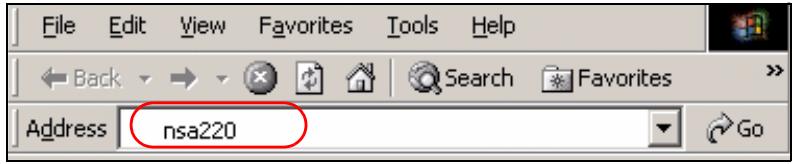
Figure 5 NSA URL
2.3 Login
The default username and password are 'admin' and '1234' respectively. Enter your username and password, then click Login. See Chapter 9 on page 85 for how to create other user accounts.
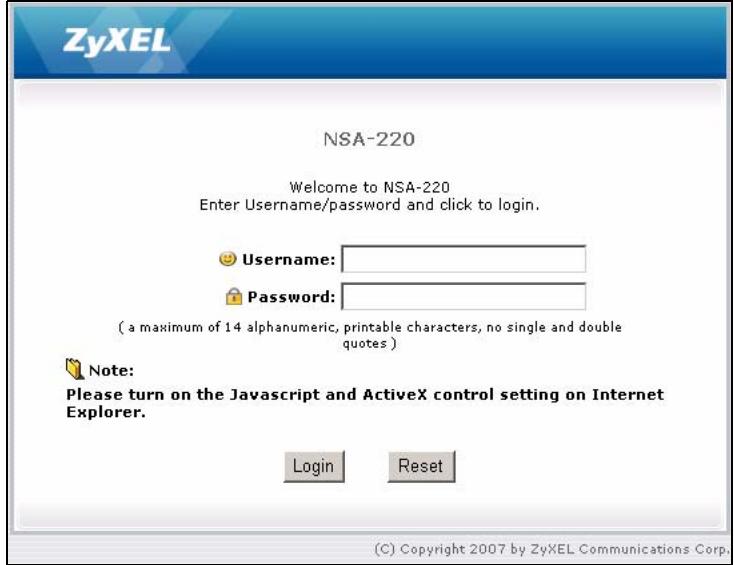
Figure 6 NSA Login Screen
You should see a screen asking you to change your password (highly recommended) as shown next. Type a new password (and retype it to confirm) and click Apply or click Ignore.
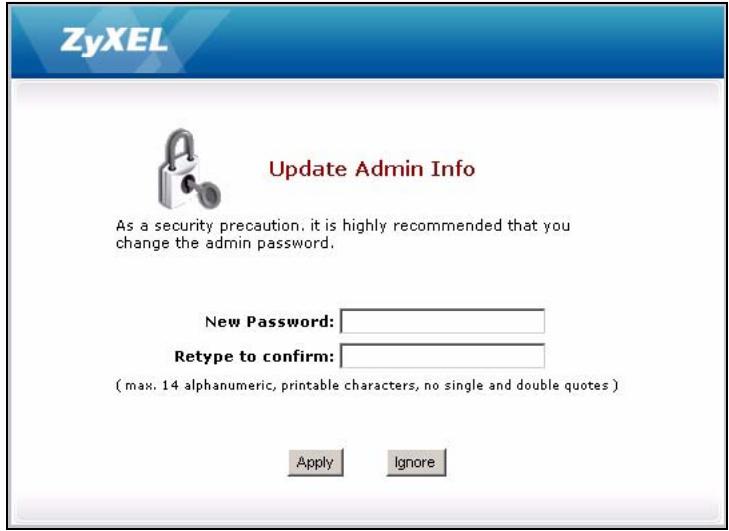
Figure 7 Change Password Screen
2.4 User-level Screens Overview
All users (including the administrator) first see the user-level access My NSA screen after login.
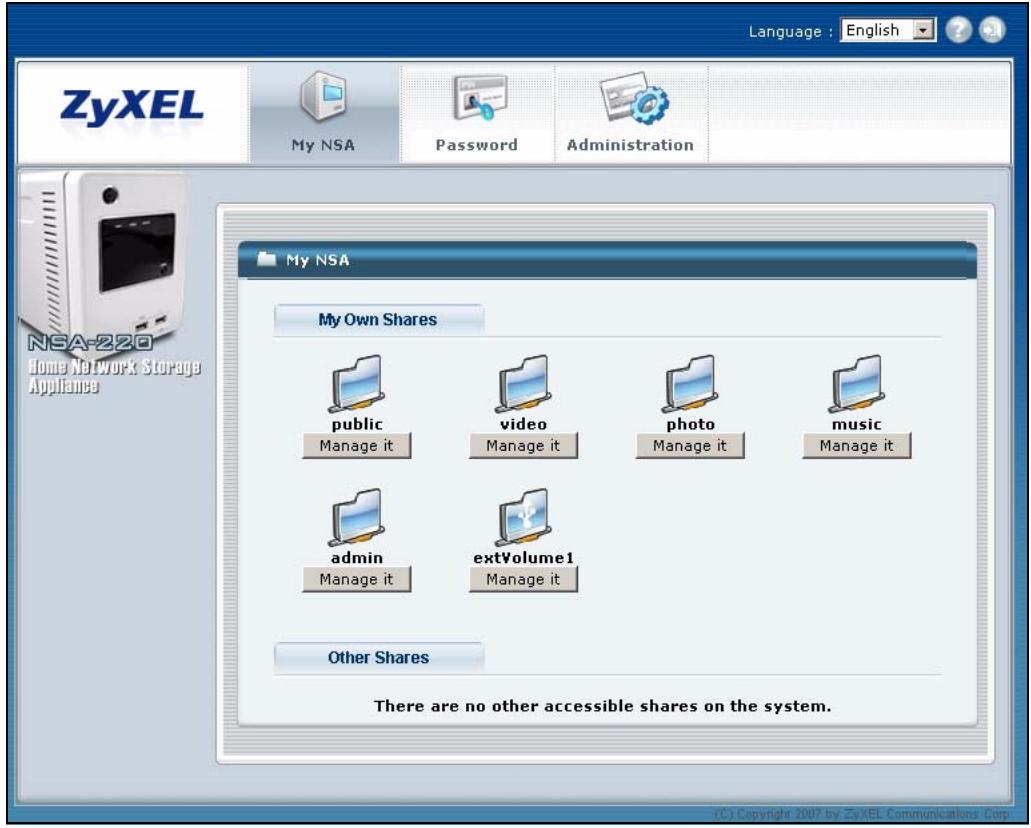
Figure 8 My NSA

The web configurator management session automatically times out if it is left idle for 15 minutes. Simply log back into the NSA if this happens to you.
The icons and language label at the top-right of the screen (1) are visible from most screens. Use the tabs at the top of the screen to navigate between the user-level screens and menus. The following table describes the 'global' icons and tabs in the user-level screens.
Table 2 User-level Global Labels and Icons
| LABEL/ICON | DESCRIPTION |
| Language | Select the web configurator language from the drop-down list box. |
| Click the Help icon to open a web help page specific to the screen you are currently configuring. | |
| Click theLogout icon at any time to exit the web configurator. | |
| My NSA | Click this tab to go to screens where you can manage your shares and access the files on public shares. The administrator must go into the administration screens to manage other user's shares. |
| Password | Click this tab to go to a screen where you can change your password. |
| Administration | Click this tab to go to screens where you can manage advanced configurations. You will have to log in as the administrator if you are not already logged in as the administrator. |
2.5 My NSA Screen
Use the My NSA screens to manage your shares and access the files in folders to which you have access.
A share is a set of user access permissions for a specific folder on a volume (gives someone access to a folder). It is equivalent to the Windows concept of a shared folder, but the access rights are independent of the folder (you configure the share and the folder separately). You can map a share to a network drive for easy and familiar file transfer for Windows users.
The main MyNSA screen displays the shares to which you have access.
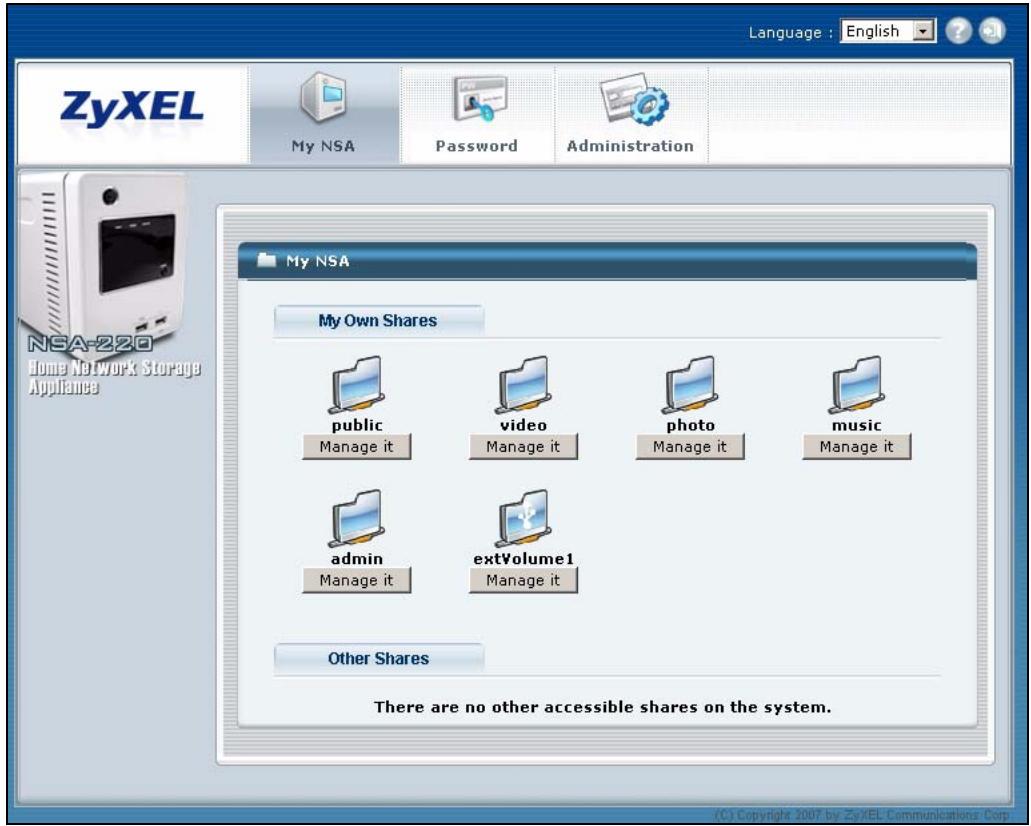
Figure 9 My NSA
The following table describes the labels in this screen.
Table 3 My NSA
| LABEL | DESCRIPTION |
| This share icon represents a share on a volume on the internal hard drives (to which you have access). Click this icon to access the share's contents. The folder appears as gray if the share is not currently available (because the hard drive was removed for example). | |
| This share icon represents a share on a volume on an external (USB) device. Click this icon to access the share's contents. The folder appears as gray if the share is not currently available (because the USB drive was removed for example). | |
| Manage It | Click this button to see and configure the management details for a share. |
2.5.1 My NSA Share Browsing Screen
Click My NSA and then click a share to open the following screen. Use the My NSA share browsing screens to see and access share contents.
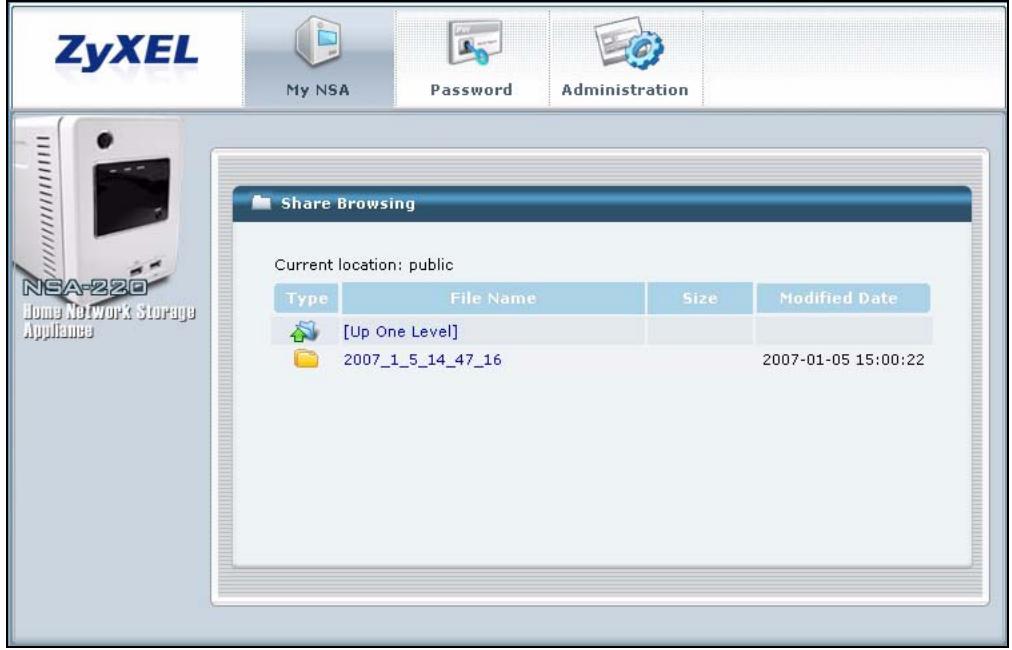
Figure 10 My NSA Share Browsing
The following table describes the labels in this screen.
Table 4 My NSA Share Browsing
| LABEL | DESCRIPTION |
| Current location | This is the name of the share and folder path that you are in. |
| Type | The icon in this column identifies the entry as a folder or a file.The folder with an arrow pointing up is for the link that takes you to thenext higher layer in the share's folder tree. |
| File Name | This column identifies the names of folders and files in the share.Click Up One Level to go to the next higher layer in the share's foldertree.Click a file's file name to open the file.Click a folder's name to display the folder's contents. |
| Size | This column displays a file's size in bytes. |
| Modified Date | This column displays the last time the file or folder was changed (in year-month-day hour:minute:second format). |
2.5.2 My NSA Management Overview Screen
Use the My NSA management overview screens to see and configure share management details.
Click My NSA and then the Manage It button of one of your shares to open the following screen. This screen displays a share's management details.
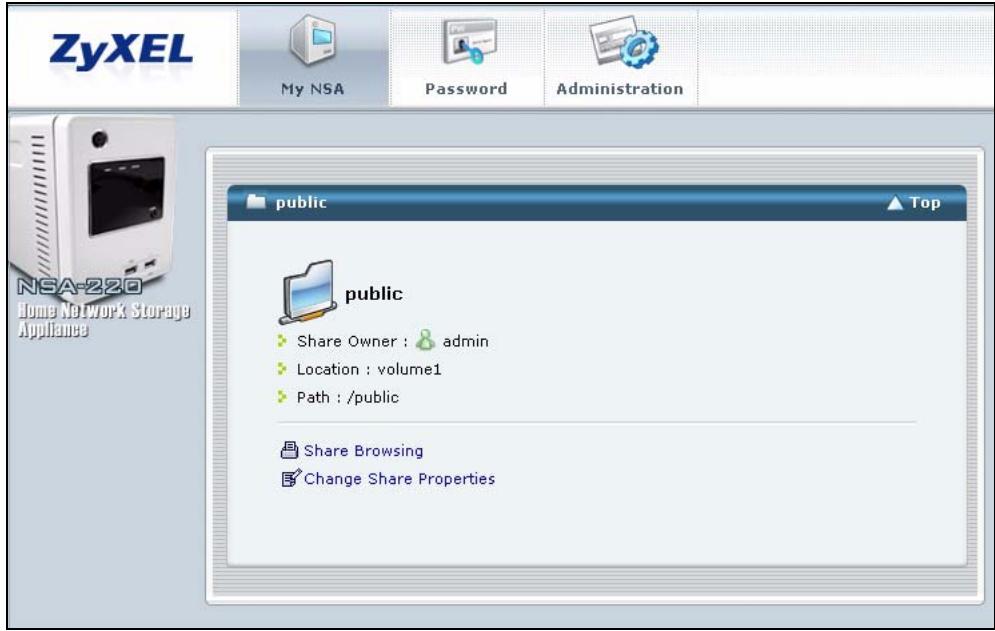
Figure 11 My NSA Management Overview
The following table describes the labels in the this screen.
Table 5 My NSA Management Overview
| LABEL | DESCRIPTION |
| Share Owner | The share belongs to (and is managed by) this user account. The share owner controls access rights to the share. |
| Location | The share is for a folder on this volume. |
| Path | This is the share's file path. |
| Share Browsing | Click this link to see and access the share's contents. |
| Change Share Properties | Click this link to configure the share's management details. |
2.5.3 My NSA Change Share Properties Screen
Use the My NSA Change Share Properties screen to configure share management details.
Click My NSA and a share's Manage It button. Then click Change Share Properties to open the following screen. This screen displays a share's management details.
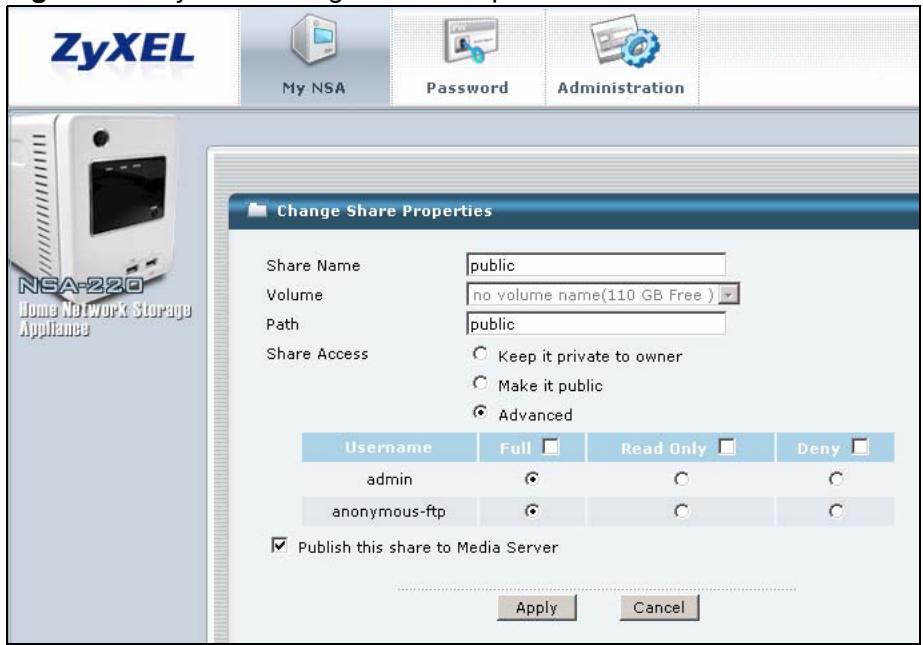
Figure 12 My NSA Change Share Properties
The following table describes the labels in the this screen.
Table 6 My NSA Change Share Properties
| LABEL | DESCRIPTION |
| Share Name | Configure a name to identify this share. Type a share name from 1 to 255 single-byte (no Chinese characters allowed for example) ASCII characters. The name cannot be the same as another existing local share. See Section 2.5.4 on page 37 for more information on share names. |
| Volume | You should have already created volumes (a single accessible storage area with a single file system) on the NSA. Select the volume that you want to use with this share. |
| Path | This is the share's file path. |
| Share Access | Select who can access the files in the share and how much access they are to be given. Select Keep it private to owner to allow only the share owner to read files in the share, delete files in the share and save files to the share. Select Make it public to allow anyone (with or without a user account on the NSA) to read files in the share, delete files in the share and save files to the share. Select Advanced to select which individual users can read the share's files, which users can delete the share's files, and which users are blocked from doing either. |
| Username | This appears when you set the Share Access to Advanced. This column lists the names of the NSA's user accounts. |
| Full | This appears when you set the Share Access to Advanced. Select this column's radio button in a user account's row to give the user full access to the share. This allows the user to read files in the share, delete files in the share and save files to the share. Select the check box at the top of the column to give all of the users full access to the share. |
| Read Only | This appears when you set the Share Access to Advanced. Select this column's radio button in a user account's row to give the user read-only access to the share. This allows the user to view or copy files in the share, but not delete files in the share or save files to the share-select the check box at the top of the column to give all of the users read-only access to the share. |
| Deny | This appears when you set the Share Access to Advanced. Select this column's radio button in a user account's row to stop the user from accessing the share. This means the user cannot read files in the share, delete files in the share, or save files to the share.Select the check box at the top of the column to stop all of the users from accessing the share.Note:Selecting the check box at the top of the column blocks everyone (including the administrator) from accessing the share. |
| Publish this share to Media Server | Select this option to make the share's files available to media clients. |
| Apply | Click this button to save your changes back to the NSA. |
| Cancel | Click this button to begin configuring this screen afresh. |
2.5.4 Share and Folder Names
The name can only contain the following characters:
- Alphanumeric (A-z 0-9) and Unicode.
The NSA allows FTP access to shares, folders or files with names encoded in the UTF-8 (8-bit UCS/Unicode Transformation Format) format. So your FTP client must support UTF-8 in order to access shares, folders or files on the NSA with Unicode names.
Spaces
- [underscores]
[periods]
- - [dashes]
Other limitations include:
- All leading and trailing spaces are removed automatically.
- Multiple spaces within names are converted to a single space.
- Share names must be unique (they cannot be the same as other share names).
- The NSA creates automatic volume names for external (USB) disk volumes. These are a type of share, so the share name you configure cannot conflict with the external (USB) disk volume names. "ExtVol1" or "ExtVol2" are examples of external (USB) disk volume names.
- Folder names must be unique (they cannot be the same as other folder names).
- The minimum character length of a name is one character, that is a name cannot be blank.
- The maximum character length of share name is 255 characters.
- Unicode is supported for share names, although your FTP client must support UTF-8. Full support should be available in all Windows versions after Windows 2000.
2.5.5 Share Paths
A share path is the full path to a folder on a volume that will be shared, for example, /mysna/topsecret/ugs/. This is independent from a "share name" which is the name shown for this share when accessing the share via CIFS or FTP. The path should start with a '/' (forward slash) followed by a parent folder, child folders leading to the folder that is to be shared.
The share path can include all characters including unicode characters (that is, you can use Chinese folder names for example) except for the following characters:
- [backslash] this will be converted to forward slash and interpreted as a path delimiter
- / [forward slash] this is always interpreted as a path delimiter, so a folder cannot include it in its folder name
: [colon] - [asterisk]
? [question mark] - "[double quote]"
- < [less than]
-
[greater than]
- | [pipe]
Please also note the following as regards share paths:
- If the share path is missing the root path slash (the first forward slash), the system will automatically add the initial slash.
- If the share path is missing the end trailing slash, the system will automatically add the trailing slash.
- If the share path has ' (backslashes) instead of ' /' (forward slashes) they will all be automatically converted to forward slashes.
- Share paths are case sensitive.
- The maximum share path length is 600 characters (the entire path string including slashes)
- The share path cannot be blank
- You cannot have an empty folder name, that is, two consecutive slashes (for example, '/ My//Corner/')
Each individual folder in the path (that is, the content between the slashes) cannot exceed 255 characters
2.5.6 Password Screen
Click Password to open the following screen.
Use this screen to change your password. Enter a new password and confirm it by re-entering it.
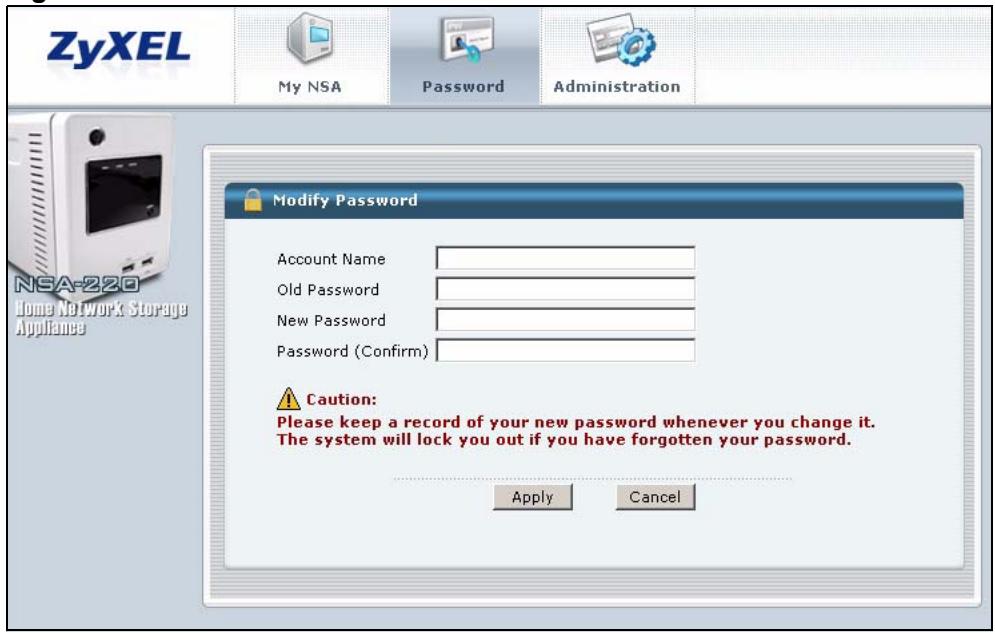
Figure 13 Password
The following table describes the labels in this screen.
Table 7 Password
| LABEL | DESCRIPTION |
| Change Password | |
| New Password | Create a new password for this user. You can type from one to 14 single-byte (no Chinese characters allowed for example) ASCII characters. |
| Retype to confirm | You must type the exact same password that you just typed in the above field. |
| Apply | Click this button to save your changes back to the NSA. |
| Cancel | Click this button to begin configuring this screen afresh. |
2.6 Administration Screens
Click Administration in the user-level screens to open the advanced administration screens. If you are not logged in using an administrator account, you will need to log in again.
The Status screen is the first advanced administration screen that displays.
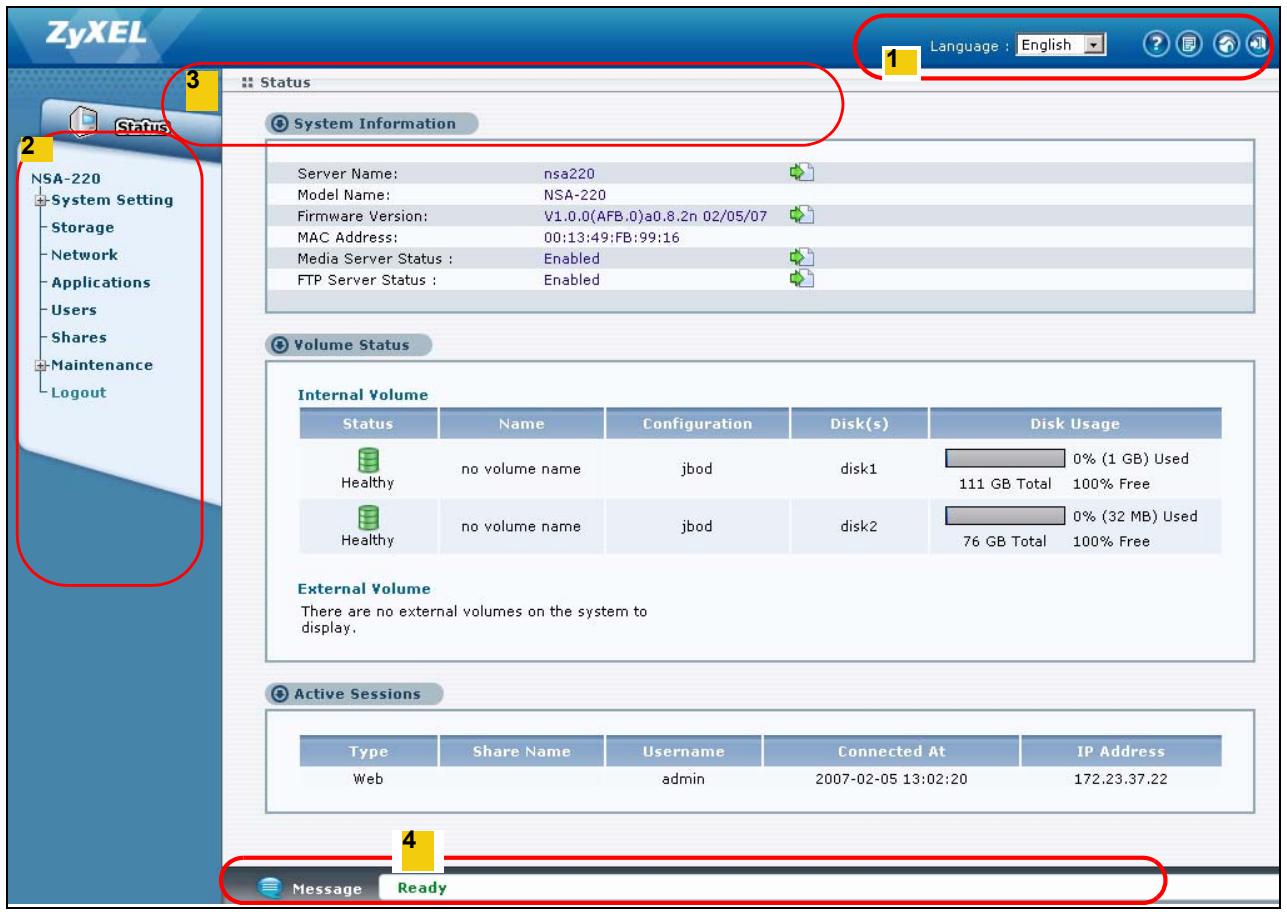
Figure 14 Status
2.6.1 Global Administration Icons
The icons and language label at the top-right of the screen (1) are visible from most of the administration screens. The following table describes the 'global' icons and labels.
Table 8 Global Labels and Icons
| LABEL/ICON | DESCRIPTION |
| Language | Select the web configurator language from the drop-down list box. |
| Click this Help icon to open a web help page specific to the screen you are currently configuring. | |
| Click this About icon to view the model name, firmware version and copyright. | |
| Click this Home icon to return to the user-level screens. | |
| Click thisLogout icon at any time to exit the web configurator. This is the same as clicking theLogout link at the bottom of the Navigation panel. |
2.6.2 Navigation Panel
The navigation panel on the left of the screen (2) contains screen links. Click a link to display sub-links. There are no sub-links for the Status screen. Certain screens also contain hyper links that allow you to jump to another screen.
Click the Status icon to open the Status screens.
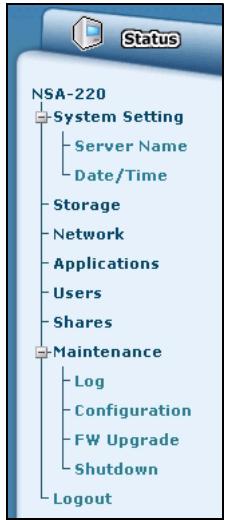
Figure 15 Navigation Panel Links
The following table describes the navigation panel screens.
Table 9 Screens Summary
| LINK | TAB | FUNCTION |
| Status | This screen shows system information, the status of the volumes, and the users who are currently using the NSA. | |
| System Setting | Server Name | Use this screen to specify the NSA's server name and workgroup name. |
| Date/Time | Date & Time | Use this screen to chose a time zone and/or allow the NSA to synchronize with a time server. |
| Storage | Storage | Use this screen to view volume and disk information. You can also create and edit volumes. A volume is a storage area that can span one or more internal disks or a single external (USB) disk. |
| Network | Network Config | Use this screen to assign the NSA a dynamic or static IP address and DNS information. |
| Applications | FTP | Use this screen to enable FTP file transfer to/from the NSA, set the number of FTP connections allowed and an FTP idle timeout. |
| Media Server | Use this screen to enable or disable the media server and select which shares to publish (share with medial clients). | |
| Users | Users | Use this screen to view, create and edit administrator and user accounts to let people use the NSA. |
| Shares | Shares | Use this screen to view, create and edit shares. Shares are shared folders to which you can allow specific users read/write access rights. |
| Maintenance | Log | Use this screen to view the NSA's logs. |
| Configuration | Use this screen to back up and/or restore the NSA configuration file. | |
| FW Upgrade | Use this screen to upload new firmware to your NSA. | |
| Shutdown | Use this screen to restart the NSA or shut it down. | |
| Logout | ClickLogout to exit the web configurator. This is recommended to prevent unauthorized administrator access to the NSA. |
2.6.3 Main Window
The main window ( 3 ) shows the screen you select in the navigation panel. It is discussed in the rest of this document.
Right after you log in, the Status screen is displayed. See Chapter 4 on page 51 for more information about the Status screen.
2.6.4 Status Messages
The message text box at the bottom of the screen (4) displays status messages as you configure the NSA.
2.6.5 Common Screen Icons
The following table explains some icons that appear in several configuration screens.
Table 10 Common Configuration Screen Icons
| ICON | DESCRIPTION |
| Click the Edit icon to go to a screen where you can change the configuration settings of an entry. | |
| Click the Delete icon to delete an entry from the list. | |
| Click the Edit icon to jump to related item's configuration screen. | |
| This is a user icon. See the chapter on user accounts for detailed information on variants of this icon. | |
| This is a share icon. See the chapter on shares for detailed information on variants of this icon. | |
| This icon represents a Healthy volume. | |
| This icon represents a Degraded volume. Click the Repair icon to fix a degraded RAID volume after you have replaced the faulty disk. | |
| This icon represents a Down volume. Click the Initialize icon to create a volume. | |
| This icon represents a Healthy disk. | |
| Click the Scan Disk icon to scan a hard disk for file system errors. | |
| Click the Eject icon before you remove an external hard drive so that you do not lose data that is being transferred to or from that hard drive. | |
| Click the Locate icon to cause the LED on the external storage device to blink. | |
| Click the Repair icon to resynchronize a RAID volume after you replace a faulty hard disk. |
This chapter provides tutorials that show how to use the NSA.
3.1 Tutorials Introduction
The following tutorials cover how you use the NSA for file sharing. This chapter assumes you have already followed the Quick Start Guide instructions to perform initial setup and configuration (so you have a working volume). See the Quick Start Guide for how to play media files using the included DLNA-compliant media client software. See the rest of this User's Guide for details on configuring the NSA's various screens.
3.2 Creating a User Account
Bob wants to create accounts for his sons Jimmy and Kevin. This is how he would do it.
1 Log into the NSA web configurator (see Section 2.3 on page 30) and click Administration to go to the configuration screens.
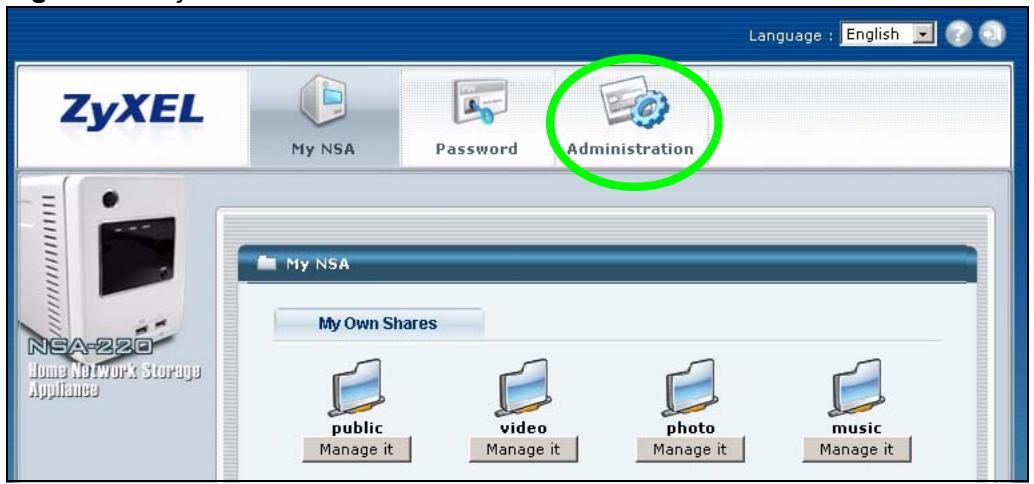
Figure 16 My NSA
2 Click Users to open the Users screen. Then click Create a New Account.
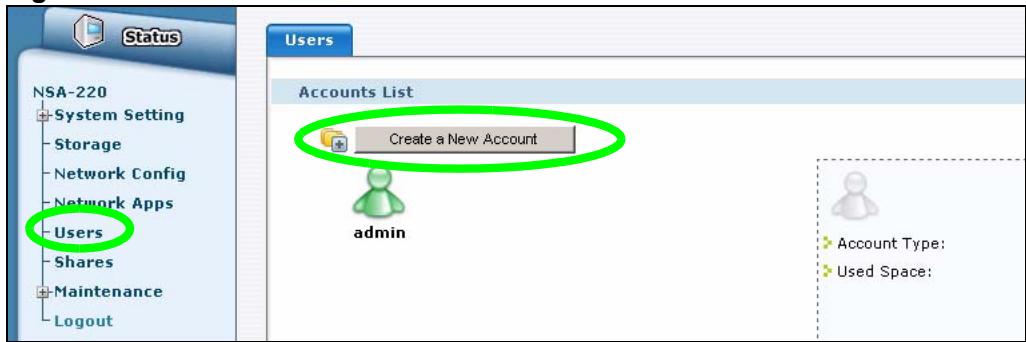
Figure 17 Users
3 Configure the screen as follows and write down the username and password to give to Jimmy. If the username and password are the same as Jimmy's Windows login, Jimmy will not need to enter a username and password when he logs into his share from his computer. Set the Account Type to User so Jimmy doesn't get to configure the whole NSA. Click Apply to create the account.
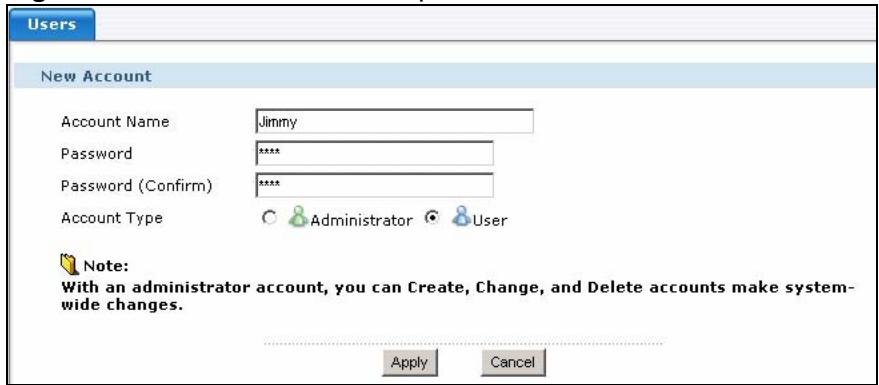
Figure 18 Users > Create Example
4 The account now displays in the Users screen.
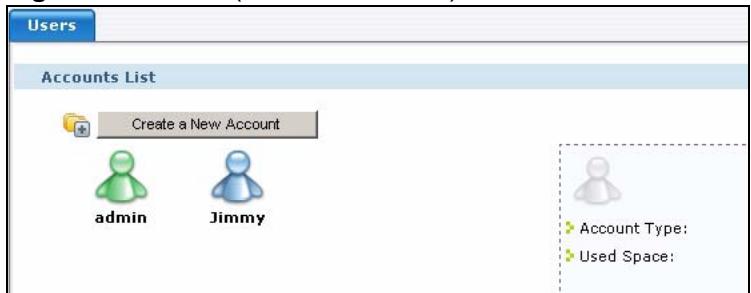
Figure 19 Users (Account Created)
Now that Bob has created Jimmy's account, he can go through the steps again to create another account for Kevin. After both accounts are created, he can go to Section 3.3 on page 44 to create shares for Jimmy and Kevin.
3.3 Creating a Share
Suppose Bob has already created separate accounts for his sons Jimmy and Kevin. Now Bob wants to create a share for each son. He also wants to make sure that each son can only access his own share (to keep them from deleting each other's files). This is how he would do it.
1 In the NSA's administration web configurator screens, click Shares > Create a New Share.
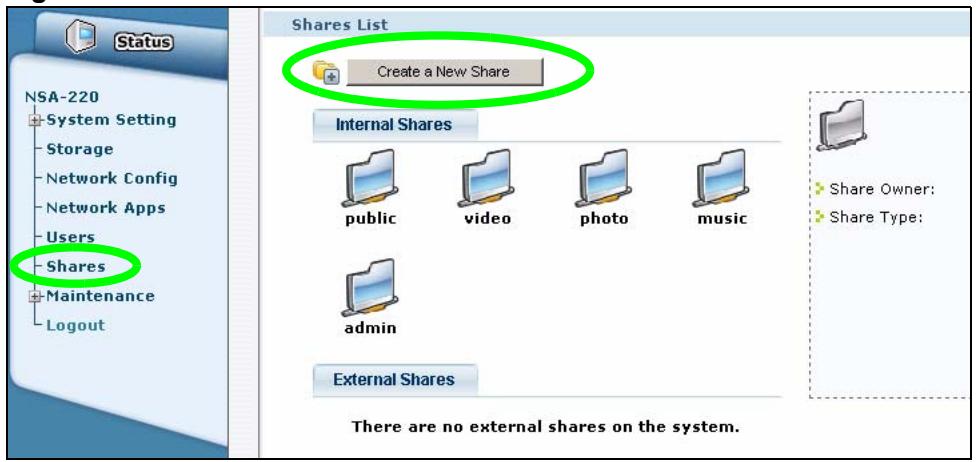
Figure 20 Shares
2 Specify a name for the share and select which volume it should be on. Then click Browse.
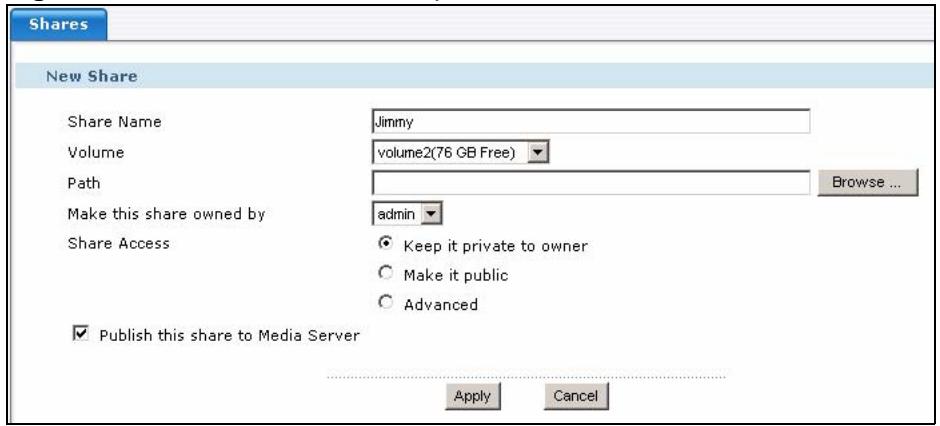
Figure 21 Shares > Create Example
3 Type a name for a new folder and click Create Folder.
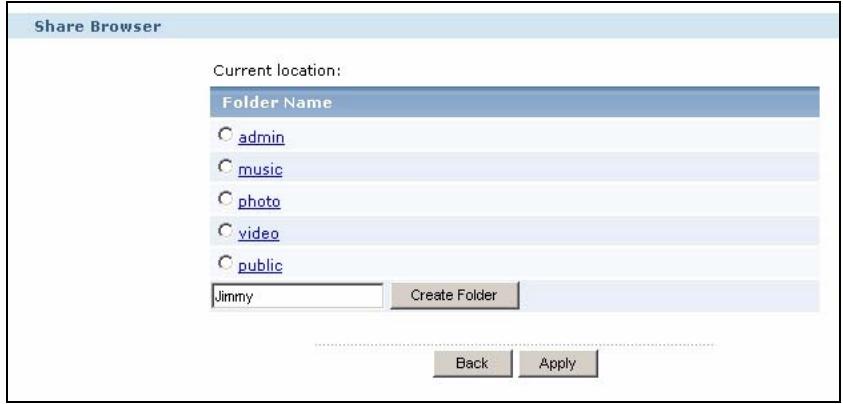
Figure 22 Shares > Create > Browse > Create Folder Example
4 Select the new folder and click Apply.
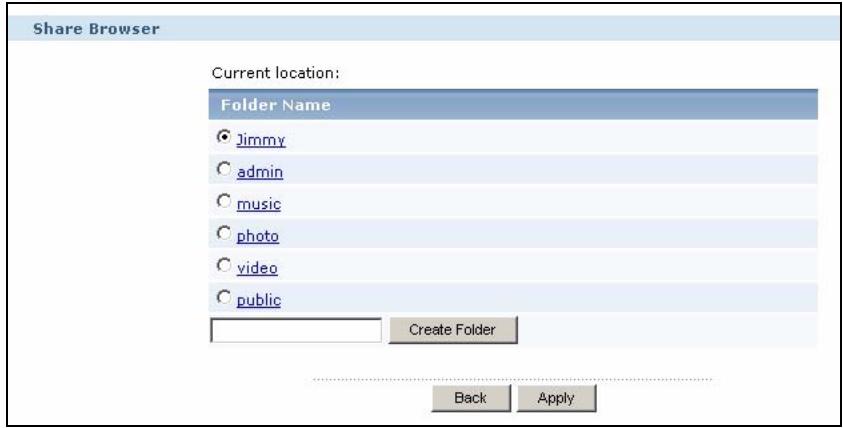
Figure 23 Shares > Create > Browse > New Folder Example
5 Configure the screen as follows and click Apply.
Figure 24 Shares > Create Example
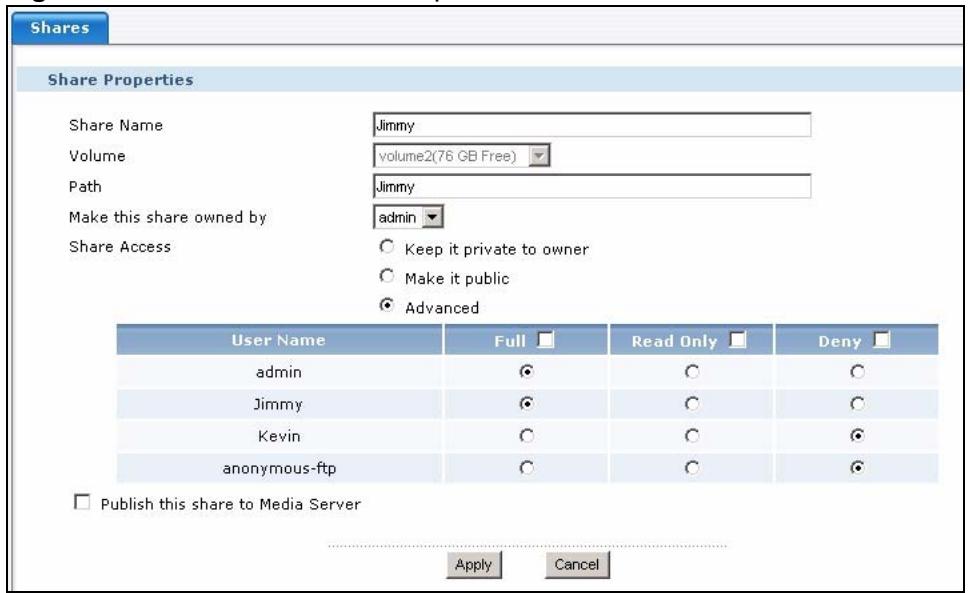
Now that Bob has created Jimmy's share, he can go through the steps again to create another share for Kevin. Then he can see the rest of the tutorials for how to use the shares.
3.4 Accessing a Share From Windows Explorer
If you map a NSA share (where data is stored) to a Windows network drive, you can use Windows Explorer to transfer files to and from the NSA as if it was another folder on your computer. In this example, Bob has already installed the NDU on Jimmy's computer (see the Quick Start Guide for details). Here he maps Jimmy's share to Jimmy's computer.
1 Start Windows Explorer and click Tools > Map Network Drive.
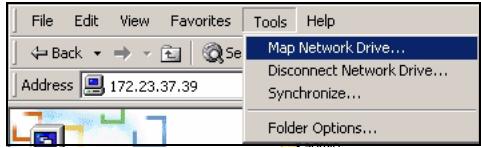
Figure 25 NSA Top Level
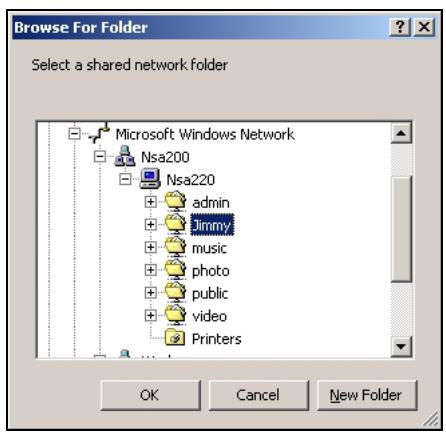
2 Select the network drive that you want to map NSA to from the Drive list box. This example uses I. Then browse to and select the share on the NSA. Click Finish.
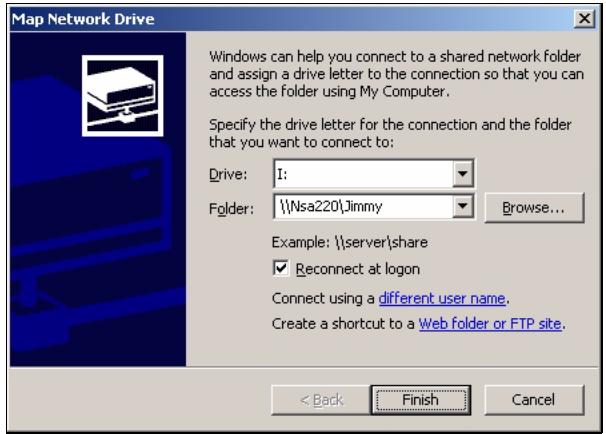
Figure 26 Map Network Drive
3 Enter the username and password for Jimmy's account and click OK. You do not need to do this if the username and password are the same as Jimmy's Windows login.
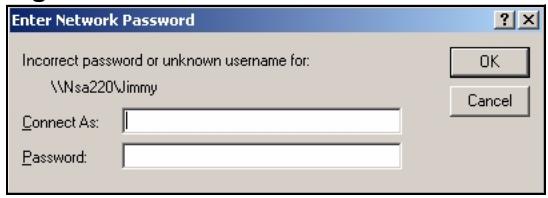
Figure 27 Enter Network Password
4 After the mapping is done, you can then simply copy and paste or drag and drop files from/to your local computer's drives to or from this network folder. Just like the NSA's share was another folder on your computer.
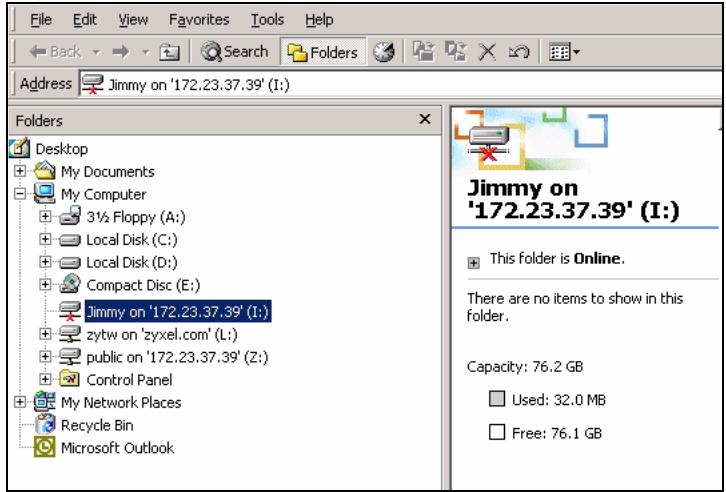
Figure 28 Example Share Mapped (Folders View)
Now that Bob has mapped Jimmy's share to Jimmy's computer, he can go through the steps again to map Kevin's share to Kevin's computer.
3.5 Accessing a Share Using FTP
You can also use FTP to access the NSA. Suppose Jimmy is temporarily using a different computer and wants to access his share without mapping it to the computer. This is how he would do it.
1 Open the FTP client (Windows Explorer is used here) and type "ftp://username@server" where "username" is the account's username and "server" is the NSA's IP address or server name.
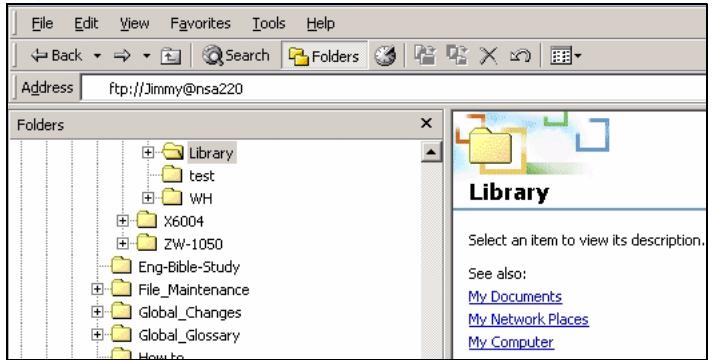
Figure 29 FTP Example: Typing the FTP Target
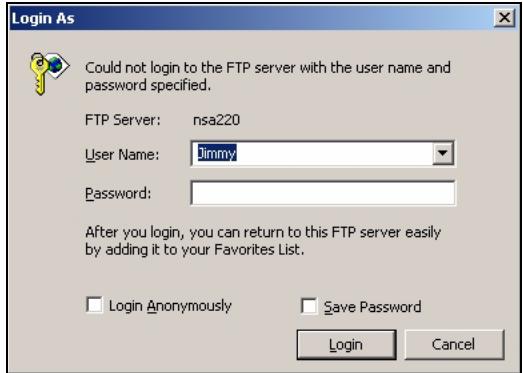
2 Enter your password and click Login.
Figure 30 FTP Example: Enter the Password
3 Now you can access files and copy files from/to your local computer's drives to or from this network folder.
- Even though the admin share displays, user accounts cannot access it unless you change it's share access settings.
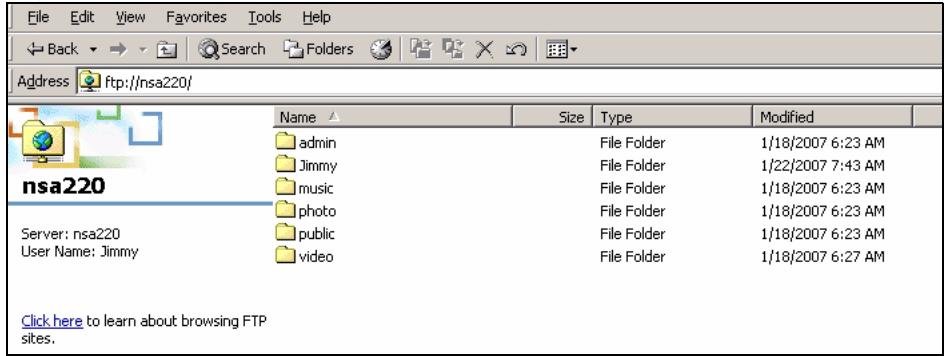
Figure 31 FTP Example: Logged In
3.6 Accessing a Share Through the Web Configurator
You can browse and access files through the web configurator.
1 Log into the NSA web configurator (see Section 2.3 on page 30) using your username and password.
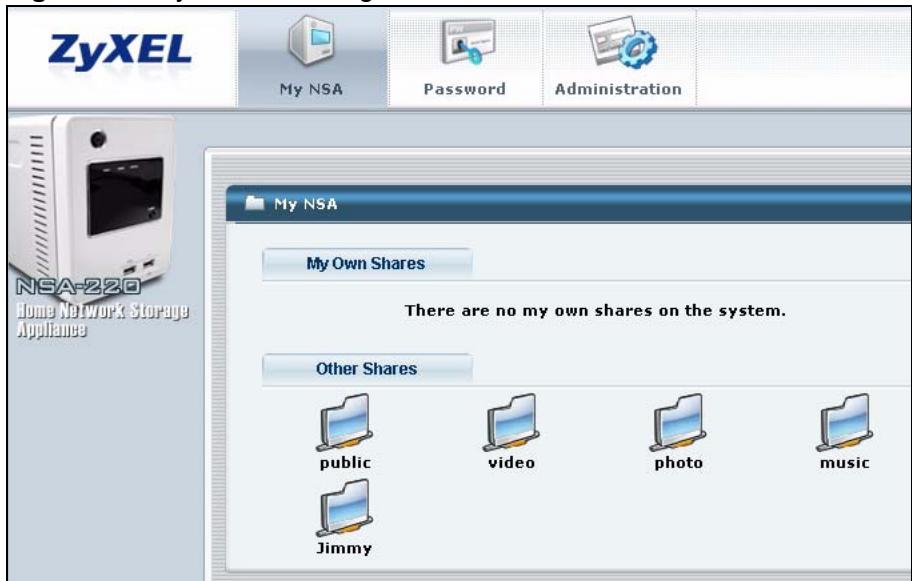
Figure 32 My NSA User Login
2 Click a share to see the top level of the share's contents. Here is the Jimmy share.
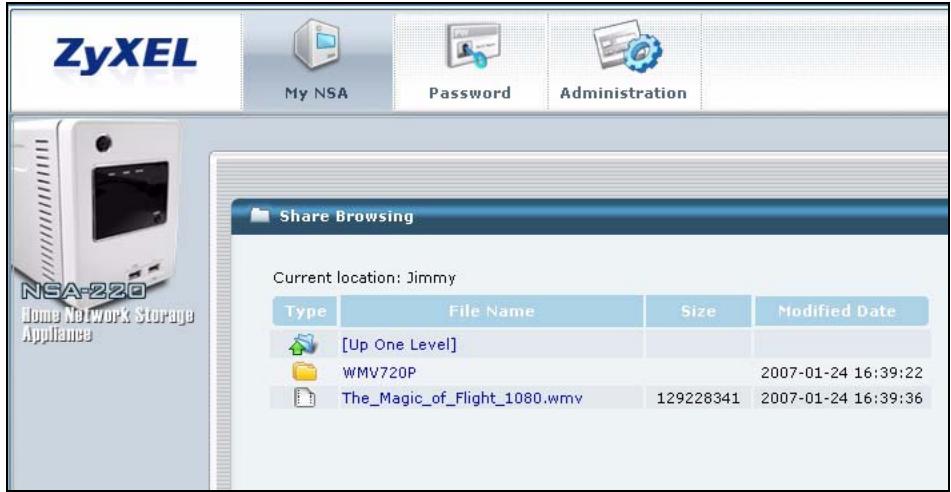
Figure 33 My NSA User Login
3 Click a folder's file name to browse the folder. You can open files or copy them to your computer. However at the time of writing you cannot use the web configurator to upload files to the NSA (use CIFS or FTP to upload files, see Section 3.4 on page 46 and Section 3.5 on page 48).
4 Click the logout icon when your are done (see Table 2 on page 32).
This chapter introduces the NSA Status screen.
4.1 Status Screen
The Status screen is the first main web configurator screen you see after you log in to the administrator screens. To view the status screens, click Status on the top-left of the navigation panel.
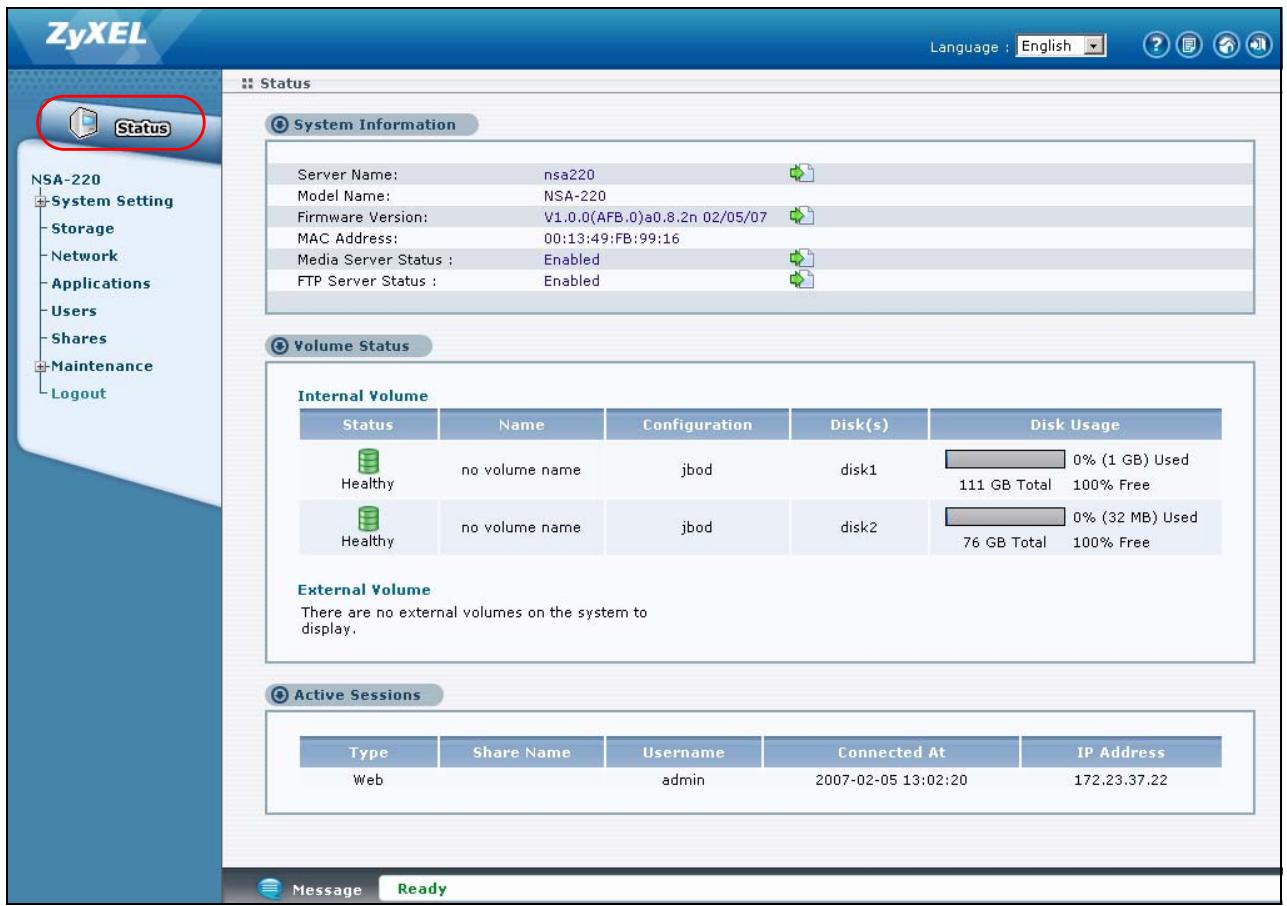
Figure 34 Status
The following table describes the labels in this screen.
Table 11 Status
| LABEL | DESCRIPTION |
| Status | Click Status to refresh the status screen statistics. |
| System Information | |
| Server Name | This displays the name which helps you find the NSA on the network. Click the edit icon to go to the screen where you can configure this. |
| Model Name | This displays which model this NSA device is. |
| Firmware Version | This is the NSA firmware version. Click the update link to go to the Maintenance > Firmware Upgrade screen from which you can upload new firmware. Click the edit icon to go to the screen where you can upload new firmware. |
| MAC Address | This displays the NSA's unique physical hardware address (MAC). You need the MAC address to register the product at myZyXEL.com. Customer support may also request it for troubleshooting purposes. |
| Media Server Status | This shows whether the media server function is enabled or disabled. It must be enabled for media clients to play content files stored on the NSA. Click the edit icon to go to the screen where you can configure this. |
| FTP Server Status | This shows whether the FTP server function is enabled or disabled. It must be enabled to use FTP file transfer to/from the NSA. Click the edit icon to go to the screen where you can configure this. |
| Volume Status | A volume is a storage area on a single disk or spread across a number of disks within a single file system. |
| Internal Volume | This displays the volumes created on the hard drives installed in the NSA. |
| Create an Internal Volume | This displays if there are no volumes created on the hard drive(s) installed in the NSA. Click this button to create a volume. See Section 6.6 on page 69. |
| External Volume | This displays the volumes created on USB hard drives connected to the NSA. USB disks are numbered in the order that you insert USB devices. |
| Status | This icon indicates whether the volume is healthy, degraded, or down. |
| Name | This field shows the name for the volume. Read only displays for an external volume that uses Windows NTFS. This means the NSA can read the volume but can't save files on it. |
| Configuration | This field (also known as Type) shows what type of data storage system (a RAID type or JBOD) an internal volume is using. |
| File System | This field shows what file system an external (USB) volume is using. |
| Disk(s) | For internal drives, this shows which hard drive bays are included in the volume. For external drives, this field shows USB1 for the first external hard drive you connect to the NSA (regardless of which USB port) and USB2 for the second. |
| Disk Usage | This field shows total disk size, the percentage of the disk being used and the percentage that is available. |
| Active Sessions | This shows how many users are currently connected to the NSA. |
| Type | This shows whether it's a Windows/CIFS, web (web configurator), or FTP connection to the NSA. |
| Share Name | This displays the shared folder name on the NSA that the user is connected to for CIFS sessions and is blank for FTP sessions. |
| Username | This displays the name of the user connected to the NSA if one is defined. ANONYMOUS CIFS or ANONYMOUS FTP display if a username is not defined for the user's connection. |
| Connected At | This displays the date and time the user last connected to the NSA in year, month, day, hour, minute, second format. |
| IP Address | This displays the IP address of the computer connected to the NSA. |
4.1.1 Session Example (Windows)
Open windows explorer and type two back slashes followed by the NSA name or IP address. Initially you can only read and write to the Public, Video, Music, and Photo folders until you create other shares on the NSA. This session is then displayed as shown in Figure 34 on page 51.
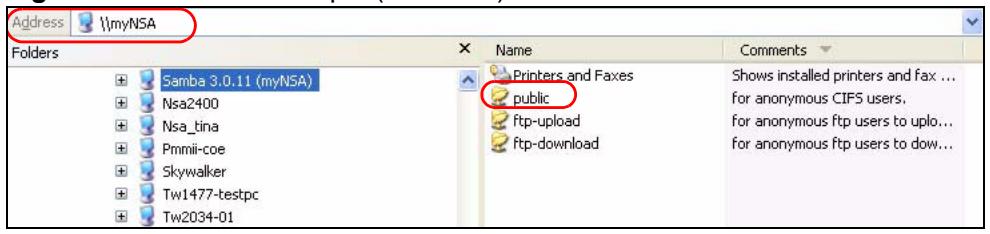
Figure 35 Session Example (Windows)
PART II
Status, System,
Storage, and
Network
System Setting Screens (57)
Storage Screens (61)
Network Screen (73)
System Setting Screens
This chapter discusses the system setting screens.
5.1 System Setting Screens
This section gives an overview of the various features included in the system setting screens.
Use the system setting screens to:
- Specify the NSA's Windows/CIFS server name and workgroup name.
- Chose a time zone and/or allow the NSA to synchronize with a time server.
- Create and edit volumes (see Chapter 6 on page 61 for details).
5.1.1 Windows/CIFS
Common Internet File System (CIFS) is a standard protocol supported by most operating systems in order to share files across the network.
- CIFS is included by default in Windows and Mac OSX operating systems.
- You can use Samba with Linux to use CIFS.
- CIFS transfers use security.
5.2 Server Name
Use this screen to configure your CIFS settings. In this screen you can set your server name and specify if your NSA is a part of a workgroup or domain.

CIFS cannot be disabled on the NSA.
Click System Setting > Server Name to open the following screen.
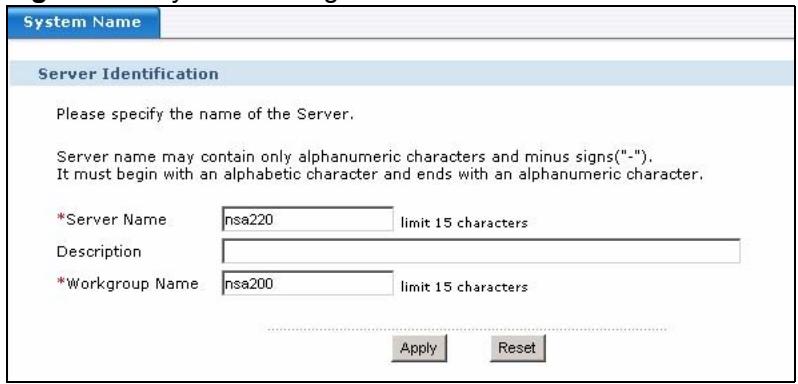
Figure 36 System Setting > Server Name
The following table describes the labels in these screens.
Table 12 System Setting > Server Name
| LABEL | DESCRIPTION |
| Server Name | Enter a name to identify your NSA on the network in this field.You can enter up to 15 alphanumeric characters with minus signs allowed but not as the last character. The name must begin with an alphabetic character (a-z) and is NOT case sensitive. |
| Description | Add text here to describe the NSA if the Server Name field was not enough. Use up to 61 characters. You can use the following. a-zA-Z0-9‘()+,‘:=?;!*#@$$%- |
| Workgroup Name | A workgroup is a group of computers on a network that can share files.These user accounts are maintained on the NSA.Type your workgroup name in this field.You can enter up to 15 alphanumeric characters with minus signs allowed but not as the last character. The name must begin with an alphabetic character (a-z) and is NOT case sensitive. |
| Apply | Click here to save your changes back to the NSA. |
5.3 Date/Time
Use this screen to select a time zone and a time server from which your NSA can get the time and date. This time is then used in NSA logs and alerts.
5.3.1 Time Lag
Time lag occurs when the time on the NSA falls behind the time on the time server. This may happen if:
- the time server is no longer reachable
- if the NSA is shut down often (the NSA internal battery keeps time when the NSA is shut down and this may cause possible variance)
power surges occur.
The NSA gives no warning if time lag occurs. You should resynchronize the time after a power surge or after you have shut down the NSA several times.
5.3.2 Date/Time Screen
Click the System Setting link in the navigation panel and then click the Date/Time link to access the System Setting > Date/Time screen.
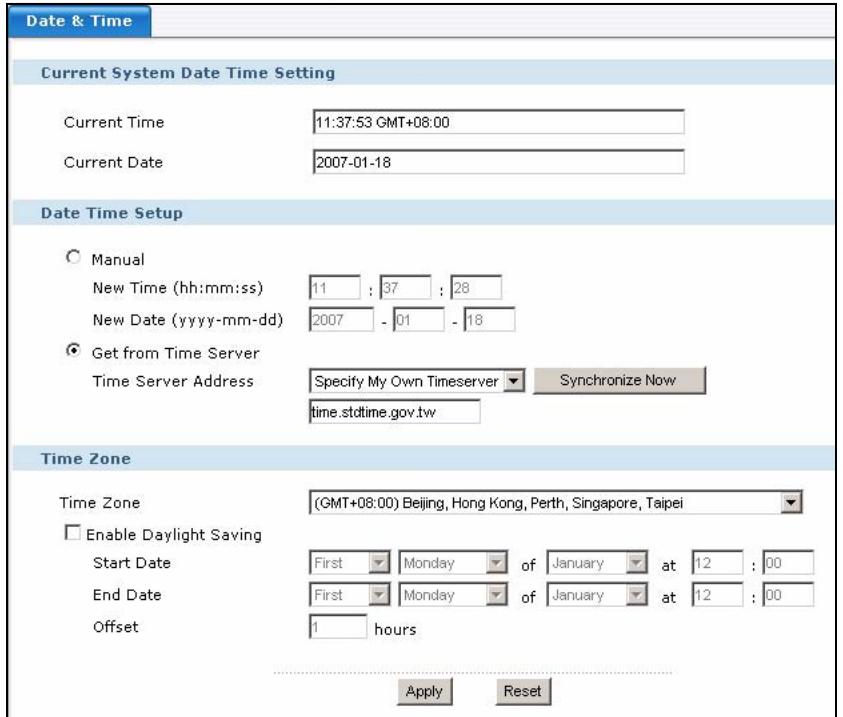
Figure 37 System Setting > Date/Time
The following table describes the labels in this screen.
Table 13 System Setting > Date/Time
| LABEL | DESCRIPTION |
| Current System Date Time Setting | |
| Current Time | This field displays the time of your NSA. |
| Current Date | This field displays the date of your NSA. |
| Current Time Zone | This field displays the time zone of your location. This will set the time difference between your time zone and Greenwich Mean Time (GMT). |
| Date Time Setup | |
| Manual | Select this radio button to enter the time and date manually. |
| New Time (hh:mm:ss) | This field displays the last updated time from the time server or the last time configured manually. When you set Time and Date Setup to Manual, enter the new time in this field and then click Apply. |
| New Date (yyyy-mm-dd) | This field displays the last updated date from the time server or the last date configured manually. When you set Time and Date Setup to Manual, enter the new date in this field and then click Apply. |
| Get from Time Server | Select this check box to have the NSA get the time and date from the time server you select in the Time Server Address field. |
| Synchronize Now | Click this button for the NSA to retrieve the correct time from the configured time server right away. |
| Time Server Address | Select a time server from the drop-down list box or select Specify my own time server and enter the time server you wish to use in the field below. Check with your ISP/network administrator if you are unsure of this information. |
| Synchronize Now | Click this button for the NSA to retrieve the correct time from the configured time server right away. |
| Time Server Address | Select a time server from the drop-down list box or select Specify my own time server and enter the time server you wish to use in the field below. Check with your ISP/network administrator if you are unsure of this information. |
| Time Zone | |
| Time Zone | Choose the time zone of your location. This will set the time difference between your time zone and Greenwich Mean Time (GMT). |
| Enable Daylight Saving | Daylight saving is a period from late spring to early fall when many countries set their clocks ahead of normal local time by one hour to give more daytime light in the evening. Select this option if you use Daylight Saving Time. |
| Start Date | Configure the day and time when Daylight Saving Time starts if you selected Enable Daylight Saving. The o'clock field uses the 24 hour format. Here are a couple of examples: Daylight Saving Time starts in most parts of the United States on the first Sunday of April. Each time zone in the United States starts using Daylight Saving Time at 2 A.M. local time. So in the United States you would select First, Sunday, April and type 2 in the o'clock field. Daylight Saving Time starts in the European Union on the last Sunday of March. All of the time zones in the European Union start using Daylight Saving Time at the same moment (1 A.M. GMT or UTC). So in the European Union you would select Last, Sunday, March. The time you type in the o'clock field depends on your time zone. In Germany for instance, you would type 2 because Germany's time zone is one hour ahead of GMT or UTC (GMT+1). |
| End Date | Configure the day and time when Daylight Saving Time ends if you selected Enable Daylight Saving. The o'clock field uses the 24 hour format. Here are a couple of examples: Daylight Saving Time ends in the United States on the last Sunday of October. Each time zone in the United States stops using Daylight Saving Time at 2 A.M. local time. So in the United States you would select Last, Sunday, October and type 2 in the o'clock field. Daylight Saving Time ends in the European Union on the last Sunday of October. All of the time zones in the European Union stop using Daylight Saving Time at the same moment (1 A.M. GMT or UTC). So in the European Union you would select Last, Sunday, October. The time you type in the o'clock field depends on your time zone. In Germany for instance, you would type 2 because Germany's time zone is one hour ahead of GMT or UTC (GMT+1). |
| Offset | Specify by how many hours to change the time for Daylight Saving Time. |
| Apply | Click Apply to save your changes back to the NSA. If you configured a new time and date, Time Zone and Daylight Saving at the same time, all of the settings take affect. |
| Reset | Click Reset to begin configuring this screen afresh. |
Storage Screens
This chapter covers storage systems, volumes and disks on the NSA.
6.1 Storage Introduction
Use the Storage screens to create and manage NSA volumes (internal and external) and disks.
- See Section 6.3 on page 62 for more information on volumes.
See Section 6.5 on page 68 for more information on disks.
6.2 Storage Overview Screen
Click Storage in the Navigation panel to display the following screen.
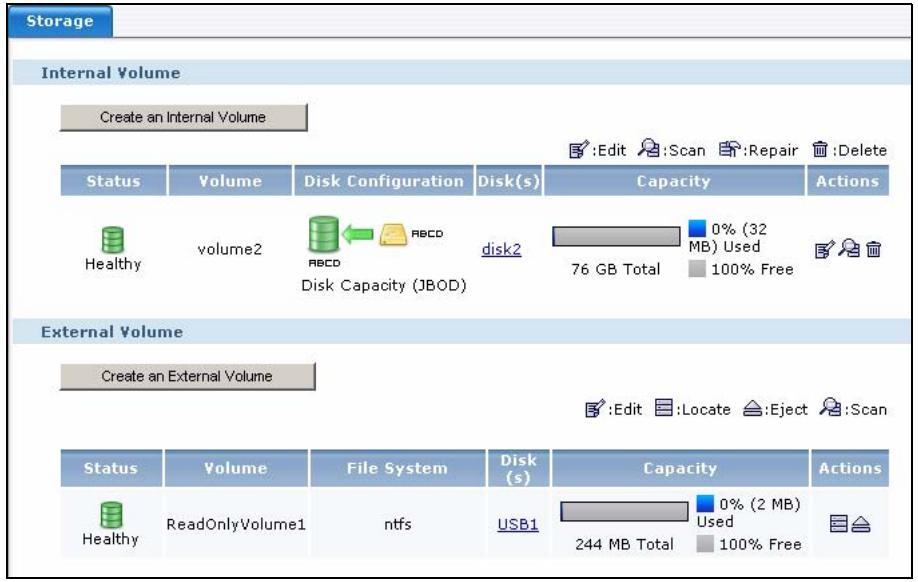
Figure 38 Storage
The following table describes the labels in this screen.
Table 14 Storage > Overview
| LABEL | DESCRIPTION |
| Internal/External Volume | These tables display information on all internal volumes (created on NSA internal disk drives) and external volumes (created on external disk drives attached to the NSA USB ports). See the volume screen for field details. |
| Create an Internal Volume | Click this to format internal hard drives and create a new volume. All data on the disk(s) will be lost. |
| Create an External Volume | Click this to format an external hard drive and create a new volume. All data on the disk will be lost. |
| Status | This field shows whether the volume is Healthy, Resyncching, Degraded, or Down. |
| Volume | The NSA creates the volume name automatically. You can edit it. |
| Disk Configuration | This field shows which disks and data storage system the volume is using. |
| File System | This field displays the file system that an external (USB) volume is using. |
| Disk(s) | Click or roll your mouse over a link in this column to display the following details about the hard drive located in the corresponding hard drive bay. Type: Whether it is an internal or external (USB) hard drive. Model Name: This is the hard disk number that identifies the disk. File System: The file system that an external volume is using Capacity: The total storage space on the disk. |
| Capacity | This field shows total disk size, the percentage of the volume being used and the percentage that is available. |
| Actions | This field displays icons allowing you to edit, scan, repair or delete a volume. You can also locate or eject an external volume. Note: If you delete a volume, all data in the volume disk(s) is erased. |
You see a warning screen before you delete a volume.

Figure 39 Delete a Volume Warning Screen
6.3 Volumes and RAID
A volume is a storage area on a disk or disks. You can create volumes on the internal disks and external disks attached to the USB port(s). You can spread a volume across internal disks but not between internal and external disks.
RAID (Redundant Array of Independent Disks) or JBOD is the storage method that the NSA uses. The storage method you use depends on how many disks you have and how many volumes you want to create. It's important that you consider this carefully as all data is deleted when you re-create a volume.

Back up your data before deleting or re-creating a volume!
For example if you originally have one disk configured at JBOD, and you then install another disk and want to configure the two disks to use RAID 1, you should first back up all your data on the two disks (see the Memeo Autobackup utility on the included CD) and then restore your data later after you create the new volume type.
Below is a table that summarizes some attributes of the various RAID levels as supported on the NSA. For capacity and storage efficiency, "S" is the size of the smallest drive in the array, and "N" is the number of drives in the array.
Storage efficiency assumes all drives are of identical size.
Performance rankings are approximations.
Table 15 RAID Quick Comparison
| RAID Level | 0 | 1 |
| Number of Disks | 2 | 2 |
| Capacity | S*N | S*N/2 |
| Storage Efficiency | 100% | 50% |
| Fault Tolerance | None | YYYY |
| Availability | Y | YYYY |
| Read Performance | YYYY | YYYY |
| Write Performance | YYYY | YYYY |
6.3.1 Choosing A Storage Method For a Volume
The following is a guide to help you choose a storage method for the various number of disks supported on the NSA. See Section 6.4 on page 65 for theoretical background on JBOD and the RAID levels used on the NSA. Typical applications for each method are also shown there.
6.3.1.1 One Disk
If you only have one disk, you must use JBOD. All disk space is used for your data - none is used for backup. If the disk fails, then you lose all the data on that volume (disk).
6.3.1.2 Two Disks:
You may choose JBOD, RAID 0 or RAID 1. With two disks you could create:
- up to two JBOD volumes
-
one RAID 0 or RAID 1 volume
-
Choose JBOD for flexibility and maximum usage of disk space for data. You can either add an additional disk to your one-disk JBOD volume (and you don't have to re-create shares, access rights etc.) or create a different JBOD volume (and create new shares, access rights and so on).
-
Choose RAID 0 if performance matters more than data security. RAID 0 has the fastest read and write performance but if one disk fails you lose all your data on the volume. It has fast performance as it can read and write to two disks simultaneously. Performance may matter more than data security to gamers for example. This method may also be acceptable for data that is already backed up somewhere else.
- Choose RAID 1 if data security is more important than performance. Since RAID 1 mirrors data onto a second disk, you can recover all data even if one disk fails, but the performance is slower than RAID 0.
6.3.2 Volume Status
You (the administrator) can see the status of a volume in the Status, Storage > Overview or Storage > Volume screens.
The NSA has the following classifications for the status of a volume:
- Healthy if all disks in the volume are OK and the file system is functioning properly.
- OK means your USB disk was formatted as NTFS. It is read-only for the NSA.
- Resync when you create or repair a RAID volume.
- Degraded when a volume is currently down, but can be fixed. Data access may be slower from a degraded volume, so it's recommended that you replace the faulty disk and repair the volume as soon as you can.
- Inactive when a disk is missing from a RAID 0 volume or a two-disk JBOD volume. The volume is unusable. If you removed one of the disks you should be able to re-install it and use the volume again (as long as you did not change anything on the disk). If a disk has failed, you need to replace it and re-create the whole volume. All data will be lost. See page 112 for how to install or replace a hard drive.
- Down when a volume is down and can not be fixed.
A down RAID volume cannot be used until you repair or replace the faulty disk(s) in the volume. Degraded means one of the disks in the RAID volume is not available but the volume can still be used. For a degraded volume, you should replace the faulty disk as soon as possible to obtain previous performance. See your Quick Start Guide for more information on replacing a disk.
If it's down, then the only indication is that you can no longer transfer files to/from the shares in the down volume. If it's degraded, then file transfer to/from the shares in the degraded volume will be slower.

There is no explicit message from CIFS that tells users their volume is degraded or down.
6.3.3 Resynchronizing a RAID 1 Volume
Resynchronizing a RAID 1 volume is done block-by-block, so the time it takes depends more on the size of your hard drive(s) than the amount of data you have on them.

You should not restart the NSA while the NSA is resynchronizing a volume as this will cause the synchronization to begin again after the NSA fully reboots.

You can access data on a RAID volume while it is resynchronizing, but it is not recommended.
6.4 RAID
This section contains theoretical background on JBOD and the RAID levels used on the NSA. Skip to the next section if you already understand RAID and know what storage system you want to use on the NSA.
Redundant Array of Independent Disks (RAID) is a method of storing data on multiple disks to provide a combination of greater capacity, reliability, and/or speed. JBOD (Just a Bunch Of Disks) is not a RAID storage method but it is included in this discussion.
These are some terms that you need to know in order to understand storage systems.
- Mirroring
In a RAID system using mirroring, all data in the system is written simultaneously to two hard disks instead of one. This provides 100% data redundancy as if one disk fails the other has the duplicated data. Mirroring setups always require an even number of drives.
- Duplexing
Like in mirroring, all data is duplicated onto two distinct physical hard drives but in addition it also duplicates the hardware that controls the two hard drives (one of the drives would be connected to one adapter and the other to a second adapter).
- Striping
Striping is the breaking up of data and storing different data pieces on each of the drives in an array. This allows faster reading and writing as it can be done simultaneously across disks. Striping can be done at the byte level, or in blocks. Byte-level striping means that the first byte of the file is sent to the first drive, then the second to the second drive, and so on. Block-level striping means that each file is split into blocks of a certain size and those are distributed to the various drives. The size of the blocks used is also called the stripe size (or block size).
- Parity
In mirroring 50% of the drives in the array are reserved for duplicate data. Parity is another way to allow data recovery in the event of disk failure using calculations rather than duplicating the data. If you have 'n' pieces of data, parity computes an extra piece of data. The 'n+1' pieces of data are stored on 'n+1' drives. If you lose any one of the 'n+1' pieces of data, you can recreate it from the 'n' that remain, regardless of which piece is
lost. Parity protection is used with striping, and the “n” pieces of data are typically the blocks or bytes distributed across the drives in the array. The parity information can either be stored on a separate, dedicated drive, or be mixed with the data across all the drives in the array.

In the following figures, A1, A2, A3 and so on are blocks of data from the A file. Similarly, B1, B2, B3 and C1, C2, C3 ar blocks of data from the B and C files.
6.4.1 JBOD
JBOD allows you to combine multiple physical disk drives into a single virtual one, so they appear as a single large disk. JBOD can be used to turn multiple different-sized drives into one big drive. For example, JBOD could convert 80 GB and 100 GB drives into one large logical drive of 180 GB. If you have two JBOD volumes (with one disk in each), a failure of one disk (volume) should not affect the other volume (disk). JBOD read performance is not as good as RAID as only one disk can be read at a time and they must be read sequentially. The following figure shows disks in a single JBOD volume. Data is not written across disks but written sequentially to each disk until it's full.
Table 16 JBOD
| A1 | B1 |
| A2 | B2 |
| A3 | B3 |
| A4 | B4 |
| DISK 1 | DISK 2 |
6.4.2 RAID 0
RAID 0 spreads data evenly across two or more disks (data striping) with no mirroring nor parity for data redundancy, so if one disk fails the entire volume will be lost. The major benefit of RAID 0 is performance. The following figure shows two disks in a single RAID 0 volume. Data can be written and read across disks simultaneously for faster performance.
Table 17 RAID 0
| A1 | A2 |
| A3 | A4 |
| A5 | A6 |
| A7 | A8 |
| DISK 1 | DISK 2 |
RAID 0 capacity is the size of the smallest disk multiplied by the number of disks you have configured at RAID 0 on the NSA. For example, if you have two disks of sizes 100 GB and 200 GB respectively in a RAID 0 volume, then the maximum capacity is 200 GB (2 * 100 GB, the smallest disk size) and the remaining space (100 GB) is unused.
Typical applications for RAID 0 are non-critical data (or data that changes infrequently and is backed up regularly) requiring high write speed such as audio, video, graphics, games and so on.
6.4.3 RAID 1
RAID 1 creates an exact copy (or mirror) of a set of data on another disk. This is useful when data backup is more important than data capacity. The following figure shows two disks in a single RAID 1 volume with mirrored data. Data is duplicated across two disks, so if one disk fails, there is still a copy of the data.
Table 18 RAID 1
| A1 | A1 |
| A2 | A2 |
| A3 | A3 |
| A4 | A4 |
| DISK 1 | DISK 2 |
As RAID 1 uses mirroring and duplexing, a RAID 1 volume needs an even number of disks (two or four for the NSA).
RAID 1 capacity is limited to the size of the smallest disk in the RAID array. For example, if you have two disks of sizes 150 GB and 200 GB respectively in one RAID 1 volume, then the maximum capacity is 150 GB and the remaining space (50 GB) is unused.
Typical applications for RAID 1 are those requiring high fault tolerance without need of large amounts of storage capacity or top performance, for example, accounting and financial data, small database systems, and enterprise servers.
6.4.4 RAID and Data Protection
If a hard disk fails and you're using a RAID 1 volume, then your data will still be available (but at degraded speeds until you replace the hard disk that failed and resynchronize the volume). However, RAID cannot protect against file corruption, virus attacks, files incorrectly deleted or modified, or the NSA malfunctioning. Here are some suggestions for helping to protect your data.
- Place the NSA behind a firewall and/or IDP (Intrusion Detection and Prevention) device to protect it. Preferably it should be a hardware-based firewall with stateful packet inspection, anti-virus, and IDP (like the ZyWALL UTM products).
-
Use anti-virus software on your computer to scan files from others before saving the files on the NSA.
-
Keep another copy of important files (preferably in another location).
6.5 Disks
Here is information on the NSA internal disks and external disks attached to the USB port(s).
6.5.1 External Disks
You may connect USB storage devices that support the following file systems to the NSA.
- Windows File Systems: NTFS (read only), FAT32 and FAT16.
If your USB storage device uses a NTFS file system, then the NSA can read files from it, but cannot write files to it. If you want to be able to write files to that storage device, you need to reformat it. You should back up any data on the device that you want to keep (to an internal drive for example) and click the Storage screen's Create an External Volume button to reformat the external hard drive. You can then both read and write to that hard drive and restore your data to it.
Linux File Systems: ReiserFS, EXT2, and EXT3.
6.5.2 Disk Replacement Restrictions
See the Quick Start Guide for information on replacing disks in the NSA. When replacing a disk in a degraded or down RAID volume, the new disk must be at least the same size or bigger than the other disks that are already in the RAID volume, so as all data in the volume can be restored.
For example, if you have RAID with 250 GB disks, you must put in a 250 GB or bigger disk as a replacement in order to restore all original data in that volume. If you put a bigger disk, the extra space on the disk will not be used.
After replacing the disk, go to the Storage > Disk page and click the Repair icon next to the new disk.

The NSA does not repair a disk automatically when you replace it; you must click Repair.
6.5.3 Disk Replacement and Volume Labels
When you create a volume, the NSA writes the volume label to the disk.

Deleting a volume removes volume label information on its disk(s). It is recommended that you first delete a volume before removing its disk(s).
If you do not want to keep the data on a disk that you will remove, it is recommended that you delete the volume before you remove the disk. If you remove a disk(s) without deleting its volume and you later put the disk(s) back in a different volume, you may have more than one volume with the same name. For example, suppose you have two disks, Disk A and Disk B and you create two JBOD volumes, volume1 (with Disk A) and volume2 (Disk B). Later you remove Disk A and replace it with another disk, Disk C and you re-create volume1. (You did not delete volume1 when you removed Disk A.) Later you replace Disk B with Disk A. Disk A still retains the volume1 label, so at this point both Disk A and Disk C have the volume1 label. Although you can still use the volumes, you may find the naming confusing.
6.6 Creating a New Internal Volume
Click the Create a New Internal Volume button in the Volume screen as shown in Figure 38 on page 61 to create a new NSA internal disk drive volume.

Creating a volume formats the hard drive. All data on the disk will be lost.
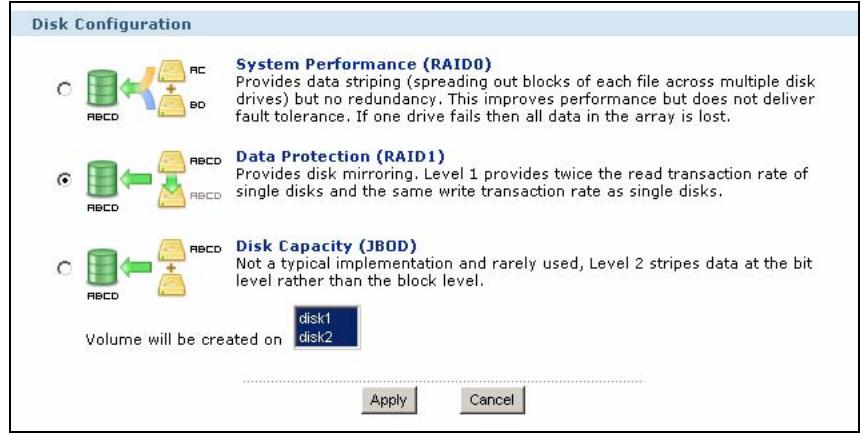
Figure 40 Create a New Internal Volume
The following table describes the labels in this screen.
Table 19 Create a New Internal Volume
| LABEL | DESCRIPTION |
| System Performance (RAID 0) | Use RAID 0 if you want maximum speed for your disks, and/or you have other means of protecting your data. This is only available when you have two hard disks installed. |
| Data Protection (RAID 1) | Use RAID 1 if you want to mirror all data on one disk to the other disk. This is only available when you have two hard disks installed. |
| Disk Capacity (JBOD) | Use JBOD if you want maximum storage capacity and/or you have other means of protecting your data. JBOD is the only option if you only have one disk installed. |
| Volume will be created on | This field lists all hard disks installed inside the NSA. Select which disks should make up this volume. A disk can only belong to one volume. You do not need to select anything if only one hard disk is installed. |
| Apply | Click this button to save your changes back to the NSA and create the volume. |
| Cancel | Click this button to begin configuring this screen afresh. |
6.7 Editing an Internal Volume
Click an internal volume's Edit icon in the Volume screen as shown in Figure 38 on page 61 to change the internal disk drive volume's name.
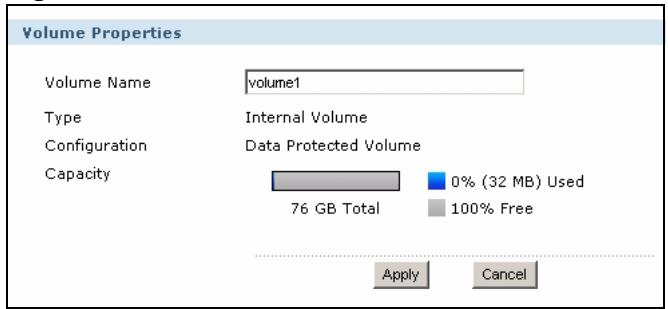
Figure 41 Edit an Internal Volume
The following table describes the labels in this screen.
Table 20 Edit an Internal Volume
| LABEL | DESCRIPTION |
| Volume Name | Type a volume name from 1 to 31 characters. The name cannot be the same as another existing external volume.Acceptable characters are all alphanumeric characters and " " [spaces],"_" [underscores], and "." [periods].The first character must be alphanumeric (A-Z 0-9).The last character cannot be a space " ". |
| Type | This displays Internal Volume indicating that the volume is on a hard disk installed in the NSA. |
| Configuration | |
| Capacity | This field shows total disk size, the percentage of the volume being used and the percentage that is available. |
| Apply | Click this button to save your changes back to the NSA and create the volume. |
| Cancel | Click this button to begin configuring this screen afresh. |
6.8 Creating a New External Volume
Click the Create a New External Volume button in the Volume screen as shown in Figure 38 on page 61 to create a new NSA internal disk drive volume.

Creating a volume formats the drive. All data on the disk will be lost.
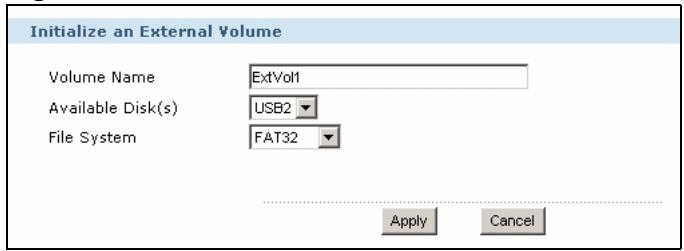
Figure 42 Create a New External Volume
The following table describes the labels in this screen.
Table 21 Create a New External Volume
| LABEL | DESCRIPTION |
| Volume Name | Type a volume name from 1 to 31 characters. The name cannot be the same as another existing external volume. Acceptable characters are all alphanumeric characters and " " [spaces], "_" [underscores], and "." [periods]. The first character must be alphanumeric (A-Z 0-9). The last character cannot be a space " ". |
| Available Disk(s) | Select the external (USB) device upon which you want to create the volume. |
| File System | Select the file system you want the new volume to use. Windows file systems FAT32: Newer, and more efficient than FAT16. Supports a volume size of up to 2 TB (Tera Bytes) and individual file sizes of up to 4 GB. FAT16: Compatible with old Windows operating systems. Supports volume and file sizes of up to 2 GB. Linux file systems EXT2: Older file system. EXT3: The same as EXT2, but adds a journaled file system and is more robust. ReiserFS: Offers better performance for small files. |
| Apply | Click this button to save your changes back to the NSA and create the volume. |
| Cancel | Click this button to begin configuring this screen afresh. |
6.9 Editing an External Volume
Click an external (USB) volume's Edit icon in the Volume screen as shown in Figure 38 on page 61 to change the external disk drive volume's name.
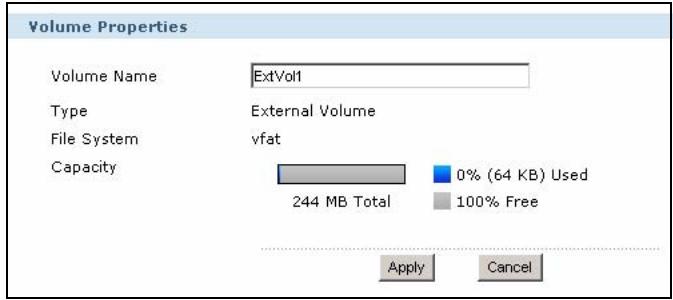
Figure 43 Edit an External Volume
The following table describes the labels in this screen.
Table 22 Edit an External Volume
| LABEL | DESCRIPTION |
| Volume Name | Type a volume name from 1 to 32 single-byte (no Chinese characters allowed for example) ASCII characters. The name cannot be the same as another existing external volume. |
| Type | This displays External Volume indicating that the volume is on an external device connected to a NSA USB port. |
| File System | |
| Capacity | This field shows total disk size, the percentage of the volume being used and the percentage that is available. |
| Apply | Click this button to save your changes back to the NSA and create the volume. |
| Cancel | Click this button to begin configuring this screen afresh. |
Network Screen
This chapter discusses the network configuration screen.
7.1 Network Settings
Use the network configuration screen to assign the NSA a dynamic or static IP address and DNS information.
7.1.1 IP Address
The NSA needs an IP address to communicate with the media servers on your network. The NSA can get an IP address automatically if you have a device on your network that gives them out. Or you can assign the NSA a static (fixed) IP address.
7.1.2 DNS Server Address
A DNS (Domain Name System) server maps domain names (like www.zyxel.com) to their corresponding IP addresses (204.217.0.2 in the case of www.zyxel.com). This lets you use domain names to access web sites without having to know their IP addresses. The NSA can receive the IP address of a DNS server automatically (along with the NSA's own IP address). You can also manually enter a DNS server IP address in the NSA.
7.2 Network Config Screen
Click Network in the navigation panel to open the following screen.
Use this screen to have the NSA use a dynamic or static IP address, subnet mask, default gateway and DNS servers.

If you change the NSA's IP address, you need to log in again after you apply changes.
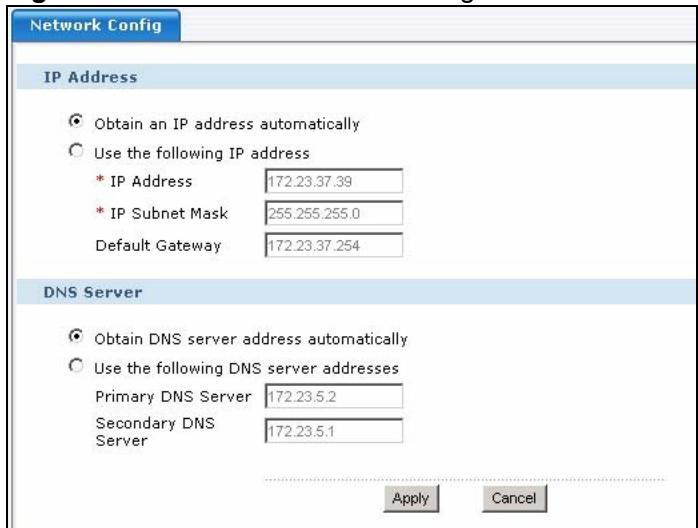
Figure 44 Network > Network Config
The following table describes the labels in this screen.
Table 23 Network Config > Network Config
| LABEL | DESCRIPTION |
| IP Address | |
| Obtain an IP address automatically | Select this option to have the NSA get IP address information automatically. If no IP address information is assigned, the NSA uses Auto-IP to assign itself an IP address and subnet mask. For example, you could connect the NSA directly to your computer. If the computer is also set to get an IP address automatically, the computer and the NSA will choose addresses for themselves and be able to communicate. |
| Use Fixed IP Address | Select this option for the NSA to use fixed TCP/IP information. You must fill in the following fields. |
| IP Address | Type an IP address in this field. |
| IP Subnet Mask | Type an IP subnet mask in this field. |
| Default Gateway | Type a default gateway address in this field. |
| DNS | DNS (Domain Name System) is for mapping a domain name to its corresponding IP address and vice versa. If you have the IP address(es) of the DNS server(s), enter them. |
| Obtain DNS server address automatically | Select the option to have the NSA get a DNS server address automatically. |
| Use the following DNS server addresses | Select this option to choose a static DNS server address. Type the DNS server IP address(es) into the fields below. |
| Primary DNS Server | Type a primary DNS server IP address. |
| Secondary DNS Server | Type a secondary DNS server IP address. |
Table 23 Network Config >Network Config
| LABEL | DESCRIPTION |
| Apply | Click Apply to save your TCP/IP configurations. After you click Apply, the NSA restarts. Wait until you see the Login screen or until the NSA fully boots and then use the NDU to rediscover it. |
| Cancel | Click Cancel to begin configuring this screen afresh. |
Application Screens
This chapter discusses the application screens.
8.1 Application Screens
Use the application screens to:
- Enable FTP file transfer to/from the NSA, set the number of FTP connections allowed and an FTP idle timeout.
- Enable or disable the media server and select which shares to publish (share with media clients).
8.2 FTP
File Transfer Protocol (FTP) is an Internet file transfer service that operates on the Internet and over TCP/IP networks. A system running the FTP server accepts commands from a system running an FTP client. The service allows users to send commands to the server for uploading and downloading files.
- The NSA allows FTP access to shares, folders or files with names encoded in the UTF-8 (8-bit UCS/Unicode Transformation Format) format. So your FTP client must support UTF-8 in order to access shares, folders or files on the NSA with Unicode names.
- FTP is not a secure protocol. Your file transfers could be subject to snooping.
8.3 FTP Screen
Click Applications > FTP to open the following screen.
Use the FTP screen to configure your NSA FTP settings. In this screen you can enable or disable FTP, set a connection limit, idle timeout, and enable or disable anonymous FTP access. See Section 8.2 on page 77 for more details on FTP.
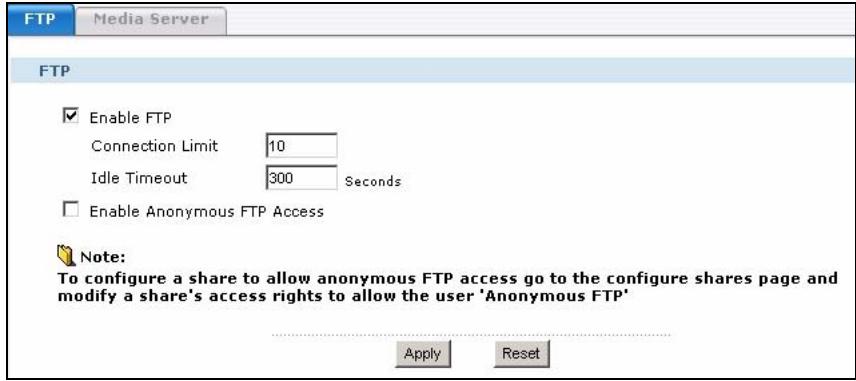
Figure 45 Applications > FTP
The following table describes the labels in this screen.
Table 24 Applications > FTP
| LABEL | DESCRIPTION |
| FTP | |
| Enable FTP | Select the Enable FTP check box to allow users to connect to the NSA via FTP; otherwise clear the check box. |
| Connection Limit | Enter the maximum number of concurrent connections allowed on the NSA in this field. |
| Idle Timeout | Enter the length of time that an FTP connection can be idle before timing out. |
| Enable Anonymous FTP Access | Select Enable Anonymous FTP Access to allow any user to log into the NSA using 'FTP' or 'anonymous' as a username and no password. Any other name is considered a username, so must be valid and have a corresponding correct password. |
| Apply | Click Apply to save your changes back to the NSA. |
| Reset | Click Reset to begin configuring this screen afresh. |
8.4 Media Server
The NSA can function as a media server where you store multimedia files (videos, music, and photos). By default, computers on your network can use media client software (included on the CD) to play multimedia files stored in the Public, Video, Music and Photo shares (you can also apply the multimedia server function to other shares). Hardware-based media clients like the DMA-1000 can also play the files. See Appendix A on page 126 for the supported multimedia file formats.

The NSA provides no security for the multimedia server function. Any DLNA-compliant media client on your network can play the multimedia files.
8.5 Media Server Screen
Click Applications > Media Server to open the following screen.
Use this screen to turn the media server off and on and see which shares the NSA will publish (share with media clients).
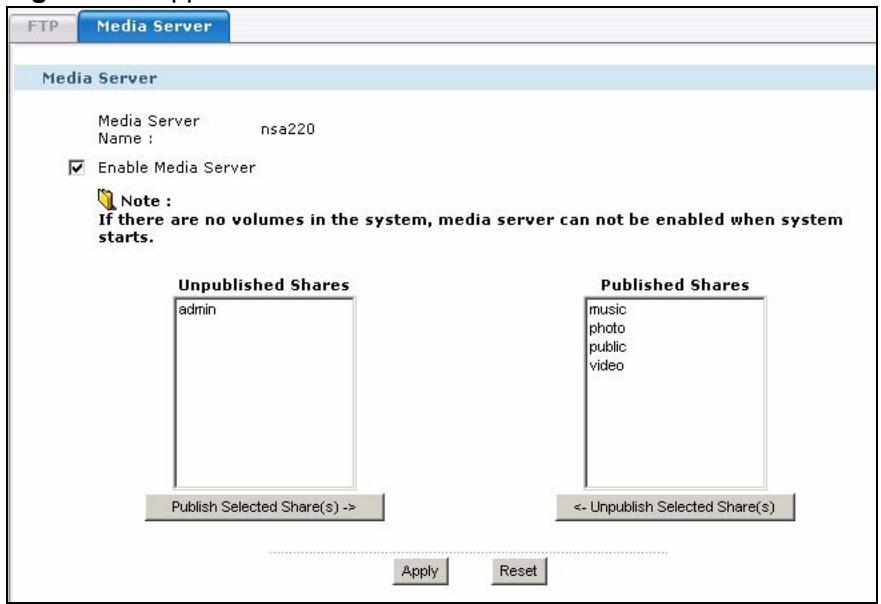
Figure 46 Applications > Media Server
The following table describes the labels in this screen.
Table 25 Applications > Media Server
| LABEL | DESCRIPTION |
| Media Server Name | This is the name of the NSA media server on the network. It is the same as the NSA's server name. This name can allow media clients to distinguish between multiple media servers on your network. |
| Enable Media Server | Select this option to turn on the media server function. |
| Unpublished Shares | This list box displays the shares that the NSA does not share with the media clients. |
| Publish Selected Share(s) | Select one or more shares in the Unpublished Shares box and click this button to share the shares with media clients. |
| Published Shares | This list box displays the shares that the NSA shares with the media clients. |
| Unpublish Selected Share(s) | Select one or more shares in the Published Shares box and click this button to not share the shares with media clients. |
| Apply | Click Apply to save your changes back to the NSA. |
| Reset | Click Reset to begin configuring this screen afresh. |
PART III
User Accounts and
Shares
Users (83)
Shares (89)
This chapter introduces the Users screens of the NSA.
9.1 User Accounts Introduction
Use the Users screens to create and manage administrator and user accounts.
Administrators can:
- Configure and manage the NSA.
- Create volumes, shares, and user accounts.
- Assign individual users specific access rights for specific shares.
Users are people who have access rights to the NSA and can store files there for later retrieval. A user can:
- Manage shares that he owns.
- Change his own password.
- Access the contents of other shares to which he is given access rights.
9.2 Users Overview Screen
Click Users to display the screen shown next.
Use this screen to create and manage accounts for users who can store files on the NSA.
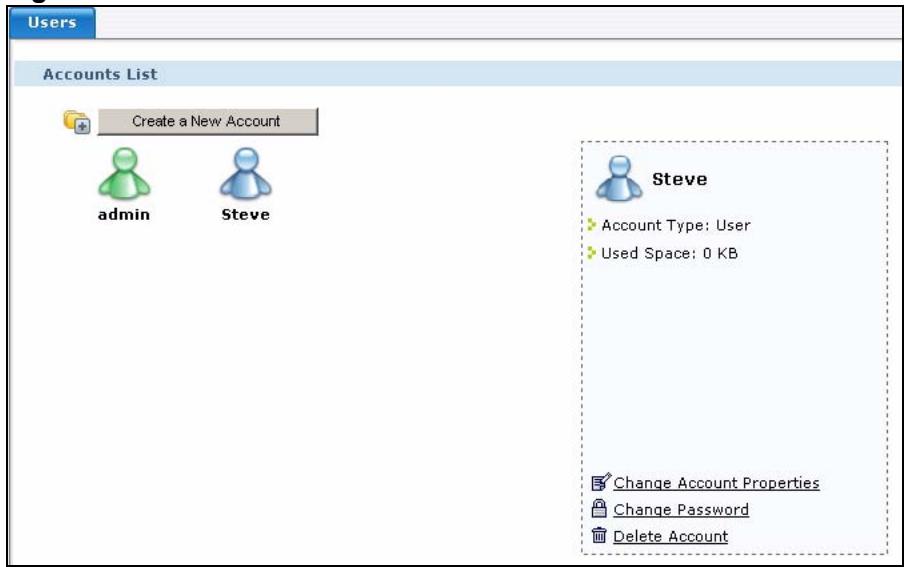
Figure 47 Users
The following table describes the labels in this screen.
Table 26 Users
| LABEL | DESCRIPTION |
| Accounts List | |
| Create a New Account | Click this button to open a screen where you can configure a new user account. |
| This screen lists the users configured on the NSA. Click a user icon to see details about the user. | |
| Account Type | This field displays whether the selected account is an administrator account or a user account. |
| Used Space | This field displays how much storage space the selected account is currently using. This only applies for files that the user saved onto the NSA while logged in with that username. |
| Change Account Properties | Click this to edit the selected account. |
| Change Password | Click this to edit the selected account's password. |
| Delete Account | Click this to remove the selected account. |
9.2.1 User Icons
The following table describes the user icons.
Table 27User Icons
| ICON | DESCRIPTION |
| The green icon is for an administrator account. | |
| The blue icon is for a user account. |
9.3 Adding or Editing a User Account
Click the Create a New Account button in the Users screen to create a new NSA user account with NSA access password. Click the Change Account Properties button in the screen shown previously to edit an existing account.
9.3.1 Add or Edit a User Account Screen
Use this screen to add a user account.
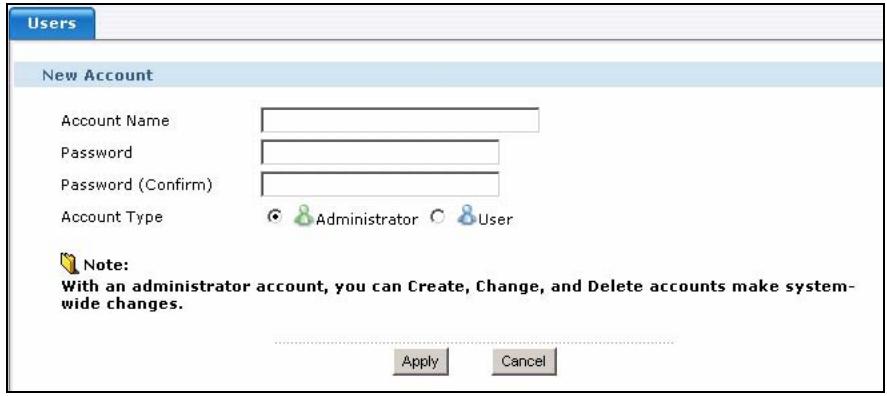
Figure 48 Users > Add or Edit an Account
The following table describes the labels in this screen.
Table 28 Users > Add or Edit an Account
| LABEL | DESCRIPTION |
| Account Name | Type a name from 1 to 32 single-byte (no Chinese characters allowed for example) ASCII characters. See Section 9.3.2 on page 85 for more details on usernames. |
| Password | Create a password associated with this user. You can type from one to 14 single-byte (no Chinese characters allowed for example) ASCII characters. |
| Password (confirm) | You must type the exact same password that you just typed in the above field. |
| Account Type | Select Administrator to give full configuration and management access to the NSA. Select User to give basic access rights to the NSA and allow the user to manage his own shares, change his own password, and access the contents of other shares to which he is given access rights. |
| Apply | Click this button to save your changes back to the NSA. |
| Cancel | Click this button to begin configuring this screen afresh. |
9.3.2 用户名
Enter a username from one to 32 characters. The first character must be alphabetical (case insensitive, [A-Z a-z]); numeric characters are not allowed as the first character.
The username can only contain the following characters:
- Alphanumeric A-z 0-9. Unicode usernames are supported with CIFS logins, but not FTP or web configurator logits.
Spaces
- [underscores]
[periods]
- - [dashes]
Other limitations on usernames are:
- All leading and trailing spaces are removed automatically.
- Multiple spaces within names are converted to a single space.
- usernames are case insensitive. The username cannot be the same (no matter the letter case) as an existing user. For example, if a user exists with the name 'BOB', you cannot create a user named 'bob'. If you enter a user 'bob' but use 'BOB' when connecting via CIFS or FTP, it will use the account settings used for 'bob'.
- The username cannot be the same as a system username such as ANONYMOUS_CIFS, ANONYMOUS FTP, EVERYONE nor be the same as an existing user. Other reserved usernames that are not allowed are:
bin
- daemon
ftp
- anonymous-ftp
- nobody
- root
pc-guest
admin
- password
9.4 Change Password Screen
Go to the Users screen and select a user account, then click Change Password to modify the account's password.
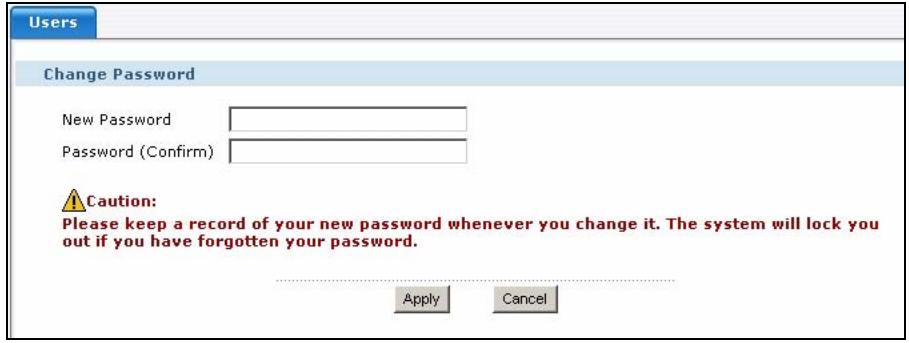
Figure 49 Users > Change Password
The following table describes the labels in this screen.
Table 29 Users > Change Password
| LABEL | DESCRIPTION |
| New Password | Create a new password for this user. You can type from one to 14 single-byte (no Chinese characters allowed for example) ASCII characters. See Section 9.3.2 on page 85 for more details on usernames. |
| Retype to confirm | You must type the exact same password that you just typed in the above field. |
| Apply | Click this button to save your changes back to the NSA. |
| Cancel | Click this button to begin configuring this screen afresh. |
9.5 Delete Account Screen
In the Users screen, select an account and click Delete Account to open this screen.
Use this screen to remove a user account.
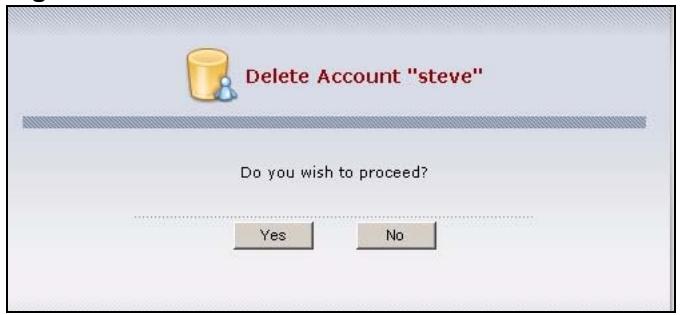
Figure 50 Users > Delete Account
The following table describes the labels in this screen.
Table 30 Users > Delete Account
| LABEL | DESCRIPTION |
| Yes | Click Yes to remove the user account. Management of any shares that belonged to the account passes to the default administrator account. |
| No | Click No to keep the user account. |
This chapter introduces the Shares screens of the NSA.
10.1 Shares Introduction
Use the Shares screens to create and manage shares. A share is a set of user access permissions mapped to a specific folder on a volume. It is equivalent to the Windows concept of a shared folder, but is independent of the folder. You can map a share to a network drive for easy and familiar file transfer for Windows users.
10.1.1 Share Icons
These are the share icons.
Table 31 Share Icons
| ICON | DESCRIPTION |
| This represents a share on a volume on the internal hard drives. Click this icon to access the share's contents. The folder appears as gray if the share is not currently available (because the hard drive was removed for example). | |
| This represents a share on a volume on an external (USB) device. Click this icon to access the share's contents. The folder appears as gray if the share is not currently available (because the USB drive was removed for example). |
10.1.2 Shares Screen
Click Shares in the Navigation panel to open the following screen. This screen lists all of the shares.
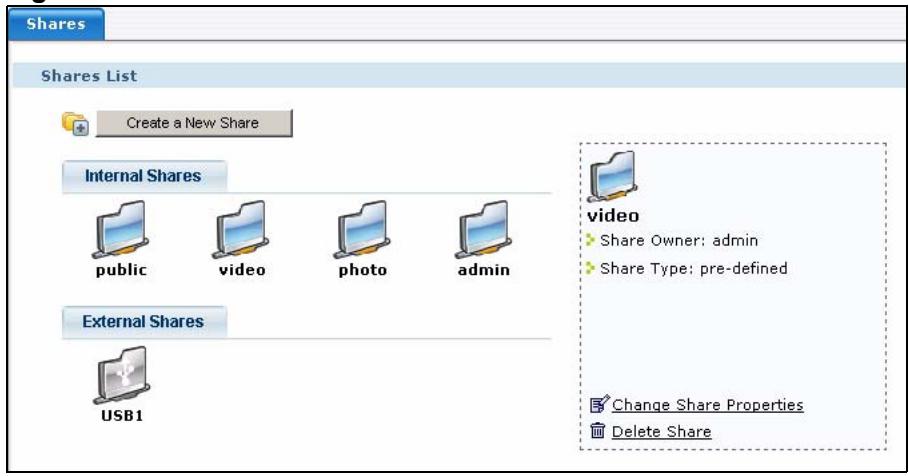
Figure 51 Shares
The following table describes the labels in this screen. See Table 31 on page 89 for icon details.
Table 32 Shares
| LABEL | DESCRIPTION |
| Create a New Share | Click this button to add a share. |
| External Shares | These are shares on the external (USB) devices. |
| Share Owner | This is the name of the user account to which this share belongs. |
| Share Type | This field displays built-in for system shares. You cannot delete these shares (these are the public and admin shares).This field displays pre-defined for default shares. You can delete these shares (these are the video, music, and photo shares).This field displays user-created for shares that an administrator has created. You can delete these shares. |
| Change Share Properties | Click this to edit the selected share. |
| Delete Share | Click this to remove the selected share. |
10.2 Adding a New Share
Click the Create a New Share button in the Shares screen to open the following screen. Use this screen to create a new shared folder with optional access password.

Figure 52 Shares > Add Share
The following table describes the labels in this screen.
Table 33 Shares > Add Share
| LABEL | DESCRIPTION |
| Share Name | Type a share name from 1 to 255 single-byte (no Chinese characters allowed for example) ASCII characters. The name cannot be the same as another existing local share. See Section 2.5.4 on page 37 for more information on share names. |
| Volume | You should have already created volumes (a single accessible storage area with a single file system) on the NSA. Select the one that contains the folder that you want to share out. |
| Path | Browse to find (or create) a folder on the NSA or type the location of the folder using forward slashes as branch separators. Each folder can only belong to a single share. See Section 2.5.5 on page 38 for more information on share paths. |
| Make this share owned by | Select the administrator or user account that is to own (manage) this share. The share owner controls access rights to the share. |
| Share Access | Use this part of the screen to assign access rights (full, read only or deny) to users. Keep it private to owner means only the share owner (selected above) can access the share. Public means every user (including people who do not have accounts on the NSA) can access the share. Advanced allows you to assign specific access rights (full, read only or deny) to individual users. |
| Username | This column lists all of the accounts configured on the NSA. |
| Full | Select this check box next to a user to give him or her full access (read, write and execute) to all files contained within this share. Select the check box in the heading row to select all users. |
| Read Only | Select this check box next to a user to give him or her read-only access (they cannot modify nor execute) to all files contained within this share. Select the check box in the heading row to select all users. |
| Deny | Select this check box next to a user to deny him or her any access (they cannot read, modify nor execute) to all files contained within this share. Select the check box in the heading row to select all users. |
| Note: No one can use the share if you deny access to all users. Thus denying all users access is not recommended. | |
| Publish this share to Media Server | Select this option to have the NSA share files in this folder with media clients. The media clients do not have to use a password to play the shares you publish. |
| Apply | Click this button to save your changes back to the NSA. |
| Cancel | Click this button to begin configuring this screen afresh. |
10.2.1 Public and ANONYMOUS Share Access Rights
If you make a share public, users do not need to log in.
With ANONYMOUS FTP, you must enter either 'anonymous' or 'ftp' as the username. Any other name is considered a username, so must be valid and have a corresponding correct password.
10.3 Share Path Browse Screen
Use this screen to navigate and/or create folders within a share.
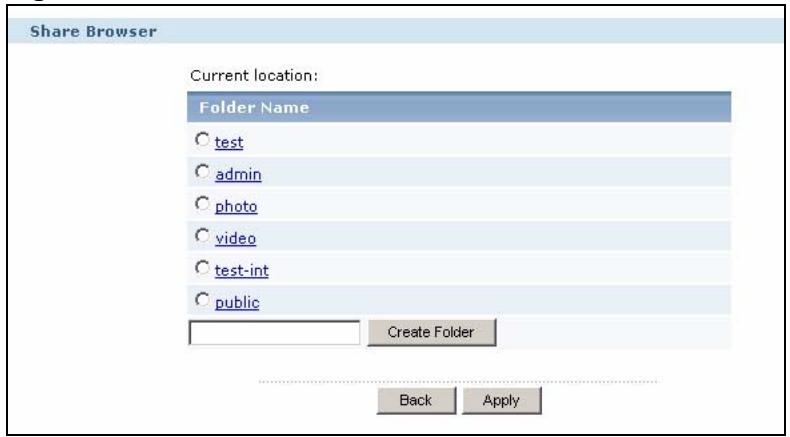
Figure 53 Share Path Browse
The following table describes the labels in this screen.
Table 34 Share Path Browse
| LABEL | DESCRIPTION |
| Folder Name | This section lists the volume's existing folders. Select the one for which you want to create a share. You can also click the folder's name to navigate to a sub folder within the folder. |
| Create Folder | Type a folder name and click Create Folder to make a new folder. The name can be 1 to 255 single-byte (no Chinese characters allowed for example) ASCII characters. The name cannot be the same as another existing folder in the same path. See Section 2.5.4 on page 37 for more information on folder names. |
| Back | Click this button to return to the previous screen without keeping selecting a folder. |
| Apply | Click this button to return to the previous screen with your folder selection. |
PART IV
Protection, Media Client, Maintenance, & Troubleshooting
Maintenance Screens (97)
Protecting Your Data (105)
Media Client Software (107)
Troubleshooting (111)
Maintenance Screens
This chapter discusses the Maintenance screens.
11.1 Maintenance Overview
Use the maintenance screens to:
View logs
- Manage the NSA configuration file
- Upload new firmware
- Restart or shut down your NSA
11.2 Log
Click Maintenance > Log to display the following screen.
The Log screen displays all NSA logs. There are at most 128 entries in the log. Older logs are removed by the system. You cannot download the log file via FTP or CIFS.
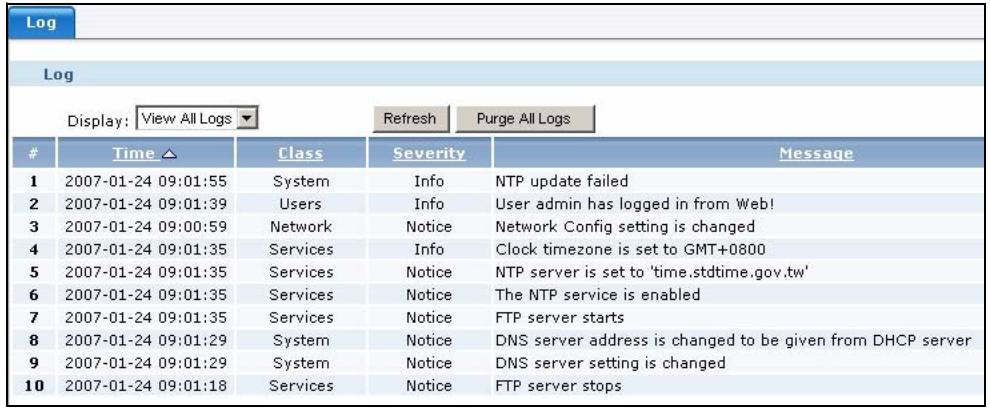
Figure 54 Maintenance > Log
The following table describes the labels in this screen.
Table 35 Maintenance > Log
| LABEL | DESCRIPTION |
| Refresh | Click this button to update the log display. |
| Purge all Logs | Click this button to erase all logs from the NSA. |
| # | This is the log entry's number in the list according to the currently selected sort order. |
| Time | This shows the date and time the log was created. Click the top of the column to sort by oldest or newest. |
| Class | This displays the log category; see Table 36 on page 98 for details. |
| Severity | This displays how serious the log is rated by the NSA. See Table 37 on page 98 for more information. |
| Message | This displays a description of the log. Click the top of the column to sort by alphabetical or reverse alphabetical order. |
| First/Prev | Use these hyperlinks to navigate to the first or previous log page. |
| Next/Last | Use these hyperlinks to navigate to the next or final log page. |
11.3 Log Classes
The following table shows information on log classes.
Table 36 Log Classes
| LOG CATEGORY | DESCRIPTION |
| Network | This log class shows information on network configuration, setting changes and so on. |
| Services | This log class shows information on the operation of the NSA's built-in services. |
| Shares | This log class shows information on shares being created or deleted. |
| System | This log class shows all other system related messages. |
| Users | This log class shows information on user access to the NSA. |
11.4 Log Severity Levels
The following table shows information on log severity levels. Levels range from 0 to 6 with 0 being the most severe level log and 6 being an informational log only. Log levels are not displayed in the logs and are for your reference only.
Table 37 Log Severity Levels
| LEVEL | DESCRIPTION |
| 0 | Emergency |
| 1 | Alert |
| 2 | Critical |
| 3 | Error |
| 4 | Warning |
| 5 | Notice |
| 6 | Info |
11.5 Log Messages
Here are some example log messages.
Table 38 Log Messages
| CLASS | SEVERITY | MESSAGE |
| Network | NOTICE | %s is active because of changing Port Group. Enable DHCP client. |
| Network | NOTICE | %s is inactive because of changing Port Group. Disable DHCP client. |
| Network | NOTICE | %s MTU > (%s MTU - 8), %s may not work correctly. |
| Network | NOTICE | (%s MTU - 8) < %s MTU, %s may not work correctly. |
| Network | NOTICE | Add interface %s. |
| Network | NOTICE | Because %s link down. Default route will not apply until %s link up. |
| Network | NOTICE | Because base interface %s will be disabled. Interface %s is disabled now., base.ud_iface |
| Network | NOTICE | Network Config setting is changed |
| Network | NOTICE | Interface %s was disabled. |
| Network | NOTICE | Interface %s was enabled. |
| Network | NOTICE | Port Group on %s is changed. Renew DHCP client. |
| Network | NOTICE | show_sdx |
| Services | INFO | admin has changed the password |
| Services | INFO | HTTP management port has changed to %s |
| Services | INFO | Clock has disable daylight saving |
| Services | INFO | MyClock has enable daylight saving |
| Services | INFO | MyClock has settimezone to %s |
| Services | INFO | MyClock has settimezone to default |
| Services | INFO | The date and time are updated from NTP server. |
| Services | INFO | The date and time are updated manually. |
| Services | INFO | The time is updated manually. |
| Services | NOTICE | MyClock has changed daylight saving interval |
| Services | NOTICE | MyClock has disabled daylight saving interval |
| Services | NOTICE | NTP server has set to '%%' |
| Services | NOTICE | NTP server has set to null |
| Services | NOTICE | The NTP service is disabled. |
| Services | NOTICE | The NTP service is enabled. |
| Services | WARNING | Reaching Maximum Allowed Rules |
| Services | WARNING | Reaching Maximum Allowed Rules |
| Services | WARNING | Rule is empty |
| Services | WARNING | The Rule Does Not Exist |
| Services | NOTICE | FTP server stops |
| Services | NOTICE | FTP server starts |
| Services | INFO | Clock timezone is set to GMT%s |
| Services | INFO | Clock timezone is set to default |
| Services | INFO | Clock daylight saving is enabled |
| Services | INFO | Clock daylight saving is disabled |
| Shares | NOTICE | Add new share %s. |
| Shares | NOTICE | Delete share %s. |
| Shares | NOTICE | Delete share %s. |
| System | INFO | NTP update failed |
| System | INFO | NTP updates successfully from %s |
| System | INFO | NTP fails to update from %s |
| System | INFO | Device is rebooted by administrator! |
| System | INFO | Device is shutdown by administrator! |
| System | NOTICE | DNS server is changed. |
| System | NOTICE | Hostname is cleared. |
| System | NOTICE | Hostname is set to '%%s'. |
| System | NOTICE | System description is changed. |
| System | NOTICE | System description is empty now. |
| System | NOTICE | DNS server setting is changed |
| System | NOTICE | DNS server address is changed to be given from DHCP server |
| System | NOTICE | DNS server setting is changed |
| System | NOTICE | DNS server address is changed to be assigned by user |
| System | NOTICE | Name server is changed. |
| Users | ALERT | Failed %s login attempt (incorrect password or nonexistent username) |
| Users | ALERT | Failed %s login attempt (incorrect password or nonexistent username) |
| Users | NOTICE | Add new user %s. |
| Users | NOTICE | Change user %s's password. |
| Users | NOTICE | Delete user %s. |
| Users | NOTICE | User %s on %u.%u.%u.%u has been denied access from %s |
| Users | INFO | User %s has logged in from %s! |
| Users | INFO | User %s has logged out from %s! |
| Users | INFO | User %s from %s has been logged out (re-auth timeout)! |
| Users | INFO | User %s from %s has been logged out (lease timeout)! |
11.6 Configuration
Click Maintenance > Configuration to open the following screen.
Use the Configuration screen to back up or restore the NSA configuration settings and enable or disable the hardware reset button.
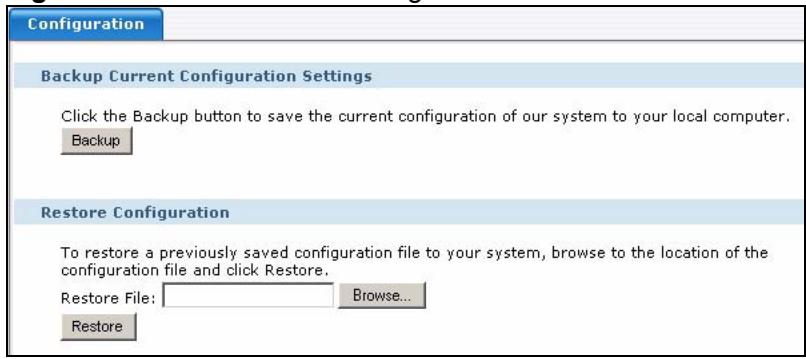
Figure 55 Maintenance > Configuration
The following table describes the labels in this screen.
Table 39 Maintenance > Configuration
| LABEL | DESCRIPTION |
| Backup Current Configuration Settings | |
| Backup | Click Backup to save the current configuration of the NSA to your computer. A pop-up screen appears asking you to confirm. Click OK to continue or Cancel to quit. |
| Restore Configuration | After you restore a configuration, if a share path does not exist, then it appears be in red. |
| Browse | Click Browse to locate a previously-saved configuration file. |
| Restore | Click Restore to load the previously-saved configuration file to the NSA. This replaces your current NSA configuration settings with the settings in the previously-saved configuration file.A pop-up screen appears asking you to confirm. Click OK to continue or Cancel to quit. |
11.7 Firmware Upgrade
Click the Maintenance link in the Navigation panel and then click the FW Upgrade link or the FW Upgrade tab to access the Maintenance > FW Upgrade screen.
Use this screen to upgrade the NSA firmware. You should first have downloaded the latest firmware files from the ZyXEL website.
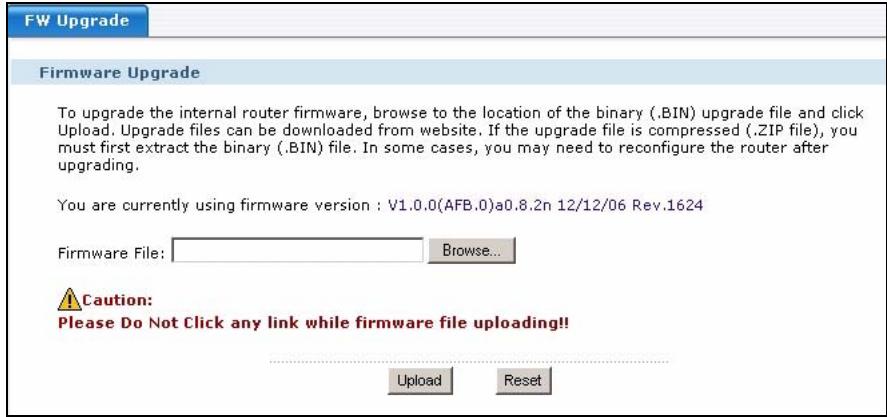
Figure 56 Maintenance > FW Upgrade
The following table describes the labels in this screen.
Table 40 Maintenance > FW Upgrade
| LABEL | DESCRIPTION |
| Firmware Upgrade | |
| Firmware File | Type the location of the firmware file you want to upload |
| Browse | Click Browse to find the file on your computer |
| Upgrade | Click Upgrade to upload the new firmware. The NSA automatically restarts after you upgrade. Wait until the restart completes before accessing the NSA again. If you interrupt the upgrade, then the NSA may become unusable. |
| Reset | Click Reset to begin configuring this screen afresh. |
11.8 Shutdown
Click the Maintenance link in the Navigation panel and then click the Shutdown link or the Shutdown tab to access the Maintenance > Shutdown screen.
Use this screen to turn off the NSA or perform a software restart. A software restart is faster than turning the NSA off and then turning it on again. Before shutting down or restarting, check the System Status > Active Sessions screen to make sure that no one is logged into the NSA or transferring files to or from the NSA.
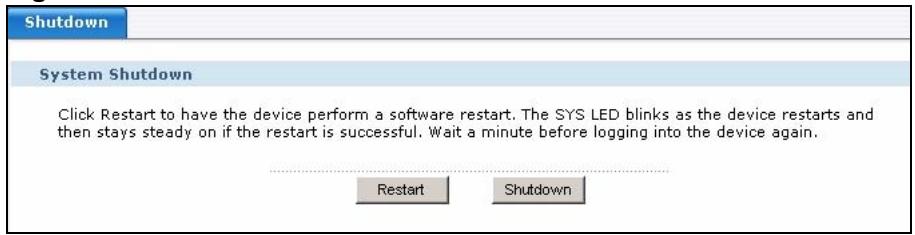
Figure 57 Maintenance > Shutdown
The following table describes the labels in this screen.
Table 41 Maintenance > Shutdown
| LABEL | DESCRIPTION |
| System Shutdown | |
| Restart | Click Restart to have the device perform a software restart. |
| Shutdown | Click Shutdown to shut down the system and restart it again later. |
When you click the Restart button a pop-up screen will appear asking you to confirm. Click OK to continue or Cancel to quit the restart.
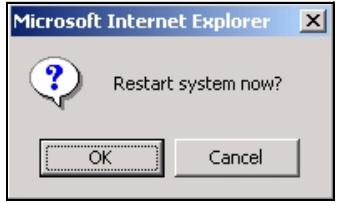
Figure 58 Maintenance > Shutdown > Confirm Restart
When you click the Shutdown button a pop-up screen will appear asking you to confirm. Click OK to continue or Cancel to quit the shutdown.
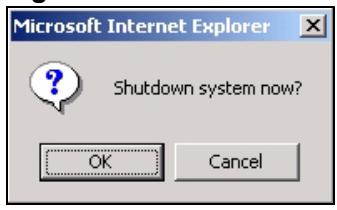
Figure 59 Maintenance > Shutdown > Confirm Shutdown
Protecting Your Data
This chapter compares the different ways of protecting data on the NSA and explains how to use backup management software included on the CD.
12.1 Protection Methods
There are a variety of ways to protect your data on the NSA. Below is a summary table of what can be done in each situation.
Table 42 Overview of Protection Methods
| SITUATION | ACTION |
| Unexpected NSA behavior after configuration changes | Back up the NSA configuration file before you make major configuration changes. |
| Need to transfer data from your computer to the NSA after volume(s) have been created | Use the Memeo Autobackup program. |
| Data infected by virus | Use anti-virus software on your computer to scan files before saving them onto the NSA. Although this may be slow so you may want to schedule it to occur while no one is using the NSA. Use a firewall with anti-virus capability on your network. |
| Hard drive malfunction. | Use RAID. |
| NSA malfunction Network down Natural disaster such as a fire or earthquake occurs where your NSA is located | Back up data to another NSA or external USB hard drive. |
The following sections describe these methods in more detail. See Section 6.4 on page 65 for more information on RAID.
12.1.1 Configuration File Backup and Restoration
Use the Maintenance > Configuration menus to create a file of your NSA configurations such as passwords, shares and volumes created, network settings and so on. If you're going to do some major configuration changes, then it is advisable to create a configuration backup file. If things go wrong after you make the configuration changes, you can always go back to the previous configuration by restoring an earlier configuration file.
If you forgot the NSA password, then reset the device to go back to the factory default configuration.

Configuration File Backup and Restoration does not affect data (your files and folders), volumes on the NSA.
12.1.2 Memeo Autobackup
Use the Memeo Autobackup software (included on the CD) on your computer to schedule and manage backups. You can backup from your computer to the NSA. You can also backup from one NSA on your network to another. You can set the Memeo Autobackup software to automatically back up files from your computer to the NSA whenever you modify the files.

The Memeo Autobackup program uses the same network port as the NDU to discover the NSA. To avoid a port conflict, do not run the Memeo Autobackup program at the same time as the NDU.
Media Client Software
This chapter introduces the media client software included on the CD.
13.1 Media Client Introduction
The NSA can function as a server to allow DLNA (Digital Living Network Alliance) compliant media clients to play files. The DLNA is a group of leading personal computer and electronics companies that works to make products compatible and able to work in a home network in order to make digital living easy and seamless. The group's members include Nokia, Intel, Microsoft, Sony, Motorola, Philips, Samsung, Matsushita, and Hewlett-Packard.
Install the included DLNA-compliant media client software on your Windows XP computers to let them browse and play files stored on the NSA.
- The software requires Windows XP.
- See the Quick Start Guide for how to install the media client software and the requirement details.
13.2 Using the Media Client Software
Refer to the Quick Start Guide and the help (Start > All Programs > DigiOn > Help) for details on how to use the media client software.
Memeo Autobackup Software
This chapter introduces the Memeo Autobackup software included on the CD.
14.1 Memeo Autobackup Introduction
Use the Memeo Autobackup software included on the CD to automatically back up selected files from your computer to the NSA whenever you modify the files. You can have Memeo backup specific files, folders of files, or types of files.
Install the included DLNA-compliant Memeo Autobackup software on your Windows 2000 or later computers to let them browse and play files stored on the NSA.
- The software requires Windows XP.
- See the Quick Start Guide for how to install the Memeo Autobackup software and the requirement details.
14.2 Using the Memeo Autobackup Software
Refer to the Quick Start Guide for how to use the Memeo Autobackup software. The software also includes help that you can display by clicking the help link in the screens.
Troubleshooting
15.1 Troubleshooting Overview
This chapter offers some suggestions to solve problems you might encounter. The potential problems are divided into the following categories.
- Power, Hardware, Connections, and LEDs
- NSA Login and Access
- Reset the NSA
- I Cannot Access The NSA
- External USB drives
Media Server Functions
15.2 Power, Hardware, Connections, and LEDs

The NSA PWR LED does not turn on (no LEDs are on).
- Make sure the NSA is turned on.
- Make sure you are using the power adaptor or cord included with the NSA.
- Make sure the power adaptor or cord is connected to the NSA and plugged in to an appropriate power source. Make sure the power source is turned on.
- Turn the NSA off and on.
- If the problem continues, contact the vendor.

An HDD LED is off.
The HDD LED is off when the NSA cannot detect a hard drive in the drive bay. Replace or install a hard drive. See Installing or replacing a hard drive

An HDD LED is orange.

Orange means that the NSA detected an error on the hard drive (like a bad sector for example). The NSA automatically tries to recover a bad sector, but the LED stays orange until the NSA restarts. Even if the hard drive still functions, it is recommended that you replace it since errors are a sign that the hard drive may fail soon. See Installing or replacing a hard drive
An HDD LED is red.
Red means the hard drive has failed and the NSA can no longer detect it. Replace the hard drive. See Installing or replacing a hard drive If you are using a RAID I volume, you may still be able to use the volume but you should replace the faulty drive as soon as possible.

Installing or replacing a hard drive

Do not remove or install hard drives while the NSA is turned on. The NSA must be turned off before you remove or install hard drive(s).
1 Turn the NSA off, remove the rear panel and the drive tray and make sure:
- there is a SATA I or SATA 3.0 Gbit/s compatible hard drive installed.
- the hard drive is installed correctly in the drive tray. Push the tray back into NSA drive bay until the screw hole at the top of the drive tray is flush with the drive bay (see the NSA Quick Start Guide and Section 6.5.2 on page 68).
- the hard drive could be faulty. Try a different hard drive or test the original hard drive in a different NSA or computer.
2 If you had to replace the drive, turn on the NSA and go to the Storage Setting screen.
- If you have a RAID I volume click the Repair icon next to the new drive.
- If you are using RAID 0 you will need to recreate the whole volume. All of your data is lost.
- If you are using a single-disk JBOD volume, you need to create a new volume on the new drive.
- If you are using a two-disk JBOD volume, you need to create a whole new volume on both drives.

The LAN LED (by the LAN port) is off.
- Make sure the Ethernet cable is connected properly to the NSA and connected to another (Ethernet) device. Make sure the other device is turned on. If it's connected directly to a computer, make sure that the computer network card is working (ping 127.0.0.1 on the computer).
- Use another Ethernet cable. If you're connecting to a Gigabit Ethernet, make sure you're using an 8-wire Ethernet cable.
- If the problem continues, contact the vendor.
See Section 1.1.1 on page 26 for a description of NSA LEDs.
15.3 NSA Login and Access

I forgot the server name of the NSA.
- The default server name is nsa220.
- Use the NDU (NSA Discovery Utility) to discover your NSA. If you have admin privileges, you can directly change the IP address of the NSA using the NDU.
- If the server name has changed and you don't have the NDU, see Section 15.3.1 on page 114 to use the RESET button to return the default setting.

I cannot get to the NSA login screen.
- Use the NDU (NSA Discovery Utility) to discover your NSA. If you have admin privileges, you can directly change the IP address of the NSA using the NDU.
- If you used the RESET button, the NSA may have a new IP address. Close and reopen the NDU to discover the NSA.
- Make sure the NSA is turned on.
-
If you are trying to login directly by typing the server name into your web browser's address field, make sure you are using the correct server name as the web site address.
-
The default server name is nsa220, if you have changed the server name, use the new one.
- If the server name has been changed and you do not know the new server name, see the troubleshooting suggestions for I forgot the server name of the NSA.
-
If it still doesn't work, try using the NDU.
-
Check the hardware connections, and make sure the LEDs are behaving as expected. See the Quick Start Guide and Section 1.1.1 on page 26.
-
By default, the NSA gets an IP address automatically. The NSA assigns itself an IP address if no device assigns one. If your computer is also set to get an IP address automatically, the computer and the NSA can both assign themselves IP addresses and communicate. See Chapter 7 on page 73 if you need to configure the NSA with a static IP address.
-
Make sure your computer's IP address is in the same subnet as the NSA's IP address. You can use the NDU to find the NSA's IP address. See Appendix B on page 129 for how to change your computer's IP address. Skip this if you know that there are routers between your computer and the NSA.
- Ping the NSA from your computer. Make sure your computer's Ethernet adapter is installed and functioning properly. In a (Windows) computer, click Start, (All) Programs, Accessories and then Command Prompt. In the Command Prompt window, type "ping" followed by the NSA's IP address (use the NDU to find the NSA's IP address if you don't know it) and then press [ENTER].
- Make sure you are using Internet Explorer 6.0 (and later) or Firefox 1.07 (and later).
- Make sure your Internet browser does not block pop-up windows and has JavaScripts and Java enabled. See Appendix C on page 143. With Internet Explorer 6, you may also have to enable scripting of safe ActiveX controls. See Section 15.3.2 on page 115.
15.3.1 Reset the NSA
If you forget your password or cannot access the web configurator, use the RESET button at the rear of the NSA.
15.3.1.1 Using the Reset Button
When you use the following reset procedure, the system name and admin password are returned to the factory defaults.
You may need to close and re-open the NDU to discover the NSA. This is because the NSA automatically re-acquires IP address information, so its IP address may change since. If no IP address information is assigned, the NSA uses Auto-IP to assign itself an IP address and subnet mask. For example, you could connect the NSA directly to your computer. If the computer is also set to get an IP address automatically, the computer and the NSA will choose addresses for themselves and be able to communicate.
1 Press and hold the RESET button (for about two seconds) until you hear a beep, and then release it.
2 The NSA automatically restarts to complete the reset.

I forgot the password.
- The default password is 1234.
- If you have changed the password and forgotten it, you will have to reset the NSA - see Section 15.3.1 on page 114.

The NDU cannot discover my NSA.
-
Confirm that the computer running the NDU has a network connection. See the section on the NSA's LAN connection for related information.
-
The computer running the NDU can only discover NSAs in the same subnet. NSAs connected to the same switch or router as your NDU computer are usually in the same subnet unless the router is doing subnetting or the switch is implementing VLAN.
- The Memeo Autobackup program uses the same network port as the NDU to discover the NSA. To avoid a port conflict, do not run the Memeo Autobackup program at the same time as the NDU.
- Close the NDU and reopen it.
15.3.2 Enabling Scripting of Safe ActiveX Controls
If pages of the web configurator do not display properly in Internet Explorer, check that scripting of safe ActiveX controls is enabled.
1 In Internet Explorer, click Tools, Internet Options and then the Security tab.
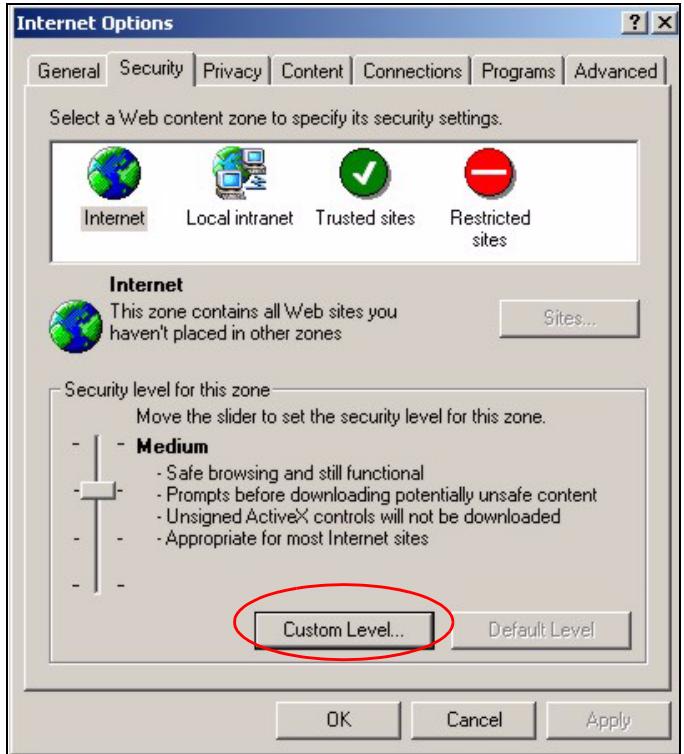
Figure 60 Internet Options: Security
2 Click the Custom Level... button.
3 Under Script ActiveX controls marked safe for scripting, make sure that Enable is selected (the default).
4 Click OK to close the window.
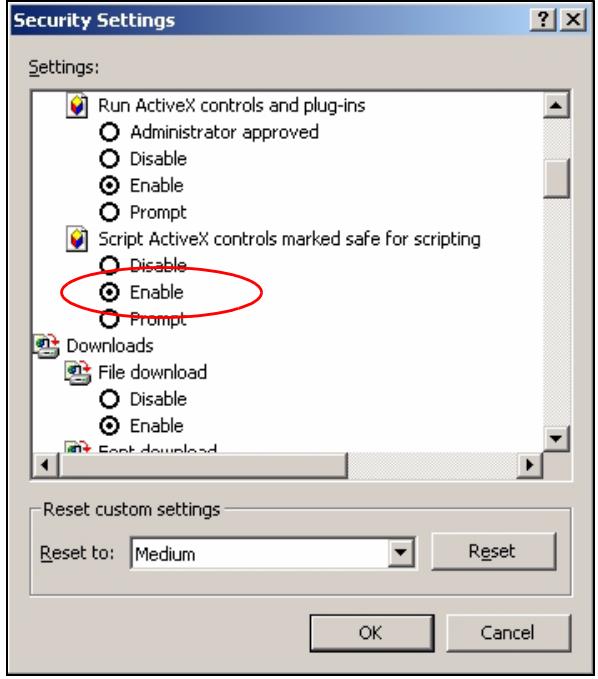
Figure 61 Security Settings - Script Safe ActiveX Controls

I can see the login screen, but I cannot log in to the NSA.
- Make sure you have entered the username and password correctly. The default username is admin, and the default password is 1234. These fields are case-sensitive, so make sure [Caps Lock] is not on.
- Turn the NSA off and on.
- If this does not work, see Section 15.3.1 on page 114 to reset the device.

I cannot see the multi-language web configurator screens while using Internet Explorer.
Use Section 15.3.2 on page 115 to enable the scripting of safe ActiveX controls.
15.4 I Cannot Access The NSA

I cannot access a share
- Check that the NSA is turned on and connected to the network. Try to ping the NSA or use the NDU to discover it.
- Check that you entered your login name and password correctly.
- Check that the share exists and check its access settings.
- Check if the shared folder is a subfolder of another (parent) share. Check that the parent share's access rights do not conflict with the subfolder share. It is recommended that you do not create subfolder shares.
- Check if there are any existing mapped network drives to the NSA. You may need to disconnect existing mapped network drives as a new mapped network drive connection may use (different) previously-saved login information. To do this, open Windows Explorer and click Tools > Disconnect Mapped Network Drives.
- Check that the volume in which the share resides, exists and is not down or degraded. If it is down or degraded, see Section 15.2 on page 111.
-
Make sure you have the client for Microsoft networks installed and enabled in your network connection's properties.
-
In Windows XP or 2000, click Start > Settings > Control Panel > Network Connections (Network and Dial-up Connections in Windows 2000/NT) > Local Area Connection > Properties.
-
Check that Client for Microsoft Networks is in the list of components and has its check box selected.
15.5 External USB drives

My external USB drive is read-only.
If your USB drive was formatted as NTFS, then it is read-only on the NSA (the volume status displays as OK). To solve this problem, re-format your USB drive using the NSA (or FAT or FAT32 using a computer). See Chapter 6 on page 61 for information on volume creation using the NSA (recommended). Back up the files on your computer before you format the USB drive.

The COPY LED is red.
Copying files from a USB device failed. The USB device may not be compatible with the NSA. Try save the files onto a computer and then from the computer to the NSA (through the network connection).
15.6 Media Server Functions

I set the media server function to publish a folder, but some of the files in the folder do not display in the list on the media client.
Files with formats that are not supported on the media server may not display in the list. See Appendix A on page 126 for the file formats that the media server supports.

I published a folder with the media server function, but the media client does not play some of the files (or does not play them properly).
1 Files with formats that are not supported on the media server may not display in the list. See Appendix A on page 126 for the file formats that the media server supports.
2 If you are using media client software, you may need to install CODEs on your computer. Since the media client software uses your computer's installed CODEs, files do not play if the required codec is not installed on your computer.
3 The media client may not support the file's format.
PART V
Appendices and Index
Product Specifications (121)
Setting up Your Computer's IP Address (129)
Open Source Licences (151)
Legal Information (181)
Customer Support (183)
Index (187)
Product Specifications
See also Chapter 1 on page 25 for a general overview of the key features.
Feature Tables
Physical Features
These are the main external physical features.
Table 43 Physical Features
| USB Ports | 2 USB (version 2) ports. Copy files directly to the NSA from compatible USB devices like card readers, MP3 players, memory sticks, and digital cameras without using a computer. Expand the NSA's storage capacity with compatible USB devices (like hard drives). |
| Gigabit Ethernet Port | The 10/100/1000 Mbps auto-negotiating Ethernet port allows the NSA to detect the speed of incoming transmissions and adjust appropriately without manual intervention. It allows data transfer of either 100 Mbps or 1000 Mbps in either half-duplex or full-duplex mode depending on your Ethernet network. Use an 8-wire Ethernet cable for Gigabit connections. The port is also auto-crossover (MDI/ MDI-X) meaning it automatically adjusts to either a crossover or straight-through Ethernet cable. |
| SATA Interface | Serial ATA is a low cost interface technology that allows high speed data transfer. Serial ATA also allows more efficient internal airflow and also smaller chassis design. |
| Reset Button | If you forget your (admin) password, then use the reset button to restore the factory default password to “1234” (with username “admin”), and auto-IP address (DHCP client). |
Firmware Features
These are some of the main firmware features of the NSA.
Table 44 Firmware Features
| DLNA Server | The NSA is a DLNA-certified media server that lets DLNA-compliant media clients play video, audio, and photo content files stored on the NSA. |
| DLNA Client Software | The DLNA-certified media client software (included on the CD) lest your Windows XP computers browser and play media files stored on the NSA. |
Table 44 Firmware Features
| RAID File Storage | Use RAID 0 if you want pure write speed and/or maximum capacity for your drives, and/or you have other means of protecting your data. Use RAID 1 if you have two drives and want to mirror primary data to the second drive. If one drive fails, replace it and then re-synchronize to recover all data. |
| User Passwords | Configure a password for an individual User to restrict access to the NSA. |
| Client Support | Data can be shared among all Windows, Mac, Linux, and UNIX users that have FTP client software or CIFS file sharing support (such as Samba for Linux and UNIX users). The NSA is also a DLNA-certified media server that lets DLNA-compliant media clients play video, audio, and photo content files stored on the NSA. |
| HTTP | Access the NSA using a regular web connection (HTTP). |
| DHCP (Dynamic Host Configuration Protocol) | DHCP (Dynamic Host Configuration Protocol) allows the NSA to obtain an IP address and subnet mask at start-up from a centralized DHCP server. Alternatively, you can give the NSA a static IP address and subnet mask. |
| Full Network Management | The embedded web configurator is an platform-independent web-based utility that allows you to easily access the NSA's management settings. |
| Firmware Upload and Configuration File Management | Upload new firmware to the NSA using the web configurator. You can also back up and restore the NSA configuration file containing all its settings to/from your computer. |
| NSA Discovery Utility (NDU) | Use the NDU from a Windows computer to find NSA(s) in your network, access the NSA login page, change its IP address configuration or map to a Windows network drive. |
| Memeo Autobackup | Memeo Autobackup is a tool for Windows users to create backups of data stored on their Windows computers to an NSA. This software is included on the CD. |
| Time and Date | Configure a time server and set a time zone for your NSA to show the correct times in logs. |
Specification Tables
The NSA hardware specifications are shown in the following table.
Table 45 NSA Hardware Specifications
| Default IP Address | DHCP client. If no DHCP server is found, the NSA uses Auto-IP to choose an IP address in the 169.254.X.X subnet (where X is a number from 1 to 254). |
| Default Subnet Mask | DHCP client by default. If no DHCP server is found, the subnet mask defaults to 255.255.255.0 (24 bits). |
| DefaultUsername | admin |
| Default Password | 1234 |
| Dimensions | 113 (W)*202 (D)*142 (H) mm |
| Weight | 1.5 kg (without hard drives) |
| Drive Trays | Two |
| Compatible Hard DisksA | SATA I and SATA 3.0 Gbit/s (Serial Advanced Technology Attachment) compatible hard drives. |
| Maximum Storage Capacity | 1.5 TB (with two 750 GB hard drives installed) is the largest storage capacity that has been tested as of this writing. The NSA theoretically supports up to 17.6 TB per volume for a maximum possible capacity of 35.2 TB with two 17.6 TB drives configured as JBOD volumes. |
| Maximum Number of Folders Per Share | The NSA's media server function can detect up to 8,000 folders within a single published share. After 8,000 folders have been created, new folder contents will not be added to the media server's list. However you can still access the folders using Samba. |
| Ports | |
| Ethernet | One auto-negotiating, auto MDI/MDI-X 10/100/1000B Mbps RJ-45 Ethernet port (10 Base-T/100 Base-TX/1000 Base-T) |
| USB v2.0 Storage | Two ports on front panel. Windows: NTFS (read only), FAT32 and FAT16 Linux: ReiserFS, EXT2, and EXT3 |
| LEDs | PWR, SYS, HDD1, HDD2, COPY, and LAN |
| Reset Button | Restores factory default username and password. It also sets the NSA to DHCP client. If no DHCP server is found, the subnet mask defaults to 255.255.255.0 (24 bits). |
| Operating Temperature | 0° C ~ 45°C |
| AC Input | Voltage: 100 - 240 V at 50 - 60 Hz Current: 3.42 A |
| Storage Temperature | -30°C ~ 60°C |
| Operating Humidity | 20% ~ 90% RH (non-condensing) |
| Storage Humidity | 20% ~ 95% RH (non-condensing) |
| Certifications | EMC: FCC Part15B, CE-EMC, VCCI, BSMI Safety: CSA International, EN60950-1 |
A. Hard drives may not be included with your NSA.
B. Use an 8-wire Ethernet cable for Gigabit connections.
The NSA firmware specifications are shown in the following table
Table 46 NSA Firmware Specifications
| File Storage System | JBOD, RAID 0, 1, |
| Network Protocols | TCP/IP, UDP/IP DHCP Client FTP HTTP |
| File Management | Create/Delete System Volume |
| Network File Sharing Protocol | CIFS/SMB for Windows and Mac OSX HTTP for web browser FTP |
| Network Security | Authentication Share level |
| Supported Clients | Windows 2000 Professional/Server Windows XP Home/Professional Windows 2003 Windows Vista Linux |
| Maximum Number of Users Allowed | 100^A |
| Maximum Number of Concurrent FTP Sessions | 20^A |
| Maximum Number of Concurrent CIFS Sessions | 20^A |
| System Management | Remote Management via Web Configurator (HTTP) NSA Discovery Utility (NDU) |
| Logging/Monitoring | Centralized Logs |
| Firmware Upgrade | Web Configurator |
| Web Browsers Supported | Internet Explorer 6.0 and later versions. Firefox 1.07 and later versions. |
A. Limits may vary depending on user-share resource usage.
The following list, which is not exhaustive, illustrates the standards and recommendations supported in the NSA.
Table 47 Supported Standards and Recommendations
| CSS level 1 | Cascading Style Sheets. |
| CSS level 2 revision 1 ("CSS 2.1") | Cascading Style Sheets. |
| DATETIME | "Date and Time Formats", W3C (World Wide Web Consortium) Note, M. Wolf and C. Wicksteed, 15 September 1997. Revised 27 August 1998. See http://www.w3.org/TR/1998/NOTE-datetime-19980827 |
| DLNA v1 Server | The DLNA (Digital Living Network Alliance) group of companies works to make products compatible and able to work in a home network in order to make digital living easy and seamless. DLNA clients play files stored on DLNA servers. |
| ECMA-262 | The original ECMAScript standard, also known as JavaScript. |
| ECMA-262 Edition 2 | The ECMAScript standard's second revision; also ISO standard 16262. |
| ECMA-262 Edition 3 | The ECMAScript standard's third revision; corresponds to JavaScript 1.5. |
| ECMA-357 | ECMAScript for XML (E4X). See also the E4X errata. |
| HTML 3.2 Reference Specification | The HyperText Markup Language (HTML). |
| HTML 4.01 Specification | Defines the HyperText Markup Language (HTML), the publishing language of the World Wide Web. |
| ISO 3166-1 | Country names (official short names in English) in alphabetical order as given in ISO 3166-1 and the corresponding ISO 3166-1-alpha-2 code elements. |
| ISO 639-2 | Two-letter and three-letter language code sets. |
| MIMETYPEPS | IANA registered content types (MIME types). See the IANA web site (ftp://ftp.isi.edu/in-notes/iana/assignments/media-types/). |
Table 47 Supported Standards and Recommendations
| RFC 1001 | (STD-19) - Protocol standard for NetBIOS service on a TCP/UDP transport: Concepts and methods |
| RFC 1002 | (STD-19) - Protocol standard for NetBIOS service on a TCP/UDP transport: Detailed specifications |
| RFC 1034 | (STD-13) - Domain names - concepts and facilities |
| RFC 1035 | (STD-13) - Domain names - implementation and specification |
| RFC 1305 | Network Time Protocol (NTP version 3) |
| RFC 1415 | FTP-FTAM Gateway Specification |
| RFC 1510 | The Kerberos Network Authentication Service (V5) |
| RFC 1738 | Uniform Resource Locators (URL) |
| RFC 1808 | Relative Uniform Resource Locators |
| RFC 1945 | The Hypertext Transfer Protocol (HTTP) 1.0. |
| RFC 2131 | Dynamic Host Configuration Protocol |
| RFC 2396 | Uniform Resource Identifier (URI) |
| RFC 2396 | Uniform Resource Identifiers (URI): Generic Syntax |
| RFC 2616 | Hypertext Transfer Protocol (HTTP) 1.1. |
| RFC 2854 | History of HTML development, and lists the relevant W3C (World Wide Web Consortium) recommendations for the "text/html" MIME type. |
| RFC 3066, BCP 47 (Best Current Practice) | Language tags |
| RFC 3282 | "Content-language:" headers. |
| RFC 3986 | (STD-66) - Uniform Resource Identifier (URI): Generic Syntax |
| RFC 4120 | The Kerberos Network Authentication Service (V5) |
| RFC 4248 | The telnet URI Scheme |
| RFC 793 | (STD-7) - Transmission Control Protocol |
| RFC 959 | (STD-9) - File Transfer Protocol |
| SATA | SATA I and SATA 3.0 Gbit/s (Serial Advanced Technology Attachment) compatible hard drives. SATA 3.0 Gbit/s |
| UPnP | |
| USB 2.0 | USB (Universal Serial Bus) version 2.0 allows for interfacing devices with data transfers rates of up to 480 Mbps. |
| XHTML 1.0 | Extensible HyperText Markup Language (Second Edition) |
| XHTML 1.1 | Module-based XHTML |
Supported Media Server Content Formats
The following describes the details about the files that the NSA media server can publish.
Table 48 Supported Media Server Content Formats
| CATEGORY | FILE TYPE | EXTENSION |
| Video | MPEG-1/MPEG-2 | m2p, mpe,mpeg, mpg, vob |
| Windows Media Video | asf, wmv | |
| AVI | avi | |
| DivX | divx ,avi | |
| DVR-MS | dvr-ms | |
| Music | MP3 | mp3 |
| MPEG-4 AAC | m4a | |
| Ogg Vorbis | ogg | |
| WAVE | wav | |
| Windows Media Audio | wma | |
| M3U ( Playlist) | m3u | |
| Photo | Bitmap | bmp |
| GIF* | gif | |
| JPEG | jpeg, jpg | |
| PNG | png | |
| TIFF* | tiff, tif |
- Files may be converted to JPEG to allow play back on client applications that do not support the original file formats.

Not all published file types can be viewed by all client applications.
Power Consumption
The NSA was tested using the specified power sources with the external power adapter and with two hard drives installed.

This table is a laboratory test of NSA power consumption for your reference only.
Table 49 Power Consumption in Watts (W)
| POWER SOURCE | SYSTEM BOOT UP | SYSTEM READ/WRITE | SYSTEM IDLE |
| 240V/50Hz | 58.14W | 31.2W | 23.9W |
| 120V/60Hz | 57.76W | 29.3W | 25.1W |
| 100V/60Hz | 58.14W | 30.0W | 25.1W |
Compatible Hard Disks
The following hard disks have been tested and are known to be compatible with the NSA.
Table 50
| BRAND | MODEL | CAPACITY | INTERFACE |
| Western Digital | WD1600JS | 160 GB | SATA 3.0 Gbit/s |
| Seagate | ST3200827AS | 200 GB | SATA 3.0 Gbit/s |
| Seagate | ST3320820AS | 320 GB | SATA 3.0 Gbit/s |
| Seagate | ST3500830AS | 500 GB | SATA 3.0 Gbit/s |
| Western Digital | WD800 | 80 GB | SATA I |
| Seagate | ST3160023AS | 160 GB | SATA I |
| Hitachi | HDS722516VLSA80 | 160 GB | SATA I |
| Maxtor | 6L120M0 | 120 GB | SATA I |
| Hitachi | HCS725032VLA380 | 320GB | SATA 3.0 Gbit/s |
| Hitachi | HCS725025VLA380 | 250GB | SATA 3.0 Gbit/s |
| Seagate | ST3160815AS | 160GB | SATA 3.0 Gbit/s |
| Seagate | ST3750840AS | 750GB | SATA 3.0 Gbit/s |
| Seagate | ST3160215SCE | 160GB | SATA 3.0 Gbit/s |
Setting up Your Computer's IP Address
All computers must have a 10M or 100M Ethernet adapter card and TCP/IP installed.
Windows 95/98/Me/NT/2000/XP, Macintosh OS 7 and later operating systems and all versions of UNIX/LINUX include the software components you need to install and use TCP/IP on your computer. Windows 3.1 requires the purchase of a third-party TCP/IP application package.
TCP/IP should already be installed on computers using Windows NT/2000/XP, Macintosh OS 7 and later operating systems.
After the appropriate TCP/IP components are installed, configure the TCP/IP settings in order to "communicate" with your network.
Windows 95/98/Me
Click Start, Settings, Control Panel and double-click the Network icon to open the Network window.
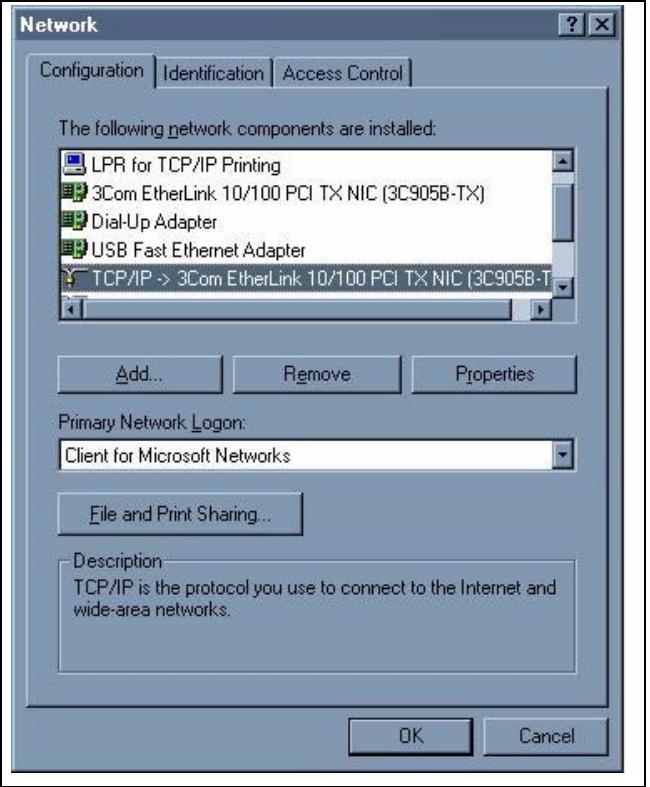
Figure 62 Windows 95/98/Me: Network: Configuration
Installing Components
The Network window Configuration tab displays a list of installed components. You need a network adapter, the TCP/IP protocol and Client for Microsoft Networks.
If you need the adapter:
1 In the Network window, click Add.
2 Select Adapter and then click Add.
3 Select the manufacturer and model of your network adapter and then click OK.
If you need TCP/IP:
1 In the Network window, click Add.
2 Select Protocol and then click Add.
3 Select Microsoft from the list of manufacturers.
4 Select TCP/IP from the list of network protocols and then click OK.
If you need Client for Microsoft Networks:
1 Click Add.
2 Select Client and then click Add.
3 Select Microsoft from the list of manufacturers.
4 Select Client for Microsoft Networks from the list of network clients and then click OK.
5 Restart your computer so the changes you made take effect.
Configuring
1 In the Network window Configuration tab, select your network adapter's TCP/IP entry and click Properties
2 Click the IP Address tab.
- If your IP address is dynamic, select Obtain an IP address automatically.
- If you have a static IP address, select Specify an IP address and type your information into the IP Address and Subnet Mask fields.
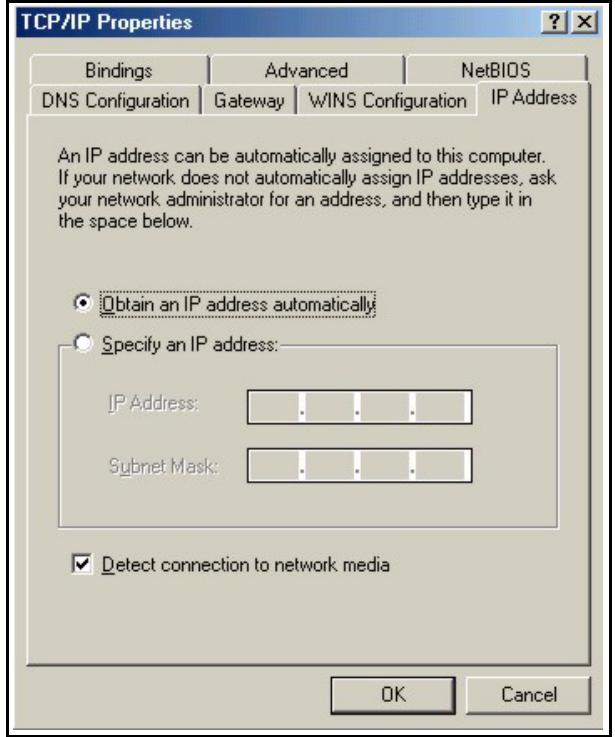
Figure 63 Windows 95/98/Me: TCP/IP Properties: IP Address
3 Click the DNS Configuration tab.
- If you do not know your DNS information, select Disable DNS.
- If you know your DNS information, select Enable DNS and type the information in the fields below (you may not need to fill them all in).
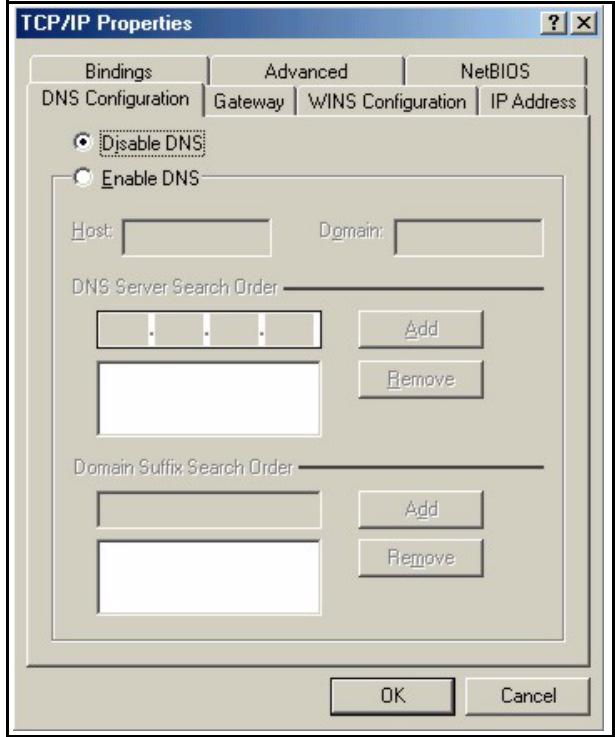
Figure 64 Windows 95/98/Me: TCP/IP Properties: DNS Configuration
4 Click the Gateway tab.
- If you do not know your gateway's IP address, remove previously installed gateways.
- If you have a gateway IP address, type it in the New gateway field and click Add.
5 Click OK to save and close the TCP/IP Properties window.
6 Click OK to close the Network window. Insert the Windows CD if prompted.
7 Restart your computer when prompted.
Verifying Settings
1 Click Start and then Run.
2 In the Run window, type "winipcfg" and then click OK to open the IP Configuration window.
3 Select your network adapter. You should see your computer's IP address, subnet mask and default gateway.
Windows 2000/NT/XP
The following example figures use the default Windows XP GUI theme.
1 Click start (Start in Windows 2000/NT), Settings, Control Panel.
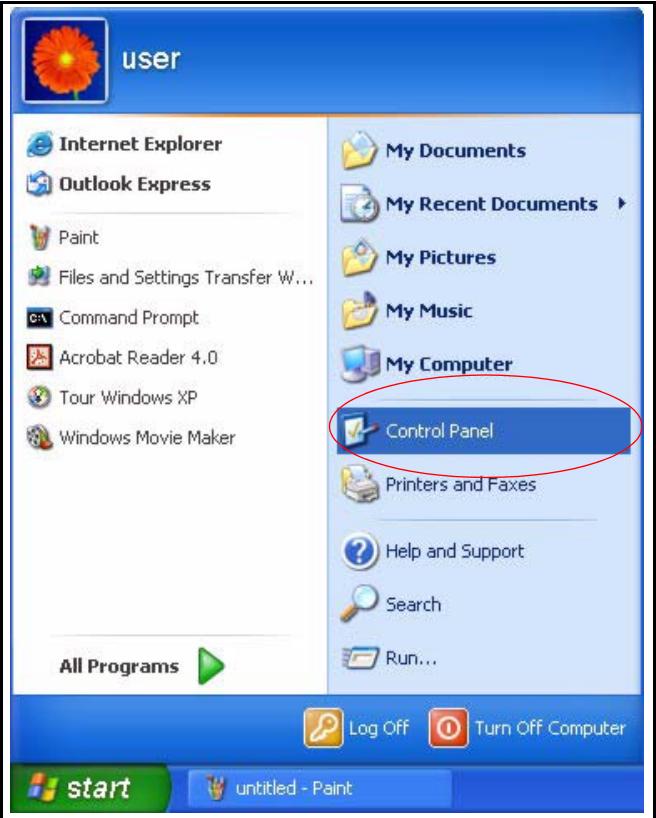
Figure 65 Windows XP: Start Menu
2 In the Control Panel, double-click Network Connections (Network and Dial-up Connections in Windows 2000/NT).
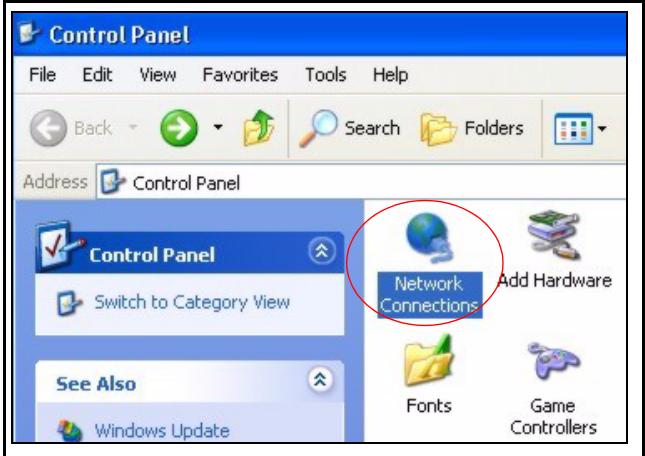
Figure 66 Windows XP: Control Panel
3 Right-click Local Area Connection and then click Properties.
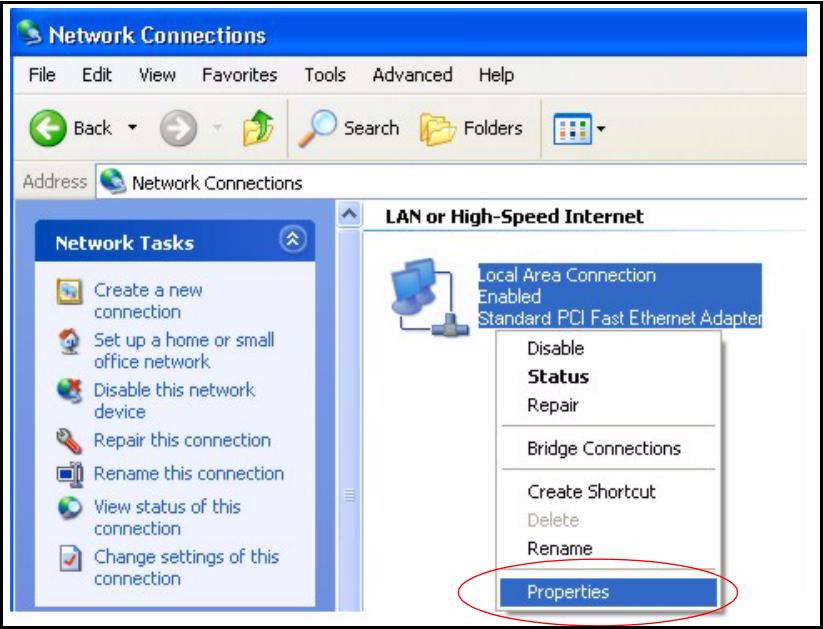
Figure 67 Windows XP: Control Panel: Network Connections: Properties
4 Select Internet Protocol (TCP/IP) (under the General tab in Win XP) and then click Properties.
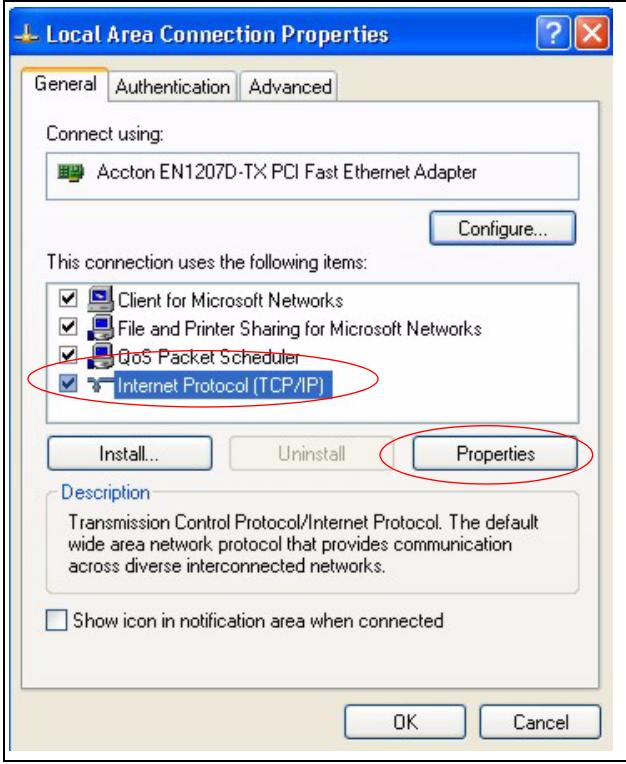
Figure 68 Windows XP: Local Area Connection Properties
5 The Internet Protocol TCP/IP Properties window opens (the General tab in Windows XP).
- If you have a dynamic IP address click Obtain an IP address automatically.
- If you have a static IP address click Use the following IP Address and fill in the IP address, Subnet mask, and Default gateway fields.
- Click Advanced.
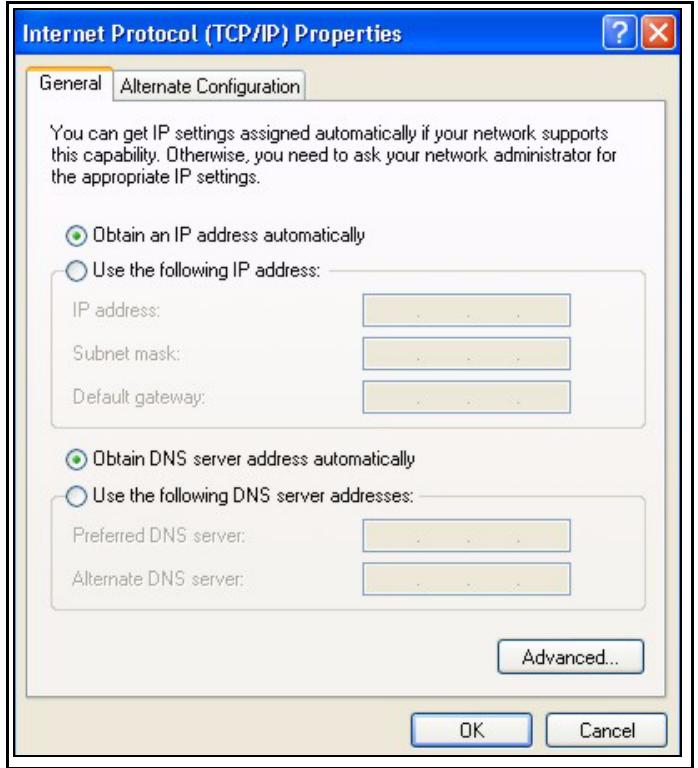
Figure 69 Windows XP: Internet Protocol (TCP/IP) Properties
6 If you do not know your gateway's IP address, remove any previously installed gateways in the IP Settings tab and click OK.
Do one or more of the following if you want to configure additional IP addresses:
- In the IP Settings tab, in IP addresses, click Add.
- In TCP/IP Address, type an IP address in IP address and a subnet mask in Subnet mask, and then click Add.
- Repeat the above two steps for each IP address you want to add.
- Configure additional default gateways in the IP Settings tab by clicking Add in Default gateways.
- In TCP/IP Gateway Address, type the IP address of the default gateway in Gateway. To manually configure a default metric (the number of transmission hops), clear the Automatic metric check box and type a metric in Metric.
- Click Add.
- Repeat the previous three steps for each default gateway you want to add.
- Click OK when finished.
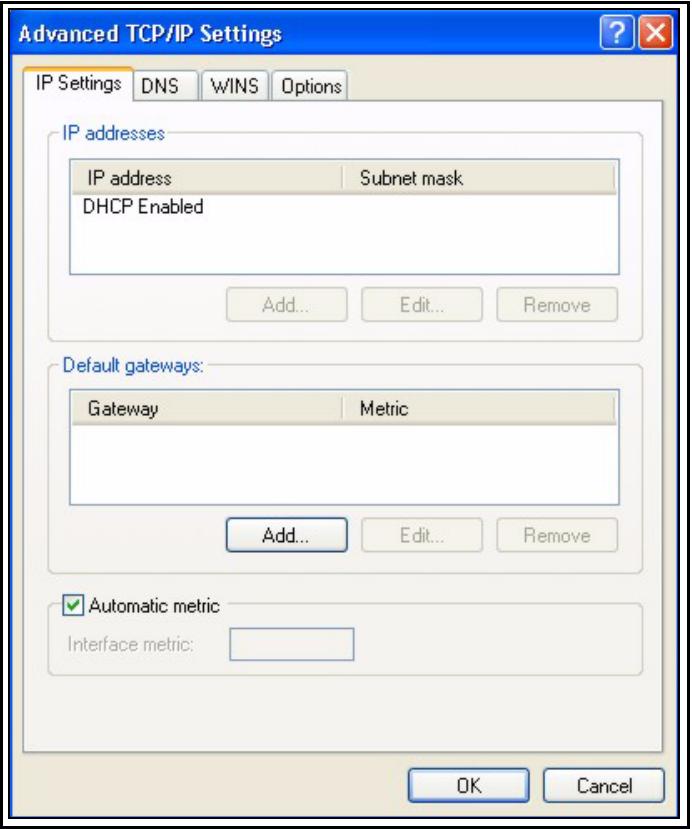
Figure 70 Windows XP: Advanced TCP/IP Properties
7 In the Internet Protocol TCP/IP Properties window (the General tab in Windows XP):
- Click Obtain DNS server address automatically if you do not know your DNS server IP address(es).
- If you know your DNS server IP address(es), click Use the following DNS server addresses, and type them in the Preferred DNS server and Alternate DNS server fields.
If you have previously configured DNS servers, click Advanced and then the DNS tab to order them.
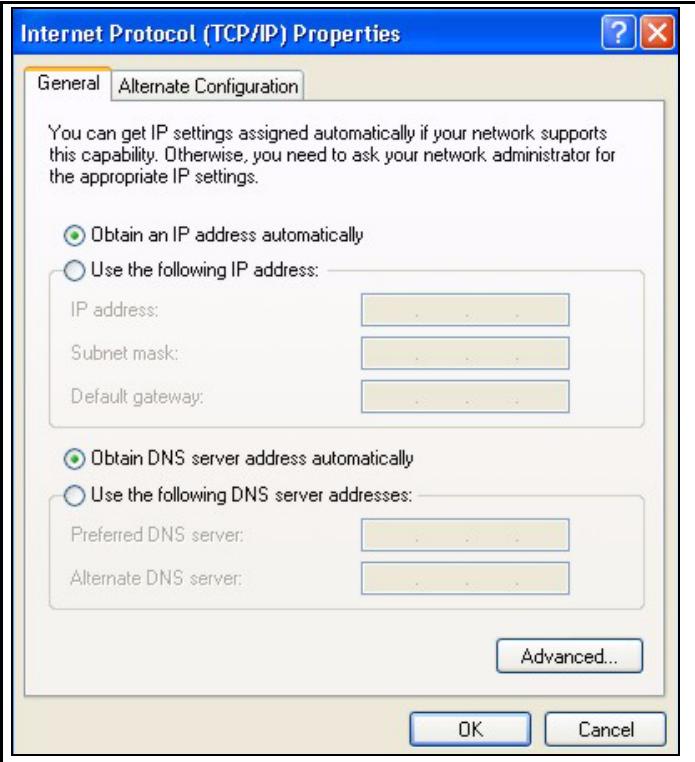
Figure 71 Windows XP: Internet Protocol (TCP/IP) Properties
8 Click OK to close the Internet Protocol (TCP/IP) Properties window.
9 Click Close (OK in Windows 2000/NT) to close the Local Area Connection Properties window.
10 Close the Network Connections window (Network and Dial-up Connections in Windows 2000/NT).
11 Restart your computer (if prompted).
Verifying Settings
1 Click Start, All Programs, Accessories and then Command Prompt.
2 In the Command Prompt window, type "ipconfig" and then press [ENTER]. You can also open Network Connections, right-click a network connection, click Status and then click the Support tab.
Macintosh OS X
1 Click the Apple menu, and click System Preferences to open the System Preferences window.
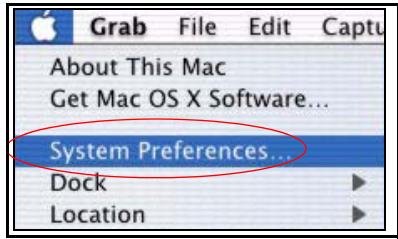
Figure 72 Macintosh OS X: Apple Menu
2 Click Network in the icon bar.
- Select Automatic from the Location list.
- Select Built-in Ethernet from the Show list.
- Click the TCP/IP tab.
3 For dynamically assigned settings, select Using DHCP from the Configure list.
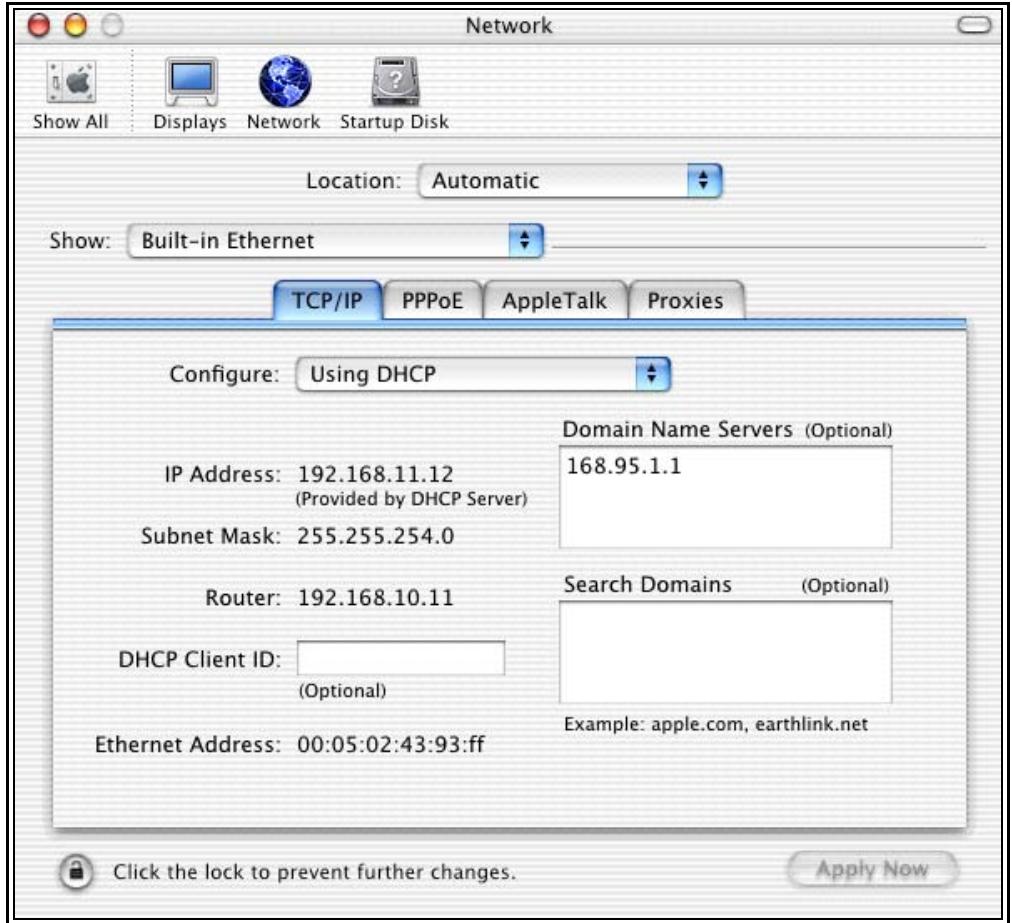
Figure 73 Macintosh OS X: Network
4 For statically assigned settings, do the following:
From the Configure box, select Manually.
- Type your IP address in the IP Address box.
- Type your subnet mask in the Subnet mask box.
- Type the IP address of your gateway in the Router address box.
5 Click Apply Now and close the window.
6 Restart your computer (if prompted).
Verifying Settings
Check your TCP/IP properties in the Network window.
Linux
This section shows you how to configure your computer's TCP/IP settings in Red Hat Linux 9.0. Procedure, screens and file location may vary depending on your Linux distribution and release version.

Make sure you are logged in as the root administrator.
Using the K Desktop Environment (KDE)
Follow the steps below to configure your computer IP address using the KDE.
1 Click the Red Hat button (located on the bottom left corner), select System Setting and click Network.
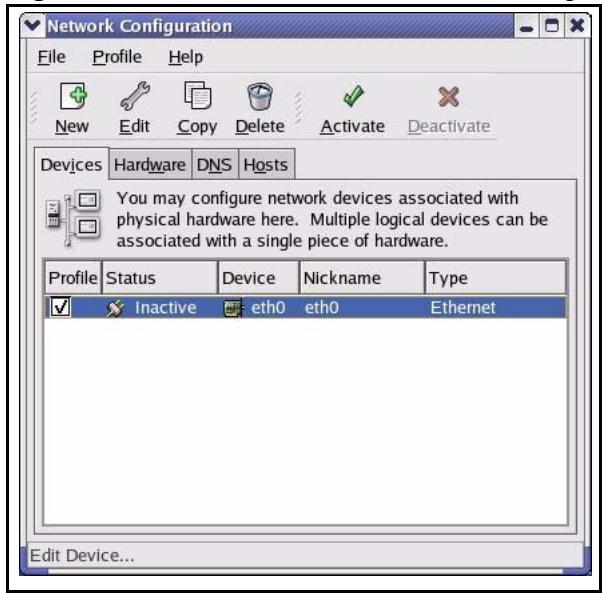
Figure 74 Red Hat 9.0: KDE: Network Configuration: Devices
2 Double-click on the profile of the network card you wish to configure. The Ethernet Device General screen displays as shown.
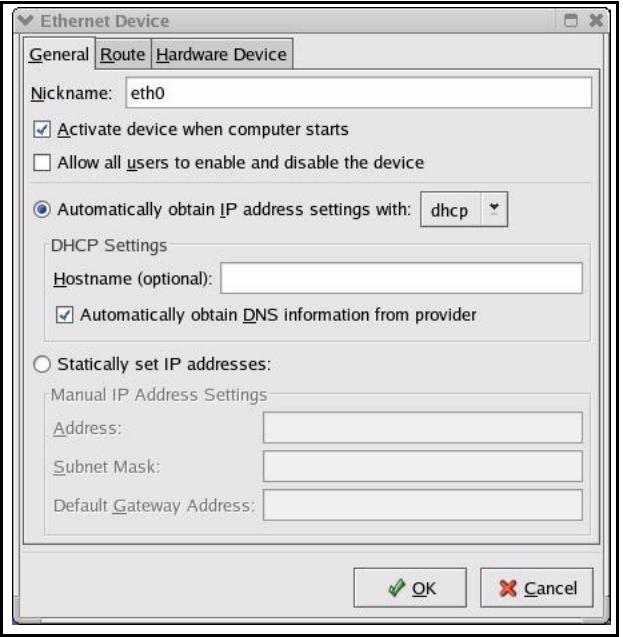
Figure 75 Red Hat 9.0: KDE: Ethernet Device: General
- If you have a dynamic IP address, click Automatically obtain IP address settings with and select dhcp from the drop down list.
- If you have a static IP address, click statically set IP Addresses and fill in the Address, Subnet mask, and Default Gateway Address fields.
3 Click OK to save the changes and close the Ethernet Device General screen.
4 If you know your DNS server IP address(es), click the DNS tab in the Network Configuration screen. Enter the DNS server information in the fields provided.
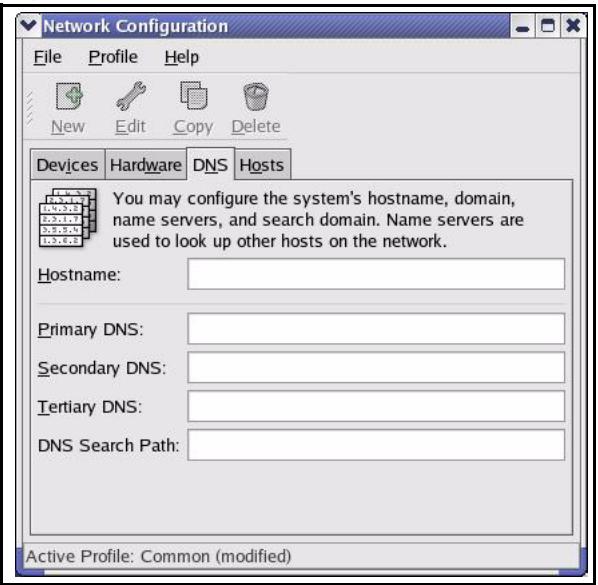
Figure 76 Red Hat 9.0: KDE: Network Configuration: DNS
5 Click the Devices tab.
6 Click the Activate button to apply the changes. The following screen displays. Click Yes to save the changes in all screens.
Figure 77 Red Hat 9.0: KDE: Network Configuration: Activate
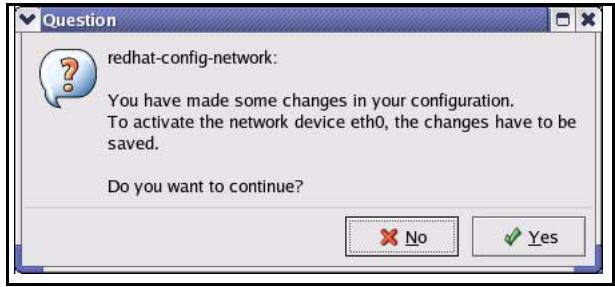
Figure 79 Red Hat 9.0: Static IP Address Setting in ifconfig-eth0
7 After the network card restart process is complete, make sure the Status is Active in the Network Configuration screen.
Using Configuration Files
Follow the steps below to edit the network configuration files and set your computer IP address.
1 Assuming that you have only one network card on the computer, locate the ifconfig-eth0 configuration file (where eth0 is the name of the Ethernet card). Open the configuration file with any plain text editor.
- If you have a dynamic IP address, enter dhcp in the BOOTPROTO= field. The following figure shows an example.
Figure 78 Red Hat 9.0: Dynamic IP Address Setting in ifconfig-eth0
DEVICE=eth0
ONBOOT=yes
BOOTPROTO=dhcp
USERCTL=no
PEERDNS=yes
TYPE=Ethernet
- If you have a static IP address, enter static in the BOOT proto = field. Type IPADDR = followed by the IP address (in dotted decimal notation) and type NETMASK = followed by the subnet mask. The following example shows an example where the static IP address is 192.168.1.10 and the subnet mask is 255.255.255.0.
DEVICE=eth0
ONBOOT=yes
BOOTPROTO=static
IPADDR=192.168.1.10
NETMASK=255.255.255.0
USERCTL=no
PEERDNS=yes
TYPE=Ethernet
2 If you know your DNS server IP address(es), enter the DNS server information in the resolv.conf file in the /etc directory. The following figure shows an example where two DNS server IP addresses are specified.
Figure 80 Red Hat 9.0: DNS Settings in resolv.conf
nameserver 172.23.5.1
nameserver 172.23.5.2
3 After you edit and save the configuration files, you must restart the network card. Enter./network restart in the /etc/rc.d/init.d directory. The following figure shows an example.
Figure 81 Red Hat 9.0: Restart Ethernet Card
[root@localhost init.d]# network restart Shutting down interface eth0: [OK] Shutting down loopback interface: [OK] Setting network parameters: [OK] Bringing up loopback interface: [OK] Bringing up interface eth0: [OK]
Verifying Settings
Enter ifconfig in a terminal screen to check your TCP/IP properties.
Figure 82 Red Hat 9.0: Checking TCP/IP Properties
[root@localhost]# ifconfig
eth0 Link encaps:Ethernet HWaddr 00:50:BA:72:5B:44 inlet addr:172.23.19.129 Bcast:172.23.19.255 Mask:255.255.255.0 UP BROADCAST RUNNING MULTICAST MTU:1500 Metric:1 RX packets:717 errors:0 dropped:0 overruns:0 frame:0 TX packets:13 errors:0 dropped:0 overruns:0 carrier:0 collisions:0 txqueuelen:100 RX bytes:730412 (713.2 Kb) TX bytes:1570 (1.5 Kb) Interrupt:10 Base address:0x1000
[root@localhost]#
Pop-up Windows
In order to use the web configurator you may need to allow:
- Web browser pop-up windows from your device.
- JavaScripts (enabled by default).
- Java permissions (enabled by default).
Internet Explorer Pop-ups
You may have to disable pop-up blocking (allow pop-ups) in order to use your device web configurator.
Either disable pop-up blocking (enabled by default in Windows XP SP (Service Pack) 2) or allow pop-up blocking and create an exception for your device's IP address.
Internet Explorer 6 screens are used here. Screens for other Internet Explorer versions may vary.
Disable pop-up Blockers
1 In Internet Explorer, select Tools, Pop-up Blocker and then select Turn Off Pop-up Blocker.
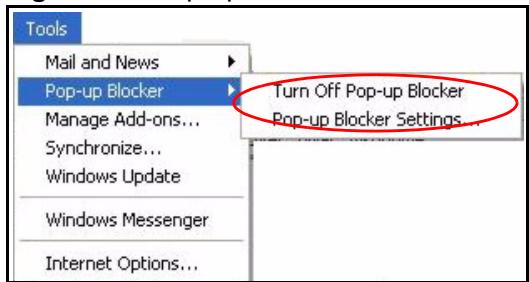
Figure 83 Pop-up Blocker
You can also check if pop-up blocking is disabled in the Pop-up Blocker section in the Privacy tab.
1 In Internet Explorer, select Tools, Internet Options, Privacy.
2 Clear the Block pop-ups check box in the Pop-up Blocker section of the screen. This disables any web pop-up blockers you may have enabled.
Figure 84 Internet Options: Privacy
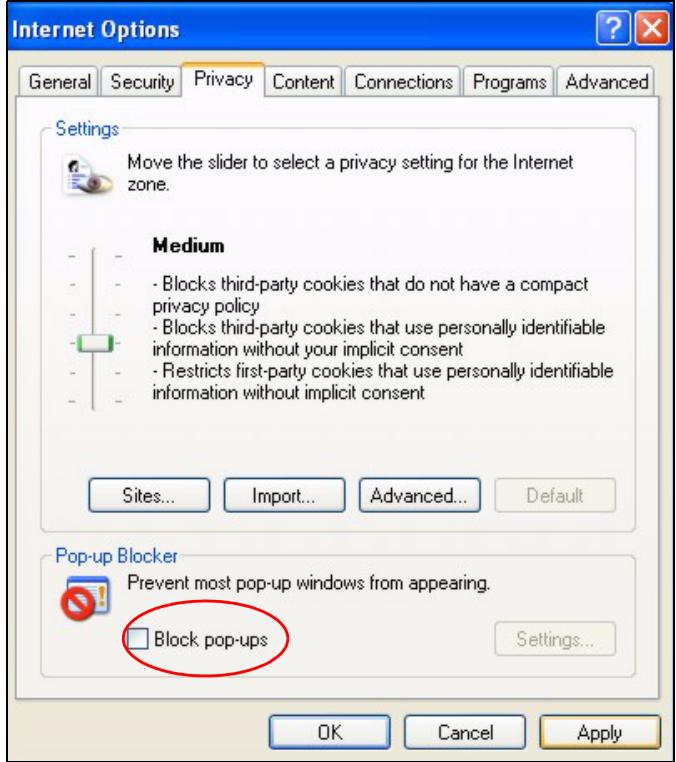
3 Click Apply to save this setting.
Enable pop-up Blockers with Exceptions
Alternatively, if you only want to allow pop-up windows from your device, see the following steps.
1 In Internet Explorer, select Tools, Internet Options and then the Privacy tab.
2 Select Settings...to open the Pop-up Blocker Settings screen.
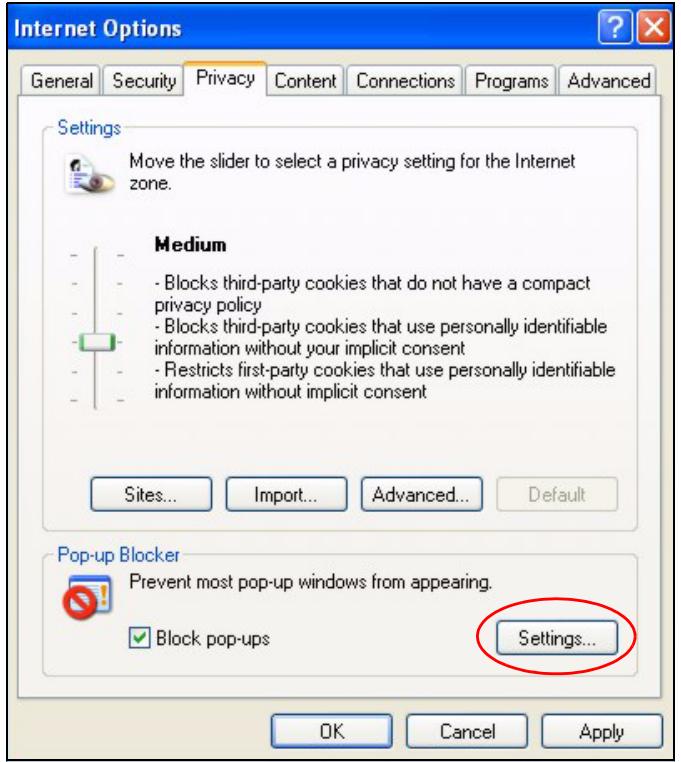
Figure 85 Internet Options: Privacy
3 Type the IP address of your device (the web page that you do not want to have blocked) with the prefix "http://". For example, http://192.168.167.1.
4 Click Add to move the IP address to the list of Allowed sites.
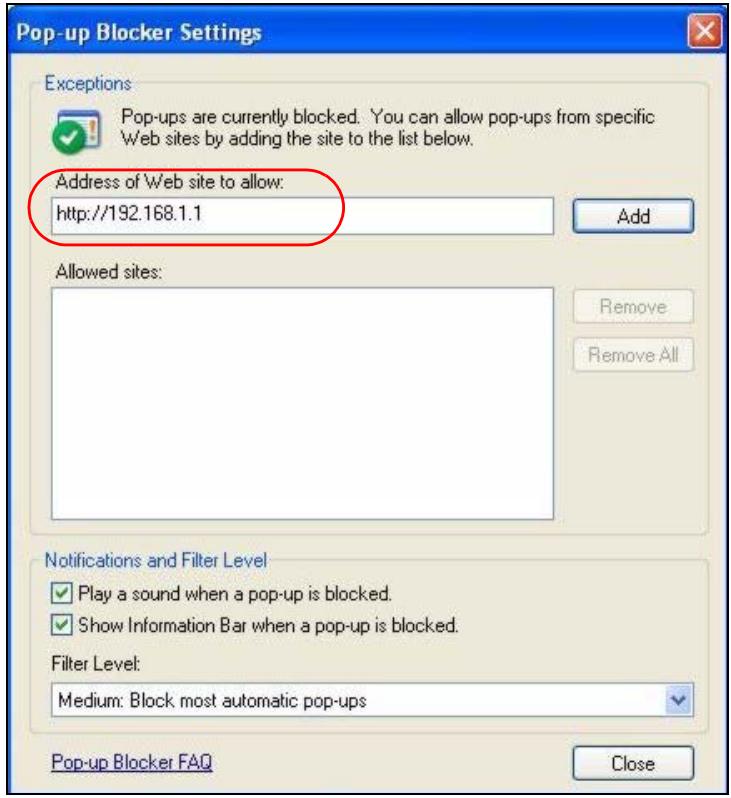
Figure 86 Pop-up Blocker Settings
5 Click Close to return to the Privacy screen.
6 Click Apply to save this setting.
JavaScript
If pages of the web configurator do not display properly in Internet Explorer, check that JavaScripts are allowed.
1 In Internet Explorer, click Tools, Internet Options and then the Security tab.
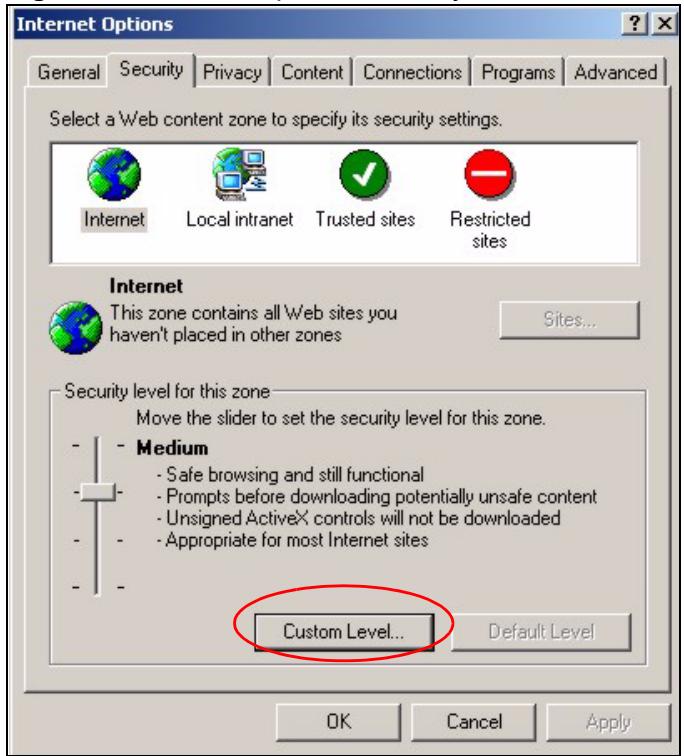
Figure 87 Internet Options: Security
2 Click the Custom Level... button.
3 Scroll down to Scripting.
4 Under Active scripting make sure that Enable is selected (the default).
5 Under Scripting of Java applets make sure that Enable is selected (the default).
6 Click OK to close the window.
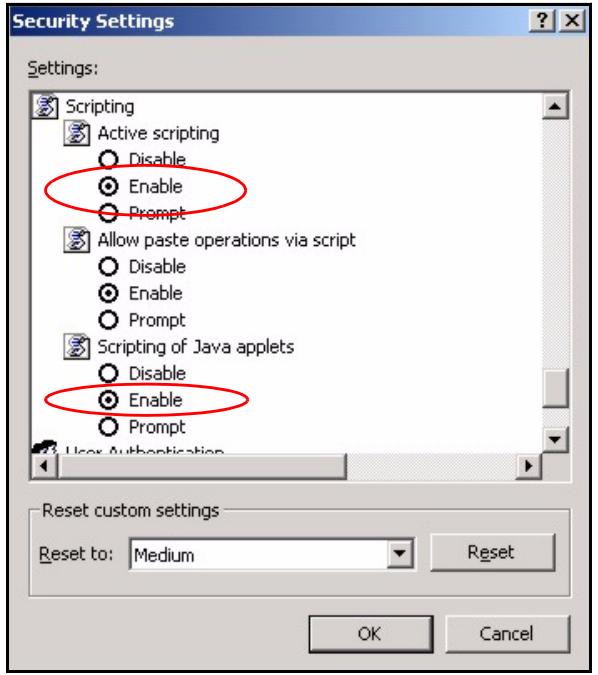
Figure 88 Security Settings - Java Scripting
Java Permissions
1 From Internet Explorer, click Tools, Internet Options and then the Security tab.
2 Click the Custom Level... button.
3 Scroll down to Microsoft VM.
4 Under Java permissions make sure that a safety level is selected.
5 Click OK to close the window.
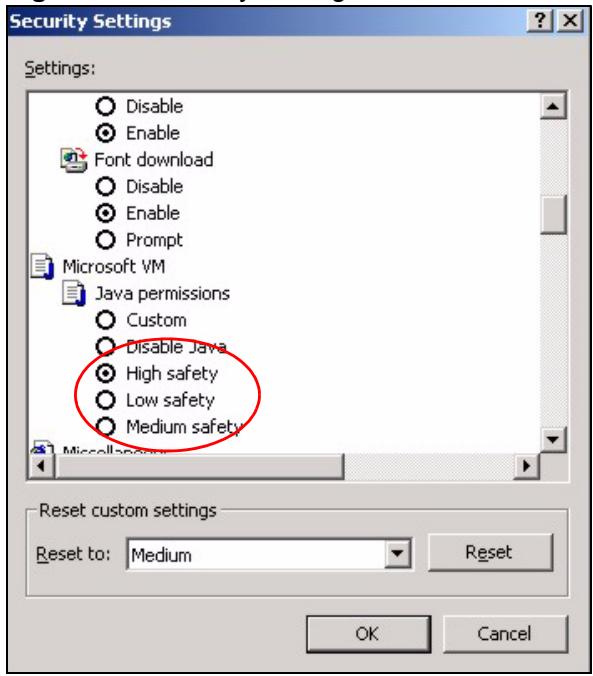
Figure 89 Security Settings - Java
JAVA (Sun)
1 From Internet Explorer, click Tools, Internet Options and then the Advanced tab.
2 Make sure that Use Java 2 for
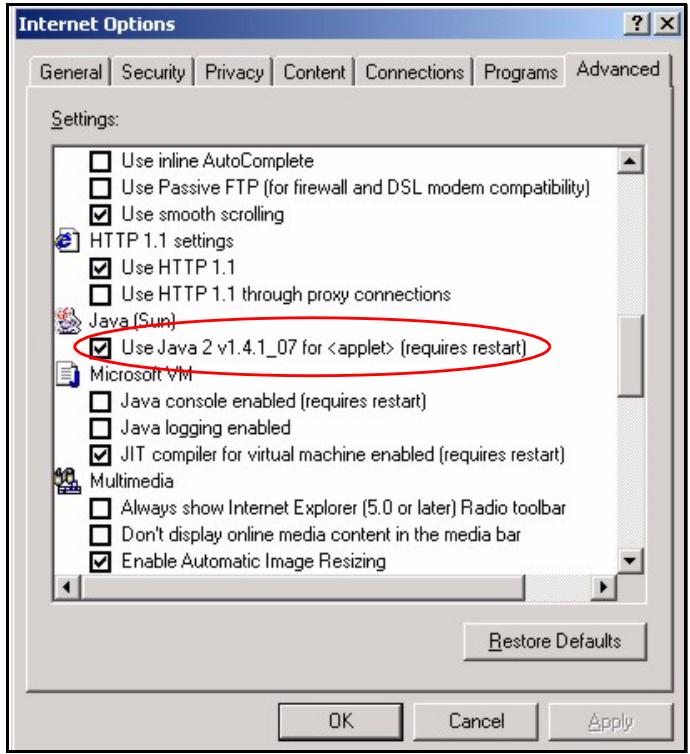
Figure 90 Java (Sun)
Mozilla Firefox
Mozilla Firefox 2.0 screens are used here. Screens for other versions may vary. You can enable Java, Javacscripts and pop-ups in one screen. Click Tools > Options > Content.
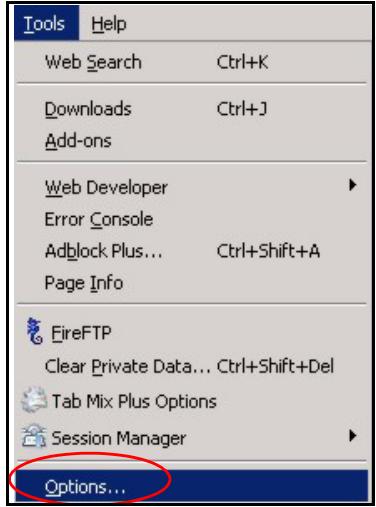
Figure 91 Mozilla Firefox: Tools > Options
Select the check boxes as shown in the following screen.
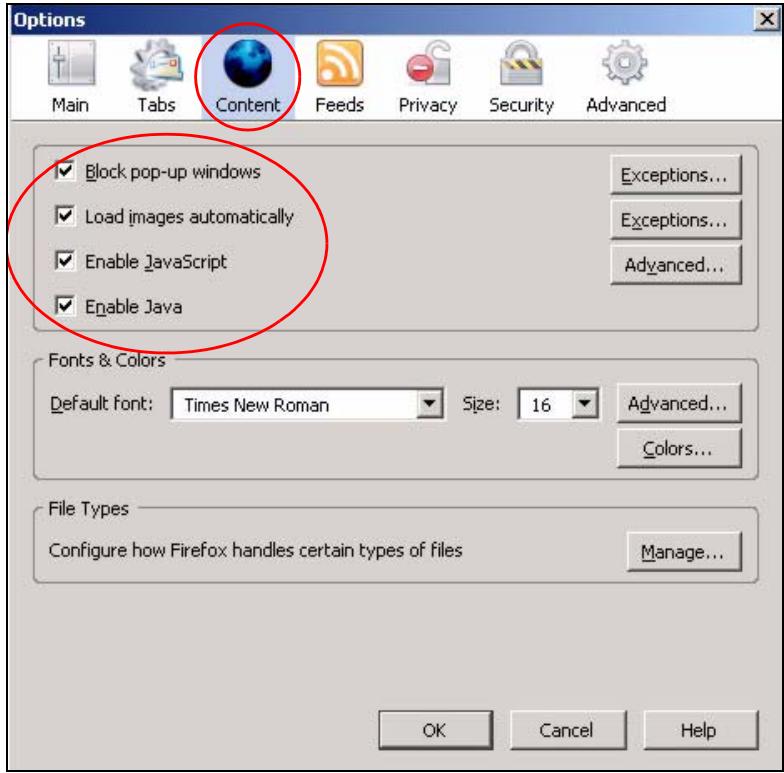
Figure 92 Mozilla Firefox Content Security
Open Source Licences
Notice
Information herein is subject to change without notice. Companies, names, and data used in examples herein are fictitious unless otherwise noted. No part may be reproduced or transmitted in any form or by any means, electronic or mechanical, for any purpose, except the express written permission of ZyXEL Communications Corporation.
This Product includes software developed by the Apache Software Foundation under Apache License.
Apache License
Version 2.0, January 2004
http://www.apache.org/licenses/
TERMS AND CONDITIONS FOR USE, REPRODUCTION, AND DISTRIBUTION
- Definitions.
"License" shall mean the terms and conditions for use, reproduction, and distribution as defined by Sections 1 through 9 of this document.
"License" shall mean the copyright owner or entity authorized by the copyright owner that is granting the License.
"Legal Entity" shall mean the union of the acting entity and all other entities that control, are controlled by, or are under common control with that entity. For the purposes of this definition,
"control" means (i) the power, direct or indirect, to cause the direction or management of such entity, whether by contract or otherwise, or (ii) ownership of fifty percent (50%) or more of the outstanding shares, or (iii) beneficial ownership of such entity.
"You" (or "Your") shall mean an individual or Legal Entity exercising permissions granted by this License.
"Source" form shall mean the preferred form for making modifications, including but not limited to software source code, documentation source, and configuration files.
"Object" form shall mean any form resulting from mechanical transformation or translation of a Source form, including but not limited to compiled object code, generated documentation, and conversions to other media types.
"Work" shall mean the work of authorship, whether in Source or Object form, made available under the License, as indicated by a copyright notice that is included in or attached to the work (an example is provided in the Appendix below).
"Derivative Works" shall mean any work, whether in Source or Object form, that is based on (or derived from) the Work and for which the editorial revisions, annotations, elaborations, or other modifications represent, as a whole, an original work of authorship. For the purposes of this License, Derivative Works shall not include works that remain separable from, or merely link (or bind by name) to the interfaces of, the Work and Derivative Works thereof.
"Contribution" shall mean any work of authorship, including the original version of the Work and any modifications or additions to that Work or Derivative Works thereof, that is intentionally submitted to Licensor for inclusion in the Work by the copyright owner or by an individual or Legal Entity authorized to submit on behalf of the copyright owner. For the purposes of this definition, "submitted" means any form of electronic, verbal, or written communication sent to the Licensor or its representatives, including but not limited to communication on electronic mailing lists, source code control systems, and issue tracking systems that are managed by, or on behalf of, the Licensor for the purpose of discussing and improving the Work, but excluding communication that is conspicuously marked or otherwise designated in writing by the copyright owner as "Not a Contribution."
"Contributor" shall mean Licensee and any individual or Legal Entity on behalf of whom a Contribution has been received by Licensee and subsequently incorporated within the Work.
-
Grant of Copyright License. Subject to the terms and conditions of this License, each Contributor hereby grants to You a perpetual, worldwide, non-exclusive, no-charge, royalty-free, irrevocable copyright license to reproduce, prepare Derivative Works of, publicly display, publicly perform, sublicense, and distribute the Work and such Derivative Works in Source or Object form.
-
Grant of Patent License. Subject to the terms and conditions of this License, each Contributor hereby grants to You a perpetual, worldwide, non-exclusive, no-charge, royalty-free, irrevocable (except as stated in this section) patent license to make, have made, use, offer to sell import, and otherwise transfer the Work, where such license applies only to those patent claims licensable by such Contributor that are necessarily infringed by their Contribution(s) alone or by combination of their Contribution(s) with the Work to which such Contribution(s) was submitted. If You institute patent litigation against any entity (including a cross-claim or counterclaim in a lawsuit) alleging that the Work or a Contribution incorporated within the Work constitutes direct or contributory patent infringement, then any patent licenses granted to You under this License for that Work shall terminate as of the date such litigation is filed.
-
Redistribution. You may reproduce and distribute copies of the Work or Derivative Works hereof in any medium, with or without modifications, and in Source or Object form, provided that You meet the following conditions:
(a) You must give any other recipients of the Work or Derivative Works a copy of this License; and
(b) You must cause any modified files to carry prominent notices stating that You changed the files; and
(c) You must retain, in the Source form of any Derivative Works that You distribute, all copyright, patent, trademark, and attribution notices from the Source form of the Work, excluding those notices that do not pertain to any part of the Derivative Works; and
(d) If the Work includes a "NOTICE" text file as part of its distribution, then any Derivative Works that You distribute must include a readable copy of the attribution notices contained within such NOTICE file, excluding those notices that do not pertain to any part of the Derivative Works, in at least one of the following places: within a NOTICE text file
distributed as part of the Derivative Works; within the Source form or documentation, if provided along with the Derivative Works; or, within a display generated by the Derivative Works, if and wherever such third-party notices normally appear. The contents of the NOTICE file are for informational purposes only and do not modify the License. You may add Your own attribution notices within Derivative Works that You distribute, alongside or as an addendum to the NOTICE text from the Work, provided that such additional attribution notices cannot be construed as modifying the License. You may add Your own copyright statement to Your modifications and may provide additional or different license terms and conditions for use, reproduction, or distribution of Your modifications, or for any such Derivative Works as a whole, provided Your use, reproduction, and distribution of the Work otherwise complies with the conditions stated in this License.
-
Submission of Contributions. Unless You explicitly state otherwise, any Contribution intentionally submitted for inclusion in the Work by You to the Licensor shall be under the terms and conditions of this License, without any additional terms or conditions. Notwithstanding the above, nothing herein shall supersede or modify the terms of any separate license agreement you may have executed with Licensor regarding such Contributions.
-
Trademarks. This License does not grant permission to use the trade names, trademarks, service marks, or product names of the Licensor, except as required for reasonable and customary use in describing the origin of the Work and reproducing the content of the NOTICE file.
-
Disclaimer of Warranty. Unless required by applicable law or agreed to in writing, Licensee provides the Work (and each Contributor provides its Contributions) on an "AS IS" BASIS, WITHOUT WARRANTY OR CONDITIONS OF ANY KIND, either express or implied, including, without limitation, any warranties or conditions of TITLE, NONINFRINGEMENT, MERCHANTABILITY, or FITNESS FOR A PARTICULAR PURPOSE. You are solely responsible for determining the appropriateness of using or redistributing the Work and assume any risks associated with Your exercise of permissions under this License.
-
Limitation of Liability. In no event and under no legal theory, whether in tort (including negligence), contract, or otherwise, unless required by applicable law (such as deliberate and grossly negligent acts) or agreed to in writing, shall any Contributor be liable to You for damages, including any direct, indirect, special, incidental, or consequential damages of any character arising as a result of this License or out of the use or inability to use the Work (including but not limited to damages for loss of goodwill, work stoppage, computer failure or malfunction, or any and all other commercial damages or losses), even if such Contributor has been advised of the possibility of such damages.
-
Accepting Warranty or Additional Liability. While redistributing the Work or Derivative Works thereof, You may choose to offer, and charge a fee for, acceptance of support, warranty, indemnity, or other liability obligations and/or rights consistent with this License. However, in accepting such obligations, You may act only on Your own behalf and on Your sole responsibility, not on behalf of any other Contributor, and only if You agree to indemnify, defend, and hold each Contributor harmless for any liability incurred by, or claims asserted against, such Contributor by reason of your accepting any such warranty or additional liability.
END OF TERMS AND CONDITIONS
Version 1.1
Copyright (c) 1999-2003 The Apache Software Foundation. All rights reserved.
Redistribution and use in source and binary forms, with or without modification, are permitted provided that the following conditions are met:
Redistributions of source code must retain the above copyright notice, this list of conditions and the following disclaimer.
Redistributions in binary form must reproduce the above copyright notice, this list of conditions and the following disclaimer in the documentation and/or other materials provided with the distribution.
The end-user documentation included with the redistribution, if any, must include the following acknowledgment: "This product includes software developed by the Apache Software Foundation (http://www.apache.org/)." Alternately, this acknowledgment may appear in the software itself, if and wherever such third-party acknowledgments normally appear.
The names "Apache" and "Apache Software Foundation" must not be used to endorse or promote products derived from this software without prior written permission. For written permission, please contact apache@apache.org.
Products derived from this software may not be called "Apache", nor may "Apache" appear in their name, without prior written permission of the Apache Software Foundation.
THIS SOFTWARE IS PROVIDED 'AS IS' AND ANY EXPRESSED OR IMPLIED WARRANTY, INCLUDING, BUT NOT LIMITED TO, THE IMPLIED WARRANTY OF MERCHANTABILITY AND FITNESS FOR A PARTICULAR PURPOSE ARE DISCLAIMED. IN NO EVENT SHALL THE APACHE SOFTWARE FOUNDATION OR ITS CONTRIBUTORS BE LIABLE FOR ANY DIRECT, INDIRECT, INCIDENTAL, SPECIAL, EXEMPLARY, OR CONSEQUENTIAL DAMAGES (INCLUDING, BUT NOT LIMITED TO, PROCEDURE OF SUBSTITUTE GOODS OR SERVICES; LOSS OF USE, DATA, OR PROFITS; OR BUSINESS INTERRUsION) HOWEVER CAUSED AND ON ANY THEORY OF LIABILITY, WHETHER IN CONTRACT, STRICT LIABILITY, OR TORT (INCLUDING NEGLIGENCE OR OTHERWISE) ARISING IN ANY WAY OUT OF THE USE OF THIS SOFTWARE, EVEN IF ADVISED OF THE POSSIBILITY OF SUCH DAMAGE.
This software consists of voluntary contributions made by many individuals on behalf of the Apache Software Foundation. For more information on the Apache Software Foundation, please see http://www.apache.org/.
Portions of this software are based upon public domain software originally written at the National Center for Supercomputing Applications, University of Illinois, Urbana-Champaign.
This Product includes phpmvc software under LGPL license.
GNU LESSER GENERAL PUBLIC LICENSE
Version 2.1, February 1999
Copyright (C) 1991, 1999 Free Software Foundation, Inc.
59 Temple Place, Suite 330, Boston, MA 02111-1307 USA
Everyone is permitted to copy and distribute verbatim copies of this license document, but changing it is not allowed. [This is the first released version of the Lesser GPL. It also counts as the successor of the GNU Library Public License, version 2, hence the version number 2.1. Preamble
The licenses for most software are designed to take away your freedom to share and change it. By contrast, the GNU General Public Licenses are intended to guarantee your freedom to share and change free software--to make sure the software is free for all its users.
This license, the Lesser General Public License, applies to some specially designated software packages--typically libraries--of the Free Software Foundation and other authors who decide to use it. You can use it too, but we suggest you first think carefully about whether this license or the ordinary General Public License is the better strategy to use in any particular case, based on the explanations below.
When we speak of free software, we are referring to freedom of use, not price. Our General Public Licenses are designed to make sure that you have the freedom to distribute copies of free software (and charge for this service if you wish); that you receive source code or can get it if you want it; that you can change the software and use pieces of it in new free programs; and that you are informed that you can do these things.
To protect your rights, we need to make restrictions that forbid distributors to deny you these rights or to ask you to surrender these rights. These restrictions translate to certain responsibilities for you if you distribute copies of the library or if you modify it.
For example, if you distribute copies of the library, whether gratis or for a fee, you must give the recipients all the rights that we gave you. You must make sure that they, too, receive or can get the source code. If you link other code with the library, you must provide complete object files to the recipients, so that they can re-link them with the library after making changes to the library and recompiling it. And you must show them these terms so they know their rights.
We protect your rights with a two-step method: (1) we copyright the library, and (2) we offer you this license, which gives you legal permission to copy, distribute and/or modify the library.
To protect each distributor, we want to make it very clear that there is no warranty for the free library. Also, if the library is modified by someone else and passed on, the recipients should know that what they have is not the original version, so that the original author's reputation will not be affected by problems that might be introduced by others.
Finally, software patents pose a constant threat to the existence of any free program. We wish to make sure that a company cannot effectively restrict the users of a free program by obtaining a restrictive license from a patent holder. Therefore, we insist that any patent license obtained for a version of the library must be consistent with the full freedom of use specified in this license.
Most GNU software, including some libraries, is covered by the ordinary GNU General Public License. This license, the GNU Lesser General Public License, applies to certain designated libraries, and is quite different from the ordinary General Public License. We use this license for certain libraries in order to permit linking those libraries into non-free programs.
When a program is linked with a library, whether statically or using a shared library, the combination of the two is legally speaking a combined work, a derivative of the original library. The ordinary General Public License therefore permits such linking only if the entire combination fits its criteria of freedom. The Lesser General Public License permits more lax criteria for linking other code with the library.
We call this license the "Lesser" General Public License because it does Less to protect the user's freedom than the ordinary General Public License. It also provides other free software developers Less of an advantage over competing non-free programs. These disadvantages are the reason we use the ordinary General Public License for many libraries. However, the Lesser license provides advantages in certain special circumstances.
For example, on rare occasions, there may be a special need to encourage the widest possible use of a certain library, so that it becomes a de-facto standard. To achieve this, non-free programs must be allowed to use the library. A more frequent case is that a free library does the same job as widely used non-free libraries. In this case, there is little to gain by limiting the free library to free software only, so we use the Lesser General Public License. In other cases, permission to use a particular library in non-free programs enables a greater number of people to use a large body of free software. For example, permission to use the GNU C Library in non-free programs enables many more people to use the whole GNU operating system, as well as its variant, the GNU/Linux operating system.
Although the Lesser General Public License is Less protective of the users' freedom, it does ensure that the user of a program that is linked with the Library has the freedom and the wherewithal to run that program using a modified version of the Library.
The precise terms and conditions for copying, distribution and modification follow. Pay close attention to the difference between a "work based on the library" and a "work that uses the library". The former contains code derived from the library, whereas the latter must be combined with the library in order to run.
GNU LESSER GENERAL PUBLIC LICENSE TERMS AND CONDITIONS FOR COOPYING, DISTRIBUTION AND MODIFICATION
- This License Agreement applies to any software library or other program which contains a notice placed by the copyright holder or other authorized party saying it may be distributed under the terms of this Lesser General Public License (also called "this License").
Each licensee is addressed as "you".
A "library" means a collection of software functions and/or data prepared so as to be conveniently linked with application programs (which use some of those functions and data) to form executables. The "Library", below, refers to any such software library or work which has been distributed under these terms. A "work based on the Library" means either the Library or any derivative work under copyright law: that is to say, a work containing the Library or a portion of it, either verbatim or with modifications and/or translated straightforwardly into another language. (Hereinafter, translation is included without limitation in the term "modification".)
"Source code" for a work means the preferred form of the work for making modifications to it. For a library, complete source code means all the source code for all modules it contains, plus any associated interface definition files, plus the scripts used to control compilation and installation of the library. Activities other than copying, distribution and modification are not covered by this License; they are outside its scope. The act of running a program using the Library is not restricted, and output from such a program is covered only if its contents constitute a work based on the Library (independent of the use of the Library in a tool for writing it). Whether that is true depends on what the Library does and what the program that uses the Library does.
-
You may copy and distribute verbatim copies of the Library's complete source code as you receive it, in any medium, provided that you conspicuously and appropriately publish on each copy an appropriate copyright notice and disclaimer of warranty; keep intact all the notices that refer to this License and to the absence of any warranty; and distribute a copy of this License along with the Library. You may charge a fee for the physical act of transferring a copy, and you may at your option offer warranty protection in exchange for a fee.
-
You may modify your copy or copies of the Library or any portion of it, thus forming a work based on the Library, and copy and distribute such modifications or work under the terms of Section 1 above, provided that you also meet all of these conditions: a) The modified work must itself be a software library. b) You must cause the files modified to carry prominent notices stating that you changed the files and the date of any change. c) You must cause the whole of the work to be licensed at no charge to all third parties under the terms of this License. d) If a facility in the modified Library refers to a function or a table of data to be supplied by an application program that uses the facility, other than as an argument passed when the facility is invoked, then you must make a good faith effort to ensure that, in the event an application does not supply such function or table, the facility still operates, and performs whatever part of its purpose remains meaningful. (For example, a function in a library to compute square roots has a purpose that is entirely well-defined independent of the application. Therefore, Subsection 2d requires that any application-supplied function or table used by this function must be optional: if the application does not supply it, the square root function must still compute square roots.) These requirements apply to the modified work as a whole. If identifiable sections of that work are not derived from the Library, and can be reasonably considered independent and separate works in themselves, then this License, and its terms, do not apply to those sections when you distribute them as separate works. But when you distribute the same sections as part of a whole which is a work based on the Library, the distribution of the whole must be on the terms of this License, whose permissions for other licensees extend to the entire whole, and thus to each and every part regardless of who wrote
it. Thus, it is not the intent of this section to claim rights or contest your rights to work written entirely by you; rather, the intent is to exercise the right to control the distribution of derivative or collective works based on the Library. In addition, mere aggregation of another work not based on the Library with the Library (or with a work based on the Library) on a volume of a storage or distribution medium does not bring the other work under the scope of this License.
-
You may opt to apply the terms of the ordinary GNU General Public License instead of this License to a given copy of the Library. To do this, you must alter all the notices that refer to this License, so that they refer to the ordinary GNU General Public License, version 2, instead of to this License. (If a newer version than version 2 of the ordinary GNU General Public License has appeared, then you can specify that version instead if you wish.) Do not make any other change in these notices. Once this change is made in a given copy, it is irreversible for that copy, so the ordinary GNU General Public License applies to all subsequent copies and derivative works made from that copy. This option is useful when you wish to copy part of the code of the Library into a program that is not a library.
-
You may copy and distribute the Library (or a portion or derivative of it, under Section 2) in object code or executable form under the terms of Sections 1 and 2 above provided that you accompany it with the complete corresponding machine-readable source code, which must be distributed under the terms of Sections 1 and 2 above on a medium customarily used for software interchange. If distribution of object code is made by offering access to copy from a designated place, then offering equivalent access to copy the source code from the same place satisfies the requirement to distribute the source code, even though third parties are not
compelled to copy the source along with the object code.
- A program that contains no derivative of any portion of the Library, but is designed to work with the Library by being compiled or linked with it, is called a "work that uses the Library". Such a work, in isolation, is not a derivative work of the Library, and therefore falls outside the scope of this License.
However, linking a "work that uses the Library" with the Library creates an executable that is a derivative of the Library (because it contains portions of the Library), rather than a "work that uses the library". The executable is therefore covered by this License. Section 6 states terms for distribution of such executables. When a "work that uses the Library" uses material from a header file that is part of the Library, the object code for the work may be a derivative work of the Library even though the source code is not. Whether this is true is especially significant if the work can be linked without the Library, or if the work is itself a library. The threshold for this to be true is not precisely defined by law. If such an object file uses only numerical parameters, data structure layouts and accessories, and small macros and small inline functions (ten lines or less in length), then the use of the object file is unrestricted, regardless of whether it is legally a derivative work. (Executables containing this object code plus portions of the Library will still fall under Section 6.) Otherwise, if the work is a derivative of the Library, you may distribute the object code for the work under the terms of Section 6. Any executables containing that work also fall under Section 6, whether or not they are linked directly with the Library itself.
- As an exception to the Sections above, you may also combine or link a "work that uses the Library" with the Library to produce a work containing portions of the Library, and distribute that work under terms of your choice, provided that the terms permit modification of the work for the customer's own use and reverse engineering for debugging such modifications. You must give prominent notice with each copy of the work that the Library is used in it and that the Library and its use are covered by this License. You must supply a copy of this License. If the work during execution displays copyright notices, you must include the copyright notice for the Library among them, as well as a reference directing the user to the copy of this License. Also, you must do one of these things: a) Accompany the work with the complete corresponding
machine-readable source code for the Library including whatever changes were used in the work (which must be distributed under Sections 1 and 2 above); and, if the work is an executable linked with the Library, with the complete machine-readable "work that uses the Library", as object code and/or source code, so that the user can modify the Library and then relent to produce a modified executable containing the modified Library. (It is understood that the user who changes the contents of definitions files in the Library will not necessarily be able to recompile the application to use the modified definitions.) b) Use a suitable shared library mechanism for linking with the Library. A suitable mechanism is one that (1) uses at run time a
copy of the library already present on the user's computer system, rather than copying library functions into the executable, and (2) will operate properly with a modified version of the library, if the user installs one, as long as the modified version is interface-compatible with the version that the work was made with. c) Accompany the work with a written offer, valid for at least three years, to give the same user the materials specified in Subsection 6a, above, for a charge no more than the cost of performing this distribution. d) If distribution of the work is made by offering access to copy from a designated place, offer equivalent access to copy the above specified materials from the same place. e) Verify that the user has already received a copy of these materials or that you have already sent this user a copy. For an executable, the
required form of the "work that uses the Library" must include any data and utility programs needed for reproducing the executable from it. However, as a special exception, the materials to be distributed need not include anything that is normally distributed (in either source or binary form) with the major components (compiler, kernel, and so on) of the operating system on which the executable runs, unless that component itself accompanies the executable.
It may happen that this requirement contradicts the license restrictions of other proprietary libraries that do not normally accompany the operating system. Such a contradiction means you cannot use both them and the Library together in an executable that you distribute.
-
You may place library facilities that are a work based on the Library side-by-side in a single library together with other library facilities not covered by this License, and distribute such a combined library, provided that the separate distribution of the work based on the Library and of the other library facilities is otherwise permitted, and provided that you do these two things: a) Accompany the combined library with a copy of the same work based on the Library, uncombined with any other library facilities. This must be distributed under the terms of the Sections above. b) Give prominent notice with the combined library of the fact that part of it is a work based on the Library, and explaining where to find the accompanying uncombined form of the same work.
-
You may not copy, modify, sublicense, link with, or distribute the Library except as expressly provided under this License. Any attempt otherwise to copy, modify, sublicense, link with, or distribute the Library is void, and will automatically terminate your rights under this License. However, parties who have received copies, or rights, from you under this License will not have their licenses terminated so long as such parties remain in full compliance.
-
You are not required to accept this License, since you have not signed it. However, nothing else grants you permission to modify or distribute the Library or its derivative works. These actions are prohibited by law if you do not accept this License. Therefore, by modifying or distributing the Library (or any work based on the Library), you indicate your acceptance of this License to do so, and all its terms and conditions for copying, distributing or modifying the Library or works based on it.
-
Each time you redistribute the Library (or any work based on the Library), the recipient automatically receives a license from the original licensor to copy, distribute, link with or modify the Library subject to these terms and conditions. You may not impose any further restrictions on the recipients' exercise of the rights granted herein. You are not responsible for enforcing compliance by third parties with this License.
-
If, as a consequence of a court judgment or allegation of patent infringement or for any other reason (not limited to patent issues), conditions are imposed on you (whether by court order, agreement or otherwise) that contradict the conditions of this License, they do not excuse you from the conditions of this License. If you cannot distribute so as to satisfy simultaneously your obligations under this License and any other pertinent obligations, then as a consequence you may not distribute the Library at all. For example, if a patent license would not permit royalty-free redistribution of the Library by all those who receive copies directly or indirectly through you, then the only way you could satisfy both it and this License would be to
refrain entirely from distribution of the Library. If any portion of this section is held invalid or unenforceable under any particular circumstance, the balance of the section is intended to apply, and the section as a whole is intended to apply in other circumstances. It is not the purpose of this section to induce you to infringe any patents or other property right claims or to
contest validity of any such claims; this section has the sole purpose of protecting the integrity of the free software distribution system which is implemented by public license practices. Many people have made generous contributions to the wide range of software distributed through that system in reliance on consistent application of that system; it is up to the author/ donor to decide if he or she is willing to distribute software through any other system and a licensee cannot impose that choice. This section is intended to make thoroughly clear what is believed to be a consequence of the rest of this License.
- If the distribution and/or use of the Library is restricted in certain countries either by patents or by copyrighted interfaces, the original copyright holder who places the Library under this License may add an explicit geographical distribution limitation excluding those countries, so that distribution is permitted only in or among countries not thus excluded. In such case, this License incorporates the limitation as if written in the body of this License.
- The Free Software Foundation may publish revised and/or new versions of the Lesser General Public License from time to time. Such new versions will be similar in spirit to the present version, but may differ in detail to address new problems or concerns. Each version is given a distinguishing version number. If the Library specifies a version number of this License which applies to it and "any later version", you have the option of following the terms and conditions either of that version or of any later version published by the Free Software Foundation. If the Library does not specify a license version number, you may choose any version ever published by the Free Software Foundation.
- If you wish to incorporate parts of the Library into other free programs whose distribution conditions are incompatible with these, write to the author to ask for permission. For software which is copyrighted by the Free Software Foundation, write to the Free Software Foundation; we sometimes make exceptions for this. Our decision will be guided by the two goals of preserving the free status of all derivatives of our free software and of promoting the sharing and reuse of software generally.
NO WARRANTY
- BECAUSE THE LIBRARY IS LICENSED FREE OF CHARGE, THERE IS NOW WARRANTY FOR THE LIBRARY, TO THE EXTENT PERMITTED BY APPLICABLE LAW. EXCEPT WHEN OTHERWISE STATED IN WRITING THE COPYRIGHT HOLDERS AND/OR OTHER PARTIES PROVIDE THE LIBRARY "AS IS" WITHOUT WARRANTY OF ANY KIND, EITHER EXPRESSED OR IMPLIED, INCLUDING, BUT NOT LIMITED TO, THE IMPLIED WARRANTYES OF MERCHANTABILITY AND FITNESS FOR A PARTICULAR PURPOSE. THE ENTIRE RISK AS TO THE QUALITY AND PERFORMANCE OF THE LIBRARY IS WITH YOU. SHOULD THE LIBRARY PROVE DEFECTIVE, YOU ASSUME THE COST OF ALL NECESSARY SERVICING, REPAIR OR CORRECTION.
- IN NO EVENT UNLESS REQUIRED BY APPLICABLE LAW OR AGREED TO IN WRITING WILL ANY COPYRIGHT HOLDER, OR ANY OTHER PARTY WHO MAY MODIFY AND/OR REDISTRIBUTE THE LIBRARY AS PERMITTED ABOVE, BE LIABLE TO YOU FOR DAMAGES, INCLUDING ANY GENERAL, SPECIAL, INCIDENTAL OR CONSEQUENTIAL DAMAGES ARISING OUT OF THE USE OR INABILITY TO USE THE LIBRARY (INCLUDING BUT NOT LIMITED TO LOSS OF DATA OR DATA BEING RENDERED INACCURATE OR LOSSES SUSTAINED BY YOU OR THIRD PARTIES OR A FAILURE OF THE LIBRARY TO OPERATE WITH ANY OTHER SOFTWARE), EVEN IF SUCH HOLDER OR OTHER PARTY HAS BEEN ADVISED OF THE POSSIBILITY OF SUCHDAMAGES.
END OF TERMS AND CONDITIONS.
This Product includes apcid, apcupsd, autofs, device-mapper, evms, exim. Lm Sensors, mdadm, pam.mount, raidtools, samba, sg_utilities, smartmontools, vsftpd, xfsprogs and Linux kernel software under GPL license.
GNU GENERAL PUBLIC LICENSE
Version 2, June 1991
Copyright (C) 1989, 1991 Free Software Foundation, Inc.
59 Temple Place - Suite 330, Boston, MA 02111-1307, USA
Everyone is permitted to copy and distribute verbatim copies of this license document, but changing it is not allowed.
Preamble
The licenses for most software are designed to take away your freedom to share and change it. By contrast, the GNU General Public License is intended to guarantee your freedom to share and change free software--to make sure the software is free for all its users. This General Public License applies to most of the Free Software Foundation's software and to any other program whose authors commit to using it. (Some other Free Software Foundation software is covered by the GNU Library General Public License instead.) You can apply it to your programs, too.
When we speak of free software, we are referring to freedom, not price. Our General Public Licenses are designed to make sure that you have the freedom to distribute copies of free software (and charge for this service if you wish), that you receive source code or can get it if you want it, that you can change the software or use pieces of it in new free programs; and that you know you can do these things.
To protect your rights, we need to make restrictions that forbid anyone to deny you these rights or to ask you to surrender the rights. These restrictions translate to certain responsibilities for you if you distribute copies of the software, or if you modify it. For example, if you distribute copies of such a program, whether gratis or for a fee, you must give the recipients all the rights that you have. You must make sure that they, too, receive or can get the source code. And you must show them these terms so they know their rights.
We protect your rights with two steps: (1) copyright the software, and (2) offer you this license which gives you legal permission to copy, distribute and/or modify the software. Also, for each author's protection and ours, we want to make certain that everyone understands that there is no warranty for this free software. If the software is modified by someone else and passed on, we want its recipients to know that what they have is not the original, so that any problems introduced by others will not reflect on the original authors' reputations.
Finally, any free program is threatened constantly by software patents. We wish to avoid the danger that re-distributors of a free program will individually obtain patent licenses, in effect making the program proprietary. To prevent this, we have made it clear that any patent must be licensed for everyone's free use or not licensed at all.
The precise terms and conditions for copying, distribution and modification follow.
TERMS AND CONDITIONS FOR COOPYING, DISTRIBUTION AND MODIFICATION
-
This License applies to any program or other work which contains a notice placed by the copyright holder saying it may be distributed under the terms of this General Public License. The "Program", below, refers to any such program or work, and a "work based on the Program" means either the Program or any derivative work under copyright law: that is to say, a work containing the Program or a portion of it, either verbatim or with modifications and/or translated into another language. (Hereinafter, translation is included without limitation in the term "modification".) Each licensee is addressed as "you". Activities other than copying, distribution and modification are not covered by this License; they are outside its scope. The act of running the Program is not restricted, and the output from the Program is covered only if its contents constitute a work based on the Program (independent of having been made by running the Program). Whether that is true depends on what the Program does.
-
You may copy and distribute verbatim copies of the Program's source code as you receive it, in any medium, provided that you conspicuously and appropriately publish on each copy an appropriate copyright notice and disclaimer of warranty; keep intact all the notices that refer to this License and to the absence of any warranty; and give any other recipients of the Program a copy of this License along with the Program. You may charge a fee for the physical act of transferring a copy, and you may at your option offer warranty protection in exchange for a fee.
-
You may modify your copy or copies of the Program or any portion of it, thus forming a work based on the Program, and copy and distribute such modifications or work under the terms of Section 1 above, provided that you also meet all of these conditions:
a) You must cause the modified files to carry prominent notices stating that you changed the files and the date of any change.
b) You must cause any work that you distribute or publish, that in whole or in part contains or is derived from the Program or any part thereof, to be licensed as a whole at no charge to all third parties under the terms of this License.
c) If the modified program normally reads commands interactively when run, you must cause it, when started running for such interactive use in the most ordinary way, to print or display an announcement including an appropriate copyright notice and a notice that there is no warranty (or else, saying that you provide a warranty) and that users may redistribute the program under these conditions, and telling the user how to view a copy of this License. (Exception: if the Program itself is interactive but does not normally print such an announcement, your work based on the Program is not required to print an announcement.)
These requirements apply to the modified work as a whole. If identifiable sections of that work are not derived from the Program, and can be reasonably considered independent and separate works in themselves, then this License, and its terms, do not apply to those sections when you distribute them as separate works. But when you distribute the same sections as part of a whole which is a work based on the Program, the distribution of the whole must be on the terms of this License, whose permissions for other licensees extend to the entire whole, and thus to each and every part regardless of who wrote it. Thus, it is not the intent of this section to claim rights or contest your rights to work written entirely by you; rather, the intent is to exercise the right to control the distribution of derivative or collective works based on the Program. In addition, mere aggregation of another work not based on the Program with the Program (or with a work based on the Program) on a volume of a storage or distribution medium does not bring the other work under the scope of this License.
- You may copy and distribute the Program (or a work based on it, under Section 2) in object code or executable form under the terms of Sections 1 and 2 above provided that you also do one of the following:
a) Accompany it with the complete corresponding machine-readable source code, which must be distributed under the terms of Sections 1 and 2 above on a medium customarily used for software interchange; or,
b) Accompany it with a written offer, valid for at least three years, to give any third party, for a charge no more than your cost of physically performing source distribution, a complete machine-readable copy of the corresponding source code, to be distributed under the terms of Sections 1 and 2 above on a medium customarily used for software interchange; or, c) Accompany it with the information you received as to the offer to distribute corresponding source code. (This alternative is allowed only for noncommercial distribution and only if you received the program in object code or executable form with such an offer, in accord with Subsection b above.) The source code for a work means the preferred form of the work for making modifications to it. For an executable work, complete source code means all the source code for all modules it contains, plus any associated interface definition files, plus the scripts used to control compilation and installation of the executable. However, as a special exception, the source code distributed need not include anything that is normally distributed (in either source or binary form) with the major components (compiler, kernel, and so on) of the operating system on which the executable runs, unless that component itself accompanies the executable. If distribution of executable or object code is made by offering access to copy from a designated place, then offering equivalent access to copy the source code from the same place counts as distribution of the source code, even though third parties are not compelled to copy the source along with the object code.
-
You may not copy, modify, sublicense, or distribute the Program except as expressly provided under this License. Any attempt otherwise to copy, modify, sublicense or distribute the Program is void, and will automatically terminate your rights under this License. However, parties who have received copies, or rights, from you under this License will not have their licenses terminated so long as such parties remain in full compliance.
-
You are not required to accept this License, since you have not signed it. However, nothing else grants you permission to modify or distribute the Program or its derivative works. These actions are prohibited by law if you do not accept this License. Therefore, by modifying or distributing the Program (or any work based on the Program), you indicate your acceptance of this License to do so, and all its terms and conditions for copying, distributing or modifying the Program or works based on it.
-
Each time you redistribute the Program (or any work based on the Program), the recipient automatically receives a license from the original licensor to copy, distribute or modify the Program subject to these terms and conditions. You may not impose any further restrictions on the recipients' exercise of the rights granted herein. You are not responsible for enforcing compliance by third parties to this License.
-
If, as a consequence of a court judgment or allegation of patent infringement or for any other reason (not limited to patent issues), conditions are imposed on you (whether by court order, agreement or otherwise) that contradict the conditions of this License, they do not excuse you from the conditions of this License. If you cannot distribute so as to satisfy simultaneously your obligations under this License and any other pertinent obligations, then as a consequence you may not distribute the Program at all. For example, if a patent license would not permit royalty-free redistribution of the Program by all those who receive copies
directly or indirectly through you, then the only way you could satisfy both it and this License would be to refrain entirely from distribution of the Program. If any portion of this section is held invalid or unenforceable under any particular circumstance, the balance of the section is intended to apply and the section as a whole is intended to apply in other circumstances. It is not the purpose of this section to induce you to infringe any patents or other property right claims or to contest validity of any such claims; this section has the sole purpose of protecting the integrity of the free software distribution system, which is implemented by public license practices. Many people have made generous contributions to the wide range of software distributed through that system in reliance on consistent application of that system; it is up to the author/donor to decide if he or she is willing to distribute software through any other system and a licensee cannot impose that choice. This section is intended to make thoroughly clear what is believed to be a consequence of the rest of this License.
-
If the distribution and/or use of the Program is restricted in certain countries either by patents or by copyrighted interfaces, the original copyright holder who places the Program under this License may add an explicit geographical distribution limitation excluding those countries, so that distribution is permitted only in or among countries not thus excluded. In such case, this License incorporates the limitation as if written in the body of this License.
-
The Free Software Foundation may publish revised and/or new versions of the General Public License from time to time. Such new versions will be similar in spirit to the present version, but may differ in detail to address new problems or concerns. Each version is given a distinguishing version number. If the Program specifies a version number of this License which applies to it and "any later version", you have the option of following the terms and conditions either of that version or of any later version published by the Free Software Foundation. If the Program does not specify a version number of this License, you may choose any version ever published by the Free Software Foundation.
-
If you wish to incorporate parts of the Program into other free programs whose distribution conditions are different, write to the author to ask for permission. For software which is copyrighted by the Free Software Foundation, write to the Free Software Foundation; we sometimes make exceptions for this. Our decision will be guided by the two goals of preserving the free status of all derivatives of our free software and of promoting the sharing and reuse of software generally.
NO WARRANTY
-
BECAUSE THE PROGRAM IS LICENSED FREE OF CHARGE, THERE IS NO WARRANTY FOR THE PROGRAM, TO THE EXTENT PERMITTED BY APPLICABLE LAW. EXCEPT WHEN OTHERWISE STATED IN WRITING THE COPYRIGHT HOLDERS AND/OR OTHER PARTIES PROVIDE THE PROGRAM "AS IS" WITHOUT WARRANTY OF ANY KIND, Either EXPRESSED OR IMPLIED, INCLUDING, BUT NOT LIMITED TO, THE IMPLIED WARRANTYES OF MERCHANTABILITY AND FITNESS FOR A PARTICULAR PURPOSE. THE ENTIRE RISK AS TO THE QUALITY AND PERFORMANCE OF THE PROGRAM IS WITH YOU. SHOULD THE PROGRAM PROVE DEFECTIVE, YOU ASSUME THE COST OF ALL NECESSARY SERVICING, REPAIR OR CORRECTION.
-
IN NO EVENT UNLESS REQUIRED BY APPLICABLE LAW OR AGREED TO IN WRITING WILL ANY COPYRIGHT HOLDER, OR ANY OTHER PARTY WHO MAY MODIFY AND/OR REDISTRIBUTE THE PROGRAM AS PERMITTED ABOVE, BE LIABLE TO YOU FOR DAMAGES, INCLUDING ANY GENERAL, SPECIAL, INCIDENTAL OR CONSEQUENTIAL DAMAGES ARISING OUT OF THE USE OR
INABILITY TO USE THE PROGRAM (INCLUDING BUT NOT LIMITED TO LOSS OF DATA OR DATA BEING RENDERED INACCURATE OR LOSSES SUSTAINED BY YOU OR THIRD PARTIES OR A FAILURE OF THE PROGRAM TO OPERATE WITH ANY OTHER PROGRAMS), EVEN IF SUCH HOLDER OR OTHER PARTY HAS BEEN ADVISED OF THE POSSIBILITY OF SUCH DAMAGES.
END OF TERMS AND CONDITIONS
All other trademarks or trade names mentioned herein, if any, are the property of their respective owners.
This Product includes OpenLDAP software under the OpenLDAP Public License
The OpenLDAP Public License
Version 2.8, 17 August 2003
Redistribution and use of this software and associated documentation ("Software"), with or without modification, are permitted provided that the following conditions are met:
- Redistributions in source form must retain copyright statements and notices,
- Redistributions in binary form must reproduce applicable copyright statements and notices, this list of conditions, and the following disclaimer in the documentation and/or other materials provided with the distribution, and
- Redistributions must contain a verbatim copy of this document.
The OpenLDAP Foundation may revise this license from time to time. Each revision is distinguished by a version number. You may use this Software under terms of this license revision or under the terms of any subsequent revision of the license.
THIS SOFTWARE IS PROVIDED BY THE OPENLDAP FOUNDATION AND ITS CORIutors `AS IS" AND ANY EXPRESSED OR IMPLIED WARRANTY, INCLUDING, BUT NOT LIMITED TO, THE IMPLIED WARRANTY OF MERCHANTABILITY AND FITNESS FOR A PARTICULAR PURPOSE ARE DISCLAIMED. IN NO EVENT SHALL THE OPENLDAP FOUNDATION, ITS CORIutors, OR THE AUTHOR(S) OR OWNER(S) OF THE SOFTWARE BE LIABLE FOR ANY DIRECT, INDIRECT, INCIDENTAL, SPECIAL, EXEMPLARY, OR CONSEQUENTIAL DAMAGES (INCLUDING, BUT NOT LIMITED TO, PROCEDURE OF SUBSTITUTE GOODSOR SERVICES;LOSS OF USE,DATA,OR PROFITS;OR BUSINESS INTERRUIPTION) HOWEVER CAUSED AND ON ANY THEORY OF LIABILITY, WHETHER IN CONTRACT, STRICT LIABILITY, OR TORT (INCLUDING NEGLIGENCE OR OTHERWISE) ARISING IN ANY WAY OUT OF THE USE OF THIS SOFTWARE, EVEN IF ADVISED OF THE POSSIBILITY OF SUCH DAMAGE.
The names of the authors and copyright holders must not be used in advertising or otherwise to promote the sale, use or other dealing in this Software without specific, written prior permission. Title to copyright in this Software shall at all times remain with copyright holders.
OpenLDAP is a registered trademark of the OpenLDAP Foundation.
Copyright 1999-2003 The OpenLDAP Foundation, Redwood City, California, USA. All Rights Reserved. Permission to copy and distribute verbatim copies of this document is granted
This Product includes open SSL under the Open SSL License
Open SSL License
LICENSE ISSUES
The OpenssL toolkit stays under a dual license, i.e. both the conditions of the OpenssL License and the original SLeay license apply to the toolkit. See below for the actual license texts. Actually both licenses are BSD-style Open Source licenses. In case of any license issues related to OpenssL please contact openssl-core@openssl.org.
OpenSSL License
Copyright (c) 1998-2004 The OpenSSL Project. All rights reserved.
Redistribution and use in source and binary forms, with or without modification, are permitted provided that the following conditions are met:
Redistributions of source code must retain the above copyright notice, this list of conditions and the following disclaimer.
Redistributions in binary form must reproduce the above copyright notice, this list of conditions and the following disclaimer in the documentation and/or other materials provided with the distribution.
All advertising materials mentioning features or use of this software must display the following acknowledgment: "This product includes software developed by the OpensSL Project for use in the OpensSL Toolkit. (http://www.openssl.org/)
The names "OpenSSL Toolkit" and "OpenSSL Project" must not be used to endorse or promote products derived from this software without prior written permission. For written permission, please contact openssl-core@openssl.org.
Products derived from this software may not be called "OpenSSL" nor may "OpenSSL" appear in their names without prior written permission of the OpenSSL Project.
Redistributions of any form whatsoever must retain the following acknowledgment: "This product includes software developed by the OpenSSL Project for use in the OpenSSL Toolkit (http://wwwopenssl.org/)
THIS SOFTWARE IS PROVIDED BY THE OpensSL PROJECT "AS IS" AND ANY EXPRESSED OR IMPLIED WARRANTYES, INCLUDING, BUT NOT LIMITED TO, THE IMPLIED WARRANTYES OF MERCHANTABILITY AND FITNESS FOR A PARTICULAR PURPOSE ARE DISCLAIMED. IN NO EVENT SHALL THE OpensSL PROJECT OR ITS COLNTRIButors BE LIABLE FOR ANY DIRECT, INDIRECT, INCIDENTAL, SPECIAL, EXEMPLARY, OR CONSEQUENTIAL DAMAGES (INCLUDING, BUT NOT LIMITED TO, PROCEDURE OF SUBSTITUTE GOODS OR SERVICES; LOSS OF USE, DATA, OR PROFITS; OR BUSINESS INTERRUPTION) HOWEVER CAUSED AND ON ANY THEORY OF LIABILITY, WHETHER IN CONTRACT, STRICT LIABILITY, OR TORT (INCLUDING NEGLIGENCE OR OTHERWISE) ARISING IN ANY WAY OUT OF THE USE OF THIS SOFTWARE, EVEN IF ADVISED OF THE POSSIBILITY OF SUCH DAMAGE.
This product includes cryptographic software written by Eric Young (eay@cryptsoft.com). This product includes software written by Tim Hudson (tjh@cryptsoft.com).
Original SSLeay License
Copyright (C) 1995-1998 Eric Young (eay@cryptsoft.com) All rights reserved.
This package is an SSL implementation written by Eric Young (eay@cryptsoft.com). The implementation was written so as to conform with Netscape's SSL.
This library is free for commercial and non-commercial use as long as the following conditions are adhered to. The following conditions apply to all code found in this distribution, be it the RC4, RSA, lhash, DES, etc., code; not just the SSL code. The SSL documentation included with this distribution is covered by the same copyright terms except that the holder is Tim Hudson (tjh@cryptsoft.com).
Copyright remains Eric Young's, and as such any Copyright notices in the code are not to be removed. If this package is used in a product, Eric Young should be given attribution as the author of the parts of the library used. This can be in the form of a textual message at program startup or in documentation (online or textual) provided with the package.
Redistribution and use in source and binary forms, with or without modification, are permitted provided that the following conditions are met:
Redistributions of source code must retain the copyright notice, this list of conditions and the following disclaimer.
Redistributions in binary form must reproduce the above copyright notice, this list of conditions and the following disclaimer in the documentation and/or other materials provided with the distribution.
All advertising materials mentioning features or use of this software must display the following acknowledgement:
"This product includes cryptographic software written by Eric Young (eay@cryptsoft.com)"
The word 'cryptographic' can be left out if the routines from the library being used are not cryptographic related:--).
If you include any Windows specific code (or a derivative thereof) from the apps directory (application code) you must include an acknowledgement:
"This product includes software written by Tim Hudson (tjh@cryptsoft.com)"
THIS SOFTWARE IS PROVIDED BY ERIC YOUNG `AS IS" AND ANY EXPRESS OR IMPLIED WARRANTY, INCLUDING, BUT NOT LIMITED TO, THE IMPLIED WARRANTY OF MERCHANTABILITY AND FITNESS FOR A PARTICULAR PURPOSE ARE DISCLAIMED. IN NO EVENT SHALL THE AUTHOR OR COLLABORBE LIABLE FOR ANY DIRECT, INDIRECT, INCIDENTAL, SPECIAL, EXEMPLARY, OR CONSEQUENTIAL DAMAGES (INCLUDING, BUT NOT LIMITED TO, PROCEDURE OF SUBSTITUTE GOODS OR SERVICES; LOSS OF USE, DATA, OR PROFITS; OR BUSINESS INTERUPTION) HOWEVER CAUSED AND ON ANY THEORY OF LIABILITY, WHETHER IN CONTRACT, STRICT LIABILITY, OR TORT (INCLUDING NEGLIGENCE OR OTHERWISE) ARISING IN ANY WAY OUT OF THE USE OF THIS SOFTWARE, EVEN IF ADVISED OF THE POSSIBILITY OF SUCH DAMAGE.
The licence and distribution terms for any publicly available version or derivative of this code cannot be changed. i.e. this code cannot simply be copied and put under another distribution licence [including the GNU Public Licence.]
This Product include mod_SSL software under BSD license
BSD
Copyright (c) [dates as appropriate to package]
The Regents of the University of California. All rights reserved. Redistribution and use in source and binary forms, with or without modification, are permitted provided that the following conditions are met:
Redistributions of source code must retain the above copyright notice, this list of conditions and the following disclaimer.
Redistributions in binary form must reproduce the above copyright notice, this list of conditions and the following disclaimer in the documentation and/or other materials provided with the distribution.
Neither the name of the University nor of the Laboratory may be used to endorse or promote products derived from this software without specific prior written permission.
THIS SOFTWARE IS PROVIDED BY THE REGENTS AND COLLECTORS AS IS" AND ANY EXPRESS OR IMPLIED WARRANTYES, INCLUDING, BUT NOT LIMITED TO, THE IMPLIED WARRANTYES OF MERCHANTABILITY AND FITNESS FOR A PARTICULAR PURPOSE ARE DISCLAIMED. IN NO EVENT SHALL THE REGENTS OR COLLECTORS BE LIABLE FOR ANY DIRECT, INDIRECT, INCIDENTAL, SPECIAL, EXEMPLARY, OR CONSEQUENTIAL DAMAGES (INCLUDING, BUT NOT LIMITED TO, PROCEDURE OF SUBSTITUTE GOODS OR SERVICES; LOSS OF USE, DATA, OR PROFITS; OR BUSINESS INTERVENTION) HOWEVER CAUSED AND ON ANY THEORY OF LIABILITY, WHETHER IN CONTRACT, STRICT LIABILITY, OR TORT (INCLUDING NEGLIGENCE OR OTHERWISE) ARISING IN ANY WAY OUT OF THE USE OF THIS SOFTWARE, EVEN IF ADVISED OF THE POSSIBILITY OF SUCH DAMAGE.
This Product includes php software under the PHP License
The PHP License, version 3.0
Copyright (c) 1999 - 2006 The PHP Group. All rights reserved.
Redistribution and use in source and binary forms, with or without modification, is permitted provided that the following conditions are met:
- Redistributions of source code must retain the above copyright notice, this list of conditions and the following disclaimer.
- Redistributions in binary form must reproduce the above copyright notice, this list of conditions and the following disclaimer in the documentation and/or other materials provided with the distribution.
- The name "PHP" must not be used to endorse or promote products derived from this software without prior written permission. For written permission, please contact group@php.net.
-
Products derived from this software may not be called “PHP”, nor may “PHP” appear in their name, without prior written permission from group@php.net. You may indicate that your software works in conjunction with PHP by saying “Foo for PHP” instead of calling it “PHP Foo” or “phpfoo”
-
The PHP Group may publish revised and/or new versions of the license from time to time. Each version will be given a distinguishing version number. Once covered code has been published under a particular version of the license, you may always continue to use it under the terms of that version. You may also choose to use such covered code under the terms of any subsequent version of the license published by the PHP Group. No one other than the PHP Group has the right to modify the terms applicable to covered code created under this License.
- Redistributions of any form whatsoever must retain the following acknowledgment:
"This product includes PHP, freely available from http://www.php.net/.
THIS SOFTWARE IS PROVIDED BY THE PHP DEVELOPMENT TEAM `AS IS" AND ANY EXPRESSED OR IMPLIED WARRANTYES, INCLUDING, BUT NOT LIMITED TO, THE IMPLIED WARRANTYES OF MERCHANTABILITY AND FITNESS FOR A PARTICULAR PURPOSE ARE DISCLAIMED. IN NO EVENT SHALL THE PHP DEVELOPMENT TEAM OR ITS CONTRIBUTORS BE LIABLE FOR ANY DIRECT, INDIRECT, INCIDENTAL, SPECIAL, EXEMPLARY, OR CONSEQUENTIAL DAMAGES (INCLUDING, BUT NOT LIMITED TO, PROCEDUREMENT OF SUBSTITUTE GOODS OR SERVICES; LOSS OF USE, DATA, OR PROFITS; OR BUSINESS INTERUPTION) HOWEVER CAUSED AND ON ANY THEORY OF LIABILITY, WHETHER IN CONTRACT, STRICT LIABILITY, OR TORT (INCLUDING NEGLIGENCE OR OTHERWISE) ARISING IN ANY WAY OUT OF THE USE OF THIS SOFTWARE, EVEN IF ADVISED OF THE POSSIBILITY OF SUCH DAMAGE.
This software consists of voluntary contributions made by many individuals on behalf of the PHP Group.
The PHP Group can be contacted via E-mail at group@php.net. For more information on the PHP Group and the PHP project, please see http://www.php.net.
This product includes the Zend Engine, freely available at http://www.zend.com.
The above copyright notice and this permission notice shall be included in all copies or substantial portions of the Software.
THE SOFTWARE IS PROVIDED "AS IS", WITHOUT WARRANTY OF ANY KIND, EXPRESS OR IMPLIED, INCLUDING BUT NOT LIMITED TO THE WARRANTY OF MERCHANTABILITY, FITNESS FOR A PARTICULAR PURPOSE AND NONINFRINGEMENT. IN NO EVENT SHALL THE AUTHORS OR COPYRIGHT HOLDERS BE LIABLE FOR ANY CLAIM, DAMAGES OR OTHER LIABILITY, WHETHER IN AN ACTION OF CONTRACT, TORT OR OTHERWISE, ARISING FROM, OUT OF OR IN CONNECTION WITH THE SOFTWARE OR THE USE OR OTHER DEALINGS IN THE SOFTWARE.
This Product includes Sablotron software under MPL License
Mozilla Public License Version 1.1
- Definitions.
1.0.1. "Commercial Use" means distribution or otherwise making the Covered Code available to a third party.
1.1. "Contributor" means each entity that creates or contributes to the creation of Modifications.
1.2. "Contributor Version" means the combination of the Original Code, prior Modifications used by a Contributor, and the Modifications made by that particular Contributor.
1.3. "Covered Code" means the Original Code or Modifications or the combination of the Original Code and Modifications, in each case including portions thereof.
1.4. "Electronic Distribution Mechanism" means a mechanism generally accepted in the software development community for the electronic transfer of data.
1.5. "Executable" means Covered Code in any form other than Source Code.
1.6. "Initial Developer" means the individual or entity identified as the Initial Developer in the Source Code notice required by Exhibit A.
1.7. "Larger Work" means a work which combines Covered Code or portions thereof with code not governed by the terms of this License.
1.8. "License" means this document.
1.8.1. "Licensable" means having the right to grant, to the maximum extent possible, whether at the time of the initial grant or subsequently acquired, any and all of the rights conveyed herein.
1.9. "Modifications" means any addition to or deletion from the substance or structure of either the Original Code or any previous Modifications. When Covered Code is released as a series of files, a Modification is:
Any addition to or deletion from the contents of a file containing Original Code or previous Modifications.
Any new file that contains any part of the Original Code or previous Modifications.
1.10. "Original Code" means Source Code of computer software code which is described in the Source Code notice required by Exhibit A as Original Code, and which, at the time of its release under this License is not already Covered Code governed by this License.
1.10.1. "Patent Claims" means any patent claim(s), now owned or hereafter acquired, including without limitation, method, process, and apparatus claims, in any patent Licensable by grantor.
1.11. "Source Code" means the preferred form of the Covered Code for making modifications to it, including all modules it contains, plus any associated interface definition files, scripts used to control compilation and installation of an Executable, or source code differential comparisons against either the Original Code or another well known, available Covered Code of the Contributor's choice. The Source Code can be in a compressed or archival form, provided the appropriate decompression or de-archiving software is widely available for no charge.
1.12. "You" (or "Your") means an individual or a legal entity exercising rights under, and complying with all of the terms of, this License or a future version of this License issued under Section 6.1. For legal entities, "You" includes any entity which controls, is controlled by, or is under common control with You. For purposes of this definition, "control" means (a) the power, direct or indirect, to cause the direction or management of such entity, whether by contract or otherwise, or (b) ownership of more than fifty percent (50%) of the outstanding shares or beneficial ownership of such entity.
2. Source Code License.
2.1. The Initial Developer Grant.
The Initial Developer hereby grants You a world-wide, royalty-free, non-exclusive license, subject to third party intellectual property claims under intellectual property rights (other than patent or trademark) Licensable by Initial Developer to use, reproduce, modify, display, perform, sublicense and distribute the Original Code (or portions thereof) with or without Modifications, and/or as part of a Larger Work; and under Patents Claims infringed by the making, using or selling of Original Code, to make, have made, use, practice, sell, and offer for sale, and/or otherwise dispose of the Original Code (or portions thereof) the licenses granted in this Section 2.1 (a) and (b) are effective on the date Initial Developer first distributes Original Code under the terms of this License.
Notwithstanding Section 2.1 (b) above, no patent license is granted: 1) for code that You delete from the Original Code; 2) separate from the Original Code; or 3) for infringements caused by: i) the modification of the Original Code or ii) the combination of the Original Code with other software or devices.
2.2. Contributor Grant.
Subject to third party intellectual property claims, each Contributor hereby grants You a world-wide, royalty-free, non-exclusive license under intellectual property rights (other than patent or trademark) Licensable by Contributor, to use, reproduce, modify, display, perform, sublicense and distribute the Modifications created by such Contributor (or portions thereof) either on an unmodified basis, with other Modifications, as Covered Code and/or as part of a Larger Work; and under Patent Claims infringed by the making, using, or selling of Modifications made by that Contributor either alone and/or in combination with its Contributor Version (or portions of such combination), to make, use, sell, offer for sale, have made, and/or otherwise dispose of: 1) Modifications made by that Contributor (or portions thereof); and 2) the combination of Modifications made by that Contributor with its Contributor Version (or portions of such combination) the licenses granted in Sections 2.2 (a) and 2.2 (b) are effective on the date Contributor first makes Commercial Use of the Covered Code.
Notwithstanding Section 2.2 (b) above, no patent license is granted: 1) for any code that Contributor has deleted from the Contributor Version; 2) separate from the Contributor Version; 3) for infringements caused by: i) third party modifications of Contributor Version or ii) the combination of Modifications made by that Contributor with other software (except as part of the Contributor Version) or other devices; or 4) under Patent Claims infringed by Covered Code in the absence of Modifications made by that Contributor.
- Distribution Obligations.
3.1. Application of License.
The Modifications which You create or to which You contribute are governed by the terms of this License, including without limitation Section 2.2. The Source Code version of Covered Code may be distributed only under the terms of this License or a future version of this License released under Section 6.1, and You must include a copy of this License with every copy of the Source Code You distribute. You may not offer or impose any terms on any Source Code version that alters or restricts the applicable version of this License or the recipients' rights hereunder. However, You may include an additional document offering the additional rights described in Section 3.5.
3.2. Availability of Source Code.
Any Modification which You create or to which You contribute must be made available in Source Code form under the terms of this License either on the same media as an Executable version or via an accepted Electronic Distribution Mechanism to anyone to whom you made an Executable version available; and if made available via Electronic Distribution Mechanism, must remain available for at least twelve (12) months after the date it initially became available, or at least six (6) months after a subsequent version of that particular Modification has been made available to such recipients. You are responsible for ensuring that the Source Code version remains available even if the Electronic Distribution Mechanism is maintained by a third party.
3.3. Description of Modifications.
You must cause all Covered Code to which You contribute to contain a file documenting the changes You made to create that Covered Code and the date of any change. You must include a prominent statement that the Modification is derived, directly or indirectly, from Original Code provided by the Initial Developer and including the name of the Initial Developer in (a) the Source Code, and (b) in any notice in an Executable version or related documentation in which You describe the origin or ownership of the Covered Code.
3.4. Intellectual Property Matters
(a) Third Party Claims
If Contributor has knowledge that a license under a third party's intellectual property rights is required to exercise the rights granted by such Contributor under Sections 2.1 or 2.2, Contributor must include a text file with the Source Code distribution titled "LEGAL" which describes the claim and the party making the claim in sufficient detail that a recipient will know whom to contact. If Contributor obtains such knowledge after the Modification is made available as described in Section 3.2, Contributor shall promptly modify the LEGAL file in all copies Contributor makes available thereafter and shall take other steps (such as notifying appropriate mailing lists or unscrupulous) reasonably calculated to inform those who received the Covered Code that new knowledge has been obtained.
(b) Contributor Apes
If Contributor's Modifications include an application programming interface and Contributor has knowledge of patent licenses which are reasonably necessary to implement that API, Contributor must also include this information in the legal file.
(c) Representations.
Contributor represents that, except as disclosed pursuant to Section 3.4 (a) above, Contributor believes that Contributor's Modifications are Contributor's original creation(s) and/or Contributor has sufficient rights to grant the rights conveyed by this License.
3.5. Required Notices.
You must duplicate the notice in Exhibit A in each file of the Source Code. If it is not possible to put such notice in a particular Source Code file due to its structure, then You must include such notice in a location (such as a relevant directory) where a user would be likely to look for such a notice. If You created one or more Modification(s) You may add your name as a Contributor to the notice described in Exhibit A. You must also duplicate this License in any documentation for the Source Code where You describe recipients' rights or ownership rights relating to Covered Code. You may choose to offer, and to charge a fee for, warranty, support, indemnity or liability obligations to one or more recipients of Covered Code. However, You may do so only on Your own behalf, and not on behalf of the Initial Developer or any
Contributor. You must make it absolutely clear than any such warranty, support, indemnity or liability obligation is offered by You alone, and You hereby agree to indemnify the Initial Developer and every Contributor for any liability incurred by the Initial Developer or such Contributor as a result of warranty, support, indemnity or liability terms You offer.
3.6. Distribution of Executable Versions.
You may distribute Covered Code in Executable form only if the requirements of Sections 3.1, 3.2, 3.3, 3.4 and 3.5 have been met for that Covered Code, and if You include a notice stating that the Source Code version of the Covered Code is available under the terms of this License, including a description of how and where You have fulfilled the obligations of Section 3.2. The notice must be conspicuously included in any notice in an Executable version, related documentation or collateral in which You describe recipients' rights relating to the Covered Code. You may distribute the Executable version of Covered Code or ownership rights under a license of Your choice, which may contain terms different from this License, provided that You are in compliance with the terms of this License and that the license for the Executable version does not attempt to limit or alter the recipient's rights in the Source Code version from the rights set forth in this License. If You distribute the Executable version under a different license You must make it absolutely clear that any terms which differ from this License are offered by You alone, not by the Initial Developer or any Contributor. You hereby agree to indemnify the Initial Developer and every Contributor for any liability incurred by the Initial Developer or such Contributor as a result of any such terms You offer.
3.7. Larger Works.
You may create a Larger Work by combining Covered Code with other code not governed by the terms of this License and distribute the Larger Work as a single product. In such a case, You must make sure the requirements of this License are fulfilled for the Covered Code.
4. Inability to Comply Due to Statute or Regulation.
If it is impossible for You to comply with any of the terms of this License with respect to some or all of the Covered Code due to statute, judicial order, or regulation then You must: (a) comply with the terms of this License to the maximum extent possible; and (b) describe the limitations and the code they affect. Such description must be included in the legal file described in Section 3.4 and must be included with all distributions of the Source Code. Except to the extent prohibited by statute or regulation, such description must be sufficiently detailed for a recipient of ordinary skill to be able to understand it.
5. Application of this License.
This License applies to code to which the Initial Developer has attached the notice in Exhibit A and to related Covered Code.
6. Versions of the License.
6.1. New Versions
Netscape Communications Corporation ("Netscape") may publish revised and/or new versions of the License from time to time. Each version will be given a distinguishing version number.
6.2. Effect of New Versions
Once Covered Code has been published under a particular version of the License, You may always continue to use it under the terms of that version. You may also choose to use such Covered Code under the terms of any subsequent version of the License published by Netscape. No one other than Netscape has the right to modify the terms applicable to Covered Code created under this License.
6.3. Derivative Works
If You create or use a modified version of this License (which you may only do in order to apply it to code which is not already Covered Code governed by this License), You must (a) rename Your license so that the phrases "Mozilla", "MOZILLA", "MOZPL", "Netscape", "MPL", "NPL" or any confusingly similar phrase do not appear in your license (except to note that your license differs from this License) and (b) otherwise make it clear that Your version of the license contains terms which differ from the Mozilla Public License and Netscape Public License. (Filling in the name of the Initial Developer, Original Code or Contributor in the notice described in Exhibit A shall not of themselves be deemed to be modifications of this License.)
7. Disclaimer of warranty
Covered code is provided under this license on an "as is" basis, without warranty of any kind, either expressed or implied, including, without limitation, warranties that the covered code is free of defects, merchantable, fit for a particular purpose or non-infringing. The entire risk as to the quality and performance of the covered code is with you. Should any covered code prove defective in any respect, you (not the initial developer or any other contributor) assume the cost of any necessary servicing, repair or correction. This disclaimer of warranty constitutes an essential part of this license. No use of any covered code is authorized hereunder except under this disclaimer.
8. Termination
8.1. This License and the rights granted hereunder will terminate automatically if You fail to comply with terms herein and fail to cure such breach within 30 days of becoming aware of the breach. All licenses to the Covered Code which are properly granted shall survive any termination of this License. Provisions which, by their nature, must remain in effect beyond the termination of this License shall survive.
8.2. If You initiate litigation by asserting a patent infringement claim (excluding declaratory judgment actions) against Initial Developer or a Contributor (the Initial Developer or Contributor against whom You file such action is referred to as "Participant") alleging that:
such Participant's Contributor Version directly or indirectly infringes any patent, then any and all rights granted by such Participant to You under Sections 2.1 and/or 2.2 of this License shall, upon 60 days notice from Participant terminate prospectively, unless if within 60 days after receipt of notice You either: (i) agree in writing to pay Participant a mutually agreeable reasonable royalty for Your past and future use of Modifications made by such Participant, or (ii) withdraw Your litigation claim with respect to the Contributor Version against such Participant. If within 60 days of notice, a reasonable royalty and payment arrangement are not mutually agreed upon in writing by the parties or the litigation claim is not withdrawn, the rights granted by Participant to You under Sections 2.1 and/or 2.2 automatically terminate at the expiration of the 60 day notice period specified above.
any software, hardware, or device, other than such Participant's Contributor Version, directly or indirectly infringes any patent, then any rights granted to You by such Participant under Sections 2.1(b) and 2.2(b) are revoked effective as of the date You first made, used, sold, distributed, or had made, Modifications made by that Participant.
8.3. If You assert a patent infringement claim against Participant alleging that such Participant's Contributor Version directly or indirectly infringes any patent where such claim is resolved (such as by license or settlement) prior to the initiation of patent infringement litigation, then the reasonable value of the licenses granted by such Participant under Sections 2.1 or 2.2 shall be taken into account in determining the amount or value of any payment or license.
8.4. In the event of termination under Sections 8.1 or 8.2 above, all end user license agreements (excluding distributors and resellers) which have been validly granted by You or any distributor hereunder prior to termination shall survive termination.
9. Limitation of liability
Under no circumstances and under no legal theory, whether tort (including negligence), contract, or otherwise, shall you, the initial developer, any other contributor, or any distributor of covered code, or any supplier of any of such parties, be liable to any person for any indirect, special, incidental, or consequential damages of any character including, without limitation, damages for loss of goodwill, work stoppage, computer failure or malfunction, or any and all other commercial damages or losses, even if such party shall have been informed of the possibility of such damages. This limitation of liability shall not apply to liability for death or personal injury resulting from such party's negligence to the extent applicable law prohibits such limitation. Some jurisdictions do not allow the exclusion or limitation of incidental or consequential damages, so this exclusion and limitation may not apply to you.
10. U.S. government end users
The Covered Code is a "commercial item," as that term is defined in 48 C.F.R. 2.101 (Oct. 1995), consisting of "commercial computer software" and "commercial computer software documentation," as such terms are used in 48 C.F.R. 12.212 (Sept. 1995). Consistent with 48 C.F.R. 12.212 and 48 C.F.R. 227.7202-1 through 227.7202-4 (June 1995), all U.S. Government End Users acquire Covered Code with only those rights set forth herein.
11. Miscellaneous
This License represents the complete agreement concerning subject matter hereof. If any provision of this License is held to be unenforceable, such provision shall be reformed only to the extent necessary to make it enforceable. This License shall be governed by California law provisions (except to the extent applicable law, if any, provides otherwise), excluding its conflict-of-law provisions. With respect to disputes in which at least one party is a citizen of, or an entity chartered or registered to do business in the United States of America, any litigation relating to this License shall be subject to the jurisdiction of the Federal Courts of the Northern District of California, with venue lying in Santa Clara County, California, with the losing party responsible for costs, including without limitation, court costs and reasonable attorneys' fees and expenses. The application of the United Nations Convention on Contracts for the International Sale of Goods is expressly excluded. Any law or regulation which provides that the language of a contract shall be construed against the drafter shall not apply to this License.
12. Responsibility for claims
As between Initial Developer and the Contributors, each party is responsible for claims and damages arising, directly or indirectly, out of its utilization of rights under this License and You agree to work with Initial Developer and Contributors to distribute such responsibility on an equitable basis. Nothing herein is intended or shall be deemed to constitute any admission of liability.
13. Multiple-licensed code
Initial Developer may designate portions of the Covered Code as "Multiple-Licensed". "Multiple-Licensed" means that the Initial Developer permits you to utilize portions of the Covered Code under Your choice of the MPL or the alternative licenses, if any, specified by the Initial Developer in the file described in Exhibit A.
Exhibit A - Mozilla Public License.
"The contents of this file are subject to the Mozilla Public License Version 1.1 (the "License"); you may not use this file except in compliance with the License. You may obtain a copy of the License at http://www.mozill.org/MPL/
Software distributed under the License is distributed on an "AS IS" basis, WITHOUT WARRANTY OF ANY KIND, either express or implied. See the License for the specific language governing rights and limitations under the License.
The Original Code is
The Initial Developer of the Original Code is
Portions created by _ are Copyright (C) _. All Rights Reserved.
Contributor(s):
Alternatively, the contents of this file may be used under the terms of the __ license (the “[_] License”), in which case the provisions of [] License are applicable instead of those above. If you wish to allow use of your version of this file only under the terms of the [] License and not to allow others to use your version of this file under the MPL, indicate your decision by deleting the provisions above and replace them with the notice and other provisions required by the [] License. If you do not delete the provisions above, a recipient may use your version of this file under either the MPL or the [] License.”
NOTE: The text of this Exhibit A may differ slightly from the text of the notices in the Source Code files of the Original Code. You should use the text of this Exhibit A rather than the text found in the Original Code Source Code for Your Modifications.
This Product includes expiate and krb5 software under the MIT License
The MIT License
Copyright (c)
Permission is hereby granted, free of charge, to any person obtaining a copy of this software and associated documentation files (the "Software"), to deal in the Software without restriction, including without limitation the rights to use, copy, modify, merge, publish, distribute, sublicense, and/or sell copies of the Software, and to permit persons to whom the Software is furnished to do so, subject to the following conditions:
The above copyright notice and this permission notice shall be included in all copies or substantial portions of the Software.
THE SOFTWARE IS PROVIDED "AS IS", WITHOUT WARRANTY OF ANY KIND, EXPRESS OR IMPLIED, INCLUDING BUT NOT LIMITED TO THE WARRANTY OF MERCHANTABILITY, FITNESS FOR A PARTICULAR PURPOSE AND NONINFRINGEMENT. IN NO EVENT SHALL THE AUTHORS OR COPYRIGHT HOLDERS BE LIABLE FOR ANY CLAIM, DAMAGES OR OTHER LIABILITY, WHETHER IN AN ACTION OF CONTRACT, TORT OR OTHERWISE, ARISING FROM, OUT OF OR IN CONNECTION WITH THE SOFTWARE OR THE USE OR OTHER DEALINGS IN THE SOFTWARE.
NOTE: Some components of the NSA incorporate source code covered under the Apache License, GPL License, LGPL License, BSD License, Open SSL License, OpenLDAP License, PHP License and MIT License. To obtain the source code covered under those Licenses, please contact ZyXEL Communications Corporation at: ZyXEL Technical Support.
End-User License Agreement for "NSA"
WARNING: ZyXEL Communications Corp. IS WILLING TO LICENSE THE ENCLOSED SOFTWARE TO YOU ONLY UPON THE CONDITION THAT YOU ACCEPT ALL OF THE TERMS CONTAINED IN THIS LICENSE AGREEMENT. PLEASE READ THE TERMS CAREFULLY BEFORE COMPLETING THE INSTALLATION PROCESS AS INSTALLING THE SOFTWARE WILL INDICATE YOUR ASSENT TO THEM. IF YOU DO NOT AGREE TO THESE TERMS, THEN ZyXEL, INC. IS UNWILLING TO LICENSE THE SOFTWARE TO YOU, IN WHICH EVENT YOU SHOULD RETURN THE UNINSTALLED SOFTWARE AND PACKAGING TO THE PLACE FROM WHICH IT WAS ACQUIRED, AND YOUR MONEY WILL BE REFUNDED.
1.Grant of License for Personal Use
ZyXEL Communications Corp. ("ZyXEL") grants you a non-exclusive, non-sublicense, nontransferable license to use the program with which this license is distributed (the "Software"), including any documentation files accompanying the Software ("Documentation"), for internal business use only, for up to the number of users specified in sales order and invoice. You have the right to make one backup copy of the Software and Documentation solely for archival, back-up or disaster recovery purposes. You shall not exceed the scope of the license granted hereunder. Any rights not expressly granted by ZyXEL to you are reserved by ZyXEL, and all implied licenses are disclaimed.
- Ownership
You have no ownership rights in the Software. Rather, you have a license to use the Software as long as this License Agreement remains in full force and effect. Ownership of the Software, Documentation and all intellectual property rights therein shall remain at all times with ZyXEL. Any other use of the Software by any other entity is strictly forbidden and is a violation of this License Agreement.
3.Copyright
The Software and Documentation contain material that is protected by United States Copyright Law and trade secret law, and by international treaty provisions. All rights not granted to you herein are expressly reserved by ZyXEL. You may not remove any proprietary notice of ZyXEL or any of its licensors from any copy of the Software or Documentation.
4. Restrictions
You may not publish, display, disclose, sell, rent, lease, modify, store, loan, distribute, or create derivative works of the Software, or any part thereof. You may not assign, sublicense, convey or otherwise transfer, pledge as security or otherwise encumber the rights and licenses granted hereunder with respect to the Software. You may not copy, reverse engineer, decompile, reverse compile, translate, adapt, or disassemble the Software, or any part thereof, nor shall you attempt to create the source code from the object code for the Software. You may not market, co-brand, private label or otherwise permit third parties to link to the Software, or any part thereof. You may not use the Software, or any part thereof, in the operation of a service bureau or for the benefit of any other person or entity. You may not cause, assist or permit any third party to do any of the foregoing.
5. Confidentiality
You acknowledge that the Software contains proprietary trade secrets of ZyXEL and you hereby agree to maintain the confidentiality of the Software using at least as great a degree of care as you use to maintain the confidentiality of your own most confidential information. You agree to reasonably communicate the terms and conditions of this License Agreement to those persons employed by you who come into contact with the Software, and to use reasonable best efforts to ensure their compliance with such terms and conditions, including, without limitation, not knowingly permitting such persons to use any portion of the Software for the purpose of deriving the source code of the Software.
6.No Warranty
THE SOFTWARE IS PROVIDED "AS IS." TO THE MAXIMUM EXTENT PERMITTED BY LAW, ZyXEL DISCLAIMS ALL WARRANTYES OF ANY KIND, Either EXPRESSED OR IMPLIED, INCLUDING, WITHOUT LIMITATION, IMPLIED WARRANTYES OF MERCHANTABILITY AND FITNESS FOR A PARTICULAR PURPOSE. ZyXEL DOES NOT WARRANTY THAT THE FUNCTIONS CONTAINED IN THE SOFTWARE WILL MEET ANY REQUIREMENTS OR NEEDS YOU MAY HAVE, OR THAT THE SOFTWARE WILL OPERATE ERROR FREE, OR IN AN UNINTERTURED FASHION, OR THAT ANY DEFECTS OR ERRORS IN THE SOFTWARE WILL BE CORRECTED, OR THAT THE SOFTWARE IS COMPATIBLE WITH ANY PARTICULAR PLATFORM. SOME JURISDICTIONS DO NOT ALLOW THE WAIVER OR EXCLUSION OF IMPLIED WARRANTYES SO THEY MAY NOT APPLY TO YOU. IF THIS EXCLUSION IS HELD TO BE UNENFORCEABLE BY A COURT OF COMPETENT JURISDICTION, THEN ALL EXPRESS AND IMPLIED WARRANTYES SHALL BE LIMITED IN DURATION TO A PERIOD OF THIRTY (30) DAYS FROM THE DATE OF PURCHASE OF THE SOFTWARE, AND NO WARRANTYES SHALL APPLY AFTER THAT PERIOD.
7. Limitation of Liability
IN NO EVENT WILL ZyXEL BE LIABLE TO YOU OR ANY THIRD PARTY FOR ANY INCIDENTAL OR CONSEQUENTIAL DAMAGES (INCLUDING, WITHOUT LIMITATION, INDIRECT, SPECIAL, PUNITIVE, OR EXEMPLARY DAMAGES FOR LOSS OF BUSINESS, LOSS OF PROFITS, BUSINESS INTERRUPTION, OR LOSS OF BUSINESS INFORMATION) ARISING OUT OF THE USE OF OR INABILITY TO USE THE PROGRAM, OR FOR ANY CLAIM BY ANY OTHER PARTY, EVEN IF ZyXEL HAS BEEN ADVISED OF THE POSSIBILITY OF SUCH DAMAGES. ZyXEL'S AGGREGATE LIABILITY WITH RESPECT TO ITS OBLIGATIONS UNDER THIS AGREEMENT OR OTHERWISE WITH RESPECT TO THE SOFTWARE AND
DOCUMENTATION OR OTHERWISE SHALL BE EQUAL TO THE PURCHASE PRICE, BUT SHALL IN NO EVENT EXCEED $1,000. BECAUSE SOME STATES/COUNTRIES DO NOT ALLOW THE EXCLUSION OR LIMITATION OF LIABILITY FOR CONSEQUENTIAL OR INCIDENTAL DAMAGES, THE ABOVE LIMITATION MAY NOT APPLY TO YOU.
8. Export Restrictions
THIS LICENSE AGREEMENT IS EXPRESSLY MADE SUBJECT TO ANY APPLICABLE LAWS, REGULATIONS, ORDERS, OR OTHER RESTRICTIONS ON THE EXPORT OF THE SOFTWARE OR INFORMATION ABOUT SUCH SOFTWARE WHICH MAY BE IMPOSED FROM TIME TO TIME. YOU SHALL NOT EXPORT THE SOFTWARE, DOCUMENTATION OR INFORMATION ABOUT THE SOFTWARE AND DOCUMENTATION WITHOUT COMPLYING WITH SUCH LAWS, REGULATIONS, ORDERS, OR OTHER RESTRICTIONS. YOU AGREE TO INDEMNIFY ZyXEL AGAINST ALL CLAIMS, LOSSES, DAMAGES, LIABILITIES, COSTS AND EXPENSES, INCLUDING REASONABLE ATTORNEYS' FEES, TO THE EXTENT SUCH CLAIMS ARESE OUT OF ANY BREACH OF THIS SECTION 8.
9.Audit Rights
ZyXEL SHALL HAVE THE RIGHT, AT ITS OWN EXPENSE, UPON REASONABLE PRIOR NOTICE, TO PERIODICALLY INSPECT AND AUDIT YOUR RECORDS TO ENSURE YOUR COMPLIANCE WITH THE TERMS AND CONDITIONS OF THIS LICENSE AGREEMENT.
10. Termination
This License Agreement is effective until it is terminated. You may terminate this License Agreement at any time by destroying or returning to ZyXEL all copies of the Software and Documentation in your possession or under your control. ZyXEL may terminate this License Agreement for any reason, including, but not limited to, if ZyXEL finds that you have violated any of the terms of this License Agreement. Upon notification of termination, you agree to destroy or return to ZyXEL all copies of the Software and Documentation and to certify in writing that all known copies, including backup copies, have been destroyed. All provisions relating to confidentiality, proprietary rights, and non-disclosure shall survive the termination of this Software License Agreement.
12.General
This License Agreement shall be construed, interpreted and governed by the laws of Republic of China without regard to conflicts of laws provisions thereof. The exclusive forum for any disputes arising out of or relating to this License Agreement shall be an appropriate court or Commercial Arbitration Association sitting in ROC, Taiwan. This License Agreement shall constitute the entire Agreement between the parties hereto. This License Agreement, the rights granted hereunder, the Software and Documentation shall not be assigned by you without the prior written consent of ZyXEL. Any waiver or modification of this License Agreement shall only be effective if it is in writing and signed by both parties hereto. If any part of this License Agreement is found invalid or unenforceable by a court of competent jurisdiction, the remainder of this License Agreement shall be interpreted so as to reasonably effect the intention of the parties.
Legal Information
Copyright
Copyright © 2007 by ZyXEL Communications Corporation.
The contents of this publication may not be reproduced in any part or as a whole, transcribed, stored in a retrieval system, translated into any language, or transmitted in any form or by any means, electronic, mechanical, magnetic, optical, chemical, photocopying, manual, or otherwise, without the prior written permission of ZyXEL Communications Corporation.
Published by ZyXEL Communications Corporation. All rights reserved.
Disclaimer
ZyXEL does not assume any liability arising out of the application or use of any products, or software described herein. Neither does it convey any license under its patent rights nor the patent rights of others. ZyXEL further reserves the right to make changes in any products described herein without notice. This publication is subject to change without notice.
Certifications
Federal Communications Commission (FCC) Interference Statement
The device complies with Part 15 of FCC rules. Operation is subject to the following two conditions:
- This device may not cause harmful interference.
- This device must accept any interference received, including interference that may cause undesired operations.
This device has been tested and found to comply with the limits for a Class B digital device pursuant to Part 15 of the FCC Rules. These limits are designed to provide reasonable protection against harmful interference in a residential installation. This device generates, uses, and can radiate radio frequency energy, and if not installed and used in accordance with the instructions, may cause harmful interference to radio communications. However, there is no guarantee that interference will not occur in a particular installation.
Notices
Changes or modifications not expressly approved by the party responsible for compliance could void the user's authority to operate the equipment.
This Class B digital apparatus complies with Canadian ICES-003.
Viewing Certifications
1 Go to http://www.zyxel.com.
2 Select your product on the ZyXEL home page to go to that product's page.
3 Select the certification you wish to view from this page.
ZyXEL warrants to the original end user (purchaser) that this product is free from any defects in materials or workmanship for a period of up to two years from the date of purchase. During the warranty period, and upon proof of purchase, should the product have indications of failure due to faulty workmanship and/or materials, ZyXEL will, at its discretion, repair or replace the defective products or components without charge for either parts or labor, and to whatever extent it shall deem necessary to restore the product or components to proper operating condition. Any replacement will consist of a new or re-manufactured functionally equivalent product of equal or higher value, and will be solely at the discretion of ZyXEL. This warranty shall not apply if the product has been modified, misused, tampered with, damaged by an act of God, or subjected to abnormal working conditions.
Note
Repair or replacement, as provided under this warranty, is the exclusive remedy of the purchaser. This warranty is in lieu of all other warranties, express or implied, including any implied warranty of merchantability or fitness for a particular use or purpose. ZyXEL shall in no event be held liable for indirect or consequential damages of any kind to the purchaser.
To obtain the services of this warranty, contact ZyXEL's Service Center for your Return Material Authorization number (RMA). Products must be returned Postage Prepaid. It is recommended that the unit be insured when shipped. Any returned products without proof of purchase or those with an out-dated warranty will be repaired or replaced (at the discretion of ZyXEL) and the customer will be billed for parts and labor. All repaired or replaced products will be shipped by ZyXEL to the corresponding return address, Postage Paid. This warranty gives you specific legal rights, and you may also have other rights that vary from country to country.
Registration
Register your product online to receive e-mail notices of firmware upgrades and information at www.zyxel.com for global products, or at www.us.zyxel.com for North American products.
Customer Support
Please have the following information ready when you contact customer support.
Required Information
Product model and serial number.
Warranty Information.
- Date that you received your device.
- Brief description of the problem and the steps you took to solve it.
Corporate Headquarters (Worldwide)
- Support E-mail: support@zyxel.com.tw
Sales E-mail: sales@zyxel.com.tw
Telephone: +886-3-578-3942
Fax: +886-3-578-2439 - Web Site: www.zyxel.com, www.europe.zyxel.com
- FTP Site: ftp.zyxel.com, ftp.europe.zyxel.com
- Regular Mail: ZyXEL Communications Corp., 6 Innovation Road II, Science Park, Hsinchu 300, Taiwan
Costa Rica
- Support E-mail: soporte@zyxel.co.cr
Sales E-mail: sales@zyxel.co.cr
Telephone: +506-2017878
Fax: +506-2015098 - Web Site: www.zyxel.co.cr
- FTP Site: ftp.zyxel.co.kr
- Regular Mail: ZyXEL Costa Rica, Plaza Roble Escazú, Etapa El Patio, Tercer Piso, San José, Costa Rica
Czech Republic
E-mail: info@cz.zyxel.com
Telephone: +420-241-091-350
Fax: +420-241-091-359
Web Site: www.zyxel.cz
- Regular Mail: ZyXEL Communications, Czech s.r.o., Modranská 621, 143 01 Praha 4 - Modrany, Ceská Republika
Denmark
- Support E-mail: support@zyxel.dk
Sales E-mail: sales@zyxel.dk
Telephone: +45-39-55-07-00
Fax: +45-39-55-07-07 - Web Site: www.zyxel.dk
- Regular Mail: ZyXEL Communications A/S, Columbusvej, 2860 Soeborg, Denmark
Finland
- Support E-mail: support@zyxel.fi
Sales E-mail: sales@zyxel.fi
Telephone: +358-9-4780-8411
Fax: +358-9-4780 8448
Web Site: www.zyxel.fi - Regular Mail: ZyXEL Communications Oy, Malminkaari 10, 00700 Helsinki, Finland
France
E-mail: info@zyxel.fr
Telephone: +33-4-72-52-97-97
Fax: +33-4-72-52-19-20
Web Site: www.zyxel.fr
- Regular Mail: ZyXEL France, 1 rue des Vergers, Bat. 1 / C, 69760 Limonest, France
Germany
- Support E-mail: support@zyxel.de
Sales E-mail: sales@zyxel.de
Telephone: +49-2405-690969
Fax: +49-2405-6909-99 - Web Site: www.zyxel.de
- Regular Mail: ZyXEL Deutschland GmbH., Adenauerstr. 20/A2 D-52146, Wuerselen, Germany
Hungary
- Support E-mail: support@zyxel.hu
Sales E-mail: info@zyxel.hu
Telephone: +36-1-3361649
Fax: +36-1-3259100
Web Site: www.zyxel.hu
Regular Mail: ZyXEL Hungary, 48, Zoldlomb Str., H-1025, Budapest, Hungary
Kazakhstan
- Support: http://zyxel.kz/support
Sales E-mail: sales@zyxel.kz
Telephone: +7-3272-590-698
Fax: +7-3272-590-689
Web Site: www.zyxel.kz
- Regular Mail: ZyXEL Kazakhstan, 43, Dostyk ave., Office 414, Dostyk Business Centre, 050010, Almaty, Republic of Kazakhstan
North America
- Support E-mail: support@zyxel.com
- Sales E-mail: sales@zyxel.com
- Telephone: +1-800-255-4101, +1-714-632-0882
Fax: +1-714-632-0858
Web Site: www.us.zyxel.com - FTP Site: ftp.us.zyxel.com
- Regular Mail: ZyXEL Communications Inc., 1130 N. Miller St., Anaheim, CA 92806-2001, U.S.A.
Norway
- Support E-mail: support@zyxel.no
Sales E-mail: sales@zyxel.no
Telephone: +47-22-80-61-80
Fax: +47-22-80-61-81 - Web Site: www.zyxel.no
- Regular Mail: ZyXEL Communications A/S, Nils Hansens vei 13, 0667 Oslo, Norway
Poland
E-mail: info@pl.zyxel.com
Telephone: +48 (22) 333 8250
Fax: +48 (22) 333 8251
Web Site: www.pl.zyoxel.com
Regular Mail: ZyXEL Communications, ul. Okrzej 1A, 03-715 Warszawa, Poland
Russia
- Support: http://zyxel.ru/support
Sales E-mail: sales@zyxel.ru
Telephone: +7-095-542-89-29
Fax: +7-095-542-89-25
Web Site: www.zyxel.ru - Regular Mail: ZyXEL Russia, Ostrovityanova 37a Str., Moscow, 117279, Russia
Spain
- Support E-mail: support@zyxel.es
Sales E-mail: sales@zyxel.es
Telephone: +34-902-195-420
Fax: +34-913-005-345
Web Site: www.zyxel.es
- Regular Mail: ZyXEL Communications, Arte, 215^a planta, 28033 Madrid, Spain
Sweden
- Support E-mail: support@zyxel.se
Sales E-mail: sales@zyxel.se
Telephone: +46-31-744-7700
Fax: +46-31-744-7701
Web Site: www.zyxel.se - Regular Mail: ZyXEL Communications A/S, Sjöporten 4, 41764 Göteborg, Sweden
Ukraine
- Support E-mail: support@ua.zyxel.com
- Sales E-mail: sales@ua.zyxel.com
Telephone: +380-44-247-69-78
Fax: +380-44-494-49-32
Web Site: www.ua.zyxel.com - Regular Mail: ZyXEL Ukraine, 13, Pimonenko Str., Kiev, 04050, Ukraine
United Kingdom
- Support E-mail: support@zyxel.co.uk
Sales E-mail: sales@zyxel.co.uk - Telephone: +44-1344 303044, 08707 555779 (UK only)
Fax: +44-1344 303034
Web Site: www.zyxel.co.uk
FTP Site: ftp.zyxel.co.uk - Regular Mail: ZyXEL Communications UK, Ltd.,11 The Courtyard, Eastern Road, Bracknell, Berkshire, RG12 2XB, United Kingdom (UK)
“+” is the (prefix) number you dial to make an international telephone call.
Index
A
about icon 40
accessing share contents 34
accessing the web configurator 29
administration screens 32, 39
anonymous access rights 92
ANONYMOUS FTP 92
apache license 151
C
certifications 123, 181
notices 181
viewing 182
change password 31
changing configuration settings 42
checking disks 42
common screen icons 42
compatibility 25
compatible hard disks 122
computer's IP Address 129
configuration file
backup 101
restore 101
configuring entries 42
contact information 183
copied files folder format 28
COPY
button 28
folder format 28
LED 28
copying files 28
copyright 40, 181
customer support 183
D
data storage system 52
date 58
daylight saving 60
degraded 64
degraded volume 42
delete icon 42
DHCP (Dynamic Host Configuration Protocol) 122
Digital Living Network Alliance, See DLNA 107, 124
disclaimer 181
disk
healthy 42
replacement restrictions 68
disk configuration 52
disk icon 42
disk trays 26
disk usage 52
DLNA 107, 124
DNS server
address assignment 73
Domain Name System. See DNS.
down 64
down volume 42
E
editicon42
ejecticon42
EMC 123
entry removal 42
everyone access rights 92
exiting the web configurator 32, 40
external disks 68
external hard drive
removal
hard drives
external 42
external hard drives 52
F
FAT16 68
FAT32 68
faulty hard disk 42
replacement 42
FCC interference statement 181
file path 35, 36
file storage system 123
file system errors 42
finding external storage devices 42
finding the NSA 52
firmware specifications 123
firmware upgrade 101
firmware version 52
folder 33
name restrictions 37
folder format of copied files 28
format of copied files folder 28
formats supported 126
FTP server status 52
G
Gigabit Ethernet 25, 121
globalicons32,40
global labels 32
global NSA icons 40
GMT 60
GNU GENERAL PUBLIC LICENSE 161
GNU LESSER GENERAL PUBLIC LICENSE 154
Greenwich Mean Time. See GMT.
H
hard disk 25
compatibility 25
external 25
faulty 42
internal 25
SATA125
serial links 25
hard drives
bays 52
external 52
internal 52
USB 52
hardware connections 26
hardware specifications 122
HDD1 LED 27
HDD2 LED 27
healthy 64
healthy disk 42
healthy volume 42
help icon 40
home icon 40
home networks 107, 124
Home screen 31
hyperlinks 40
1
icons 32
about 40
administration 40
common 42
delete 42
disk 42
edit 42
eject 42
global 32, 40
help 40
home 40
logout 32, 40
repair 42, 68
scan disk 42
share 33, 42
USB share 33
user 42
volume 42
web help 32
identifying external storage devices 42
inactive 64
install drives 26
internal hard drives 52
J
JavaScript 29
L
LAN LEDs 28
language 40
LEDS 26
liability 181
license 181
license Agreement for "NSA" 177
lights 26
links
sub-links 40
to screens 40
locate icon
icons
locate 42
log 97
classes 98
screen 97
severity 98
logging/monitoring 124
login
username 30
logout icon 32, 40
M
MAC address 52
Manage It 33
management session
timeout 32
managing shares 35
MDI/MDI-X 121
media server 107, 124
configuration 107
software 107, 124
status 52
Memo AutoBackup 122
messages 42
MIT License 176
model name 40, 52
Mozilla Public License 169
My NSA 32
Change Share Properties screen 35
management overview screens 34
My NSA screens 33
N
navigation panel
screen summary 40
NDU (NSA Discovery Utility) 29
network protocols 123
network security 123
NSA Discovery Utility (NDU) 122
NTFS 68
0
OK 64
open source licences 151
Open SSL License 165, 166
OpenLDAP 165
OpenLDAP Public License 165
operating humidity 123
operating temperature 123
P
password 30, 32
changing 38
Patent 181
path 35, 36
PHP License 168
pop-ups 29
power consumption 126, 127
POWERLED27
private shares 36
proof of purchase 182
public shares 36
R
RAID 25
type 52
RAID file storage 122
RAID volume
repair 42
Redundant Array of Independent Disks (see also RAID) 25
related documentation 3
remove hard drives 26
removing entries 42
removing external hard drives 42
repairicon42,68
replacing faulty hard disks 42
reset button 121
restart 102
restrictions
on folder names 37
on share names 37
on volume names 37
resynchronize 42
resynch 64
return material authorization (RMA) 182
rights 181
RMA 182
formats 126
supported clients 124
syntax conventions 4
SYS LED 27
system management 124
system name 52
s
safety warnings 6
SATA 25
SATA 3.0 Gbit/s 25
SATA125
scan disk icon 42
screen
hyperlinks 40
screen links 40
screen summary 40
screens summary 41
Serial Advanced Technology Attachment (see also SATA) 25
serial ATA (SATA) 121
serial links 25
settings
changing 42
share 33
access 36
access rights 92
anonymous access 92
browsing 34
changing properties 35
deny access 37
everyone 92
file path 35, 36
full access 36
icon 33
management details 33
name restrictions 37
paths 38
private 36
public 36
read only access 37
USB 33
share icon 42
share paths 38
shared folder 33
shutdown 102
status 51
status messages 42
storage capacity 25
storage humidity 123
storage temperature 123
sub-links 40
supported
T
time 58
Daylight Saving Time 60
zone 60
time out 32
time server 59
time server address 60
time zone 59
troubleshooting
external disks 117
forgot password 113
LED indicators 111
LAN 113
login 116
media files 118
NDU discovery 114
overview 111
user share access 117
web configurator access 113
type 52
U
USB (version 2) 25
USB hard drives 52
USB share 33
user access permissions 33
user icon 42
user name
restrictions 85
user password management 38
user passwords 122
user-level screens 40
V
volume 62
degraded 42, 64
down 42, 64
healthy 42, 64
inactive 64
name restrictions 37
OK 64
resync64
status 64
volume icon 42
volume name 52
volume status 52
W
warranty 182
period 182
web browsers supported 124
web configurator 29
browsers 29
logout 32, 40
web help 40
web help icon 32
Z
ZyXEL Communications Corporation 181
ZyXEL Limited Warranty Note 182
BSD 168
- About This User's Guide
- Intended Audience
- Related Documentation
- User Guide Feedback
- Document Conventions
- Warnings and Notes
- Syntax Conventions
- Icons Used in Figures
- SafetyWarnings
- For your safety, be sure to read and follow all warning notices and instructions.
- Contents Overview
- Introduction 23
- Status, System, Storage, and Network 55
- User Accounts and Shares 81
- Protection, Media Client, Maintenance, & Troubleshooting 95
- Appendices and Index 119
- Table of Contents
- Chapter 3
- Tutorials 43
- Chapter 4
- Status Screen 51
- Part II: Status, System, Storage, and Network 55
- Chapter 5
- System Setting Screens 57
- Chapter 6
- Storage Screens 61
- Chapter 7 Network Screen 73
- Chapter 8 Application Screens 77
- Part III: User Accounts and Shares 81
- Chapter 9 Users. 83
- Chapter 10 Shares 89
- Part IV: Protection, Media Client, Maintenance, & Troubleshooting . 95
- Chapter 11
- Chapter 12
- Chapter 13
- Chapter 14
- Chapter 15
- Part V: Appendices and Index 119
- List of Figures
- List of Tables
- PART I
- Introduction
- Getting to Know Your NSA
- NSA Overview
- LEDs
- COPY Button
- Web Configurator Basics
- Web Configurator Overview
- Accessing the NSA Web Configurator
- Access the NSA Via NDU
- Web Browser Access
- Login
- User-level Screens Overview
- My NSA Screen
- My NSA Share Browsing Screen
- My NSA Management Overview Screen
- My NSA Change Share Properties Screen
- Share and Folder Names
- Share Paths
- Password Screen
- Administration Screens
- Global Administration Icons
- Navigation Panel
- Main Window
- Status Messages
- Common Screen Icons
- Tutorials Introduction
- Creating a User Account
- Creating a Share
- Accessing a Share From Windows Explorer
- Accessing a Share Using FTP
- Accessing a Share Through the Web Configurator
- Status Screen
- Session Example (Windows)
- PART II
- Status, System,
- Storage, and
- Network
- System Setting Screens
- System Setting Screens
- Windows/CIFS
- Server Name
- Date/Time
- Time Lag
- Date/Time Screen
- Storage Screens
- Storage Introduction
- Storage Overview Screen
- Volumes and RAID
- Back up your data before deleting or re-creating a volume!
- Choosing A Storage Method For a Volume
- One Disk
- Two Disks:
- Volume Status
- Resynchronizing a RAID 1 Volume
- RAID
- JBOD
- RAID 0
- RAID 1
- RAID and Data Protection
- Disks
- External Disks
- Disk Replacement Restrictions
- Disk Replacement and Volume Labels
- Creating a New Internal Volume
- Editing an Internal Volume
- Creating a New External Volume
- Editing an External Volume
- Network Screen
- Network Settings
- IP Address
- DNS Server Address
- Network Config Screen
- Application Screens
- Application Screens
- FTP
- FTP Screen
- Media Server
- Media Server Screen
- PART III
- User Accounts and
- Shares
- User Accounts Introduction
- Users Overview Screen
- User Icons
- Adding or Editing a User Account
- Add or Edit a User Account Screen
- 用户名
- Change Password Screen
- Delete Account Screen
- Shares Introduction
- Share Icons
- Shares Screen
- Adding a New Share
- Public and ANONYMOUS Share Access Rights
- Share Path Browse Screen
- PART IV
- Protection, Media Client, Maintenance, & Troubleshooting
- Maintenance Screens
- Maintenance Overview
- Log
- Log Classes
- Log Severity Levels
- Log Messages
- Configuration
- Firmware Upgrade
- Shutdown
- Protecting Your Data
- Protection Methods
- Configuration File Backup and Restoration
- Memeo Autobackup
- Media Client Software
- Media Client Introduction
- Using the Media Client Software
- Memeo Autobackup Software
- Memeo Autobackup Introduction
- Using the Memeo Autobackup Software
- Troubleshooting
- Troubleshooting Overview
- Power, Hardware, Connections, and LEDs
- An HDD LED is red.
- Installing or replacing a hard drive
- The LAN LED (by the LAN port) is off.
- NSA Login and Access
- I forgot the server name of the NSA.
- I cannot get to the NSA login screen.
- Reset the NSA
- Using the Reset Button
- I forgot the password.
- The NDU cannot discover my NSA.
- Enabling Scripting of Safe ActiveX Controls
- I Cannot Access The NSA
- External USB drives
- My external USB drive is read-only.
- The COPY LED is red.
- Media Server Functions
- PART V
- Appendices and Index
- Product Specifications
- Feature Tables
- Physical Features
- Firmware Features
- Specification Tables
- Supported Media Server Content Formats
- Power Consumption
- Compatible Hard Disks
- Setting up Your Computer's IP Address
- Windows 95/98/Me
- Installing Components
- Configuring
- Verifying Settings
- Windows 2000/NT/XP
- Macintosh OS X
- Linux
- Using the K Desktop Environment (KDE)
- Using Configuration Files
- Pop-up Windows
- Internet Explorer Pop-ups
- Disable pop-up Blockers
- Enable pop-up Blockers with Exceptions
- JavaScript
- Java Permissions
- JAVA (Sun)
- Mozilla Firefox
- Open Source Licences
- Notice
- Apache License
- GNU LESSER GENERAL PUBLIC LICENSE
- GNU LESSER GENERAL PUBLIC LICENSE TERMS AND CONDITIONS FOR COOPYING, DISTRIBUTION AND MODIFICATION
- NO WARRANTY
- GNU GENERAL PUBLIC LICENSE
- The OpenLDAP Public License
- Open SSL License
- LICENSE ISSUES
- Original SSLeay License
- BSD
- The PHP License, version 3.0
- Mozilla Public License Version 1.1
- Contributor Grant.
- Description of Modifications.
- Intellectual Property Matters
- Third Party Claims
- Contributor Apes
- Representations.
- Required Notices.
- Distribution of Executable Versions.
- Larger Works.
- Inability to Comply Due to Statute or Regulation.
- Application of this License.
- Versions of the License.
- New Versions
- Effect of New Versions
- Derivative Works
- Disclaimer of warranty
- Termination
- Limitation of liability
- U.S. government end users
- Miscellaneous
- Responsibility for claims
- Multiple-licensed code
- The MIT License
- End-User License Agreement for "NSA"
- Restrictions
- Confidentiality
- 6.No Warranty
- Limitation of Liability
- Export Restrictions
- 9.Audit Rights
- Termination
- 12.General
- Legal Information
- Copyright
- Disclaimer
- Certifications
- Federal Communications Commission (FCC) Interference Statement
- Notices
- Viewing Certifications
- Note
- Registration
- Customer Support
- Required Information
- Corporate Headquarters (Worldwide)
- Costa Rica
- Czech Republic
- Denmark
- Finland
- France
- Germany
- Hungary
- Kazakhstan
- North America
- Norway
- Poland
- Russia
- Spain
- Sweden
- Ukraine
- United Kingdom
- Index
- A
- C
- D
- E
- F
- G
- H
- 1
- J
- L
- M
- N
- 0
- P
- R
- s
- T
- U
- V
- W
- Z
Brand : ZYXEL
Model : NSA-220
Category : NAS Server