USER MANUAL 2885 SKIL
IMPORTANT: Read Before Using
For English See page 2
A WARNING
Read and understand all instructions. Failure to follow all instructions listed below, may result in electric shock, fire and/or serious personal
injury.
SAVE THESE INSTRUCTIONS
Work Area
Keep your work area clean and well lit. Cluttered benches and dark areas invite accidents.
Do not operate power tools in explosive atmospheres, such as in the presence of flammable liquids, gases, or dust. Power tools create sparks which may ignite the dust or fumes.
Keep by-standers, children, and visitors away while operating a power tool. Distractions can cause you to lose control.
Electrical Safety
Do not abuse the cord. Never use the cord to carry the tool. Keep cord away from heat, oil, sharp edges, or moving parts. Replace damaged cords immediately. Damaged cords may create a fire.
A battery operated tool with integral batteries or a separate battery pack must be recharged only with the specified charger for the battery. A charger that may be suitable for one type of battery may create a risk of fire when used with another battery.
Use battery operated tool only with specifically designated battery pack. Use of any other batteries may create a risk of fire.
Personal Safety
Stay alert, watch what you are doing, and use common sense when operating a power tool. Do not use tool while tired or under the influence of drugs, alcohol, or medication. A moment of inattention while operating power tools may result in serious personal injury.
Dress properly. Do not wear loose clothing or jewelry. Contain long hair. Keep your hair, clothing, and gloves away from moving parts. Loose clothes, jewelry, or long hair can be caught in moving parts.
Avoid accidental starting. Be sure switch is in the locked or off position before inserting battery pack. Carrying tools with your finger on the switch or inserting the battery pack into a tool with the switch on invites accidents.
Remove adjusting keys or wrenches before turning the tool on. A wrench or a key that is left attached to a rotating part of the tool may result in personal injury.
Do not overreach. Keep proper footing and balance at all times. Proper footing and balance enable better control of the tool in unexpected situations.
Use safety equipment. Always wear eye protection. Dust mask, non-skid safety shoes, hard hat, or hearing protection must be used for appropriate conditions.
Use clamps or other practical way to secure and support the workpiece to a stable platform. Holding the work by hand or against your body is unstable and may lead to loss of control.
Do not force tool. Use the correct tool for your application. The correct tool will do the job better and safer at the rate for which it is designed.
Do not use tool if switch does not turn it on or off. A tool that cannot be controlled with the switch is dangerous and must be repaired.
Disconnect battery pack from tool or place the switch in the locked or off position before making any adjustments, changing accessories, or storing the tool. Such preventive safety measures reduce the risk of starting the tool accidentally.
Store idle tools out of reach of children and other untrained persons. Tools are dangerous in the hands of untrained users.
When battery pack is not in use, keep it away from other metal objects like: paper clips, coins, keys, nails, screws, or other small metal objects that can make a connection from one terminal to another. Shorting the battery terminals together may cause sparks, burns, or a fire.
Maintain tools with care. Keep cutting tools sharp and clean. Properly maintained tools with sharp cutting edge are less likely to bind and are easier to control.
Check for misalignment or binding of moving parts, breakage of parts, and any other condition that may affect the tool's operation. If damaged, have the tool serviced before using. Many accidents are caused by poorly maintained tools.
Use only accessories that are recommended by the manufacturer for your model. Accessories that may be suitable for one tool may create a risk of injury when used on another tool.
Service
Tool service must be performed only by qualified repair personnel. Service or maintenance performed by unqualified personnel may result in a risk of injury.
When servicing a tool, use only identical replacement parts. Follow instructions in the Maintenance section of this manual. Use of unauthorized parts or failure to follow Maintenance Instructions may create a risk of shock or injury.
Safety Rules for Cordless Hammer Drills
Hold tool by insulated gripping surfaces when performing an operation where the cutting tools may contact hidden wiring or its own cord. Contact with a "live" wire will make exposed metal parts of the tool "live" and shock the operator. Do not drill, fasten or break into existing walls or other blind areas where electrical wiring may exist. If this situation is unavoidable, disconnect all fuses or circuit breakers feeding this worksite.
Wear ear protectors when using the tool for extended periods. Prolonged exposure to high intensity noise can cause hearing loss.
Always use auxiliary handle for maximum control over torque reaction or kick-back. High torque 3/8 and larger chuck capacity drills are equipped with auxiliary handles.
Always wear safety goggles or eye protection when using this tool. Use a dust mask or respirator for applications which generate dust.
Use thick cushioned gloves and limit the exposure time by taking frequent rest periods. Vibration caused by hammer-drill action may be harmful to your hands and arms.
Secure the material being drilled. Never hold it in your hand or across legs.
Unstable support can cause the drill bit to bind causing loss of control and injury.
Disconnect battery pack from tool or place the switch in the locked or off position before making any assembly, adjustments or changing accessories. Such preventive safety measures reduce the risk of starting the tool accidentally.
Position yourself to avoid being caught between the tool or side handle and walls or posts. Should the bit become bound or jammed in the work, the reaction torque of the tool could crush your hand or leg.
If the bit becomes bound in the workpiece, release the trigger immediately, reverse the direction of rotation and slowly squeeze the trigger to back out the bit. Be ready for a strong reaction torque. The drill body will tend to twist in the opposite direction as the drill bit is rotating.
Do not grasp the tool or place your hands too close to the spinning chuck or drill bit. Your hand may be lacerated.
When installing a drill bit, insert the shank of the bit well within the jaws of the chuck. If the bit is not inserted deep enough, the grip of the jaws over the bit is reduced and the loss of control is increased.
Do not use dull or damaged bits and accessories. Dull or damaged bits have a greater tendency to bind in the workpiece.
When removing the bit from the tool avoid contact with skin and use proper protective gloves when grasping the bit or accessory. Accessories may be hot after prolonged use.
Check to see that keys and adjusting wrenches are removed from the drill before switching the tool "ON". Keys or wrenches can fly away at high velocity striking you or a bystander.
Do not run the tool while carrying it at your side. A spinning drill bit could become entangled with clothing and injury may result.
A WARNING Some dust created by power sanding, sawing, grinding, drilling, and other construction activities contains chemicals known to cause cancer, birth defects or other reproductive harm. Some examples of these chemicals are:
- Lead from lead-based paints,
- Crystalline silica from bricks and cement and other masonry products, and
- Arsenic and chromium from chemically-treated lumber.
Your risk from these exposures varies, depending on how often you do this type of work. To reduce your exposure to these chemicals: work in a well ventilated area, and work with approved safety equipment, such as those dust masks that are specially designed to filter out microscopic particles.
Battery/Charger
Before using battery charger, read all instructions and cautionary markings on (1) battery charger, (2) battery pack, and (3) product using battery.
Use only the charger which accompanied your product or direct replacement as listed in the catalog or this manual. Do not substitute any other charger. Use only Skil approved chargers with your product. See Functional Description and Specifications.
Do not disassemble charger or operate the charger if it has received a sharp blow, been dropped or otherwise damaged in any way. Replace damaged cord or plugs immediately. Incorrect reassembly or damage may result in electric shock or fire.
Do not recharge battery in damp or wet environment. Do not expose charger to rain or snow. If battery case is cracked or otherwise damaged, do not insert into charger. Battery short or fire may result.
Charge only Skil approved rechargeable batteries. See Functional Description and Specifications. Other types of batteries may burst causing personal injury and damage.
Charge battery pack in temperatures above +40 degrees F (4 degrees C) and below +105 degrees F (41 degrees C). Store tool and battery pack in locations
where temperatures will not exceed 120 degrees F (49 degrees C). This is important to prevent serious damage to the battery cells.
Battery leakage may occur under extreme usage or temperature conditions. Avoid contact with skin and eyes. The battery liquid is caustic and could cause chemical burns to tissues. If liquid comes in contact with skin, wash quickly with soap and water, then with lemon juice or vinegar. If the liquid contacts your eyes, flush them with water for a minimum of 10 minutes and seek medical attention.
Place charger on flat non-flammable surfaces and away from flammable materials when re-charging battery pack. The charger and battery pack heat during charging. Carpeting and other heat insulating surfaces block proper air circulation which may cause overheating of the charger and battery pack. If smoke or melting of the case are observed unplug the charger immediately and do not use the battery pack or charger.
Use of an attachment not recommended or sold by Skil may result in a risk of fire, electric shock or injury to persons.
Battery Care

When batteries are not in tool or charger, keep them
away from metal objects. For example, to protect terminals from shorting DO NOT place batteries in a tool box or pocket with
nails, screws, keys, etc. Fire or injury may result.
DO NOT PUT BATTERIES INTO FIRE OR EXPOSE TO HIGH HEAT. They may explode.
Battery Disposal

Do not attempt to disassemble the battery or
remove any component projecting from the battery terminals. Fire or injury may result. Prior to disposal, protect exposed terminals with heavy insulating tape to prevent shorting.
NICKEL-CADMIUM BATTERIES
If equipped with a nickel-cadmium battery, the battery must be collected, recycled or disposed of in an environmentally sound manner.

"The EPA certified RBRC Battery Recycling Seal on the nickel-cadmium (Ni-Cd) battery indicates S-B Power Tool Company is voluntarily participating in an industry
program to collect and recycle these batteries at the end of their useful life, when taken out of service in the United States or
Canada. The RBRC program provides a convenient alternative to placing used Ni-Cd batteries into the trash or the municipal waste stream, which may be illegal in your area.
Please call 1-800-8-BATTERY for information on Ni-Cd battery recycling and disposal bans/restrictions in your area, or return your batteries to a Skil/Bosch/Dremel Service Center for recycling. S-B Power Tool Company's involvement in this program is part of our commitment to preserving our environment and conserving our natural resources."
If equipped with a nickel-metal hydride battery, the battery can be disposed of in a municipal solid waste stream.
Symbols
IMPORTANT: Some of the following symbols may be used on your tool. Please study them and learn their meaning. Proper interpretation of these symbols will allow you to operate the tool better and safer.
| Symbol | Name | Designation/Explanation |
| V | Volts | Voltage (potential) |
| A | Amperes | Current |
| Hz | Hertz | Frequency (cycles per second) |
| W | Watt | Power |
| kg | Kilograms | Weight |
| min | Minutes | Time |
| s | Seconds | Time |
| ∅ | Diameter | Size of drill bits, grinding wheels, etc. |
| n0 | No load speed | Rotational speed, at no load |
| .../min | Revolutions or reciprocation per minute | Revolutions, strokes, surface speed, orbits etc. per minute |
| 0 | Off position | Zero speed, zero torque... |
| 1, 2, 3, ...I, II, III, | Selector settings | Speed, torque or position settings. Higher number means greater speed |
| 9 | Infinitely variable selector with off | Speed is increasing from 0 setting |
| → | Arrow | Action in the direction of arrow |
| ~ | Alternating current | Type or a characteristic of current |
| == | Direct current | Type or a characteristic of current |
| ~ | Alternating or direct current | Type or a characteristic of current |
| 回 | Class II construction | Designates Double Insulated Construction tools. |
| ☆ | Earthing terminal | Grounding terminal |
| △ | Warning symbol | Alerts user to warning messages |
| Ni-Cad RBRC seal | Designates Ni-Cad battery recycling program |

This symbol designates that this tool is listed by Underwriters Laboratories.

This symbol designates that this tool is listed to Canadian Standards by Underwriters Laboratories.



This symbol designates that this tool is listed by the Canadian Standards Association.

US
This symbol designates that this tool is listed by Underwriters Laboratories, and listed to Canadian Standards by Underwriters Laboratories.
This symbol designates that this tool complies to NOM Mexican Standards.
Functional Description and Specifications

Disconnect battery pack from tool or place the switch in the locked or off position before making any assembly, adjustments or changing
accessories. Such preventive safety measures reduce the risk of starting the tool accidentally.
Cordless Drills/Drivers with Hammer Action
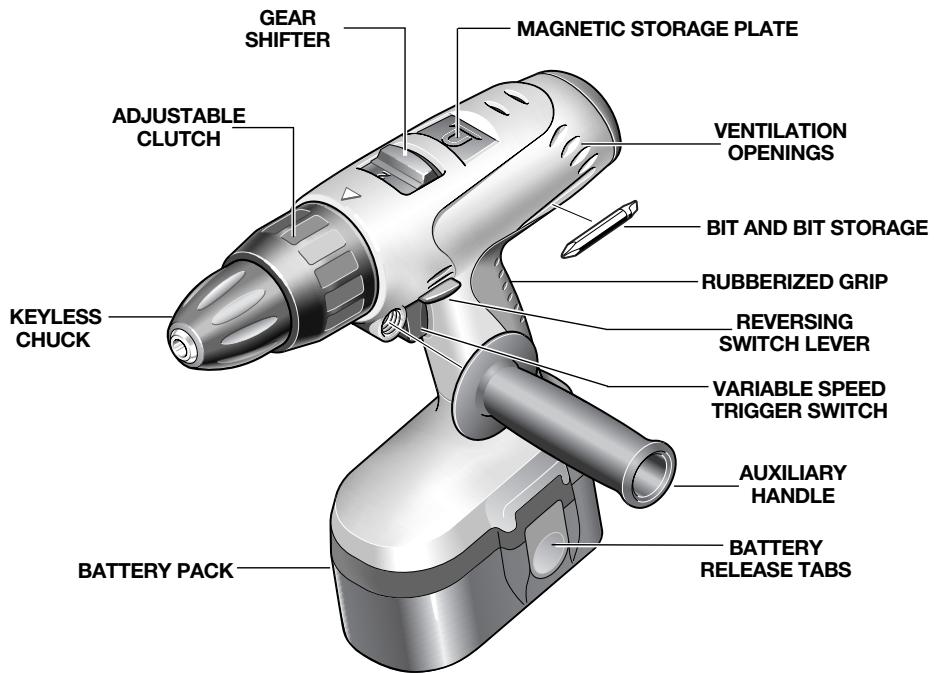
FIG. 1
Tool
Model number 2585 2885
Voltage rating 14.4 V --- 18 V ---
Charge time 3 hr. 1 hr.
Maximum Capacities
Chuck size 3/8" 3/8"
Charger
Battery pack 144BAT 180BAT
Voltage rating 120V 60Hz 120V 60Hz
NOTE: For tool specifications refer to the nameplate on your tool.
Operating Instructions
VARIABLE SPEED CONTROLLED TRIGGER SWITCH
Your tool is equipped with a variable speed trigger switch. The tool speed can be controlled from the minimum to the maximum nameplate RPM by the pressure you apply to the trigger. Apply more pressure to increase the speed and release pressure to decrease speed. This accurate speed control enables you to drill without center punching. It also permits you to use as a power screwdriver. Bits are available for driving screws as well as running bolts and nuts.
FORWARD/REVERSING LEVER & TRIGGER LOCK
Your tool is equipped with a forward/ reversing lever and trigger lock located above the trigger (Fig. 1). This lever was designed for changing rotation of the chuck, and for locking the trigger in an "OFF" position to help prevent accidental starts and accidental battery discharge. For forward rotation, (with chuck pointed away from you) move the lever to the far left. For reverse rotation move the lever to the far right. To activate trigger lock move lever to the center off position.
CAUTION
comes to a complete stop. Shifting during rotation of the chuck can cause damage to the tool.
GEAR SHIFTING
Your tool is equipped with two separate gear ranges, low gear and high gear. Low gear provides high-torque and slower drilling speeds for heavy duty work or for driving screws. High gear provides faster speeds for drilling lighter work. To change speeds slide switch, to the high or low position.
ATTENTION: If your tool appears to be running, but the chuck will not turn, check to make sure the gear shifting switch is pushed fully into desired setting.
ADJUSTABLECLUTCH
Your tool features 6 clutch settings. Output torque will increase as the clutch ring, is rotated from 1 to 5. The drill " " position will lock up the clutch to permit drilling and driving heavy duty work, and also enables bits to be changed quickly and easily in the keyless chuck.
The hammer drill position locks up the clutch for hammer drilling.
The clutch ring allows the tool to be set for various drilling /hammer drilling applications. Rotate the clutch ring to the drill or hammer drill symbol depending on the below applications).
Drilling mode: For drilling in woods, metals, plastics or other non concrete materials.
Hammer drilling mode: For drilling in brick, block, mortar, concrete, asphalt, tile or other similar hard materials.
AUXILIARY HANDLE
The auxiliary handle will provide additional control, support and guidance for the tool. To mount, thread handle into hole provided in housing until tight.
BRAKE
When the trigger switch is released it activates the brake to stop the chuck quickly. This is especially useful in the repetitive driving and removal of screws.
INSERTING BITS
Move reverse switch lever to the center "OFF" position. Remove battery pack and rotate the clutch ring to the drill bit symbol "O". Rotate the chuck sleeve counterclockwise viewing from chuck end, and open chuck to approximate drill bit diameter. Insert a clean bit up to the drill bit flutes for small bits, or as far as it will go for large bits.
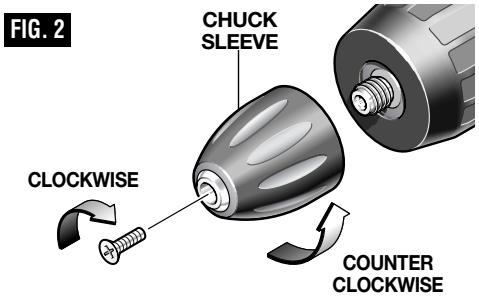
Close chuck by rotating the chuck sleeve clockwise and securely tighten by hand until a noticeable "click" noise is heard, indicating that the drill bit is firmly gripped in the jaws.
A WARNING
Do not use the power of the drill while grasping
chuck to loosen or tighten bit. Friction burn or hand injury is possible if attempting to grasp the spinning chuck.
REMOVING CHUCK
Rotate the clutch ring to the drill bit symbol "▶". Open the chuck all the way, remove left-hand thread screw inside chuck by turning it clockwise. Insert the short arm
of a 3/8 hex key wrench and close jaws on flats of wrench. Strike long arm of wrench sharply counterclockwise, remove wrench and unthread chuck from spindle (Fig. 2).
INSTALLING CHUCK
Always keep the spindle threads, the threads of the chuck and securing screw free of
debris. To install a chuck, reverse "removing the chuck" procedure.
RELEASING AND INSERTING BATTERY PACK
Release battery pack from tool by pressing on both sides of the battery release tabs and pull downwards. To insert battery, align
battery and slide battery pack into tool until it locks into position. Do not force.
CHARGING BATTERY PACK (1 HOUR CHARGER)
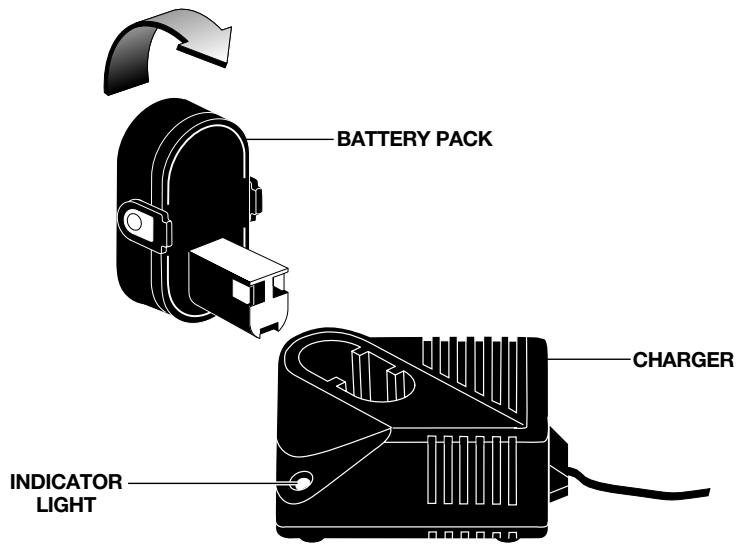
Plug charger cord into your standard power outlet, then insert battery pack into charger.The charger's green indicator will begin to "BLINK". This indicates that the battery is receiving a fast charge. Fast-charging will automatically stop when the battery pack is fully charged.
When the indicator light stops "BLINKING" (and becomes a steady green light) fast charging is complete.
When you begin the charging process of the battery pack, a steady green light could also
mean the battery pack is too hot or too cold.
The purpose of the light is to indicate that the battery pack is fast-charging. It does not indicate the exact point of full charge. The light will stop blinking in less time if the battery pack was not completely discharged.
When the battery pack is fully charged, unplug the charger (unless you're charging another battery pack) and slip the battery pack back into the tool handle (Fig.3).
-9-
FIG. 3
CHARGING BATTERY PACK (3 HOUR CHARGER)
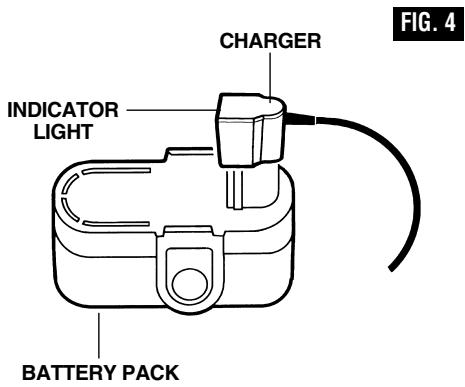
Plug charger cord into your standard power outlet, then insert battery pack into charger. The charger's green light (Fig. 4), will turn "ON". The green light remains "ON" as long as charger is plugged in, and does not shut off.
After normal usage, the battery pack requires approximately 3 hours or less charging time to become fully charged. If the battery pack is run-down completely, it may require up to 5 hours charging time to become fully charged.
When the battery pack is fully charged, unplug the charger (unless you're charging another battery pack) and slip the battery pack back into the tool handle.
IMPORTANT CHARGING NOTES
- The battery pack accepts only about 80% of its maximum capacity with its first few charge cycles. However, after the first few charge cycles, the battery will charge to full capacity.
- The charger was designed to fast charge the battery only when the battery temperature is between 40^ (4^) and 105^ (41^) .
- A substantial drop in operating time per charge may mean that the battery pack is nearing the end of its life and should be replaced.
- If you anticipate long periods (i.e. a month or more) of non-use of your tool, it is best to run your tool down until it is fully discharged before storing your battery pack. After a long period of storage, the capacity at first recharge will be lower. Normal capacity will be restored in two or three charge/discharge
cycles. Remember to unplug charger during storage period.
5. If battery does not charge properly:
a. Check for voltage at outlet by plugging in some other electrical device.
b. Check to see if outlet is connected to a light switch which turns power "off" when lights are turned off.
c. Check battery pack terminals for dirt. Clean with cotton swab and alcohol if necessary.
d. If you still do not get proper charging, take or send tool, battery pack and charger to your local Skil Service Center. See "Tools, Electric" in the Yellow Pages for names and addresses.
Note: Use of chargers or battery packs not sold by Skil may void the warranty.
DRILLING WOOD OR PLASTIC
If backing block is not used, ease up on the pressure just before the bit breaks through the wood to avoid splintering. Complete the hole from the opposite side immediately after the point breaks through. If bit binds, reverse the drilling operation to help remove the bit from the work.
Make a center punch in the material for easier starting. Use enough pressure to keep the bit cutting. If the bit is allowed to merely spin in the hole, it will become dull within a short time. When drilling a larger hole, it is faster and easier on your power pack to first make a smaller hole and enlarge it to the
required size. Lubricate the tip of the bit occasionally with CUTTING OIL for easier metal drilling. If bit binds, reverse the drilling to help remove the bit from the work.
It is not recommended to drill holes larger than 3/8 diameter through soft steel thicker than 1/8 . Drilling through metal rapidly drains energy from your power pack.
DRILLING MASONRY
Use carbide-tipped masonry bit for cinder block, mortar, common brick, concrete, soft stone and other materials. The amount of pressure to be used is dependent upon the type of material being drilled. Soft materials require less pressure while the hard materials
need more pressure to prevent the drill bit from spinning.
It is not recommended to drill holes larger than 3/8'' diameter in masonry material. Doing so rapidly drains energy from the battery pack.
FASTENING WITH SCREWS
This procedure shown in (Fig. 5) will enable you to fasten materials together with your Cordless Drill/Screwdriver without stripping, splitting or separating the material.
First, clamp the pieces together and drill the first hole 2/3 the diameter of the screw. If the material is soft, drill only 2/3 the proper length. If it is hard, drill the entire length.
Second, unclamp the pieces and drill the second hole the same diameter as the screw shank in the first or top piece of wood.
Third, if flat head screw is used, countersink the hole to make the screw flush with the surface. Then, simply apply even pressure when driving the screw. The screw shank clearance hole in the first piece allows the screw head to pull the pieces tightly together.
The adjustable screw drill accessory will do all of these operations quickly and easily. Screw drills are available for screw sizes No. 6, 8, 10 and 12.
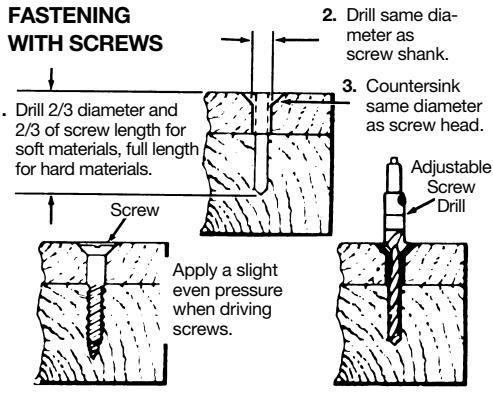
FIG.5
Maintenance
Service
A WARNING
NO USER SERVICEABLE PARTS INSIDE. Preventive
maintenance performed by unauthorized personnel may result in misplacing of internal wires and components which could cause serious hazard. We recommend that all tool service be performed by a Skil Factory Service Center or Authorized Skil Service Station. SERVICEMEN: Disconnect tool and/or charger from power source before servicing.
BATTERIES
Be alert for battery packs that are nearing their end of life. Battery packs typically last from 500 to 1000 charges. If you notice decreased tool performance or significantly shorter running time between charges then it is time to replace the battery pack. Failure to do so can cause the tool to operate improperly or damage the charger.
Long term battery storage should be in the discharged state. Battery packs last longer and re-charge better when they are stored discharged. Remember to fully recharge battery packs before using after prolonged storage.
Your Skil tool has been properly lubricated and is ready for use. It is recommended that
tools with gears be regreased with a special gear lubricant yearly.
D.C.MOTORS
The motor in your tool has been engineered for many hours of dependable service. To maintain peak efficiency of the motor, we recommend it be examined every six months. Only a genuine Skil replacement motor specially designed for your tool should be used.
Cleaning
WARNING
To avoid accidents, always disconnect the
tool and/or charger from the power supply before cleaning. The tool may be cleaned most effectively with compressed dry air. Always wear safety goggles when cleaning tools with compressed air.
Ventilation openings and switch levers must be kept clean and free of foreign matter. Do not attempt to clean by inserting pointed objects through opening.
A CAUTION
Certain cleaning agents and solvents damage
plastic parts. Some of these are: gasoline, carbon tetrachloride, chlorinated cleaning solvents, ammonia and household detergents that contain ammonia.
Accessories
WARNING
If an extension cord is necessary, a cord with
adequate size conductors that is capable of carrying the current necessary for your tool must be used. This will prevent excessive voltage drop, loss of power or overheating. Grounded tools must use 3-wire extension cords that have 3-prong plugs and receptacles.
NOTE: The smaller the gauge number, the heavier the cord.
RECOMMENDED SIZES OF EXTENSION CORDS 120 VOLT ALTERNATING CURRENT TOOLS
| Tool's Ampere Rating | Cord Size in A.W.G. | Wire Sizes in mm2 |
| Cord Length in Feet | Cord Length in Meters |
| 25 | 50 | 100 | 150 | 15 | 30 | 60 | 120 |
| 3-6 | 18 | 16 | 16 | 14 | .75 | .75 | 1.5 | 2.5 |
| 6-8 | 18 | 16 | 14 | 12 | .75 | 1.0 | 2.5 | 4.0 |
| 8-10 | 18 | 16 | 14 | 12 | .75 | 1.0 | 2.5 | 4.0 |
| 10-12 | 16 | 16 | 14 | 12 | 1.0 | 2.5 | 4.0 | — |
| 12-16 | 14 | 12 | — | — | — | — | — | — |
*Screwdriver bit
** Carrying case
(^* = standard equipment)
(^** = optional accessories)
S-B Power Tool Company ("Seller") warrants to the original purchaser only, that all SKIL consumer portable power tools will be free from defects in material or workmanship for a period of two years from date of purchase. SELLER'S SOLE OBLIGATION AND YOUR EXCLUSIVE REMEDY under this Limited Warranty and, to the extent permitted by law, any warranty or condition implied by law, shall be the repair or replacement of parts, without charge, which are defective in material or workmanship and which have not been misused, carelessly handled, or misrepaired by persons other than Seller or Authorized Service Station. To make a claim under this Limited Warranty, you must return the complete portable power tool product, transportation prepaid, to any SKIL Factory Service Center or Authorized Service Station. For Authorized SKIL Power Tool Service Stations, please refer to your phone directory.
THIS LIMITED WARRANTY DOES NOT APPLY TO ACCESSORY ITEMS SUCH AS CIRCULAR SAW BLADES, DRILL BITS, ROUTER BITS, JIGSAW BLADES, SANDING BELTS, GRINDING WHEELS AND OTHER RELATED ITEMS.
ANY IMPLIED WARRANTYES SHALL BE LIMITED IN DURATION TO TWO YEARS FROM DATE OF PURCHASE. SOME STATES IN THE U.S., SOME CANADIAN PROVINCES DO NOT ALLOW LIMITATIONS ON HOW LONG AN IMPLIED WARRANTY LASTS, SO THE ABOVE LIMITATION MAY NOT APPLY TO YOU.
IN NO EVENT SHALL SELLER BE LIABLE FOR ANY INCIDENTAL OR CONSEQUENTIAL DAMAGES (INCLUDING BUT NOT LIMITED TO LIABILITY FOR LOSS OF PROFITS) ASING FROM THE SALE OR USE OF THIS PRODUCT. SOME STATES IN THE U.S. AND SOME CANADIAN PROVINCES DO NOT ALLOW THE EXCLUSION OR LIMITATION OF INCIDENTAL OR CONSEQUENTIAL DAMAGES, SO THE ABOVE LIMITATION OR EXCLUSION MAY NOT APPLY TO YOU.
THIS LIMITED WARRANTY GIVES YOU SPECIFIC LEGAL RIGHTS, AND YOU MAY ALSO HAVE OTHER RIGHTS WHICH VARY FROM STATE TO STATE IN THE U.S., PROVINCE TO PROVINCE IN CANADA AND FROM COUNTRY TO COUNTRY.
THIS LIMITED WARRANTY APPLIES ONLY TO PORTABLE ELECTRIC TOOLS SOLD WITHIN THE UNITED STATES OF AMERICA, CANADA AND THE COMMONWEALTH OF PUERTO RICO. FOR WARRANTY COVERAGE WITHIN OTHER COUNTRIES, CONTACT YOUR LOCAL SKIL DEALER OR IMPORTER.
GARANTIE LIMITEE DES OUTILS ÉLECTRIQUES PORTATIFS GRAND PUBLIC SKIL POUR USAGE DOMESTIQUE