BBA 2594 - Bread maker CLATRONIC - Free user manual and instructions
Find the device manual for free BBA 2594 CLATRONIC in PDF.


| Product Type | Automatic Bread Maker |
| Brand | CLATRONIC |
| Model | BBA 2594 |
| Capacity | 3 liters (up to 1300 g bread) |
| Power | 800 W |
| Voltage | 230 V |
| Frequency | 50 Hz |
| Safety Class | I |
| Number of Programs | 10 automatic programs |
| Available Programs | Normal, Quick, White Bread, Sweet Bread, Whole Wheat, Cake, Dough, Bake, Jam, Sandwich |
| Crust Options | 3 levels (Light, Medium, Dark) |
| Weight Options | 2 levels (Small/Large) |
| Delay Timer | Yes, up to 13 hours |
| Keep Warm | 1 hour automatic after baking |
| Kneading Type | 2 hooks with reverse rotation |
| Bowl Coating | Non-stick |
| Included Accessories | Removal hook, measuring spoon, measuring cup |
| Safety Features | Automatic stop in case of overheating, child safety lock |
| Maintenance | Clean the bowl and hooks with soapy water; never immerse the appliance |
| Warranty | 24 months |
| Repairability | Repair by an authorized service center |
Frequently Asked Questions - BBA 2594 CLATRONIC
User questions about BBA 2594 CLATRONIC
0 question about this device. Answer the ones you know or ask your own.
Ask a new question about this device
Download the instructions for your Bread maker in PDF format for free! Find your manual BBA 2594 - CLATRONIC and take your electronic device back in hand. On this page are published all the documents necessary for the use of your device. BBA 2594 by CLATRONIC.
USER MANUAL BBA 2594 CLATRONIC
Bread baking machine
Kenyérsütő automata
BBA 2594
Operating Instructions 26
Safety Instructions 26
Parts and Drawings 27
Control Panel 27
Description of the Control Panel 28
Bread Baking Machine Functions 29
Bread Baking Machine Program Phases 29
Program Phase Timing 30
Cleaning and Maintenance 30
Questions & Answers on Baking 31
Questions & Answers on Bread Baking Machines 33
Questions & Answers on Recipes 34
Remarks on the Recipes 35
Recipes 37
Guarantee 48
Technical Data on the Bread Baking Machine 72
Oldal
Kezelésiutasítás 49
Biztonsagi eloirasok 49
Alkatreszek es jelolések 50
Kezelötable 50
Magyaraszatok a kezelotablaoz 51
Akenyersutoautomata funkcioi 51
Akenyersutoo automata programlefutasa 52
A programok idobeli lefutasa 53
Tisztlas es karbantartas 54
Kerdesek a suteshez 54
Kerdesek a kenyersuto automatához 56
Operating Instructions
Congratulations for having purchased the BBA 2594 model Bread Baking Machine. You have bought a machine based on a revolutionary new concept:
- The bread dough is kneaded with two kneading pegs and is hence worked better.
Some machine programs provide two different levels for the baking of large or small quantities of bread. - The bread baking machine offers 10 pre-installed programs with 31 different setting options. There is a completely new program with which you can either just bake a fresh loaf of bread or to brown one that has already been baked.
- You can even schedule the bread baking machine, i.e. you can preprogram a program up to 13 hours in advance.
The appliance is completely automatic and extremely user-friendly. It kneads the dough in two different directions thus providing for excellent mixing. You will also find the recipes for the following specialties:
- White bread, dark leavened bread, light wheat and rye bread, whole bread;
- Bread with baking mixes;
- Bread for allergic people;
- Cakes for the baking-powder program;
- Dough which needs to be further worked;
- Marmalades that can be cooked.
Safety Instructions
Read all the instructions in the manual and follow them carefully!
- Do not touch any of the appliance's hot surfaces. Use oven cloths! The bread baking machine is very hot after baking.
- Never dip the connection cable or the appliance in water or any other liquid.
- Keep your eye on the appliance when children are around! Unplug the appliance if it is not being used and before cleaning it. Before removing single parts of the appliance let it cool down.
- Never use the appliance with a defective connection cable, after malfunctions or if the appliance happens to be damaged in any way whatsoever! In these cases have the Customer Service check and repair it if necessary. Never try to repair it yourself. The warranty is void in this latter case.
- The use of accessories not recommended by the manufacturer can cause damage. Use the appliance exclusively for the envisaged purpose.
- Lay the appliance firmly on the counter to avoid that it falls off during the kneading of a thick dough. This is especially important when using the preprogram function and the appliance is not being watched. In the case of extremely smooth counters the appliance should be placed on a thin rubber mat to avoid any risk of falling.
- The bread baking machine must be kept at a distance of at least 10cm from other objects when it is working. The appliance can be used only indoors.
- Make sure that the power cable does not touch any hot surface and that it does not hang over a table edge thus avoiding, for example, that children may grab it.
-
Never place the appliance either on or near a gas or electrical stovetop or a hot oven.
-
Pay great attention when handling the appliance especially when it is full of hot liquids (marmalades)!
- Never remove the baking tin while the appliance is still working!
- When baking white bread, never fill the baking tin more than maximum level! Should this happen, the bread will not be baked evenly and the dough may overflow. Please follow our instructions.
- Metal foils or other materials must not be put inside the appliance as these may cause a fire or a short circuit!
- Never cover the appliance with a towel or any other material! The heat and steam generated by the appliance must be free to escape. A fire can break out if the appliance is covered with flammable materials or if it comes in contact, for example, with curtains.
- Before trying to bake a given type of bread overnight, try the recipe first while keeping an eye on it to make sure that the doses of the ingredients are correct, that the dough is not too thick or thin or that the quantity is too much and hence risks overflowing.
The manufacturer is not liable if this appliance is used for commercial purposes or in any way or manner that does not comply with the instructions herein provided.
Parts and Drawings
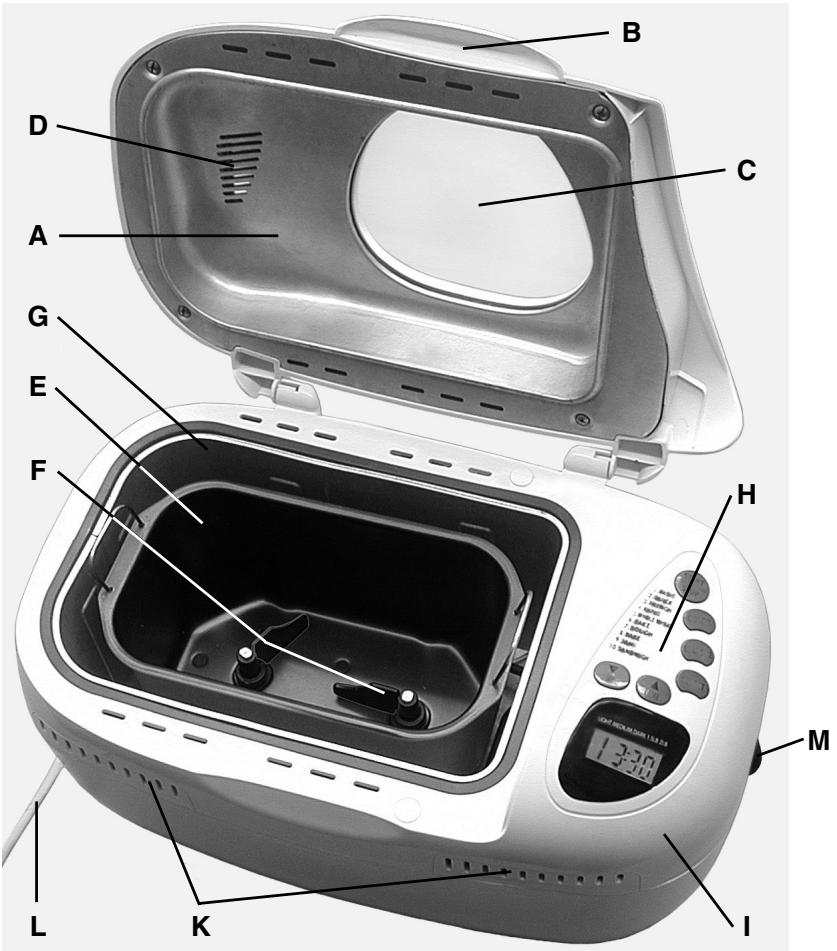
Control Panel
1 LCD display
It shows the time left before the end of the program
2 START-/STOP key
To start and stop the program
3 COLOR key
To set the desired level of browning
4 DOUGH QUANTITY key
To set 2 weight levels as described below
5 SELECTION key
To select the programs described in the "program phase timing" section.
6 TIME keys
To set the preprogram timer
A Cover, removable
B Handle
C Viewing panel
D Vent
E Baking tin
F Kneading pegs
G Baking compartment
H Control Panel
Casing
K Side vent
L Cable
M On/off Switch
Accessories: 1 hook to remove the kneading pegs, 1 measuring spoon, 1 measuring beaker
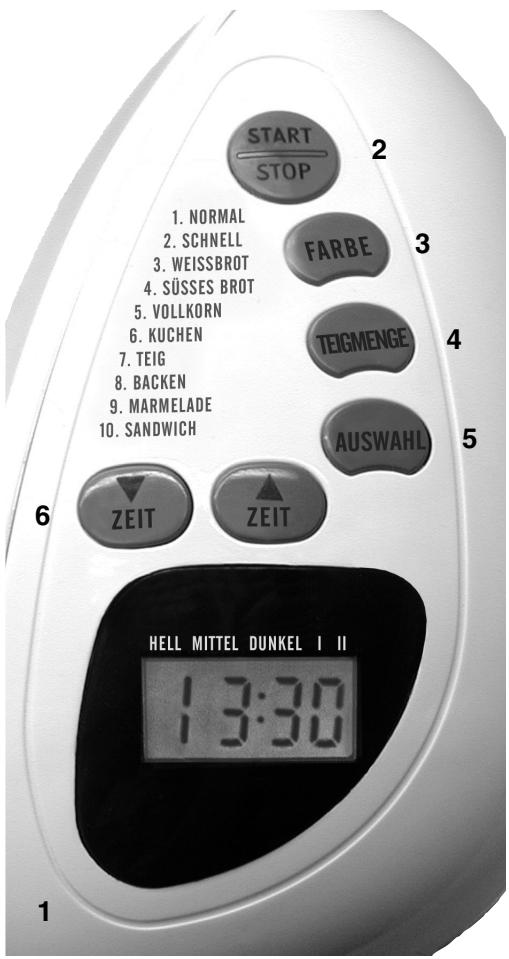
Description of the Control Panel
Insert the plug into a properly installed 230V/50Hz protective contact socket and switch on the appliance with the on/off switch (M).
1. DISPLAY
BASIC SETTING
This displays signals when the appliance is ready for use. It corresponds to the normal program. "1 3:30" appears on the display. The "1" specifies which program has been chosen and the "3:30" is the length of the program. The positions of two arrows provide information on the selected browning level and the weight. The basic setting after switching the appliance on is: "superior weight" and "medium browning level". During operation the course of the program can be read on the display. As the program proceeds the digits of the set time will decrease progressively.
2. START/STOP key
To start and stop the program. As soon as the START/STOP key is pressed, the points of the time value start to blink. Use the START/STOP key to stop the program in any moment. Keep the key pressed until a signal beep is heard. The starting position of the aforementioned start program appears on the screen. If a different needs to be used, select it with the SELECTION key.
3. TIME keys
Those programs that can be timed to start later on are listed in the "Program Phase Timing" table. The RAPID, CAKE, SWEETBREAD and MARMALADE programs cannot be timed to start later on. The hours and minutes after which the preparation should be started need to be added to the relevant basic time for the specific program plus 1 hour of warming time (after the end of the baking process). A maximum timing of 13 hours can be set.
Example: It is 8.30 p.m. and the bread must be ready the next morning by 7.00 a.m., i.e. in 10 hours and 30 minutes. Press the TIME key until 10.30 appears, that is to say the time between now (8.30 p.m.) and when the bread must be ready.
When working with the timing function never use perishable ingredients such as milk, eggs, fruit, yogurt, onions, etc.!.
4. COLOR key
The desired browning level is set with this key: LIGHT - MEDIUM - DARK.
5. DOUGH QUANTITY key
It provides for the following settings in the various programs (see table):
LEVEL I = For small quantities of bread;
LEVEL II = For large quantities of bread.
In the recipes you will find our recommended quantities.
6. SELECTION key
Use this menu key to run one of the available programs described in detail in the "Program Phase Timing" table.
Use the programs for the following specialties:
- NORMAL For white and wheat and rye bread. This program is used the most.
- RAPID For the quick preparation of white and wheat and rye bread
- WHITE BREAD For the preparation of particularly light white bread
- SWEETBREAD For the preparation of sweet leavened dough
- WHOLEMEAL For wholemeal bread
- CAKE For cakes with baking powder
- DOUGH For the preparation of dough
- BAKING To brown bread or cakes
- MARMALADE To cook marmalades and jams
- SANDWICH To prepare light sandwich bread
Bread Baking Machine Functions
Buzzer function
The buzzer goes off:
-
When pressing all the program keys;
-
During the second kneading cycle of the NORMAL, WHOLEMEAL, RAPID, CAKE and SANDWICH programs to signal that the cereals, fruit, nuts or other ingredients can be added.
- When the end of the program is reached.
During the warming phase at the end of the baking procedure the acoustic signal rings several times.
Repeat function
In case of a blackout the bread baking machine must be started again. This is possible only if the program was stopped before the kneading phase was reached. Otherwise you will have to start from the beginning!
Safety functions
If the temperature of the appliance is still too high (more than 40^ ) for a new program after using the appliance previously, H:HH will appear on the display when pressing start again and an acoustic signal is given. If this is the case, press the START/STOP key until the H:HH message is deleted and the basic setting appears on the display. Remove the container and wait until the appliance has cooled.
The BAKING program can be started immediately even when the appliance is still hot.
Bread Baking Machine Program phases
Insert the baking tin
The nonstick baking tin must be held firmly with both hands and be placed in the middle of the baking compartment. Press the tin downwards with caution until it snaps into place. Insert the two kneading pegs on the driving shafts.
Put in the ingredients
The ingredients must be put into the baking tin in the order specified in the relevant recipe.
Switch on
Insert the plug into a duly installed 230 V/50 Hz protective contact socket and switch on the appliance with the on/off switch (M).
Select the program
Select the desired program with the SELECTION key. Choose the level corresponding to the selected program. Then select the desired degree of browning. Use the TIME key to set the time when the program is to be started. Press the START/STOP key.
Mix and knead the dough
The bread baking machine mixes and kneads the automatically until it reaches the right consistency.
Leave the dough to rise
After the last kneading cycle the bread baking machine is heated to the optimal temperature for the rising of the dough.
Baking
The bread baking machine sets the baking temperature and time automatically. If the bread is too light at the end of the baling program, use the BAKE program to let it brown more. To do so, press the START/STOP key, then select the BAKE program and start. When the desired degree of baking has been reached, stop the process.
Warming
Once the baking is over, the buzzer goes off to signal that the bread or specialty can be removed. The 1-hour warming time starts immediately.
End of the program phases
Switch off the appliance after use with the on/off switch (M) and pull out the plug. At the end of the program pull out the baking tin by using oven cloths, lay it on the counter and if the bread does not fall out of the tin onto the grid, move the knead shaft back and forth a few times until the bread comes out. If one of the kneading pegs is still stuck in the bread, take the hook supplied with the appliance. Insert it under the warm loaf of bread into the almost circular opening of the kneading peg and wedge the hook against the lower edge of the kneading peg preferably where the blade of the kneading peg is located. You can then cut the bread easily and pull out the kneading peg completely.
Program phase timing
| Menu no. | 1 | 2 | 3 | 4 | 5 | 6 | 7 | 8 | 9 | 10 | |||
| NORMAL | RAPID | WHITEBREAD | SWEATBREAD | WHOLE MEAL | CAKE | DOUGH | BAKE | MARMELADE | SANDWICH | ||||
| Level | 1 | 2 | 1 | 2 | 1 | 2 | |||||||
| Bread weight in grams, approx. | 750 | 1300 | 750 | 1300 | 750 | 1300 | |||||||
| Total time - h | 3:20 | 3:30 | 1:58 | 3:50 | 1:52 | 3:30 | 3:40 | 2:00 | 1:50 | 1:00 | 1:20 | 3:09 | 3:20 |
| The following time indications are specified in minutes | |||||||||||||
| Pre-heating The motor is not running - Heating on/off 5/25 s)* | 17 | 20 | 5 | 22 | 3 | 37 | 40 | 22 | - | Heating on/off 15 s/15 s | 11 | 22 | |
| Stirring (left) | 3 | 3 | 3 | 3 | 3 | 3,5 | 3 | - | 15 | 3 | |||
| 1. kneading (left) | 2 | 2 | 2 | 2 | 2 | - | 2 | - | - | 2 | |||
| 2. kneading (right/left alternated) Heating on/off 5/25 s* | 13 | 20 | 16 | 5 | 13 | Beating 12.5 min. (or heat.) 8 min. Heating on/off 5/25 s | 16 | 13 | |||||
| Signal to add the ingredients | |||||||||||||
| Displayed time | ca. 2:54 | ca. 2:57 | ca. 1:33 | - | - | ca. 2:44 | ca. 2:47 | ca. 1:49 | - | - | - | ca. 2:34 | ca. 2:45 |
| 1. rising Heating on/off (5/25 s)* | 45 | - | 45 | - | 45 | - | - | - | - | 45 | |||
| Dough smoothing | 1 | 1 | 1 | - | 1 | - | - | - | - | 1 | |||
| 2. rising Heating on/off (5/25 s)* | 18 | 7 | 25 | 7 | 18 | - | 45 | - | - | 18 | |||
| Dough smoothing | 1 | - | 1 | - | 1 | - | - | - | - | 1 | |||
| 3. rising Heating on/off (5/25 s)** | 45 | 25 | 50 | 27 | 35 | - | 22 | - | - | 39 | |||
| Baking Heating on/off (22/8 s), 8/22 s after reaching the temperature | 55 | 62 | 55 | 65 | 65 | 55 | 62 | 80 | - | 60 | 45 Stirring/ Cooking Right/left Heating on/off 15 s/15 s | 56 | |
| Rest phase (w/o heating) | - | - | - | - | - | 16 | - | - | 20 | ||||
| Warming Heating on/off | 60 | 60 | 60 | - | 60 | - | - | - | - | 60 | |||
| Pre-programming | |||||||||||||
| Timer (max) | 13 Std. | - | 13 Std. | - | 13 Std. | - | 13 Std. | 13 Std. | - | 13 Std. | |||
- The heating is switched on only if the room temperature is lower than 25^ . If the room temperature is above 25^ the ingredients are already at the right temperature and there is no need for pre-heating. For the first and second rising the room temperature must be above 25^ or high enough to make the dough rise without extra heating.
** The heating is switched on only if the room temperature is lower than 35^ . A room temperature of more than 35^ is enough to make the dough rise without extra heating.
Cleaning and Maintenance
- Before using the appliance for the first time wash the bread baking machine's baking tin with a mild detergent and clean the kneading pegs.
- It is highly recommended to coat the new baking tin and the kneading pegs with heat resistant grease before using them for the first time and let them heat in the oven for about 10 minutes at 160^ . Once these have cooled down clean away (polish) the grease from the baking tin with a sheet of paper towel. This operation is to be performed to protect the nonstick coating. This operation can be repeated from time to time.
- After use always leave the appliance to cool before cleaning it or putting it away. It takes about half an hour for the appliance to cool and to be ready again for baking and kneading.
- Before cleaning pull out the plug and leave the appliance to cool. Use a mild detergent. Never use chemical cleaning agents, gasoline, oven cleaners or any detergent that can scratch or ruin the coating.
- Remove all the ingredients and crumbs from the lid, casing and baking compartment with a moist towel. Never dip the appliance in water nor fill the baking compartment with water! For easy cleaning the lid can be removed by positioning it vertically and pulling it out.
- Wipe the outside of the baking tin with a moist towel. The inside of the tin can be washed with some detergent liquid. Do not leave it too long dipped in water.
- Both the kneading pegs and drive shafts need to be cleaned immediately after use. If the kneading pegs remain in the tin, it becomes difficult to remove them afterwards. In this case fill the container with warm water and leave it to rest for 30 minutes. Then remove the kneading pegs.
- The baking tin has a nonstick coating. Do not use metal objects that can scratch the surface when cleaning it. It is normal that the color of the coating changes over the course of time. This change does not alter its effectiveness in any way whatsoever.
- Before putting the appliance away for storage, make sure that it is perfectly cool, clean and dry. Put the appliance away with the lid closed.
Questions & Answers on Baking
- The bread sticks to the container after baking
Leave the bread to cool for about 10 minutes after baking - turn the container upside down. If necessary move the kneading peg shaft back and forth. Grease the kneading pegs before baking.
- How do you avoid the forming of holes in the bread owing to the presence of the kneading pegs
You can remove the kneading pegs with your fingers covered with flour before leaving the dough to rise for the last time (see "Program Phase Timing" and the display messages). If do not wish to do so, use the hook after baking. If you proceed with caution, you can avoid the forming of a large hole.
- The dough spills over when it is left to rise.
This happens in particular when wheat flour is used owing its greater content of gluten.
Remedy:
a) Reduce the amount of flour and adjust the amounts of the other ingredients. When the bread is ready, it will still have a large volume.
b) Spread a tablespoon of heated liquefied margarine on the flour.
- The bread rises and spills over anyway
a) If a V-shaped ditch forms in the middle of the bread, the flour does not have enough gluten. This means that the wheat contains too little protein (it happens during especially rainy summers) or that the flour is too moist.
Remedy: add one tablespoon of wheat gluten for 500g of wheat.
b) If the bread has a funnel shape in the middle, the possible cause can be one of the following:
- the water temperature was too high;
- too much water was used;
-
the flour was poor in gluten.
-
When can the lid of the bread baking machine be opened during the baking?
Generally speaking, it is always possible while the kneading is underway. During this phase small quantities of flour or liquid can still be added.
If the bread must have a particular aspect after baking, proceed as follows: before the last rising phase (see the Program Phase Timing" table and the message on the display) open the lid with caution and shortly and carve the bread crust while it is forming with a sharp pre-heated knife, scatter cereals on it or spread a mixture of potato flour and water on the crust to give it a glossy finish. This is the last time that the lid can be opened, otherwise the bread will go down in the middle.
What do the type numbers for flour mean?
The lower the type number, the less roughage the flour contains and the lighter it will be.
What is wholemeal flour?
Wholemeal flour is made of all types of cereals including wheat. The term "wholemeal" means that the flour was ground from whole grain and hence it has greater contents of roughage thus making the wheat wholemeal flour darker. However, the use of wholemeal flour does not make the bread darker as it is widely believed.
What must be done when using rye flour?
Rye flour does not contain any gluten and the bread hardly rises. In order to make it easily digestible a rye wholemeal bread with leaven is to be made.
The dough will rise only if one part of 550 type flour is added to every four parts of rye flour without gluten.
What is the gluten in flour?
The higher the type number, the lower the gluten contents of the flour are and the less the dough will rise. The highest quantity of gluten is contained in 550 type flour.
How many different flour types are there and how are they used?
a) Corn, rice and potato flour are suitable for people allergic to gluten or for those who suffer from sprue or celiac disease. See the relevant recipes in the operating instructions.
b) Spelt flour is very expensive, but it is free from chemical additives because spelt grows on very pool soil and requires no fertilizers. Spelt flour is especially suitable for allergic people. It can be used in all those recipes described in the operating instructions requiring flour types 405, 550 or 1050.
c) Millet flour is especially suitable for people suffering from many allergies. It can be used in all recipes requiring flour types 405, 550 or 1050 as described in the operating instructions.
d) Durum wheat flour is suitable for baguettes thanks to its consistency and it can be replaced with durum wheat semolina.
How can fresh bread be made easier to digest?
If a mashed boiled potato is added to the flour and kneaded in the dough the fresh bread is easier to digest.
What doses of rising agent should be used?
For yeast and leaven which must be bought in different quantities follow the producer's instructions on the package and adapt the quantity to the amount of flour used.
What can be done if the bread tastes of yeast?
a) Often sugar is added to eliminate this taste. The adding of sugar makes the bread lighter in color.
b) Add 1_ tablespoon of vinegar for a small bread loaf and 2 tablespoons for a large loaf to the water.
c) Use buttermilk or kefir instead of water. This is possible for all the recipes and it is recommended for the freshness of the bread.
- Why does the bread made in an oven taste different from the bread made with the bread baking machine?
It depends on the different degree of humidity: the bread is baked drier in the oven owing to the larger baking space, while the bread made in the machine is moister.
Questions & Answers on Bread Baking Machines
A table of problems that may occur is provided below:
| Problem | Cause | Solution |
| Smoke comes out of the baking compartment or of the vents | The ingredients stick to the baking compartment or on the outside of the baking tin | Pull out the plug and clean the outside of the baking tin or the baking compartment. |
| The bread goes down in the middle and is moist on the bottom. | The bread is left too long in the tin after baking and warming. | Take the bread out of the baking tin before the warming function is over. |
| It is difficult to take the bread out of the baking tin. | The bottom of the loaf is stuck to the kneading peg. | Clean the kneading peg and shafts after the baking. If necessary, fill the baking tin with warm water for 30 minutes. Then the kneading pegs can be easily removed and cleaned. |
| The ingredients are not mixed or the bread is not baked correctly. | Incorrect program setting. | Check the selected menu and the other settings. |
| The START/STOP key was touched while the machine was working. | Do not use the ingredients and start over again. | |
| The lid opened several timers while the machine was working. | After the last rising do not open lid. | |
| Long blackout while the machine was working. | Do not use the ingredients and start over again. | |
| The rotation of the kneading pegs is blocked. | Check that the kneading pegs are blocked by grains, etc. Pull out the baking tin and check whether the drivers turn. If this is not the case, send the appliance to the customer service. | |
| The baking tin jumps up during the kneading. | The side springs in the base inside the inner casing have lost tension. | Press the START/STOP key and interrupt the program. Pull out the container and push the springs slightly to the side. Insert the container again and close the lid. Start the program over again. |
| The dough is too thick. The kneading pegs are blocked and the container is pressed upwards. | Open the lid. Add some liquid to the dough and close the lid again. | |
| The appliance does not start. The display shows H:HH. | The appliance is still hot after the last baking cycle. | Press the START/STOP key until the basic setting appears on the display. Remove the baking tin and leave the appliance to cool. Then put the baking tin back in, set the program again and start. |
Questions & Answers on the Recipes
| Problem | Cause | Solution |
| The bread rises too fast. | - too much yeast, too much flour, not enough salt - or several of these causes | a/b |
| The bread does not rise at all or not enough. | - no yeast at all or too little - old or stale yeast - liquid too hot - the yeast has come into contact with the liquid - wrong flour type or stale flour - too much or not enough liquid - not enough sugar | a/b e c d e a/b/g a/b |
| The dough rises too much and spills over the baking tin. | - if the water is too soft the yeast ferments more - too much milk affects the fermentation of the yeast | f c |
| The bread goes down in the middle. | - The dough volume is larger than the tin and the bread goes down. - The fermentation is too short or too fast owing to the excessive temperature of the water or the baking chamber or to the excessive moistness. | a/f c/h/i |
| The bread has a dip once the baking is over. | - Not enough gluten in the flour - Too much liquid | k a/b/h |
| Heavy, lumpy structure | - Too much flour or not enough liquid - Not enough yeast or sugar - Too much fruit, wholemeal or of one of the other ingredients - Old or stale flour | a/b/g a/b b e |
| The bread is not baked in the center. | - Too much or not enough liquid - Too much humidity - Recipe with moist ingredients | a/b/g h g |
| Open or coarse structure or too many holes | - Too much water - No salt - Great humidity, water too hot - Too much liquid | g b h/i c |
| Mushroom-like, unbaked surface | - Bread volume too big for the tin - Too much flour, especially for white bread - Too much yeast or not enough salt - Too much sugar - Sweet ingredients besides the sugar | a/f f a/b a/b b |
| The bread slices are unequal or lumpy | - Bread not cooled enough (the vapor has not escaped) | j |
| Flour deposits on the bread crust | - The flour was not worked well on the sides during the kneading. | g/i |
Solutions for the problems
a) Measure the ingredients correctly.
b) Adjust the ingredient doses and check that all the ingredients have been added.
c) Use another liquid or leave it to cool at room temperature. Add the ingredients specified in the recipe in the right order. Make a small ditch in the middle of the flour and put in the crumbled yeast or the dry yeast. Avoid letting the yeast and the liquid come into direct contact.
d) Use only fresh and correctly stored ingredients.
e) Reduce the total amount of the ingredients, do not use more than the specified amount of flour. Reduce all the ingredients by 1/3.
f) Correct the amount of liquid. If ingredients containing water are used, the dose of the liquid to be added must be duly reduced.
g) In case of very humid weather remove 1-2 tablespoons of water.
h) In case of warm weather do not use the timing function. Use cold liquids.
i) Take the bread out of the tin immediately after baking and leave it on the grid to cool for at least 15 minutes before cutting it.
j) Reduce the amount of yeast or of all the ingredient doses by 1/4.
k) Add a tablespoon of wheat gluten to the dough.
Remarks on the Recipes
1. Ingredients
Since each ingredient plays a specific role for the successful baking of the bread, the measuring is just as important as the order in which the ingredients are added.
- The most important ingredients like the liquid, flour, salt, sugar and yeast (either dry or fresh yeast can be used) affect the successful outcome of the preparation of the dough and the bread. Always use the right quantities in the right proportion.
- Use lukewarm ingredients if the dough needs to be prepared immediately. If you wish to set the program phase timing function, it is advisable to use cold ingredients to avoid that the yeast starts to rise too early.
- Margarine, butter and milk affect the flavor of the bread.
- Sugar can be reduced by 20% to make the crust lighter and thinner without affecting the successful outcome of the baking. If you prefer a softer and lighter crust replace the sugar with honey.
- Gluten which is produced in the flour during the kneading provides for the structure of the bread. The ideal flour mixture is composed of 40% wholemeal flour and 60% of white flour.
- If you wish to add cereals grains, leave them to soak overnight. Reduce the quantity of flour and the liquid (up to 1/5 less).
- Leaven is indispensable with rye flour. It contains milk and acetobacteria that make the bread lighter and ferment thoroughly. You can make your own leaven but it takes time. For this reason concentrated leaven powder is used in the recipes below. The powder is sold in 15g packets (for 1 kg of flour). Follow the instructions given in the recipes (1/2, or 1 packet). If less leaven that requested is used the bread will crumble.
- If leaven powders with a different concentration (100 g packet for 1 kg of flour) are used, the quantity of flour must be reduced by 80 kg for a 1 kg of flour.
- Liquid leaven sold in bags is also available and it is suitable for use. Follow the doses specified on the package. Fill the measuring beaker with the liquid leaven and top it up with the other liquid ingredients in the right doses as specified in the recipe.
- Wheat leaven which often comes dry improves the workability of the dough, the freshness and the taste. It is milder that rye leaven.
- Use either the NORMAL or WHOLEMEAL program when baking leavened bread.
- Baking ferment can used to replace the leaven. The only difference is in the taste. It is fit to be used in the bread baking machine.
- Wheat bran is added to the dough if you want particularly light bread rich in roughage. Use one tablespoon for 500g of flour and increase the quantity of liquid by _ tablespoons.
- Wheat gluten is a natural additive obtained from wheat proteins. It makes the bread lighter and more voluminous. The bread falls in more rarely and it is more easily digestible. The effect can be easily appreciated when baking wholemeal and other bakery products made of home-milled flour.
- The black malt used in some recipes is dark-roasted barley malt. It is used to obtain a darker bread crust and soft part (e.g. brown bread). Rye malt is also suitable but it is not as dark. You can find this malt in whole food shops.
- Pure lecithin powder is a natural emulsifier that improves the volume of the bread, makes the soft part softer and lighter and keeps it fresh longer.
2. Adapting the doses
If the doses need to be increased or reduced, make sure that the proportions of the original recipe are maintained. To obtain a perfect result, the basic rules below for the adapting of the ingredient doses must be following:
- Liquids/flour: the dough ought to be soft (not too soft) and easy to knead without becoming stringy. A ball can be obtained by kneading it lightly. This is not the case with heavy doughs like rye wholemeal or cereal bread. Check the dough five minutes after the first kneading. If it is too moist, add some flour until the dough has reached the right consistency. If the dough is too dry add a spoonful of water at a time during the kneading.
- Replacing liquids: When using ingredients containing liquids in a recipe (e.g. curd cheese, yogurt, etc.), the required amount of liquid must be reduced. When using eggs beat them in the measuring beaker and fill it with the other required liquid up to the envisaged amount.
If you are living in a place located at a high altitude (more than 750m ) the dough rises faster. The yeast can be reduced in these cases by 1/4 to 1/2 of a teaspoon to proportionally reduce its rising. The same is true of places with particularly soft water.
3. Adding and measuring the ingredients and quantities
- Always put in first the liquid and the yeast at the end. To avoid that the yeast acts too fast (in particular when using the timing function), contact between the yeast and the liquid must be avoided.
- When measuring use the same measuring units, that is to say use either the measuring spoon supplied with the bread baking machine or a spoon used in your home when the recipes require doses measured in tablespoons and teaspoons.
- The measures in grams must be weighed precisely.
- For the millimeter indications you can use the supplied measuring beaker which has a graduated scale of 50 to 300ml .
The abbreviations in the recipes mean:
EL = level tablespoonful (or large measuring spoon)
TL = level teaspoonful (or small measuring spoon)
g = grams
ml = milliliter
Packet = 7g dry yeast for 500 g of flour – corresponds to 20 g of fresh yeast.
- Fruit, nuts or cereal ingredients. If you wish to add other ingredients, you can do so in specific programs (see the "Program Phase Timing" table), when you here the acoustic signal. If you add the ingredients too early, they will be crushed during the kneading.
4. Recipes for the BBA 2594 type bread baking machine
The following recipes are for various bread sizes. In some programs (see the "Program Phase Timing" table) a difference is made in the weights. We recommend you to use Level I for a bread loaf of 750 g and Level II for a bread loaf between 1000 and 1300 g.
If no levels are specified in the recipe, it means that they are not envisaged in the proposed programs and that both small and large quantities can be used.
5. Bread weights and volumes
- In the following recipes you will find exact indications regarding the bread weight. You will see that the weight of pure white bread is less than that of wholemeal bread. This depends on the fact that white flour raises more and hence limits need to be posed.
- Despite the precise weight indications there may be slight differences. The actual bread weight depends much on the air humidity of the room at the moment of the preparation.
- All breads with a substantial portion of wheat reach a large volume and exceed the container edge after the last rising in the case of the highest weight class. But the bread does not spill over. The part of the bread outside the tin is more easily browned compared to the bread in the tin.
- When the RAPID program is suggested for sweetbreads, you can use the ingredients in smaller quantities also for the SWEETBREAD program to make a lighter bread.
6. Baking results
- The result of the baking depends on the on-site conditions (soft water – high air humidity – high altitude – consistency of the ingredients, etc.). Therefore, the recipe indications are reference points which can be adapted. If one recipe or another does not go straight the first time, do not let yourself be discouraged. Try to find the cause and try it again by varying the proportions.
If the bread is too pale after baking, you can leave it to brown with the baking program. - It is recommended to bake a test bread before actually setting the timing function for use overnight so that you can make the necessary changes if necessary.
Classic Bread Recipes
| Level I | Level II | |
| White Bread | ||
| Bread weight approx. | 740 g | 1080 g |
| Water | 350 ml | 500 ml |
| Salt | 1 tsp | 1 1/2 tsp |
| Sugar | 1 tsp | 1 1/2 tsp |
| Durum wheat semolina | 150 g | 200 g |
| 550 type flour | 350 g | 500 g |
| Yeast | 3/4 packet | 1 packet |
Program:WHITE BREAD
Nut & Raisin Bread
Tip: Add the raisins and nuts after the acoustic signal during the second kneading phase.
| Bread weight approx. | 900 g | 1180 g |
| Water or milk | 275 ml | 350 ml |
| Margarine or butter | 30 g | 40 g |
| Salt | 1/2 tsp | 3/4 tsp |
| Sugar | 1 tbsp | 2 tbsp |
| 405 type flour | 500 g | 650 g |
| Dry yeast | 3/4 packet | 1 packet |
| Raisins | 75g | 100 g |
| Crushed walnuts | 40g | 60g |
Program: RAPID or SWEETBREAD
Attention: When using the SWEETBREAD program the bread is lighter. Use the Level I doses, otherwise the volume is too large.
Poppy Seed Bread
Tip: Before the last rising open the lid briefly and coat the dough with some water and then spread the poppy seeds. Press the seeds delicately with your hand.
| Bread weight approx. | 850 g | 1380 g |
| Water | 375 ml | 570 ml |
| 550 type flour | 500 g | 670 g |
| Corn semolina | 75 g | 130 g |
| Sugar | 1 tsp | 11/2 tsp |
| Salt | 1 tsp | 11/2 tsp |
| Whole or milled poppy seeds | 50 g | 75 g |
| Butter | 15 g | 20g |
| Grated nutmeg | 1 pinch | 2 pinches |
| Grated Parmesan cheese | 1 tbsp | 11/2 tbsp |
| Dry yeast | 3/4 packet | 1 packet |
Program: RAPID or SWEETBREAD
Attention: When using the SWEETBREAD program the bread is lighter. Use the Level I doses, otherwise the volume is too large.
Coarse White Bread
| Bread weight approx. | 750 g | 950 g |
| Milk | 275 ml | 350 ml |
| Margarine or butter | 25 g | 30 g |
| Salt | 1 tsp | 11/2 tsp |
| Sugar | 1 tsp | 11/2 tsp |
| 1050 type flour | 500 g | 650 g |
| Dry yeast | 3/4 packet | 1 packet |
Program: NORMAL
| Level I | Level II | |
| French White Bread | ||
| Bread weight approx. | 860 g | 1280 g |
| Water | 375 ml | 550 ml |
| Salt | 1 tsp | \( 1^{1/2} \) tsp |
| Vegetable oil | 1 tbsp | \( 1^{1/2} \) tsp |
| 405 type flour | 525 g | 700 g |
| Durum wheat flour | 75 g | 100 g |
| Sugar | 1 tsp | \( 1^{1/2} \) tsp |
| Dry yeast | \( 3/4 \) packet | 1 packet |
Program: RAPID
Italian White Bread
| Bread weight approx. | 900 g | 1300 g |
| Water | 375 ml | 570 ml |
| Salt | 1 tsp | \( 1^{1/2} \) tsp |
| Vegetable oil | 1 tbsp | \( 1^{1/2} \) tbsp |
| Sugar | 1 tsp | \( 1^{1/2} \) tsp |
| 550 type flour | 475 g | 650 g |
| Corn semolina | 100 g | 150 g |
| Dry yeast | \( 3/4 \) packet | 1 packet |
Program: SANDWICH
Oat Bread
| Bread weight approx. | 800 g | 1200 g |
| Water | 350 ml | 500 ml |
| Margarine or butter | 25 g | 30 g |
| Salt | 1 tsp | 1½ tsp |
| Brown Sugar | 1 tsp | 1½ tsp |
| Rolled oats – “Tender Flakes” | 150 g | 200 g |
| 1050 type flour | 375 g | 550 g |
| Dry yeast | 3/4 packet | 1 packet |
Program: NORMAL
Buttermilk Bread
| Bread weight approx. | 860 g | 1150 g |
| Buttermilk | 375 ml | 550 ml |
| Salt | 1 tsp | 1½ tsp |
| Sugar | 1 tsp | 1½ tsp |
| 1050 type flour | 500 g | 760 g |
| Dry yeast | 3/4 packet | 1 packet |
Program:WHITE BREAD
Sweetbread
| Bread weight approx. | 750 g | 1180 g |
| Fresh milk | 275 ml | 400 ml |
| Margarine or butter | 25 g | 35 g |
| Eggs | 2 | 4 |
| Salt | 1 tsp | 1 1/2 tsp |
| Honey | 2 tbsp | 3 tbsp |
| 550 type flour | 500 g | 700 g |
| Dry yeast | 3/4 packet | 1 packet |
Program: RAPID OR SWEETBREAD
Attention: When using the SWEETBREAD program the bread is lighter. Use the Level I doses, otherwise the volume is too large.
| Level I | Level II | |
| Wholemeal Bread | ||
| Bread weight approx. | 860 g | 1110 g |
| Water | 350 ml | 500 ml |
| Margarine or butter | 25 g | 35 g |
| Salt | 1 tsp | \( 1^{1/2} \) tsp |
| Sugar | 1 tsp | \( 1^{1/2} \) tsp |
| 1050 type flour | 270 g | 380 g |
| Wheat wholemeal flour | 270 g | 380 g |
| Dry yeast | \( 3/4 \) packet | 1 packet |
Program: NORMAL
Raisin Bread
Tip: Add the raisins or any other kind of dry fruit after the acoustic signal during the second kneading phase.
| Bread weight approx. | 850 g | 1100 g |
| Water | 275 ml | 350 ml |
| Margarine or butter | 30 g | 40 g |
| Salt | 1/2 tsp | 3/4 tsp |
| Honey | 1 tbsp | 2 tbsp |
| 405 type flour | 500 g | 650 g |
| Zimt | 3/4 tsp | 1 tsp |
| Dry yeast | 3/4 packet | 1 packet |
| Raisins/dry fruit | 75 g | 100 g |
Program: RAPID or SWEETBREAD
Attention: When using the SWEETBREAD program the bread is lighter. Use the Level I doses, otherwise the volume is too large.
Coarse bread
| Bread weight approx. | 780 g | 980 g |
| Water | 300 ml | 450 ml |
| Salt | 1 tsp | \( 1^{1/2} \) tsp |
| Dried wheat leaven* | 25 g | 40 g |
| 1050 type flour | 500 g | 750 g |
| Sugar | 1 tsp | \( 1^{1/2} \) tsp |
| Dry yeast | \( 3/4 \) packet | 1 packet |
Program:WHITE BREAD
- Wheat leaven improves the dough consistency, the freshness and the taste. It is milder than rye leaven.
Onion bread
| Bread weight approx. | 860 g | 1180 g |
| Water | 350 ml | 500 ml |
| Salt | 1 tsp | 1 1/2 tsp |
| Sugar | 1 tsp | 1 tsp |
| Grilled onions | 50 g | 75 g |
| 1050 type flour | 540 g | 760 g |
| Dry yeast | 3/4 packet | 1 packet |
Program: RAPID
Rye Bread
| Bread weight approx. | 780 g | 1050 g |
| Water | 350 ml | 450 ml |
| Dried leaven* | 1/2 packet | 3/4 packet |
| Salt | 1 tsp | 11/2 tsp |
| Sugar | 1/2 tsp | 3/4 tsp |
| Rye malt | 10 g | 15 g |
| Rye flour | 300 g | 400 g |
| 1050 type flour | 200 g | 260 g |
| Yeast | 1 packet | 11/2 packet |
Program: WHOLEMEAL
- Dried leaven is concentrated and it comes in 15g packets.
Level I Level II
Potato Bread
| Bread weight approx. | 1000 g | 1400 g |
| Water or Milk | 300 ml | 400 ml |
| Margarine or Butter | 25 g | 30 g |
| Eggs | 1 | 1 |
| Mashed boiled potatoes | 150 g | 200 g |
| Salt | 1 tsp | 1 1/2 tsp |
| Sugar | 1 tsp | 1 1/2 tsp |
| 1050 type flour | 630 g | 780 g |
| Dry yeast | 1 packet | 1 1/2 packet |
Program: RAPID
Leavened Bread
| Bread weight approx. | 740 g | 1050 g |
| Dried leaven* | 1/2 packet | 3/4 packet |
| Water | 350 ml | 450 ml |
| Bread spices | 1/2 tsp | 3/4 tsp |
| Salt | 1 tsp | 11/2 tsp |
| Rye flour | 250 g | 340 g |
| 1050 type flour | 250 g | 340 g |
| Dry yeast | 1 packet | 11/2 packet |
Program: NORMAL
- Dried leaven is concentrated and it comes in 15g packets.
Wheat Graham Bread
| Bread weight approx. | 900 g | 1350 g |
| Water | 350 ml | 550 ml |
| Salt | 1 tsp | \( 1^{1/2} \) tsp |
| Butter or Margarine | 25 g | 30 g |
| Honey | 1 tsp | \( 1^{1/2} \) tsp |
| Vinegar | \( 3/4 \) tbsp | 1 tbsp |
| Wheat wholemeal flour | 500 g | 700 g |
| Wheat graham | 75 g | 100 g |
| Dry yeast | 1 packet | \( 1^{1/2} \) packet |
Program: WHOLEMEAL
Coarse Brown Bread
Tip: The spices can be added either whole or crushed. Before the last rising open briefly the lid, wet the dough with some water and spread the rolled oats or millets. Press them slightly with your hand.
| Bread weight approx. | 770 g | 1050 g |
| Water | 350 ml | 450 ml |
| Rye flour | 170 g | 220 g |
| Wheat wholemeal flour | 170 g | 220 g |
| Spelt flour | 170 g | 220 g |
| Beet syrup | 1 tsp | 1 1/2 tsp |
| Pimento grains | 1/4 tsp | 1/2 tsp |
| Coriander | 1/4 tsp | 1/2 tsp |
| Grated nutmeg | 1 Prise | 2 Prisen |
| Salt | 1 tsp | 1 1/2 tsp |
| Dried leaven | 1/2 packet | 3/4 packet |
| Dry yeast | 3/4 packet | 1 packet |
Program: NORMAL
Coarse Wholemeal Breads
Level I Level II
Seven Cereal Bread
| Bread weight approx. | 800 g | 1200g |
| Water | 500 ml | 700 ml |
| Margarine or butter | 30g | 50 g |
| Salt | 11/2 tsp | 2 tsp |
| Sugar | 11/2 tsp | 2 tsp |
| Vinegar | 11/2 tbsp | 2 tbsp |
| Wholemeal flour | 550g | 750 g |
| 7-grain flakes | 200 g | 300g |
| Dry yeast | 3/4 packet | 1 packet |
Program: WHOLEMEAL
Bavarian Wholemeal Bread
Tip: Instead of caraway you can use also 1/2 teaspoon (5g) of coriander, fennel or aniseed.
| Bread weight approx. | 850 g | 1180 g |
| Water | 300 ml | 360 ml |
| Wheat wholemeal flour | 400 g | 570 g |
| Rye wholemeal flour | 125 g | 150 g |
| Salt | 1 tsp | 11/2 tsp |
| Caraway | 1 tbsp | 2 tbsp |
| Average-sized potato, boiled and mashed | 100 g | 150 g |
| Dried leaven | 1/2 packet | 3/4 Pckg |
| Dry yeast | 3/4 packet | 1 packet |
Program: WHOLEMEAL
Maple Wholemeal Bread
| Bread weight approx. | 870 g | 1120 g |
| Margarine or butter | 25 g | 35 g |
| Salt | 1 tsp | 1 1/2 tsp |
| Maple syrup | 1 1/2 tbsp | 2 tbsp |
| 1050 type flour | 540 g | 760 g |
| Dry yeast | 3/4 packet | 1 packet |
Program: NORMAL
Yogurt Wholemeal Bread
| Bread weight approx. | 800 g | 1150 g |
| Water oder Milk | 250 ml | 300 ml |
| Yogurt | 150 g | 200 g |
| Salt | 1 tsp | 1½ tsp |
| Sugar | 1 tsp | 1½ tsp |
| Vinegar | 3/4 tbsp | 1 tbsp |
| Wheat wholemeal flour | 500 g | 700 g |
| Dry yeast | 1 packet | 1½ packet |
Program: NORMAL
Pollard Bread
| Bread weight approx. | 850 g | 1350 g |
| Water | 350 ml | 570 ml |
| Margarine or butter | 30 g | 40 g |
| Salt | 1 tsp | 11/2 tsp |
| Sugar | 1 tsp | 11/2 tsp |
| Wheat pollard | 75 g | 100 g |
| Wheat germs | 50 g | 70 g |
| Wheat germs | 1 tbsp | 11/2 tbsp |
| Wheat wholemeal flour | 400 g | 650 g |
| Dry yeast | 3/4 packet | 1 packet |
Program: WHOLEMEAL
Level I Level II
Cereal Bread
| Bread weight approx. | 960 g | 1350 g |
| Water | 450 ml | 650 ml |
| Wheat wholemeal flour | 175 g | 250 g |
| Rye wholemeal flour | 175 g | 250 g |
| Coarse rye meal | 50 g | 70 g |
| Unripe spelt grain meal | 50 g | 70 g |
| Buckwheat meal | 50 g | 70 g |
| Sunflower seeds | 35 g | 50 g |
| Pumpkin seeds | 35 g | 50 g |
| Linseeds | 1 tbsp | 11/2tbsp |
| Sesame | 1 tbsp | 11/2tbsp |
| Salt | 1 tsp | 11/2tsp |
| Honey | 1 tsp | 11/2tsp |
| Dried leaven | 1/2packet | 3/4packet |
| Dry yeast | 1 packet | 11/2packet |
Program: WHOLEMEAL
Spelt Bread
Tip: open the lid of the appliance briefly before the last rising, wet the bread with warm water, spread the spelt or rolled oats and press them slightly with your hand.
| Bread weight approx. | 940 g | 1350 g |
| Buttermilk | 400 ml | 500 ml |
| Spelt wholemeal flour | 230 g | 280 g |
| Rye wholemeal flour | 180 g | 230 g |
| Coarse spelt meal | 180 g | 180 g |
| Sunflower seeds | 75 g | 100 g |
| Salt | 1 tsp | 11/2 tsp |
| Sugar | 1 tsp | 11/2 tsp |
| Dried leaven | 3/4 packet | 1 packet |
| Dry yeast | 3/4 packet | 1 packet |
Program: NORMAL
100% Whole Wheat Bread
| Bread weight approx. | 850 g | 1140 g |
| Water | 350 ml | 500 ml |
| Salt | 1 tsp | 1 1/2 tsp |
| Honey | 1 tsp | 2 tsp |
| Wheat wholemeal flour | 540 g | 760 g |
| Dry yeast | 3/4 packet | 1 packet |
Program: WHOLEMEAL
Brown Bread
| Bread weight approx. | 920 g | 1080 g |
| Water | 400 ml | 450 ml |
| Coarse rye wholemeal | 180 g | 180 g |
| Rye wholemeal flour | 180 g | 180 g |
| Wheat wholemeal flour | 230 g | 280 g |
| Black malt (made of roasted barley malt – sold in whole food shops – it gives a dark color to the inside of the bread | 10 g | 15 g |
| Salt | 1 tsp | 1 1/2 tsp |
| Sunflower seeds | 75 g | 100 g |
| Dark beet syrup | 3/4 tbsp | 1 tbsp |
| Dry yeast | 3/4 packet | 1 packet |
| Dry yeast | 3/4 packet | 1 packet |
Program: WHOLEMEAL
Level I Level II
Pure Wheat Wholemeal Breadt
| Bread weight approx. | 860 g | 1150 g |
| Water | 350 ml | 550 ml |
| Salt | 1 tsp | 1 1/2 tsp |
| Vegetable oil | 1 tbsp | 1 1/2 tbsp |
| Honey | 3/4 tsp | 1 tsp |
| Beet syrup | 3/4 tsp | 1 tsp |
| Wheat wholemeal flour | 500 g | 760 g |
| Genuine wheat gluten | 3/4 tbsp | 1 tbsp |
| Dry yeast | 3/4 packet | 1 packet |
Program: WHOLEMEAL
Level I Level II
Beer bread
| Bread weight approx. | 950 g | 1080 g |
| Water | 200 ml | 225 ml |
| Beer | 200 ml | 225 ml |
| Wheat wholemeal flour | 230 g | 280 g |
| Buckwheat flour | 180 g | 180 g |
| Spelt wholemeal | 180 g | 180 g |
| Salt | 1 tsp | 1 1/2 tsp |
| Sesame | 50 g | 75 g |
| Black malt (barley malt) | 5 g | 10 g |
| Dry yeast | 3/4 packet | 1 packet |
| Dried leaven | 3/4 packet | 1 packet |
Program: NORMAL
All Sorts of Tasty Bakery Delights
Colorful Breakfast Bread
Tip: The crunchy muesli can be replaced with chocolate muesli or with your favorite muesli.
| Bread weight approx. | 750 g | 1020 g |
| Milk | 250 ml | 330 ml |
| 405 type flour | 425 g | 570 g |
| Sugar | 1½ tbsp | 2 tbsp |
| Salt | 1 tsp | 1½ tsp |
| Dried and coarsely chopped plums | 15 g | 20 g |
| Dried and coarsely chopped plums | 15 g | 20 g |
| Crunchy muesli | 50 g | 75 g |
| Coconut flakes | 3/4 tbsp | 1 tbsp |
| Butter | 25 g | 35 g |
| Dry yeast | 3/4 packet | 1 packet |
Program: RAPID or SWEETBREAD
Attention: When using the SWEETBREAD program the bread is lighter. Use the Level I doses, otherwise the volume is too large.
Rum Raisin & Nut Bread
| Bread weight approx. | 900 g | 1180 g |
| Milk oder Water | 280 ml | 350 ml |
| Rum 40% | 1 tbsp | 2 tbsp |
| Butter | 30 g | 40 g |
| Wheat wholemeal flour | 500 g | 650 g |
| Fir honey | 2 tbsp | 3 tbsp |
| Salt | 1 tsp | 1½ tsp |
| Whole walnut kernels* | 40 g | 60 g |
| Schwartau rum raisins* | 50 g | 75 g |
| Dry yeast | 3/4 packet | 1 packet |
Program: RAPID or SWEETBREAD
Attention: When using the SWEETBREAD program the bread is lighter. Use the Level I doses, otherwise the volume is too large.
- Add these ingredients after the first acoustic signal.
Yogurt Bread
| Bread weight approx. | 800 g | 1150 g |
| Water oder Milk | 250 ml | 300 ml |
| Yogurt | 150 g | 200 g |
| Salt | 1 tsp | 1½ tsp |
| Sugar | 1 tsp | 1½ tsp |
| 550 type flour | 500 g | 700 g |
| Dry yeast | 3/4 packet | 1 packet |
Program: NORMAL
French Honey bread
| Bread weight approx. | 770 g | 1130 g |
| Water | 325 ml | 450 ml |
| Salt | 1 tsp | \( 1^{1}/2 \) tsp |
| Olive oil | 1 tbsp | \( 1^{1}/2 \) tbsp |
| Honey | \( 1/2 \) tbsp | \( 3/4 \) tbsp |
| 405 type flour | 450 g | 600 g |
| Durum wheat flour | 75 g | 100 g |
| Dry yeast | \( 3/4 \) packet | 1 packet |
Program: RAPID or SWEETBREAD
Attention: When using the SWEETBREAD program the bread is lighter. Use the Level I doses, otherwise the volume is too large.
Fresh Cheese Bread
| Bread weight approx. | 800 g | 1200 g |
| Water or Milk | 200 ml | 300 ml |
| Margarine or butter | 30 g | 40 g |
| Whole eggs | 1 | 1 |
| Salt | 1 tsp | 1½ tsp |
| Sugar | 1 tbsp | 1½ tbsp |
| Granular fresh cheese | 125 g | 200 g |
| 550 type flour | 500 g | 700 g |
| Dry yeast | 3/4 packet | 1 packet |
Program: NORMAL
Level I Level II
Amaretto Bread
Tip: Instead of using almond leaves you can even use crushed almonds. The amaretto can be replaced with milk or water.
| Bread weight approx. | 850 g | 1100 g |
| Milk or Water | 200 ml | 250 ml |
| Amaretto | 75 ml | 100 ml |
| 405 type flour | 500 g | 650 g |
| Sugar | 1 tbsp | 2 tbsp |
| Salt | 1/2 tsp | 3/4 tsp |
| Butter | 30 g | 40 g |
| Almond leaves | 75 g | 100 g |
| Dry yeast | 3/4 packet | 1 packet |
Program: RAPID or SWEETBREAD
Attention: When using the SWEETBREAD program the bread is lighter. Use the Level I doses, otherwise the volume is too large.
Herb Bread
| Bread weight approx. | 860 g | 1170 g |
| Buttermilk | 375 ml | 550 ml |
| Salt | 1 tsp | 11/2 tsp |
| Butter | 10 g | 20 g |
| Sugar | 1 tsp | 11/2 tsp |
| 550 type flour | 500 g | 760 g |
| Fresh and finely chopped parsley or mixed herbs | 11/2 tbsp | 2 tbsp |
| Dry yeast | 3/4 packet | 1 packet |
Program: NORMAL - (immediate baking)
Rice Bread
- Cook the rice in abundant salted water and leave it cool. Save the cooking water and use as described below.
- Tip: Instead of the rice cooking water you can use milk.
- You can add 2-3 tablespoons of raisins and 1 teaspoon of cinnamon.
- You cannot bake a larger loaf otherwise the bread becomes too sticky.
| Bread weight approx. | 950 g | 1100 g |
| Rice cooking water | 300 ml | 350 ml |
| 405 type flour | 540 g | 650 g |
| Round grain rice – raw weight | 50 g | 75 g |
| Sugar | 2 tsp | 3 tsp |
| Dry yeast | 3/4 packet | 1 packet |
Program: SWEETBREAD
Carrot Bread
| Bread weight approx. | 800 g | 1000 g |
| Water | 275 ml | 350 ml |
| Butter | 25 g | 30 g |
| 550 type flour | 500 g | 650 g |
| Finely diced carrots* | 60 g | 90 g |
| Salt | 1 tsp | 1 1/2 tsp |
| Sugar | 1 tsp | 1 1/2 tsp |
| Dry yeast | 3/4 packet | 1 packet |
Program: NORMAL
- If you please, you can make a carrot juice and add the marc obtained in the required amount.
Level I Level II
Egg Bread
Tip: Beat the eggs first in a measuring beaker and then water until the required level is reached. Bake the bread immediately and eat while fresh.
| Bread weight approx. | 730 g | 1050 g |
| Eggs | 2 | 4 |
| with Water or milk up to Margarine or butter | 275 ml | 400 ml |
| 25 g | 35 g | |
| Salt | 1 tsp | 11/2 tsp |
| Sugar | 1 tsp | 11/2 tsp |
| 550 type flour | 500 g | 700 g |
| Yeast | 3/4 packet | 1 packet |
Program: RAPID
Sunflower Bread
Tip: Add the sunflower seeds after the first acoustic signal. You can also use pumpkin seeds. If you roast the seeds briefly in a pan, the taste will be more intense.
| Bread weight approx. | 870 g | 1310 g |
| Water | 375 ml | 550 ml |
| Butter | 30 g | 40 g |
| 550 type flour | 525 g | 700 g |
| Salt | 1 tsp | 11/2 tsp |
| Sugar | 1 tsp | 11/2 tsp |
| Sunflower seeds | 35 g | 50 g |
| Dry yeast | 3/4 packet | 1 packet |
Program: NORMAL
Fig & Walnut Bread
| Bread weight approx. | 900 g | 1270 g |
| Water | 350 ml | 550 ml |
| 1050 type flour | 260 g | 320 g |
| Rye flour | 400 g | 450 g |
| Salt | 1 tsp | 11/2 tsp |
| Finely cut dry figs | 50 g | 60 g |
| Chopped walnut | 50 g | 60 g |
| Honey | 11/2 tsp | 2 tsp |
| Dried leaven | 3/4 packet | 1 packet |
| Dry yeast | 3/4 packet | 1 packet |
Program: NORMAL
Wedding bread (Bread and Salt
Tip: If the timer display shows 1:30, use a new small clay pot of 5cm in diameter to make a small ditch in the middle of the bread. It can then be baked. Once it has cooled you can fill the ditch with salt. This is an original gift for a wedding, when moving in or for other occasions.
| Bread weight approx. | 800g | 1230 g |
| Buttermilk | 250 ml | 330 ml |
| Water | 150 ml | 200 ml |
| Rye flour | 175 g | 240 g |
| 1700 type rye wholemea | 175 g | 240 g |
| 550 type flour | 225 g | 300 g |
| Sugar | 1 tsp | \( 1^{1/2} \) tsp |
| Salt | 1 tsp | \( 1^{1/2} \) tsp |
| Dried leaven | \( 3/4 \) packet | 1 packet |
| Dry yeast | 1 packet | \( 1^{1/2} \) packet |
Program: NORMAL
| Level I | Level II | |
| Herb bread | ||
| Bread weight approx. | 770 g | 1050 g |
| Water | 350 ml | 450 ml |
| Dried leaven | 1/2 packet | 3/4 packet |
| 1150 type flour | 300 g | 400 g |
| 1050 type flour | 200 g | 260 g |
| Salt | 1 tsp | 1 1/2 tsp |
| Sugar | 1 tsp | 1 1/2 tsp |
| Coriander | 1/2 tsp | 3/4 tsp |
| Fennel | 1/2 tsp | 3/4 tsp |
| Aniseed | 1/2 tsp | 3/4 tsp |
| Dry yeast | 1 packet | 1 1/2 packet |
Program: NORMAL
French Herb Bread
Tip: You can increase the number of garlic cloves fourfold by cutting them into thin slices, letting them brown slightly in butter and adding them to the other ingredients once they have cooled. The taste is better. You can also replace the salt with herbal salt.
| Bread weight approx. | 850 g | 1250 g |
| Water | 350 ml | 480 ml |
| 550 type flour | 525 g | 700 g |
| Durum wheat flour | 75 g | 100 g |
| Sugar | 1 tsp | 11/2 tsp |
| Salt | 1 tsp | 11/2 tsp |
| Diced parsley, Dill and cress | 11/2 tbsp | 2 tbsp |
| Finely crushed garlic gloves | 2 St. | 3 St. |
| Butter | 15 g | 20 g |
| Dry yeast | 3/4 packet | 1 packet |
Program: RAPID
Pepper Almond Bread
Tip: This party bread tastes much better with cream cheese. It is much lighter. If you want it to be thicker use only half the required amount of yeast.
| Bread weight approx. | 820 g | 1120 g |
| Water | 325 ml | 450 ml |
| 550 type flour | 500 g | 700 g |
| Salt | 1 tsp | 1½ tsp |
| Sugar | 1 tsp | 1½ tsp |
| Butter | 15 g | 20 g |
| Grilled almond leaves | 75 g | 100 g |
| Green pepper grains | 1 tbsp | 1½ tbsp |
| Dry yeast | 3/4 packet | 1 packet |
Program: NORMAL
Cornbread
Tip: The dough is especially fit for the making of crusty bread rolls. Use the RAPID + DOUGH program, make the bread rolls and bake them in the oven.
| Bread weight approx. | 950 g | 1300 g |
| Water | 300 ml | 400 ml |
| Butter | 25 g | 30 g |
| 550 type flour | 540 g | 700 g |
| Corn semolina | 60 g | 80 g |
| Diced sour apples with skin | 1 | 1 |
| Dry yeast | 3/4 packet | 1 packet |
Program: NORMAL
Level I Level II
Pumpkin Bread
| Bread weight approx. | 900 g | 1270 g |
| Pumpkin puree* | 300 ml | 400 ml |
| 550 type flour | 500 g | 650 g |
| Salt | 1 tsp | 11/2 tsp |
| Sugar | 1 tsp | 11/2 tsp |
| Butter | 25 g | 30 g |
| Pumpkin seeds | 50 g | 100 g |
| Dry yeast | 3/4 packet | 1 packet |
Program: NORMAL
- Make the pumpkin puree out of a sour-sweet marinated pumpkin. Use the indicated quantity.
Anchovy Bread
Tip: Instead of the apple, you can add the same amount of finely diced pickles. The bread is especially tasty when served with herbal butter and is a special treat for any sandwich buffet.
| Bread weight approx. | 900 g | 1350 g |
| Water | 325 ml | 440 ml |
| Wheat wholemeal flour | 500 g | 700 g |
| Wheat wholemeal | 75 g | 100 g |
| Finely chopped anchovy files | 8 | 11 |
| Red apple with skin, cored and cut into thin slices | 1 | 11/2 |
| Olive oil | 11/2 tbsp | 2 tbsp |
| Dry yeast | 1 packet | 11/2 packet |
Program: RAPID
Winegrowers' Bread
| Bread weight approx. | 870 g | 1220 g |
| Water | 150 ml | 180 ml |
| Dry white wine | 150 ml | 180 ml |
| Wheat wholemeal flour | 400 g | 570 g |
| Rye wholemeal flour | 125 g | 150 g |
| Salt | 1 tsp | 11/2 tsp |
| Brown Sugar | 1 tsp | 11/2 tsp |
| Pork or greaves lard | 20 g | 30 g |
| Tender and finely cut | ||
| grapevine leaves | 1 tbsp | 2 tbsp |
| Finely cut leeks | 1 tbsp | 2 tbsp |
| Coarsely crushed walnuts | 2 tbsp | 3 tbsp |
| Dried leaven | 1/2 packet | 3/4 packet |
| Dry yeast | 3/4 packet | 1 packet |
Program: WHOLEMEAL
Pizza Bread
| Bread weight approx. | 920 g | 1330 g |
| Water | 375 ml | 570 ml |
| Olive oil | 1 tbsp | 11/2 tbsp |
| Salt | 1 tsp | 11/2 tsp |
| Sugar | 1 tsp | 11/2 tsp |
| Oregano | 3/4 tsp | 1 tsp |
| Parmesan cheese | 21/2 tbsp | 31/2 tbsp |
| Corn semolina | 100 g | 150 g |
| 550 type flour | 475 g | 650 g |
| Dry yeast | 3/4 packet | 1 packet |
Program: RAPID
Level I Level II
Zucchini Bread
Tip: This bread is especially tasty if eaten hot with some olive oil.
| Bread weight approx. | 840 g | 1250 g |
| Water | 50 ml | 75 ml |
| 550 type wheat flour | 500 g | 750 g |
| Finely cut raw zucchini | 300 g | 450 g |
| Salt | 1 tsp | 1½ tsp |
| Sugar | 1 tsp | 1½ tsp |
| Dry yeast | 3/4 packet | 1 packet |
Program: NORMAL
Level I Level II
Franconian Bacon Bread
Tip: In the DOUGH program you can choose to make either a bread loaf or bread rolls with the ingredients, dust with flour and bake the bread in a baking oven at 200^ .
| Bread weight approx. | 850 g | 1150 g |
| Buttermilk | 350 ml | 450 ml |
| Rye flour | 300 g | 400 g |
| 1050 type wheat flour | 200 g | 260 g |
| Salt | 1 tsp | 11/2 tsp |
| Finely sliced streaky bacon | 75 g | 100 g |
| Dried leaven | 1/2 packet | 3/4 packet |
| Dry yeast | 1 packet | 11/2 packet |
Program: NORMAL
Bread Recipes using Baking Mixes
Use the RAPID program when using baking mixes, if the producer does not specify otherwise.
Ciabatta
TIP: You can make the dough with the DOUGH program, make bread rolls and bake them.
| Bread weight approx. | 730 g | 1000 g |
| Lukewarm water | 310 ml | 375 ml |
| Ciabatta baking mix | 625 g | 750 g |
| Dry yeast | 3/4 packet | 1 packet |
Program: RAPID
Leavened Bread
| Bread weight approx. | 900 g | 1100 g |
| Lukewarm water | 375 ml | 450 ml |
| Leavened bread baking mix | 600 g | 750 g |
| Dry yeast | 1 packet | 1 1/2 packet |
Program: NORMAL
Wholemeal - Rye Bread
| Bread weight approx. | 920 g | 1180 g |
| Lukewarm water | 425 ml | 550 ml |
| Wholemeal – rye bread baking mix | 600 g | 750 g |
| Dry yeast | 1 packet | 1 1/2 packet |
Program: NORMAL
Coarse Brown Bread
| Bread weight approx. | 900 g | 1100 g |
| Lukewarm water | 375 ml | 450 ml |
| Coarse brown bread baking mix | 600 g | 750 g |
| Dry yeast | 1 packet | 1 1/2 packet |
Program: NORMAL
Fine Leavened Plait
| Bread weight approx. | 730 g | 1000 g |
| Lukewarm water or milk | 310 ml | 375 ml |
| Fine leavened plait baking mix | 625 g | 750 g |
| Dry yeast | 3/4 packet | 1 packet |
Program: RAPID or SWEETBREAD
Attention: When using the SWEETBREAD program the bread is lighter. Use the Level I doses, otherwise the volume is too large.
Bread for People suffering from Allergie
As regards people allergic to cereals or on a diet, we have tried the various recipes with our bread baking machine by using flour mixtures normally containing corn, rice or potato starch. These alternative recipes have provided good results.
All the specified flour types are suitable for diets for specific nutritional requirements (e.g. celiac disease, sprue). Even if greater quantities of yeast or wine lees baking powder, the breads baked with the bread baking machine remain relatively firm.
- Add the ingredients of the recipes provided below in the same order as they are described into the baking tin.
Select the following programs:
a) For the breads:
NORMAL dark, for breads with a thick crust; RAPID dark, for breads with a thinner crust.
b) For dough to be further worked: Use the DOUGH program.
c) For pastries with baking powder or wine less used as the rising agent: Only the CAKE program.
- As gluten-free flours are not fit for pre-programming, start the procedure immediately by pressing the START/STOP key.
- If flour deposits form around the edge of the container, open the lid during the kneading. Spread the flour in the middle of the baking tin with a plastic dough scraper and press into the dough. Close the lid again.
- When baking breads with yeast take out the kneading pegs after the last kneading cycle (see the "Program Timing" table), as the bread rises slowly. Otherwise you can take them out at the end of the baking. In this case a hole will be left in the bread which in turn is higher.
- Pour a few drops of oil on the dough and spread it with your fingers or with the dough scraper. The oil is important to avoid that the bread rises too much.
- Close the lid to proceed with the process.
- Leave the baked bread to cool on a grid.
It is advisable to cut the cooled bread in slices and to freeze them in portions to avoid that they dry too fast. If you please, you can toast the bread slices in a toaster to give them a fresh-baked taste.
The following recipes can be prepared either with baking powder or phosphate-free wine lees baking powder. Use a packet of baking powder instead of the corresponding packet of dry yeast.
DAMIN - Gluten-free baking mix (cornstarch) for bread
| Bread weight approx. | 1150 g |
| Warm water | 270 ml |
| Milk 3,5% | 300 ml |
| DAMIN | 700 g |
| Sugar | 1½ tsp |
| Salt | 1½ tsp |
| Dry yeast | 2 packet |
Program: NORMAL
3-Pauly flour mix for gluten-free bread, bread rolls and dough base
Tip: When using these ingredients to prepare a dough with the DOUGH program, you can make bread rolls, pizza dough or dough bases.
| Bread weight approx. | 1150 g |
| Warm water | 570 ml |
| Flour mix | 700 g |
| Butter | 30 g |
| Salt | 1½ tsp |
| Dry yeast | 2 packet |
Program: NORMAL
SCHÄR - gluten-free bread flour mix MIX B - White Bread III
| Bread weight approx. | 1150 g |
| Warm water | 570 ml |
| Soft butter | 30 g |
| MIX B bread flour mix | 700 g |
| Salt | 1/2 tsp |
| Dry yeast | 2 packet |
Program: NORMAL
SIBYLLE diet flour mix light - For bread and bread roll
Tip: You can make a dough with these ingredients by using the DOUGH program. You can use the dough to make bread rolls that can be baked in your oven.
| Bread weight approx. | 1150 g |
| Warm milk or water | 570 ml |
| Flour mix | 700 g |
| Salt | 1½ tsp |
| Sugar | 1½ tsp |
| Very soft butter | 40 g |
| Dry yeast | 2 packet |
Program: NORMAL
SCHÄR - gluten-free bread flour mix MIX B - White Bread I
| Bread weight approx. | 1150 g |
| Warm water | 570 ml |
| Vinegar | 1½ tsp |
| MIX B bread flour mix | 700 g |
| Salt | ½ tsp |
| Dry yeast | 2 packet |
Program: NORMAL
SCHÄR - gluten-free bread flour mixMIX B - White Bread I
| Bread weight approx. | 1150 g |
| Warm water | 570 ml |
| Oil | 1 1/2 tbsp |
| MIX B bread flour mix | 700 g |
| Salt | 1/2 tsp |
| Dry yeast | 2 packet |
Program: NORMAL
SCHÄR - gluten-free bread flour mix
MIX B - Milk Bread
| Bread weight approx. | 1000 g |
| Warm milk | 500 ml |
| Eggs | 1 |
| Sugar | 1 tsp |
| Salt | 1 tsp |
| MIX B bread flour mix | 500 g |
| Dry yeast | 1 packet |
Program: NORMAL
SCHÄR - gluten-free bread flour mix
MIX B - Herb Bread
SIBYLLE diet flour mix dark for bread and Doug
| Bread weight approx. | 1150 g |
| Warm water | 570 ml |
| Vinegar | 1 1/2 tbsp |
| MIX B bread flour mix | 700 g |
| Marjoram/Oregano | je 1/2 tsp |
| Oregano | 1/2 tsp |
| Salt | 1/2 tsp |
| Dry yeast | 2 packet |
Program: NORMAL
Tip: By using milk instead of water, you can also make fruit cake dough bases with the same ingredients in the DOUGH program. Instead of the vinegar use the same quantity of milk.
| Bread weight approx. | 1100 g |
| Warm water | 300 ml |
| Full-cream milk yogurt | 170 g |
| Flour mix | 700 g |
| Salt | 11/2 tsp |
| Vinegar | 11/2 tbsp |
| Sugar | 11/2 tsp |
| Dry yeast | 2 packet |
Program: NORMAL
Cake base recipes
You can also use the bread baking machine to make excellent mixed cakes. Since the appliance works with kneading pegs instead of a mixer, the cake is firmer, but the taste is the same.
Please bear in mind the following:
- The cake baking cannot be pre-programmed;
- You can add other ingredients to the base recipe. Unleash your fantasy. But make sure that the set quantities are not exceeded otherwise there is the risk that the cake will bake well. If the crust is too dark, press the START/STOP button after about 60 minutes.
- If the cake is already baked, take the baking tin out of the appliance. Place the tin on a humid towel and leave it too cool in the tin for about 15 minutes. You can ease the cake out of the tin with a plastic dough scraper and take it delicately out of the tin.
Mixed Cake Base Recipe
| Ingredients for a cake of | 1000 g | 1200 g |
| Eggs | 4 | 6 |
| Soft butter | 150 g | 250 g |
| Sugar | 150 g | 250 g |
| Vanilla sugar | 1 packet | 2 packet |
| 405 type flour | 450 g | 550 g |
| Baking powder | 1 packet | 1 packet |
| + 1 tsp |
Program: KUCHEN
Other ingredients to vary the base recipe
| Ingredients for a cake of | 1000 g | 1200 g |
| Crushed nuts | 70 g | 100 g |
| or chocolate chips | 70 g | 100 g |
| or cocoa flakes | 70 g | 100 g |
| or sealed and diced apples (1 cm) | 70 g | 100 g |
Dough Preparation
You can easily prepare dough with the DOUGH program of your bread baking machine. The dough can be further worked and baked in your oven.
During the 2nd kneading phase add the ingredients when you hear the acoustic signal.
In the DOUGH program there are no differences in the baking levels. We will provide the doses that can be prepared. Here are a few recipes:
French Baguette
| Bread weight approx. | 850 g | 1280 g |
| Water | 375 ml | 550 ml |
| Dried wheat leaven | 25 g | 50 g |
| Salt | 1 tsp | 11/2 tsp |
| Sugar | 1 tsp | 11/2 tsp |
| 550 type flour | 525 g | 700 g |
| Durum wheat flour | 75 g | 100 g |
| Dry yeast | 3/4 packet | 1 packet |
Program: DOUGH
- Divide the dough when ready into 2 - 4 parts, form long loaf shapes and leave them to rest for 30 - 40 minutes. Make a series of diagonal cuts on the top surface and put the bread to bake in the oven.
Wholemeal Pizza
| Ingredients for | 2 pizzas | 3 pizzas |
| Water | 150 ml | 225 ml |
| Salt | 1/2 tsp | 1 tsp |
| Olive oil | 2 tbsp | 3 tbsp |
| Wheat wholemeal flour | 300 g | 450 g |
| Wheat germs | 1 tbsp | 1 1/2 tbsp |
| Dry yeast | 1/2 packet | 3/4 packet |
Program: DOUGH
- Spread the dough, make round forms and leave them to rest for 10 minutes.
- Spread pizza sauce on the dough and the desired filling.
- Bake for 20 minutes.
Croissants
| Zutaten für ca. Stück | 14 pieces |
| Eggs | 1 |
| Fill with water or milk to Butter | 225 ml 60 g |
| Salt | 1 tsp |
| Sugar | 2 tbsp |
| 405 type flour | 400 g |
| Dry yeast | 3/4 packet |
Program: DOUGH
- Take the dough from the container, knead, leave it to rest and work it again;
- Cover the dough and put in the refrigerator for 30 minutes;
- Roll out the dough into a rectangle and spread melted butter on it (not on the edges). Fold the dough three times (like a letter). Repeat this procedure three times.
- Place the dough in a plastic bag for at least 1 hour or overnight in the refrigerator.
-
Roll out the dough into a rectangle and cut it into 9 (18) squares. Cut each square diagonally.
-
Roll up the triangles starting from the wider side and lay them on a greased baking tin.
- Coat them with beaten eggs and bake them for 20 minutes in an oven heated to 190^ . Do not open the oven while baking!
Coffee Cake
| Ingredients for a cake of | 22 cm Ø | 26 cm Ø |
| Milk | 170 ml | 225 ml |
| Salt | 1/4 tsp | 1/2 tsp |
| Egg yolk | 1 | 1 |
| Butter or Margarine | 10 g | 20 g |
| 550 type flour | 350 g | 450 g |
| Sugar | 35 g | 50 g |
| Dry yeast | 1/2 packet | 3/4 packet |
Program: DOUGH
- Take the dough out of the container and work it.
- Make a round or square shape with it and add the following fillings.
| Melted butter | 2 tbsp | 3 tbsp |
| Sugar | 75 g | 100 g |
| Grated cinnamon | 1 tsp | 1 1/2 tsp |
| Crushed nuts | 60 g | 90 g |
| Icing, as much as you like |
- Spread the butter on the dough.
- Mix the sugar, cinnamon and nuts in a bowl and spread them on the butter.
- Leave the dough to rest for 30 minutes in a warm place and then bake.
Pretzels
| Ingredients for pretzels | 9 pieces | 12 pieces |
| Water | 200 ml | 300 ml |
| Salt | 1/4 tsp | 1/2 tsp |
| 405 type flour | 360 g | 540 g |
| Sugar | 1/2 tsp | 3/4 tsp |
| Dry yeast | 1/2 packet | 3/4 packet |
| 1 egg (slightly beaten) to spread | ||
| Coarse-grained salt to spread | ||
| Fill all the ingredients except the egg and coarse-grained salt in the container. |
Program: DOUGH
- When the acoustic signal rings and the display shows 0:00, press the START/STOP key.
- Heat the oven to 230^ .
- Divide the dough into pieces and form a long thin roll out of each piece of dough.
- Make the pretzels and lay them on a greased baking tin.
- Coat the pretzels with the beaten egg and then spread the salt.
- Bake the pretzels at 200^ for 12-15 minutes in the preheated oven.
Yeast rolls
If you please, can put an apricot in the middle before baking. Coat the baked and cooled "fried eggs" with powdered sugar.
| Ingredients for yeast rolls | 9 pieces | 12 pieces |
| Milk | 100 ml | 200 ml |
| Salt | 3/4 tsp | 1 tsp |
| Water | 30 ml | 45 ml |
| Butter | 30 g | 45 g |
| Whole egg | 1 | 1 + 1 egg yolk |
| 405 type flour | 350 g | 450 g |
| Sugar | 1½ tbsp | 2 tbsp |
| Dry yeast | 1/2 packet | 3/4 packet |
Program: DOUGH
Shape the dough as you please or work it as follows for cinnamon rolls (Danish pastry):
Filling
| Melted Butter / Margarine | 50 g | 100 g |
| Sugar | 50 g | 100 g |
| Grated cinnamon | 1/2 tsp | 3/4 tsp |
| Icing, as much as you like |
- Take the dough out of the baking container and work it thoroughly.
- Roll it out into a rectangle on a floured work surface and spread the butter cream on the dough. Mix the sugar and cinnamon and spread on the butter.
- Roll it up starting from the wider side. Tuck in the sides well.
- Cut the roll into pieces and lay them on a baking tin without making them touch with one another.
- Leave them to rest for about 40 min.
- Bake them at 190^ C for 25-30 minutes in a preheated oven.
- Cover them with icing while they are still hot.
Bran rolls
| Ingredients for bran rolls | 9 pieces | 12 pieces |
| Water | 325 ml | 430 ml |
| Salt | 1 tsp | \( 1^{1/2} \) tsp |
| Butter or Margarine | 30 g | 40 g |
| Pure lecithin powder* | 5 g | 8 g |
| 1050 type flour | 400 g | 600 g |
| Pollard | 75 g | 100 g |
| Sugar | 1 tsp | \( 1^{1/2} \) tsp |
| Dry yeast | \( 3/4 \) packet | 1 packet |
Program: DOUGH
- Remove the dough when the program is over.
- Work the dough and make rolls out of it which need to be further worked.
- Bake at 200^ in a preheated oven.
- Pure lecithin powder is a natural emulsifier that improves the volume of the bread, makes the soft part softer and lighter and keeps it fresh longer.
Christmas Stollen
| Ingredients for a Christmas Stollen weighing | 1000 g |
| Milk | 125 ml |
| Butter cream | 125 g |
| Eggs | 1 |
| Rum | 3 tbsp |
| 405 flour type | 500 g |
| Sugar | 100 g |
| Candied lemon peels | 50 g |
| Candied orange peels | 25 g |
| Crushed almonds | 50 g |
| Raisins | 100 g |
| Salt | 1 pinch |
| Cinnamon | 2 pinches |
| Dry yeast | 2 packet |
Program: DOUGH
Take the dough from the container, press it into a Stollen-shape tin. Bake at 180^ (160°C in a hot-air oven) for about 1 - 1'15" hours (for large quantities).
Brioches
| Ingredients fo | 9 pieces | 12 pieces |
| Eggs | 1 | 2 |
| Fill with water or milk up to Butter or margarine | 225 ml | 300 ml |
| 55 g | 75 g | |
| Salt | 1/2 tsp | 3/4 tsp |
| Sugar | 40 g | 50 g |
| 405 flour type | 400 g | 540 g |
| Dry yeast | 3/4 packet | 1 packet |
Program: DOUGH
- Take the dough from the container, work it and divide it into pieces.
- Make one small and one large ball out of each piece.
- Place the large ball into a greased brioche tin. Place the small ball on top of it. Leave it to rise until its volume doubles.
- Mix an egg with some sugar, coat the brioches and bake.
Marmalade
It is easy to make jams or marmalades with the bread baking machine. Even if you have never made marmalade before, it is worth giving it a try. You can be sure to make especially tasty marmalades.
Proceed as follows:
- Wash fresh, ripe fruit. Peel the apples, peaches, pears and other hard-peeled fruits.
- Always use the recommended doses, as these are precisely determined for the MARMALADE program. Otherwise the marmalade risks to boil too early or to spill over.
- Weigh the fruit, cut it into small pieces (max 1 cm) or make a puree with it and put it into the container.
- Add the 2:1 jellifying sugar in the specified quantities. Do not absolutely use normal sugar or 1:1 jellifying sugar, as the jam will not be thick enough.
- Mix the fruit with the sugar and start the program that runs completely automatically.
- After 1^20" the acoustic signal is given. You can fill the marmalade into glass jars. Close the jars well.
Strawberry Jam
| Washed and cleaned fresh strawberries, either cut into pieces or pureed | 900 g |
| 2:1 jellifying sugar | 500 g |
| Lemon juice | 1 tbsp |
- Mix all the ingredients in the container with a plastic scraper.
- Select the MARMALADE program and start.
- Remove the sugar remains on the side of the container with a spatula.
- When the acoustic signal is given, take the container out of the appliance with oven cloths.
- Fill the marmalade into glass jars and close them well.
Berry Jam
Thawed deep-frozen berries 950 g
2:1 jellifying sugar 500 g
Lemon juice 1 tbsp
- Mix all the ingredients in the container.
- Select the MARMALADE program and start.
- Remove the sugar remains on the side of the container with a spatula.
- When the acoustic signal is given, take the container out of the appliance with oven cloths.
- Fill the marmalade into glass jars and close them well.
Orange Jam
Peeled and thinly diced oranges 900 g
Peeled and thinly diced lemons 100 g
2:1 jellifying sugar 500 g
- Peel the oranges and lemons and cut them into pieces.
- Add the sugar and mix all the ingredients in the container.
- Select the MARMALADE program and start.
- Remove the sugar remains on the side of the container with a plastic spatula.
- When the acoustic signal is given, take the container out of the appliance with oven cloths.
- Fill the marmalade into glass jars and close them well.
This appliance conforms with the CE directives for radio interference suppression and low-voltage safety and has been built to meet current safety requirements. Subject to technical changes without prior notice!
Warranty
We undertake to guarantee the appliance sold by our company for 24 months as of the date of purchase (cash receipt).
During the life of the warranty we shall provide for the repair or replacement of the appliance owing to material or manufacturing defects absolutely free of charge.
Proof for the warranty is provided by the purchase document. The replacement and repair will not be performed free of charge without this proof of purchase.
Should the warranty be valid, please consign the complete appliance in its original packing together with the cash receipt to your local dealer.
You are not entitled to the replacement of the appliance owing to broken glass parts and faulty accessories.
However, said parts will be replaced free of charge. In this case only the faulty accessory needs to be ordered without sending back the whole appliance!
The cleaning, servicing and replacement of wear parts are not covered by this warranty and hence are to be paid for.
The warranty is terminated in case of handling on the part of Third parties.
After the warranty
Once the warranty has expired, repairs can be carried out by specialized technicians or repair services against the payment of the service.
Kezelésiutasítás
3 liters (equal to approx. 1,300 g of bread)
Muszaki adatok
Modell:
BBA 2594
Feszültsegellatas:
230 V, 50 Hz