
DK2000P2 B - Range hood GORENJE - Free user manual and instructions
Find the device manual for free DK2000P2 B GORENJE in PDF.



| Product type | Extractor hood |
| Brand | GORENJE |
| Model | DK2000P2 B |
| Installation type | Wall-mounted, extractor or recirculation (filter) version |
| Telescopic chimney | Optional |
| Controls | Touch (sensitive) |
| Suction speeds | 3 speeds (low, medium, high) + intensive (5 minutes) |
| Lighting | Halogen lamp 20 W (G4) |
| Grease filter | Metallic, washable monthly (by hand or dishwasher) |
| Activated carbon filter | Washable every 2 months, replacement every 3 years |
| Filter maintenance indicator | Flashing low speed button (grease) and medium speed button (charcoal), can be activated/deactivated |
| Motor stop function | Yes (OFF button) |
| Electronic shut-off function | Yes (long press 3s on OFF) |
| Filter indicator reset | Long press 3s on OFF after maintenance |
| Minimum distance to cooking surface | 40 cm (electric cooking) / 65 cm (gas or mixed cooking) |
| Vapour screen | Yes, openable only for maintenance |
| Power supply | 220-240 V ~ 50 Hz (according to label) |
| Electrical connection | With plug or direct to bipolar switch (contact distance >3 mm) |
| Supplied accessories | Pivots, screws, connection flange, deflectors, drilling template |
| Safety | Disconnect before maintenance, do not flambé under the hood |
Frequently Asked Questions - DK2000P2 B GORENJE
User questions about DK2000P2 B GORENJE
0 question about this device. Answer the ones you know or ask your own.
Ask a new question about this device
Download the instructions for your Range hood in PDF format for free! Find your manual DK2000P2 B - GORENJE and take your electronic device back in hand. On this page are published all the documents necessary for the use of your device. DK2000P2 B by GORENJE.
USER MANUAL DK2000P2 B GORENJE
Description of the hood - Fig. 1
1 Control panel
2 Grease filter
3 Grease filter release handle
4 Halogen lamp
5 Steam screen
6 Air outlet (Filter Version only)
7 Telescopic flue
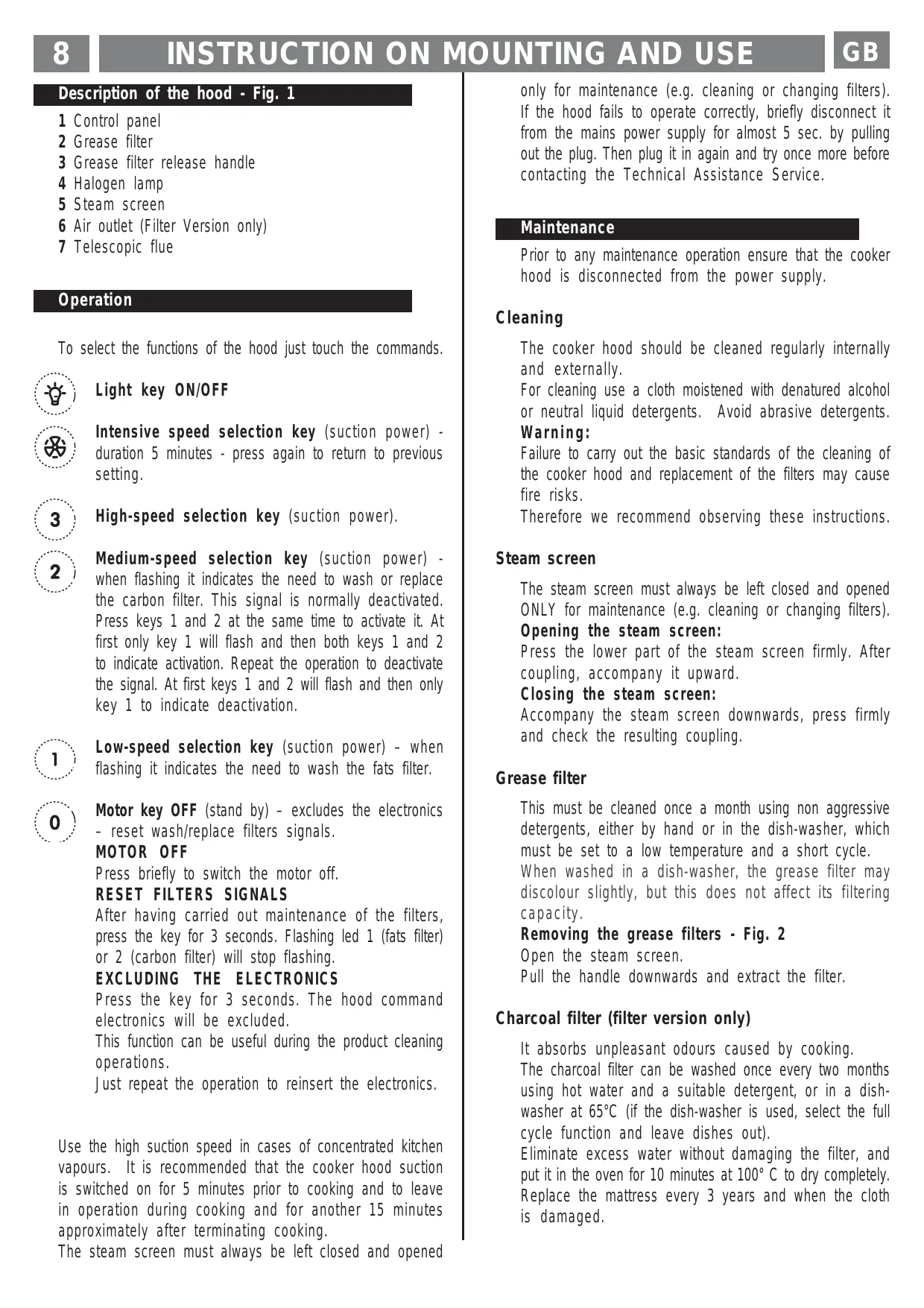
Operation
To select the functions of the hood just touch the commands.

Light key ON/OFF

Intensive speed selection key (suction power) - duration 5 minutes - press again to return to previous setting.

High-speed selection key (suction power).

Medium-speed selection key (suction power) - when flashing it indicates the need to wash or replace the carbon filter. This signal is normally deactivated. Press keys 1 and 2 at the same time to activate it. At first only key 1 will flash and then both keys 1 and 2 to indicate activation. Repeat the operation to deactivate the signal. At first keys 1 and 2 will flash and then only key 1 to indicate deactivation.

Low-speed selection key (suction power) - when flashing it indicates the need to wash the fats filter.

Motor key OFF (stand by) - excludes the electronics - reset wash/replace filters signals.
MOTOR OFF
Press briefly to switch the motor off.
RESET FILTERS SIGNALS
After having carried out maintenance of the filters, press the key for 3 seconds. Flashing led 1 (fats filter) or 2 (carbon filter) will stop flashing.
EXCLUDING THE ELECTRONICS
Press the key for 3 seconds. The hood command electronics will be excluded.
This function can be useful during the product cleaning operations.
Just repeat the operation to reinsert the electronics.
Use the high suction speed in cases of concentrated kitchen vapours. It is recommended that the cooker hood suction is switched on for 5 minutes prior to cooking and to leave in operation during cooking and for another 15 minutes approximately after terminating cooking.
The steam screen must always be left closed and opened
only for maintenance (e.g. cleaning or changing filters). If the hood fails to operate correctly, briefly disconnect it from the mains power supply for almost 5 sec. by pulling out the plug. Then plug it in again and try once more before contacting the Technical Assistance Service.
Maintenance
Prior to any maintenance operation ensure that the cooker hood is disconnected from the power supply.
Cleaning
The cooker hood should be cleaned regularly internally and externally.
For cleaning use a cloth moistened with denatured alcohol or neutral liquid detergents. Avoid abrasive detergents.
Warning:
Failure to carry out the basic standards of the cleaning of the cooker hood and replacement of the filters may cause fire risks.
Therefore we recommend observing these instructions.
Steam screen
The steam screen must always be left closed and opened ONLY for maintenance (e.g. cleaning or changing filters).
Opening the steam screen:
Press the lower part of the steam screen firmly. After coupling, accompany it upward.
Closing the steam screen:
Accompany the steam screen downwards, press firmly and check the resulting coupling.
Grease filter
This must be cleaned once a month using non aggressive detergents, either by hand or in the dish-washer, which must be set to a low temperature and a short cycle.
When washed in a dish-washer, the grease filter may discolour slightly, but this does not affect its filtering capacity.
Removing the grease filters - Fig. 2
Open the steam screen.
Pull the handle downwards and extract the filter.
Charcoal filter (filter version only)
It absorbs unpleasant odours caused by cooking.
The charcoal filter can be washed once every two months using hot water and a suitable detergent, or in a dishwasher at 65^ (if the dishwasher is used, select the full cycle function and leave dishes out).
Eliminate excess water without damaging the filter, and put it in the oven for 10 minutes at 100^ C to dry completely. Replace the mattress every 3 years and when the cloth is damaged.
Montage - Fig. 3
Open the steam screen and remove the grease filter. Install the carbon filter on the back of the grease filter and fix with two rods.
Attention! The rods are included in the carbon filter packing and not on the hood.
- To dismantle the filter act in the reverse manner.
Replacing lamps - Fig. 4
Firstly check that the lamps are well cooled prior to replacing them.
Extract the lamp cover by levering it off with a small screwdriver or similar tool.
Replace the damaged light bulb.
Only use halogen bulbs of 20W max (G4), making sure you do not touch them with your hands.
Close the lamp cover (it will snap shut).
If the lights do not work, make sure that the lamps are fitted properly into their housings before you call for technical assistance.
Caution
This appliance is designed to be operated by adults. Children should not be allowed to tamper with the controls or play with the appliance.
Do not use the cooker hood where the grill is not correctly fixed! The suctioned air must not be conveyed in the same channel used for fumes discharged by appliances powered by other than electricity. The environment must always be adequately aerated when the cooker hood and other appliances powered by other than electricity are used at the same time. Flambé cooking with a cooker hood is prohibited. The use of a free flame is damaging to the filters and may cause fire accidents, therefore free flame cooking must be avoided. Frying of foods must be kept under close control in order to avoid overheated oil catching fire. Carry out fumes discharging in accordance with the regulations in force by local laws for safety and technical restrictions.
Installation - Fig. 5
Consult the designs in the front pages referenced in the text by alphabet letters. Closely follow the instructions set out in this manual. All responsibility, for any eventual inconveniences, damages or fires caused by not complying with the instructions in this manual, is declined.
The minimum distance between the supporting surface for the cooking vessels on the hob and the lowest part of the range hood must be not less than 40cm from electric cookers and 65cm from gas or mixed cookers.
If the instructions for installation for the gas hob specify a greater distance, this has to be taken into account.
The hood is supplied in SUCTION version.
It is necessary to have an evacuation conduit going from the upper B exit to the extraction hole towards the exterior. In this case a connection ring (12A) has to be installed on the B extraction hole.
If you intend using the hood in the FILTERING version, fumes and steam are recycled through the F deflector (12F).
It is possible to use the other deflector C supplied (12G): in this case you must connect it to the extraction hole B with an evacuation conduit.
Preliminary information for installation of the hood
Expansion wall plugs are provided to secure the hood to most types of walls/ceilings. However, a qualified technician must verify suitability of the materials in accordance with the type of wall/ceiling. The wall/ceiling must be strong enough to take the weight of the hood.
Do not tile, grout or silicone this appliance to the wall. Surface mounting only.
For the filtering version chimney may be installed or not according your needs.
During electrical connection ensure the power supply is disconnected at the domestic main switch.
- Apply three adhesive strips C to the back of the hood.
- Trace a centre line on the wall to facilitate the montage (1), position the hole template so that the middle line printed on it corresponds to the centre line previously drawn and that the lower side of the grill corresponds to the lower part of the hood once mounted (2).
- Make two holes with the 8mm drill and fix the support bracket with two dowels and wall screws (3).
- Open the steam screen and remove the grease filter (see relative paragraph).
Fix the chimney bracket with two dowels and wall screws (4).
- Hang up the hood (5), adjusting its position (6-7) and from the inner part of the hood mark two points for the definitive fixing. Remove the hood and make two 8 mm Ø holes (9), insert two wall dowels, hang the hood up again and fix it definitively with two screws (10).
-
Connect the electricity (11), but leave the hood disconnected from the general electric panel of the house.
-
If the hood is to be used in the suction version, install the flange supplied in the kit on the exit hole of the hood (12A - suction version - also install a fumes discharge tube of suitable dimensions) instead of the deflector (12F or 12G - filtering version).
- Mount the grease filter and close the steam screen. Attention! If the hood is to be used in the suction version, remove, if supplied with the kit, the carbon filter and the fixing rods (on the back of the grease filter - see relative paragraph).
If the hood is to be used in the filtering version, check that the carbon filter is already mounted on the back of the grease filter or, in its absence, purchase it and install it.
Install the upper cover with 3 screws (13).
- Installa the chimney (14a) to the bracket (14b) with two screws.
- Slide bottom section of the chimney inside the proper housing on top of the hood.
- Connect the hood to the general electric panel, wait for about 15 seconds to allow the hood to calibrate the control panel (the leds of the controls flash) and check the functioning.
Electrical connection
The electrical tension must correspond to the tension noted on the label placed inside the cooker hood. Connect the electrical plug, where provided, to the an easily accessible outlet in conformity with local standards in force.
Where an electrical plug is not provided (for direct connection to electrical network) place a standards approved bipolar switch with an aperture distance of not less than 3mm (accessible) from the contacts.
This appliance is marked according to the European directive 2002/96/EC on Waste Electrical and Electronic Equipment (WEEE). By ensuring this product is disposed of correctly, you will help prevent potential negative consequences for the environment and human health, which could otherwise be caused by inappropriate waste handling of this product.

The symbol on the product, or on the documents accompanying the product, indicates that this appliance may not be treated as household waste. Instead it shall be handed over to the applicable collection point for the recycling of electrical and electronic equipment. Disposal must be carried out in accordance with local environmental regulations for waste disposal.
For more detailed information about treatment, recovery and recycling of this product, please contact your local city office, your household waste disposal service or the shop where you purchased the product.
NOLLAA SUODATINSIGNAALIT
Cencop BbICOKOckopoCTn (MOUHOCTb BCaCbIBaHn).

CencopcpeHneckopoctn(MOCHOCbBCaBbAHNA).AnnapaTobopyoBaHHdNkauHne3arpr3HeHHOCTnyrTohBOHOΦnIbTpTa:ecnCEHCOPMiraet,3NaHTyrolhBbHΦnIbTp3arpr3HeHneRHO6XODMO3aMeHNTb.B0bIyHOMpexmE3TaΦyHKUHaHEAKTNPOBAHa.HTo6bIeEBKLIIOHTb,OJHOBPemEHHOaXMTHeAceHCOpbln2.ChaJaIa3amraETTohkoCeHCop1,3aTeMo6a ceHCopa1n2,yKa3bIBaAR,HTOΦyHKUBAKIIQUeHa.HTo6blBbIKJIIOHTbHHdNkauHIO3aPr3HeHHOCTnyrTohBOHOΦnIbTpA,NOBTOpNTeOpauHIO.ChaJaIa3AMRAOTceHCopbln2,a3aTeMTohkoCeHCop1,0603Haay,HTOΦyHKUBAKJIIOUeHa.

CencopMaioNCKOpocTn(MoHOCbBCaCbIbAHNA).MiraOuNi CEHCOP O3NaHaeT,HTO XINPOBQΦJIbTp 3aqrpa3HeH eRO HEOxOJIMMOBbIMbITb.

Cehcop BbIKIOUeHn MOtopa (peXm stand by) -OTKIOUeHne 3JIeKTPoHHo NaHeN ynpaBLeHn -IpeE3arpy3Ka INDInKauN 3aRpa3HHeHocTnФINbTPOB.
Cechop BbIKJIOUeHn MoTopa KopotKnM npIKOCHOBeHnEM K CcHcOpy OTKJIIOuHTe MOTOp.
OTKJIUOHeHne 3JIeKToPOHHo nAHeJIyIpaBHeHn HaXMMTe Ha ceHCOp n UdepXkNBaYte erO B TeUeHne 3 cekyHd. 3JIeKToPOHHa nAHeJIyIpaBHeHn BbIKIOUeHa. IcNoJb3yIte 3Ty fynKcIuHO, KOrDa Bbl YnCTInTe aannapat.ДЯ BKNIOUeHn nAHeJIyIpaBHeHn NOBTopiTe oNepaCNUO.
Ipee3arpy3ka Hndnkaun 3arp3HeHOctn nJbTPOB Pocne ounstkn pfjltpoB haxmnte uyepeXNBaute cencop B TeueHne 3 cekynd. Hndnkaun ceHCopa1 (xnpoBoi pfnlbTp) nceHCopa
2(yrOJIbHbIΦnJIbTp)pepeTaHETMIRaTb.
IcnoJb3yIte nHTeHCBHbI peXIM npi HaJIuHn BblCOKoK KOHcHTpaUIN DbIm u 3aNaXa B KUYHe. PeKOMeHNdyETcB KNIQUaTb BblAxxky 3a 5 MmHyT Do HauJa npriROTOBLeHn Iu, OCTaBJIaTb ee pa6OtaUoSeB BO BpeMraTOTOBKn IN OKONO 15 MmHyT NocJe OKOHuaHn ppiROTOBJIeHn.
B HopMaJIbHOM IonoJxHmN 3KpaH-3acNoHka 3aKpbI, OTKpbIBaIe erO ToJIbKO JnA OcyUeCTBLeHnO6cIyXuBaHnI, HApPImEep, OChCTKn NIn 3aMeHbIФЛьТрOB.
EcnBbITaKKa He pa6oTaET nCnpaBHO,OTKIOUHTe IODaCy 3NeKTPoNTaHnB, BbITaUNB BnIKy CeTeBOrO shypa n3 po3EtKn Ha 5 cekyn.3aTEM BCTaBbTe BnIKy n nonp6oyIte pa6oTaTb eue pa3.Bcnyae HeydaHOn IONbITKn CBXkTecb C cepBnCHOn cnykBoi.
YxoI n Texo6cJIyXuBaHne
Kakdbi pa3 nepeod ouncTkOu I Texo6cnyxBaHneM OTKluayTe annapaT OT 3NeKtpoCetN.
IOBceHbHbIyXoA
CneJyET peryIaRHO OunuataB BCE BHyTpEHnE N BHeUHnE NOBepXHOCTN BbITaKKN.
IcnoJb3yIte IJIa OUHCTKn TpAnKy, CMOueHHyIO DeHaTpyATOM 3TINIOBOrO CnIrPaTbHBIM XnDKIM MOUoIIM CpeIcTBOM. 3anpeuaetcR NcNoJIb3OBaTb a6pa3INBHeIe MOUoIe CpeIcTBA.
PpeDocTepeXeHne!
Ha cAMOM ⅢdEJIIN IJN
COnpOBoDInTeIbHOJ DOKyMeHNTaUIN yKa3bIBaEIT, YTO npn yTuIN3aUIN DaHHORO N3DeJIIN C HIM HeJIb3r O6paUaTbcra KaK C O6bIuHbIMN 6bITOBbIMN OTXODaMn BMeCTO 3TORO, eRo cNeDuET CdaBaTb B COOTBeTCTByIOUm PnyKT pPneMKN 3JeKTPnueCKOrO n 3JeKTPoHHO rOBOpYDoBAHn IJa IocNe dyUoUeJyTuIN3aUIN.
CdaaHa cIOM DoJXHa npOn3BOIDtbcB COOTBeTCTBn C MeCTbIMN npabUNamn NO YTuIN3aunn OTXoIDOB.
3a 60lee noopobno nHΦopMauné O npabnlaox obaaeeNc TaKIMN N3deJnA M, IN yTnIIN3aun IN nepepa6OTKn ObaaauTeCb B MeCTHbIe OprAhblBnaTn, B cnyx6y IIO yTnIIN3aunOxODOB INN B Maarazn, B KOTOpOM Bblnpno6peJI nnDaHHoe n3delle.
Popis digestore -OCR.1
Otwieranie osłony przyciwparowej: naleźmy mocno przycisinność:, please, please, please, please, please, please, please, please, please, please, please, please, please, please, please, please, please, please, please, please, please, please, please, please, please, please, please, please, please, please, please, please, please, please, please, please, please, please, please, please, please, please, please, please, please, please, please, please, please, please, please
Pexm Hn3bKoI WBNIOKcTi (BCMOKTOUHa
notyxhictb) -KIO BIn 6JIIMaE, Heo6XiIHO NOMTN JxnpOBn IpbTp.

KHONKa BIMKHeHHa MoTOpy De3aKtNbBye po60Tu
eNeKtpoHikn. HAtnciTb 5BnIDKO, 106 BnKJIIOuHTN MOTOp.
CnHaJI nepeyctaHOBLeHHaΦiNbTpIb
Iicna yctaHOBKn fInbTpuy UtpmmyTe KhoNky npotrrom 3 ceKyu. Dncnnei 1 (xnpobu n fInbTp) a6o dncnnei 2 (ByirnbHn fInbTp), aKi 6JIMMaOTb, npinnHArb 6JIMMaTn.
BiKJIIOUeHnE neKtpoHikn
UtpmyTe KhoNky npotrom 3 cekyHd. EneKtpoHika BnTJKKn De3aKTnByeTbcra. Zr cyHKciR KopncHa nId Yac UHHeHH npnaLy. O6 nepeinporpaMyBaTu n eJeKtpoHki, NOBtopitb npouedpy.
BnKopncToBytepeXIM BnCkooi Swdkocsti, kIIO nID qac roTyBaHH BnnapOBuBaHH HaCnueHl. PeKOMeHycTbcB KblOyATn BtAxxky 3a 5 XBnINH DoNoaytky roTyBaHH i 3aIIuHaTN BkIooHeHO Ha 15 XBnIH nicra roTyBaHH 3aJnKpaOro pe3yIbTaTY BCMOKTuBaHH BnnapOBuBaHb. NapoBa I npMa 3abXKn MaE 6ytN 3akpntOIO. BiDkpnuBatn II cniD tIbKnPi dac YnUeHH fInbTpib.
KIO BNTA KHe npaOe HaJeXHm YHOM, BiKIOUHTb II BID eNEKTPoMEpEki Ha 5 cekyHd, a NOTIM BKIOUHTb 3HOBy. KIO BNTA KHe npaIOe i nicra zuoro - 3B'JxITbcr 3 cepBICHM ueHTpOM.
Dorla
Ipeed 6ydb-ram BtpuahnB p060Ty npnilady a6o
yueneHHa BnEBHITbcra, 0o BapnlbHa nobepxHa BiKIOueHa
Bid eIeKTpomepexi.
UH
BntaJxKy cIiD peryIyIrpHo yIcIHTn. IJIa YIuIeHNH BVKOpNCTOBuYIte raHcy, 3BOLOKeHy DeHaTpyaTOM CInpTy a6o HeItpaJIbHIM piIKM DeTepeHTOM. He BVKOpNCTOBuYIte a6pa3INBHi peOvBHH.
PonepeJxKeHHa:
HeKopekTheuHnHn npnaNy Ta cnpo6n camOtjXKn BiDpeMOHTyBaTn BNTJKKy MOxTyB np3Becn Do noNokexi.
Tomy Mn pekomehnyeMo doTpmyBaTncb iHCTpyKcii.
UmpMa BiD napn
Umpma 3aBxDi Ma6 6yTu 3aKpntOIO. BiDkPnBaTn II MOXHa TJIbKn DnI 3diCHeHHr Oepaui No YHsEHHIO, peMOHTy Ta DOJNAY.
BiDkpBbAHnHnWipMn:
I3 3yCnllnHaTnCHiB Ha HxKHIO qAcTHHy uipMn. IicNCTIKOBKn, NiDhIMiTb II BROPy.
3aKpmbaHHH 7nPmN:
NotarHtB wnpMy DOHN3y, HATNCHTb i3 3ycnllm i nepeBiPeTe, nn HaDiIHO BOHa 3aKpnta.
KinpobniΦijbtp
Ioro cJIiD uHCTNTn pa3 Ha MiCAUb, BVKOPNCTOBYOuHi. HearpcuBHI deTepeHTn, BpyHy a6o B NOcyDomnHiMaunHi, B kIi CJIi D BCTaHOBHTn MImaJIbHy TEMpepaTyPy i HauKOpOTnuiKJI. Ppi CuHSeHHi B NocyDomnHi MaunHi φiNbTp Moxe Dee o6e36apBHTncb, aJe ue He BpInBaEc Ha φiNbTpuyOuH epeKT.
3amiha kipoboro oipbtpy - maJ.2.
BiiKpnIte npOBy uHpMy. IOTaRHiTb pyUkY φiJIbTpU Bn3 i BNTaRHiTb NOrO.
ByrilbHnΦijIbTp (tiJIbKn MoJeI 3 φiJIbTpOM)
Bin B6npaC HnepmHi apomatn BiD roTyBaHn. Ioro cIIMTN pa3 Ha 2 mca, BnkOpncTObYIOU n TeNpy BoNy iBiINOBiHN DeTepreHT., a60 X 3a DOnOMOIO NOcyDMNIHOIMaunH npn Tempepatypi 65^ i NOBHOMy uKJI.
UcyhTe 3aBy BDOy ObepeJxHO, 06 He NpOxKOHTn 0iJIbTp, iNOMictIb NOro B DuxOBky Ha 10xbuINn Prn Tempeatypi 100^ do NOBHorO BNCsyuBaHHa. MiHnTe 0jIbTp pa3 Ha Tprn pOKi I KcTko TkaHNHa yUkoDxKeHa.
MOHTaK - MaJI. 3.
Biikpnite napoby uipmy i BNTaHrHiB pfIbTp. BcTaHObitb ByrJIbHn PfIbTp Ha 3aDiHi qactHi JxnpOBoro pfIbTpuy i 3aqiKcyte DbOMa 3akpinlIOBaayamn.
Ybara! 3akpinIIOBaui BxOJaTb Do KOMJIeKTy fiJIbTpY, a He Do KOMJIeKTy BNTJXKN.
- Description of the hood - Fig. 1
- Operation
- Light key ON/OFF
- MOTOR OFF
- RESET FILTERS SIGNALS
- EXCLUDING THE ELECTRONICS
- Maintenance
- Cleaning
- Warning:
- Steam screen
- Opening the steam screen:
- Closing the steam screen:
- Grease filter
- Removing the grease filters - Fig. 2
- Charcoal filter (filter version only)
- Replacing lamps - Fig. 4
- Caution
- Installation - Fig. 5
- Preliminary information for installation of the hood
- Do not tile, grout or silicone this appliance to the wall. Surface mounting only.
- Electrical connection
- NOLLAA SUODATINSIGNAALIT
- YxoI n Texo6cJIyXuBaHne
- IOBceHbHbIyXoA
- PpeDocTepeXeHne!
- Popis digestore -OCR.1
- CnHaJI nepeyctaHOBLeHHaΦiNbTpIb
- BiKJIIOUeHnE neKtpoHikn
- Dorla
- UH
- PonepeJxKeHHa:
- UmpMa BiD napn
- KinpobniΦijbtp
- ByrilbHnΦijIbTp (tiJIbKn MoJeI 3 φiJIbTpOM)
Brand : GORENJE
Model : DK2000P2 B
Category : Range hood