
UC3020A - Brush cutter DOLMAR - Free user manual and instructions
Find the device manual for free UC3020A DOLMAR in PDF.



User questions about UC3020A DOLMAR
0 question about this device. Answer the ones you know or ask your own.
Ask a new question about this device
Download the instructions for your Brush cutter in PDF format for free! Find your manual UC3020A - DOLMAR and take your electronic device back in hand. On this page are published all the documents necessary for the use of your device. UC3020A by DOLMAR.
USER MANUAL UC3020A DOLMAR
-
Rear handle
-
Guide bar
-
Rear hand guard
-
Switch trigger
-
Saw chain
-
Serrated rail (claw stop)
-
Oil filter cap
-
Lever
-
Lock-off button
-
Front handle
-
Sprocket cover
-
Chain catcher
-
Front hand guard
-
Oil level sight
-
Scabbard
Explanation of general view
-
Lock-off button
-
Tighten
-
Sight glass
-
Switch trigger
-
Lever
-
Serrated rail
-
Press in
-
Low
-
Felling area
-
Loosen
-
High
-
Oil guide groove
-
Sprocket cover
-
Guide bar
-
Oil feed hole
-
Adjusting dial
-
Saw chain
-
Push nut
-
Adjusting pin
-
Oil filler cap
-
Slotted bit screwdriver
-
Hook
-
Hand guard
-
Filter
-
Hole
-
Lock
-
Sprocket
-
Small hole
-
Unlock
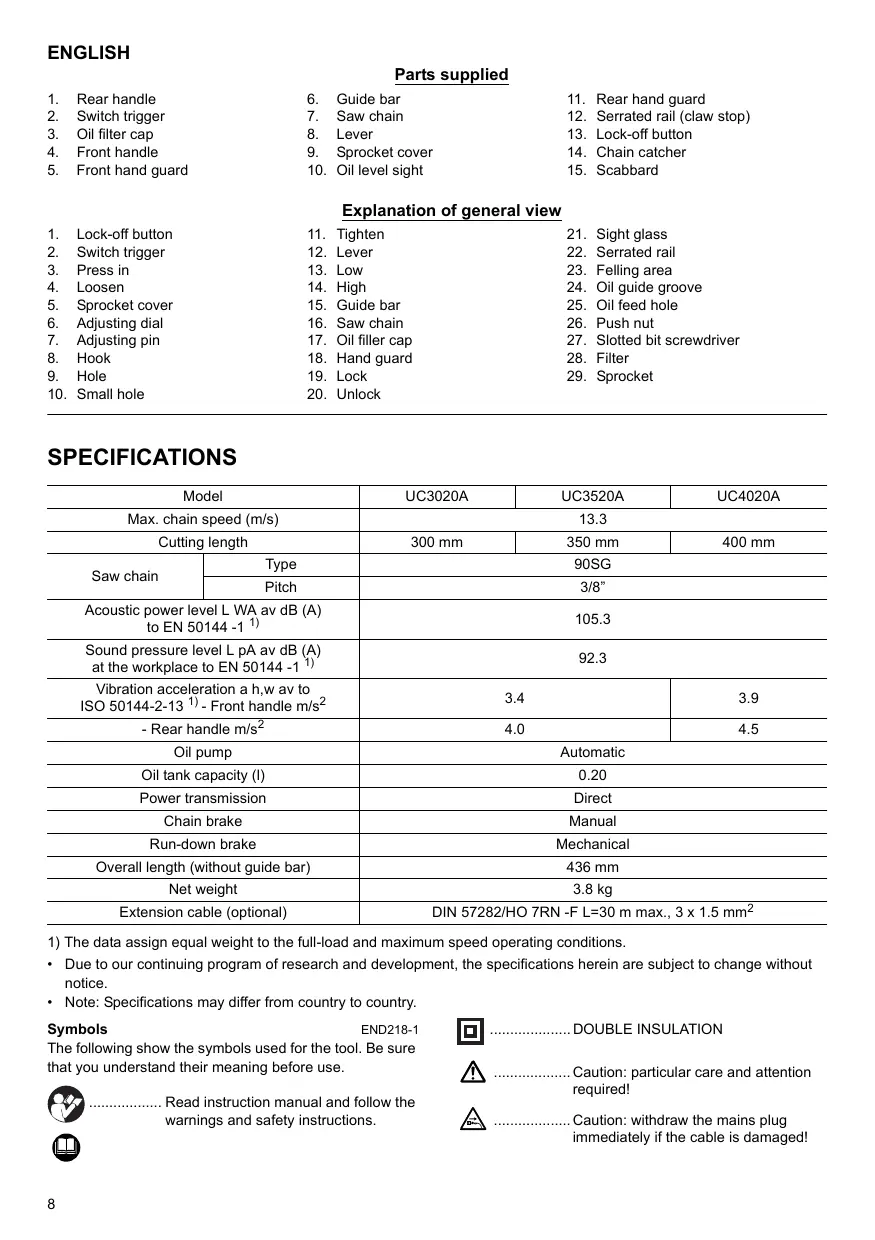
SPECIFICATIONS
| Model | UC3020A | UC3520A | UC4020A | |
| Max. chain speed (m/s) | 13.3 | |||
| Cutting length | 300 mm | 350 mm | 400 mm | |
| Saw chain | Type | 90SG | ||
| Pitch | 3/8" | |||
| Acoustic power level L WA av dB (A) to EN 50144 -1 1) | 105.3 | |||
| Sound pressure level L pA av dB (A) at the workplace to EN 50144 -1 1) | 92.3 | |||
| Vibration acceleration a h,w av to ISO 50144-2-13 1) - Front handle m/s2 | 3.4 | 3.9 | ||
| - Rear handle m/s2 | 4.0 | 4.5 | ||
| Oil pump | Automatic | |||
| Oil tank capacity (l) | 0.20 | |||
| Power transmission | Direct | |||
| Chain brake | Manual | |||
| Run-down brake | Mechanical | |||
| Overall length (without guide bar) | 436 mm | |||
| Net weight | 3.8 kg | |||
| Extension cable (optional) | DIN 57282/HO 7RN -F L=30 m max., 3 x 1.5 mm2 | |||
1) The data assign equal weight to the full-load and maximum speed operating conditions.
- Due to our continuing program of research and development, the specifications herein are subject to change without notice.
Note: Specifications may differ from country to country.
Symbols
END218-1
The following show the symbols used for the tool. Be sure that you understand their meaning before use.

Read instruction manual and follow the warnings and safety instructions.


DOUBLE INSULATION

Caution: particular care and attention required!

Caution: withdraw the mains plug immediately if the cable is damaged!

Caution: kickback!

Protect against rain and damp!

Wear a helmet, goggles and ear protection!

Wear safety gloves!

Withdraw the mains plug!

First aid


Recycling

CE marking

Maximum permissible length of cut


Direction of chain travel

Chain oil


Chain brake released/applied

Prohibited!
Intended use
The tool is intended for cutting lumbers and logs.
Power supply
The tool should be connected only to a power supply of the same voltage as indicated on the nameplate, and can only be operated on single-phase AC supply. They are double-insulated in accordance with European Standard and can, therefore, also be used from sockets without earth wire.
For public low-voltage distribution systems of between 220 V and 250 V.
Switching operations of electric apparatus cause voltage fluctuations. The operation of this device under unfavorable mains conditions can have adverse effects to the operation of other equipment. With a mains impedance equal or less than 0.35 Ohms it can be presumed that there will be no negative effects. The mains socket used for this device must be protected with a fuse or protective circuit breaker having slow tripping characteristics.
ADDITIONAL SAFETY RULES
ENB098-1
- Read the instruction manual in order to familiarize yourself with operation of the chain saw.
- Before using the chain saw for the first time, arrange to have instruction in its operation. If this is not possible, at least practice cutting round timber on a trestle before beginning work.
- The chain saw must not be used by children or young persons under 18 years of age. Young persons over 16 years of age may be exempted from
this restriction if they are undergoing training under the supervision of an expert.
- Working with the chain saw requires a high level of concentration. Do not work with the saw if you are not feeling fit and well. Carry out all work calmly and carefully.
- Never work under the influence of alcohol, drugs or medication.
Proper use
- The chain saw is intended solely for cutting wood. Do not use it for example to cut plastic or porous concrete.
- Only use the chain saw for operations described in this instruction manual. Do not, for example, use it to trim hedges or for similar purposes.
- The chain saw must not be used for forestry work, i.e. for felling and limbing standing timber. The chain saw cable does not provide the operator with the mobility and safety required for such work.
- The chain saw is not intended for commercial use.
- Do not overload the chain saw.
Personal protective equipment
- Clothing must be close-fitting, but must not obstruct mobility.
-
Wear the following protective clothing during work:
-
A tested safety helmet, if a hazard is presented by falling branches or similar;
A face mask or goggles; - Suitable ear protection (ear muffs, custom or mouldable ear plugs). Octave brand analysis upon request.
Firm leather safety gloves; - Long trousers manufactured from strong fabric;
- Protective dungarees of cut-resistant fabric;
- Safety shoes or boots with non-slip soles, steel toes, and cut-resistant fabric lining;
- A breathing mask, when carrying out work which produces dust (e.g. sawing dry wood).
Protection against electric shock

The chain saw must not be used in wet weather or damp environments, as the electric motor is not waterproof.
- Only plug the saw into earthed sockets in tested electrical circuits. Check that the system voltage matches that on the rating plate. Ensure that a 16 A line fuse is fitted. Saws used in the open air must be connected to a residual current-operated circuit-breaker with an operating current no higher than 30mA .

Should the connecting cable be damaged, withdraw the mains plug immediately.
Safe working practices
- Before starting work, check that the chain saw is in proper working order and that its condition
complies with the safety regulations. Check in particular that:
- The chain brake is working properly;
- The run-down brake is working properly;
- The bar and the sprocket cover are fitted correctly;
- The chain has been sharpened and tensioned in accordance with the regulations;
-
The mains cable and mains plug are undamaged; Refer to the "CHECKS "section.
-
Always ensure in particular that the extension cable used is of adequate cross-section (see "SPECIFICATIONS"). When using a cable reel, wind the cable completely off the reel. When using the saw in the open air, ensure that the cable employed is intended for open-air use and is rated accordingly.
- Do not operate the chain saw in the vicinity of flammable dust or gases, as the motor generates sparks and presents a risk of explosion.
- Work only on firm ground and with a good footing. Pay particular attention to obstacles (e.g. the cable) in the working area. Take particular care where moisture, ice, snow, freshly cut wood or bark may make surfaces slippery. Do not stand on ladders or trees when using the saw.
- Take particular care when working on sloping ground; rolling trunks and branches pose a potential hazard.
- Never cut above shoulder height. (Fig. 1)
- Hold the chain saw with both hands when switching it on and using it. Hold the rear handle with your right hand and the front handle with your left. Hold the handles firmly with your thumbs. The bar and the chain must not be in contact with any objects when the saw is switched on.
- Clean the area to be cut of foreign objects such as sand, stones, nails, wire, etc. Foreign objects damage the bar and chain, and can lead to dangerous kickback.
- Take particular care when cutting in the vicinity of wire fences. Do nut cut into the fence, as the saw may kick back.
- Do not cut into the ground.
- Cut pieces of wood singly, not in bunches or stacks.
- Avoid using the saw to cut thin branches and roots, as these can become entangled in the chain saw. Loss of balance presents a hazard.
- Use a secure support (trestle) when cutting sawn timber.
- Do not use the chain saw to pry off or brush away pieces of wood and other objects.
- Guide the chain saw such that no part of your body is within the extended path of the saw chain. (Fig. 2)
-
When moving around between sawing operations, apply the chain brake in order to prevent the chain from being operated unintentionally. Hold the chain saw by the front handle when carrying it, and do not keep your finger on the switch. Withdraw the mains plug when taking breaks or leaving the chain saw unattended. Leave the chain saw where it cannot present a hazard.
-
Withdraw the mains plug when taking breaks or leaving the chain saw unattended. Leave the chain saw where it cannot present a hazard.
Kickback
- Hazardous kickback may arise during work with the chain saw. Kickback arises when the tip of the bar (in particular the upper quarter) comes into contact with wood or another solid object. This causes the chain saw to be deflected in the direction of the operator. (Fig. 3)
-
In order to avoid kickback, observe the following:
-
Never begin the cut with the tip of the bar.
- Never use the tip of the bar for cutting. Take particular care when resuming cuts which have already been started.
- Start the cut with the chain running.
- Always sharpen the chain correctly. In particular, set the depth gauge to the correct height (refer to "Sharpening the chain" for details).
- Never saw through several branches at a time.
- When limbing, take care to prevent the bar from coming into contact with other branches.
- When bucking, keep clear of adjacent trunks. Always observe the bar tip.
Use a trestle.
Safety features
- Always check that the safety features are in working order before starting work. Do not use the chain saw if the safety features are not working properly.
- Chain brake:
The chain saw is fitted with a chain brake which brings the saw chain to a standstill within a fraction of a second. It is activated when the hand guard is pushed forwards. The saw chain then stops within 0.15s , and the power supply to the motor is interrupted.
- Run-down brake: (Fig. 4)
The chain saw is equipped with an run down brake which brings the saw chain to an immediate stop when the ON/OFF switch is released. This prevents the saw chain from running on when switched off, and thus presenting a hazard.
- The front and rear hand guards protect the user against in jury from pieces of wood which may be thrown backwards, or a broken saw chain.
- The trigger lockout prevents the chain saw from being switched on accidentally.
- The chain catcher protects the user against injury should the chain jump or break.
Transport and storage

When the chain saw is not in use or is being transported, withdraw the mains plug and fit the scabbard supplied with the saw. Never carry or transport the saw with the saw chain running.
-
Carry the chain saw by the front handle only, with the bar pointing backwards.
-
Keep the chain saw in a secure, dry and locked room out of the reach of children. Do not store the chain saw outdoors.
Maintenance
- Withdraw the plug from the socket before carrying out any adjustments or maintenance.
- Check the power cable regularly for damage to the insulation.
- Clean the chain saw regularly.
- Have any damage to the plastic housing repaired properly and immediately.
- Do not use the saw if the switch trigger is not working properly. Have it properly prepared.
- Under no circumstances should any modifications be made to the chain saw. Your safety is at risk.
- Do not carry out maintenance or repair work other than that described in this instruction manual. Any other work must be carried out by MAKITA Service.
- Only use original MAKITA replacement parts and accessories intended for your model of saw. The use of other parts increases the risk of accident.
- MAKITA accepts no responsibility for accidents or damage should non-approved bars, saw chains or other replacement parts or accessories be used. Refer to the "Extract from the spare parts list" for approved saw bars and chains.
First aid

Do not work alone. Always work within shouting distance of a second person.
- Always keep a first-aid box to hand. Replace any items taken from it immediately.
- Should you request assistance in the event of an accident, state the following:
Where did the accident happen?
What happened?
How many persons are injured?
- What injuries do they have?
Who is reporting the accident?
NOTE:
Individuals with poor circulation who are exposed to excessive vibration may experience injury to blood vessels or the nervous system.
Vibration may cause the following symptoms to occur in the fingers, hands or wrists: "Falling asleep "(numbness), tingling, pain, stabbing sensation, alteration of skin colour or of the skin.
If any of these symptoms occur, see a physician!
SAVE THESE INSTRUCTIONS
FUNCTIONAL DESCRIPTION
CAUTION:
- Always be sure that the tool is switched off and unplugged before adjusting or checking function on the tool.
Switch action (Fig. 5)
CAUTION:
- Before plugging in the tool, always check to see that the switch trigger actuates properly and returns to the "OFF" position when released.
To prevent the switch trigger from being accidentally pulled, a lock-off button is provided.
To start the tool, depress the lock-off button and pull the switch trigger.
Release the switch trigger to stop.
ASSEMBLY
CAUTION:
Always be sure that the tool is switched off and unplugged before carrying out any work on the tool.
Installing or removing saw chain
CAUTION:
Always be sure that the tool is switched off and unplugged before installing or removing the saw chain.
Always wear gloves when installing or removing the saw chain.
1. To remove the saw chain, move the lever in the upright position. (Fig. 6)
2. Press the lever and with the lever pressed in, turn it counterclockwise to loosen the nut until sprocket cover comes off. (Pressing in the lever leads to the fitting of lever into the nut.)
3. Turn the adjusting dial counterclockwise to release the saw chain tension.
4. Remove the sprocket cover.
5. Remove the saw chain and guide bar from the chain saw.
6. To install the saw chain, fit in one end of the saw chain on the top of the guide bar and the other end of it around the sprocket. (Fig. 7)
At this time, fit the saw chain as shown in the figure because it rotates in the direction of arrow.
- Rest the guide bar in place on the chain saw.
- Turn the adjusting dial counterclockwise to slide the adjusting pin in the direction of arrow. (Fig. 8)
- Place the sprocket cover on the chain saw so that the hook at its back cover is inserted into a hole in the chain saw and the adjusting pin is positioned in a small hole in the guide bar. (Fig. 9)
- Press in the lever and with the lever depressed turn it fully clockwise to tighten the nut. Then make it about a quarter turn counterclockwise to loosen the nut lightly. (Fig. 10)
Adjusting saw chain tension
The saw chain may become loose after many hours of use. From time to time check the saw chain tension before use.
Move the lever in the upright position. (Fig. 11)
Press in the lever. With the lever depressed, make a quarter turn on it counterclockwise to loosen the nut lightly.
(Pressing in the lever leads to the fitting of lever into the nut.) (Fig. 12)
Turn the adjusting dial to adjust saw chain tension. Grasp the saw chain in the middle of the guide bar and lift up. The gap between the guide bar and the tie strap of the saw chain should be approx. 2 - 4 mm. If the gap is not approx. 2 - 4 mm, slightly turn the adjusting dial which secures the guide bar. At this time, adjust with the tip of guide bar slightly pointing up. (Fig. 13)
With the lever depressed, turn it fully clockwise to tighten the nut firmly. (Fig. 14)
Return the lever to its original position. (Fig. 15)
CAUTION:
- Excessively high tension of saw chain may cause breakage of saw chain, wear of the guide bar and breakage of the adjusting dial.
- Installing or removing saw chain should be carried out in a clean place free from sawdust and the like.
OPERATION
Lubrication
CAUTION:
Always be sure that the tool is switched off and unplugged before lubricating the saw chain.
Lubricate the saw chain and bar using a biologically degradable saw chain oil with an adhesion agent. The adhesion agent in the saw chain oil prevents the oil from being thrown off the saw excessively quickly. Mineral oils must not be used, as they are harmful to the environment. (Fig. 16)
CAUTION:
- Prevent the oil from coming into contact with the skin and eyes. Contact with the eyes causes irritation. In the event of eye contact, flush the affected eye immediately with clear water, then consult a doctor at once.
- Never use waste oil. Waste oil contains carcinogenic substances. The contaminants in waste oil cause accelerated wear of the oil pump, the bar and the chain. Waste oil is harmful to the environment.
- When filling the chain saw with chain oil for the first time, or refilling the tank after it has been completely emptied, add oil up to the bottom edge of the filler neck. The oil delivery may otherwise be impaired.
Clean the area around the oil filler cap shown in the figure thoroughly to prevent any dirt from entering the oil tank. (Fig. 17)
Unscrew the oil filler cap and add oil up to the lower edge of the filler neck.
Screw the oil filler cap firmly back in place.
Wipe away any spilt chain oil carefully.
When the chain saw is used for the first time, it may take up to two minutes for the saw chain oil to begin its lubricating effect upon the saw mechanism. Run the saw without load until it does so (see "CHECKS").
The tank capacity (200 ml) is sufficient for approximately 30 minutes' use.
CHECKS
Before starting work, carry out the following checks:
Checking the chain tension (Fig. 18)
WARNING:
- Always withdraw the mains plug before checking the chain tension, and wear safety gloves.
The saw chain is correctly tensioned when it is in contact with the underside of the bar and can be raised approximately 2 - 4 mm from the bar by light finger pressure.
Check the chain tension frequently, as new chains are subject to elongation. A chain which is too slack can jump off the bar, and therefore presents an accident risk.
If the chain is too slack: Refer to the section titled "Adjusting saw chain tension" and adjust the saw chain tension again.
Checking the switch action
CAUTION:
Always unplug the tool before testing the switch trigger. Locking the switch trigger in the ON position is prohibited. It must not be possible to depress the switch trigger unless the lock-off button is first depressed.
The switch trigger must not jam in the depressed position. When released, the switch trigger must return automatically to the OFF position, and the lock-off button must return to its original position. (Fig. 19)
Checking the chain brake
NOTE:
- If the chain saw fails to start, the chain brake must be released. Pull the hand guard backwards firmly until you feel it engage.
Hold the chain saw with both hands when switching it on. Hold the rear handle with your right hand, the front handle with your left. The bar and the chain must not be in contact with any object.
First press the lock-off button, then the switch trigger. The saw chain starts immediately.
Press the hand guard forwards using the back of your hand. The saw chain must come to an immediate standstill.(Fig.20)
CAUTION:
- Should the saw chain not stop immediately when this test is performed, the saw may not be used under any circumstances. Consult a MAKITA specialist repair shop.
Checking the run-down brake
Switch on the chain saw.
Release the switch trigger completely. The saw chain must come to a standstill within one second.
CAUTION:
- Should the saw chain not come to a stop within one second when this test is performed, the saw must not be used. Consult a MAKITA specialist repair shop.
Checking the chain oiler (Fig. 21)
Before starting work, check the oil level in the tank, and the oil delivery.
The oil level can be seen in the sight glass shown in the figure.
Check the oil delivery as follows:
Start the chain saw.
With the saw running, hold the saw chain approximately 15 cm above a tree trunk or the ground. If lubrication is adequate, the oil spray will produce a light oil trace.
Observe the wind direction, and do not expose yourself to the oil spray unnecessarily.
CAUTION:
- If an oil trace is not formed, do not use the saw. The lifespan of the chain will otherwise be reduced. Check the oil level. Clean the oil feed groove and the oil feed hole in the bar (refer to "MAINTENANCE").
WORKING WITH THE CHAIN SAW
Bucking
For bucking cuts, rest the serrated rail shown in the figure on the wood to be cut. (Fig. 22)
With the saw chain running, saw into the wood, using the rear handle to raise the saw and the front one to guide it. Use the serrated rail as a pivot.
Continue the cut by applying slight pressure to the front handle, easing the saw back slightly. Move the serrated rail further down the timber and raise the front handle again.
When making several cuts, switch the chain saw off between cuts.
CAUTION:
- If the upper edge of the bar is used for cutting, the chain saw may be deflected in your direction if the chain becomes trapped. For this reason, cut with the lower edge, so that the saw will be deflected away from your body. (Fig. 23)
Cut wood under tension on the pressure side (A) first. Then make the final cut on the tension side (B). This prevents the bar from becoming trapped. (Fig. 24)
Limbing
CAUTION:
- Limbing may only be performed by trained persons. A hazard is presented by the risk of kick-back.
When limbing, support the chain saw on the trunk if possible. Do not cut with the tip of the bar, as this presents a risk of kickback.
Pay particular attention to branches under tension. Do not cut unsupported branches from below.
Do not stand on the felled trunk when climbing.
Burrowing and parallel-to-grain cuts
CAUTION:
- Burrowing and parallel-to-grain cuts may only be carried out by persons with special training. The possibility of kickback presents a risk of injury.
Perform parallel-to-grain cuts at as shallow an angle as possible. Carry out the cut as carefully as possible, as the serrated rail cannot be used. (Fig. 25)
Felling
CAUTION:
- Felling work may only be performed by trained persons. The work is hazardous.
Observe local regulations if you wish to fell a tree.
(Fig. 26)
- Before starting felling work, ensure that:
(1) Only persons involved in the felling operation are in the vicinity;
(2) Any person involved has an unhindered path of retreat through a range of approximately 45^ either side of the felling axis. Consider the additional risk of tripping over electrical cables;
(3) The base of the trunk is free of foreign objects, roots and ranches;
(4) No persons or objects are present over a distance of 2 1/2 tree lengths in the direction in which the tree will fall.
-
Consider the following with respect to each tree:
-
Direction of lean;
- Loose or dry branches;
- Height of the tree;
Natural overhang; -
Whether or not the tree is rotten.
-
Consider the wind speed and direction. Do not carry out felling work if the wind is gusting strongly.
- Trimming of root swellings: Begin with the largest swellings. Make the vertical cut first, then the horizontal cut. (Fig. 27)
- Cut a scarf: The scarf determines the direction in which the tree will fall, and guides it. It is made on the side towards which the tree is to fall. Cut the scarf as close to the ground as possible. First make the horizontal cut to a depth of 1/5 - 1/3 of the trunk diameter. Do not make the scarf too large. Then make the diagonal cut.
- Cut any corrections to the scarf across its entire width. (Fig. 28)
- Make the back cut a little higher than the base cut of the scarf. The back cut must be exactly horizontal. Leave approximately 1/10 of the trunk diameter between the back cut and the scarf. The wood fibers in the uncut trunk portion act as a hinge. Do not cut right through the fibers under any circumstances, as the tree will otherwise fall unchecked. Insert wedges into the scarf in time.
Only plastic or aluminum wedges may be used to keep the scarf open. The use of iron wedges is prohibited. - Stand to the side of the falling tree. Keep an area clear to the rear of the falling tree up to an angle of 45^ either side of the tree axis (refer to the "felling area" figure). Pay attention to falling branches.
MAINTENANCE
CAUTION:
- Always be sure that the tool is switched off and unplugged before attempting to perform inspection or maintenance.
- Always wear gloves when performing any inspection or maintenance.
Carry out the maintenance work described below at regular intervals. Warranty claims will be accepted only if these operations have been performed regularly and properly.
Only maintenance work described in this instruction manual may be performed by the user. Any other work must be carried out by a MAKITA specialist repair shop.
Cleaning the chain saw
Clean the saw regularly with a clean rag. The handles, in particular, must be kept free of oil.
Checking the plastic housing
Carry out regular visual inspections of all parts of the housing. Should any parts be damaged, have them repaired immediately and properly in a MAKITA specialist repair shop.
Sharpening the saw chain
CAUTION:
Always withdraw the mains plug and wear safety gloves when performing work on the saw chain. (Fig. 29)
Sharpen the saw chain when:
- Mealy sawdust is produced when damp wood is cut;
- The chain penetrates the wood with difficulty, even when heavy pressure is applied;
- The cutting edge is obviously damaged;
- The saw pulls to the left or right in the wood. The reason for this behaviour is uneven sharpening of the saw chain, or damage to one side only.
Sharpen the saw chain frequently, but remove only a little material each time.
Two or three strokes with a file are usually sufficient for routine resharpening.
When the saw chain has been sharpened several times, have it sharpened in a MAKITA specialist repair shop.
Sharpening criteria:
- All cutters must be of equal length (dimension a). Cutters of differing length prevent the chain from running smoothly, and may cause the chain to break.
- Do not sharpen the chain once a minimum cutter length of 3mm has been reached. A new chain must then be fitted.
- The chip thickness is determined by the distance between the depth gauge (round nose) and the cutting edge. The best cutting results are obtained with a distance of 0.5 ~mm between cutting edge and depth gauge. (Fig. 30)
WARNING:
-
An excessive distance increases the risk of kick-back.
-
The sharpening angle of 30^ distance must be the same on all cutters. Differences in angle cause the chain to run roughly and unevenly, accelerate wear, and lead to chain breaks.
- The side plate angle of the cutter of 80^ is determined by the depth of penetration of the round file. If the specified file is used properly, the correct side plate angle is produced automatically. (Fig. 31)
File and file guiding (Fig. 32 - 34)
- Use a special round file (optional accessory) for saw chains, with a diameter of 4.5 ~mm , to sharpen the chain. Normal round files are not suitable.
- The file should only engage the material on the forward stroke. Lift the file off the material on the return stroke.
- Sharpen the shortest cutter first. The length of this cutter is then the gauge dimension for all other cutters on the saw chain.
- Guide the file as shown in the figure. The file can be guided more easily if a file holder (optional accessory) is employed. The file holder has markings for the correct sharpening angle of 30^ (align the markings parallel to the saw chain) and limits the depth of penetration (to 4/5 of the file diameter).
- After sharpening the chain, check the height of the depth gauge using the chain gauge tool (optional accessory).
- Remove any projecting material, however small, with a special flat file (optional accessory).
- Round off the front of the depth gauge again.
Cleaning the guide bar and lubricating the return sprocket
CAUTION:
Always wear safety gloves for this task. Burrs present a risk of injury. (Fig. 35)
Check the running surfaces of the bar regularly for damage. Clean using a suitable tool, and remove burrs if necessary.
If the chain saw receives frequent use, lubricate the return sprocket bearing at least once a week. Before adding new fresh grease, carefully clean the 2mm hole on the tip of the guide bar, then force a small quantity of multi-purpose grease (optional accessory) into the hole.
Cleaning the oil guide (Fig. 36)
- Clean the oil guide groove and the oil feed hole in the bar at regular intervals.
Cleaning the oil filter at the oil discharge hole
Small dust or particles may be built up in the oil filter at the oil discharge hole during operation.
Small dust or particles built up in the oil filter may impair the oil discharge flow and cause an insufficient lubrication on the whole saw chain.
When a poor chain oil delivery occurs at the top of guide bar, clean the filter as follows.
Unplug the tool from the mains.
Remove the sprocket cover and saw chain from the tool. (Refer to the section titled "Installing or removing saw chain".)
Remove the push nut using a slotted bit screwdriver with a slender shaft or the like. (Fig. 37)
Take the filter out of the chain saw and remove small dust or particles from it.
When the filter is too dirty, replace it with a new one.
Plug in the tool. (Fig. 38)
Pull the switch trigger to flow built-up dust or particles off the oil discharge hole by discharging chain oil.
Unplug the tool from the mains. (Fig. 39)
Insert the cleaned oil filter into the oil discharge hole.
When the filter is too dirty, replace it with a new one.
(Fig. 40)
Insert the push nut with its correct side facing up as shown in the figure into the oil discharge hole to secure the filter. When the filter cannot be secured with a disfigured push nut, replace the push nut with a new one.
- Reinstall the sprocket cover and saw chain on the tool. (Fig. 41)
New saw chains
Use two or three saw chains alternately, so that the saw chain, sprocket and running surfaces of the bar wear evenly.
Turn the bar over when changing the chain so that the bar groove wears evenly.
CAUTION:
Only use chains and bars which are approved for this model of saw (refer to "SPECIFICATIONS").(Fig.42)
Before fitting a new saw chain, check the condition of the sprocket.
CAUTION:
- A worn sprocket will damage a new saw chain. Have the sprocket replaced in this case.
Always fit a new locking ring when replacing the sprocket.
Maintaining the chain and run-down brakes
The braking systems are very important safety features. Like any other component of the chain saw, they are subject to a certain degree of wear. They must be inspected regularly by a MAKITA specialist repair shop. This measure is for your own safety.
Storing tool
Biologically degradable saw chain oil can only be kept for a limited period.
Beyond two years after manufacture, biological oils begin to acquire an adhesive quality, and cause damage to the oil pump and components in the lubricating system.
Before taking the chain saw out of service for a longer period, empty the oil tank and fill it with a small quantity of engine oil (SAE 30).
- Run the chain saw briefly to flush all residue of the biological oil out of the tank, lubricating system and saw mechanism.
When the chain saw is taken out of service, small quantities of chain oil will leak from it for some time afterwards. This is normal, and is not a sign of a fault.
Store the chain saw on a suitable surface.
Before returning the chain saw to service, fill up with fresh BIOTOP saw chain oil.
To maintain product SAFETY and RELIABILITY, repairs, any other maintenance or adjustment should be performed by Makita Authorized Service Centers, always using Makita replacement parts.
ACCESSORIES
CAUTION:
- These accessories or attachments are recommended for use with your Makita tool specified in this manual. The use of any other accessories or attachments might present a risk of injury to persons. Only use accessory or attachment for its stated purpose.
If you need any assistance for more details regarding these accessories, ask your local Makita Service Center.
- Saw chain
Scabbard
Guide bar complete - Chain gauge
- Round file 4.5 mm
- Flat file
File holder with 4.5mm file
File handle
1 I BIOTOP chainsaw oil
5 I BIOTOP chainsaw oil - Multi-purpose grease
Grease gun
FRANÇAIS
Pèces fournies
Euvtnpnon tnc aluoidac kai twv diataeewdiakonic epyaaleiou
Ta ouotnmuata nenoanotoeauov nou omaavtka
xapaktnpiotikaoafoaaleiac. Ontock8e aallo
Eaptnua tou aluoonpivouov, unokcivtae opiaevo
baohopacnpneia va eleyoxvtaKTiKa ano
eiikeuemco kataotna emokekun tsMAKITA.Auto
anotetle metoTVA TNPooswnkOa aphiaiia.
Anohtkeuaonepyaleiou
Mnpes te va pfauoote to bioanoikoboumo laabiuaioia cpioviu ovo yia nepiopiaevo diaotma.
出 x 出 出 出 出 出 出 出 出 出 出 出 出 出 出 出 出 出 出 出 出 出 出 出
EU Conformity Declaration
The undersigned, Kanzaki, as authorized by, declare that the MAKITA machines,
Type:
211
EU model identification No.:
UC3020A,UC3520A,UC4020A:M6 05 10 24243 064
complies with the standard safety and health requirements of the pertinent EU guidelines:
EU machinery guideline 98/37/EC, EU EMC guideline 89/336/EEC (amended by 91/263/EEC, 92/31/EEC and 93/68/EEC), Noise emission 2000/14/EG.
The requirements of the above EU guidelines were implemented chiefly on the basis of the following standards: EN50144-2-13, EN 55014, EN 55014-2, EN60555-T3, -T3/A1, EN 61000-3-2. The conformity assessment procedure 2000/14/EG was performed per Annex V. The measured sound power level (Lwa) is 100 dB(A). The guaranteed sound power level (Ld) is 101 dB(A). The EU Type-Examination per 98/37/EG was performed by: TÜV Product Service GmbH, Zertifizierungstelle, Ridlerstraße 31, D-80339 München.
Michigan Drive, Tongwell, Milton Keynes,
Bucks MK15 8JD, ENGLAND
Responsible manufacturer:
Fabricant responsible :
Michigan Drive, Tongwell, Milton Keynes,
Bucks MK15 8JD, ENGLAND
Responsible manufacturer:
Fabricant responsible :
Director Direktor Director
Director Direktor Direktø
Johtaja Direktor
MAKITA INTERNATIONAL EUROPE LTD.
Michigan Drive, Tongwell, Milton Keynes,
Bucks MK15 8JD, ENGLAND
Responsible manufacturer: Produktore responsable:
Fabricant responsable : Verantwoordelijke fabrikant:
Verantwortlicher Hersteller: Fabricante responsable:
Fabricante responsavel : Ansvarlig produsent:
Ansvarlig fabrikant: Vastaava valmistaja:
Ansvarig tillverkare: Ytεύθυος κατασκευαστης
PORTUGUES
Michigan Drive, Tongwell, Milton Keynes,
Bucks MK15 8JD, ENGLAND
Responsible manufacturer:
Fabricant responsible :
Michigan Drive, Tongwell, Milton Keynes,
Bucks MK15 8JD, ENGLAND
Responsible manufacturer:
Fabricant responsible :
Michigan Drive, Tongwell, Milton Keynes,
Bucks MK15 8JD, ENGLAND
Responsible manufacturer:
Fabricant responsible :