
XQ2 - Sander PARKSIDE - Free user manual and instructions
Find the device manual for free XQ2 PARKSIDE in PDF.


| Product type | Detail sander |
| Brand | PARKSIDE |
| Model | XQ2 |
| Rated power | 160 W |
| Rated voltage | 230 V ~ 50 Hz |
| No-load speed | 13,000 min⁻¹ |
| Oscillation speed | 26,000 min⁻¹ |
| Oscillation diameter | 1.6 mm |
| Rotary platen | 360° rotating |
| Sound pressure level | 76 dB(A) |
| Sound power level | 90 dB(A) |
| Hand-arm vibration | 1.24 m/s² |
| Protection class | II / double insulation |
| Dust extraction | Internal (dust bin) and external (adapter) |
| Abrasive fastening system | Self-gripping (Velcro) |
| Number of abrasives supplied | 6 sheets (grits 60, 80, 100) |
| Main functions | Dry sanding of wood, plastic, metal, filler, and painted surfaces; stripping, polishing |
| Maintenance and cleaning | Clean the safety filter after use; vacuum residues; do not use solvents |
| Safety | Safety goggles, dust mask, gloves, hearing protection recommended |
| Included accessories | External extraction adapter, reducer, 6 abrasive sheets, instructions, safety booklet, warranty |
| Warranty | Manufacturer's warranty according to enclosed booklet |
Frequently Asked Questions - XQ2 PARKSIDE
User questions about XQ2 PARKSIDE
0 question about this device. Answer the ones you know or ask your own.
Ask a new question about this device
Download the instructions for your Sander in PDF format for free! Find your manual XQ2 - PARKSIDE and take your electronic device back in hand. On this page are published all the documents necessary for the use of your device. XQ2 by PARKSIDE.
USER MANUAL XQ2 PARKSIDE

Operation and Safety Notes
C E

Operation and Safety Notes.
Page
| Before reading, unfold the page containing the illustrations and familiarise yourself with all functions of the device. | |||
| The following icons / symbols are used in this instruction manual: | |||
| i | Read instruction manual! | Wear particle mask! | |
| ! | Observe caution and safety notes! | Wear protective gloves! | |
| 4 | Caution – electric shock! Dangerous electric current – danger to life! | Wear safety goggles! | |
| n0 | Rated idle running speed | Wear ear protection! | |
| W | Watt (performance) | Proper procedure and handling. | |
| V~ | Voltage | ||
Introduction
Your safety. 6
Proper use.. 6
Features.. 6
Included items.. 6
Technical information.. 6
Safety
Safety advice relating to this specific tool.. 6
Operation
Switching on and off.. 7
Vacuum dust extraction. 8
Attaching / detaching sanding sheets.. 8
Rotating the backing plate.. 8
Advice on use.. 8
Maintenance and cleaning.. 9
Disposal. 9
Information
Service. 9
Declaration of conformity/Producer.. 9
Palm detail sander XQ² Ideal for sanding, polishing, de-rusting and much more
Introduction
Your safety

Make sure you familiarise yourself fully with the way the product works before you use it for the first time and that you
understand how to handle electrical power tools correctly. Further details can be found in the operating instructions. In addition, you must also observe the general safety advice contained in the accompanying booklet. Use the product only as described and for the indicated purposes. Keep these instructions in a safe place. If you pass the product on to anyone else, please ensure that you also pass on all the documentation.
Proper use
The palm detail sander is intended for dry sand- ing and polishing of wood, plastic, metal, filler and painted surfaces. The product is intended exclusively for domestic use. Any other use or modification to the belt sander shall be considered as improper use and could give rise to considerable dangers. The manufacturer will not accept liability for loss or damage arising from improper use.
Features
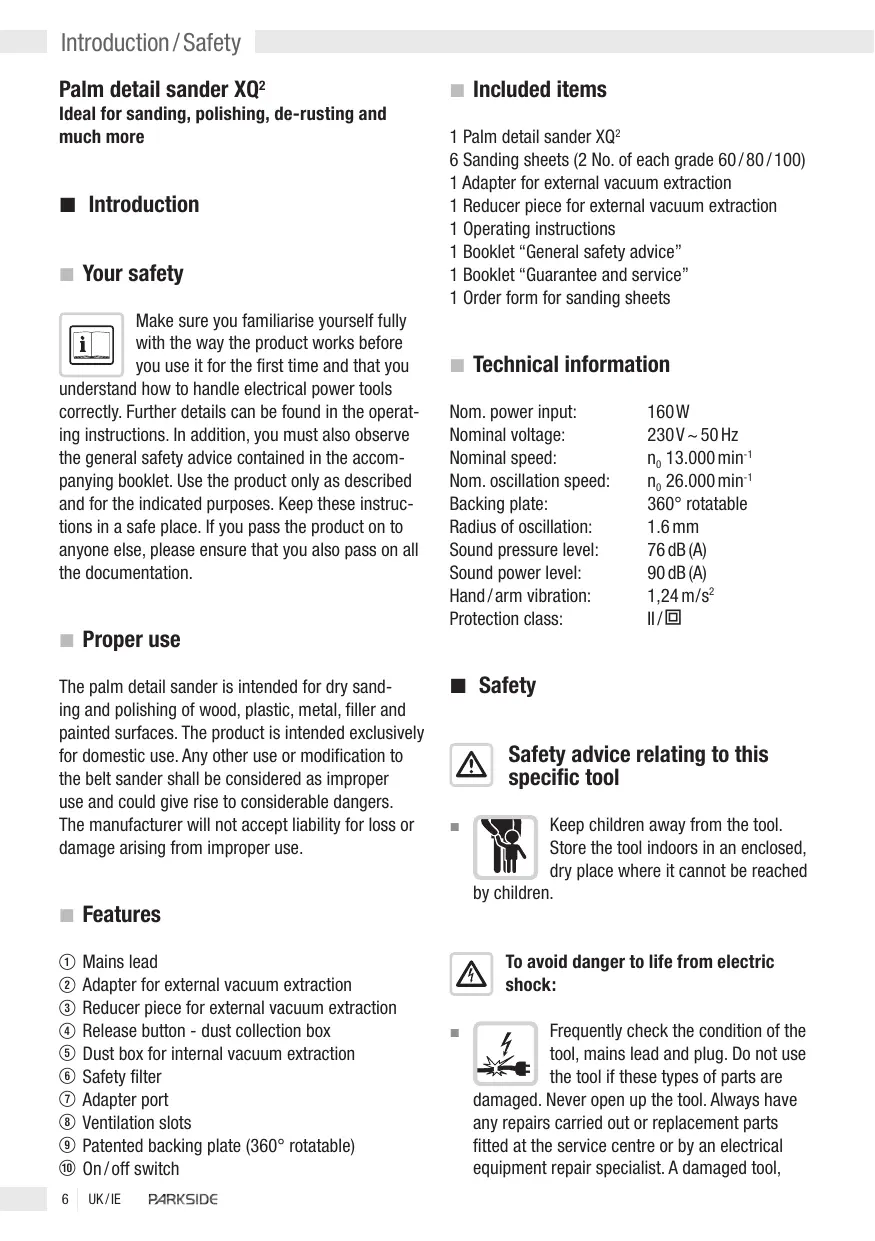
① Mains lead
② Adapter for external vacuum extraction
③ Reducer piece for external vacuum extraction
④ Release button - dust collection box
⑤ Dust box for internal vacuum extraction
⑥ Safety filter
⑦ Adapter port
(8) Ventilation slots
⑨ Patented backing plate (360^ rotatable)
10 On/off switch
■ Included items
1 Palm detail sander XQ^2
6 Sanding sheets (2 No. of each grade 60/80/100)
1 Adapter for external vacuum extraction
1 Reducer piece for external vacuum extraction
1 Operating instructions
1 Booklet "General safety advice"
1 Booklet "Guarantee and service"
1 Order form for sanding sheets
Technical information
Nom. power input: 160W
Nominal voltage: 230V 50Hz
Nominal speed: n_0 13.000 min^-1
Nom. oscillation speed: n_0 26.000 min^-1
Backing plate: 360^ rotatable
Radius of oscillation: 1.6 mm
Sound pressure level: 76 dB (A)
Sound power level: 90 dB (A)
Hand/arm vibration: 1,24 m/s²
Protection class: II/回
Safety

Safety advice relating to this specific tool
- Keep children away from the tool. Store the tool indoors in an enclosed, dry place where it cannot be reached by children.

To avoid danger to life from electric shock:
Frequently check the condition of the tool, mains lead and plug. Do not use the tool if these types of parts are damaged. Never open up the tool. Always have any repairs carried out or replacement parts fitted at the service centre or by an electrical equipment repair specialist. A damaged tool,
mains lead or plug presents a serious danger to life from electric shock.
Have repairs carried out only by an electrician or the relevant service centre.
- Do not operate the device if it is damp and do not use it in a damp environment.
If you use the device outdoors, always connect it through a residual current device with a maximum trip current of 30mA .
If using an extension lead always use one that is approved for outdoor use.
- Do not use the tool in rain or in wet conditions.
Always work with the mains lead ① leading away from the rear of the device.

To avoid the danger of injury, burning and damage to health:
Danger of fire from flying sparks!
Warning! Be aware that persons operating the tool or in its vicinity may be at risk of being in contact with or inhaling dusts. Take all the necessary safety precautions in relation to dusts. Working with this tool can give rise to dusts that may be hazardous to health, inflammable or explosive. Harmful or poisonous dusts can, for example, arise from sanding paints containing lead, or from certain types of hardwoods or metals. Some dusts are classed as carcinogenic. Wear a breathing mask and use a suitable dust/chip vacuum extraction device.
Warning! Keep your working area clean. Mixtures of materials can be particularly dangerous. Light metal dust, for example, may burn or explode.
- When sanding wood and in particular when working on materials that give rise to dusts that are hazardous to health, the sander must be connected to a suitable external dust extraction device.

Wear protective glasses, hearing protection, dust protection masks and protective gloves.
-
Ensure that there is adequate ventilation when working on plastic, paint, varnish etc.
-
Avoid sanding paints containing lead or other substances hazardous to health.
- Do not sand any material containing asbestos.
Firmly support the workpiece (in a clamp or vice) unless its own weight is enough to keep it in place.
Avoid contact with the moving sanding belt. - Operate the tool only with an attached sanding sheet.
- Do not abrade moistened materials or damp surfaces.

Proper procedure and handling:
- Never use the tool for a purpose for which it was not intended nor with non-original parts/accessories.
Always switch on the device before placing it against the workpiece. After abrading, lift the device from the workpiece before switching it off. - When working always hold the device securely with both hands. Always keep proper footing and balance.
- Allow the device to come to a complete standstill and switch it off before you put it down.
- When taking a break from your work, before carrying out any tasks on the device itself (e.g. changing the sanding belt) and when you are not using the device, always pull the mains plug out of the mains socket.
Always keep the device clean, dry and free of oil or grease. - Remain alert at all times! Always watch what you are doing and proceed with caution. Do not use the device if you cannot concentrate or you are feeling unwell.
Operation
Switching on and off
Caution! Before connecting to the electricity supply, ensure that the palm detail sander is switched off.
Switching on
Push the On/Off switch ⑩ upwards into position “1”.
Switching off
Push the On/Off switch ⑩ downwards into position “0”.
Vacuum dust extraction
Warning! Danger of fire! There is the danger of fire when working with electrical devices that have a dustbox or can be connected to a vacuum cleaner. Under certain conditions the wood dust in the dust extraction bag (or in the vacuum's dust bag) may ignite, e.g. as a result of flying sparks generated when abrading metals or metal objects left in wood. This can happen particularly if the wood dust is mixed with paint residue or other chemicals and the abraded particles are hot from prolonged abrasion. Therefore you must empty the dust box and the vacuum cleaner's dust bag before taking a break or stopping work and always avoid overheating of the abraded particles and the tool.

Wear a dust mask!
Adapter for internal vacuum extraction
Connection:
- Slide the dust extraction box ⑤ on to the adapter port ⑦ until you hear it engage.
Removal:
Press the release button 4 of the dust extraction box 5 and withdraw it towards the rear of the device.
Tap it on a robust object.
Adapter for external vacuum extractor
Connection:
Push the adapter for external vacuum extraction ② into the adapter port ⑦ . If it is necessary to use the reducer piece ③ push the reducer piece into the adapter for external vacuum extraction ②
- Slide the hose of a suitable dust extraction device approved for that purpose (e.g. a workshop vacuum cleaner) on to the adapter for external vacuum extraction ② or the reducer piece ③ .
Removal:
Pull the hose of the dust extraction device off the adapter for external vacuum extraction ②.
Pull off the adapter for external vacuum extraction ②.
Attaching/detaching sanding sheets
Attaching
- Sanding sheets are easily attached to the backing plate (9) by means of the hook and pile fastening.
Detaching
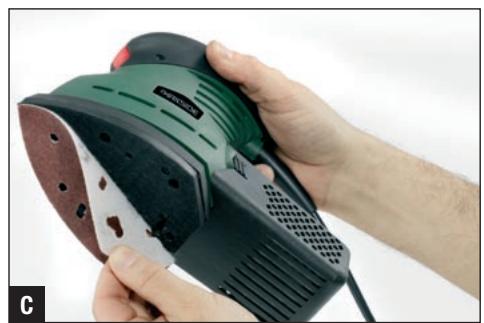
Simply pull the sanding sheet off the backing plate (see Fig. C).
Rotating the backing plate
Switch off the tool.
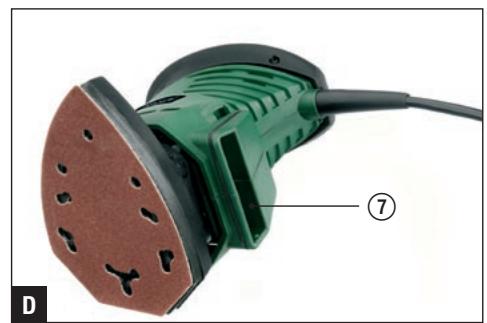
- Rotate the backing plate ⑨ into the desired position (see Fig. D).
Advice on use
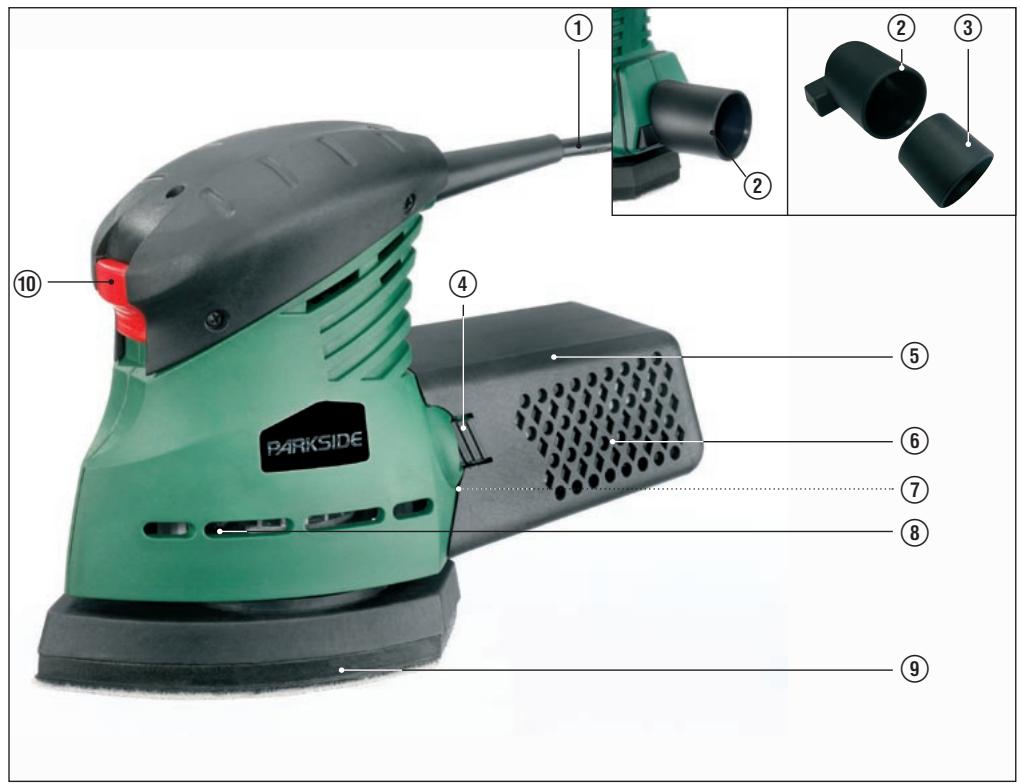
- Switch the tool on before placing it against the workpiece.
Apply light sanding pressure.
Advance the tool at an even rate.
Work in parallel and overlapping widths.
Sanding and surfaces
The sanding output and the quality of the surface finish are determined by the grade of grit on the sanding sheet.
Tips and tricks
Change sanding sheets at the appropriate time.
- Avoid sanding metal and other materials with the same sanding sheet.
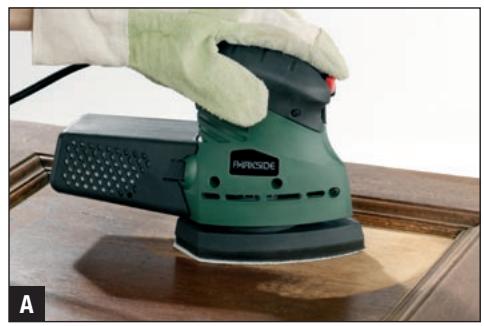
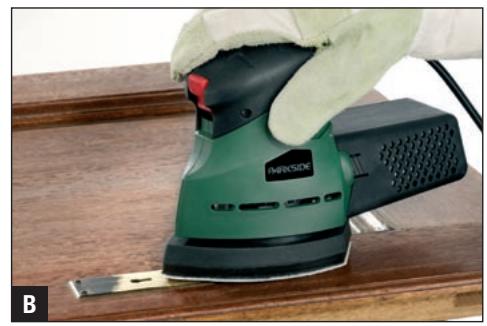
- Sand difficult to reach places with the front or side corners of the backing plate (9).
■ Maintenance and cleaning
Attention: before starting any work on your sander, always pull the plug out of the mains socket.
- Remove any dirt from the tool, surfaces and other items in the working area immediately after you finish work.
Clean the safety filter ⑥ of the dust extraction box ⑤ by pulling the safety filter out of the dust extraction box ⑤ . Suck out the debris carefully with a vacuum cleaner using a low suction pressure.
Clean the tool and remove any adhering dust with a narrow paint brush. - Never any kind of sharp object or petrol, solvents or cleaning agents that might attack plastic. Do not allow any liquids to enter the inside of the tool.
Always keep the ventilation slots ⑧ clear.
Disposal

The packaging consists entirely of environmentally-friendly materials. It can be disposed of at your local recycling facility.

Do not dispose of electric tools in the household waste!
In accordance with European Directive 2002/96/EC about waste electrical and electronic equipment and its transposition into national legislation, worn out electric tools must be collected separately and taken for environmentally compatible recycling.
Contact your local refuse disposal authority for more details of how to dispose of your eclectic tools.
Information
Service
Details of the Service Centre responsible for your region are shown in the warranty documents.
Declaration of conformity/ Producer C
We, Komperna GmbH, Burgstr. 21, D-44867 Bochum, Germany, hereby declare that this product complies with the following EU directives:
Machinery Directive (98/37/EC)
Low voltage directive (73/23/EEC)
Electromagnetic compatibility (89/336/EEC)
Applicable harmonized standards EN60745-1:2003+A1,EN60745-2-4:2003, EN55014-1:2000+A1+A2,EN55014-2:1997+A1, EN61000-3-2:2000+A2,EN61000-3-3:1995+A1, EN50366:2003
and confirm this with the CE symbol.
Type/Machine designation:
Palm detail sander XQ²
Bochum, 01.07.2006

Hans Kompernaβ
- Managing Director -
We reserve the right to make technical modifications in the course of further development.