
RT XM 305 - Table saw EINHELL - Free user manual and instructions
Find the device manual for free RT XM 305 EINHELL in PDF.
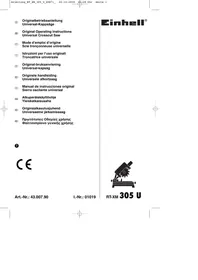


| Brand | EINHELL |
| Model | RT XM 305 |
| Product type | Radial miter saw |
| Supply voltage | 230 V ~ 50 Hz |
| Power consumption | 1800 W (S1) |
| No-load speed | 2500 rpm |
| Blade diameter | 250 mm |
| Blade bore | 30 mm |
| Blade thickness | 2.2 mm |
| Number of teeth | 48 |
| Net weight | 17.5 kg |
| Table pivot range | -52° / 0° / +60° |
| Miter cut (head tilt) | 0° to 45° to the left |
| Max. cutting capacity at 90° (wood) | 305 x 75 mm |
| Max. cutting capacity at 90° (metal) | 105 x 75 mm |
| Max. cutting capacity at 45° (wood) | 210 x 75 mm |
| Max. cutting capacity at 45° (metal) | 70 x 75 mm |
| Max. double miter cut (wood) | 210 x 40 mm |
| Sound pressure level LpA | 93.7 dB(A) |
| Sound power level LWA | 108.5 dB(A) |
| Vibration emission value | 1.068 m/s² |
| Pull function | Yes (pull guide) |
| Clamping device | Vertical and horizontal clamp |
| Chip collection box | Yes, included |
| Mounting stand | Included (detailed parts) |
Frequently Asked Questions - RT XM 305 EINHELL
User questions about RT XM 305 EINHELL
0 question about this device. Answer the ones you know or ask your own.
Ask a new question about this device
Download the instructions for your Table saw in PDF format for free! Find your manual RT XM 305 - EINHELL and take your electronic device back in hand. On this page are published all the documents necessary for the use of your device. RT XM 305 by EINHELL.
USER MANUAL RT XM 305 EINHELL
9. Transport (Fig. 1-3)
- Safety Information 21
- Layout 21
- Items supplied 21
- Intended use 22
- Technical data 22 6. Before starting the equipment 23
- Operation as wood/plastics saw 24
- Operation as metal saw 26
- Transport 26
- Replacing the power cable 26
- Cleaning, maintenance and ordering of spare parts 26
- Disposal and recycling 26
Important.
When using the equipment, a few safety precautions must be observed to avoid injuries and damage.
Please read the complete operating instructions and safety information with due care. Keep this manual in a safe place so that the information is available at all times. If you give the equipment to any other person, hand over these operating instructions and the safety information as well. We cannot accept any liability for damage or accidents which arise due to a failure to follow these instructions and the safety information.
1. Safety Information
Please refer to the booklet included in delivery for the safety information.
CAUTION
Read all the safety information and instructions.
Any errors made in following the safety regulations and instructions may result in an electric shock, fire and/or serious injury.
Keep all safety regulations and instructions in a safe place for future use.
2. Layout
2.1 Drag, crosscut and miter saw (Fig. 1-3)
- Handle
- ON/OFF switch
- Release lever
- Machine head
- Saw shaft lock
- Movable blade guard
- Saw blade
- Vertical clamping device
- Roll base with limit stop
- Holding bar for the roll base
- Stop rail
- Table insert with cutting depth scale
- Latched position lever
- Locking grip
- Pointer
- Scale
- Turntable
- Fixed saw table
- Scale
- Pointer
- Horizontal clamping device
- Locking screw
- Chip box
- Drag guide
- Locking screw for drag guide
- Guard
- Fastening bolt
- Locking screw for the horizontal clamping device
- Locking screw for the vertical clamping device
- Locking screw for the roll base
- Foot with rubber stopper
- Foot
- Extractor adapter
- Knurled screw for cutting depth limiter
- Stop for cutting depth limiter
2.2 Base frame (Fig. 4)
A. Feet B. Side part C. Intermediate strut D. Corner bracing E. Bottom cross strut F. Top cross strut
3. Items supplied (Fig. 1, 5)
Drag, crosscut and miter saw - Clamping device (8) - Roll base with limit stop (9) - 2 x Holding bar for the roll base (10) - Chip box (23) - 4 x Foot (A) - 2 x Side part (B) - 2 x Intermediate strut (C) - 4 x Corner bracing (D) - 2 x Bottom cross strut (E) - 2 x Top cross strut (F) - 4 x Nut (G) - 4 x Washers (H) - 28 x Nut (I) - 28 x Washer - 28 x Screw (L) - 4 x Screw (N) - Allen key (O) - Allen key (P) - 4 x Screw (M) - 4 x Washer (Q) - 4 x Cap nut (R)
4. Intended use
The universal saw is designed for cross-cutting wood and plastic. In accordance with the operating instructions, the equipment can also be used to saw hollow metal profiles with a rectangular cross-section. Sawing metal profiles may only be carried out with crosscuts. The equipment is expressly not permitted to saw metal with a tensile strength of more than 400 N/mm², hardened metal, combustible and reactive metals (such as magnesium and magnesium alloys), all kinds of round materials, and firewood.
The equipment is to be used only for its prescribed purpose. Any other use is deemed to be a case of misuse.
The user / operator and not the manufacturer will be liable for any damage or injuries of any kind caused as a result of this.
Please note that our equipment has not been designed for use in commercial, trade, or industrial applications. Our warranty will be voided if the equipment is used in commercial, trade, or industrial businesses or for equivalent purposes. The equipment is to be operated only with suitable saw blades. It is prohibited to use any type of cutting off wheel.
To use the equipment properly you must also observe the safety regulations, the assembly instructions, and the operating instructions to be found in this manual. All persons who use and service the equipment have to be acquainted with this manual and must be informed about the machine's potential hazards. It is also imperative to observe the accident prevention regulations in force in your area. The same applies for the general rules of health and safety at work. The manufacturer will not be liable for any changes made to the equipment nor for any damage resulting from such changes. Even when the equipment is used as prescribed it is still impossible to eliminate certain residual risk factors. The following hazards may arise in connection with the machine's construction and design:
- Contact with the saw blade in the uncovered saw zone.
- Reaching into the running saw blade (cut injuries).
- Kick-back of workpieces and parts of workpieces.
- Saw blade fracturing.
- Catapulting of faulty carbide tips from the saw blade.
- Damage to hearing if ear-muffs are not used as necessary.
- Harmful emissions of metal and wood dust when
used in closed rooms.
- Cut injuries through contact with chips and workpieces.
- Eye injuries caused by small metal chips.
- Technical data
| AC motor: | 230V ~ 50Hz |
| Power: | 1800 W |
| Operating mode: | S1 |
| Idle speed n0: | 2,500 min-1 |
| Carbide saw blade: | ø 250 x ø 30 x 2.2 mm |
| Number of teeth: | 48 |
| Swiveling range: | -52° / 0°/ +60° |
| Miter cut: | 0° to 45° to the left |
| Saw width at 90°: | |
| Wood: | 305 x 75 mm |
| Metal: | 105 x 75 mm |
| Saw width at 45°: | |
| Wood: | 210 x 75 mm |
| Metal: | 70 x 75 mm |
| Saw width at 2 x 45° (double miter cut): | |
| Wood: | 210 x 40 mm |
| Metal: | 70 x 40 mm |
| Weight: | approx. 17.5 kg |
Sound and vibration
Sound and vibration values were measured in accordance with EN 13898.
| LpA sound pressure level | 93.7 dB(A) |
| KpA uncertainty | 2 dB |
| LWA sound power level | 108.5 dB(A) |
| KpA uncertainty | 2 dB |
Wear ear-muffs.
The impact of noise can cause damage to hearing.
The quoted values are emission values and not necessarily reliable workplace values. Although there is a correlation between emission and immission levels it is impossible to draw any certain conclusions as to the need for additional precautions.
Factors with a potential influence on the actual immission level at the workplace include the duration of impact, the type of room, and other sources of
noise etc., e.g. the number of machines and other neighboring operations. Reliable workplace values may also vary from country to country. With this information the user should at least be able to make a better assessment of the dangers and risks involved.
Total vibration values (vector sum of three directions) determined in accordance with EN 61029.
Vibration emission value ah = 1.068 m/s2
Reduce noise generation and vibration to a minimum!
- Use only equipment that is in perfect condition.
- Maintain and clean the equipment regularly.
- Adapt your working methods to the equipment.
- Do not overload the equipment.
- Have the equipment checked if necessary.
- Switch off the equipment when not in use. Wear gloves.
6. Before starting the equipment
6.1 General information
- Before commissioning the machine, it must be firmly mounted on a workbench; fully assemble the underframe that came with the unit or similar.
- All covers and safety devices have to be properly fitted before the machine is switched on. It must be possible for the blade to run freely.
- When working with wood that has been processed before, watch out for foreign bodies such as nails or screws, etc.
- Before you actuate the On/Off switch, make sure that the saw blade is correctly fitted and that the machine's moving parts run smoothly.
- Check that the voltage on the rating plate is the same as your supply voltage before you connect the machine to the power supply.
6.2 Assembling the saw (Fig. 1-3; 6)
To adjust the turntable (17), loosen the locking grip (14) by approx. 2 turns, which frees the turntable (17). - Press the latched position lever (13), turn the turntable (17) and scale pointer (15) to the desired angular setting on the dial (16) and lock into place with the locking grip (14). The saw has locking positions at angles of -45°, -30°, -22.5°, -15°, 0°, 15°, 22.5°, 30°, 45° and 60°, at which you can engage the latched position lever. To release the saw from its position at the bottom, pull the fastening bolt (27) out of the motor mounting while pressing down lightly on the
machine head (4). Turn the fastening bolt (27) through 90° before releasing it, so that the saw remains unlocked.
- Swing the machine head (4) up until the release lever (3) latches into place.
- The clamping devices (8, 21) can be fitted on the left or right of the fixed saw table (18).
- Undo the locking screws for the roll base (30).
- Guide roll base with limit stop (9) over one of the holding bars for the roll base (10) and install on the fixed saw table (18), tightening the appropriate locking screw (30) (Figure 6).
- Mount the second holding bar for the roll base (10) on the opposite side of the saw and secure with the appropriate locking screw (30).
- When the locking screw (22) is loosened, you can tilt the machine head (4) to the left by up to 45°.
- If the saw is used without the base frame, the foot (32) will prevent the saw from tipping forwards during operation. In this case, turn out the foot (32) until it touches the surface on which the saw is standing.
6.3 Assembling the base frame and bolting the saw to the base frame (Fig. 4-24)
- Insert the feet (A) from the bottom into the intermediate struts (C) as shown in Figure 7. Ensure that the rubber stoppers on the feet (A) are aligned so that the support surfaces are level.
- Screw the feet (A) to the intermediate struts (C) together with the screws (N), washers (H) and nuts (G), as shown in Figures 8 - 9.
- Guide the side parts (B) from the top over the intermediate struts (C).
- At each connection point, screw the side parts (B) to the intermediate struts (C) using three screws (L), washers (K), and nuts (I) (Figures 11-12).
- Insert the two bottom cross struts (E) into the appropriate openings on one of the intermediate struts (C) as far as the stop (Figure 13). Screw the bottom cross struts (E) to the intermediate strut (C) using two screws (L), washers (K), and nuts (I) in each case, as shown in Figures 14-15.
- On the same side of the base frame, slide the two top cross struts (F) as far as the stop into the appropriate openings on the side part (B) (Figure 16). Insert a corner bracing (D) into each opening on the side part (B). Note that each of the corner bracings (D) only fits on one side of the base frame; this is the case when the openings on the side part (B), the top cross struts (F), and the corner bracings are positioned precisely on top of each other (Figure 17).
- Now screw the top cross struts (F), corner bracings (D), and side parts (B) together using two screws (L), washers (K), and nuts (I) in each case,
as shown in Figures 18-19.
- Insert the two base frame parts in such a way that the bottom and top cross struts (E, F) are positioned in the relevant openings on the side part (B) and the cross strut (C) (Figure 20).
- Screw the bottom cross strut (E) to the other part of the base frame (Figure 21/1) as described under 5.
- Screw the top cross struts (F) to the other part of the base frame (Figure 21/2) as described under 6.
- Pull the four rubber stoppers (32) from the bottom side of the saw (Figure 22).
- Place the saw onto the base frame so that the openings in which the rubber stoppers (32) were held are in line with the four openings on the top side of the saw mounts (J). Then insert the four screws (M) through the feet from the top and screw the saw onto the base frame (Figures 23-24).
6.4 Precision adjustment of the stop for crosscut 90° (Figures 1, 25-27)
- Fasten the turntable (17) in the 0° position.
- Undo the locking screw (22) and move the machine head (4) all the way to the right using the handle (1).
- Place the 90° angular stop (a) between the blade (7) and the turntable (17).
- Adjust the adjustment screw (38) until the angle between the blade (7) and the turntable (17) equals 90°.
- Finally, check the position of the pointer (20) on the scale (19). If necessary, release the pointer (20) with a cross-tip screwdriver, move it to the 0° position on the scale (19), and retighten the holding screw.
No stop angle included.
6.5 Precision adjustment of the stop for miter cut 45° (Fig. 1, 25, 28-29)
- Fasten the turntable (17) in the 0° position.
- Undo the locking screw (22) and move the machine head (4) all the way to the left using the handle (1), until it coincides at 45°.
- Place the 45° stop angle (b) between the blade (7) and the turntable (17).
- Adjust the adjustment screw (37) so that the angle between the blade (7) and the turntable (17) equals exactly 45°. No stop angle included.
7. Operation as wood/plastics saw
7.1 Cross cut 90° and turntable 0° (Fig. 1-3, 30) For cutting widths up to approx. 100 mm, it is possible to fix the saw's drag function with the locking screw for drag guide (25) in the rear position. If the cutting width exceeds 100 mm, you must ensure that the locking screw for drag guide (25) is slackened and that the machine head (4) can be moved.
- Move the machine head (4) to its upper position.
- Use the handle (1) to push back the machine head (4) and fix it in this position if required (dependent on the cutting width).
- Place the piece of wood to be cut at the stop rail (11) and on the turntable (17).
- Lock the material with the clamping device (8) on the fixed saw table (18) to prevent the material from moving during the cutting operation.
- Push down the release lever (3) to release the machine head (4).
- Press the ON/OFF switch (2) to start the motor.
- With the drag guide (24) fixed in place: Use the handle (1) to move the machine head (4) steadily and with light pressure downwards until the saw blade (7) has completely cut through the workpiece.
- With the drag guide (24) not fixed in place: Pull the machine head (4) all the way to the front and then use the handle (1) to move it downwards steadily and with light pressure. Now push the machine head (4) slowly and steadily to the very back until the saw blade (7) has completely cut through the workpiece.
- When the cutting operation is completed, move the machine head (4) back to its upper (home) position and release the ON/OFF button (2).
Important. The integral resetting springs will automatically lift the machine head. Do not simply let go of the handle (1) after cutting, but allow the machine head (4) to rise slowly, applying slight counterpressure as it does so.
7.2 Cross cut 90° and turntable -52°... + 60° (Fig. 1-3, 31)
The crosscut saw can be used to make crosscuts of 0° - 52° to the left and 0° - 60° to the right in relation to the stop rail.
- Release the turntable (17) by slackening the locking grip (14).
- Press the latched position lever (13), turn the turntable (17) and scale pointer (15) to the desired angular setting on the dial (16) and lock into place with the locking grip (14). The saw has locking positions at angles of -45° , -30° , -22.5° , -15° , 0° , 15° , 22.5° , 30° , 45° and 60° , at which you can engage latched position lever.
- Retighten the locking grip (14) to secure the turntable (17) in place. Cut as described under section 7.1.
7.3 Miter cut 0° - 45° and turntable 0° (Fig. 1-3, 32) The crosscut saw can be used to make miter cuts of 0° - 45° in relation to the work face.
- If necessary, dismantle the clamping device (8) or mount it on the opposite side of the fixed saw table (18).
- Move the machine head (4) to its upper position.
- Fasten the turntable (17) in the 0° position.
- Undo the locking screw (22) and use the handle (1) to tilt the machine head (4) to the left until the pointer (20) coincides with the required value on the scale (19).
- Retighten the locking screw (22) and make the cut as described in section 7.1.
7.4 Miter cut 0° - 45° and turntable 0° - 45° (Fig. 1-3, 33)
The crosscut saw can be used to make miter cuts to the left of 0° - 45° in relation to the work face and, at the same time, 0° - 52° to the left or 0° - 60° to the right in relation to the stop rail (double miter cut).
- If required, dismantle the clamping device (8) or mount it on the opposite side of the fixed saw table (18).
- Move the machine head (4) to its upper position.
- Release the turntable (17) by slackening the locking grip (14).
- Use the handle (1) to adjust the turntable (17) to the angle required (in this connection see also section 7.2).
- Retighten the locking grip (14) to secure the turntable in place.
- Undo the locking screw (22) and use the handle (1) to tilt the machine head (4) to the left until it coincides with the required angle value (in this connection see also section 7.3).
- Re-tighten the fixing screw (22). Cut as described under section 7.1.
7.5 Limiting the cutting depth (Fig. 34)
- The cutting depth can be infinitely adjusted using the screw (34). To do so, undo the knurled nut on the screw (34) and move the stop for the cutting depth limiter (35) to the outside. Turn the screw (34) in or out to set the required cutting depth and then retighten the knurled nut on the screw (34).
- Check the setting by completing a test cut.
7.6 Chip box (Fig. 35-36/Item 23)
The saw is equipped with a chip box (23) for sawdust and chips. The chip box (23) can be fitted onto the extractor adapter (33).
To empty the chip box (23), flip the box open as shown in Figure 36 and carefully empty it by tapping.
Alternatively, a suitable dust extraction device can be fitted to the extractor adaptor (33).
7.7 Changing the saw blade (Fig. 1, 37-40) Pull out the power plug!
- Swing the machine head (4) upwards and lock in this position with the fastening bolt (27).
- Press the release lever (3) and swing up the saw blade guard (6) to the point where the recess in the saw blade guard (6) is above the flange bolt (39).
- Press the saw shaft lock (5) with one hand while holding the wrench (P) on the flange bolt (39) with the other.
- Firmly press on the saw shaft lock (5) and slowly rotate the flange bolt (39) in clockwise direction. The saw shaft lock (5) engages after no more than one rotation.
- Now, using a little more force, slacken the flange bolt (39) in the clockwise direction.
- Turn the flange screw (39) right out and remove the external flange (40). Take the blade (7) off the inner flange and pull out downwards.
- Carefully clean the flange screw (39), outer flange (40) and inner flange.
- Fit and fasten the new saw blade (7) in reverse order.
- Important. The cutting angle of the teeth, in other words the direction of rotation of the saw blade (7) must coincide with the direction of the arrow on the housing.
- Check to make sure that all safety devices are properly mounted and in good working condition before you begin working with the saw again.
- Important. Every time that you change the saw blade, check to see that it spins freely in the table insert (12) in both perpendicular and 45° angle settings.
- Important. The work to change and align the saw blade (7) must be carried out correctly.
8. Operation as metal saw
Important. Wear gloves (risk of injury) and suitable safety goggles.
- You can make crosscuts with and without miter in the angle ranges listed in section 7.) When working with metal, you can only make crosscuts due to risk of kick-back. In this case the drag guide (24) must be fixed with the locking screw.
- Before using the equipment, sweep any small metal chips away from the machine to protect yourself against injury. Always clamp the workpiece with the vertical clamping device (8) and the horizontal clamping device (21).
- Press the ON/OFF switch (2). Wait until the saw blade reaches full speed before making a cut.
- Press the release lever (3). With the drag guide (24) fixed in place, use the handle (1) to move the machine head (4) downwards steadily, quickly and exerting slight pressure until the workpiece is completely cut through.
- When the cutting operation is completed, move the machine head (4) back to its upper (home) position and release the ON/OFF button (2).
- Let the saw blade run to a complete stop before removing the workpiece.
- Important: The integral resetting springs will automatically lift the machine head. Do not simply let go of the handle (1) after cutting but allow the machine head (4) to rise slowly, applying slight counterpressure as it does so.
9. Transport (Fig. 1-3)
- Retighten the locking grip (14) to secure the turntable (17) in place.
- Activate the release lever (3), press the machine head (4) downwards and secure with the fastening bolt (27). The saw is now locked in its bottom position. Fix the saw's drag function with the locking screw for the drag guide (25) in the rear position.
- Carry the machine on the fixed saw table (18), or if the saw is mounted to the base frame, on the relevant trough handles on the base frame. To set up the equipment again, proceed as described in section 6.2.
10. Replacing the power cable
If the power cable for this equipment is damaged, it must be replaced by the manufacturer or its after-sales service or similarly trained personnel to avoid
danger.
11. Cleaning, maintenance and ordering of spare parts
Always pull out the mains power plug before starting any cleaning work.
11.1 Cleaning
- Keep all safety devices, air vents and the motor housing free of dirt and dust as far as possible. Wipe the equipment with a clean cloth or blow it down with compressed air at low pressure. We recommend that you clean the equipment immediately after you use it.
- Clean the appliance regularly with a damp cloth and some soft soap. Do not use cleaning agents or solvents; these may be aggressive to the plastic parts in the appliance. Ensure that no water can get into the interior of the equipment.
11.2 Carbon brushes
In case of excessive sparking, have the carbon brushes checked only by a qualified electrician. Important. The carbon brushes should not be replaced by anyone but a qualified electrician.
11.3 Servicing
There are no parts inside the equipment which require additional maintenance.
11.4 Ordering replacement parts:
Please provide the following information on all orders for spare parts:
Model/type of the equipment - Article number of the equipment ID number of the equipment - Spare part number of the required spare part For our latest prices and information please go to www.isc-gmbh.info
12. Disposal and recycling
The equipment is supplied in packaging to prevent it from being damaged in transit. The raw materials in this packaging can be reused or recycled. The equipment and its accessories are made of various types of material, such as metal and plastic. Defective components must be disposed of as special waste. Ask your dealer or your local council.
Annex VI
Subject to change without notice
Archive-File/Record: 4300790-50-4155050-09
Documents registrar: Siegfried Roider
Wiesenweg 22, D-94405 Landau/Isar

For EU countries only
For EU countries only
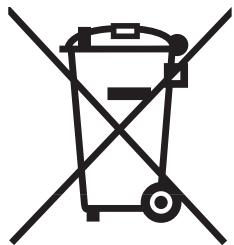
Never place any electric tools in your household refuse.
To comply with European Directive 2002/96/EC concerning old electric and electronic equipment and its implementation in national laws, old electric tools have to be separated from other waste and disposed of in an environment-friendly fashion, e.g. by taking to a recycling depot.
Recycling alternative to the demand to return electrical devices:
As an alternative to returning the electrical device, the owner is obliged to cooperate in ensuring that the device is properly recycled if ownership is relinquished. This can also be done by handing over the used device to a returns center, which will dispose of it in accordance with national commercial and industrial waste management legislation. This does not apply to the accessories and auxiliary equipment without any electrical components which are included with the used device.
The reprinting or reproduction by any other means, in whole or in part, of documentation and papers accompanying products is permitted only with the express consent of ISC GmbH.
F
All of our products undergo strict quality checks to ensure that they reach you in perfect condition. In the unlikely event that your device develops a fault, please contact our service department at the address shown on this guarantee card. Of course, if you would prefer to call us then we are also happy to offer our assistance under the service number printed below. Please note the following terms under which guarantee claims can be made:
- These guarantee terms cover additional guarantee rights and do not affect your statutory warranty rights. We do not charge you for this guarantee.
- Our guarantee only covers problems caused by material or manufacturing defects, and it is restricted to the rectification of these defects or replacement of the device. Please note that our devices have not been designed for use in commercial, trade or industrial applications. Consequently, the guarantee is invalidated if the equipment is used in commercial, trade or industrial applications or for other equivalent activities. The following are also excluded from our guarantee: compensation for transport damage, damage caused by failure to comply with the installation/assembly instructions or damage caused by unprofessional installation, failure to comply with the operating instructions (e.g. connection to the wrong mains voltage or current type), misuse or inappropriate use (such as overloading of the device or use of non-approved tools or accessories), failure to comply with the maintenance and safety regulations, ingress of foreign bodies into the device (e.g. sand, stones or dust), effects of force or external influences (e.g. damage caused by the device being dropped) and normal wear resulting from proper operation of the device. This applies in particular to rechargeable batteries for which we nevertheless issue a guarantee period of 12 months. The guarantee is rendered null and void if any attempt is made to tamper with the device.
- The guarantee is valid for a period of 2 years starting from the purchase date of the device. Guarantee claims should be submitted before the end of the guarantee period within two weeks of the defect being noticed. No guarantee claims will be accepted after the end of the guarantee period. The original guarantee period remains applicable to the device even if repairs are carried out or parts are replaced. In such cases, the work performed or parts fitted will not result in an extension of the guarantee period, and no new guarantee will become active for the work performed or parts fitted. This also applies when an on-site service is used.
- In order to assert your guarantee claim, please send your defective device postage-free to the address shown below. Please enclose either the original or a copy of your sales receipt or another dated proof of purchase. Please keep your sales receipt in a safe place, as it is your proof of purchase. It would help us if you could describe the nature of the problem in as much detail as possible. If the defect is covered by our guarantee then your device will either be repaired immediately and returned to you, or we will send you a new device.
Of course, we are also happy to offer a chargeable repair service for any defects which are not covered by the scope of this guarantee or for units which are no longer covered. To take advantage of this service, please send the device to our service address.
- TRANSPORT (FIG. 1-3)
- IMPORTANT
- SAFETY INFORMATION
- CAUTION
- LAYOUT
- BASE FRAME (FIG. 4)
- ITEMS SUPPLIED (FIG. 1, 5)
- INTENDED USE
- SOUND AND VIBRATION
- WEAR EAR-MUFFS
- REDUCE NOISE GENERATION AND VIBRATION TO A MINIMUM
- BEFORE STARTING THE EQUIPMENT
- GENERAL INFORMATION
- ASSEMBLING THE SAW (FIG. 1-3; 6)
- ASSEMBLING THE BASE FRAME AND BOLTING THE SAW TO THE BASE FRAME (FIG. 4-24)
- PRECISION ADJUSTMENT OF THE STOP FOR CROSSCUT 90° (FIGURES 1, 25-27)
- NO STOP ANGLE INCLUDED
- PRECISION ADJUSTMENT OF THE STOP FOR MITER CUT 45° (FIG. 1, 25, 28-29)
- OPERATION AS WOOD/PLASTICS SAW
- CROSS CUT 90° AND TURNTABLE 0° (FIG. 1-3, 30) FOR CUTTING WIDTHS UP TO APPROX. 100 MM, IT IS POSSIBLE TO FIX THE SAW'S DRAG FUNCTION WITH THE LOCKING SCREW FOR DRAG GUIDE (25) IN THE REAR POSITION. IF THE CUTTING WIDTH EXCEEDS 100 MM, YOU MUST ENSURE THAT THE LOCKING SCREW FOR DRAG GUIDE (25) IS SLACKENED AND THAT THE MACHINE HEAD (4) CAN BE MOVED
- CROSS CUT 90° AND TURNTABLE -52°... + 60° (FIG. 1-3, 31)
- OPERATION AS METAL SAW
- IMPORTANT. WEAR GLOVES (RISK OF INJURY) AND SUITABLE SAFETY GOGGLES
- REPLACING THE POWER CABLE
- CLEANING, MAINTENANCE AND ORDERING OF SPARE PARTS
- CLEANING
- CARBON BRUSHES
- SERVICING
- ORDERING REPLACEMENT PARTS
- DISPOSAL AND RECYCLING
- FOR EU COUNTRIES ONLY
Brand : EINHELL
Model : RT XM 305
Category : Table saw