MD 90161 - Computer MEDION - Free user manual and instructions
Find the device manual for free MD 90161 MEDION in PDF.



| Product type | 2.5-inch external hard drive |
| Interface | USB 2.0 (compatible with USB 1.1) |
| Power supply | Via USB port (Y-cable included) |
| Dimensions (approx.) | 120 x 75 x 10 mm |
| Weight (approx.) | 150 g |
| Compatible operating systems | Windows XP, Windows Vista |
| Supported file systems | NTFS, FAT, FAT32 |
| Package contents | Hard drive, Y-USB cable, instruction manual, warranty card |
| Partitioning | Possible via Windows Disk Management |
| Activity indicator | Blue LED: solid = ready, blinking = data transfer |
| Operating temperature | Normal ambient, avoid heat sources |
| Safety | Do not expose to shocks, moisture, dust |
| Maintenance | No cleaning required; unplug before cleaning |
| Environment | Do not dispose with household waste; recycle |
| Warranty | Refer to the included warranty card |
Frequently Asked Questions - MD 90161 MEDION
User questions about MD 90161 MEDION
0 question about this device. Answer the ones you know or ask your own.
Ask a new question about this device
Download the instructions for your Computer in PDF format for free! Find your manual MD 90161 - MEDION and take your electronic device back in hand. On this page are published all the documents necessary for the use of your device. MD 90161 by MEDION.
USER MANUAL MD 90161 MEDION
Copyright © 2009, 09/09
Safety instructions 3
Safety and installation. 3
Electromagnetic compatibility/ Conformity with norms. 5
Cleaning 6
Recycling and disposal 6
Data security. 6
Introduction 7
Notes on these Operating Instructions. 7
Service. 7
Our target group. 7
Box contents 8
System requirements 8
Setting up 9
Connecting the cables. 9
Installing the hard disk. 10
Before you install your hard disk 10
Partitioning programmes 10
Partitioning the drive 10
Formatting the drive. 11
Choosing between NTFS, FAT, and FAT32 11
Deleting hard disks from the system 14
Customer service 15
Troubleshooting 15
Localize the Cause. 15
Requirements for optimal performance: 15
Errors And Possible Causes 15
Do you require additional support? 16
Copying this manual 16
Copyright © 2009, 09/09
All rights reserved.
This manual is protected by Copyright.
The Copyright is owned by MEDION.
Trademarks:
MS-DOS and Windows are registered trademarks of Microsoft.
Other trademarks are the property of their respective owners.
We reserve the right to make technical changes.
Safety instructions
Please read this chapter carefully and observe all listed notes. This will ensure reliable operation and long life expectancy of your product. Keep these instructions with your product at all times. The proper set up, use and care can help extend the life of your product. In the event that you transfer ownership of this product, please provide these instructions to the new owner.
Safety and installation
- Never allow children to use electronic devices unsupervised. Children may not always correctly identify potential hazards.
- Changing the hard disk must only be performed by a person who is experienced in repairing and upgrading PCs.
- Should you not possess the necessary skills, call in a technician.
- Hard disks are extremely fragile. Never drop or shake the hard drive - this could irreversibly damage the data on the hard disk. Be especially careful when transporting the hard disk as we provide no guarantee for this type of damage.
- The hard drive consumes energy and becomes very warm during operation. Remove the hard drive from the data dock or from the plug power supply unit when not in use.
- Follow the user guide for your PC.
- The slits and openings in the hard disk are for air circulation. Do not cover these openings, as this could lead to overheating.
- Never open the casing of your hard disk, if you do the hard disk will no longer be covered by our guarantee.
- The hard disk is not designed for use in commercial applications/situations.
- After transportation, wait until the equipment is at room temperature before turning it on. If there is a large difference in temperature or humidity, damp can build up through condensation and cause an electrical short circuit.
- Keep your hard disk and all connected equipment away from damp and avoid dust, heat and direct sunlight in order to prevent operational problems.
-
In order to avoid damage from a fall, place the hard disk on a stable and level surface which does not vibrate.
-
For additional safety, we recommend using power connection through a power surge protection unit in order to protect your equipment from power surges and lightning strikes.
- Arrange cables so no one can walk on or trip over them.
- Do not place objects on any of the cables.
- The voltages and interfaces used in the equipment are in line with the low voltage protection guidelines set out in EN60950. Connections to other equipment may only be made using similar interfaces with low voltage protection in accordance with EN 60950.
- Please use our Service Center if you have any technical problems with your hard disk. If repairs are needed, please exclusively use our authorised service partners.
- In the first hours of operation, new devices may emit a typical, unavoidable but completely harmless smell, which will decline increasingly in the course of time. We recommend that you ventilate the room regularly, to counteract the formation of the smell.
Electromagnetic compatibility/ Conformity with norms
This device fulfils the requirements of electromagnetic compatibility and electrical safety of the following norms:
EN 55022
Information technology equipment - Radio disturbance characteristics - Limits and methods of measurement
EN 55024
Information technology equipment - Immunity characteristics - Limits and methods of measurement
EN 61000-3-2
Electromagnetic compatibility (EMC) - Limits for harmonic current emissions (equipment input current up to and including 16 A per phase)
EN 61000-3-3
Electromagnetic compatibility (EMC) - Limitation of voltage changes, voltage fluctuations and flicker in public low-voltage supply systems, for equipment with rated current <= 16 A per phase and not subject to conditional connection
EN 60950
Information technology equipment - Radio disturbance characteristics - Limits and methods of measurement
- On connecting the hard disk, you must keep to the guidelines for electromagnetic compatibility.
- Ensure your hard disk is located at least one meter away from sources of high frequency and magnetic disturbance (TVs, speakers, mobile telephones, etc.) in order to avoid operational problems and data loss.
Cleaning
- Before cleaning your hard disk drive, always unplug all connection cables.
- Do not use any solvents, corrosive or gaseous cleaning products.
Caution!
This equipment does not include any parts that need servicing or cleaning.
Recycling and disposal
Device

At the end of its life, the appliance must not be disposed of in household rubbish. Enquire about the options for environmentally-friendly disposal with your retailer.
Packaging

All packaging and packaging materials that are no longer required can and should be recycled.
Data security

Every time you update your data make back-up copies on an external storage medium. We assume no liability for data loss or damage to data storage units, and no claims can be accepted for damages resulting from the loss of data or consequential losses.
Introduction
Notes on these Operating Instructions
We have structured these Operating Instructions for the installation so that you will be able to look up the necessary subject-related information by means of the Contents List at any time.
The purpose of these instructions is to help you operate and install your external hard disk safely, quickly and easily.
In addition, many application programs include extensive help functions. As a general rule, you can access help functions by pressing F1 on the keyboard. These help functions are available to you when you use the Microsoft Windows operating system or the various application programs.
Service
Our customer care is there to provide support and assistance whenever you have questions or are experiencing problems.
This manual contains a section specific to Customer Service starting on page 14.
We are pleased to welcome you as our newest customer.
Our target group
These instructions are intended for advanced users. Regardless of the possible professional utilization, this Notebook is designed for day-to-day household use. The functions and applications for use have been designed with the entire family in mind.
Box contents
Please check the contents of the box and notify us within 14 days of purchase if the contents of this box is incomplete. The following should be included with the hard drive:
- External 2.5'' hard disk in compact casing
USB cable - User manual
System requirements
- Operating system
Windows*XP/Vista
- Connection
USB
Setting up
Connecting the cables
Connect the external hard disk to your computer using a free USB port. You can also connect the hard disk to computers with a USB 1.1 port however the speed of transmission will be slower.
- Start your computer and wait until Windows* has been fully loaded.
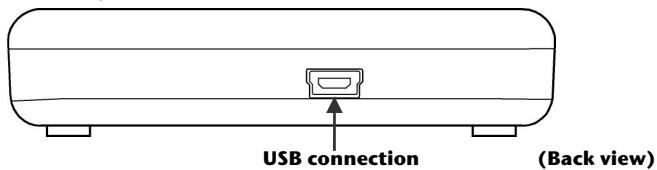
- Connect the mini-USB connector of the supplied Y-cable to the USB port of your external hard disk.
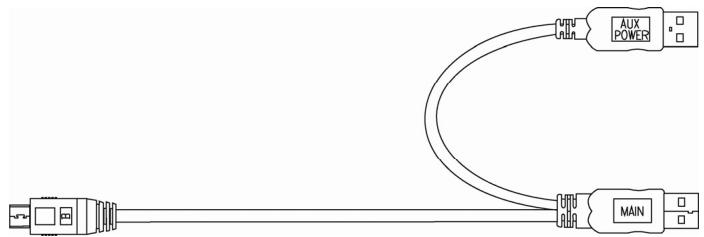
- Connect the other end of the Y-cable which has two USB Type-A connectors with the following labels connector must be connected to your PC / Notebook at all times when in use; the 'AUX' is an addition power source, in case your PC / Notebook does not supply sufficient power strength with one USB port. We recommend to connecting both USB Type-A (MAIN & AUX) connectors to your PC / Notebook's USB ports when using the hard drive.
- The operating indicator (blue LED) will light up as soon as the hard drive is connected to a source of electricity.
- With Windows XP/Vista the hard disk will be automatically recognized and connected.
Installing the hard disk
Note
Your drive has already been set up (1 partition in FAT32 format) and so it will not be necessary to reformat or repartition it.
Caution!
Partitioning or formatting a disk drive deletes data. We assume no responsibility for lost data.
Before you install your hard disk …
We would like to remind you once again that when installing the new hard disk some programmes are used that could cause your data to be irreversibly lost if used incorrectly.
Note
Make a backup of all your data and check that the recovery procedure works.
Partitioning programmes
With Windows XP/Vista use the disk management help program in order to install the hard disk. You can find the program in the computer management section of control panel.
With these operating systems you must have administration rights to install a hard disk.
Look under help in Windows for detailed information on using this program.
Partitioning the drive
Partitioning a drive divides the space into different areas which can be accessed as separate logic drives (with letters C:, D:, E: etc.). Read the manual of your operating system to find out how to partition hard drives with your particular system.
Formatting the drive
In order to remove data from the hard disk, the partitions must be formatted.
Caution!
You must be totally sure about which drive letter to enter so that you don't format a drive that contains data you wish to keep.
You can carry out the partitioning using Windows Explorer (right click on the drive and select format).
Read which formatting options you have in the next section.
Choosing between NTFS, FAT, and FAT32
When you use Windows XP and Windows 2000 you can choose between three file systems for disk partitions:
NTFS,
- FAT and
- FAT32.
Use the information below to compare the file systems.
NTFS is more powerful than FAT or FAT32, and includes features required for hosting Active Directory as well as other important security features. You can use features such as Active Directory and domain-based security only by choosing NTFS as your file system.
It is easy to convert partitions to NTFS. The Setup program makes conversion easy, whether your partitions used FAT, FAT32, or the older version of NTFS. This kind of conversion keeps your files intact (unlike formatting a partition).
If you do not need to keep your files intact and you have a FAT or FAT32 partition, it is recommended that you format the partition with NTFS rather than convert from FAT or FAT32.
Formatting a partition erases all data on the partition and allows you to start with a clean drive.
Whether a partition is formatted with NTFS or converted using the convert command, NTFS is the better choice of file system.
In order to maintain access control on files and folders and support limited accounts, you must use NTFS.
. If you use FAT32, all users will have access to all files on your hard drive, regardless of their account type (administrator, limited, or standard.)
NTFS is the file system that works best with large disks. (The next best file system for large disks is FAT32.)
There is one situation in which you might want to choose FAT or FAT32 as your file system.
If it is necessary to have a computer that will sometimes run an earlier version of Windows and other times run Windows XP, you will need to have a FAT or FAT32 partition as the primary (or startup) partition on the hard disk.
Earlier versions of Windows cannot access a partition if it uses the latest version of NTFS.
The two exceptions are Windows 2000 and Windows NT 4.0 with Service Pack 4 or later. Windows NT is not, however, supported by this device.
You will obtain additional information about this on the next page.
Important
Once you convert a drive or partition to NTFS, you cannot simply convert it back to FAT or FAT32. You will need to reformat the drive or partition which will erase all data including programs and personal files on the partition.
Remark
There are some older programs that cannot be run on a NTFS capacity. Because of this, you should find out the actual requirements of the software before the conversion.
The following table describes the compatibility of each file system with various operating systems.
NTFS
A computer running Windows XP or Windows 2000 can access files on an NTFS partition. A computer running Windows NT 4.0 with Service Pack 4 or later might be able to access some files. Other operating systems allow no access.
FAT
Access is available through MS-DOS, all versions of Windows, Windows NT, Windows 2000, Windows XP, and OS/2.
FAT32
Access is available only through Windows 95 OSR2, Windows 98, Windows Millennium Edition, Windows 2000, and Windows XP.
The following table compares disk and file sizes possible with each file system.
NTFS
Recommended minimum volume size is approximately 10 megabytes (MB). Volumes much larger than 2 terabytes (TB) are possible. Cannot be used on floppy disks.
FAT
Volumes from size up to 4 gigabytes (GB). Does not support domains.
FAT32
Volumes from 512
MB to 2 TB. In
Windows XP, you can
format a FAT32
volume up to 32 GB
only. Does not
support domains.
File size limited only by size of volume.
Maximum file size is 2 GB.
Maximum file size is 4 GB.
Deleting hard disks from the system
Depending on the operating system, the external hard disk must be disconnected before it can be deleted. This is usually the case for Windows 2000. Read how this works in the help files of your operating system.
-
Disconnect the hard disk from the operating system if necessary using the safely remove hardware wizard.
-
Now pull out the plug and disconnect all the connection cables from the external hard disk.
Caution!
While accessing the hard disk, the hard disk must not be deleted or turned off. This can lead to data loss.
You can see that data is being transmitted when the LED display flashes blue. When the LED display is constantly blue, no data is being transmitted. However, you should make sure that all files that you have opened from the hard disk (documents, etc.) have been closed again before you delete or turn off the hard disk.
Customer service
Troubleshooting
Localize the Cause
Errors can have simple causes, but sometimes they are caused by faulty equipment. We would like to give you some tips to help solve common problems.
Requirements for optimal performance:
- a stable, trouble-free computer
- a correctly installed operating system
- cables correctly attached to the hard disk
- regular execution of the Windows* defragmenter and scandisk programs to remove sources of error and increase the system performance.
Errors And Possible Causes
We wish to give you a basic guide in the following, in order for you to recognize a problem possibly present and to remove the cause of it. We shall be glad to help you further if the notes given here do not lead to success.
PROBLEM: Is the motor of the hard disk functioning?
- ANSWER: You should hear a quiet humming and clicks after connecting the hard drive to electricity in this case.
PROBLEM: The drive is not recognised by my computer.
- ANSWER: Restart your computer.
PROBLEM: ScanDisk reports an unrecoverable error.
- ANSWER: The Scandisk program tests drives for errors. If ScanDisk finds a problem and is unable to fix it, there may be a problem with the hard disk.
PROBLEM: The hard drive does not seem to have as much storage capacity as I allocated.
- ANSWER: Check that your operating system and file system support the desired amount.
Do you require additional support?
If the suggestions in the previous section have not solved your problem, please contact the hotline. We will try and help you over the telephone. However, before you contact your nearest MEDION Technology Centre, please have the following information available:
How is your computer configured?
What additional peripherals do you use?
What messages, if any, appear on your screen?
What software were you using when the error occurred?
- What steps have you already undertaken to solve the problem?
If you have already been given a customer number, please have this available.
Copying this manual
This document contains legally protected information. All rights reserved. Copying in mechanical, electronic and any other form without the written approval of the manufacturer is prohibited.
Sommaire
Copyright © 2009, 09/09
Copyright © 2009, 09/09
Copyright © 2009, 09/09