HS300D - Circular saw MAKITA - Free user manual and instructions
Find the device manual for free HS300D MAKITA in PDF.


User questions about HS300D MAKITA
0 question about this device. Answer the ones you know or ask your own.
Ask a new question about this device
Download the instructions for your Circular saw in PDF format for free! Find your manual HS300D - MAKITA and take your electronic device back in hand. On this page are published all the documents necessary for the use of your device. HS300D by MAKITA.
USER MANUAL HS300D MAKITA
ENGLISH (Original instructions)
Explanation of general view
| 1-1. Battery cartridge | 5-2. Switch trigger | 8-2. Protrusion |
| 1-2. Button | 6-1. Shaft lock | 8-3. Outer flange |
| 2-1. Clamping screw | 6-2. Hex wrench | 8-4. Saw blade |
| 2-2. Depth guide | 7-1. Hex bolt | 8-5. Inner flange |
| 3-1. Clamping screw | 7-2. Outer flange | 8-6. Protrusion (bigger side) |
| 3-2. Bevel scale plate | 7-3. Saw blade | 9-1. Hex wrench |
| 4-1. Cutting line | 7-4. Inner flange | 10-1. Dust nozzle (accessory) |
| 5-1. Lock-off lever | 8-1. Hex bolt | 10-2. Screw |
SPECIFICATIONS
| Model | HS300D | |
| Blade diameter | 85 mm | |
| Max. Cutting depth | at 90° | 25.5 mm |
| at 45° | 16.5 mm | |
| No load speed (min-1) | 1,400 | |
| Overall length | 300 mm | |
| Net weight | 1.5 kg | |
| Rated voltage | D.C. 10.8 V | |
- Due to our continuing programme of research and development, the specifications herein are subject to change without notice.
- Specifications and battery cartridge may differ from country to country.
Weight, with battery cartridge, according to EPTA-Procedure 01/2003
ENE028-1
Intended use
The tool is intended for performing lengthways and crossways straight cuts and metre cuts with angles in wood while in firm contact with the workpiece.
ENG905-1
Noise
The typical A-weighted noise level determined according to EN60745:
Sound pressure level (L_pA):86dB(A)
Sound power level (L_WA):97dB(A)
Uncertainty (K) : 3 dB(A)
Wear ear protection
ENG900-1
Vibration
The vibration total value (tri-axial vector sum) determined according to EN60745:
Work mode: cutting chipboard
Vibration emission (a_h):2.5m / s^2 or less
Uncertainty (K) : 1.5 m/s²
ENG901-1
The declared vibration emission value has been measured in accordance with the standard test method and may be used for comparing one tool with another.
The declared vibration emission value may also be used in a preliminary assessment of exposure.
WARNING:
- The vibration emission during actual use of the power tool can differ from the declared emission value depending on the ways in which the tool is used.
- Be sure to identify safety measures to protect the operator that are based on an estimation of exposure in the actual conditions of use (taking account of all parts of the operating cycle such as the times when the tool is switched off and when it is running idle in addition to the trigger time).
ENH101-14
For European countries only
EC Declaration of Conformity
We Makita Corporation as the responsible manufacturer declare that the following Makita machine(s):
Designation of Machine:
Cordless Circular Saw
Model No./ Type: HS300D
are of series production and
Conforms to the following European Directives: 2006/42/EC
And are manufactured in accordance with the following standards or standardised documents:
EN60745
The technical documentation is kept by our authorised representative in Europe who is:
Makita International Europe Ltd.
10.2.2010
000230

Tomoyasu Kato Director
Makita Corporation
3-11-8, Sumiyoshi-cho, Anjo, Aichi, JAPAN
GEA010-1
General Power Tool SafetyWarnings
WARNING Read all safety warnings and all instructions. Failure to follow the warnings and instructions may result in electric shock, fire and/or serious injury.
Save all warnings and instructions for future reference.
GEB077-2
CORDLESS CIRCULAR SAW SAFETY WARNINGS
- DANGER: Keep hands away from cutting area and the blade. Keep your second hand on auxiliary handle, or motor housing. If both hands are holding the saw, they cannot be cut by the blade.
- Do not reach underneath the workpiece. The guard cannot protect you from the blade below the workpiece.
- Adjust the cutting depth to the thickness of the workpiece. Less than a full tooth of the blade teeth should be visible below the workpiece.
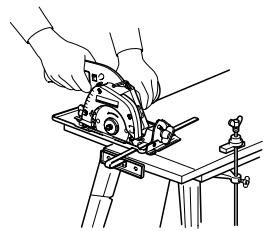
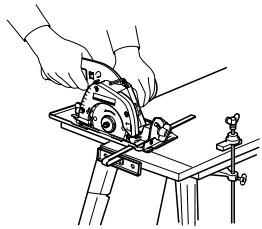
- Never hold piece being cut in your hands or across your leg. Secure the workpiece to a stable platform. It is important to support the work properly to minimize body exposure, blade binding, or loss of control.
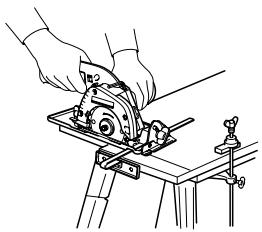
A typical illustration of proper hand support and workpiece support.
011401
-
Hold power tool by insulated gripping surfaces when performing an operation where the cutting tool may contact hidden wiring. Contact with a "live" wire will also make exposed metal parts of the power tool "live" and shock the operator.
-
When ripping always use a rip fence or straight edge guide. This improves the accuracy of cut and reduces the chance of blade binding.
-
Always use blades with correct size and shape (diamond versus round) of arbour holes. Blades that do not match the mounting hardware of the saw will run eccentrically, causing loss of control.
-
Never use damaged or incorrect blade washers or bolt. The blade washers and bolt were specially designed for your saw, for optimum performance and safety of operation.
9. Causes and Operator Prevention of Kickback:
- kickback is a sudden reaction to a pinched, bound or misaligned saw blade, causing an uncontrolled saw to lift up and out of the workpiece toward the operator;
when the blade is pinched or bound tightly by the kerf closing down, the blade stalls and the motor reaction drives the unit rapidly back toward the operator; - if the blade becomes twisted or misaligned in the cut, the teeth at the back edge of the blade can dig into the top surface of the wood causing the blade to climb out of the kerf and jump back toward the operator.
Kickback is the result of saw misuse and/or incorrect operating procedures or conditions and can be avoided by taking proper precautions as given below.
- Maintain a firm grip with both hands on the saw and position your arms to resist kickback forces. Position your body to either side of the blade, but not in line with the blade. Kickback could cause the saw to jump backwards, but kickback forces can be controlled by the operator, if proper precautions are taken.
- When blade is binding, or when interrupting a cut for any reason, release the trigger and hold the saw motionless in the material until the blade comes to a complete stop. Never attempt to remove the saw from the work or pull the saw backward while the blade is in motion or kickback may occur. Investigate and take corrective actions to eliminate the cause of blade binding.
- When restarting a saw in the workpiece, centre the saw blade in the kerf and check that saw teeth are not engaged into the material. If saw blade is binding, it may walk
up or kickback from the workpiece as the saw is restarted.
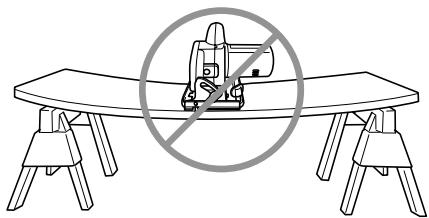
Support large panels to minimise the risk of blade pinching and kickback. Large panels tend to sag under their own weight. Supports must be placed under the panel on both sides, near the line of cut and near the edge of the panel.
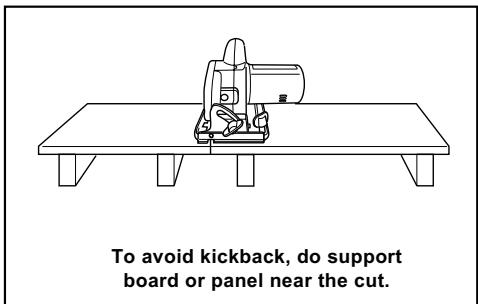
011398
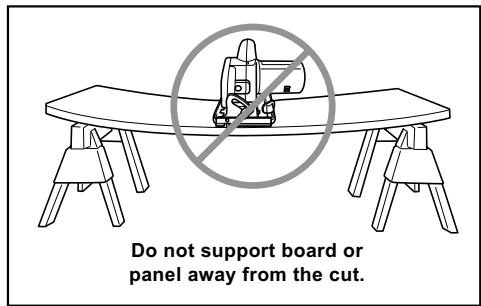
011399
- Do not use dull or damaged blades. Unsharpened or improperly set blades produce narrow kerf causing excessive friction, blade binding and kickback.
-
Blade depth and bevel adjusting locking levers must be tight and secure before making cut. If blade adjustment shifts while cutting, it may cause binding and kickback.
Use extra caution when making a "plunge cut" into existing walls or other blind areas. The protruding blade may cut objects that can cause kickback. -
Check lower guard for proper closing before each use. Do not operate the saw if lower guard does not move freely and close instantly. Never clamp or tie the lower guard into the open position. If saw is accidentally dropped, lower guard may be bent. Raise the lower guard with the retracting handle and make sure it moves freely and does not touch the blade or any other part, in all angles and depths of cut.
- Check the operation of the lower guard spring. If the guard and the spring are not operating
properly, they must be serviced before use. Lower guard may operate sluggishly due to damaged parts, gummy deposits, or a build-up of debris.
- Lower guard should be retracted manually only for special cuts such as "plunge cuts" and "compound cuts." Raise lower guard by retracting handle and as soon as blade enters the material, the lower guard must be released. For all other sawing, the lower guard should operate automatically.
- Always observe that the lower guard is covering the blade before placing saw down on bench or floor. An unprotected, coasting blade will cause the saw to walk backwards, cutting whatever is in its path. Be aware of the time it takes for the blade to stop after switch is released.
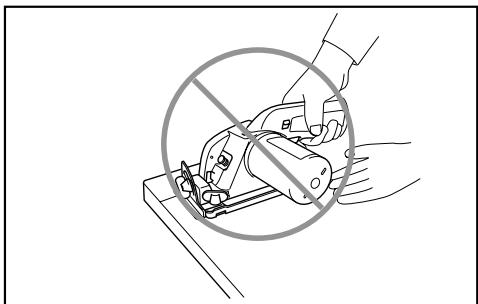
- ALWAYS hold the tool firmly with both hands. NEVER place your hand or fingers behind the saw. If kickback occurs, the saw could easily jump backwards over your hand, leading to serious personal injury.
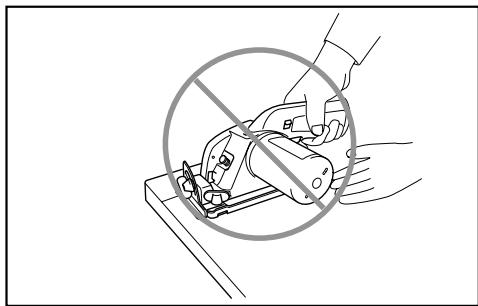
011400
- Never force the saw. Push the saw forward at a speed so that the blade cuts without slowing. Forcing the saw can cause uneven cuts, loss of accuracy, and possible kickback.
- Use extra caution when cutting damp wood, pressure treated lumber, or wood containing knots. Adjust speed of cut to maintain smooth advancement of tool without decrease in blade speed.
- Do not attempt to remove cut material when blade is moving. Wait until blade stops before grasping cut material. CAUTION: Blades coast after turn off.
- Avoid Cutting Nails. Inspect for and remove all nails from lumber before cutting.
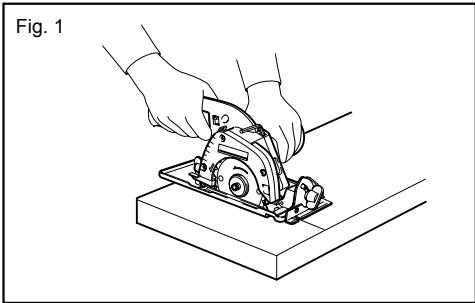
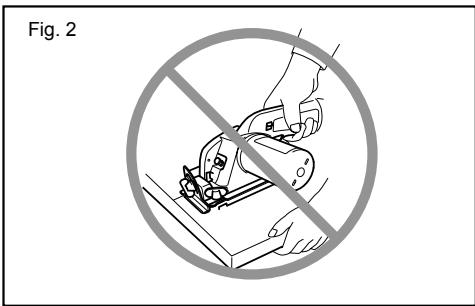
- Place the wider portion of the saw base on that part of the workpiece which is solidly supported, not on the section that will fall off when the cut is made. As examples, Fig. 1 illustrates the RIGHT way to cut off the end of a board, and Fig. 2 the WRONG way. If the
workpiece is short or small, clamp it down. DO NOT TRY TO HOLD SHORT PIECES BY HAND!
Fig. 1
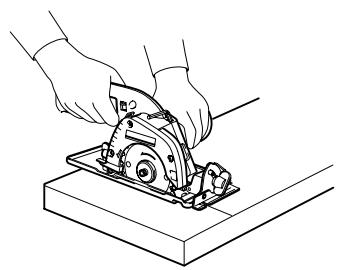
011402
Fig. 2
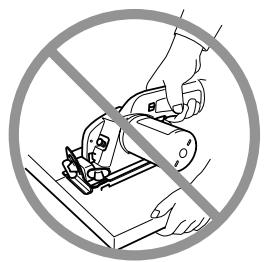
011403
- Before setting the tool down after completing a cut, be sure that the lower guard has closed and the blade has come to a complete stop.
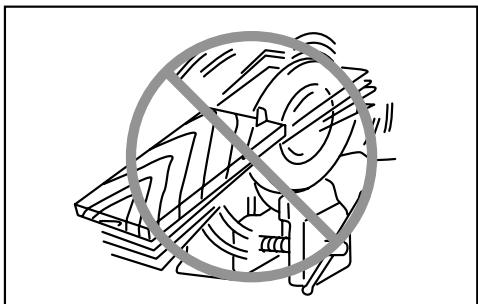
- Never attempt to saw with the circular saw held upside down in a vise. This is extremely dangerous and can lead to serious accidents.
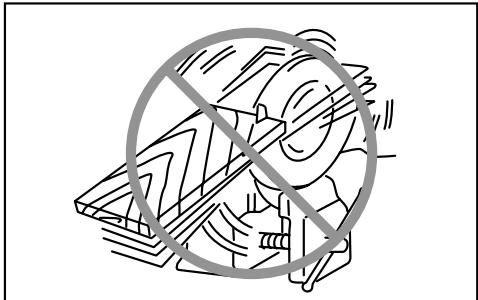
011397
- Some material contains chemicals which may be toxic. Take caution to prevent dust inhalation and skin contact. Follow material supplier safety data.
- Do not stop the blades by lateral pressure on the saw blade.
-
Always use blades recommended in this manual. Do not use any abrasive wheels.
-
Keep blade sharp and clean. Gum and wood pitch hardened on blades slows saw and increases potential for kickback. Keep blade clean by first removing it from tool, then cleaning it with gum and pitch remover, hot water or kerosene. Never use gasoline.
- Wear a dust mask and hearing protection when use the tool.
SAVE THESE INSTRUCTIONS.
WARNING:
DO NOT let comfort or familiarity with product (gained from repeated use) replace strict adherence to safety rules for the subject product. MISUSE or failure to follow the safety rules stated in this instruction manual may cause serious personal injury.
ENC007-6
IMPORTANT SAFETY INSTRUCTIONS
FOR BATTERY CARTRIDGE
- Before using battery cartridge, read all instructions and cautionary markings on (1) battery charger, (2) battery, and (3) product using battery.
- Do not disassemble battery cartridge.
- If operating time has become excessively shorter, stop operating immediately. It may result in a risk of overheating, possible burns and even an explosion.
- If electrolyte gets into your eyes, rinse them out with clear water and seek medical attention right away. It may result in loss of your eyesight.
- Do not short the battery cartridge:
(1) Do not touch the terminals with any conductive material.
(2) Avoid storing battery cartridge in a container with other metal objects such as nails, coins, etc.
(3) Do not expose battery cartridge to water or rain.
A battery short can cause a large current flow, overheating, possible burns and even a breakdown.
- Do not store the tool and battery cartridge in locations where the temperature may reach or exceed 50^ C (122 F).
- Do not incinerate the battery cartridge even if it is severely damaged or is completely worn out. The battery cartridge can explode in a fire.
- Be careful not to drop or strike battery.
- Do not use a damaged battery.
SAVE THESE INSTRUCTIONS.
Tips for maintaining maximum battery life
- Charge the battery cartridge before completely discharged.
Always stop tool operation and charge the battery cartridge when you notice less tool power.
- Never recharge a fully charged battery cartridge.
Overcharging shortens the battery service life.
- Charge the battery cartridge with room temperature at 10^ - 40^ (50° F - 104° F). Let a hot battery cartridge cool down before charging it.
FUNCTIONAL DESCRIPTION
CAUTION:
Always be sure that the tool is switched off and the battery cartridge is removed before adjusting or checking function on the tool.
Installing or removing battery cartridge
Fig.1
Always switch off the tool before insertion or removal of the battery cartridge.
To remove the battery cartridge, withdraw it from the tool while pressing the buttons on both sides of the cartridge.
- To insert the battery cartridge, hold it so that the battery cartridge front shape fits to that of the battery installment opening and slip it into place. Always insert it all the way until it locks in place with a little click. If not, it may accidentally fall out of the tool, causing injury to you or someone around you.
- Do not use force when inserting the battery cartridge. If the cartridge does not slide in easily, it is not being inserted correctly.
Battery protection system
The tool is equipped with the protection system, which automatically cuts off the output power for its long service life.
The tool stops during operation when the tool and/or battery are placed under the following situation. This is caused by the activation of protection system and does not show the tool trouble.
- When the tool is overloaded:
At this time, release the switch trigger and remove causes of overload and then pull the switch trigger again to restart.
- When the remaining battery capacity gets low:
Recharge the battery cartridge.
Adjusting depth of cut
Fig.2
CAUTION:
After adjusting the depth of cut, always tighten the clamping screw securely.
Loosen the clamping screw on the depth guide and move the base up or down. At the desired depth of cut, secure the base by tightening the clamping screw.
For cleaner, safer cuts, set cut depth so that no more than one blade tooth projects below workpiece. Using proper cut depth helps to reduce potential for dangerous KICKBACKS which can cause personal injury.
Bevel cutting
Fig.3
Loosen the clamping screw on the bevel scale plate on the front of the base. Set for the desired angle (0^ - 45^) by tilting accordingly, then tighten the clamping screw securely.
Sighting
Fig.4
For straight cuts, align the A position on the front of the base with your cutting line. For 45^ bevel cuts, align the B position with it.
Switch action
Fig.5
CAUTION:
Before inserting the battery cartridge into the tool, always check to see that the switch trigger actuates properly and returns to the "OFF" position when released.
- Do not pull the switch trigger hard without pressing the lock-off lever. This can cause switch breakage.
To prevent the switch trigger from being accidentally pulled, a lock-off lever is provided. To start the tool, slide the lock-off lever and pull the switch trigger. Release the switch trigger to stop.
WARNING:
- For your safety, this tool is equipped with lock-off lever which prevents the tool from unintended starting. NEVER use the tool if it runs when you simply pull the switch trigger without pressing the lock-off lever. Return tool a MAKITA service center for proper repairs BEFORE further usage.
NEVER tape down or defeat purpose and function of lock-off lever.
ASSEMBLY
CAUTION:
Always be sure that the tool is switched off and the battery cartridge is removed before carrying out any work on the tool.
Removing or installing saw blade
Fig.6
CAUTION:
- Be sure the blade is installed with teeth pointing up at the front of the tool.
Use only the Makita wrench to install or remove the blade.
To remove the blade, press the shaft lock fully so that the blade cannot revolve and use the wrench to loosen the hex bolt counterclockwise. Then remove the hex bolt, outer flange and blade.
Fig.7
To install the blade, follow the removal procedure in reverse. BE SURE TO TIGHTEN THE HEX BOLT CLOCKWISE SECURELY.
Fig.8
NOTE:
If a inner flange is removed by chance, install the inner flange so that its protrusion (bigger side) faces inside as shown in the figure.
When changing blade, make sure to also clean upper and lower blade guards of accumulated sawdust. Such efforts do not, however, replace the need to check lower guard operation before each use.
Hex wrench storage
Fig.9
When not in use, store the hex wrench as shown in the figure to keep it from being lost.
Connecting a vacuum cleaner
Fig.10
Fig.11
When you wish to perform clean cutting operation, connect a Makita vacuum cleaner to your tool. Install the dust nozzle (accessory) on the tool using the screw. Then connect a hose of the vacuum cleaner to the dust nozzle as shown in the figure.
OPERATION
CAUTION:
- Be sure to move the tool forward in a straight line gently. Forcing or twisting the tool will result in overheating the motor and dangerous kickback, possibly causing severe injury.
NOTE:
- When the battery cartridge temperature is low, the tool may not work to its full capacity. At this time, for example, use the tool for a light-duty cut for a while until the battery cartridge warms up as high as room temperature. Then, the tool can work to its full capacity.
Fig.12
Hold the tool firmly. The tool is provided with both a front grip (motor housing) and rear handle. Use both to best grasp the tool. If both hands are holding saw, they cannot be cut by the blade. Set the base on the workpiece to be cut without the blade making any contact. Then turn the tool on and wait until the blade attains full speed. Now simply move the tool forward
over the workpiece surface, keeping it flat and advancing smoothly until the sawing is completed.
To get clean cuts, keep your sawing line straight and your speed of advance uniform. If the cut fails to properly follow your intended cut line, do not attempt to turn or force the tool back to the cut line. Doing so may bind the blade and lead to dangerous kickback and possible serious injury. Release switch, wait for blade to stop and then withdraw tool. Realign tool on new cut line, and start cut again. Attempt to avoid positioning which exposes operator to chips and wood dust being ejected from saw. Use eye protection to help avoid injury.
Rip fence (Guide rule) (optional accessory)
Fig.13
The handy rip fence allows you to do extra-accurate straight cuts. Simply slide the rip fence up snugly against the side of the workpiece and secure it in position with the screw on the front of the base. It also makes repeated cuts of uniform width possible.
MAINTENANCE
CAUTION:
Always be sure that the tool is switched off and the battery cartridge is removed before attempting to perform inspection or maintenance.
- Never use gasoline, benzine, thinner, alcohol or the like. Discoloration, deformation or cracks may result.
To maintain product SAFETY and RELIABILITY, repairs, any other maintenance or adjustment should be performed by Makita Authorized Service Centers, always using Makita replacement parts.
ACCESSORIES
CAUTION:
These accessories or attachments are recommended for use with your Makita tool specified in this manual. The use of any other accessories or attachments might present a risk of injury to persons. Only use accessory or attachment for its stated purpose.
If you need any assistance for more details regarding these accessories, ask your local Makita Service Center.
Saw blades
Rip fence (Guide rule)
- Hex wrench 4
Dust nozzle
- Various type of Makita genuine batteries and chargers
SVENSKA (Originalbruksanvising)
Tomoyasu Kato Director
Makita Corporation
3-11-8, Sumiyoshi-cho, Anjo, Aichi, JAPAN
GEA010-1
Michigan Drive, Tongwell,
10.2.2010

3-11-8, Sumiyoshi-cho,
Anjo, Aichi, JAPAN
GEA010-1
3-11-8, Sumiyoshi-cho,
Anjo, Aichi, JAPAN
GEA010-1
"MaKita International Europe Ltd",
10.2.2010

000230
Tomoyasu Kato Direktors
"Macita Corporation"
3-11-8, Sumiyoshi-cho, Anjo, Aichi, JAPANA
GEA010-1
Visparejie mehanizeto darbariku drošibas bridinajumi
BRIDINAJUMS Izlasiet visus drošibas bridinajumus un visus noradijumus. Bridinajumu un noradijumu neieverosanas gadjumā var rasties elektrkás strávas trieciens, ugunsgreks un/vai nopietnas traumas.
Glabajiet visus bridinajumus un noradijums, laivaretu tajos ieskatities turpmak.
GEB077-2
DROŠIBAS BRIDINAJUMI BEZVADU RIPZAGA LIETOŠANAI
- BISTAMI: Netuviniet rokas griesanas zonai un asmenim. Otro roku turiet uz papildus roktura vai dzineja korpusa. Ja turat zaigi an abam rokam, asmens tas nevar sagriezt.
- Nesniedzieties zem apstradajama materiala. Aizsargs neaizsarga no asmens zem apstradajama materiala.
- Noreguljiet griesanas dzilumu atbilstosi apstradajama materia lia bezumam. Zem apstradajama materi laja jabut redzamam nedaudz mazak nekā vesselam zága zobam.
- Apstradajamo gabalu nekad neturiet rokas vai pär kaju. Apstradajamo materiäu piestiprijet stabilai platformai. Materialiu ir svarigi parezìnostiprinat, lui mazinatu apdraedjumu kermenim, asmens iekflésanss vai kontrocles zuduma risku.
Standarta attels pareizam roku un apstradajama materiala atbalstam.
011401
Michigan Drive, Tongwell,
Milton Keynes, MK15 8JD, England (Anglia)
10.2.2010

000230
Tomoyasu Kato
Direktorius
Makita Corporation
3-11-8, Sumiyoshi-cho,
Anjo, Aichi, JAPAN (JAPONIJA)
GEA010-1
EESTI (algsed juhised)
Ulvaate selqitus
1-1. Akukassett
5-2. Luliti päästk
8-2. Eend
1-2. Nupp
6-1. Völlilukk
8-3. Valimine flans
2-1. Pitskruvi
6-2. Kuuskantvoti
8-4. Saetera
2-2. Sugavusjuhik
7-1. Kuuskantpolt
8-5. Sisemine flans
3-1. Pitskruvi
7-2. Valimine flans
Michigan Drive, Tongwell,
10.2.2010

000230
Tomoyasu Kato
direktor
Makita korporatsoon
3-11-8, Sumiyoshi-cho,
Anjo, Aichi, JAAPAN
GEA010-1
TEXHINUeCKNE XAPAKTEPNUKNI
CTaHdApTHoM MeToDnKoI NCbItaHm I MoKet 6bITb NcNoIb3ObaHO DJIa CpaBHeHn HNCTpyMeHTOB.
3aBHeHnOe 3NaHEnpe paCnpocTpaHnE Bn6paun MoXHO TaKKe IcNoJIb30BaTb DnI PneDbapnteJbHbIX OceHOK BO3DeiCTBnI.
TIPDEUYTPEJKDEHN:
PacnpoctpaHHeN Bn6paunn BO BpemfФaktnueckoro NcNoIb3OBaHn3JNeKtponHCTpyMeHTa MoKET OTmuaTbcr OTO3aBnEHHO 3NaueHEn B 3aBNCMOnctn CnOco6a npImeHHeN INCTpyMeHTa.
- 063aTeIbHo onpeDenIte Mepbl be3oNaChocTn
ДлЯ 3aunTbI opeTpOpa, ochOBaHbIe Ha OcHKe
B03dIeCTBnB Y peAlhBxI yCNoBIAx
NcNoJIb3OBAHnI (C yETOM BcEx eTanOB paOboYero
UKNJa, taKIX KAK BblKJIOChEm INHCTpymHeTa,
paOTo aE3 hArpy3kn INBKnOyehne).
ENH101-14
ToIbko dny eBponecknx cTpaH
Deknapaun o COOTBETCTBUN EC
Makita Corporation, JBnAocb OTBcTBeHHbIM npOn3BoInTeJeM, 3aBnAeT, yTO CJeDyUoJne ycToiCTBa Makita:
0603nueHne yctpoiCTBa:
AkkymyIaTOpHaN aIpkynIaPHaN iIina
10.2.2010

000230
3-11-8, Sumiyoshi-cho,
Anjo, Aichi, JAPAN
GEA010-1
Оьшце pekomehdaци поТexнIKE 6e3OpaHcOCTn ДлЯЗелкторнстчмЕТВ
PNEpyPEXKDEHNE O3HaKoMbTeScb CO BCEMNHTcPKUHM INe PekOMHeAaUMN NO TEXHKe63oNaChOCTN.HeBInOnHeHne HnCTpKUIM INe peKOMHeAaM NMOKET nPiNbEcTn K nopaxEHNO3JIeKTPoTOkOM,NoXapy Hn/IN TAgKeBbIM TpaBMaM.
CoxpaHnTe 6poUhopy c HnctpyKcIyMaMn IpeKOMeHdaQIaMm DJIaJIbHeJWeO NcNoJIb3OBAHnI.
GEB077-2
ПРавиЛАТEXнКИ БЕЗОПACHEСТИ ПРИ ЭКСПЛУATAЦИ АKKUMYЛЯTOPHО ЦRPКУЛРHOД ПИЛБI
- ONACHOCTb: Depxnte pykn Ha pacctoHm OT Mecta paCnna Nnbl. Depxnte BTOpy kHa DOnONHInTeJbHO npyke HnN KOpnyce MoTopa.Yepzahne INCTpymenta OBeHmPykAmNo3BOIINT n36ExKaTb INNONADAHNIO DNCK Nnbl.
- He HauKIOHJIteCb noD obpa6aTbIbAemyo detanb.OrpaXdEHe He 3aUHTBt BAC OT DnCKa noD obpa6aTbIbAeMoJ deTaJIbI.
- Otperynnpyte rnybny pacnnna B COOTBETCTBn C ToLHNOI DeTANI. POn
pacnINBaemOn DeTaIbIO DoJKeH 6bITb BnDEH NOHTN BEc3y6 Pnbl.
- HnKOrJa He DepxKeIte pa3pe3aEmyO Detanb pyKaMn, Hne CTabBte ee nonepek HOrn. 3AkpenIte 6opBaTaBbAeMyo Detanb Ha yctpoHvOBOM OCHOBAHm. BaxHo oecneuHt npABNbHyO fKnCAcuNIO Detann DnCHKeHn DO MHNIMMa pNcKa POnJUeyHn TpaBM, 3aKNINHBaHn DnCKa INNnotepn KOHTpONJ.
TnHnHna HnHocTaPnna PpaBnBHoR
pa3MeueHn pyK nФmKcaun paCnNbaEmoI deTann.
011401
- Ecni npn BbInonHeHH npabot cyueCTByet pNCK KOHTaPpeJyUero HNCTpyMeNTa COCKbIToI 3NeKTPnpOBOdkO, DePKeHte 3NEKTPOnHCTpyMeNTbI 3a CneuHaJIbHO npedHa3NaYeHHeIe N3OJIPOBaHHBe NOBepxHoCTN. KONTc c npOBoDM oND HanpRaeHem npINBeTe K TOMy, YTO MetaJInuCeKMe DetAlTI NCHtpymEtA TaIKe 6yDyT nOD HanpRaeHem, yTO npINBeTe K npopaxHIO OepaTopa OeTPOuCeKIM TOKOM.
- Ipn pacnne Bcerda HcnoJb3yIte HnpabJnHyo PJIaHKy MIn npmyo HnpabJIOUO NO kpaO. 3TO NOBbIaET TOHOCb paCnna NCHkae pNCK N3r6a DnCKOB0 NiJIbl.
- Bcerda nCnoNb3yIte DnCKOBbIe nIIbl coOTBcTCTByUOJIero pa3Mepa nΦoPmbl OTBcPcN dIa UINHdJIe (pOM6OBDHbIE uIN KpyIbIe).PiIbI c HecOOBTcTCTByUOJIm KpeIJIeHNEM bdyt pa60TaT bKcEHTPNueCKn, yTO npINBeTe K nOTEpe KOHTPOJ NaH INHCTpymEtOM.
- HnKOrda He nCnOlb3yIte nobPexdeHbIe nnn HecooTBeTCTByUoJne 7aN6bl, nnn 60NT dNcKOBO Nnbl. 7aN6bl n60T nNbl 6bln cNeuaJIbHO pa3pa6OtaHbI dNra daHNO nRPKynrPHOn nNbl dNra o6ecneueHn ONTMaJIbHbIX 3KcPiyaTaUIOHbIX XapAKTePrcntIK n 6e3OpacHoCTn pa60bl.
- Пичинь образно OTдачи Меры ee npedotbpaanseHЯ onepaTOPM:
OTDAH -3TO MTHOBeHHaPeaknHa Ha 3aueMHeHne, n3rno Hn Hapuyehne COOCHCTN CHPKyIpaRHOINPiNb, npINBOJuaA K HeKOHTpONIPyEMOMy NOBEmy NINblnE
He noDdepeKbAaTe DoCKy nn NaHb Ha 3NaHTeBHom pacCToHHN O MeTa paCnHa.
011399
He nCpOJIb3yIe TynIe nnIOBpeXJDeHbIe DNCKn. He 3atoYehIbe nnHepPaBnIbHO yCTaHOBJIeHNbIe DNCKn npINBeDt K y3KOMpyacnIy, YTO npINBeTe K Qpe3MePHOMy TpeHIO, 3aKnINBaHne DNCKn OITDAe.
- Пара pe3ko HeobxOdmo KpEnko 3aTHyTb 6bokpyouepebUarpe3K. Ecni npi pe3ke perynipOBka NcKa hApuyntcra, 3TO MOKeT PnBecTu K 3aKnHbAHIO DNCKa BO3HNKHOBeHHO OTdaH.
Будte Oco6eHNO octopoxHbI npn BblonHHeHH "Bpe3Kn" B cyueCTByIOuNX CTehax NnHa Dpyrnx Hne3BeCThIx yuctkax. BblctyauoJIN DNCK NIIb MoKet CTOLKNHytbcra CnpedMeTAMN, KOtopbIe MOryt npmbecTu K obpathoN OTDAhe.
- Npeed kajdbim nCnoJb3ObaHnem y6eInTeCb B TOM, qTO HxKHee orpaxdHeine xopoOo 3akpbITo. He 3KnIpyAtnpyTe nHy, ecnn HxKHee orpaxdHe He nepeMeuAetcB CBOODHO m MRHOBeHN Ho 3aKpbIbAeTcN. HNKOrJa He fIKCNpyTe HxKHee orpaxdHee B OTKpblTom IOnOKeHm KAKM 6bI To HN 6bIIO cnOCobom. PnP cnyaHOM naDeHm nnblor paxdHe moKET corHytcb. PoDnHMITE HxKHee orpaxdHeine npn NOMOUs pyKn iNDbEMa n y6eINTeCB bero CBOODHom nepemueHm, nQTO OH e KaCaTaC TNIbln IN dpyrNX detanei pnip BCex yrrnx n rIybuHax
NIIJIeHnI.
- Поберытpe pa6otу npyknHbI HnXHero orpaXdEHHa.EcnnOrpaXdEHHe npykHa He pa6oTaOT NaIeXaUIMO6pa3OM, IN He06XoDmO OTePMOnTHpOBaTb pepe IcNoJIb3OBAHem UINPKyIpHOn NIIbl. HnXheeorpaXdEHHe MOKeT pa6oTaTb MeIeHHO n3-3a NobPexdEHHbIX DeTaeJIe, OTIOXeHHa CMON IIN CkOPIeHHa MyCopa.
- HxKHee orpaXdHne DoJxHo nOaHMaTbcB BpyHyTOIbKO npn CneuaNAbHbIX paCnIIax, TAKNX KAK Bpe3AHne NIN CLOXHOe paCnINHBaHne. POnHMnTe HxKHee orpaXdHne, NOHnB pyKy, N KaK TOJIbKO IINa BOiDeT B paCnINBaEMbM MaTePnAIn, HxKHee orpaXdHne MoKeT 6bITb ONUeHO. IBy BceX Dpynx BNIOB NINeHn HxKHee orpaXdHne DOJxHO pa6oTaB ABToMaTueckn.
- Npeed TEM KAK NOLOXnTB NHny Ha Bepctak HnHa nON, BcERda npOBepaTe, YTO HNXHHe ORpaxdene 3akpbIbAeT pexyu nnck. He3auuHennb, Bpaauoouncr no INhePmD NCK NIIb MOKeT HnepeHamepeHNO DBNHytCBs Ha3aI, paCNINBaB Ce, YTO nonaetcna HnyTN. POMNHTE O BVPemH, Heo6xOdMOM Dn8 octAHOBKn NIIbI NocLe OTNysKaHHa KypKOBOrO BbIKIOUcATEJIa.
- BCEΓДA DePKeTe HNCTpymeHT OBeHMn pykam. HIKOKrDA He NOMEuaJIte pykn nnn naIbci c3aDn nnB. B Cnyae OTdaH, nna MoKet IerKO OTCKOHT bHa3d Na BaUy pyK, TTo npINBeET K cepbe3HOIT TaPbME.
011400
- HnkOrda He npnlaraHTe noBbIeHHbIX ycIIIN K nIIe. DBrnaiTe nIy Bnepe Co ckOpocTbIO, KOtOpA NO3BOJAE DNCKOBON IIIE nnITb 63 CHIKENK CKOPoCTN. IpnIOKeHHe NOBbIeHHbIX ycIIIN K DNCKOBON IIIE MoJcET npNBecTN K HepaBHOMepHOMy pacNIUY, CHIKeHNO TOHOCTH N BO3MOXHO OTDAue.
- BydTe 0ocbeHNO 0ctopoxhbl npn pacnInBaHHMOKpO JpeBeCNbI, npeccOBaHHo dpeBecHNbl INN dpeBecHNbIC cyKam.N Otperyu npyTe ckopocTb
pacnININBaHn TaKIM O6pa3OM, TTObI nOndepKINBaTb PnABHOe DnBKeHne PnIbI 6e3 CHNKeHnCKOpocTN BpaUeHn DaNCa.
- He nbItaItecb y6bpaTb oTe3aHbIe deTaII npn BpaueHm DnCKOBoi nIIbl. IpePe ydaJIeHNEM paCNIeHNBIX DeTAJIeN JOxDiTEc bONHO OCTaHOBN NIIbl. IPEyIYPExKJEHHe: nOcne BbIKIOUeHn IINa eIe 6ydt HekOTOpoe BpMaBpauaTbcn.
18.ИЗбeraи Te nonaДаня peжуцero nHCTpyMeHTa Ha rBO3n.IIpeed paCINJIbAHHeM OCMOTpIne DeTaIb I ydAnIte n3 Hee BcR rBO3m. - TomecHTe ⅢnPKoYIO qAcTb OCHOBAHnI ZnPKyIaRHOH NIIb Ha YacTb DetaII, NMeOuSe HAdExHoe KpEnJIeHne, a He Ha TY qAcTb, KOTOPa 6ydt Otpe3Ha nUyadet npi OTNIIBaHm. B KaYeCTBe pPImepa PnC. 1 Noka3bIbAet PPABINbHbI cnoc6 Otpe3Kn Kpa DocKn I nC. 2 HEPABINbHbI cnoc6. EcIn pacnNlBaMaJd TcAnB KOpOTKaI IN ManehKka, ee Heo6OJIMo 3akpenIb. HE IIbITAITECb DEPxATb KOPOTKNE DETALIN PYKOI!
011402
011403
- Npeed pa3meeHem nIbI nocne 3aBepeHnna pacnna, y6eHntecb, YTO HxHcE orpaxdHe 3akpbIIOcb, nTO nIa nOIIHOCTbIO npekpATnla BpaauTbCn.
- HnKoIa He nbItaiTeCb nIIInTb npn nomOu npeBepHyToI cIpyKUyIpaHOn pINbl, 3axaToB TnCKax. 3TO OueHb ONaCHO M MoKET
011397
- HeKOTOpbIe MaTePnAbl MyrT coDEpKaTb TOKCNHbIe XmNueckne BeUeCTBa. PnIMnTE COOTBeTCTByOuIe MEPbI pPeOCTOPOXHOCTH, YTObI n36EkaTb BdIXaHNs Nn KONTaTc KoKei TAKNX BeUeCTB. Co6HoaJte Tpe6obAHn, yKa3aHHbIe B nacnopte 6e3onachOCTn MaTePnAna.
- He nbItaTaeTcB octaHOBnTb nNny nyTEM 6OKOBOrO daBHeHnHa dNckOByU nNny.
- Bcerda nCnoNb3yIte nIbl, peKoMeHDoBaHHbIe B DaHHom pyKOBoDcTBe. He nCnoNb3yIte KaKHe-Ni6o a6pa3nBhIe dIscKn.
25.Пиьдонжыбьтбoctримичс'tьим. CMonaI dpebechblne,3aTbepeBwne Ha nDCKOBbIX PINJAX,CHNkaOT PON3BOIDTeNBHOCTb PnblI NOBbIaOT NOTeHcuaJIbHbI pCK OTdauCn CoedpKNTe NBy BcTcToTe.ДЯ STOrO Chmnte ee CnHCTpyMeHTa NOnCTHte PACTBOpNTeMe CMonI dpebeCHO peKa,TopaeB BODoI Jn KepocInHom.HNKOrDa He NCNoJIb3yIte 6EH3HN.
26.ПиИСПОЛБЗOBAHIN ИСТРУМЕТА НадБаITeNBJIe3aUHTHyO MaCKy I NcPONIb3yITe CpeIDCTBa 3aUNTbI cIvyA.
COXPAHNTE DAHHbIE INHCTPYKcN.
△PENEYUNPEXDEHIN:
HE DONYCKAITE, YTO6bI yOo6cTBO HIN OnblT 3Kcnnyataun DaHHoro yCTpoiCtBa (NOnyueHbI OH MTHOROKpArTHOrO NcONb3OBaHn) DOMHNHPOBAnu HAd CTporm CO6JIIODeHnEM npABIn TEXHnIK 6e30NaChOCTn Pn ObpaJeHn C 3TNM yCTpoiCTBOM. HEIPABUNBJHOE NCIOJIb3OBAHNe INCTpyMeHa Tnn He6OJIIODeHne npABIn TEXHKn 6e30NaChOCTn, Yka3aHHbIX B DaAHHom pyKOBoDCTBe, MOKeT npInBeCTn K T8KeJIoT TaPBeM.
BAЖHbI E NHCTPYKcIIN IO TEXHnke B3OpACHOCTNДЯ AKKUMyJIaTOPHO6JOKA
- Npeed hCnoJIb3ObaHHe m AKKymJrTOphORo 6Ioka npouHTaTe BCE nHCTpyKuNn n npEduPpeXdaOpUne HaDnncn Ha (1) 3apAnHom ycTpoiCTBe, (2) AKKymJrTOphOM 6Ioke n (3) HNCTpymEnTe, paBoTaHOe OT aKKymJrTOphORo 6Ioka.
- He pa36npaTe aKkymyIaTOpHbI 6Jok.
- EcIn BpeMa pa60TbI akKymyIaTOpHOro 6NoKa 3HaHTeINbHO COKpatINocB, HeMeDnEHNO npeKpaTIte pa6Otu. B npOTnbHOM cIyuae, MoXet BO3HNKHyb NepeRpeB 6NoKa, TpO pINBeTeK OXKOrAM IaJae K B3PbIBy.
- B cnyae nonaadaHna 3neKtpoHnTa B rIa3a, npomoe INX O6JIbHbIM KOINueCTBOM UCTO BObl HEmeJeHHO 6paTntecb K Bpaay. 3To MoKet PpNBecTN K notepe 3peHnA.
- He 3aMbIkaIte KOHTaKTbI aKKymyIaTOPHOrO 6JOKa MEXdy co6oB:
(1) He npinkacaiTecb K KOHTaKtAm KaKIMN-JI6o TOKOpopoBDAuIMn PpeDMeTaMn.
(2) ɪnɪsɪeɪnɪtɪbʌkKymIyIaTOpHbɪn 6ɒk B KOHTeɪHepe BmecTe C ἀpyrɪMn MetaɪnɪyeckɪMn πpeɪdMeTaɪn, TakɪMn KAK ΓB03ʌn, MOHæTbɪ N T. n.
(3) He donyckaHTe nonadaHnHa akKymJIaTOPbI b6NOK BObI INI DOxJa. 3aBikAHne KOHTAKTOB akKymJIaTOPHO 6Noka MEXdy CO6o MoXet npNbEcTe K Bo3HNKHOBeHIO 60nbUoro TOKA, nepepeBy, BO3MOXHbIM OXORAM n DaKe pa3pbBy 6Noka.
- He xpaHnTe HnctpyMeHT n AkkymyIaTOpHbI blok B MecTaX, Ie TeMnepaTypa MoKet doCTnRaTb Nn PpeBbIaTaB 50° C (122° F).
7.He 6pocaiTe akkymyIaTOphBb 6nok B orOHB, daxe ecnn OH CnblHO nobpeKdeH nIN NOHOCbBO BBIIeN N3 CTPOJ. AkkymyIaTOphBb 6nok MOKeT B3OpBaTbcra ND DeJeCTbEM OrHr. - He poHnIte n He yIapAit e AKKymyIaTOpHbI 6JOK.
9.He nCnoJb3yIte noBpeKdEHHbI aKKymJIaTOpHbI 6Iok.
COXPAHNTE DAHHbIE INHCTPYKcIN.
CoBeTbI NO oBecneueHnIO MaKcHMaJIbHorO cPoka Cnyx6bl aKKyMylrTopHOro 6Joka 6Joka
- 3apjkaTe akkymyIaTOpHbI 6nok Do TOrO, KaK OH NOnHOCTbIO pa3pIaNTcR.
B cnyuae noteprn mozhoctn npn 3kcnnyataunn Hnctpymehta, npekpatnte pa60ty u3apndte akkymyIaTOpHbI 6nok.
- HnKOrda He 3apJkaIte noNHOCTbIO 3apJxHeHHbAkkymyIaTOpHb6Iok.
IpeepaKa cokpaaet cpk cnky6bl 6nka.
- 3apjkaTe akkymyIaTOpHbI 6nok npKOMHaTHoI TeMtnepaTyB npeJenax ot 10^ do 40^ (OT 50^ do 104^) .IpeE3apJkoI daTe ropaemy akkymyIaTOpHomy 6noky OCTbITb.
ОПИСАНЕ ФУHKЦИОнЮВАНИА
△IPEDUYIPKJEHN:
Ipeed perynipoBko nnipOBepkoIyHKUHOHPOBAHNA BcerdaOTKJIOUaTeINCTpyMeHT N BbIHMaTE 6LOK aKKyMylTOpOB.
UctaHOBka nIIN CHrTne 6noka aKKymyIaTOPOB
Pnc.1
- Параь Вставков Или Chятуем 6лoka akkyмларов BCERda OTKЛЮчай Te INHCTpymENT.
- Драз_CHТЯЗ 6иОКа akKуМЛЯТОРВ, ВьнБte erO n3 ИСТPyмЕNTА, НжIMмЯ HA KONIKС Oбeнx CTОРН 6иОКа.
- 4TObB BCTaBnTB KapTpNdx AkkymyIYTopo, COBMeCTInTE nepeDHHO Yactb akKymyIYTopo c OTBepCTnEM THe3da, IN BCTaBBte Ha MeCTo. BceJa yctaHabNBAIte 6nOK Do yNopa TaK, 7cTobb OH 3aΦHKcPOBaCn HA MeCte C He6OJIbShIM UeIhKOM. B nptOBHOM cnyae AkKymyIYTophB b6nOK MoKET BblNaCTb N HCHpEmTa I TpaBMnPOBaTb Bac INI NKpyKaIoUxN.
He npilarai Te ycnni npn BCTabKe 6noka akkymnyTOpOB.Ecnn 6nok BCTabIeTc TpyDom, 3NaHT, OH BCTabJIeTc HnpaBnIbHO.
CnCTema 3aunTbI aKKymyIaTopa
Инстурment Oсашени СпcteMoI 3a山ITbI,KOTOPA АВТOMATИСЕСКИ OTКЛЮЧаET BыIXODHoe ПИТAHINE ДПЯ пюденья erO croka cnlyжбI.