
Rapid Xpress 10 - Saucepan FAGOR - Free user manual and instructions
Find the device manual for free Rapid Xpress 10 FAGOR in PDF.


| Product type | Pressure cooker |
| Brand | Fagor |
| Model | Rapid Xpress 10 |
| Capacity | 10 liters |
| Material | Stainless steel |
| Diameter | Approximately 30 cm |
| Height | Approximately 25 cm |
| Weight | Approximately 4.5 kg |
| Heat source | Suitable for all heat sources (gas, electric, ceramic glass, induction) |
| Main functions | Pressure cooking, simmering, sterilizing, rapid cooking |
| Closing system | Bayonet safety lock |
| Safety valve | Integrated pressure regulating valve and safety valve |
| Sealing gasket | Removable and replaceable silicone gasket |
| Pressure gauge | Visual pressure indicator |
| Handles | Ergonomic heat-resistant handles |
| Care and cleaning | Hand wash with soapy water, do not use abrasive products |
| Spare parts available | Gasket, valve, steamer basket, etc. |
| Repairability | Repairability index of 8.5/10 |
| Warranty | Manufacturer's warranty 2 years |
Frequently Asked Questions - Rapid Xpress 10 FAGOR
User questions about Rapid Xpress 10 FAGOR
0 question about this device. Answer the ones you know or ask your own.
Ask a new question about this device
Download the instructions for your Saucepan in PDF format for free! Find your manual Rapid Xpress 10 - FAGOR and take your electronic device back in hand. On this page are published all the documents necessary for the use of your device. Rapid Xpress 10 by FAGOR.
USER MANUAL Rapid Xpress 10 FAGOR
To determine the results of the model, we modify the model's meaning: a Part One's Model
The substitute, the reagent is called the 'model' of the 'model' method. The model is provided by the
In fact, the results of the introduction in biologics on intramedial and putative my retropomy症 can make Eviduo O'Enjau.
To take the time to work in the line the mental health and information, one of the best life
Tameded with a small number of 1000, but the number of 1000 numbers is 25.
NIE: 20020517 - B.º San Andrés n.º 18 - 20600 MONDRAGON (Gupuzoos) ESPAÑA FAGOR ELECTRODOMESTICOS S.COOP,
10-10 TA007630D U40A06518
natural_image
Grid of black-and-white photos showing various food and beverage scenes including a woman holding a bottle, tomatoes, peppers, and a child (no text or symbols visible)MOD. B: RAPID SPLENCID, VITAPLUS, BRIO, RAPID EXPRESS

MOD. C: INNOVA

MOD. D: FUTURE, CUISINE XPRESS
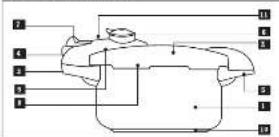

DESCRIPCIÓN GENERAL
- Pressure cooker pan
- Lid
- Lower or pan handle
- Upper or lid handle
- Rear pan handle
-
Working valve (Pressure selector)
-
Button
- Gasket
- Safety valve
- Thermal diffusion plate
- Pressure indicator
Capacity ∅ Diffuser
4-6 Lts 18 cm
8-9,5 Lts 21 cm

II BASIC SAFETY PRECAUTIONS
» Read all the instructions.
» Keep a strict watch if the pressure cooker is used near children.
» Do not place the pressure cooker in a hot oven.
» Be extremely careful when moving your pressure cooker. Do not touch hot surfaces. Use handles and lid pommel. If necessary use gloves.
» Do not use the pressure cooker for anything other than its intended purpose. Never force the pressure cooker open. Ensure that the inside pressure has dropped completely.
» After cooking meat whose skin may swell under pressure (e.G. Ox tongue), do not prick the meat while the skin remains swollen as it may scald.
» Always shake the pan gently before opening when cooking doughy substances to avoid spattering.
» Never use the pressure cooker to fry with oil under pressure.
» Do not interfere with the safety systems except as described in the maintenance instructions in this users' manual.
» Use only original spare parts for the corresponding model.
» Never use abrasive detergents.
» Use a suitable size hotplate or gas burner equal to, or smaller than, the pan base. Overheating may blacken the stainless steel or result in brown or blue stains. These stains will disappear with normal cleaning.
» Never use the pressure cooker without first adding water as this could seriously damage your appliance.
» This appliance cooks food under high pressure. Incorrect use may result in burns. Ensure that the cooker is properly closed before heating. See section "how to use the pressure cooker".
» Never fill the pan to more than 2/3 of its capacity. When cooking elements that expand, such as rice and pulses, never fill the pan to more than halfway.
» Before each use, check that the valves are not obstructed. See section "maintenance".
» Keep these instructions for future reference.

III HOW TO USE THE PRESSURE COOKER
1. OPENING THE PRESSURE COOKER:
Move the button back and turn the lid to the right.
2. FILLING the pressure cooker:
» Never fill the pan to more than 2/3 of its capacity
» Always fill with a minimum amount of liquid, 200 ml.
Check that the vapour outlets are clean and free from obstructions. (Fig.8,9).
- CLOSING THE LID. Place the lid in accordance with markings and turn to the left (automatic closure Fig.2.1 manual closure Fig.2.2).
4. SELECTING THE PRESSURE LEVEL.
4.1 Position for removing and placing the valve for cleaning. (Fig.3.1)
Before turning the lid to this position make sure no pressure has built up inside the pressure cooker. You can do this by holding the valve cap in decompression position, for example. See section III.4.2.
4.2 Position for removing all the pressure from inside the pressure cooker, after cooking. Pressure = 0 bar (Fig.3.2).
4.3 Average pressure level. The cooking times are slightly longer than in position 2. Use for soups, fi sh, puddings, etc. Pressure = 0.55 bar (Fig.3.3).
4.4 High pressure level. The cooking times are slightly shorter. Use for cooking meat, vegetables, pasta, etc. Pressure = 1.05 bar (Fig.3.4).
| POSITION OF SELECTOR PRESSURE / bar | |
| {≡ | 0 |
| 1 | 0.55 |
| 2/P/∅ | 1.05 |
For further information, see the enclosed table in III.5
4.5 Select the cooking pressure:
5. FUNCTIONING UNDER PRESSURE.
» Place the pan on an appropriate-size hotplate or gas burner and turn to maximum.
» When the pressure indicator appears it means there is pressure inside the pressure cooker. (fi g.4)
» When a continual stream of vapour escapes from the working valve (fi g.5), reduce the heat just enough to maintain sufficient pressure to ensure a steady vapour outlet
» The cooking time is measured from this point.
| FOOD | Water quantity | Cooking time in minutes | Selector stabilirea |
| SOUPS: | |||
| Rice soup To taste 4-6 2 | |||
| Garlic soup To taste 1-2 1 | |||
| Soup Juliana-style To taste 3-5 2 | |||
| Vegetable soup To taste 4-5 2 | |||
| Fish soup To taste 3-4 2 | |||
| Noodle soup | To taste 3-5 1 | ||
| PASTA: | |||
| Chicken and rice | 2 cups for 1 cup rice 6-7 2 | ||
| Paella valencia-style | 2 cups for 1 cup rice 6-8 2 | ||
| Spaghetti | Cover | 4-5 | 2 |
| Macaroni cheese | Cover | 5-6 2 | |
| VEGETABLES: | |||
| Chard | Cover | 6-7 | 2 |
| Sautéed artichokes | Couvrir | 5-6 2 | |
| Leeks | Cover | 3-5 | 2 |
| Carrots | Cover | 5-6 | 2 |
| Cabbage | 2 cups | 4-5 | 2 |
| Cauliflower | 2 cups | 4-6 2 | |
| Espinach | Cover | 4 | 2 |
| Broad Beans | Cover | 3-4 2 | |
| PULSES: | |||
| Chickpeas | Cover | 20 | |
| Lentils | Cover | 15 | 2 |
| POTATOES: | |||
| Potatoes with garlic and parsley | 1 l. per 1 kg. | 5-7 2 | |
| Potatoes with chorizo | 3/4 l. per 1 kg. | 5-7 2 | |
| FISH: | |||
| Squid | 2 cups | 10 | 2 |
| Octopus | Cover | 30 | 2 |
| Trout | 1 cup | 30 | 1 |
| Steamed mussels | 1/2 litre 20 1 | ||
| MEAT: | |||
| Meatballs | 2 cups | 10-12 | 2 |
| Round of beef | Cover | 20-22 | 2 |
| Kidneys cooked in sherry | 2 cups of sherry | 5-6 2 | |
| Ox sirloin steak | 1 cup per 1.5 kg. | 15-17 | 2 |
| Tripe | Cover | 25-35 | 2 |
| Lamb | 1/2 l. per 1 kg. | 10-12 | 2 |
| Rabbit | 1/2 l. | 10-12 | 2 |
| Quail in sauce | 1 cup | 5-10 2 | |
| Chicken with sherry | 1 cup | 8-9 2 | |
| Chicken | Cover | 15-20 | 2 |
| DESERTS: | |||
| Rice pudding | 2 cups milk | ||
| 1 cup rice | 6 | 1 | |
| Compote | 2 cups | 7-8 | 1 |
| Creme caramel 1/2 l. milk | 4-5 1 | ||
2
The times indicated are meant only as a guideline. You should adjust them to suit your personal tastes, cooking style and ingredients, etc.
» It is best to soak lentils, chickpeas and haricot beans etc. before cooking.
» You do not need to defrost frozen pulses or small fi sh Increase cooking time by a few minutes when cooking large fi sh and frozen meat.
» Frothy soups (e.g. pea soup, etc.) should be first cooked with the lid off. Before closing the lid remove the froth with a skimmer.
» You do not need to worry about water evaporation as only a very small amount of vapour actually escapes.
» Brown meat a little more than normal as the vapour tends to lighten the colour. Cooking times will depend on its thickness and quality.
» Clean fi sh well, squeeze a little lemon juice over the top and season immediately before cooking.
- DECOMPRESSION. There are several ways of reducing the pressure:
6.1 Quick decompression. Place the pressure cooker under the extractor hood or take it outside. Then turn the valve to (Fig.3.2).
6.2 Quick decompression by cooling.
Pour a little cold water over a corner of the lid until the orange indicator drops. Never submerge the pressure cooker in water, as this is very dangerous.
6.3 Natural decompression.
If you let the pressure cooker cool down in the position you have cooked the food in, take this extra time into account when calculating the cooking times.
- OPENING THE PRESSURE COOKER. Move the open-close selector to the open position and turn the lid handle to the right holding the body handle in your left hand (fi g. 6).

MAINTENANCE
- After each use, wash the pan with hot soapy water and a soft cloth, rinse and dry. Take special care with the inside of the lid.
Do not use wire sponges or abrasive products as these could scratch the stainless steel coating.
-
Clean the sealing gasket manually after each use.
-
Check that the vapour outlets are clean and free from obstructions.
- Safety valve. Before each use, press the sphere with a ballpoint pen to make sure it is not obstructed.
- Gasket. We recommend that you replace the gasket every 1 or 2 years, depending on the frequency of use.
IMPORTANT: Do not adjust parts or attempt to assemble them in any way other than that indicated. ALWAYS USE ORIGINAL SPARE PARTS.

V TROUBLESHOOTING
- If the operating valve is blocked, turn off the heat, open the pressure cooker and clean the operating valve as described in point IV.3.
- No pressure is building up inside the pressure cooker:
2.1 The pressure cooker is not correctly closed. Close it again. See point III.3.
2.2 No pressure has been selected. Select position 1 or 2/P/☐. See points III.4.3 and III.4.4.

VI ENVIRONMENT
INFORMATION FOR THE CORRECT DISPOSAL OF ELECTRICAL AND ELECTRONIC APPLIANCES
At the end of its working life, the product must not be disposed of as urban waste.
It must be taken to a special local authority differentiated waste collection centre or to a dealer providing this service. Disposing of a household appliance separately avoids possible negative consequences for the environment and health deriving from inappropriate disposal and enables the constituent materials to be recovered to obtain significant savings in energy and resources.

ГЕНИКН ПЕРИГРАФН
I ALGEMENE BESCHRIJVING


- DESCRIPCIÓN GENERAL
- II BASIC SAFETY PRECAUTIONS
- III HOW TO USE THE PRESSURE COOKER
- OPENING THE PRESSURE COOKER:
- FILLING the pressure cooker:
- SELECTING THE PRESSURE LEVEL.
- For further information, see the enclosed table in III.5
- FUNCTIONING UNDER PRESSURE.
- MAINTENANCE
- V TROUBLESHOOTING
- VI ENVIRONMENT
- INFORMATION FOR THE CORRECT DISPOSAL OF ELECTRICAL AND ELECTRONIC APPLIANCES
- ГЕНИКН ПЕРИГРАФН
- I ALGEMENE BESCHRIJVING
Brand : FAGOR
Model : Rapid Xpress 10
Category : Saucepan