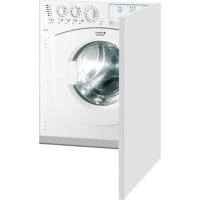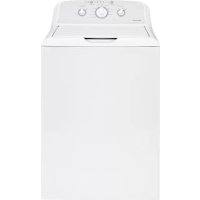
AQ8F 292 U - Washing machine HOTPOINT - Free user manual and instructions
Find the device manual for free AQ8F 292 U HOTPOINT in PDF.



User questions about AQ8F 292 U HOTPOINT
0 question about this device. Answer the ones you know or ask your own.
Ask a new question about this device
Download the instructions for your Washing machine in PDF format for free! Find your manual AQ8F 292 U - HOTPOINT and take your electronic device back in hand. On this page are published all the documents necessary for the use of your device. AQ8F 292 U by HOTPOINT.
USER MANUAL AQ8F 292 U HOTPOINT
Unpacking and levelling
Connecting the electricity and water supplies
Technical data
Description of the machine, 4-5
Control panel
Running a wash cycle, 6
Wash cycles and options, 7
Table of wash cycles
Wash options
Detergents and laundry, 8
Detergent
Preparing the laundry
Washing recommendations
Load balancing system
Precautions and advice, 9
General safety
Disposal
Opening the porthole door manually
Care and maintenance, 10
Cutting off the water and electricity supplies
Cleaning the machine
Cleaning the detergent dispenser drawer
Caring for your appliance drum
Cleaning the pump
Checking the water inlet hose
Trouble shooting, 11
Assistance, 12
! This instruction manual should be kept in a safe place for future reference. If the washing machine is sold, given away or moved, please ensure the manual is kept with the machine, so that the new owner may benefit from the advice contained within it.
! Read these instructions carefully: they contain vital information relating to the safe installation and operation of the appliance.
! Inside the pack containing this manual, you will also find the guarantee and all the details necessary for installation.
Unpacking and levelling
Unpacking
- Once you have removed all the packaging from the washing machine, make sure it has not been damaged during transportation.
If it has been damaged, contact the retailer and do not proceed any further with the installation process.
-
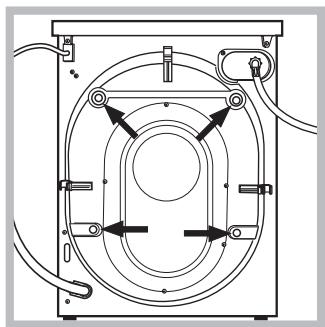
Remove the 4 protective screws (used during transportation) and the corresponding spacer, located on the rear part of the appliance (see figure).
-
Close off the holes using the plastic plugs supplied in the pack.
- Keep all the parts in a safe place; they will be needed again if the washing machine is moved to another location, to prevent the inside of the appliance being damaged.
! Packaging materials should not be used as toys for children.
Levelling
- Place the washing machine on a flat sturdy floor, without resting it up against walls or cabinets.
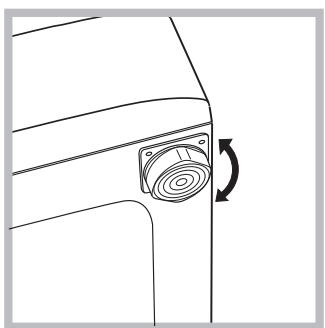
- If the floor is uneven, the front feet of the machine may be adjusted until it reaches a horizontal position (the angle of inclination must not exceed 2 degrees).
! If the appliance is levelled correctly, it will be more stable and much less likely to cause vibrations and noise while it is operating, particularly during the spin cycle.
! If it is placed on carpet or a rug, adjust the feet in such a way as to allow a sufficient ventilation space underneath the washing machine.
Connecting the electricity and water supplies
Connecting the water inlet hose
! Before connecting the inlet hose to the water supply, run the water until it is perfectly clear.
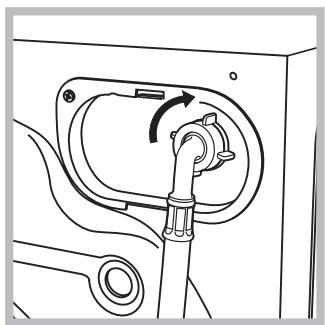
- Connect the inlet hose to the machine by screwing it onto the cold water inlet of the appliance, which is situated on the top right-hand side of the rear part of the appliance (see figure).
-
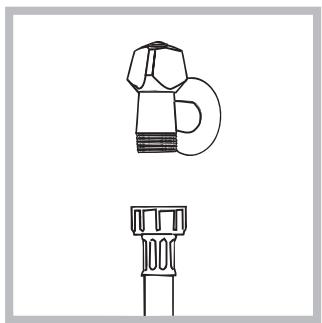
Connect the inlet hose by screwing it to a cold water tab using a 3/4 gas threaded connection (see figure).
-
Make sure that the hose is not folded over or bent.
! The water pressure at the tap must fall within the values indicated in the Technical data table (see next page).
If the inlet hose is not long enough, contact a specialised shop or an authorised technician.
! Never use second-hand or old inlet hoses; use the products supplied with the machine.
Connecting the drain hose
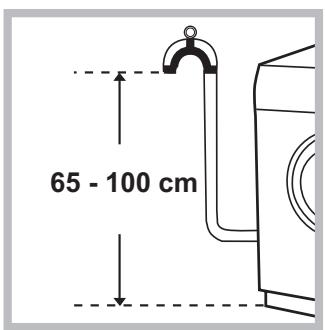
Connect the drain hose to drain duct piping or a wall drain located between 65 and 100~cm above the floor, making sure it is not bent at all.
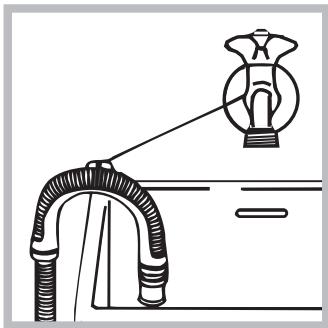
Alternatively, rest the drain hose on the side of a washbasin or bathtub, fastening the duct supplied to the tap (see figure). The free end of the hose should not be underwater.
! We advise against the use of hose extensions; if it is absolutely necessary, the extension must have the same diameter as the original hose and must not exceed 150 cm in length.
Electrical connections
Before plugging the appliance into the electricity socket, make sure that:
- the socket is earthed and complies with all applicable laws;
- the socket is able to withstand the maximum power load of the appliance as indicated in the Technical data table (see opposite);
- the power supply voltage falls within the values indicated in the Technical data table (see opposite);
- the socket is compatible with the plug of the appliance. If this is not the case, have the socket or the plug replaced.
! The appliance must only be installed indoor in a frost free and dry room, to prevent it from electronic damage due to frost or condensation.
! The mains socket must remain within easy reach after the washing machine has been installed.
! Do not use extension cords or multiple sockets.
! The cable should not be bent or compressed.
The power supply cable and plug must only be replaced by authorised technicians.
Warning! The company shall not be held responsible in the event that these regulations are not respected.
| Technical data | |
| Model | AQ8F 292 U |
| Dimensions | width 59.5 cm height 85 cm depth 64,5 cm |
| Capacity | from 1 to 8 kg |
| Electrical connections | please refer to the technical data plate fixed to the machine |
| Water connections | maximum pressure 1 MPa (10 bar) minimum pressure 0.05 MPa (0.5 bar) drum capacity 62 litres |
| Spin speed | up to 1200 rotations per minute |
| Energy rated programmes according to regulation EN 60456 | programme; temperature 60°C; using a load of 8 kg. |
| CE | This appliance conforms to the following EC Directives: - 2004/108/EC (Electromagnetic Compa-tibility) - 2006/95/EC (Low Voltage) - 2002/96/EC |
Description of the machine
EN
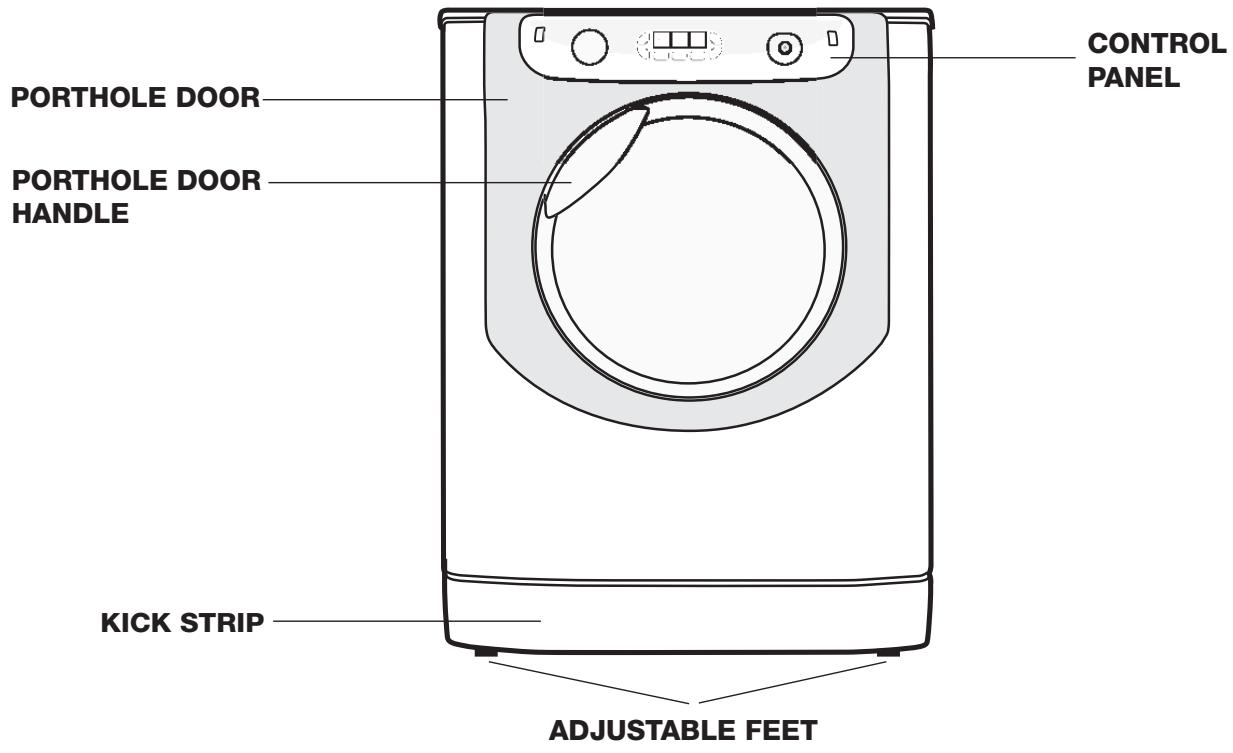
PORTHOLE DOOR
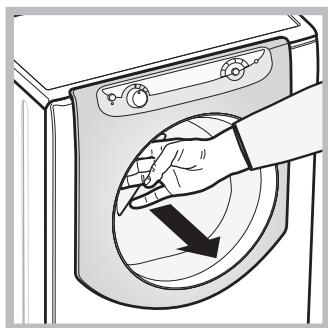
Always use the handle to open the porthole door (see figure).
DETERGENT DISPENSER DRAWER
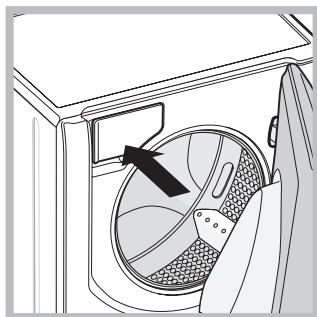
The detergent dispenser drawer is located inside the machine and can be accessed by opening the door.
For more information on detergent measures, please refer to the chapter entitled "Detergents and laundry".
Note: stick the label showing the wash cycle descriptions
and options on the front of the detergent dispenser drawer. You will find the sticker in the pack containing this manual.
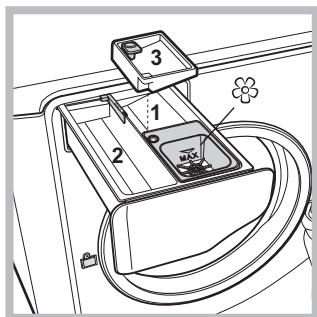
- pre-wash compartment: use powder detergent.
! Before pouring in the detergent, make sure that extra compartment 3 has been removed. - main wash compartment: use powder or liquid detergent. If using the latter type of detergent, we recommend it is poured
into the drawer immediately before you start the washing machine.
- extra compartment: Bleach
! The use of extra compartment 3 excludes the prewash function.
washing additives compartment: for fabric softener or liquid additives. We recommend that the maximum level indicated by the grille is not exceeded, and that concentrated fabric softeners are diluted.
Standby mode
This washing machine, in compliance with new energy saving regulations, is fitted with an automatic standby system which is enabled after about 30 minutes if no activity is detected. Press the ON-OFF button briefly and wait for the machine to start up again.
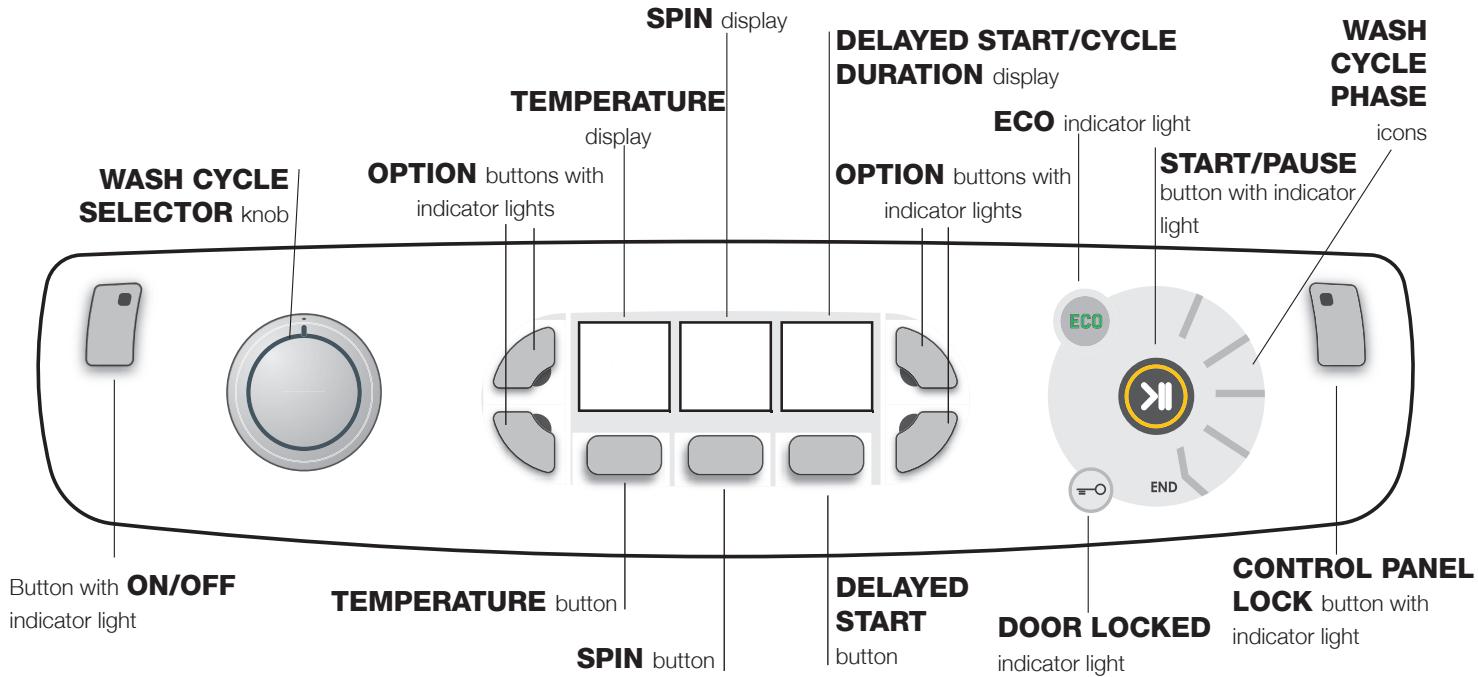
Control panel
EN
Button with ON/OFF indicator light: press this briefly to switch the machine on or off. The green indicator light indicates that the machine is switched on. To switch off the washing machine during the wash cycle, press and hold the button for approximately 3 seconds; if the button is pressed briefly or accidentally the machine will not switch off. If the machine is switched off during a wash cycle, this wash cycle will be cancelled.
WASH CYCLE SELECTOR knob: may be turned in either direction. To select the most suitable wash cycle, please refer to the "Table of wash cycles". The knob will not move during the wash cycle.
TEMPERATURE button: press to modify or exclude the temperature setting; the value selected will appear on the display above (see “Running a wash cycle”).
SPIN CYCLE button: press to modify or exclude the spin cycle; the value selected will appear on the display above (see "Running a wash cycle").
DELAYED START button: press to set a delayed start for the selected wash cycle; the set delay time will appear on the display above (see "Running a wash cycle").
OPTION buttons with indicator lights: press to select the available options. The indicator light corresponding to the selected option will remain lit (see "Running a wash cycle").
WASH CYCLE PHASE icons: these illuminate to indicate the progress of the wash cycle (Wash - - - - - - - - - - - - - - - - - ⑨ - Drain ). The text END lights up when the cycle is complete.
START/PAUSE button with indicator light: when the green indicator light flashes slowly, press the button to start a wash cycle. Once the cycle has begun the indicator light will remain lit in a fixed manner. To pause the wash cycle, press the button again; the indicator light will flash in an orange colour. If the "Door locked" =0 indicator light is switched off, the door may be opened. To start the wash cycle from the point at which it was interrupted, press the button again.
DOOR LOCKED indicator light: indicates that the porthole door is locked. To open the door, pause the wash cycle (see “Running a wash cycle”).
CONTROL PANEL LOCK button with indicator light: to activate or deactivate the control panel lock, press and hold the button for approximately 2 seconds. when the indicator light is illuminated, the control panel is locked. This means it is possible to prevent wash cycles from being modified accidentally, especially where there are children in the home.
ECO indicator light: the ECO icon lights up when, after altering the washing parameters, an energy saving of at least 10% is made. Furthermore, before the machine enters "Standby" mode, the icon will light up for a few seconds; when the machine is switched off the estimated energy saving will be around the 80% mark.
WARNING: before you use the washing machine for the first time, run a wash cycle with detergent and no laundry, using the 90^ cottons cycle without pre-wash.
- SWITCH THE MACHINE ON. Press the button. All the indicator lights will illuminate for 1 second; the indicator light corresponding to the button will then remain lit in a fixed manner and the START/PAUSE indicator light will flash slowly.
- LOAD THE LAUNDRY. Open the porthole door. Load the laundry, making sure you do not exceed the maximum load value indicated in the table of wash cycles on the following page.
- MEASURE OUT THE DETERGENT. Pull out the detergent dispenser drawer and pour the detergent into the relevant compartments as described in "Description of the machine".
- CLOSE THE PORTHOLE DOOR.
- SELECT THE PROGRAMME. Turn the WASH CYCLE SELECTOR KNOB right or left, until you have selected the desired wash cycle. A temperature and spin speed is set for each wash cycle; these may be adjusted.
- CUSTOMISE THE WASH CYCLE. Use the relevant buttons on the control panel:
Modify the temperature and/or spin speed.
The machine automatically displays the maximum temperature and spin speed values set for the selected cycle, or the most recently-used settings if they are compatible with the selected cycle. The temperature can be decreased by pressing the button, until the cold wash (NO) setting is reached. The spin speed may be progressively reduced by pressing the button, until it is completely excluded (NO). If these buttons are pressed again, the maximum values are restored.
! Exception: if the "Cottons" programme is selected, the temperature can be increased up to a value of 90^ .
Set a delayed start.
Press the button until you have reached the desired delay time. During the setting process, the delay time is shown on the display and the symbol flashes. After selecting a delayed start time, the fixed symbol and the cycle duration will appear on the display. Press the button once to display the selected delay time. To remove the delayed start option, press the button until the display shows the text OFF; the symbol will disappear.
! Once the START/PAUSE button has been pressed, the time delay may only be decreased.
Modify the cycle settings.
Press the OPTION buttons to customise the wash cycle in accordance with your own requirements.
-
Press the button to activate the option; the corresponding indicator light will switch on.
-
Press the button again to disable the option; the indicator light will switch off.
! If the selected option is not compatible with the selected wash cycle, this incompatibility will be signalled by the flashing of the indicator light and a sound alert (3 beeps); the option will not be activated.
If the selected option is not compatible with another option that has been selected previously, the indicator light corresponding to the first option selected will flash and only the second option will be activated; the indicator light corresponding to the button will remain lit in a constant manner.
- START THE PROGRAMME. Press the START/PAUSE button. The corresponding indicator light remains lit in a fixed manner and the porthole door locks (the DOOR LOCKED indicator light illuminates). The icons corresponding to the wash cycle phases will light up during the cycle to indicate which phase is currently in progress.
To change a wash cycle once it has already started, pause the washing machine by pressing the START/ PAUSE button; then select the desired cycle and press the START/PAUSE button again.
To open the door during a wash cycle, press the START/ PAUSE button; if the DOOR LOCKED indicator light is switched off you may open the door. Press the START/PAUSE button again to restart the wash cycle from the point at which it was interrupted.
- THE END OF THE WASH CYCLE. This is indicated by the illuminated text END. The porthole door may be opened immediately. If the START/PAUSE indicator light is flashing, press the button to end the cycle. Open the door, unload the laundry and switch off the machine.
If you wish to cancel a cycle which has already begun, press and hold the button until the cycle stops and the machine switches off.
Bag for quilts, curtains and delicate garments
The Aqualtis washing machine makes it easier for you to wash even the most valuable and delicate garments in complete confidence thanks to the special bag which protects the laundry (this is supplied with the machine). We recommend that the bag is used every time you wash quilts and padded items with an outer layer made using synthetic material.
Wash cycles and options
Table of wash cycles
| Icon | Description of the wash cycle | Max. temp. (°C) | Max. speed (rpm) | Detergent and additives | Max. load (kg) | Cycle duration | ||
| Wash | Fabric softener | Bleach | ||||||
| Cottons wash cycles | The duration of the wash cycles can be checked on the display. | |||||||
| Cottons with pre-wash (Add detergent to the relevant compartment). | 90° | 1200 | ● | ● | - | 8 | ||
| Cottons (1): heavily soiled whites and resistant colours. | 60° (Max. 90°C) | 1200 | ● | ● | ● | 8 | ||
| Cottons (2): heavily soiled whites and delicate colours. | 40° | 1200 | ● | ● | ● | 8 | ||
| Coloured Cottons (3) | 40° | 1200 | ● | ● | ● | 8 | ||
| Shirts | 40° | 600 | ● | ● | ● | 2 | ||
| Jeans | 40° | 800 | ● | ● | - | 4 | ||
| Special programmes | ||||||||
| Baby: heavily soiled delicate colours | 40° | 800 | ● | ● | ● | 4 | ||
| Durable Synthetics | 60° | 800 | ● | ● | ● | 3,5 | ||
| Delicate Synthetics | 40° | 800 | ● | ● | ● | 3,5 | ||
| "Bed & Bath" for bedlinen and towels. | 60° | 1200 | ● | ● | ● | 8 | ||
| Duvets: for down-stuffed garments. | 30° | 1000 | ● | ● | - | 3,5 | ||
| Silk: for garments in silk and viscose, lingerie. | 30° | 0 | ● | ● | - | 2 | ||
| Wool: for wool, cashmere, etc. | 40° | 600 | ● | ● | - | 2 | ||
| Mix 30' to refresh lightly soiled garments quickly (not suitable for wool, silk and clothes which require washing by hand) | 30° | 800 | ● | ● | - | 3,5 | ||
| Partials wash cycles | ||||||||
| Rinse | - | 1200 | - | ● | ● | 8 | ||
| Spin | - | 1200 | - | - | - | 8 | ||
| Drain | - | 0 | - | - | - | 8 | ||
The length of cycle shown on the display or in this booklet is an estimation only and is calculated assuming standard working conditions. The actual duration can vary according to factors such as water temperature and pressure, the amount of detergent used, the amount and type of load inserted, load balancing and any wash options selected.
(*) Note: 10 minutes after the START, the machine will recalculate the time remaining until the end of the wash cycle on the basis of the load inside it; this value will then be shown on the display.
For all Test Institutes:
1) Test wash cycle in compliance with regulation EN 60456: set wash cycle with a temperature of 60^ .
2) Long wash cycle for cottons: set wash cycle with a temperature of 40^ .
3) Short wash cycle for cottons: set wash cycle with a temperature of 40^ .
Wash options
Super Wash
This option offers a high-performance wash due to the greater quantity of water used in the initial phase of the cycle, and due to the increased wash cycle duration,
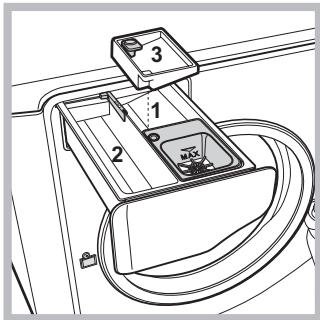
is particularly useful for the removal of stubborn stains. It can be used with or without bleach. If you desire bleaching, insert the extra tray compartment (3) into compartment 1. When pouring in the bleach, be careful not to exceed the "max" level marked on the central pivot (see figure).
To bleach laundry without
carrying out a full wash cycle, pour the bleach into the extra compartment 3, select the "Rinse" cycle and activate the "Super Wash" option.
! It cannot be used in conjunction with P, 30, , , , , , , , , ,
Easy Iron
By selecting this option, the wash and spin cycles will be modified in order to reduce the formation of creases. At the end of the cycle the washing machine drum will rotate slowly;
the “Easy Iron” and START/PAUSE indicator lights will flash. To end the cycle press the START/PAUSE button or the “Easy Iron” button.
For the Silk wash cycle, the machine will end the cycle while the laundry is soaking and the "Easy Iron" indicator light will flash. To drain the water so that the laundry may be removed, press the START/PAUSE button or the "Easy Iron" button.
! It cannot be used in conjunction with ③ 1, 日 , 日 , 日
Time Saver
If you select this option, the wash cycle duration will be reduced by 30% - 50% , depending on the selected cycle, thereby guaranteeing simultaneous water and energy saving. Use this cycle for lightly soiled garments.
It cannot be used in conjunction with, , , , ,
,,9,。
Extra rinse
By selecting this option, the efficiency of the rinse is increased and optimal residual detergent removal is guaranteed. It is particularly useful for skin which is sensitive to detergents. We recommend this option is used with a full load of washing, or when a large amount of detergent is required.
! It cannot be used in conjunction with 空 9, 空
Detergents and laundry
Detergent
The type and quantity of detergent required depend on the type of fabric you are washing (cotton, wool, silk, etc.), as well as its colour, the washing temperature, the level of soiling and the hardness of the water in the area. Measuring out the detergent carefully will avoid wastage and help to protect the environment: although they are biodegradable, detergents still contain ingredients which alter the balance of nature.
We recommend the following:
- use powder detergents for white cotton garments and pre-washing.
- use liquid detergents for delicate cotton garments and for all low-temperature wash cycles.
- use gentle liquid detergents for wool and silk garments. The detergent should be poured into the relevant compartment - or the dispenser placed directly inside the drum - before the wash cycle begins. In the latter case, it will not be possible to select the Cottons with pre-wash cycle.
! Do not use hand washing detergents because these create too much foam.
Preparing the laundry
- Shake out the garments before loading them into the machine.
- Divide the laundry according fabric type (symbol on the washing instruction label) and colour, making sure you separate the coloured garments from the white ones;
- Empty all pockets and check the buttons;
- Do not exceed the values listed in the "Table of wash cycles", which refer to the weight of the laundry when dry.
How much does your laundry weigh?
1 sheet 400-500 g
1 pillowcase 150-200 g
1 tablecloth 400-500 g
1 bathrobe 900-1200 g
1 towel 150-250 g
1 pair of jeans 400-500 g
1 shirt 150-200 g
Washing recommendations
Shirts: use the special "Shirts" wash cycle to wash shirts in different fabrics and colours to guarantee they receive the best possible care.
Jeans: use the special "Jeans" wash cycle for all denim garments; turn inside out before washing and use a liquid detergent.
Baby: use the special "Baby" wash cycle to remove the remove the soiling typically caused by babies, while removing all traces of detergent from nappies in order to prevent the delicate skin of babies from suffering allergic reactions. The cycle has been designed to reduce the amount of bacteria by using a greater quantity of water and optimising the effect of special disinfecting additives added to the detergent. At the end of the wash cycle, the machine will slowly rotate the drum; to end the cycle press the START/PAUSE button.
Silk: use the special "Silk" wash cycle to wash all silk garments. We recommend the use of special detergent which has been designed to wash delicate clothes.
Curtains: use the "Silk" wash cycle. These should be folded and placed inside the bag provided.
Wool: is the only washing machine brand to have been awarded the prestigious Woolmark Platinum Care endorsement (M.0508) by the Woolmark Company, which means that all woollen garments may be washed in the washing machine, even those which state "hand wash only" on the label. The "Wool" wash cycle can be used to wash all woollen garments in the washing machine while guaranteeing optimum performance.
Duvets: to wash double or single duvets (the weight of which should not exceed 3,5kg ), cushions or clothes padded with goose down such as puffa jackets, use the special "Duvets" 12 wash cycle. We recommend that duvets are placed in the drum with their edges folded inwards (see figure) and that no more than 3/4 of the total volume of the drum is used. To achieve the best results, we recommend that a liquid detergent is used and placed inside the detergent dispenser drawer.
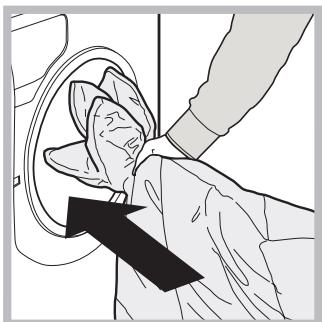
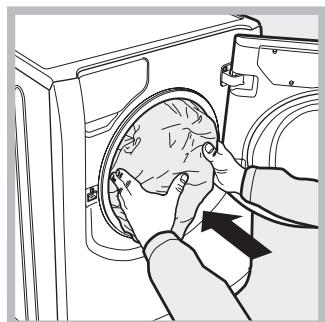
Quilts: to wash quilts with a synthetic outer layer, use the bag provided and set the wash cycle to “Duvets”
Bedlinen and towels: use the "Bed & Bath" cycle to wash laundry from all over the house; this optimises fabric softener performance and helps you save time and energy. We recommend the use of powder detergent.
Stubborn stains: it is wise to treat stubborn stains with solid soap before washing, and to use the Cottons with pre-wash cycle.
Load balancing system
Before every spin cycle, to avoid excessive vibrations before every spin and to distribute the load in a uniform manner, the drum rotates continuously at a speed which is slightly greater than the washing rotation speed. If, after several attempts, the load is not balanced correctly, the machine spins at a reduced spin speed. If the load is excessively unbalanced, the washing machine performs the distribution process instead of spinning. To encourage improved load distribution and balance, we recommend small and large garments are mixed in the load.
! The machine was designed and constructed in accordance with international safety regulations. The following information is provided for safety reasons and must therefore be read carefully.
General safety
- This appliance was designed for domestic use only.
- This appliance is not intended for use by persons (including children) with reduced physical, sensory or mental capabilities, or lack of experience and knowledge, unless they have been given supervision or instruction concerning use of the appliance by a person responsible for their safety. Children should be supervised to ensure that they do not play with the appliance.
- the machine must only be used by adults, in accordance with the instructions given in this manual.
- Do not touch the machine when barefoot or with wet or damp hands or feet.
- Do not pull on the power supply cable when unplugging the appliance from the electricity socket. Hold the plug and pull.
- Do not touch the drained water as it may reach extremely high temperatures.
- Never force the porthole door. This could damage the safety lock mechanism designed to prevent accidental opening.
- If the appliance breaks down, do not under any circumstances access the internal mechanisms in an attempt to repair it yourself.
- Always keep children well away from the appliance while it is operating.
- If it must be moved, proceed with the help of two or three people and handle it with the utmost care. Never try to do this alone, because the appliance is very heavy.
- Before loading laundry into the washing machine, make sure the drum is empty.
Disposal
- Disposing of the packaging materials: observe local regulations so that the packaging may be re-used.
- The European Directive 2002/96/EC relating to Waste Electrical and Electronic Equipment (WEEE) states that household appliances should not be disposed of using the normal solid urban waste cycle. Exhausted appliances should be collected separately in order to optimise the cost of re-using and recycling the materials inside the machine, while preventing potential damage to the atmosphere and to public health. The crossed-out dustbin is marked on all products to remind the owner of their obligations regarding separated waste collection. For more information relating to the correct disposal of household appliances, owners should contact their local authorities or appliance dealer.
Opening the porthole door manually
In the event that it is not possible to open the porthole door due to a powercut, and if you wish to remove the laundry, proceed as follows:
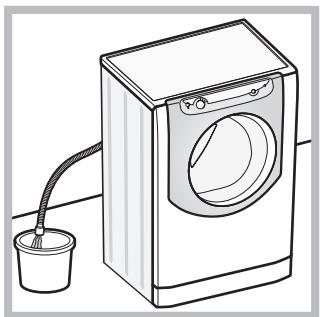
- remove the plug from the electrical socket.
-
make sure the water level inside the machine is lower than the door opening; if it is not, remove excess water using the drain hose, collecting it in a bucket as indicated in the figure.
-
remove the cover panel on the lower front part of the washing machine (see overleaf).
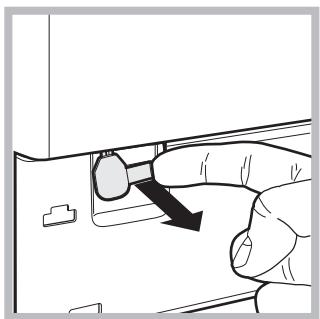
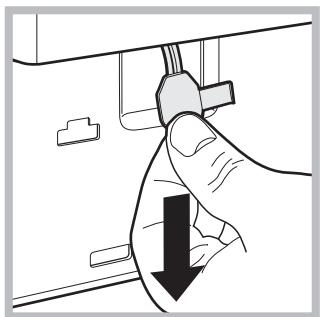
- pull outwards using the tab as indicated in the figure, until the plastic tie-rod is freed from its stop position; pull downwards until you hear a "click", which indicates that the door is now unlocked.
-
open the door; if this is still not possible repeat the procedure.
-
reposition the panel, making sure the hooks are securely in place before you push it onto the appliance.
Cutting off the water and electricity supplies
- Turn off the water tap after every wash cycle. This will limit wear on the hydraulic system in the machine and help to prevent leaks.
- Unplug the appliance when cleaning it and during all maintenance work.
Cleaning the machine
The outer parts and rubber components of the appliance can be cleaned using a soft cloth soaked in lukewarm soapy water. Do not use solvents or abrasives.
Cleaning the detergent dispenser drawer
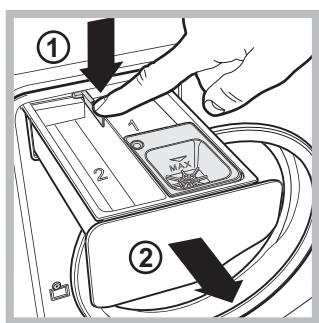
To remove the drawer, press lever (1) and pull the drawer outwards (2) (see figure). Wash it under running water; this procedure should be repeated frequently.
Caring for your appliance drum
- Always leave the door ajar to prevent unpleasant odours from forming.
Cleaning the pump
The washing machine is fitted with a self-cleaning pump which does not require any maintenance. Sometimes, small items (such as coins or buttons) may fall into the protective pre-chamber at the base of the pump.
Make sure the wash cycle has finished and unplug the appliance.
To access the pre-chamber:
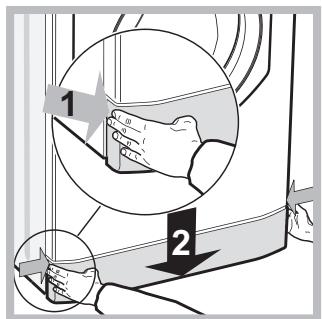
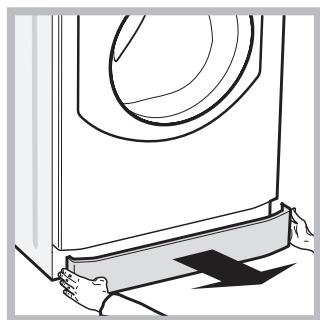
- take off the cover panel on the front of the machine by first pressing it in the centre and then pushing downwards on both sides until you can remove it (see figures);
-
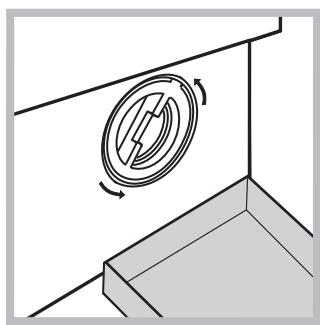
position a container so that it will collect the water which flows out (approximately 1.5 l) (see figure);
-
unscrew the lid by rotating it in an anti-clockwise direction (see figure);
-
clean the inside thoroughly;
- screw the lid back on;
- reposition the panel, making sure the hooks are securely in place before you push it onto the appliance.
Checking the water inlet hose
Check the inlet hose at least once a year. If there are any cracks, it should be replaced immediately: during the wash cycles, water pressure is very strong and a cracked hose could easily split open.
Your washing machine could occasionally fail to work. Before contacting the Technical Assistance Centre (see "Assistance"), make sure that the problem cannot be not solved easily using the following list.
Problem:
The washing machine does not switch on.
The wash cycle does not start.
The washing machine does not fill with water.
The washing machine door remains locked.
The machine continuously fills with water and drains.
The washing machine does not drain or spin.
The machine vibrates a lot during the spin cycle.
The washing machine leaks.
The icons corresponding to the "Phase in progress" flash rapidly at the same time as the ON/OFF indicator light.
There is too much foam.
The washing machine door remains locked.
Possible causes / Solutions:
- The appliance is not plugged into the socket fully, or not enough to make contact.
There is no power in the house. - The door is not closed properly.
- The START/PAUSE button has not been pressed.
- The water tap has not been opened.
-
A delayed start has been set.
-
The water inlet hose is not connected to the tap.
The hose is bent. - The water tap has not been opened.
There is no water supply in the house. - The pressure is too low.
-
The START/PAUSE button has not been pressed.
-
If you have selected the "Baby" cycle or the "Easy iron" option, when the wash cycle has finished the machine will slowly rotate the drum; to end the cycle press the START/PAUSE button or the "Easy iron" button. If you have selected the "Silk" wash cycle, the machine will end the cycle while the laundry is soaking; to drain the water so that the laundry may be removed, press the START/PAUSE button or the "Easy iron" button.
-
The drain hose is not fitted at a height between 65 and 100~cm from the floor (see "Installation").
- The free end of the hose is under water (see "Installation").
- If the dwelling is on one of the upper floors of a building, there may be problems relating to water drainage, causing the washing machine to fill with water and drain continuously. Special anti-draining valves are available in shops and help to prevent this inconvenience.
- The wall drainage system is not fitted with a breather pipe.
- The wash cycle does not include draining: Some wash cycles require the drain phase to be started manually (see "Wash cycles and options").
- The "Easy iron" option is enabled: to complete the wash cycle, press the START/PAUSE button ("Wash cycles and options").
- The drain hose is bent (see Installation).
-
The drainage duct is clogged.
-
The drum was not unlocked correctly during installation (see "Installation").
- The machine is not level (see "Installation").
- The machine is trapped between cabinets and walls (see "Installation").
- The load is unbalanced (see "Detergents and laundry").
- The water inlet hose is not screwed on properly (see "Installation").
- The detergent dispenser is blocked (to clean it, see "Care and maintenance").
-
The drain hose is not fixed in place properly (see "Installation").
-
Switch off the machine and unplug it, wait for approximately 1 minute and then switch it back on again. If the problem persists, contact the Technical Assistance Service.
-
The detergent is not suitable for machine washing (it should display the text "for washing machines" or "hand and machine wash", or the like).
- Too much detergent was used.
- Perform the manual unlocking procedure (see "Precautions and tips").
! Note: To exit "Demo mode", press and hold the two "ON/OFF" Ⓞ and "START/PAUSE" >按钮 simultaneously for 3 seconds.
Before calling for Assistance:
- Check whether you can solve the problem by yourself (see "Trouble shooting");
- Restart the wash cycle to check whether the problem has been solved;
- If it has not, contact the Authorised Technical Assistance Service.
! If the washing machine has been installed or used incorrectly, you will have to pay for the call-out service.
! Always request the assistance of authorised technicians.
Please have the following information to hand:
- the type of problem;
- the appliance model (Mod.);
the serial number (S/N).
The above information can be found on the data plate located on the appliance itself.

Espanol