
Q1755 - Surveillance Camera AXIS - Free user manual and instructions
Find the device manual for free Q1755 AXIS in PDF.


| Product type | Network surveillance camera |
| Dimensions | 72 x 58 x 106 mm |
| Weight | 450 g |
| Power supply | PoE IEEE 802.3af (12V DC optional) |
| Resolution | 1920 x 1080 pixels |
| Lens | Varifocal 2.8-8 mm, F1.2 |
| Night vision | Yes, up to 10 meters |
| Video compression | H.264 and M-JPEG |
| Storage | microSD card (up to 64 GB), NAS |
| Connectivity | Ethernet 10/100 Base-T |
| Functions | Motion detection, two-way audio |
| Maintenance | Clean the lens with a soft cloth |
| Security | Password authentication, HTTPS encryption |
| Spare parts | Power supply, cables, mounts (sold separately) |
| Repairability | Repairable by an authorized technician |
Frequently Asked Questions - Q1755 AXIS
User questions about Q1755 AXIS
0 question about this device. Answer the ones you know or ask your own.
Ask a new question about this device
Download the instructions for your Surveillance Camera in PDF format for free! Find your manual Q1755 - AXIS and take your electronic device back in hand. On this page are published all the documents necessary for the use of your device. Q1755 by AXIS.
USER MANUAL Q1755 AXIS
This document includes instructions for installing the AXIS Q1755 Network Camera on your network. Previous experience of networking will be beneficial when installing the product.
Legal Considerations
Video and audio surveillance can be prohibited by laws that vary from country to country. Check the laws in your local region before using this product for surveillance purposes.
This product includes one (1) H.264 decoder license. To purchase further licenses, contact your reseller.
Electromagnetic Compatibility (EMC)
This equipment generates, uses and can radiate radio frequency energy and, if not installed and used in accordance with the instructions, may cause harmful interference to radio communications. However, there is no guarantee that interference will not occur in a particular installation.
If this equipment does cause harmful interference to radio or television reception, which can be determined by turning the equipment off and on, the user is encouraged to try to correct the interference by one or more of the following measures: Re-orient or relocate the receiving antenna. Increase the separation between the equipment and receiver. Connect the equipment to an outlet on a different circuit to the receiver. Consult your dealer or an experienced radio/TV technician for help. Shielded (STP) network cables must be used with this unit to ensure compliance with EMC standards.
USA - This equipment has been tested and found to comply with the limits for a Class B computing device pursuant to Subpart B of Part 15 of FCC rules, which are designed to provide reasonable protection against such interference when operated in a commercial environment. Operation of this equipment in a residential area is likely to cause interference, in which case the user at his/her own expense will be required to take whatever measures may be required to correct the interference.
Canada - This Class B digital apparatus complies with Canadian ICES-003.
Europe - C This digital equipment fulfills the requirements for radiated emission according to limit B of EN55022, and the requirements for immunity according to EN55024 residential and commercial industry.
Japan – This is a class B product based on the standard of the Voluntary Control Council for Interference from Information Technology Equipment (VCCI). If this is used near a radio or television receiver in a domestic environment, it may cause radio interference. Install and use the equipment according to the instruction manual.
Australia – This electronic device meets the requirements of the Radio communications (Electromagnetic Compatibility) Standard AS/NZS CISPR22.
Equipment Modifications
This equipment must be installed and used in strict accordance with the instructions given in the user documentation. This equipment contains no user-serviceable components. Unauthorized equipment changes or modifications will invalidate all applicable regulatory certifications and approvals.
Liability
Every care has been taken in the preparation of this document. Please inform your local Axis office of any inaccuracies or omissions. Axis Communications AB cannot be held responsible for any technical or typographical errors and reserves the right to make changes to the product and documentation without prior notice. Axis Communications AB makes no warranty of any kind with regard to the material contained within this document, including, but not limited to, the implied warranties of merchantability and fitness for a particular purpose. Axis Communications AB shall not be liable nor responsible for incidental or consequential damages in connection with the furnishing, performance or use of this material.
RoHS
This product complies with both the European RoHS directive, 2002/95/EC, and the Chinese RoHS regulations, ACPEIP.

WEEE Directive
The European Union has enacted a Directive 2002/96/EC on Waste Electrical and Electronic Equipment (WEEE Directive). This directive is applicable in the European Union member states.

The WEEE marking on this product (see right) or its documentation indicates that the product must not be disposed of together with household waste. To prevent possible harm to human health and/or the environment, the product must be disposed of in an approved and environmentally safe recycling process. For further information on how to dispose of this product correctly, contact the product supplier, or the local authority responsible for waste disposal in your area.
Business users should contact the product supplier for information on how to dispose of this product correctly. This product should not be mixed with other commercial waste.
Support
Should you require any technical assistance, please contact your Axis reseller. If your questions cannot be answered immediately, your reseller will forward your queries through the appropriate channels to ensure a rapid response. If you are connected to the Internet, you can:
- download user documentation and firmware updates
- find answers to resolved problems in the FAQ database. Search by product, category, or phrases
- report problems to Axis support by logging in to your private support area.
The AXIS Q1755 uses a 3.0V CR2032 Lithium battery, for more information please see page 73.
AXIS Q1755 Installation Guide
This installation guide provides instructions for installing the AXIS Q1755 Network Camera on your network. For all other aspects of using the product, please see the User's Manual, available on the CD included in this package, or from www.axis.com/techsup
Installation steps
- Check the package contents against the list below.
- Hardware overview. See page 4.
- Install the hardware. See page 5.
- Assign an IP address. See page 6.
- Set the password. See page 9.

Important!
This product must be used in compliance with local laws and regulations.
1 Package contents
| Item Models/variants/notes | |
| Network camera AXIS Q1755 | 50Hz/60Hz |
| Terminal block connector | (1) 4-pin connector for connecting external devices to the I/O terminal connector(1) 3-pin connector for power connection(2) 2-pin connector for RS-485/422 connection |
| Camera stand Metal stand supplied with mounting screws | |
| CD | AXIS Network Video Product CD, including product documentation, installation tools and other software |
| Printed materials AXIS Q1755 | Installation Guide (this document)Axis Warranty Document |
| Optional accessories | See www.axis.com for information on power accessories and outdoor housings |
② Hardware overview
The camera is designed to be installed with the logotype facing down.
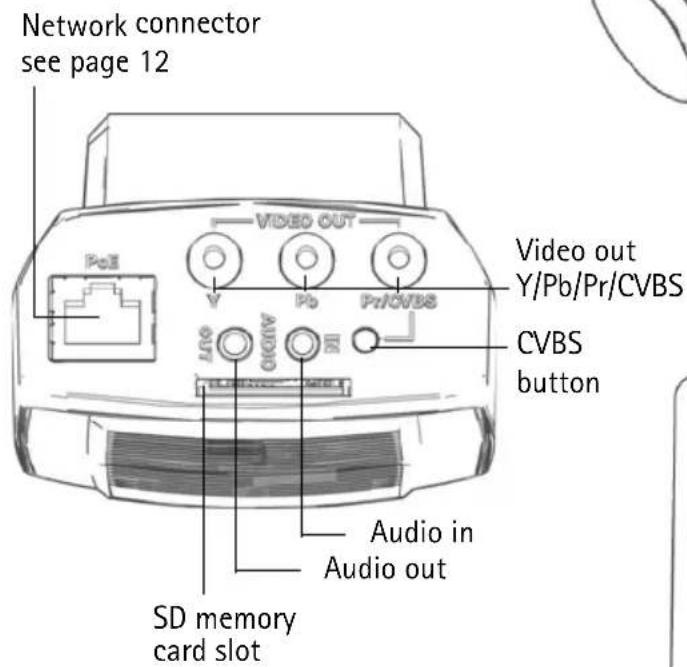
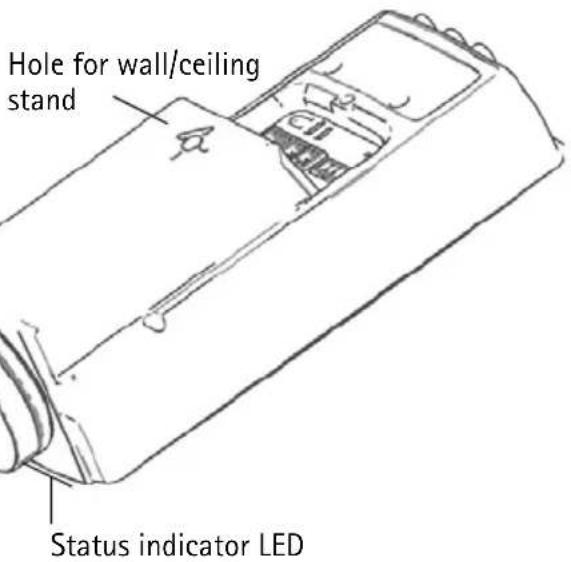
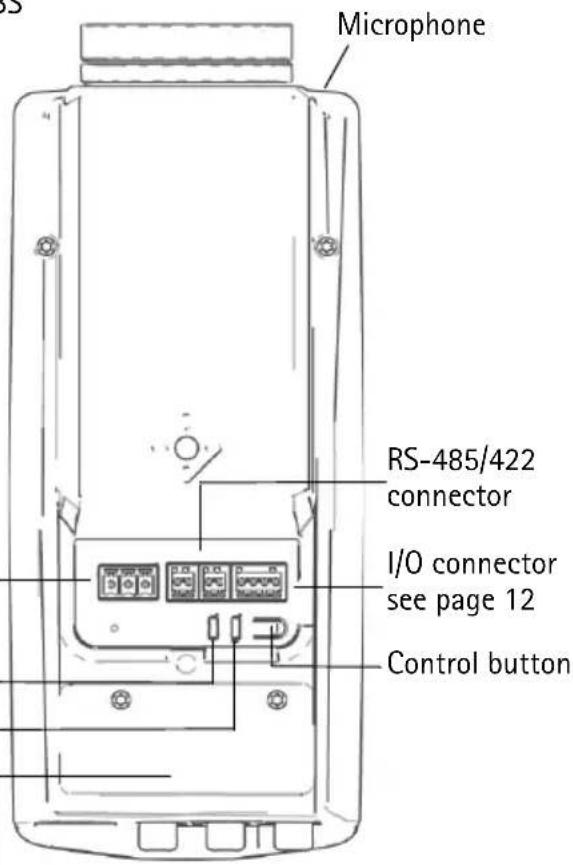
Part number (P/N) & Serial number (S/N). The serial number may be required during the installation.
IMPORTANT! - To use AXIS Q1755 outdoors, it must be installed in an approved
■ outdoor housing. Please see www.axis.com for more information on outdoor housings.
3 Install the hardware
Attach the metal stand to the camera and use the appropriate screws for the wall/ceiling material. Note that the camera is designed to be installed with the logotype facing down.
Connect the cables
- Optionally connect external input/output devices, e.g. alarm devices. See page 12 for information on the terminal connector pins.
- Optionally connect an active speaker and/or external microphone.
- Connect the camera to the network using a shielded network cable.
-
Connect power, using one of the methods listed below:
-
PoE (Power over Ethernet, Class 3). If available, this is automatically detected when the network cable is connected.
-
Connect an external power adapter to the power connector block, see Unit connectors, on page 12 for wiring information.
-
Check that the indicator LEDs indicate the correct conditions. See the table on page 14 for further details.
Composite video out (optional)
For quick and easy installation, follow these instructions to view the video signal in a connected video monitor.
- Follow the instructions in Connect the cables, on page 5.
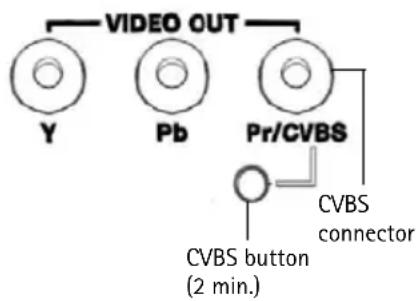
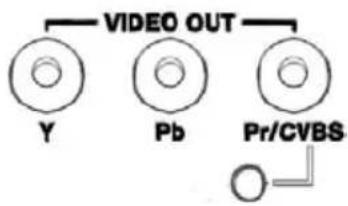
- Using a composite video cable, connect a video monitor to the Video out Pr/CVBS connector (red) on the AXIS Q1755.
-
Press and hold the CVBS button for 5 seconds to switch to composite video out (installation mode).
Note: AXIS Q1755 will stay in installation mode for two (2) minutes and then automatically revert to Component video. If additional time is required, press the button again. -
Position the camera and check that the intended area is in view on the screen.
-
Disconnect the video monitor.
Component video out (optional)
Follow these instructions to view the video signal directly in a connected HDTV video monitor.
- Follow the instructions in Connect the cables, on page 5.
- Connect AXIS Q1755 directly to an HDTV monitor using a component video cable connected to the Video Out Y/Pb/Pr connectors.
Once the cables have been connected, proceed to Assign an IP address, on page 6.

Assign an IP address
Most networks today have a DHCP server that automatically assigns IP addresses to connected devices. If your network does not have a DHCP server the AXIS Q1755 will use 192.168.0.90 as the default IP address.
If you would like to assign a static IP address, the recommended method in Windows is either AXIS IP Utility or AXIS Camera Management. Depending on the number of cameras you wish to install, use the method that best suits your purpose.
Both of these free applications are available on the Axis Network Video Product CD supplied with this product, or they can be downloaded from www.axis.com/techsup
| Method Recommended for Operating system | ||
 | AXIS IP UtilitySee page 7 | Single cameraSmall installations |
 | AXIS Camera ManagementSee page 8 | Multiple camerasLarge installationsInstallation on a different subnet |
Notes:
- If assigning the IP address fails, check that there is no firewall blocking the operation.
- For other methods of assigning or discovering the IP address of the AXIS Q1755 e.g. in other operating systems, see page 11.
AXIS IP Utility - single camera/small installation
AXIS IP Utility automatically discovers and displays Axis devices on your network. The application can also be used to manually assign a static IP address.
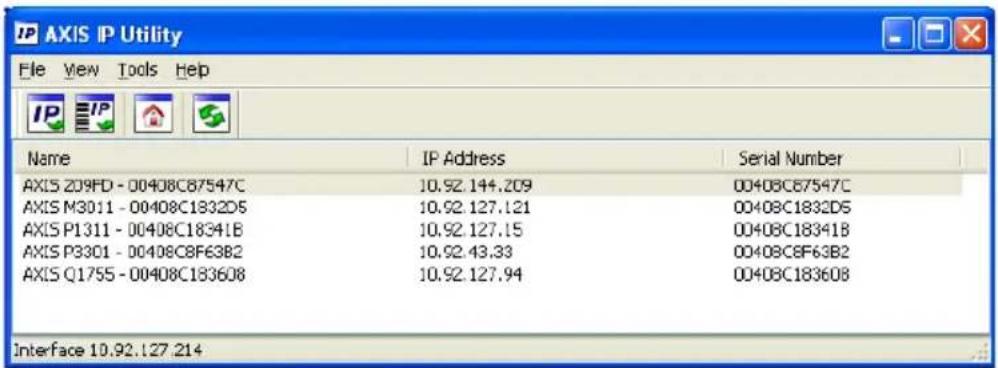
Note that the computer running AXIS IP Utility must be on the same network segment (physical subnet) as the AXIS Q1755.
Automatic discovery
- Check that the AXIS Q1755 is connected to the network and that power has been applied.
- Start AXIS IP Utility.
- When the camera appears in the window, double-click it to open its home page.
- See page 9 for instructions on how to assign the password.
Assign the IP address manually (optional)
- Acquire an unused IP address on the same network segment as your computer.
- Select the AXIS Q1755 in the list.
- Click the button IP Assign new IP address to the selected device and enter the IP address.
- Click the Assign button and follow the on-screen instructions. Note that the camera must be restarted within 2 minutes for the new IP address to be set.
- Click the Home Page button to access the camera's web pages.
- See page 9 for instructions on how to set the password.
AXIS Camera Management - multiple cameras/large installations
AXIS Camera Management can automatically discover multiple Axis devices, show connection status, manage firmware upgrades and set IP addresses.
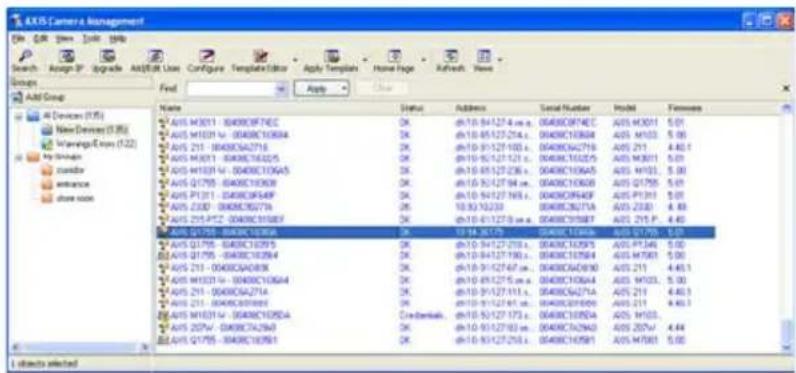
Automatic discovery
- Check that the camera is connected to the network and that power has been applied.
- Start AXIS Camera Management. When the AXIS Q1755 appears in the window, right-click the link and select Live View Home Page.
- See page 9 for instructions on how to set the password.
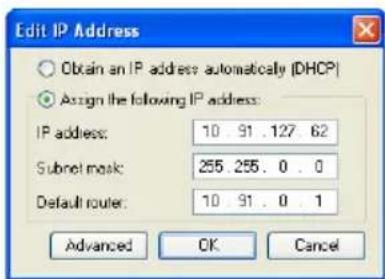
Assign an IP address in a single device
- Select AXIS Q1755 in AXIS Camera Management and click the Assign IP button.
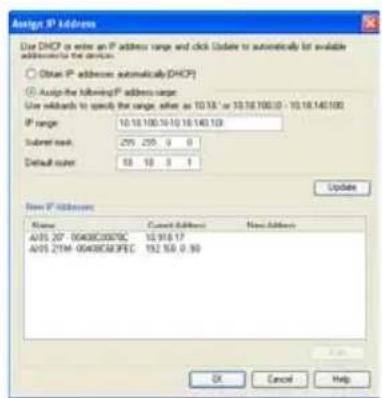
- Select Assign the following IP address and enter the IP address, subnet mask and default router the device will use.
- Click the OK button.
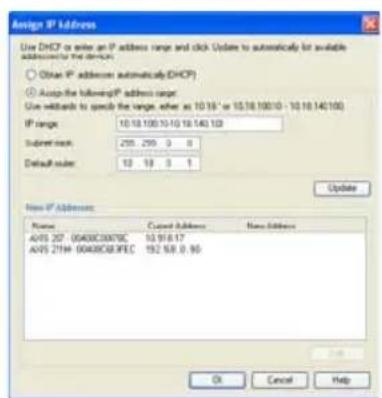
Assign IP addresses in multiple devices
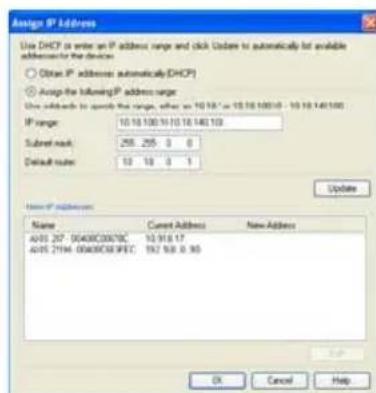
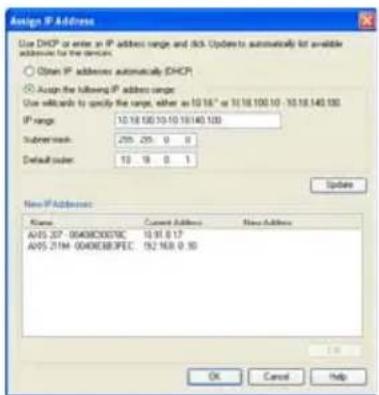
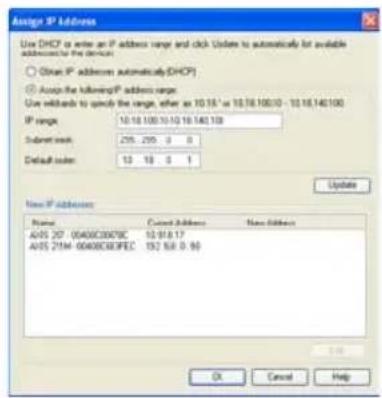
AXIS Camera Management speeds up the process of assigning IP addresses to multiple devices, by suggesting IP addresses from a specified range.
- Select the devices you wish to configure (different models can be selected) and click the Assign IP button.
- Select Assign the following IP address range and enter the range of IP addresses, the subnet mask and default router the devices will use.
- Click the OK button.

Set the password
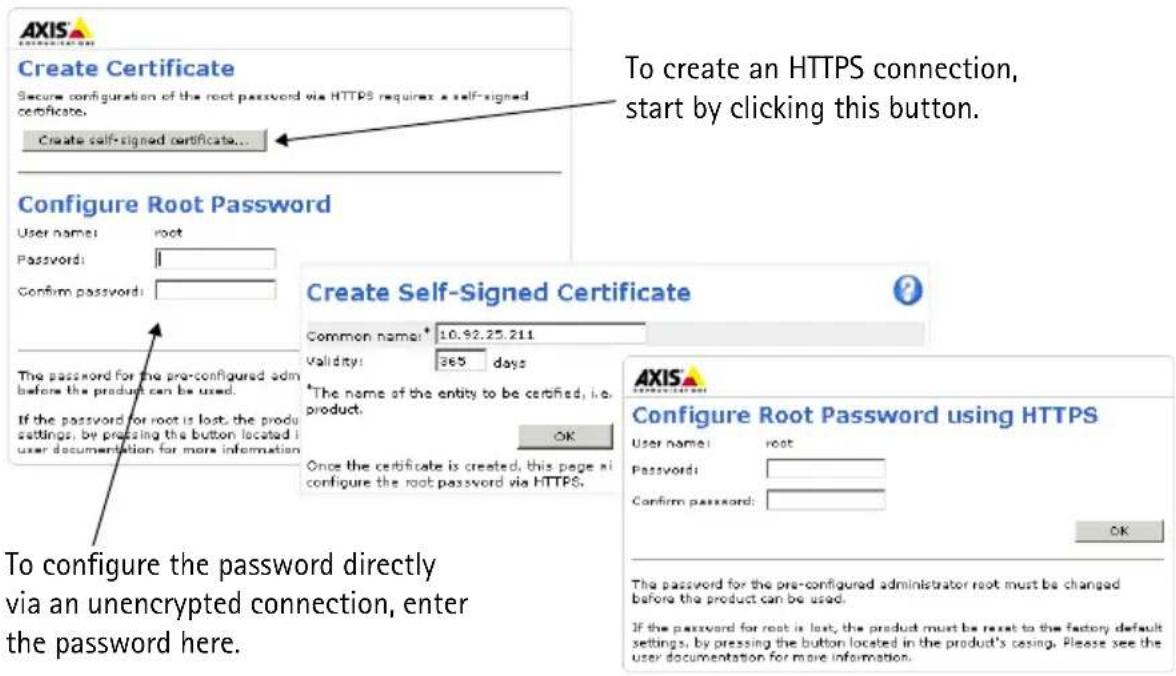
To gain access to the product, the password for the default administrator user root must be set. This is done in the 'Configure Root Password' dialog, which is displayed when the AXIS Q1755 is accessed for the first time.
To prevent network eavesdropping when setting the root password, this can be done via an encrypted HTTPS connection, which requires an HTTPS certificate (see note below).
To set the password via a standard HTTP connection, enter it directly in the first dialog shown below.
To set the password via an encrypted HTTPS connection, follow these steps:
- Click the Create self-signed certificate button.
- Provide the requested information and click OK. The certificate is created and the password can now be set securely. All traffic to and from the AXIS Q1755 is encrypted from this point on.
- Enter a password and then re-enter it to confirm the spelling. Click OK. The password has now been configured.
- To log in, enter the user name "root" in the dialog as requested
Note: The default administrator user name root cannot be deleted. - Enter the password as set above, and click OK.
Access the video stream
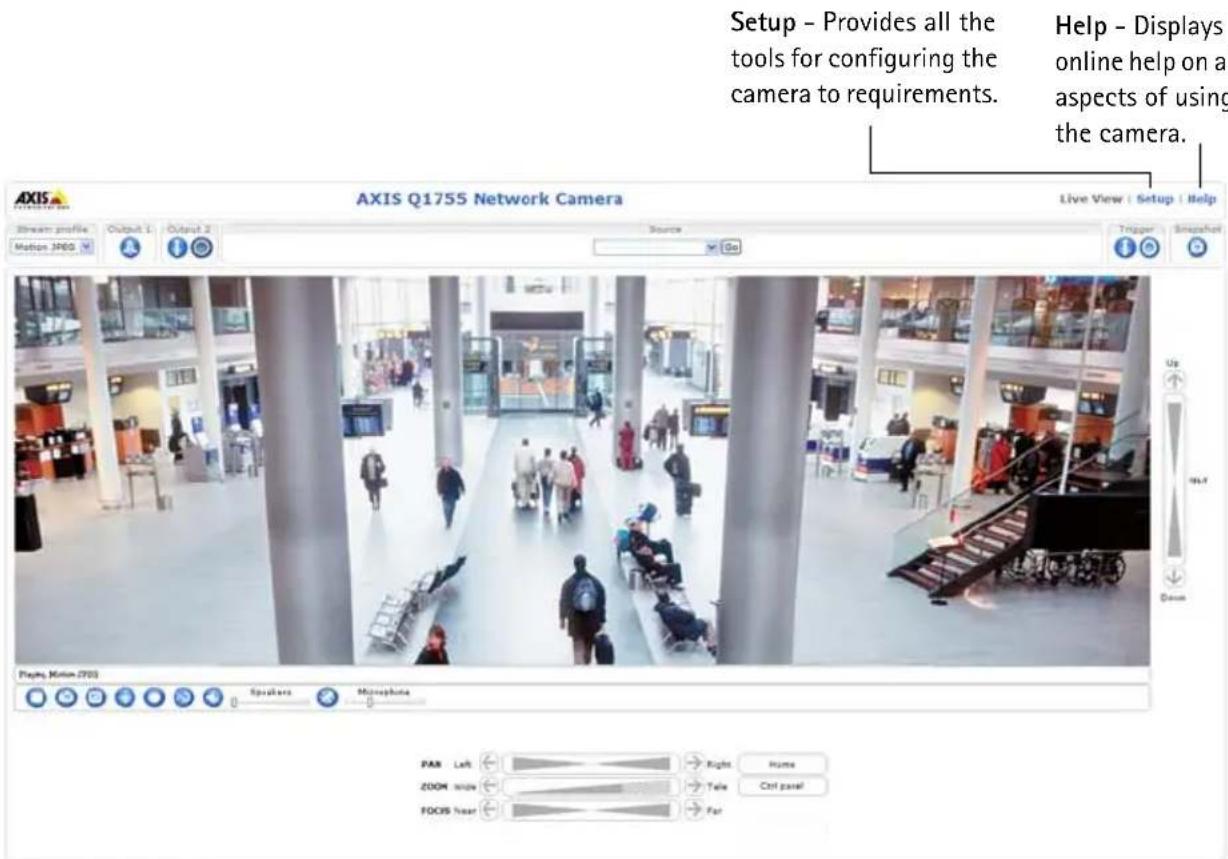
The Live View page of the AXIS Q1755 is displayed, with links to the Setup tools, which allow you to customize the camera.
If required, click Yes to install AMC (AXIS Media Control), which allows viewing of the video stream in Internet Explorer. You will need administrator rights on the computer to do this.
Company@company.com
Notes:
- HTTPS (Hypertext Transfer Protocol over Secure Socket Layer) is a protocol used to encrypt the traffic between web browsers and servers. The HTTPS certificate controls the encrypted exchange of information.
- The default administrator user root cannot be deleted.
- If the password for root is lost or forgotten, the AXIS Q1755 must be reset to the factory default settings. See Resetting to the Factory Default Settings, on page 15.
Other methods of setting the IP address
The table below shows the other methods available for setting or discovering the IP address. All methods are enabled by default, and all can be disabled.
| Use in operating system | Notes | |
| UPnPTM | Windows (ME or XP) | When enabled on your computer, the camera is automatically detected and added to “My Network Places.” |
| Bonjour | MAC OSX (10.4 or later) | Applicable to browsers with support for Bonjour. Navigate to the Bonjour bookmark in your browser (e.g. Safari) and click on the link to access the camera’s web pages. |
| AXIS Dynamic DNS Service | All A free service from | Axis that allows you to quickly and simply install your camera. Requires an Internet connection with no HTTP proxy. See www.axiscam.net for more information. |
| ARP/Ping | All See below. The com | command must be issued within 2 minutes of connecting power to the camera. |
| View DHCP server admin pages | All To view the admin | pages for the network DHCP server, see the server’s own documentation. |
Set the IP address with ARP/Ping
- Acquire an IP address on the same network segment your computer is connected to.
- Locate the serial number (S/N) on the product label on the camera.
- Open a command prompt on your computer and enter the following commands:
| Windows syntax: Windows example: | |
| arp -s <IP Address> <Serial Number> ping -l 408 -t <IP Address> | arp -s 192.168.0.125 00-40-8c-18-10-00 ping -l 408 -t 192.168.0.125 |
| UNIX/Linux/Mac syntax: UNIX/Linux/Mac example: | |
| arp -s <IP Address> <Serial Number> temp ping -s 408 <IP Address> | arp -s 192.168.0.125 00:40:8c:18:10:00 temp ping -s 408 192.168.0.125 |
- Check that the network cable is connected to the camera and then start/restart the camera, by disconnecting and reconnecting power.
- Close the command prompt when you see 'Reply from 192.168.0.125: ...' or similar.
- In your browser, type in http://
in the Location/Address field and press Enter on your keyboard.
Notes:
- To open a command prompt in Windows: from the Start menu, select Run... and type cmd. Click OK.
- To use the ARP command on a Mac OS X, use the Terminal utility in Application > Utilities.
Unit connectors
Network - RJ-45 Ethernet connector. Supports PoE (Power over Ethernet, class 3). Using shielded cables is recommended.
Audio in - 3.5mm input for a mono microphone, or a line-in mono signal (left channel is used from a stereo signal).
Audio out - 3.5mm output for audio (line level), can be connected to a public address (PA) system or an active speaker with a built-in amplifier. A pair of headphones can also be connected. A stereo connector must be used for audio out.
Video Out - RCA connectors for component or composite video out.
- Component video out for HDTV video, e.g. an entrance camera connected to an HDTV screen
- Composite video (CVBS) - for easy installation using a video monitor
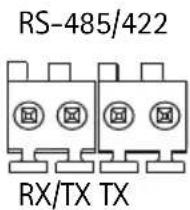
RS-485/422 - two 2-pin terminal blocks for RS-485/422 serial interface used to control auxiliary equipment, e.g. PTZ devices.
The RS-485/422 serial port can be configured in the following port modes:
- Bidirectional RS-485 half-duplex port for data transmission using two wires, one combined RX/TX pair.
- Bidirectional RS-485 full-duplex port for data transmission using four wires, one RX pair and one TX pair.
- Unidirectional RS-422 port for transmitting or receiving data using two wires, RX- or TX pair.
- Bidirectional RS-422 full-duplex port for data transmission (point-to-point) using four wires, one RX pair and one TX pair.
Pins 4 3 2 1
| Function Pin Notes | ||
| RS 485/422TX(A) 1 TX pair for RS-422 and 4-wire RS-485 | ||
| RS 485/422TX(B) 2 | ||
| RS-485A alt RS-485/422RX(A) 3 RX | pair for all modes (combined RX/TX for 2-wire RS-485) | |
| RS-485B alt RS-485/422RX(B) 4 | ||
SDHC memory card slot – High capacity SD memory card used for local recording and removable storage.
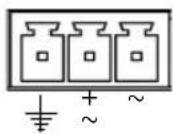
Power - 3-pin terminal block 8-20 VDC or 20-24 VAC
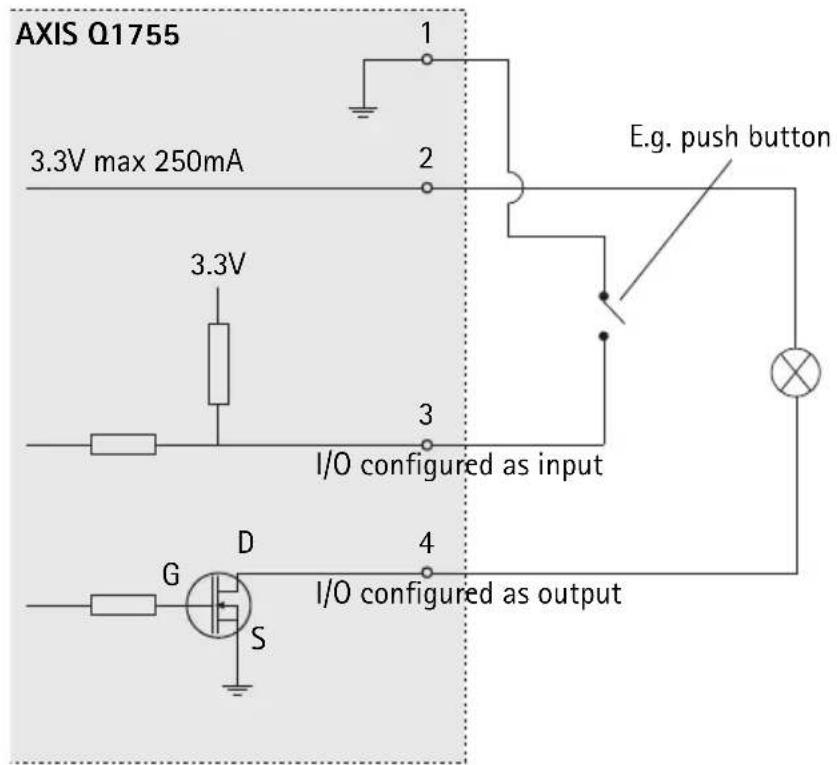
I/O terminal connector – Used in applications for e.g. motion detection, event triggering, time lapse recording and alarm notifications. In addition to an auxiliary power and a GND pin, the AXIS Q1755 has 2 pins that can be configured as either input or output. These pins provide the interface to:
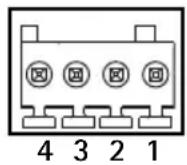
- Transistor output - For connecting external devices such as relays and LEDs. Connected devices can be activated by AXIS VAPIX API, output buttons on the Live View page or by an Event Type. The output will show as active (shown under Event Configuration > Port Status) if the alarm device is activated.
- Digital input - An alarm input for connecting devices that can toggle between an open and closed circuit, for example: PIRs, door/window contacts, glass break detectors, etc. When a signal is received the state changes and the input becomes active (shown under Event Configuration > Port Status.)
| Function | Pin number | Notes Specifications | |
| GND 1 Ground | |||
| 3.3V DC Power | 2 Can be used | to power auxiliary equipment.Note:This pin can only be used as power out. | Max load = 250mA |
| Configurable (Input or Output) | 3 - 4 Digital input | - Connect to GND to activate, or leave floating (or unconnected) to deactivate. | Min input = - 40V DCMax input = + 40V DC |
| Digital output - Uses an open-drain NFET transistor with the source connected to GND.If used with an external relay, a diode must be connected in parallel with the load, for protection against voltage transients. | Max load = 100mAMax voltage = + 40V DC | ||
Connection diagram
LED indicators
| LED Color | Indication | |
| Network | Green | Steady for connection to a 100 Mbit/s network. Flashes for network activity. |
| Amber | Steady for connection to 10 Mbit/s network. Flashes for network activity. | |
| Unlit No network connection. | ||
| Status Green Steady green for normal operation.Note: The Status LED can be configured to be unlit during normal operation, or to flash only when the camera is accessed. To configure, go to Setup > System Options > LED. See the online help files for more information. | ||
Resetting to the Factory Default Settings
This will reset all parameters, including the IP address, to the Factory Default settings:
- Disconnect power from the camera.
- Press and hold the Control button and reconnect power.
- Keep the Control button pressed until the Status indicator displays amber (this may take up to 15 seconds).
- Release the Control button. When the Status indicator displays green (which can take up to 1 minute) the process is complete and the camera has been reset.
- Re-assign the IP address, using one of the methods described in this document.
It is also possible to reset parameters to the original factory default settings via the web interface.
For more information, please see the online help or the user's manual.
Accessing the camera from the Internet
Once installed, your AXIS Q1755 is accessible on your local network (LAN). To access the camera from the Internet, network routers must be configured to allow incoming traffic, which is usually done on a specific port
- HTTP port (default port 80) for viewing and configuration
- RTSP port (default port 554) for viewing H.264 video streams
Please refer to the documentation for your router for further instructions. For more information on this and other topics, visit the Axis Support Web at www.axis.com/techsup
Further information
The user's manual is available from the Axis Web site at www.axis.com or from the Axis Network Video Product CD supplied with this product.
Tip!
Visit www.axis.com/techsup to check if there is updated firmware available for your AXIS Q1755. To see the currently installed firmware version, see Setup > About.
AXIS Q1755 Guide d'installation

Company@company.com
Remarques :



Safety Notice - Battery Replacement
The AXIS Q1755 uses a 3.0V CR2032 Lithium battery as the power supply for its internal real-time clock (RTC). Under normal conditions this battery will last for a minimum of 5 years. Low battery power affects the operation of the RTC, causing it to reset at every power-up. A log message will appear when the battery needs replacing. The battery should not be replaced unless required!
- If the battery does need replacing, please observe the following:
- Danger of Explosion if battery is incorrectly replaced
- Replace only with the same or equivalent battery, as recommended by the manufacturer.
- Dispose of used batteries according to the manufacturer's instructions.
© Axis Communications AB, 2008
Ver.1.00
Printed: December 2008
Part No. 32474
- Legal Considerations
- Electromagnetic Compatibility (EMC)
- Equipment Modifications
- Liability
- RoHS
- WEEE Directive
- Support
- AXIS Q1755 Installation Guide
- Installation steps
- Package contents
- ② Hardware overview
- Install the hardware
- Connect the cables
- Composite video out (optional)
- Component video out (optional)
- Assign an IP address
- Notes:
- AXIS IP Utility - single camera/small installation
- Automatic discovery
- Assign the IP address manually (optional)
- AXIS Camera Management - multiple cameras/large installations
- Assign an IP address in a single device
- Assign IP addresses in multiple devices
- Set the password
- Access the video stream
- Other methods of setting the IP address
- Set the IP address with ARP/Ping
- Unit connectors
- Connection diagram
- LED indicators
- Resetting to the Factory Default Settings
- Accessing the camera from the Internet
- Further information
- AXIS Q1755 Guide d'installation
- Remarques :
- Safety Notice - Battery Replacement
Brand : AXIS
Model : Q1755
Category : Surveillance Camera