
BBA 5013 CB - Bread maker BOMANN - Free user manual and instructions
Find the device manual for free BBA 5013 CB BOMANN in PDF.


| Product type | Bread machine |
| Brand | Bomann |
| Model | BBA 5013 CB |
| Power supply | 220-240 V~, 50 Hz, 480-580 W |
| Protection class | II |
| Capacity | 2 liters (bread up to 900 g) |
| Net weight | Approximately 3.8 kg |
| Number of programs | 12 programs (47 settings) |
| Weight settings | 3 positions: 450 g, 680 g, 900 g |
| Timer | Delay up to 10 hours |
| Keep warm function | 1 hour after baking |
| Browning level | 2 levels: light (PALE) and dark (DARK) |
| Mold material | Non-stick coating |
| Accessories included | Kneading hook, measuring cup, measuring spoon, hook for removing kneading hook |
| Safety | Hot surface – do not touch; do not immerse; do not cover during operation; keep a distance of at least 10 cm |
| Care and cleaning | Clean with a damp cloth; do not use abrasives or harsh cleaners; do not immerse the appliance or the mold |
| Spare parts and repairability | Removable kneading hook; do not repair yourself – contact qualified after-sales service or the manufacturer |
| General information | Compliant with EC directives; manufactured according to current safety regulations |
Frequently Asked Questions - BBA 5013 CB BOMANN
User questions about BBA 5013 CB BOMANN
0 question about this device. Answer the ones you know or ask your own.
Ask a new question about this device
Download the instructions for your Bread maker in PDF format for free! Find your manual BBA 5013 CB - BOMANN and take your electronic device back in hand. On this page are published all the documents necessary for the use of your device. BBA 5013 CB by BOMANN.
USER MANUAL BBA 5013 CB BOMANN
BROTBACKAUTOMAT BBA 5013 CB
Location of Controls ...... Page 3
Table of Contents Page 17
Instruction Manual Page 17
Technical Specifications......Page 27
Disposal Page 27
ITALIANO
Indice
Inhaltsverzeichnis
General Safety Guidelines....17
Safety Precautions....17
Intended use....18
Unpacking....18
Controls....19
Control Panel....19
Description Control Panel....19
Instructions for use of the appliance....20
Start-up 20
Program Sequence Bread Maker....20
Cleaning....21
Storage 21
Baking Q & A 21
Questions on Bread Baking Machines....22
Mistakes with the Recipes....23
Tips for Recipes....24
Classic Bread Recipes....25
Dough Recipes....26
Jam....27
Technical Specifications....27
Disposal 27
Instruction Manual
Thank you for deciding to purchase our product. We hope you enjoy using the appliance.
- The bread maker offers 12 pre-installed programs with a total of 47 different settings. A baking program to bake only or to reheat baked bread to make it darker is completely new.
- You can choose between 3 weight settings for smaller or larger loaves of bread in almost all baking programs.
- You can start baking with a delay, meaning you can program the program start up to 10 hours ahead.
The appliance works fully automatic and is extremely user-friendly. In the following you find recipes for
- White bread, dark leaven bread, light brown bread, bread with seeds, bread with yoghurt
- Dough, which is processed otherwise,
- Jam, cooked in the bread maker.
Symbols in this user manual
Important notes for your safety are marked distinctively. Pay absolute attention to them to avoid accidents and damage to the device:
WARNING:
Warns of dangers for your health and indicates potential risks of injury.
△ CAUTION:
Indicates potential dangers for the device or other objects.
i NOTE:
Highlights tips and information for you.
General Safety Guidelines
Before using this device, carefully read this user manual and keep it together with the Warranty Certificate, cashier receipt and if possible, the original package inclusive its interior packing. If you hand on the device to any third person, include the user manual as well.
- Use the device for private and its intended purpose only. The device is not intended for commercial use.
- Do not use the device outdoors. Protect it from heat, direct sunlight, humidity (do not immerse into liquids under any circumstances) and sharp edges. Do not use the device with wet hands. If the device gets wet, unplug it immediately.
- Always switch off and unplug the device (pull the plug, not the cable) when you do not use the device, or when you attach accessories, during cleaning or malfunctioning.
- Do not leave the device unattended during operation. Always switch off the device when leaving the room. Unplug the device.
- Regularly check the device and cable for signs of damage. Do not continue to operate the device in case of damage.
- Do not repair the device by yourself. Please contact authorized personnel. In order to avoid hazards, a damaged mains cable must be replaced with an equivalent cable by the manufacturer, our customer service or any other qualified specialist.
- Do only use original parts.
- For the safety of your children, keep any packing parts (plastic bags, cartilage, Styrofoam etc.) out of their reach.
WARNING!
Don't let small children play with foils for danger of suffocation!
- Please observe the following "Special safety instructions".
Safety Precautions
Symbols on the product
On the product you find the following warning symbol:

WARNING: Hot surface!
Very high temperatures arise during the operation that can cause burns.
- Do not touch the viewing window in any case during and after the operation!
- When you remove the baking pan after baking, always use potholders or oven gloves!

WARNING: risk of fire!
- Do not leave the appliance without supervision. For delayed program start set the start time so that you are present during operation.
- Keep at least 10 cm distance to other objects during operation.
- Do not cover the appliance with a towel or other materials during operation! Heat and steam must be able to escape. Risk of fire, if the appliance is covered or comes in contact with flammable materials such as curtains.
- Do not place metal foil or other materials in the appliance; risk of short-circuit and fire.
- Risk of fire, if the dough overflows from the baking tin into the casing or onto the heating element.
- Do not fill in more ingredients than indicated in the recipe.
- Ensure that the maximum weight of the 3 different weight settings is not exceeded together with the ingredients.
- This appliance can be used by children aged from 8 years and above and persons with reduced physical, sensory or mental capabilities or lack of experience and knowledge if they have been given supervision or instruction concerning use of the appliance in a safe way and understand the hazards involved.
• Children shall not play with the appliance.
- Cleaning and user maintenance shall not be made by children unless they are older 8 years and supervised.
- Keep the appliance and its cord out of reach of children less than 8 years.
- Do not operate the appliance with an external timer or similar remote system.
- Place the appliance on a level work surface. Ensure that mains cord and appliance are not placed on or in close proximity of hot surfaces or heat sources. Run the mains cord away from sharp objects.
- Set up the appliance steady and slip-proof. The appliance can move when kneading heavy dough. Place the appliance on a rubber mat if the work surface is slippery.
- Do not move or lift the appliance during operation; first turn it off and disconnect from mains power supply. Always carry the appliance in both hands!
- Do not remove the baking tin during operation!
- Let the appliance cool down completely before cleaning ore storing.
Intended use
This appliance is intended for use in
- Baking bread
• Preparing different types of dough - Making jam or fruit puree.
It is designed exclusively for this purpose and may only be used therefor.
It may only be used in the manner described in this instruction manual.
The appliance may not be used for commercial purposes.
Any other use is considered not as intended and may lead to damage to property or even personal injury.
The manufacturer assumes no liability for damage resulting from use other than the intended purpose.
Unpacking
- Remove the appliance from the gift box.
- Remove all packaging materials, such as plastic foil, filling materials, cable clips and cardboard.
- Check that all accessories are contained in the box.
- Clean the appliance as described in chapter "Cleaning".
Controls
1 Lid handle
2 Lid with viewing window
3 Baking pan with handle
4 Inside chamber of the appliance
5 Housing
6 Control panel
7 Ventilation
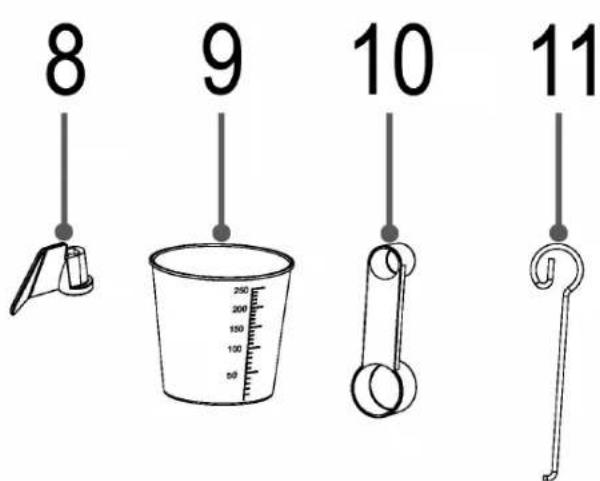
8 Dough hook
9 Measuring cup
10 Measuring spoon
11 Hook pike to remove the dough hook
Control Panel
a) LCD Display
shows information about desired program number, browning, bread weight (marked with arrow) and baking time.
b)
START / STOP button
to start and end the program
c)
COLOUR button
to set the desired browning
d)
Time buttons
to enter the program timer setting
e)
WEIGHT button
to set the 3 weight levels, as described later
f)
PROGRAM button
to select the programs described in chapter "Program Sequence Bread Maker".


Description Control Panel
a) LCD Display
NORMAL SETTING BASIC
This displays standby mode. It corresponds with the basic program. The display shows "I 2:50". The "I" stands for the selected program; "2:50" stands for the program duration. The positions of two arrows show the selected browning and the weight. The basic setting after turning the appliance on is: "PALE" (light browning) and "450 g". During operation the display shows the program duration counting down.
b)

START / STOP button
to start and end the program.
- After pressing the START / STOP button the dots on the time display start flashing. The backlight of the display lights up at 5 second intervals.
- Press the START / STOP button at any time to cancel the program. Keep the button pressed until you hear a buzzer. The backlight of the display turns off. The display shows the start position of above start program. Press the PROGRAM button to select a different program. Depending on the operation mode you may have to wait for the appliance to cool down.
i NOTE:
Do not push the START / STOP button during a program when you are opening the lid to add more ingredients or to check the bread! Doing so will end the program.
c)

COLOUR button
Press this button to set the desired browning: PALE - DARK.
d)

Time buttons
Use the timer function to set the end time for a selected program.
This function is available for the following programs:
BASIC
FRENCH
SWEET
WHOLE WHEAT
SANDWICH
YOGHOURT
The other programs cannot be started time-delayed.

WARNING:
During time-delayed baking, make sure that you always check on the appliance during operation.
- Press the / buttons to set the end time for the program.
iNOTE:
- Repeatedly press the / buttons to move the end time of the program by 10 minutes.
• The max. time delay is 10 hours. - If you chose a different program, the previous timer setting will be deleted.
- Do not use the timer function for recipes containing fresh ingredients such as milk, eggs, fruit, yoghurt, onions etc.!
Example: It is now 8:30 p.m. and you want the bread ready the next morning at 7:00 a.m., in 10 hours and 30 minutes. Set this value (10:30) on the display. You need to calculate the amount of hours between the program duration (e.g. 2:50) and the desired end. The program is started automatically so that the bread is completed by the entered time.
- By pushing the START / STOP button, you are activating the timer function. The dots in the time indicator flash. The backlight of the display is lightup at 5 seconds intervals.
- If you want to abort the timer function, push the START / STOP button again, until a buzzer can be heard.
e)

WEIGHT button
In some programs you can set the following levels:
SETTING I = for a bread weight up to 450 g
SETTING II = for a bread weight up to 680 g
SETTING III = for a bread weight up to 900 g
f)

PROGRAM button
Press the PROGRAM button to access the individual programs. The programs are used for the following types of bread:
-
BASIC for white and brown bread. This program is mainly used.
-
FRENCH for especially light white bread
-
SWEET for the preparation of bread made from sweet yeast dough
- CAKE for pastries containing baking powder
- WHOLE WHEAT for wholewheat bread
- SANDWICH for preparation of light sandwich bread
- WHISK to knead heavy dough (noodles, dumplings)
- JAM for cooking jam and marmalade
- YOGHOURT for yoghurt bread
- DOUGH to make yeast dough (pizza, rolls, pretzels)
- FAST BAKE for fast preparation of white and brown bread
- BAKE for baking bread or cake (5 minutes - 1 hour).
Instructions for use of the appliance
Explanation of the buzzers
The appliance creates different buzzers:
1 long buzzer The appliance is connected to the power supply.
1 short buzzer - You have pushed a button.
- Announcing the start of the program start when the timer function is activated
5 successive buzzers The temperature of the appliance is too high to start a new program.
10 successive buzzers The second kneading process has started. You can still add ingredients (grains, fruits, nuts, etc.) in the programs BASIC, FRENCH, SWEET, WHOLE WHEAT and SANDWICH.
12 successive buzzers The program is complete. In all baking programs, a keep warm phase of 1 hour will then commence.
Program Memory
The program continues after a power failure of less than 20 minutes. After a longer power failure the bread maker must be restarted. This is only practical if the dough was at this time still in the kneading phase. You have to start from the beginning if baking already started!
Safety functions
After a baking program is complete, the appliance needs to cool off before you can start a new baking or kneading program (exception: the programs "8. JAM" and "12. BAKE").
The appliance warns you with 5 buzzers and shows the message "HOE" in the display, when the temperature of the appliance is still too high.
- Disconnect the power supply.
- Remove the baking pan.
- Leave the lid open and wait until the appliance has cooled off. This time varies depending on the previous use.
Start-up
Electric Connection
- Confirm that your mains voltage matches the specifications on the type label before connecting to mains power supply.
- Connect the appliance to a properly installed wall outlet.
A buzzer sounds and the display shows the basic setting (see "Control Panel", "a) LCD Display"). The appliance is operational.
Program Sequence Bread Maker
△ CAUTION: Fire hazard!
- Never fill the ingredients into the baking pan at the start of your baking project, if the pan is still in the inside chamber of the device.
- If you add further ingredients such as grains, fruits, or nuts during the second kneading process, ensure that they do not fall into the inside chamber of the appliance.
1. Removing the baking pan
Open the lid and pull the baking pan out by its handle. Set the baking pan onto a flat work surface.
2. Insert Kneading Hook
Place the semi-circular opening of the kneading hook over the drive shaft inside the baking tin. The flange of the opening must face down. Observe the flute on the shaft. The kneading hook sits level on the bottom of the baking tin.
3. Insert Ingredients
Ensure that the ingredients are filled into the baking tin according to the sequence determined by the recipe.
4. Inserting the baking pan
Set the baking pan onto the base in the inside area of the appliance. It must audibly click into place.
Close the lid.
5. Starting the program
- Select the desired program with the button.

- Select the total weight of your ingredients with the

WEIGHT button.
- Select a light or dark browning of the bread crust with the COLOUR button.
- Use the / time buttons to delay the start of the program.
- Push the START / STOP button. The flashing colon announces the program start to you. The backlight of the display lights up at 5 second intervals.
6. Leave Dough to Rise
After the last kneading the bread maker sets the optimum temperature for the dough to rise. It heats up to 25^ C if the room temperature is lower.
7. Baking
The bread maker adjusts the baking temperature automatically. Select the BAKE program to extend the baking process in case the bread is still too pale after baking.
8. Keeping Warm (except for the programs "7. WHISK", "8. JAM" and "10. DOUGH")
The buzzer sounds repeatedly after the baking program is finished and bread or foodstuffs can be removed. At the same time the 1-hour warming phase starts. The backlight of the display continues to flash.
After 1 hour, the keep warm phase ends. The background light in the display turns off. The original program status is shown.
9. Program (Additional) baking (BAKE)
- Select the program "12. BAKE". The time indication flashes.
- Set the desired baking time with the / time buttons.
- Push the START / STOP button once. The time indicator is stops. Should you want to still correct the selected time, please remember the following: You can only increase the baking time. You cannot correct it to below the set value is not possible.
- Push the START / STOP button a second time. The flashing colon shows you the program start. The backlight of the display lights up at 5 second intervals.
- After the time has elapsed, 12 buzzers will sound. The backlight of the display will continue to flash. The keep warm phase of 1 hour commences.
- If you want to cancel the program, keep the START / STOP button pressed until a buzzer can be heard.
10. Program End
Have a grid ready and disconnect from mains power supply. Remove the baking tin with oven gloves after the program has ended, turn it upside down and slightly shake it; turn the kneading hook drive at the bottom if the bread does not come out immediately. Use the supplied hook in case the kneading hook gets stuck inside the bread. Insert it through the semi-circular opening of the kneading hook at the bottom of the warm bread and hook into the lower edge (at the wing of the kneading hook). Carefully pull the kneading hook upward with the hook. You can see in which part of the bread the wing of the kneading hook is stuck. Cut the bread in that position and easily remove the kneading hook.
Cleaning
WARNING:
• Always disconnect from mains power supply and let the appliance cool down before cleaning.
- Do not submerge the appliance and the baking tin in water. To avoid the risk of electric shock and fire do not fill water into the baking chamber.
△ CAUTION:
- Do not use a wire brush or other abrasive objects for cleaning.
-
Do not use aggressive or abrasive cleaning agents.
-
For easier cleaning, the lid can be removed by setting it vertically and then pulling it off.
- Remove all ingredients and crumbs with a damp cloth from lid, casing and baking chamber.
- Wipe the baking tin on the outside with a damp cloth. The inside can be cleaned with water and a mild cleaning agent.
- Clean kneading hooks and drive shafts immediately after use. If the dough hook remains in the pan, it is more difficult to remove it later on. In this case fill warm water for approx. 30 minutes into the tin. The dough hook can then be removed
i NOTE:
The baking tin is anti-stick coated. It is normal if the color of the coating changes over time, this does not affect the function.
Storage
- Ensure that the appliance is clean and dry and has cooled down complete before storing. Store the appliance with the lid closed.
- We recommend storing the appliance in the original packaging if you do not want to use it for long periods of time.
- Always keep the appliance out of the reach of children in a dry, well ventilatedplace.
Baking Q & A
• The bread sticks to the container after baking
Leave the bread to cool for about 10 minutes after baking – turn the container upside down. Move the kneading hook shaft back and forth, if necessary. Grease the kneading hooks before baking.
- How do you avoid the forming of holes in the bread owing to the presence of the kneading hooks
You can remove the kneading hooks with your fingers covered with flour before leaving the dough to rise for the last time. The display must show a remaining processing time of approx. 1:30 hours, depending on the program. If you not wish to do so, use the hook after baking. If you proceed with caution, you can avoid the forming of a large hole.
• The dough spills over when it is left to rise
This happens in particular when wheat flour is used owing to its greater content of gluten.
Remedy:
a) Reduce the amount of flour and adjust the amounts of the other ingredients. When the bread is ready, it will still have a large volume.
b) Spread a tablespoon of heated liquefied margarine on the flour.
• The bread rises and spills over anyway
a) If a V-shaped ditch forms in the middle of the bread, the flour does not have enough gluten. This means that the wheat contains too little protein (it happens during especially rainy summers) or that the flour is too moist.
Remedy: Add one tablespoon of wheat gluten per 500 g of wheat flour.
b) If the bread has a funnel shape in the middle, the possible cause can be one of the following
- he water temperature was too high,
- too much water was used,
- the flour was poor in gluten,
- draft when opening the lid during baking.
- When can the lid of the bread maker be opened during the baking?
Generally speaking, it is always possible while the kneading is underway. During this phase small quantities of flour or liquid can still be added.
If the bread must have a particular aspect after baking, proceed as follows: before the last rising phase (the display must show a remaining processing time of approx. 1:30 hours, depending on the program) open the lid with caution and shortly and carve the bread crust while it is forming with a sharp preheated knife, scatter cereals on it or spread a mixture of potato flour and water on the crust to give it a glossy finish. This is the last time that the lid can be opened; otherwise the bread will go down in the middle.
• What do the type numbers for flour mean?
The lower the type number, the less roughage the flour contains and the lighter it will be.
• What is wholewheat flour?
Wholewheat flour is made of all types of cereals including wheat. The term “wholewheat” means that the flour was ground from whole grain and hence it has a greater contents of roughage thus making the wholewheat flour darker. However, the use of wholewheat flour does not make the bread darker as is widely believed.
• What must be done when using rye flour?
Rye flour does net contain any gluten and the bread hardly rises. In order to make it easily digestible a RYE WHOLE-WHEAT BREAD with leaven is to be made.
The dough will rise only if one part of type 550 flour is added to every four parts of rye flour without gluten.
• What is gluten in flour?
The highez the type number, the lower the gluten contents of the flour are and the less the dough will rise. The highest quantity of gluten is contained in type 550 flour.
- How many different flour types are there and how are they used?
a) Corn, rice and potato flour are suitable for people allergic to gluten or for those who suffer from sprue or celiac disease.
b) Spelt flour is very expensive, but it is free from chemical additives because spelt grows on very poor soil and requires no fertilizers. Spelt flour is especially suitable for allergic people. It can be used in all those recipes described in the operating instructions requiring flour types 405, 550 or 1050.
c) Millet flour is especially suitable for people suffering from many allergies. It can be used in all recipes requiring flour types 405, 550 or 1050 as described in the operating instructions.
d) Durum wheat flour (DURUM) is suitable for baguettes thanks to its consistency and it can be replaced with durum wheat semolina.
• How can fresh bread be made easier to digest?
If a mashed boiled potato is added to the flour and kneaded in the dough the fresh bread is easier to digest.
• What doses of rising agent should be used?
For yeast and leaven, which must be bought in different quantities follow the producer's instruction on the package and adjust the quantity to the amount of flour used.
• What can be done if the bread tastes of yeast?
a) Often sugar is added to eliminate this taste. The adding of sugar makes the bread lighter in color.
b) Add 1 12 tablespoons of vinegar for a small bread loaf and 2 tablespoons for a large loaf to the water.
c) Use buttermilk or kefir instead of water. This is possible for all the recipes and it is recommended for the freshness of the bread.
- Why does the bread made in an oven taste different form the bread made with the bread maker?
It depends on the different degree of humidity. The bread is baked drier in the oven owing to the larger baking space, while the bread made in the bread maker is moister.
Questions on Bread Baking Machines
| Problem Cause Remedy | ||
| Smoke comes out of the baking compartment or the vents | The ingredients stick to the baking compartment or on the outside of the baking tin | Disconnect from mains power supply, let the appliance cool down, and clean the outside of the baking tin or the baking compartment. |
| The bread goes down in the middle and is moist at the bottom | The bread is left too long in the tin after baking and warming | Take the bread out of the baking tin before the warming function is over. |
| It is difficult to take the bread out of the baking tin | The bottom of the loaf is stuck to the kneading hook. | Clean the kneading hooks and shafts after baking. If necessary, fill the baking tin with warm water for 30 minutes. Then the kneading hooks can be easily removed and cleaned. |
| The ingredients are not mixed or the bread is not baked correctly. | Incorrect program setting Check the selected menu and the other settings. | |
| The START / STOP button was touched while the machine was working (The program was ended early.) | Do not use the ingredients and start over again | |
| The lid was opened several times while the bread maker was working | Do not open the lid after the last rising (if at least “1:30” is shown on the display). Ensure that the lid is properly closed after opening. | |
| Long power failure while the machine was working | Do not use the ingredients and start over again. | |
| The rotation of the kneading hooks is blocked | Check if the kneading hooks are blocked by grains, etc. Pull out the baking tin and check whether the drive shafts turn. If this is not the case contact the customer service. | |
| The appliance does not start. 5 buzzers will sound. The display shows “HOE”. | The appliance is still hot after the last baking cycle | Remove the baking tin and leave the appliance to cool. Then replace the baking tin, reset the program and start again. |
Mistakes with the Recipes
| Problem Cause Remedy | ||
| The bread rises too fast Too much | yeast, too much flour, not enough salt, or several of these causes a/b | |
| The bread does not rise at all or not enough | No yeast at all or too little yeast a/b | |
| Old or stale yeast d | ||
| Liquid too hot c | ||
| The yeast has come into contact with the liquid d | ||
| Wrong flour type or stale flour d | ||
| Too much or not enough liquid a/b/g | ||
| Not enough sugar | a/b | |
| The dough rises too much and spills over the baking tin | If the water is too soft the yeast ferments more | f/k |
| Too much milk affects the fermentation of the yeast | c | |
| The bread goes down in the middle | The dough volume is larger than the tin and the bread goes down | a/f |
| The fermentation is too short or too fast owing to the excessive temperature of the water or the baking chamber or to the excessive moistness. | c/h/i | |
| No salt at all or too little salt | a/b | |
| Too much liquid | h | |
| Heavy, lumpy structure. | Too much flour or not enough liquid | a/b/g |
| Not enough yeast or sugar | a/b | |
| Too much fruit, wholewheat or one of the other ingredients | b | |
| Old or stale flour | d | |
| The bread is not baked in the center | Too much or nor enough liquid | a/b/g |
| Too much humidity | h | |
| Recipe with moist ingredients such as yogurt | g | |
| Open or coarse structure or too many holes | Too much water | g |
| No salt | b | |
| High humidity, water too hot | h/i | |
| Too much liquid | c | |
| Mushroomlike, unbaked surface | Bread volume to big for the tin | a/f |
| Too much flour, especially for white bread | f | |
| Too much yeast or not enough salt | a/b | |
| Too much sugar | a/b | |
| Sweet ingredients besides the sugar | b | |
| The bread slices are unequal or lumpy | Bread not cooled enough (the vapor has not escaped) | j |
| Flour deposits on the bread crust | The flour was not worked well on the sides during the kneading | g/i |
Remedy Problems
a) Measure the ingredients correctly.
b) Adjust the ingredient doses and check that all ingredients have been added.
c) Use another liquid or leave it to cool at room temperature. Add the ingredients specified in the recipe in the right order. Make a small ditch in the middle of the flour and put in the crumbled yeast or the dry yeast. Avoid letting the yeast and the liquid come into direct contact.
d) Use only fresh and correctly stored ingredients.
e) Reduce the total amount of the ingredients, do not use more than the specified amount of flour. Reduce all the ingredients by 1/3.
f) Correct the amount of liquid. If ingredients containing water are used, the dose of the liquid to be added must be duly reduced.
g) In case of very humid weather remove 1-2 tablespoons of water.
h) In case of warm weather do not use the timer function. Use cold liquids.
i) Take the bread out of the tin immediately after baking and leave it on the grid to cool for at least 15 minutes before cutting it.
j) Reduce the amount of yeast or of all the ingredient doses by 1/4.
k) Do not grease the baking tin!
I) Add a tablespoon of wheat gluten to the dough.
Tips for Recipes
1. Ingredients
Since each ingredient plays a specific role for the successful baking of the bread, the measuring is just as important as the order in which the ingredients are added.
- The most important ingredients like the liquid, flour, salt, sugar and yeast (either dry or fresh yeast can be used) affect the successful outcome of the preparation of the dough and the bread. Always use the right quantities in the right proportion.
- Use lukewarm ingredients if the dough needs to be prepared immediately. If you wish to set the program phase timing function, it is advisable to use cold ingredients to avoid that the yeast starts to rise too early.
- Margarine, butter and milk affect the flavor of the bread.
- Sugar can be reduced by 20% to make the crust lighter and thinner without affecting the successful outcome of the baking. If you prefer a softer and lighter crust replace the sugar with honey.
- Gluten, which is produced in the flour during the kneading provides for the structure of the bread. The ideal flour mixture is composed of 40% wholewheat flour and 60% white flour.
- If you wish to add whole grains, leave them to soak overnight. Reduce the quantity of flour and the liquid (up to 1/5 less).
- Leaven is indispensable with rye flour. It contains milk and acetobacteria that make the bread lighter and ferment thoroughly. You can make your own leaven but it takes time. For this reason concentrated leaven powder is used in the recipes below. The powder is sold in 15 g packets (for 1 kg of flour).
Follow the instructions given in the recipes ( 12 , 34 or 1 packet). If less leaven than requested is used the bread will crumble.
- If leaven powders with a different concentration (100 g packet for 1 kg of flour) are used, the quantity of flour must be reduced by 80 g for 1 kg of flour.
- Liquid leaven sold in bags is also available and it is suitable for use. Follow the doses specified on the package. Fill the measuring cup with the liquid leaven and top it up with the other liquid ingredients in the right dosage as specified in the recipe.
- Wheat leaven, which often comes dry, improves the workability of the dough, the freshness and the taste. It is milder than rye leaven.
- Use either the BASIC or WHOLE WHEAT program when baking leavened bread.
- Wheat bran is added to the dough if you want particularly light bread rich in roughage. Use one tablespoon for 500 g of flour and increase the quantity of liquid by 12 tablespoon.
- Wheat gluten is a natural additive obtained from wheat proteins. It makes the bread lighter and more voluminous. The bread falls in more rarely and it is more easily digestible. The effect can be easily appreciated when baking wholewheat and other bakery products made of home-milled flour.
- The black malt used in some recipes is dark-roasted barley malt. It is used to obtain a darker bread crust and soft part (e.g. brown bread). Rye malt is also suitable but it is not as dark. You can find this malt in whole food shops.
- Bread seasoning can generally be added to all our brown breads. The amount depends on your personal taste and the manufacturer's specifications.
- Pure lecithin powder is a natural emulsifier that improves the volume of the bread, makes the soft part softer and lighter and keeps it fresh for longer.
2. Adjust Doses
If the doses need to be increased or reduced, make sure that the proportions of the original recipe are maintained. To obtain a perfect result, the basic rules below for the adjustment of the ingredient doses must be following:
- Liquids/flour: The dough ought to be soft (not too soft) and easy to knead without becoming stringy. A ball can be obtained by kneading it lightly. This is not the case with heavy dough like rye wholewheat or cereal bread. Check the dough five minutes after the first kneading. If it is too moist, add some flour until the dough has reached the right consistency. If the dough is too dry add a spoonful of water at a time during the kneading.
- Replacing liquids: When using ingredients containing liquids in a recipe (e.g. curd cheese, yogurt, etc.) the required amount of liquid must be reduced. When using eggs beat them in the measuring beaker and fill it up with the other required liquids to the envisaged amount.
If you are living in a place located at a high altitude (more than 750 m above sea level) the dough rises faster. The yeast can be reduced in these cases by 14 to 12 teaspoon to proportionally reduce its rising. The same is true of places with particularly soft water.
3. Add and Measure Ingredients and Quantities
• Always put in first the liquid and the yeast at the end.
To avoid that the yeast acts too fast, contact between the yeast and the liquid must be avoided.
- When measuring use the same measuring units, that is to say use either the measuring spoon supplied with the bread maker, or a spoon used in your home when the recipes require doses measured in tablespoons and teaspoons.
- The measures in grams must be weighed precisely.
- For the milliliter indications you can use the supplied measuring cup, which has a graduated scale of 50 to 250 ml.
$$ \begin{array}{l} \text { The abbreviations in the recipes mean: } \ \text { tbs } = \text { level tablespoonful (or large measuring spoon) } \ \mathrm{tsp} = \text { level teaspoonful (or small measuring spoon) } \ g = \text { grams } \ \mathrm{ml} = \text { milliliter } \ \text { Packet } = 7 \mathrm{g} \text { dry yeast for } 5 0 0 \mathrm{g} \text { of flour } \ - \text { corresponds to } 2 0 \mathrm{g} \text { of fresh yeast } \ \end{array} $$
- Fruit, nuts or cereal ingredients. If you want to add any other ingredients, you can do this in sthe programs where 10 buzzers can be heard. If you add the ingredients too early, they will be crushed during the kneading.
4. Recipes for the Bread Maker
The following recipes are for various bread sizes. In some programs a difference is made in weight. The "11. FAST BAKE" program is only suitable for a bread weight of up to 700 g.
△ CAUTION:
- Adjust the recipes to the appropriate weight.
- Ensure that the maximum weight of the 3 different weight settings is not exceeded together with the ingredients.
5. Bread Weights and Volumes
- In the following recipes you will find exact indications regarding the bread weight. You will see that the weight of pure white bread is less than that of wholewheat bread. This depends on the fact that white flour rises more and hence limits need to be posed.
- Despite the precise weight indications there may be slight differences. The actual bread weight depends much on the humidity of the room at the time of preparation.
- All breads with a substantial portion of wheat reach a large volume and exceed the baking tin edge after the last rising in case of the higher weight level. But the bread does not spill over. The part of the bread outside the tin is more easily browned compared to the bread in the tin.
6. Baking Results
- The baking result depends on the on-site conditions (soft water - high humidity - high altitude - consistency of the ingredients, etc.). Therefore, the recipe indications are reference points, which can be adjusted. If one recipe or another dose not work out straight the first time, do not be discouraged. Try to find the cause and try it again by varying the proportions.
- If the bread is too pale after baking, you can leave it to brown with program BAKE.
Classic Bread Recipes
Classic White Bread
| Ingredients |
| Water or milk 300 ml |
| Margarine/butter 1 1/2 tbs |
| Salt 1 tsp |
| Sugar 1 tbs |
| Flour type 550 540 g |
| Dry yeast 1 packet |
| Program “BASIC” |
Nut & Raisin Bread
| Ingredients | |
| Water or milk 300 ml | |
| Margarine/butter 1 1/2 tbs | |
| Salt 1 tsp | |
| Sugar 2 tbs | |
| Flour type 405 460 g | |
| Dry yeast 1 packet | |
| Raisins 85 g | |
| Crushed walnuts | 3 tbs |
| Program “BASIC” | |
Add raisins and nuts after the first kneading process (signaled by 10 buzzers).
Wholewheat Bread
| Ingredients | |
| Water | 300 ml |
| Margarine/butter 1 1/2 tbs | |
| Egg | 1 |
| Salt 1 tsp | |
| Sugar 2 tsp | |
| Flour type 1050 | 360 g |
| Wholewheat flour | 180 g |
| Dry yeast 1 packet | |
| Program “WHOLE WHEAT” | |
If you delay the program start with the timer function, use a bit more water instead of the egg.
Buttermilk Bread
| Ingredients | |
| Buttermilk | 300 ml |
| Margarine/butter 1 1/2 tbs | |
| Salt 1 tspSugar | 2 tbs |
| Flour type 1050 | 540 g |
| Dry yeast 1 packet | |
| Program “BASIC” | |
Onion Bread
Ingredients
Water 250 ml
Margarine/butter 1 tbs
Salt 1 tsp
Sugar 2 tbs
Large chopped onion 1
Flour type 1050 540 g
Dry yeast 1 packet
Program "BASIC"
Seven Seeds Bread
Ingredients
Water 300 ml
Butter/margarine 1 ½ tbs
Salt 1 tsp
Sugar 2 1/2 tbs
Flour type 1150 240 g
Wholewheat flour 240 g
7-seed flakes 60 g
Dry yeast 1 packet
Program "WHOLE WHEAT"
Soak, if using whole seeds.
Sunflower Seed Bread
Ingredients
Water 310 ml
Butter 1 tbs
Flour type 550 480 g
Sunflower seeds 5 tbs
Salt 1 tsp
Sugar 1 tbs
Dry yeast 1 packet
Program "BASIC"
Tip: You can substitute sunflower seeds with pumpkin seeds.
Roast the seeds once in a frying pan for more intensive taste.
Farmer's White Bread
Ingredients
Milk 300 ml
Margarine/butter 2 tbs
Salt 1 1/2 tsp
Sugar 1 1/2 tsp
Flour type 1050 540 g
Dry yeast 1 packet
Program "BASIC"
Leaven Bread
Ingredients
Dry leaven 45 g
Water 310 ml
Margarine/butter 1 1/2 tbs
Salt 3 tsp
Sugar 2 tbs
Flour type 1150 160 g
Flour type 1050 310 g
Yeast 1/2 packet
Program "BASIC"
Yoghurt bread
Ingredients
Water or milk 170 ml
Yoghurt 150 g
Vegetable oil 1 1/2 tbs
Salt 1/2 tsp
Sugar 2 tbs
Flour type 550 340 g
Dry yeast 1 1/4 tsp
Program "YOGHOURT"
△ CAUTION:
- Adjust the recipes to the appropriate weight.
- Ensure that the maximum weight of the 3 different weight settings is not exceeded together with the ingredients.
Dough Recipes
French Baguette
Ingredients
Water 300 ml
Honey 1 tbs
Salt 1 tsp
Sugar 1 tsp
Flour type 550 540 g
Dry yeast 1 packet
Program "DOUGH"
Split the dough in 2-4 parts and shape long loafs. Leave to rise for 30-40 minutes. Incise the top diagonally and bake in the oven.
Pizza
Ingredients
Water 300 ml
Salt 3/4 tsp
Olive oil 1 tbs
Flour type 405 450 g
Sugar 2 tsp
Dry yeast 1 packet
Program "DOUGH"
- Roll the dough, place it in a round tin and leave to rise for 10 minutes. Pierce several times with a fork.
- Spread pizza sauce on the dough and add the desired toppings.
- Bake for 20 minutes.
Jam
Jam
Ingredients
Fruit 500 g
Canning sugar "2:1" 250 g
Lemon juice 1 tbs
Program "JAM"
- Cut and pit the fruit before processing.
- The following fruit is especially well suited for these recipes: strawberries, blackberries, blueberries or a mixture thereof.
- Fill the jam in clean bottles, close the lid and place the bottles for approx. 10 minutes upside down (to ensure that the lid is properly closed)!
Orange Marmalade
Ingredients
Oranges 400 g
Lemons 100 g
Canning sugar "2:1" 250 g
Program "JAM"
Peel and cut in cubes or strips.
Technical Specifications
Model: BBA 5013 CB
Power supply: 220 - 240 V\~, 50 Hz
Power consumption: 480 - 580 W
Protection class:....
Capacity: 2 Liters
(corresponds to approx. 900 g bread weight)
Net weight: approx. 3.8 kg
Subject to change without prior notice!
This device complies with all current CE directives, such as electromagnetic compatibility and low voltage directive and is manufactured according to the latest safety regulations.
Disposal
Meaning of the "Wheelie Bin" Symbol
Take care of our environment, do not dispose of electrical appliances via the household waste.
Dispose of obsolete or defective electrical appliances via municipal collection points.
Please help to avoid potential environmental and health impacts through improper waste disposal.
You contribute to recycling and other forms of utilization of old electric and electronic appliances.
Your municipality provides you with information about collecting points.
Indice
BASIC FRENCH SWEET WHOLE WHEAT SANDWICH YOGHOURT
Programme "WHOLE WHEAT"
Programme "YOGHOURT"
ATTENTION :
Programa "WHOLE WHEAT"

- ITALIANO
- Indice
- Inhaltsverzeichnis
- Instruction Manual
- Symbols in this user manual
- WARNING:
- △ CAUTION:
- i NOTE:
- General Safety Guidelines
- WARNING!
- Safety Precautions
- Symbols on the product
- WARNING: Hot surface!
- WARNING: risk of fire!
- Intended use
- Unpacking
- Controls
- Control Panel
- Description Control Panel
- a) LCD Display
- NORMAL SETTING BASIC
- iNOTE:
- Instructions for use of the appliance
- Explanation of the buzzers
- Program Memory
- Safety functions
- Start-up
- Electric Connection
- Program Sequence Bread Maker
- △ CAUTION: Fire hazard!
- Removing the baking pan
- Insert Kneading Hook
- Insert Ingredients
- Inserting the baking pan
- Starting the program
- Leave Dough to Rise
- Baking
- Keeping Warm (except for the programs "7. WHISK", "8. JAM" and "10. DOUGH")
- Program (Additional) baking (BAKE)
- Program End
- Cleaning
- Storage
- Baking Q & A
- • The bread sticks to the container after baking
- - How do you avoid the forming of holes in the bread owing to the presence of the kneading hooks
- • The dough spills over when it is left to rise
- Remedy:
- • The bread rises and spills over anyway
- Remedy Problems
- Tips for Recipes
- Ingredients
- Adjust Doses
- Add and Measure Ingredients and Quantities
- Recipes for the Bread Maker
- Bread Weights and Volumes
- Baking Results
- Classic Bread Recipes
- Onion Bread
- Seven Seeds Bread
- Sunflower Seed Bread
- Farmer's White Bread
- Leaven Bread
- Yoghurt bread
- Dough Recipes
- French Baguette
- Pizza
- Jam
- Orange Marmalade
- Technical Specifications
- Disposal
- Meaning of the "Wheelie Bin" Symbol
- ATTENTION :
Brand : BOMANN
Model : BBA 5013 CB
Category : Bread maker