HPS Center - Speaker INFINITY - Free user manual and instructions
Find the device manual for free HPS Center INFINITY in PDF.


User questions about HPS Center INFINITY
0 question about this device. Answer the ones you know or ask your own.
Ask a new question about this device
Download the instructions for your Speaker in PDF format for free! Find your manual HPS Center - INFINITY and take your electronic device back in hand. On this page are published all the documents necessary for the use of your device. HPS Center by INFINITY.
USER MANUAL HPS Center INFINITY
High-Performance Loudspeaker Center-Channel Loudspeaker Models HPS-1.5, HPS Center
Owner's Manual
Part #335158-001
The Infinity HPS-1.5 bookshelf loudspeaker features advanced acoustic technology, the highest quality components and superior enclosure design. While the HPS-1.5 is, on its own, an excellent loudspeaker, it is ideal for use with the wide variety of subwoofer systems available today. When combined with a powered subwoofer, especially one of Infinity's HPS Series subwoofers, the HPS-1.5 offers the listener superior accuracy, dynamics and resolution while delivering an exceptionally realistic stereo image. The HPS Center is the perfect center channel for expansion into home theater, and is voice-matched with the HPS-1.5 for optimal performance.
UNPACKING THE SPEAKERS
If you suspect damage from transit, report it immediately to your dealer and/or delivery service. Keep the shipping carton and packing materials for future use.
These speakers are covered by a Limited Warranty (see Warranty Sheet for details), so save the sales receipt to protect your purchase and aid in any service-related questions. Also, save these instructions for future reference.

text_image
Declaration of Conformity CE We, Infinity Systems A/S Kongovcjon 1948 DK-3460 Birkord DENMARK declare in own responsibility, that the products described in this owner's manual are in compliance with technical standards: EN 50081-1:1992 EN 50062-1:1992 Stoon Monelson Infinity Systems A/S Birkord, DENMARK, 3/99STEREO SPEAKER PLACEMENT...
Figure 1. Experiment with speaker placement to obtain the best bass level and stereo imaging in your room.
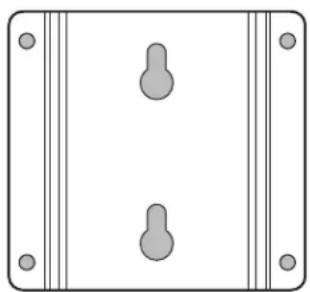
WALL MOUNTING...
Figure 2. Integrated wall-mount bracket.
Before deciding where to put your HPS-1.5 bookshelf speakers, survey your room, keeping the following points in mind:
These speakers are designed for placement on surfaces such as bookshelves, low tables or speaker stands. For optimum performance, it is strongly suggested that you place the speakers on rigid stands that place the tweeter at or near ear level.
◆ Position each speaker so that the top of the enclosure is between 25 and 50 inches above the floor.
◆ Refer to Figure 1 when placing speakers for optimum bass level and stereo image (see Final Adjustments on page 7).
If you also plan to use the speakers for home-theater reproduction, refer to Home-Theater Placement on the next page.

text_image
Left Channel Right Channel Listening PositionIf desired, the HPS-1.5 may be mounted to a wall using the integrated wall-mount bracket (see Figure 2).
natural_image
Simple diagram of a rectangular panel with two circular buttons and mounting holes (no text or symbols)NOTE: The customer is responsible for proper selection and use of mounting hardware (available in hardware stores) and for correctly and safely wall-mounting the speakers.
HOME-THEATER PLACEMENT...
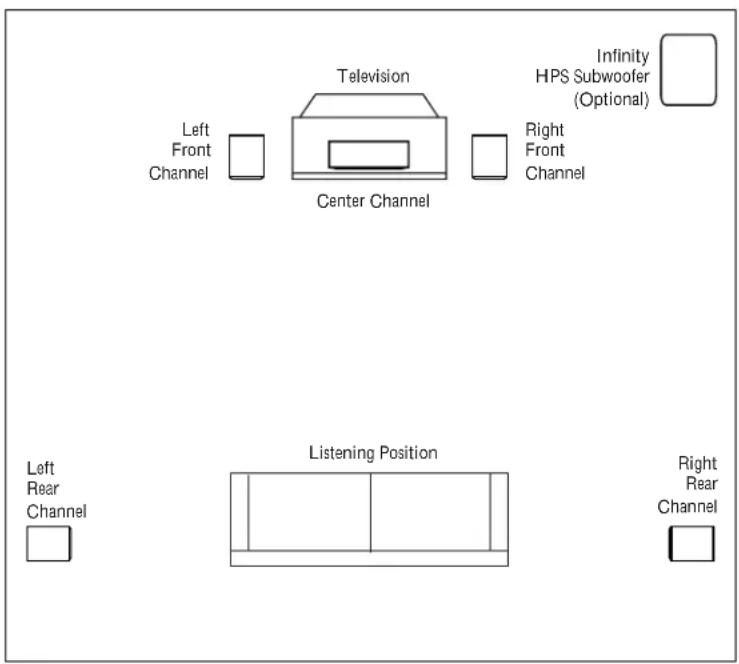
Figure 3. This overhead view shows a typical home-theater plan.
CENTER-CHANNEL PLACEMENT...
PLANNING YOUR SYSTEM (CONT'D)
HPS-1.5 bookshelf speakers are suitable for use in reproducing sound from front left channels and front right channels, as well as for use as rear surrounds (see Figure 3).
For front-channel use, place one speaker on the left and another on the right (on bookshelves or stands) along either side of the television monitor. Since the speakers are magnetically shielded, you can set them very close to the TV without worrying about the magnetic field distorting the TV picture.
For optimum surround-channel performance, place speakers on bookshelves or stands alongside or behind the listening position. Ideally, the surround speakers should be placed 6 feet to 7 feet from the floor, facing the listening area. Final placement depends on room acoustics, availability of space and your listening preference.
NOTE: You can add an Infinity HPS Series subwoofer for deep-bass impact on sound effects and music. Contact your local Infinity dealer for recommendations on the best subwoofer model for your application.
text_image
Television Left Front Channel Center Channel Right Front Channel Infinity HPS Subwoofer (Optional) Left Rear Channel Listening Position Right Rear ChannelFor optimum performance, the center-channel speaker should be placed as close to the front of the TV as possible. The tweeter height of the center channel should be within 2 feet of the front left and right loudspeakers' tweeter heights.
TURN OFF ALL POWER...
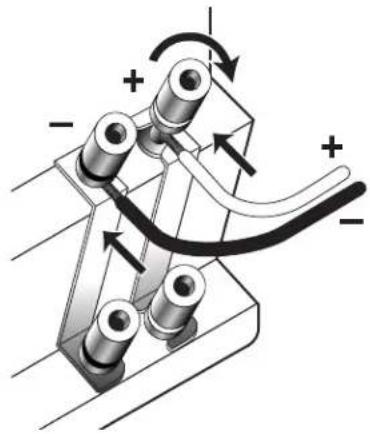
Figure 4. This example shows how to connect bare wires to the terminals. Banana plugs may also be inserted directly into the rear of the connector.
Figure 5. Wiring diagram shows polarity connections for one channel of a stereo or home-theater system.
IMPORTANT!
WIRING THE SYSTEM
IMPORTANT: Make sure all equipment is turned off before making any connections.
For speaker connections, use a minimum #16-gauge speaker wire with polarity coding. The side of the wire with a ridge or other coding is usually considered positive polarity (i.e., +).
NOTE: If desired, consult your local Infinity dealer about speaker wire and connection options.
The speakers have coded terminals that accept a variety of wire connectors. The most common connection is shown in Figure 4.
natural_image
Mechanical assembly diagram showing rotating components with positive and negative charges (no text or labels)- Loosen the terminals.
- Insert bare ends; tighten terminals.
To ensure proper polarity, connect each+ terminal on the back of the amplifier or receiver to the respective + (red) terminal on each speaker, as shown in Figure 5. Connect the - (black) terminals in a similar way. See the owner's manuals that were included with your amplifier, receiver and television to confirm connection procedures.

text_image
Standard Connection Receiver or Amplifier (rear view) (one channel shown) Speaker (rear view)Do not reverse polarities (i.e., + to - or - to +) when making connections. Doing so will cause poor imaging and diminished bass response.
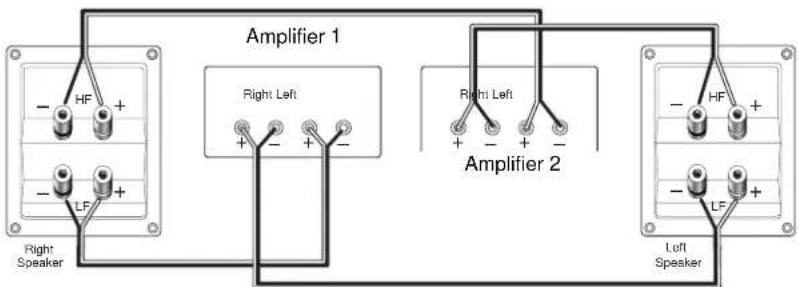
Bi-Wiring
The HPS-1.5 outer connection panel and internal dividing network are designed so that separate sets of speaker cables can be attached to the low-frequency transducer and midrange/high-frequency transducer portions of this dividing network. This is called bi-wiring. Bi-wiring can provide several sonic advantages and considerably more flexibility in power amplifier selection.

natural_image
Pure mechanical diagram showing interconnected components with arrows indicating motion direction (no text or symbols)-
Loosen the terminals and remove Strapping Bars.
-
Insert the Speaker Wire for the high frequencies into the top set of terminals and tighten.
-
Insert the Speaker Wire for the low frequencies into the bottom set of terminals and tighten.
Single-Stereo Amplifier

text_image
Receiver/Amplifier Right Speaker Right left + - + - Left SpeakerDual-Stereo Amplifier
text_image
Amplifier 1 Right Left Amplifier 2 Left Speaker Right Speaker HF + LF + HF + LF +Final Adjustments
Check the speakers for playback by first setting the system volume control for a minimum level and then applying power to your audio system. Play a favorite music or video segment, increasing the system volume control to a comfortable level.
NOTE: You should hear balanced audio reproduction across the entire frequency spectrum. If not, check all wiring connections or consult the authorized Infinity dealer where you purchased the system for more help.
The amount of bass you hear and the stereo image quality will be affected by a number of different factors, including the room's size and shape, the construction materials used to build the room, the listener's position relative to the speakers and the position of the speakers in the room.
Listen to a variety of music selections and note the bass level. If there is too much bass, move the speakers away from nearby walls (see Figure 1 on page 3). Conversely, if you want more bass, place the speakers closer to the walls.
Nearby reflecting surfaces can adversely affect stereo imaging quality. If this occurs, try angling the speakers slightly inward toward the listening position until the desired effect is achieved.
Each HPS Series enclosure has a high-quality, vinyl finish that does not require any routine maintenance. Use a soft cloth, dampened with only water, to remove any fingerprints or to wipe off dust.
Clean the grille by gently vacuuming or using a damp cloth.
NOTE: Do not use any cleaning products or polishes on the cabinet or grille.
SPECIFICATIONS
PERFORMANCE DATA
RECOMMENDED AMPLIFIER POWER
FREQUENCY RANGE
SENSITIVITY: (2.83V @ 1m)
NOMINAL IMPEDANCE
DRIVERS
LOW-FREQUENCY TRANSDUCER
HIGH-FREQUENCY TRANSDUCER
DIMENSIONS
HEIGHT, WIDTH, DEPTH
WEIGHT (EACH)
HPS-1.5
15 \~ 125W
100Hz \~ 20kHz
89dB spl
8 Ω
HPS CENTER
15 \~ 150W
70Hz \~ 20kHz
91dB spl
8 Ω
5-1/4" (133mm)
1" (25mm) Silk dome
Dual 5-1/4" (133mm)
1" (25mm) Silk dome
10-1/2 × 6-1/2 × 8"
(267 x 165 x 203mm)
9 lbs (3.9 kg)
7-1/2 × 17-1/2 × 9"
(191 x 444 x 229mm)
17-1/2 lbs (7.9 kg)
Infinity continually strives to update and improve existing products, as well as create new ones. The specifications and construction details in this and related Infinity publications are therefore subject to change without notice.
©1999 Infinity Systems, Inc., 250 Crossways Park Drive, Woodbury, NY 11797 USA (800) 553-3332
www.infinitysystems.com
Infinity is a registered trademark of Infinity Systems, Inc.
H A Harman International Company
Part No. 335158-001