
CLASSICA 95 - Sewing machine HUSQVARNA - Free user manual and instructions
Find the device manual for free CLASSICA 95 HUSQVARNA in PDF.


User questions about CLASSICA 95 HUSQVARNA
0 question about this device. Answer the ones you know or ask your own.
Ask a new question about this device
Download the instructions for your Sewing machine in PDF format for free! Find your manual CLASSICA 95 - HUSQVARNA and take your electronic device back in hand. On this page are published all the documents necessary for the use of your device. CLASSICA 95 by HUSQVARNA.
USER MANUAL CLASSICA 95 HUSQVARNA
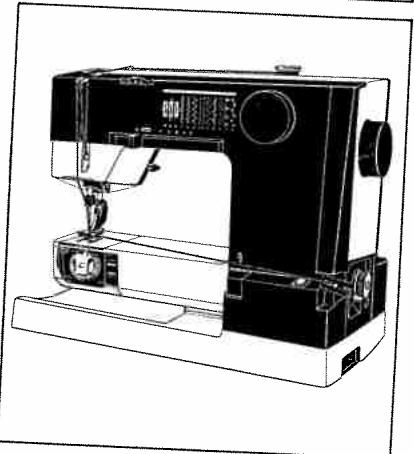
Survey of the machine
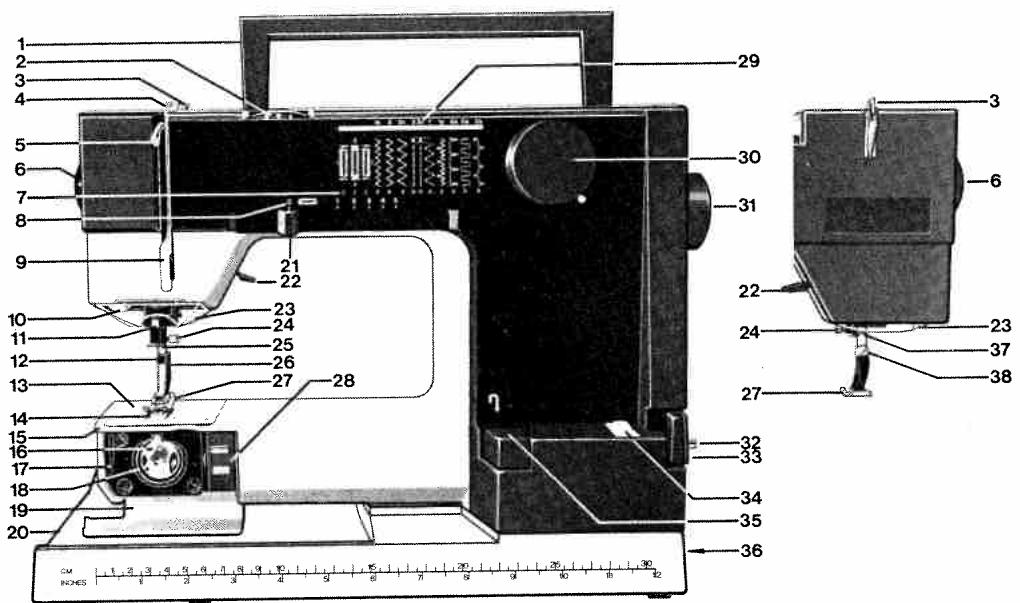
- Handle
- Thread tension dial
- Thread guide
- Thread tension discs
- Thread take-up lever
- Presser foot pressure dial
- Recommended presser foot
- Stitch length scale
- Front thread guide with thread take-up spring
- Sewing light
- Needle bar
-
Needle
-
Needle plate (stitch plate)
- Feed dog
15.Free arm - Bobbin case
- Thread cutter
18.Shuttle (hook) - Door for shuttle (hook)
- Base plate
- Stitch length regulator
- Presser bar lever
- Lamp guard
- Needle clamp screw
-
Presser bar
-
Presser foot ankle
- Presser foot
- Drop feed button
- Recommended stitch length
- Stitch selector
- Handwheel
- Bobbin winding spindle
- Bobbin winding arm
- Main switch
- Reverse feed button
- Socket for foot control
- Thread cutter
- Screw for edge guide
Unpacking
Place the machine on the table and remove the plastic packing. Retain the top part which can later be used to cover the machine. Remove the foot control from the back of the machine.
Wipe the machine clean before you start sewing, and be especially careful with the stitch plate and the space around the needle. The machine is equipped with a number of presser feet and these are packed in two plastic bags. Regarding the placing of the accessories, please refer to page 4 under "Accessory box".
We reserve the right to change the equipment of the machine without prior notice.
Putting the machine away
Pull the plugs out of the wall outlet and the socket of the machine. Wind the cords around your hand, starting at the foot control and push them into the control compartment.
Make sure that all accessories are correctly placed in the box. Slide the accessory box into place.
Lower the presser foot and hang the foot control on the thread guide at the rear of the machine. The bottom of the foot control should be turned toward the machine.
To replace the plastic cover, drop the handle. By raising the handle the machine can easily be transported.
Connecting the foot control
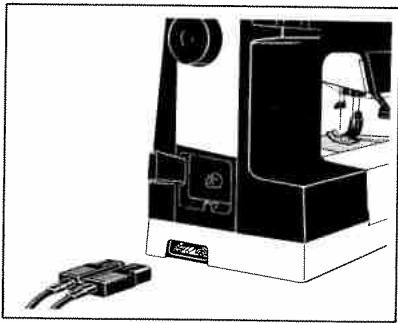
Remove the cord from the foot control and place the control under the table. Insert the foot control plug with the marking "UP" upward into the socket on the right-hand side of the machine.
Connecting to the wall outlet
The voltage (V) and frequency (Hz) are indicated under the base of the machine. Check that these values correspond to those of the electricity source before connecting the machine.
Working surface
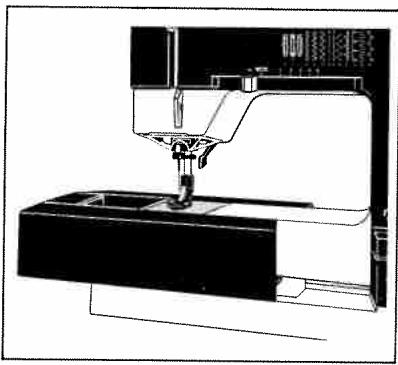
The working surface around the stitch plate consists partly of the upper side of the accessory box and partly of the machine itself, i.e. the free arm.
Retain the accessory box on the machine when you require a larger working surface. Pull the accessory box to the left and remove it if you wish to use the free arm.
Pant legs and sleeves can be drawn onto the free arm, making it easy to sew, mend or patch these parts.
The free arm also makes it much easier to attach collars and cuffs as well as sew children's clothes, or darn socks and stockings on the machine.
Main switch
The light and the machine are turned on by pressing the inner part of the main switch.
Reverse feed button
As long as you keep the reverse feed button depressed the machine will sew in reverse but will revert to ordinary sewing as soon as you release it. Excellent for fastening off.
Pressbar lever
By means of the presser bar lever at the rear of the machine, the presser foot can be raised and lowered. When raising, the presser foot will remain in the raised position, but the height can be increased by 3mm by pushing the presser bar lever upward and holding it in this position. This is useful when you want to put garments with thick seams under the presser foot.
The presser foot should be lowered while sewing.
Presser foot pressure
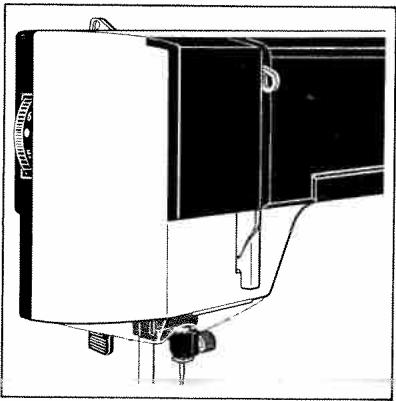
The presser foot pressure can be adjusted with the aid of a marked dial on the left side of the machine. Normal pressure is obtained by setting the dial at the white dot. The higher the number, the greater the pressure.
By setting the dial at the symbol the presser foot pressure is completely released. This setting should be used when free-hand sewing with the darning foot, i.e. darning, monogramming, machine embroidery and quilting.
If you turn the graded dial for the pressure foot pressure to the lowest number, it is possible to darn with presser foot A.
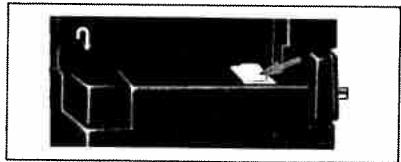
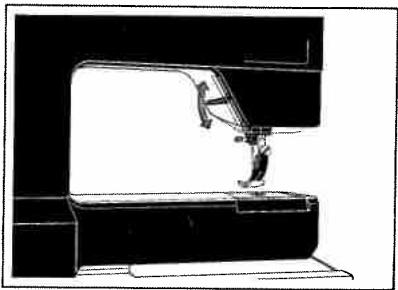
Lower the feed dog and move the fabric forward, backward and sideways by hand.
Lowering the feed dog
You lower the feed dog by pushing in the upper part of the push-button. In order to raise the feed dog again push in the lower part.
The feed dog should be lowered for a certain type of darning and when sewing on buttons. It is also easier to get thick garments under the presser foot if the teeth of the feed dog are not above the level of the stitch plate.
Removing the bobbin case
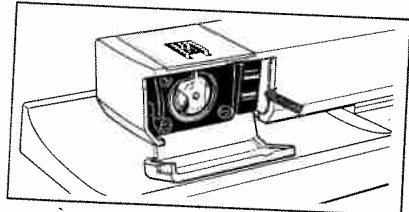
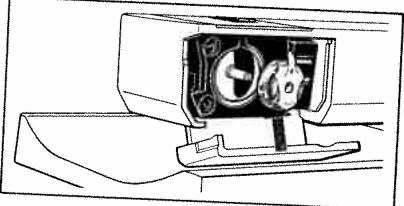
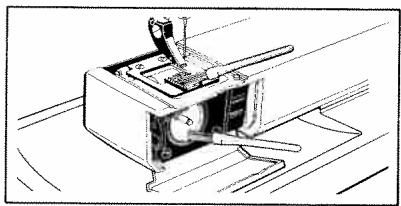
Open the door in front of the shuttle by means of the small recess on the left side.
Grip the bobbin case with the thumb and index finger so that the latch is depressed and pull the bobbin case out. The bobbin will remain in the case as long as the latch is depressed. When you release the latch, the bobbin will be released.
Bobbin winding
Turn the empty bobbin until the small round mark on one side is outward.
Slide the bobbin onto the bobbin winding spindle located on the right side of the machine.
Grip the lower part of the bobbin winding arm on the right-hand side of the machine and turn it out to the side. Raise the presser foot and pull the thread from the thread guide by the needle clamp through the groove on the arm. Wind the thread around the bobbin a couple of times, beginning from underneath. If you are using a metal presser foot, allow the thread to go through the eye of the needle and under the presser foot. Never run the thread direct from the eye of the needle to the bobbin because you will run the risk of bending the needle. Hold the thread end and lightly depress the foot control. As soon as winding starts you can release the thread end.
Threading the lower thread
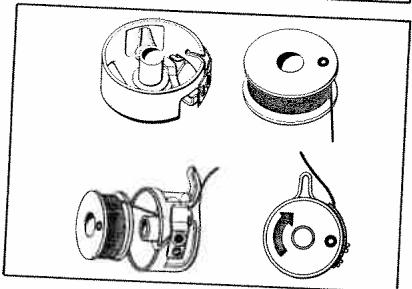
When the bobbin winding is finished, place the bobbin beside its case with the marking upward. The thread should run as shown in the figure. Place the bobbin in its case without turning it around.
Slide the thread into the slot on the edge of the bobbin case. Pull the thread in under the tension spring. Check that the bobbin rotates in the direction of the arrow (clockwise) when the thread is pulled.
The thread must be pulled in the direction of the spring, otherwise the spring will be overloaded.
Insertion of the bobbin case
Slide the thread behind the projection of the bobbin case and to the right. Put the bobbin case into place. Press the bobbin case until it clicks to ensure that it fits properly. The thread cutter is located to the left of the bobbin case. Hold the thread end and draw the thread from underneath and up toward the thread cutter. By doing so the thread will be cut off and kept in place. Shut the door.
Thread cutter
On the back of the presser bar you will find a notch, the thread cutter, by means of which you can easily cut off the threads when you have finished sewing.
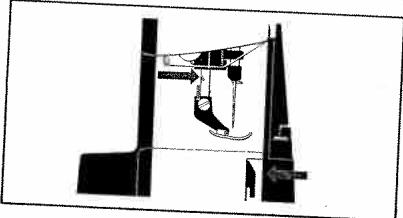
Threading the upper thread
Raise the presser foot. Check that the needle is at its highest position. Place the spool of thread on the left spool pin and thread the machine for sewing.
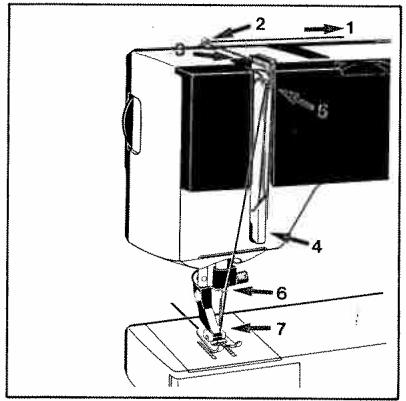
Slide the thread into thread guide 2 on the upper arm and draw it upward. Then draw the thread to the front between the tension discs 3 and down around thread guide 4. Continue threading by drawing the thread from the right into the slot on thread take-up lever 5 and draw it down to the needle, ensuring that it goes through thread guide 6.
Thread the needle from the front. Due to the white color of the presser foot ankle the needle-eye is clearly seen and the threading of the needle, 7, is easier. Pull the thread under the presser foot about 15cm (6") toward the rear.
Tension of the upper thread
The thread tension dial is graduated from 0-10. The higher the number, the tighter the tension. Normal thread tension is obtained by setting the dial at the white dot. It may be necessary to adapt the thread tension to the thickness of the thread and the type of fabric.
There is also a mark on the thread tension dial for the tension that is suitable for making buttonholes, for satin stitching, topstitching, embroidery, etc.
Correct and incorrect thread tension
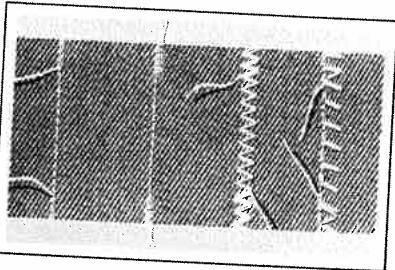
In order to easily understand the importance of correct thread tension, you can try different thread tensions by sewing on a scrap of fabric. Begin by using an excessively loose tension, i.e. set the tension dial near "0". The lower thread lies straight and the upper thread is drawn underneath the fabric. If, however, you set the dial at the highest number, the opposite will occur, or the seam may pucker. The thread tension is correct when the threads interlock in the middle of both layers of fabric.
Please note that even the best quality thread may vary in thickness. When sewing in fine fabrics, the knot may sometimes be visible.
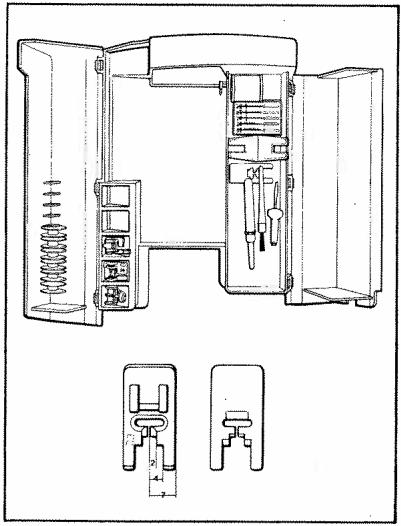
Accessory box
Store the accessories in the accessory box. By placing them as illustrated, it will be easier for you to remove and replace the box.
Select the correct presser foot for the type of sewing you are doing.
Presser foot A is fitted on the machine at delivery and is used for straight stitching, zig-zag and other utility stitches. This foot has notches which can be used as guides when sewing. When straight stitching with the needle in the center position, you will have a 7mm (1/4^ ) seam allowance if you guide the fabric even with the outer edge of the foot; 4mm (3/16^ ) at the inner edge and 2mm (3/32^ ) at the innermost notch.
Zipper foot E can be attached to the right or to the left of the needle, making it easy to sew both sides of the zipper.
The edging presser foot. Is used for overcasting with zig-zag or joining fine, slippery fabrics with overcast stitch.
Needle and thread
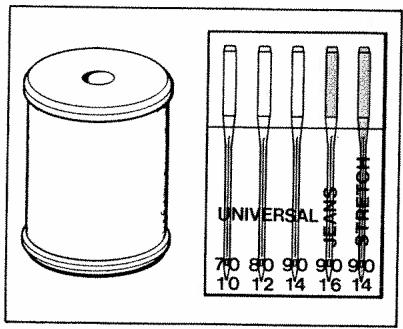
The machine is delivered with a spool of synthetic thread, which can be used for all types of fabrics and most seams. Mercerized cotton can also be used.
For buttonholes, topstitching and darning embroidery silk No. 30-50 is recommended.
Always use needles coded 130/705H. The needle fitted in the machine is No. 80.
Two needles for sewing in stretch fabric and denim are specially designed for the purpose.
Changing the needle
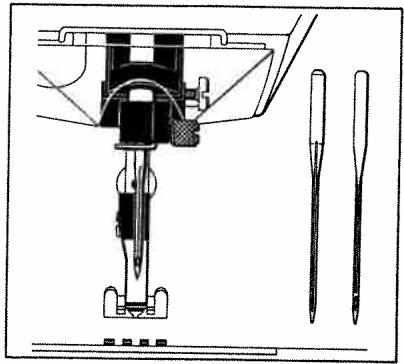
Even if the needles look alike there can be slight variations which can affect the sewing result. Be sure to use high quality needles.
Only a completely undamaged needle will give perfect sewing results. Therefore, change the needle if you have the slightest reason to believe that it is bent or that the point is damaged. To remove the needle, loosen the screw in the needle clamp. With the flat side of the shank away from you, insert the new needle into the needle socket as far as it will go. Tighten the screw with the screwdriver.
Stitch selection
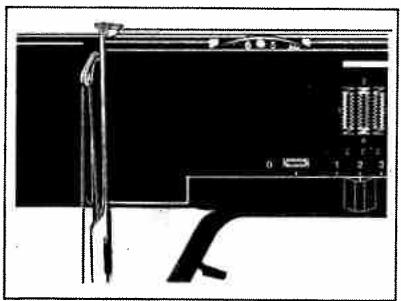
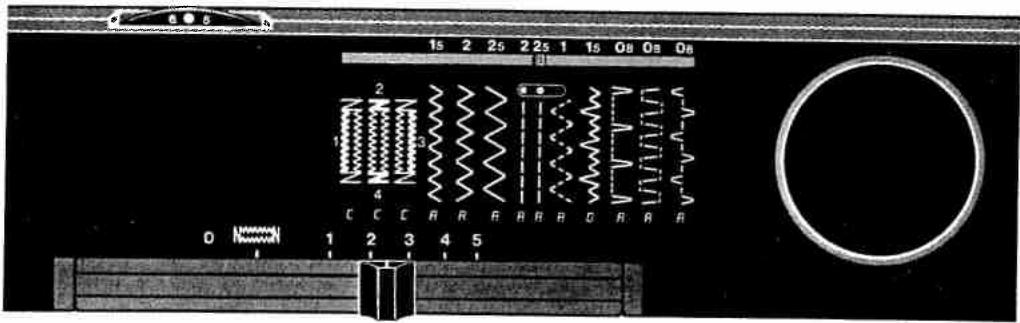
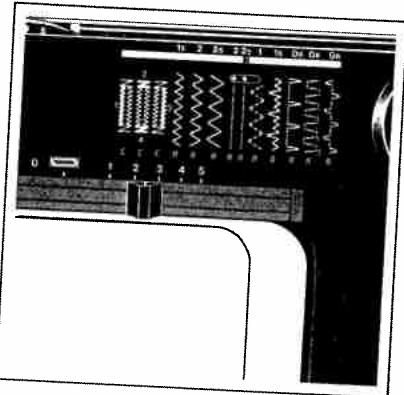
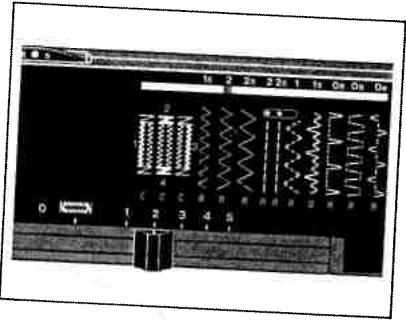
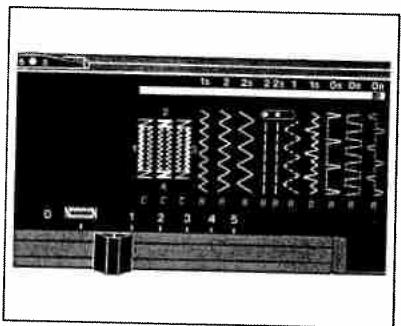
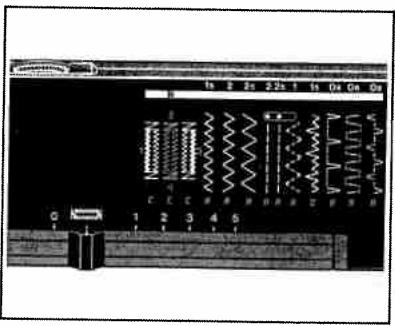
The pattern scale located on the front of the machine indicates which stitches you can sew with the machine. The stitch length can be varied between 0 and 5mm and there are three zig-zag widths to choose from.
The straight stitch can be sewn with the needle at the center or left needle position. The left needle position is suitable when sewing narrow hems and when sewing in light fabrics where the fabric is well supported in the outer edge of the needle hole.
The required stitch is set by turning the stitch selector to the left or to the right until the red indicator lines up with the stitch symbol.
Choice of stitch length
There are figures above the stitch symbols which indicate the most suitable stitch length when sewing normal fabrics.
Set the stitch length by means of the stitch length regulator under the symbols. The symbol N indicates the stitch length which is best for sewing buttonholes.
Always use the recommended stitch length to start with but experiment until you arrive at the exact stitch length for the actual work you will be doing.
Presser foot
There are letters under the stitch symbols which indicate the most suitable presser foot for each stitch. The letter is also marked on the presser foot.
General hints
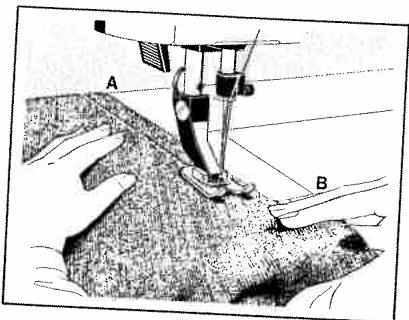
The best way to hold the fabric is to let your left hand rest lightly on the work at A and guide it forward. Hold the edge of the fabric at B with your right hand and guide the work. Do not pull the fabric—just guide it toward the presser foot and let the machine do the feeding.
When you wish to straight stitch, place the work so that the needle goes down in the center of the marking for the seam. When sewing zig-zag and other wide stitches, e.g. the overcast stitch place the marking for the seam along the left edge of the needle hole.
Lower the presser foot, start the machine gently and increase the speed gradually.
When sewing fine and soft fabrics, start the seam a couple of mm (1/8") from the edge of the fabric, to prevent it from being pulled down into the needle hole. If you wish to extend the seam out to the very edge of the fabric, sew a few reverse stitches and then hold the threads behind the presser foot when sewing forward again.
Fasten off the seam by depressing the reverse feed but- ton and sew a few reverse stitches.
When the seam is finished, raise the presser foot, remove the work from behind and cut off the threads leaving at least 15 cm (6") of thread.
Straight stitching
Check that the needle is in the highest position. Turn the stitch selector to the straight stitch symbol. Set the settings.
Set the stitch length regulator to the recommended basic setting 2.5 but experiment until you arrive at the exact stitch length for the actual work you will be doing.
Increase the stitch length when basting and topstitching. It is even possible to
It is even possible to do straight stitching with the needle in the left needle position by turning the stitch selector one step to the left. This is very useful when sewing light fabrics.
Zig-zag
Check that the needle is in the highest position. You have the choice of three zig-zag widths, 1.5, 3 and 5 mm.
Turn the stitch selector to the required zig-zag symbol. Recommended stitch length 1.5-2.5.
Zig-zag is used for sewing on lace, gathering, bound edging, appliqués, etc.
Three-step zig-zag is recommended for overcasting, as it binds better and is more attractive.
Three-step zig-zag
Check that the needle is in the highest position. Turn the stitch selector to symbol . Recommended stitch length 1.
Three-step zig-zag is suitable for overcasting most fabrics, especially stretch, lightweight or loosely woven fabrics. It has many advantages compared to ordinary zig-zag. It is more elastic and will not pucker the edge of the fabric. It is ideal for sewing terry cloth and is also used for darning and mending.
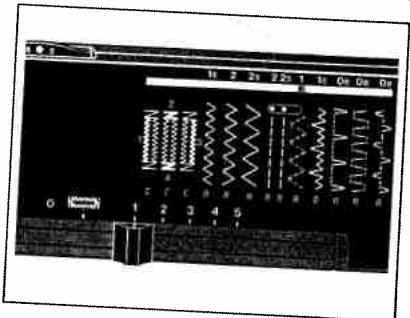
Blindstitching
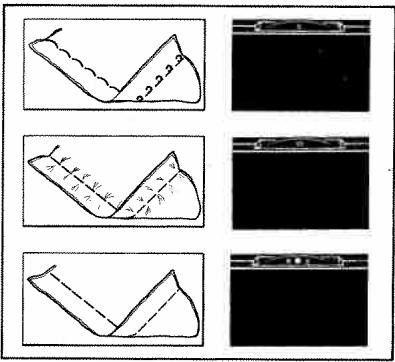
Blindstitching is used for hemming skirts made of woven and knitted fabrics without the stitches being visible on the right side.
Check that the needle is in the highest position. Set the stitch selector at the symbol . Recommended stitch length 1.5.
The thicker and softer the fabric, the less visible the stitches will be. When sewing lightweight woven fabrics, it is unavoidable that a small stitch will show on the right side.
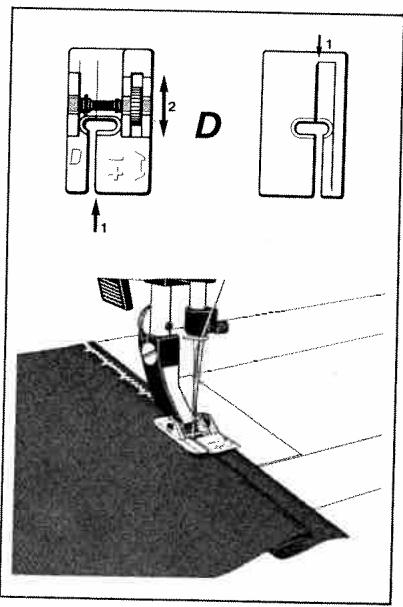
Fold the fabric as illustrated. As fabrics vary in thickness the presser foot D can be shifted sideways so that the edge guide 1 underneath may be set according to the thickness of the fabric.
Be sure that the folded edge follows the edge guide 1 underneath the presser foot.
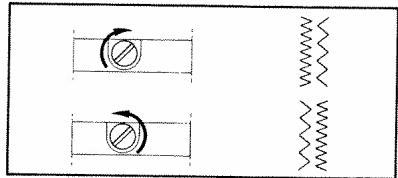
Sew a few inches and check that the large zig-zag stitches catch just one thread of the folded edge. If the stitches fail to reach the fold, turn the red roller slightly toward + . If they are too far in on the fabric fold, turn the roller toward - .
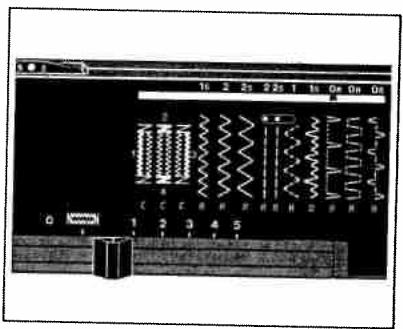
Overcast stitch
Check that the needle is in the highest position. Turn the stitch selector to the symbol ^^^^ .
The overcast stitch can be used for joining and overcasting lightweight woven and elastic fabrics.
Join and overcast directly on the edge where a 5 mm (3%) seam is allowed, or cut out the garment with a wider seam allowance, sew with overcast stitch and then trim close to the stitching.
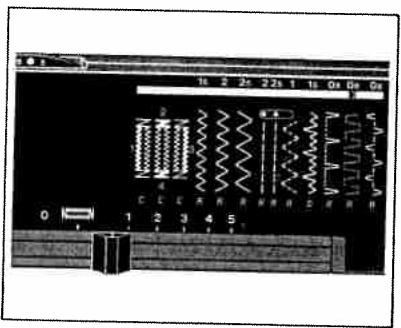
Double-action stitch
Check that the needle is in the highest position. Turn the stitch selector to the symbol
Use the double-action stitch for hemming and sewing overlapped seams in tricot and soft material and also for gathering with narrow, flat elastic or elastic cord. Be sure the elastic does not get stitched in by mistake but can run freely under the stitching.
Overlapped seams are also recommended for sewing leather.
Bridging stitch
Check that the needle is in the highest position. Turn the stitch selector to the symbol y^-_-y^-_-y^-.
Use the bridging stitch for joining two pieces of fabric with folded edges.
If you would like a decorative seam, place the folded edges (without sewing them together first) a few millimeters from each other and join with bridging stitch.
The bridging stitch is also useful for gathering with shirring elastic. Use the buttonhole foot C and place the shirring elastic around its "heel".
Buttonholes
When sewing buttonholes, change to the buttonhole foot C. This foot has graduated markings to help you make the buttonholes the same length. Decrease the upper thread tension by turning the thread tension dial to the buttonhole symbol.
Set the stitch selector and stitch length regulator at the buttonhole symbol. The finer thread you use, the more attractive and even the buttonhole will be. Make a mark on the fabric where you wish to begin the buttonhole.
Always test sew a buttonhole and adjust the stitch length setting. Insert the fabric under the presser foot, remembering that the machine will begin to sew in reverse.
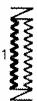
Set the stitch selector to symbol 1. The machine sews the first column in reverse. Stop when you reach the correct column length.
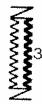
Turn to symbol 3. Sew the other column the same length as the first one.
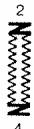
Turn to symbol 2-4.
Now the machine will form the bar tack.
Sew three or four stitches.
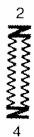
Turn back to symbol 2-4. The machine will form the final bar tack. Sew three or four stitches. Turn to symbol 1 and lock the threads in the first column.
Coreded buttonholes
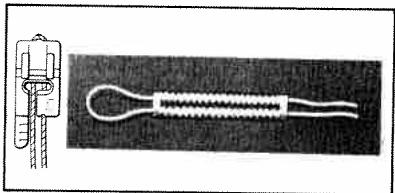
A small cord can be used to sew buttonholes in elastic material, in order to keep the shape better. Attach the cord around the projection at the heel of the buttonhole foot as shown in the illustration and sew the buttonhole in the normal way.
In heavy garments you can sew reinforced buttonholes by sewing the columns twice and the bar tacks the second time.
Cutting the buttonhole
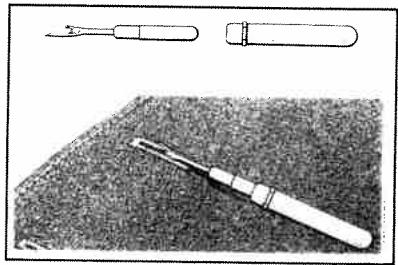
The buttonhole knife which you will find in the accessory box, is equipped with a safety cap which, when taken off, can be pushed onto the back of the knife, providing a good handle.
When you have finished sewing all the buttonholes, they must be cut open as follows:
Pierce the fabric at a right angle until the curved blade edge reaches down to the buttonhole.
With the knife more or less parallel to the fabric, push forward, taking care not to cut the columns of the buttonhole. The small red bead serves as a guide. Cut the buttonhole to the middle and then repeat the cut from the other direction.
Sewing on buttons
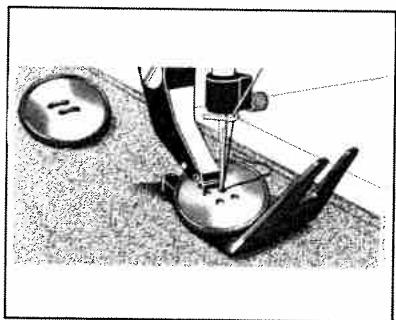
Lower the feed dog. Remove the presser foot, put the button in place and lower the presser bar. Set the stitch selector at the widest or intermediate zig-zag. Turn the handwheel toward you and test carefully that the needle enters the first hole and then the other hole. Sew five or six stitches. Move to the other holes and repeat. Set the needle to straight stitch in the left needle position and fasten the threads with a few stitches.
When a "shank" is required, use the button reed as illustrated.
Changing the light bulb
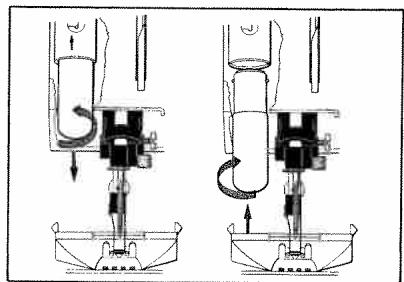
The lamp is located to the left of the needle. First remove the lamp guard. By inserting the small screwdriver in the recess at the left edge and applying slight downward leverage, you can slide the guard down to the stitch plate.
To remove, press the light bulb upward, turn a quarter turn in the direction of the arrow. To insert the new light bulb, push it upward and turn it a quarter turn in the direction of the arrow.
The wattage of the bulb is indicated on the rear of the machine.
Care of the machine
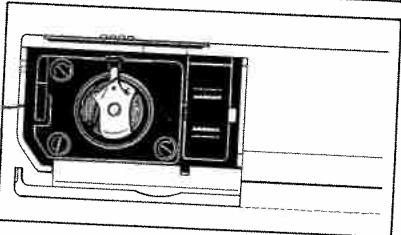
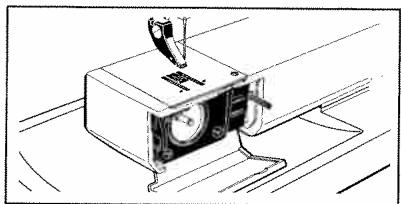
If you want to clean the machine, remove the presser foot and lower the feed dog. There is a recess in the free arm to the right above the hook cover. Push the stitch plate straight up and backward at the same time until it loosens. Clean between the teeth of the feed dog with the brush you will find in the accessory box.
When replacing the stitch plate, insert it from behind into the recess in the arm. Ease the front edge up onto the small pin and continue to push it forward until it snaps into place.
Belts
Belt adjustment is not required.
Why haven't I got the results I expected?
Always start by checking the needle
An important part which needs to be changed from time to time is the needle. Always start with a new needle as soon as you discover that a seam is not what you expected. Check that it is correctly inserted.
Unattractive stitches
The thread tension is not correct. See page 4.
The machine may be incorrectly threaded. The correct threading is shown on pages 3 and 4.
Wrong upper thread. It should be of the same thickness as the lower thread.
Bobbin wrongly inserted in the bobbin case. See page 3.
The needle breaks
You may have helped the machine to feed by pulling the fabric. The needle can easily strike against the needle plate and break.
The upper thread breaks
Check the thread spool to see that it has not caught in any way.
The needle eye may have sharp edges which cut the thread. If so, change the needle. See page 5.
The upper thread is incorrectly threaded or has too much tension. See page 4.
The thread is knotted.
The hole in the needle plate may be chipped and have sharp edges. Replace the needle plate.
Lower thread breaks
The bobbin case is incorrectly threaded or inserted. See page 3.
The bobbin is overwound.
Uneven thread tension
This may be due to poor quality thread.
Irregular bobbin winding
The bobbin is not placed correctly. See page 3. The machine is not correctly threaded for bobbin winding. See page 3.
The fabric puckers
The upper thread tension is too tight. See page 4 for correct thread tension.
The machine does not feed the fabric
The stitch length is too short. Shift the stitch length regulator to a higher number.
The feed dog may be lowered. Raise it by pressing the lower part of the feed dog button. See page 3.
The presser foot pressure is disengaged. See page 2.
The feed dog is full of dust and dirt. Clean with the brush. See instructions above.
Machine runs sluggishly
Dirt or lint has fastened under the needle plate. Loosen the needle plate and brush clean between the teeth of the feed dog.
See instructions above.
Dirt or lint has fastened in the hook. Remove the bobbin case and clean with the brush.
See instructions above.
We reserve the right to change the machine equipment and the assortment of extra accessories without prior notice, or make modifications in the design or appearance of the machine. Such modifications however will always be to the benefit of the user and the product.