VS-570-HDSDI - Surveillance Camera MARSHALL - Free user manual and instructions
Find the device manual for free VS-570-HDSDI MARSHALL in PDF.


User questions about VS-570-HDSDI MARSHALL
0 question about this device. Answer the ones you know or ask your own.
Ask a new question about this device
Download the instructions for your Surveillance Camera in PDF format for free! Find your manual VS-570-HDSDI - MARSHALL and take your electronic device back in hand. On this page are published all the documents necessary for the use of your device. VS-570-HDSDI by MARSHALL.
USER MANUAL VS-570-HDSDI MARSHALL
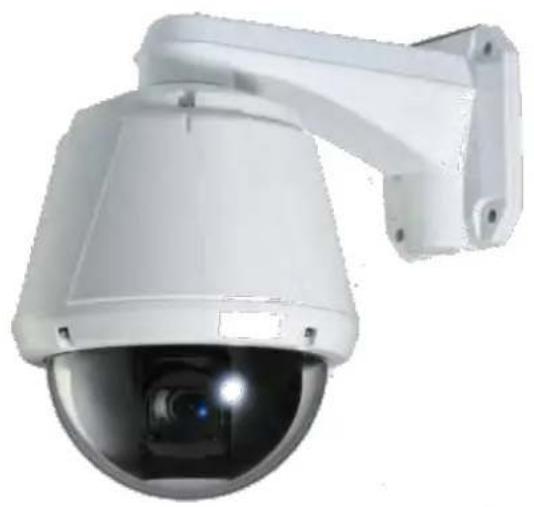
2.0 Megapixel Speed Dome
natural_image
White surveillance camera with mounted antenna and spherical lens (no text or symbols visible)User Manual ver.1.0
Safety Precaution
We appreciate your purchasing VS-570-HDSDI. Before installing the product, please read the following with care.
Make sure to turn off the power before installing VS-570-HDSDI.
Do not install under the direct sunlight or in dusty areas.
Make sure to use the product within the temperature and humidity specified in the specification.
Do not operate the product in the presence of vibrations or strong magnetic fields.
Do not put electrically conducting materials in the ventilation hole.
Do not open the top cover of the product. It may cause a failure or electric shock on the components.
To prevent from overheating, make sure to keep the distance at least 10cm from the ventilation hole.
Make sure of proper voltage (220V/100V) before connecting the power.
Table of Content
- Introduction....4
About this manual....4
Features....4
Product and Accessories....7
Part Names and Functions....8
System Connections....9
- Installation....12
DIP Switch Setup....12
Installation Camera with Brackets.... 14
Wiring/Cabling & Connecting....16
Check if it works 19
- System Operation 20
Remote Video Monitoring 20
Initialization of IP address....23
- Remote Configuration 24
Using Web Brower....24
System Configuration 25
Video Configuration....29
Audio Configuration....34
Network Configuration 35
Serial Configuration....40
Event Configuration....42
PTZ Configuration 45
Record Configuration....49
User Configuration....50
Camera Configuration 52
1. Introduction
About this manual
This User Manual provides information on operating and managing the premium network camera, VS-570-HDSDI. The Manual includes instructions of installation, operation and configuration of VS-570-HDSDI troubleshooting tips.
Features
VS-570-HDSDI is a 2.0M PTZ network-based camera with remote live monitoring, audio monitoring and control via an IP network such as LAN, ADSL/VDSL, and Wireless LAN.
Camera
• 1/3" 2Megapixel CMOS Image Sensor
• X10 optical zoom, x12 digital zoom
• True Day & Night (ICR)
Video
• Highly efficient compression algorithm, H.264 & MJPEG support
• 18 kinds of compression and resolutions: CIF (352x240) - Full HD (1920x1080)
- Wide range of transmission rates: 32kbps \~ 8Mbps
- Various transmission modes: CBR, VBR
- Motion detection
- Composite video output
• HD-SDI video output (Option)
Audio
- Multi-transmission mode: Simplex (VS-570-HDSDI → Client PC or Decoder, Client PC or Decoder → VS-570-HDSDI), Full Duplex
Network
• Fixed IP & Dynamic IP (DHCP) support
- 1:1, 1:N support
- Multicasting
- Various types of Protocol support: TCP/IP, UDP, Multicast, DHCP, SMTP, HTTP, SNMP, RTP, RTSP
Serial Data
- RS-485 support:
• Data pass-through mode: Serial data communication between VS-570-HDSDI and Decoder.
Sensor and Alarm
• Supports direct connections of external sensor and alarm devices.
• Event Alarm notification.
- 2 alarm sensor Inputs and 2 alarm Output relays are available.
- If an external sensor is activated, camera can be set to move to the corresponding Preset position.
User Interface
• Diagnose and upgrade a through dedicated program called True Manager.
- System configuration using Internet Explorer
High Reliability
- Reliable embedded system.
Powerful Pan/Tilt Functions
• Max. 360°/sec high speed Pan/Tilt Motion.
- Using Vector Drive Technology, Pan/Tilt motions are accomplished in the shortest path. As a result, the time to target view is reduced dramatically and the video on the monitor is very stable.
- When using a PTZ controller, the ultra slow speed of 0.05^ / sec is useful for accurately moving the camera to a desired view. Additionally, the zoom-proportional pan/tilt movement improves the ability to follow a moving object.
Preset, Pattern, Swing, Group
• MAX. 128 Presets are assignable and characteristics of each preset can be set up independently.
- Max. 8 sets of Swing action can be stored. This enables you to move the camera repetitively between two preset positions with a designated speed.
- Max. 4 of Patterns can be recorded and played back. This enables to move camera to follow any trajectory operated by a joystick as closely as possible.
- Max. 8 sets of Group actions can be stored. This enables you to move camera repetitively with a combination of Preset or Pattern or Swing. A Group is composed of a maximum of 20 entities of Preset/Pattern/Swings.
PTZ(Pan/Tilt/Zoom) Control
• With RS-485 communication, a maximum of 255 cameras can be controlled at the same time.
- Pelco-D or Pelco-P protocol can be selected as a control protocol in the current version of firmware.
Easy Installation and Perfect Outdoor Environment Compatibility
- Fans and heaters are built into the camera enclosure for both hot and cold temperature environments. Advanced mechanical design protects the camera from damaging water and dust.
• It is easy to install and maintain the camera with a cable channel built into the mountain brackets.
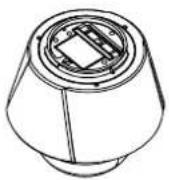
Product and Accessories
| ● Main body & Dome Cover | ● Accessories | ||
 | 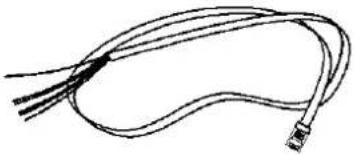 |  | 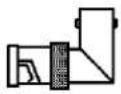 |
| Main Cable | Wrench Driver | 2EA of BNC | |
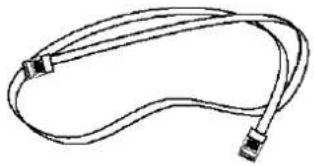 | 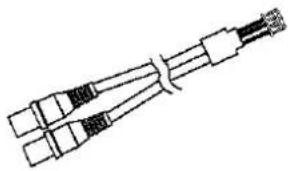 |  | |
| Cross LAN Cable | Audio Cable | CD | |
Note: Mount Brackets are optional.
| ● Wall Mount Bracket | ● Ceiling Mount Bracket |
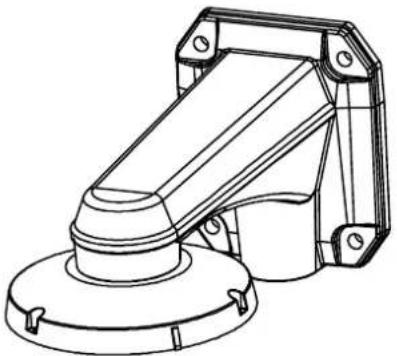 | 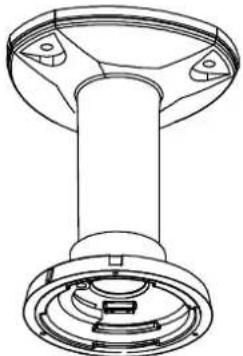 |
| [Screws : Torx Screw M4×18, Hex Lag #14×50] | [Screws : Torx Screw M4×18, Anchor Bolt 3/8"×70] |
Part Names and Functions
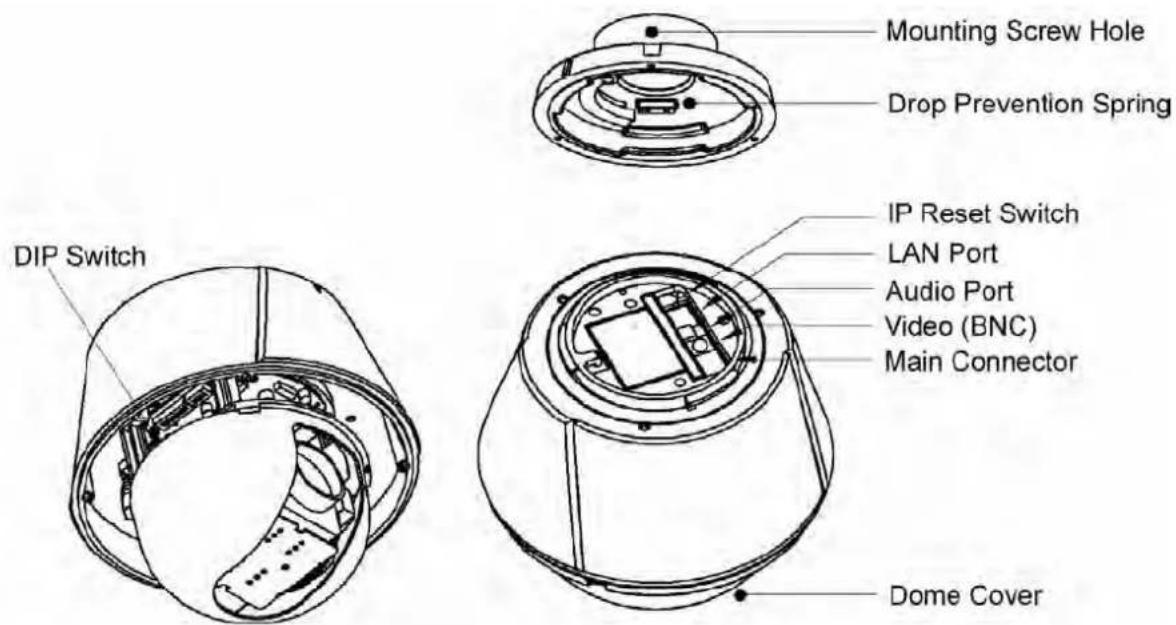
text_image
Mounting Screw Hole Drop Prevention Spring DIP Switch IP Reset Switch LAN Port Audio Port Video (BNC) Main Connector Dome Cover• Dome Cover To protect the dome cover from scratches or dust Do Not Remove the protective vinyl from the dome before completing the installation process.
• DIP Switch Sets up camera ID and protocol.
- Drop Prevention Spring
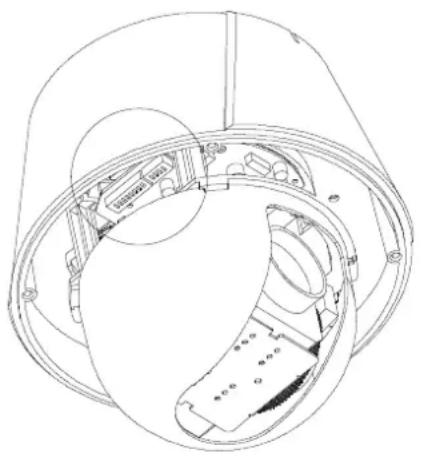
This prevents the camera from dropping during installation and maintenance. After installing the Bracket, please connect the spring to the drop prevention hook of main body as shown in picture.
- Mounting Screw Hole This hole is for screws that attach the main body to the mounting bracket.
- IP Reset Switch Reset the network configuration to the factory defaults. You will lose all the data that had been previously entered. To initialize the system to the factory default, press the reset button and hold for more than 5 seconds.
• LAN Port This is used for the Ethernet connection.
• Audio Port This is used for the audio in/out connection.
• Video (BNC) This is used for the HD-SDI video out.
- Main Connector This is used for connecting to the power wire, the RS-485 communication cable, and the alarm in/out connection cable.
System Connections
VS-570-HDSDI IP Cameras can be connected in either 1 to 1 connection where one VS-570-HDSDI is connected to one PC client or a decoder system or, 1 to many connections where one VS-570-HDSDI can be connected to several PCs and decoder systems. The VS-101 video server can work as a video decoder which takes the data from a video server or IP camera, decodes and outputs analog or digital video, HDMI and HDSDI.
Topology
Generally, the VS-570-HDSDI and PC or a decoder is connected in 1-to-1 mode or 1-to many configuration.
- 1:1 Connection.
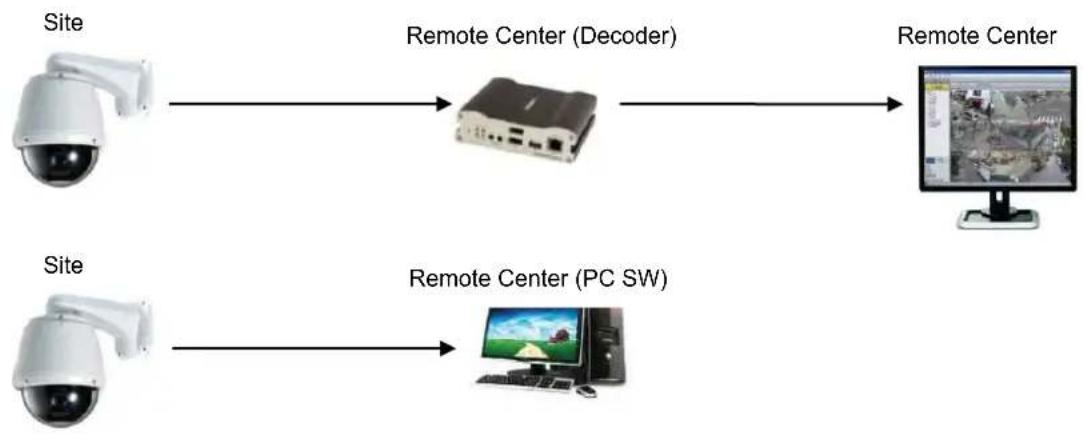
flowchart
graph LR
    A["Site"] --> B["Remote Center (Decoder)"]
    B --> C["Remote Center"]
    D["Site"] --> E["Remote Center (PC SW)"]
One VS-570-HDSDI is installed at a site where video images are transmitted. A PC or a decoder is installed at a central location to receive and view the video images on an analog monitor. Audio and serial data are transferred in either direction.
- 1:N Connection.
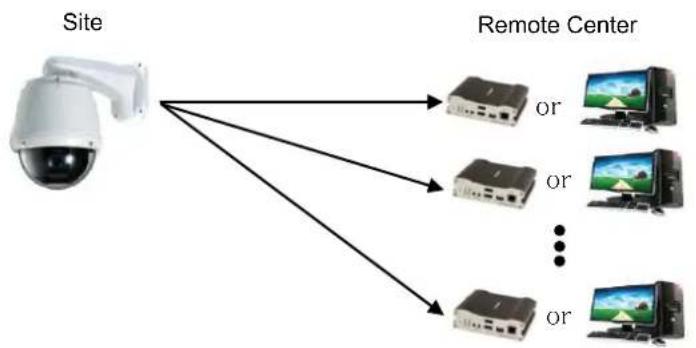
In this configuration, a site can be monitored from many remote central locations. Although up to 64 PCs or decoders can be connected to one VS-570-HDSDI, in the real network environment, network bandwidth can limit the maximum connections. Functionally, the central monitoring system (CMS) software provided can replace the decoder.
Multicast Mode
If the network supports multicasting, a large number of decoders can be used to receive video effectively from a VS-570-HDSDI using a single streaming of video and audio. However, multicast mode is possible only when the network environment supports multicast.
Relay
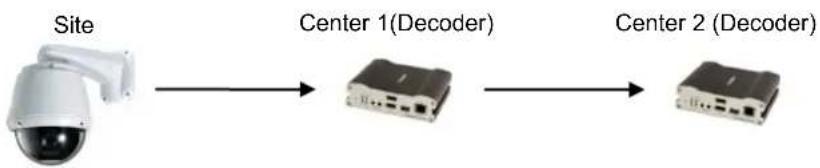
flowchart
graph LR
    A["Site"] --> B["Center 1 (Decoder)"]
    B --> C["Center 2 (Decoder)"]
Video and audio data can be retransmitted from one center to another center. This arrangement is useful when the network bandwidth to the site is limited and there is more than one center wanting to monitor the site.
CMS (Central Monitoring System)
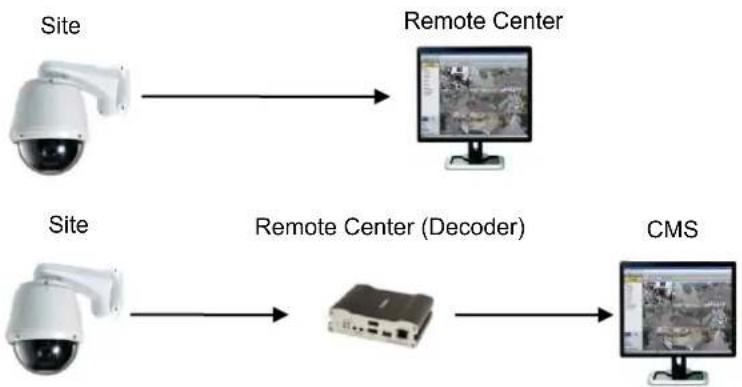
flowchart
graph LR
    A["Site"] --> B["Remote Center"]
    C["Site"] --> D["Remote Center (Decoder)"]
    D --> E["CMS"]
CMS (Central Monitoring System) is a Window-based remote monitoring program used to monitor or control video, audio, and events in real time from several IP cameras or video servers. Please refer to the CMS User Manual for more detail.
2. Installation
DIP Switch Setup
When you control the camera through RS-485, before installation, you should set the DIP switches to configure the camera ID, communication protocol.
natural_image
Technical line drawing of a mechanical component with no visible text or symbolsCamera ID setup
text_image
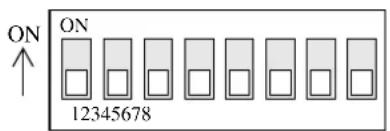
ON 12345678- ID numbers of each camera are set up using binary numbers. See the examples shown below:
| Switch | 1 | 2 | 3 | 4 | 5 | 6 | 7 | 8 |
| ID Value | 1 | 2 | 4 | 8 | 16 | 32 | 64 | 128 |
| ex) ID=5 | On | off | On | off | off | off | off | off |
| ex) ID=10 | off | On | off | On | off | off | off | off |
● The camera ID range is 1\~255. The Camera ID must not be 0.
● Factory default of Camera ID is 1.
- Match the camera ID with Cam ID setting of your DVR or Controller to control the camera.
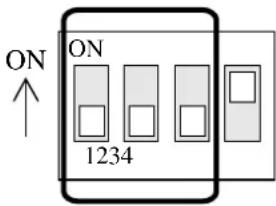
Communication Protocol Setup
text_image
ON ON 1234- Select the appropriate Protocol with DIP switch combination.
| Switch State | Protocol/Baud rate | ||
| S0 (Pin 1) | S1 (Pin 2) | S2 (Pin 3) | |
| OFF | OFF | OFF | PELCO-D, 2400 bps |
| ON | OFF | OFF | PELCO-D, 9600 bps |
| OFF | ON | OFF | PELCO-P, 4800 bps |
| ON | ON | OFF | PELCO-P, 9600 bps |
| Otherwise | Reserved | ||
- If you want to control using a DVR or P/T controller, their protocol must be identical to the camera otherwise, you can not control the camera.
- Turn off the camera before adjusting the DIP switches. If you change the camera protocol by changing the DIP switches, the change will be effective after you reboot the camera.
● Factory default of protocol is "Pelco-D, 2400 bps".
Camera Installation using Brackets
Installation using a Ceiling Mount Bracket (not supplied)
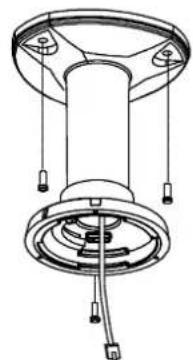
① Remove the ceiling tile from the ceiling and cut a hole whose diameter is 30\~40mm on the ceiling tile to pass the wire(s) and cable(s) through to the upside of the ceiling. Then prepare the ceiling mount bracket. Pull the wire(s) for the system as below.
(Anchor Bolt 3/8" × 70)
natural_image
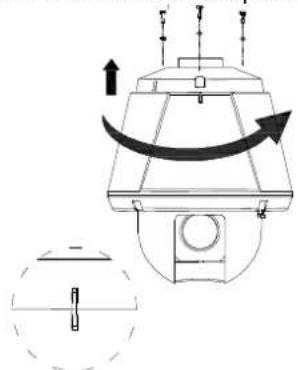
Technical line drawing of a mechanical component with no visible text or symbols③ Align the index marks and assemble the main body to the mounting adaptor and turn it. Attach the main body to the camera mounting adaptor with the included screws. (Torx screw M4X18). Please make certain the screws are securely tightened to maintain a waterproof seal.
natural_image
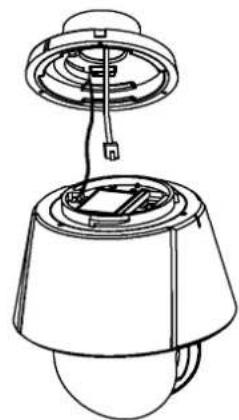
Technical diagram of a mechanical device with directional arrows and a magnified inset showing internal components (no text or symbols)② Hook up the "Drop Prevention Spring" on main body to prevent the camera from unexpected drops. Pull the wire(s) and cable(s) for the system as shown below.
natural_image
Technical line drawing of a mechanical device with a central hub and top component (no text or symbols)④ Screw the dome cover to the main body and remove the protection vinyl from the dome cover.
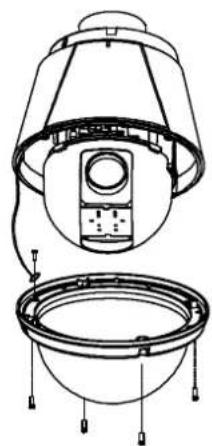
natural_image
Technical line drawing of a mechanical device with internal components and wiring (no text or symbols)Notice
● Before starting the installation, make sure that the Camera ID and Protocol are set up properly.
- To adjust the installation height from the mounting surface, pipes and couplers may be needed between the surface mount part of the ceiling mount bracket and the camera mount part of the ceiling mount bracket. Please note that these are not supplied by the manufacturer.
Installation using the Wall Mount Bracket
① Make a hole whose diameter is 30\~40mm on the mounting surface to pass the wire(s) and cable(s) through the mounting surface.
Prepare the wall mount bracket by Pulling the wire(s) and cable(s) for the system as below. Attach the wall mount bracket to the mounting surface. (Hex Lag #14×50)
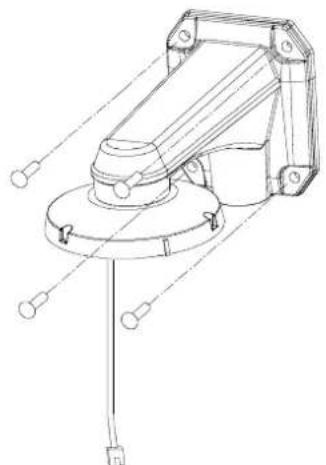
natural_image
Technical line drawing of a mechanical device with no visible text or symbols③ Line up the index marks and assemble the main body to the mounting ring and turn it. Attach the main body to the mounting adaptor with the supplied (Torx screw M4X18). Please make certain the screws are securely tightened to maintain a waterproof seal.
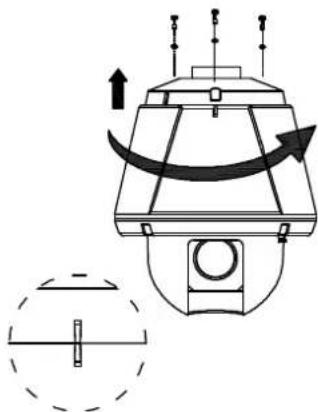
natural_image
Diagram of a mechanical device with directional arrows and a dashed circular annotation (no text or symbols)② Hook up the "Drop Prevention Spring" on main body to prevent the camera from unexpected drops. Pull the wire(s) and cable(s) for the system as below.
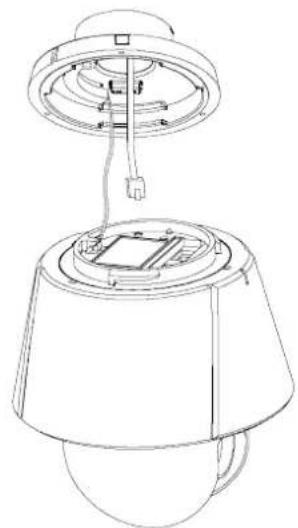
natural_image
Technical line drawing of a mechanical device with a top and bottom views, showing internal components and wiring (no text or symbols)④ Screw the dome cover to the main body and remove the protection vinyl from the dome.
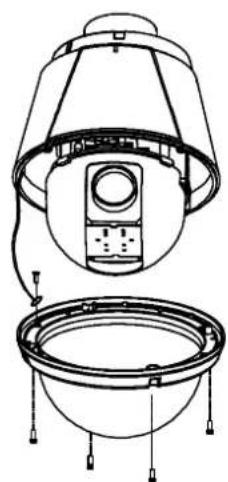
natural_image
Technical line drawing of a surveillance camera with a circular base and sensor array (no text or symbols)Notice
- Before starting the installation, make sure that the Camera ID and Protocol are set up properly.
Wiring/Cabling & Connecting
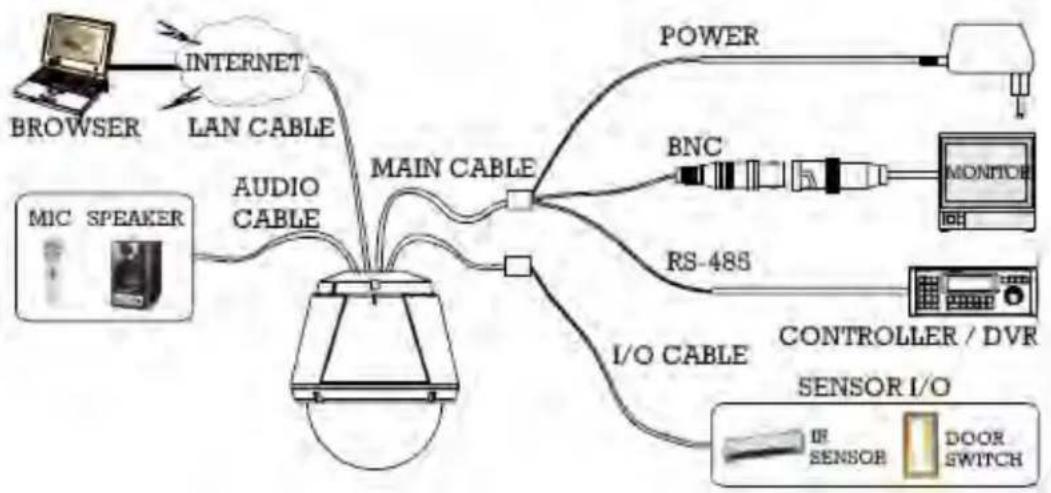
flowchart
graph TD
    A["BROWSER"] --> B["INTERNET"]
    B --> C["LAN CABLE"]
    C --> D["MAIN CABLE"]
    D --> E["POWER"]
    E --> F["MONITOR"]
    G["MIC SPEAKER"] --> H["Audio Cable"]
    H --> D
    I["RS-485"] --> D
    J["CONTROLLER / DVR"] --> K["I/O CABLE"]
    K --> L["SENSOR I/O"]
    L --> M["FOOD SWITCH"]
    N["IR SENSOR"] --> L
    O["UNLESSY"] --> P["UNLESSY"]
Port Description
- Main Cable
| Port Pin Number (RJ45) | Connector / Wire Color | Signal |
| 1 | Black | RS485 + |
| 2 | Brown | RS485 – |
| 3 | Red | DC 12V |
| 4 | Orange | Ground |
| 5 | Yellow | OUT COM (Relay Output Common) |
| 6 | Green | OUT 2 (Relay Output 2) |
| 7 | Blue | OUT 1 (Relay Output 1) |
| 8 | Violet | IN COM (Sensor Input Common) |
| 9 | Gray | IN 1 (Sensor Input 1) |
| 10 | White | IN 2 (Sensor Input 2) |
- Audio Cable
| Port Pin Number | Connector/ Wire Color | Signal |
| 1 | RCA (Yellow) | Audio IN |
| 2 | Audio GND | |
| 3 | RCA (White) | Audio OUT |
Connecting Power
- Carefully check the voltage and current capacity of the rated power. The rated power is indicated in the back of main unit.
- After confirming the voltage, connect the power adaptor to the AC power source then connect the 12V DC connector to the system.
- For the DC input models, be careful with the polarity of the DC power. The system will be permanently damaged if connected to reverse polarity power supplies.
- In cases where the power wire is very long, there may be a voltage drop and the system may not work properly. Make the length of the power wire as short as possible.
Connecting Network
- Plug thne network cable to Ethernet port (RJ-45 network port).
Connecting Video
- To display video through the HD-SDI port, connect the port to a monitor using a BNC coaxial cable rated for HDSDI video.
- Set Enable Preview option "ON" on the Video tab of web page. (Please refer to the Video Configuration part of this manual)
- When using HD-SDI, video may contain errors if the correct type of BNC coaxial cable is not used.
- If the video transmission distance exceeds 100 meters, video data may lost due to a reduction in the video signal. In order to prevent this use of a repeater is recommended.
- When using HD-SDI, video can be only be viewed on a HD-SDI monitor.
Connecting Audio
Audio is full-duplex. It is possible to set the mode as Tx-only, Rx-only or Tx-Rx.
- Connect the audio input and output ports to the corresponding audio devices.
- The Audio signal required is line level. Audio equipment using an amp, mixer or other amplifier should be used.
Connecting Serial Port (RS-485 Communication)
- For PTZ control, connect the cable(s) to your keyboard or DVR. To connect multiple cameras to a single controller, the RS-485 communication should be connected in parallel as shown below. If you are connecting a single camera to a controller, you must terminate the camera. When connecting more than one camera to a single controller, terminate the last camera on the communication line. The last camera means the camera farthest in cable length from the controller. Note that the total length of the communication cable between a controller and the camera(s) on the same communication line must be less than 1.2Km.
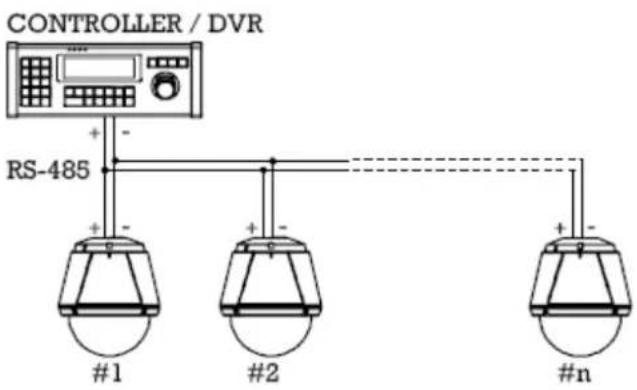
text_image
CONTROLLER / DVR RS-485 #1 #2 #n- The RS-485 port of VS-570-HDSDI can be connected to external equipment such as PT receiver etc. A PC client can send PT commands to the external equipment via the serial port.
When a decoder system instead of a PC client is connected to VS-570-HDSDI, the serial port and that of the decoder system work in pass-through mode. That is, data from one port is delivered to the other port and vice versa.
Connecting Sensor and Alarm
Connect sensor and alarm devices to corresponding terminals accordingly.
- Sensor Input
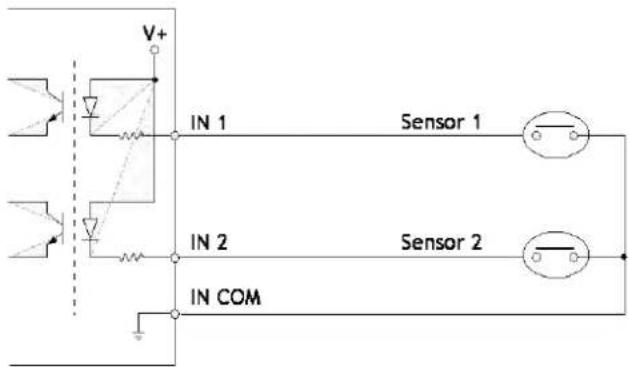
text_image
V+ IN 1 Sensor 1 IN 2 Sensor 2 IN COM- Relay Output
text_image
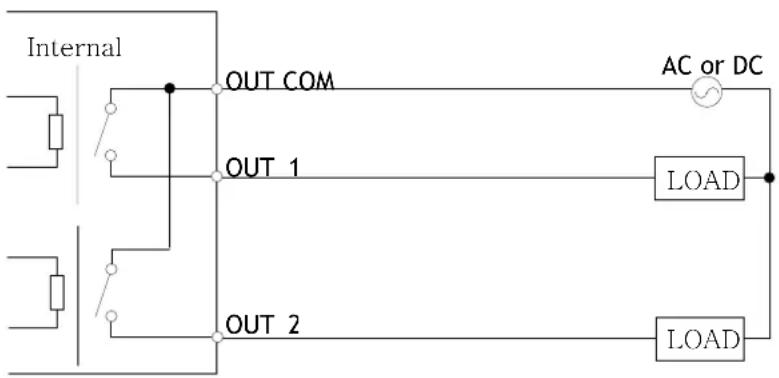
Internal OUT COM OUT 1 AC or DC LOAD OUT 2 LOADMaximum allowable electrical load of relay is shown bellow table.
| Drive Power | DC Power | AC Power |
| Max. Load | Max DC 24V, 1A | Max AC 125V, 0.5A |
Check if it works
Once the power is supplied to the camera, it will start booting. The system will boot up to an operating mode after approximately 40-60 seconds. The green LED on the Ethernet port will flash indicating the system is ready.
The software provided in the CD called True Manager allows you to check the IP address and other network details of the camera. Please refer to the True Manager manual for instructions on how to find the IP address of the camera and change it if required.
3. System Operation
Remote Video Monitoring
There are two ways to monitor video when the center system and VS-570-HDSDI are connected. In order for proper operation, an IP address must be set accordingly. Please refer to True Manager in Chapter 3 or Remote Setting in Chapter 4 for further details.
| Default ID : admin | Default Password : 1234 |
Video Monitoring using Internet Explorer
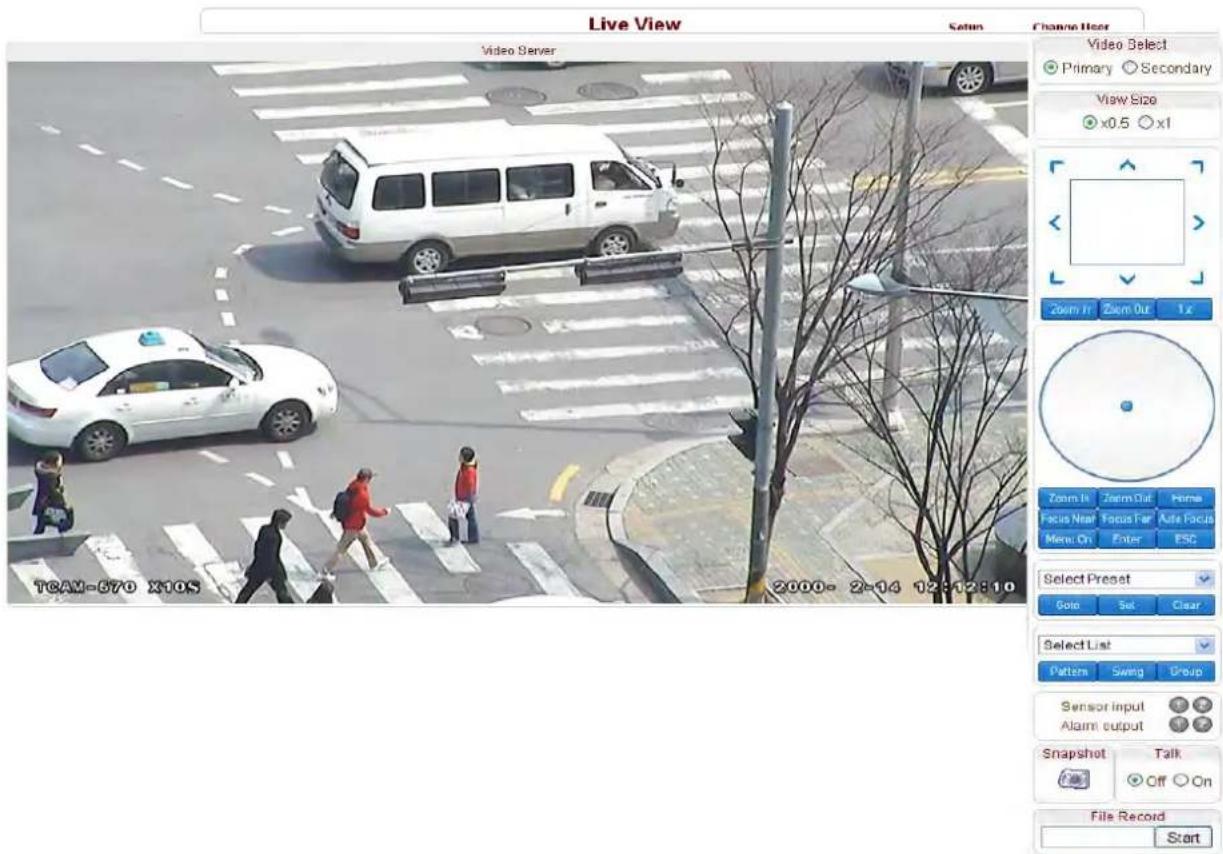
Open Internet Explorer and enter VS-570-HDSDI's IP address. The system will ask for confirmation to install Active-X control. Once authorized, the Internet Explorer will start to display video images from VS-570-HDSDI as shown below.
Default IP Address : http://192.168.10.100
text_image
Live View Video Server Video Select Primary Secondary View Size x0.5 x1 Zoom In Zoom Out 1x Zoom In Zoom Out Home Focus Near Focus Far Aide Focus Menu On Enter ESC Select Preset Go to Set Clear Select List Pattern Swing Group Sensor Input Alarm output Snapshot Talk Off On File Record Start TEAM-670 X105 2000- 2=14 12:12:10- Video Selection
Select the Video stream to be viewed: Primary or Secondary.
The VS-570-HDSDI is capable of dual streaming; primary streaming and secondary streaming.
Video will be displayed according to the resolution set in the video configuration. If dual streaming ("Use Dual Encode" Menu on the Video page) is not activated, the secondary video will not be available.
- Screen Size
Adjust the Screen size.
Screen size is initially adjusted according to the compression resolution. If you click on the x1/2 icon, the whole screen size will be reduced by half.
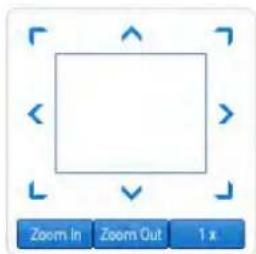
- Digital Zoom
Controsl the Digital zoom on the screen.
The more the camera zooms in, the smaller the square of the control panel. Position of the image can be changed by moving the position of the square. Max x5 Digital Zoom is available. If you press x1, the screen will return to the normal size.
text_image
Zoom In Zoom Out 1 x● PTZ Control Panel (Optical Zoom & Digital zoom built-in the camera)
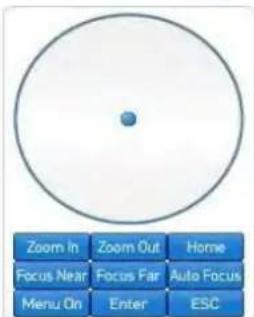
Control PTZ and PTZ Control Panel is used for controlling external PTZ devices when the external PTZ devices are connected through a serial port. Since x10 optical zoom lens and x12 digital zoom is built into the VS-570-HDSDI, it is possible to control zooming by using the Zoom in/out buttons of the PTZ control Panel. In order to use digital zoom, select Digital zoom ON in the Camera tab.
text_image
Zoom In Zoom Out Home Focus Near Focus Far Auto Focus Menu On Enter ESC● Focus Near, Focus Far, Auto Focus
Adjusts the focus of the lens.
- Menu On, Enter, ESC
Displays and controls OSD (On Screen Display) menu if OSD menu is supported.
NOTE: The VS-570-HDSDI does not support the OSD menu.
- Select Preset
Set the preset position, move to the specific preset position or clear the preset position.
- Go to: Moves to the selected preset entry if the preset entry is set.
- Set: Sets the current position to the selected preset entry.
- Clear: Deletes the selected preset entry.
- Select List
Operate the selected Pattern or Swing or Group.
(Please refer to the PTZ tab to set Pattern, Swing and Group)
- Sensor Input
Displays the status of the installed sensors in real time.
The VS-570-HDSDI supports two sensor inputs. When the sensor(s) of VS-570-HDSDI are installed and working, the sensor light turns red.
- Alarm Output
Operates the alarm device by pressing the number icon
VS-570-HDSDI supports two alarm outputs. A number icon indicates the status of the alarm device.
- Screen Capture
Captures video images and stores them as BMP or JPEG files.
- Audio Transfer
Transfer audio from a PC that is displaying the current video image to VS-570-HDSDI.
- File record
Recording the video appearing on the Live view page to an AVI file is available. The AVI files are generated in the specified folder or in a specified file name on the PC where web browser is running.
-
Enter the drive and the folder name on the PC and enter the AVI file name to be used.
-
Press the "Start" button to begin recording.
-
Press "Stop" button to end recording.
-
AVI file named "File name_IP address_hh_mm_ss" will be generated in the specified folder.
Video Monitoring with Decoder System
Once the VS-570-HDSDI's IP address is set in the remote IP address section of the decoder, the decoder system will connect to VS-570-HDSDI and start receiving the video images. Normally, a monitor connected to the decoder will display video images.
Initialization of IP address
If a system IP address is lost, the system can be reset to the system default IP address using the reset button in the rear of the system.
- While the system is in operation, press and hold the reset button for more than 5 seconds.
- The system will automatically reboot.
- Once the system reboots, the IP address will be set to the system default as below:
| • IP mode | Fixed IP | • IP address | 192.168.10.100 |
| • Subnet mask | 255.255.255.0 | • Gateway | 192.168.10.1 |
| • Base port | 2222 | • HTTP port | 80 |
4. Remote Configuration
Using Web Brower
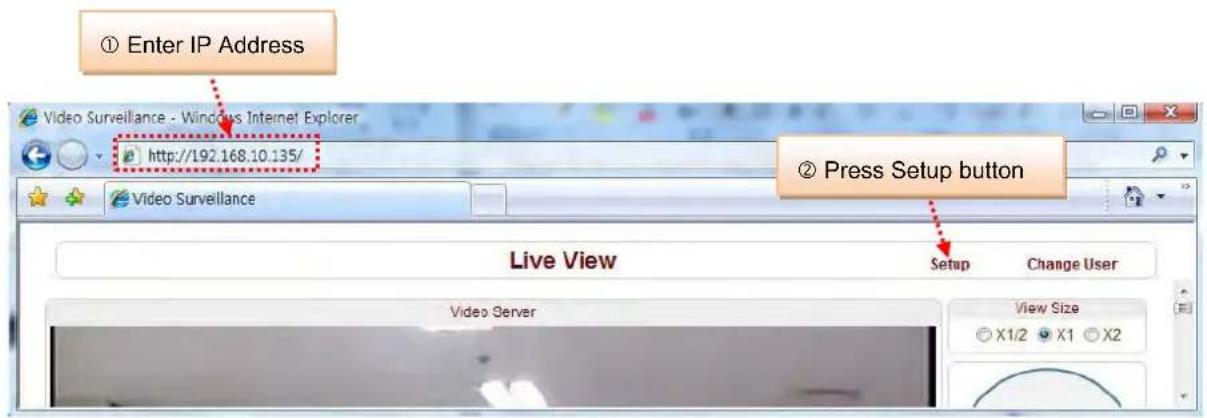
Remote setting is available by using the web browser. Enter the IP address of a VS-570-HDSDI, a live view screen appears as below. Press the Setup button located in the upper right area of the monitoring screen to go to the server setup. To change Remote Settings, the user must be authorized higher than manager level.
text_image
① Enter IP Address http://192.168.10.135/ ② Press Setup button Live View Setup Change User Video Server View Size X1/2 X1 X2The configurations are grouped into 10 categories: System, Video, Audio, Network, Serial, Event, PTZ, Record, User and Camera. Configuration changes are not applied until the Apply button is pressed. If you leave the page without pressing the Apply button, any changes made on the page will not be saved.
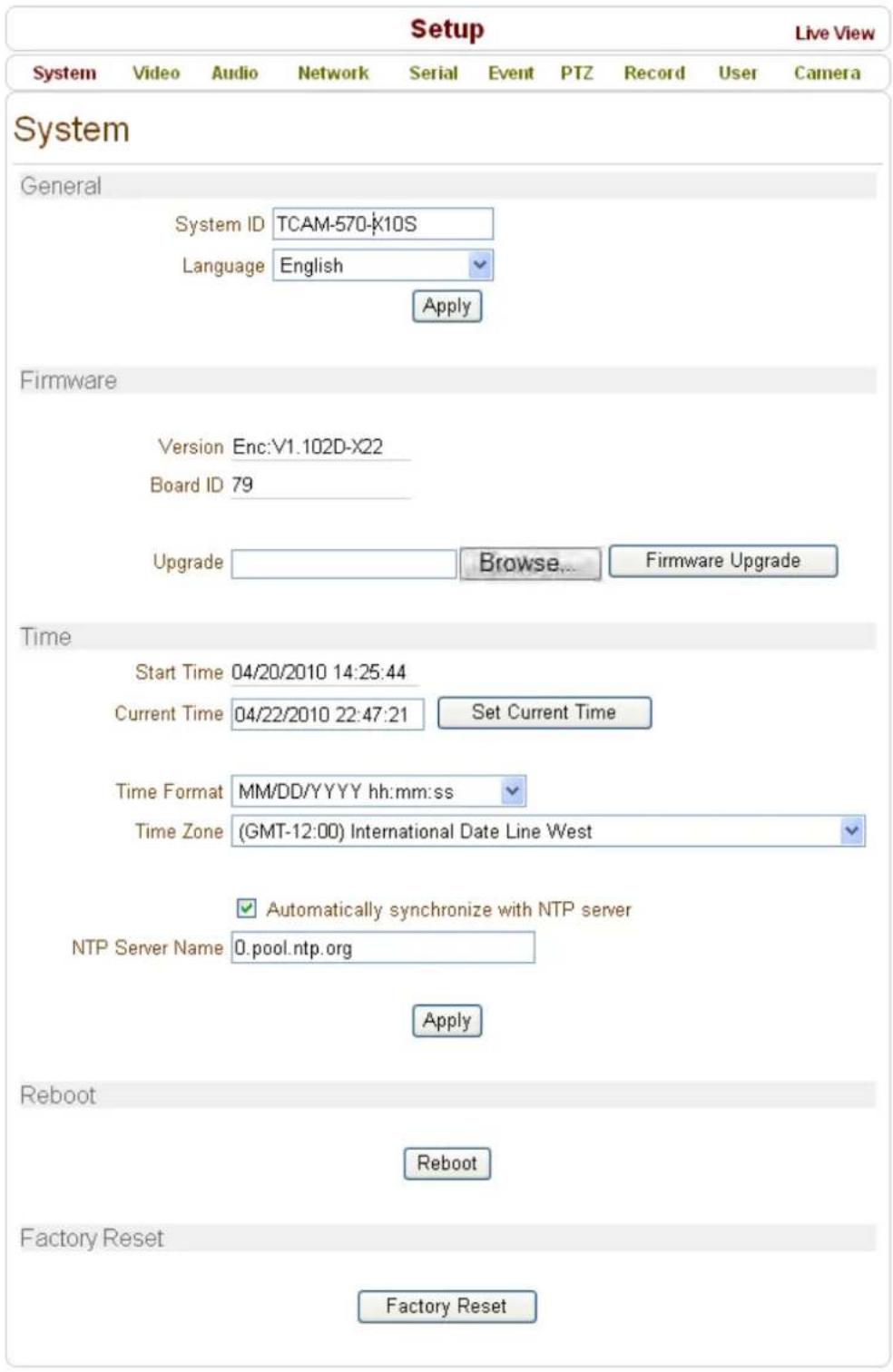
System Configuration
text_image
Setup Live View System Video Audio Network Serial Event PTZ Record User Camera System General System ID TCAM-570-X10S Language English Apply Firmware Version Enc:V1.102D-X22 Board ID 79 Upgrade Browse... Firmware Upgrade Time Start Time 04/20/2010 14:25:44 Current Time 04/22/2010 22:47:21 Set Current Time Time Format MM/DD/YYYY hh:mm:ss Time Zone (GMT-12:00) International Date Line West ✓ Automatically synchronize with NTP server NTP Server Name 0.pool.ntp.org Apply Reboot Reboot Factory Reset Factory ResetGeneral
- System ID
Enter the System ID that will be used as the camera title.
The set System ID will be displayed with video image on the web browser. The System ID is also transferred to remote software, such as CMS, and displayed on it.
- Language
Select the language to be used for web-based configuration.
Firmware
- Firmware version
Displays the current firmware version.
- Board ID
Display the Network board ID of VS-570-HDSDI recognized by system.
- Upgrade
Upgrade firmware :
- Press the Browse button to select a firmware file from your PC.
- Press the Firmware Upgrade button to start the upgrade.
- Messages showing the status (downloading / upgrading) will be displayed.
- The camera will reboot automatically after completing the upgrade. Do not turn the camera off during the upgrade process.
Firmware
Version Enc:V1.102D-001
Board ID 47
Now Downloading... Please wait...
Upgrade D:\cckskim\update_fw\hvsSys102C_
Browse.
Firmware Upgrade
Now, Upgrading... Please wait a minute.
Time
- Start Time
This is the date and time when the camera was last booted.
- Current Time
This is the current date & time.
Enter a new date and time and press the Set Current Time button to update.
- Time Format
This allows you to change the time format. Selectable time formats are as follows:
- YYYY/MM/DD hh:mm:ss (Ex. 2010-4-11 18:18:42)
- DD/MM/YYYY hh:mm:ss (Ex.11- 4-2010 18:18:42)
- MM/DD/YYYY hh:mm:ss (Ex. 4-11-2010 18:18:42)
- Time Zone
This allows you to select the time zone of where the camera is installed.
Depending on the time zone, Daylight Saving Time will work automatically.
A time zone is a region of the earth that has uniform standard time, usually referred to as the local time. By convention, time zones compute their local time as an offset from UTC (Coordinated Universal Time). In casual use, GMT (Greenwich Mean Time) can be considered equivalent to UTC. Local time is UTC plus the current time zone offset for the considered location.
● Automatically synchronize with NTP server
Checking this box will Synchronize the camera time with an NTP server using NTP (network time protocol). Enter the NTP server name of the NTP server to be used.
The Network Time Protocol (NTP) is a protocol for synchronizing the clocks of computer systems over packet-switched, variable-latency data networks. It is designed particularly to resist the effects of variable latency by using a jitter buffer.
Reboot
- Pressing this button will Reboot the camera.
Do not press the Reboot button unless required.
Factory Reset
- This changes the Current IP Address of VS-570-HDSDI to default IP Address: 192.168.10.100. The System log and user registrations are also cleared. All other setting values will remain. Note that the Password will not be changed by the Factory Reset for the security purpose. Please contact Marshall Electronics Technical Support if you forget your password.
Video Configuration
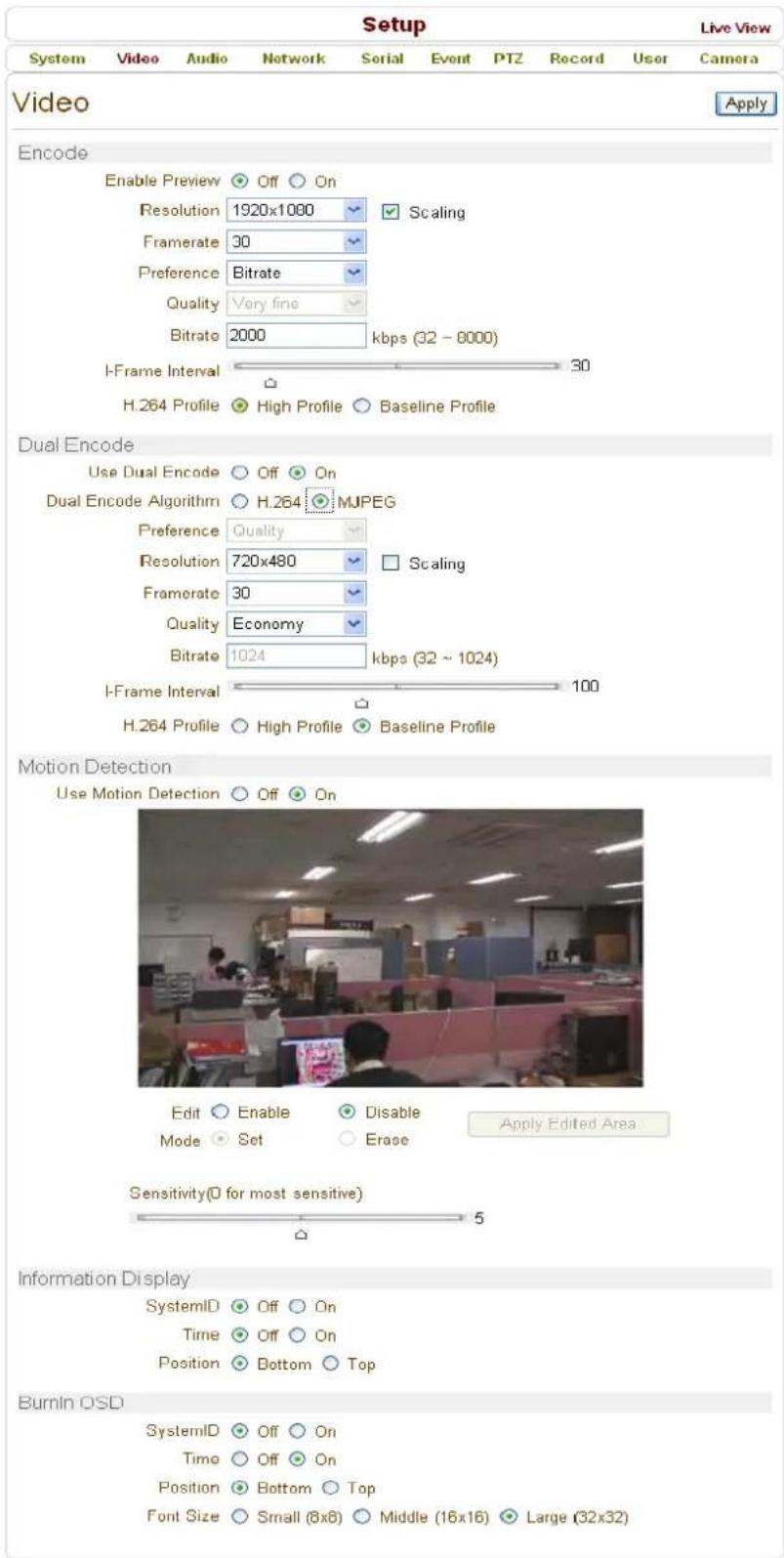
text_image
Setup Live View System Video Audio Network Serial Event PTZ Record User Camera Video Apply Encode Enable Preview Off On Resolution 1920x1000 Scaling Framerate 30 Preference Bitrate Quality Very fine Bitrate 2000 kbps (32 - 8000) I-Frame Interval 30 H.264 Profile High Profile Baseline Profile Dual Encode Use Dual Encode Off On Dual Encode Algorithm H.264 MJPEG Preference Quality Resolution 720x480 Scaling Framerate 30 Quality Economy Bitrate 1024 kbps (32 - 1024) I-Frame Interval 100 H.264 Profile High Profile Baseline Profile Motion Detection Use Motion Detection Off On Edit Enable Disable Apply Edited Area Mode Set Erase Sensitivity(0 for most sensitive) 5 Information Display SystemID Off On Time Off On Position Bottom Top BurnIn OSD SystemID Off On Time Off On Position Bottom Top Font Size Small (8x8) Middle (16x16) Large (32x32)Encode
- Enable Preview
- Select ON to display video on the monitor that is connected to the composite or HD-SDI video port.
- Select the Output format accordingly in the end of the Video page.
Note that when Enable Preview is ON, dual streaming is not available.
When the video is transmitted directly to the monitor through the BNC cable, the video signal bypasses the network and encoding.
- Resolution
Select the video encoding resolution required.
18 resolutions are available.
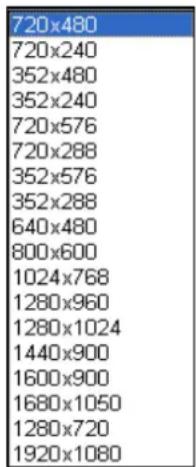
text_image
720×480 720×240 352×480 352×240 720×576 720×288 352×576 352×288 640×480 800×600 1024×768 1280×960 1280×1024 1440×900 1600×900 1680×1050 1280×720 1920×1080The Scaling option is used when the encoding resolution is different from the input compression. Without the Scaling option, input video will be cropped according to the encoding resolution. On the other hand, if Scaling is selected, the input video will be adjusted according to the encoding resolution.
- Frame rate
Select the maximum number of frames per second for the video stream.
A frame rate of 1,2,3,4,5,6,8,10,15,20,25 and 30 can be selected. The actual frame rate of video can be less than the maximum frame rate set due to any network bandwidth limitation.
- Preference
Select the encoding mode to control video quality: Quality or Bit rate.
If „Bit rate' is selected, the video encoding will be affected by the „Bit rate' value entered. Therefore, 'Bit rate' mode is CBR (Constant Bit rate) encoding.
If „Quality' is selected, the video encoding will be affected by the quality of image selected. Therefore, 'Quality' mode is VBR (Variable Bit Rate) encoding.
- Quality
Select the required Video quality. Eight levels of quality are available.
Quality mode (VBR encoding) adjusts the bit rate according to the image complexity, using higher bandwidth for increased activity in the video and lower bandwidth for decreased activity.
For active video content such as sports, or when network bandwidth is limited, It is recommended that CBR or Bit Rate encoding be used.
- Bit rate
Set the bit rate value between 32 \~ 8000kbps.
Bit rate mode (CBR encoding) allows you to set a fixed bit rate that consumes a predictable amount of bandwidth. If the network capacity is sufficient use of a fixed bit rate of 4096 kbps or higher will maintain a high quality picture regardless of content.
- I-Frame Interval
Set the I-frame Interval between 0 and 255.
There will be no I-frames if 0 is selected.
H.264 Profile
Select the H.264 Profile: High Profile or Baseline Profile
The standard defines various sets of capabilities which are referred to as profiles targeting specific classes of applications.
- High Profile (HiP)
The primary profile for broadcast and disc storage applications particularly for high-definition television applications (for example, this is the profile adopted by the Blu-ray Disc storage format and the DVB HDTV broadcast service).
- Baseline Profile (BP)
Primarily for low-cost applications that require additional data loss robustness, this profile is used in some videoconferencing and mobile applications. This profile includes all features that are supported in the Constrained Baseline Profile, plus three additional features that can be used for loss robustness (or for other purposes such as low-delay multi-point video stream compositing).
Dual Encode
- Use Dual Encode
- Select the Off button on the Enable Preview to enable to use Dual Encode.
- Select the ON button to enable to use Dual Encoding.
The secondary video can be viewed on Live View window by selecting Secondary on Video selection.
- Dual Compression Algorithm
Select H.264 or MJPEG for the secondary streaming.
Maximum resolution is 1280 x 720 and 9 steps of resolution are available. If MJPEG is selected, only "Quality" mode is supported
Motion Detection
- Use Motion Detection
Select ON to use the Motion Detection function.
● Motion Detection Area Editing
Configure the regions for motion detection. Regions of arbitrary shapes can be configured using the following steps:
① Select the Enable button ajacent to the Edit heading.
② Select editing Mode. Set is for including cells to motion detection region and Erase is for excluding.
③ Select cells using the right mouse button. Multiple cells can be selected conveniently by pressing and dragging.
④ Press Apply Edited Area to save the editing
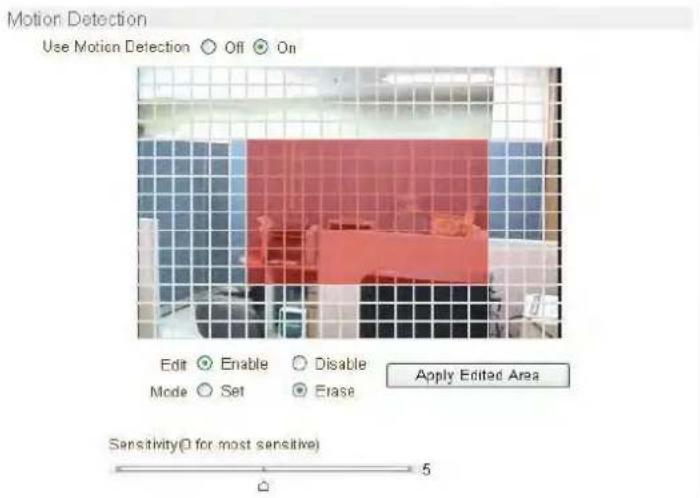
text_image
Motion Detection Use Motion Detection ○ Off ○ On Edit ○ Enable ○ Disable Mode ○ Set ○ Erase Apply Edited Area Sensitivity(○ for most sensitive) 5- Sensitivity
Sensitivity selects the amount of movement required to trigger (detect) a motion event.
The value determines the sensitivity of the motion detection within a block. The lower the number the more sensitive to movement. Select from 0 to 10.
● Information Display
System ID and/or server time can be displayed over the video window in Internet Explorer. Each item can be turned on or off separately, and the position also can be configured. This information is displayed after the video is decompressed.
- Burn-in OSD
Inserts the system ID and date/time in the compressed video. The System ID and time respectively can be turned on or off in the video, the Position and Font size is also selectable.
Note: Since time information is inserted when the video is compressed, the changing characters of the time display is detected as motion. Therefore, even though there is no motion, an event will be triggered. In order to prevent this, exclude the area displaying time using Motion detection area editing.
Output Format
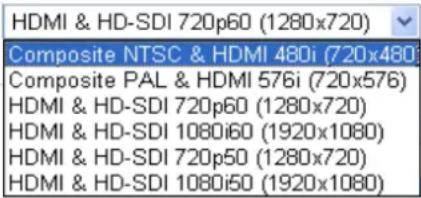
Output Format menu appears only when Enable Preview is on.
Output Format
Output Format
text_image
HDMI & HD-SDI 720p60 (1280x720) Composite NTSC & HDMI 480i (720x480) Composite PAL & HDMI 576i (720x576) HDMI & HD-SDI 720p60 (1280x720) HDMI & HD-SDI 1080i60 (1920x1080) HDMI & HD-SDI 720p50 (1280x720) HDMI & HD-SDI 1080i50 (1920x1080)Select the output format for the monitor preview according to the video output and monitor specification.
Audio Configuration
text_image
Setup Live View System Video Audio Network Serial Event PTZ Record User Camera Audio Apply Algorithm Algorithm ○ G.711 ○ AAC Bitrate ○ 64kbps ○ 128kbps Mode Mode ○ Off ○ Tx-only ○ Rx-only ○ Tx & Rx Input Gain Input Gain 25Algorithm
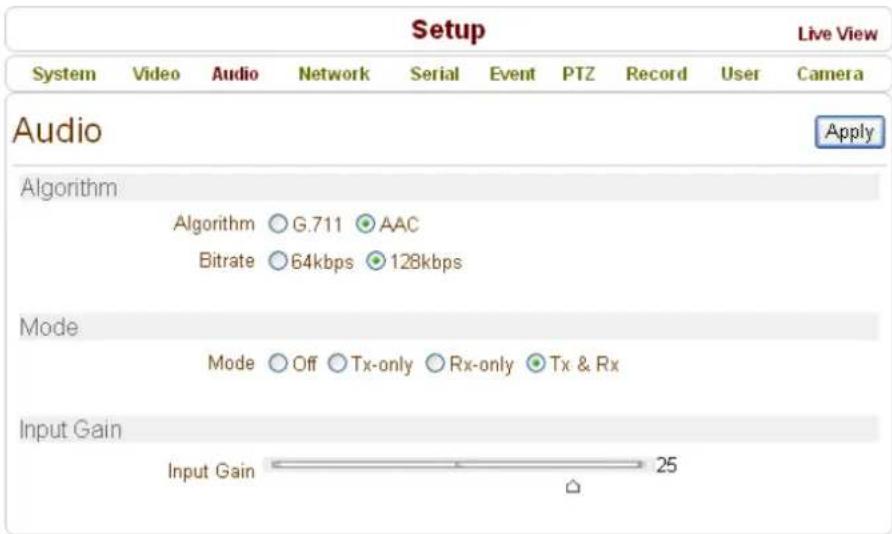
- Algorithm
Select the audio algorithm: G.711 or AAC.
- Bitrate
Select the Bitrate to be 64kbps or 128kbps when AAC is selected.
The sampling rate is fixed to 32KHz when G7.11 is selected.
Note that when VS-570-HDSDI is connected to a decoder, the decoder's audio algorithm MUST be set identically to transmit audio and video properly.
Mode
- Select the audio Transmit / Receive mode:
| Mode | Action |
| Off | No operation |
| Tx-Only | Transmit only |
| Rx-Only | Receive only |
| Tx & Rx | Transmit and Receive |
Input Gain
- Set the audio input gain from 0 to 31.
Network Configuration
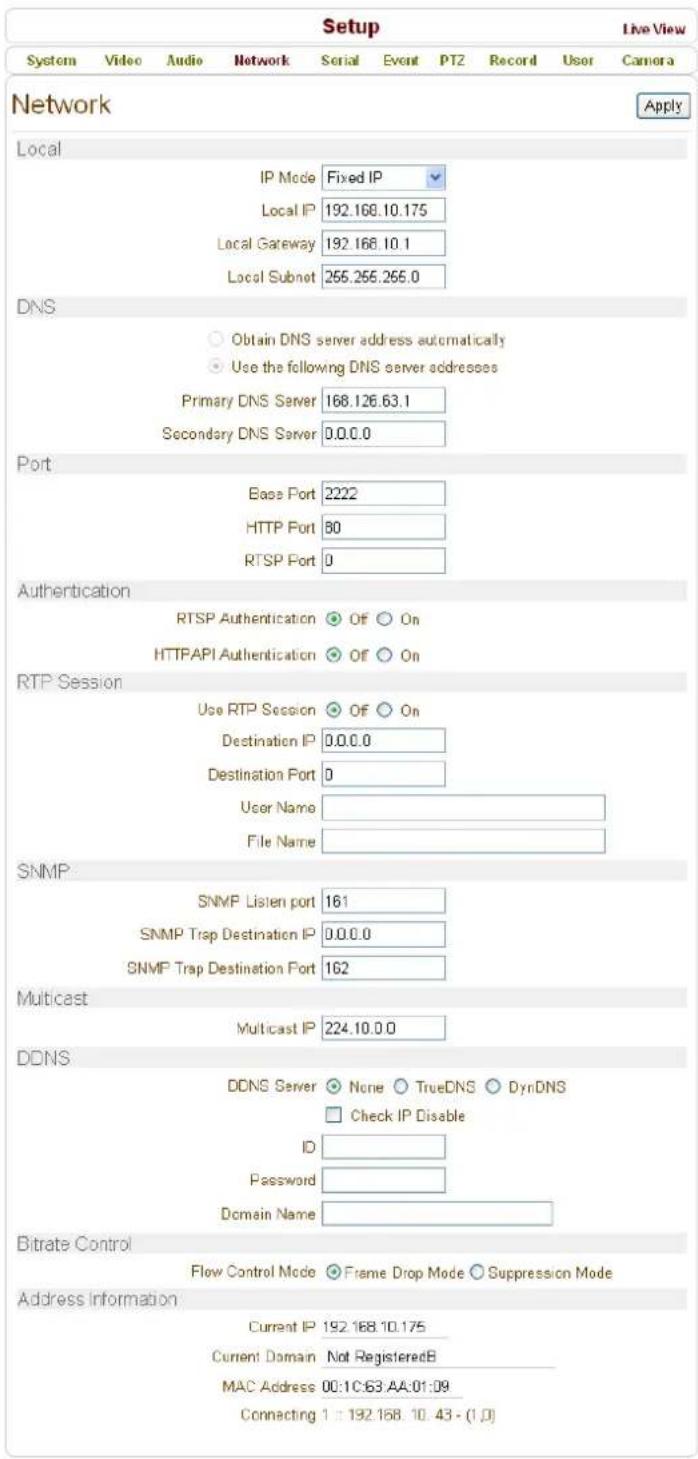
text_image
Setup Live View System Video Audio Network Serial Event PTZ Record User Camera Network Apply Local IP Mode Fixed IP Local IP 192.168.10.175 Local Gateway 192.168.10.1 Local Subnet 255.255.255.0 DNS Obtain DNS server address automatically Use the following DNS server addresses Primary DNS Server 168.126.63.1 Secondary DNS Server 0.0.0.0 Port Base Port 2222 HTTP Port 80 RTSP Port 0 Authentication RTSP Authentication Off On HTTPAPI Authentication Off On RTP Session Use RTP Session Off On Destination IP 0.0.0.0 Destination Port 0 User Name File Name SNMP SNMP Listen port 161 SNMP Trap Destination IP 0.0.0.0 SNMP Trap Destination Port 162 Multicast Multicast IP 224.10.0.0 DDNS DDNS Server None TrueDNS DynDNS Check IP Disable ID Password Domain Name Bitrate Control Flow Control Mode Frame Drop Mode Suppression Mode Address Information Current IP 192.168.10.175 Current Domain Not RegisteredB MAC Address 00:1C:63:AA:01:09 Connecting 1 : 192.168.10.43 - (1,0)Local
- IP mode
Select the IP mode: Fixed IP or DHCP (Dynamic Host Configuration Protocol)
Depending on the mode selected, configuration items will appear as follows:
| IP Mode | Selection | Description |
| Fixed IP | Local IP | Fixed IP address |
| Local Gateway | Gateway IP address | |
| Local Subnet | Subnet mask | |
| DHCP | N/A |
Please request IP address information from your ISP provider or network manager.
DNS
- Obtain DNS server address automatically.
Get DNS server address automatically when the IP mode is DHCP.
- Use the following DNS server addresses:
Enter the DNS server IP address.
- Primary DNS server
- Secondary DNS server
Domain Name System (DNS) is a database system that translates a computer's fully qualified domain name into an IP address. Networked computers use IP addresses to locate and connect to each other, but IP addresses can be difficult for people to remember. For example, on the web, it's much easier to remember the domain name www.amazon.com than it is to remember its corresponding IP address (207.171.166.48). Each organization that maintains a computer network will have at least one server handling DNS queries. That server, called a name server, will hold a list of all the IP addresses within its network, plus a cache of IP addresses for recently accessed computers outside the network.
Port
- Base Port
Enter the Base Port number.
The Network base port is used for communication between systems. In order for the VS-540-HDSDI and remote systems (decoder or CMS, NVR software) to be connected, the port numbers must be identically set.
- HTTP Port
Enter the HTTP port used for web-based connection.
- RTSP Port
Enter the RTSP port used for RTSP-based connection. The default RTSP port is 554.
RTSP (Real Time Streaming Protocol) is a standard for connected client(s) to control streaming data over the World Wide Web.
Authentication
- RTSP Authentication
If the RTSP Authentication set to ON, the user must enter correct User ID and Password when any RTSP client is connected.
- HTTP API Authentication
When HTTP API authentication set to ON, HTTP Authentication is asked for all clients which use HTTP API.
RTP Session
- RTP (Real-Time Transport Protocol) is an Internet protocol used for transmitting single real-time multimedia data such as audio and video to a select group of connected clients. Normally RTSP uses RTP to format packets of multimedia content. The RTP Session menu is used when only streaming the RTP without RTSP connection. The RTP stream will be transmitted to the destination set. The SDP (Session Description Protocol) file can be found in the server, and a client can retrieve it using http connection.
Related settings are as follows:
- Destination IP: Set the IP Address for your destination system which will receive RTP stream.
- Destination Port: Set the Port for your destination system which will receive RTP stream.
- User Name: Enter the User name that will be used as session name in the SDP file.
- File Name: Enter the file name that will be used as the name of the SDP file. It can then be accessed through http://ServerAddress/filename.
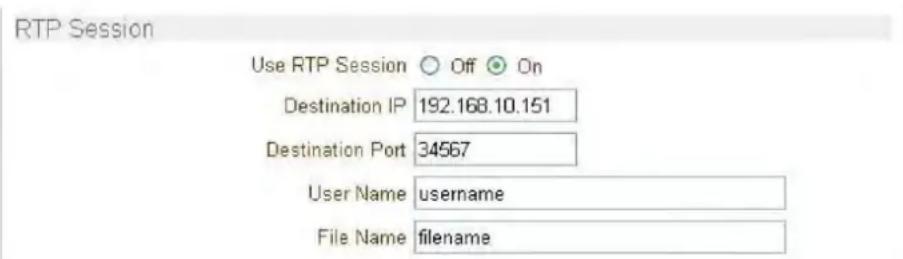
text_image
RTP Session Use RTP Session ○ Off ● On Destination IP 192.168.10.151 Destination Port 34567 User Name username File Name filenameSNMP
- The VS-570-HDSDI can be used as an SNMP agent. It is compatible to both SNMPv1 and SNMPvec. Settings for using SNMP (Simple Network Management Protocol) are as follows:
- SNMP Listen Port: This port is used for connecting external devices when the system operates as an SNMP client. SNMP is not used when setting a 0 value.
- SNMP Trap Destination IP: Set the SNMP Trap Destination IP.
- SNMP Trap Destination Port: Set the SNMP Trap Destination Port. SNMP is not used by setting 0 value.
SNMP
SNMP Listen port
161
SNMP Trap Destination IP
192.168.10.100
SNMP Trap Destination Port
162
Simple Network Management Protocol (SNMP) is used by network management systems to communicate with network elements. SNMP lets TCP/IP-based network management clients use a TCP/IP-based internetwork to exchange information about the configuration and status of nodes. SNMP can also generate trap messages used to report significant TCP/IP events asynchronously to interested clients. For example, a router could send a message if one of its redundant power supplies fails or a printer could send an SNMP trap when it is out of paper.
Multicast
- Multicast IP
The multicast IP address selection range is between 224.0.1.0 and 238.255.255.255. The selection can be used only when media protocol is set to Multicast. The Multicast menu is used for the Multicast connection request from a decoder or CMS / NVR software to transmit Multicast stream to the decoder or CMS / NVR software. The multicast address must be the same for the system to be connected using multicast protocol.
DDNS
Select the DDNS (Dynamic DNS) server to use. One of these two servers can be selected.
- True DNS: TrueDNS service is used in this mode. Systems can be registered on the website for TrueDNS service: http://ns1.truecam.net. System will get a domain name of xxx.truecam.net style. Please, refer to the user guide document for True DNS service.
- DynDNS: DynDNS service is used in this mode. Refer to www.dyndns.org for details. ID, Password and Domain name are needed when DynDNS is set.
Dynamic DNS is a method, protocol, or network service that provides the capability for a networked device, such as a router or computer system using the Internet Protocol Suite, to notify a domain name server to change, in real time (ad-hoc) the active DNS configuration of its configured hostnames, addresses or other information stored in DNS.
- Check IP Disable: If "Check IP Disable" is selected, the IP Server will skip to check its own IP. In Fixed IP mode, the set IP will be registered on the DDNS server. In DHCP mode, the allotted IP will be registered on the DDNS server. Normally Check IP Disable can be unchecked.
Bitrate control
- When there is more than one client connected to the VS-570-HDSI, due to bandwidth differences among the clients, some of them may not have enough bandwidth to receive the encoded stream completely. In this case, it is possible to select the way to stream video to clients as follows:
- Frame Drop Mode: Encoding will be adjusted to the client with the highest bandwidth. Clients with limited bandwidth may not receive all the frames.
- Suppression Mode: Bit rate and frame rate are adjusted most efficiently for all clients. In this case, all clients can be affected by the averaged bit rate and frame rate.
Address Info
● The following network information is displayed as Read only:
- IP Address: The Camera's own IP address. This information is useful when the camera's IP mode is set to DHCP.
- Domain Name: If the camera is registered at the DDNS server, the registered domain name is displayed.
- MAC Address: Display the MAC address of the camera. If the camera is registered at DDNS server, the MAC address is used in DDNS registration.
- Connecting: Client IP Addresses that are currently connected to the system are listed. (1) Indicates Primary Streaming and (0) Indicates Secondary streaming.
Serial Configuration
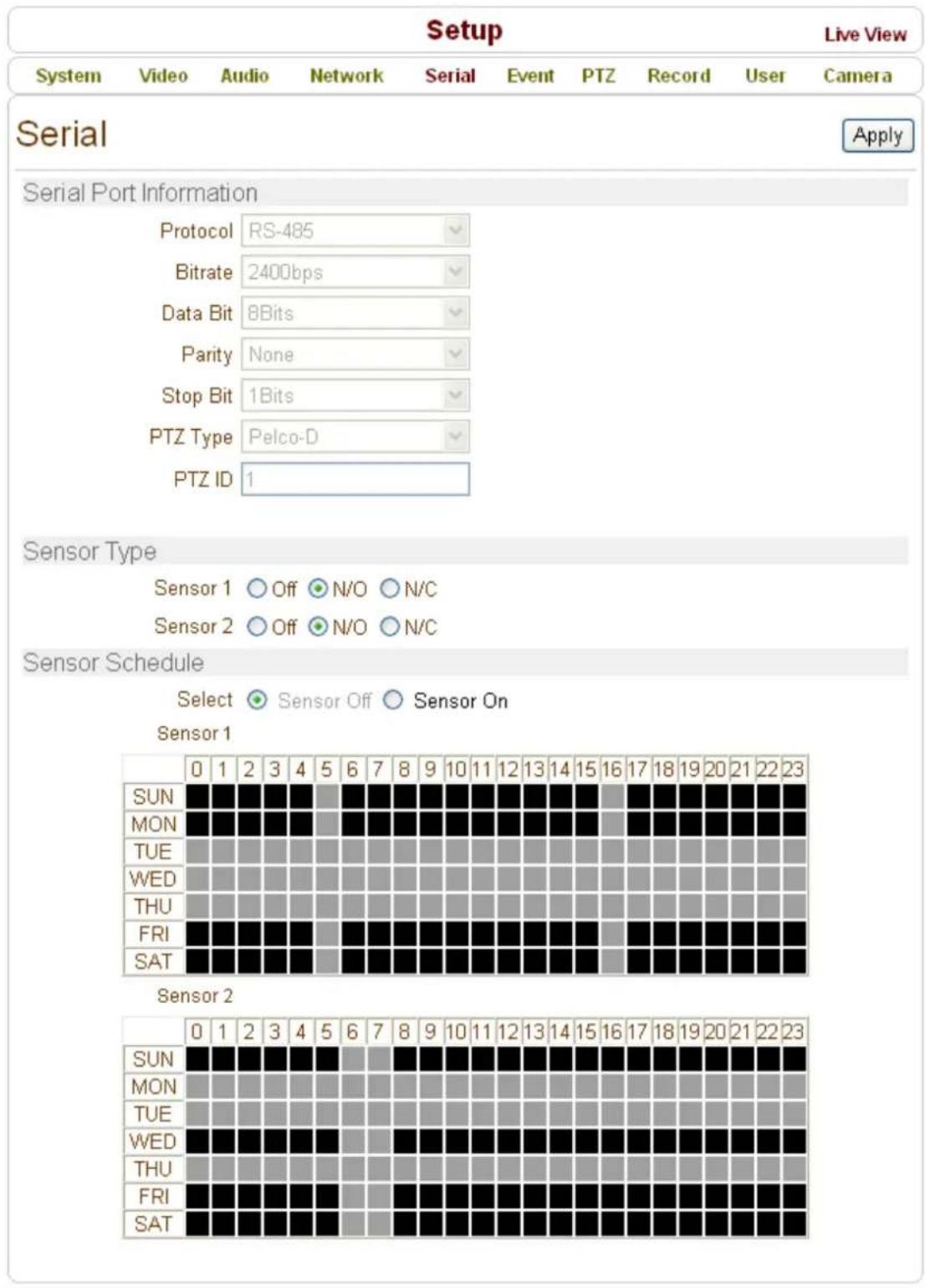
text_image
Setup Live View System Video Audio Network Serial Event PTZ Record User Camera Serial Apply Serial Port Information Protocol RS-485 Bitrate 2400bps Data Bit 8Bits Parity None Stop Bit 1Bits PTZ Type Pelco-D PTZ ID 1 Sensor Type Sensor 1 Off N/O N/C Sensor 2 Off N/O N/C Sensor Schedule Select Sensor Off Sensor On Sensor 1 0 1 2 3 4 5 6 7 8 9 10 11 12 13 14 15 16 17 18 19 20 21 22 23 SUN MON TUE WED THU FRI SAT Sensor 2 0 1 2 3 4 5 6 7 8 9 10 11 12 13 14 15 16 17 18 19 20 21 22 23 SUN MON TUE WED THU FRI SATSerial Port Configuration
- Serial Port Information
RS-485 in VS-570-HDSDI support one RS-485 serial port.
The camera's serial port information is displayed automatically once the camera reboots after the DIP switch setup of the camera.
- PTZ Type & ID: PTZ Type & ID are displayed automatically once the camera reboots after DIP switch setup. The default PTZ Type and ID is Pelco-D and 2400bps.
Sensor Type
- There are two sensor input ports on VS-570-HDSDI. The sensor ports can be configured as follows:
| Function | Operation |
| OFF | Not used |
| NO (Normally Open) | The port is normally open and activated when closed. |
| NC (Normally Closed) | The port is normally closed and activated when opened. |
The function of the sensor port is set based on the type of the sensor connected.
Sensor Schedule
- Choose Sensor OFF or Sensor ON. Click or drag the schedule cells below to set the Sensor Schedule according to the day of the week and hour of the day.
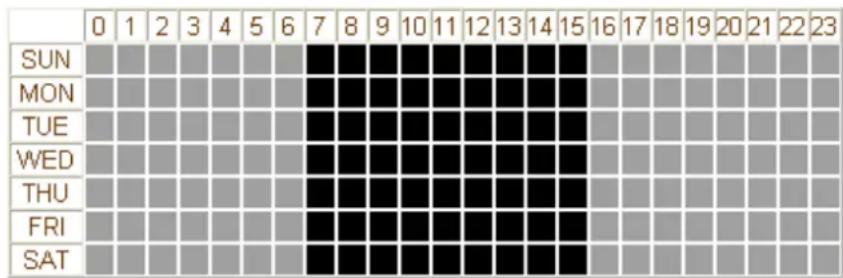
Event Configuration
text_image
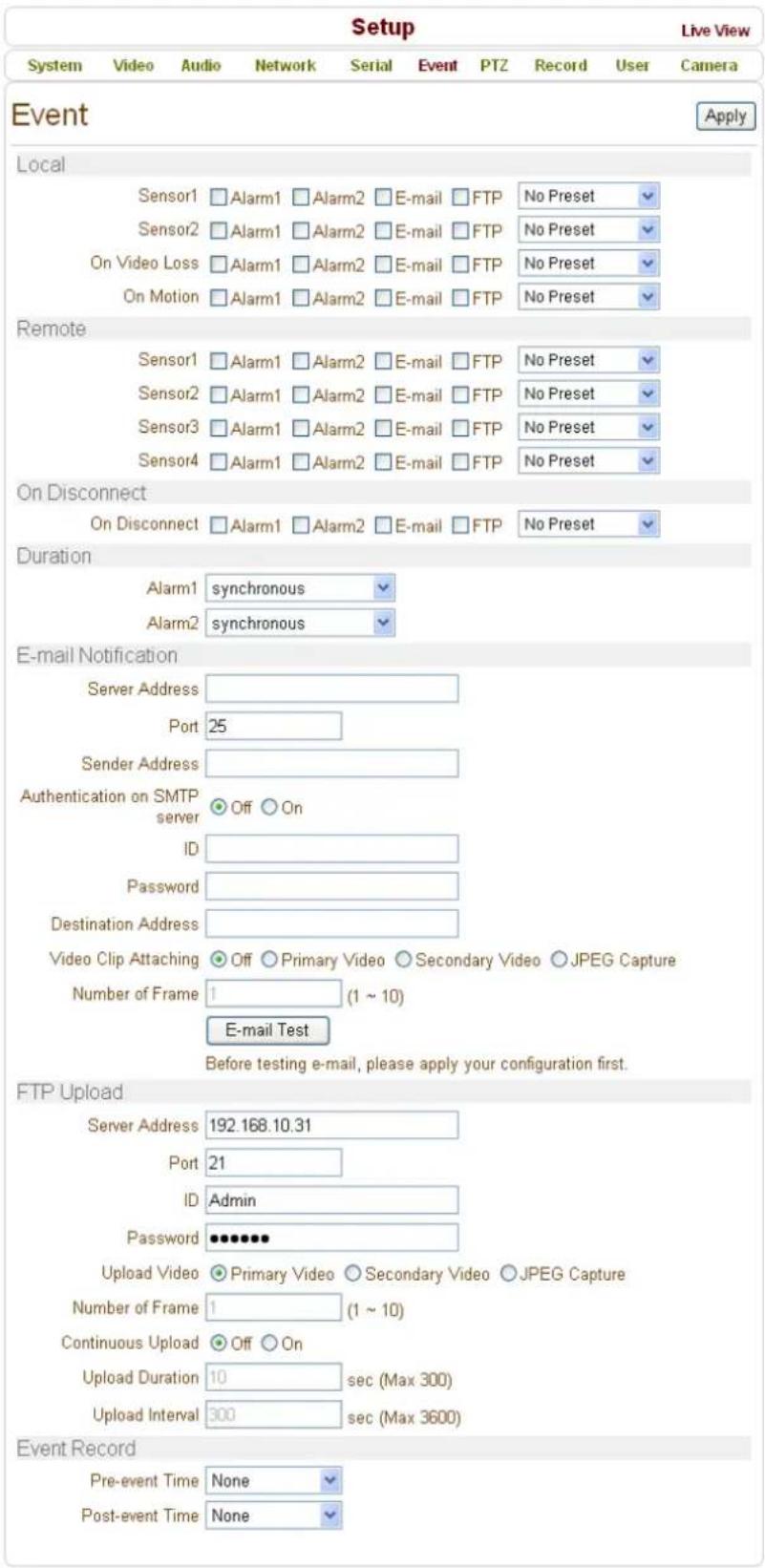
Setup Live View System Video Audio Network Serial Event PTZ Record User Camera Event Apply Local Sensor1 Alarm1 Alarm2 E-mail FTP No Preset Sensor2 Alarm1 Alarm2 E-mail FTP No Preset On Video Loss Alarm1 Alarm2 E-mail FTP No Preset On Motion Alarm1 Alarm2 E-mail FTP No Preset Remote Sensor1 Alarm1 Alarm2 E-mail FTP No Preset Sensor2 Alarm1 Alarm2 E-mail FTP No Preset Sensor3 Alarm1 Alarm2 E-mail FTP No Preset Sensor4 Alarm1 Alarm2 E-mail FTP No Preset On Disconnect On Disconnect Alarm1 Alarm2 E-mail FTP No Preset Duration Alarm1 synchronous Alarm2 synchronous E-mail Notification Server Address Port 25 Sender Address Authentication on SMTP server Off On ID Password Destination Address Video Clip Attaching Off Primary Video Secondary Video JPEG Capture Number of Frame 1 (1 ~ 10) E-mail Test Before testing e-mail, please apply your configuration first. FTP Upload Server Address 192.168.10.31 Port 21 ID Admin Password •••••••• Upload Video Primary Video Secondary Video JPEG Capture Number of Frame 1 (1 ~ 10) Continuous Upload Off On Upload Duration 10 sec (Max 300) Upload Interval 300 sec (Max 3600) Event Record Pre-event Time None Post-event Time NoneThe VS-570-HDSDI has two sensor ports and two alarm ports.
When a decoder instead of a PC client is connected to a VS-570-HDSDI, one system becomes a Local system and the other a Remote system. Generally a system which is being used by the user is called the Local system. Then, actions for events can be configured for events from the remote system as well as for local system. For example, it is possible to turn on an alarm device in local (center) decoder system when a sensor device in remote (site) IP camera is triggered. Local section configures the actions for events from local (self) system, and configuration activates local devices. Remote sections configure the actions for events from the remote (peer) system.
The following table lists the possible actions for events.
| Action | Description |
| Alarm out | Triggers alarm (relay) port. |
| Sends E-mail to the specified address. AVI file can be attached. | |
| FTP | Upload AVI file to a specified FTP server. |
| Preset | Move to the Preset position. |
Local & Remote Event Configuration
- Sensor1 / Sensor2/ Sensor3 / Sensor4.
Configures the actions when the sensor is activated. Multiple actions can be set for a single event.
- On Video Loss
Configures the actions if the video input signal is lost. Multiple actions can be set for a single event.
- On Motion
Configures the actions when motion is detected. Multiple actions can be set for a single event.
- On Disconnect
Configures the actions when the link (connection) with peer system is disconnected. Multiple actions can be set for a single event.
Alarm and Beep activation duration
- Set the duration of alarm or beep activation in case of an event. If it is set to continuous, it will remain in an active state until an operator resets it manually.
E-mail Notification
- Specifies the information required to send event information, when E-mail is selected as an event action.
- Server Address: Enter an address of a mail (SMTP) server.
- Port: Specify a port for SMTP operation. Port 25 is the default port in SMTP operation. If a different port is configured in the SMTP server, this port needs to be changed accordingly.
- Sender Address: Enter an account registered in the SMTP server.
- ID & password: When the server requires authentication, ID and Password of an E-mail account need to be entered.
- Destination address: Enter the Destination address. More than one address can be entered by delimiting comma (,) or semi-colon (;). the Destination address can take up to 63 characters.
- Video Clip Attaching: Video clips stored at the moment of an event can be attached as an AVI or JPEG file format. If using dual Encoding, Primary video or Secondary video (H.264 only) can be selected.
FTP Upload
- Specifies the information to upload event information, when FTP is selected as an event action.
- Server Address: Enter an address of an FTP server to receive video files.
- Port: Specify a port for FTP operation. Port 21 is the default port in FTP operation. If a different port is configured in the FTP server, this port needs to be changed accordingly.
- ID & password: Enter ID and Password for accessing the FTP server.
- Upload video: Primary video and Secondary video (H.264 only), JPEG can be selected as an upload method.
- Number of Frame: Enter frame number of JPEG Capture (from 1 to 10)
- Continuous upload: Continuous upload "on" allows the video image to be transmitted regularly, regardless of the occurrence of events.
- Upload duration: Specify recording duration of a video clip to be transmitted. (Max 300 sec).
- Upload interval: Specify transmission interval. (Max 3600 sec).
Recording duration is not included in the transmission interval. For example, if Upload interval is 60 seconds and Upload duration is 20 seconds, a Video clip of 20 seconds is transmitted every 80 seconds.
Event Record
- Specify the duration of recorded video generated by events to send through E-mail or upload through FTP.
- Pre-event Time: Specify the duration of the recording before an event happens.
- Post-event Time: Specify the duration after the event is cleared.
Max duration is 30 seconds.
PTZ Configuration
text_image
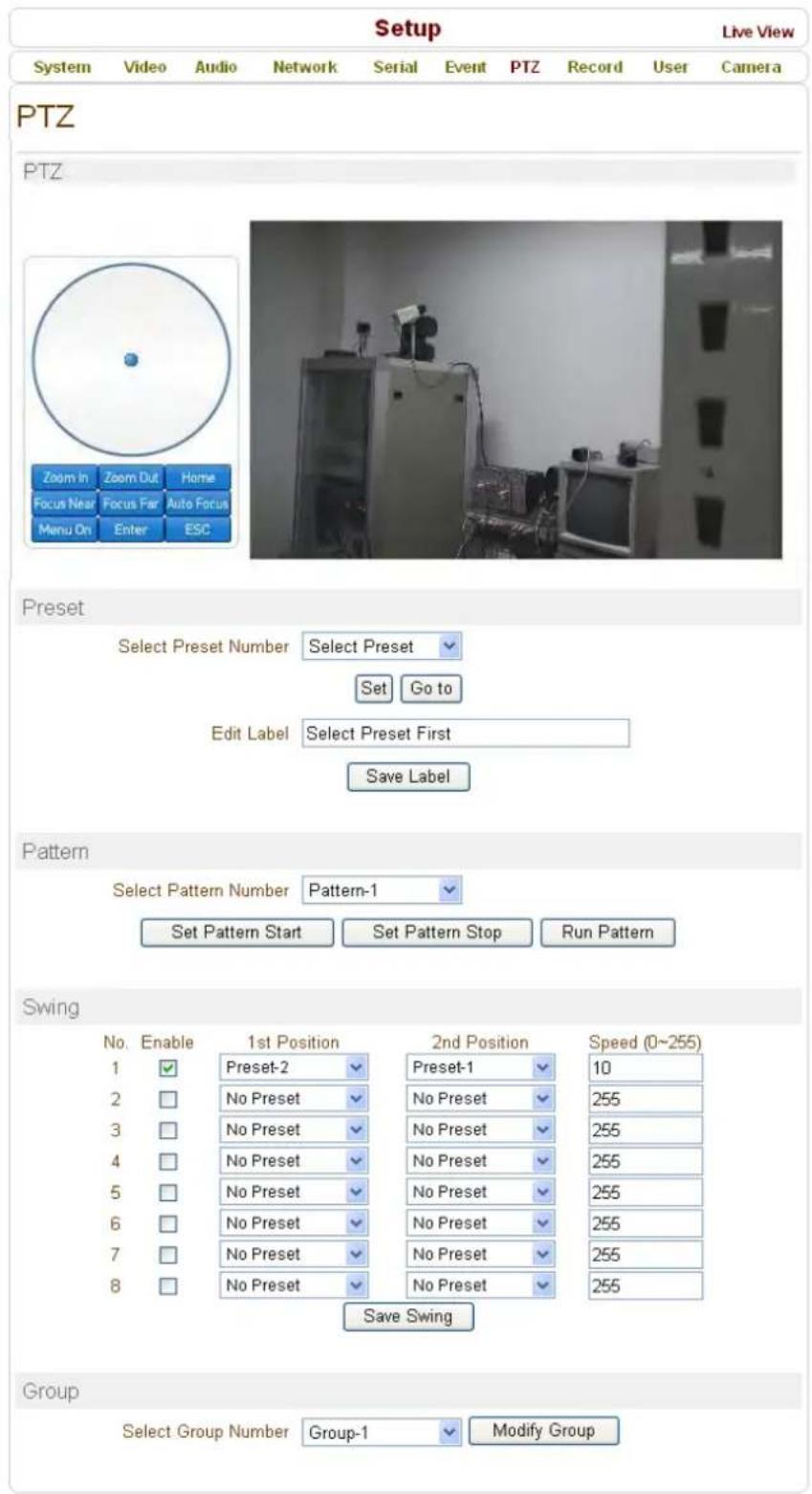
Setup Live View System Video Audio Network Serial Event PTZ Record User Camera PTZ PTZ Zoom In Zoom Out Home Focus Near Focus Far Auto Focus Menu On Enter ESC Preset Select Preset Number Select Preset Set Go to Edit Label Select Preset First Save Label Pattern Select Pattern Number Pattern-1 Set Pattern Start Set Pattern Stop Run Pattern Swing No. Enable 1st Position 2nd Position Speed (0~255) 1 Preset-2 Preset-1 10 2 No Preset No Preset 255 3 No Preset No Preset 255 4 No Preset No Preset 255 5 No Preset No Preset 255 6 No Preset No Preset 255 7 No Preset No Preset 255 8 No Preset No Preset 255 Save Swing Group Select Group Number Group-1 Modify GroupPTZ
● Control PTZ using the PTZ controller
Preset
● A Maximum 128 positions can be stored as Preset positions.
- Move the position to be set.
- Select one of the entries of Preset from the list.
- Press Set button.
- Enter the preset name to be used and press Save Label button.
- Press Go to button to move to the present position.
Pattern
- Pattern Function is that a camera memorizes the path (mostly curve path) by joystick of controller for assigned time and revives the path exactly as it memorized. 4 Patterns are available and Maximum 760 communication commands can be stored in a pattern.
- Select one of the entries of Pattern from the list.
- Press Set Pattern Start button. Create the Pattern by using the PTZ controls. Every move will be saved until pressing the Set Pattern Stop button.
- Press Set Pattern Stop button to save the pattern.
- Press Run Pattern button to playback the selected pattern.
Note that when the system memorizes patterns, the commands are stored in the internal memory not the in the Pan/Tilt/Zoom positions. Hence there might be small differences between the original path and the replayed path by path patterns. Note that it is not a problem in position precision.
Swing
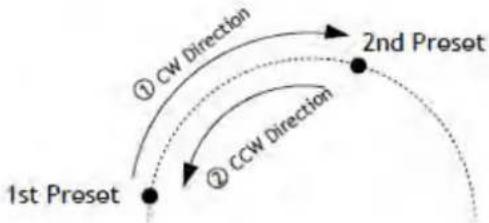
- By using Swing function, you can make camera to move between 2 Preset positions repeatedly. When swing function runs, camera moves from the preset assigned as the 1st point to the preset assigned as the 2nd point in CW(Clockwise) direction. Then camera moves from the preset assigned as the 2nd point to the preset assigned as the 1st point in CCW(Counterclockwise) direction.
flowchart
graph TD
    A["1st Preset"] -->|① CW Direction| B["2nd Preset"]
    B -->|② CCW Direction| A
    style A fill:#000,stroke:#000,color:#fff
    style B fill:#fff,stroke:#000,color:#fff
    style A fill:#000,stroke:#000,color:#fff
    style B fill:#fff,stroke:#000,color:#fff
In case that the preset assigned as the 1st point is same as the preset assigned as the 2nd point, camera turns on its axis by 360^ in CW(Clockwise) direction and then it turns on its axis by 360^ in CCW(Counterclockwise) direction
- Check Enable box
- Select the Preset for 1st Position and 2nd Position
- Enter the Speed (0\~255)
- Press Save Swing button to save the Swing
Group
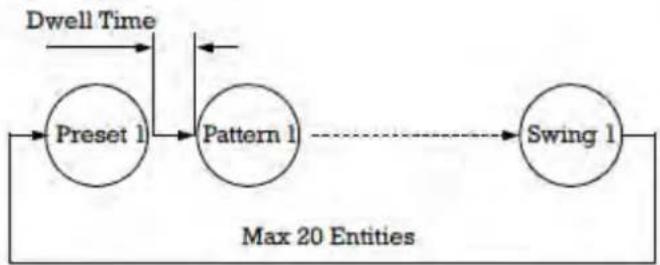
- This function allows the camera to memorize a combination of Presets, Patterns and/or Swings as a Group which can be sequentially run repetitively. A Maximum of 8 sets of Group are available to program. Each group can have maximum of 20 actions which are the combination of Presets, Patterns and Swings. Preset speed and the repeat number of Pattern & Swing can be set using the Option entry. Dwell time between actions can be set up as well.
flowchart
graph LR
    A["Preset 1"] --> B["Pattern 1"]
    B --> C["Swing 1"]
    D["Dwell Time"] --> A
    style A fill:#fff,stroke:#000
    style B fill:#fff,stroke:#000
    style C fill:#fff,stroke:#000
    note right of B "Max 20 Entities"
- Select one of the Group entries.
- Press Modify Group button. The following window will appear.
- Set the Action (Preset or Swing or Pattern), Dwell Time and Option and check the Enable boxes.
- Press Apply button. The Group can then be used on the Live View Page.
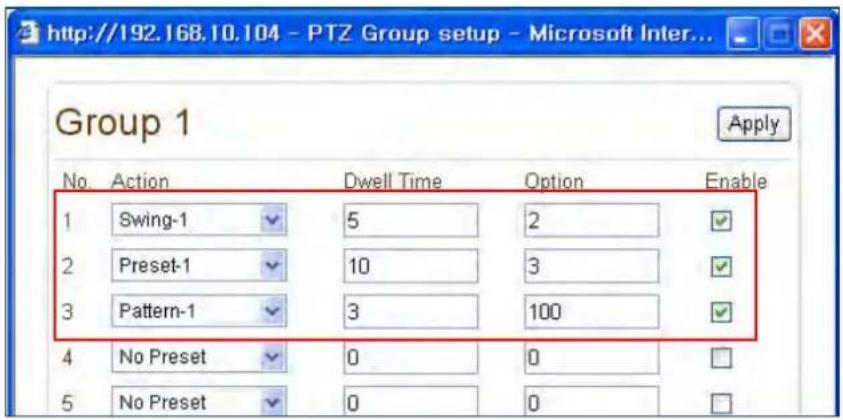
text_image
http://192.168.10.104 - PTZ Group setup - Microsoft Inter... Group 1 Apply No. Action Dwell Time Option Enable 1 Swing-1 5 2 2 Preset-1 10 3 3 Pattern-1 3 100 4 No Preset 0 0 5 No Preset 0 0Ex) Group-1
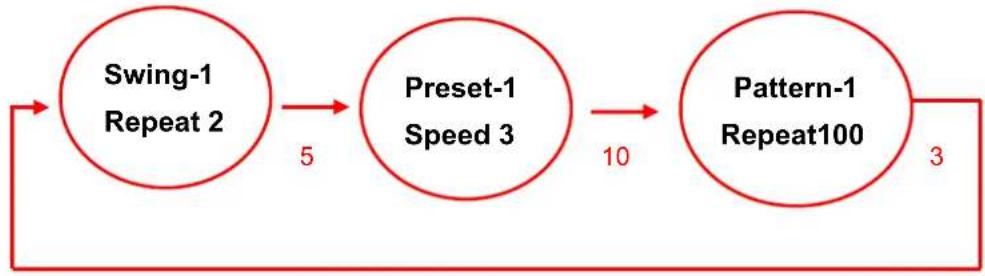
flowchart
graph LR
    A["Swing-1 Repeat 2"] -->|5| B["Preset-1 Speed 3"]
    B -->|10| C["Pattern-1 Repeat100"]
    C -->|3| D
Live View Page
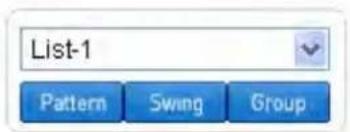
text_image
List-1 Pattern Swing GroupSelect List-1 and Press Group to playback the Group-1 program.
Record Configuration
This page is not available from the VS-570-HDSDI
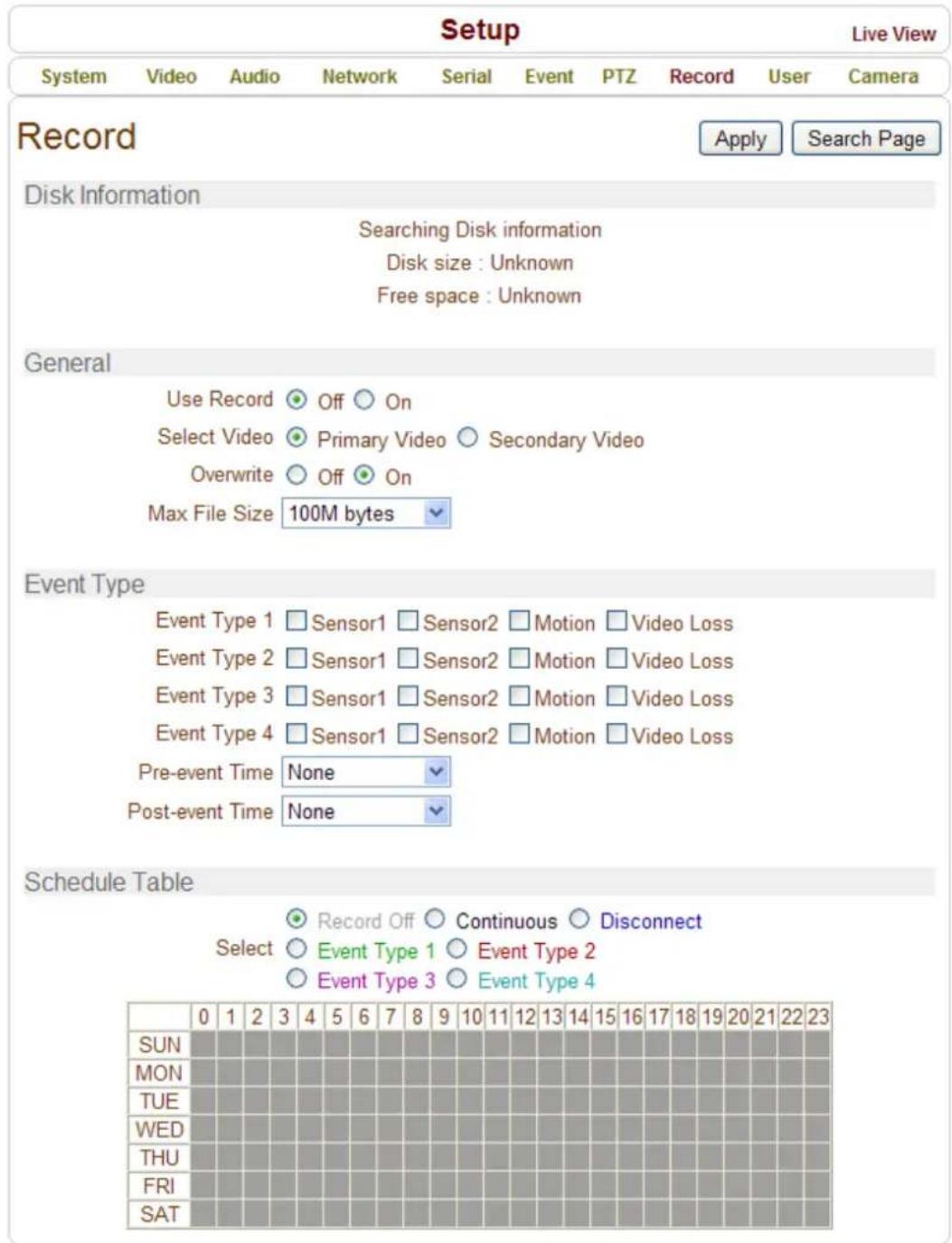
text_image
Setup Live View System Video Audio Network Serial Event PTZ Record User Camera Record Apply Search Page Disk Information Searching Disk information Disk size : Unknown Free space : Unknown General Use Record Off On Select Video Primary Video Secondary Video Overwrite Off On Max File Size 100M bytes Event Type Event Type 1 Sensor1 Sensor2 Motion Video Loss Event Type 2 Sensor1 Sensor2 Motion Video Loss Event Type 3 Sensor1 Sensor2 Motion Video Loss Event Type 4 Sensor1 Sensor2 Motion Video Loss Pre-event Time None Post-event Time None Schedule Table Record Off Continuous Disconnect Select Event Type 1 Event Type 2 Event Type 3 Event Type 4 0 1 2 3 4 5 6 7 8 9 10 11 12 13 14 15 16 17 18 19 20 21 22 23 SUN MON TUE WED THU FRI SAT- When using the VS-570-HDSDI the Record page is not available.
User Configuration
text_image
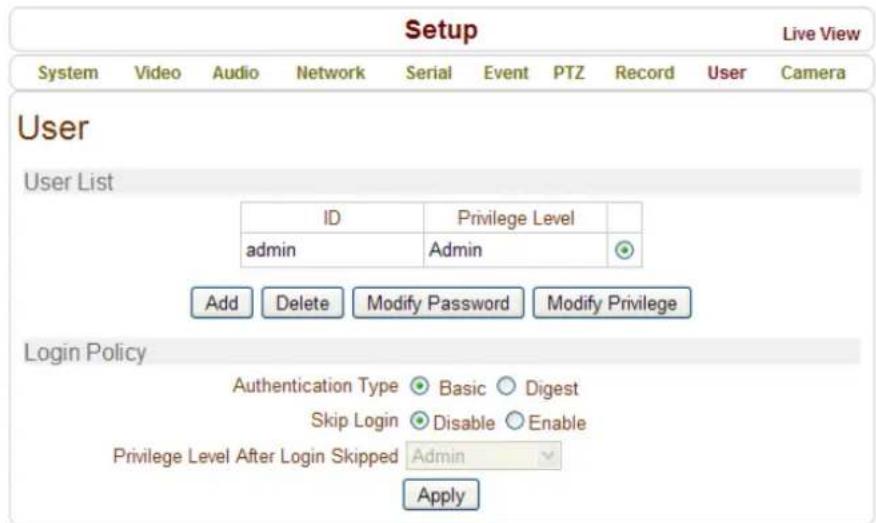
Setup Live View System Video Audio Network Serial Event PTZ Record User Camera User User List ID Privilege Level admin Admin Add Delete Modify Password Modify Privilege Login Policy Authentication Type Basic Digest Skip Login Disable Enable Privilege Level After Login Skipped Admin ApplyUser List
- Users can be registered and the privilege level of each user can be specified. User configuration is allowed only by the Admin user. A maximum of 16 users can be registered and each user can have one of four privileges:
| Privilege | Allowed Operations | Remarks |
| Admin | All operations | User ID = admin |
| Manager | All operations except for user configuration | |
| User | Live viewing and PTZ control | |
| Guest | Live viewing only |
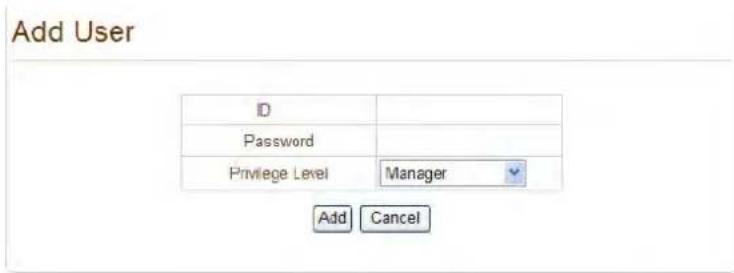
- Add User
Press the Add button. The following window will appear:
text_image
Add User ID Password Privilege Level Manager Add CancelEnter the User ID and password (up to 15 characters) and select the allowed Privilege Level
- Delete User
Select the User to be deleted and press the Delete button.
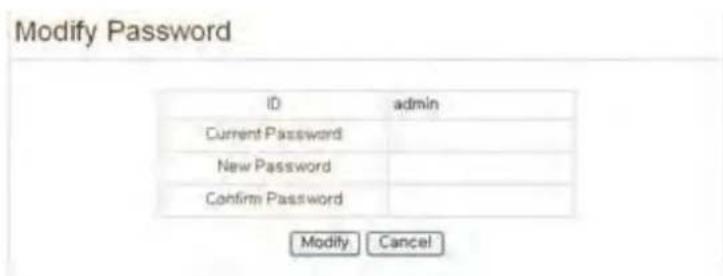
- Change Password
Press Modify Password button. The following window will appear:
text_image
Modify Password ID admin Current Password New Password Confirm Password Modify CancelEnter the current password and then set a new password.
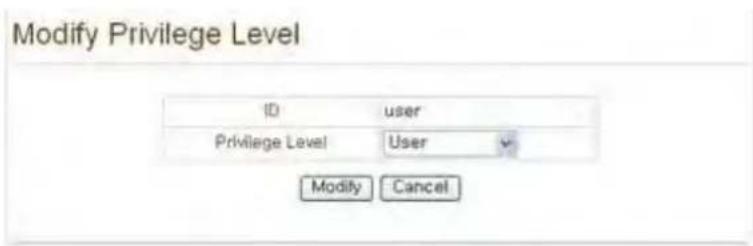
- Modify Privilege Level
Press the Modify Privilege button to change the User privilege level. It is not allowed to change the privilege level of the admin user.
text_image
Modify Privilege Level ID user Privilege Level User Modify CancelLogin Policy
- Authentication Type
For user login, the following access algorithms can be selected: Basic or Digest.
HTTP authentication based on RFC 2617 (HTTP Authentication: Basic and Digest Access Authentication) is supported.
- Skip Login provides for convenient access to the server when authentication is not required. When Skip Login is set to Enable, the login step is skipped. The privilege level in force after login skip is used will be determined by the setting of Privilege Level After Login Skipped.
Camera Configuration
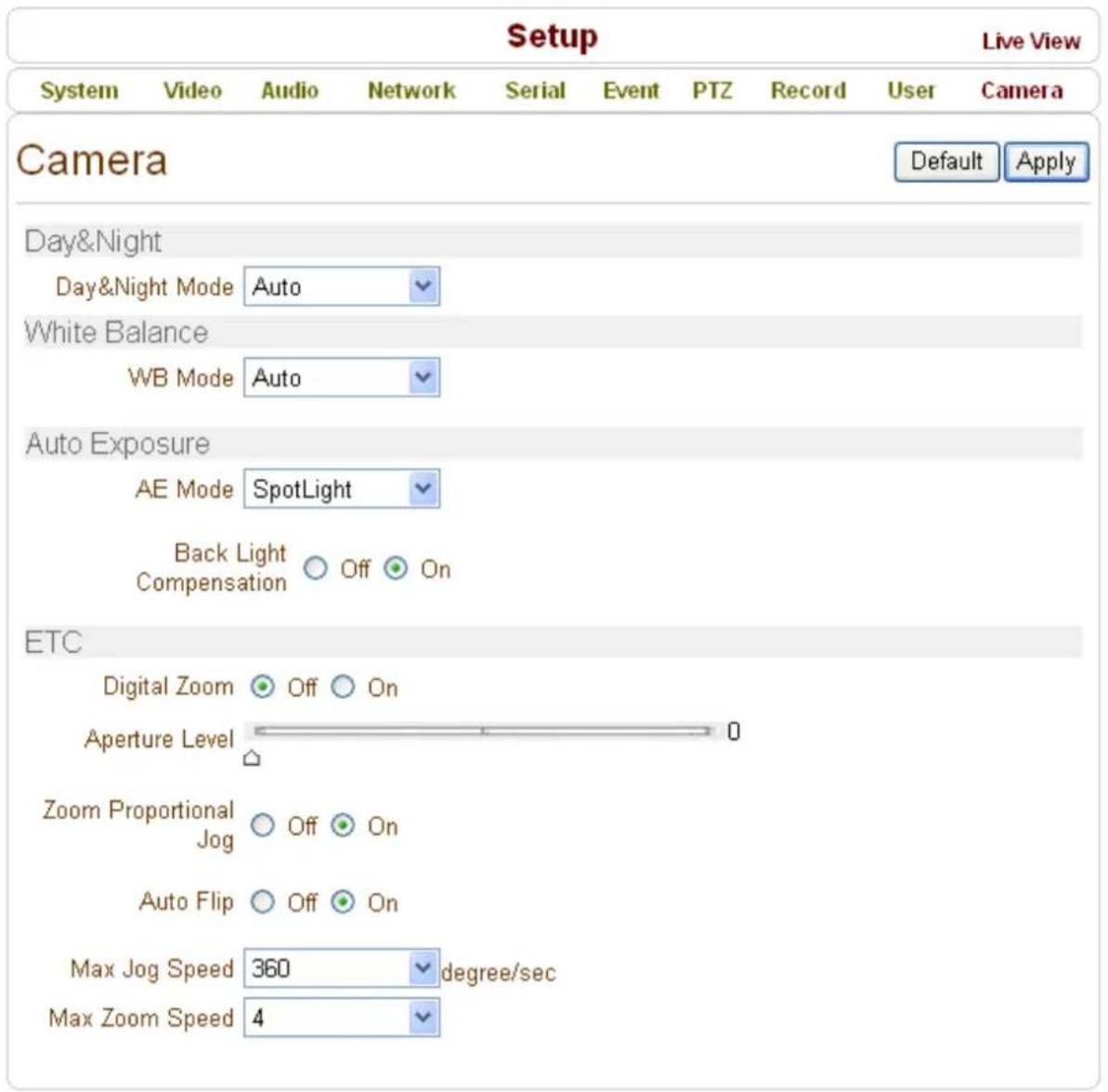
text_image
Setup Live View System Video Audio Network Serial Event PTZ Record User Camera Camera Default Apply Day&Night Day&Night Mode Auto White Balance WB Mode Auto Auto Exposure AE Mode SpotLight Back Light Off On Compensation ETC Digital Zoom Off On Aperture Level 0 Zoom Proportional Jog Off On Auto Flip Off On Max Jog Speed 360 degree/sec Max Zoom Speed 4Day & Night
-
The camera delivers color images during the day. As light diminishes below a certain level, the camera can automatically switch to night mode (Black & White mode) to maintain good image quality.
● Day & Night function can be selectable according to the environment. -
Auto : Automatically switches to Day (Color) or Night (B&W) according to light using ICR (Infrared Cut filter Removable).
- Day (Color): Delivers a color image regardless of light.
- Night (B/W): Delivers a B/W image regardless of light.
White Balance
● White Balance has the following modes:
- Auto: This mode computes the white balance value output using color information from the entire screen. It outputs the proper value using the color temperature radiating from a black subject based on a range of values from 3000 to 7500K
- Manual: Manual allows control of R and B gain, 256 steps each.
Auto Exposure
- AE Mode
- Full Auto: Auto Iris and Gain, Fixed Shutter Speed (59.94/NTSC:1/60 sec, 50/PAL: 1/50 sec) DSS (Digital Shutter Speed) mode (Auto or Off) can be selected. When DSS mode is Auto, from 1/2 to 1/60 DSS Limit is available. Back Light Compensation can be selected.
- Manual: 21 steps of Shutter, 18 steps of Iris and 8 steps of Gain can be set manually.
- Shutter Priority: 21 steps (1/2 \~ 1/10,000) of Shutter Speed can be set manually. The Iris and Gain are set automatically according to the brightness of the subject.
- Iris Priority: 18 steps (F1.8 to Close) of Iris can be set manually. The Shutter Speed and Gain are set automatically, according to the brightness of the subject.
- Bright: The bright control function adjusts both the Gain and Iris using an internal algorithm according to a brightness level set by the user. Exposure is controlled by Gain when dark and by Iris when bright. As both Gain and Iris are fixed, this mode is used when exposing at a fixed camera sensitivity.
- Spot Light: Avoids a situation where the face of the subject is over-illuminated, and becomes washed out. In Spot AE, a particular section of the subject can be designated, and then that portion of the image can be weighted and a value computed so that the Iris and Gain can be optimized to obtain an image.
ETC
- Digital Zoom
Determine the Digital zoom (12x) supported by the camera zoon lens.
x10 Optical zoom and x12 Digital zoom lens (f=5.1 \~ 5.1mm) is built-in VS-570-HDSDI.
- Aperture Level
Set Aperture Level from 0 to 15.
Aperture control is a function which adjusts the enhancement of the edges of objects in the picture. There are 16 levels of adjustment, starting from “no enhancement.” When shooting text, this control may help by making the text sharper.
- Zoom Proportional Jog
When Zoom proportional Jog is ON, the Pan/Tilt speed will be set automatically after Zoom in (x10)
- Auto Flip
- ON: If the tilt angle arrives at the top of the tilt orbit(90°), the zoom module camera turns on its axis by 180° at the top of tilt orbit and moves to the opposite tilt direction (180°) to keep tracing targets.
- Off: More than 90° tilt moving is not available
- Max Jog Speed
Adjust the Max Pan Speed (8 Steps)
- Max Zoom Speed
Adjust the Max Zoom Speed (8 Steps)