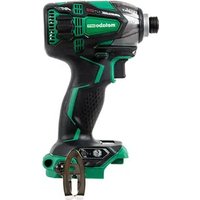
USER MANUAL BS 18 LI 18V METABO
18 V...1,5 Ah ...6.25499 ... Li-Power Compact
18 V...3,0 Ah ...6.25455 ... Li-Power Extreme
18 V...4,0 Ah ...6.25527 ... Li-Power Extreme


6.
B


7.1
C


7.2
D
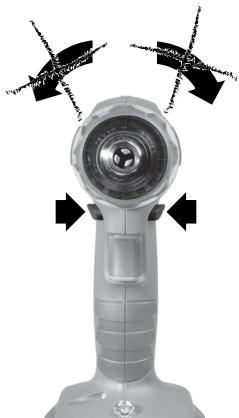
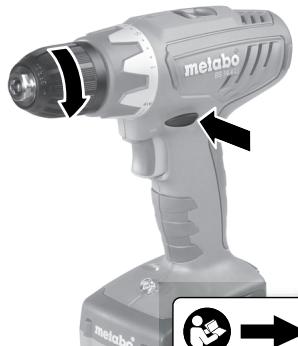


7.3
E
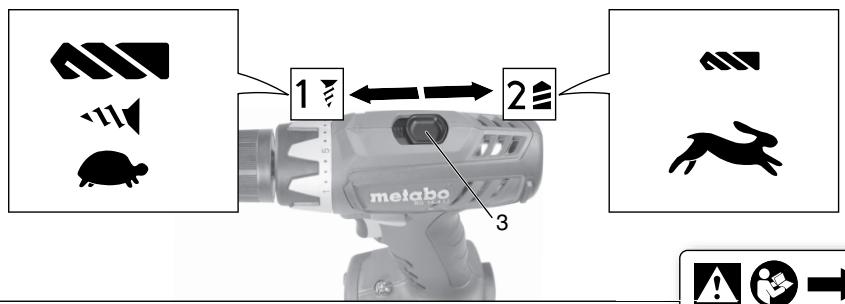


7.4
F
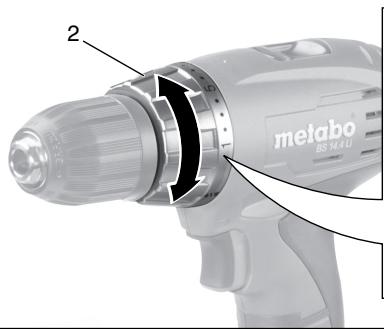
1... = Nm...Nm
= . N m

(SB 18 Li)
SB...


7.5
G


7.7
H





7.8
| 12. | BS 14.4 Li | BS 18 Li | SB 18 Li |
| U | V | 14,4 | 18 | 18 |
| n0 | /min, rpm | 1 | 0 - 450 | 0 - 450 | 0 - 450 |
| 2 | 0 - 1600 | 0 - 1650 | 0 - 1650 |
| M1 | Nm (in-lbs) | 20 (177) | 24 (212) | 24 (212) |
| M3 | Nm (in-lbs) | 40 (354) | 48 (424.8) | 48 (424.8) |
| M4 | Nm (in-lbs) | 1 | 0,7 - 4,9 (6.2 - 43) | 0,8 - 4,8 (7 - 42) | 1,2-6,5(10.6-57.5) |
| D1 max I | mm (in) | 1 | 10 (3/8) | 10 (3/8) | 10 (3/8) |
| 2 | 5 (3/16) | 5 (3/16) | 5 (3/16) |
| D2 max II | mm (in) | 1 | 20 (3/4) | 20 (3/4) | 20 (3/4) |
| 2 | 16 (5/8) | 16 (5/8) | 16 (5/8) |
| D3 max | mm (in) | 2 | - | - | 10 (3/8) |
| s | /min, bpm | - | - | 25800 |
| m | kg (lbs) | 1,4 (3.1) | 1,5 (3.3) | 1,8 (4) |
| G | UNF(in) | 1/2“ - 20 UNF | 1/2“ - 20 UNF | 1/2“ - 20 UNF |
| Dmax | mm (in) | 10 (3/8) | 10 (3/8) | 13 (1/2) |
| ah, ID/Kh, ID | m/s2 | - | - | 16 / 1,5 |
| ah, D/Kh, D | m/s2 | < 2,5 / 1,5 | < 2,5 / 1,5 | 2,5 / 1,5 |
| ah, S/Kh, S | m/s2 | < 2,5 / 1,5 | < 2,5 / 1,5 | 2,5 / 2,5 |
| LpA/KpA | dB(A) | 73 / 3 | 73 / 3 | 89 / 3 |
| LWA/KWA | dB(A) | - | - | 100 / 3 |


J

EN 60745
2006/42/EG, 2004/108/EG, 2011/65/EU
2012-02-14
Volker Siegle
Director Product Engineering & Quality
Responsible Person for Documentation
D2max = in Weichholz
D3max in Beton
s = max.Schlagzahl
Original instructions
We, being solely responsible, hereby declare that this product conforms to the specified standards and directives. Fig.J
2. Specified Use
The drills and impact drills are suitable for drilling in metal, wood, plastic and similar materials, and also for screwdriving and thread tapping.
The impact drills are also suited for drilling in masonry, brickwork and stone.
The user bears sole responsibility for any damage caused by improper use.
Generally accepted accident prevention regulations and the enclosed safety information must be observed.
3. General Safety Instructions

For your own protection and for the protection of your electrical tool, pay attention to all parts of the text that are marked with this symbol!
WARNING - Reading the operating instructions will reduce the risk of injury.

WARNING Read all safety warnings and instructions. Failure to follow all safety warn-and instructions may result in electric shock, nd/or serious injury.
Keep all safety instructions and information for future reference.
Pass on your electrical tool only together with these documents.
4. Special Safety Instructions
Wear ear protectors with impact drills (machines with the designation SB). Exposure to noise can cause hearing loss.
Hold tool by insulated gripping surfaces, when performing an operation where the cutting accessory may contact hidden wiring. Cutting accessory contacting a "live" wire may make exposed metal parts of the electrical tool "live" and could give the operator an electric shock.
Ensure that the spot where you wish to work is free of power cables, gas lines or water pipes (e.g. using a metal detector).

Protect battery packs from water and moisture!
Do not expose battery packs to naked flame!
Do not touch or short-circuit battery packs!

Slightly acidic, flammable fluid may leak from defective li-ion battery packs!

If battery fluid leaks out and comes into contact with your skin, rinse immediately with plenty of water. If battery fluid leaks out
and comes into contact with your eyes, wash them with clean water and seek medical attention immediately.
Remove the battery pack from the machine before any adjustments, conversions or servicing are performed.
Before fitting the battery pack, make sure that the machine is switched off.
Dust from material such as paint containing lead, some wood species, minerals and metal may be harmful. Contact with or inhalation of the dust may cause allergic reactions and/or respiratory diseases to the operator or bystanders.
Certain kinds of dust are classified as carcinogenic such as oak and beech dust especially in conjunction with additives for wood conditioning (chromate, wood preservative). Material containing asbestos must only be treated by specialists.
-
Where the use of a dust extraction device is possible it shall be used.
-
The work place must be well ventilated.
-
The use of a dust mask of filter class P2 is recommended.
Follow national requirements for the materials you want to work with.
Secure the workpiece against slipping, e.g. with the help of clamping devices.
LED (9): Do not view LEDs directly through optical instruments, LED class 1M, classified as per DIN EN 60825-1: 2003, wavelength: 400-700 nm; 300~ s .
Illustrations are provided at the beginning of the operating instructions.
Symbol explanation:

Movement direction

Slow

Fast

First gear

Second gear

Screws

Without torque limitation

Impact drilling
Nm
Torque
Do not use faulty or deformed battery packs!
Do not open battery packs!
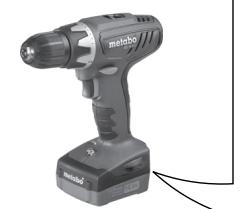
6. Overview

Fig. A
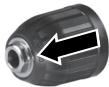
1 Keyless chuck
2 Sleeve (torque, drilling, impact drilling)*
3 Switch (1st/2nd gear)
4 Rotation selector switch (rotation setting, transport lock) - both sides of the machine
5 Battery pack release button
6 Capacity indicator button
7 Capacity and signal indicator
8 Battery pack
9 LED lights
10 Ttrigger
*equipment-specific
7. Use
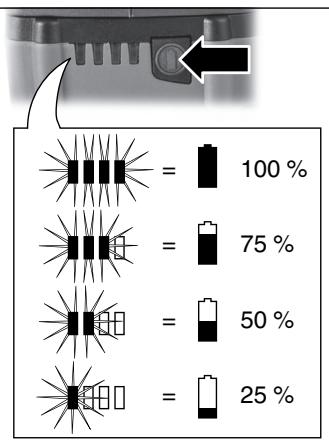
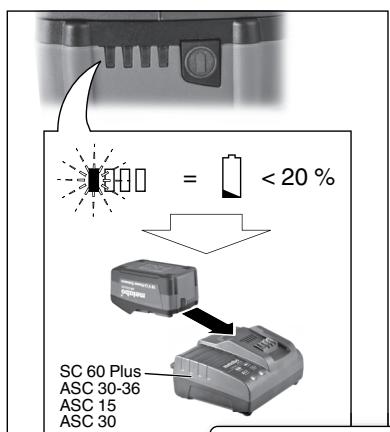
7.1 Battery pack, capacity and signal display Fig.B
Charge the battery pack before use.
If performance diminishes, recharge the battery pack.
The ideal storage temperature is between 10^ and 30^ .
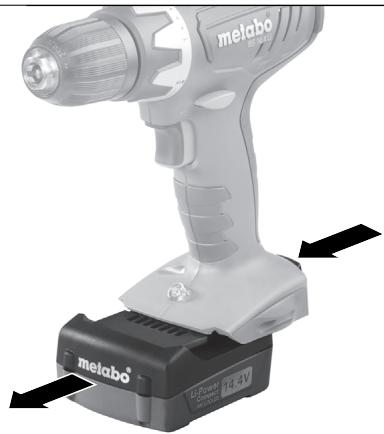
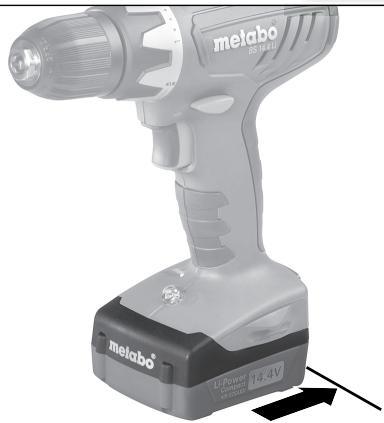
7.2 Removing, replacing battery pack Fig.C
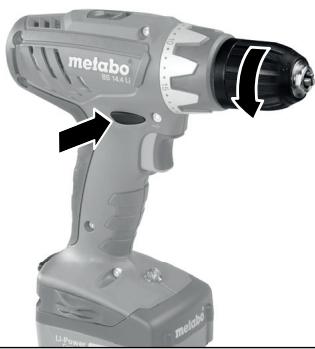
7.3 Setting direction of rotation, transporting safety device (switch-on lock) Fig. D
7.4 Selecting gear stage Fig. E

Do not set the switch (3) unless the motor has stopped completely!
7.5 Setting torque limitation, drilling, impact drilling Fig. F
7.6 Switching on/off, setting speed Fig.A
Switching on, speed: press the trigger (10). The speed can be changed by pressing in the trigger.
Switching off: release the trigger (10). Note: The noise that the machine makes when it switches off is due to the design (quick stop) and has no influence on the function or the service life of the machine.
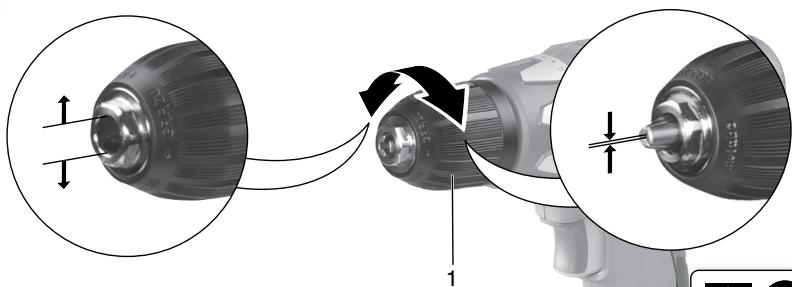
7.7 Keyless chuck Fig. G
With a soft tool shank, retightening may be required after a short period of operation.
Notes on machines with the designation SB...
- The ratchet sound which can possibly be heard after opening the drill chuck is functional and is switched off by a reverse rotation of the sleeve.
Turn sleeve (1) in direction "GRIP, ZU" until the noticeable mechanical resistance has been
overcome.
Caution! The chuck is not yet fully tightened! Keep turning the sleeve (it must "click" when turning)) until it cannot be turned any further - only now is the tool safely clamped.
Cleaning: From time to time, hold the machine vertically with the keyless chuck facing downwards and turn the sleeve fully in direction "GRIP, ZU" and then turn fully in direction "AUF, RELEASE". The dust collected falls from the keyless chuck.
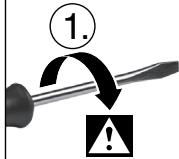
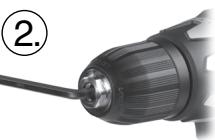
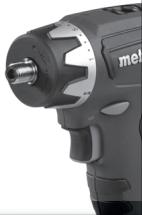
7.8 Unscrewing chuck Fig. H
Employ the same procedure when attaching the chuck, except in reverse order.
8. Troubleshooting
8.1 The machine's multifunctional monitoring system
If the machine switches off automatically, the machine electronics have activated automatic protection mode. A warning signal sounds (continuous beeping). The beeping stops after a maximum of 30 seconds or when the trigger (10) is released.
Causes and remedies:
- Battery pack almost empty Fig. A, B (The electronics protect the battery pack against damage through total discharge).
If one LED is flashing (7), the battery pack is almost flat. If necessary, press the (6) button and check the LEDs (7) to see the charge level. If the battery pack is almost flat, it must be recharged.
- Long continuous overloading of the machine will activate the temperature cut-out.
Leave the machine or battery pack to cool.
Note: If the battery pack feels very warm, the pack will cool more quickly in your "AIR COOLED" charger.
Note: The machine will cool more quickly if you operate it at idling speed.
- If the current is too high (for example, if the machine seizes continuously for long periods), the machine switches off.
Switch off the machine at the trigger (10). Then continue working as normal. Try to prevent the machine from seizing.
9. Accessories
Use only genuine Metabo accessories.
For a complete range of accessories, see www.metabo.com or the main catalogue.
10. Repairs

Repairs to electrical tools must be carried out by qualified electricians ONLY!
If you have Metabo electrical tools that require repairs, please contact your Metabo service centre. For addresses see www.metabo.com.
You can download spare parts lists from www.metabo.com.
11. Environmental Protection
Observe national regulations on environmentally compatible disposal and on the recycling of disused machines, packaging and accessories.
Battery packs must not be disposed of with regular waste. Return faulty or used battery packs to your Metabo dealer!
Do not allow battery packs to come into contact with water!
Only for EU countries: Never dispose of power tools in your household waste! In accordance with European Guideline 2002/96/EC on used electronic and electric equipment and its implementation in national legal systems, used power tools must be collected separately and handed in for environmentally compatible recycling. Before disposal, discharge the battery pack in the power tool. Prevent the contacts from short-circuiting (e.g. by protecting them with adhesive tape).
12. Technical Specifications
Fig. 1. We reserve the right to make technical improvements.
U = Voltage of battery pack
No-load speed
Tightening torque for screwing:
M1 = Soft screwing application (wood)
M_3 = Hard screwing application (metal)
M4 = Adjustable torque
Max. drill diameter:
D1max = in steel
Dmax in softwood
D3max = in concrete
s = Max.impact rate
m = Weight (with smallest battery pack)
G = Spindle thread
D max = Chuck clamping range
Vibration total value (vector sum of three directions) determined in accordance with EN 60745:
a_h, ID = Vibration emission value (impact drilling into concrete)
a_h,D = Vibration emission value (drilling into metal)
a_h,S = Vibration emission level (screwing without impact)
K_h, = Uncertainty (vibration)
The vibration emission level given in this information sheet has been measured in accordance with a standardised test given in EN 60745 and may be used to compare one tool with another. It is also suitable for a provisional estimate of the vibratory load.
The specified vibration level applies to the main applications of the power tool. However, if the tool is used for other applications, with different accessories or is poorly maintained, the vibration level may
vary. This can considerably increase the vibratory load over the entire working period.
An estimation of the level of exposure to vibration should also take into account the times when the tool is switched off or when it is running but not actually doing the job. This can considerably reduce the vibratory load over the entire working period.
Identify additional safety measures to protect the operator from the effects of vibration such as: maintain the tool and the accessories, keep the hands warm, organisation of work patterns.
A-effective perceived sound levels:
L_pA =Sound pressure level
LWA = Acoustic power level
K_pA^W K_WA = Uncertainty (noise level)
During operation the noise level can exceed 80 dB(A).

Wear ear protectors!
Measured values determined in conformity with EN 60745.
The technical specifications quoted are subject to tolerances (in compliance with the relevant valid standards).
Notice originale
a_h,D = trillingsemissiewaarde (boren in metaal)
Reservedelsestiner kan downloads paa www.metabo.com.
a_h, ID = Vibrationsemission (slagboring i beton)
a_h,D = Vibrationsemission (boring i metal)
a_h,S = Vibrationsemission (skruning uden slag)
K_h, = Usikkerhed(vibration)
PTEyPENEXHEH! BueJX CnHexHnI pyNCKa TpaBmnpoBaHnI pOuyTHepyKOBODCTBO NO 3KcNlyaTaun.

IPEyPENEXHEHNE!IpoTuTe Bce HNCTpyKUm yka3aHaNo TeXnHe
6e30nachoctn. HebblonHeHne HNCTpyKu n yHa3aHn IIO TeXHHe 6e30nachctoM MoKeT npINBcHcN K IopApHeHNO 3JIeKTPNuEeCKHM TOKOM, BO3rOpAHNo M/NI K N OJUYeHnO TJAKeJIbIX TpaBM.
CoXpaHnTe Bce HNCTpyKuM N yHa3aHmN IO texHnke 6e3oNaCHocTH dIa 6yduzero Blaedbca HacadH.
IpeedabaiTe 3JeKToHnCTpyMeHT cJeDyoUeMy BlaedeBtu TObko BMcTe C 3TmN DOKyMeHtAmN.
4. CneuHaBhIe yka3aHnna no TexHHne 6e3OnaChOCTn
HadeBaIte HayuHHNn npn pa6oTe c ydapHbIMn DpeJIaMn (HcHTpymeHT C 06O3HaueHneM SB...). Bo3dJeCTBVe WyMa MoJET npNBecTn K noTepe cLyxa.
Пи ВьлОнгени pa6OT B6Ли3N ChpbIToI ⅢЛeHTpO npOBoDnДержnte INHCTpymeT OToBko 3a ИЗЛИрОваньпс NOBepxHOCtN.Пи KOKTHaTE C TOKONpOBOdIuIMKa6JIeM MeTaJIIn- YeCckneЧаСТИЗЛЕКТРОHCTpyMeHTA MOryT
OHa3aTbCnIoHnPaJxHHeM,TO MoKcT npBBeCTN KnpaJxHeHIO 3JeLKeTpUeCKHm TOKOM. Y6eDntecb (HaNPImep, C NMOOuB MToAJIOnckaTeJI), QTO B TOM MecTe, rDe 6yDuT npOn3BOuTbCn pa60tbl, He PNOxOaT LInHH 3JeKtpo-, BODo- n Ra3Ocha6KeHHeN.

PpIMnTe MeBpyI NO 3aunTe aKkymyIaTOpHOrO 6loKa OT nonadHn BlaI!
He noDBeprayTe aKHyMylTOpHbIe 6JIoKn BO3DeIcTBnIO OTKpbITOrO orHr!
He nCnoJIb3yIte DeΦeKTHbIe HJIu DeΦOpMnPoBaHbIe aKHyMylAToPbIe 6IoKn!
He BcKpbIbAaTe aKHMyJrTOpHbIe 6IoKn! He KacaiTeCb KOHTaKToB aKHMyJrToPbHbIX 6IoKOB/He 3aMbIaKeIte Nx HAcopoTko

N3 HeuCnpaBHOro JInTH-NOHOrO aKHYMyIaTophoro 6LoKa MOKeT BbITEKaTb ClaobKcIaRTopouy KJdKOCTb!

Ecln 3IeKTPoJNt POnJLJcN I NonaI Ha KOHy, HEmeJeLHeH NpOMOte 3OT yAcTOK 60JIbHM KOnJIeCTBOM BObI. PtI nona
dAnHH 3JIeKTPoJNTa B rIa3a npOMOHTe Hx YHCTOn BOdo I cpoHIO o6paTntecb K Bpaay!
I3BLeKaIeTe aKHyMylTOpHbI 6LoK I3 3JeIeTPO-HNCTpymEHTa nepeD KaKdblIMn peYJInPobKO, nepeOchaIeHEm, TexO6cJnyKbHaHEm NIN OChTko.
Y6eIHTecB TOM, YTO 3JIeHTPOHCTPymEHT npn yCTaHOBKe aKHyMylTOpHOrO 6JIOHa bblKnIOUeH.
Пьл, ВОЗнkaоця рп ообрабOTke
Материалов, Содарнаши CBИНЕU, НЕКOTOPБИ
ВДIOВ ДРЕБЕСнbl, МИЕРаю NMeТАЛOB,
MOжТnpEDCTaBЯRTb COБОй OANCHOSTь ДД
ЗДОРБь. Вдыхане частMu TAKOй Пьл Ил
КонткTС HeМОжТСТаTB пчИнOH IOЯВLEнIH
АллергЧecнx peakuN n/Nn 3a6OleBaHIN
ДьхаTeIынБиpyTeN.
HeKToOpBle BnIb Ibln (HaNPmEep, Iblb, BO3NtHaOuJaa pRn 06pa6OTKe DyBa HINb 6yKa) CUHTaOTc KaHcePoreHHbIMn, OOCeEHNO B KOMbuaHsC DOnOIHNTEbHbIMn MATEpHaIaMn, INCNoJIb3yeMbIMn dJa 06pa6OTKn DpeBeCInHb (COJIIN XPOMOBoi KICLOTbI, cpeCTBa 3aUHTbI dpeBeCInHb). O6pa6OTka MaTePnaIaOB C COepeJhaHem a6cECTa DOJIxHa BblIOJIHrTaC8 TOnBJKO CNEuAJIncTAm.
-ПОВOSTHOCKTNICIOJIb3yIeTOXOJUHIN NblJeOTCaCbIBaIOUHn annapaT.
- OBeCnepeyTe XopoOuIy BoHTnJIaIciH pa6OueY 30HbI.
- PeKOMeHnyETcHaIeBaTb peCnnpaTOp c ΦIbTpom Klacca P2.
Co6lijoadaTe DeiCTByIOUe HaUNOHAHbHbIe PpeIINSCAHNIO O6pa6oTKe MaTePnaIOB.
TsqteIbHo 3akpeNITe o6pa6aTBiBaEMyIO deTaIb, HapnpMep, C NOMOuB 3aXHMOB.
CbeToNDIOd (9): He cMoTpnte Ha rOpAun CBeToDIOd chepe3 onTnueckne npnbopbl; CbeToNDIOd
Klacca 1M, KlaaccnphiunpoBaH no EN 60825-1: 2003,Длна ВОЛны:400-700 H;300 MKC.
5. PucyHKN
PncyHKn pacnoJIOxeHb I HauaJIe pyKOBoDCTBa nO 3KcIpyatauN.
IorcheHHKHCNoJIb3yEmbIM Cnmbolam:

HapablneHeIe DbNKeHHa
MeDJIeHNO


BbICTpo

Первая сокорст.

BtopaCKopoctb

BnHtbl

Cbepra

Bez orpaHneHn KpyTJeTo MOMeHTa

Ydaphoe cBepenHe
Nm
KpyTAAHIMOMeHT
6. 063op

Pnc.A
1БbICTPO3aXIMHO CBEPINbHb naTPOH
2 TnIb3a (KpyTAA MOpHrT, CBePLeHne, ydapHoe CBePLeHne)*
3Переклочаелсхорoctи(1-2-)
4Переклочаелнанразьгеляврашени (perynipobka Hanpaableney BpauneHn, bOKINPOBkaДдТрснорTpOBNi)-cObexx CTOPOH INCHCTpyMEnHa
5 KhoNka pa36IoknpoBkn aKHyMnyTOpHOro 6Ioka
6 KhoNka HndnKaaunm EMKoCTn
7 CnHaJIbHbI INdIkaTOP eMkoCTN
8 AkHymyIaTOpHbI 6IoK
9 CBeToaIOA
10 HaKIMHNOIpeHKIOUaTeJIb B3aBNCIMOCTNOT KOMJIeKTAuIN
7. энспунатусян
7.1 AHHyMylTOpHbI 6JIOH, CnHaNbHbI HNIMKaTOp EMMoCTn Pnc.B
Ipeed nCnoJIb3OBAHnEM 3apJnte aKHyMylaTOpHbI 6Jok.
Pn CHNKeHm MOUHOCTn 3apAaTe aKKymyTTOpHbI 6lOK.
S = MaKcImaJIbHaJyacTota ydaPOb
m = Macca (C cambim JefkHm aHHyMnya-TOpHbIM 6JOKOM)
G = pe3b6a wHnHdJIa
CymmaHoe 3NaueHne Bn6paunu (BeKToPna Cymma TpEx HnpaBLeHn) paCsnTbIaETcB COOTBeCTbnco cTaHApTOM EN 60745:
a_h,1D = 3HaueHne Bn6paun (ydaHoe CbepJeHneB6eToHe)
a_h,D =
3NaHeHNE Bn6paun(CbepeHne B MeTaJIe)
a_h,S = 3nueHneBn6paunn(3aBnHnBaHne 6e3 ydapa)
Kh,... KO3ΦΦHnUeHT nOgpeuHocTn (Bn6paun)
Yka3aHHbI B DaHHOM pyKOBoDCTBe yPoBeHb Bn6paunu N3MepeH MeToDm, OnpedeJIeHHbIM
CTaHApTOM EN 60745, INMOKeT NcNoIb3ObaTcBcA DJI cPABHeNIAJeHTpOHNCTpyMeHTOBdpyC O dpyrom. ON TaKte NIOxOAnIT dJI pReBaPntelb Horo OnpeJeHnB N6BaPauHOHn HarpyKn.
Yka3aHHbI yPoBeH bN6paCunI DeIcTBtTeJIeH IJIA OCHOBHbX Cfepe NcOJIb3OBAHNJ 3JeKTPoMHCTpyMeHTA.ODHaKO cEcln 3JeKTPoIHCTpyMeHTNcOJIb3yeTcI JdI pyrJxU cIeJI, C dpyrIMn paOChIMN IHCTpyMeHTAMNI IN B CJIyae eEO HeYDoBJIteBOpHTeJIbHO TExO6ClyuHBaHnI, yPoBeH bVbpaCUn MoKeT 6blb HbIM. BcJIeDCTBE 3TOBO TteEHNE BCEr nopMDa pa6ToBI IHCTpyMeHTa BO3MOJxHO 3HaHITeJIbHoE YBeLIuHeHne BN6paCIN OHHO HarpTy3Kn.
ДлTochHOrO onpeTeleHnBn6paZHOHHoH
Harpy3Kn CLeDyET TAnHeYuHTbYBaTb PpOMeKHyTHN
BpEmEH, B TeueHene KOTopbX 3KeLTKPOINHCTpy
MeHT HaxoDNITcB B BkIKIOUeHm COCTOHN HnI
pa6OtaeT BxOLOCTyO. BcIeDCTBne 3TOBO B
TeueHene BCeR opeNdo pa6Otbl 3KeHtPOINHCTpy
MeHTa Bo3MOJxHO 3HaUInTeMbHOe YMeHbSeHne
Bn6paZHOHH Harpy3Kn.
ПриMuNTeДоноЛНТeьHbIe Меры 6e3oNaCHOCTn
ДЯЗaUNTbI ONEpAToPаOT Bo3dEJICTBnA Bo3NHa
UOSeBnB6paunH, HApMep: TExNHueCKeO obcLny
KINBaHHe 3JeHTPOINHCTpyMeHTa n pa6oHyX
HnCTpyMeHToB, COxPAHeNIE TEnla pyK,
IpaBnblHaR opraHn3aUny pa6oHyx pnocecoB.
YpOBeHbIyMaIO MeToYoA:
LDA = ypOBeHb 3ByKOBOrO daBJIeHnA
LWA = yPOBEHb 3ByKOBOM MOUHOCTN
KpA, KWA= KOaΦnueHT nOgpeHOCTN (ypoBehb wyma)
Bo BpemraaboTbIypoBeHbUymaMOHeT ppeBbl 80 d5(A).

HaedeBaIte 3aunTHbIe HayuHHNn!
Pe3yIbTaTbI N3MepeHn IOnUyeHbIB COOTBeTCTBnI CO CTaHdApTOM EN 60745.
Ha k3a3HHbIe TExnHcEckne XapAKeTepiCTNkpcAnpOCTpaHJIOTcDonyCKn, PpeDyCMOTpeHHbIeDeIeCTBHyOuIMn CTaHApTaMn.
PROFESSIONAL POWER TOOLS
work. don't play.
Metabowerke GmbH, 72622 Nürtingen, Germany www.metabo.com