
WR250FN - Off-road motorcycle YAMAHA - Free user manual and instructions
Find the device manual for free WR250FN YAMAHA in PDF.



| Product Type | Off-road motorcycle (motocross) |
| Brand | YAMAHA |
| Model | WR250FN |
| Dimensions (L × W × H) | 2 165 × 827 × 1 303 mm |
| Seat height | 998 mm |
| Wheelbase | 1 475 mm |
| Ground clearance | 382 mm |
| Curb weight | 110.0 kg |
| Engine type | 4-stroke, liquid-cooled, DOHC, slanted single cylinder |
| Displacement | 249 cm³ |
| Bore × stroke | 77.0 × 53.6 mm |
| Compression ratio | 12.5:1 |
| Starter | Kick |
| Fuel tank capacity | 12 L (reserve 1.6 L) |
| Recommended fuel | Premium unleaded gasoline, 95 octane or higher |
| Engine oil (type) | SAE 10W-30 or 20W-40, API SH or higher |
| Engine oil quantity | 1.5 L (drain) to 1.7 L (total) |
| Transmission | 5-speed constant mesh, chain |
| Front suspension | Telescopic fork, travel 300 mm |
| Rear suspension | Monocross link, travel 315 mm |
| Brakes | Front disc 250 mm, rear 240 mm |
| Tires (front/rear) | 80/100-21 / 100/100-18 |
| Tire pressure | 100 kPa (1.0 kg/cm²) |
| Ignition | CDI magneto |
| Headlight/Taillight | 12V 60/55W / 12V 21/5W |
Frequently Asked Questions - WR250FN YAMAHA
User questions about WR250FN YAMAHA
0 question about this device. Answer the ones you know or ask your own.
Ask a new question about this device
Download the instructions for your Off-road motorcycle in PDF format for free! Find your manual WR250FN - YAMAHA and take your electronic device back in hand. On this page are published all the documents necessary for the use of your device. WR250FN by YAMAHA.
USER MANUAL WR250FN YAMAHA
Thank-you for downloading this manual from MYXmanuals. Please come back and see us again. Manuals are updated regularly. If you have a manual you think we should have, please drop us a line, and we will give it a home. Thanks.
myxmanuals@gmail.com
LEGAL NOTE
This is an electronic backup of the Original Factory Service Manual. You should own the original manual to be able to download this backup.
OWNER'S SERVICE MANUAL
MANUEL D'ATELIER DU
ET PROPRIETAIRE
FAHRER- UND
WARTUNGS-HANDBUCH
OWNER'S SERVICE MANUAL
©2000 by Yamaha Motor Co., Ltd.
1st Edition, November 2000
All rights reserved.
Any reprinting or unauthorized use
without the written permission of
Yamaha Motor Co., Ltd.
is expressly prohibited.
Printed in Japan
WR250F(N)
MANUEL D'ATELIER
DU PROPRIETAIRE
© 2000 Yamaha Motor Co., Ltd.
© 2000 Yamaha Motor Co., Ltd.
©2000 by Yamaha Motor Co., Ltd.
Congratulations on your purchase of a Yamaha WR series. This model is the culmination of Yamaha's vast experience in the production of pacesetting racing machines. It represents the highest grade of craftsmanship and reliability that have made Yamaha a leader.
This manual explains operation, inspection, basic maintenance and tuning of your machine. If you have any questions about this manual or your machine, please contact your Yamaha dealer.
NOTE:
As improvements are made on this model, some data in this manual may become outdated. If you have any questions, please consult your Yamaha dealer.
WARNING
PLEASE READ THIS MANUAL CAREFULLY AND COMPLETELY BEFORE OPERATING THIS MACHINE. DO NOT ATTEMPT TO OPERATE THIS MACHINE UNTIL YOU HAVE ATTAINED A SATISFACTORY KNOWLEDGE OF ITS CONTROLS AND OPERATING FEATURES AND UNTIL YOU HAVE BEEN TRAINED IN SAFE AND PROPER RIDING TECHNIQUES. REGULAR INSPECTIONS AND CAREFUL MAINTENANCE, ALONG WITH GOOD RIDING SKILLS, WILL ENSURE THAT YOU SAFETY ENJOY THE CAPABILITIES AND THE RELIABILITY OF THIS MACHINE.
INTRODUCTION
THIS MACHINE IS DESIGNED STRICTLY FOR COMPETITION USE, ONLY ON A CLOSED COURSE. It is illegal for this machine to be operated on any public street, road, or highway. Off-road use on public lands may also be illegal. Please check local regulations before riding.
SAFETY INFORMATION
- THIS MACHINE IS TO BE OPERATED BY AN EXPERIENCED RIDER ONLY.
Do not attempt to operate this machine at maximum power until you are totally familiar with its characteristics.
- THIS MACHINE IS DESIGNED TO BE RIDDEN BY THE OPERATOR ONLY.
Do not carry passengers on this machine.
- ALWAYS WEAR PROTECTIVE APPAREL.
When operating this machine, always wear an approved helmet with goggles or a face shield. Also wear heavy boots, gloves, and protective clothing. Always wear proper fitting clothing that will not be caught in any of the moving parts or controls of the machine.
- ALWAYS MAINTAIN YOUR MACHINE IN PROPER WORKING ORDER.
For safety and reliability, the machine must be properly maintained. Always perform the pre-operation checks indicated in this manual. Correcting a mechanical problem before you ride may prevent an accident.
- GASOLINE IS HIGHLY FLAMMABLE.
Always turn off the engine while refueling. Take care to not spill any gasoline on the engine or exhaust system.
Never refuel in the vicinity of an open flame, or while smoking.
NOTICE IMPORTANTE
If you should swallow some gasoline, inhale excess gasoline vapors, or allow any gasoline to get into your eyes, contact a doctor immediately. If any gasoline spills onto your skin or clothing, immediately wash skin areas with soap and water, and change your clothes.
- ONLY OPERATE THE MACHINE IN AN AREA WITH ADEQUATE VENTILATION.
Never start the engine or let it run for any length of time in an enclosed area. Exhaust fumes are poisonous. These fumes contain carbon monoxide, which by itself is odorless and colorless. Carbon monoxide is a dangerous gas which can cause unconsciousness or can be lethal.
- PARK THE MACHINE CAREFULLY; TURN OFF THE ENGINE.
Always turn off the engine if you are going to leave the machine. Do not park the machine on a slope or soft ground as it may fall over.
- THE ENGINE EXHAUST PIPE, MUFFLER, AND OIL TANK WILL BE VERY HOT AFTER THE ENGINE HAS BEEN RUN.
Be careful not to touch them or to allow any clothing item to contact them during inspection or repair.
10.PROPERLY SECURE THE MACHINE BEFORE TRANSPORTING IT.
When transporting the machine in another vehicle, always be sure it is properly secured and in an upright position and that the fuel cock is in the "OFF" position. Otherwise, fuel may leak out of the carburetor or fuel tank.
- L'ESSENCE PEUT CAUSER DES BLESSURES.
This manual will provide you with a good basic understanding of features, operation, and basic maintenance and inspection items of this machine. Please read this manual carefully and completely before operating your new machine. If you have any questions regarding the operation or maintenance of your machine, please consult your Yamaha dealer.
NOTE:
This manual should be considered a permanent part of this machine and should remain with it even if the machine is subsequently sold.
EC060000
NOTICE
Some data in this manual may become outdated due to improvements made to this model in the future. If there is any question you have regarding this manual or your machine, please consult your Yamaha dealer.
EC070001
F.I.M. MACHINE WEIGHTS:
Weights of machines without fuel
The minimum weights for motocross machines are:
for the class 125 cc............ minimum
88 kg (194 lb)
for the class 250 cc............ minimum
98 kg (216 lb)
for the class 500 cc............ minimum
102 kg (225 lb)
In modifying your machine (e.g., for weight reduction), take note of the above limits of weight.
AU NOUVEAU PROPRIETAIRE
HOW TO USE THIS MANUAL
EC081000 PARTICULARLY IMPORTANT INFORMATION

The Safety Alert Symbol means ATTENTION! BECOME ALERT! YOUR SAFETY IS INVOLVED!

WARNING
Failure to follow WARNING instructions could result in severe injury or death to the machine operator, a bystander, or a person inspecting or repairing the machine.
CAUTION:
A CAUTION indicates special precautions that must be taken to avoid damage to the machine.
NOTE:
A NOTE provides key information to make procedures easier or clearer.
EC082000
FINDING THE REQUIRED PAGE
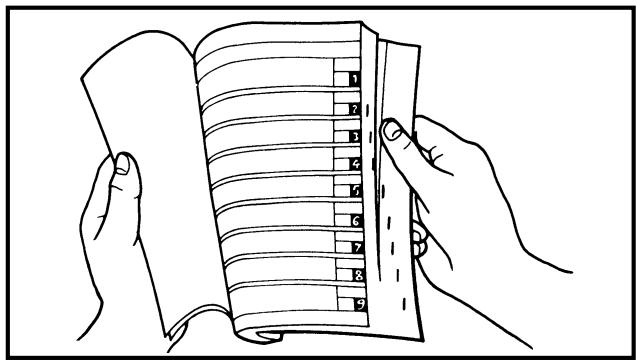
- This manual consists of seven chapters; "General information", "Specifications", "Regular inspection and adjustments", "Engine", "Chassis", "Electrical" and "Tuning".
- The table of contents is at the beginning of the manual. Look over the general layout of the book before finding then required chapter and item.
Bend the book at its edge, as shown, to find the required fore edge symbol mark and go to a page for required item and description.
COMMENTUTILISER CE MANUEL
INFORMATIONS PARTICULIEREMENT IMPOR TANTES
!
All of the procedures in this manual are organized in a sequential, step-by-step format. The information has been complied to provide the mechanic with an easy to read, handy reference that contains comprehensive explanations of all disassembly, repair, assembly, and inspection operations. In this revised format, the condition of a faulty component will precede an arrow symbol and the course of action required will follow the symbol, e.g.,
- Bearings
Pitting/damage Replace.
EC084002
HOW TO READ DESCRIPTIONS
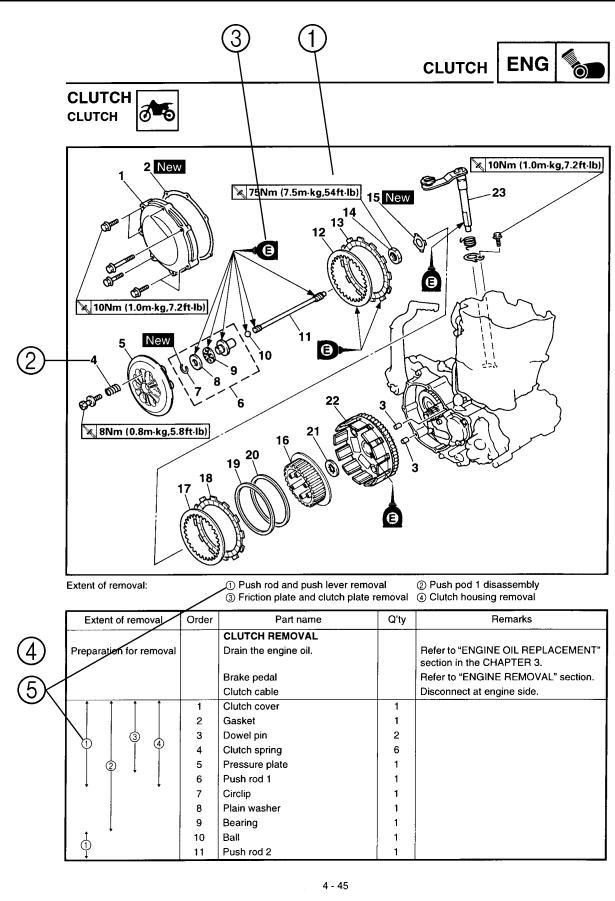
To help identify parts and clarify procedure steps, there are exploded diagrams at the start of each removal and disassembly section.
- An easy-to-see exploded diagram ① is provided for removal and disassembly jobs.
- Numbers ② are given in the order of the jobs in the exploded diagram. A number that is enclosed by a circle indicates a disassembly step.
- An explanation of jobs and notes is presented in an easy-to-read way by the use of symbol marks ③. The meanings of the symbol marks are given on the next page.
- A job instruction chart ④ accompanies the exploded diagram, providing the order of jobs, names of parts, notes in jobs, etc.
- Extent of removal ⑤ is provided in the job instruction chart to save the trouble of an unnecessary removal job.
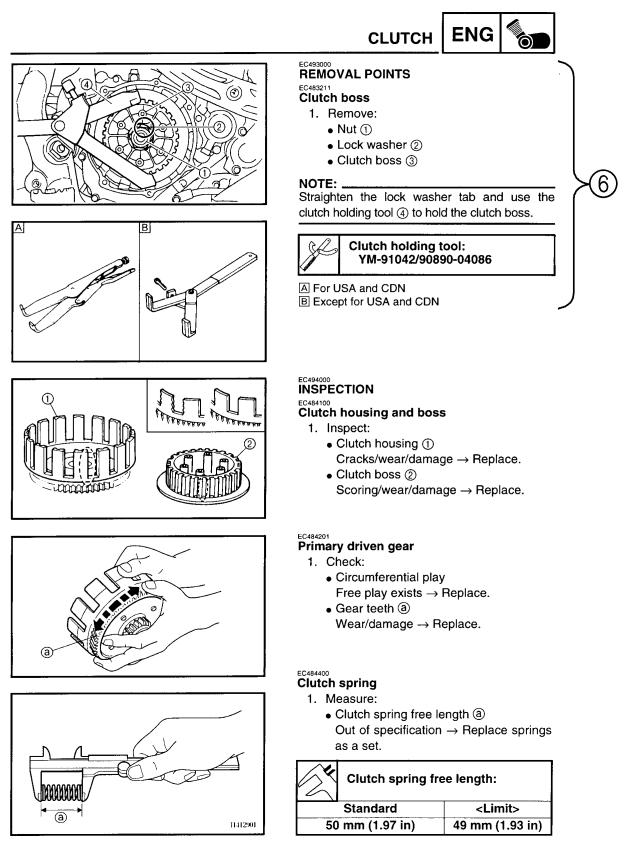
- For jobs requiring more information, the step-by-step format supplements ⑥ are given in addition to the exploded diagram and job instruction chart.
FORMAT DU MANUEL
ILLUSTRATED SYMBOLS (Refer to the illustration)
Illustrated symbols ① to ⑦ are designed as thumb tabs to indicate the chapter's number and content.
① General information
② Specifications
③ Regular inspection and adjustments
④ Engine
⑤ Chassis
⑥ Electrical
⑦ Tuning
Illustrated symbols ⑧ to ⑭ are used to identify the specifications appearing in the text.
(8) With engine mounted
⑨ Special tool
10 Filling fluid
① Lubricant
⑫ Tightening
③ Specified value, Service limit
④ Resistance () , Voltage (V), Electric current (A)
Illustrated symbols ⑤ to ⑧ in the exploded diagrams indicate grade of lubricant and location of lubrication point.
15 Apply engine oil
16 Apply molybdenum disulfide oil
⑦ Apply lightweight lithium-soap base grease
Apply molybdenum disulfide grease
Illustrated symbols ⑲ to ② in the exploded diagrams indicate where to apply a locking agent and where to install new parts.
19 Apply locking agent (LOCTITE®)
Use new one
SYMBOLES GRAPHI-QUES (Voir l'illustration)
CHECKING OF CONNECTION 1-6
SPECIAL TOOLS 1-7
CONTROL FUNCTIONS 1-10
FUEL 1-13
STARTING AND BREAK-IN 1-14
TORQUE-CHECK POINTS 1-18
CLEANING AND STORAGE 1-19
CHAPTER 2 SPECIFICATIONS
GENERAL SPECIFICATIONS 2-1
MAINTENANCE SPECIFICATIONS 2-4
GENERAL TORQUE
SPECIFICATIONS 2-18
DEFINITION OF UNITS 2-18
CABLE ROUTING DIAGRAM 2-19
CHAPTER 3 REGULAR INSPECTION AND ADJUSTMENTS
MAINTENANCE INTERVALS 3-1
VALVES AND VALVE SPRINGS 4-33
CYLINDER AND PISTON 4-42
CLUTCH 4-49
OIL FILTER ELEMENT, WATER PUMP
AND RIGHT CRANKCASE COVER .... 4-56
BALANCER 4-63
OIL PUMP 4-66
KICK SHAFT AND SHIFT SHAFT 4-71
CDIMAGNETO 4-78
ENGINE REMOVAL 4-82
CRANKCASE AND CRANKSHAFT 4-87
TRANSMISSION, SHIFT CAM
AND SHIFT FORK 4-96
CHAPTER 5 CHASSIS
FRONT WHEEL AND REAR WHEEL ....... 5-1
FRONT BRAKE AND REAR BRAKE .... 5-11
FRONT FORK 5-28
HANDLEBAR 5-41
STEERING 5-47
SWINGARM 5-53
REAR SHOCK ABSORBER 5-60
CHAPITRE 4 MOTEUR
SELLE, RESERVOIR DE
CARBURANT ET CACHES
LATERAUX 4-1
TUYAU D'ECHAPPEMENT
ET SILENCIEUX 4-2
RADIATEUR 4-4
CARBURATEUR 4-7
ARBRES A CAMES 4-20
CULASSE 4-29
SOUPAPES ET RESSORTS
DE SOUPAPE 4-33
CYLINDRE ET PISTON 4-42
EMBRAYAGE 4-49
ELEMENT DE FILTRE
A HUILE, POMPE A EAU ET
DEMI-CARTER DROIT 4-56
BALANCIER 4-63
POMPE A HUILE 4-66
ARBRE DE KICK ET ARBRE DE
SELECTEUR 4-71
VOLANT MAGNETIQUE
CDI 4-78
DEPOSE DUMOTEUR 4-82
CARTER ET VILEBREQUIN ....4-87
BOITE A VITESSES,
TAMBOUR ET FOURCHETTS
DE SELECTION 4-96
KAPITEL 4 MOTOR
SITZBANK.
KRAFTSTOFFTANK UND
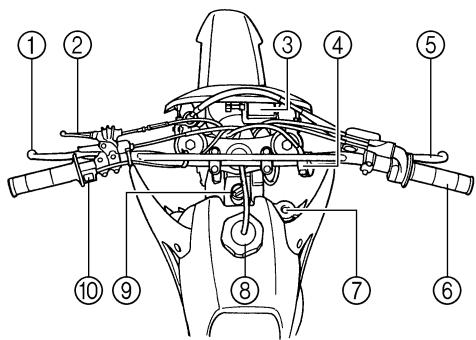
① Clutch lever
② Decompression lever
③ Trip meter
④ Light switch
⑤ Front brake lever
(6) Throttle grip
⑦ Radiator cap
⑧ Fuel tank cap
⑨ Oil tank cap
Engine stop switch
① Taillight
⑫ Kickstarter crank
③ Fuel tank
14 Headlight
⑤ Radiator
16 Coolant drain bolt
⑦ Rear brake pedal
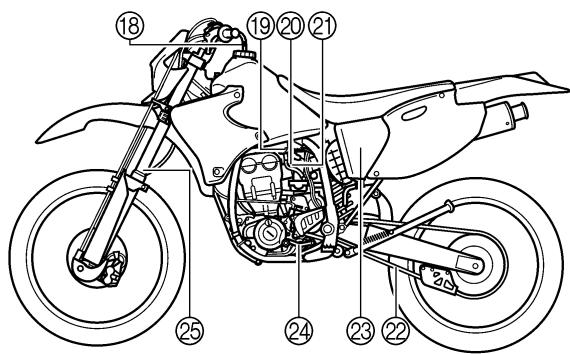
18 Valve joint
19 Fuel cock
Cold starter knob
② Hot starter knob (red)
Drive chain
Air filter
② Shift pedal
⑤ Front fork
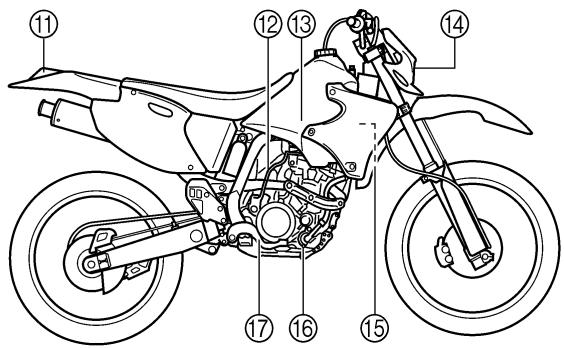
NOTE:
- The machine you have purchased may differ slightly from those shown in the following.
- Designs and specifications are subject to change without notice.
RENSEIGNEMENTS GENERAUX DESCRIPTION
There are two significant reasons for knowing the serial number of your machine:
- When ordering parts, you can give the number to your Yamaha dealer for positive identification of the model you own.
- If your machine is stolen, the authorities will need the number to search for and identify your machine.
EC121001
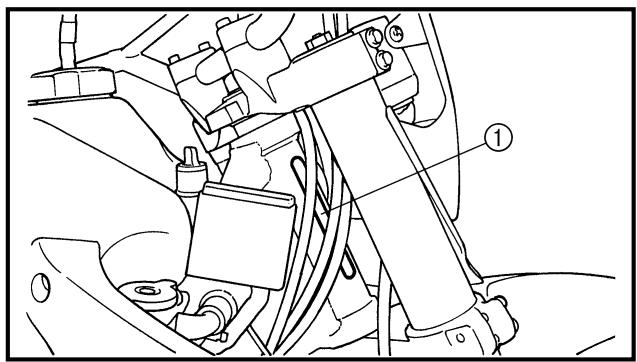
VEHICLE IDENTIFICATION NUMBER
The vehicle identification number ① is stamped on the right of the steering head pipe.
EC123001
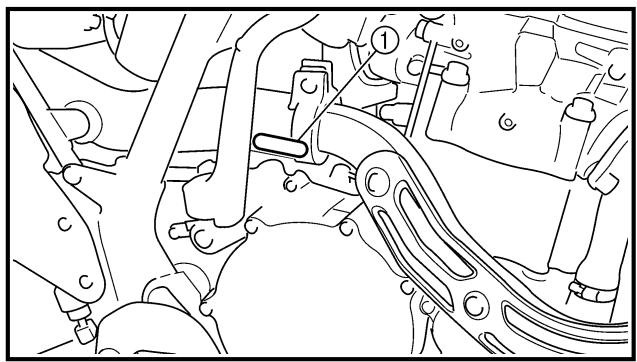
ENGINE SERIAL NUMBER
The engine serial number ① is stamped into the elevated part of the right-side of the engine.
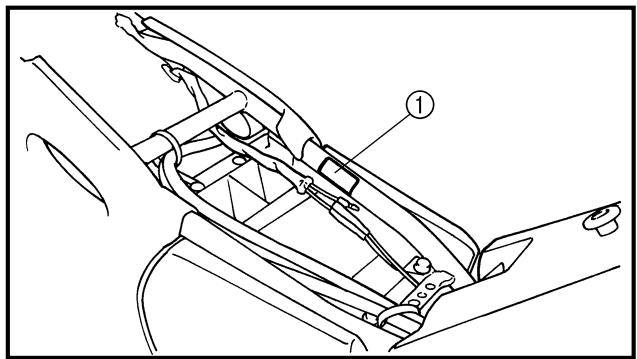
EC124000
MODEL LABEL
The model label ① is affixed to the frame under the rider's seat. This information will be needed to order spare parts.
IDENTIFICATION DE LA MACHINE
EC131010 PREPARATION FOR REMOVAL AND DISASSEMBLY
- Remove all dirt, mud, dust, and foreign material before removal and disassembly.
When washing the machine with high pressured water, cover the parts follows.
- Silencer end
Air filter intake hole
Water pump housing hole at the bottom -
Carburetor accelerator pump
-
Use proper tools and cleaning equipment. Refer to "SPECIAL TOOLS" section.
- When disassembling the machine, keep mated parts together. They include gears, cylinders, pistons, and other mated parts that have been "mated" through normal wear. Mated parts must be reused as an assembly or replaced.
- During the machine disassembly, clean all parts and place them in trays in the order of disassembly. This will speed up assembly time and help assure that all parts are correctly reinstalled.
- Keep away from fire.
INFORMATIONS IMPOR TANTES
PREPARATION POUR LA DEPOSE ET DEMONTAGE
ALL REPLACEMENT PARTS
- We recommend to use Yamaha genuine parts for all replacements. Use oil and/or grease recommended by Yamaha for assembly and adjustment.
EC133000
GASKETS, OIL SEALS AND O-RINGS
- All gaskets, oil seals, and O-rings should be replaced when an engine is overhauled. All gasket surfaces, oil seal lips, and O-rings must be cleaned.
- Properly oil all mating parts and bearings during reassembly. Apply grease to the oil seal lips.
EC134000
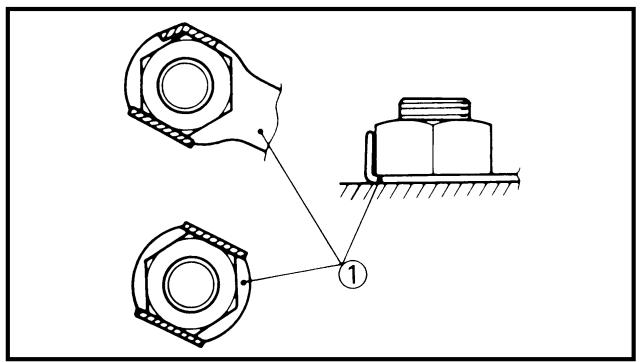
LOCK WASHERS/PLATES AND COTTER PINS
- All lock washers/plates ① and cotter pins must be replaced when they are removed. Lock tab(s) should be bent along the bolt or nut flat(s) after the bolt or nut has been properly tightened.
EC135001
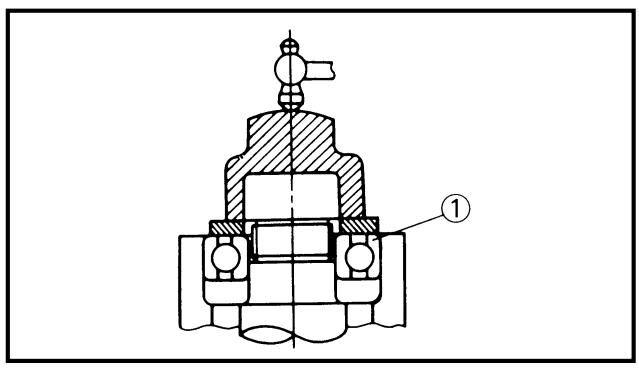
BEARINGS AND OIL SEALS
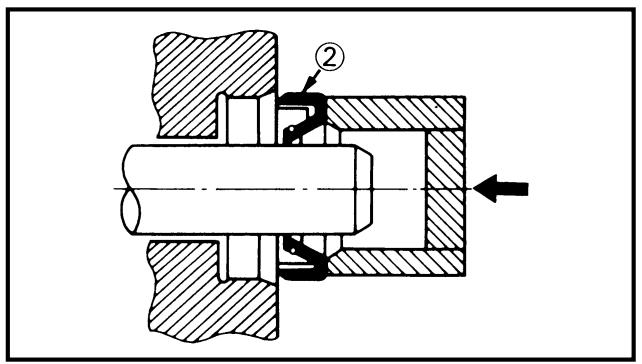
- Install the bearing(s) ① and oil seal(s) ② with their manufacturer's marks or numbers facing outward. (In other words, the stamped letters must be on the side exposed to view.) When installing oil seal(s), apply a light coating of lightweight lithium base grease to the seal lip(s). Oil the bearings liberally when installing.
CAUTION:
Do not use compressed air to spin the bearings dry. This causes damage to the bearing surfaces.
PIECES DE RECHANGE
- All circlips should be inspected carefully before reassembly. Always replace piston pin clips after one use. Replace distorted circlips. When installing a circlip ① , make sure that the sharp-edged corner ② is positioned opposite to the thrust ③ it receives. See the sectional view.
④ Shaft
CIRCLIPS
CHECKING OF CONNECTION
Dealing with stains, rust, moisture, etc. on the connector.
- Disconnect:
- Connector
- Dry each terminal with an air blower.
- Connect and disconnect the connector two or three times.
- Pull the lead to check that it will not come off.
- If the terminal comes off, bend up the pin ① and reinsert the terminal into the connector.
- Connect:
- Connector
NOTE:
The two connectors "click" together.
- Check for continuity with a tester.
NOTE:
- If there is no continuity, clean the terminals.
- Be sure to perform the steps 1 to 7 listed above when checking the wireharness.
- For a field remedy, use a contact revitalizer available on the market.
- Use the tester on the connector as shown.
VERIFICATION DES CONNXIONS
The proper special tools are necessary for complete and accurate tune-up and assembly. Using the correct special tool will help prevent damage caused by the use of improper tools or improvised techniques. The shape and part number used for the special tool differ by country, so two types are provided. Refer to the list provided to avoid errors when placing an order.
NOTE:
- For U.S.A. and Canada, use part number starting with "YM-" or "YU-.
- For others, use part number starting with "90890-".
| Part number | Tool name/How to use | Illustration | |
| YU-1135-A, 90890-01135 | Crankcase separating tool These tool is used to remove the crankshaft from either case. | YU-1135-A | 90890-01135 |
| YU-1235, 90890-01235 | Rotor holding tool This tool is used when loosening or tightening the fly-wheel magneto securing nut. | YU-1235 | 90890-01235 |
| YU-3097, 90890-01252 YU-1256 | Dial gauge and stand Stand These tools are used to check each part for runout or bent. | YU-3097 YU-1256 | 90890-01252 |
| YU-90050, 90890-01274 YU-90050, 90890-01275 YU-91044, 90890-04081 YM-1277, 90890-01277 | Crankshaft installing tool Crankshaft installing pot Crankshaft installing bolt Spacer (crankshaft installer) Adapter (M10) These tools are used to install the crankshaft. | YU-90050 YM-1277 YU-91044 | 90890-01274 90890-01275 90890-01277 90890-04081 |
| YU-1304, 90890-01304 | Piston pin puller set This tool is used to remove the piston pin. | YU-1304 | 90890-01304 |
| YU-24460-01, 90890-01325 YU-33984, 90890-01352 | Radiator cap tester Radiator cap tester adapter These tools are used for checking the cooling system. | YU-24460-01 YU-33984 | 90890-01325 90890-01352 |
| YU-33270-B, 90890-01362 | Flywheel puller This tool is used to remove the flywheel magneto. | YM-33270-B | 90890-01362 |
| YU-33975, 90890-01403 | Steering nut wrench | YU-33975 | 90890-01403 |
| This tool is used when tighten the steering ring nut to specification. | |||
| YM-1423, 90890-01423 | Damper rod holder | YM-1423 | 90890-01423 |
| Use this tool to remove and install the damper rod. | |||
| YM-01442, 90890-01442 | Fork seal driver | YM-01442 | 90890-01442 |
| This tool is used when install the fork oil seal. | |||
| YU-3112-C, 90890-03112 | Pocket tester | YU-3112-C | 90890-03112 |
| Use this tool to inspect the coil resistance, output voltage and amperage. | |||
| YU-08036-B 90890-03113 | Inductive tachometer | YU-08036-B | 90890-03113 |
| Engine tachometer | |||
| This tool is needed for observing engine rpm. | |||
| YM-33277-A, 90890-03141 | Timing light | YM-33277-A | 90890-03141 |
| This tool is necessary for checking ignition timing. | |||
| YM-04019, 90890-04019 | Valve spring compressor | YM-04019 | 90890-04019 |
| This tool is needed to remove and install the valve assemblies. | |||
| YM-91042, 90890-04086 | Clutch holding tool | YM-91042 | 90890-04086 |
| This tool is used to hold the clutch when removing or installing the clutch boss securing nut. | |||
| YM-4111, 90890-04111 | Valve guide remover | YM-4111 | 90890-04111 |
| YM-4116, 90890-04116 | Intake 4.0 mm (0.16 in) | YM-4116 | 90890-04116 |
| Exhaust 4.5 mm (0.18 in) | |||
| This tool is needed to remove and install the valve guide. | |||
| YM-4112, 90890-04112 YM-4117, 90890-04117 | Valve guide installer Intake 4.0 mm (0.16 in) Exhaust 4.5 mm (0.18 in) This tool is needed to install the valve guide. | YM-4112 YM-4117 | 90890-04112 90890-04117 |
| YM-4113, 90890-04113 YM-4118, 90890-04118 | Valve guide reamer Intake 4.0 mm (0.16 in) Exhaust 4.5 mm (0.18 in) This tool is needed to rebore the new valve guide. | YM-4113 YM-4118 | 90890-04113 90890-04118 |
| YM-34487 90890-06754 | Dynamic spark tester Ignition checker This instrument is necessary for checking the ignition system components. | YM-34487 | 90890-06754 |
| ACC-QUICK-GS-KT 90890-85505 | Quick gasket® YAMAHA Bond No. 1215 This sealant (Bond) is used for crankcase mating surface, etc. | ACC-QUICK-GS-KT | 90890-85505 |
OUTILS SPECIAUX
The engine stop switch ① is located on the left handlebar. Continue pushing the engine stop switch till the engine comes to a stop.
EC152000
CLUTCH LEVER
The clutch lever ① is located on the left handlebar; it disengages or engages the clutch. Pull the clutch lever to the handlebar to disengage the clutch, and release the lever to engage the clutch. The lever should be pulled rapidly and released slowly for smooth starts.
EC153000
SHIFT PEDAL
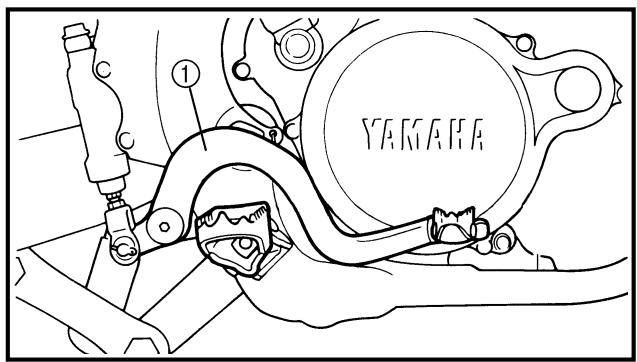
The gear ratios of the constant-mesh 5 speed transmission are ideally spaced. The gears can be shifted by using the shift pedal ① on the left side of the engine.
KICKSTARTER CRANK
Rotate the kickstarter crank ① away from the engine. Push the starter down lightly with your foot until the gears engage, then kick smoothly and forcefully to start the engine. This model has a primary kickstarter crank so the engine can be started in any gear if the clutch is disengaged. In normal practices, however, shift to neutral before starting.
FONCTIONS DES COMMANDES
COUPE-CIRCUIT DU MOTEUR
Never use the decompression lever after the engine is started. The engine may be damaged if you use the decompression lever while it is running.
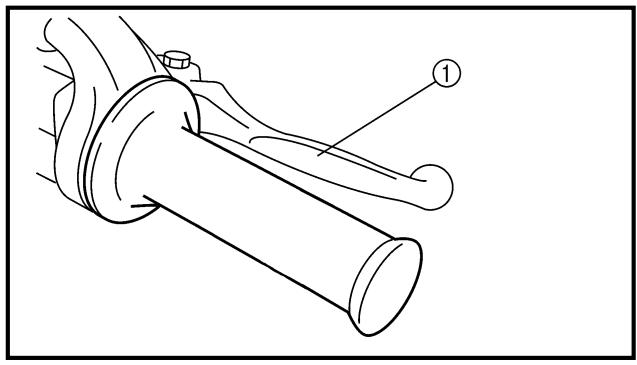
The decompression lever ① is located on the left handlebar and is used when starting the engine. Squeezing the decompression lever presses down on the exhaust valve and releases the pressure in the cylinder head. This enables the vehicle to be kickstarted more easily.
EC155001
THROTTLE GRIP
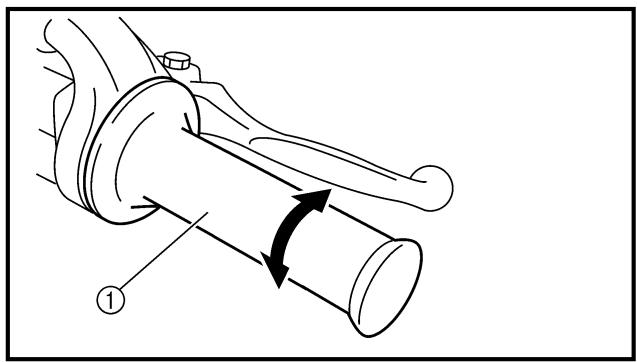
The throttle grip ① is located on the right handlebar; it accelerates or decelerates the engine. For acceleration, turn the grip toward you; for deceleration, turn it away from you.
EC156000
FRONT BRAKE LEVER
The front brake lever ① is located on the right handlebar. Pull it toward the handlebar to activate the front brake.
EC157000
REAR BRAKE PEDAL
The rear brake pedal ① is located on the right side of the machine. Press down on the brake pedal to activate the rear brake.
LEVIER DE DECOMPRESSION
ATTENTION:
The fuel cock supplies fuel from the tank to carburetor while filtering the fuel. The fuel cock has the three positions:
OFF:With the lever in this position, fuel will not flow. Always return the lever to this position when the engine is not running.
ON: With the lever in this position, fuel flows to the carburetor. Normal riding is done with the lever in this position.
RES: This indicates reserve. If you run out of fuel while riding, move the lever to this position. FILL THE TANK AT THE FIRST OPPORTUNITY. BE SURE TO SET THE LEVER TO "ON" AFTER REFUELING.
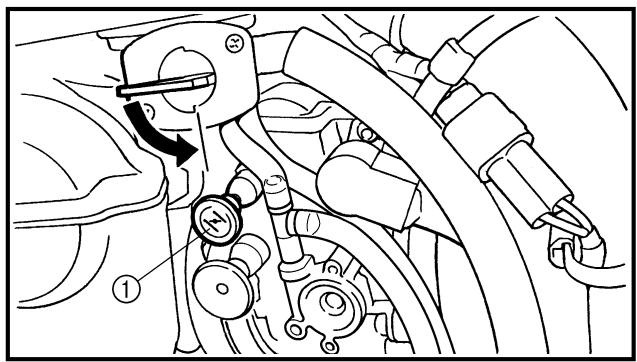
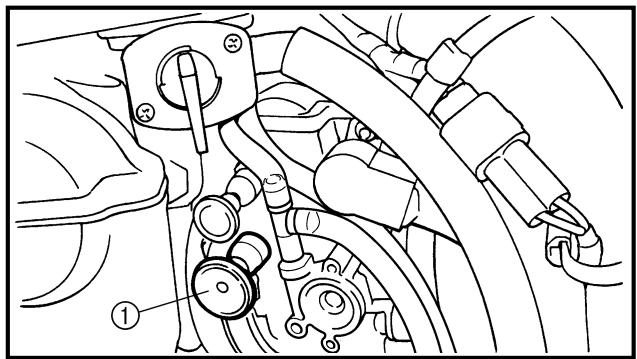
COLD STARTER KNOB
When cold, the engine requires a richer air-fuel mixture for starting. A separate starter circuit, which is controlled by the cold starter knob ① , supplies this mixture. Pull the cold starter knob out to open the circuit for starting. When the engine has warmed up, push it in to close the circuit.
HOT STARTER KNOB
The hot starter knob (red) ① is used when starting a warm engine.
Use the hot starter knob when starting the engine again immediately after it was stopped (the engine is still warm). Pulling out the hot starter knob injects secondary air to thin the air-fuel mixture temporarily, allowing the engine to be started more easily.
CAUTION:
After the engine has started, be sure to push the hot starter knob back in.
FONCTIONS DES COMMANDES ARMATUREN UND DEREN FUNKTION FUNZIONI DI COMANDO
ROBINET DE CARBURANT
This valve joint ① prevents fuel from flowing out and is installed to the fuel tank breather hose.
CAUTION:
In this installation, make sure the arrow faces the fuel tank and also downward.
LIGHTS SWITCH
The lights switch ① is located on the handlebar.
FLAP
In order to prevent water from entering the carburetor while the motorcycle is operated in the rain, attach the accessory flap ① to the frame at the rear of the fuel tank.
NOTE:
Riding with the flap attached when it is not raining can help keep out dust, dirt and sand.
FUEL
Always use the recommended fuel as stated below. Also, be sure to use new gasoline the day of a race.
Recommended fuel:
Except for AUS:
Premium unleaded fuel with a research octane number of 95 or higher.
For AUS:
Unleaded fuel only
NOTE:
Except for AUS:
- If knocking or pinging occurs, use a different brand of gasoline or higher octane grade.
- If unleaded gasoline is not available, then leaded gasoline can be used.
FONCTIONS DES COMMANDES/ESSENCE ARMATUREN UND DEREN FUNKTION/KRAFTSTOFF FUNZIONI DI COMANDO/CARBURANTE
CLAPET DE DURIT DE MISE A LIAIR
Never start or run the engine in a closed area. The exhaust fumes are poisonous; they can cause loss of consciousness and death in a very short time. Always operate the machine in a well-ventilated area.
CAUTION:
- The carburetor on this motorcycle has a built-in accelerator pump. Therefore, when starting the engine, do not operate the throttle or the spark plug will foul.
- Unlike a two-stroke engine, this engine cannot be kick started when the throttle is open because the kick starter may kick back. Also, if the throttle is open the air/ fuel mixture may be too lean for the engine to start.
- Never use the decompression lever after the engine is started. The engine may be damaged if you use the decompression lever while it is running.
- Before starting the machine, perform the checks in the pre-operation check list.
STARTING A COLD ENGINE
- Inspect the coolant level.
- Turn the fuel cock to "ON".
- Shift the transmission into neutral.
- Fully open the cold starter knob.
- Without pulling in the decompression lever, slowly depress the kickstarter crank until the compression stroke is found. When considerable resistance of the kickstarter crank is felt, the engine is on the compression stroke. If the engine is on the exhaust stroke, resistance will only be felt when the kickstarter crank is initially depressed, not through the entire range of depression (as when the engine is on the compression stroke); therefore, depress the kickstarter crank a few more times.
Do not open the throttle while kicking the kickstarter crank. Otherwise, the kick starter may kick back.
- Return the cold starter knob to its original position and run the engine at 3,000 5,000 r / min for 1 or 2 minutes.
NOTE:
Since this model is equipped with an accelerator pump, if the engine is raced (the throttle opened and closed), the air/fuel mixture will be too rich and the engine may stall. Also unlike a two-stroke engine, this model can idle.
CAUTION:
Do not warm up the engine for extended periods of time.
MISE EN MARCHE ET RODAGE ANLASSEN UND EINFAHREN AVVIO E RODAGGIO
Do not operate the cold starter knob and throttle. Open the hot starter knob (red) and start the engine by kicking the kickstarter crank forcefully with a firm stroke.
As soon as the engine starts, push in the hot starter knob to close the air passage.
Restarting an engine after a fall
Pull the hot starter knob (red) and start the engine. As soon as the engine starts, push in the hot starter knob to close the air passage.
The engine fails to start
Pull the hot starter knob (red) all the way out, pull the decompression lever to the handlebar, and while holding the lever, kick the kickstarter crank 10 to 20 times to clear the engine.
Then, restart the engine.
Refer to "Restarting an engine after a fall".
| Throttle grip operation* | Cold starter knob | Hot starter knob (red) | ||
| Starting a cold engine | Air temperature = less than 5 °C (41 °F) | Open 3 or 4 times | ON | OFF |
| Air temperature = more than 5 °C (41 °F) | None | ON | OFF | |
| Air temperature (normal temperature) = between 5 °C (41 °F) and 25 °C (77 °F) | None | ON/OFF | OFF | |
| Air temperature = more than 25 °C (77 °F) | None | OFF | OFF | |
| Starting an engine after a long period of time | None | ON | OFF | |
| Restarting a warm engine | None | OFF | ON | |
| Restarting an engine after a fall | None | OFF | ON | |
- Operate the throttle grip before kick starting.
CAUTION:
Observe the following break-in procedures during initial operation to ensure optimum performance and avoid engine damage.
MISE EN MARCHE ET RODAGE ANLASSEN UND EINFAHREN AVVIO E RODAGGIO
MISE EN MARCHE D'UN MOTEUR CHAUD
- Before starting the engine, fill the fuel tank with the fuel.
- Perform the pre-operation checks on the machine.
- Start and warm up the engine. Check the idle speed, and check the operation of the controls and the engine stop switch. Then, restart the engine and check its operation within no more than 5 minutes after it is restarted.
- Operate the machine in the lower gears at moderate throttle openings for five to eight minutes.
- Check how the engine runs when the motorcycle is ridden with the throttle 1/4 to 1/2 open (low to medium speed) for about one hour.
- Restart the engine and check the operation of the machine throughout its entire operating range. Restart the machine and operate it for about 10 to 15 more minutes. The machine will now be ready to race.
CAUTION:
- After the break-in or before each race, you must check the entire machine for loose fittings and fasteners as per "TORQUE-CHECK POINTS".
Tighten all such fasteners as required.
- When any of the following parts have been replaced, they must be broken in. CYLINDER AND CRANKSHAFT:
About one hour of break-in operation is necessary.
PISTON, RING, VALVES, CAMSHAITS AND GEARs:
These parts require about 30 minutes of break-in operation at half-throttle or less. Observe the condition of the engine carefully during operation.
PROCEDURE DE RODAGE
PISTONS, SEGMENTS, SOUPAPES, ARBRES A CAMES ET PIGNONS:
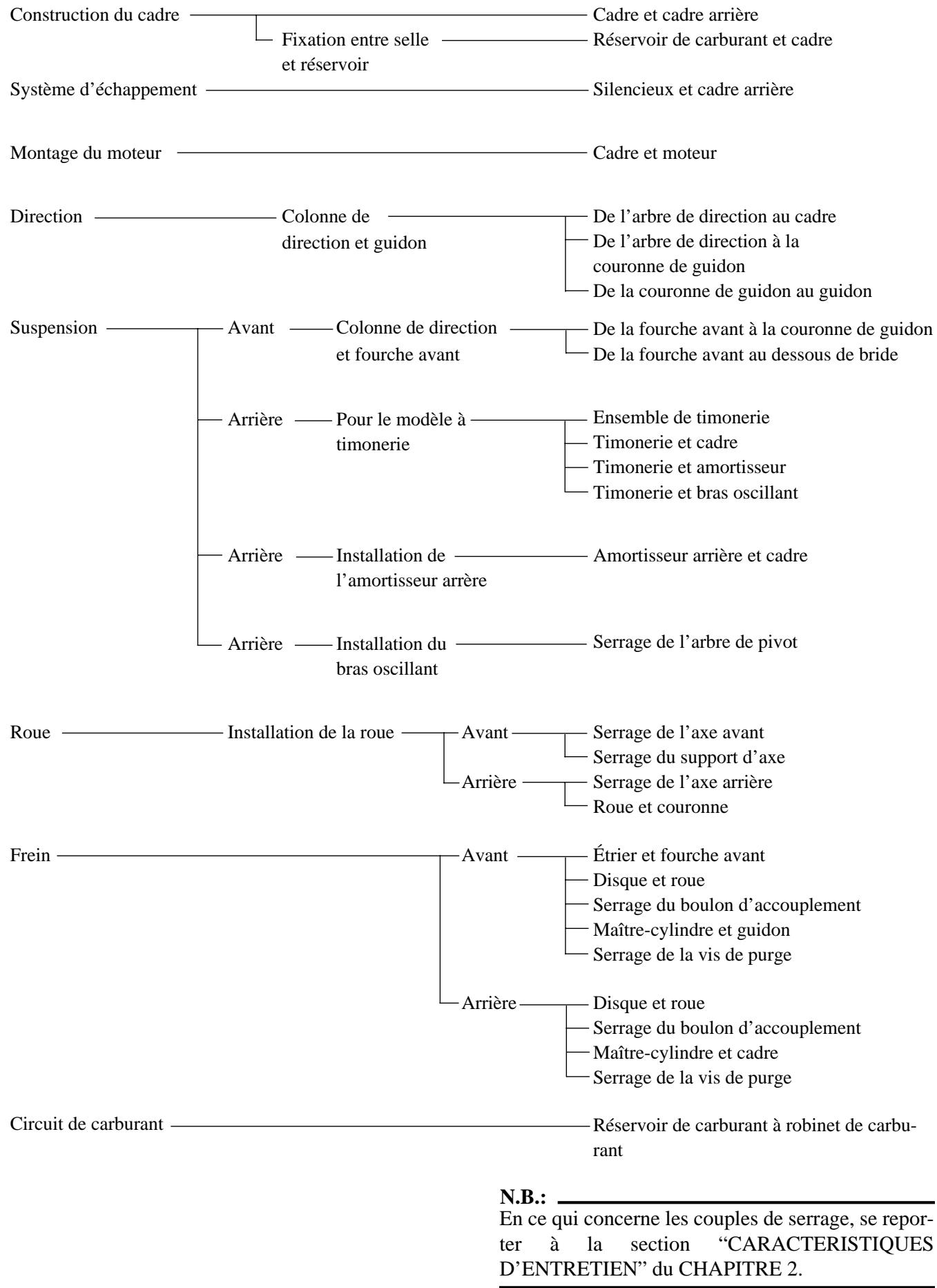
NOTE: Concerning the tightening torque, refer to "MAINTENANCE SPECIFICATIONS" section in the CHAPTER 2.
POINTS DE VERIFICATION DE COUPLE DE SERRAGE
ANZUGSMOMENTE KONTROLLIEREN
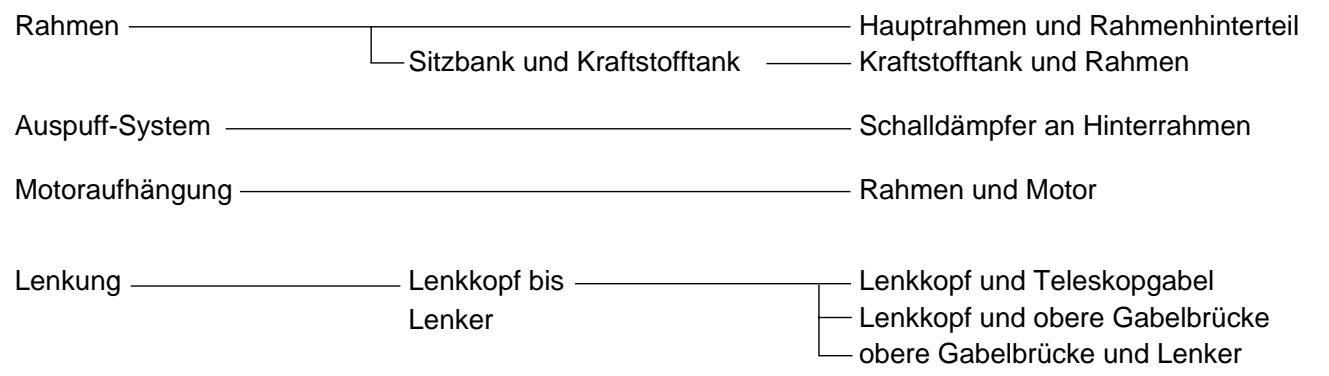
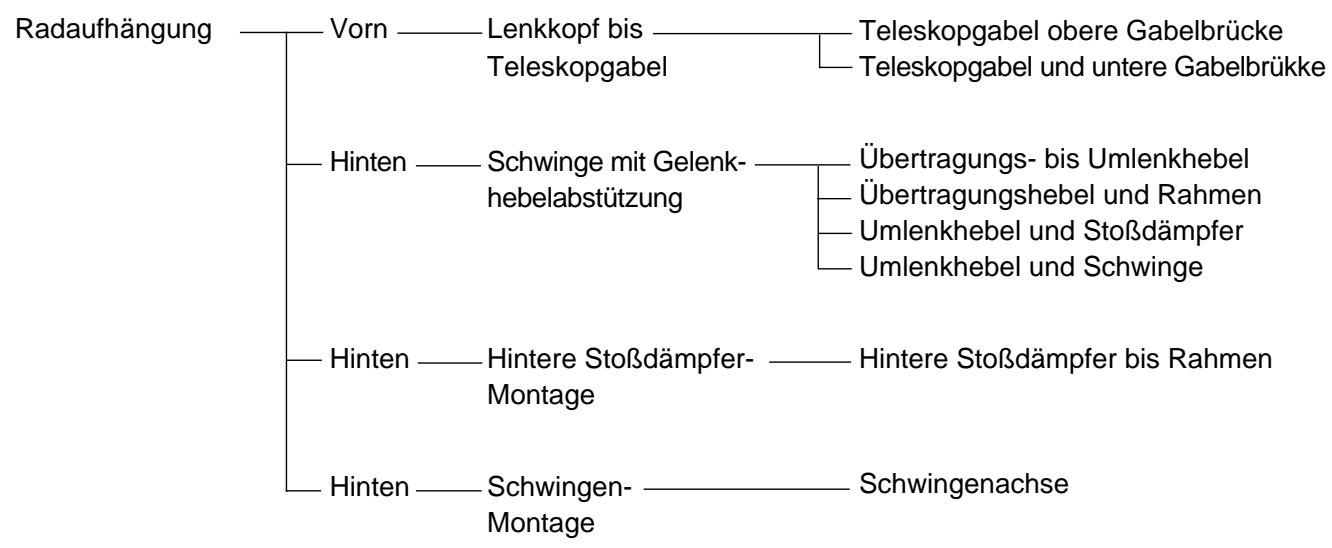

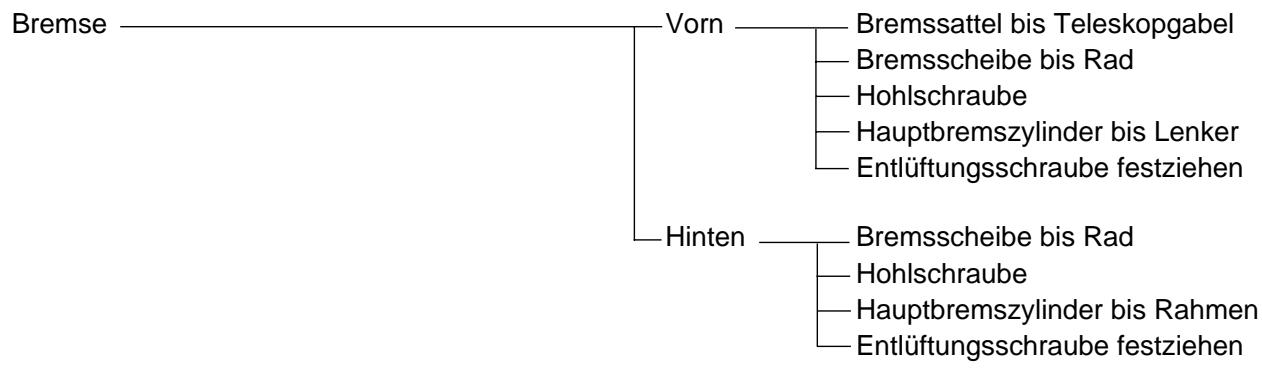

HINWEIS:
CLEANING AND STORAGE
EC1B1000
CLEANING
Frequent cleaning of your machine will enhance its appearance, maintain good overall performance, and extend the life of many components.
- Before washing the machine, block off the end of the exhaust pipe to prevent water from entering. A plastic bag secured with a rubber band may be used for this purpose.
- If the engine is excessively greasy, apply some degreaser to it with a paint brush. Do not apply degreaser to the chain, sprockets, or wheel axles.
- Rinse the dirt and degreaser off with a garden hose; use only enough pressure to do the job.
CAUTION:
Excessive hose pressure may cause water seepage and contamination of wheel bearings, front forks, brakes and transmission seals. Many expensive repair bills have resulted from improper high pressure detergent applications such as those available in coin-operated car washers.
- After the majority of the dirt has been hosed off, wash all surfaces with warm water and a mild detergent. Use an old toothbrush to clean hard-to-reach places.
- Rinse the machine off immediately with clean water, and dry all surfaces with a soft towel or cloth.
- Immediately after washing, remove excess water from the chain with a paper towel and lubricate the chain to prevent rust.
- Clean the seat with a vinyl upholstery cleaner to keep the cover pliable and glossy.
- Automotive wax may be applied to all painted or chromed surfaces. Avoid combination cleaner-waxes, as they may contain abrasives.
- After completing the above, start the engine and allow it to idle for several minutes.
NETTOYAGE ET RANGEMENT
NETTOYAGE
If your machine is to be stored for 60 days or more, some preventive measures must be taken to avoid deterioration. After cleaning the machine thoroughly, prepare it for storage as follows:
- Drain the fuel tank, fuel lines, and the carburetor float bowl.
- Remove the spark plug, pour a tablespoon of SAE 10W-30 motor oil in the spark plug hole, and reinstall the plug. With the engine stop switch pushed in, kick the engine over several times to coat the cylinder walls with oil.
- Remove the drive chain, clean it thoroughly with solvent, and lubricate it. Reinstall the chain or store it in a plastic bag tied to the frame.
- Lubricate all control cables.
- Block the frame up to raise the wheels off the ground.
- Tie a plastic bag over the exhaust pipe outlet to prevent moisture from entering.
- If the machine is to be stored in a humid or salt-air environment, coat all exposed metal surfaces with a film of light oil. Do not apply oil to rubber parts or the seat cover.
NOTE:
Make any necessary repairs before the machine is stored.
RANGEMENT
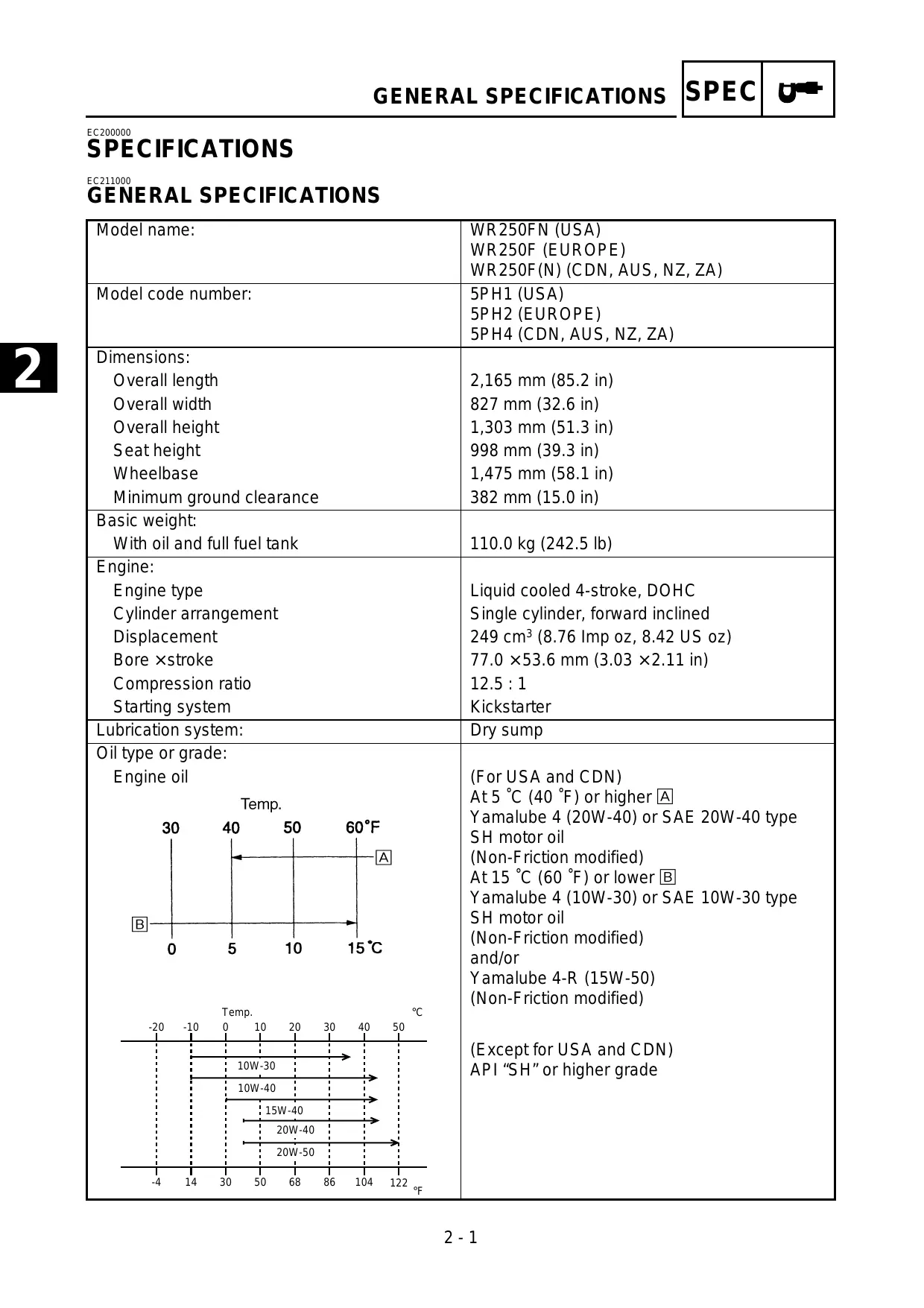
| Model name: | WR250FN (USA) WR250F (EUROPE) WR250F(N) (CDN, AUS, NZ, ZA) |
| Model code number: | 5PH1 (USA) 5PH2 (EUROPE) 5PH4 (CDN, AUS, NZ, ZA) |
| Dimensions: Overall length | 2,165 mm (85.2 in) |
| Overall width | 827 mm (32.6 in) |
| Overall height | 1,303 mm (51.3 in) |
| Seat height | 998 mm (39.3 in) |
| Wheelbase | 1,475 mm (58.1 in) |
| Minimum ground clearance | 382 mm (15.0 in) |
| Basic weight: With oil and full fuel tank | 110.0 kg (242.5 lb) |
| Engine: Engine type | Liquid cooled 4-stroke, DOHC |
| Cylinder arrangement | Single cylinder, forward inclined |
| Displacement | 249 cm³ (8.76 Imp oz, 8.42 US oz) |
| Bore × stroke | 77.0 × 53.6 mm (3.03 × 2.11 in) |
| Compression ratio | 12.5 : 1 |
| Starting system | Kickstarter |
| Lubrication system: | Dry sump |
| Oil type or grade: Engine oil Temp. 30 40 50 60°F A B 0 5 10 15°C | (For USA and CDN) At 5 °C (40 °F) or higher A Yamalube 4 (20W-40) or SAE 20W-40 type SH motor oil (Non-Friction modified) At 15 °C (60 °F) or lower B Yamalube 4 (10W-30) or SAE 10W-30 type SH motor oil (Non-Friction modified) and/or Yamalube 4-R (15W-50) (Non-Friction modified) (Except for USA and CDN) API “SH” or higher grade |
| Oil capacity: Engine oil Periodic oil change | 1.5 L (1.32 Imp qt, 1.59 US qt) |
| With oil filter replacement | 1.6 L (1.41 Imp qt, 1.69 US qt) |
| Total amount | 1.7 L (1.50 Imp qt, 1.80 US qt) |
| Coolant capacity (including all routes): | 1.3 L (1.14 Imp qt, 1.37 US qt) |
| Air filter: | Wet type element |
| Fuel: Type | Premium unleaded fuel with a research octane number of 95 or higher. (Except for AUS) |
| Tank capacity | Unleaded fuel only (For AUS) |
| Reserve | 12 L (2.64 Imp gal, 3.17 US gal) (For USA, CDN) 8.0 L (1.76 Imp gal, 2.11 US gal) (Except for USA, CDN) |
| 1.6 L (0.35 Imp gal, 0.42 US gal) (For USA, CDN) | |
| 1.4 L (0.31 Imp gal, 0.37 US gal) (Except for USA, CDN) | |
| Carburetor: Type | FCR-MX37 |
| Manufacturer | KEIHIN |
| Spark plug: Type/manufacturer | CR8E/NGK |
| U24ESR-N/DENSO | |
| Gap | 0.7 ~ 0.8 mm (0.028 ~ 0.031 in) |
| Clutch type: | Wet, multiple-disc |
| Transmission: Primary reduction system | Gear |
| Primary reduction ratio | 57/17 (3.353) |
| Secondary reduction system | Chain drive |
| Secondary reduction ratio | 52/13 (4.000) |
| Transmission type | Constant mesh, 5-speed |
| Operation | Left foot operation |
| Gear ratio: 1st | 31/13 (2.385) |
| 2nd | 28/16 (1.750) |
| 3rd | 28/21 (1.333) |
| 4th | 25/24 (1.042) |
| 5th | 22/27 (0.815) |
| Chassis: Frame type | Semi double cradle |
| Caster angle | 27.1° |
| Trail | 117.4 mm (4.62 in) |
GENERAL SPECIFICATIONS
SPEC

| Tire: Type Size (front) Size (rear) Tire pressure (front and rear) | With tube 80/100-21 51M (For USA, CDN and ZA) 90/90-21 54R (For EUROPE, AUS and NZ) 100/100-18 59M (For USA, CDN and ZA) 120/90-18 65R (For EUROPE, AUS and NZ) 100 kPa (1.0 kg/cm², 15 psi) |
| Brake: Front brake type Operation Rear brake type Operation | Single disc brake Right hand operation Single disc brake Right foot operation |
| Suspension: Front suspension Rear suspension | Telescopic fork Swingarm (link type monocross suspension) |
| Shock absorber: Front shock absorber Rear shock absorber | Coil spring/oil damper Coil spring/gas, oil damper |
| Wheel travel: Front wheel travel Rear wheel travel | 300 mm (11.8 in) 315 mm (12.4 in) |
| Electrical: Ignition system | CDI magneto |
| Headlight type: | Quartz bulb (halogen) |
| Bulb wattage × quantity: Headlight Taillight | 12 V 60/55 W × 1 12 V 21/5 W × 1 |
MAINTENANCE SPECIFICATIONS
ENGINE
| Item | Standard | Limit | ||
| Cylinder head: Warp limit | ---- | 0.05 mm (0.002 in) | ||
| Cylinder: Bore size | 77.00 ~ 77.01 mm (3.0315 ~ 3.0319 in) | ---- | ||
| Out of round limit | ---- | 0.05 mm (0.002 in) | ||
| Camshaft: Drive method | Chain drive (Left) | ---- | ||
| Camshaft cap inside diameter | 22.000 ~ 22.021 mm (0.8661 ~ 0.8670 in) | ---- | ||
| Camshaft outside diameter | 21.967 ~ 21.980 mm (0.8648 ~ 0.8654 in) | ---- | ||
| Shaft-to-cap clearance | 0.020 ~ 0.054 mm (0.0008 ~ 0.0021 in) | 0.08 mm (0.003 in) | ||
| Cam dimensions | ||||
| Intake | “A” | 30.296 ~ 30.346 mm (1.1923 ~ 1.1947 in) | 30.196 mm (1.1888 in) | |
| “B” | 22.45 ~ 22.55 mm (0.8839 ~ 0.8878 in) | 22.35 mm (0.8799 in) | ||
| Exhaust | “A” | 30.399 ~ 30.499 mm (1.1968 ~ 1.2007 in) | 30.299 mm (1.1929 in) | |
| “B” | 22.45 ~ 22.55 mm (0.8839 ~ 0.8878 in) | 22.35 mm (0.8799 in) | ||
| Camshaft runout limit | ---- | 0.03 mm (0.0012 in) | ||
| Item | Standard | Limit | ||
| Timing chain: Timing chain type/No. of links Timing chain adjustment method | 92RH2010-114M/114 Automatic | ---- | ||
| Valve, valve seat, valve guide: Valve clearance (cold) | IN | 0.10 ~ 0.15 mm (0.0039 ~ 0.0059 in) | ---- | |
| EX | 0.17 ~ 0.22 mm (0.0067 ~ 0.0087 in) | ---- | ||
| Valve dimensions: A Head Diameter | B Face Width | C Seat Width | D Margin Thickness | |
| “A” head diameter | IN | 22.9 ~ 23.1 mm (0.9016 ~ 0.9094 in) | ---- | |
| EX | 24.4 ~ 24.6 mm (0.9606 ~ 0.9685 in) | ---- | ||
| “B” face width | IN | 2.26 mm (0.089 in) | ---- | |
| EX | 2.26 mm (0.089 in) | ---- | ||
| “C” seat width | IN | 0.9 ~ 1.1 mm (0.0354 ~ 0.0433 in) | 1.6 mm (0.0630 in) | |
| EX | 0.9 ~ 1.1 mm (0.0354 ~ 0.0433 in) | 1.6 mm (0.0630 in) | ||
| “D” margin thickness | IN | 0.8 mm (0.0315 in) | ---- | |
| EX | 0.7 mm (0.0276 in) | ---- | ||
| Stem outside diameter | IN | 3.975 ~ 3.990 mm (0.1565 ~ 0.1571 in) | 3.945 mm (0.1553 in) | |
| EX | 4.460 ~ 4.475 mm (0.1756 ~ 0.1762 in) | 4.430 mm (0.1744 in) | ||
| Guide inside diameter | IN | 4.000 ~ 4.012 mm (0.1575 ~ 0.1580 in) | 4.050 mm (0.1594 in) | |
| EX | 4.500 ~ 4.512 mm (0.1772 ~ 0.1776 in) | 4.550 mm (0.1791 in) | ||
| Stem-to-guide clearance | IN | 0.010 ~ 0.037 mm (0.0004 ~ 0.0015 in) | 0.08 mm (0.003 in) | |
| EX | 0.025 ~ 0.052 mm (0.0010 ~ 0.0020 in) | 0.10 mm (0.004 in) | ||
| Stem runout limit | ---- | 0.01 mm (0.0004 in) | ||
| Valve seat width | IN | 0.9 ~ 1.1 mm (0.0354 ~ 0.0433 in) | 1.6 mm (0.0630 in) | |
| EX | 0.9 ~ 1.1 mm (0.0354 ~ 0.0433 in) | 1.6 mm (0.0630 in) | ||
| Valve spring: | ||||
| Free length | IN | 37.81 mm (1.49 in) | 35.9 mm (1.41 in) | |
| EX | 37.54 mm (1.48 in) | 35.7 mm (1.41 in) | ||
| Set length (valve closed) | IN | 29.13 mm (1.15 in) | ---- | |
| EX | 29.30 mm (1.15 in) | ---- | ||
| Compressed pressure (inalled) | IN | 99 ~ 114 N (10.1 ~ 11.6 kg, 22.27 ~ 25.57 lb) | ---- | |
| EX | 126 ~ 144 N (12.9 ~ 14.7 kg, 28.44 ~ 32.41 lb) | ---- | ||
| Tilt limit * | IN | ---- | 2.5°/1.7 mm (2.5°/0.067 in) | |
| EX | ---- | 2.5°/1.6 mm (2.5°/0.063 in) | ||
| Direction of winding (top view) | IN | Clockwise | ---- | |
| EX | Clockwise | ---- | ||
| Piston: | ||||
| Piston to cylinder clearance | 0.040 ~ 0.065 mm (0.0016 ~ 0.0026 in) | 0.1 mm (0.004 in) | ||
| Piston size “D” | 76.955 ~ 76.970 mm (3.0297 ~ 3.0303 in) | ---- | ||
| Measuring point “H” | 8 mm (0.31 in) | ---- | ||
| Piston off-set | 0.5 mm (0.020 in)/IN-side | ---- | ||
| Item | Standard | Limit | ||
| Piston pin bore inside diameter | 16.002 ~ 16.013 mm | 16.043 mm | ||
| (0.6300 ~ 0.6304 in) | (0.6316 in) | |||
| Piston pin outside diameter | 15.991 ~ 16.000 mm | 15.971 mm | ||
| (0.6296 ~ 0.6299 in) | (0.6288 in) | |||
| Piston rings: | ||||
| Top ring: | ||||
| Type | Barrel | ---- | ||
| Dimensions (B × T) | 0.90 × 2.75 mm (0.04 × 0.11 in) | ---- | ||
| End gap (installed) | 0.15 ~ 0.25 mm | 0.50 mm | ||
| (0.006 ~ 0.010 in) | (0.020 in) | |||
| Side clearance (installed) | 0.030 ~ 0.065 mm | 0.12 mm | ||
| (0.0012 ~ 0.0026 in) | (0.005 in) | |||
| 2nd ring: | ||||
| Type | Taper | ---- | ||
| Dimensions (B × T) | 0.80 × 2.75 mm (0.03 × 0.11 in) | ---- | ||
| End gap (installed) | 0.30 ~ 0.45 mm | 0.80 mm | ||
| (0.012 ~ 0.018 in) | (0.031 in) | |||
| Side clearance | 0.020 ~ 0.055 mm | 0.12 mm | ||
| (0.0008 ~ 0.0022 in) | (0.005 in) | |||
| Oil ring: | ||||
| Dimensions (B × T) | 1.50 × 2.25 mm (0.06 × 0.09 in) | ---- | ||
| End gap (installed) | 0.10 ~ 0.40 mm | ---- | ||
| (0.004 ~ 0.016 in) | ||||
| Crankshaft: | ||||
| Crank width “A” | 55.95 ~ 56.00 mm | ---- | ||
| (2.203 ~ 2.205 in) | ||||
| Runout limit “C” | 0.03 mm (0.0012 in) | 0.05 mm | ||
| (0.002 in) | ||||
| Big end side clearance “D” | 0.15 ~ 0.45 mm | 0.50 mm | ||
| (0.0059 ~ 0.0177 in) | (0.02 in) | |||
| Small end free play “F” | 0.4 ~ 1.0 mm | 2.0 mm | ||
| (0.02 ~ 0.04 in) | (0.08 in) | |||
| Decompression device: | ||||
| Type | Manual | ---- | ||
| Cable free play | 5 ~ 9 mm (0.20 ~ 0.35 in) | ---- | ||
MAINTENANCE SPECIFICATIONS
| SPEC |
| Item | Standard | Limit | ||
| Clutch: | ||||
| Friction plate thickness | 2.9 ~ 3.1 mm(0.114 ~ 0.122 in) | 2.7 mm(0.106 in) | ||
| Quantity | 9 | ---- | ||
| Clutch plate thickness | 1.1 ~ 1.3 mm (0.043 ~ 0.051 in) | ---- | ||
| Quantity | 8 | ---- | ||
| Warp limit | ---- | 0.1 mm(0.004 in) | ||
| Clutch spring free length | 39.1 mm (1.54 in) | 38.1 mm(1.50 in) | ||
| Quantity | 5 | ---- | ||
| Clutch housing thrust clearance | 0.10 ~ 0.35 mm(0.0039 ~ 0.0138 in) | ---- | ||
| Clutch housing radial clearance | 0.010 ~ 0.044 mm(0.0004 ~ 0.0017 in) | ---- | ||
| Clutch release method | Inner push, cam push | ---- | ||
| Shifter: | ||||
| Shifter type | Cam drum and guide bar---- | ----0.05 mm(0.002 in) | ||
| Guide bar bending limit | ||||
| Kickstarter: | ||||
| Type | Kick and ratchet type | ---- | ||
| Carburetor: | USA | EUROPE | CDN, ZA,AUS, NZ | |
| Type/manufacturer | FCR-MX37/KEIHIN | ← | ← | |
| I. D. mark | 5PH1 00 | 5PH2 10 | 5PH4 20 | |
| Main jet | (M.J) | #170 | ← | ← |
| Main air jet | (M.A.J) | #200 | ← | ← |
| Jet needle | (J.N) | OBELP-3 | OBEGP-4 | OBEHP-4 |
| Cutaway | (C.A) | 1.5 | ← | ← |
| Pilot jet | (P.J) | #42 | ← | ← |
| Pilot air jet | (P.A.J) | #75 | ← | ← |
| Pilot outlet | (P.O) | ø0.9 | ← | ← |
| Pilot screw (example) | (P.S) | 1-3/4 | ← | ← |
| Bypass | (B.P) | ø1.0 | ← | ← |
| Valve seat size | (V.S) | ø3.8 | ← | ← |
| Starter jet | (G.S) | #72 | ← | ← |
| Leak jet | (Acc.P) | #60 | #105 | ← |
| Float height | (F.H) | 8 mm (0.31 in) | ← | ← |
| Engine idle speed | 1,700 ~1,900 r/min | ← | ← | |
| Intake vacuum | 26.7 ~ 32.0 kPa(200 ~ 240 mmHg,7.87 ~ 9.45 inHg) | ← | ← | |
MAINTENANCE SPECIFICATIONS
| SPEC |
| Item | Standard | Limit |
| Lubrication system: | ||
| Oil filter type | Wire mesh type | ---- |
| Oil pump type | Trochoid type | ---- |
| Tip clearance | 0.12 mm or less(0.0047 in or less) | 0.20 mm(0.008 in) |
| Side clearance | 0.09 ~ 0.17 mm(0.0035 ~ 0.0067 in) | 0.24 mm(0.009 in) |
| Housing and rotor clearance | 0.03 ~ 0.10 mm(0.0012 ~ 0.0039 in) | 0.17 mm(0.0067 in) |
| Cooling: | ||
| Radiator core size | ||
| Width | 117.8 mm (4.6 in) | ---- |
| Height | 220 mm (8.7 in) | ---- |
| Thickness | 32 mm (1.26 in) | ---- |
| Radiator cap opening pressure | 110 kPa (1.1 kg/cm2, 15.6 psi) | ---- |
| Radiator capacity (total) | 0.6 L (0.53 Imp qt, 0.63 US qt) | ---- |
| Water pump | ||
| Type | Single-suction centrifugal pump | ---- |
| Part to be tightened | Thread size | Q'ty | Tightening torque | ||
| Nm | m·kg | ft·lb | |||
| Spark plug | M10S × 1.0 | 1 | 13 | 1.3 | 9.4 |
| Camshaft cap | M6 × 1.0 | 10 | 10 | 1.0 | 7.2 |
| Cylinder head blind plug screw | M12 × 1.0 | 1 | 37 | 3.7 | 27 |
| Cylinder head (stud bolt) | M6 × 1.0 | 2 | 7 | 0.7 | 5.1 |
| (stud bolt) | M8 × 1.25 | 1 | 15 | 1.5 | 11 |
| (bolt) | M9 × 1.25 | 4 | 38 | 3.8 | 27 |
| (nut) | M6 × 1.0 | 2 | 10 | 1.0 | 7.2 |
| Cylinder head cover | M6 × 1.0 | 2 | 10 | 1.0 | 7.2 |
| Oil pressure check bolt | M6 × 1.0 | 1 | 10 | 1.0 | 7.2 |
| Cylinder | M6 × 1.0 | 1 | 10 | 1.0 | 7.2 |
| Balancer weight | M6 × 1.0 | 2 | 10 | 1.0 | 7.2 |
| Balancer shaft driven gear | M14 × 1.0 | 1 | 50 | 5.0 | 36 |
| Timing chain guide (intake side) | M6 × 1.0 | 2 | 10 | 1.0 | 7.2 |
| Decompression shaft | M6 × 1.0 | 1 | 7 | 0.7 | 5.1 |
| Decompression cable guide | M6 × 1.0 | 1 | 10 | 1.0 | 7.2 |
| Timing chain tensioner | M6 × 1.0 | 2 | 10 | 1.0 | 7.2 |
| Timing chain tensioner cap bolt | M6 × 1.0 | 1 | 7 | 0.7 | 5.1 |
| Impeller | M8 × 1.25 | 1 | 14 | 1.4 | 10 |
| Radiator hose clamp | M6 × 1.0 | 8 | 2 | 0.2 | 1.4 |
| Coolant drain bolt | M6 × 1.0 | 1 | 10 | 1.0 | 7.2 |
| Water pump housing | M6 × 1.0 | 4 | 10 | 1.0 | 7.2 |
| Radiator | M6 × 1.0 | 6 | 10 | 1.0 | 7.2 |
| Radiator guard | M6 × 1.0 | 2 | 10 | 1.0 | 7.2 |
| Radiator pipe | M6 × 1.0 | 1 | 10 | 1.0 | 7.2 |
| Oil pump cover | M4 × 0.7 | 1 | 3 | 0.3 | 2.2 |
| Oil pump | M6 × 1.0 | 3 | 10 | 1.0 | 7.2 |
| Oil filter element drain bolt | M6 × 1.0 | 1 | 10 | 1.0 | 7.2 |
| Oil filter element cover | M6 × 1.0 | 2 | 10 | 1.0 | 7.2 |
| Oil strainer | M6 × 1.0 | 2 | 10 | 1.0 | 7.2 |
| Oil delivery pipe 1 (M10) | M10 × 1.25 | 1 | 20 | 2.0 | 14 |
| (M8) | M8 × 1.25 | 2 | 18 | 1.8 | 13 |
| Oil delivery pipe 2 | M6 × 1.0 | 1 | 10 | 1.0 | 7.2 |
| Oil hose | M6 × 1.0 | 3 | 10 | 1.0 | 7.2 |
| Oil hose clamp | — | 2 | 2 | 0.2 | 1.4 |
| Oil strainer and frame | M18 × 1.5 | 1 | 90 | 9.0 | 65 |
| Carburetor joint clamp | M4 × 0.7 | 2 | 3 | 0.3 | 2.2 |
| Air filter joint clamp | M6 × 1.0 | 1 | 3 | 0.3 | 2.2 |
| Throttle cable cover | M5 × 0.8 | 1 | 4 | 0.4 | 2.9 |
| Air filter joint | M5 × 0.8 | 2 | 5 | 0.5 | 3.6 |
| Air filter joint and air filter case | M5 × 0.8 | 5 | 1 | 0.1 | 0.7 |
| Air filter element | M6 × 1.0 | 1 | 2 | 0.2 | 1.4 |
| Air filter case cover | M6 × 1.0 | 4 | 4 | 0.4 | 2.9 |
| Exhaust pipe (nut) | M8 × 1.25 | 1 | 13 | 1.3 | 9.4 |
| (bolt) | M8 × 1.25 | 1 | 24 | 2.4 | 17 |
| Exhaust pipe protector | M6 × 1.0 | 3 | 10 | 1.0 | 7.2 |

MAINTENANCE SPECIFICATIONS
SPEC


| Part to be tightened | Thread size | Q'ty | Tightening torque | ||
| Nm | m·kg | ft·lb | |||
| Silencer | M8 × 1.25 | 2 | 35 | 3.5 | 25 |
| Silencer clamp | M8 × 1.25 | 1 | 20 | 2.0 | 14 |
| Spark arrester (for USA) | M6 × 1.0 | 3 | 10 | 1.0 | 7.2 |
| Silencer end pipe (for USA) | M6 × 1.0 | 1 | 10 | 1.0 | 7.2 |
| Crankcase | M6 × 1.0 | 11 | 12 | 1.2 | 8.7 |
| Crankcase bearing stopper | M6 × 1.0 | 11 | 10 | 1.0 | 7.2 |
| Crankcase bearing stopper (crankshaft) | M6 × 1.0 | 4 | 10 | 1.0 | 7.2 |
| Left crankcase cover | M6 × 1.0 | 8 | 10 | 1.0 | 7.2 |
| Right crankcase cover | M6 × 1.0 | 8 | 10 | 1.0 | 7.2 |
| Clutch cover | M6 × 1.0 | 7 | 10 | 1.0 | 7.2 |
| Crankcase oil drain bolt | M10 × 1.25 | 1 | 20 | 2.0 | 14 |
| Drive chain sprocket cover | M6 × 1.0 | 2 | 10 | 1.0 | 7.2 |
| Kick shaft ratchet wheel guide | M6 × 1.0 | 2 | 12 | 1.2 | 8.7 |
| Kickstarter crank | M8 × 1.25 | 1 | 33 | 3.3 | 24 |
| Primary drive gear | M18 × 1.0 | 1 | 75 | 7.5 | 54 |
| Clutch spring | M6 × 1.0 | 5 | 8 | 0.8 | 5.8 |
| Clutch boss | M16 × 1.0 | 1 | 60 | 6.0 | 43 |
| Push lever shaft | M6 × 1.0 | 1 | 10 | 1.0 | 7.2 |
| Drive sprocket | M18 × 1.0 | 1 | 75 | 7.5 | 54 |
| Drive axle oil seal stopper | M6 × 1.0 | 2 | 10 | 1.0 | 7.2 |
| Segment | M8 × 1.25 | 1 | 30 | 3.0 | 22 |
| Shift guide | M6 × 1.0 | 2 | 10 | 1.0 | 7.2 |
| Stopper lever | M6 × 1.0 | 1 | 10 | 1.0 | 7.2 |
NOTE:
- marked portion shall be checked for torque tightening after break-in or before each race.
CHASSIS
| Item | Standard | Limit | ||
| Steering system: Steering bearing type | Taper roller bearing | ---- | ||
| Front suspension: Front fork travel | USA, CDN | EUROPE | AUS, NZ, ZA | |
| Fork spring free length | 300 mm (11.8 in) | ← | ← | |
| Spring rate, STD | 460 mm (18.1 in) | ← | ← | |
| Spring rate, STD | K = 4.31 N/mm (0.44 kg/mm, 24.6 lb/in) | K = 4.12 N/mm (0.42 kg/mm, 23.5 lb/in) | K = 4.02 N/mm (0.41 kg/mm, 23 lb/in) | |
| Optional spring/spacer | Yes | ← | ← | |
| Oil capacity | 568 cm³ (20.0 Imp oz, 19.2 US oz) | 578 cm³ (20.3 Imp oz, 19.5 US oz) | 568 cm³ (20.0 Imp oz, 19.2 US oz) | |
| Oil level | 140 mm (5.51 in) | 130 mm (5.12 in) | 140 mm (5.51 in) | |
| <Min..~Max.> | 80 ~ 150 mm (3.15 ~ 5.91 in) | ← | ← | |
| (Oil grade) | Suspension oil “01” | ← | ← | |
| Inner tube outer diameter | 46 mm (1.81 in) | ← | ← | |
| Front fork top end | 7 mm (0.28 in) | 8 mm (0.31 in) | 10.5 mm (0.41 in) | |
| Rear suspension: Shock absorber travel | USA, CDN | EUROPE | AUS, NZ, ZA | |
| Spring free length | 132 mm (5.20 in) | ← | ← | |
| Fitting length | 260 mm (10.24 in) | ← | ← | |
| <Min..~Max.> | 240.5 mm (9.47 in) | 247 mm (9.72 in) | 243.5 mm (9.59 in) | |
| Spring rate, STD | 240.5 ~ 258.5 mm (9.47 ~ 10.18 in) | ← | ← | |
| Spring rate, STD | K = 47.0 N/mm (4.80 kg/mm, 268.8 lb/in) | ← | ← | |
| Optional spring | Yes | ← | ← | |
| Enclosed gas pressure | 1,000 kPa (10 kg/cm², 142 psi) | ← | ← | |
| Swingarm: Swingarm free play limit End | ---- | 1.0 mm (0.04 in) | ||
MAINTENANCE SPECIFICATIONS
| SPEC |
| Item | Standard | Limit |
| Wheel: | ||
| Front wheel type | Spoke wheel | ---- |
| Rear wheel type | Spoke wheel | ---- |
| Front rim size/material | 21 × 1.60/Aluminum | ---- |
| Rear rim size/material | 18 × 1.85/Aluminum | ---- |
| Rim runout limit: | ||
| Radial | ---- | 2.0 mm(0.08 in) |
| Lateral | ---- | 2.0 mm(0.08 in) |
| Drive chain: | ||
| Type/manufacturer | DID520VM/DAIDO | ---- |
| Number of links | 113 links + joint | ---- |
| Chain slack | 40 ~ 50 mm (1.6 ~ 2.0 in) | ---- |
| Chain length (10 links) | ---- | 150.1 mm(5.91 in) |
| Front disc brake: | ||
| Disc outside dia. × Thickness | 250 × 3.0 mm (9.84 × 0.12 in) | 250 × 2.5 mm(9.84 × 0.10 in) |
| Pad thickness | 4.4 mm (0.17 in) | 1 mm(0.04 in) |
| Master cylinder inside dia. | 11.0 mm (0.433 in) | ---- |
| Caliper cylinder inside dia. | 27.0 mm (1.063 in) × 2 | ---- |
| Brake fluid type | DOT #4 | ---- |
| Rear disc brake: | ||
| Disc outside dia. × Thickness | 240 × 4.0 mm (9.45 × 0.16 in) | 240 × 3.5 mm(9.45 × 0.14 in) |
| Deflection limit | ---- | 0.15 mm(0.006 in) |
| Pad thickness | 6.4 mm (0.25 in) | 1.0 mm(0.04 in) |
| Master cylinder inside dia. | 12.7 mm (0.500 in) | ---- |
| Caliper cylinder inside dia. | 27.0 mm (1.063 in) × 1 | ---- |
| Brake fluid type | DOT #4 | ---- |
| Brake lever and brake pedal: | ||
| Brake lever position | 95 mm (3.74 in) | ---- |
| Brake pedal height | 5 mm (0.20 in) | ---- |
| (vertical height below footrest top) | ||
| Clutch lever free play (at lever pivot) | 2 ~ 4 mm (0.08 ~ 0.16 in) | ---- |
| Throttle grip free play | 3 ~ 5 mm (0.12 ~ 0.20 in) | ---- |
| Part to be tightened | Thread size | Q'ty | Tightening torque | ||
| Nm | m·kg | ft·lb | |||
| Upper bracket and outer tube | M8 × 1.25 | 4 | 23 | 2.3 | 17 |
| Lower bracket and outer tube | M8 × 1.25 | 4 | 20 | 2.0 | 14 |
| Upper bracket and steering stem | M24 × 1.0 | 1 | 145 | 14.5 | 105 |
| Handlebar holder and upper bracket | M8 × 1.25 | 4 | 28 | 2.8 | 20 |
| Steering stem and steering ring nut | M28 × 1.0 | 1 | Refer to NOTE. | ||
| Front fork and front fork cap bolt | M48 × 1.0 | 2 | 30 | 3.0 | 22 |
| Front fork and base valve | M30 × 1.0 | 2 | 55 | 5.5 | 40 |
| Front fork cap bolt and damper rod | M12 × 1.25 | 2 | 29 | 2.9 | 21 |
| Front fork bleed screw and front fork cap bolt | M5 × 0.8 | 2 | 1 | 0.1 | 0.7 |
| Front fork and front fork protector | M6 × 1.0 | 6 | 10 | 1.0 | 7.2 |
| Meter cable holder and front fork protector | M5 × 0.8 | 2 | 4 | 0.4 | 2.9 |
| Front fork and brake hose guide | M5 × 0.8 | 2 | 4 | 0.4 | 2.9 |
| Front fork and brake hose holder | M6 × 1.0 | 2 | 10 | 1.0 | 7.2 |
| Front fork and brake hose cover (M8) | M8 × 1.25 | 1 | 16 | 1.6 | 11 |
| (M6) | M6 × 1.0 | 1 | 7 | 0.7 | 5.1 |
| Throttle grip cap | M5 × 0.8 | 2 | 4 | 0.4 | 2.9 |
| Front brake master cylinder | M6 × 1.0 | 2 | 9 | 0.9 | 6.5 |
| Brake lever mounting bolt | M6 × 1.0 | 1 | 6 | 0.6 | 4.3 |
| Brake lever mounting nut | M6 × 1.0 | 1 | 6 | 0.6 | 4.3 |
| Brake lever position locknut | M6 × 1.0 | 1 | 5 | 0.5 | 3.6 |
| Front brake hose guide | M5 × 0.8 | 2 | 4 | 0.4 | 2.9 |
| Clutch lever holder | M5 × 0.8 | 2 | 4 | 0.4 | 2.9 |
| Clutch lever mounting bolt | M6 × 1.0 | 1 | 2 | 0.2 | 1.4 |
| Decompression lever holder | M5 × 0.8 | 2 | 4 | 0.4 | 2.9 |
| Light switch | M4 × 0.7 | 2 | 2 | 0.2 | 1.4 |
| Front brake master cylinder cap | M4 × 0.7 | 2 | 2 | 0.2 | 1.4 |
| Front brake hose union bolt | M10 × 1.25 | 2 | 30 | 3.0 | 22 |
| Front brake caliper | M8 × 1.25 | 2 | 23 | 2.3 | 17 |
| Pad pin plug | M10 × 1.0 | 2 | 3 | 0.3 | 2.2 |
| Front brake caliper and pad pin | M10 × 1.0 | 1 | 18 | 1.8 | 13 |
| Rear brake caliper and pad pin | M10 × 1.0 | 1 | 18 | 1.8 | 13 |
| Brake caliper and bleed screw | M8 × 1.25 | 2 | 6 | 0.6 | 4.3 |
| Front wheel axle and axle nut | M16 × 1.5 | 1 | 105 | 10.5 | 75 |
| Front wheel axle holder | M8 × 1.25 | 4 | 23 | 2.3 | 17 |
| Front brake disc | M6 × 1.0 | 6 | 12 | 1.2 | 8.7 |
NOTE:
1. First, tighten the steering nut approximately 38Nm (3.8 m · kg, 27 ft · lb) by using the steering nut wrench, then loosen the steering nut one turn.
2. Retighten the steering nut 7Nm (0.7m· kg,5.1ft lb)
| Part to be tightened | Thread size | Q'ty | Tightening torque | ||
| Nm | m·kg | ft·lb | |||
| Rear brake disc | M6 × 1.0 | 6 | 14 | 1.4 | 10 |
| Brake pedal | M8 × 1.25 | 1 | 26 | 2.6 | 19 |
| Rear brake master cylinder | M6 × 1.0 | 2 | 10 | 1.0 | 7.2 |
| Rear brake reservoir tank | M6 × 1.0 | 1 | 10 | 1.0 | 7.2 |
| Rear brake reservoir tank cap | M4 × 0.7 | 2 | 2 | 0.2 | 1.4 |
| Rear brake hose union bolt | M10 × 1.25 | 2 | 30 | 3.0 | 2.2 |
| Rear wheel axle and axle nut | M20 × 1.5 | 1 | 125 | 12.5 | 90 |
| Nipple (spoke) | — | 72 | 3 | 0.3 | 2.2 |
| Rear wheel sprocket | M8 × 1.25 | 6 | 42 | 4.2 | 30 |
| Rear brake disc cover | M6 × 1.0 | 2 | 7 | 0.7 | 5.1 |
| Rear brake caliper protector | M6 × 1.0 | 2 | 7 | 0.7 | 5.1 |
| Engine mounting: | |||||
| Engine and engine bracket (front) | M10 × 1.25 | 1 | 69 | 6.9 | 50 |
| Engine and frame (lower) | M10 × 1.25 | 1 | 69 | 6.9 | 50 |
| Engine bracket and frame | M8 × 1.25 | 6 | 34 | 3.4 | 24 |
| Engine and engine bracket (upper) | M10 × 1.25 | 1 | 55 | 5.5 | 40 |
| Lower engine guard | M6 × 1.0 | 3 | 10 | 1.0 | 7.2 |
| Left engine guard | M8 × 1.25 | 2 | 23 | 2.3 | 17 |
| Right engine guard | M8 × 1.25 | 2 | 10 | 1.0 | 7.2 |
| Pivot shaft and nut | M16 × 1.5 | 1 | 85 | 8.5 | 61 |
| Relay arm and swingarm | M14 × 1.5 | 1 | 80 | 8.0 | 58 |
| Relay arm and connecting rod | M14 × 1.5 | 1 | 80 | 8.0 | 58 |
| Connecting rod and frame | M14 × 1.5 | 1 | 80 | 8.0 | 58 |
| Rear shock absorber and frame | M10 × 1.25 | 1 | 56 | 5.6 | 40 |
| Rear shock absorber and relay arm | M10 × 1.25 | 1 | 53 | 5.3 | 38 |
| Rear frame | M8 × 1.25 | 3 | 29 | 2.9 | 21 |
| Swingarm and brake hose holder | M5 × — | 4 | 4 | 0.4 | 2.9 |
| Drive chain tensioner | M8 × 1.25 | 2 | 19 | 1.9 | 13 |
| Drive chain case | M6 × 1.0 | 3 | 7 | 0.7 | 5.1 |
| Seal guard and swingarm | M5 × 0.8 | 4 | 6 | 0.6 | 4.3 |
| Fuel tank | M6 × 1.0 | 2 | 10 | 1.0 | 7.2 |
| Fuel cock | M6 × 1.0 | 2 | 7 | 0.7 | 5.1 |
| Seat set bracket and fuel tank | M6 × 1.0 | 1 | 7 | 0.7 | 5.1 |
| Hooking screw (fitting band) and fuel tank | M6 × 1.0 | 1 | 7 | 0.7 | 5.1 |
| Radiator cover | M6 × 1.0 | 6 | 4 | 0.4 | 2.9 |
| Front fender | M6 × 1.0 | 4 | 7 | 0.7 | 5.1 |
| Rear fender | M6 × 1.0 | 4 | 7 | 0.7 | 5.1 |
| Side cover | M6 × 1.0 | 2 | 7 | 0.7 | 5.1 |
| Seat | M8 × 1.25 | 2 | 23 | 2.3 | 17 |
MAINTENANCE SPECIFICATIONS
| SPEC |
| Part to be tightened | Thread size | Q'ty | Tightening torque | ||
| Nm | m·kg | ft·lb | |||
| Headlight stay (lower) and lower bracket | M6 × 1.0 | 2 | 7 | 0.7 | 5.1 |
| Headlight (left and right) | M6 × 1.0 | 2 | 10 | 1.0 | 7.2 |
| Headlight (lower) | M6 × 1.0 | 1 | 7 | 0.7 | 5.1 |
| Taillight | M6 × 1.0 | 3 | 4 | 0.4 | 2.9 |
| Taillight lead clamp and rear fender | M4 × 1.59 | 2 | 1 | 0.1 | 0.7 |
| Coolant reservoir | M6 × 1.0 | 2 | 7 | 0.7 | 5.1 |
| Sidestand bracket and frame | M10 × 1.25 | 2 | 64 | 6.4 | 46 |
| Sidestand | M10 × 1.25 | 1 | 64 | 6.4 | 46 |
NOTE:
- marked portion shall be checked for torque tightening after break-in or before each race.
EC212300
ELECTRICAL
| Item | Standard | Limit |
| Ignition system: Advancer type | Electrical | ---- |
| CDI: Magneto-model/manufacturer | F5NG 00/YAMAHA | ---- |
| Charging coil 1 resistance (color) | 640 ~ 960 Ω at 20 °C (68 °F) (Green – Brown) | ---- |
| Charging coil 2 resistance (color) | 464 ~ 696 Ω at 20 °C (68 °F) (Green – Pink) | ---- |
| Lighting coil resistance (color) | 0.16 ~ 0.24 Ω at 20 °C (68 °F) (Black – Yellow) | ---- |
| Pickup coil resistance (color) | 248 ~ 372 Ω at 20 °C (68 °F) (White – Red) | ---- |
| CDI unit-model/manufacturer | 5PH-00/YAMAHA | ---- |
| Ignition coil: Model/manufacturer | 4SR-00/YAMAHA | ---- |
| Minimum spark gap | 6 mm (0.24 in) | ---- |
| Primary coil resistance | 0.20 ~ 0.30 Ω at 20 °C (68 °F) | ---- |
| Secondary coil resistance | 9.5 ~ 14.3 kΩ at 20 °C (68 °F) | ---- |
| Part to be tightened | Thread size | Q'ty | Tightening torque | ||
| Nm | m·kg | ft·lb | |||
| Stator | M6 × 1.0 | 3 | 10 | 1.0 | 7.2 |
| Rotor | M10 × 1.25 | 1 | 48 | 4.8 | 35 |
| Neutral switch | M5 × 0.8 | 2 | 4 | 0.4 | 2.9 |
| Ignition coil | M6 × 1.0 | 2 | 7 | 0.7 | 5.1 |
EC220001
GENERAL TORQUE SPECIFICATIONS
This chart specifies torque for standard fasteners with standard I.S.O. pitch threads. Torque specifications for special components or assemblies are included in the applicable sections of this book. To avoid warpage, tighten multi-fastener assemblies in a crisscross fashion, in progressive stages, until full torque is reached. Unless otherwise specified, torque specifications call for clean, dry threads. Components should be at room temperature.
| A (Nut) | B (Bolt) | TORQUE SPECIFICATION | ||
| Nm | m·kg | ft·lb | ||
| 10 mm | 6 mm | 6 | 0.6 | 4.3 |
| 12 mm | 8 mm | 15 | 1.5 | 11 |
| 14 mm | 10 mm | 30 | 3.0 | 22 |
| 17 mm | 12 mm | 55 | 5.5 | 40 |
| 19 mm | 14 mm | 85 | 8.5 | 61 |
| 22 mm | 16 mm | 130 | 13 | 94 |
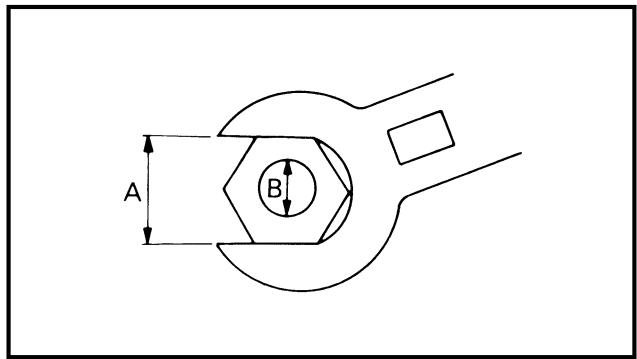
A: Distance between flats
B: Outside thread diameter
EC230000
DEFINITION OF UNITS
| Unit | Read | Definition | Measure |
| mm | millimeter | 10-3meter | Length |
| cm | centimeter | 10-2meter | Length |
| kg | kilogram | 103gram | Weight |
| N | Newton | 1 kg × m/sec2 | Force |
| Nm | Newton meter | N × m | Torque |
| m • kg | Meter kilogram | m × kg | Torque |
| Pa | Pascal | N/m2 | Pressure |
| N/mm | Newton per millimeter | N/mm | Spring rate |
| L | Liter | — | Volume or capacity |
| cm3 | Cubic centimeter | — | Volume or capacity |
| r/min | Revolution per minute | — | Engine speed |
CHARACTERISTIQUES
CHARACTERISTIQUES GENERALES
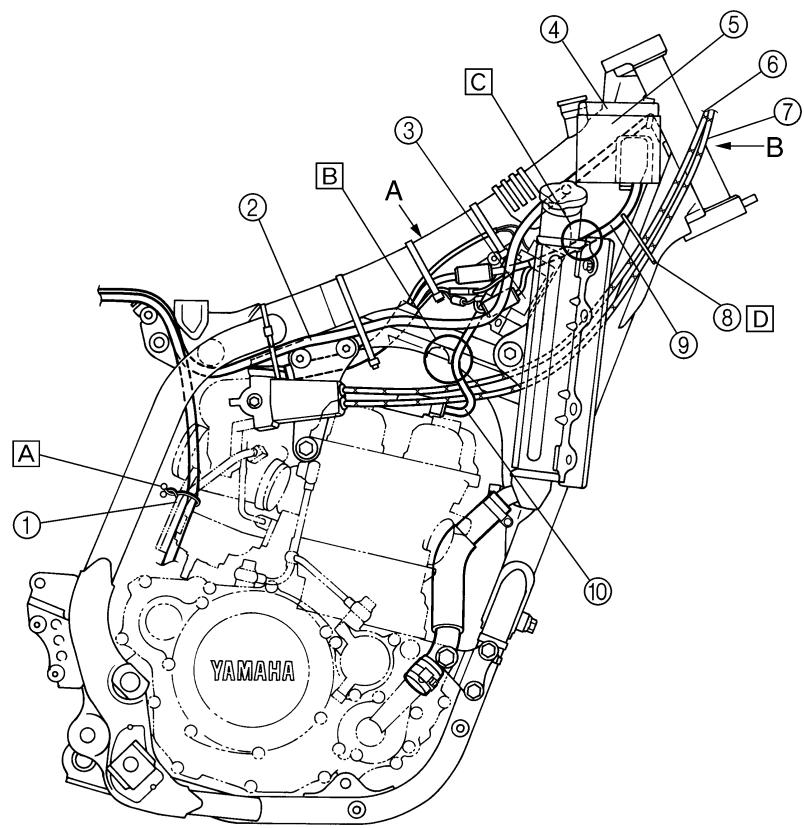
① Hose guide
② Brake hose
③ Voltage regulator
④ Light switch lead
⑤ Fuel tank breather hose
⑥ Clamp
⑦ Oil tank breather hose
⑧ Engine stop switch lead
⑨ Sub-wire harness
10 Taillight lead
① Throttle position sensor lead
Neutral switch lead
⑬ Oil hose
④ Cylinder head breather hose
CDI magneto lead
16 Clutch cable
⑦ Cable guide
18 Carburetor breather hose
19 Carburetor overflow hose
Coolant reservoir breather hose
② Decompression cable
CDI unit lead
② Ignition coil lead
② Voltage regulator lead
A Pass the fuel tank breather hose behind handlebar, then insert it into the steering stem hole.
Pass the decompression cable, engine stop switch lead and light switch lead under where the oil hose is attached.
Pass the voltage regulator lead, engine stop switch lead and light switch lead over the radiator hose.
Fasten the engine stop switch lead and ignition coil lead of the sub-wire harness.
Fasten the sub-wire harness and engine stop switch lead.
Pass the cylinder head breather hose along the right side of the oil tank breather hose.
Fasten the sub-wire harness and engine stop switch lead in front of the upper engine brackets.
Fasten the sub-wire harness.
Pass the sub-wire harness between the upper engine brackets.
Fasten the sub-wire harness.
Fasten the throttle position sensor lead.
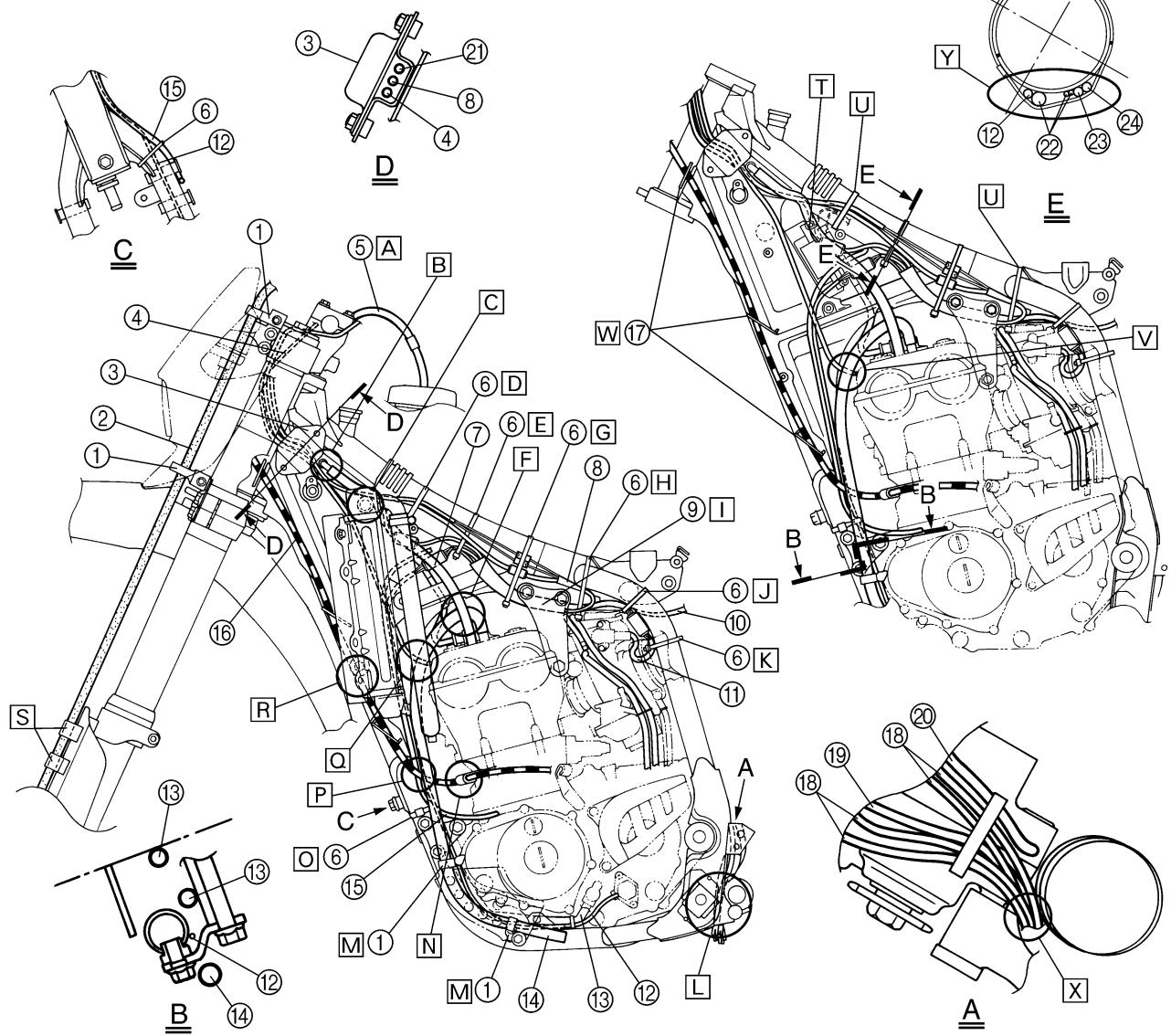
CHEMINEMENT DESCABLES
Pass the carburetor breather hose and overflow hose between the connecting rod and cross tube (frame).
Pass the cylinder head breather hose through the hose guide.
Pass the clutch cable through the cable guide.
Fasten the neutral switch lead and CDI magneto lead.
Pass the clutch cable along the inner side of the cylinder head breather hose.
Pass the cylinder head breather hose along the inner side of the radiator hose.
Pass the clutch cable in front of the radiator mounting boss.
Fit the brake hose into the guides on the protector.
Fasten the ground lead together with the ignition coil lead.
Do not allow the engine stop switch leads and light switch lead to slacken between the two clamps.
Pass the decompression cable along the right side of the cylinder head breather hose.
W Pass the clutch cable through the cable guides.
Pass the carburetor breather hoses and overflow hose so that all there hoses do not contact the rear shock absorber.
Y Position each lead at the lower left of the main tube (frame).
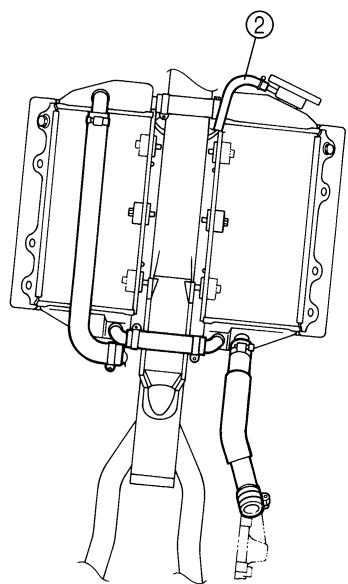
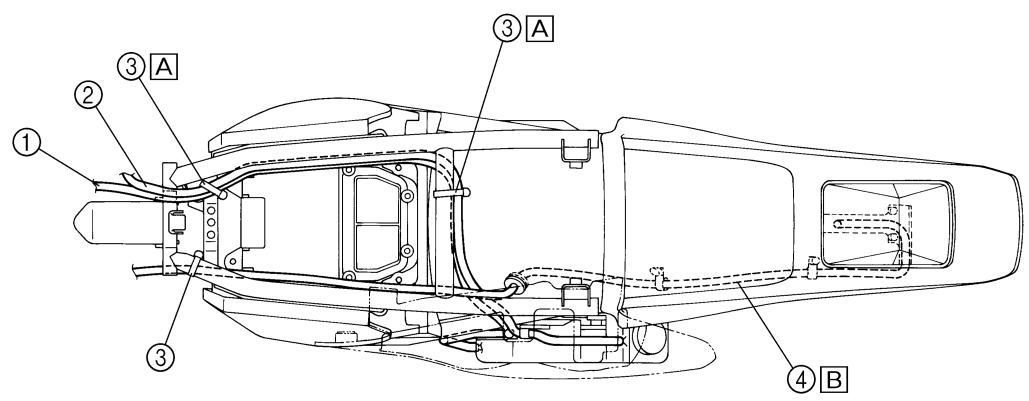
① Coolant reservoir breather hose
② Radiator breather hose
③ Ignition coil
④ CDI unit
⑤ CDI unit band
⑥ Throttle cable (return)
⑦ Throttle cable (pull)
⑧ Cable guide
⑨ CDI unit lead
Spark plug lead
⑪ CDI unit stay
A Fasten the coolant reservoir breather hose and carburetor breather hose together.
Pass the throttle cables along inner side of the spark plug lead.
Pass the CDI unit lead between the radiator hose and radiator mounting boss.
Pass the throttle cables through the cable guide.
E Insert the CDI unit band over the CDI unit stay (frame) as far as possible.
A
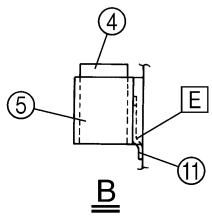
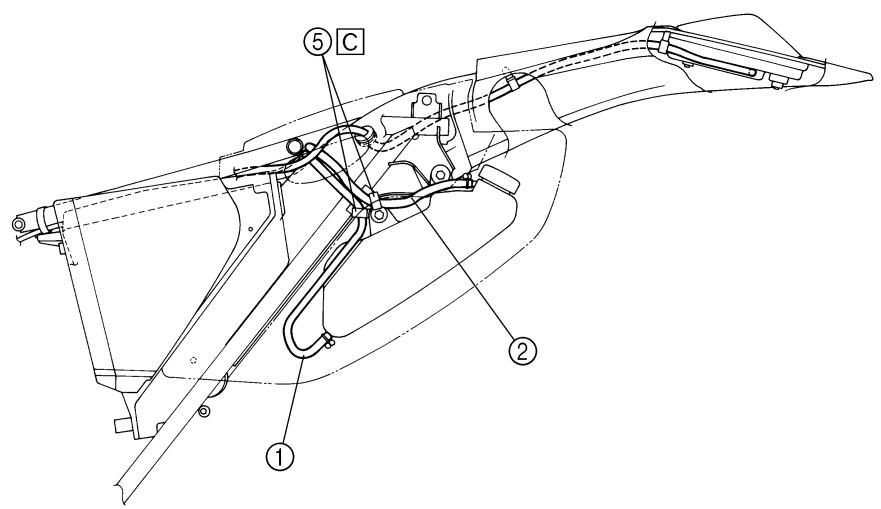
① Coolant reservoir hose
② Coolant reservoir breather hose
③ Clamp
④ Taillight lead
⑤ Hose guide
A Fasten the coolant reservoir hose and coolant reservoir breather hose.
Do not allow the taillight lead to slacken.
Pass the coolant reservoir hose and coolant reservoir breather hose through the hose guide.
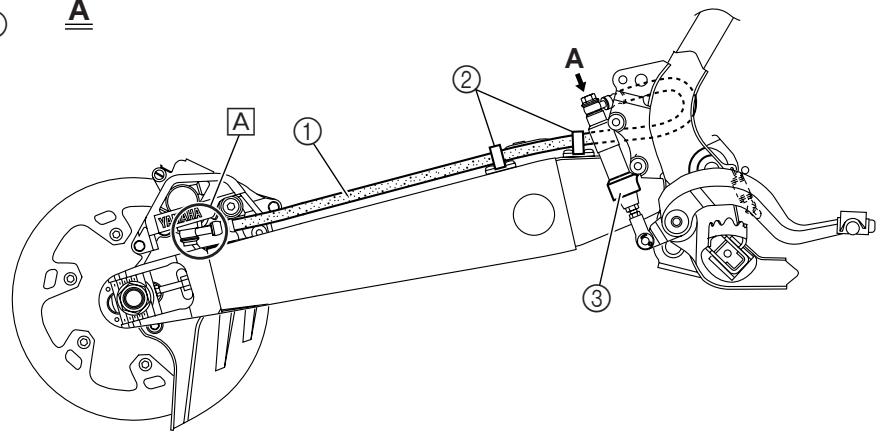
① Brake hose
② Brake hose holder
③ Brake master cylinder
A Install the brake hose to the brake caliper with the paint on the pipe facing the brake caliper and with the pipe contacting the brake caliper projection.
Pass the brake hose into the brake hose holders.
If the brake hose contacts the spring (rear shock absorber), correct its twist.
Install the brake hose so that its pipe portion directs as shown and lightly touches the projection on the brake master cylinder.
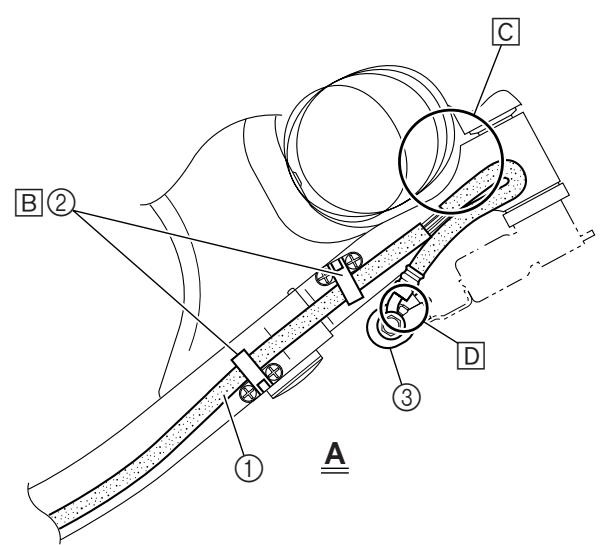
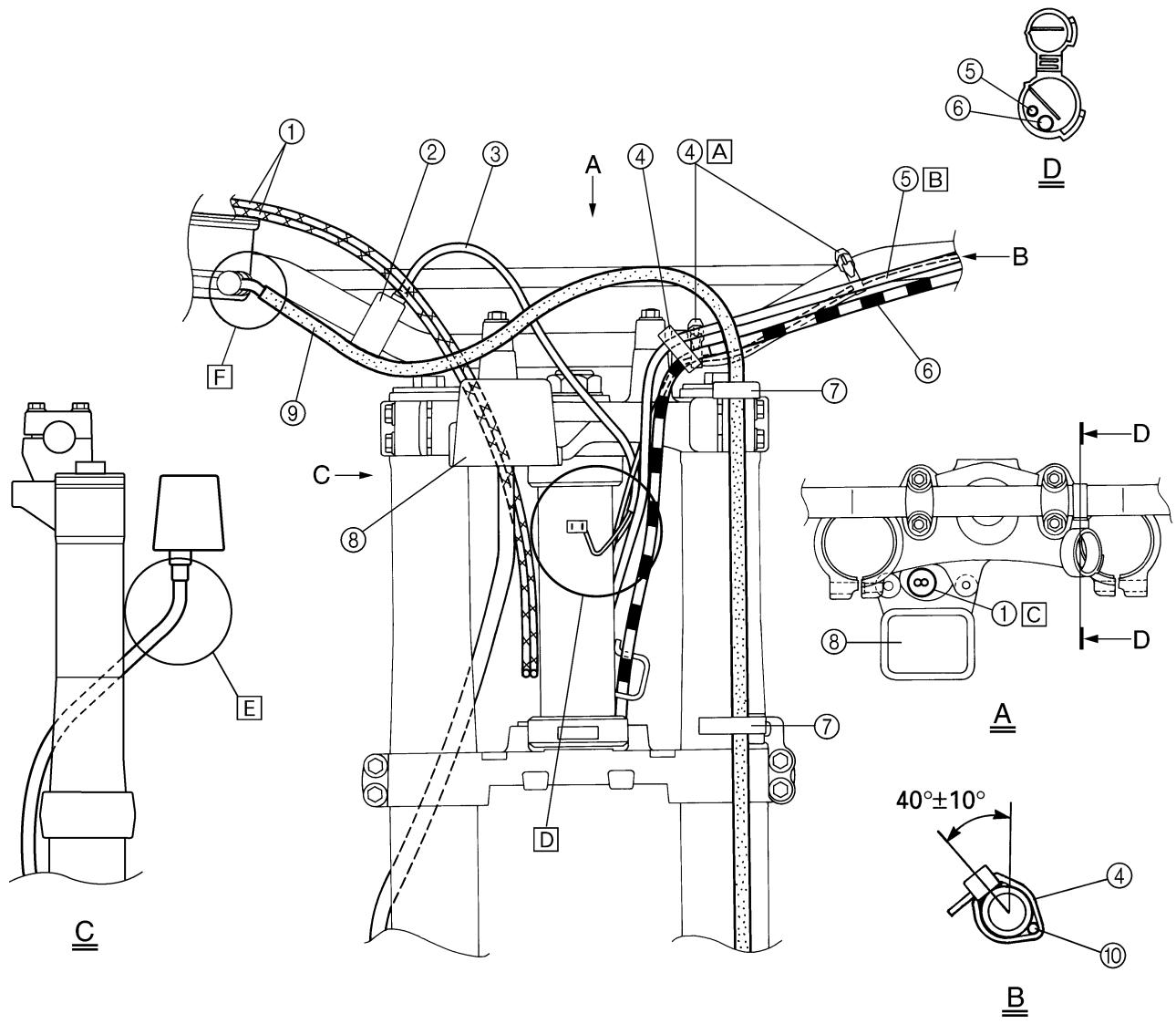
① Throttle cable
② Light switch
③ Light switch lead
④ Clamp
(5) Decompression cable
(6) Clutch cable
⑦ Hose guide
⑧ Trip meter
⑨ Brake hose
Engine stop switch lead
A Fasten the engine stop switch lead to the handlebar with the plastic band.
Pass the decompression cable between the brake hose and clutch cable.
Pass the throttle cables between the upper bracket and trip meter.
Pass the light switch leads behind the engine stop switch lead, then pass the headlight lead (of the light switch leads) in front of the head pipe.
E Install the trip meter cable so that its bent portion faces the chassis rear.
Install the brake hose so that it contacts the master cylinder projection and that its bent portion faces downward.
The following schedule is intended as a general guide to maintenance and lubrication. Bear in mind that such factors as weather, terrain, geographical location, and individual usage will alter the required maintenance and lubrication intervals. If you are a doubt as to what intervals to follow in maintaining and lubricating your machine, consult your Yamaha dealer.
| Item | After break-in | Every race | Every third race or 500 km (300 mi) | Every fifth race or 1,000 km (600 mi) | As required | Remarks |
| ENGINE OIL ReplaceInspect | ||||||
| OIL FILTER ELEMENT, OIL STRainer Clean | ||||||
| VALVES Check the valve clearances.InspectReplace | The engine must be cold. Check the valve seats and valve stems for wear. | |||||
| VALVE SPRINGSInspectReplace | Check the free length and the tilt. | |||||
| VALVE LIFTERSInspectReplace | Check for scratches and wear. | |||||
| CAMSHAFTSInspectReplace | Inspect the camshaft surface. | |||||
| TIMING CHAIN SPROCKETS, TIMING CHAINInspectReplace | Check for wear on the teeth and for damage. | |||||
| PISTONInspectCleanReplace | Inspect crack Remove carbon | |||||
| PISTON RINGInspectReplace | Check ring end gap | |||||
| PISTON PINInspectReplace | ||||||
| CYLINDER HEADInspect and clean | Remove carbon Change gasket | |||||
| CYLINDERInspect and cleanReplace | Inspect score marksInspect wear | |||||
| CLUTCHInspect and adjustReplace | ● | ● | Inspect housing, friction plate, clutch plate and spring | |||
| TRANSMISSIONInspectReplace bearing | ||||||
| SHIFT FORK, SHIFT CAM, GUIDE BAR Inspect | ● | Inspect wear | ||||
| ROTOR NUT Retighten | ● | ● | ||||
| EXHAUST PIPE, SILENCER, PROTECTOR Inspect and retighten | ● | ● | ● | * Whichever comes first | ||
| Clean Replace | ● | |||||
| *SPARK ARRESTER Clean | (Every six months) | |||||
| CRANK Inspect and clean | ● | ● | ||||
| CARBURETOR Inspect, adjust and clean | ● | ● | When using a high-pressure washer, make sure that water does not enter the accelerator pump. | |||
| SPARK PLUG Inspect and clean Replace | ● | ● | ||||
| DRIVE CHAIN Lubricate, slack, alignment Replace | ● | ● | ● | Use chain lube Chain slack: 40 ~ 50 mm (1.6 ~ 2.0 in) | ||
| COOLING SYSTEM Check coolant level and leakage Check radiator cap operation Replace coolant Inspect hoses | ● | ● | ● | Every two years | ||
| ● | ● | |||||
| OUTSIDE NUTS AND BOLTS Retighten | ● | ● | Refer to "STARTING AND BREAK-IN" section in the CHAPTER 1. | |||
| AIR FILTER Clean and lubricate Replace | ● | ● | ● | Use foam air-filter oil | ||
| FRAME Clean and inspect | ● | ● | ||||
| FUEL TANK, COCK Clean and inspect | ● | ● | ||||
| BRAKES Adjust lever position and pedal height Lubricate pivot point Check brake disc surface Check fluid level and leakage Retighten brake disc bolts, caliper bolts, master cylinder bolts and union bolts Replace pads Replace brake fluid | ● | ● | ● Every one year | |||
| FRONT FORKS Inspect and adjust Replace oil Replace oil seal | ● | ● | ● | Suspension oil "01" |
MAINTENANCE INTERVALS
| Item | After break-in | Every race | Every third race or 500 km (300 mi) | Every fifth race or 1,000 km (600 mi) | As required | Remarks |
| FRONT FORK OIL SEAL AND DUST SEAL Clean and lube | ● | ● | Lithium base grease | |||
| REAR SHOCK ABSORBER Inspect and adjust Lube Retighten | ● | ● | ● | ● | Molybdenum disulfide grease | |
| ● | ● | |||||
| CHAIN GUARD AND ROLLERS Inspect | ● | ● | ||||
| SWINGARM Inspect and retighten | ● | ● | ||||
| RELAY ARM, CONNECTING ROD Inspect and lube | ● | ● | Molybdenum disulfide grease | |||
| STEERING HEAD Inspect free play and retighten Clean and lube Replace bearing | ● | ● | ● | ● | Lithium base grease | |
| TIRE, WHEELS Inspect air pressure, wheel run-out, tire wear and spoke looseness Retighten sprocket bolt Inspect bearings Replace bearings Lubricate | ● | ● | ● | ● | Lithium base grease | |
| ● | ||||||
| ● | ||||||
| THROTTLE,CONTROL CABLE Check routing and connection Lubricate | ● | ● | Yamaha cable lube or SAE 10W-30 motor oil | |||
| ● | ● |
- marked : For USA
CONTROLES ET REGLAGES COURANTS
PROGRAMME D'ENTRETIEN
Before riding for break-in operation, practice or a race, make sure the machine is in good operating condition.
Before using this machine, check the following points.
GENERAL INSPECTION AND MAINTENANCE
| Item | Routine | Page |
| Coolant | Check that coolant is filled up to the radiator cap. Check that the coolant level is correct in the coolant reservoir. Check the cooling system for leakage. | P.3-5 ~ 9 |
| Fuel | Check that a fresh gasoline is filled in the fuel tank. Check the fuel line for leakage. | P.1-13 |
| Engine oil | Check that the oil level is correct. Check the crankcase and frame oil line for leakage. | P.3-14 ~ 17 |
| Gear shifter and clutch | Check that gears can be shifted correctly in order and that the clutch operates smoothly. | P.3-9 |
| Throttle grip/Housing | Check that the throttle grip operation and free play are correctly adjusted. Lubricate the throttle grip and housing, if necessary. | P.3-10 ~ 11 |
| Brakes | Check the play of front brake and effect of front and rear brake. | P.3-26 ~ 32 |
| Drive chain | Check drive chain slack and alignment. Check that the drive chain is lubricated properly. | P.3-33 ~ 35 |
| Wheels | Check for excessive wear and tire pressure. Check for loose spokes and have no excessive play. | P.3-43 ~ 44 |
| Steering | Check that the handlebar can be turned smoothly and have no excessive play. | P.3-44 ~ 45 |
| Front forks and rear shock absorber | Check that they operate smoothly and there is no oil leakage. | P.3-35 ~ 42 |
| Cables (wires) | Check that the clutch and throttle cables move smoothly. Check that they are not caught when the handlebars are turned or when the front forks travel up and down. | — |
| Exhaust pipe | Check that the exhaust pipe is tightly mounted and has no cracks. | P.4-2 |
| Rear wheel sprocket | Check that the rear wheel sprocket tightening bolt is not loose. | P.3-33 |
| Lubrication | Check for smooth operation. Lubricate if necessary. | P.3-46 |
| Bolts and nuts | Check the chassis and engine for loose bolts and nuts. | P.1-18 |
| Lead connectors | Check that the CDI magneto, CDI unit, and ignition coil are connected tightly. | P.1-6 |
| Settings | Is the machine set suitably for the condition of the racing course and weather or by taking into account the results of test runs before racing? Are inspection and maintenance completely done? | P.7-1 ~ 22 |
CONTROLE ET ENTRETIEN AVANT UTILISATION
Do not remove the radiator cap ① , drain bolt and hoses when the engine and radiator are hot. Scalding hot fluid and steam may be blown out under pressure, which could cause serious injury.
When the engine has cooled, place a thick towel over the radiator cap, slowly rotate the cap counterclockwise to the detent. This procedure allows any residual pressure to escape. When the hissing sound has stopped, press down on the cap while turning counterclockwise and remove it.
CAUTION:
Hard water or salt water is harmful to the engine parts. You may use distilled water, if you can't get soft water.
- Place the machine on a level place, and hold it in an upright position.
- Inspect:
Coolant level
Coolant level should be between the maximum ⑧ and minimum 6 marks.
Coolant level is below the "LOW" level line Add soft water (tap water) up to the proper level.
- Start the engine and let it warm up for several minutes.
- Turn off the engine and check the coolant level again.
NOTE:
Before checking the coolant level, wait a few minutes until the coolant settles.
COOLANT REPLACEMENT
WARNING
Do not remove the radiator cap when the engine is hot.
MOTEUR
CONTROLE DU NIVEAU DU LIQUIDE DE REFROIDISSEMENT
A VERTISSEMENT
Take care so that coolant does not splash on painted surfaces. If it splashes, wash it away with water.
- Place a container under the engine.
-
Remove:
-
Seat
- Left side cover
Refer to "SEAT FUEL TANK AND SIDE COVERS" section in the CHAPTER 4.
- Disconnect:
Coolant reservoir hose ①
Drain the coolant completely.
-
Connect:
-
Coolant reservoir hose
-
Remove:
Coolant drain bolt ①
-
Remove:
-
Radiator cap
Drain the coolant completely.
- Clean:
Cooling system
Thoroughly flush the cooling system with clean tap water.
- Install:
Copper washer
Coolant drain bolt
10 Nm (1.0 m·kg, 7.2 ft·lb)
-
Fill:
-
Radiator
Engine
To specified level.

Recommended coolant: High quality ethylene glycol anti-freeze containing anti-corrosion for aluminum engine Coolant ① and water (soft water) ② mixing ratio: 50% / 50% Coolant capacity: 1.3 L (1.14 Imp qt, 1.37 US qt)
ATTENTION:
- Do not mix more than one type of ethylene glycol antifreeze containing corrosion inhibitors for aluminum engine.
- Do not use water containing impurities or oil.
Handling notes of coolant:
The coolant is harmful so it should be handled with special care.
WARNING
- When coolant splashes to your eye. Thoroughly wash your eye with water and see your doctor.
- When coolant splashes to your clothes. Quickly wash it away with water and then with soap.
- When coolant is swallowed.
-
Quickly make him vomit and take him to a doctor.
-
Install:
-
Radiator cap
-
Fill:
Coolant reservoir
Midway ⑧ between maximum and minimum marks on the tank.
12.Install:
Coolant reservoir cap
- Start the engine and let it warm up for several minutes.
- Turn off the engine and inspect the coolant level.
Refer to "COOLANT LEVEL INSPECTION" section.
NOTE:
Before checking the coolant level wait a few minutes until the coolant settles.
EC355000
RADIATOR CAP INSPECTION
-
Inspect:
-
Seal (radiator cap) ①
- Valve and valve seat ②
Crack/damage Replace.
Exist fur deposits ③ Clean or replace.
ATTENTION:
-
Attach:
-
Radiator cap tester ① and adapter ②
Radiator cap tester: YU-24460-01/90890-01325
Radiator cap tester adapter: YU-33984/90890-01352
NOTE:
Apply water on the radiator cap seal.
③ Radiator cap
- Apply the specified pressure.
Radiator cap opening pressure: 110 kPa (1.1 kg/cm², 15.6 psi)
- Inspect:
Pressure
impossible to maintain the specified pressure for 10 seconds → Replace.
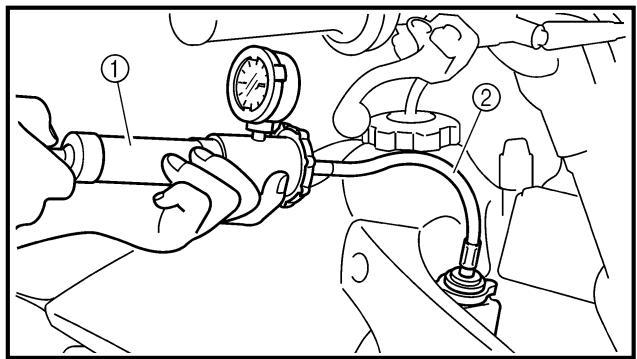
COOLING SYSTEM INSPECTION
- Inspect:
Coolant level - Attach:
- Radiator cap tester ① and adapter ②
Radiator cap tester: YU-24460-01/90890-01325
Radiator cap tester adapter: YU-33984/90890-01352
- Apply the specified pressure.
Standard pressure: 180 kPa (1.8 kg/cm², 25.6 psi)
CONTROLE DE LA PRESSION D'OUVERTURE DU BOUCHON DU RADIATEUR
- Do not apply pressure more than specified pressure.
- Radiator should be filled fully.
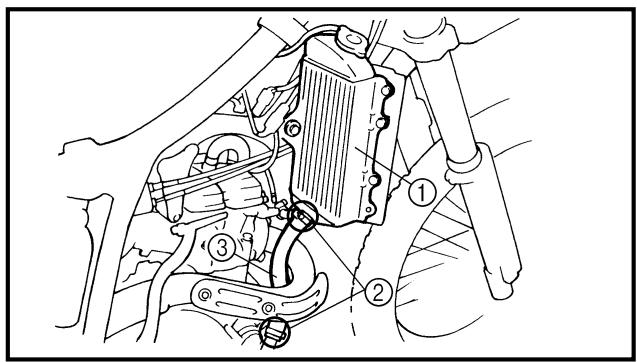
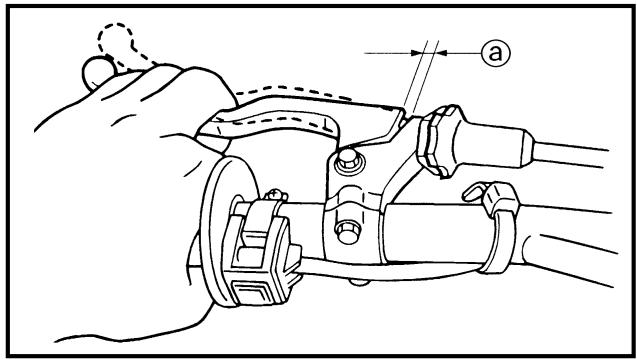
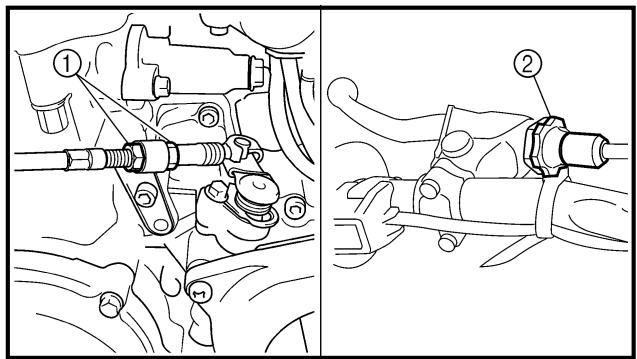
4. Inspect:
Pressure
impossible to maintain the specified pressure for 10 seconds → Repair.
- Radiator ①
- Radiator hose joint ②
Coolant leakage Repair or replace.
- Radiator hose ③
Swelling Replace.
CLUTCH ADJUSTMENT
1. Check:
- Clutch lever free play @
Out of specification Adjust.
Clutch lever free play @:
2 ~ 4 mm (0.08 ~ 0.16 in)
2. Adjust:
- Clutch lever free play
Clutch lever free play adjustment steps:
- Loosen the locknuts ①.
- Adjust the free play by changing their tightening position.
- Tighten the locknuts.
NOTE:
- Make minute adjustment on the lever side using the adjuster ②.
- After adjustment, check proper operation of clutch lever.
N.B.:
THROTTLE CABLE ADJUSTMENT
-
Check:
-
Throttle grip free play @
Out of specification Adjust.
Throttle grip free play ④ : 3 ~ 5 mm (0.12 ~ 0.20 in)
-
Adjust:
-
Throttle grip free play
Throttle grip free play adjustment steps:
- Remove the throttle cable cap ① and throttle cable cover ②.
NOTE:
- Before adjusting the throttle cable free play, the engine idle speed should be adjusted.
- When the motorcycle is accelerating, throttle cable #1 ③ is pulled and throttle cable #2 ④ is pushed.
1st step:
- Loosen the locknuts ⑤ on throttle cable #2.
- Adjust the free play by changing their tightening position.
2nd step:
- Loosen the locknuts ⑥ on throttle cable #1.
- Adjust the free play by changing their tightening position.
- Tighten the locknuts.
WARNING
After adjusting, turn the handlebar to right and left and make sure that the engine idling does not run faster.
- Install the throttle cable cover and throttle cable cap.

Throttle cable cover: 4 Nm (0.4 m • kg, 2.9 ft • lb)
-
Remove:
-
Rubber cover ①
-
Throttle grip cap ②
-
Apply:
-
Lithium soap base grease
On the throttle cable end ⑧
-
Install:
-
Throttle grip cap
- Screw (throttle grip cap)
4Nm(0.4m·kg,2.9ft·lb)
Rubber cover
DECOMPRESSION ADJUSTMENT
-
Check:
-
Decompression lever free play @
Out of specification Adjust.
Checking steps:
- Remove the timing mark accessing screw
- ① and crankshaft end accessing screw
- ②.
- Turn the crankshaft counterclockwise with a wrench.
NOTE:
Squeezing the decompression lever allows the crankshaft to be turned easily.
- Align the T.D.C. mark ⑥ on the rotor with the align mark ⑤ on the crankcase cover when piston is at T.D.C. on compression stroke.
- Check the free play.
Free play ⑧ : 5 ~ 9 mm (0.20 ~ 0.35 in)
GRAISSAGE DE L'ACCELERATEUR
- Decompression lever free play
Adjustment steps:
- Loosen the locknut ①.
- Turn the adjuster ② in or out until the adjustment is suitable.
- Tighten the locknut.
CAUTION:
After the adjustment, start the engine and make sure that the engine does not stop when the handlebar is turned fully both ways. If the decompression cable is too tense, the engine will stop by the decompression system.
AIR FILTER CLEANING
NOTE:
Proper air filter maintenance is the biggest key to preventing premature engine wear and damage.
CAUTION:
Never run the engine without the air filter element in place; this would allow dirt and dust to enter the engine and cause rapid wear and possible engine damage.
- Remove:
- Seat
- Disconnect:
- Taillight lead connectors ①
-
Remove:
Air filter case cover ② -
Remove:
-
Fitting bolt ①
- Washer ②
Air filter element ③
Air filter guide ④
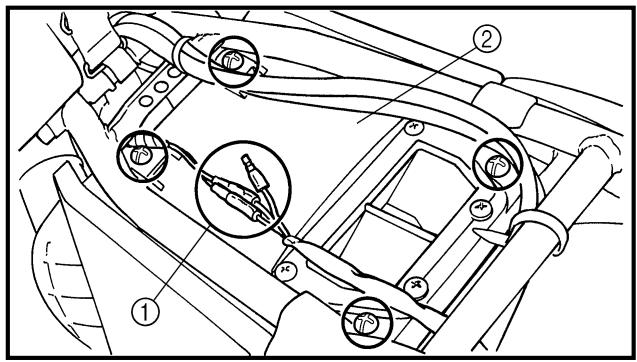
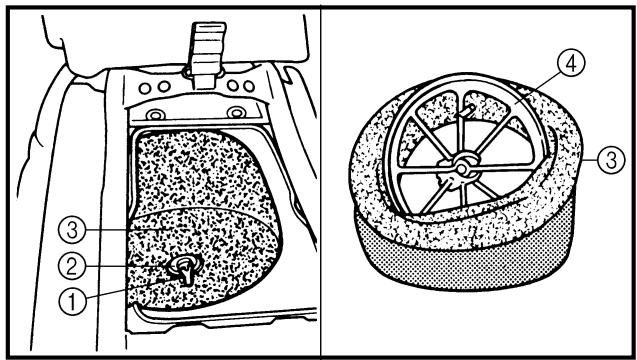
Clean them with solvent.
NOTE:
After cleaning, remove the remaining solvent
by squeezing the element.
CAUTION:
- Do not twist the element when squeezing the element.
-
Leaving too much of solvent in the element may result in poor starting.
-
Inspect:
Air filter element
Damage Replace.
- Apply:
- Foam-air-filter oil or engine oil to the element.
NOTE:
Squeeze out the excess oil. Element should be wet but not dripping.
- Install:
Air filter guide ①
NOTE:
Align the projection ⑧ on air filter guide with the hole ⑥ in air filter element.
-
Apply:
-
Lithium soap base grease
On the matching surface ⑧ on air filter element.
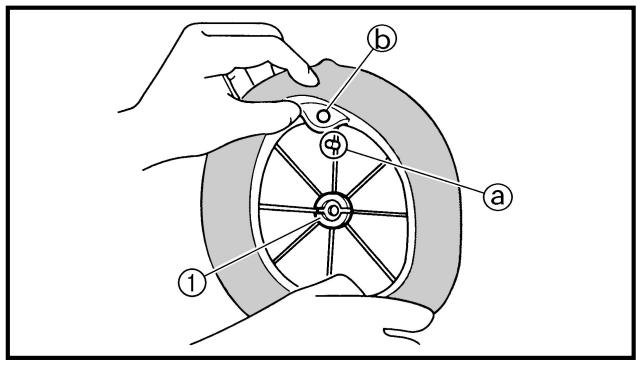
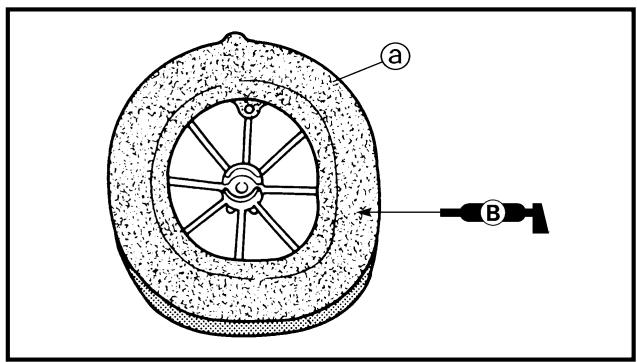
5. Nettoyer:
Air filter element ①
- Washer
Fitting bolt
2 Nm (0.2 m · kg, 1.4 ft · lb)
NOTE:
Align the projection ⑧ on filter guide with the hole ⑥ in air filter case.
ENGINE OIL LEVEL INSPECTION
- Start the engine, warm it up for several minutes, and then turn off the engine and wait for five minutes.
- Place the machine on a level place and hold it up on upright position by placing the suitable stand under the engine.
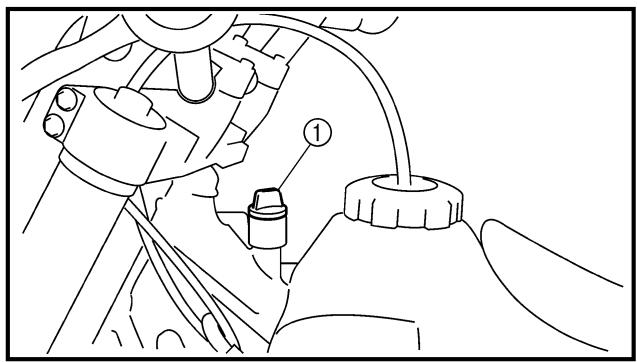
-
Remove:
-
Oil tank cap ①
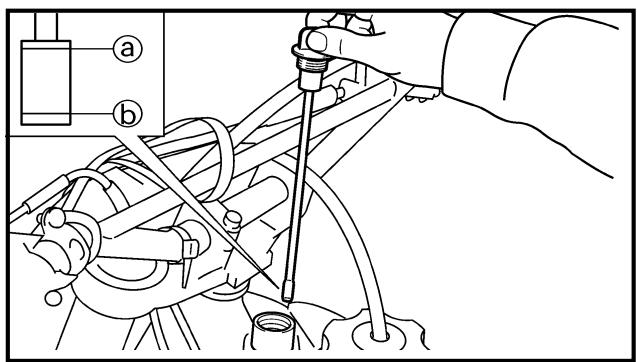
- Inspect:
Oil level
Oil level should be between maximum ⑥ and minimum 6 marks.
Oil level is low Add oil to proper level.
NOTE:
When inspecting the oil level, do not screw the oil tank cap into the oil tank. Insert the gauge lightly.
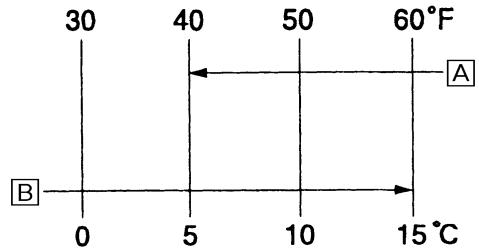
Temp.
Recommended oil:
At 5^ C ( 40^ F ) or higher
Yamalube 4 (20W-40) or
SAE 20W-40 type SH motor oil
(Non-Friction modified)
At 15^ C ( 60^ F ) or lower [B]
Yamalube 4 (10W-30) or
SAE 10W-30 type SH motor oil
(Non-Friction modified)
and/or
Yamalube 4-R (15W-50)
(Non-Friction modified)
CAUTION:
- Do not add any chemical additives. Engine oil also lubricates the clutch and additives could cause clutch slippage.
- Do not allow foreign material to enter the crankcase.
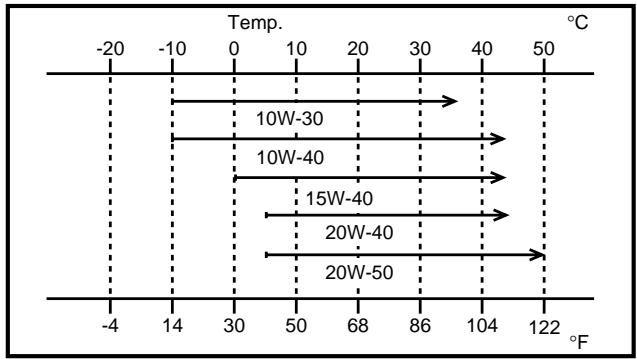
(Except for USA and CDN)

Recommended oil:
Refer to the following chart for selection of oils which are suited to the atmospheric temperatures.
Recommended engine oil classification:
API STANDARD:
API "SH" or higher grade
(Designed primarily for motorcycles)
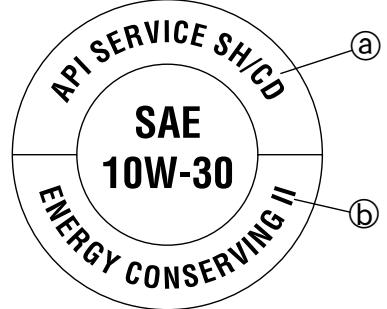
CAUTION:
- Do not add any chemical additives or use oils with a grade of CD ⑧ or higher.
- Do not use oils labeled "ENERGY CONSERVING II" ⑥ or higher. Engine oil also lubricates the clutch and additives could cause clutch slippage.
-
Do not allow foreign materials to enter the crankcase.
-
Install:
- Oil tank cap
- Start the engine and let it warm up for several minutes.
- Turn off the engine and inspect the oil level once again.
NOTE:
Wait a few minutes until the oil settles before inspecting the oil level.
ENGINE OIL REPLACEMENT
- Start the engine and warm it up for several minutes, and then turn off the engine and wait for five minute.
- Place the machine on a level place and hold it on upright position by placing the suitable stand under the engine.
- Place a suitable container under the engine.
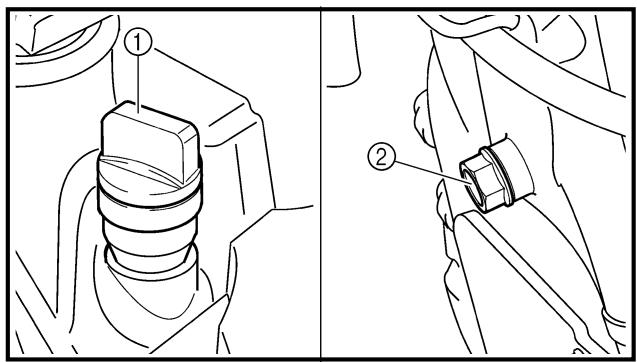
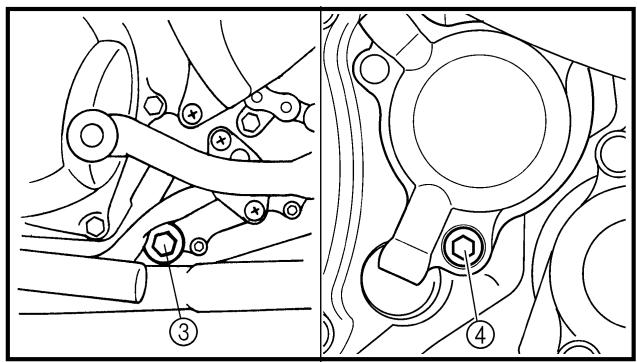
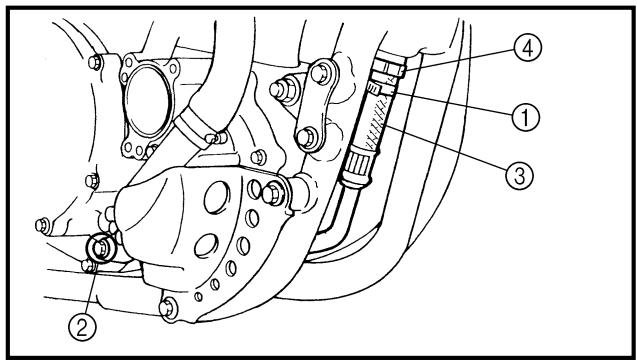
-
Remove:
-
Oil tank cap ①
- Frame oil drain bolt ②
- Crankcase oil drain bolt ③
- Oil filter element drain bolt ④
Drain the crankcase and oil tank (frame) of its oil.
-
Remove:
-
Lower engine bracket
- Oil hose clamp ①
- Bolt (oil hose) ②
- Oil hose ③
-
Oil strainer (frame) ④
-
Inspect:
-
Oil strainer (frame)
Clogged Blow.
CHANGEMENT DE L'HUILE DE MOTEUR
- If the oil filter is to be replaced during this oil change, remove the following parts and reinstall them.
Replacement steps:
- Remove the oil filter element cover ① and oil filter element ②.
- Check the O-rings ③ , if cracked or damaged, replace them with a new one.
- Install the oil filter element and oil filter element cover.
Oil filter element cover: 10 Nm (1.0 m • kg, 7.2 ft • lb)
- Install:

Copper washer ①
- Oil strainer (frame) ②

90 Nm (9.0 m · kg, 65 ft · lb)
- Oil hose ③
- Bolt (oil hose) ④

10 Nm (1.0 m · kg, 7.2 ft · lb)
- Oil hose clamp ⑤

2 Nm (0.2 m · kg, 1.4 ft · lb)
- Lower engine bracket

10 Nm (1.0 m · kg, 7.2 ft · lb)
- Install:
Copper washer

- Oil filter element drain bolt

10 Nm (1.0 m·kg, 7.2 ft·lb)
- Crankcase oil drain bolt

20Nm (2.0m· kg,14ft· lb)
- Frame oil drain bolt

23 Nm (2.3 m·kg, 17 ft·lb)
- Fill:
Engine oil

Oil quantity:
Total amount:
1.7 L (1.50 Imp qt, 1.80 US qt)
Periodic oil change:
1.5 L (1.32 Imp qt, 1.59 US qt)
With oil filter replacement:
1.6 L (1.41 Imp qt, 1.69 US qt)
-
Check:
-
Oil leakage
12.Install:
-
Oil tank cap
-
Check:
Engine oil level
CHANGEMENT DE L'HUILE DE MOTEUR MOTORÖL WECHSELN SOSTITUZIONE DELL'OLIO MOTORE
(1,41 Imp qt, 1,69 US qt)
(1,41 Imp qt, 1,69 US qt)
- Slightly loosen the oil pressure check bolt ①.
- Start the engine and keep it idling until oil starts to seep from the oil pressure check bolt. If no oil comes out after one minute, turn the engine off so it will not seize.
- Check oil passages and oil pump for damage or leakage.
- Start the engine after solving the problem(s) and recheck the oil pressure.
- Tighten the oil pressure check bolt.
Oil pressure check bolt: 10 Nm (1.0 m • kg, 7.2 ft • lb)
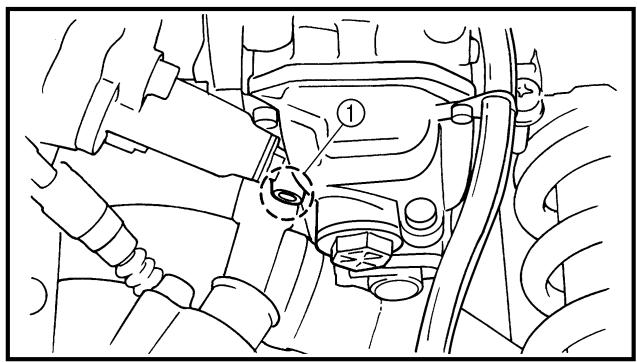
PILOT SCREW ADJUSTMENT
-
Adjust:
-
Pilot screw ①
Adjustment steps:
NOTE:
To optimize the fuel flow at a smaller throttle opening, each machine's pilot screw has been individually set at the factory. Before adjusting the pilot screw, turn it in fully and count the number of turns. Record this number as the factory-set number of turns out.
- Turn in the pilot screw until it is lightly seated.
- Turn out the pilot screw by the factory-set number of turns.
Pilot screw: 1-3/4 turns out (example)
CONTROLE DE LA PRESSION D'HUIL
ENGINE IDLING SPEED ADJUSTMENT
- Start the engine and thoroughly warm it up.
-
Attach:
-
Inductive tachometer
-
To spark plug lead.
-
Adjust:
- Engine idling speed
| Adjustment steps: ·Adjust the pilot screw. Refer to “PILOT SCREW ADJUSTMENT” section. ·Turn the throttle stop screw ① until the engine runs at the lowest possible speed. | |
| To increase idle speed → Turn the throttle stop screw ① in ⑧. To decrease idle speed → Turn the throttle stop screw ① out ⑧. | |
| Inductive tachometer: YU-08036-B Engine tachometer: 90890-03113 | |
| Engine idling speed: 1,700 ~ 1,900 r/min | |
VALVE CLEARANCE INSPECTION AND ADJUSTMENT
NOTE:
- The valve clearance should be adjusted when the engine is cool to the touch.
-
The piston must be at Top Dead Center (T.D.C.) on compression stroke to check or adjust the valve clearance.
-
Remove:
-
Seat
-
Fuel tank Refer to "SEAT, FUEL TANK AND SIDE COVERS" section in the CHAPTER 4.
-
Drain:
-
Coolant Refer to "COOLANT REPLACEMENT" section.
REGLAGE DU REGIME DE RALENTI/CONTROLE ET REGLAGE DU JEU DE SOUPAPES LEERLAUFDEHZAHL EINSTELEN/VENTILSPIEL KONTROLLIEREN UND EINSTELLEN REGOLAZIONE DEL MINIMO/CONTROLLO E REGOLAZIONE DEL GIOCO DELLE VALVOLE
- Right radiator Refer to "RADIATOR" section in the CHAPTER 4.
- Carburetor Refer to "CARBURETOR" section in the CHAPTER 4.
- Spark plug
- Upper engine bracket
- Cylinder head cover Refer to "CAMSHAFTS" section in the CHAPTER 4.
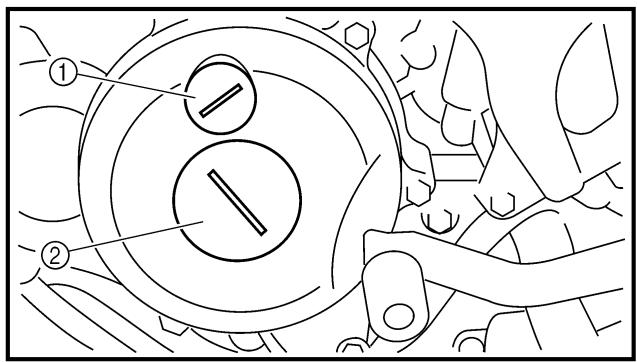
4. Remove:
- Timing mark accessing screw ①
Crankshaft end accessing screw ② - O-ring
5. Check:
- Valve clearance Out of specification Adjust.
Valve clearance (cold):
Intake valve:
0.10 ~ 0.15 mm (0.0039 ~ 0.0059 in)
Exhaust valve:
0.17 ~ 0.22 mm (0.0067 ~ 0.0087 in)
CONTROLE ET REGLAGE DU JEU DE SOUPAPES VENTILSPIEL KONTROLLIEREN UND EINSTELLEN CONTROLLOE REGOLAZIONE DEL GIOCO DELLE VALVOLE
3. Déposer:
- Turn the crankshaft counterclockwise with a wrench.
NOTE: Squeezing the decompression lever allows the crankshaft to be turned easily.
- Align the T.D.C. mark ⑧ on the rotor with the align mark ⑥ on the crankcase cover when piston is at T.D.C. on compression stroke.
NOTE:
In order to be sure that the piston is at Top Dead Center, the punch mark © on the exhaust camshaft and the punch mark © on the intake camshaft must align with the cylinder head surface, as shown in the illustration.
- Measure the valve clearance ⑥ using a feeler gauge ① .
NOTE:
Record the measured reading if the clearance is incorrect.
-
Adjust:
-
Valve clearance
Adjustment steps:
- Remove the camshaft (intake and exhaust). Refer to "CAMSHAFTS" section in the CHAPTER 4.
- Remove the decompression cable ①, guide ②, bolt ③ and decompression shaft ④.
- Remove the valve lifters ⑤ and the pads ⑥.
NOTE:
- Place a rag in the timing chain space to prevent pads from falling into the crank-case.
- Identity each valve lifter and pad position very carefully so that they can be rein-stalled in their original place.
- Select the proper pad using the pad selecting table.
| Pad range | Pad Availability: 25 increments | |
| No. 120 | 1.20 mm | Pads are available in 0.05 mm increments |
| ~ | ||
| No. 240 | 2.40 mm | |
NOTE:
The thickness ⑧ of each pad is indicated in hundredths of millimeters on the pad upper surface.
- Round off the last digit of the installed pad number to the nearest increment.
| Last digit of pad number | Rounded value |
| 0 or 2 | 0 |
| 5 | (NOT ROUNDED OFF) |
| 8 | 10 |
EXAMPLE:
Installed pad number = 148
Rounded off value = 150
NOTE:
Pads can only be selected in 0.05mm increments.
- Locate the rounded-off value and the measured valve clearance in the chart "PAD SELECTION TABLE". The field where these two coordinates intersect shows the new pad number to use.
NOTE: Use the new pad number only as a guide when verifying the valve clearance adjustment.
- Install the new pads ⑦ and the valve lifters ⑧ .
NOTE:
- Apply the engine oil on the valve lifters.
- Apply the molybdenum disulfied oil on the valve stem ends.
- Valve lifter must turn smoothly when rotated with a finger.
- Be careful to reinstall valve lifters and pads in their original place.
Install the decompression shaft ⑨ , copper washer ⑩ , bolt (decompression shaft) ⑪ , guide ⑫ , bolt (guide) ⑬ and decompression cable ⑭ .
NOTE: Apply the engine oil on the decompression shaft.
Bolt (decompression shaft):
7 Nm (0.7 m • kg, 5.1 ft • lb)
Bolt (guide):
10 Nm (1.0 m • kg, 7.2 ft • lb)
Install the camshafts (exhaust and intake). Refer to "CAMSHAFTS" section in the CHAPTER 4.
- Be sure the exhaust pipe and muffler are cool before cleaning the spark arrester.
- Do not start the engine when cleaning the exhaust system.
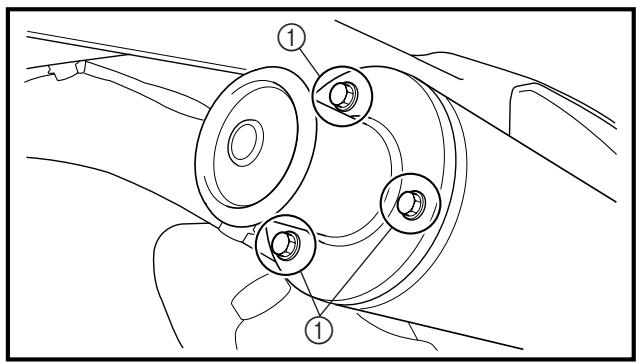
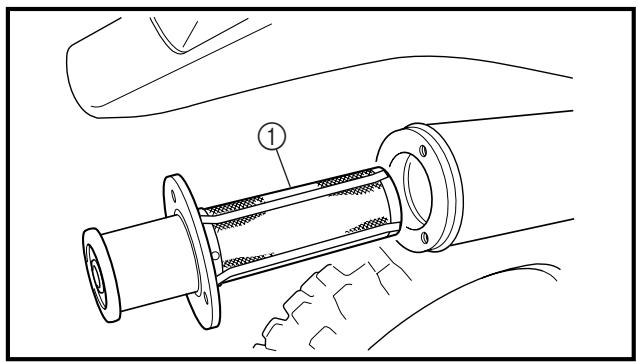
-
Remove:
-
Bolt (spark arrester) ①
-
Remove:
-
Spark arrester ①
Pull the spark arrester out of the muffler.
-
Clean:
-
Spark arrester
Tap the spark arrester lightly, then use a wire brush to remove any carbon deposits.
-
Install:
-
Spark arrester
Insert the spark arrester into the muffler and align the bolt holes.
- Bolt (spark arrester)
10 Nm (1.0 m · kg, 7.2 ft · lb)
NETTOYAGE DU PARE-ETINCELLES (pour les USA)/ FUNKENFÄNGER REINIGEN (NUR USA) PULIZIA DEL PARASCINTILLE (Per USA)
NETTOYAGE DU PARE-ETINCELLES (pour les USA)
A VERTISSEMENT
Bleed the brake system if:
- The system has been disassembled.
- A brake hose has been loosened or removed.
- The brake fluid is very low.
- The brake operation is faulty.
A dangerous loss of braking performance may occur if the brake system is not properly bleed.
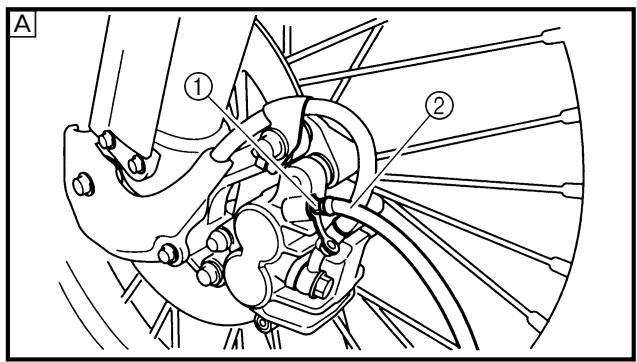
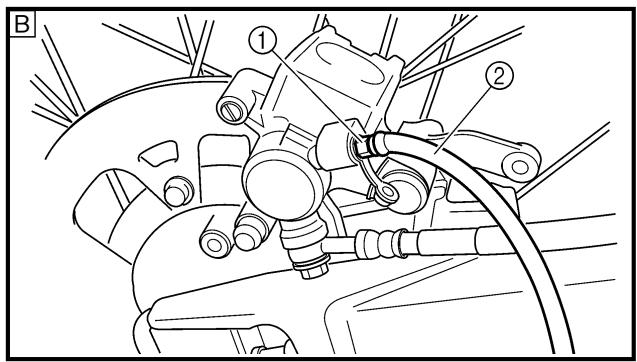
- Remove:
Reservoir cap
Diaphragm
- Protector (rear brake)
-
Bleed:
-
Brake fluid
A Front
Rear
Air bleeding steps:
a. Add proper brake fluid to the reservoir.
b. Install the diaphragm. Be careful not to spill any fluid or allow the reservoir to overflow.
c. Connect the clear plastic tube ② tightly to the caliper bleed screw ①.
d. Place the other end of the tube into a container.
e. Slowly apply the brake lever or pedal several times.
f. Pull the lever in or push down on the pedal. Hold the lever or pedal in position.
g. Loosen the bleed screw and allow the lever or pedal to travel towards its limit.
h. Tighten the bleed screw when the lever or pedal limit has been reached; then release the lever or pedal.

Bleed screw: 6 Nm (0.6 m • kg, 4.3 ft • lb)
i. Repeat steps (e) to (h) until of the air bubbles have been removed from the system.
PARTIE CYCLE
PURGE DE L'AIR DU SYSTEME DE FREINAGE
A VERTISSEMENT
If bleeding is difficult, it may be necessary to let the brake fluid system stabilize for a few hours. Repeat the bleeding procedure when the tiny bubbles in the system have disappeared.
j. Add brake fluid to the level line on the reservoir.
WARNING
Check the operation of the brake after bleeding the brake system.
3. Install:
- Protector (rear brake)
Diaphragm - Reservoir cap
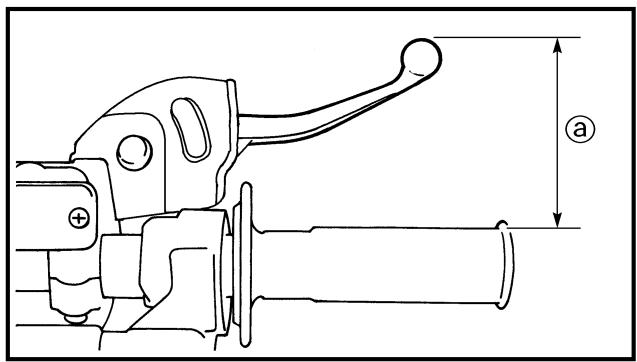
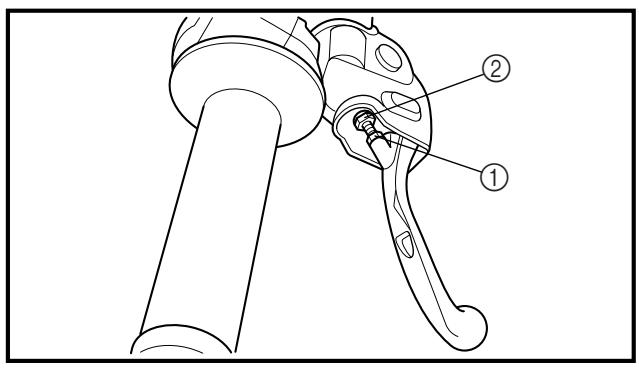
EC362040
- Brake lever position @
| Brake lever position @: | |
| Standard position | Extent of adjustment |
| 95 mm (3.74 in) | 76 ~ 97 mm (2.99 ~ 3.82 in) |
2. Adjust:
- Brake lever position
Brake lever position adjustment steps:
- Loosen the locknut ①.
- Turn the adjusting bolt ② until the lever position ⑧ is within specified position.
- Tighten the locknut.
Locknut:
5 Nm (0.5 m • kg, 3.6 ft • lb)
CAUTION:
Be sure to tighten the locknut, as it will cause poor brake performance.
N.B.:
-
Check:
-
Brake pedal height @
Out of specification Adjust.
Brake pedal height ① : 5 mm (0.20 in)
-
Adjust:
-
Brake pedal height
Pedal height adjustment steps:
- Loosen the locknut ①.
- Turn the adjusting nut ② until the pedal height 已 is within specified height.
- Tighten the locknut.
WARNING
- Adjust the pedal height between the maximum A and the minimum B as shown. (In this adjustment the bolt ③ end ⑥ should protrude out of the lower adjusting nut ④ but not be less than 2 mm (0.08 in) ⑨ away from the brake pedal ⑤).
- After the pedal height adjustment, make sure that the rear brake does not drag.
FRONT BRAKE PAD INSPECTION AND REPLACEMENT
-
Inspect:
-
Brake pad thickness @
Out of specification Replace as a set.
Brake pad thickness:
4.4 mm (0.17 in)
-
Replace:
-
Brake pad
Brake pad replacement steps:
- Remove the pad pin plug ①.
REGLAGE DU FREIN ARRIERE
- Contoler:
- Loosen the pad pin ②.
- Remove the brake hose holder ③ and brake caliper ④ from the front fork.
- Remove the pad pin and brake pads ⑤.
- Connect the transparent hose ⑥ to the bleed screw ⑦ and place the suitable container under its end.
- Loosen the bleed screw and push the brake caliper piston in.
CAUTION:
Do not reuse the drained brake fluid.
- Tighten the bleed screw.
Bleed screw: 6 Nm (0.6 m • kg, 4.3 ft • lb)
Install the brake pads ⑧ and pad pin.
NOTE:
Install the brake pads with their projections ⑧ into the brake caliper recesses 6 8
- Temporarily tighten the pad pin at this point.
- Install the brake hose holder ⑨ and brake caliper 10 and tighten the pad pin 11 .
NOTE:
Fit the brake hose holder cut ⑥ over the projection ⑥ on the front fork and clamp the brake hose.
Bolt (brake caliper): 23 Nm (2.3 m • kg, 17 ft • lb) Pad pin: 18 Nm (1.8 m • kg, 13 ft • lb)
Install the pad pin plug ⑫.
3 Nm (0.3 m • kg, 2.2 ft • lb)
-
Inspect:
-
Brake fluid level Refer to "BRAKE FLUID LEVEL INSPECTION" section.
-
Check:
-
Brake lever operation A soft or spongy feeling Bleed brake system. Refer to "BRAKE SYSTEM AIR BLEEDING" section.
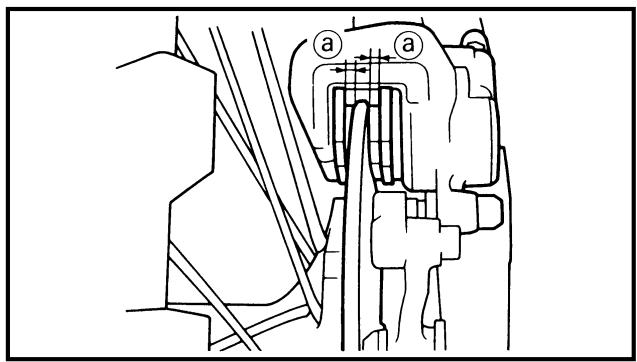
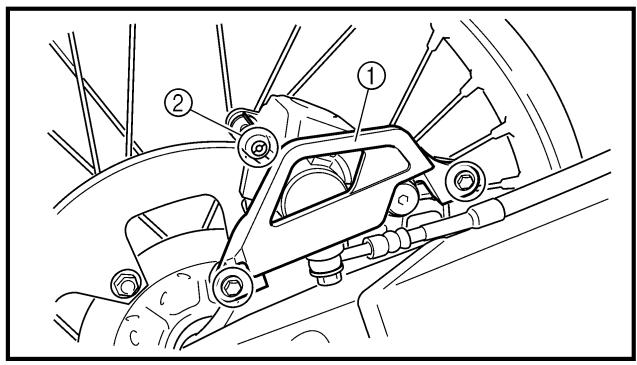
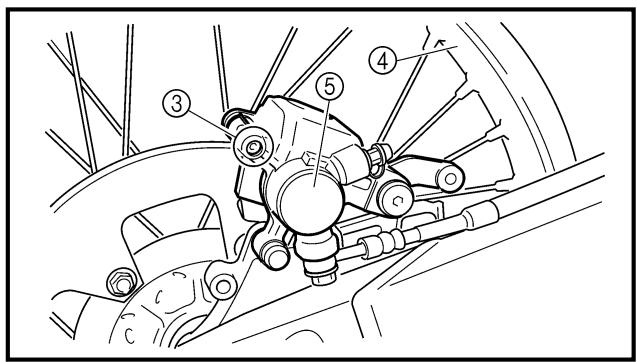
REAR BRAKE PAD INSPECTION AND REPLACEMENT
-
Inspect:
-
Brake pad thickness ⑧ Out of specification Replace as a set.
Brake pad thickness: 6.4 mm (0.25 in)
-
Replace:
-
Brake pad
Brake pad replacement steps:
- Remove the protector ① and pad pin plug ②.
- Loosen the pad pin ③.
- Remove the rear wheel ④ and brake caliper ⑤ . Refer to “FRONT WHEEL AND REAR WHEEL” section in the CHAPTER 5.
3. Vérifier:
- Remove the pad pin ⑥ and brake pads ⑦ .
- Connect the transparent hose ⑧ to the bleed screw ⑨ and place the suitable container under its end.
- Loosen the bleed screw and push the brake caliper piston in.
CAUTION:
Do not reuse the drained brake fluid.
- Tighten the bleed screw.
Bleed screw: 6 Nm (0.6 m • kg, 4.3 ft • lb)
Install the brake pad ⑩ and pad pin ①
NOTE:
Install the brake pads with their projections ④ into the brake caliper recesses ⑥
- Temporarily tighten the pad pin at this point.
Install the brake caliper ⑫ and rear wheel ⑬ .
Refer to "FRONT WHEEL AND REAR WHEEL" section in the CHAPTER 5.
- Tighten the pad pin ⑭.

Pad pin: 18 Nm (1.8 m • kg, 13 ft • lb)
- Install the pad pin plug ⑤ and protector 16
3 Nm (0.3 m • kg, 2.2 ft • lb)
Bolt (protector): 7 Nm (0.7 m • kg, 5.1 ft • lb)
Boulon (protection):
7Nm
(0,7m· kg,5,1ft lb)
Refer to "BRAKE FLUID LEVEL INSPECTION" section.
4. Check:
- Brake pedal operation
A soft or spongy feeling Bleed brake system.
Refer to "BRAKE SYSTEM AIR
BLEEDING" section.
EC36b000
REAR BRAKE PAD INSULATOR
INSPECTION
1. Remove:
- Brake pad
Refer to "REAR BRAKE PAD INSPECTION AND REPLACEMENT" section.
2. Inspect:
- Rear brake pad insulator ①
Damage Replace.
- Place the brake master cylinder (reservoir tank) so that its top is in a horizontal position.
2. Inspect:
- Brake fluid level
Fluid at lower level Fill up.
Lower level
A Front
Rear

Recommended brake fluid: DOT #4
WARNING
- Use only designated quality brake fluid to avoid poor brake performance.
- Refill with same type and brand of brake fluid; mixing fluids could result in poor brake performance.
- Be sure that water or other contaminants do not enter master cylinder when refilling.
-
Clean up spilled fluid immediately to avoid erosion of painted surfaces or plastic parts.
-
Vérifier:
-
Niveau du liquide de frein
Se reporter à la section “CON-TROLE DU NIVEAU DE LIQUIDE DE FREIN”. -
Controller:
-
Fonctionnement de la pedale de frein
Sensation de mollesse Purger le circuit de freinage.
Se reporter à la section “PURGE DE L’AIR DU SYSTEME DE FREINAGE”.
CONTROLE DE L'ISOLANT DE LA PLAQUETTE DE FREIN ARRIERE
-
Inspect:
-
Sprocket teeth ⑧ Excessive wear Replace.
NOTE:
Replace the drive sprocket, rear wheel sprocket and drive chain as a set.
DRIVE CHAIN INSPECTION
-
Remove:
-
Drive chain ①
NOTE: Remove the drive chain using a chain cutter ②.
-
Clean:
-
Drive chain
Brush off as much dirt as possible. Then clean the chain using the chain cleaner.
CAUTION:
This machine has a drive chain with small rubber O-rings ① between the chain plates. Steam cleaning, high-pressure washes, certain solvent and kerosene can damage these O-rings.
-
Measure:
-
Drive chain length (10 links) @
Out of specification Replace.
Drive chain length (10 links):
-
Check:
-
Drive chain stiffness @ Clean and oil the chain and hold as illustrated.
Stiff Replace drive chain.
CONTROLE DES PIGNONS
- Controller:
Dents de pignon ⑧
Usure excessive Remplacer.
N.B.:
- Chain joint ①
- O-ring ②
- Drive chain ③
NOTE:
When installing the drive chain, apply the lithium soap base grease on the chain joint and O-rings.
6. Install:
- Link plate ④

NOTE:
- Press the link plate onto the chain joint using a chain rivetter ⑤.
- Rivet the end of the chain joint using a chain rivetter ⑥.
- After riveting the chain joint, make sure its movement is smooth.
7. Lubricate:
- Drive chain

Drive chain lubricant: SAE 10W-30 motor oil or suitable chain lubricants
EC36A060
DRIVE CHAIN SLACK ADJUSTMENT
- Elevate the rear wheel by placing the suitable stand under the engine.
-
Check:
-
Drive chain slack
Above the seal guard installation bolt.
Out of specification Adjust.
Drive chain slack: 40 50 ~mm (1.6 ~ 2.0 in)
NOTE:
Before checking and/or adjusting, rotate the rear wheel through several revolutions and check the slack several times to find the tightest point. Check and/or adjust chain slack with rear wheel in this "tight chain" position.
- Monter:
Raccord de chaîne ①
New
- Joint torque ②
- Chaigne de transmission ③
N.B.:
Drive chain slack adjustment steps:
- Loosen the axle nut ① and locknuts ②.
- Adjust chain slack by turning the adjusters ③
To tighten Turn adjuster ③ counterclockwise.
To loosen Turn adjuster ③ clockwise and push wheel forward.
- Turn each adjuster exactly the same amount to maintain correct axle alignment. (There are marks @ on each side of chain puller alignment.)
NOTE:
Turn the adjuster so that the chain is in line with the sprocket, as viewed from the rear.
CAUTION:
Too small chain slack will overload the engine and other vital parts; keep the slack within the specified limits.
- Tighten the axle nut while pushing down the drive chain.

Axle nut:
125 Nm (12.5 m·kg, 90 ft·lb)
- Tighten the locknuts.
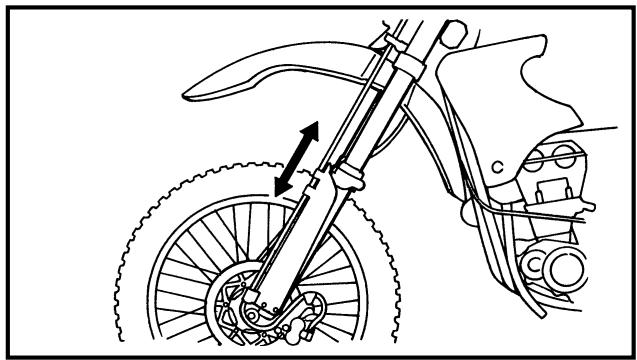
EC36C000
FRONT FORK INSPECTION
-
Inspect:
-
Front fork smooth action
Operate the front brake and stroke the front fork.
Unsmooth action/oil leakage Repair or replace.
CONTROLE DE LA FOURCHE AVANT TELESKOPGABEL KONTROLLIEREN ISPEZIONE FORCELLA ANTERIORE
3. Régler:
Flèche de chaine de transmission
EC36D001 FRONT FORK OIL SEAL AND DUST SEAL CLEANING
-
Remove:
-
Protector
- Dust seal ①
NOTE: Use a thin screw driver, and be careful not to damage the inner fork tube and dust seal.
-
Clean:
-
Dust seal @
- Oil seal (b)
NOTE:
- Clean the dust seal and oil seal after every run.
- Apply the lithium soap base grease on the inner tube.
EC36H002 FRONT FORK REBOUND DAMPING FORCE ADJUSTMENT
-
Adjust:
-
Rebound damping force
By turning the adjuster ①.
Stiffer ④ Increase the rebound damping force. (Turn the adjuster ① in.)
Softer ⑥ Decrease the rebound damping force. (Turn the adjuster ① out.)
| Extent of adjustment | |
| Maximum | Minimum |
| Fully turned in position | 20 clicks out (from maximum position) |
- STANDARD POSITION: This is the position which is back by the specific number of clicks from the fully turned-in position.
Standard position:
14 clicks out
-
13 clicks out
-
For EUROPE
NETTOYAGE DE BAGUE D'ETANCHEITE ET DE JOINT ANTIPOUSSIERE DE FOURCHE AVANT
- Déposer:
Protection
- Joint antipoussière ①
N.B.:
Do not force the adjuster past the minimum or maximum extent of adjustment. The adjuster may be damaged.
WARNING
Always adjust each front fork to the same setting. Uneven adjustment can cause poor handling and loss of stability.
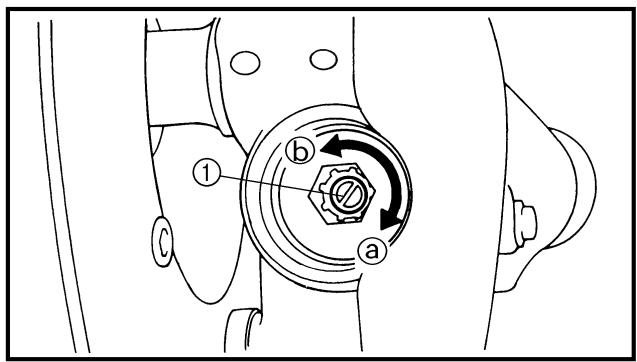
EC36J001
FRONT FORK COMPRESSION DAMPING FORCE ADJUSTMENT
- Remove:
Rubber cap - Adjust:
- Compression damping force By turning the adjuster ①.
| Stiffer a → Increase the compression damping force. (Turn the adjuster ① in.) |
| Softer b → Decrease the compression damping force. (Turn the adjuster ① out.) |
| Extent of adjustment | |
| Maximum | Minimum |
| Fully turned in position | 20 clicks out (from maximum position) |
ATTENTION:
This is the position which is back by the specific number of clicks from the fully turned-in position.

Standard position:
10 clicks out
*, **15 clicks out
- For EUROPE
** For AUS, NZ and ZA
CAUTION:
Do not force the adjuster past the minimum or maximum extent of adjustment. The adjuster may be damaged.
WARNING
Always adjust each front fork to the same setting. Uneven adjustment can cause poor handling and loss of stability.
-
Install:
-
Rubber cap
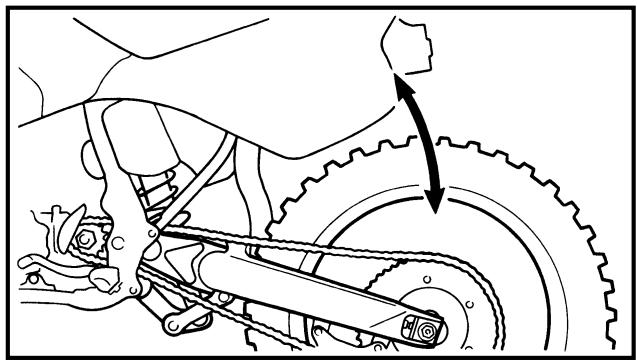
EC36K000
REAR SHOCK ABSORBER INSPECTION
-
Inspect:
-
Swingarm smooth action
Abnormal noise/unsmooth action Grease the pivoting points or repair the pivoting points.
Damage/oil leakage Replace.
- POSITION STANDARD:
- Elevate the rear wheel by placing the suitable stand under the engine.
- Remove:
Rear frame
- Loosen:
- Locknut ①
- Adjust:
- Spring preload By turning the adjuster ② .
| Stiffer → Increase the spring preload. (Turn the adjuster ② in.) Softer → Decrease the spring preload. (Turn the adjuster ② out.) |
| Spring length (installed) @: | |
| Standard length | Extent of adjustment |
| 240.5 mm (9.47 in) *247 mm (9.72 in) **243.5 mm (9.59 in) | 240.5 ~ 258.5 mm (9.47 ~ 10.18 in) |
- For EUROPE
** For AUS, NZ and ZA
NOTE:
- Be sure to remove all dirt and mud from around the locknut and adjuster before adjustment.
- The length of the spring (installed) changes 1.5 mm (0.06 in) per turn of the adjuster.
CAUTION:
Never attempt to turn the adjuster beyond the maximum or minimum setting.
- Tighten:
- Locknut
- Install:
Rear frame
29 Nm (2.9 m·kg, 21 ft·lb)
REGLAGE DE LA PRECONTRAINTE DE RESSORT DE L'AMORTISSEUR ARRIERE
-
Adjust:
-
Rebound damping force By turning the adjuster ①.
Stiffer ⑧ Increase the rebound damping force. (Turn the adjuster ① in.)
Softer ⑥ Decrease the rebound damping force. (Turn the adjuster ① out.)
| Extent of adjustment | |
| Maximum | Minimum |
| Fully turned in position | 20 clicks out (from maximum position) |
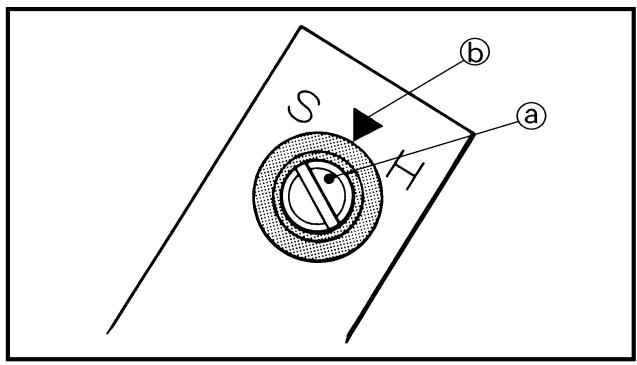
STANDARD POSITION:
This is the position which is back by the specific number of clicks from the fully turned-in position. (Which align the punch mark on the adjuster with the punch mark on the bracket.)
Standard position: About 7 clicks out , *About 10 clicks out
- For EUROPE
** For AUS, NZ and ZA
CAUTION:
Do not force the adjuster past the minimum or maximum extent of adjustment. The adjuster may be damaged.
REGLAGE DE LA FORCE D'AMORTISSEMENT DE DETENTE DE L'AMORTISSEUR ARRIERE
-
Adjust:
-
Low compression damping force By turning the adjuster ①.
Stiffer ⑧ Increase the low compression damping force. (Turn the adjuster ① in.)
Softer Decrease the low compression damping force. (Turn the adjuster ① out.)
| Extent of adjustment | |
| Maximum | Minimum |
| Fully turned in position | 20 clicks out (from maximum position) |
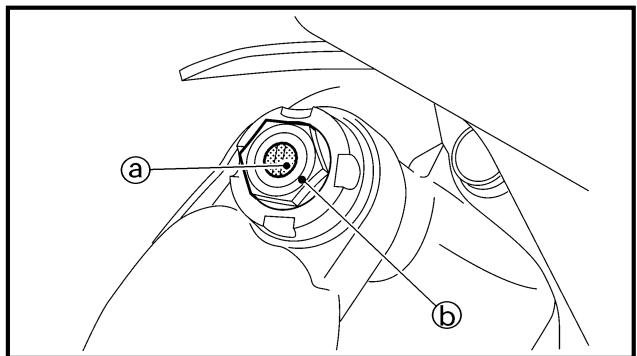
STANDARD POSITION:
This is the position which is back by the specific number of clicks from the fully turned-in position. (Which align the punch mark ⑧ on the adjuster with the punch mark ⑥ on the high compression damping adjuster.)
Standard position:
About 9 clicks out
, *About 12 clicks out
- For EUROPE
** For AUS, NZ and ZA
CAUTION:
Do not force the adjuster past the minimum or maximum extent of adjustment. The adjuster may be damaged.
REGLAGE DE LA FORCE D'AMORTISSEMENT A BASSE COMPRESSION DE L'AMORTISSEUR ARRIERE
1. Régler:
-
Adjust:
-
High compression damping force By turning the adjuster ①.
Stiffer ⑧ Increase the high compression damping force. (Turn the adjuster ① in.)
Softer ⑥ Decrease the high compression damping force. (Turn the adjuster ① out.)
| Extent of adjustment | |
| Maximum | Minimum |
| Fully turned in position | 2 turns out (from maximum position) |
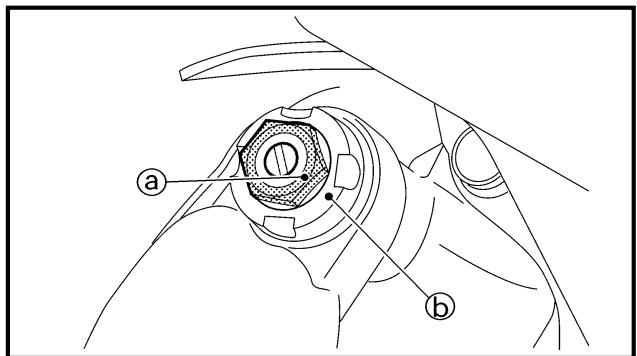
STANDARD POSITION:
This is the position which is back by the specific number of turns from the fully turned-in position. (Which align the punch mark ⑧ on the adjuster with the punch mark ⑥ on the adjuster body.)
Standard position: About 1 turns out *About 1- 1/2 turns out
- For EUROPE
CAUTION:
Do not force the adjuster past the minimum or maximum extent of adjustment. The adjuster may be damaged.
REGLAGE DE LA FORCE D'AMORTISSEMENT A HAUTE COMPRESSION DE L'AMORTISSEUR ARRIERE
-
Measure:
-
Tire pressure
Out of specification Adjust.
Standard tire pressure: 100 kPa (1.0 kg/cm², 15 psi)
NOTE:
- Check the tire while it is cold.
- Loose bead stoppers allow the tire to slip off its position on the rim when the tire pressure is low.
- A tilted tire valve stem indicates that the tire slips off its position on the rim.
- If the tire valve stem is found tilted, the tire is considered to be slipping off its position. Correct the tire position.
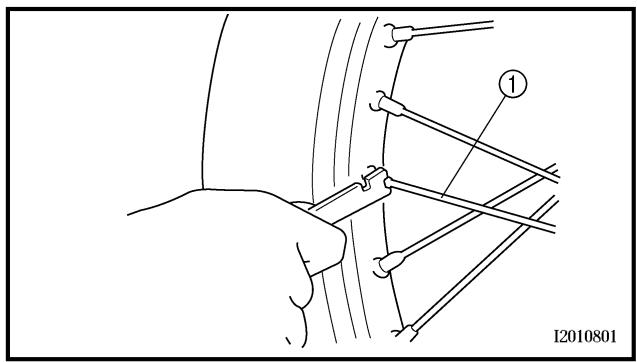
EC36S002
SPOKES INSPECTION AND TIGHTENING
-
Inspect:
-
Spokes ①
Bend/damage Replace.
Loose spoke Retighten.
-
Tighten:
-
Spokes

NOTE:
Be sure to retighten these spokes before and after break-in. After a practice or a race check spokes for looseness.
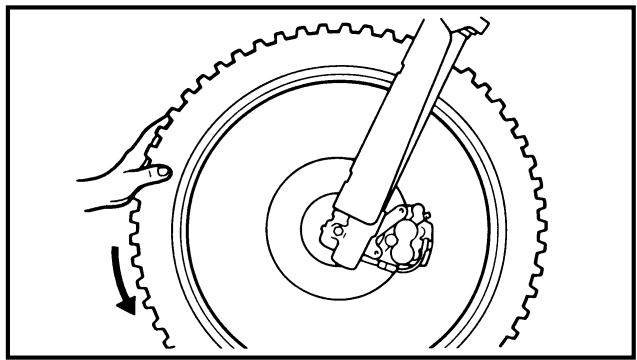
EC36T000
WHEEL INSPECTION
-
Inspect:
-
Wheel runout
Elevate the wheel and turn it.
Abnormal runout Replace.
CONTROLE DE PRESSION DES PNEUS
-
Mesurer:
-
Pression des pneus
Hors specifications Regler.

Pression des pneus standard:
(1,0kg / cm^2,15psi)
N.B.:
- Bearing free play Exist play Replace.
STEERING HEAD INSPECTION AND ADJUSTMENT
- Elevate the front wheel by placing a suitable stand under the engine.
-
Check:
-
Steering shaft
- Grasp the bottom of the forks and gently rock the fork assembly back and forth.
-
Free play Adjust steering head.
-
Check:
-
Steering smooth action
- Turn the handlebar lock to lock.
- Unsmooth action Adjust steering ring nut.
4. Adjust:
- Steering ring nut
Steering ring nut adjustment steps:
- Remove the headlight.
- Remove the handlebar and upper bracket.
- Loosen the steering ring nut ① using the steering nut wrench ②.
Steering nut wrench: YU-33975/90890-01403
CONTROLE ET REGLAGE DE LA TETE DE FOURCHE LENKKOPF KONTROLLIEREN UND EINSTELLLEN ISPEZIONE E REGOLAZIONE DELLA TESTA DI STERZO
| · Tighten the steering ring nut ③ using steering nut wrench ④. NOTE: Set the torque wrench to the steering nut wrench so that they form a right angle. | |
| Steering nut wrench: YU-33975/90890-01403 | |
| Steering ring nut (initial tightening): 38 Nm (3.8 m • kg, 27 ft • lb) | |
| · Loosen the steering ring nut one turn. · Retighten the steering ring nut using the steering nut wrench. A WARNING Avoid over-tightening. | |
| Steering ring nut (final tightening): 7 Nm (0.7 m • kg, 5.1 ft • lb) | |
| · Check the steering stem by turning it lock to lock. If there is any binding, remove the steering stem assembly and inspect the steering bearings. · Install the upper bracket ⑤, steering stem nut ⑥, handlebar ⑦, handlebar holder ⑧ and headlight ⑨. NOTE: · The upper handlebar holder should be installed with the punched mark ⑧ forward. · Insert the end of fuel breather hose ⑩ into the hole of the steering stem. CAUTION: First tighten the bolts on the front side of the handlebar holder, and then tighten the bolts on the rear side. | |
| Steering stem nut: 145 Nm (14.5 m • kg, 105 ft • lb) Handlebar upper holder: 28 Nm (2.8 m • kg, 20 ft • lb) Pinch bolt (handle crown): 23 Nm (2.3 m • kg, 17 ft • lb) Headlight: 7 Nm (0.7 m • kg, 5.1 ft • lb) | |
CONTROLE ET REGLAGE DE LA TETE DE FOURCHE LENKKOPF KONTROLLIEREN UND EINSTellenISPEZIONE E REGOLAZIONE DELLA TESTA DI STERZO
To ensure smooth operation of all components, lubricate your machine during setup, after break-in, and after every race.
① All control cable
② Clutch lever pivot
③ Shift pedal pivot
(4) Footrest pivot
⑤ Throttle-to-handlebar contact
⑥ Drive chain
⑦ Tube guide cable winding portion
⑧ Throttle cable end
Clutch cable end
10 Decompression cable end
A Use Yamaha cable lube or equivalent on these areas.
Use SAE 10W-30 motor oil or suitable chain lubricants.
Lubricate the following areas with high quality, lightweight lithium-soap base grease.
CAUTION:
Wipe off any excess grease, and avoid getting grease on the brake discs.
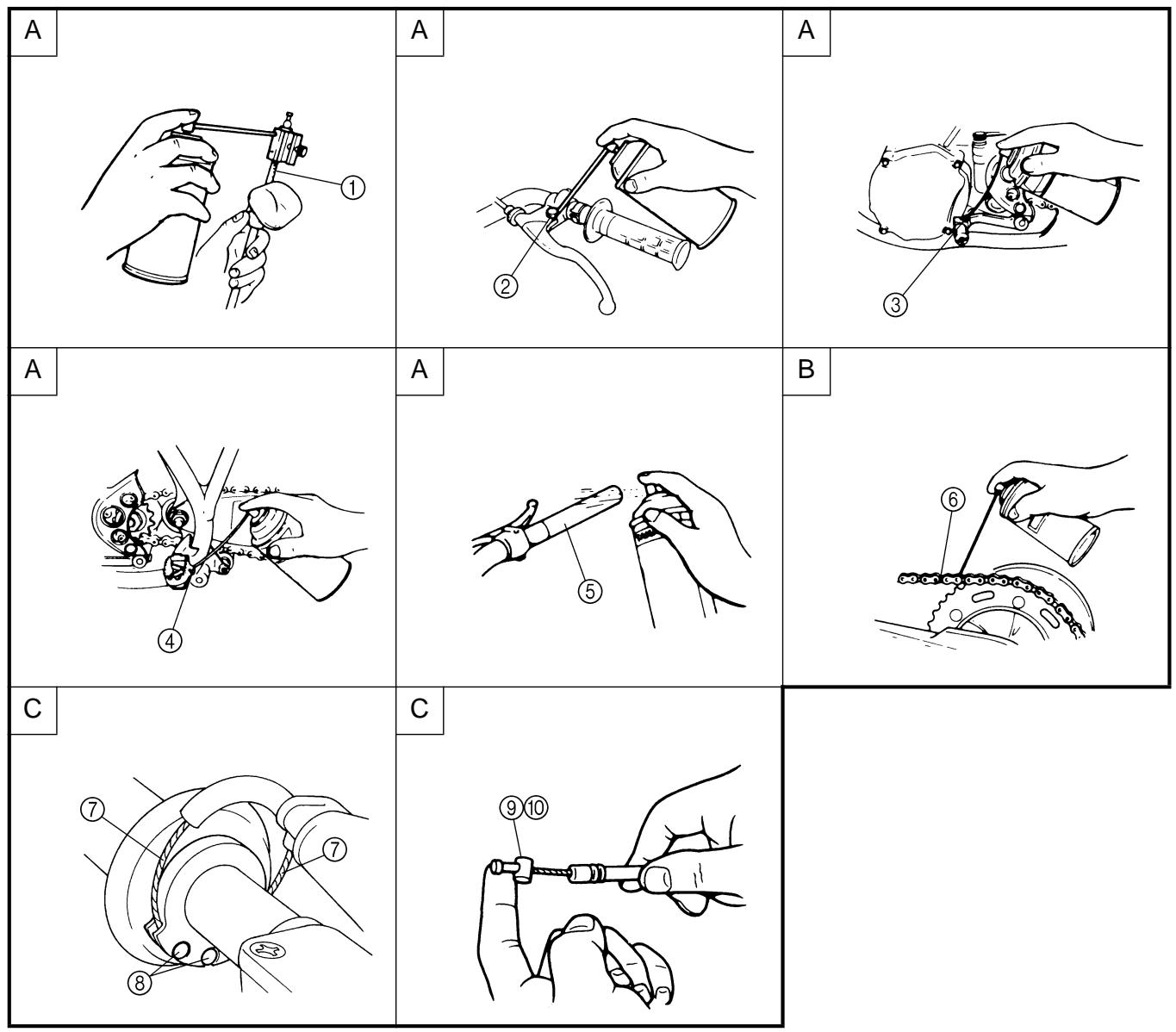
GRAISSAGE
-
Remove:
-
Spark plug
-
Inspect:
-
Electrode ①
Wear/damage Replace.
Insulator color ②
Normal condition is a medium to light tan color.
Distinctly different color Check the engine condition.
NOTE:
When the engine runs for many hours at low speeds, the spark plug insulator will become sooty, even if the engine and carburetor are in good operating condition.
-
Measure:
-
Plug gap @
Use a wire gauge or thickness gauge.
Out of specification Regap.

Spark plug gap: 0.7 ~ 0.8 mm (0.028 ~ 0.031 in)
- Clean the plug with a spark plug cleaner if necessary.
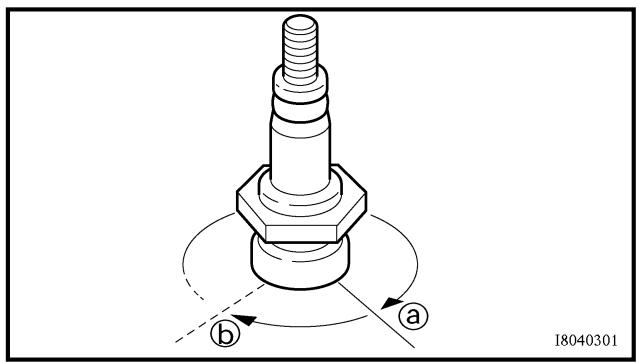
- Tighten:
Spark plug
13 Nm (1.3 m·kg, 9.4 ft·lb)
NOTE:
- Before installing a spark plug, clean the gasket surface and plug surface.
- Finger-tighten ⑧ the spark plug before torquing to specification ⑥ .
PARTIE ELECTRIQUE/CONTROLE DE LA BOUGIE ELEKTRISCHE ANLAGE/ZündKERZE KONTROLLIEREN PARTE ELETTRICA/ISPEZIONE DELLA CANDELA
PARTIE ELECTRIQUE CONTROLE DE LA BOUGIE
- Déposer:
Bougie
IGNITION TIMING CHECK
1. Remove:
- Timing mark accessing screw ①
2. Attach:
- Timing light
- Inductive tachometer
To the spark plug lead.
Timing light: YM-33277-A/90890-03141
Inductive tachometer:
YU-08036-B
Engine tachometer:
90890-03113
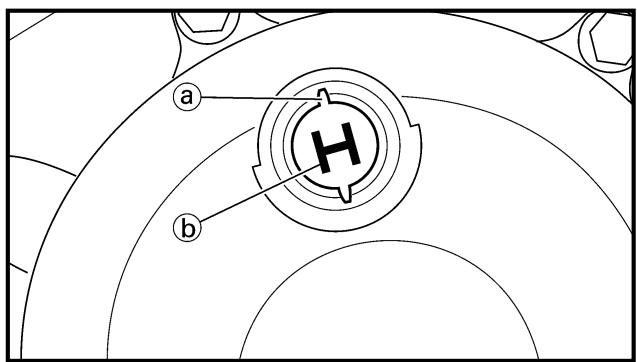
3. Check:
- Ignition timing
Checking steps:
- Start the engine and let it warm up. Let the engine run at the specified speed.
Engine speed: 1,700 ~ 1,900 r/min
- Visually check the stationary pointer ④ is within the firing range ⑥ on the rotor. Incorrect firing range Check rotor and pickup assembly.
4. Install:
- Timing mark accessing screw
CONTROLE DE L'AVANCE A L'ALLUMAGE
1. Déposer:
REPLACING THE HEADLIGHT BULBS
- Remove:
- Headlight Refer to "SEAT, FUEL TANK AND SIDE COVERS" section in the CHAPTER 4.
- Remove:
- Headlight bulb holder cover ①
- Detach:
- Headlight bulb holder ①
- Remove:
- Headlight bulb ②
WARNING
Since the headlight bulb gets extremely hot, keep flammable products and your hands away from the bulb unit it has cooled down.
-
Install:
-
Headlight bulb New Secure the new headlight bulb with the headlight bulb holder.
CAUTION:
Avoid touching the glass part of the headlight bulb to keep it free from oil, otherwise the transparency of the glass, the life of the bulb and the luminous flux will be adversely affected. If the headlight bulb gets soiled, thoroughly clean it with a cloth moistened with alcohol or lacquer thinner.
- Attach:
- Headlight bulb holder
- Install:
- Headlight bulb holder cover
- Install:
- Headlight bolt (left and right)
| 10 Nm (1.0 m · kg, 7.2 ft · lb) |
- Headlight bolt (lower)
7 Nm (0.7 m·kg, 5.1 ft·lb) Refer to "SEAT, FUEL TANK AND SIDE COVERS" section in the CHAPTER 4.
REMPLACER LES AMPOULES DU PHARE SCHEINWERFERLAMPE AUSWECHSELN SOSTITUZIONE DELLE LAMPADE DEL FARO
REMPLACER LES AMPOULES DU PHARE
-
Déposer:
-
Phare
-
Adjust:
-
Headlight beam (vertically)
| Adjusting steps: ·Turn the adjusting screw ① in direction ⑧ or ⑥. | |
| Direction ⑧ | Headlight beam is raised. |
| Direction ⑥ | Headlight beam is lowered. |
REGLAGES DES FAISCEAUX DES PHARES
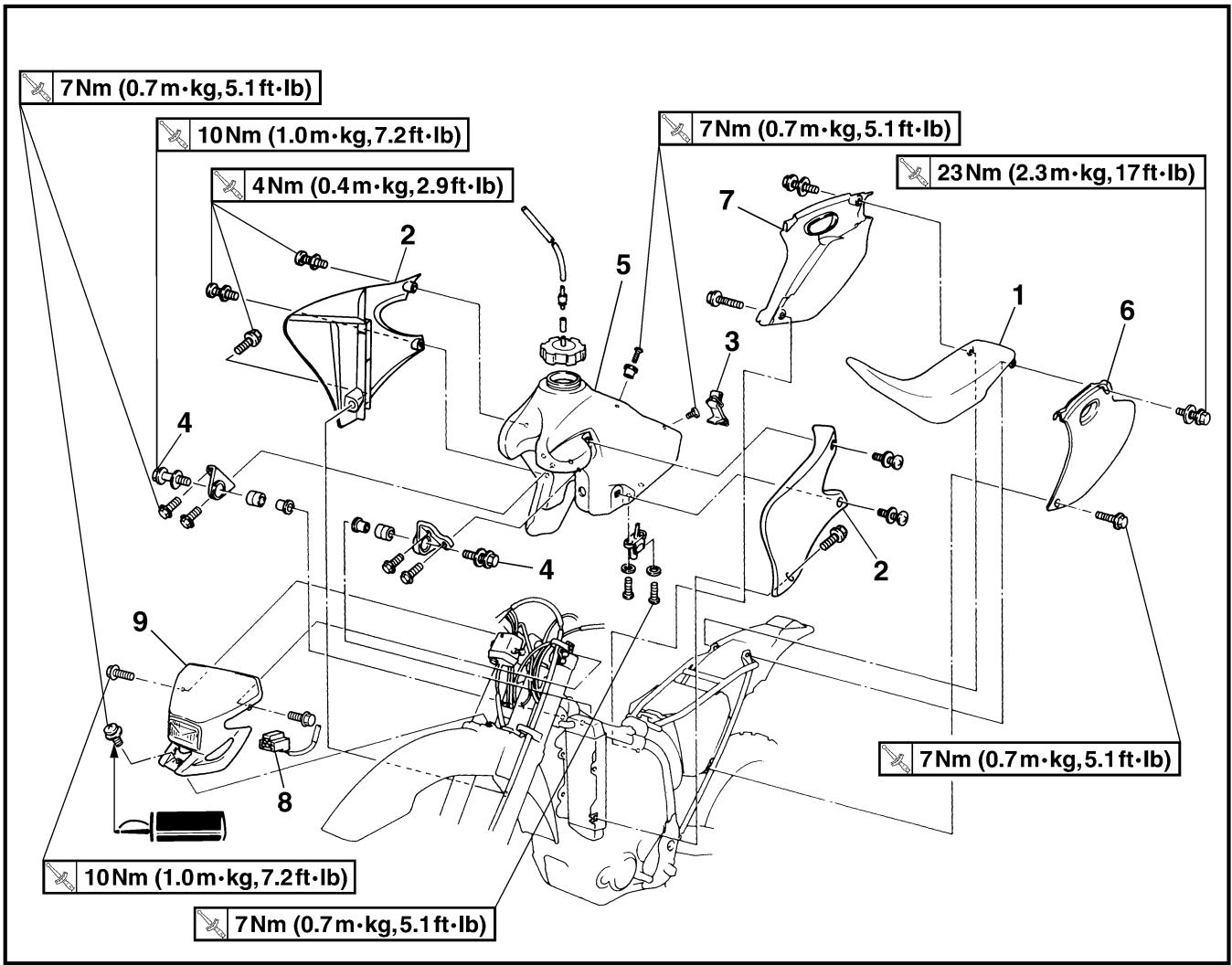
Extent of removal:
① Seat removal
② Fuel tank removal
③ Side covers removal
④ Headlight removal
| Extent of removal | Order | Part name | Q'ty | Remarks |
| Preparation for removal | SEAT, FUEL TANK AND SIDE COVERS REMOVAL Turn the fuel cock to “OFF”. Disconnect the fuel hose. | |||
| ①↑ ③↓ ② ③ ④ | 1 2 3 4 5 6 7 8 9 | Seat Air scoop (left and right) Fitting band Bolt (fuel tank) Fuel tank Left side cover Right side cover Headlight coupler Headlight | 1 2 1 2 1 1 1 1 1 1 | Remove on fuel tank side. |
SELLE, RESERVOIR DE CARBURANT ET CACHES LATERAUX SITZBANK, KRAFTSTOFFTANK UND SEITENABDECKUNGEN SELLA, SERBATOIO CARBURANTE E CARENATURA LATERALE
MOTEUR
SELLE, RESERVOIR DE CARBURANT ET CACHES LATERAUX

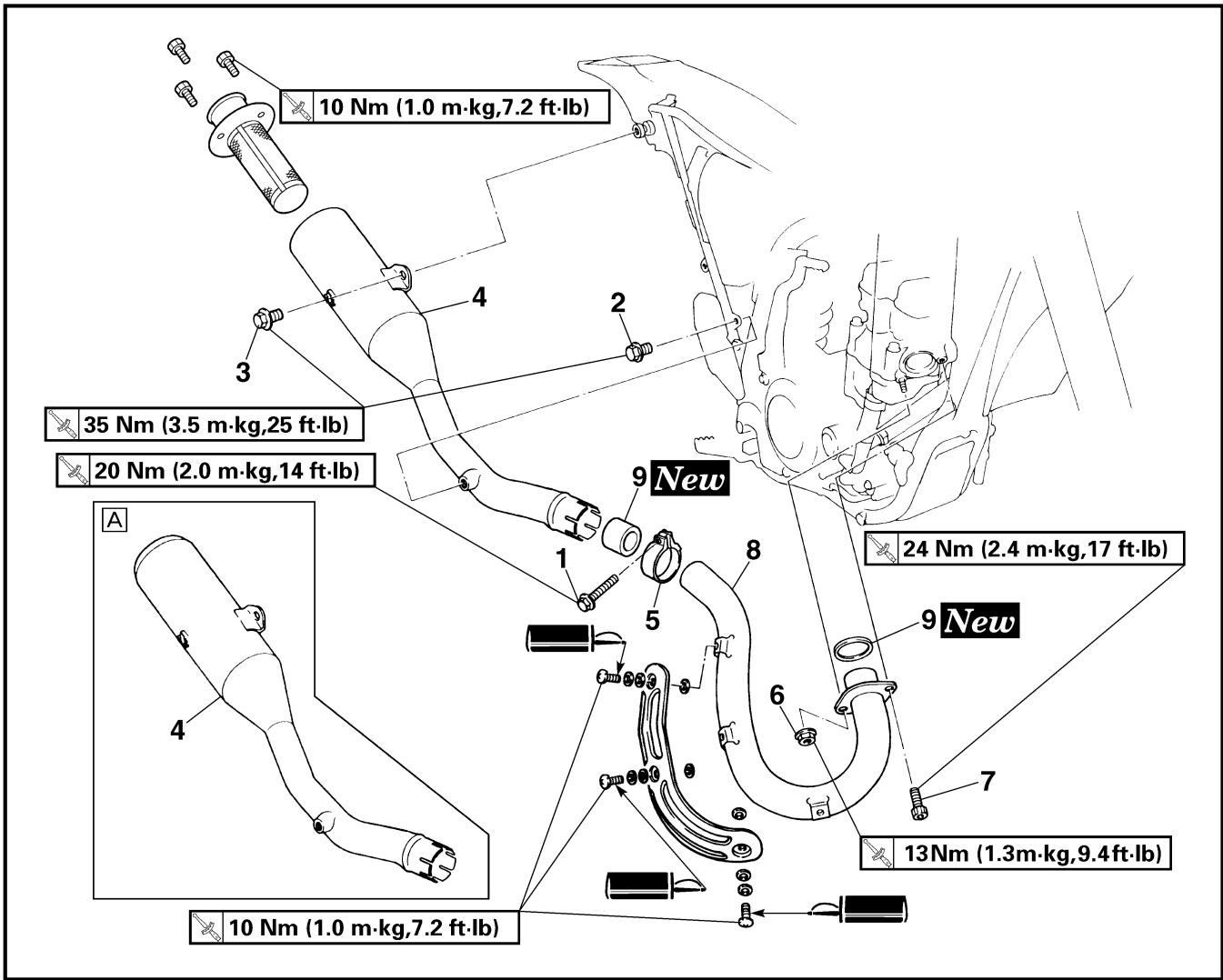
Except for USA
Extent of removal:
① Silencer removal
② Exhaust pipe removal
| Extent of removal | Order | Part name | Q'ty | Remarks |
| Preparation for removal | EXHAUST PIPE AND SILENCER REMOVAL Right side cover | Refer to “SEAT, FUEL TANK AND SIDE COVERS” section. | ||
| 1 | 1 | Bolt (silencer clamp) | 1 | Only loosening. |
| 2 | Bolt [silencer (front)] | 1 | ||
| 3 | Bolt [silencer (rear)] | 1 | ||
| 4 | Silencer | 1 | ||
| 5 | Silencer clamp | 1 | ||
| 6 | Nut (exhaust pipe) | 1 | ||
| 7 | Bolt (exhaust pipe) | 1 | ||
| 8 | Exhaust pipe | 1 | ||
| 9 | Gasket | 2 |
TUYAU D'ECHAPPEMENT ET SILENCIEUX KRÜMMER UND SCHALLDÄMPFER TUBO DI SCARICO E SILENZIATORE
TUYAU D'ECHAPPEMENT ET SILENCIEUX

A Excepté pour USA
Silencer and exhaust pipe
-
Inspect:
-
Gasket ①
Damage Replace.
ASSEMBLY AND INSTALLATION
Silencer and exhaust pipe
- Install:
Gasket

- Exhaust pipe ①
- Nut (exhaust pipe) ②

13 Nm (1.3 m·kg, 9.4 ft·lb)
- Bolt (exhaust pipe) ③

24 Nm (2.4 m·kg, 17 ft·lb)
NOTE:
First, temporarily tighten the nut (exhaust pipe), then tighten the bolt (exhaust pipe) 20Nm (2.0m kg, 14 ft · lb). After that, retighten the nut (exhaust pipe) 13Nm (1.3m kg, 9.4 ft · lb) and then the bolt (exhaust pipe) 24Nm (2.4m kg, 17 ft · lb).
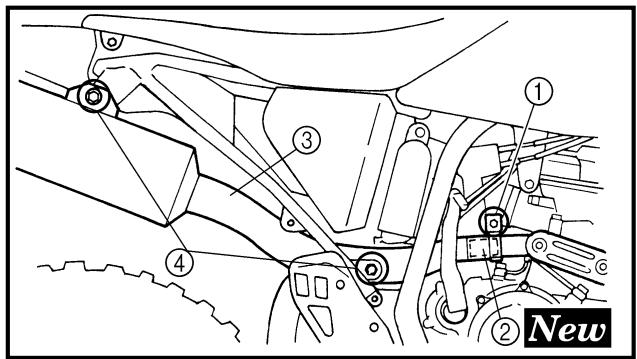
-
Install:
-
Silencer clamp ①

-
Silencer ③
-
Bolt (silencer) ④

35 Nm (3.5 m · kg, 25 ft · lb)
CONTROLE
① Radiator removal
| Extent of removal | Order | Part name | Q'ty | Remarks |
| Preparation for removal | RADIATOR REMOVALDrain the coolant.Seat, fuel tank and leftSide cover | Refer to “COOLANT REPLACEMENT”section in the CHAPTER 3.Refer to “SEAT, FUEL TANK AND SIDE COVERS” section. | ||
| 1 | 1 | Radiator guard | 2 | Only loosening. |
| 2 | 2 | Radiator hose clamp | 8 | |
| 3 | 3 | Radiator hose 1 | 1 | |
| 4 | 4 | Left radiator | 1 | |
| 5 | 5 | Radiator hose 3 | 1 | |
| 6 | 6 | Coolant reservoir hose | 1 | |
| 7 | 7 | Right radiator | 1 | |
| 8 | 8 | Radiator hose 2 | 1 | |
| 9 | 9 | Radiator hose 4 | 1 | |
| 10 | 10 | Radiator pipe | 1 | |
| 11 | 11 | Coolant reservoir breather hose | 1 | |
| 12 | 12 | Coolant reservoir | 1 |
RADIATEUR

Do not remove the radiator cap when the engine and radiator are hot. Scalding hot fluid and steam may be blown out under pressure, which could cause serious injury.
When the engine has cooled, open the radiator cap by the following procedure:
Place a thick rag, like a towel, over the radiator cap, slowly rotate the cap counterclockwise to the detent. This procedure allows any residual pressure to escape. When the hissing sound has stopped, press down on the cap while turning counterclockwise and remove it.
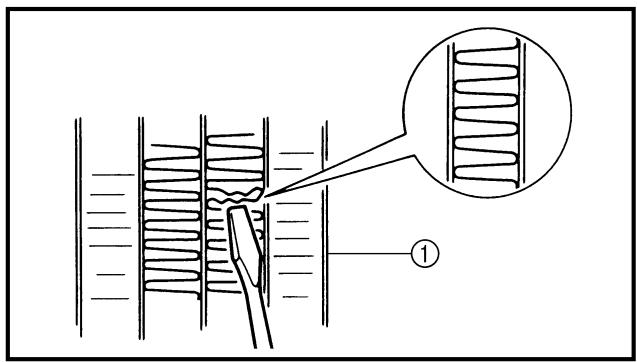
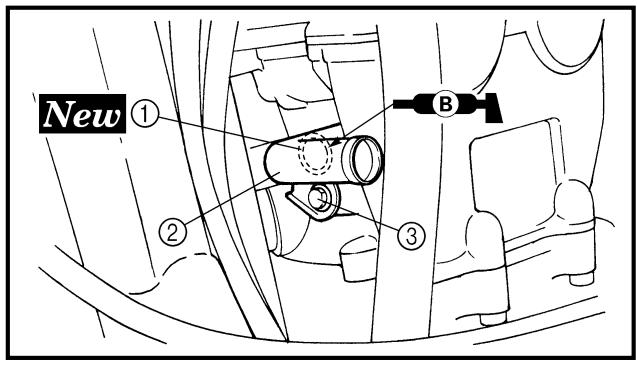
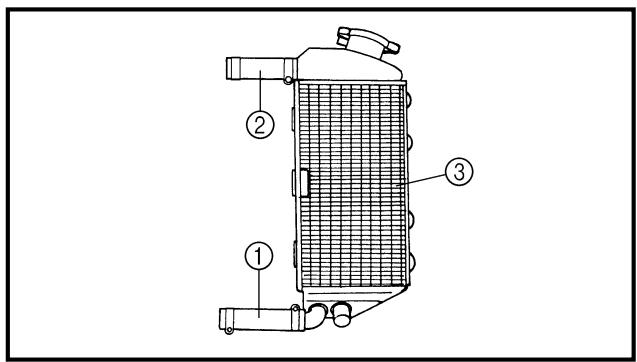
EC454000
INSPECTION
EC444100
Radiator
-
Inspect:
-
Radiator core ①
Obstruction Blow out with compressed air through rear of the radiator. Bent fin Repair/replace.
EC455000
ASSEMBLY AND INSTALLATION
Radiator
-
Install:
-
O-ring ① New
- Radiator pipe ②
- Bolt (radiator pipe) ③
10Nm(1.0m·kg,7.2ft·lb)
NOTE:
Apply the lithium soap base grease on the O-ring.
-
Install:
-
Radiator hose 4 (longer) ①
- Radiator hose 2 (shorter) ② To right radiator ③
REMARQUES CONCERNANT LA MANIPULATION

AVERTISSEMENT
- Right radiator ①
- Bolt (right radiator) ②
10 Nm (1.0 m·kg, 7.2 ft·lb)
- Radiator hose 3③
Refer to "CABLE ROUTING DIAGRAM" section in the CHAPTER 2.
4. Install:
- Left radiator ①
- Bolt (left radiator) ②
10 Nm (1.0 m·kg, 7.2 ft·lb)
- Radiator hose 1③
2 Nm (0.2 m·kg, 1.4 ft·lb)
Refer to "CABLE ROUTING DIAGRAM" section in the CHAPTER 2.
5. Tighten:
- Radiator hose clamp ④
2 Nm (0.2 m·kg, 1.4 ft·lb)
6. Install:
- Radiator guard ①
- Bolt (radiator guard) ②
10 Nm (1.0 m·kg, 7.2 ft·lb)
NOTE:
Fit the hook ⑧ on the inner side first into the radiator.
7. Install:
Coolant reservoir ①
- Clamp ②
- Bolt (coolant reservoir) ③
7Nm (0.7m· kg,5.1ft· lb)
Coolant reservoir hose ④
- Coolant reservoir breather hose ⑤ Refer to “CABLE ROUTING DIA-GRAM” section in the CHAPTER 2.
8. Fill:
- Radiator
- Engine
-
Coolant reservoir Refer to "COOLANT REPLACEMENT" section in the CHAPTER 3.
-
Monter:
-
Radiateur de droite ①
- Boulon (radiateur droite) ②
10Nm(1,0m·kg,7,2ft·lb)
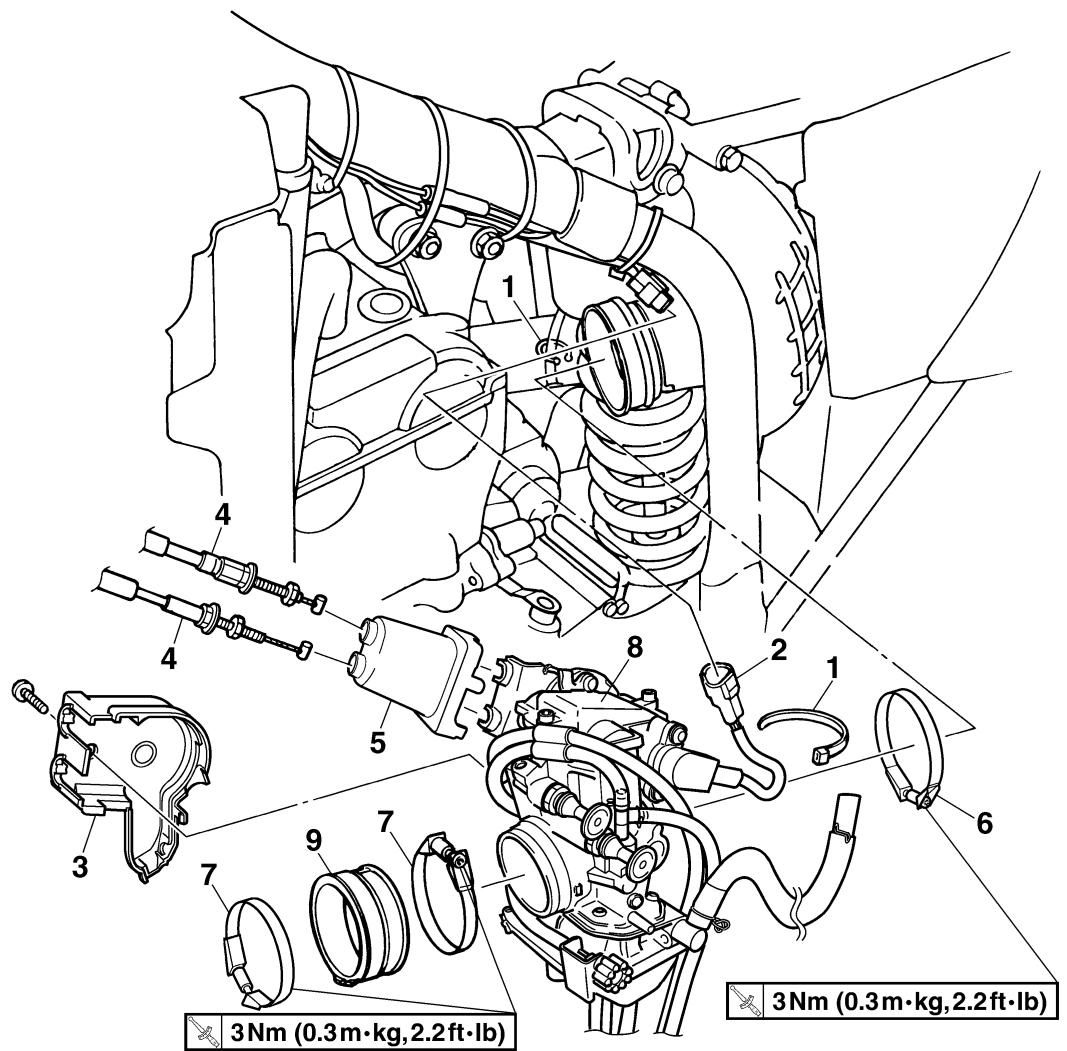
Extent of removal:
① Carburetor removal
| Extent of removal | Order | Part name | Q'ty | Remarks |
| Preparation for removal | CARBURETOR REMOVALSeat and fuel tank | Refer to “SEAT, FUEL TANK AND SIDE COVERS” section. | ||
| 1 | 1 | Clamp | 2 | |
| 2 | Throttle position sensor lead cou-pler | 1 | ||
| 3 | Throttle cable cover | 1 | ||
| 4 | Throttle cable | 2 | ||
| 5 | Throttle cable cap | 1 | ||
| 6 | Clamp (air filter joint) | 1 | Loosen the screw (air filter joint). | |
| 7 | Clamp (carburetor joint) | 2 | Loosen the screws (carburetor joint). | |
| 8 | Carburetor assembly | 1 | ||
| 9 | Carburetor joint | 1 |
CARBURATEUR
① Carburetor disassembly
| Extent of removal | Order | Part name | Q'ty | Remarks |
| 1 | ① | CARBURETOR DISASSEMBLY | ||
| ② | Carburetor breather hose | 4 | ||
| ③ | Valve lever housing cover | 1 | ||
| ④ | Screw (throttle shaft) | 1 | ||
| ⑤ | Throttle valve | 1 | ||
| ⑥ | Needle holder | 1 | ||
| ⑦ | Jet needle | 1 | ||
| ⑧ | Accelerator pump cover | 1 | ||
| ⑨ | Spring | 1 | ||
| ⑩ | Diaphragm (accelerator pump) | 1 | ||
| ⑪ | Air cut valve cover | 1 | ||
| ⑫ | Spring (air cut valve) | 1 | ||
| ⑬ | Diaphragm (air cut valve) | 1 | ||
| ⑭ | Float chamber | 1 | ||
| ⑮ | Leak jet | 1 | ||
| ⑯ | Pilot screw | 1 | Refer to “REMOVAL POINTS”. | |
| ⑰ | Float pin | 1 |
DEMONTAGE DU CARBURATEUR
Do not loosen the screws (throttle position sensor) ① except when changing the throttle position sensor due to failure because it will cause a drop in engine performance.
REMOVAL POINTS
Pilot screw
-
Remove:
-
Pilot screw ①
NOTE:
To optimize the fuel flow at a small throttle opening, each machine's pilot screw has been individually set at the factory. Before removing the pilot screw, turn it in fully and count the number of turns. Record this number as the factory-set number of turns out.
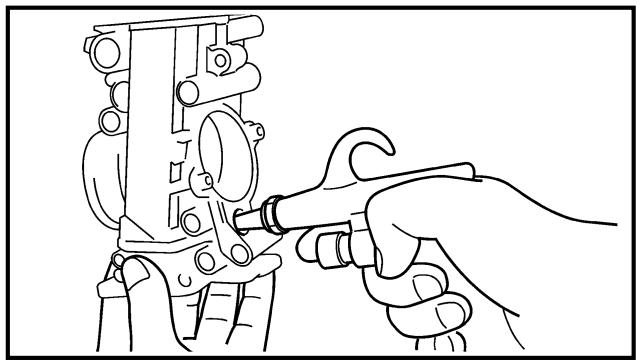
INSPECTION
Carburetor
-
Inspect:
-
Carburetor body
Contamination Clean.
NOTE:
- Use a petroleum based solvent for cleaning. Blow out all passages and jets with compressed air.
- Never use a wire.
REMARQUE CONCERNANT LES MANIPULATIONS
ATTENTION:
- Use a petroleum based solvent for cleaning. Blow out all passages and jets with compressed air.
- Never use a wire.
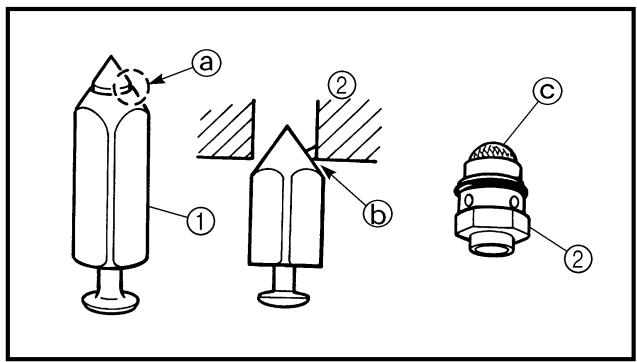
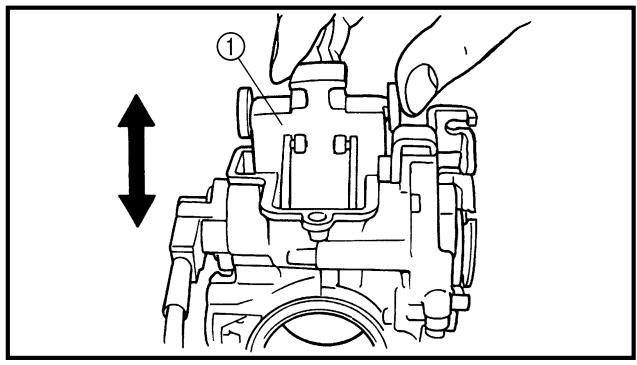
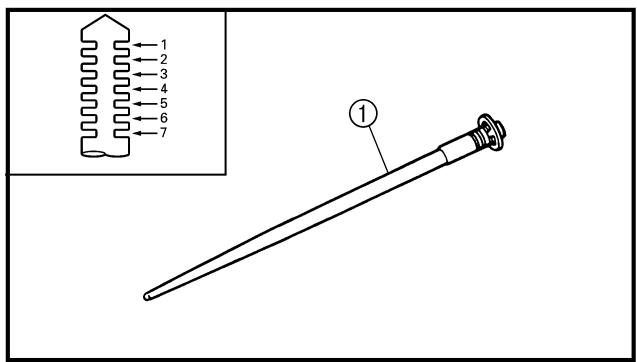
Needle valve
-
Inspect:
-
Needle valve ①
- Valve seat ②
Grooved wear ⑧ Replace.
Dust ⑥ and ⑤ → Clean.
NOTE:
Replace the needle valve and valve seat as a set.
EC464301
Throttle valve
-
Check:
-
Free movement
Stick Repair or replace.
NOTE:
Insert the throttle valve ① into the carburetor body, and check for free movement.
EC464401
Jet needle
-
Inspect:
-
Jet needle ①
Bends/wear Replace. - Clip groove
Free play exists/wear Replace. - Clip position
Standard clip position:
No.3 Groove
*,** No.4 Groove
- For EUROPE
** For CDN, ZA, AUS and NZ
- Controller:
-
Measure:
-
Float height @
Out of specification Adjust.
Float height: 8.0 mm (0.31 in)
Measurement and adjustment steps:
- Hold the carburetor in an upside down position.
NOTE:
- Slowly tilt the carburetor in the opposite direction, then take the measurement when the needle valve aligns with the float arm.
- If the carburetor is level, the weight of the float will push in the needle valve, resulting in an incorrect measurement.
- Measure the distance between the mating surface of the float chamber and top of the float using a vernier calipers.
NOTE:
The float arm should be resting on the needle valve, but not compressing the needle valve.
- If the float height is not within specification, inspect the valve seat and needle valve.
- If either is worn, replace them both.
- If both are fine, adjust the float height by bending the float tab ⑥ on the float.
- Recheck the float height.
EC464600
Float
-
Inspect:
-
Float ①
Damage Replace.
Hauteur du flotteur
Cold starter plunger ①
Hot starter plunger (red) ②
Wear/damage Replace.
Accelerator pump
1. Inspect:
- Diaphragm (accelerator pump) ①
- Spring (accelerator pump) ②
- Accelerator pump cover ③
- O-ring ④
- Push rod ⑤ Tears (diaphragm)/damage Replace. Dirt Clean.
2. Inspect:
- Throttle shaft ①
Spring ② - Lever 1 ③
Spring 1 ④ - Lever 2 (5)
Spring 2 ⑥
Dirt Clean.
Air cut valve
1. Inspect:
- Diaphragm (air cut valve) ①
- Spring (air cut valve) ②
Air cut valve cover ③ - O-ring ④ Tears(diaphragm)/damage Replace.
ASSEMBLY AND INSTALLATION
Carburetor
1. Install:
- Hot starter plunger (red) ①
Cold starter plunger ②
Plongeur de starter
- Main air jet ①
- Pilot air jet ②
- Intake joint ③
5 Nm (0.5 m·kg, 3.6 ft·lb)
3. Install:
Spring 1①
- Lever 1 ②
To lever 2 ③
NOTE:
Make sure the spring 1 fits on the stopper ④ of the lever 2.
4. Install:
Spring 2 ①
To lever 2 ②.
5. Install:
- Push rod link lever assembly ①
NOTE:
Make sure the stopper ④ of the spring 2 fits into the recess ⑥ in the carburetor.
6. Install:
-
Washer ①
Circlip ② -
Monter:
Spring ①
- Joint collar ②
To throttle shaft ③.
NOTE: Install the bigger hook ⑧ of the spring fits on the stopper 6 of the throttle shaft pulley.
8. Install:
- Throttle shaft assembly ①
- Washer (metal) ②
- Washer (resin) ③
- Valve lever ④
NOTE:
- Apply the fluorochemical grease on the bearings.
- Fit the projection ⑧ on the throttle shaft assembly into the slot ⑥ in the throttle position sensor.
- Make sure the stopper © of the spring fits into the recess in the carburetor.
- Turn the throttle shaft assembly left while holding down the lever 1 ⑤ and fit the throttle stop screw tip ⑥ to the stopper ⑧ of the throttle shaft assembly pulley.
9. Install:
- Push rod ①
NOTE: While holding down the lever 1 ② , insert the push rod farthest into the carburetor.
-
Installer:
-
Ressort ①
- Manchette de joint ②
- Valve seat
- Screw (valve seat) ①
- Needle valve ②
- Float ③
- Float pin ④
NOTE:
- After installing the needle valve to the float, install them to the carburetor.
- Check the float for smooth movement.
12. Install:
- Pilot screw ①
Spring ② - Washer ③
- O-ring ④
Note the following installation points:
- Turn in the pilot screw until it is lightly seated.
- Turn out the pilot screw by the number of turns recorded before removing.
Pilot screw:
1-3/4 turns out (example)
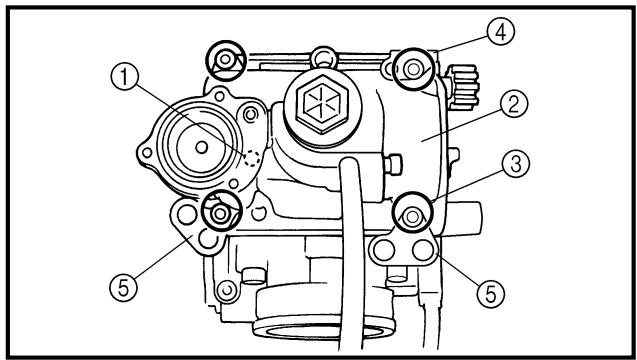
13. Install:
- O-ring
- Leak jet ①
- Float chamber ②
- Bolt (float chamber) ③
- Cable holder (throttle stop screw cable) ④
-
Hose holder (carburetor breather hose) ⑤
-
Monter:
- Diaphragm (air cut valve) ①
- Spring (air cut valve) ②
- O-ring ③
Air cut valve cover ④ - Screw (air cut valve cover) ⑤
15.Install:
- Diaphragm (accelerator pump) ①
Spring ② - O-ring ③
- Accelerator pump cover ④
- Bolt (accelerator pump cover) ⑤
NOTE:
Install the diaphragm (accelerator pump) with its mark ⑧ facing the spring.
16. Install:
- Jet needle ①
- Collar ②
Spring ③ - Needle holder ④
- Throttle valve plate ⑤
To throttle valve ⑥.
17. Install:
- Throttle valve assembly ①
- Screw (throttle shaft) ②
NOTE:
Install the valve lever rollers ③ into the slits ⑧ of the throttle valve.
18. Install:
- O-ring ①
- Valve lever housing cover ②
-
Bolt (valve lever housing cover) ③
-
Monter:
-
Membrane (clapet de coupure d'air) ①
- Ressort (clapet de coupure d'air) ②
- Joint torque ③
- Couvercle du clapet de coupure d'air ④
-
Vis (couvercle du clapet de coupure d'air) ⑤
-
Montieren:
-
Membran (Luftabschaltventil) ①
Feder ② - O-Ring ③
Deckel ④ - Schrauben (Deckel)


-
Install:
-
Carburetor breather hose ①
NOTE: Install the carburetor breather hoses to the carburetor so that the hoses do not bend near where they are installed.
Carburetor installation
-
Install:
-
Clamp ①
NOTE: Install the projections ⑧ on the carburetor joint between the clamp ends.
-
Install:
-
Carburetor joint ①
3Nm(0.3m·kg,2.2ft·lb)
NOTE: Install the projection ⑧ on the cylinder head between the carburetor joint slots 6 .
-
Install:
-
Carburetor ①
NOTE: Install the projection between the carburetor joint slots.
-
Tighten:
-
Screw (air filter joint) ①
3 Nm (0.3 m·kg, 2.2 ft·lb)
- Screw (carburetor joint) ②
3 Nm (0.3 m·kg, 2.2 ft·lb)
- Monter:
-
Monter:
-
Carburaturer ①
N.B.:
-
Install:
-
Throttle cable cap ①
-
Install:
-
Throttle cable ①
-
Adjust:
-
Throttle grip free play Refer to "THROTTLE CABLE ADJUSTMENT" section in the CHAPTER 3.
-
Install:
-
Throttle cable cover ①
- Screw (throttle cable cover) ②
4Nm(0.4m·kg,2.9ft·lb)
NOTE: Install the throttle cable cover with its pawl ⑧ hung on the carburetor.
-
Install:
-
Throttle position sensor lead coupler ①
-
Clamp ② Refer to "CABLE ROUTING DIAGRAM" section in the CHAPTER 2.
-
Install:
-
Clamp ① Refer to "CABLE ROUTING DIAGRAM" section in the CHAPTER 2.
-
Monter:
-
Cache du logement des câbles des gaz ①
-
Montieren:
-
Gasseilzugkappe ①
-
Installare:
-
Tappodelcavocacceleratore ①
-
Monter:
Cable de gaz ①
Extent of removal:
① Cylinder head cover removal
| Extent of removal | Order | Part name | Q'ty | Remarks |
| Preparation for removal | CYLINDER HEAD COVER REMOVAL | Refer to “SEAT, FUEL TANK AND SIDE COVERS” section. Refer to “CARBURETOR” section. | ||
| Seat and fuel tank | ||||
| Carburetor | ||||
| 1 | 1 | Spark plug | 1 | |
| 2 | Cylinder head breather hose | 1 | ||
| 3 | Oil tank breather hose | 1 | ||
| 4 | Bolt (cylinder head cover) | 2 | ||
| 5 | Cylinder head cover | 1 | ||
| 6 | Cylinder head cover gasket | 1 | ||
| 7 | Timing chain guide (top side) | 1 |
ARBRES A CAMES

COUVRE-CULASSE
Extent of removal:
① Camshaft removal
| Extent of removal | Order | Part name | Q'ty | Remarks |
| 1 | 1 | CAMSHAFTS REMOVAL | Refer to “REMOVAL POINTS”. | |
| 2 | Timing mark accessing screw | 1 | ||
| 3 | Crankshaft end accessing screw | 1 | ||
| 4 | Timing chain tensioner cap bolt | 1 | ||
| 5 | Timing chain tensioner | 1 | ||
| 6 | Camshaft cap | 2 | ||
| 7 | Clip | 2 | ||
| 8 | Exhaust camshaft | 1 | ||
| 8 | Intake camshaft | 1 |
ARBRES A CAMES
REMOVAL POINTS Camshaft
-
Remove:
-
Timing mark accessing screw ①
-
Crankshaft end accessing screw ②
-
Align:
T.D.C. mark
With align mark.
Checking steps:
- Turn the crankshaft counterclockwise with a wrench.
NOTE:
Squeezing the decompression lever allows the crankshaft to be turned easily.
- Align the T.D.C. mark ⑧ on the rotor with the align mark ⑥ on the crankcase cover when piston is at T.D.C. on compression stroke.
NOTE:
In order to be sure that the piston is at Top Dead Center, the punch mark © on the exhaust camshaft and the punch mark © on the intake camshaft must align with the cylinder head surface, as shown in the illustration.
-
Remove:
-
Timing chain tensioner cap bolt ①
-
Timing chain tensioner ②
Gasket -
Remove:
-
Bolt (camshaft cap) ①
- Camshaft cap ②
- Clip
NOTE:
Remove the bolts (camshaft cap) in a crisscross pattern, working from the outside in.
CAUTION:
The bolts (camshaft cap) must be removed evenly to prevent damage to the cylinder head, camshafts or camshaft caps.
POINTS DE DEPOSE
Arbre à cames
- Exhaust camshaft ①
- Intake camshaft ②
NOTE:
Attach a wire ③ to the timing chain to prevent it from falling into the crankcase.
INSPECTION
Camshaft
1. Inspect:
- Cam lobe
Pitting/scratches/blue discoloration Replace.
2. Measure:
- Cam lobe length ⑧ and ⑥
Out of specification Replace.
Cam lobes length:
Intake:
@ 30.296 ~ 30.346 mm
(1.1923 ~ 1.1947 in)
(1.1888 in)
⑥ 22.45\~22.55mm
(0.8839 ~ 0.8878 in)
(0.8799 in)
Exhaust:
@ 30.399 ~ 30.499 mm
(1.1968 ~ 1.2007 in)
(1.1929 in)
⑥ 22.45\~22.55mm
(0.8839 ~ 0.8878 in)
(0.8799 in)
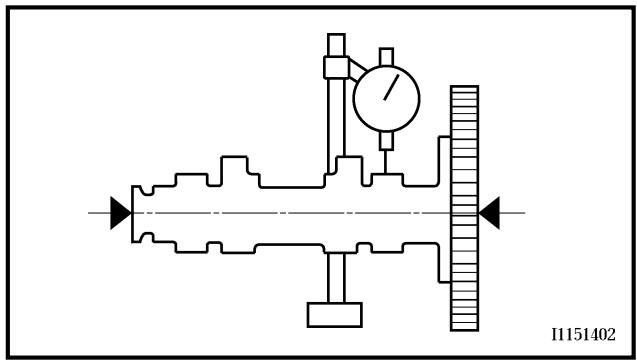
3. Measure:
- Runout (camshaft)
Out of specification Replace.
Runout (camshaft):
Less than 0.03 mm (0.0012 in)
@ 30,399 à 30,499 mm
(1,1923 ~ 1,1947 in)
(1,1888 in)
⑥ 22.45\~22.55mm
(0,8839 0,8878 in)
(0,8799 in)
Scarico:
30,399 30,499mm
(1,1968 ~ 1,2007 in)
(1,1929 in)
22,45 22,55 mm
(0,8839 0,8878 in)
(0,8799 in)
- Camshaft-to-cap clearance
Out of specification Measure bearing diameter (camshaft)
Camshaft-to-cap clearance:
0.020 ~ 0.054 mm
(0.0008 ~ 0.0021 in)
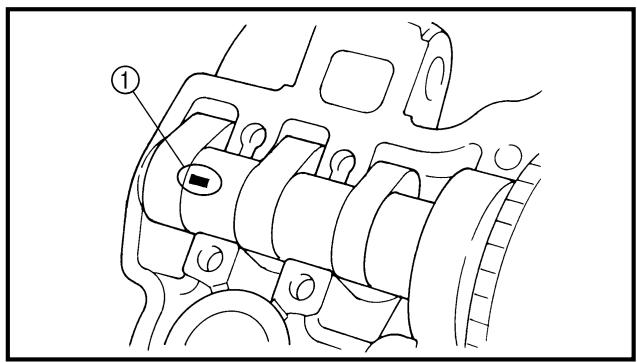
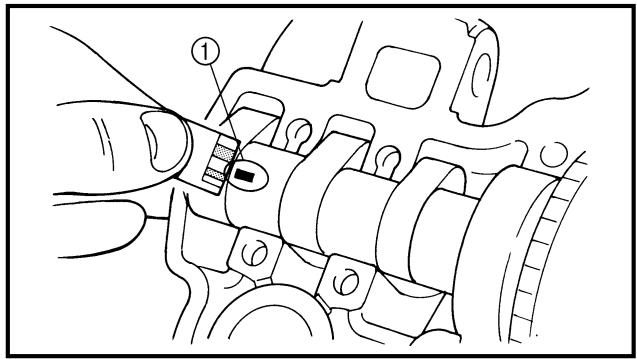
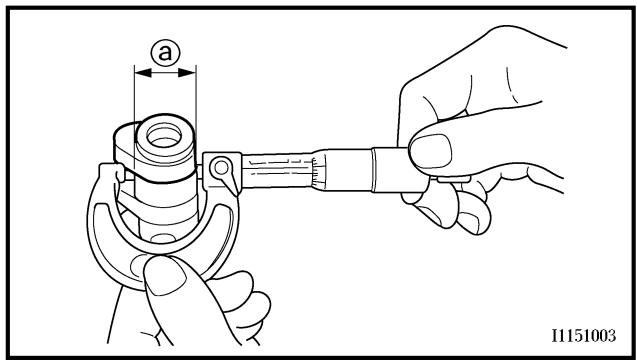
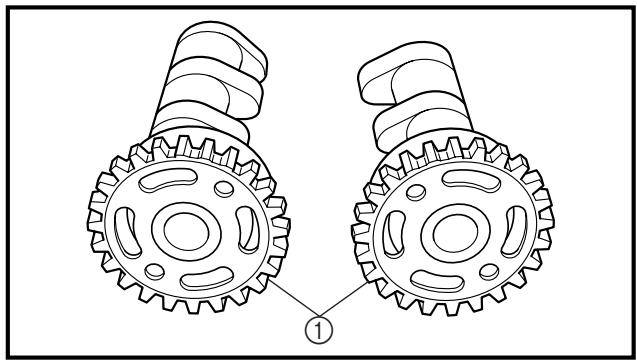
Measurement steps:
- Install the camshaft onto the cylinder head.
- Position a strip of Plastigauge® ① onto the camshaft.
- Install the clip, dowel pins and camshaft caps.
Bolt (camshaft cap): 10 Nm (1.0 m • kg, 7.2 ft • lb)
NOTE:
- Tighten the bolts (camshaft cap) in a crisscross pattern from innermost to outer caps.
- Do not turn the camshaft when measuring clearance with the Plastigauge®.
- Remove the camshaft caps and measure the width of the Plastigauge® ①.
5. Measure:
- Camshaft outside diameter @
Out of specification Replace the camshaft.
Within specification Replace camshaft case and camshaft caps as a set.
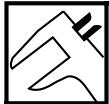
Camshaft outside diameter:
21.967 ~ 21.980 mm
(0.8648 ~ 0.8654 in)
Camshaft sprocket
1. Inspect:
- Camshaft sprocket ①
Wear/damage Replace the camshaft assembly and timing chain as a set.
4. Mesurer:
Timing chain tensioner
1. Check:
- While pressing the tensioner rod lightly with fingers, use a thin screwdriver ① and wind the tensioner rod up fully clockwise.
- When releasing the screwdriver by pressing lightly with fingers, make sure that the tensioner rod will come out smoothly.
- If not, replace the tensioner assembly.
ASSEMBLY AND INSTALLATION
Camshaft
-
Install:
-
Exhaust camshaft ①
- Intake camshaft ②
Installation steps:
- Turn the crankshaft counterclockwise with a wrench.
NOTE:
Squeezing the decompression lever allows the crankshaft to be turned easily.
- Align the T.D.C. mark ⑧ on the rotor with the align mark ⑥ on the crankcase cover when piston is at T.D.C. on compression stroke.
- Fit the timing chain ③ onto both camshaft sprockets and install the camshafts on the cylinder head.
NOTE:
The camshafts should be installed onto the cylinder head so that the punch mark © on the exhaust camshaft and the punch mark © on the intake camshaft must align with the cylinder head surface, as shown in the illustration.
Do not turn the crankshaft during the camshaft installation. Damage or improper valve timing will result.
- Install the clips, camshaft caps ④ and bolts (camshaft cap) ⑤.
Bolt (camshaft cap): 10 Nm (1.0 m • kg, 7.2 ft • lb)
NOTE:
- Before removing the clips, cover the cylinder head with a clean rag to prevent the clips from into the cylinder head cavity.
- Apply the engine oil on the thread and contact surface of the bolts (camshaft cap).
- Tighten the bolts (camshaft cap) ⑤ in a crisscross pattern.
CAUTION:
The bolts (camshaft cap) must be tightened evenly or damage to the cylinder head, camshaft caps and camshaft will result.
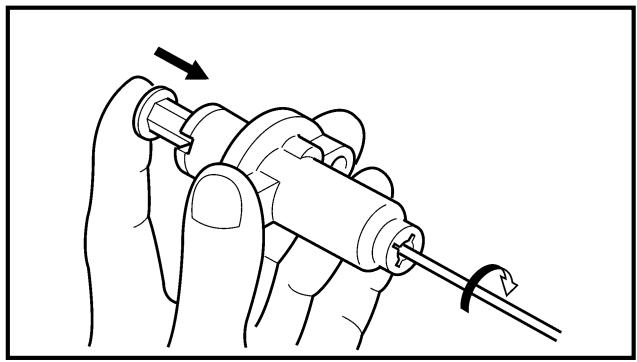
2. Install:
- Timing chain tensioner
Installation steps:
- While pressing the tensioner rod lightly with fingers, use a thin screwdriver and wind the tensioner rod up fully clockwise.
- With the rod fully wound and the chain tensioner UP mark ⑧ facing upward, install the gasket ① and the timing chain tensioner ② , and tighten the bolt ③ to the specified torque.
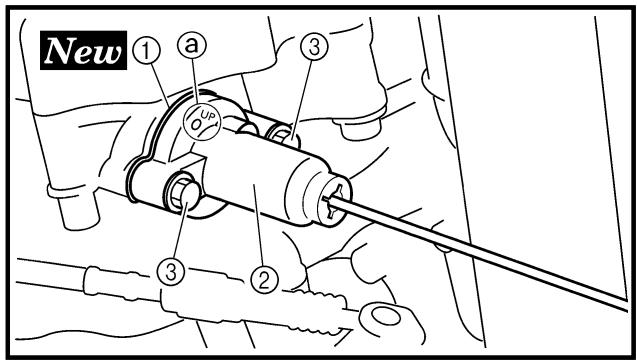
Bolt (timing chain tensioner): 10 Nm (1.0 m • kg, 7.2 ft • lb)
ATTENTION:
- Release the screwdriver, check the tensioner rod to come out and tighten the gasket ④ and the cap bolt ⑤ to the specified torque.
Tensioner cap bolt: 7 Nm (0.7 m • kg, 5.1 ft • lb)
-
Turn:
-
Crankshaft
Counterclockwise several turns
-
Check:
-
Rotor T.D.C. mark
Align with the crankcase align mark.
- Camshaft match marks
Align with the cylinder head surface.
Out of alignment Adjust.
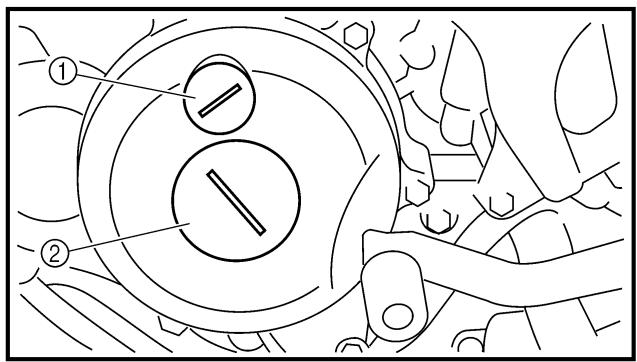
-
Install:
-
Timing mark accessing screw ①
- Crankshaft end accessing screw ②
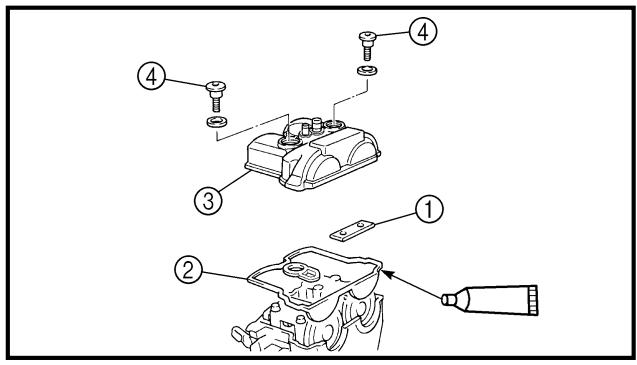
-
Install:
-
Timing chain guide (top side) ①
- Cylinder head cover gasket ②
- Cylinder head cover ③
- Bolt (cylinder head cover) ④
10 Nm (1.0 m·kg, 7.2 ft·lb)
NOTE: Apply the sealant on the cylinder head cover gasket.
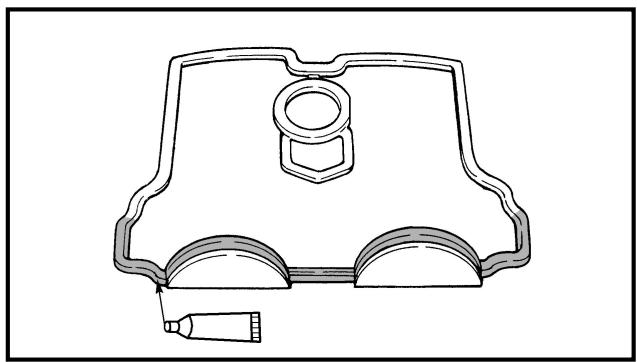
Quick gasket®:
ACC-QUICK-GS-KT
YAMAHA Bond No. 1215:
90890-85505
- Oil tank breather hose
- Cylinder head breather hose
- Spark plug
13 Nm (1.3 m · kg, 9.4 ft · lb)
- Monter:
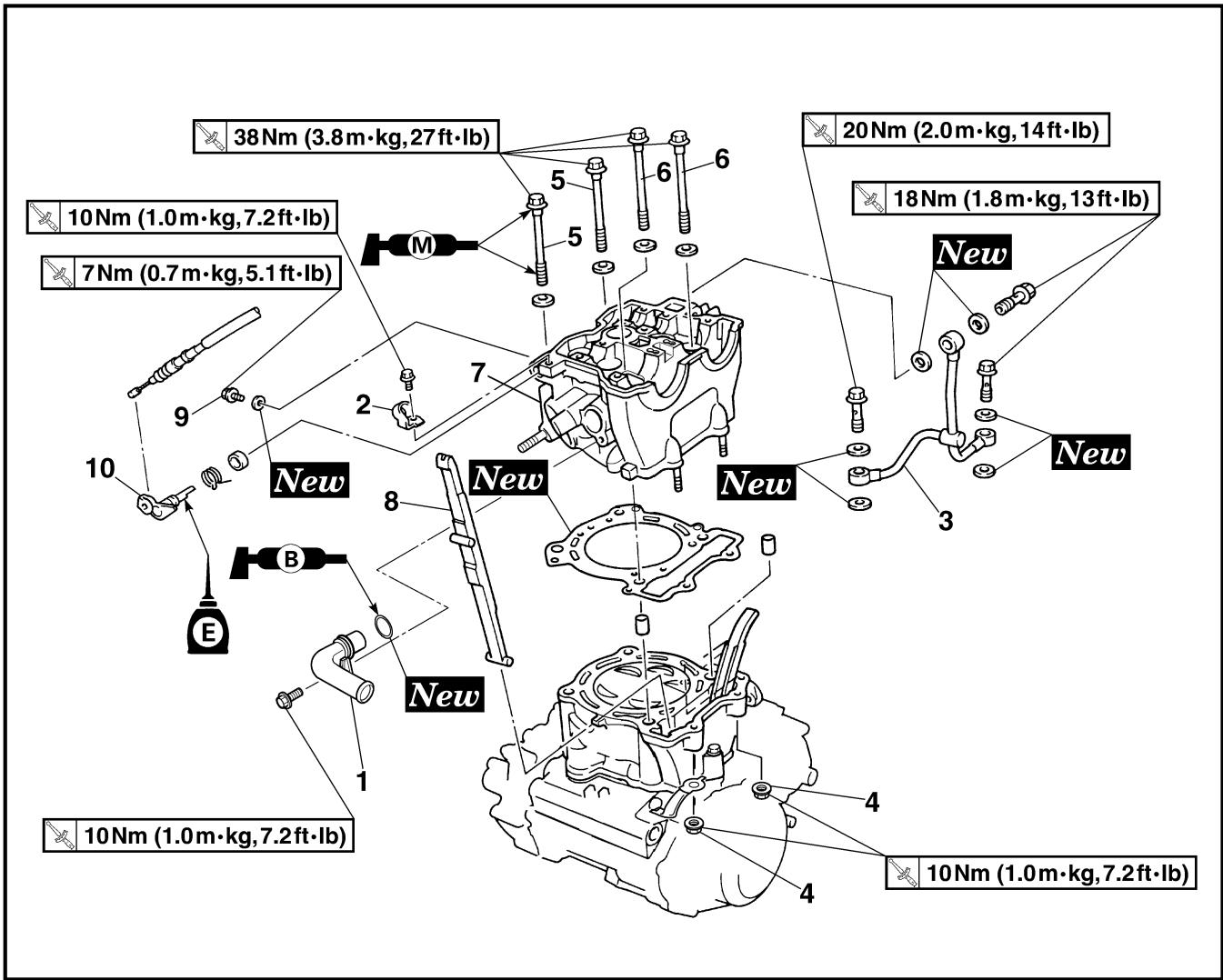
Extent of removal:
① Cylinder head removal
| Extent of removal | Order | Part name | Q'ty | Remarks |
| Preparation for removal | CYLINDER HEAD REMOVAL Seat and fuel tank Exhaust pipe and silencer Radiator hose 1 Carburetor Camshaft Upper engine bracket | Refer to “SEAT, FUEL TANK AND SIDE COVERS” section.Refer to “EXHAUST PIPE AND SILENCER” section.Disconnect at cylinder head side.Refer to “CARBURETOR” section.Refer to “CAMSHAFTS” section.Refer to “ENGINE REMOVAL” section. | ||
| ① | 1 | Radiator pipe | 1 | |
| 2 | Decompression cable guide | 1 | ||
| 3 | Oil delivery pipe | 1 | ||
| 4 | Nut | 2 | ||
| 5 | Bolt [L=135 mm (5.31 in)] | 2 | ||
| 6 | Bolt [L=145 mm (5.71 in)] | 2 | ||
| 7 | Cylinder head | 1 | Disconnect the decompression cable. | |
| 8 | Timing chain guard (exhaust side) | 1 | ||
| 9 | Bolt (decompression shaft) | 1 | ||
| 10 | Decompression shaft | 1 |
CULASSE

-
Eliminate:
-
Carbon deposits (from the combustion chambers)
Use a rounded scraper.
NOTE:
Do not use a sharp instrument to avoid damaging or scratching:
- Spark plug threads
-
Valve seats
-
Inspect:
-
Cylinder head
Scratches/damage Replace.
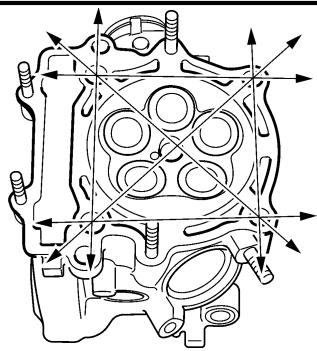
-
Measure:
-
Cylinder head warpage
Out of specification Resurface.
Cylinder head warpage:
Less than 0.05 mm (0.002 in)
Warpage measurement and resurface-ment steps:
- Place a straightedge and a feeler gauge across the cylinder head.
- Use a feeler gauge to measure the warpage.
- If the warpage is out of specification, resurface the cylinder head.
- Place a 400 600 grit wet sandpaper on the surface plate, and resurface the head using a figure-eight sanding pattern.
NOTE:
To ensure an even surface rotate the cylinder head several times.
CONTROLE
Culasse
ASSEMBLY AND INSTALLATION
Cylinder head
-
Install:
-
Decompression shaft ①
Copper washer ② New - Bolt (decompression shaft) ③
10 Nm (1.0 m·kg, 7.2 ft·lb)
NOTE:
Apply the engine oil on the decompression shaft.
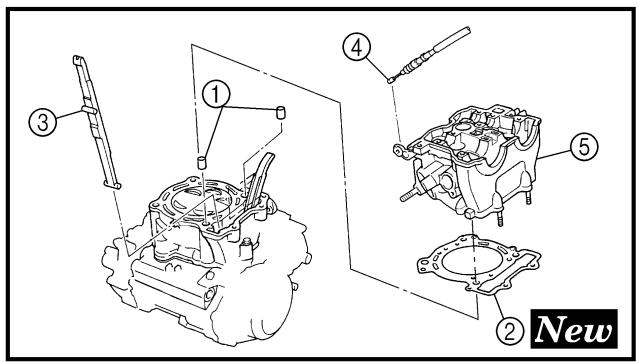
- Install:
Dowel pin ①
- Cylinder head gasket ② New
- Timing chain guide (exhaust side) ③
- Decompression cable ④
- Cylinder head ⑤
NOTE:
- Install the decompression cable to the cylinder head, and then to the cylinder.
- While pulling up the timing chain, install the timing chain guide (exhaust side) and cylinder head.
ASSEMBLAGE ET MONTAGE
Culasse
- Bolts [L=135 mm (5.31 in)] ④
$$ 3 8 \mathrm {N m} (3. 8 \mathrm {m} \cdot \mathrm {k g}, 2 7 \mathrm {f t} \cdot \mathrm {l b}) $$
- Nuts ⑤ 10 Nm (1.0 ~m · kg, 7.2 ft · lb)
NOTE:
- Apply the molybdenum disulfide grease on the thread and contact surface of the bolts.
- Follow the numerical order shown in the illustration. Tighten the bolts and nuts in two stages.
4. Install:
Copper washer ①
New
- Oil delivery pipe ②
- Union bolt (M8) ③
$$ 1 8 \mathrm {N m} (1. 8 \mathrm {m} \cdot \mathrm {k g}, 1 3 \mathrm {f t} \cdot \mathrm {l b}) $$
- Union bolt (M10) ④
$$ 2 0 \mathrm {N m} (2. 0 \mathrm {m} \cdot \mathrm {k g}, 1 4 \mathrm {f t} \cdot \mathrm {l b}) $$
5. Install:
- Decompression cable guide ①
- Bolt (decompression cable guide) ②
$$ 1 0 \mathrm {N m} (1. 0 \mathrm {m} \cdot \mathrm {k g}, 7. 2 \mathrm {f t} \cdot \mathrm {l b}) $$
6. Install:
- Radiator pipe ①
- Bolt (radiator pipe) ②
$$ 1 0 \mathrm {N m} (1. 0 \mathrm {m} \cdot \mathrm {k g}, 7. 2 \mathrm {f t} \cdot \mathrm {l b}) $$
3. Monter:
Rondelle ①
Guide de cable ②
Boulons
[L = 145 ~mm(5,71 in)] ③
38Nm (3,8m· kg,27ft· lb)
Boulons
[L = 135 ~mm(5,31 in)] ④
38Nm (3,8m· kg,27ft· lb)
- Ecrous ⑤
10Nm(1,0m·kg,7,2ft·lb)
N.B.:
Extent of removal:
① Valve removal
| Extent of removal | Order | Part name | Q'ty | Remarks |
| Preparation for removal | VALVES AND VALVE SPRINGS REMOVAL | Refer to “CYLINDER HEAD” section. | ||
| Cylinder head | ||||
| 1 | 1 | Valve lifter | 5 | Use special tool. Refer to “REMOVAL POINTS”. |
| 2 | Adjusting pad | 5 | ||
| 3 | Valve cotter | 10 | ||
| 4 | Valve spring retainer | 5 | ||
| 5 | Valve spring | 5 | ||
| 6 | Valve stem seal | 5 | ||
| 7 | Valve spring seat | 5 | ||
| 8 | Exhaust valve | 2 | ||
| 9 | Intake valve | 3 |
SOUPAPES ET RESSORTS DE SOUPAPE

Valve lifter and valve cotter
-
Remove:
-
Valve lifter ①
- Pad ②
NOTE:
Identify each lifter ① and pad ② position very carefully so that they can be reinstalled in their original place.
-
Check:
-
Valve sealing
Leakage at the valve seat Inspect the valve face, valve seat and valve seat width.
Checking steps:
- Pour a clean solvent ① into the intake and exhaust ports.
-
Check that the valve seals properly. There should be no leakage at the valve seat ②
-
Remove:
-
Valve cotter
NOTE:
Attach a valve spring compressor ① between the valve spring retainer and the cylinder head to remove the valve cotters.
Valve spring compressor: YM-04019/90890-04019
POINTS DE DEPOSE
-
Measure:
-
Stem-to-guide clearance
Stem-to-guide clearance = valve guide inside diameter a - valve stem diameter b
Out of specification Replace the valve guide.
Clearance (stem to guide):
Intake:
0.010 ~ 0.037 mm
(0.0004 ~ 0.0015 in)
Exhaust:
0.025 ~ 0.052 mm
(0.0010 ~ 0.0020 in)
-
Replace:
-
Valve guide
Replacement steps:
NOTE:
To ease guide removal, installation and to maintain correct fit heat the cylinder head in an over to 100^ (212 F).
- Remove the valve guide using a valve guide remover ①.
- Install the new valve guide using a valve guide remover ① and valve guide installer ② .
After installing the valve guide, bore the valve guide using a valve guide reamer ③ to obtain proper stem-to-guide clearance.
CONTROLE
Soupape
After replacing the valve guide reface the valve seat.
3. Inspect:
- Valve face
Pitting/wear Grind the face.
- Valve stem end
Mushroom shape or diameter larger than the body of the stem Replace.
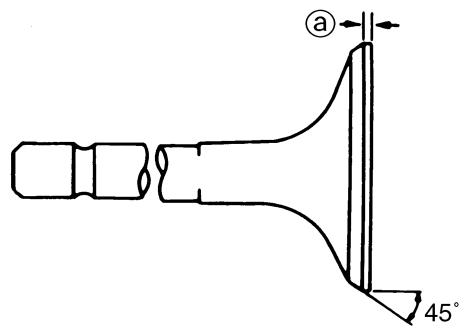
4. Measure:
- Margin thickness (a)
Out of specification Replace.
Margin thickness:
Intake:
0.8 mm (0.0315 in)
Exhaust:
0.7 mm (0.0276 in)

- When installing a new valve always replace the guide.
- If the valve is removed or replaced always replace the oil seal.
6. Eliminate:
- Carbon deposits
(from the valve face and valve seat)
7. Inspect:
- Valve seat
Pitting/wear Reface the valve seat.
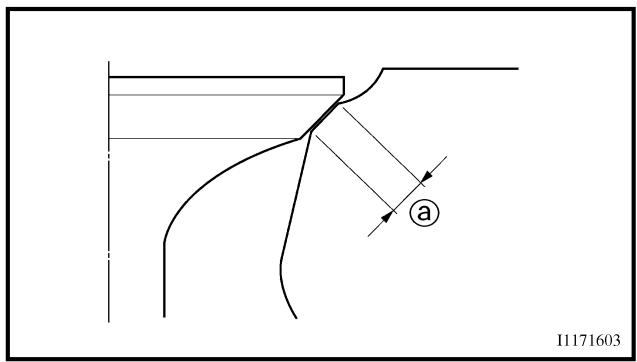
8. Measure:
- Valve seat width ⑧
Out of specification Reface the valve seat.
Valve seat width:
Intake:
$$ 0. 9 \sim 1. 1 \mathrm {m m} (0. 0 3 5 4 \sim 0. 0 4 3 3 \mathrm {i n}) $$
$$ < \text {L i m i t} >: 1. 6 \mathrm {m m} (0. 0 6 3 0 \mathrm {i n}) $$
Exhaust:
$$ 0. 9 \sim 1. 1 \mathrm {m m} (0. 0 3 5 4 \sim 0. 0 4 3 3 \mathrm {i n}) $$
$$ < \text {L i m i t} >: 1. 6 \mathrm {m m} (0. 0 6 3 0 \mathrm {i n}) $$
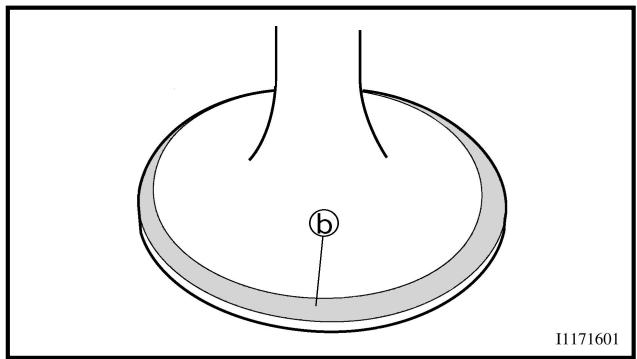
Measurement steps:
- Apply Mechanic's blueing dye (Dykem) ⑥ to the valve face.
- Install the valve into the cylinder head.
- Press the valve through the valve guide and onto the valve seat to make a clear pattern.
- Measure the valve seat width. Where the valve seat and valve face made contact, blueing will have been removed.
- If the valve seat is too wide, too narrow, or the seat is not centered, the valve seat must be refaced.
SOUPAPES ET RESSORTS DE SOUPAPE VENTILE UND VENTILFEDERN VALVOLE E MOLLE VALVOLE
ENG
-
Mesurer:
-
Ovalisation (queue de soupape)
Hors specifications Remplacer.

Limin de déformation: 0,01 mm (0,0004 in)
N.B.:
After refacing the valve seat or replacing the valve and valve guide, the valve seat and valve face should be lapped.
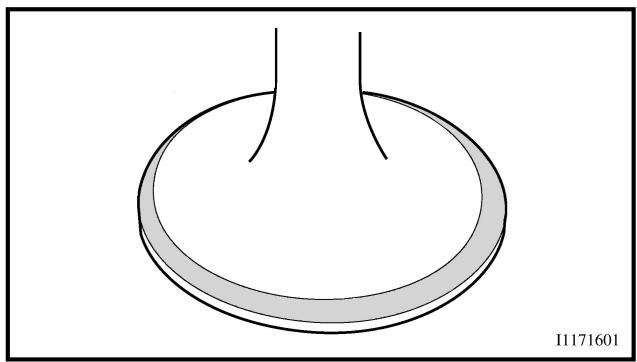
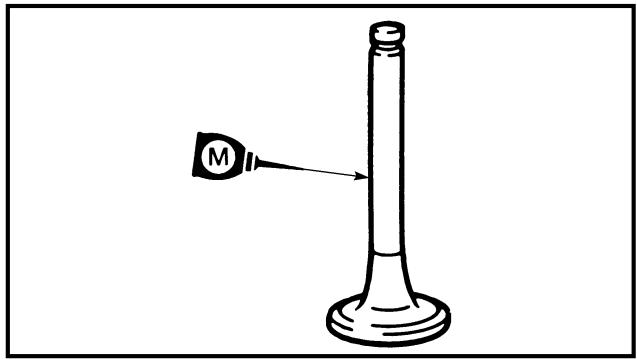
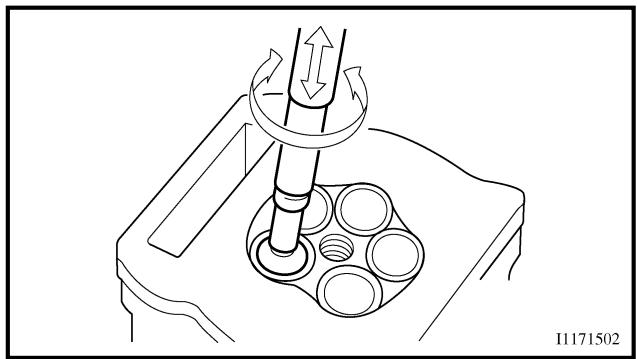
Lapping steps:
- Apply a coarse lapping compound to the valve face.
CAUTION:
Do not let the compound enter the gap between the valve stem and the guide.
- Apply molybdenum disulfide oil to the valve stem.
- Install the valve into the cylinder head.
- Turn the valve until the valve face and valve seat are evenly polished, then clean off all of the compound.
NOTE:
For best lapping results, lightly tap the valve seat while rotating the valve back and forth between your hands.
- Apply a fine lapping compound to the valve face and repeat the above steps.
NOTE:
After every lapping operation be sure to clean off all of the compound from the valve face and valve seat.
- Apply Mechanic's blueing dye (Dykem) to the valve face.
- Install the valve into the cylinder head.
- Press the valve through the valve guide and onto the valve seat to make a clear pattern.
- Measure the valve seat width again. If the valve seat width is out of specification, reface and relap the valve seat.
SOUPAPES ET RESSORTS DE SOUPAPE VENTILE UND VENTILFEDERN VALVOLE E MOLLE VALVOLE
9. Roder:
-
Measure:
-
Valve spring free length @
Out of specification Replace.
Free length (valve spring):
Intake:
37.81 mm (1.49 in)
Exhaust:
37.54 mm (1.48 in)
-
Measure:
-
Compressed spring force @
Out of specification Replace.
⑥ Installed length
Compressed spring force:
Intake:
10.1 ~ 11.6 kg at 29.13 mm
(22.27 ~ 25.57 lb at 1.15 in)
Exhaust:
12.9 ~ 14.7 kg at 29.30 mm
(28.44 ~ 32.41 lb at 1.15 in)
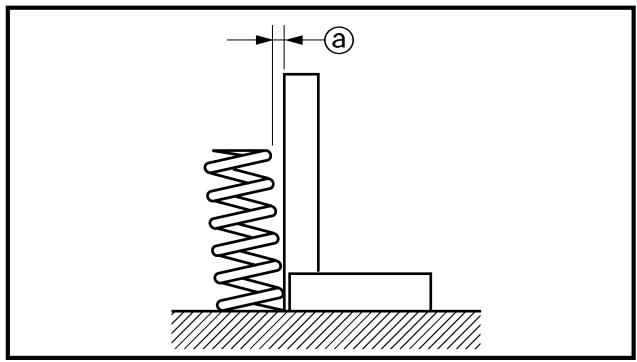
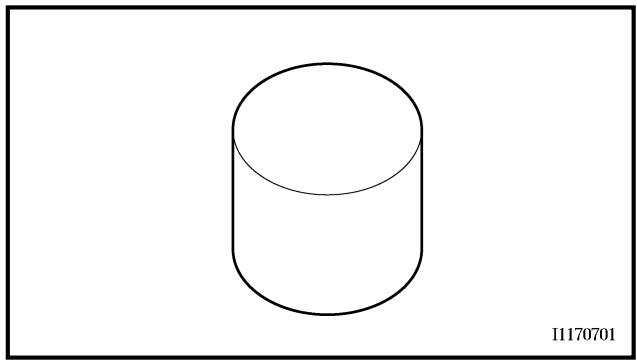
-
Measure:
-
Spring tilt @
Out of specification Replace.
Spring tilt limit:
Intake:
2.5/1.7 mm (0.067 in)
Exhaust:
2.5^ / 1.6 ~mm (0.063 in)
Valve lifter
-
Inspect:
-
Valve lifter
Scratches/damage Replace both lifters and cylinder head.
SOUPAPES ET RESSORTS DE SOUPAPE VENTILE UND VENTILFEDERN VALVOLE E MOLLE VALVOLE
Ressort de soupape
Force du ressort comprime:
Admission:
10.1 à 11.6 kg à
29.13 mm (22.27 a
25,57 lb à 1,15 in)
Echappement:
12,9 à 14,7 kg à
29,30 mm (28,44 a
32,41 lb à 1,15 in)
Ventilfeder
Combination of cylinder head and valve lifter
1. Combination:
For this combination, match the paint color on the cylinder head with that on the valve lifter according to the chart below.
| Combination | |
| Cylinder head mark ⑧ (color) | Valve lifter mark ⑥ (color) |
| Red | Red |
| Blue | Blue |
| Yellow | Yellow |
| Purple | Black |
NOTE:
When you purchase a cylinder head, you cannot designate its size. Choose the valve lifter that matches the above chart.
ASSEMBLY AND INSTALLATION
Valve and valve spring
1. Apply:
- Molybdenum disulfide oil
Onto the valve stem and valve stem seal.
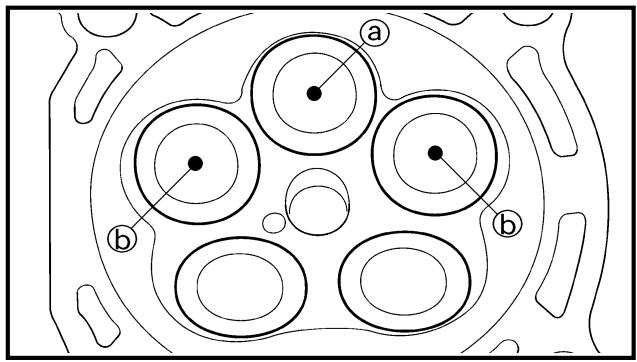
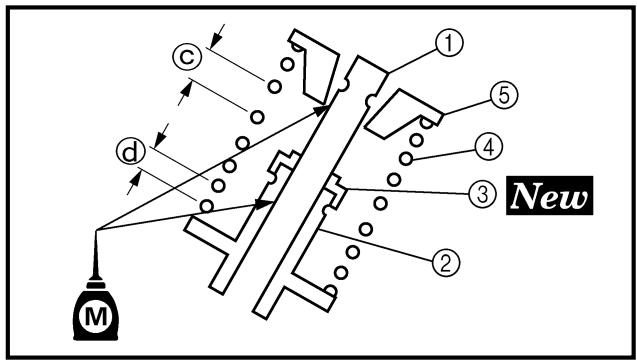
2. Install:
- Valve ①
- Valve spring seat ②
- Valve stem seal ③
- Valve spring ④
- Valve spring retainer ⑤ To cylinder head.
NOTE:
- Make sure that each valve is installed in its original place, also referring to the painted color as follows.
Intake (middle) ⑧ : yellow
Intake (right/left) ⑥ : white
Exhaust: no paint
Install the valve springs with the larger pitch
facing upward.
Smaller pitch
NOTE: While compressing the valve spring with a valve spring compressor ① install the valve cotters.

- To secure the valve cotters onto the valve stem, lightly tap the valve tip with a piece of wood.
CAUTION:
Hitting the valve tip with excessive force could damage the valve.
-
Install:
-
Adjusting pad ①
- Valve lifter ②
NOTE:
- Apply the molybdenum disulfied oil on the valve stem end.
- Apply the engine oil on the valve lifters.
- Valve lifter must turn smoothly when rotated with a finger.
- Be careful to reinstall valve lifters and pads in their original place.
SOUPAPES ET RESSORTS DE SOUPAPE VENTILE UND VENTILFEDERN VALVOLE E MOLLE VALVOLE
-
Monter:
-
Clavette de soupape
N.B.:
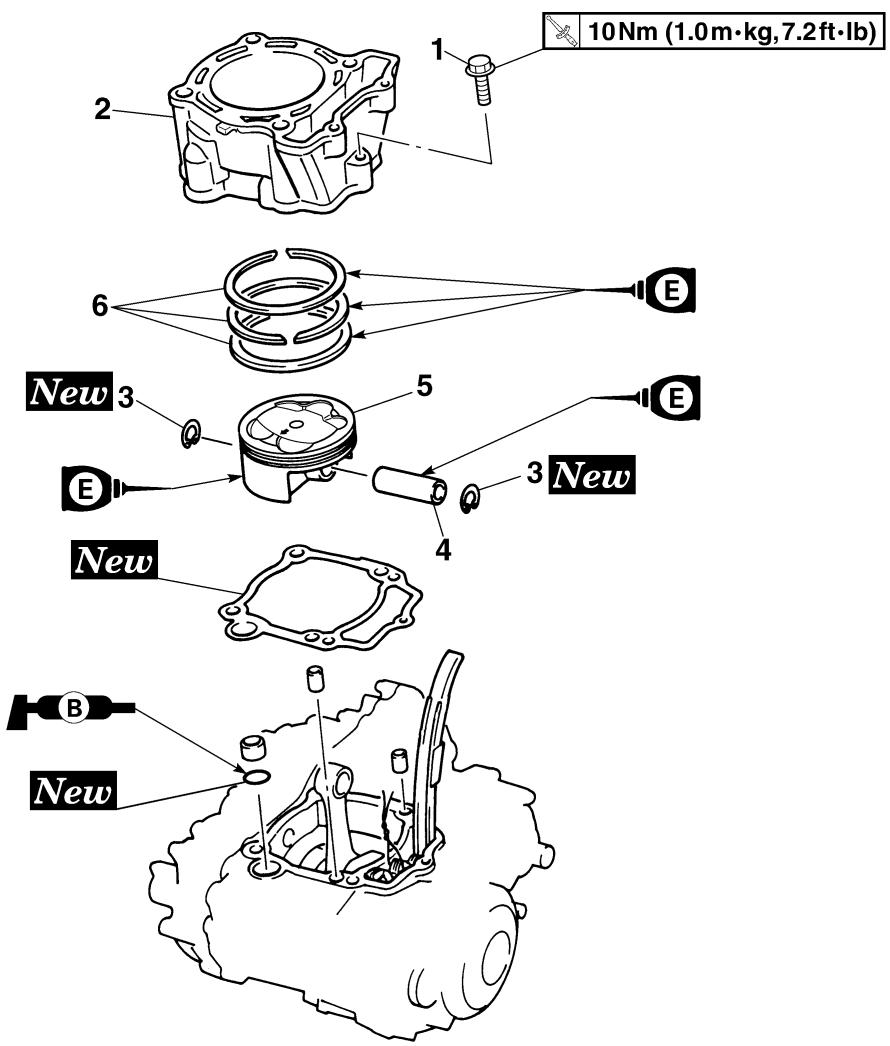
Extent of removal:
① Cylinder removal
② Piston removal
| Extent of removal | Order | Part name | Q'ty | Remarks |
| Preparation for removal | CYLINDER AND PISTON REMOVAL | Refer to “CYLINDER HEAD” section. | ||
| Cylinder head | ||||
| 1 | 1 | Bolt (cylinder) | 1 | Use special tool. Refer to “REMOVAL POINTS”. |
| 2 | Cylinder | 1 | ||
| 3 | Piston pin clip | 2 | ||
| 4 | Piston pin | 1 | ||
| 5 | Piston | 1 | ||
| 6 | Piston ring set | 1 |
CYLINDRE ET PISTON
Piston and piston ring
-
Remove:
-
Piston pin clip ①
- Piston pin ②
- Piston ③
NOTE:
- Put identification marks on each piston head for reference during reinstallation.
- Before removing each piston pin, deburr the clip groove and pin hole area. If the piston pin groove is deburred and the piston pin is still difficult to remove, use the piston pin puller set ④.
Piston pin puller set: YU-1304/90890-01304
CAUTION:
Do not use a hammer to drive the piston pin out.
-
Remove:
-
Piston ring ①
NOTE:
Spread the end gaps apart while at the same time lifting the piston ring over the top of the piston crown, as shown in the illustration.
INSPECTION
Cylinder and piston
-
Inspect:
-
Cylinder and piston walls
Vertical scratches Replace cylinder and piston.
-
Measure:
-
Piston-to-cylinder clearance
Measurement steps:
1st step:
- Measure the cylinder bore "C" with a cylinder bore gauge.
NOTE:
Measure the cylinder bore "C" in parallel to and at right angles to the crankshaft. Then, find the average of the measurements.
POINTS DE DEPOSE
| Cylinder bore “C” | 77.00 ~ 77.01 mm (3.0315 ~ 3.0319 in) |
| Taper limit “T” | 0.05 mm (0.002 in) |
| Out of round “R” | 0.05 mm (0.002 in) |
| “C” = Maximum D | |
| “T” = (Maximum D1 or D2) - (Maximum D5 or D6) | |
| “R” = (Maximum D1, D3 or D5) - (Minimum D2, D4 or D6) | |
| If out of specification, replace the cylinder, and replace the piston and piston rings as set. 2nd step: · Measure the piston skirt diameter “P” with a micrometer. @ 8 mm (0.31 in) from the piston bottom edge | |
| Piston size “P” | |
| Standard | 76.955 ~ 76.970 mm (3.0297 ~ 3.0303 in) |
| · If out of specification, replace the piston and piston rings as a set. 3rd step: · Calculate the piston-to-cylinder clearance with following formula: | |
| Piston-to-cylinder clearance = Cylinder bore “C” - Piston skirt diameter “P” | |
| Piston-to-cylinder clearance: 0.040 ~ 0.065 mm (0.0016 ~ 0.0026 in) <Limit>: 0.1 mm (0.004 in) | |
| · If out of specification, replace the cylinder, and replace the piston and piston rings as set. | |
Out of specification Replace the piston and rings as a set.
NOTE: Clean carbon from the piston ring grooves and rings before measuring the side clearance.
| Side clearance: | ||
| Standard | <Limit> | |
| Top ring | 0.030 ~ 0.065 mm (0.0012 ~ 0.0026 in) | 0.12 mm (0.005 in) |
| 2nd ring | 0.020 ~ 0.055 mm (0.0008 ~ 0.0022 in) | 0.12 mm (0.005 in) |
2. Position:
- Piston ring
(in cylinder)
NOTE:
Insert a ring into the cylinder and push it approximately 10mm (0.39 in) into the cylinder. Push the ring with the piston crown so that the ring will be at a right angle to the cylinder bore.
⑧ 10 mm (0.39 in)
3. Measure:
Ring end gap
Out of specification Replace.
NOTE:
You cannot measure the end gap on the expander spacer of the oil control ring. If the oil control ring rails show excessive gap, replace all three rings.
| End gap: | ||
| Standard | <Limit> | |
| Top ring | 0.15 ~ 0.25 mm (0.006 ~ 0.010 in) | 0.50 mm (0.020 in) |
| 2nd ring | 0.30 ~ 0.45 mm (0.012 ~ 0.018 in) | 0.80 mm (0.031 in) |
| Oil ring | 0.10 ~ 0.40 mm (0.004 ~ 0.016 in) | — |
Segment de piston
-
Mesurer:
-
Jeu létal du segment
- Piston pin
- Blue discoloration/grooves Replace, then inspect the lubrication system.
2. Measure:
- Piston pin-to-piston clearance
Measurement steps:
Measure the outside diameter (piston pin) a. If out of specification, replace the piston pin.
Outside diameter (piston pin):
15.991 ~ 16.000 mm
(0.6296 ~ 0.6299 in)
Measure the inside diameter (piston) 6.
Inside diameter (piston):
16.002 ~ 16.013 mm
(0.6300 ~ 0.6304 in)
- Calculate the piston pin-to-piston clearance with the following formula.
Piston pin-to-piston clearance = Inside diameter (piston) ⑥ - Outside diameter (piston pin) ⑧
- If out of specification, replace the piston.
Piston pin-to-piston clearance:
0.002 ~ 0.022 mm
(0.0001 ~ 0.0009 in)
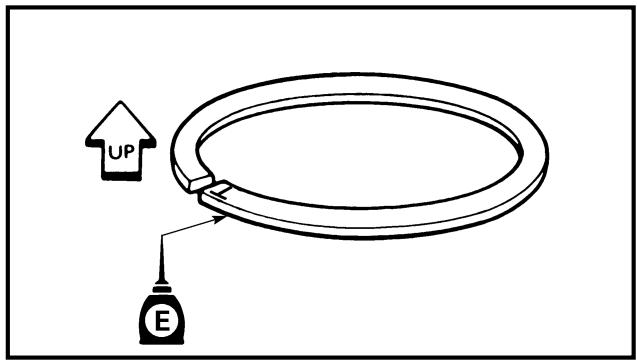
ASSEMBLY AND INSTALLATION
Piston ring and piston
1. Install:
- Piston ring
Onto the piston.
NOTE:
- Be sure to install the piston rings so that the manufacturer's marks or numbers are located on the upper side of the rings.
- Lubricate the piston and piston rings liberally with engine oil.
Axe de piston
-
Controller:
-
Axe de piston
- Top ring
- 2nd ring
Oil ring
Offset the piston ring end gaps as shown.
Top ring end
⑥ 2nd ring end
Oil ring end (upper)
@ Oil ring
Oil ring end (lower)
3. Install:
- Piston ①
- Piston pin ②
- Piston pin clip ③ New
NOTE:
- Apply engine oil onto the piston pin and piston.
- Be sure that the arrow mark ⑧ on the piston points to the exhaust side of the engine.
- Before installing the piston pin clip, cover the crankcase with a clean rag to prevent the piston pin clip from falling into the crankcase.
- Install the piston pin clips with their ends facing downward.
Cylinder
-
Lubricle:
-
Piston
- Piston ring
- Cylinder
NOTE:
Apply a liberal coating of engine oil.
2. Install:
Dowel pin ①
- O-ring ② New
NOTE:
Apply the lithium soap base grease on the O-ring.
2. Positionner:
Install the cylinder with one hand while compressing the piston rings with the other hand.
CAUTION:
- Pass the timing chain ③ through the timing chain cavity.
-
Be careful not to damage the timing chain guide ④ during installation.
-
Install:
-
Bolt (cylinder) ⑤

10 Nm (1.0 m · kg, 7.2 ft · lb)
-
Monter:
-
Joint de cylindre ①

Cylindre ②
N.B.:
① Push rod 1, 2 and push lever shaft removal
③ Friction plate and clutch plate removal
② Push pod 1 disassembly
④ Primary driven gear removal
| Extent of removal | Order | Part name | Q'ty | Remarks |
| Preparation for removal | CLUTCH REMOVALDrain the engine oil.Brake pedalClutch cable | Refer to "ENGINE OIL REPLACEMENT"section in the CHAPTER 3.Refer to "ENGINE REMOVAL" section.Disconnect at engine side. | ||
| 124 | 1 | Clutch cover | 1 | |
| 2 | Clutch spring | 5 | ||
| 3 | Pressure plate | 1 | ||
| 4 | Push rod 1 | 1 | ||
| 5 | Circlip | 1 | ||
| 6 | Washer | 1 | ||
| 7 | Bearing | 1 | ||
| 8 | Ball | 1 | ||
| 9 | Push rod 2 | 1 |
EMBRAYAGE

-
Remove:
-
Nut ①
- Lock washer ②
- Clutch boss ③
NOTE:
Straighten the lock washer tab and use the clutch holding tool ④ to hold the clutch boss.
Clutch holding tool: YM-91042/90890-04086
For USA and CDN
Except for USA and CDN
EC4A4000
INSPECTION
EC484100
Clutch housing and boss
-
Inspect:
-
Clutch housing ①
Cracks/wear/damage Replace. - Clutch boss ②
Scoring/wear/damage Replace.
EC484201
Primary driven gear
-
Check:
-
Circumferential play
Free play exists Replace.
Gear teeth @
Wear/damage Replace.
Clutch spring
-
Measure:
-
Clutch spring free length @
Out of specification Replace springs as a set.
Clutch spring free length:
39.1 mm (1.54 in)
POINTS DE DEPOSE
Noix d'embrayage
- Friction plate thickness
- Out of specification Replace friction plate as a set.
- Measure at all four points.
Friction plate thickness: 2.9 3.1 ~mm (0.114 ~ 0.122 in)
EC484600
Clutch plate
1. Measure:
- Clutch plate warpage Out of specification Replace clutch plate as a set. Use a surface plate ① and thickness gauge ②.
Warp limit: 0.1 mm (0.004 in)
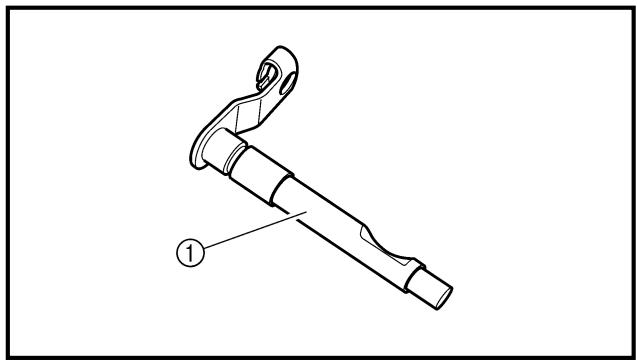
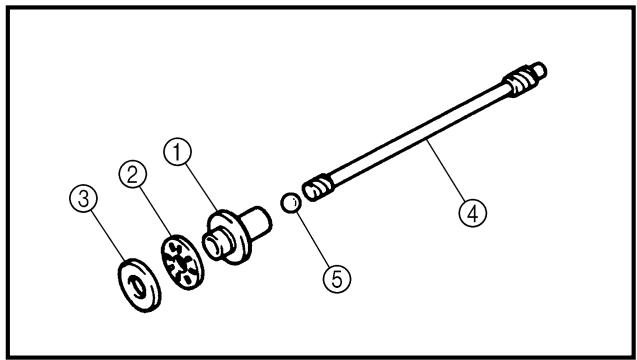
Push lever shaft
1. Inspect:
- Push lever shaft ① Wear/damage → Replace.
Push rod
1. Inspect:
- Push rod 1 ①
- Bearing ②
- Washer ③
- Push rod 2 ④
- Ball ⑤ Wear/damage/bend → Replace.
Disque de friction
ASSEMBLY AND INSTALLATION
Push lever shaft
-
Install:
-
Push lever shaft ①
- Bolt (push lever shaft) ②
10 Nm (1.0 m · kg, 7.2 ft · lb)
NOTE:
- Apply the lithium soap base grease on the oil seal lip.
- Apply the engine oil on the push lever shaft.
- Fit the seat plate ③ in the groove ⑧ of the push lever shaft and tighten the bolt (seat plate).
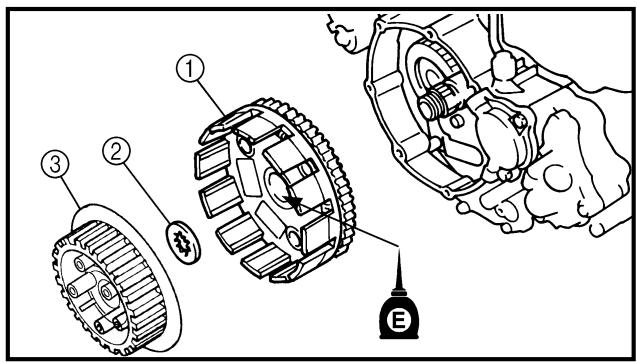
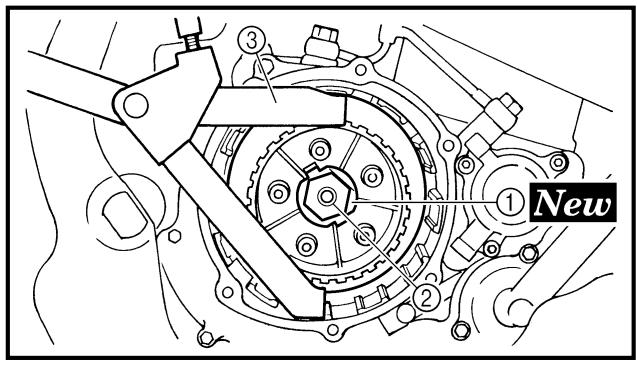
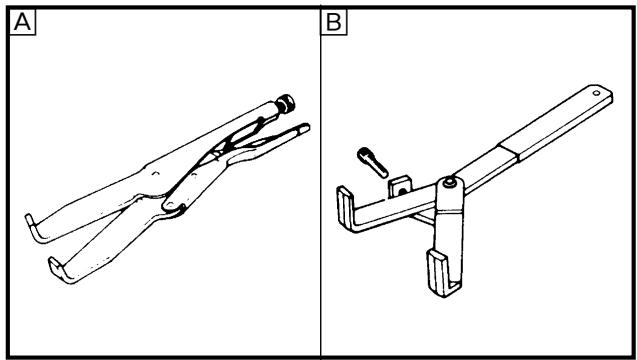
Clutch
-
Install:
-
Primary driven gear ①
- Thrust washer ②
- Clutch boss ③
NOTE:
Apply the engine oil on the primary driven gear inner circumference.
-
Install:
-
Lock washer ①

- Nut (clutch boss) ②
60 Nm (6.0 m · kg, 43 ft · lb)
NOTE:
Use the clutch holding tool ③ to hold the clutch boss.

For USA and CDN
Except for USA and CDN
ASSEMBLAGE ET MONTAGE
Levier de poussaee
- Install the seat plate with its champered portion ⑧ facing the clutch boss ③ .
-
Install the cushion spring with the paint ⑥ facing out.
-
Install:
-
Friction plate 1 ①
- Clutch plate 1 ②
- Friction plate 2 ③
- Clutch plate 2 ④
NOTE:
- Install the clutch plates and friction plates alternately on the clutch boss, starting with a friction plate and ending with a friction plate.
- Use the friction plates 1 for the first and final while paying attention to the difference in surface pattern.
- Apply the engine oil on the friction plates and clutch plates.
-
Unlike the clutch plate 2, the clutch plate 1 has no surface gloss. Use the clutch plate 1 for the first while paying attention to the difference in surface gloss.
-
Install:
-
Bearing ①
- Washer ②
- Circlip ③ New
To push rod 1 ④.
NOTE:
Apply the engine oil on the bearing and washer.
-
Courber la languette de la rondelle-frein ①.
-
Die Lasche der Sicherungsscheibe ① umbiegen.
-
Piegare la linguetta della rondella di bloccaggio ①.
4. Monter:
(an Druckstange 1 ④)
HINWEIS:
NOTE: Apply the engine oil on the push rod 1, 2 and ball.
8. Install:
- Pressure plate ①
9. Install:
- Clutch spring ①
- Bolt (clutch spring) ②
8 Nm (0.8 m·kg, 5.8 ft·lb)
NOTE:
Tighten the bolts in stage, using a crisscross pattern.
10. Install:
Dowel pin ①
- Gasket (clutch cover) ②
New
11.Install:
- Clutch cover ①
- Bolt (clutch cover)
10 Nm (1.0 m·kg, 7.2 ft·lb)
NOTE:
Tighten the bolts in stage, using a crisscross pattern.
- Monter:
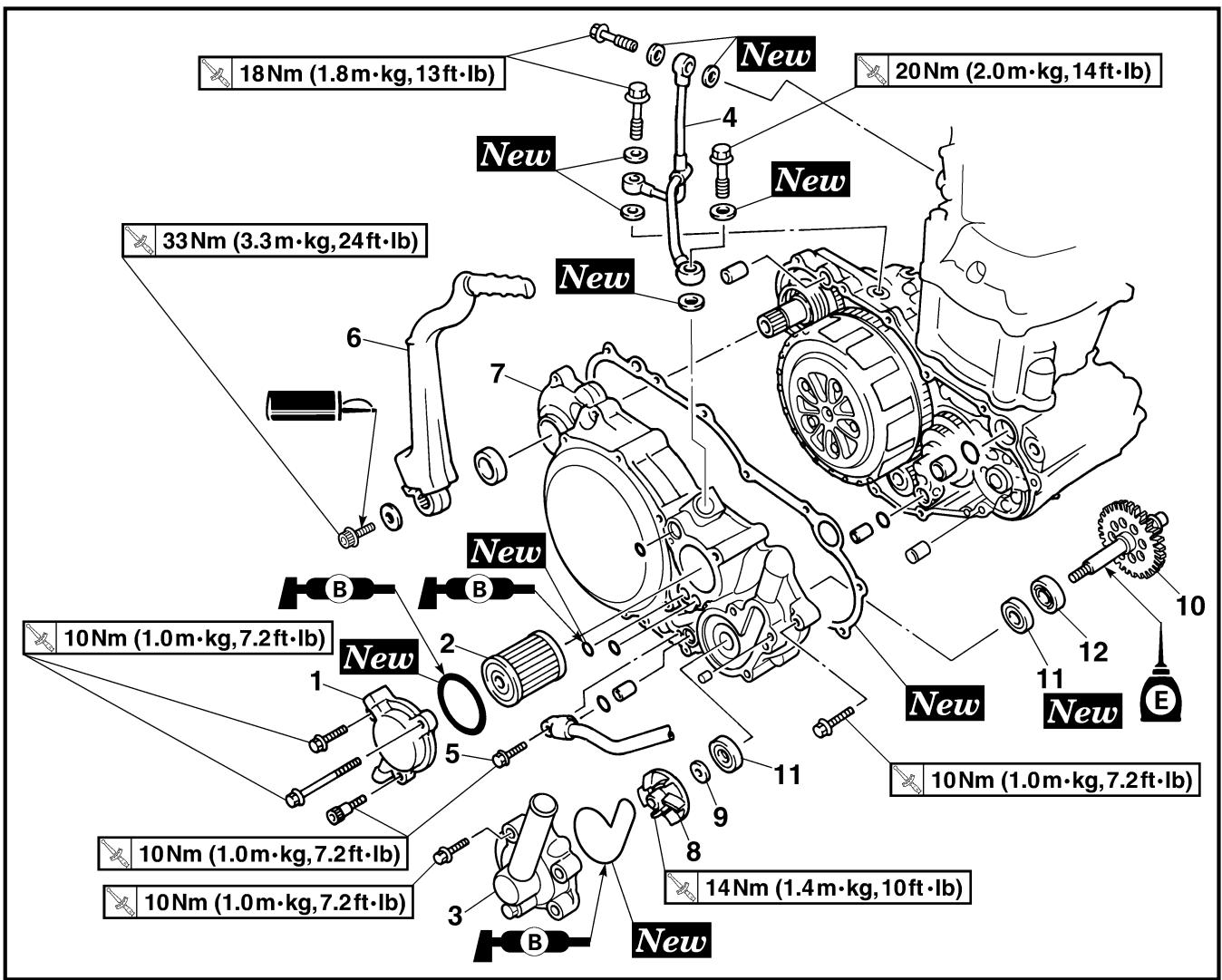
Extent of removal:
① Oil filter element removal
② Water pump removal
③ Right crankcase cover removal
| Extent of removal | Order | Part name | Q'ty | Remarks |
| Preparation for removal | OIL FILTER ELEMENT, WATER PUMP AND RIGHT CRANK-CASE COVER REMOVAL | Refer to “ENGINE OIL REPLACEMENT” section in the CHAPTER 3. Refer to “COOLANT REPLACEMENT” section in the CHAPTER 3. Disconnect at water pump side. Refer to “EXHAUST PIPE AND SILENCER” section. Refer to “ENGINE REMOVAL” section. | ||
| Drain the engine oil. | ||||
| Drain the coolant. | ||||
| Radiator hose 3 | ||||
| Exhaust pipe | ||||
| Brake pedal | ||||
| Right engine guard | ||||
| 1 | 3 | 1 | Oil filter element cover | 1 |
| 2 | Oil filter element | 1 |
ELEMENT DE FILTRE A HUILE, POMPE A EAU ET DEMI-CARTER DROIT
NOTE: Hold the impeller shaft on its width across the flats @ with spanners, etc. and remove the impeller.
EC4G3210
Oil seal
NOTE:
It is not necessary to disassemble the water pump, unless there is an abnormality such as excessive change in coolant level, discoloration of coolant, or milky transmission oil.
- Remove:
- Bearing ①
- Remove:
- Oil seal ①
INSPECTION Oil delivery pipe
-
Inspect:
-
Oil delivery pipe ①
Bend/damage → Replace.
Clogged → Blow.
POINTS DE DEPOSE
Arbre de rotor
-
Inspect:
-
Impeller shaft ① Bend/wear/damage → Replace. Fur deposits → Clean.
EC444300
Impeller shaft gear
- Inspect:
Gear teeth @
Wear/damage Replace.
EC4H4600
Bearing
-
Inspect:
-
Bearing
Rotate inner race with a finger.
Rough spot/seizure Replace.
EC444400
Oil seal
-
Inspect:
-
Oil seal ①
Wear/damage Replace.
ASSEMBLY AND INSTALLATION
Oil seal
-
Install:
-
Oil seal ①

NOTE:
- Apply the lithium soap base grease on the oil seal lip.
- Install the oil seal with its manufacture's marks or numbers facing the right crankcase cover ②
Arbre de rotor
-
Controller:
-
Arbre de rotor ①
Déformation/usure/endomma-gement Remplacer.
NOTE: Install the bearing by pressing its outer race parallel.
Impeller shaft
-
Install:
-
Impeller shaft ①
- Washer ②
- Impeller ③
14 Nm (1.4 m·kg, 10 ft·lb)
NOTE:
- Take care so that the oil seal lip is not damaged or the spring does not slip off its position.
- When installing the impeller shaft, apply the lithium soap base grease on the oil seal lip and impeller shaft. And install the shaft while turning it.
- Hold the impeller shaft on its width across the flats ④ with spanners, etc. and remove the impeller.
Right crankcase cover
- Install:
Dowel pin ①
- O-ring ②
- Collar ③
- Gasket ④


NOTE: Apply the lithium soap base grease on the O-ring.
- Monter:
Roulement ①
- Montieren:
Lager ①
- Installare:
Cuscinetto ①
N.B.:
- Right crankcase cover ①
- Bolt (right crankcase cover) ②
10 Nm (1.0 m·kg, 7.2 ft·lb)
NOTE:
- Apply the engine oil on the impeller shaft end.
- Mesh the impeller shaft gear ③ with primary drive gear ④.
- Tighten the bolts in stage, using a crisscross pattern.
Kickstarter crank
1. Install:
- Kickstarter crank ①
- Washer ②
- Bolt (kickstarter crank) ③

Install the kickstarter crank so that the kickstarter crank is as vertical as possible with the distance ⑧ between the kickstarter crank and the frame being 8 ~mm (0.31 in) or more.
2. Install:
- Oil hose ①
- Bolt (oil hose) ②
10 Nm (1.0 m·kg, 7.2 ft·lb)
3. Install:
Copper washer ①
- Oil delivery pipe ②
- Union bolt (M8) ③
18Nm(1.8m·kg,13ft·lb)
- Union bolt (M10) ④
20Nm(2.0m·kg,14ft·lb)
- Monter:
Boulon (pedale de kick) ③

33Nm (3,3m· kg,24ft· lb)
N.B.:
Dowel pin ①
- O-ring ② New
NOTE: Apply the lithium soap base grease on the O-ring.
- Install:
Water pump housing ①
- Bolt (water pump housing) ②
10 Nm (1.0 m · kg, 7.2 ft · lb)
Oil filter element
-
Install:
-
Oil filter element ①
- O-ring ② New
- Oil filter element cover ③
- Bolt (oil filter element cover)
10 Nm (1.0 m · kg, 7.2 ft · lb)
NOTE: Apply the lithium soap base grease on the O-ring.
Extent of removal:
① Balancer shaft drive gear
② Balancer shaft
| Extent of removal | Order | Part name | Q'ty | Remarks |
| Preparation for removal | BALANCER REMOVALPrimary driven gearRight crankcase coverStator | Refer to “CLUTCH” section.Refer to “OIL FILTER ELEMENT,WATER PUMP AND RIGHT CRANK-CASE COVER” section.Refer to “CDI MAGNETO” section. | ||
| ① | 1 | Nut (primary drive gear) | 1 | Refer to “REMOVAL POINTS”. |
| 2 | Nut (balancer shaft driven gear) | 1 | ||
| 3 | Lock washer | 1 | ||
| 4 | Primary drive gear | 1 | ||
| 5 | Balancer shaft drive gear | 1 | ||
| 6 | Lock washer | 1 | ||
| 7 | Balancer shaft driven gear | 1 | ||
| 8 | Balancer shaft | 1 | Refer to “REMOVAL POINTS”. |
BALANCIER

Balancer shaft drive gear and balancer shaft driven gear
- Straighten the lock washer tab.
-
Loosen:
-
Nut (primary drive gear) ①
- Nut (balancer shaft driven gear) ②
NOTE:
Place an aluminum plate ⑧ between the teeth of the balancer shaft drive gear ③ and driven gear ④ .
Balancer shaft
-
Remove:
-
Balancer shaft ①
NOTE:
When removing the balancer shaft, align the center ⑧ of the balancer shaft weight along the line connecting the centers of the crankshaft and balancer shaft.
INSPECTION
Primary drive gear, balancer shaft drive gear and balancer shaft driven gear
-
Inspect:
-
Primary drive gear ①
- Balancer shaft drive gear ②
- Balancer shaft driven gear ③ Wear/damage Replace.
Balancer shaft
- Inspect:
Balancer shaft
Cracks/damage Replace.
POINTS DE DEPOSE
ASSEMBLY AND INSTALLATION Balancer shaft, balancer shaft drive gear and balancer shaft driven gear
-
Install:
-
Balancer shaft ①
NOTE:
- Apply the engine oil on the bearing.
-
When installing the balancer shaft, align the center ④ of the balancer shaft weight along the line connecting the centers of the crankshaft and balancer shaft.
-
Install:
-
Balancer shaft driven gear ①
NOTE: Install the balancer shaft driven gear onto the balancer shaft while aligning the punch mark ⑧ on the balancer shaft driven gear with the lower spline ⑥ on the balancer shaft end.
-
Install:
-
Balancer shaft drive gear ①
NOTE:
- Align the punched mark ⑧ on the balancer shaft drive gear with the punched mark ⑥ on the balancer shaft driven gear ②
-
Align the punched mark ⑥ on the balancer shaft drive gear with the lower spline ① on the crankshaft end.
-
Install:
-
Lock washer ①
- Nut (balancer shaft driven gear) ②

- Primary drive gear ③
- Nut (primary drive gear) ④

NOTE:
- Install the primary drive gear with its stepped side @ facing the engine.
-
Place an aluminum plate ⑥ between the teeth of the balancer shaft drive gear ⑤ and driven gear ⑥.
-
Bend the lock washer tab.
ASSEMBLAGE ET INSTALLATION
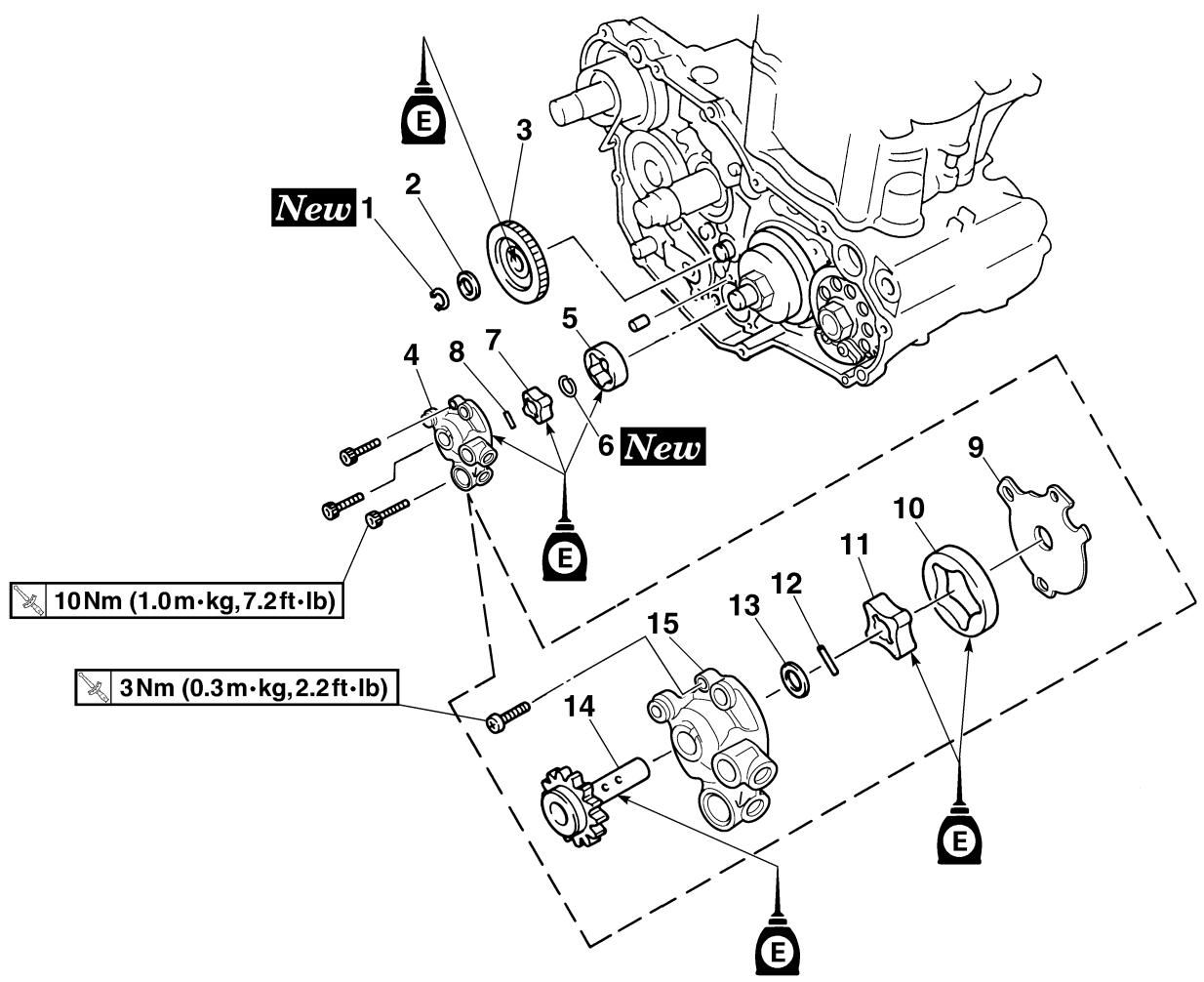
Extent of removal:
① Oil pump removal
② Oil pump disassembly
| Extent of removal | Order | Part name | Q'ty | Remarks |
| Preparation for removal | OIL PUMP REMOVAL AND DIS-ASSEMBLY | Refer to “CLUTCH” section.Refer to “OIL FILTER ELEMENT,WATER PUMP AND RIGHT CRANK-CASE COVER” section. | ||
| Primary driven gearRight crankcase cover | ||||
| 1 | 1 | Circlip | 1 | |
| 2 | Washer | 1 | ||
| 3 | Oil pump drive gear | 1 | ||
| 4 | Oil pump assembly | 1 | ||
| 5 | Outer rotor 2 | 1 | ||
| 6 | Circlip | 1 | ||
| 7 | Inner rotor 2 | 1 | ||
| 8 | Dowel pin | 1 | ||
| 9 | Oil pump cover | 1 | ||
| 10 | Outer rotor 1 | 1 | ||
| 11 | Inner rotor 1 | 1 |
POMPE A HUIL

-
Inspect:
-
Oil pump drive gear ①
- Oil pump drive shaft ②
- Rotor housing ③
-
Oil pump cover ④ Cracks/wear/damage Replace.
-
Measure:
-
Tip clearance ⑧ (between the inner rotor ① and outer rotor ②
- Side clearance ⑥ (between the outer rotor ② and rotor housing ③ )
- Housing and rotor clearance © (between the rotor housing ③ and rotors ① ②) Out of specification Replace the oil pump assembly.
Tip clearance a: 0.12 mm or less (0.0047 in or less)
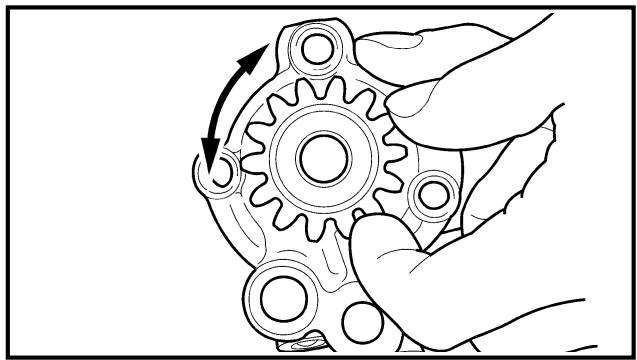
-
Check:
-
Unsmooth Repeat steps #1 and #2 or replace the defective parts.
CONTROLE
Pompe à huile
1. Controller:
ASSEMBLY AND INSTALLATION
Oil pump
1. Install:
- Oil pump drive shaft ①
- Washer ②
Dowel pin ③ - Inner rotor 1 ④
NOTE:
- Apply the engine oil on the oil pump drive shaft and inner rotor 1.
- Fit the dowel pin into the groove in the inner rotor 1.
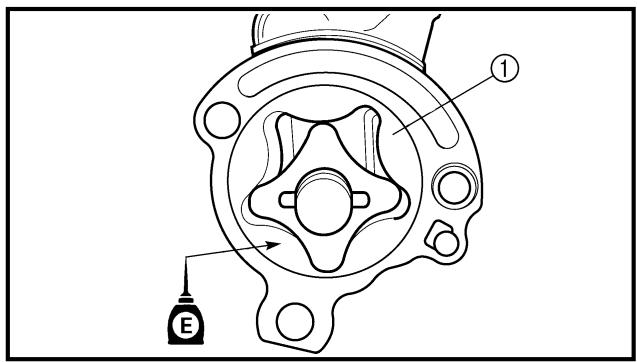
2. Install:
- Outer rotor 1 ①
NOTE:
Apply the engine oil on the outer rotor 1.
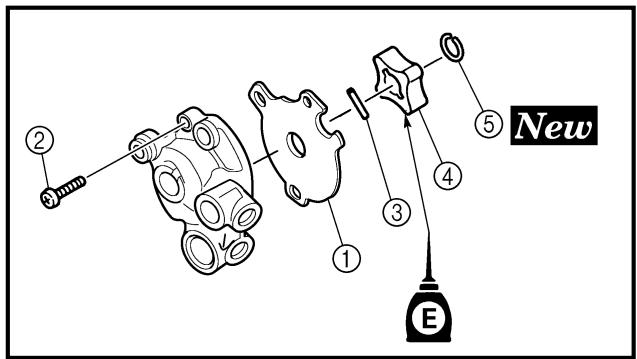
3. Install:
- Oil pump cover ①
- Screw (oil pump cover) ②
3Nm (0.3m· kg,2.2ft· lb)
Dowel pin ③
- Inner rotor 2 ④
- Circlip ⑤ New
NOTE:
- Apply the engine oil on the inner rotor 2.
- Fit the dowel pin into the groove in the inner rotor 2.
ASSEMBLAGE ET INSTALLATION
Pompe à huile
- Outer rotor 2 (1)
Dowel pin ② - Oil pump assembly ③
- Bolt (oil pump assembly) [L = 25 ~mm(0.94 in)] 4

10 Nm (1.0 m · kg, 7.2 ft · lb)
- Bolt (oil pump assembly)
[L = 30 ~mm(1.18 in)] ⑤

10 Nm (1.0 m·kg, 7.2 ft·lb)
NOTE:
Apply the engine oil on the outer rotor 2.
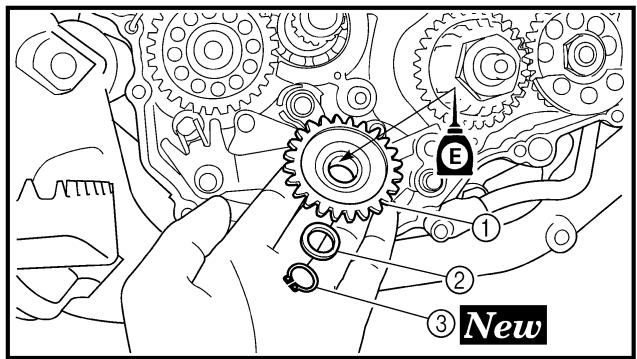
5. Install:
- Oil pump drive gear ①
- Washer ②
Circlip ③
NOTE:
Apply the engine oil on the oil pump drive gear inner circumference.
- Schraube (Ölpumpe)
[ [L = 30 \, \text{mm}] ]
10Nm(1,0m·kg)
HINWEIS:
KICK SHAFT AND SHIFT SHAFT
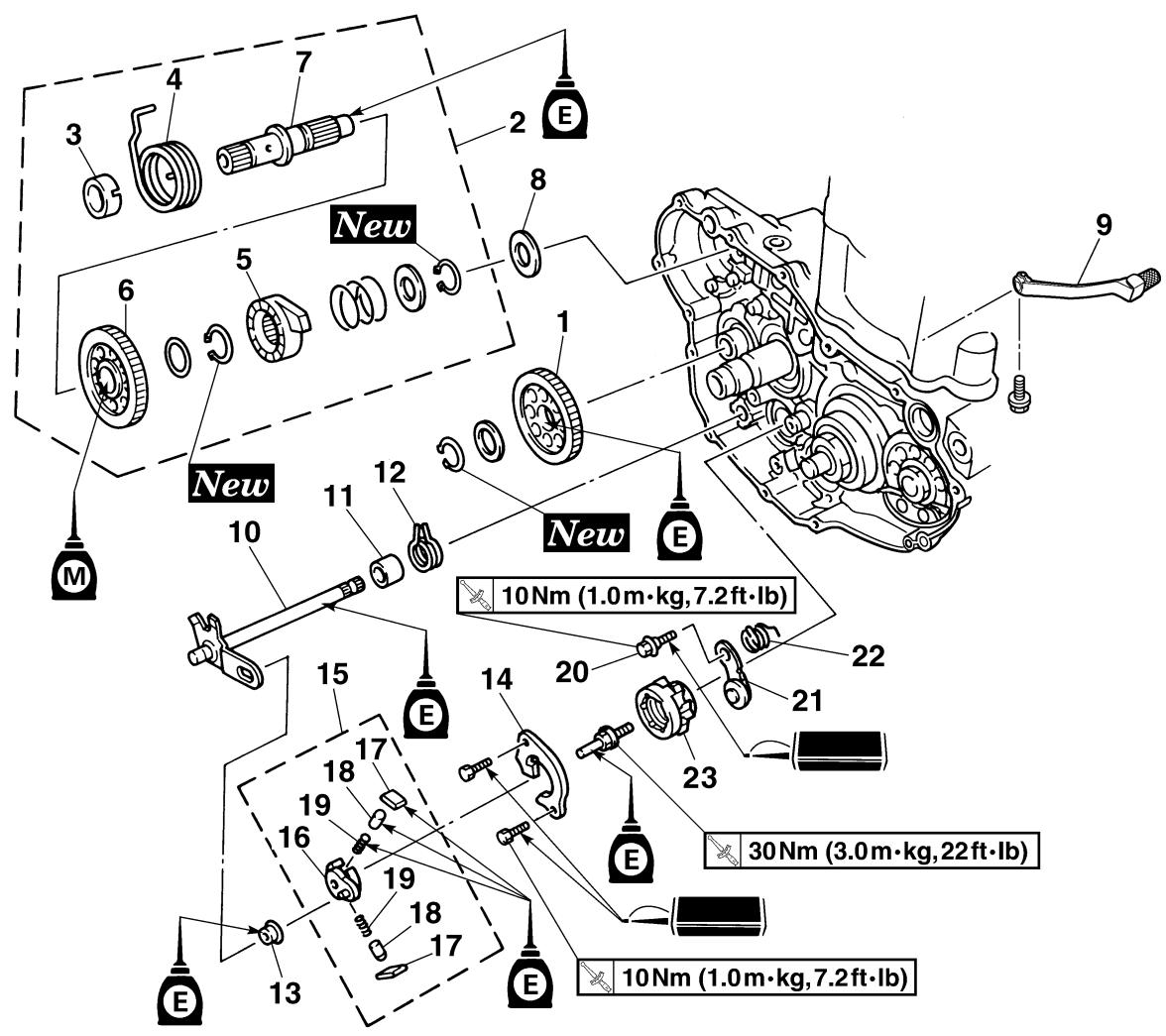
Extent of removal:
① Kick shaft removal
② Kick shaft disassembly
③ Shift shaft removal
④ Segment removal
| Extent of removal | Order | Part name | Q'ty | Remarks |
| Preparation for removal | KICK SHAFT AND SHIFT SHAFT REMOVAL Oil pump | Refer to “OIL PUMP” section. | ||
| 1 | 1 | Kick idle gear | 1 | Refer to “REMOVAL POINTS”. |
| 2 | 2 | Kick shaft assembly | 1 | |
| 3 | 3 | Spring guide | 1 | |
| 4 | 4 | Torsion spring | 1 | |
| 5 | 5 | Ratchet wheel | 1 | |
| 6 | 6 | Kick gear | 1 | |
| 7 | 7 | Kick shaft | 1 | |
| 8 | 8 | Washer | 1 | |
| 9 | 9 | Shift pedal | 1 | |
| 10 | 10 | Shift shaft | 1 | |
| 11 | 11 | Collar | 1 |
ARBRE DE KICK ET ARBRE DE SELECTEUR KICKSTARTER UND KICKSTARTERWELLE ALBERO PEDALE E ALBERO DEL CAMBIO
-
Remove:
-
Kick shaft assembly ①
NOTE:
Unhook the torsion spring ② from the hole ⑧ in the crankcase.
EC4C3101
Shift guide and shift lever assembly
-
Remove:
-
Bolt (shift guide)
- Shift guide ①
- Shift lever assembly ②
NOTE:
The shift lever assembly is disassembled at the same time as the shift guide.
EC4N3100
Segment
-
Remove:
-
Bolt (segment) ①
- Segment ②
NOTE:
Turn the segment counterclockwise until it stops and loosen the bolt.
INSPECTION
Kick shaft and ratchet wheel
-
Check:
-
Ratchet wheel ① smooth movement Unsmooth movement Replace.
- Kick shaft ② Wear/damage Replace.
- Spring ③ Broken Replace.
EC4C4300
Kick gear, kick idle gear and ratchet wheel
-
Inspect:
-
Kick gear ①
- Kick idle gear ②
- Ratchet wheel ③
Gear teeth @ - Ratchet teeth ⑥ Wear/damage Replace.
ARBRE DE KICK ET ARBRE DE SELECTEUR KICKSTARTER UND KICKSTARTERWILLE ALBERO PEDALE E ALBERO DEL CAMBIO
POINTS DE DEPOSE
Arbre de kick complet
-
Déposer:
-
Boulon(barillet) ①
- Barillet ②
N.B.:
-
Inspect:
-
Shift shaft ①
Bend/damage Replace.
Spring ②
Broken Replace.
EC4C4100
Shift guide and shift lever assembly
-
Inspect:
-
Shift guide ①
- Shift lever ②
- Pawl ③
- Pawl pin ④
Spring ⑤
Wear/damage Replace.
EC4B4500
Stopper lever
-
Inspect:
-
Stopper lever ①
Wear/damage Replace.
- Torsion spring ②
Broken Replace.
ASSEMBLY AND INSTALLATION
Segment
-
Install:
-
Segment ①
- Bolt (segment)

30 Nm (3.0 m·kg, 22 ft·lb)
NOTE:
Align the notch ⑧ on the segment with the pin
⑥ on the shift cam.
ARBRE DE KICK ET ARBRE DE SELECTEUR KICKSTARTER UND KICKSTARTERWELLE ALBERO PEDALE E ALBERO DEL CAMBIO
Arbre de sélecteur
Align the stopper lever roller with the slot on segment.
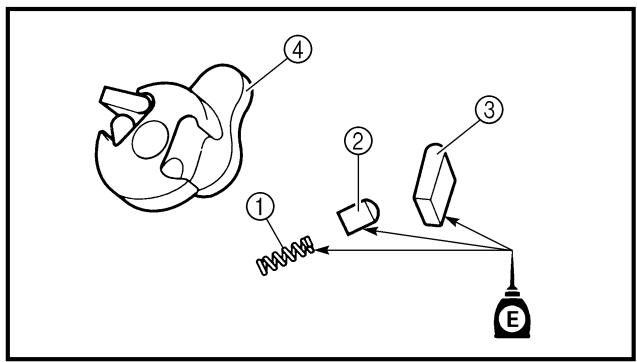
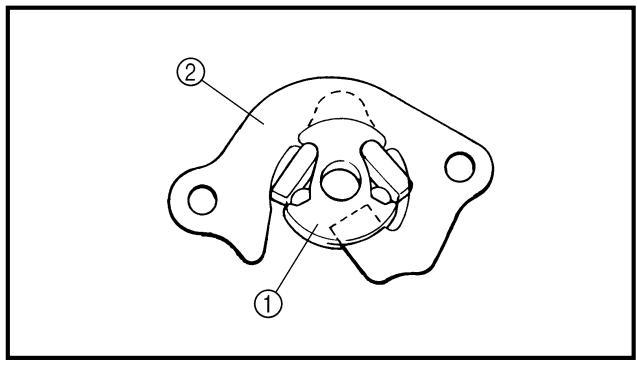
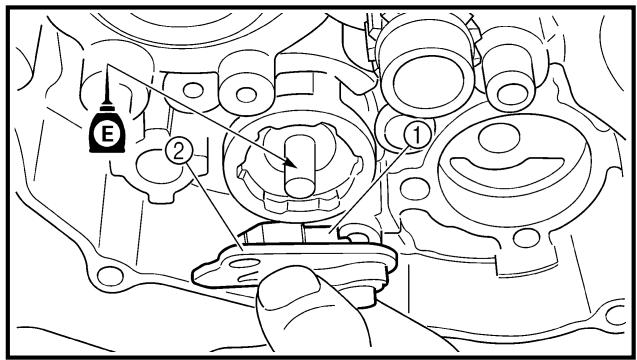
Shift guide and shift lever assembly
- Install:
Spring ①
- Pawl pin ②
- Pawl ③
To shift lever ④.
NOTE:
Apply the engine oil on the spring, pawl pin and pawl.
-
Install:
-
Shift lever assembly ①
To shift guide ②.
-
Install:
-
Shift lever assembly ①
- Shift guide ②
NOTE:
- The shift lever assembly is installed at the same time as the shift guide.
- Apply the engine oil on the bolt (segment) shaft.
Levier de butée
- Bolt (shift guide) ①

10 Nm (1.0 m·kg, 7.2 ft·lb)
Shift shaft
1. Install:
- Roller ①
Collar ② - Torsion spring ③
- Shift shaft ④
NOTE:
Apply the engine oil on the roller and shift shaft.
2. Install:
- Shift pedal ①
- Bolt (shift pedal) ②
NOTE:
When installing the shift pedal onto the shift shaft, be sure that the center of the shift pedal is about 2 ~mm ⑧ above the top of the footrest.
Kick shaft assembly
1. Install:
- Kick gear ①
- Washer ②
Circlip ③ - Ratchet wheel ④
Spring ⑤ - Washer ⑥
Circlip ⑦
To kick shaft ⑧.
NOTE:
- Apply the molybdenum disulfide oil on the kick gear inner circumference.
- Align the punch mark ⑧ on the ratchet wheel with the punch mark ⑥ on the kick shaft.
ARBRE DE KICK ET ARBRE DE SELECTEUR KICKSTARTER UND KICKSTARTERWELLE ALBERO PEDALE E ALBERO DEL CAMBIO
- Torsion spring ① To kick shaft ②.
NOTE: Make sure the stopper ⑧ of the torsion spring fits into the hole ⑥ on the kick shaft.
3. Install:
Spring guide ①
NOTE: Slide the spring guide into the kick shaft, make sure the groove ⑧ in the spring guide fits on the stopper of the torsion spring.
4. Install:
- Kick shaft assembly ①
- Washer ②
NOTE:
- Apply the engine oil on the kick shaft.
- Slide the kick shaft assembly into the crankcase, make sure the kick shaft stopper ④ fit into their home position ③ .
5. Hook:
- Torsion spring ①
NOTE:
Turn the torsion spring clockwise and hook into the proper hole ⑧ in the crankcase.
Kick idle gear
1. Install:
- Kick idle gear ①
- Washer ②
- Circlip ③ New
NOTE:
- Apply the engine oil on the kick idle gear inner circumference.
Install the kick idle gear with its depressed side @ toward you.
ARBRE DE KICK ET ARBRE DE SELECTEUR KICKSTARTER UND KICKSTARTERWelle ALBERO PEDALE E ALBERO DEL CAMBIO
① CDI magneto removal
| Extent of removal | Order | Part name | Q'ty | Remarks |
| Preparation for removal | CDI MAGNETO REMOVALSeat and fuel tankBolt (left radiator)Disconnect the CDI magneto lead.Shift pedal | Refer to “SEAT, FUEL TANK AND SIDE COVERS” section.Refer to “RADIATOR” section.Refer to “KICK SHAFT AND SHIFT SHAFT” section. | ||
| 1 | 123456 | Left engine guardLeft crankcase coverNut (rotor)RotorStatorWoodruff key | 1111111 | Use special tool.Refer to “REMOVAL POINTS”. |
VOLANT MAGNETIQUE CDI
Install three bolts ③ of the proper size, as shown in illustration.
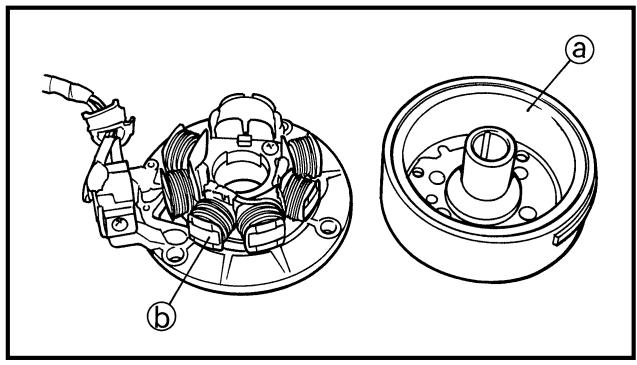
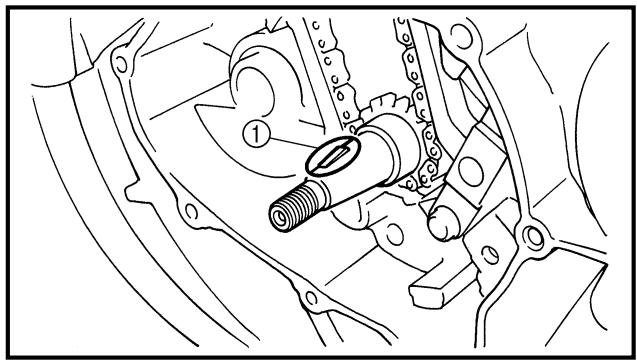
EC4L4000
INSPECTION
EC4L4101
CDI magneto
-
Inspect:
-
Rotor inner surface @
- Stator outer surface
Damage Inspect the crankshaft runout and crankshaft bearing. If necessary, replace CDI magneto and/or stator.
EC4L4200
Woodruff key
- Inspect:
Woodruff key ①
Damage Replace.
POINTS DE DEPOSE
Rotor
-
Déposer:
-
Ecrou (rotor) ①
Rondelle ②
Utiliser l'outil de maintain derotor ③

Outil de maintain de rotor: YU-1235/90890-01235
AUSBAU
Rotor
ASSEMBLY AND INSTALLATION
CDI magneto
-
Install:
-
Stator ①
- Screw (stator) ②
10 Nm (1.0 m·kg, 7.2 ft·lb)
NOTE:
- Apply the sealant on the grommet of the CDI magneto lead.
- Tighten the screws using the T30 bit.
Quick gasket®:
ACC-QUICK-GS-KT
YAMAHA Bond No. 1215:
90890-85505
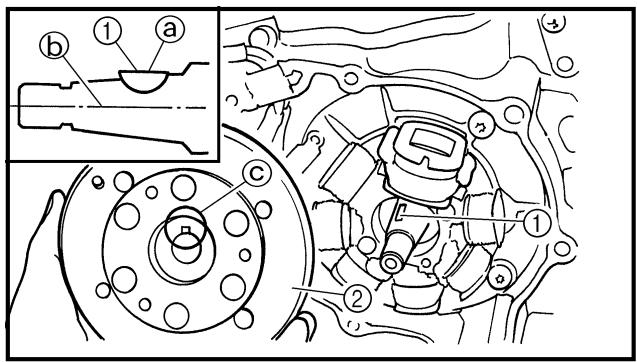
-
Install:
-
Woodruff key ①
- Rotor ②
NOTE:
- Clean the tapered portions of the crankshaft and rotor.
- When installing the woodruff key, make sure that its flat surface ⑧ is in parallel with the crankshaft center line ⑨ .
- When installing the rotor, align the keyway © of the rotor with the woodruff key.
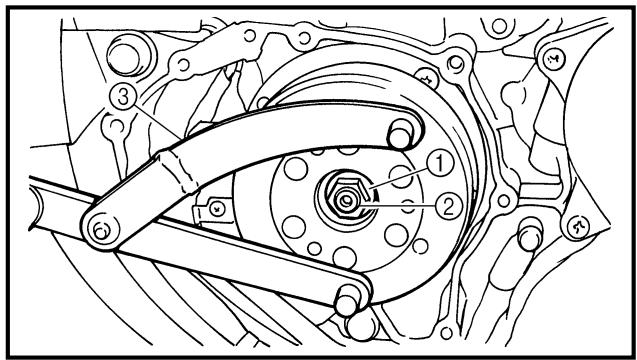
-
Install:
-
Washer ①
- Nut (rotor) ②
48Nm (4.8m· kg,35ft· lb)
Use the rotor holding tool ③.
Rotor holding tool:
YU-1235/90890-01235
-
Monter:
-
Stator ①
- Vis (stator) ②
10Nm(1,0m·kg,7,2ft·lb)
N.B.:
Refer to "CABLE ROUTING DIAGRAM" section in the CHAPTER 2.
5. Install:
Dowel pin
- Gasket (left crankcase cover)
- Left crankcase cover ①
- Hose guide (cylinder head breather hose) ②
- Bolt (left crankcase cover) ③

10 Nm (1.0 m · kg, 7.2 ft · lb)
NOTE:
Tighten the screws in stage, using a crisscross pattern.
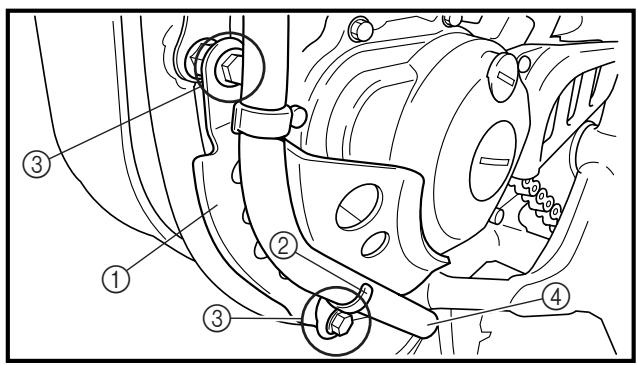
6. Install:
- Left engine guard ①
- Hose holder (cylinder head breather hose) ②
- Bolt (left engine guard) ③

23 Nm (2.3 m·kg, 17 ft·lb)
- Cylinder head breather hose ④
| Extent of removal | Order | Part name | Q'ty | Remarks |
| Preparation for removal | ENGINE REMOVALHold the machine by placing the suitable stand under the frame. | \(\triangle\)WARNING\(\square\)Support the machine securely so there is no danger of it falling over.\(\square\)Refer to "SEAT, FUEL TANK AND SIDE COVERS" section.\(\square\)Refer to "CARBURETOR" section.\(\square\)Refer to "EXHAUST PIPE AND SILENCER" section.\(\square\)Disconnect at engine side.\(\square\)Disconnect at engine side.\(\square\)Refer to "RADIATOR" section.\(\square\)Refer to "KICK SHAFT AND SHIFT SHAFT" section.\(\square\)Refer to "CAMSHAFTS" section.\(\square\)Refer to "ENGINE OIL REPLACEMENT" section in the CHAPTER 3. | ||
| Seat and fuel tank | ||||
| Carburetor | ||||
| Exhaust pipe and silencer | ||||
| Clutch cable | ||||
| Decompression cable and guide | ||||
| Radiator | ||||
| Shift pedal | ||||
| Cylinder head breather hose and oil tank breather hose | ||||
| Drain the engine oil |
DEPOSE DU MOTEUR
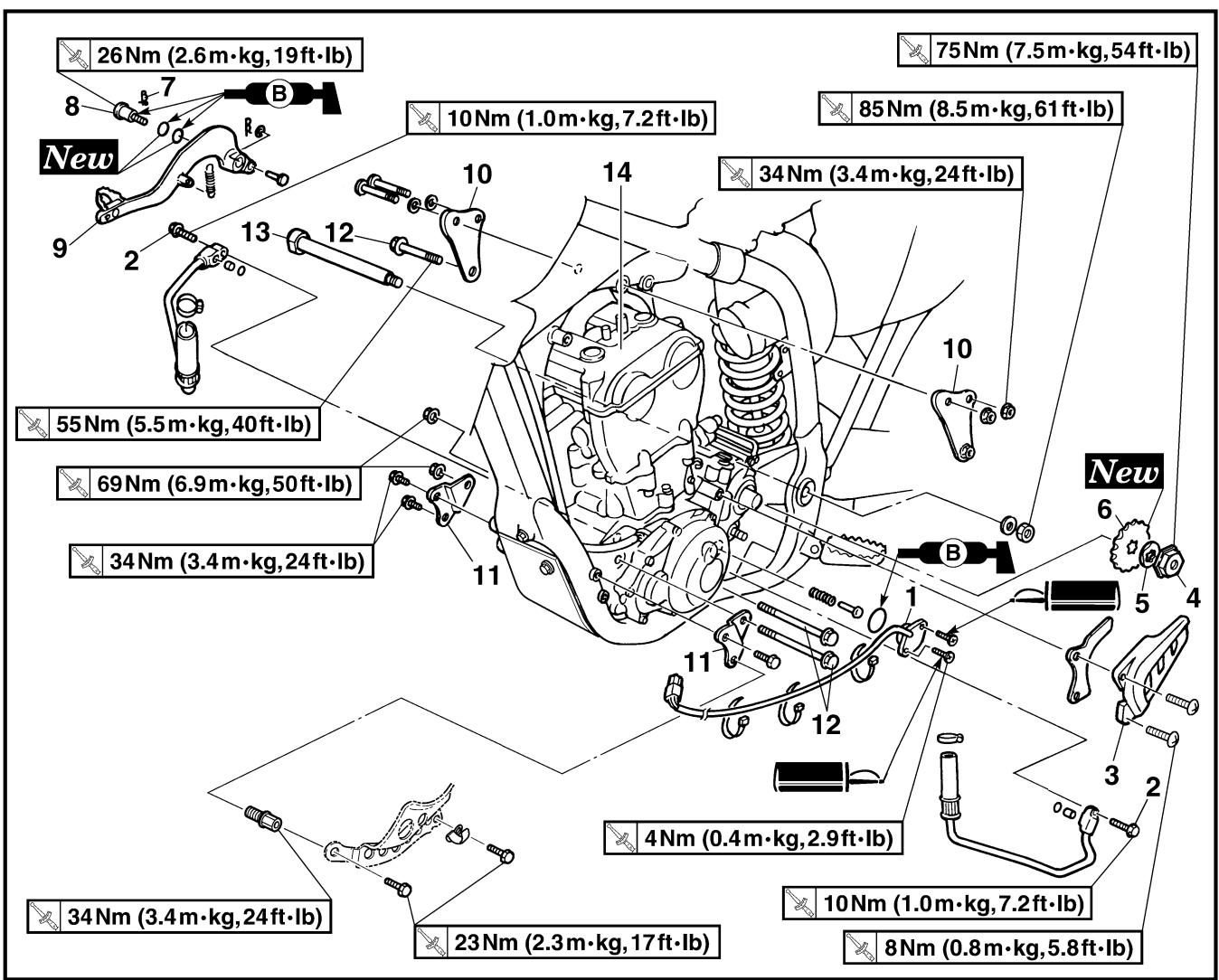
Extent of removal:
① Engine removal
| Extent of removal | Order | Part name | Q'ty | Remarks |
| Spark plug cap Disconnect the CDI magneto lead. Right engine guard | ||||
| 1 | 1 | Neutral switch | 1 | Refer to “REMOVAL POINTS”. |
| 2 | 2 | Bolt (oil hose) | 2 | |
| 3 | 3 | Drive chain sprocket cover | 1 | |
| 4 | 4 | Nut (drive sprocket) | 1 | |
| 5 | 5 | Lock washer | 1 | |
| 6 | 6 | Drive sprocket | 1 | |
| 7 | 7 | Clip | 1 | |
| 8 | 8 | Bolt (brake pedal) | 1 | |
| 9 | 9 | Brake pedal | 1 | |
| 10 | 10 | Upper engine bracket | 2 | |
| 11 | 11 | Lower engine bracket | 2 | |
| 12 | 12 | Engine mounting bolt | 3 | |
| 13 | 13 | Pivot shaft | 1 | Refer to “REMOVAL POINTS”. |
| 14 | 14 | Engine | 1 |
-
Remove:
-
Nut (drive sprocket) ①
- Lock washer ②
NOTE:
- Straighten the lock washer tab.
- Loosen the nut while applying the rear brake.
2. Remove:
- Drive sprocket ①
- Drive chain ②
NOTE:
Remove the drive sprocket together with the drive chain.
EC4M3301
Engine removal
-
Remove:
-
Pivot shaft ①
NOTE:
If the pivot shaft is pulled all the way out, the swingarm will come loose. If possible, insert a shaft of similar diameter into the other side of the swingarm to support it.
2. Remove:
- Engine ①
From right side.
NOTE:
Make sure that the couplers, hoses and cables are disconnected.
POINTS DE DEPOSE
ASSEMBLY AND INSTALLATION
Engine installation
-
Install:
-
Engine ①
Install the engine from right side.
- Pivot shaft ②
$$ \lambda 8 5 \mathrm {N m} (8. 5 \mathrm {m} \cdot \mathrm {k g}, 6 1 \mathrm {f t} \cdot \mathrm {l b}) $$
- Engine mounting bolt (lower) ③
$$ \mathrm {x} \quad 6 9 \mathrm {N m} (6. 9 \mathrm {m} \cdot \mathrm {k g}, 5 0 \mathrm {f t} \cdot \mathrm {l b}) $$
-
Lower engine bracket ④
-
Bolt (engine bracket) ⑤
$$ \text {X} 3 4 \mathrm {N m} (3. 4 \mathrm {m} \cdot \mathrm {k g}, 2 4 \mathrm {f t} \cdot \mathrm {l b}) $$
- Engine mounting bolt (front) ⑥
$$ \mathbb {X} 6 9 \mathrm {N m} (6. 9 \mathrm {m} \cdot \mathrm {k g}, 5 0 \mathrm {f t} \cdot \mathrm {l b}) $$
-
Upper engine bracket ⑦
-
Engine mounting bolt (upper) ⑧
$$ \lambda_ {x} = 5 5 \mathrm {N m} (5. 5 \mathrm {m} \cdot \mathrm {k g}, 4 0 \mathrm {f t} \cdot \mathrm {l b}) $$
- Bolt (engine guard) ⑨
$$ \lambda 2 3 \mathrm {N m} (2. 3 \mathrm {m} \cdot \mathrm {k g}, 1 7 \mathrm {f t} \cdot \mathrm {l b}) $$
EC4M5211
Brake pedal
- Install:
Spring ①
- Brake peda
- O-ring ③ New
- Bolt (brake pedal) ④
$$ 2 6 \mathrm {N m} (2. 6 \mathrm {m} \cdot \mathrm {k g}, 1 9 \mathrm {f t} \cdot \mathrm {l b}) $$
- Clip ⑤
NOTE:
- Apply the lithium soap base grease on the bolt, O-rings and brake pedal bracket.
- Install the clip with its stopper portion ④ facing inward.
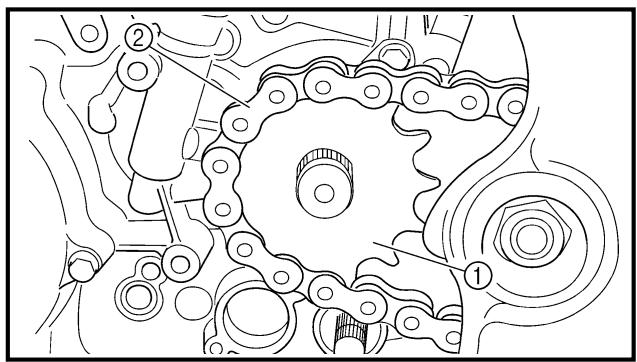
Drive sprocket
-
Install:
-
Drive sprocket ①
- Drive chain ②
NOTE:
Install the drive sprocket together with the drive chain.
34Nm(3,4m·kg,24ft·lb)
-
Install:
-
Lock washer ①

- Nut (drive sprocket) ②
75Nm(7.5m·kg,54ft·lb)
NOTE:
Tighten the nut while applying the rear brake.
-
Bend the lock washer tab to lock the nut.
-
Install:
-
Drive chain sprocket guide ①
- Drive chain sprocket cover ②
- Screw (drive chain sprocket cover) ③
8 Nm (0.8 m·kg, 5.8 ft·lb)
Oil hose and neutral switch
-
Install:
-
O-ring ① New
Dowel pin ② - Oil hose ③
- Bolt (oil hose) ④
10 Nm (1.0 m·kg, 7.2 ft·lb)
NOTE: Apply the lithium soap base grease on the O-ring.
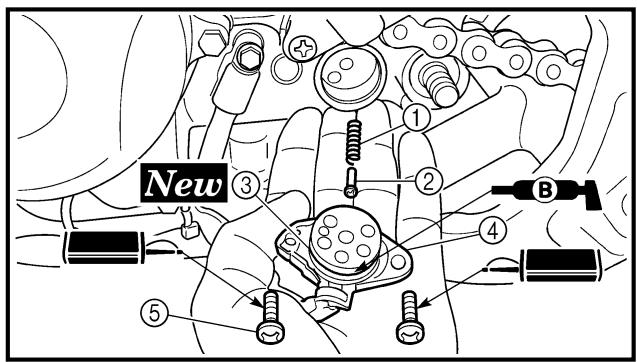
- Install:
Spring ①
Pin ②
- O-ring ③ New
- Neutral switch ④
- Bolt (neutral switch) ⑤

4 Nm (0.4 m·kg, 2.9 ft·lb)
NOTE: Apply the lithium soap base grease on the O-ring.
- Monter:
Rondelle-frein ① New
- Ecrou (pignon d'entrainment)

75Nm (7,5m· kg,54ft· lb)
N.B.:
-
Installare:
-
O-ring ①

4Nm(0.4m·kg,2.9 ft·lb)
NOTA:
CRANKCASE AND CRANKSHAFT
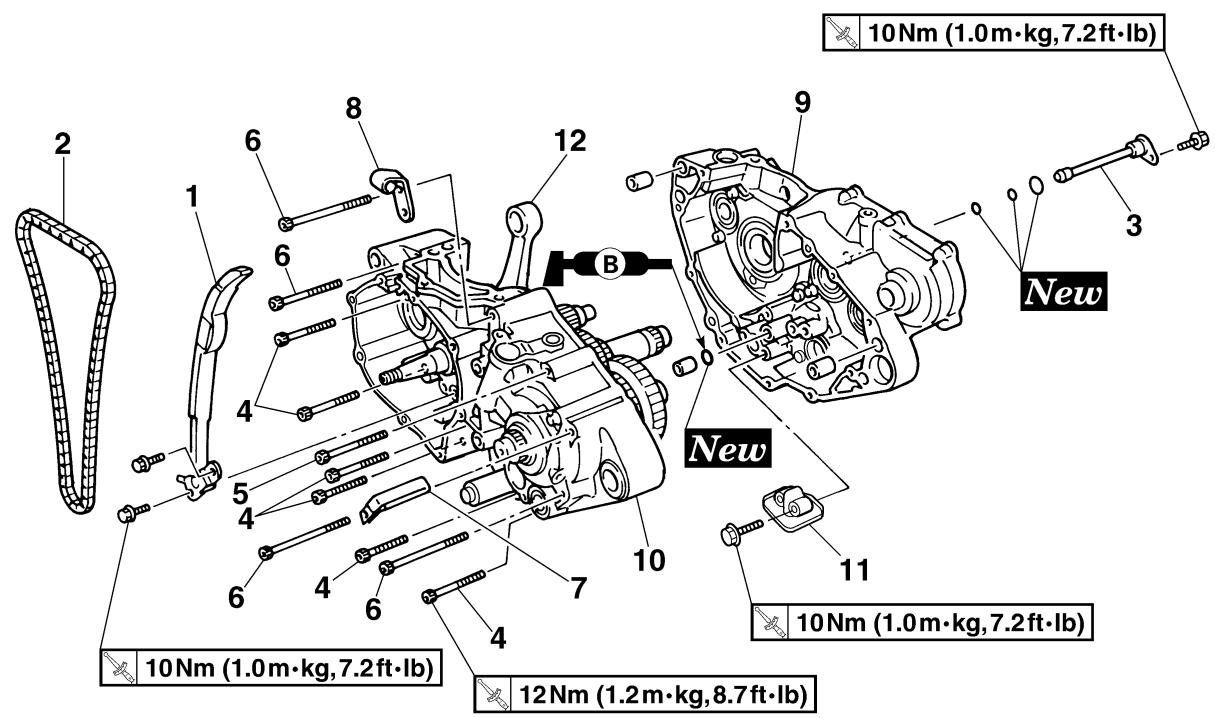
Extent of removal:
① Crankcase separation
② Crankshaft removal
| Extent of removal | Order | Part name | Q'ty | Remarks |
| Preparation for removal | CRANKCASE AND CRANK- SHAFT REMOVAL Engine Piston Kick shaft assembly Segment Stator Balancer shaft | Refer to “ENGINE REMOVAL” section.Refer to “CYLINDER AND PISTON” section.Refer to “KICK SHAFT AND SHIFT SHAFT” section.Refer to “CDI MAGNETO” section.Refer to “BALANCER” section. | ||
| ① | ② | 1 Timing chain guide (intake side) | 1 | |
| 2 Timing chain | 1 | |||
| 3 Oil delivery pipe 2 | 1 |
| Extent of removal | Order | Part name | Q'ty | Remarks |
| 1 | 4 | Bolt [L = 45 mm (1.77 in)] | 6 | Refer to “REMOVAL POINTS”. |
| 5 | Bolt [L = 55 mm (2.17 in)] | 1 | ||
| 6 | Bolt [L = 70 mm (2.76 in)] | 4 | ||
| 7 | Hose guide | 1 | ||
| 8 | Clutch cable holder | 1 | ||
| 9 | Right crankcase | 1 | ||
| 10 | Left crankcase | 1 | ||
| 11 | Oil strainer | 1 | ||
| 12 | Crankshaft | 1 | Use special tool. Refer to “REMOVAL POINTS”. |
Extent of removal:
① Crankcase bearing removal
| Extent of removal | Order | Part name | Q'ty | Remarks |
| Preparation for removal | CRANKCASE BEARING REMOVALTransmissionShift cam and shift fork | Refer to “TRANSMISSION, SHIFT CAM AND SHIFT FORK” section. | ||
| ① | 1 | Oil seal | 2 | Refer to “REMOVAL POINTS”. |
| 2 | Bearing | 10 |
-
Separate:
-
Right crankcase
- Left crankcase
Separation steps:
- Remove the crankcase bolts ①, hose guide ② and clutch cable holder ③.
NOTE:
Loosen each bolt 1/4 of a turn at a time and after all the bolts are loosened, remove them.
- Remove the right crankcase ④.
NOTE:
- Place the crankcase with its left side downward and split it by inserting a screwdriver tip into the splitting slit ⑧ in the crankcase.
- Lift the right crankcase horizontally while lightly patting the case splitting slit and engine mounting boss using a soft hammer, and leave the crankshaft and transmission with the left crankcase.
CAUTION:
Use soft hammer to tap on the case half. Tap only on reinforced portions of case. Do not tap on gasket mating surface. Work slowly and carefully. Make sure the case halves separate evenly. If one end "hangs up", take pressure off the push screw, realign, and start over. If the cases do not separate, check for a remaining case screw or fitting. Do not force.
- Remove the dowel pins and O-ring.
Do not use a hammer to drive out the crankshaft.
Crankcase bearing
-
Remove:
-
Bearing ①
NOTE:
- Remove the bearing from the crankcase by pressing its inner race.
- Do not use the removed bearing.
INSPECTION
Timing chain and timing chain guide
-
Inspect:
-
Timing chain
Cracks/stiff Replace the timing chain and camshaft sprocket as a set.
-
Inspect:
-
Timing chain guide
Wear/damage Replace.
Crankcase
-
Inspect:
-
Contacting surface @
Scratches Replace.
- Engine mounting boss ⑥, crankcase
Cracks/damage Replace.
-
Inspect:
-
Bearing
Rotate inner race with a finger.
Rough spot/seizure Replace.
- Inspect:
Oil seal
Damage Replace.
Vilebreguin
- Déposer:
Vilebreguin ①
- Runout limit @
- Small end free play limit ⑥
- Connecting rod big end side clearance
- Crank width @
Out of specification Replace.
Use the dial gauge and a thickness gauge.
| Dial gauge and stand: YU-3097/90890-01252 |
| Standard | <Limit> | |
| Runout limit: | 0.03 mm (0.0012 in) | 0.05 mm (0.002 in) |
| Small end free play: | 0.4 ~ 1.0 mm (0.016 ~ 0.039 in) | 2.0 mm (0.08 in) |
| Side clearance: | 0.15 ~ 0.45 mm (0.0059 ~ 0.0177 in) | 0.50 mm (0.02 in) |
| Crack width: | 55.95 ~ 56.00 mm (2.203 ~ 2.205 in) | - |
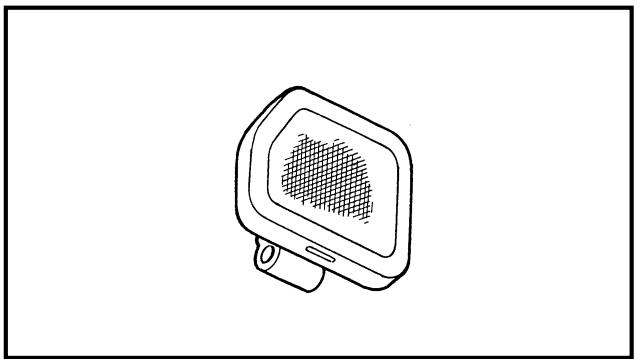
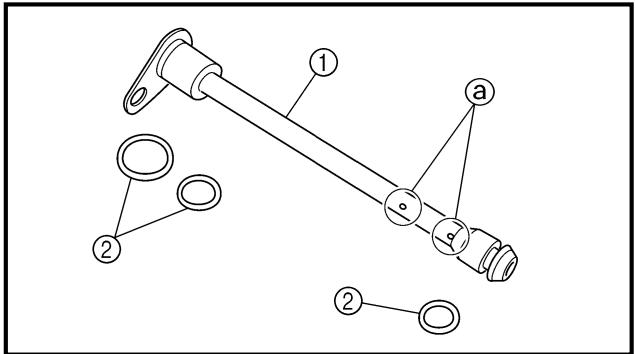
Oil strainer
1. Inspect:
- Oil strainer
Damage Replace.
Oil delivery pipe 2
1. Inspect:
- Oil delivery pipe 2 ①
- O-ring ②
Damage Replace.
- Oil orifice @
Clogged Blow.
ASSEMBLY AND INSTALLATION
Crankcase bearing
-
Install:
-
Bearing

- Bearing stopper
- Screw (bearing stopper)

10 Nm (1.0 m · kg, 7.2 ft · lb)
- Screw [bearing stopper (crankshaft)] ①
10Nm (1.0m· kg,7.2ft· lb)
To left and right crankcase.
NOTE:
- Install the bearing by pressing its outer race parallel.
- To prevent the screw [bearing stopper (crankshaft)] from becoming loose, crush the screw head periphery ④ into the concave ⑥ using a punch etc. In so doing, take care not to damage the screwdriver receiving hole in the screw head.
Crankshaft
- Install:
Crankshaft ①
Use the crankshaft installing tool ②, ③, ④, ⑤.
Crankshaft installing pot ② : YU- 90050/90890- 01274
Crankshaft installing bolt ③ : YU- 90050/90890- 01275
Adapter (M10) ④:
YM-1277/90890-01277
Spacer (crankshaft installer) ⑤ YU-91044/90890-04081
For USA and CDN
Except for USA and CDN
NOTE:
- Hold the connecting rod at top dead center with one hand while turning the nut of the installing tool with the other. Operate the installing tool until the crankshaft bottoms against the bearing.
- Before installing the crankshaft, clean the contacting surface of crankcase.
CAUTION:
Do not use a hammer to drive in the crankshaft.
- Shifter operation
Transmission operation Unsmooth operation Repair.
3. Install:
- Oil strainer ①
- Bolt (oil strainer) ②
10 Nm (1.0 m · kg, 7.2 ft · lb)
4. Apply:
Sealant
On the right crankcase ①.
Quick gasket®:
ACC-QUICK-GS-KT
YAMAHA Bond No. 1215:
90890-85505
NOTE:
Clean the contacting surface of left and right crankcase before applying the sealant.
5. Install:
Dowel pin ①
- O-ring ②

- Right crankcase
To left crankcase.
NOTE:
- Fit the right crankcase onto the left crankcase. Tap lightly on the case with soft hammer.
- When installing the crankcase, the connecting rod should be positioned at TDC (top dead center).
NOTE: Tighten the crankcase tightening bolts in stage, using a crisscross pattern.
7. Install:
- Oil delivery pipe 2 ①
- O-ring ② New
- Bolt (oil delivery pipe 2) ③
10 Nm (1.0 m·kg, 7.2 ft·lb)
NOTE: Apply the lithium soap base grease on the O-rings.
8. Install:
- Timing chain ①
- Timing chain guide (intake side) ②
- Bolt (timing chain guide) ③
10 Nm (1.0 m·kg, 7.2 ft·lb)
9. Remove:
- Sealant
Forced out on the cylinder mating surface.
10. Apply:
Engine oil
To the crank pin, bearing and oil delivery hole.
11. Check:
-
Crankshaft and transmission operation. Unsmooth operation Repair.
-
Monter:
Guide de durit ①
Support de cable d'embrayage ②
- Boulon (carter) ③
12Nm(1,2m·kg,8,7ft·lb)
N.B.:
TRANSMISSION, SHIFT CAM AND SHIFT FORK
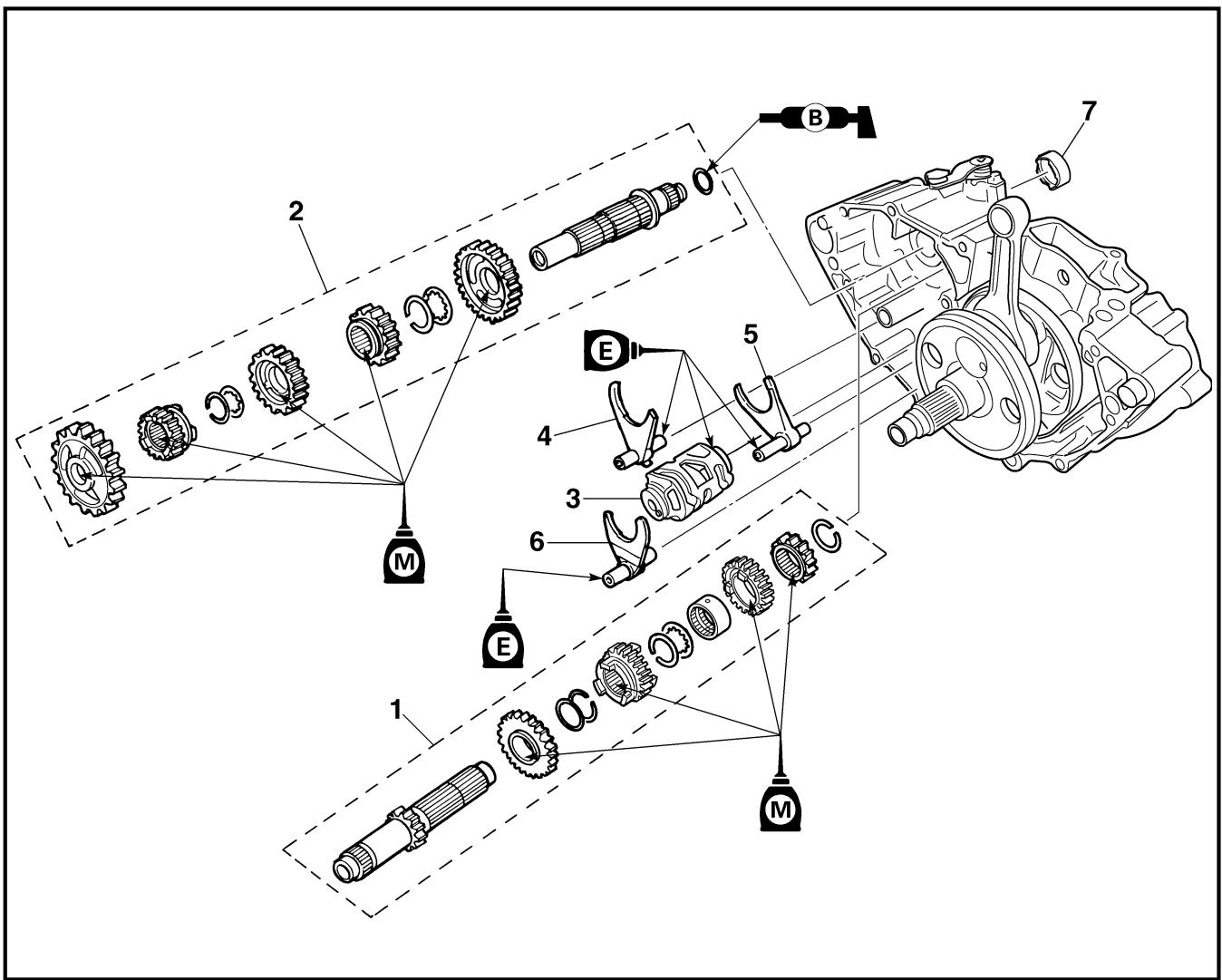
Extent of removal:
① Shift fork, shift cam, main axle and drive axle removal
| Extent of removal | Order | Part name | Q'ty | Remarks |
| Preparation for removal | TRANSMISSION, SHIFT CAM AND SHIFT FORK REMOVAL Engine Separate the crankcase. | Refer to “ENGINE REMOVAL” section. Refer to “CRANKCASE AND CRANK- SHAFT” section. | ||
| 1 | 1 | Main axle | 1 | Refer to “REMOVAL POINTS”. |
| 2 | Drive axle | 1 | ||
| 3 | Shift cam | 1 | ||
| 4 | Shift fork 3 | 1 | ||
| 5 | Shift fork 2 | 1 | ||
| 6 | Shift fork 1 | 1 | ||
| 7 | Collar | 1 |
BOITE A VITESSES, TAMBOUR ET FOURCHETTES DE SELECTION
-
Remove:
-
Main axle ①
- Drive axle ②
- Shift cam
- Shift fork 3
- Shift fork 2
- Shift fork 1
NOTE:
- Remove assembly with the collar ③ installed to the crankcase.
- Remove assembly carefully. Note the position of each part. Pay particular attention to the location and direction of shift forks.
- Remove the main axle, drive axle, shift cam and shift fork all together by tapping lightly on the transmission drive axle with a soft hammer.
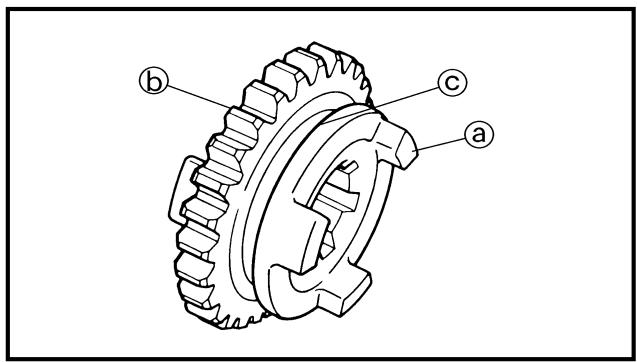
EC4H4000
INSPECTION
EC4H4200
Gears
- Inspect:
Matching dog a
Gear teeth
- Shift fork groove ©
Wear/damage Replace.
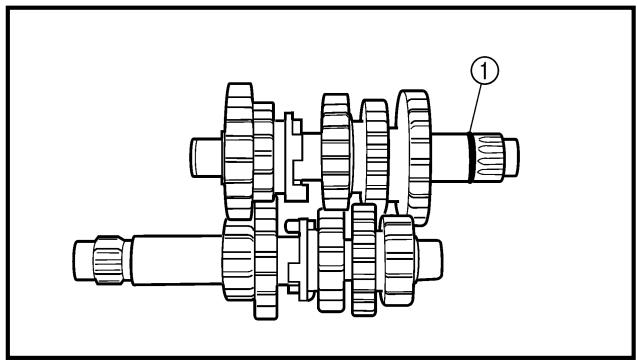
-
Inspect:
-
O-ring ①
Damage Replace.
-
Check:
-
Gears movement
Unsmooth movement Repair or replace.
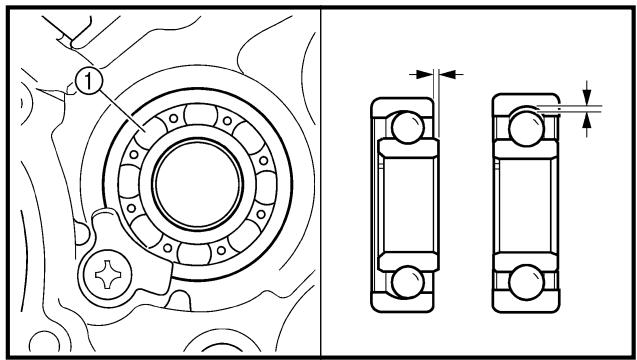
EC4H4600
Bearing
-
Inspect:
-
Bearing ①
Rotate inner race with a finger.
Rough spot/seizure Replace.
POINTS DE DEPOSE
Boite à vitesses
-
Déposer:
-
Arbre primaire ①
- Arbre secondaire ②
Tambour - Fourchette 3
Fourchette 2
Fourchette 1
N.B.:
-
Inspect:
-
Shift fork ①
Wear/damage/scratches Replace.
-
Inspect:
-
Shift cam ①
- Segment ②
Wear/damage Replace.
-
Check:
-
Shift fork movement
Unsmooth operation Replace shift fork.
NOTE:
For a malfunctioning shift fork, replace not only the shift fork itself but the two gears each adjacent to the shift fork.
EC4H5000
ASSEMBLY AND INSTALLATION
Transmission
-
Install:
-
5th pinion gear (27T) ①
- 3rd pinion gear (21T) ②
- Collar ③
- 4th pinion gear (24T) ④
- 2nd pinion gear (16T) ⑤
To main axle ⑥.
NOTE:
- Apply the molybdenum disulfide oil on the 4th and 5th pinion gears inner circumference and on the end surface.
- Apply the molybdenum disulfide oil on the 2nd and 3rd pinion gears inner circumference.
- 2nd wheel gear (28T) ①
- 4th wheel gear (25T) ②
- 3rd wheel gear (28T) ③
- 5th wheel gear (22T) ④
- 1st wheel gear (31T) ⑤
- O-ring ⑥ New To drive axle ⑦
NOTE:
- Apply the molybdenum disulfide oil on the 1st, 2nd and 3rd wheel gears inner circumference and on the end surface.
- Apply the molybdenum disulfide oil on the 4th and 5th wheel gears inner circumference.
- Apply the lithium soap base grease on the O-ring.
3. Install:
- Washer ①
- Circlip ②

NOTE:
- Be sure the circlip sharp-edged corner 已 is positioned opposite side to the washer and gear 6 .
- Be sure the circlip end () is positioned at axle spline groove
4. Install:
- Collar ①
NOTE:
- Apply the lithium soap base grease on the oil seal lip.
-
When installing the collar into the crankcase, pay careful attention to the crankcase oil seal lip.
-
Monter:
-
Pignon de 2ème (28D) ①
- Pignon de 4ème (25D) ②
- Pignon de 3ème (28D) ③
- Pignon de 5ème (22D) ④
- Pignon de l'ère (31D) ⑤
- Joint torque ⑥ New Sur l'axe moteur ⑦.
N.B.:
- Shift fork 1 (L) ①
- Shift fork 2 (C) ②
- Shift fork 3 (R) ③
- Shift cam ④ To main axle and drive axle.
NOTE:
- Apply the molybdenum disulfide oil on the shift fork grooves.
- Mesh the shift fork #1 (L) with the 4th wheel gear ⑤ and #3 (R) with the 5th wheel gear ⑦ on the drive axle.
- Mesh the shift fork #2 (C) with the 3rd pinion gear ⑥ on the main axle.
6. Install:
Transmission assembly ①
To left crankcase ②.
NOTE:
Apply the engine oil on the bearings and guide bars.
7. Check:
-
Shifter operation
Transmission operation Unsmooth operation Repair. -
Monter:
-
Fourchette 1 (L) ①
- Fourchette 2 (C) ②
- Fourchette 3 (R) ③
Tambour ④
① Front wheel removal
③ Brake disc removal
② Wheel bearing removal
| Extent of removal | Order | Part name | Q'ty | Remarks |
| Preparation for removal | FRONT WHEEL REMOVALHold the machine by placing the suitable stand under the engine. | WARNINGSupport the machine securely so there is no danger of it falling over. | ||
| 13 | 12 | 1 Trip meter cable2 Brake hose cover3 Bolt (brake hose holder)4 Bolt (axle holder)5 Nut (front wheel axle)6 Front wheel axle7 Front wheel8 Trip meter gear unit9 Collar10 Oil seal11 Bearing12 Brake disc | 112411112 | Only loosening.Only loosening.Refer to “REMOVAL POINTS”. |
PARTIE CYCLE
ROUE AVANT ET ROU ARRIERE
ROUE AVANT
① Rear wheel removal
③ Brake disc removal
② Wheel bearing removal
| Extent of removal | Order | Part name | Q'ty | Remarks |
| Preparation for removal | REAR WHEEL REMOVALHold the machine by placing the suitable stand under the engine. | ▲WARNINGSupport the machine securely so there is no danger of it falling over. | ||
| 13 | 12345678910 | Nut (rear wheel axle)Rear wheel axleDrive chain pullerRear wheelCollarRear wheel sprocketOil sealCirclipBearingBrake disc | 11221122112211 | Refer to “REMOVAL POINTS”.Refer to “REMOVAL POINTS”. |
ROUE ARRIERE
Push the wheel forward and remove the drive chain ②.
EC513201
Wheel bearing (if necessary)
-
Remove:
-
Bearing ①
NOTE:
Remove the bearing using a general bearing puller ②.
EC594000
INSPECTION
EC514100
Wheel
-
Measure:
-
Wheel runout
Out of limit Repair/replace.
Wheel runout limit:
Radial ①: 2.0 mm (0.08 in)
Lateral ②: 2.0 mm (0.08 in)
-
Inspect:
-
Bearing
Rotate inner race with a finger.
Rough spot/seizure Replace.
NOTE:
Replace the bearings, oil seal and wheel collar as a set.
POINTS DE DEPOSE
Roue arrière
- Déposer:
Roue ①
N.B.:
-
Measure:
-
Wheel axle bends
Out of specification Replace.
Use the dial gauge ①.

Wheel axle bending limit: 0.5 mm (0.020 in)
NOTE:
The bending value is shown by one half of the dial gauge reading.

WARNING
Do not attempt to straighten a bent axle.
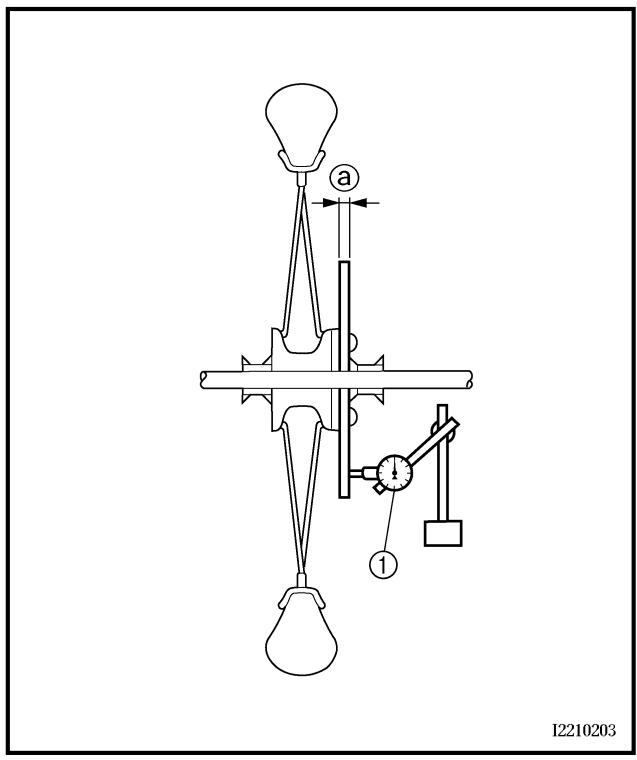
EC594200
Brake disc
-
Measure:
-
Brake disc deflection (only rear brake disc)
Use the dial gauge ①.
Out of specification Inspect wheel runout.
If wheel runout is in good condition, replace the brake disc.
Brake disc deflection limit:
Rear:
-
Measure:
-
Brake disc thickness @
Out of limit Replace.
Brake disc thickness:
Front:
3.0 mm (0.12 in)
Rear:
4.0 mm (0.16 in)
Axe de roue
ASSEMBLY AND INSTALLATION
Front wheel
-
Install:
-
Bearing (left) ①
- Spacer ②
- Bearing (right) ③
- Oil seal ④
NOTE:
- Apply the lithium soap base grease on the bearing and oil seal lip when installing.
- Use a socket that matches the outside diameter of the race of the bearing.
- Left side of bearing shall be installed first.
- Install the oil seal with its manufacture's marks or numbers facing outward.
CAUTION:
Do not strike the inner race of the bearing. Contact should be made only with the outer race.
-
Install:
-
Brake disc ①
- Bolt (brake disc) ②


NOTE:
Tighten the bolts in stage, using a crisscross pattern.
-
Install:
-
Collar ①
NOTE:
- Apply the lithium soap base grease on the oil seal lip.
-
Install the collar with their projection ⑧ facing the wheel.
-
Install:
-
Trip meter gear unit ①
NOTE:
Make sure the two projections ④ in the wheel hub are meshed with the two slots 6 in the trip meter gear unit.
REMONTAGE ET MONTAGE
Roue avant
1. Monter:
- Install the brake disc between the brake pads correctly.
-
Make sure that the projections ⑧ in the trip meter gear unit fits over the stopper 6 on the front fork outer tube.
-
Install:
-
Wheel axle ①
NOTE:
Apply the lithium soap base grease on the wheel axle.
-
Install:
-
Nut (wheel axle) ①
105 Nm (10.5 m·kg, 75 ft·lb)
-
Tighten:
-
Bolt (axle holder) ①
23 Nm (2.3 m·kg, 17 ft·lb)
NOTE:
Before tightening the bolt, fit the wheel axle to the axle holder by stroking the front fork several times with the front brake applied.
- Monter:
Roue
N.B.:
-
Install:
-
Brake hose ①
10 Nm (1.0 m · kg, 7.2 ft · lb)
To brake hose holder ②.
NOTE:
Before tightening the bolt (brake hose holder), pass the brake hose in front of the axle boss ⑧ , then fit it into the hose groove ⑥ so that the brake hose does not contact the nut (wheel axle).
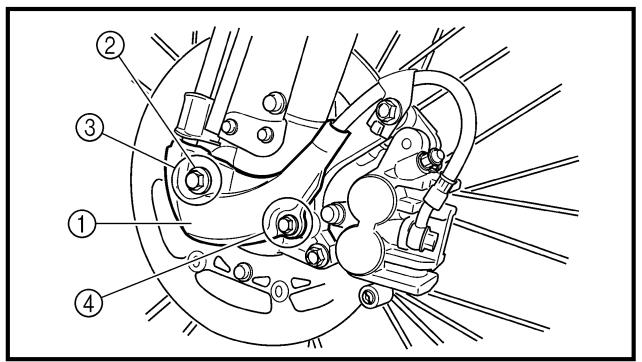
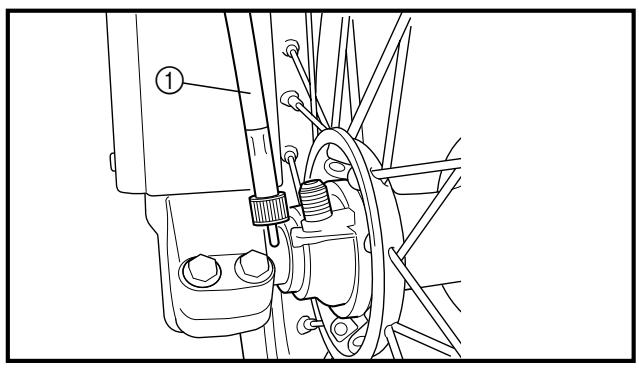
-
Install:
-
Brake hose cover ①
- Washer ②
- Bolt [brake hose cover (M8)] ③
16Nm(1.6m·kg,11ft·lb)
- Bolt [brake hose cover (M6)] ④
7 Nm (0.7 m·kg, 5.1 ft·lb)
-
Install:
-
Trip meter cable ①
-
Monter:
Tuyau de frein ①
10Nm(1,0m·kg,7,2ft·lb)
-
Install:
-
Bearing (right) ①
Circlip ②

-
Spacer ③
-
Bearing (left) ④
-
Oil seal ⑤

NOTE:
- Apply the lithium soap base grease on the bearing and oil seal lip when installing.
- Install the bearing with seal facing outward.
- Use a socket that matches the outside diameter of the race of the bearing.
- Right side of bearing shall be installed first.
- Install the oil seal with its manufacture's marks or numbers facing outward.
CAUTION:
Do not strike the inner race of the bearing. Contact should be made only with the outer race.
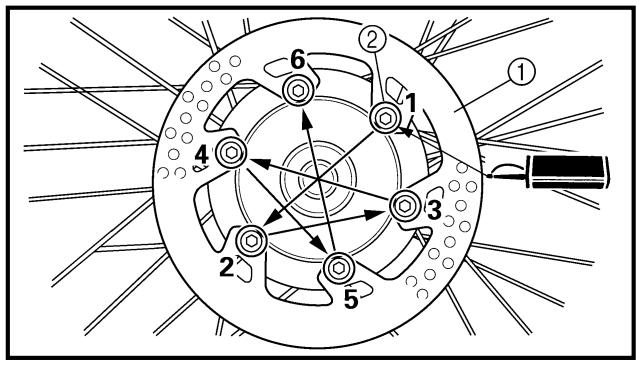
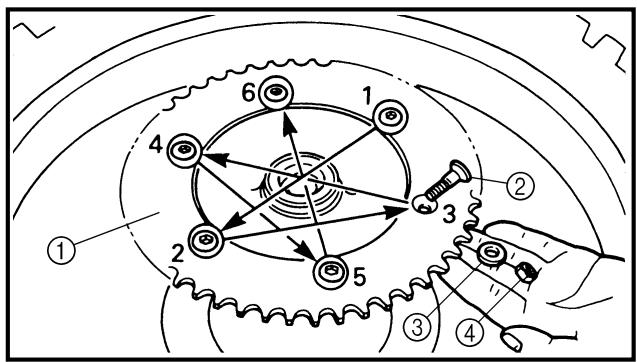
-
Install:
-
Brake disc ①
- Bolt (brake disc) ②


NOTE:
Tighten the bolts in stage, using a crisscross pattern.
-
Install:
-
Rear wheel sprocket ①
- Bolt (rear wheel sprocket) ②
- Washer (rear wheel sprocket) ③
- Nut (rear wheel sprocket) ④

NOTE:
Tighten the nuts in stage, using a crisscross pattern.
Roue arrière
Apply the lithium soap base grease on the oil seal lip.
- Install:
Wheel
NOTE:
Install the brake disc ① between the brake pads ② correctly.
-
Install:
-
Drive chain ①
NOTE:
Push the wheel ② forward and install the drive chain.
-
Install:
-
Left drive chain puller ①
- Wheel axle ②
NOTE:
- Install the left drive chain puller, and insert the wheel axle from left side.
-
Apply the lithium soap base grease on the wheel axle.
-
Install:
-
Right drive chain puller ①
- Washer ②
- Nut (wheel axle) ③
NOTE:
Temporarily tighten the nut (wheel axle) at this point.
-
Adjust:
-
Drive chain slack @
Drive chain slack: 40 50 ~mm (1.6 ~ 2.0 in)
Refer to "DRIVE CHAIN SLACK ADJUSTMENT" section in the CHAPTER 3.
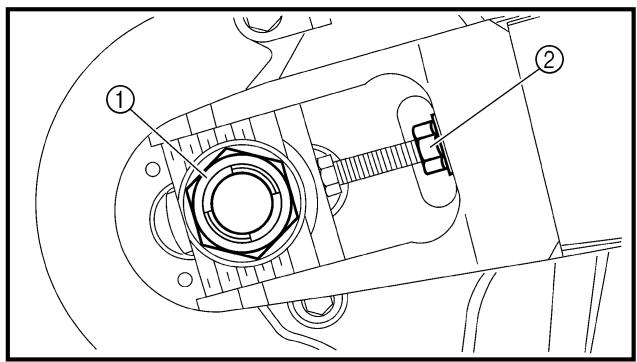
-
Tighten:
-
Nut (wheel axle) ①
125 Nm (12.5 m·kg, 90 ft·lb)
-
Locknut ②
-
Régler:
Flèche de chaine de transmission ⑧

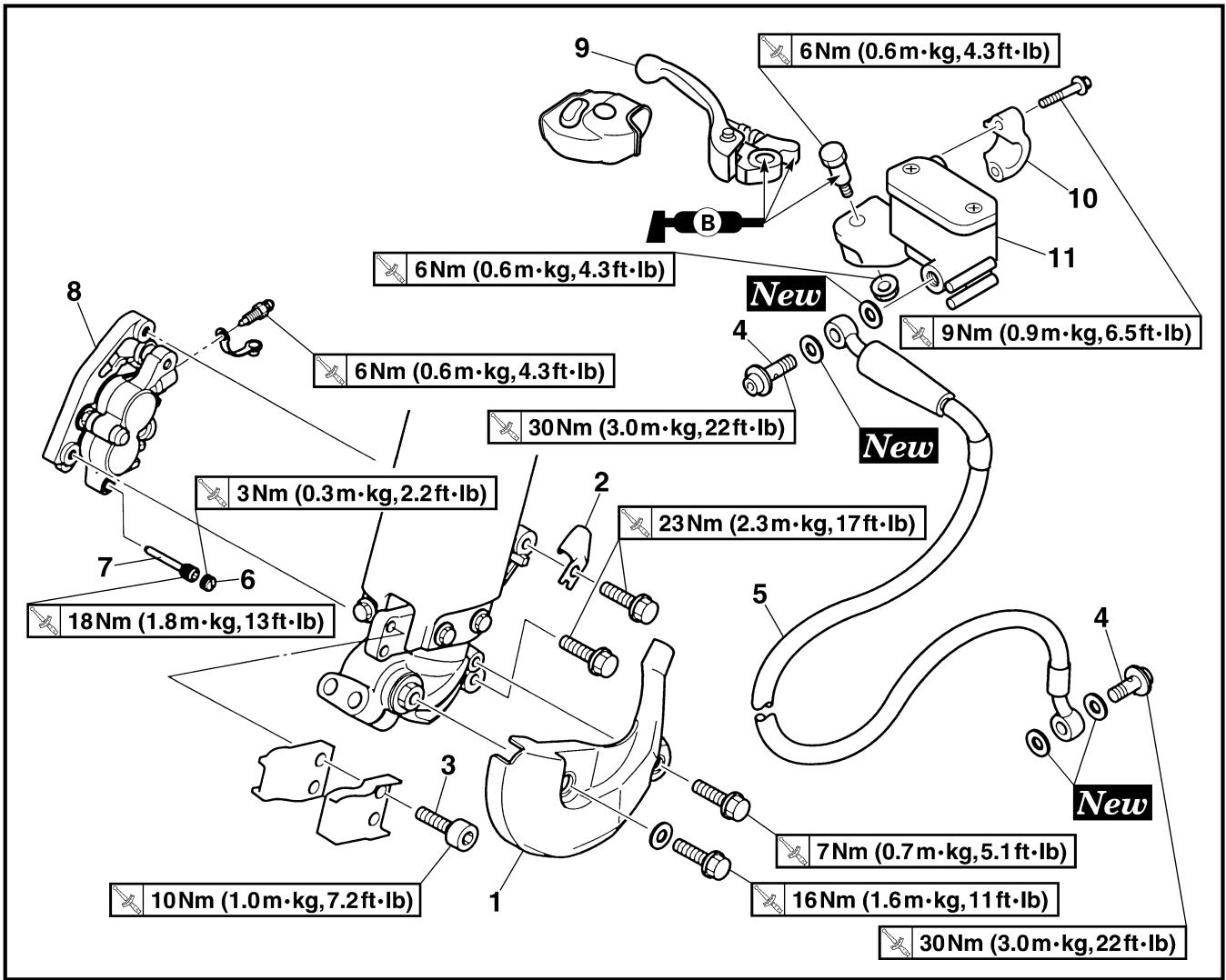
Extent of removal:
① Brake hose removal
③ Brake master cylinder removal
② Brake caliper removal
| Extent of removal | Order | Part name | Q'ty | Remarks |
| Preparation for removal | FRONT BRAKE REMOVALHold the machine by placing the suitable stand under the engine.Drain the brake fluid. | WARNINGSupport the machine securely so there is no danger of it falling over.Refer to “REMOVAL POINTS”. | ||
| 1 | 2 | Brake hose cover | 1 | Only loosening. |
| Brake hose holder | 1 | |||
| 3 | Bolt (brake hose holder) | 2 | ||
| 4 | Union bolt | 2 | ||
| 5 | Brake hose | 1 | ||
| 6 | Pad pin plug | 1 | Remove when loosening the pad pin. Loosen when disassembling the caliper. | |
| 7 | Pad pin | 1 | ||
| 8 | Brake caliper | 1 | ||
| 9 | Brake lever | 1 | ||
| 10 | Brake master cylinder bracket | 1 | ||
| 11 | Brake master cylinder | 1 |
FREIN AVANT ET FREIN ARRIERE VORDER- UND HINTERRADBREMSE FRENO ANTERIORE E POSTERIORE
FREIN AVANT ET FREIN ARRIERE
FREIN AVANT
① Brake caliper removal
② Brake hose removal
③ Brake master cylinder removal
| Extent of removal | Order | Part name | Q'ty | Remarks |
| Preparation for removal | REAR BRAKE REMOVALHold the machine by placing the suitable stand under the engine.Rear wheelDrain the brake fluid. | ▲WARNINGSupport the machine securely so there is no danger of it falling over.Refer to “FRONT WHEEL AND REAR WHEEL” section.Refer to “REMOVAL POINTS”. | ||
| 12345678910 | 12345678910 | Pad pin plugPad pinBrake caliperBrake hose holderUnion boltBrake hoseBrake pedalReservoir tankReservoir hoseBrake master cylinder | 1111221111 | Remove when loosening the pad pin.Loonen when disassembling the caliper. |
FREIN AVANT ET FREIN ARRIERE VORDER- UND HINTERRADBREMSE FRENO ANTERIORE E POSTERIORE
FREIN ARRIERE
① Front brake caliper disassembly
② Rear brake caliper disassembly
| Extent of removal | Order | Part name | Q'ty | Remarks | |
| 12 | ①②③④⑤⑥ | BRAKE CALIPER DISASSEMBLY Pad pin Brake pad Pad support Brake caliper piston Dust seal Piston seal | A | B | Refer to “REMOVAL POINTS”. Refer to “REMOVAL POINTS”. |
| 1 | 1 | ||||
| 2 | 2 | ||||
| 1 | 1 | ||||
| 2 | 1 | ||||
| 2 | 1 | ||||
| 2 | 1 | ||||
FREIN AVANT ET FREIN ARRIERE VORDER- UND HINTERRADBREMSE FRENO ANTERIORE E POSTERIORE
DEMONTAGE DE L'ETRIER
A Avant
B Arriere
① Front brake master cylinder disassembly
② Rear brake master cylinder disassembly
| Extent of removal | Order | Part name | Q'ty | Remarks |
| 1 2 1↑ 2 1↓ | 1 2 3 4 5 6 7 | BRAKE MASTER CYLINDER DISASSEMBLY Brake master cylinder cap Diaphragm Brake master cylinder boot Circlip Washer Push rod Brake master cylinder kit | 1 1 1 1 1 1 1 1 | Use a long nose circlip pliers. |
FREIN AVANT ET FREIN ARRIERE VORDER- UND HINTERRADBREMSE FRENO ANTERIORE E POSTERIORE

DEMONTAGE DU MAITRE-CYLINDRE DE FREIN
A Avant
B Arriere
- Brake master cylinder cap ①
[Rear] - Brake master cylinder guard ①
- Reservoir tank cap ②
NOTE:
Do not remove the diaphragm.
A Front
Rear
- Connect the transparent hose ② to the bleed screw ① and place a suitable container under its end.
A Front
Rear
- Loosen the bleed screw and drain the brake fluid while pulling the lever in or pushing down on the pedal.
CAUTION:
- Do not reuse the drained brake fluid.
- Brake fluid may erode painted surfaces or plastic parts. Always clean up spilled fluid immediately.
Brake caliper piston
-
Remove:
-
Brake caliper piston
Use compressed air and proceed carefully.
WARNING
- Cover piston with rag and use extreme caution when expelling piston from cylinder.
- Never attempt to pry out piston.
Caliper piston removal steps:
- Insert a piece of rag into the brake caliper to lock one brake caliper.
- Carefully force the piston out of the brake caliper cylinder with compressed air.
A Front
Rear
FREIN AVANT ET FREIN ARRIERE VORDER- UND HINTERRADBREMSE FRENO ANTERIORE E POSTERIORE

POINTS DE DEPOSE
Liquide de frein
- Déposer:
Brake caliper piston seal kit
-
Remove:
-
Dust seal ①
- Piston seal ②
NOTE:
Remove the piston seals and dust seals by pushing them with a finger.
CAUTION:
Never attempt to pry out piston seals and dust seals.
WARNING
Replace the piston seals and dust seals whenever a caliper is disassembled.
A Front
Rear
EC5A4000
INSPECTION
Brake master cylinder
-
Inspect:
-
Brake master cylinder inner surface @ Wear/scratches Replace master cylinder assembly. Stains Clean.
WARNING
Use only new brake fluid.
A Front
Rear
-
Inspect:
-
Diaphragm ① Crack/damage Replace.
A Front
Rear
-
Inspect:
-
Brake master cylinder piston ①
- Brake master cylinder cup ② Wear/damage/score marks Replace brake master cylinder kit.
A Front
Rear
FREIN AVANT ET FREIN ARRIERE VORDER- UND HINTERRADBREMSE FRENO ANTERIORE E POSTERIORE

- Brake caliper cylinder inner surface @ Wear/score marks Replace brake caliper assembly.
A Front
Rear
2. Inspect:
- Brake caliper piston ① Wear/score marks Replace brake caliper piston assembly.
WARNING
Replace the piston seals and dust seals ② whenever a caliper is disassembled.
EC534301
Brake hose
1. Inspect:
- Brake hose ① Crack/damage → Replace.
EC5A5000
ASSEMBLY AND INSTALLATION
WARNING
- All internal parts should be cleaned in new brake fluid only.
- Internal parts should be lubricated with brake fluid when installed.
- Replace the piston seals and dust seals whenever a caliper is disassembled.
Brake caliper piston
1. Clean:
- Brake caliper
- Piston seal
- Dust seal
- Brake caliper piston Clean them with brake fluid.
FREIN AVANT ET FREIN ARRIERE VORDER- UND HINTERRADBREMSE FRENO ANTERIORE E POSTERIORE
Etrier de frein
- Controller:
-
Install:
-
Piston seal ①
New
- Dust seal ②
New
WARNING
Always use new piston seals and dust seals.
NOTE: Fit the piston seals and dust seals onto the slot on brake caliper correctly.
A Front
Rear
-
Install:
-
Brake caliper piston ①
NOTE: Apply the brake fluid on the piston wall.
CAUTION:
- For the front brake caliper, install the piston with its depressed side ④ facing the brake caliper. For the rear brake caliper, install the piston with its shallow depressed side ⑥ facing the caliper.
- Never force to insert.
A Front
Rear
Front brake caliper
-
Install:
-
Pad support ①
- Brake pad ②
- Pad pin ③
NOTE:
Install the brake pads with their projections 包 into the brake caliper recesses ⑥
- Temporarily tighten the pad pin at this point.
FREIN AVANT ET FREIN ARRIERE VORDER- UND HINTERRADBREMSE FRENO ANTERIORE E POSTERIORE
-
Monter:
-
Joint de piston ①
-
Joint antipoussiere
New
② New
A VERTISSEMENT
Always use new copper washers.
CAUTION:
Install the brake hose so that its pipe portion ⑧ directs as show and lightly touches the projection 6 on the brake caliper.
-
Install:
-
Brake hose holder ①
- Brake caliper ②
- Bolt (brake caliper) ③

23 Nm (2.3 m·kg, 17 ft·lb)
NOTE:
Fit the brake hose holder cut ⑧ over the projection 6 on the front fork and clamp the brake hose.
-
Tighten:
-
Pad pin ④

18 Nm (1.8 m·kg, 13 ft·lb)
-
Install:
-
Pad pin plug ⑤

3 Nm (0.3 m·kg, 2.2 ft·lb)
Rear brake caliper
-
Install:
-
Pad support ①
- Brake pad ②
- Pad pin ③
NOTE:
Install the brake pads with their projections into the brake caliper recesses
- Temporarily tighten the pad pin at this point.
FREIN AVANT ET FREIN ARRIERE VORDER- UND HINTERRADBREMSE FRENO ANTERIORE E POSTERIORE

- Monter:
- Brake disc cover ①
- Bolt (brake disc cover) ②
7 Nm (0.7 m · kg, 5.1 ft · lb)
3. Install:
Copper washer ①
New
- Brake hose ②
- Union bolt ③
30 Nm (3.0 m·kg, 22 ft·lb)
WARNING
Always use new copper washers.
CAUTION:
Install the brake hose to the brake caliper with the paint ⑧ on the pipe facing the brake caliper and with the pipe contacting the brake caliper projection ⑥ .
4. Install:
- Brake caliper ①
- Rear wheel ② Refer to "FRONT WHEEL AND REAR WHEEL" section.
5. Tighten:
- Pad pin ③
18Nm(1.8m·kg,13ft·lb)
6. Install:
- Pad pin plug ④
3 Nm (0.3 m·kg, 2.2 ft·lb)
FREIN AVANT ET FREIN ARRIERE VORDER- UND HINTERRADBREMSE FRENO ANTERIORE E POSTERIORE
Brake master cylinder kit
-
Clean:
-
Brake master cylinder
- Brake master cylinder kit Clean them with brake fluid.
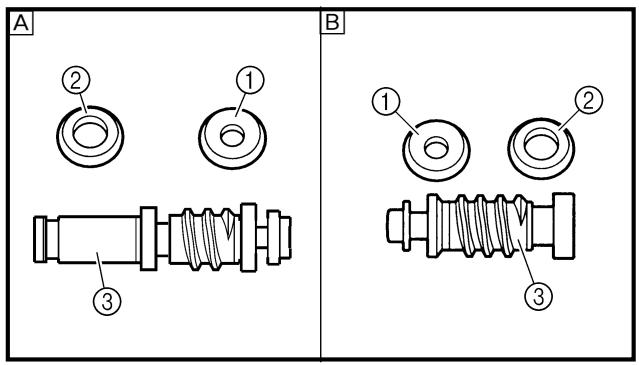
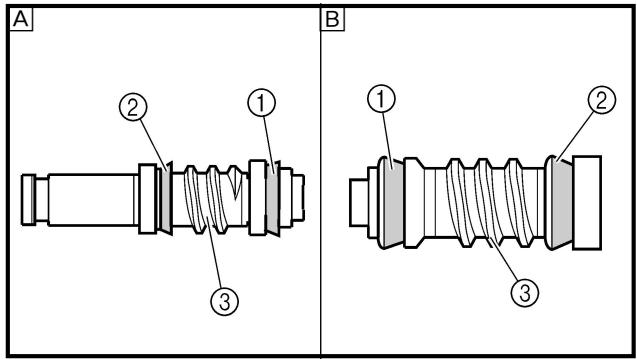
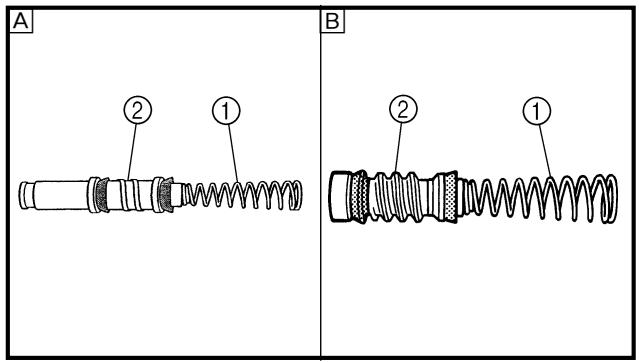
-
Install:
-
Brake master cylinder cup (primary) ①
- Brake master cylinder cup (secondary) ②
To brake master cylinder piston ③.
NOTE: Apply the brake fluid on the brake master cylinder cup.
WARNING
After installing, cylinder cup should be installed as shown direction. Wrong installation cause improper brake performance.
A Front
Rear
- Install:
Spring ①
To brake master cylinder piston ②.
NOTE:
Install the spring at the smaller dia. side.
A Front
Rear
FREIN AVANT ET FREIN ARRIERE VORDER- UND HINTERRADBREMSE FRENO ANTERIORE E POSTERIORE
- Brake master cylinder kit ①
- Washer ②
Circlip ③ - Brake master cylinder boot ④
To brake master cylinder ⑤.
[Rear]
- Brake master cylinder kit ①
- Push rod ②
Circlip ③ - Brake master cylinder boot ④
To brake master cylinder ⑤.
NOTE:
- Apply the brake fluid on the brake master cylinder kit.
- Apply the lithium soap base grease on the tip of the push rod.
- When installing the circlip, use a long nose circlip pliers.
A Front
Rear
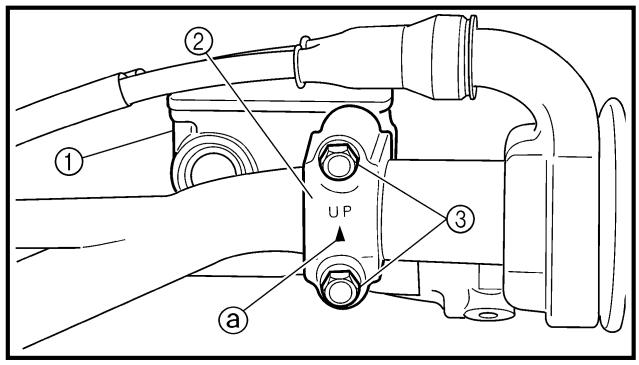
Front brake master cylinder
1. Install:
- Brake master cylinder ①
- Brake master cylinder bracket ②
- Bolt (brake master cylinder bracket) ③
9Nm(0.9m·kg,6.5ft·lb)
NOTE:
Install the bracket so that the arrow mark ⑧ face upward.
- First tighten the bolts on the upper side of the brake master cylinder bracket, and then tighten the bolts on the lower side.
FREIN AVANT ET FREIN ARRIERE VORDER- UND HINTERRADBREMSE FRENO ANTERIORE E POSTERIORE
- Monter:
[Avant]
Apply the lithium soap base grease on the brake lever sliding surface, bolt and contacting surface of the brake master cylinder piston.
Rear brake master cylinder
1. Install:
- Reservoir hose ①
- Reservoir tank ②
- Bolt (reservoir tank) ③

10 Nm (1.0 m·kg, 7.2 ft·lb)
2. Install:
- Brake master cylinder ①
- Bolt (brake master cylinder) ②
10 Nm (1.0 m·kg, 7.2 ft·lb)
3. Install:
Spring ①
- Brake pedal ②
- O-ring ③ New
- Bolt (brake pedal) ④
26 Nm (2.6 m·kg, 19 ft·lb)
- Clip ⑤
NOTE:
- Apply the lithium soap base grease on the bolt, O-ring and brake pedal bracket.
- Install the clip with its stopper portion @ facing inward.
FREIN AVANT ET FREIN ARRIERE VORDER- UND HINTERRADBREMSE FRENO ANTERIORE E POSTERIORE

2. Monter:
6Nm(0,6m·kg,4,3ft·lb)
6Nm(0,6m·kg,4,3ft·lb)
6Nm(0,6m·kg,4,3ft·lb)
NOTA:
26Nm(2,6m·kg,19ft·lb)
After installing, check the brake pedal height. Refer to "REAR BRAKE ADJUSTMENT" section in the CHAPTER 3.
Front brake hose
1. Install:
- Brake hose ①
10 Nm (1.0 m·kg, 7.2 ft·lb)
To brake hose holder ②.
NOTE:
Before tightening the bolt (brake hose holder), pass the brake hose in front of the axle boss ⑧ , then fit it into the hose groove ⑥ so that the brake hose does not contact the nut (wheel axle).
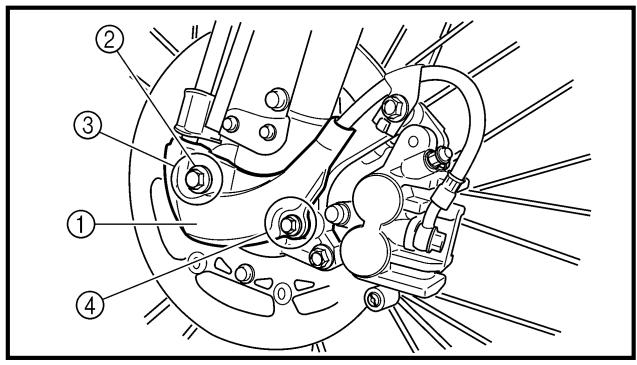
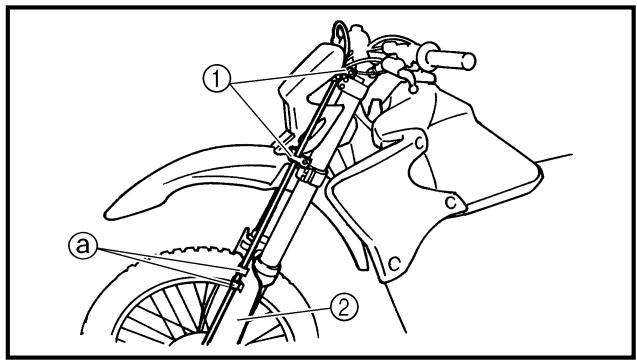
2. Install:
- Brake hose cover ①
- Washer ②
- Bolt [brake hose cover (M8)] ③
16Nm(1.6m·kg,11ft·lb)
- Bolt [brake hose cover (M6)] ④
7 Nm (0.7 m·kg, 5.1 ft·lb)
- Pass the brake hose through the cable guides ① , then through the guides 圆 on the protector ②
FREIN AVANT ET FREIN ARRIERE VORDER- UND HINTERRADBREMSE FRENO ANTERIORE E POSTERIORE
- Monter:
Copper washer ①
- Brake hose ②
- Union bolt ③

30 Nm (3.0 m - kg, 22 ft - lb)
WARNING
Always use new copper washers.
CAUTION:
Install the brake hose so that it contacts the master cylinder projection ④ and that its bent portion 6 faces downward.
Rear brake hose
1. Install:
Copper washer ①
- Brake hose ②
Copper washer ③
- Union bolt ④

30 Nm (3.0 m · kg, 22 ft · lb)
WARNING
Always use new copper washers.
CAUTION:
When installing the brake hose, first align the tooth ④ on the copper washer ① with the projection ⑥ on the brake master cylinder. Then, align the pipe portion ⑤ on the end of the brake hose with the tooth ④ on the copper washer ① and tighten the union bolt.
FREIN AVANT ET FREIN ARRIERE VORDER- UND HINTERRADBREMSE FRENO ANTERIORE E POSTERIORE

- Monter:
- Brake hose holder ①
- Screw (brake hose holder) ②
4Nm(0.4m·kg,2.9ft·lb)
CAUTION:
After installing the brake hose holders, make sure the brake hose does not contact the spring (rear shock absorber). If it does, correct its twist.
Brake fluid
1. Fill:
- Brake fluid
Until the fluid level reaches "LOWER" level line (a) .

Recommended brake fluid: DOT #4
WARNING
- Use only the designated quality brake fluid:
otherwise, the rubber seals may deteriorate, causing leakage and poor brake performance. - Refill with the same type of brake fluid; mixing fluids may result in a harmful chemical reaction and lead to poor performance.
- Be careful that water does not enter the master cylinder when refilling. Water will significantly lower the boiling point of the fluid and may result in vapor lock.
CAUTION:
Brake fluid may erode painted surfaces or plastic parts. Always clean up spilled fluid immediately.
A Front
Rear
FREIN AVANT ET FREIN ARRIERE VORDER- UND HINTERRADBREMSE FRENO ANTERIORE E POSTERIORE

- Monter:
Support de tuyau de frein ①
- Vis (support de tuyau de frein) ②
4Nm (0.4m· kg,2,9ft· lb)
- Montieren:
Fluid at lower level Fill up.
Refer to "BRAKE FLUID LEVEL INSPECTION" section in the CHAPTER 3.
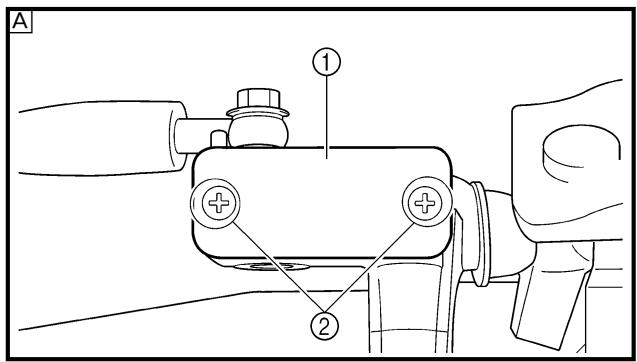
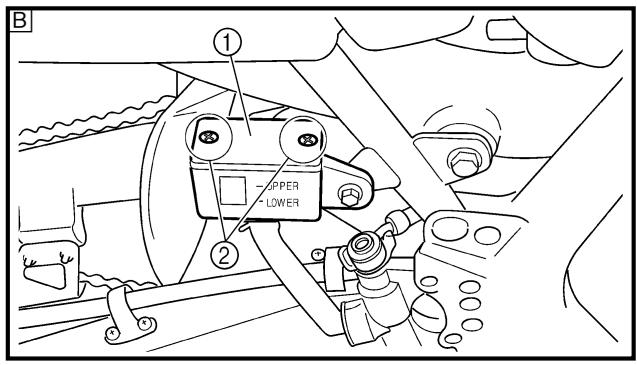
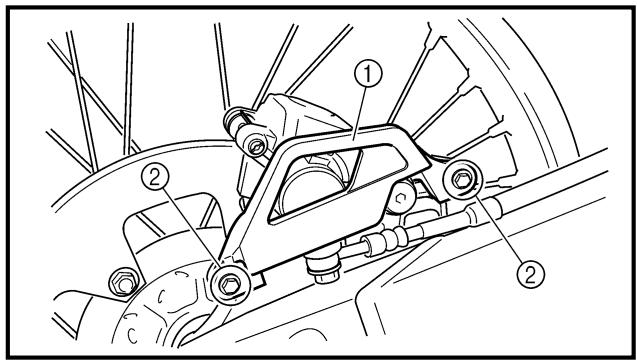
4. Install:
[Front]
Diaphragm
- Brake master cylinder cap ①
- Screw (brake master cylinder cap) ②
2Nm(0.2m·kg,1.4ft·lb)
[Rear]
Diaphragm
- Reservoir tank cap ①
- Screw (reservoir tank cap) ②
2Nm(0.2m·kg,1.4ft·lb)
- Brake master cylinder guard
10 Nm (1.0 m·kg, 7.2 ft·lb)
CAUTION:
After installation, while pulling the brake lever in or pushing down on the brake pedal, check whether there is any brake fluid leaking where the union bolts are installed respectively at the brake master cylinder and brake caliper.
A Front
Rear
-
Install: (rear brake only)
-
Protector ①
- Bolt (protector) ②
7 Nm (0.7 m·kg, 5.1 ft·lb)
FREIN AVANT ET FREIN ARRIERE VORDER- UND HINTERRADBREMSE FRENO ANTERIORE E POSTERIORE
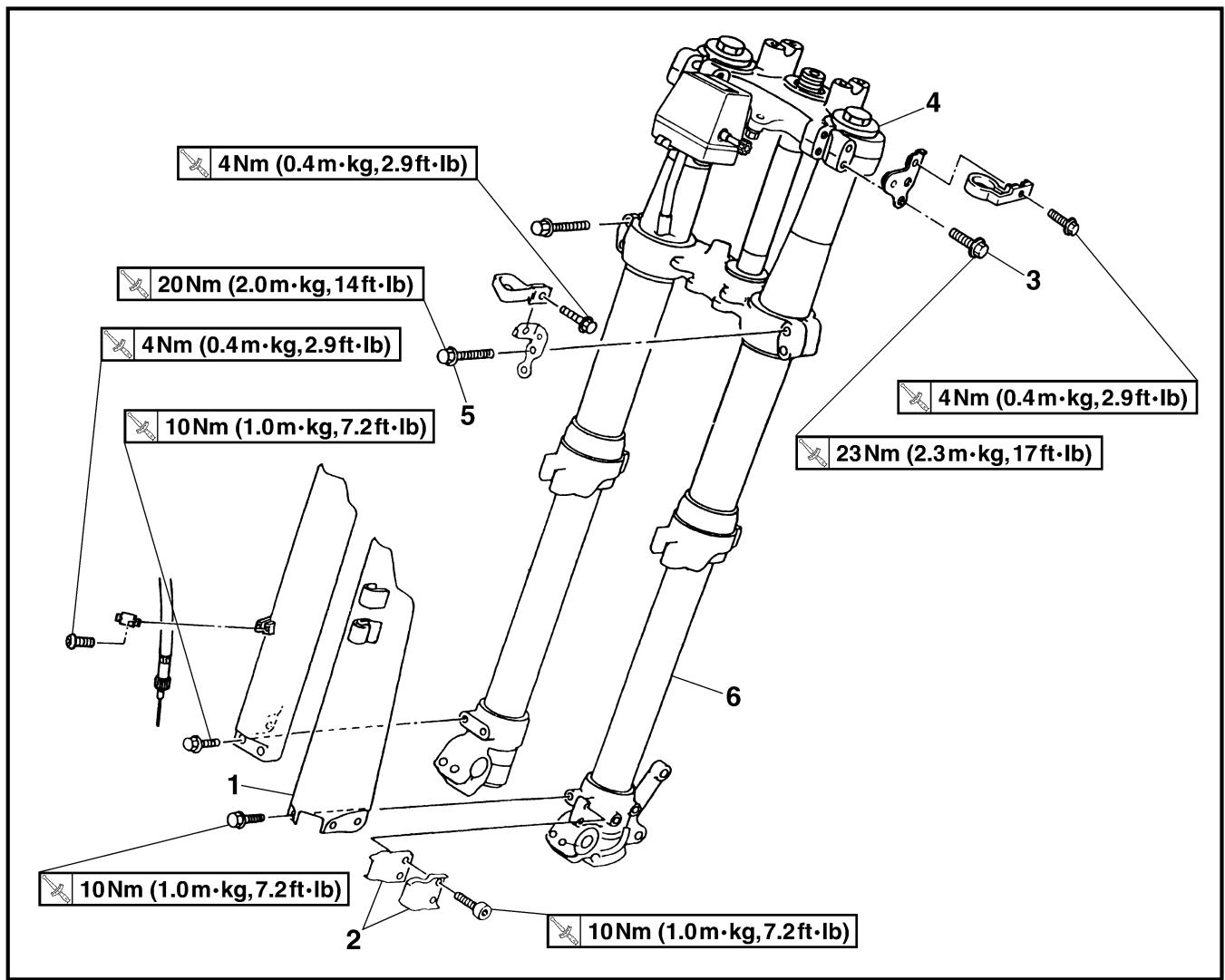
Extent of removal:
① Front fork removal
| Extent of removal | Order | Part name | Q'ty | Remarks |
| Preparation for removal | FRONT FORK REMOVALHold the machine by placing the suitable stand under the engine.Front wheelFront brake caliperHeadlightHandlebar | ▲WARNINGSupport the machine securely so there is no danger of it falling over.Refer to “FRONT WHEEL AND REAR WHEEL” section.Refer to “FRONT BRAKE AND REAR BRAKE” section.Refer to “HANDLEBAR” section. | ||
| 1 | 1 | Protector | 1 | |
| 2 | Brake hose holder | 2 | ||
| 3 | Pinch bolt (upper bracket) | 2 | Only loosening. | |
| 4 | Cap bolt | 1 | Loosen when disassembling the front fork. | |
| 5 | Pinch bolt (lower bracket) | 2 | Only loosening. | |
| 6 | Front fork | 1 |
FOURCHE AVANT
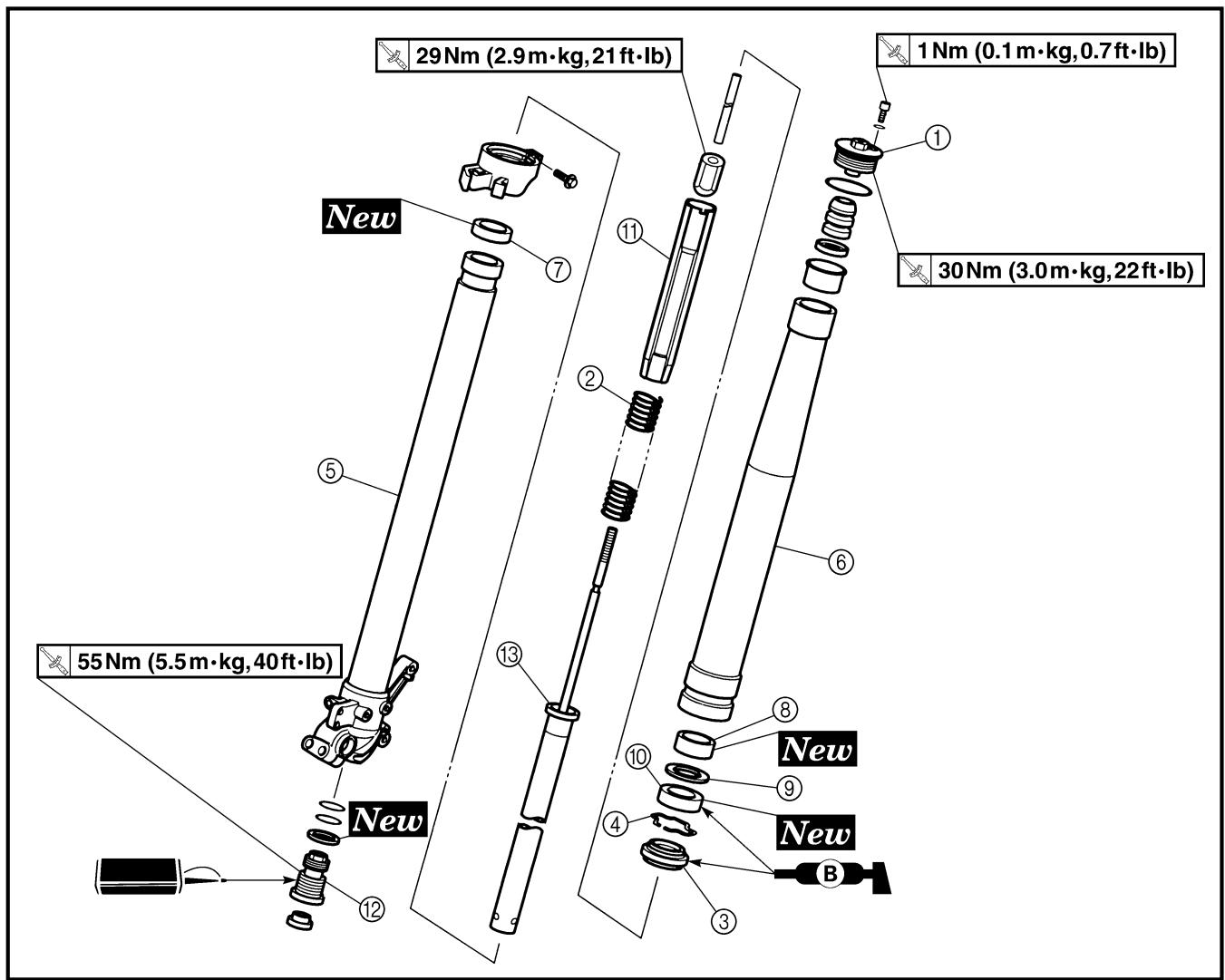
Extent of removal:
① Oil seal removal
② Damper rod removal
| Extent of removal | Order | Part name | Q'ty | Remarks |
| 12 | FRONT FORK DISASSEMBLY | Refer to “REMOVAL POINTS”. Drain the fork oil. Refer to “REMOVAL POINTS”. | ||
| ① | Front fork cap bolt | 1 | ||
| ② | Fork spring | 1 | ||
| ③ | Dust seal | 1 | ||
| ④ | Stopper ring | 1 | ||
| ⑤ | Inner tube | 1 | ||
| ⑥ | Outer tube | 1 | ||
| ⑦ | Piston metal | 1 | ||
| ⑧ | Slide metal | 1 | ||
| ⑨ | Oil seal washer | 1 | ||
| ⑩ | Oil seal | 1 | ||
| ⑪ | Spring guide | 1 | ||
| ⑫ | Base valve | 1 | Use special tool. Refer to “REMOVAL POINTS”. | |
| ⑬ | Damper rod | 1 | ||
DEMONTAGE DE LA FOURCHE AVANT
The front fork requires careful attention. So it is recommended that the front fork be maintained at the dealers.
CAUTION:
To prevent an accidental explosion of air, the following instructions should be observed:
- The front fork with a built-in piston rod has a very sophisticated internal construction and is particularly sensitive to foreign material.
Use enough care not to allow any foreign material to come in when the oil is replaced or when the front fork is disassembled and reassembled.
- Before removing the cap bolts or front forks, be sure to extract the air from the air chamber completely.
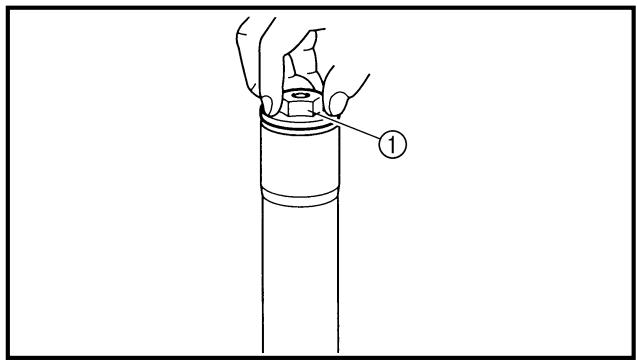
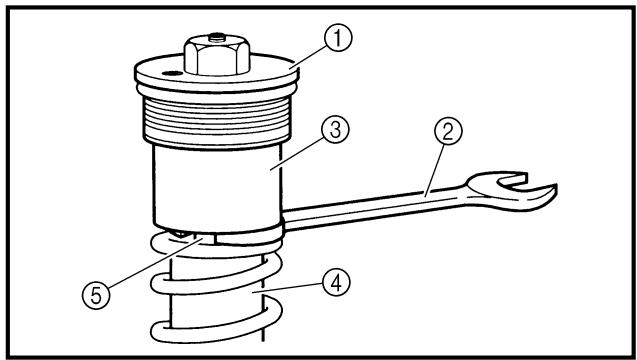
EC553000
REMOVAL POINTS
Front fork cap bolt
-
Remove:
-
Front fork cap bolt ①
From the outer tube.
NOTE:
Before removing the front fork from the machine, loosen the front fork cap bolt.
-
Remove:
-
Front fork cap bolt ①
NOTE:
- While compressing the fork spring, set the thin type spanners ② between the spacer ③ and spring guide ④.
- Hold the locknut ⑤ and remove the front fork cap bolt.
REMARQUES CONCERNANT LA MANIPULATION
N.B.:
-
Remove:
-
Dust seal ①
- Stopper ring ②
Using slotted-head screwdriver.
CAUTION:
Take care not to scratch the inner tube.
-
Remove:
-
Inner tube ①
Oil seal removal steps:
- Push in slowly @ the inner tube just before it bottoms out and then pull it back quickly b.
- Repeat this step until the inner tube can be pulled out from the outer tube.
EC553311
Damper rod
-
Remove:
-
Base valve ①
- Damper rod ②
NOTE:
Use a damper rod holder ③ to lock the damper rod.
Damper rod holder: YM-1423/90890-01423
EC554000
INSPECTION
EC554100
Damper rod
-
Inspect:
-
Damper rod ①
Bend/damage Replace damper rod.
CAUTION:
The front fork with a built-in piston rod has a very sophisticated internal construction and is particularly sensitive to foreign material.
Use enough care not to allow any foreign material to come in when the oil is replaced or when the front fork is disassembled and reassembled.
Tube interne
-
Déposer:
-
Joint antipoussière ①
Bagued'arrét ②
-
Inspect:
-
Valve assembly ① Wear/damage Replace.
- O-ring ② Damage → Replace.
EC554400
Fork spring
-
Measure:
-
Fork spring free length @ Out of specification Replace.
Fork spring free length: 460 mm (18.1 in)
EC554502
Inner tube
-
Inspect:
-
Inner tube surface @ Score marks Repair or replace. Use #1,000 grit wet sandpaper. Damaged oil lock piece Replace.
- Inner tube bends Out of specification Replace. Use the dial gauge ①.
Inner tube bending limit: 0.2 mm (0.008 in)
NOTE: The bending value is shown by one half of the dial gauge reading.

WARNING
Do not attempt to straighten a bent inner tube as this may dangerously weaken the tube.
EC554600
Outer tube
-
Inspect:
-
Outer tube ① Score marks/wear/damage → Replace.
Soupape de base
-
Controller:
-
Ensemble clapet ① Usure/endommagement → Remplacer.
- Joint torque ② Endommagement Remplacer.
Luftventil
-
Inspect:
-
Front fork cap bolt ①
- O-ring ②
Air bleed screw ③
Wear/damage Replace.
EC555000
ASSEMBLY AND INSTALLATION
Front fork assembly
- Wash the all parts in a clean solvent.
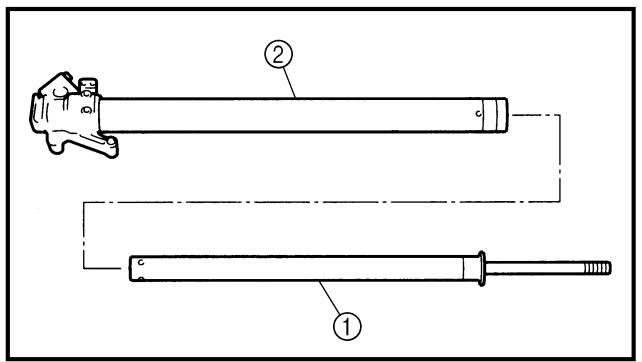
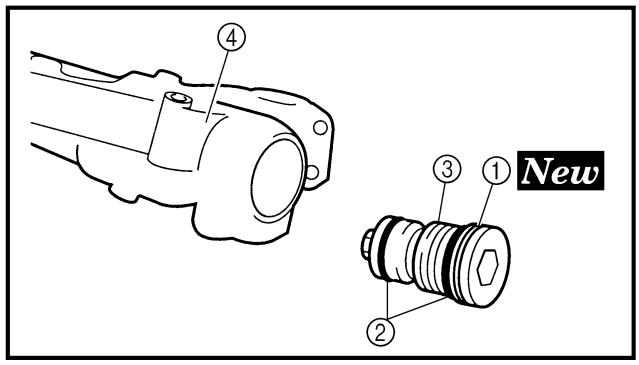
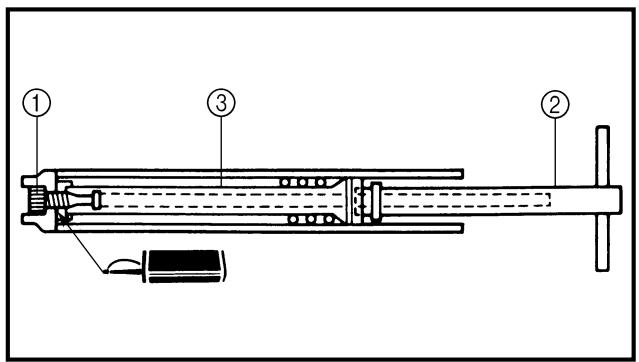
-
Install:
-
Damper rod ①
To inner tube ②.
CAUTION:
To install the damper rod into the inner tube, hold the inner tube aslant. If the inner tube is held vertically, the damper rod may fall into it, damaging the valve inside.
- Install:
Copper washer ①

- O-ring ②
- Base valve ③
To inner tube ④.
-
Tighten:
-
Base valve ①

55 Nm (5.5 m · kg, 40 ft · lb)
NOTE:
- Use a damper rod holder ② to lock the damper rod ③.
- Apply the LOCTITE® on the base valve thread.
Damper rod holder: YM-1423/90890-01423
Install the spring guide with its cut @ facing upward.
- With its thread ⑥ facing upward, fully finger tighten the locknut onto the damper rod.
6. Install:
- Dust seal ①
- Stopper ring ②
- Oil seal ③ New
- Oil seal washer ④
- Slide metal ⑤ New
To inner tube ⑥.
NOTE:
- Apply the fork oil on the inner tube.
- When installing the oil seal, use vinyl seat ⑧ with fork oil applied to protect the oil seal lip.
- Install the oil seal with its manufacture's marks or number facing the axle holder side.
7. Install:
- Piston metal ①

NOTE:
Install the piston metal onto the slot on inner tube.
8. Install:
- Outer tube ①
To inner tube ②.
- Monter:
- Slide metal ①
- Oil seal washer ②
To outer tube slot.
NOTE:
Press the slide metal into the outer tube with fork seal driver ③.
Fork seal driver: YM-01442/90890-01442
10. Install:
- Oil seal ①
NOTE:
Press the oil seal into the outer tube with fork seal driver ②.
Fork seal driver: YM-01442/90890-01442
11.Install:
- Stopper ring ①
NOTE:
Fit the stopper ring correctly in the groove in the outer tube.
12.Install:
- Dust seal ①
NOTE:
Apply the lithium soap base grease on the inner tube.
- Inner tube smooth movement Tightness/binding/rough spots Repeat the steps 2 to 12.
14. Compress the front fork fully.
15. Fill:
- Front fork oil
- Until outer tube top surface with recommended fork oil (1).

Recommended oil: Suspension oil “01”
CAUTION:
- Be sure to use recommended fork oil. If other oils are used, they may have an excessively adverse effect on the front fork performance.
- Never allow foreign materials to enter the front fork.
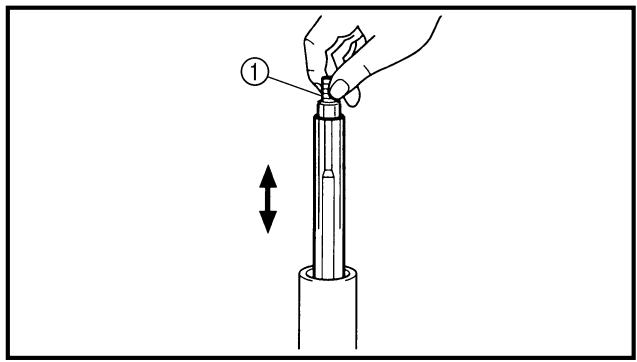
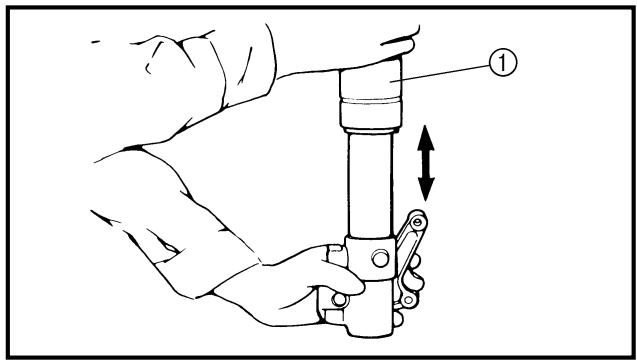
- After filling, pump the damper rod ① slowly up and down more than 10 times to distribute the fork oil.
17. Fill:
- Front fork oil
-
Until outer tube top surface with recommended fork oil once more.
-
After filling, pump the outer tube ① slowly up and down (about 200 ~mm (7.9 in) stroke) to distribute the fork oil once more.
NOTE:
Be careful not to excessive full stroke. A stroke of 200 ~mm (7.9 in) or more will cause air to enter. In this case, repeat the steps 15 to 18.
-
Controller:
-
Mouvement régulier du tube plongeur
Raideur/coincement/point dur → Répéter les étapes du 2 à 12. -
Kontrollieren:
-
Leichtgangigkeit des Standrohres Schwergängigkeit → Die Schritte 2 bis 12 wiederholen.
-
Controllare:
-
Movimento agevole del tubo di forza Tenuta/resistenza/punti rugosi Ripetere le fasi da 2 a 12.
-
Comprimer la fourche avant complètement.
- Remplir:
- Wait ten minutes until the air bubbles have been removed from the front fork, and the oil has dispense evenly in system before setting recommended oil level.
NOTE:
Fill with the fork oil up to the top end of the outer tube, or the fork oil will not spread over to every part of the front forks, thus making it impossible to obtain the correct level.
Be sure to fill with the fork oil up to the top of the outer tube and bleed the front forks.
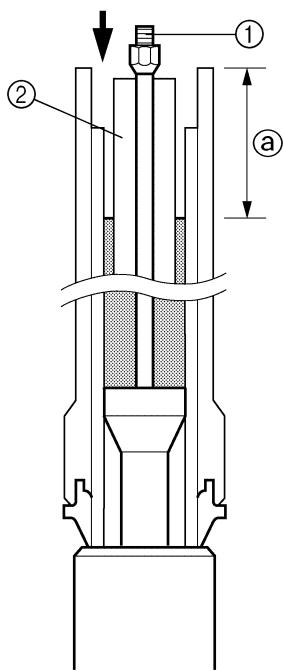
311404
20.Measure:
- Oil level (left and right) ⑧
Out of specification Adjust.
Standard oil level:
140 mm (5.51 in)
- 130 mm (5.12 in)
Extent of adjustment:
80 ~ 150 mm (3.15 ~ 5.91 in)
From top of outer tube with inner tube and damper rod ①
fully compressed without spring.
- For EUROPE
NOTE:
Be sure to install the spring guide ② when checking the oil level.
WARNING
Never fail to make the oil level adjustment between the maximum and minimum level and always adjust each front fork to the same setting. Uneven adjustment can cause poor handling and loss of stability.
Out of specification Turn into the locknut.
Distance ⑧ : 20 mm (0.79 in) or more Between damper rod ① top and locknut ② top.
22. Loosen:
- Rebound damping adjuster ①
NOTE:
- Loosen the rebound damping adjuster finger tight.
- Record the set position of the adjuster (the amount of turning out the fully turned in position).
23.Install
Cushion rubber ①
- Washer ②
- Spacer ③
To front fork cap bolt ④.
NOTE:
Install the cushion rubber with its smaller dia.end ⑧ facing the front fork cap bolt.
24. Install:
- Push rod ①
- Fork spring ②
NOTE:
- Install the fork spring with the damper rod ③ pulled up.
- After installing the fork spring, hold the damper rod end so that it will not go down.
25.Install:
-
Front fork cap bolt ① Fully tighten the front fork cap bolt onto the damper rod by hand.
-
Mesurer:
-
Distance @
- While compressing the fork spring, set the thin type spanners ② between the spacer ③ and spring guide ④ .
- Hold the locknut ⑤ and tighten the front fork cap bolt with specified torque.
27.Install:
- Front fork cap bolt ①
To outer tube.
NOTE:
Temporarily tighten the cap bolt.
28. Install:
- Protector guide ①
Installation
1. Install:
- Front fork ①
NOTE:
- Temporarily tighten the pinch bolts (lower bracket).
- Do not tighten the pinch bolts (upper bracket) yet.
2. Tighten:
- Front fork cap bolt ①
30Nm(3.0m·kg,22ft·lb)
3. Adjust:
- Front fork top end ⑧
Front fork top end (standard) @:
7 mm (0.28 in)
8 mm (0.31 in)
* 10.5 mm (0.41 in)
-
For EUROPE
** For AUS, NZ and ZA -
Serrer:
-
Bouchon de tube de fourche (contré-écrou) ①
29Nm (2,9m· kg,21ft· lb)
N.B.:
- Pinch bolt (upper bracket) ①
23 Nm (2.3 m - kg, 17 ft - lb)
- Pinch bolt (lower bracket) ②
Tighten the lower bracket to specified torque. If torqued too much, it may cause the front fork to malfunction.
5. Install:
- Brake hose holder ①
- Brake caliper ②
- Bolt (brake caliper) ③
23 Nm (2.3 m·kg, 17 ft·lb)
NOTE:
Fit the brake hose holder cut ⑧ over the projection 6 on the front fork and clamp the brake hose.
6. Install:
- Brake hose holder ①
- Bolt (brake hose holder) ②
10 Nm (1.0 m·kg, 7.2 ft·lb)
- Protector ③
- Bolt (protector) ④
10 Nm (1.0 m·kg, 7.2 ft·lb)
NOTE: When installing the brake hose holder, pass the brake hose ⑤ in front of the axle boss ④ , then fit it into the hose groove ⑥ so that the brake hose does not contact the nut (wheel axle).
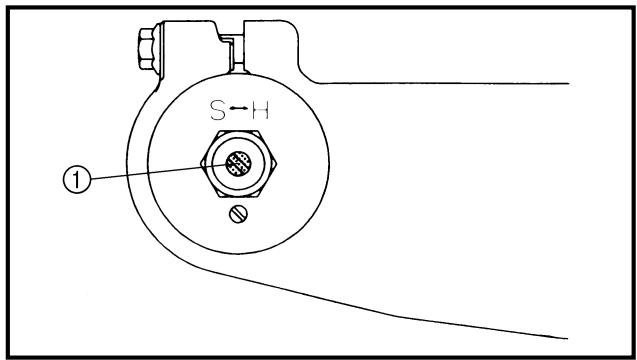
7. Adjust:
- Rebound damping force
NOTE: Turn in the damping adjuster ① finger-tight and then turn out to the originally set position.
| Extent of removal | Order | Part name | Q'ty | Remarks |
| Preparation for removal | HANDLEBAR REMOVAL Headlight | |||
| 1 | 1 | Decompression cable | 1 | Disconnect at the lever side. |
| 2 | Decompression lever holder | 1 | ||
| 3 | Clutch cable | 1 | Disconnect at the lever side. | |
| 4 | Clutch lever holder | 1 | ||
| 5 | Engine stop switch | 1 | ||
| 6 | Light switch | 1 | ||
| 7 | Brake master cylinder | 1 | Refer to “REMOTE POINTS”. | |
| 8 | Throttle cable cap | 1 | ||
| 9 | Throttle cable #2 (pushed) | 1 | Disconnect at the throttle side. | |
| 10 | Throttle cable #1 (pulled) | 1 | Disconnect at the throttle side. | |
| 11 | Right grip | 1 | Refer to “REMOTE POINTS”. | |
| 12 | Tube guide | 1 | ||
| 13 | Collar | 1 | ||
| 14 | Left grip | 1 | Refer to “REMOTE POINTS”. | |
| 15 | Handlebar upper holder | 2 | ||
| 16 | Handlebar | 1 |
GUIDON
Brake master cylinder
-
Remove:
-
Brake master cylinder bracket ①
- Brake master cylinder ②
CAUTION:
- Do not let the brake master cylinder hang on the brake hose.
- Keep the brake master cylinder cap side horizontal to prevent air from coming in.
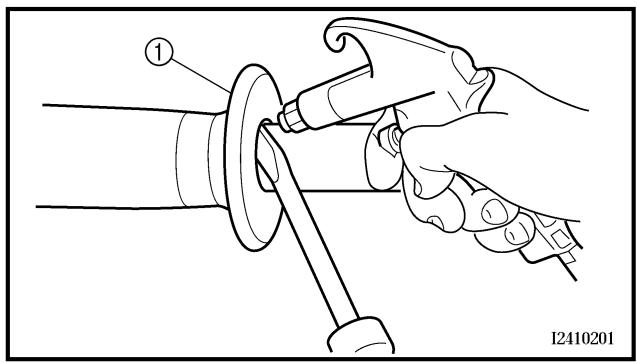
EC5B3200
Grip
-
Remove:
-
Grip ①
NOTE: Blow in air between the handlebar or tube guide and the grip. Then remove the grip which has become loose.
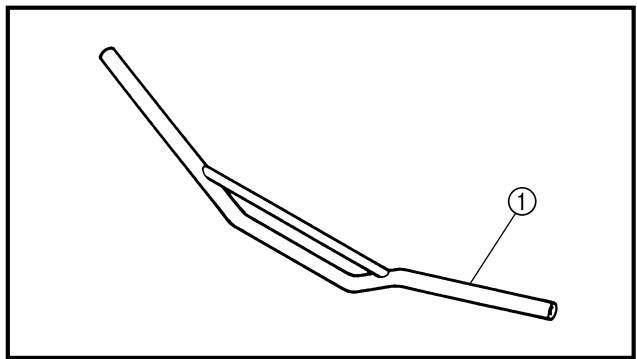
EC5B4000
INSPECTION
EC5B4100
Handlebar
-
Inspect:
-
Handlebar ①
Bends/cracks/damage Replace.
WARNING
Do not attempt to straighten a bent handlebar as this may dangerously weaken the handlebar.
POINTS DE DEPOSE
ASSEMBLY AND INSTALLATION
Handlebar
-
Install:
-
Handlebar ①
- Handlebar upper holder ②
- Bolt (handlebar upper holder) ③
28 Nm (2.8 m·kg, 20 ft·lb)
NOTE:
- The handlebar upper holder should be installed with the punched mark @ forward.
-
First tighten the bolts on the front side of the handlebar upper holder, and then tighten the bolts on the rear side.
-
Install:
-
Left grip ①
Apply the adhesive to the handlebar ②.
NOTE:
- Before applying the adhesive, wipe off grease or oil on the handlebar surface @ with a lacquer thinner.
-
Install the left grip to the handlebar so that the line ⑥ between the two arrow marks faces straight upward.
-
Install:
-
Right grip ①
Collar ②
Apply the adhesive on the tube guide ③.
NOTE:
- Before applying the adhesive, wipe off grease or oil on the tube guide surface @ with a lacquer thinner.
- Install the grip to the tube guide so that the grip match mark ⑥ and tube guide slot ⑤ form the angle as shown.
REMONTAGE ET MONTAGE
Guidon
Apply the lithium soap base grease on the throttle cable end and tube guide cable winding portion.
5. Install:
- Throttle cable cap ①
- Screw (throttle cable cap) ②
4 Nm (0.4 m·kg, 2.9 ft·lb)
- Cover (throttle cable cap) ③
WARNING
After tightening the screws, check that the throttle grip ④ moves smoothly. If it does not, retighten the bolts for adjustment.
6. Install:
- Brake master cylinder ①
- Brake master cylinder bracket ②
- Bolt (brake master cylinder bracket) ③
9Nm (0.9m· kg,6.5ft· lb)
NOTE:
Install the bracket so that the arrow mark ④ faces upward.
- First tighten the bolt on the upper side of the brake master cylinder bracket, and then tighten the bolt on the lower side.
- Engine stop switch ①
- Clutch lever holder ②
- Bolt (clutch lever holder) ③
4Nm(0.4m·kg,2.9ft·lb)
- Decompression lever holder ④
- Bolt (decompression lever holder) ⑤
4Nm(0.4m·kg,2.9ft·lb)
- Clamp ⑥
NOTE:
- The engine stop switch, clutch lever holder, decompression lever holder and clamp should be installed according to the dimensions shown.
- Pass the engine stop switch lead in the middle of the clutch holder.
9. Install:
- Clutch cable ①
- Decompression cable ②
NOTE:
Apply the lithium soap base grease on the clutch cable end and decompression cable end.
10. Adjust:
- Clutch lever free play Refer to "CLUTCH ADJUSTMENT" section in the CHAPTER 3.
-
Decompression lever free play Refer to "DECOMPRESSION LEVER ADJUSTMENT" section in the CHAPTER 3.
-
Posér:
-
Contacteur d'éclairage ①
2Nm(0,2m·kg,1,4ft·lb)
- Fasten the decompression cable ① and clutch cable ② with a clamp ③.
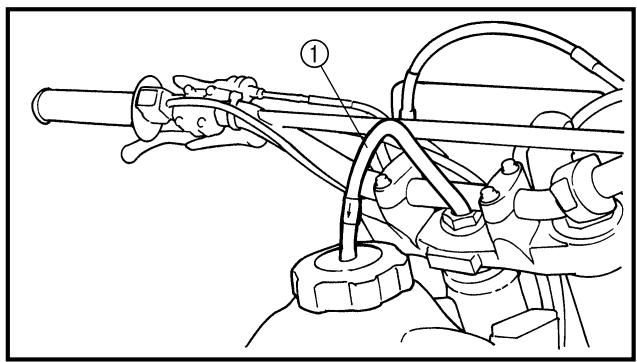
① Lower bracket removal
② Bearing removal
| Extent of removal | Order | Part name | Q'ty | Remarks |
| Preparation for removal | STEERING REMOVALHold the machine by placing the suitable stand under the engine. Headlight Handlebar Cable guide Front fender | ▲WARNINGSupport the machine securely so there is no danger of it falling over.Refer to “HANDLEBAR” section. | ||
| 12 | 12 | Trip meterSteering stem nutFront forkUpper bracketSteering ring nutLower bracketBall race cover | 1121111 | Refer to “FRONT FORK” section.Use special tool.Refer to “REMOVAL POINTS”. |
DIRECTION
Steering nut wrench: YU-33975/90890-01403
WARNING
Support the steering stem so that it may not fall down.
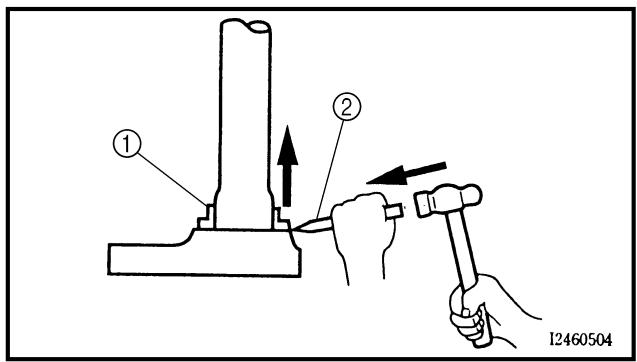
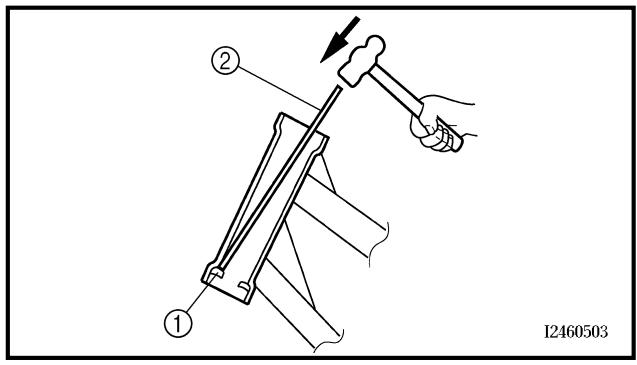
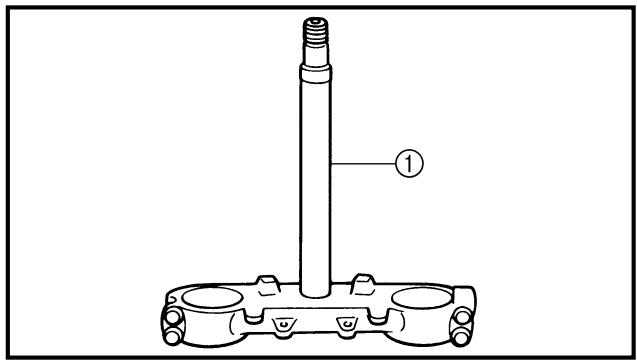
Lower bearing
-
Remove:
-
Lower bearing ①
Use the floor chisel ②.
CAUTION:
Take care not to damage the steering stem thread.
EC563400
Ball race
-
Remove:
-
Ball race ①
Remove the ball race using long rod ② and the hammer.
EC564000
INSPECTION
Steering stem
-
Inspect:
-
Steering stem ①
Bend/damage Replace.
POINTS DE DEPOSE
Hakenschlüssel
YU-33975/
90890-01403
WARNING
Bearing and ball race
-
Wash the bearings and ball races with a solvent.
-
Inspect:
-
Bearing ①
Ball race
Pitting/damage Replace bearings and ball races as a set.
Install the bearing in the ball races. Spin the bearings by hand. If the bearings hang up or are not smooth in their operation in the ball races, replace bearings and ball races as a set.
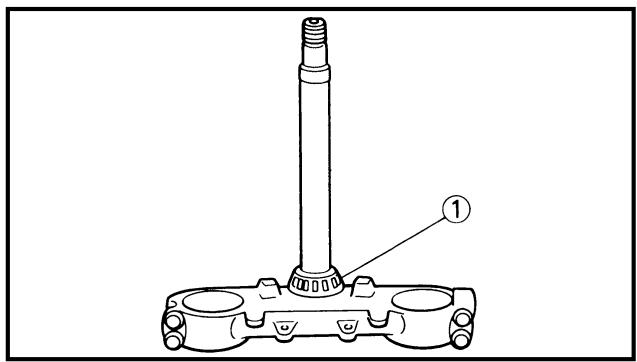
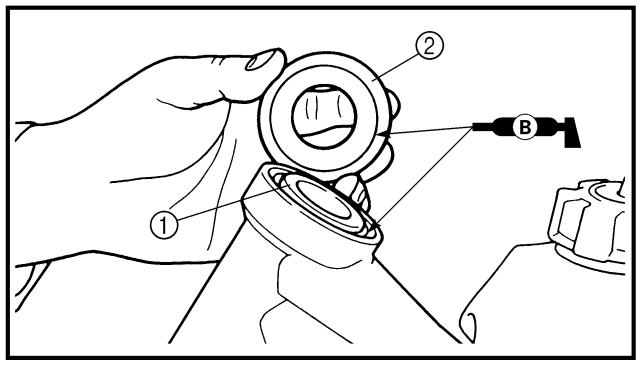
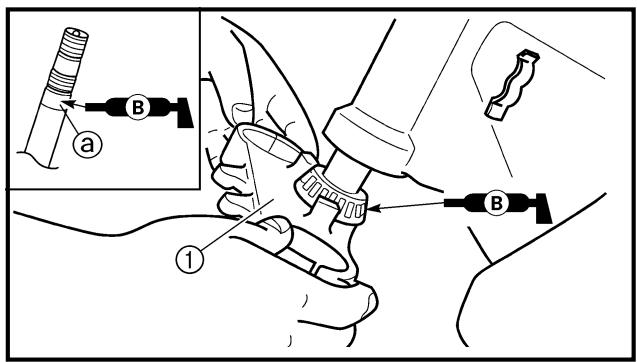
EC565000
ASSEMBLY AND INSTALLATION
Lower bracket
-
Install:
-
Lower bearing ①
NOTE:
Apply the lithium soap base grease on the dust seal lip and bearing inner circumference.
- Install:
Ball race
- Upper bearing ①
- Ball race cover ②
NOTE:
Apply the lithium soap base grease on the bearing and ball race cover lip.
-
Install:
-
Lower bracket ①
NOTE:
Apply the lithium soap base grease on the bearing and the portion ⑧ of the steering stem.
Refer to "STEERING HEAD INSPECTION AND ADJUSTMENT" section in the CHAPTER 3.
- Check the steering stem by turning it lock to lock. If there is any binding, remove the steering stem assembly and inspect the steering bearings.
6. Install:
- Washer ①
7. Install:
- Front fork ①
- Upper bracket ②
NOTE:
- Temporarily tighten the pinch bolts (lower bracket).
- Do not tighten the pinch bolts (upper bracket) yet.
8. Install:
- Washer ①
- Steering stem nut ②
-
After tightening the nut, check the steering for smooth movement. If not, adjust the steering by loosening the steering ring nut little by little.
-
Adjust:
-
Front fork top end ⑧
Front fork top end (standard) © :
7 mm (0.28 in)
- 8mm (0.31 in)
** 10.5 mm (0.41 in)
- For EUROPE
** For AUS, NZ and ZA
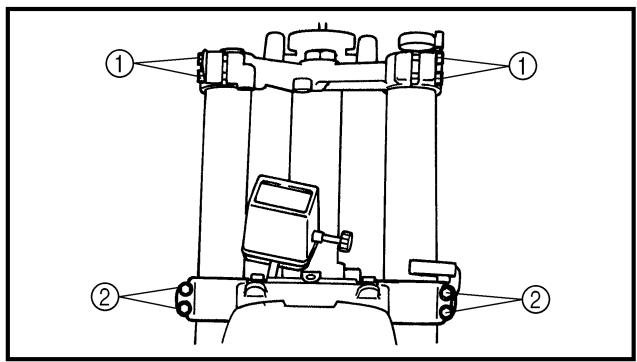
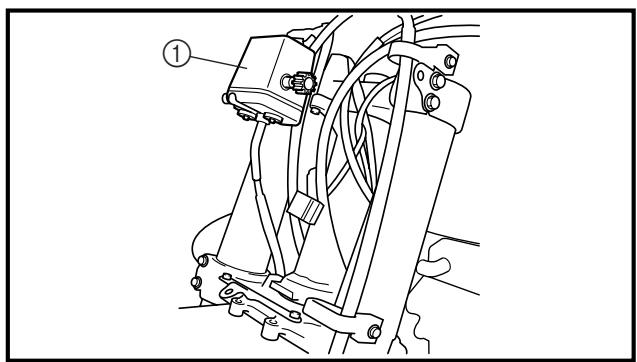
-
Tighten:
-
Pinch bolt (upper bracket) ①
23 Nm (2.3 m·kg, 17 ft·lb)
- Pinch bolt (lower bracket) ②
20Nm (2.0m· kg,14ft· lb)
CAUTION:
Tighten the lower bracket to specified torque. If torqued too much, it may cause the front fork to malfunction.
| Extent of removal | Order | Part name | Q'ty | Remarks |
| Preparation for removal | STEERING REMOVALHold the machine by placing the suitable stand under the engine.Brake hose holderRear brake caliperBolt (brake pedal)Drive chain | WARNINGSupport the machine securely so there is no danger of it falling over.Refer to “FRONT BRAKE AND REAR BRAKE” section.Shift the brake pedal backward. | ||
| 1 | 123456 | Drive chain caseLower chain tensionerBolt (rear shock absorber-relay arm)Bolt (connecting rod)Pivot shaftSwingarm | 111111 | Hold the swingarm. |
BRAS OSCILLANT
② Connecting rod removal and disassembly
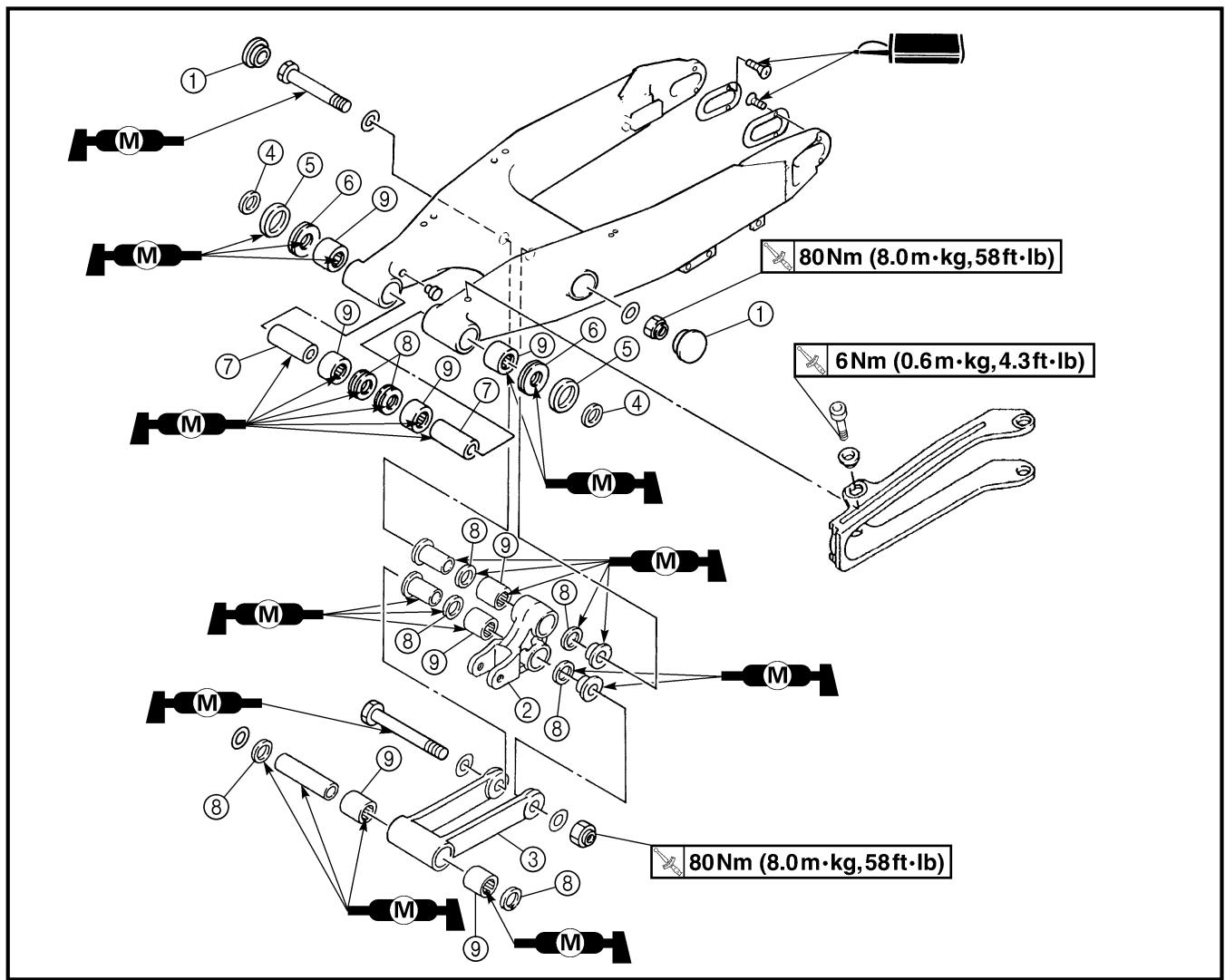
① Swingarm disassembly
③ Relay arm removal and disassembly
Extent of removal:
| Extent of removal | Order | Part name | Q'ty | Remarks |
| 3 ② ① ① ② ③ | ① ② ③ ④ ⑤ ⑥ ⑦ ⑧ ⑨ | SWINGARM DISASSEMBLY Cap Relay arm Connecting rod Collar Oil seal Thrust bearing Bushing Oil seal Bearing | 2 1 1 2 2 2 2 2 8 8 | Refer to “REMOVAL POINTS”. |
DEMONTAGE DU BRAS OSCILLANT
Install the bearing by pressing its outer race.
INSPECTION
Wash the bearings, bushings, collars, and covers in a solvent.
Swingarm
-
Inspect:
-
Bearing ①
- Bushing ②
Free play exists/unsmooth revolution/ rust Replace bearing and bushing as a set.
-
Inspect:
-
Oil seal ③
Damage Replace.
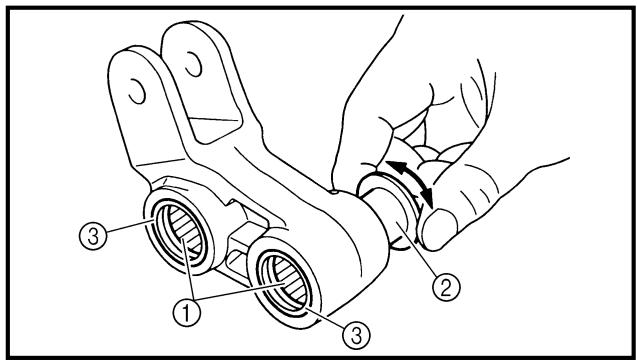
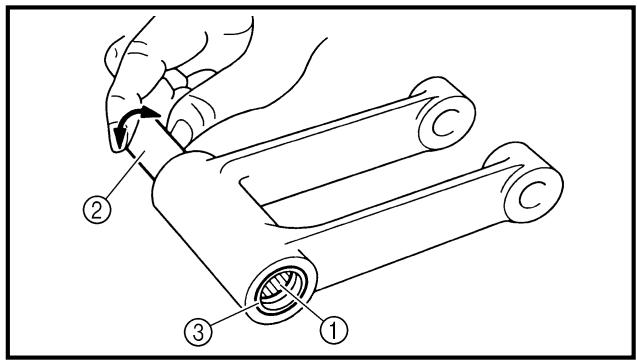
EC574210
Relay arm
-
Inspect:
-
Bearing ①
Collar ②
Free play exists/unsmooth revolution/rust Replace bearing and collar as a set.
-
Inspect:
-
Oil seal ③
Damage Replace.
EC574310
Connecting rod
-
Inspect:
-
Bearing ①
Collar ②
Free play exists/unsmooth revolution/rust Replace bearing and collar as a set.
-
Inspect:
-
Oil seal ③
Damage Replace.
POINTS DE DEPOSE
Roulement
- Déposer:
Roulement ①
N.B.:
ASSEMBLY AND INSTALLATION
EC575201
Bearing and oil seal
-
Install:
-
Bearing ①
- Oil seal ②
To swingarm.
NOTE:
- Apply the molybdenum disulfide grease on the bearing when installing.
- Install the bearing by pressing it on the side having the manufacture's marks or numbers.
- First install the outer and then the inner bearings to a specified depth from inside.
Installed depth of bearings: Outer a: Zero mm (Zero in) Inner b: 8.5 mm (0.33 in)
-
Install:
-
Bearing ①
- Oil seal ②
To relay arm.
NOTE:
- Apply the molybdenum disulfide grease on the bearing when installing.
- Install the bearing by pressing it on the side having the manufacture's marks or numbers.
Installed depth of bearings ④ : 5 mm (0.20 in)
-
Install:
-
Bearing ①
- Oil seal ②
To connecting rod.
NOTE:
- Apply the molybdenum disulfide grease on the bearing when installing.
- Install the bearing by pressing it on the side having the manufacture's marks or numbers.
Installed depth of bearings ⑧ : 5 mm (0.20 in)
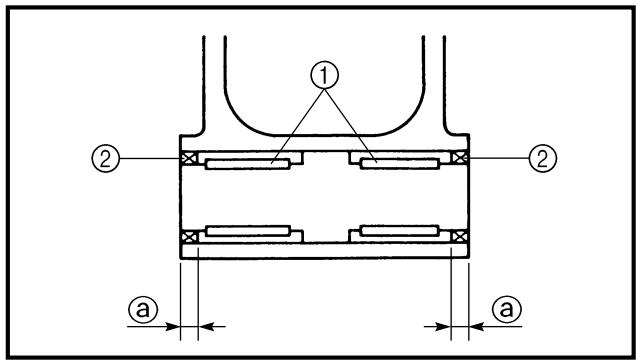
REMONTAGE ET MONTAGE
-
Install:
-
Bushing ①
- Thrust bearing ②
- Oil seal ③
- Collar ④ To swingarm ⑤
NOTE: Apply the molybdenum disulfide grease on the bushings, thrust bearings and oil seal lips.
-
Install:
-
Collar ①
To relay arm ②.
NOTE: Apply the molybdenum disulfide grease on the collars, bearings and oil seal lips.
-
Install:
-
Collar ①
To connecting rod ②.
NOTE: Apply the molybdenum disulfide grease on the collar, bearings and oil seal lips.
-
Install:
-
Connecting rod ①
- Bolt (connecting rod) ②
- Washer ③
- Nut (connecting rod) ④

80Nm (8.0m· kg,58ft· lb)
To relay arm ⑤.
NOTE: Apply the molybdenum disulfide grease on the bolt.
CAUTION:
Install the nut on the left side of the chassis. If you make a mistake in its installation position, the nut contacts the swingarm when stroking the rear shock absorber.
Bras oscillant
- Apply the molybdenum disulfide grease on the bolt.
- Do not tighten the nut yet.
6. Install:
- Swingarm ①
- Pivot shaft ②
85 Nm (8.5 m·kg, 61 ft·lb)
NOTE:
- Apply the molybdenum disulfide grease on the pivot shaft.
- Insert the pivot shaft from right side.
7. Check:
- Swingarm side play ⑧ Free play exists Replace thrust bearing.
- Swingarm up and down movement (b) Unsmooth movement/binding/rough spots Grease or replace bearings, bushings and collars.
8. Install:
- Bolt (connecting rod) ①
- Washer ②
- Nut (connecting rod) ③
NOTE:
- Apply the molybdenum disulfide grease on the bolt.
- Do not tighten the nut yet.
9. Install:
- Washer ①
- Bolt (rear shock absorber-relay arm) ②

53Nm(5.3m·kg,38ft·lb)
NOTE:
- Apply the molybdenum disulfide grease on the bolt.
- Insert the bolt from right side.
5. Monter:
- Bras de relais ①
- Boulon (bras relais) ②
Rondelle ③ - Ecrou (bras relais) ④
- Nut (connecting rod) ①
80Nm(8.0m·kg,58ft·lb)
11. Tighten:
- Nut (relay arm) ①
80 Nm (8.0 m · kg, 58 ft · lb)
12. Install:
- Cap ①
NOTE: Install the cap with its mark @ facing forward.
13. Install:
- Bolt (lower chain tensioner) ①
- Washer ②
- Collar ③
- Lower chain tensioner ④
- Nut (lower chain tensioner) ⑤
19Nm(1.9m·kg,13ft·lb)
14. Install:
- Drive chain case ①
- Drive chain case cover ②
- Bolt {drive chain case [ = 50mm (1.97 in)]} ③
- Nut (drive chain case) ④
7 Nm (0.7 m·kg, 5.1 ft·lb)
- Bolt {drive chain case cover [ = 10 mm (0.39 in)]} ⑤
7 Nm (0.7 m·kg, 5.1 ft·lb)
-
Serrer:
-
Ecrou (bielle) ①
80Nm (8,0m· kg,58ft· lb)
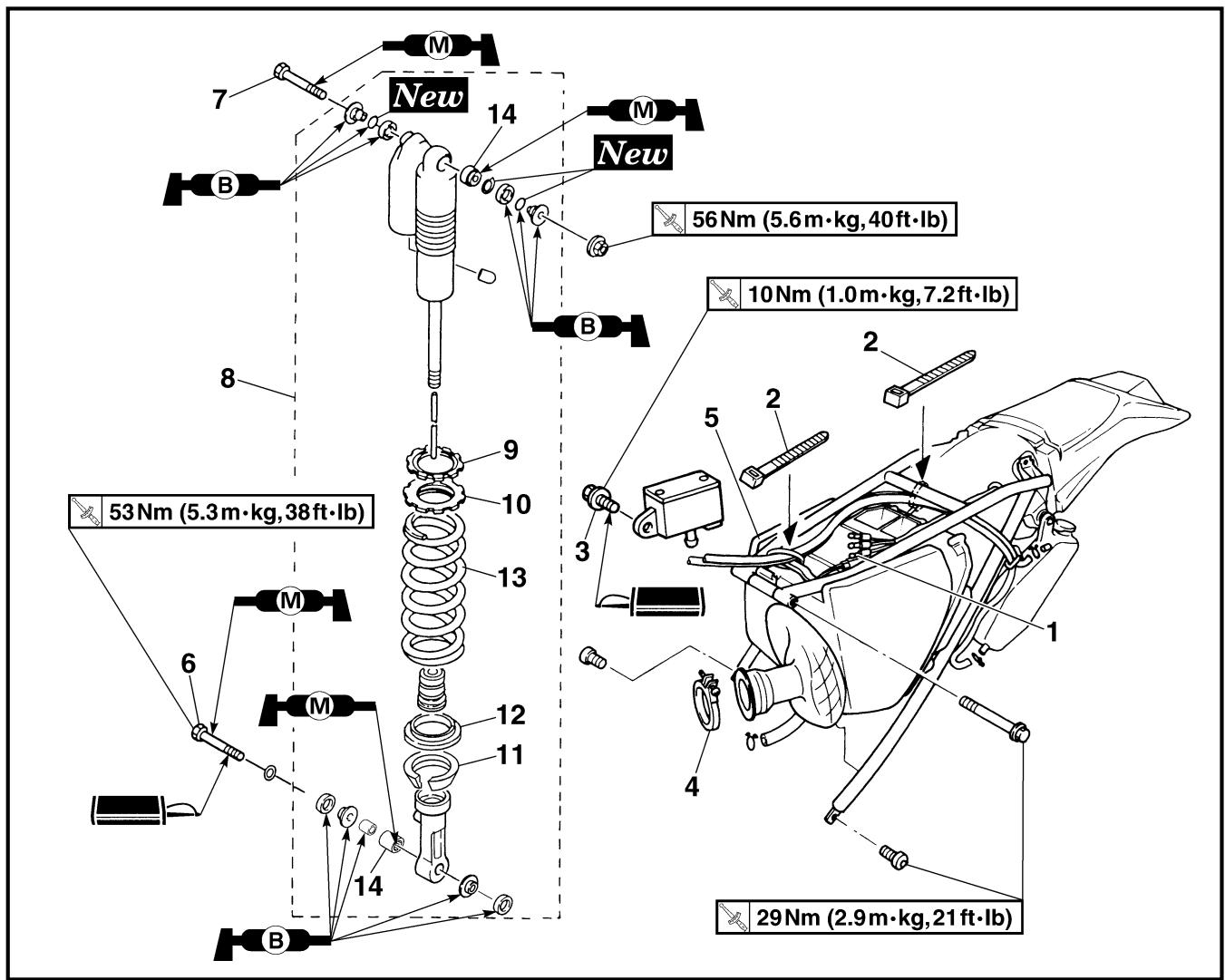
Extent of removal:
(1) Rear shock absorber removal
(2) Rear shock absorber disassembly
| Extent of removal | Order | Part name | Q'ty | Remarks |
| Preparation for removal | REAR SHOCK ABSORBER REMOVALHold the machine by placing the suitable stand under the engine.Seat and side coversSilencerDrain the coolant.Coolant reservoir | ▲WARNINGSupport the machine securely so there is no danger of it falling over.Refer to "SEAT, FUEL TANK AND SIDE COVERS" section in the CHAPTER 4.Refer to "EXHAUST PIPE AND SILENCER" section in the CHAPTER 4.Refer to "COOLANT REPLACEMENT" section in the CHAPTER 3.Refer to "RADIATOR" section in the CHAPTER 4. | ||
| 12 | 12 | Taillight connectorBandBolt (reservoir tank)Clamp (air filter joint)Rear frameBolt (rear shock absorber-relay arm)Bolt (rear shock absorber-frame)Rear shock absorber | 2211111 | Only loosening.Hold the swingarm. |
AMORTISSEUR ARRIERE
This rear shock absorber is provided with a separate type tank filled with high-pressure nitrogen gas. To prevent the danger of explosion, read and understand the following information before handling the shock absorber.
The manufacturer can not be held responsible for property damage or personal injury that may result from improper handling.
- Never tamper or attempt to disassemble the cylinder or the tank.
- Never throw the rear shock absorber into an open flame or other high heat. The rear shock absorber may explode as a result of nitrogen gas expansion and/or damage to the hose.
- Be careful not to damage any part of the gas tank. A damaged gas tank will impair the damping performance or cause a malfunction.
- Take care not to scratch the contact surface of the piston rod with the cylinder; or oil could leak out.
- Never attempt to remove the plug at the bottom of the nitrogen gas tank. It is very dangerous to remove the plug.
- When scrapping the rear shock absorber, follow the instructions on disposal.
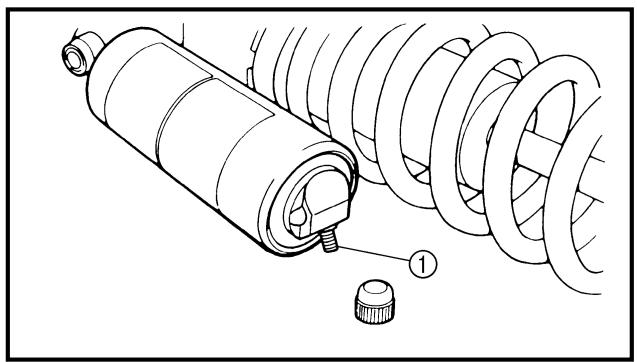
NOTES ON DISPOSAL (YAMAHA DEALERS ONLY)
Before disposing the rear shock absorber, be sure to extract the nitrogen gas from valve ①. Wear eye protection to prevent eye damage from escaping gas and/or metal chips.
WARNING
To dispose of a damaged or worn-out rear shock absorber, take the unit to your Yamaha dealer for this disposal procedure.
REMARQUES CONCERNANT LA MANIPULATION

AVERTISSEMENT
-
Remove:
-
Stopper ring (upper bearing) ①
NOTE:
Press in the bearing while pressing its outer race and remove the stopper ring.
-
Remove:
-
Upper bearing ①
NOTE:
Remove the bearing by pressing its outer race.
-
Remove:
-
Lower bearing ①
NOTE:
Remove the bearing by pressing its outer race.
EC584000
INSPECTION
Rear shock absorber
-
Inspect:
-
Damper rod ①
Bends/damage Replace rear shock absorber assembly.
- Shock absorber ②
Oil leaks Replace rear shock absorber assembly.
Gas leaks Replace rear shock absorber assembly.
Spring ③
Damage Replace spring.
Fatigue Replace spring.
Move spring up and down.
Spring guide ④
Wear/damage Replace spring guide.
- Bearing ⑤
Free play exists/unsmooth revolution/ rust Replace.
POINTS DE DEPOSE
Roulement
ASSEMBLY AND INSTALLATION
EC585300
Bearing
-
Install:
-
Upper bearing ①
NOTE: Install the bearing parallel until the stopper ring groove appears by pressing its outer race.
CAUTION:
Do not apply the grease on the bearing outer race because it will wear the rear shock absorber surface on which the bearing is press fitted.
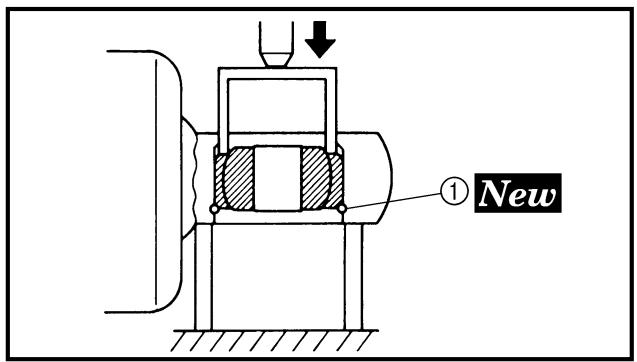
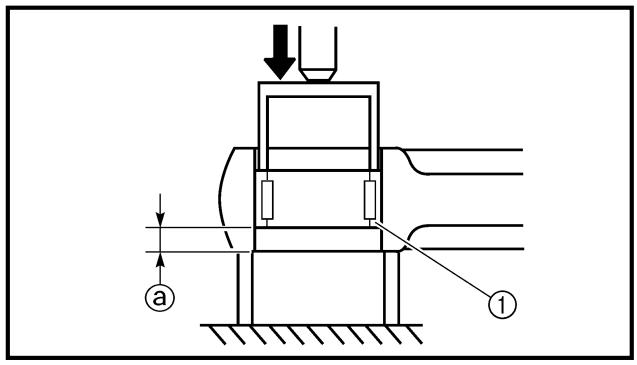
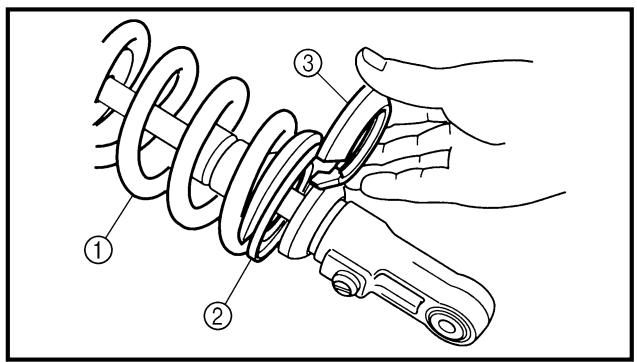
-
Install:
-
Stopper ring (upper bearing) ①

NOTE: After installing the stopper ring, push back the bearing until it contacts the stopper ring.
-
Install:
-
Lower bearing ①
NOTE: Install the bearing by pressing it on the side having the manufacture's marks or numbers.
Installed depth of the bearing ④ : 4 mm (0.16 in)
Spring (rear shock absorber)
- Install:
Spring ①
- Upper spring guide ②
- Lower spring guide ③
REMONTAGE ET MONTAGE Roulement
- Monter:
- Spring length (installed) ⑧
| Spring length (installed) @: | |
| Standard length | Extent of adjustment |
| 240.5 mm (9.47 in) * 247 mm (9.72 in) **243.5 mm (9.59 in) | 240.5 ~ 258.5 mm (9.47 ~ 10.18 in) |
- For EUROPE
** For AUS, NZ and ZA
NOTE:
The length of the spring (installed) changes 1.5 mm (0.06 in) per turn of the adjuster.
CAUTION:
Never attempt to turn the adjuster beyond the maximum or minimum setting.
4. Tighten:
- Locknut ①
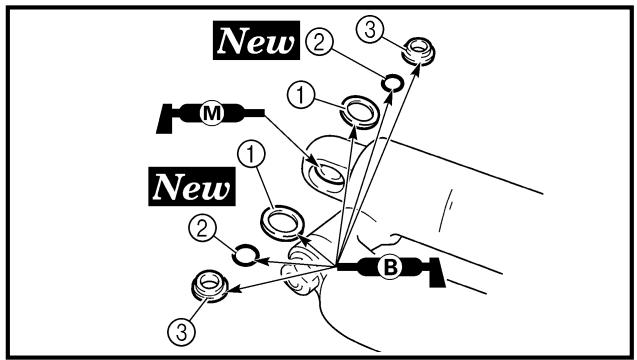
Rear shock absorber
1. Install:
-
Dust seal ①
-
O-ring ②

Collar ③
NOTE:
- Apply the molybdenum disulfide grease on the bearing.
-
Apply the lithium soap base grease on the dust seals, O-rings and collars.
-
Serrer:
- Bushing ①
- Collar ②
- Dust seal ③
NOTE:
- Apply the molybdenum disulfide grease on the bearing.
- Apply the lithium soap base grease on the bushing, collars and dust seals.
- Install the dust seals with their lips facing outward.
3. Install:
Rear shock absorber
4. Install:
- Bolt (rear shock absorber-frame) ①
- Nut (rear shock absorber-frame) ②

56 Nm (5.6 m·kg, 40 ft·lb)
NOTE:
Apply the molybdenum disulfide grease on the bolt.
5. Install:
- Washer ①
- Bolt (rear shock absorber-relay arm) ②

53Nm (5.3m· kg,38ft· lb)
NOTE:
- Apply the molybdenum disulfide grease on the bolt.
- Insert the bolt from right side.
6. Install:
- Rear frame ①
- Bolt (rear frame) ②
29Nm (2.9m· kg,21ft· lb)
- Bolt (reservoir tank) ③

10 Nm (1.0 m·kg, 7.2 ft·lb)
7. Tighten:
- Screw (air filter joint) ①
3 Nm (0.3 m·kg, 2.2 ft·lb)
-
Monter:
-
Douille ①
- Collerette ②
- Joint antipoussière ③
N.B.:
① Headlight
② Voltage regulator
③ Engine stop switch
④ Throttle position sensor
⑤ Taillight
⑥ Neutral switch
⑦ CDI magneto
⑧ Spark plug
⑨ Ignition coil
Light switch
CDI unit
COLOR CODE
B............ Black
Br............ Brown
G............Green
Gy .........Gray
L............ Blue
O............ Orange
P............ Pink
R Red
Sb ....Sky blue
W . White
Y .........Yel
B/L Black/Blue
B/W............ Black/White
L/W............Blue/White
R/W............Red/White
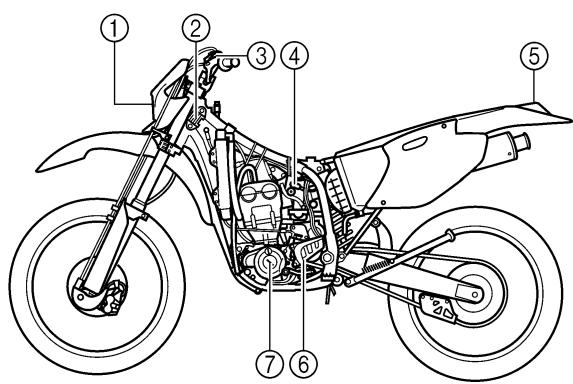
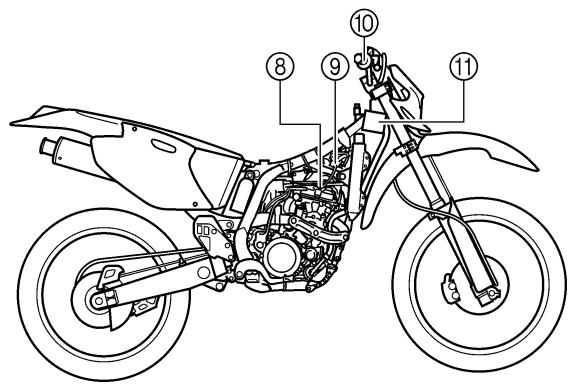
EC612000
WIRING DIAGRAM
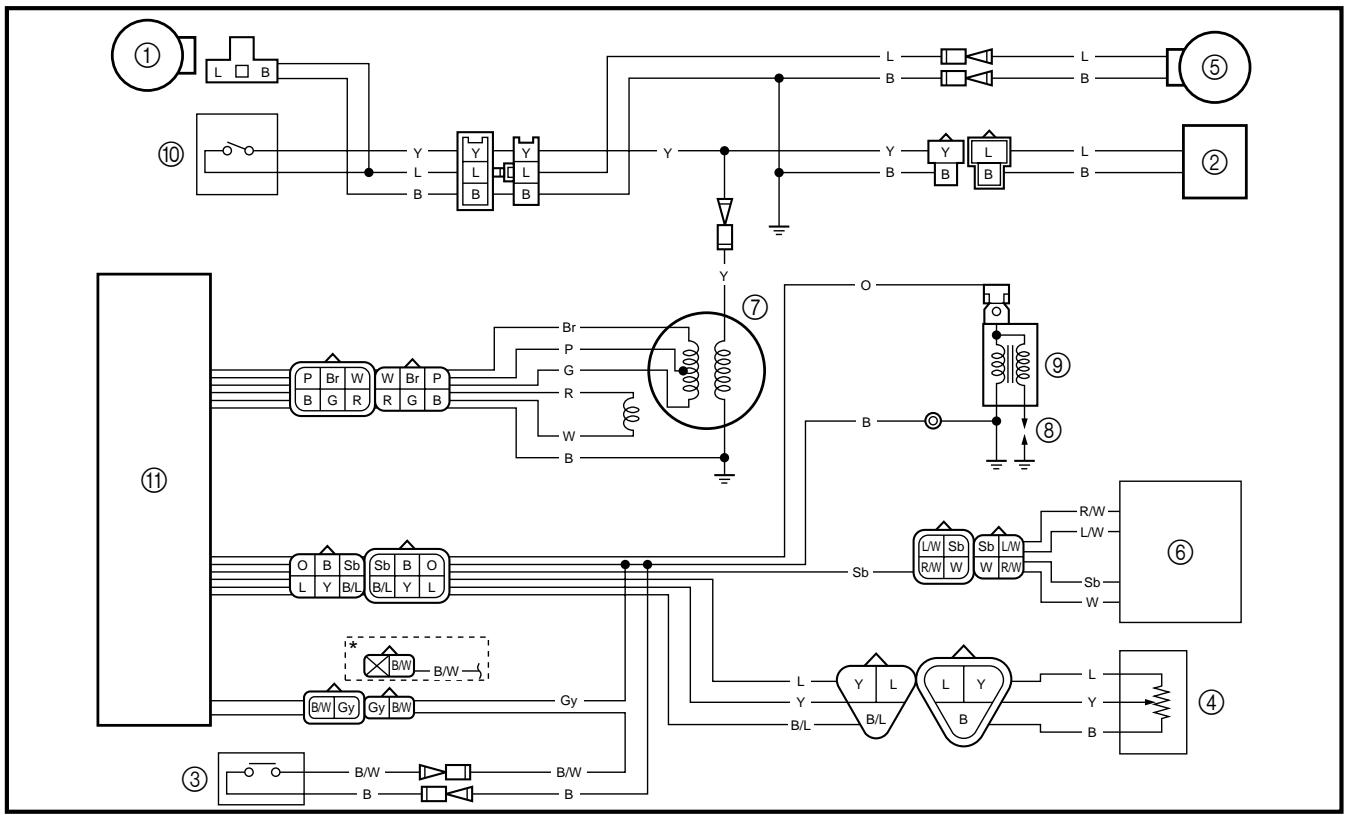
PARTIE
ELECTRIQUE
COMPOSANTS ELECTRIQUES ET SCHEMA DE CABLAGE
COMPOSANTS ELECTRIQUES
A map-controlled, CDI ignition system is used in the WR250F.
The microcomputer in the CDI unit detects the engine speed and throttle position, thus determining the optimum ignition timing through the entire operating range. In this way, quick throttle response can be achieved according to various riding conditions.
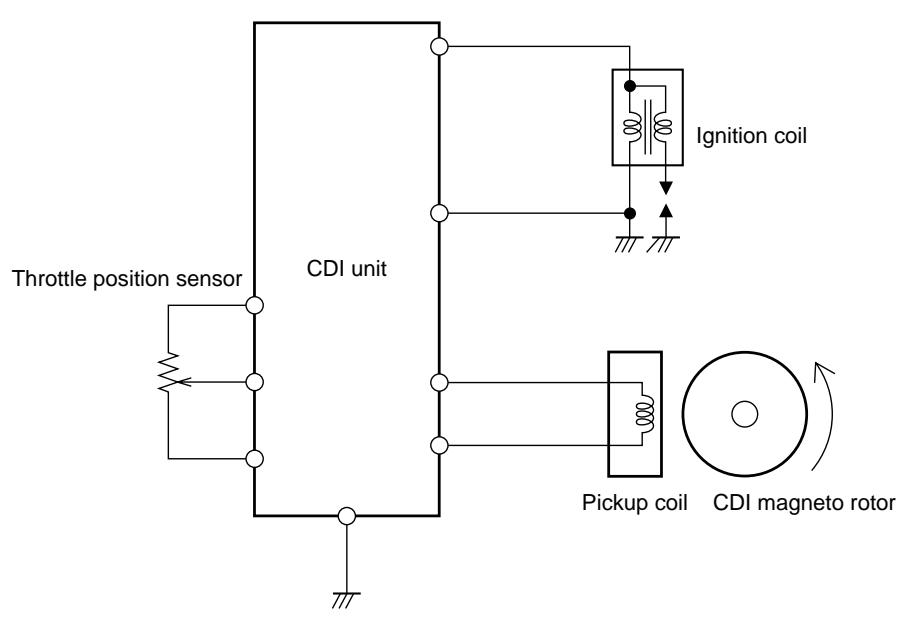
Function of Component
| Component | Function |
| Throttle position sensor | Detects throttle valve opening and inputs it into the computer in the CDI unit as a throttle opening signal. |
| Pickup coil | Detects signal rotor revolutions and inputs them into the computer in the CDI unit as engine revolution signals. |
| CDI unit | The signals of the throttle position sensor and pickup coil sensor are analyzed by the computer in the CDI unit, which then adjusts ignition timing for the operation requirements. |
Principal of 3-Dimensional Control
Conventionally, ignition timing was controlled only by engine revolutions (2-dimensional control).
However, ignition timing needs advancement also by engine load. Thus, accurate ignition timing can be determined by adding throttle opening to determine ignition timing (3-dimensional control).
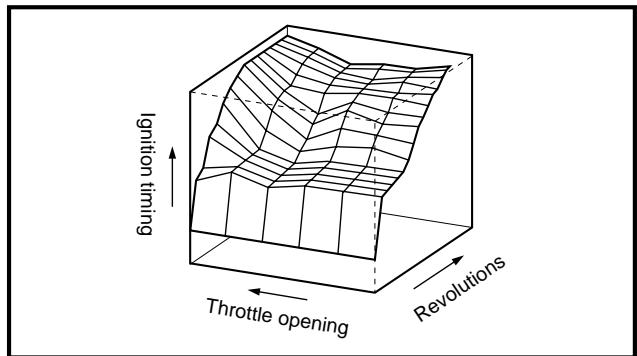
3-D Image Map of Ignition Timing
(different from actual characteristics)
BLOC CDI CONTROLE PAR MICROPROCESSEUR
Use the following steps for checking the possibility of the malfunctioning engine being attributable to ignition system failure and for checking the spark plug which will not spark.

*marked: Only when the ignition checker is used.
NOTE:
- Remove the following parts before inspection.
1) Seat
2) Fuel tank - Use the following special tools in this inspection.
Dynamic spark tester: YM-34487
Ignition checker: 90890-06754

Pocket tester: YU-3112-C/90890-03112
SYSTEME D'ALLUMAGE
ETAPES DU CONTROL
- Disconnect the spark plug cap from spark plug.
-
Connect the dynamic spark tester (ignition checker) as shown.
-
Spark plug cap ③
- Spark plug ④
For USA and CDN
Except for USA and CDN
- Kick the kickstarter crank.
- Check the ignition spark gap.
- Start engine, and increase spark gap until misfire occurs. (for USA and CDN only)
Minimum spark gap: 6.0 mm (0.24 in)
EC624000
COUPLERS AND LEADS CONNECTION INSPECTION
-
Check:
-
Couplers and leads connection Rust/dust/looseness/short-circuit Repair or replace.
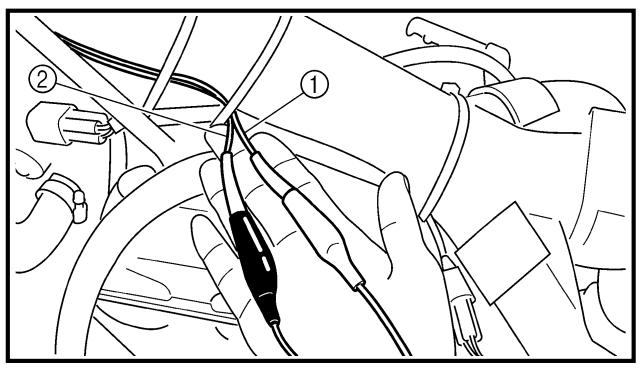
ENGINE STOP SWITCH INSPECTION
- Inspect:
- Engine stop switch conduct
| Tester (+) lead → Black/White lead ① Tester (-) lead → Black lead ② |
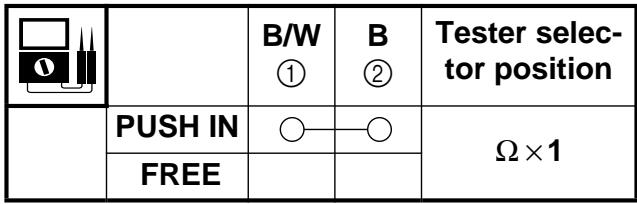
No continuous while being pushed Replace. Continuous while being freed Replace.
TEST DE LA LONGUEUR D'ETIN-CELLE D'ALLUMAGE
IGNITION COIL INSPECTION
1. Inspect:
Primary coil resistance
Out of specification Replace.
Tester (+) lead Orange lead ①
Tester (-) lead Black lead ②
| Primary coil resistance | Tester selector position |
| 0.20 ~ 0.30 Ω at 20 °C (68 °F) | Ω × 1 |
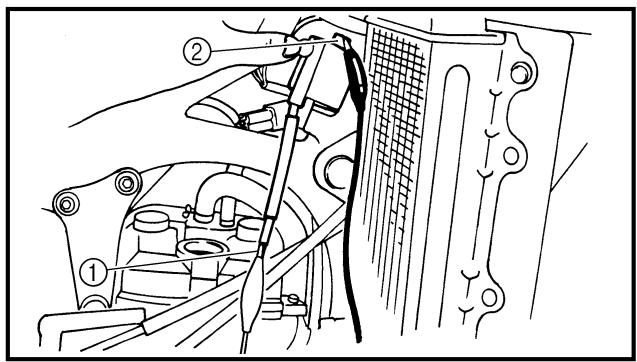
2. Inspect:
- Secondary coil resistance
Out of specification Replace.
| Tester (+) lead → Spark plug lead ① |
| Tester (-) lead → Orange lead ② |
| Secondary coil resistance | Tester selector position |
| 9.5 ~ 14.3 kΩ at 20 °C (68 °F) | kΩ × 1 |
NOTE:
When inspecting the secondary coil resistance, remove the spark plug cap.

CDI MAGNETO INSPECTION
1. Inspect:
- Pickup coil resistance
Out of specification Replace.
| Tester (+) lead → Red lead ① Tester (-) lead → White lead ② |
| Pickup coil resistance | Tester selector position |
| 248 ~ 372 Ω at 20 °C (68 °F) | Ω × 100 |
CONTROLE DE LA BOBINE D'ALLUMAGE
- Charging coil 1 resistance
Out of specification Replace.
| Tester (+) lead → Brown lead ① |
| Tester (−) lead → Green lead ② |
| Charging coil 1 resistance | Tester selector position |
| 640 ~ 960 Ω at 20 °C (68 °F) | Ω × 100 |
3. Inspect:
- Charging coil 2 resistance
Out of specification Replace.
| Tester (+) lead → Pink lead ① Tester (-) lead → Green lead ② |
| Charging coil 2 resistance | Tester selector position |
| 464 ~ 696 Ω at 20 °C (68 °F) | Ω × 100 |
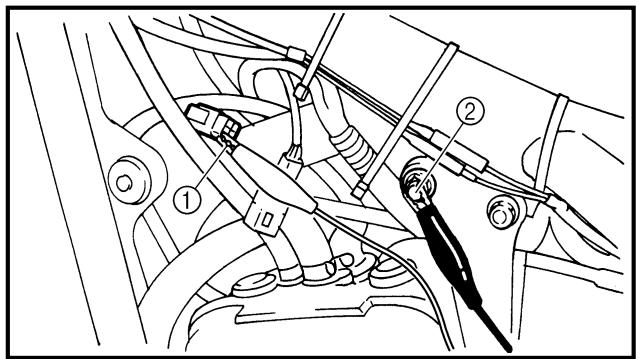
NEUTRAL SWITCH INSPECTION
1. Inspect:
- Neutral switch conduct
| Tester (+) lead → Sky blue lead ① |
| Tester (-) lead → Ground ② |
| Sb ① | Ground ② | Tester selec- tor position | |
| NEUTRAL | ○ | ○ | Ω×1 |
| IN GEAR |
No continuous while in neutral Replace.
Continuous while in gear Replace.
EC628000
CDI UNIT INSPECTION
Check all electrical components. If no fault is found, replace the CDI unit. Then check the electrical components again.
If the throttle position sensor will not operate, use the following inspection steps.
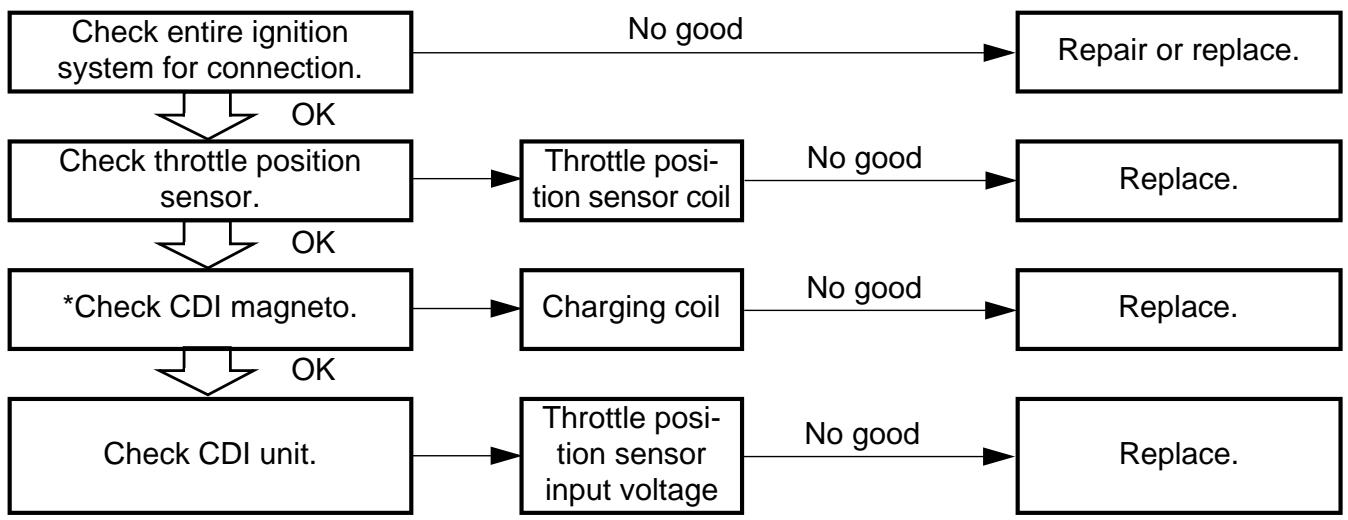
*marked: Refer to "IGNITION SYSTEM" section.
NOTE:
- Remove the following parts before inspection.
1) Seat
2) Fuel tank - Use the following special tools in this inspection.
Pocket tester:
YU-3112-C/90890-03112
Inductive tachometer:
YU-08036-B
Engine tachometer:
90890-03113
CIRCUIT DU CAPTEUR DE PAPILLON DES GAZ
ETAPES DU CONTROLE
-
Check:
-
Couplers and leads connection Rust/dust/looseness/short-circuit Repair or replace.
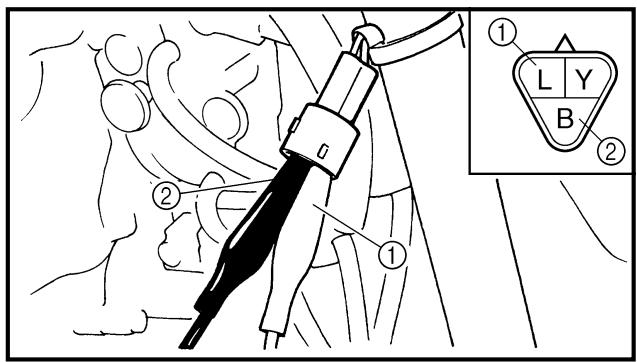
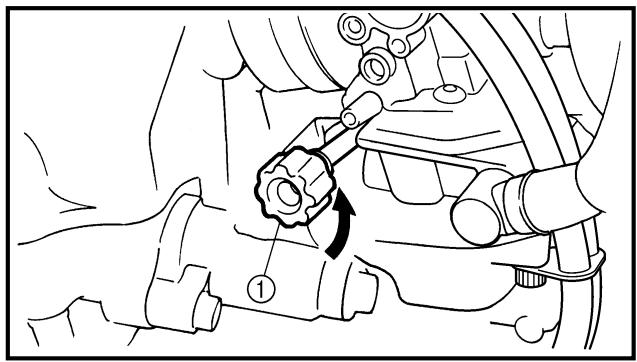
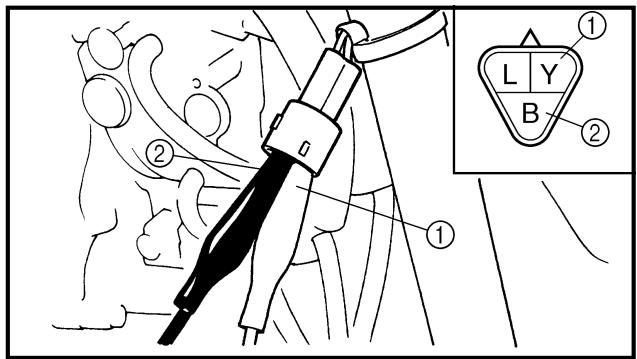
THROTTLE POSITION SENSOR COIL INSPECTION
-
Inspect:
-
Throttle position sensor coil resistance Out of specification Replace.
| Tester (+) lead → Blue lead ① Tester (-) lead → Black lead ② |
| Throttle position sensor coil resistance | Tester selector position |
| 4 ~ 6 kΩ at 20 °C (68 °F) | kΩ × 1 |
-
Loosen:
-
Throttle stop screw ①
NOTE:
Turn out the throttle stop screw until the throttle shaft is in the full close position.
-
Inspect:
-
Throttle position sensor coil variable resistance
Check that the resistance in increased as the throttle grip is moved from the full close position to the full open position.
Out of specification Replace.
| Tester (+) lead → Yellow lead ① Tester (-) lead → Black lead ② |
| Throttle position sensor coil variable resistance | Tester selector position | ||
| Full closed | Full opened | kΩ×1 | |
| Zero ~ 3 kΩ at 20 °C (68 °F) | 4 ~ 6 kΩ at 20 °C (68 °F) | ||
CONTROLE DES CONNXIONS DES COUPLEURS ET DES FILS
1. Vérifier:
THROTTLE POSITION SENSOR REPLACEMENT AND ADJUSTMENT
-
Remove:
-
Throttle position sensor coupler
- Screw (throttle position sensor) ①
- Washer ②
- Throttle position sensor ③
NOTE: Loosen the screws (throttle position sensor) using the T20 bit (tamper resistant fastener type).
- Replace:
- Throttle position sensor
- Install:
- Throttle position sensor ①
- Washer ②
- Screw (throttle position sensor) ③
NOTE:
- Align the slot ⑧ in the throttle position sensor with the projection ⑥ on the carburetor.
-
Temporarily tighten the screws (throttle position sensor).
-
Adjust:
-
Engine idling speed
Refer to "ENGINE IDLE SPEED ADJUSTMENT" section in the CHAPTER 3.
- Calculate:
- Throttle position sensor coil resistance at idle speed
Throttle position sensor coil resistance at idle speed:
Throttle position sensor coil resistance × (0.13 ~ 0.15)
If the throttle position sensor coil resistance is 5k then the throttle position sensor coil resistance at idle speed is:
$$ 5 \mathrm {k} \Omega \times (0. 1 3 \sim 0. 1 5) = 6 5 0 \sim 7 5 0 \Omega $$
Refer to "THROTTLLE POSITION SENSOR COIL INSPECTION" section about the throttle position sensor coil resistance.
REEMPLACEMENT ET REGLAGE DU CAPTEUR DE PAPILLON DES GAZ
- Déposer:
-
Adjust:
-
Throttle position sensor coil resistance at idle speed
Adjustment steps:
Adjust the angle of the throttle position sensor ① to obtain the resistance calculated (example: 650 750
Tester (+) lead Yellow lead ②
Tester (-) lead Black lead ③
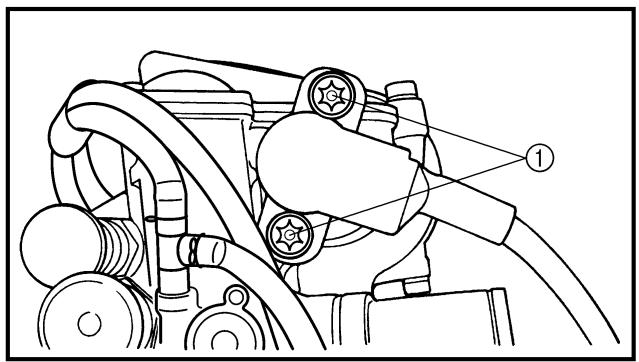
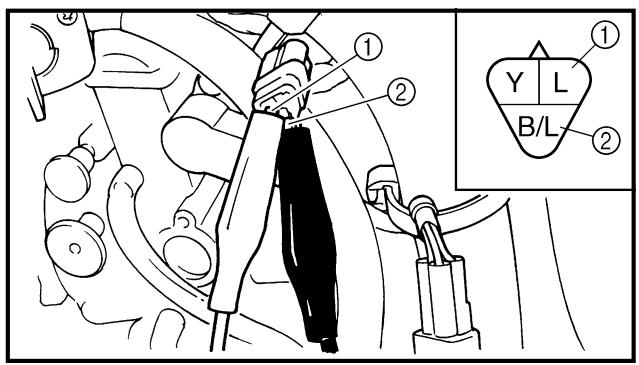
-
Tighten:
-
Screw (throttle position sensor) ①
NOTE:
Tighten the screws (throttle position sensor) using the T20 bit (tamper resistant fastener type).
-
Install:
-
Throttle position sensor coupler
THROTTLE POSITION SENSOR INPUT VOLTAGE INSPECTION
- Disconnect the throttle position sensor coupler.
- Start the engine.
-
Inspect:
-
Throttle position sensor input voltage Out of specification Replace the CDI unit.
Tester (+) lead Blue lead ①
Tester (-) lead Black/Blue lead ②
| Throttle position sensor input voltage | Tester selector position |
| 4 ~ 6 V | DCV-20 |
6. Régler:
Refer to the following flow chart when inspecting the ignition system for possible problems.
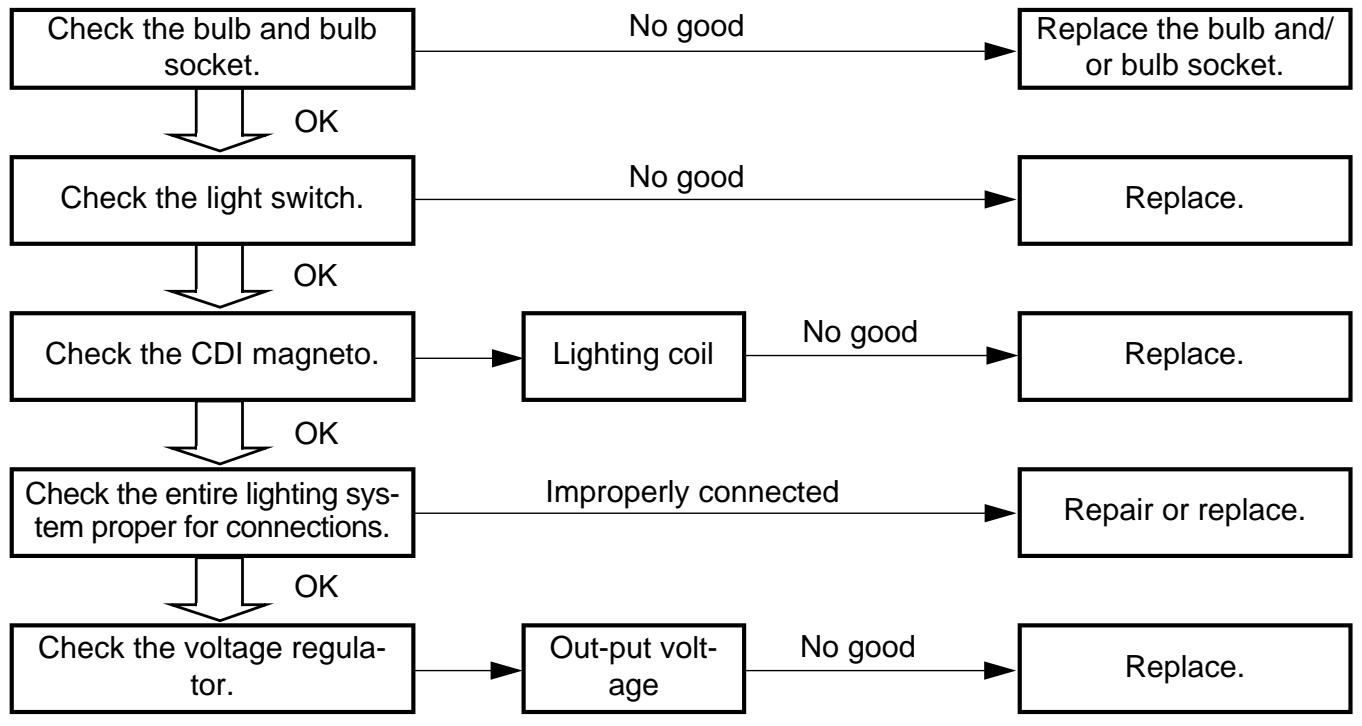
NOTE:
- Replace the bulb and/or bulb socket.
1) Seat
2) Fuel tank
- Use the following special tool.
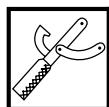
Pocket tester: YU-3112-C/90890-03112
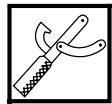
Inductive tachometer:
YU-08036-B
Engine tachometer:
90890-03113
SYSTEME D'ECLAIRAGE
PROCEDURES DE VERIFICATION
- Inspect:
Light switch continuity
| Tester (+) lead → Yellow lead ① Tester (-) lead → Blue lead ② |
| Y ① | L ② | Tester selec- tor position | |
| ○—○ | ○ | Ω×1 | |
| OFF |
No continuous while being Replace. Continuous while being OFF Replace.
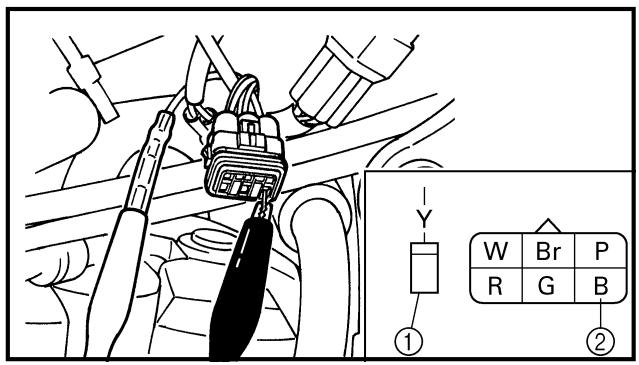
CDIMAGNETOINSPECTION
-
Inspect:
-
Lighting coil resistance Out of specification Replace.
| Tester (+) lead → Yellow lead ① Tester (-) lead → Black lead ② |
| Lighting coil resistance | Tester selector position |
| 0.16 ~ 0.24 Ω at 20 °C (68 °F) | Ω × 1 |
VOLTAGE REGULATOR INSPECTION
- Start the engine.
- Turn on the headlight and taillight by turning on the light switch.
-
Inspect:
-
Out-put voltage
- Out of specification Replace voltage regulator.
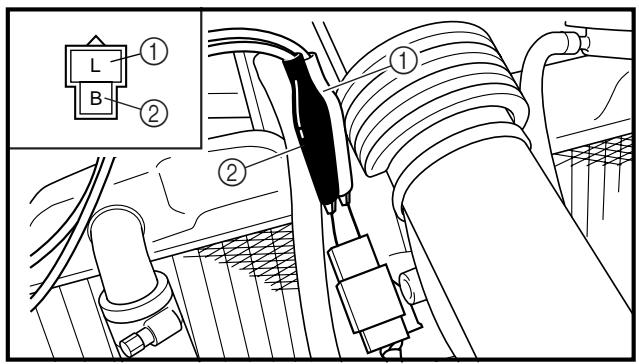
| Tester (+) lead → Blue lead ① Tester (-) lead → Black lead ② |
| 0 | Out-put voltage | Tester selector position |
| 13.3 ~ 14.3 V at 5,000 r/min | ACV-20 |
VERIFICATION INTERRUPEUR LUMIERES
- Vérifier:
- The air/fuel mixture will vary depending on atmospheric conditions. Therefore, it is necessary to take into consideration the air pressure, ambient temperature, humidity, etc., when adjusting the carburetor.
- Perform a test run to check for proper engine performance (e.g., throttle response) and spark plug(-s) discoloration or fouling. Use these readings to determine the best possible carburetor setting.
NOTE:
It is recommended to keep a record of all carburetor settings and external conditions (e.g., atmospheric conditions, track/surface conditions, lap times) to make future carburetor setting easier.

WARNING
- The carburetor is a part of the fuel line. Therefore, be sure to install it in a well-ventilated area, away from flammable objects and any sources of fire.
- Never look into the carburetor intake. Flames may shoot out from the pipe if the engine backfires while it is being started. Gasoline may be discharged from the accelerator pump nozzle when the carburetor has been removed.
MISES AU POINT MOTEUR
- The carburetor is extremely sensitive to foreign matter (dirt, sand, water, etc.). During installation, do not allow foreign matter to get into the carburetor.
- Always handle the carburetor and its components carefully. Even slight scratches, bends or damage to carburetor parts may prevent the carburetor from functioning correctly. Carefully perform all servicing with the appropriate tools and without applying excessive force.
- When the engine is stopped or when riding at no load, do not open and close the throttle unnecessarily. Otherwise, too much fuel may be discharged, starting may become difficult or the engine may not run well.
- After installing the carburetor, check that the throttle operates correctly and opens and closes smoothly.
Atmospheric conditions and carburetor settings
| Air temp. | Humidity | Air pressure (altitude) | Mixture | Setting |
| High | High | Low (high) | Richer | Leaner |
| Low | Low | High (low) | Leaner | Richer |
The air density (i.e., concentration of oxygen in the air) determines the richness or leanness of the air/fuel mixture. Therefore, refer to the above table for mixture settings.
That is:
- Higher temperature expands the air with its resultant reduced density.
- Higher humidity reduces the amount of oxygen in the air by so much of the water vapor in the same air.
- Lower atmospheric pressure (at a high altitude) reduces the density of the air.
ATTENTION:
Effects of the setting parts on the throttle valve opening
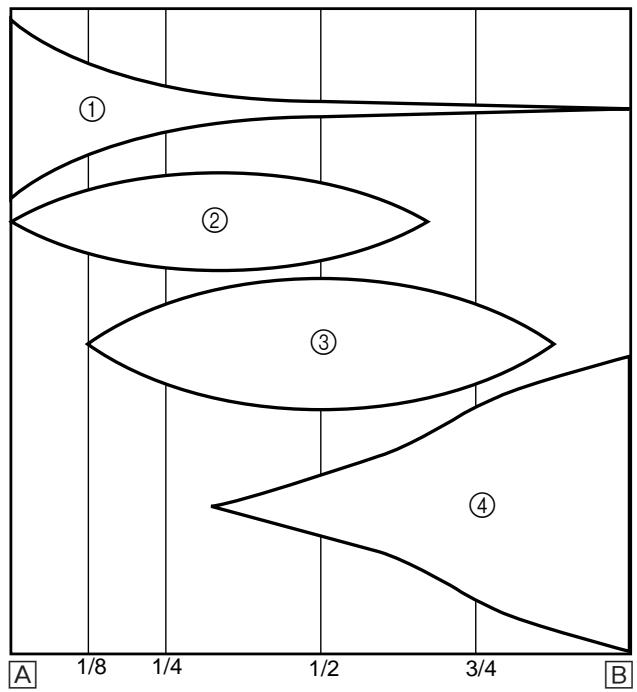
A Closed
Fully open
① Pilot screw/pilot jet
② Throttle valve cutaway
③ Jet needle
④ Main jet
Main system
The FLATCR carburetor has a primary main jet. This type of main jet is perfect for racing motorcycles since it supplies an even flow of fuel, even at full load. The main air jet has almost no effect on the air-fuel mixture. Use the main jet and the jet needle to set the carburetor.
Pilot system
The FLATCR carburetor is manufactured with a pilot screw. The pilot screw adjustment ranges from fully closed throttle to 1/4 open throttle.
① Jet needle
② Main air jet
③ Pilot air jet
④ Needle jet
⑤ Main jet
⑥ Pilot jet
⑦ Pilot screw
Main jet adjustment
The richness of the air-fuel mixture at full throttle can be set by changing the main jet ①.
| Standard main jet | #170 |
If the air-fuel mixture is too rich or too lean, the engine power will drop, resulting in poor acceleration.
Effects of changing the main jet (reference)
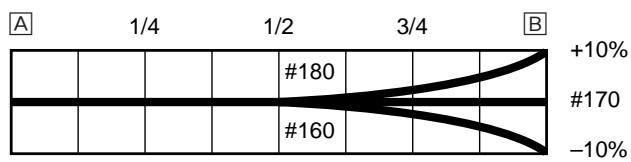
A Idle
Fully open
Pilot screw adjustment
The richness of the air-fuel mixture with the throttle fully closed to 1/4 open can be set by turning the pilot screw ① . Turning in the pilot screw will make the mixture lean at low speeds, and turning it out will enrich it.
| Standard pilot screw position | 1-3/4 (example) |
NOTE:
- If the engine idling speed fluctuates, turn the pilot screw only 1/2 of a turn in either direction.
- To optimize the fuel flow at a smaller throttle opening, each machine's pilot screw has been individually set at the factory. Before adjusting the pilot screw, turn it in fully and count the number of turns. Record this number as the factory-set number of turns out.
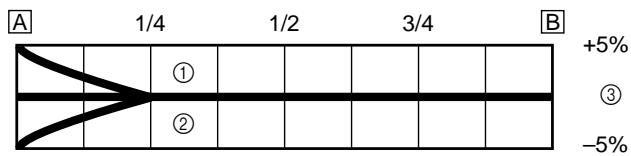
Effects of adjusting the pilot screw (reference)
A Idle
Fully open
① 2-1/4 turns out
(2) 1 - 1 / 4 turns out
③ 1-3/4 turns out
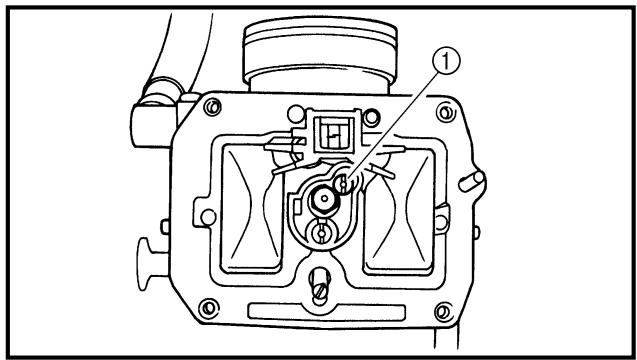
Pilot jet adjustment
The richness of the air-fuel mixture with the throttle open 1/4 or less can be set by adjusting the pilot jet ①.
| Standard pilot jet | #42 |
Effects of adjusting the pilot jet (reference)
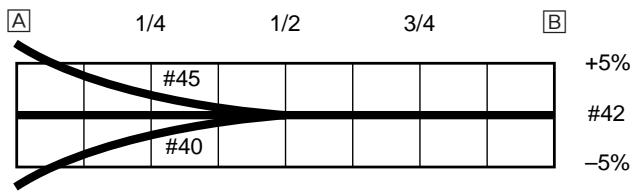
A Idle
Fully open
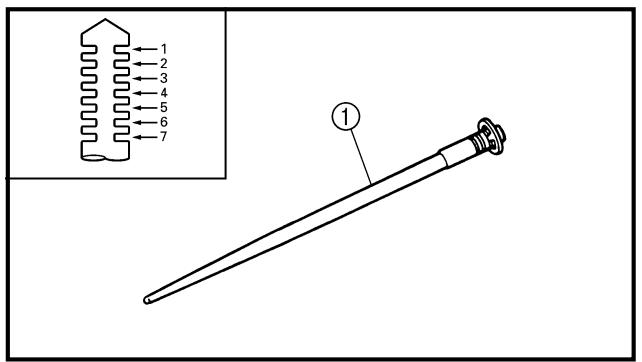
Jet needle groove position adjustment
Adjusting the jet needle ① position affects the acceleration when the throttle is 1/8 to 3/4 open.
- Too rich at intermediate speeds
Rough engine operation is felt and the engine will not pick up speed smoothly. In this case, step up the jet needle clip by one groove and move down the needle to lean out the mixture.
- Too lean at intermediate speeds
The engine breathes hard and will not pick up speed quickly.
Step down the jet needle clip by one groove and move up the needle to enrich the mixture.
| Standard clip position | No.3 groove *, ** No. 4 groove |
- For EUROPE
** For CDN, ZA, AUS and NZ
NOTE:
It is recommended that in the summer the clip position be changed from the 4th (STD) to the 2nd groove for a leaner air-fuel mixture. (For AUS and NZ only)
Effects of changing the jet needle groove position (reference)
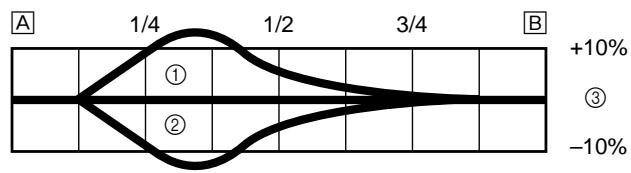
A Idle
Fully open
① No.4 groove
② No.2 groove
③ No.3 groove
Jet needle adjustment
The jet needle is adjusted by changing it.
| Standard jet needle | OBELP *OBEGP **OBEHP |
- For EUROPE
** For CDN, ZA, AUS and NZ
The tapered sections of all jet needles have the same starting positions, but the needles are available with different straight-partion diameters.
OBELP - 4

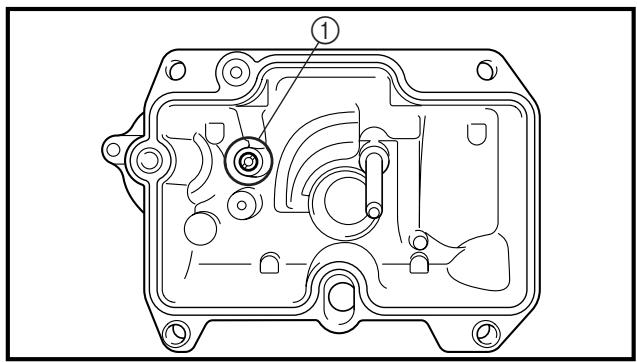
Leak jet adjustment (accelerator pump adjustment)
The leak jet ① is a setting part that adjusts the flow of fuel discharged by the accelerator pump. Since the accelerator pump operates only when throttle is open, the leak jet is used to adjust a fuel mixture ratio for quick throttle opening and is therefore different from other setting parts that adjust a fuel mixture for each throttle opening (each engine speed).
- The engine breathes hard in quick throttle opening.
Select a leak jet having lower calibrating No. than standard to enrich the mixture.
- Rough engine operation is felt in quick throttle opening.
Select a leak jet having higher calibrating No. than standard to lean out the mixture.
| Standard leak jet | #60 *, ** #105 |
- For EUROPE
** For CDN, ZA, AUS and NZ
Effects of changing the jet needle (reference)
(Diameter of the straight portion)
Changing the diameter of the straight portion adjusts the air-fuel mixture when the throttle is 1/8 to 1/4 open.
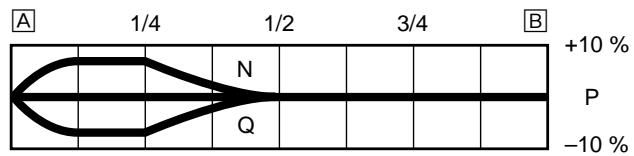
A Idle
Fully open
Relationship with throttle opening
The flow of the fuel through the carburetor main system is controlled by the main jet and then, it is further regulated by the area between the main nozzle and the jet needle.
The fuel flow relates to the diameter of the straight portion of the jet needle with the throttle 1/8 to 1/4 open and relates to the clip position with the throttle 1/8 to 3/4 open.
Therefore, the fuel flow is balanced at each stage of throttle opening by the combination of the jet needle straight portion diameter and clip position.
Carburetor setting parts
| Part name | Size | Part number | |
| Main jet | Rich | #185 | 4MX-14943-44 |
| #182 | 4MX-14943-94 | ||
| #180 | 4MX-14943-43 | ||
| #178 | 4MX-14943-93 | ||
| #175 | 4MX-14943-42 | ||
| #172 | 4MX-14943-92 | ||
| #170 | 4MX-14943-41 | ||
| #168 | 4MX-14943-91 | ||
| #165 | 4MX-14943-40 | ||
| #162 | 4MX-14943-90 | ||
| #160 | 4MX-14943-39 | ||
| (P,STD) | Lean | #170 | 4MX-14943-41 |
| #168 | 4MX-14943-91 | ||
| #165 | 4MX-14943-40 | ||
| #162 | 4MX-14943-90 | ||
| #160 | 4MX-14943-09 | ||
| Pilot jet | Rich | #50 | 4MX-14948-07 |
| #48 | 4MX-14948-06 | ||
| #45 | 4MX-14948-05 | ||
| #42 | 4MX-14948-04 | ||
| #40 | 4MX-14948-03 | ||
| #38 | 4MX-14948-02 | ||
| #35 | 4MX-14948-01 | ||
| Jet needle | Rich | OBELL | 5NL-14916-EL |
| OBELM | 5NL-14916-EM | ||
| OBELN | 5NL-14916-EN | ||
| OBELP | 5NL-14916-EP | ||
| OBELQ | 5NL-14916-E1 | ||
| OBELR | 5NL-14916-ER | ||
| OBELS | 5NL-14916-ES | ||
| *Jet needle | Rich | OBEGL | 5NL-14916-GL |
| OBEGM | 5NL-14916-GM | ||
| OBEGN | 5NL-14916-GN | ||
| OBEGP | 5NL-14916-GP | ||
| OBEGQ | 5NL-14916-G1 | ||
| OBEGR | 5NL-14916-GR | ||
| OBEGS | 5NL-14916-GS | ||
| ** Jet needle | Rich | OBEHL | 5NL-14916-HL |
| OBEHM | 5NL-14916-HM | ||
| OBEHN | 5NL-14916-HN | ||
| OBEHP | 5NL-14916-HP | ||
| OBEHQ | 5NL-14916-H1 | ||
| OBEHR | 5NL-14916-HR | ||
| OBEHS | 5NL-14916-HS | ||
| Leak jet | Rich | ||
| #35 | 4JT-1494F-01 | ||
| #40 | 4JT-1494F-03 | ||
| #50 | 4JT-1494F-07 | ||
| #60 | 4JT-1494F-11 | ||
| #70 | 4JT-1494F-15 | ||
| #75 | 4JT-1494F-17 | ||
| #80 | 4JT-1494F-19 | ||
| #85 | 4JT-1494F-21 | ||
| #90 | 4JT-1494F-23 | ||
| #95 | 4JT-1494F-25 | ||
| (*, ** STD) | #105 | 4JT-1494F-28 | |
| #115 | 4JT-1494F-30 | ||
| #125 | 4JT-1494F-32 | ||
| #135 | 4JT-1494F-34 | ||
- For EUROPE
** For CDN, ZA, AUS and NZ
Examples of carburetor setting depending on symptom
| Symptom | Setting | Checking |
| At full throttleHard breathingShearing noiseWhitish spark plug\(\downarrow\)Lean mixture | Increase main jet calibration no.(Gradually) | Discoloration of spark plug →If tan color, it is in good condition.If cannot be corrected:Clogged float valve seatClogged fuel hoseClogged fuel cockCheck that the accelerator pump oper-ates smoothly. |
| At full throttleSpeed pick-up stopsSlow speed pick-upSlow responseSooty spark plug\(\downarrow\)Rich mixture | Decrease main jet calibration no.(Gradually) | Discoloration of spark plug →If tan color, it is in good condition.If cannot be corrected:Clogged air filterFuel overflow from carburetor |
| Lean mixture | Lower jet needle clip position.(1 groove down) | |
| Rich mixture | Raise jet needle clip position.(1 groove up) | |
| 1/4 ~ 3/4 throttleHard breathingLack of speed | Lower jet needle clip position.(1 groove down) | |
| 1/4 ~ 1/2 throttleSlow speed pick-upPoor acceleration | Raise jet needle clip position.(1 groove up) | The clip position is the jet needle groove on which the clip is installed.The positions are numbered from the top Check that the accelerator pump oper-ates smoothly. (except for rich mixture symptom). |
| Closed to 1/4 throttleHard breathingSpeed down | Use jet needle with a smaller diameter. | Slow-speed-circuit passageClogged → Clean.Overflow from carburetor |
| Closed to 1/4 throttlePoor acceleration | Use jet needle with a larger diameter.Raise jet needle clip position.(1 groove up) | |
| Poor response in the low to intermediate speeds | Raise jet needle clip position.If this has no effect, lower the jet needle clip position. | |
| Poor response when throttle is opened quickly | Check overall settings.Use main jet with a lower calibration no.Raise jet needle clip position.(1 groove up)If these have no effect, use a main jet with a higher calibration no. and lower the jet needle clip position. | Check air filter for fouling.Check that the accelerator pump oper-ates smoothly. |
- This should be taken simply for an example. It is necessary to set the carburetor while checking the operating conditions of the engine.
Selection of the secondary reduction ratio (Sprocket)
Secondary
Secondary reduction ratio = Number of rear wheel sprocket teeth / Number of drive sprocket teeth
Standard secondary reduction ratio
52/13 (4.000)
- It is generally said that the secondary gear ratio should be reduced for a longer straight portion of a speed course and should be increased for a course with many corners. Actually, however, as the speed depends on the ground condition of the day of the race, be sure to run through the circuit to set the machine suitable for the entire course.
- In actuality, it is very difficult to achieve settings suitable for the entire course and some settings may be sacrificed. Thus, the settings should be matched to the portion of the course that has the greatest effect on the race result. In such a case, run through the entire course while making notes of lap times to find the best balance; then, determine the secondary reduction ratio.
- If a course has a long straight portion where a machine can run at maximum speed, the machine is generally set such that it can develop its maximum revolutions toward the end of the straight line, with care taken to avoid the engine over-revving.
NOTE:
Riding technique varies from rider to rider and the performance of a machine also vary from machine to machine. Therefore, do not imitate other rider's settings from the beginning but choose your own setting according to the level of your riding technique.
PARTIE CYCLE
Drive and driven sprockets setting parts
| Part name | Size | Part number |
| Drive sprocket ① (STD) | 13T | 9383B-13218 |
| Rear wheel | 48T | 5GS-25448-50 |
| sprocket ② | 50T | 5GS-25450-50 |
| (STD) | 52T | 5GS-25452-50 |
| 54T | 5PH-25454-50 |
EC721002
Tire pressure
Tire pressure should be adjust to suit the road surface condition of the circuit.
Standard tire pressure: 100 kPa (1.0 kg/cm², 15 psi)
- Under a rainy, muddy, sandy, or slippery condition, the tire pressure should be lower for a larger area of contact with the road surface.
Extent of adjustment: 60 80 kPa (0.6 0.8 ~kg / cm^2, 9.0 12 psi)
- Under a stony or hard road condition, the tire pressure should be higher to prevent a flat tire.
Extent of adjustment: 100 120 kPa (1.0 ~ 1.2 kg/cm ^2 , 15 ~ 18 psi)
The front fork setting should be made depending on the rider's feeling of an actual run and the circuit conditions.
The front fork setting includes the following three factors:
-
Setting of air spring characteristics
-
Change the fork oil level.
-
Setting of spring preload
-
Change the spring.
Install the adjustment washer. -
Setting of damping force
-
Change the compression damping.
- Change the rebound damping.
The spring acts on the load and the damping force acts on the cushion travel speed.
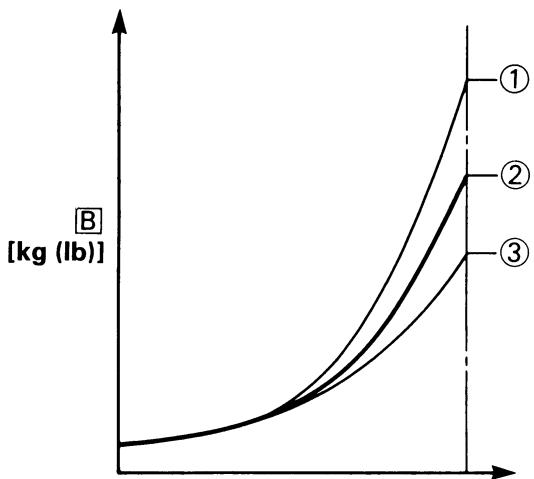
A
[mm (in)]
EC723001
Change in level and characteristics of fork oil
Damping characteristic near the final stroke can be changed by changing the fork oil amount.
CAUTION:
Adjust the oil level in 5mm (0.2 in) increments or decrements. Too low oil level causes the front fork to produce a noise at full rebound or the rider to feel some pressure on his hands or body. Alternatively, too high oil level will develop unexpectedly early oil lock with the consequent shorter front fork travel and deteriorated performance an characteristics. Therefore, adjust the front fork within the specified range.
Standard oil level:
140 mm (5.51 in)
- 130 mm (5.12 in)
Extent of adjustment:
80 ~ 150 mm (3.15 ~ 5.91 in)
From top of outer tube with inner tube and damper rod fully compressed without spring.
- For EUROPE
A Air spring characteristics in relation to oil level change
Load
Stroke
① Max. oil level
(2) Standard oil level
③ Min. oil level
Spring preload adjustment
The spring preload is adjusted by installing the adjustment washer ① between the fork spring ② and damper rod ③.
CAUTION:
Do not install three or more adjustment washers for each front fork.
WARNING
Always adjust each front fork to the same setting. Uneven adjustment can cause poor handling and loss of stability.
Standard washer quantity:
Zero adjustment washers
Extent of adjustment:
Zero ~ 2 adjustment washers
A Load
Fork stroke
(1) Without adjustment washer (standard)
② 1 adjustment washer
③ 2 adjustment washers
EC72A001
Setting of spring after replacement
As the front fork setting can be easily affected by rear suspension, take care so that the machine front and rear are balanced (in position, etc.) when setting the front fork.
- Use of soft spring
Generally a soft spring gives a soft riding feeling. Rebound damping tends to become stronger and the front fork may sink deeply over a series of gaps.
To set a soft spring:
- Change the rebound damping.
Turn out one or two clicks. - Change the compression damping.
Turn in one or two clicks.
2. Use of stiff spring
Generally a stiff spring gives a stiff riding feeling. Rebound damping tends to become weaker, resulting in lack of a sense of contact with the road surface or in a vibrating handlebar.
To set a stiff spring:
- Change the rebound damping.
Turn in one or two clicks. - Change the compression damping.
Turn out one or two clicks.
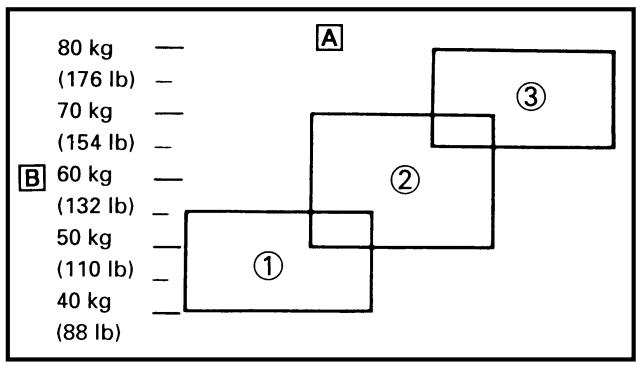
A Coverage of spring by weight
Rider weight
① Soft
(2) Standard
③ Stiff
2. Ressort dur
Front fork setting parts
- Adjustment washer ①
| TYPE (thickness) | PART NUMBER |
| T = 2.3 mm (0.09 in) | 4SS-23364-L0 |
- Front fork spring ②
[Equal pitch spring]
| TYPE | SPRING RATE | SPRING PART NUMBER | I.D. MARK (slits) |
| SOFT | 0.380 | 4SS-23141-10 | I-I |
| 0.390 | 4SS-23141-20 | I-II | |
| 0.400 | 4SS-23141-30 | I-III | |
| **STD | 0.410 | 4XM-23141-L0 | - |
| *STD | 0.420 | 4SR-23141-L0 | - |
| 0.430 | 4SS-23141-60 | III | |
| STD | 0.440 | 4SS-23141-70 | III |
| STIFF | 0.450 | 5BE-23141-L0 | - |
| 0.460 | 5BE-23141-00 | - | |
| 0.470 | 5GR-23141-00 | II-II |
- For EUROPE
** For AUS, NZ and ZA
[Unequal pitch spring]
| TYPE | SPRING RATE (approx.) | SPRING PART NUMBER | I.D. MARK (slits) |
| SOFT | 0.400 | 5ET-23141-20 | V |
| 0.410 | 5ET-23141-00 | V-I | |
| 0.420 | 5ET-23141-30 | V-II | |
| 0.430 | 5ET-23141-10 | V-III | |
| STIFF | 0.440 | 5ET-23141-40 | V-III |
NOTE:
- The unequal pitch spring is softer in initial characteristic than the equal pitch spring and is difficult to bottom out under full compression.
- The I.D. mark (slits) ⑧ is proved on the end of the spring.
Rear suspension setting
The rear suspension setting should be made depending on the rider's feeling of an actual run and the circuit conditions.
The rear suspension setting includes the following two factors:
-
Setting of spring preload
-
Change the set length of the spring.
-
Change the spring.
-
Setting of damping force
-
Change the rebound damping.
- Change the compression damping.
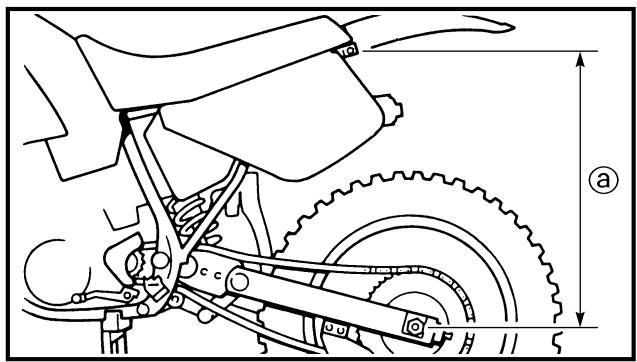
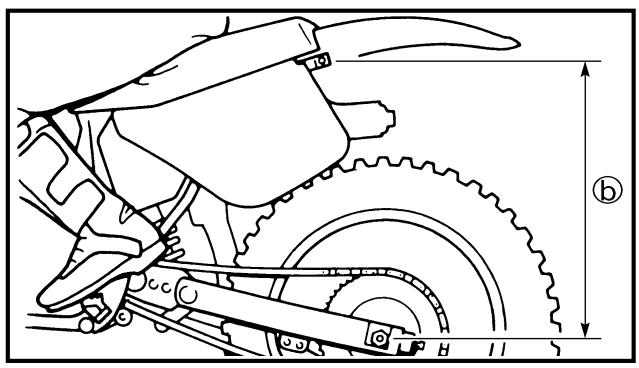
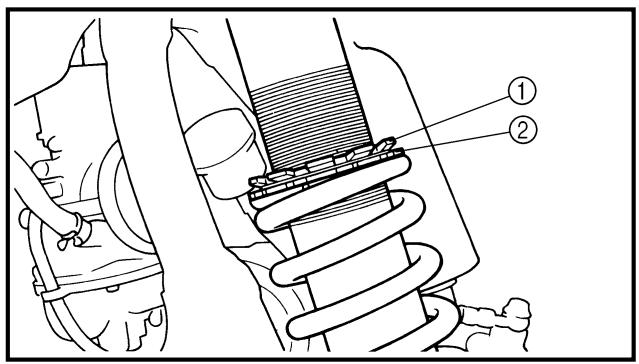
EC72C001
Choosing set length
- Place a stand or block under the engine to put the rear wheel above the floor, and measure the length @ between the rear wheel axle center and the rear fender holding bolt.
- Remove the stand or block from the engine and with a rider astride the seat, measure the sunken length ⑥ between the rear wheel axle center and the rear fender holding bolt.
- Loosen the locknut ① and make adjustment by turning the spring adjuster ② to achieve the standard figure from the subtraction of the length ⑥ from the length ⑧.
Standard figure: 90 ~ 100 mm (3.5 ~ 3.9 in)
- If the machine is new and after it is broken in, the same set length of the spring may change because of the initial fatigue, etc. of the spring. Therefore, be sure to make re-evaluation.
- If the standard figure cannot be achieved by adjusting the spring adjuster and changing the spring set length, replace the spring with an optional one and make re-adjustment.
Setting of spring after replacement
After replacement, be sure to adjust the spring to the set length [sunken length 90 100 ~mm (3.5 ~ 3.9 in)] and set it.
-
Use of soft spring
-
Set the soft spring for less rebound damping to compensate for its less spring load. Run with the rebound damping adjuster one or two clicks on the softer side and readjust it to suit your preference.
-
Use of stiff spring
-
Set the soft spring for more rebound damping to compensate for its greater spring load. Run with the rebound damping adjuster one or two clicks on the stiffer side and readjust it to suit your preference.
-
Adjusting the rebound damping will be followed more or less by a change in the compression damping. For correction, turn the low compression damping adjuster on the softer side.
N.B.:
When using a rear shock absorber other than currently installed, use the one whose overall length ⑧ does not exceed the standard as it may result in faulty performance. Never use one whose overall length is greater than standard.
Length ⑧ of standard shock: 485.5 mm (19.11 in)
Coverage of spring by weight
Rider weight
① Soft
② Standard
③ Stiff
ATTENTION:
Rear shock absorber setting parts
Rear shock spring ①
[Equal pitch spring]
| TYPE | SPRING RATE | SPRING PART NUMBER | I.D. COLOR/ POINT | SPRING FREE LENGTH |
| SOFT | 4.4 | 5DH-22212-70 | Brown/1 | 260 |
| 4.6 | 5DH-22212-10 | Green/1 | 260 | |
| STD | 4.8 | 5DH-22212-20 | Red/1 | 260 |
| STIFF | 5.0 | 5DH-22212-30 | Black/1 | 260 |
| 5.2 | 5DH-22212-40 | Blue/1 | 260 | |
| 5.4 | 5DH-22212-50 | Yellow/1 | 265 | |
| 5.6 | 5DH-22212-60 | Pink/1 | 265 |
[Unequal pitch spring]
| TYPE | SPRING RATE (approx.) | SPRING PART NUMBER | I.D. COLOR/ POINT | SPRING FREE LENGTH |
| SOFT | 4.6 | 5ET-22212-20 | Green/2 | 275 |
| 4.8 | 5ET-22212-00 | Red/2 | 275 | |
| 5.0 | 5ET-22212-10 | Black/2 | 275 | |
| 5.2 | 5ET-22212-30 | Blue/2 | 275 | |
| 5.4 | 5ET-22212-40 | Yellow/2 | 275 | |
| STIFF | 5.6 | 5ET-22212-50 | Pink/2 | 280 |
NOTE:
- The unequal pitch spring is softer in initial characteristic than the equal pitch spring and is difficult to bottom out under full compression.
- The I.D. color ⑧ is marked at the end of the spring.
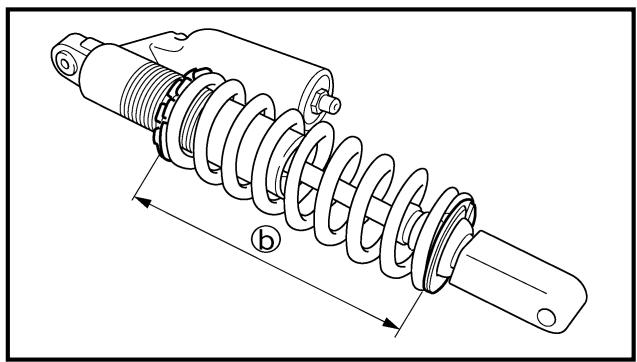
- Extent of adjustment (spring length)
| SPRING FREE LENGTH | EXTENT OF ADJUSTMENT ⑥ |
| 260 mm (10.24 in) | 240.5 ~ 258.5 mm (9.47 ~ 10.18 in) |
| 265 mm (10.43 in) | 245.5 ~ 263.5 mm (9.67 ~ 10.37 in) |
| 275 mm (10.83 in) | 255.5 ~ 273.5 mm (10.06 ~ 10.77 in) |
| 280 mm (11.02 in) | 260.5 ~ 278.5 mm (10.26 ~ 10.96 in) |
- If any of the following symptoms is experienced with the standard position as the base, make resetting by reference to the adjustment procedure given in the same chart.
- Before any change, set the rear shock absorber sunken length to the standard figure 90 100 ~mm (3.5 ~ 3.9 in).
| Symptom | Section | Check | Adjust | |||
| Jump | Large gap | Medium gap | Small gap | |||
| Stiff over entire range | ○ | ○ | ○ | Compression damping Oil level (oil amount) Spring | Turn adjuster counterclockwise (about 2 clicks) to decrease damping. Decrease oil level by about 5 ~ 10 mm (0.2 ~ 0.4 in). Replace with soft spring. | |
| Unsmooth movement over entire range | ○ | ○ | ○ | ○ | Outer tube Inner tube Under bracket tightening torque | Check for any bends, dents, and other noticeable scars, etc. If any, replace affected parts. Retighten to specified torque. |
| Poor initial movement | ○ | Rebound damping Oil seal | Turn adjuster counterclockwise (about 2 clicks) to decrease damping. Apply grease in oil seal wall. | |||
| Soft over entire range, bottoming out | ○ | ○ | Compression damping Oil level (oil amount) Spring | Turn adjuster clockwise (about 2 clicks) to increase damping. Increase oil level by about 5 ~ 10 mm (0.2 ~ 0.4 in). Replace with stiff spring. | ||
| Stiff toward stroke end | ○ | Oil level (oil amount) | Decrease oil level by about 5 mm (0.2 in). | |||
| Soft toward stroke end, bottoming out | ○ | Oil level (oil amount) | Increase oil level by about 5 mm (0.2 in). | |||
| Stiff initial movement | ○ | ○ | ○ | ○ | Compression damping | Turn adjuster counterclockwise (about 2 clicks) to decrease damping. |
| Low front, tending to lower front posture | ○ | ○ | Compression damping Rebound damping Balance with rear end Oil level (oil amount) | Turn adjuster clockwise (about 2 clicks) to increase damping. Turn adjuster counterclockwise (about 2 clicks) to decrease damping. Set sunken length for 95 ~ 100 mm (3.7 ~ 3.9 in) when one passenger is astride seat (lower rear posture). Increase oil level by about 5 mm (0.2 in). | ||
| "Obtrusive" front, tend- ing to upper front pos- ture | ○ | ○ | Compression damping Balance with rear end Spring Oil lever (oil amount) | Turn adjuster counterclockwise (about 2 clicks) to decrease damping. Set sunken length for 90 ~ 95 mm (3.5 ~ 3.7 in) when one passenger is astride seat (upper rear posture). Replace with soft spring. Decrease oil level by about 5 ~ 10 mm (0.2 ~ 0.4 in). | ||
Rear shock absorber
NOTE:
- If any of the following symptoms is experienced with the standard position as the base, make resetting by reference to the adjustment procedure given in the same chart.
- Adjust the rebound damping in 2-click increments or decrements.
- Adjust the low compression damping in 1-click increments or decrements.
- Adjust the high compression damping in 1/6 turn increments or decrements.
| Symptom | Section | Check | Adjust | |||
| Jump | Large gap | Medium gap | Small gap | |||
| Stiff, tending to sink | ○ | ○ | Rebound dampingSpring set length | Turn adjuster counterclockwise (about 2 clicks) to decrease damping.Set sunken length for 90 ~ 100 mm (3.5 ~ 3.9 in) when one passenger is astride seat. | ||
| Spongy and unstable | ○ | ○ | Rebound dampingLow compression dampingSpring | Turn adjuster clockwise (about 2 clicks) to increase damping.Turn adjuster clockwise (about 1 click) to increase damping.Replace with stiff spring. | ||
| Heavy and dragging | ○ | ○ | Rebound dampingSpring | Turn adjuster counterclockwise (about 2 clicks) to decrease damping REPLACE with soft spring. | ||
| Poor road gripping | ○ | Rebound dampingLow compression dampingHigh compression dampingSpring set lengthSpring | Turn adjuster counterclockwise (about 2 clicks) to decrease damping.Turn adjuster clockwise (about 1 clicks) to increase damping.Turn adjuster clockwise (about 1/6 clicks) to increase damping.Set sunken length for 90 ~ 100 mm (3.5 ~ 3.9 in) when one passenger is astride seat.Replace with soft spring. | |||
| Bottoming out | ○ | ○ | High compression dampingSpring set lengthSpring | Turn adjuster clockwise (about 1/6 turn) to increase damping.Set sunken length for 90 ~ 100 mm (3.5 ~ 3.9 in) when one passenger in astride seat.Replace with stiff spring. | ||
| Bouncing | ○ | ○ | Rebound dampingSpring | Turn adjuster clockwise (about 2 clicks) to increase damping REPLACE with soft spring. | ||
| Stiff travel | ○ | ○ | High compression dampingSpring set lengthSpring | Turn adjuster counterclockwise (about 1/6 turn) to decrease damping.Set sunken length for 90 ~ 100 mm (3.5 ~ 3.9 in) when one passenger is astride seat.Replace with soft spring. | ||
- LEGAL NOTE
- OWNER'S SERVICE MANUAL
- MANUEL D'ATELIER DU
- ET PROPRIETAIRE
- FAHRER- UND
- WARTUNGS-HANDBUCH
- NOTE:
- WARNING
- INTRODUCTION
- SAFETY INFORMATION
- NOTICE IMPORTANTE
- NOTICE
- F.I.M. MACHINE WEIGHTS:
- Weights of machines without fuel
- AU NOUVEAU PROPRIETAIRE
- HOW TO USE THIS MANUAL
- EC081000 PARTICULARLY IMPORTANT INFORMATION
- CAUTION:
- EC082000
- FINDING THE REQUIRED PAGE
- COMMENTUTILISER CE MANUEL
- INFORMATIONS PARTICULIEREMENT IMPOR TANTES
- !
- HOW TO READ DESCRIPTIONS
- FORMAT DU MANUEL
- ILLUSTRATED SYMBOLS (Refer to the illustration)
- SYMBOLES GRAPHI-QUES (Voir l'illustration)
- CHAPTER 2 SPECIFICATIONS
- CHAPTER 3 REGULAR INSPECTION AND ADJUSTMENTS
- CHAPTER 5 CHASSIS
- CHAPITRE 4 MOTEUR
- KAPITEL 4 MOTOR
- RENSEIGNEMENTS GENERAUX DESCRIPTION
- VEHICLE IDENTIFICATION NUMBER
- ENGINE SERIAL NUMBER
- MODEL LABEL
- IDENTIFICATION DE LA MACHINE
- EC131010 PREPARATION FOR REMOVAL AND DISASSEMBLY
- INFORMATIONS IMPOR TANTES
- PREPARATION POUR LA DEPOSE ET DEMONTAGE
- ALL REPLACEMENT PARTS
- GASKETS, OIL SEALS AND O-RINGS
- LOCK WASHERS/PLATES AND COTTER PINS
- BEARINGS AND OIL SEALS
- PIECES DE RECHANGE
- CIRCLIPS
- CHECKING OF CONNECTION
- VERIFICATION DES CONNXIONS
- OUTILS SPECIAUX
- CLUTCH LEVER
- SHIFT PEDAL
- KICKSTARTER CRANK
- FONCTIONS DES COMMANDES
- COUPE-CIRCUIT DU MOTEUR
- EC155001
- THROTTLE GRIP
- EC156000
- FRONT BRAKE LEVER
- EC157000
- REAR BRAKE PEDAL
- LEVIER DE DECOMPRESSION
- ATTENTION:
- COLD STARTER KNOB
- HOT STARTER KNOB
- FONCTIONS DES COMMANDES ARMATUREN UND DEREN FUNKTION FUNZIONI DI COMANDO
- ROBINET DE CARBURANT
- LIGHTS SWITCH
- FLAP
- FUEL
- Recommended fuel:
- Except for AUS:
- For AUS:
- FONCTIONS DES COMMANDES/ESSENCE ARMATUREN UND DEREN FUNKTION/KRAFTSTOFF FUNZIONI DI COMANDO/CARBURANTE
- CLAPET DE DURIT DE MISE A LIAIR
- STARTING A COLD ENGINE
- MISE EN MARCHE ET RODAGE ANLASSEN UND EINFAHREN AVVIO E RODAGGIO
- Restarting an engine after a fall
- The engine fails to start
- MISE EN MARCHE ET RODAGE ANLASSEN UND EINFAHREN AVVIO E RODAGGIO
- MISE EN MARCHE D'UN MOTEUR CHAUD
- PROCEDURE DE RODAGE
- POINTS DE VERIFICATION DE COUPLE DE SERRAGE
- ANZUGSMOMENTE KONTROLLIEREN
- HINWEIS:
- CLEANING AND STORAGE
- CLEANING
- NETTOYAGE ET RANGEMENT
- NETTOYAGE
- RANGEMENT
- GENERAL SPECIFICATIONS
- MAINTENANCE SPECIFICATIONS
- ENGINE
- GENERAL TORQUE SPECIFICATIONS
- DEFINITION OF UNITS
- CHARACTERISTIQUES
- CHARACTERISTIQUES GENERALES
- CHEMINEMENT DESCABLES
- MAINTENANCE INTERVALS
- CONTROLES ET REGLAGES COURANTS
- PROGRAMME D'ENTRETIEN
- CONTROLE ET ENTRETIEN AVANT UTILISATION
- COOLANT REPLACEMENT
- MOTEUR
- CONTROLE DU NIVEAU DU LIQUIDE DE REFROIDISSEMENT
- A VERTISSEMENT
- Handling notes of coolant:
- EC355000
- RADIATOR CAP INSPECTION
- COOLING SYSTEM INSPECTION
- CONTROLE DE LA PRESSION D'OUVERTURE DU BOUCHON DU RADIATEUR
- Inspect:
- CLUTCH ADJUSTMENT
- Check:
- Adjust:
- Clutch lever free play adjustment steps:
- N.B.:
- THROTTLE CABLE ADJUSTMENT
- Throttle grip free play adjustment steps:
- 1st step:
- 2nd step:
- DECOMPRESSION ADJUSTMENT
- Checking steps:
- GRAISSAGE DE L'ACCELERATEUR
- Adjustment steps:
- AIR FILTER CLEANING
- Nettoyer:
- ENGINE OIL LEVEL INSPECTION
- ENGINE OIL REPLACEMENT
- CHANGEMENT DE L'HUILE DE MOTEUR
- Replacement steps:
- Oil quantity:
- CHANGEMENT DE L'HUILE DE MOTEUR MOTORÖL WECHSELN SOSTITUZIONE DELL'OLIO MOTORE
- PILOT SCREW ADJUSTMENT
- CONTROLE DE LA PRESSION D'HUIL
- ENGINE IDLING SPEED ADJUSTMENT
- VALVE CLEARANCE INSPECTION AND ADJUSTMENT
- REGLAGE DU REGIME DE RALENTI/CONTROLE ET REGLAGE DU JEU DE SOUPAPES LEERLAUFDEHZAHL EINSTELEN/VENTILSPIEL KONTROLLIEREN UND EINSTELLEN REGOLAZIONE DEL MINIMO/CONTROLLO E REGOLAZIONE DEL GIOCO DELLE VALVOLE
- Remove:
- Check:
- CONTROLE ET REGLAGE DU JEU DE SOUPAPES VENTILSPIEL KONTROLLIEREN UND EINSTELLEN CONTROLLOE REGOLAZIONE DEL GIOCO DELLE VALVOLE
- Déposer:
- EXAMPLE:
- NETTOYAGE DU PARE-ETINCELLES (pour les USA)/ FUNKENFÄNGER REINIGEN (NUR USA) PULIZIA DEL PARASCINTILLE (Per USA)
- NETTOYAGE DU PARE-ETINCELLES (pour les USA)
- Air bleeding steps:
- Bleed screw: 6 Nm (0.6 m • kg, 4.3 ft • lb)
- PARTIE CYCLE
- Install:
- EC362040
- Brake lever position adjustment steps:
- Locknut:
- Pedal height adjustment steps:
- FRONT BRAKE PAD INSPECTION AND REPLACEMENT
- Brake pad replacement steps:
- REGLAGE DU FREIN ARRIERE
- REAR BRAKE PAD INSPECTION AND REPLACEMENT
- Vérifier:
- Check:
- EC36b000
- REAR BRAKE PAD INSULATOR
- INSPECTION
- Remove:
- Inspect:
- Recommended brake fluid: DOT #4
- CONTROLE DE L'ISOLANT DE LA PLAQUETTE DE FREIN ARRIERE
- DRIVE CHAIN INSPECTION
- CONTROLE DES PIGNONS
- Install:
- Lubricate:
- EC36A060
- DRIVE CHAIN SLACK ADJUSTMENT
- Drive chain slack adjustment steps:
- To tighten → Turn adjuster ③ counterclockwise.
- To loosen → Turn adjuster ③ clockwise and push wheel forward.
- Too small chain slack will overload the engine and other vital parts; keep the slack within the specified limits.
- EC36C000
- FRONT FORK INSPECTION
- CONTROLE DE LA FOURCHE AVANT TELESKOPGABEL KONTROLLIEREN ISPEZIONE FORCELLA ANTERIORE
- Régler:
- EC36D001 FRONT FORK OIL SEAL AND DUST SEAL CLEANING
- EC36H002 FRONT FORK REBOUND DAMPING FORCE ADJUSTMENT
- NETTOYAGE DE BAGUE D'ETANCHEITE ET DE JOINT ANTIPOUSSIERE DE FOURCHE AVANT
- FRONT FORK COMPRESSION DAMPING FORCE ADJUSTMENT
- REAR SHOCK ABSORBER INSPECTION
- Never attempt to turn the adjuster beyond the maximum or minimum setting.
- REGLAGE DE LA PRECONTRAINTE DE RESSORT DE L'AMORTISSEUR ARRIERE
- REGLAGE DE LA FORCE D'AMORTISSEMENT DE DETENTE DE L'AMORTISSEUR ARRIERE
- REGLAGE DE LA FORCE D'AMORTISSEMENT A BASSE COMPRESSION DE L'AMORTISSEUR ARRIERE
- Régler:
- Standard tire pressure: 100 kPa (1.0 kg/cm², 15 psi)
- SPOKES INSPECTION AND TIGHTENING
- WHEEL INSPECTION
- CONTROLE DE PRESSION DES PNEUS
- STEERING HEAD INSPECTION AND ADJUSTMENT
- Adjust:
- Steering ring nut adjustment steps:
- CONTROLE ET REGLAGE DE LA TETE DE FOURCHE LENKKOPF KONTROLLIEREN UND EINSTELLLEN ISPEZIONE E REGOLAZIONE DELLA TESTA DI STERZO
- CONTROLE ET REGLAGE DE LA TETE DE FOURCHE LENKKOPF KONTROLLIEREN UND EINSTellenISPEZIONE E REGOLAZIONE DELLA TESTA DI STERZO
- GRAISSAGE
- PARTIE ELECTRIQUE/CONTROLE DE LA BOUGIE ELEKTRISCHE ANLAGE/ZündKERZE KONTROLLIEREN PARTE ELETTRICA/ISPEZIONE DELLA CANDELA
- PARTIE ELECTRIQUE CONTROLE DE LA BOUGIE
- IGNITION TIMING CHECK
- Attach:
- Check:
- Install:
- CONTROLE DE L'AVANCE A L'ALLUMAGE
- Déposer:
- REPLACING THE HEADLIGHT BULBS
- REMPLACER LES AMPOULES DU PHARE SCHEINWERFERLAMPE AUSWECHSELN SOSTITUZIONE DELLE LAMPADE DEL FARO
- REMPLACER LES AMPOULES DU PHARE
- REGLAGES DES FAISCEAUX DES PHARES
- SELLE, RESERVOIR DE CARBURANT ET CACHES LATERAUX SITZBANK, KRAFTSTOFFTANK UND SEITENABDECKUNGEN SELLA, SERBATOIO CARBURANTE E CARENATURA LATERALE
- SELLE, RESERVOIR DE CARBURANT ET CACHES LATERAUX
- TUYAU D'ECHAPPEMENT ET SILENCIEUX KRÜMMER UND SCHALLDÄMPFER TUBO DI SCARICO E SILENZIATORE
- TUYAU D'ECHAPPEMENT ET SILENCIEUX
- Silencer and exhaust pipe
- ASSEMBLY AND INSTALLATION
- CONTROLE
- RADIATEUR
- Radiator
- REMARQUES CONCERNANT LA MANIPULATION
- AVERTISSEMENT
- Tighten:
- Install:
- Fill:
- CARBURATEUR
- DEMONTAGE DU CARBURATEUR
- REMOVAL POINTS
- Pilot screw
- Carburetor
- REMARQUE CONCERNANT LES MANIPULATIONS
- Needle valve
- Throttle valve
- Jet needle
- Float height: 8.0 mm (0.31 in)
- Measurement and adjustment steps:
- Float
- Hauteur du flotteur
- Accelerator pump
- Inspect:
- Air cut valve
- Install:
- Plongeur de starter
- Install:
- Install:
- Install:
- Install:
- Note the following installation points:
- Install:
- 15.Install:
- Install:
- Install:
- Install:
- Carburetor installation
- ARBRES A CAMES
- COUVRE-CULASSE
- REMOVAL POINTS Camshaft
- POINTS DE DEPOSE
- Arbre à cames
- Camshaft
- Measure:
- Cam lobes length:
- Intake:
- Exhaust:
- Measure:
- Runout (camshaft):
- Measurement steps:
- Measure:
- Camshaft sprocket
- Mesurer:
- Timing chain tensioner
- Installation steps:
- Install:
- CULASSE
- Cylinder head warpage:
- Less than 0.05 mm (0.002 in)
- Warpage measurement and resurface-ment steps:
- Cylinder head
- ASSEMBLAGE ET MONTAGE
- Monter:
- SOUPAPES ET RESSORTS DE SOUPAPE
- Valve lifter and valve cotter
- Clearance (stem to guide):
- Soupape
- Inspect:
- Measure:
- Eliminate:
- Inspect:
- Measure:
- Valve seat width:
- SOUPAPES ET RESSORTS DE SOUPAPE VENTILE UND VENTILFEDERN VALVOLE E MOLLE VALVOLE
- Limin de déformation: 0,01 mm (0,0004 in)
- Lapping steps:
- Roder:
- Valve lifter
- Ressort de soupape
- Ventilfeder
- Combination of cylinder head and valve lifter
- Combination:
- Valve and valve spring
- Apply:
- CYLINDRE ET PISTON
- Piston and piston ring
- Cylinder and piston
- Position:
- Segment de piston
- Piston ring and piston
- Axe de piston
- Cylinder
- Positionner:
- EMBRAYAGE
- Clutch housing and boss
- Primary driven gear
- Clutch spring
- Noix d'embrayage
- EC484600
- Clutch plate
- Measure:
- Push lever shaft
- Push rod
- Disque de friction
- Clutch
- Levier de poussaee
- Monter:
- Install:
- 11.Install:
- ELEMENT DE FILTRE A HUILE, POMPE A EAU ET DEMI-CARTER DROIT
- INSPECTION Oil delivery pipe
- Impeller shaft gear
- Bearing
- Oil seal
- Arbre de rotor
- Impeller shaft
- Right crankcase cover
- Oil filter element
- BALANCIER
- Balancer shaft drive gear and balancer shaft driven gear
- Balancer shaft
- Primary drive gear, balancer shaft drive gear and balancer shaft driven gear
- ASSEMBLY AND INSTALLATION Balancer shaft, balancer shaft drive gear and balancer shaft driven gear
- ASSEMBLAGE ET INSTALLATION
- POMPE A HUIL
- Pompe à huile
- Controller:
- Oil pump
- KICK SHAFT AND SHIFT SHAFT
- ARBRE DE KICK ET ARBRE DE SELECTEUR KICKSTARTER UND KICKSTARTERWELLE ALBERO PEDALE E ALBERO DEL CAMBIO
- EC4C3101
- Shift guide and shift lever assembly
- EC4N3100
- Segment
- Kick shaft and ratchet wheel
- EC4C4300
- Kick gear, kick idle gear and ratchet wheel
- ARBRE DE KICK ET ARBRE DE SELECTEUR KICKSTARTER UND KICKSTARTERWILLE ALBERO PEDALE E ALBERO DEL CAMBIO
- Arbre de kick complet
- Stopper lever
- Arbre de sélecteur
- Levier de butée
- Shift shaft
- Kick shaft assembly
- Hook:
- Kick idle gear
- VOLANT MAGNETIQUE CDI
- CDI magneto
- Woodruff key
- Rotor
- AUSBAU
- Remove:
- EC4M3301
- Engine removal
- Engine installation
- Brake pedal
- Drive sprocket
- Oil hose and neutral switch
- CRANKCASE AND CRANKSHAFT
- Separation steps:
- Crankcase bearing
- Timing chain and timing chain guide
- Crankcase
- Vilebreguin
- Oil strainer
- Oil delivery pipe 2
- Crankshaft
- Apply:
- Remove:
- Apply:
- Check:
- TRANSMISSION, SHIFT CAM AND SHIFT FORK
- BOITE A VITESSES, TAMBOUR ET FOURCHETTES DE SELECTION
- Gears
- Boite à vitesses
- Transmission
- Check:
- ROUE AVANT ET ROU ARRIERE
- ROUE AVANT
- ROUE ARRIERE
- Wheel bearing (if necessary)
- Wheel
- Roue arrière
- Brake disc
- Axe de roue
- Front wheel
- REMONTAGE ET MONTAGE
- Monter:
- FREIN AVANT ET FREIN ARRIERE VORDER- UND HINTERRADBREMSE FRENO ANTERIORE E POSTERIORE
- FREIN AVANT ET FREIN ARRIERE
- FREIN AVANT
- FREIN ARRIERE
- DEMONTAGE DE L'ETRIER
- DEMONTAGE DU MAITRE-CYLINDRE DE FREIN
- Brake caliper piston
- Caliper piston removal steps:
- Liquide de frein
- Brake caliper piston seal kit
- Brake master cylinder
- EC534301
- Brake hose
- EC5A5000
- Clean:
- Etrier de frein
- Front brake caliper
- Rear brake caliper
- Brake master cylinder kit
- Front brake master cylinder
- Rear brake master cylinder
- Monter:
- NOTA:
- Front brake hose
- Rear brake hose
- Brake fluid
- Fill:
- FOURCHE AVANT
- DEMONTAGE DE LA FOURCHE AVANT
- Front fork cap bolt
- Oil seal removal steps:
- Damper rod
- Tube interne
- Fork spring
- Inner tube
- Outer tube
- Soupape de base
- Luftventil
- Front fork assembly
- 12.Install:
- Compress the front fork fully.
- Fill:
- Recommended oil: Suspension oil “01”
- Fill:
- Loosen:
- 23.Install
- Install:
- 25.Install:
- 27.Install:
- Install:
- Installation
- Tighten:
- Adjust:
- Adjust:
- GUIDON
- Grip
- Handlebar
- Adjust:
- DIRECTION
- Lower bearing
- Ball race
- Steering stem
- Bearing and ball race
- Lower bracket
- BRAS OSCILLANT
- DEMONTAGE DU BRAS OSCILLANT
- Swingarm
- Relay arm
- Connecting rod
- Roulement
- Bearing and oil seal
- Monter:
- Tighten:
- Install:
- AMORTISSEUR ARRIERE
- NOTES ON DISPOSAL (YAMAHA DEALERS ONLY)
- Rear shock absorber
- Spring (rear shock absorber)
- REMONTAGE ET MONTAGE Roulement
- Tighten:
- Tighten:
- COLOR CODE
- WIRING DIAGRAM
- PARTIE
- ELECTRIQUE
- COMPOSANTS ELECTRIQUES ET SCHEMA DE CABLAGE
- COMPOSANTS ELECTRIQUES
- Principal of 3-Dimensional Control
- BLOC CDI CONTROLE PAR MICROPROCESSEUR
- SYSTEME D'ALLUMAGE
- ETAPES DU CONTROL
- COUPLERS AND LEADS CONNECTION INSPECTION
- ENGINE STOP SWITCH INSPECTION
- TEST DE LA LONGUEUR D'ETIN-CELLE D'ALLUMAGE
- IGNITION COIL INSPECTION
- CDI MAGNETO INSPECTION
- CONTROLE DE LA BOBINE D'ALLUMAGE
- NEUTRAL SWITCH INSPECTION
- CDI UNIT INSPECTION
- CIRCUIT DU CAPTEUR DE PAPILLON DES GAZ
- ETAPES DU CONTROLE
- THROTTLE POSITION SENSOR COIL INSPECTION
- CONTROLE DES CONNXIONS DES COUPLEURS ET DES FILS
- Vérifier:
- THROTTLE POSITION SENSOR REPLACEMENT AND ADJUSTMENT
- REEMPLACEMENT ET REGLAGE DU CAPTEUR DE PAPILLON DES GAZ
- THROTTLE POSITION SENSOR INPUT VOLTAGE INSPECTION
- Régler:
- SYSTEME D'ECLAIRAGE
- PROCEDURES DE VERIFICATION
- CDIMAGNETOINSPECTION
- VOLTAGE REGULATOR INSPECTION
- VERIFICATION INTERRUPEUR LUMIERES
- MISES AU POINT MOTEUR
- That is:
- Main system
- Pilot system
- Main jet adjustment
- Effects of changing the main jet (reference)
- Pilot jet adjustment
- Jet needle groove position adjustment
- Effects of changing the jet needle groove position (reference)
- Jet needle adjustment
- Leak jet adjustment (accelerator pump adjustment)
- Effects of changing the jet needle (reference)
- Relationship with throttle opening
- Standard secondary reduction ratio
- Tire pressure
- Spring preload adjustment
- Setting of spring after replacement
- Use of stiff spring
- Ressort dur
- Front fork setting parts
- Rear suspension setting
- Choosing set length
- Rear shock absorber setting parts
Brand : YAMAHA
Model : WR250FN
Category : Off-road motorcycle