
KGT330NWI - Refrigerator THOMSON - Free user manual and instructions
Find the device manual for free KGT330NWI THOMSON in PDF.



| Product type | Refrigerator with 4-star freezer compartment |
| Brand | THOMSON |
| Model | KGT330NWI |
| Height (mm) | 1860 or 2010 depending on version |
| Width (mm) | 600 |
| Depth (mm) | 610 |
| Open door depth (mm) | 1170 |
| Power supply | 220-240 V ~ 50 Hz, grounded plug |
| Bulb power | E14, 220-240 V, 15 W maximum |
| Refrigerant | R600a (flammable, ozone-safe) |
| No-Frost technology | Yes (no frost formation) |
| Special functions | Super Cooling, Super Freezing, Alarm, Holiday Mode, BIO FILTER |
| Multifresh compartment | Yes, for meat, fish and vegetables |
| BIO FILTER filter | Absorbs odors and retains microorganisms; lifespan ~6 months; replacement code 993010246 |
| Door reversibility | Yes, required tool: Phillips screwdriver |
| Cleaning | Warm water and baking soda; do not use steam or abrasive detergents |
| Operating conditions | Ambient temperature between 10°C and 43°C |
| Freezing power | See rating plate (not specified in manual) |
| Child safety | Removing doors and keeping shelves in case of disposal |
| Warranty and service | Approved technical service, genuine parts |
Frequently Asked Questions - KGT330NWI THOMSON
User questions about KGT330NWI THOMSON
0 question about this device. Answer the ones you know or ask your own.
Ask a new question about this device
Download the instructions for your Refrigerator in PDF format for free! Find your manual KGT330NWI - THOMSON and take your electronic device back in hand. On this page are published all the documents necessary for the use of your device. KGT330NWI by THOMSON.
USER MANUAL KGT330NWI THOMSON
natural_image
Symbol of a trash bin crossed out by two crossed lines, with no text or labels present.natural_image
Simple line drawing of a rectangular object with a base and spout, emitting light rays (no text or symbols)
natural_image
Simple line drawing of a 3D rectangular box (no text or symbols)CARACTERÍSTICAS DEL APARATO:
natural_image
Simple graphic of an exclamation mark inside a square frame with radiating lines (no text or symbols)natural_image
Simple line drawing of a magnifying glass (no text or symbols)natural_image
Simple line drawing of a plug and a wall socket (no text or symbols)natural_image
Close-up of a white plastic door handle with two circular buttons, no visible text or symbolsFig. 1 Bisagra superior
natural_image
Close-up of a mechanical component with two circular holes and an arrow indicating motion (no text or symbols)Fig. 3 Bisagra inferior
natural_image
Close-up of a white door handle with metal clips and a small bracket (no text or symbols visible)Fig. 2 Bisagra central
natural_image
Simple line drawing of a thermometer with radiating lines (no text or symbols)natural_image
Interior view of a refrigerator showing a rack with liquid and a wavy surface, no visible text or symbolsnatural_image
Interior view of a refrigerator with open door and visible food items (no text or symbols)SISTEMA DOUBLE FRESH
natural_image
Hand holding a transparent electronic device with a display panel (no visible text or symbols on the device body)Fig.5
natural_image
Close-up of hands holding a transparent plastic container and a small electronic component (no visible text or symbols)Fig.6
natural_image
Close-up of hands holding a small electronic device with a grid of pins (no visible text or symbols)Fig.7
natural_image
Close-up of hands assembling a white plastic component (no visible text or symbols)Fig.8
Duración y recambio
natural_image
Simple line drawing of a tray with hexagonal patterns (no text or symbols)natural_image
Simple line drawing of a fish-like shape with circular spots and a wavy base (no text or symbols)natural_image
Simple line drawing of a light bulb with radiating lines (no text or symbols)natural_image
Simple line drawing of a refrigerator with motion lines indicating vibration (no text or symbols)natural_image
Simple line drawing of a classic rotary telephone with keypad and scroll (no text or symbols)natural_image
Symbol of a trash bin crossed out by two crossed lines, with no text or labels present.natural_image
Simple line drawing of a rectangular object with shading and radiating lines (no text or symbols)EMBALAGEM:
natural_image
Simple line drawing of a 3D rectangular block (no text or symbols)natural_image
Simple graphic of an exclamation mark inside a square with radiating lines (no text or symbols)natural_image
Simple line drawing of a magnifying glass (no text or symbols)LOCALIZAÇÃO:
natural_image
Simple line drawing of a plug and a wall socket (no text or symbols)natural_image
Close-up of a white mechanical component with two circular holes, no visible text or symbolsFig. 1 Dobradiça superior
natural_image
Close-up of a white door handle with two circular buttons, no visible text or symbolsFig. 2 Dobradiça central
natural_image
Close-up of a mechanical component with two circular ports and an arrow indicating motion (no text or symbols)Fig. 3 Dobradiça inferior
natural_image
Simple line drawing of a thermometer with radiating lines (no text or symbols)PAINEL DE CONTROLO (No-Frost)
natural_image
Interior view of a refrigerator showing wall-mounted appliances and a rack with wavy insulation (no text or symbols visible)natural_image
Interior view of a refrigerator with open door and visible food items (no text or symbols)natural_image
Hand holding a transparent electronic device with a grid of buttons and a label (no readable text or symbols on the device itself)Fig.5
natural_image
Close-up of hands holding a transparent plastic device next to a small electronic component (no visible text or symbols)Fig.6
natural_image
Close-up of hands holding a small electronic component with multiple slots and a small inset showing internal structure (no visible text or symbols)Fig.7
natural_image
Close-up of hands assembling a white plastic component (no visible text or symbols)Fig.8
natural_image
Simple line drawing of a tray with hexagonal patterns (no text or symbols)natural_image
Simple line drawing of a round, oval-shaped object with scattered circular holes, resting on a textured surface (no text or symbols)natural_image
Simple line drawing of a glowing light bulb (no text or symbols)natural_image
Simple line drawing of a refrigerator with motion lines indicating vibration (no text or symbols)natural_image
Simple line drawing of a classic rotary telephone with keypad and keypad (no text or symbols)natural_image
Symbol of a trash bin crossed out by two crossed lines, with no text or labels present.natural_image
Simple line drawing of a refrigerator with no text or symbols
natural_image
Simple line drawing of a 3D rectangular box (no text or symbols)2. DESCRIPTION DU REFRIGERATEUR
natural_image
Simple graphic of an exclamation mark inside a square with radiating lines (no text or symbols)natural_image
Simple line drawing of a magnifying glass (no text or symbols)natural_image
Simple line drawing of a hand holding a plug and a wall socket (no text or symbols)natural_image
Close-up of a white mechanical component with two circular holes, no visible text or symbolsnatural_image
Close-up of a white door handle with two buttons and a white lever (no text or symbols visible)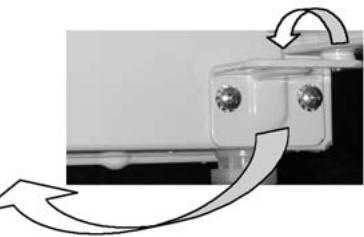
natural_image
Close-up of a mechanical component with curved arrows indicating motion or force (no text or symbols visible)natural_image
Simple line drawing of a thermometer with radiating lines (no text or symbols)natural_image
Interior view of a refrigerator with three panels showing internal components and arrows pointing to specific areas (no text or symbols visible)Fig. 4 Grilles de ventilation
SYSTEME MULTIFRESH
natural_image
Interior view of a refrigerator with open door and visible food items (no text or symbols)SYSTEME DOUBLE FRESH
natural_image
Hand holding a transparent plastic device with a small attached clip, no visible text or symbols on the device itself.Fig.5
natural_image
Close-up of a hand holding a small electronic component next to a transparent plastic container (no visible text or symbols)Fig.6
natural_image
Close-up of hands holding a small electronic component with visible traces and pads (no text or symbols)Fig.7
natural_image
Close-up of hands holding a white plastic component with grid-like cutouts (no visible text or symbols)Fig.8
natural_image
Simple line drawing of a tray with hexagonal patterns (no text or symbols)natural_image
Simple line drawing of a round, textured object with circular holes and a base (no text or symbols)natural_image
Simple line drawing of a glowing light bulb with rays (no text or symbols)natural_image
Simple line drawing of a refrigerator with motion lines indicating vibration (no text or symbols)natural_image
Simple line drawing of a classic rotary telephone with keypad and keypad (no text or symbols)CES POINTS REPONDENT AUX DIRECTIVES CEE 73/23, 93/68, 89/336, 92/75, 96/57, 94/2, 86/594, 2002/72.
CONTENTS
Page
- SAFETY INFORMATION AND GENERAL INSTRUCTIONS. .. 2
- DESCRIPTION OF THE REFRIGERATOR. 3
- INSTALLATION. 4
- OPERATION AND USE OF THE REFRIGERATOR...... 6
- CLEANING AND MAINTENANCE. 11
- NORMAL REFRIGERATOR NOISES. 12
- TROUBLESHOOTING.... 13
- TECHNICAL SERVICE CALLS. 15
- SPECIFICATIONS.... 15
Please read these instructions carefully before use. Keep this manual for future reference
1. SAFETY INFORMATION AND GENERAL INSTRUCTIONS
RECYCLING:

INFORMATION FOR THE CORRECT DISPOSAL OF ELECTRICAL AND ELECTRONIC APPLIANCES (RAEE)
When the appliance reaches the end of its service life, you should not dispose of it with the general domestic waste.
It can be taken free of charge to the local administrations' specific selective collection centres, or to distributors who provide this service.
Separating a domestic appliance before disposing of it means you will prevent possible negative consequences for the environment and health which may be given rise to by incorrect disposal, and it means the materials making it up can be treated and recycled, obtaining important savings on energy and resources.
natural_image
Symbol of a trash bin crossed with a diagonal line, no text or numbers presentTo remind you that you must collaborate with a selective collection scheme, there is a symbol on the product warning you not to dispose of it in traditional refuse containers.
For further information, contact your local authority or the shop where you bought the product.
OLD REFRIGERATOR:
Make sure that the refrigeration circuit is not damaged: it may contain substances which could affect the environment.
→ Make the refrigerator unusable:
- Cut off supply cable.
- If possible remove the doors: leave the racks in place to prevent children from getting in easily.
natural_image
Simple line drawing of a vertical stack with radiating lines and a small object at the base (no text or symbols)PACKING:
The packing materials used are completely recyclable, (Cardboard, PE bubble wrap, EPS...).
WARNING: Keep packing materials out of the reach of children: these materials are potentially hazardous.
With disposal, observe local standards of treatment of this type of waste.
natural_image
Simple line drawing of a 3D rectangular box (no text or symbols)FEATURES OF THE REFRIGERATOR:
This refrigerator includes a four star (* ****) freezer compartment enabling you to freeze food.
This refrigerator will operate correctly between the following temperatures:
- No-Frost Models
10^-43^
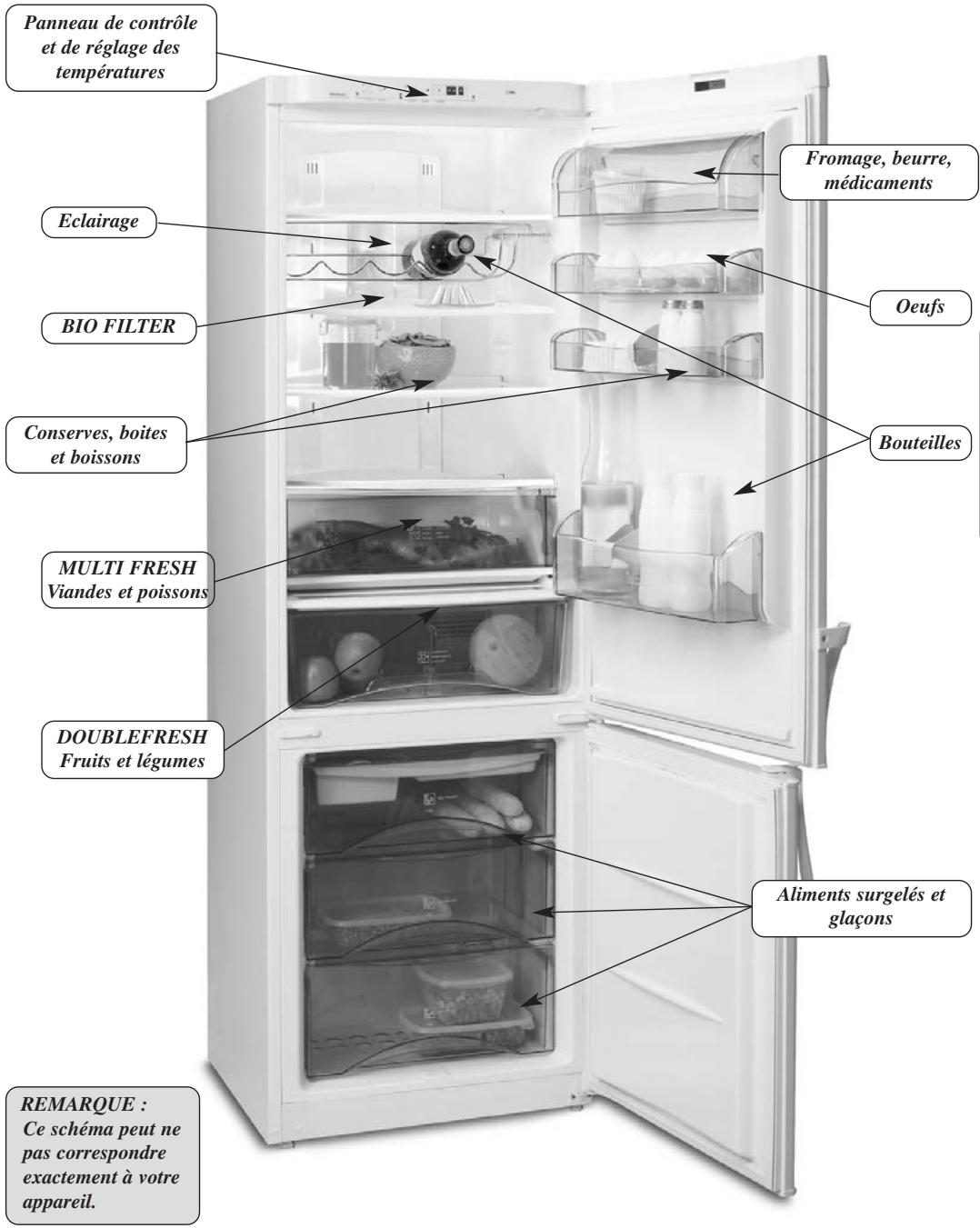
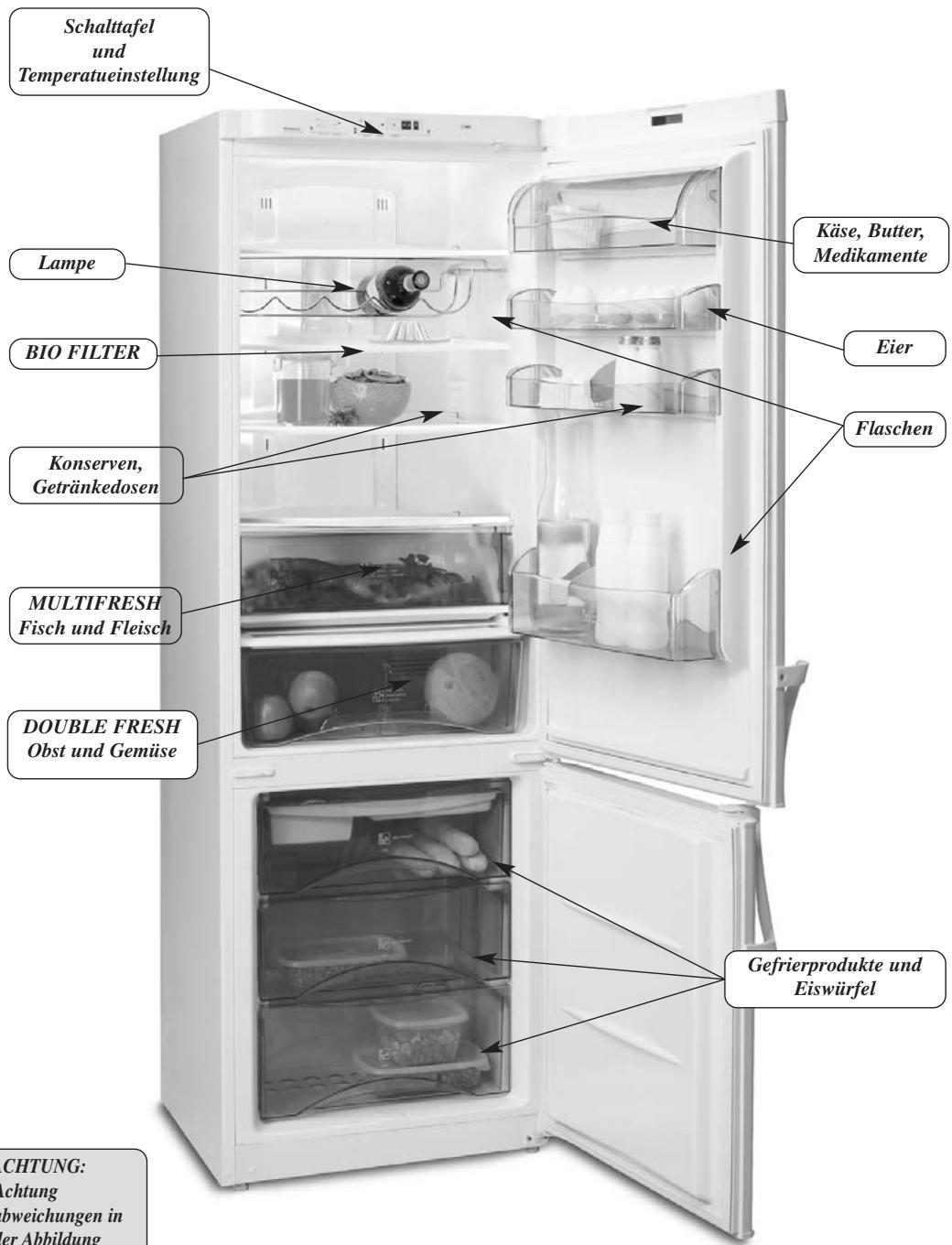
2. DESCRIPTION OF THE REFRIGERATOR
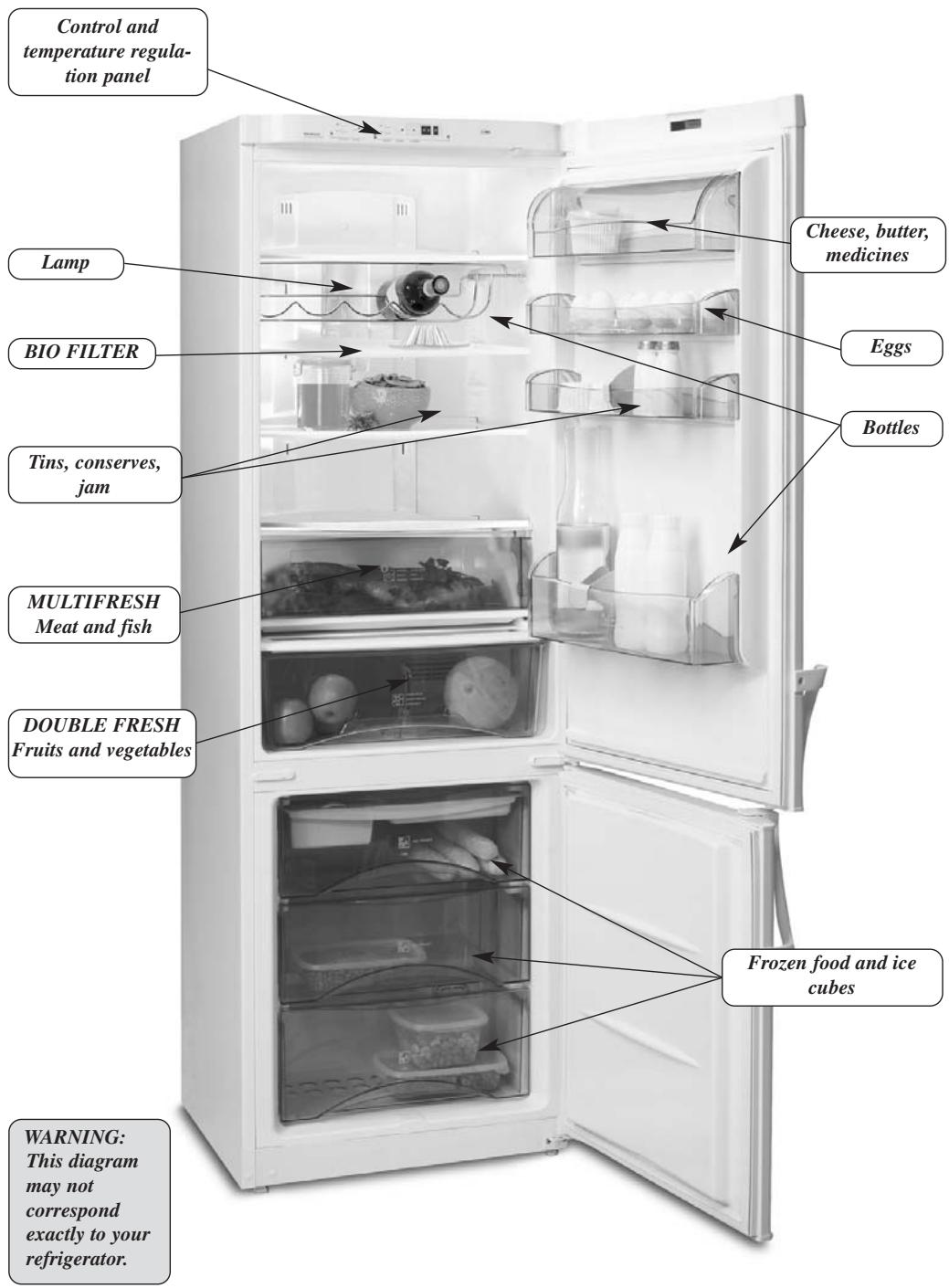
SAFETY:

natural_image
Simple graphic of an exclamation mark inside a gray square with radiating lines (no text or symbols)This model refrigerator is commercialised with R600a coolant. Points to note:
• This coolant does not affect the environment.
- It is inflammable, so the cooling circuit must be in perfect condition. If damaged in any way, consult your distributor before switching on.
This refrigerator must be repaired only by the technical assistance service, using original spares.
In case of damage to the power cable, to avoid hazards it should also be replaced by the technical assistance service.
Do not use flame-producing equipment or electrical apparatus inside the refrigerator.
This appliance is not designed for use by physically, sensorially or mentally handicapped people (including children), or people with no experience or knowledge of this type of appliance, unless they have been instructed in its use by a responsible person.
Children must be supervised to ensure they do not play with the appliance.
Do not introduce volatile liquids or inflammable products.
3. INSTALLATION
LOCATION:

natural_image
Simple line drawing of a magnifying glass (no text or symbols)➢ Ensure that the refrigerator is located away from heat sources (stoves, radiators, etc.) and protected from direct sunlight, which increases consumption.
Allow air flow around the rear of the refrigerator. Do not cover the space between the refrigerator and the floor or the top of the refrigerator with any object.
The refrigerator must not be installed outdoors, or exposed to rain.
To ensure better energy efficiency, a 20 mm space is recommended between the back of the refrigerator and the wall.
On certain occasions, relative humidity and room temperature may generate condensation on the inside and outside of the refrigerator.
To avoid vibrations and noise, ensure that the refrigerator is stable and level.
ELECTRICAL CONNECTION:
natural_image
Simple line drawing of a hand holding a plug and a socket (no text or symbols)Plug specifications: 220-240V with earth.
Do not use adaptors or extension cables.
→ Ensure that the cable is not in contact with the motor.
→ Ensure that the cable is not caught under the refrigerator.
CHANGING THE DOOR-OPENING DIRECTION:
TOOLS REQUIRED:
A Phillips screwdriver.
PROCEDURE:
- Unplug the refrigerator and take everything from the compartment.
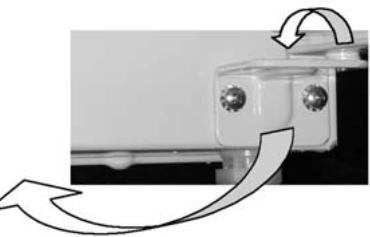
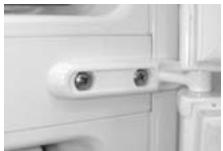
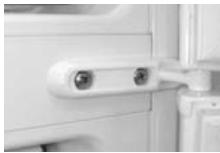
- Remove the cover from the top hinge. (Fig.1)
- Loosen the top hinge screws. (Fig.1)
-
Take the door off with an upward movement.
-
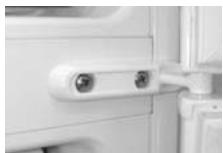
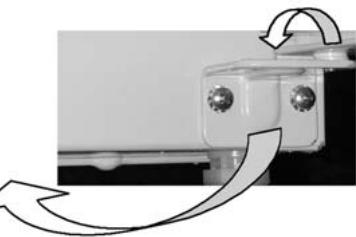
Remove the cover of the central hinge screws, and loosen the two screws holding it in place. (Fig.2)
-
With the screws loose, move the freezer door upward to release it.
-
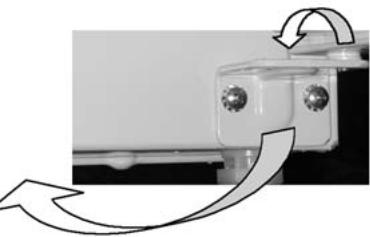
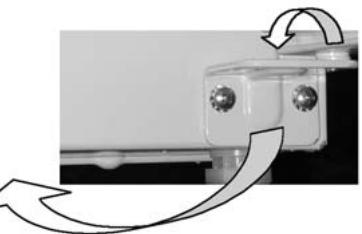
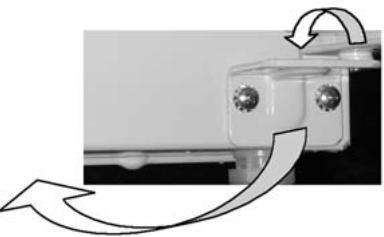
Lastly, remove the screws and take out the lower hinge. (Fig.3)
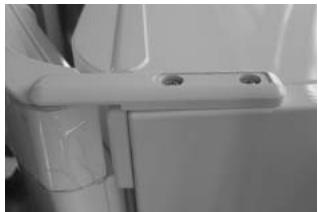
natural_image
Close-up of a white mechanical component with a handle and mounting holes (no visible text or symbols)Fig. 1 Top hinge
natural_image
Close-up of a white door handle with two circular buttons, no visible text or symbolsFig. 2 Central hinge
natural_image
Close-up of a mechanical component with a curved arrow indicating motion or rotation (no text or symbols visible)Fig. 3 Bottom hinge
- Change the position of the
bottom hinge shaft, placing it on the opposite side. (Fig.3) - If fitted, change the lateral handles to the other side.
- Reverse this procedure to refit the doors.
BEFORE SWITCHING THE REFRIGERATOR ON:
Clean the inside with warm water and bicarbonate of soda. Rinse and dry carefully.
Wait for 2 hours before starting, to ensure that the motor lubricants have stabilised.
If the refrigerator has been switched off, wait 4 hours after restarting before placing food inside.
natural_image
Simple line drawing of a thermometer with no text or symbolsIn normal conditions, the recommended approximate temperature is 4^ C in the refrigerator and about -19^ C in the freezer.
To regulate the temperature, use the temperature selection controls: temperatures are indicated in °C.
WARNING: The inside refrigerator temperature depends on:
■ Room temperature.
■ The location of the refrigerator.
■ Door-opening frequency
CONTROL PANEL (No-Frost)
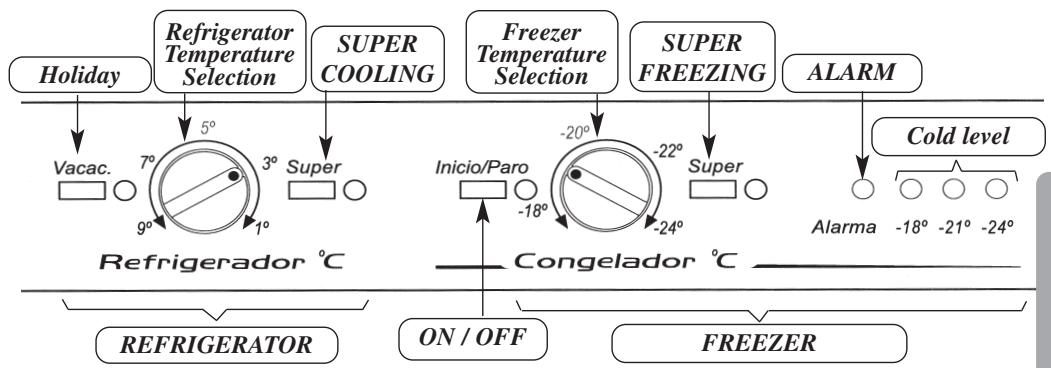
Your refrigerator will have either a LED control panel or a Digital control panel.
Digital control panel
"ON/OFF"
LED control panel
The refrigerator is switched on and off using the "ON/OFF" button.
Digital control panel
The refrigerator is switched on and off using the freezer temperature selection buttons. If a value appears on the freezer displays, this means the refrigerator is running. To switch off the refrigerator, press + or – repeatedly until the displays switch off.
| Freezer (°C) | OFF | -17 | -18 | -19 | -20 | -21 | -22 | -23 | -24 | OFF |
"INTERNAL TEMPERATURE SELECTION"
LED control panel
The refrigerator and freezer temperatures in ^ C can be selected by turning the dials. The coldest temperature is obtained by turning the dial clockwise as far as it will go.
| Refrigerator (°C) | +9 | +8 | +7 | +6 | +5 | +4 | +3 | +2 | +1 |
| Freezer (°C) | -18 | -19 | -20 | -21 | -22 | -23 | -24 |
Digital control panel
The refrigerator and freezer temperatures can be selected by pressing the + or - buttons. After selection they will remain on the Control Panel display.
To determine the real temperatures inside the refrigerator, press the corresponding + or – button for each compartment and hold it down for at least 5 seconds. The real temperature in the compartment will begin to flash on each display and will gradually reach the selected temperature. When the + or – button is released, the Control Panel will show the temperature selected for each compartment.
| Refrigerator (°C) | H | +1 | +2 | +3 | +4 | +5 | +6 | +7 | +8 | +9 | H |
| Freezer (°C) | OFF | -17 | -18 | -19 | -20 | -21 | -22 | -23 | -24 | OFF |
"SUPER COOLING" With this function running, the refrigerator temperature is regulated automatically to maximum cold for six hours. It switches off automatically but can also be turned off automatically before the 6 hours is up.
"SUPER FREEZING" With this function running, the freezer temperature is automatically adjusted to maximum cold. This is to facilitate freezing of food and it is recommended that it is turned on 24 hours before introducing a large amount of food. The function will turn off automatically, and can also be switched off manually.
"Alarm" A light and audio signal is activated if the freezer temperature is abnormally low. The audio alarm can be turned off manually using the SUPER FREEZING function.
When the refrigerator door is left open for more than 120 seconds, an alarm will sound intermittently. This alarm will be switched off by closing the door.
"Cold level" The number of lights on indicate freezer cold level. The more lights on, the colder the freezer.
"Holiday Function" Used when you want the freezer to work normally and the refrigerator to be switched off when you do not plan to use it for a long period of time, such as, for example, during the holiday period. Before enabling this option, empty the refrigerator, clean it and close the door. Then activate this function to ensure that your refrigerator is maintained in optimum conditions to avoid generating unpleasant odours. When you come back from your holidays, simply deactivate the function and the temperature in the refrigerator will drop once again to pre-selected level.
To activate or desactivate the holiday function:
LED control panel
Press the holiday function button and close the refrigerator door.
Digital control panel
Press the + or – button used for selecting the refrigerator temperature until the letter H (Holiday) appears on the refrigerator display.
CORRECT USE OF THE APPLIANCE:
REFRIGERATOR
Leave enough space between food items to let air to flow around them.
Do not leave the door open longer than necessary.
Do not put hot food in the refrigerator.
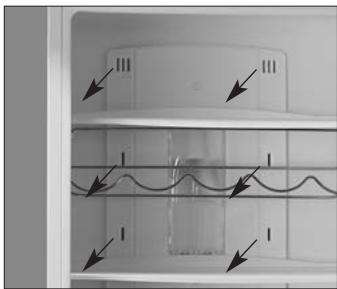
Do not obstruct the ventilation grilles.(Fig.4)
To prevent foodstuffs stored from drying out, we recommend that you place them in an airtight container or wrapped them in aluminium foil or plastic food wrap.
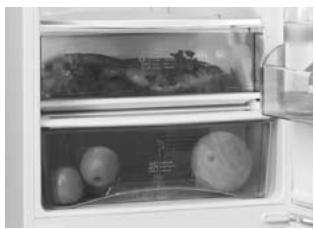
MULTIFRESH SYSTEM
If your refrigerator has a Multifresh compartment:
This guarantees ideal conservation of fresh food such as meat and fish, and also vegetables, allowing these items to be conserved for longer periods of time without having to freeze them.
This area has the coldest temperatures in the refrigerator and is also the area least affected by frequent opening.
For meat and fish, an intermediate refrigerator temperature is recommended.
For greater capacity in the refrigerator, remove the top rack and cover, and store directly on the tray. This area loses the benefits outlined above.
natural_image
Interior view of a refrigerator showing three panels with arrows pointing to different sections (no text or symbols visible)Fig. 4 Ventilation grilles
natural_image
Interior view of a refrigerator with open door and visible food items (no text or symbols)DOUBLE FRESH SYSTEM
Your refrigerator is fitted with this system, the top rack covering the fruit and vegetable baskets has a membrane filter maintaining a high level of humidity in the baskets. The humidity level provided is ideal to ensure that vegetables do not dry, out, ensuring that they retain all their texture, flavour and nutritional properties.
BIO FILTER
Function
The refrigerator may be equipped with a filter that absorbs any unpleasant smells produced by the food, and retains microorganisms (mould and bacteria) from the circulating air.
Location
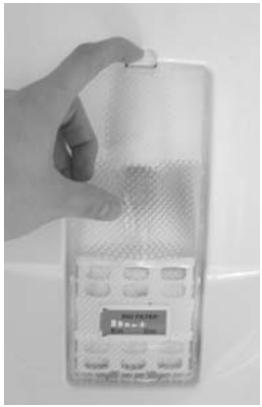
The BIO FILTER is located on the inside of the reflector cover on the refrigerator light.
Activation
If your refrigerator has a BIO FILTER, the procedure for activating it is as follows:
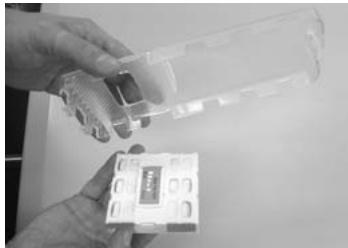
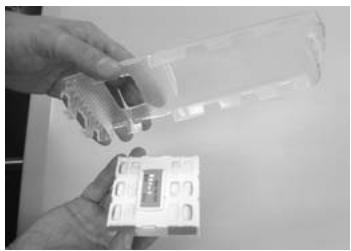
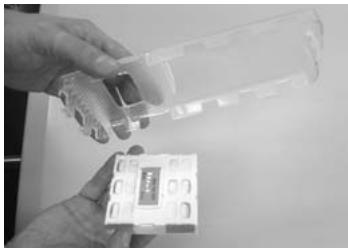
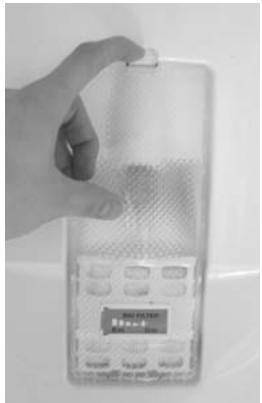
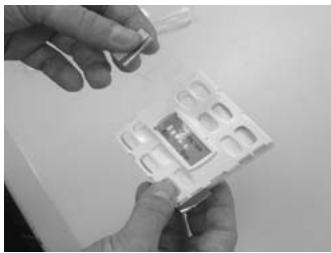
1.- Press the top tab and remove the light reflector cover (Fig.5).
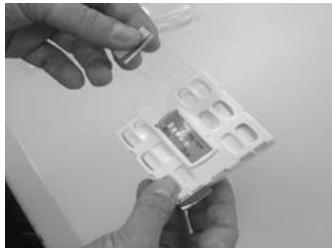
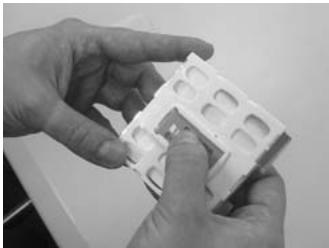
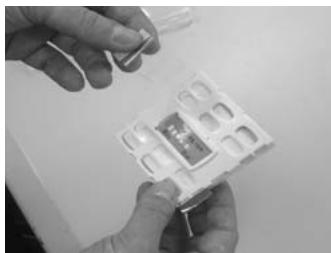
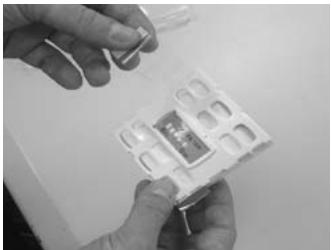
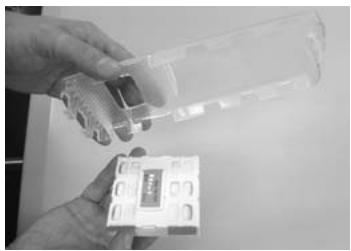
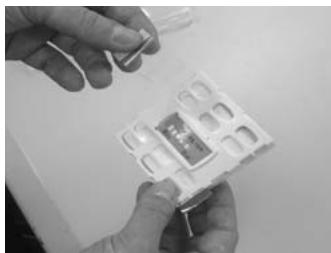
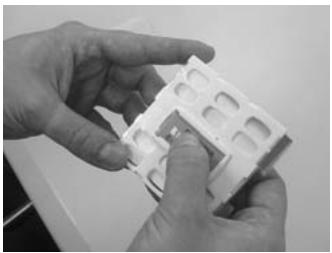
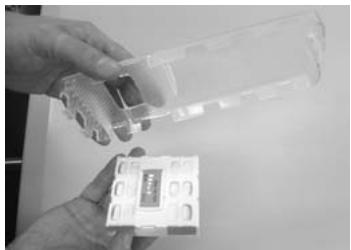
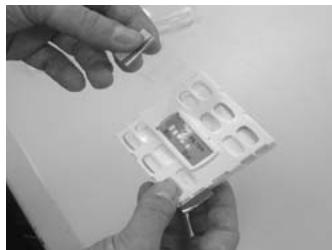
2.- Separate the filter from the cover (Fig.6) and remove the seals by pulling on the red tabs (Fig.7).
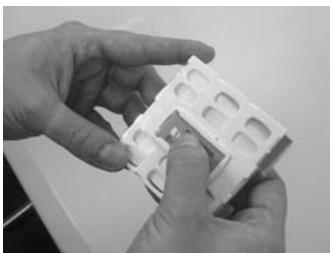
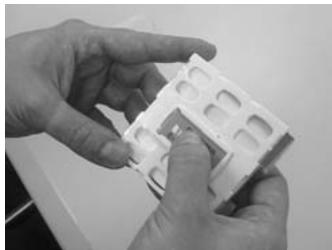
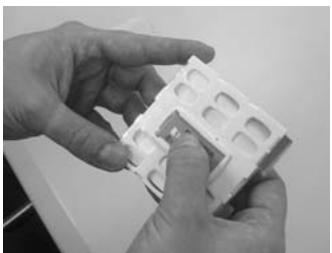
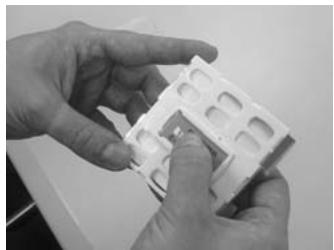
3.- Then press on the BIO FILTER window until you hear a click. After a few seconds the time scale will begin to colour in (Fig.8).
4.- Put the filter back in place and fit the cover into its corresponding recess (firstly position the lower part and then click the top part into place.)
natural_image
Close-up of hands holding a transparent plastic container and a small electronic device (no visible text or symbols)Fig.6
natural_image
Close-up of hands assembling a small electronic component with visible traces and pads (no text or symbols)Fig.7
natural_image
Close-up of hands holding a white plastic component with visible internal structure (no text or symbols)Fig.8
natural_image
Hand holding a transparent electronic device with a grid of buttons and a label (no readable text or symbols on the device itself)Fig.5
Duration and replacement
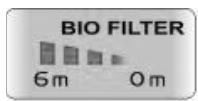
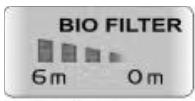
The BIO FILTER only maintains its properties for a certain time (approx. 6 months). The BIO FILTER window shows when it needs changing (Fig.9). To replace it, proceed as for activation. Spares can be purchased in the shop where you bought your refrigerator. The code 993010246 will be printed on the rear of the filter.
Valid window
visor sin caducar
Expired window
Fig.9
Caution

Keep all spares and used BIO FILTERs out of reach of children. It could be dangerous if swallowed in large amounts.

Do not get the BIO FILTER wet, as it will lose its properties.
FREEZER:
The amount of food to be frozen at once must not exceed the freezing power indicated on the specifications plate.
→ Ensure that your food to be frozen is in good conditions.
Observe the best-by date.
To prevent the food from drying out, wrap it in aluminium foil or plastic film.
Do not put food to be frozen in contact with food already frozen.
Never refreeze thawed food.
→ Freeze in daily servings.
Do not store bottles with carbonated drinks or glass bottles containing liquids in the freezer. They may burst.
Do not eat very cold ice-cream or food: this may burn the mouth.
→ Label the wrapping, indicating the content and the freezing date.
For maximum volume, we suggest that you remove the ice tray.
For best energy yield, keep the ice-cube holder full, along with the ice holder on the upper basket tray.
natural_image
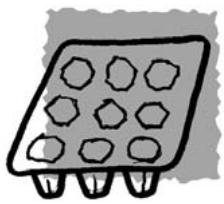
Simple line drawing of a tray with hexagonal patterns (no text or symbols)→ Fill the trays in the freezer up to three quarters, with water.
Place the trays in the freezer.
Once the water has frozen, the cubes can be removed by twisting the tray slightly. Store the cubes in the ice compartment.
DEFROSTING
No-Frost refrigerators do not generate layers of frost or ice, which means that no operations are required for their elimination.
In no case should any mechanical devices or other means be used to speed up the defrosting process.
DEFROSTING FOOD
Not all food should be defrosted in the same way
If you have bought frozen food, follow the instructions on the pack.
→ Vegetables should be cooked directly.
In general, prepared or pre-cooked foods can be cooked directly.
Meat and fish must be defrosted slowly in the refrigerator over several hours. If you have a microwave, this can speed this considerably.
5. CLEANING AND MAINTENANCE
CLEANING:
natural_image
Simple line drawing of a round, oval-shaped object with circular holes and a base, resembling a stylized fruit or vegetable (no text or symbols)Switch off the refrigerator using the ON/OFF button before starting to clean it.
Clean the interior with water or bicarbonate of soda, with the help of a sponge or cloth: this will prevent the formation of odours.
Never use steam cleaning machines, solvents or abrasive detergents, which may damage the inside of your refrigerator. Do not place the inside fittings in the dishwasher.
It is recommended that the rear grill be cleaned once year using a vacuum cleaner: if it is dusty and dirty, that reduces the refrigerator's performance and increases its consumption.
CHANGING THE LIGHT

natural_image
Simple line drawing of a glowing light bulb with rays, no text or symbols presentSwitch the refrigerator off.
Remove the light reflector cover by pressing the top tab.
Remove the bulb which has failed and replace it with another of the same sort, screw type E14, 220-240V, with a maximum of 15 W.
WHAT TO DO IN CASE OF A POWER OUTAGE:

natural_image
Symbol of a speaker with a crossed-out X mark, no text or numbers present→ If possible, do not open the refrigerator doors.
When power is restored, check to see if the food has unfrozen.
→ Consume any defrosted food immediately. Do not re-freeze!
WHAT TO DO IF THE REFRIGERATOR IS NOT TO BE USED FOR A LONG PERIOD OF TIME:
→ Empty the refrigerator.
Switch off and clean the appliance as described in the Cleaning section.
Leave the doors open to prevent formation of unwanted odours.
HOLIDAY function: If your refrigerator is to be out of use for any length of time and you wish to keep food in the freezer, you may switch off the appliance and activate the HOLIDAY function, leaving the door closed. The refrigerator will then function at a very low rate of consumption and no bad smells will be produced.
6. NORMAL REFRIGERATOR NOISE
natural_image
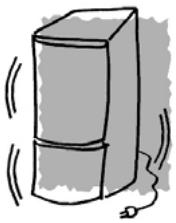
Simple line drawing of a refrigerator with motion lines indicating vibration (no text or symbols)The refrigerating gas may produce bubbling sounds as it flows through the circuits.
The compressor may buzz and/or produce slight knocking, which may be more marked on starting.
→ Cracking sounds produced by expansion and contraction of the materials used.
The insulation used amplifies sound levels.
You may hear a gentle murmur whwn your refrigerator is switched on. This is due to the working of a fan incorporated to ensure adequate air circulation inside the appliance.
You will note the effect of the fan in the freezer, which cools the whole of the refrigerator evenly.
7. TROUBLESHOOTING
| PROBLEM | CAUSE | SOLUTION |
| The refrigerator does not operate | It is not plugged in.There is no electrical current to the plug because the fuse has blown or the automatic power limiter has activated.The connection controls are not on. | Plug in.Change the fuse or reset the automatic power limiter.Switch the controls on. |
| The refrigerator vibrates. | The refrigerator is incorrectly levelled. | Level it, with the leveller bases. |
| The refrigerator or freezer is not very cold | Temperature selection is set too hot.The door is not properly closed or is opened very frequently.The space between the refrigerator and floor or the top of the refrigerator has been covered.The refrigerator is exposed to direct sunlight or a heat source.A large amount of food has been introduced.There is something obstructing the ventilation grilles | Set temperature selection to maximum cold.Ensure that the door does not remain open too long.Keep these areas free as described in the "Installation" section in this manual.Relocate the refrigerator or protect it from these heat sources.Consult the section on "operation and use of the refrigerator".Remove any obstacles blocking the air outlet of the ventilation grilles. |
| The motor runs permanently. | The doors are not properly closed.The doors are opened often.The food was introduced recently.Temperature selection in a high position. | Close the door properly.Avoid opening the door frequently.Wait for the appliance to return to normal.Set the temperature switch to less cold. |
| The door does not close. | The refrigerator is not correctly levelled.The door was closed violently.It is prevented from closing by a product inside. | Level the refrigerator correctly.Close the doors gently.Put this product in a suitable place. |
| A lot of ice at the front of the freezer drawers. | The door is open.The door has been opened often. | Check to see if food is preventing the door from being closed.Ensure that the door does not remain open for too long. |
| Odour in the refrigerator. | Some food is transmitting odours to the refrigerator. | Wrap the food or cover it correctly, or replace the BIO FILTER in models which have this function. |
| The food dries out. | The food is not properly wrapped. | Wrap the food or cover it correctly. |
| The refrigerator light does not come on. | The light is loose.It has blown.The plug is not connected to the power takeoff.There is no electrical current to the plug because the fuse has blown or the automatic power limiter has activated. | Screw it in properly.Change the light as explained in the manual.Plug in.Change the fuse or reset the automatic power limiter. |
8. TECHNICAL SERVICE CALLS
natural_image
Simple line drawing of a classic rotary telephone with keypad and buttons (no text or symbols)Read the manual carefully and, if you are unable to resolve the problem, call the technical assistance service.
The address and telephone number closest to your address appear in the index of official technical service offices we supply with the refrigerator, or in your city telephone directory.
To facilitate the work of the technical assistance service, please provide them with the following details.
• The refrigerator model.
• The refrigerator reference.
• Date of purchase.
• A description of the problem.
- Your home address and telephone number.
9. SPECIFICATIONS
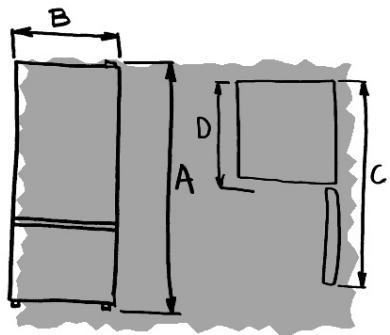
| DIMENSIONS | |||
| Height (mm) | A | 1860 | 2010 |
| Width (mm) | B | 600 | 600 |
| With door open (mm) | C | 1170 | 1170 |
| Depth (mm) | D | 610 | 610 |
THESE UNITS COMPLY WITH EEC DIRECTIVES 73/23, 93/68, 89/336, 92/75, 96/57, 94/2, 86/594, 2002/72.
INHALTSVERZEICHNIS
Seite
natural_image
Symbol of a trash bin crossed with a diagonal line and a horizontal bar below (no text or labels)natural_image
Simple line drawing of a vertical stack with heat lines indicating airflow or vibration (no text or symbols)
natural_image
Simple line drawing of a 3D rectangular box (no text or symbols)2. BESCHREIBUNG
natural_image
Simple graphic of an exclamation mark inside a gray square with radiating lines (no text or symbols)natural_image
Simple line drawing of a magnifying glass (no text or symbols)natural_image
Simple line drawing of a hand holding a plug and a socket (no text or symbols)natural_image
Close-up of a white mechanical component with two circular holes, no visible text or symbolsnatural_image
Close-up of a white door handle with two buttons and a handle (no text or symbols visible)Abb.2 Mittleres Scharnier
natural_image
Close-up of a mechanical component with a curved arrow indicating motion or force, no visible text or symbolsnatural_image
Simple line drawing of a thermometer with no text or symbolsSCHALTTAFEL (No-Frost)
natural_image
Interior view of a refrigerator showing the door, shelves, and internal components with arrows pointing to specific areas (no text or symbols visible)natural_image
Interior view of a refrigerator with open door and visible food items (no text or symbols)DOUBLE FRESH-SYSTEM
natural_image
Close-up of hands holding a transparent plastic container and a small electronic device (no visible text or symbols)Abb.6
natural_image
Close-up of hands holding a small electronic component with visible traces and pads (no text or symbols)Abb.7
natural_image
Close-up of hands assembling a white plastic component (no visible text or symbols)Abb.8
natural_image
Hand holding a transparent electronic device with a grid of buttons and a display (no visible text or symbols)Abb.5
natural_image
Simple line drawing of a tray with hexagonal patterns (no text or symbols)natural_image
Simple line drawing of a fish-like shape with circular holes and textured base, no text or symbols presentnatural_image
Simple line drawing of a glowing light bulb (no text or symbols)natural_image
Simple line drawing of a refrigerator with a handle and wheels (no text or symbols)natural_image
Simple line drawing of a classic rotary telephone with keypad and buttons (no text or symbols)natural_image
Symbol of a trash bin crossed with a diagonal line, no text or labels presentnatural_image
Simple line drawing of a refrigerator with no text or symbolsIMBALLAGGIO:
natural_image
Simple line drawing of a 3D rectangular box (no text or symbols)CARATTERISTICHE DELL'APPARECCHIO:
natural_image
Simple graphic of an exclamation mark inside a gray square with radiating lines (no text or symbols)natural_image
Simple line drawing of a magnifying glass (no text or symbols)natural_image
Simple line drawing of a plug and a wall socket (no text or symbols)natural_image
Close-up of a white mechanical component with two circular holes, no visible text or symbolsnatural_image
Close-up of a white door handle with two buttons and a handlebar (no text or symbols visible)Fig. 2 Cerniera centrale
natural_image
Close-up of a mechanical component with a curved arrow indicating motion or direction (no text or symbols visible)Fig. 3 Cerniera inferiore
natural_image
Simple line drawing of a thermometer with radiating lines (no text or symbols)PANNELLO DI CONTROLLO (No-Frost)
natural_image
Interior view of a refrigerator showing the refrigerator with labeled arrows pointing to internal components (no text or symbols present)natural_image
Interior view of a refrigerator with open door and visible food items (no text or symbols)SISTEMA DOUBLE FRESH
natural_image
Hand holding a transparent electronic device with a grid of buttons and a small display (no visible text or symbols)Fig.5
natural_image
Close-up of a hand holding a transparent plastic container and a small electronic device (no visible text or symbols)Fig.6
natural_image
Close-up of hands holding a small electronic component with visible traces and pads (no text or symbols)Fig.7
natural_image
Close-up of hands assembling a white plastic component (no visible text or symbols)Fig.8
natural_image
Simple line drawing of a tray with hexagonal patterns (no text or symbols)natural_image
Simple line drawing of a round, oval-shaped object with speckled texture and shadow (no text or symbols)natural_image
Simple line drawing of a glowing light bulb with rays (no text or symbols)natural_image
Simple line drawing of a speaker icon with a crossed-out X symbol (no text or numbers)natural_image
Simple line drawing of a refrigerator with motion lines indicating speed (no text or symbols)natural_image
Simple line drawing of a classic rotary telephone with keypad and buttons (no text or symbols)
- CARACTERÍSTICAS DEL APARATO:
- SISTEMA DOUBLE FRESH
- Duración y recambio
- EMBALAGEM:
- LOCALIZAÇÃO:
- PAINEL DE CONTROLO (No-Frost)
- DESCRIPTION DU REFRIGERATEUR
- SYSTEME MULTIFRESH
- SYSTEME DOUBLE FRESH
- CONTENTS
- SAFETY INFORMATION AND GENERAL INSTRUCTIONS
- RECYCLING:
- INFORMATION FOR THE CORRECT DISPOSAL OF ELECTRICAL AND ELECTRONIC APPLIANCES (RAEE)
- OLD REFRIGERATOR:
- PACKING:
- FEATURES OF THE REFRIGERATOR:
- DESCRIPTION OF THE REFRIGERATOR
- SAFETY:
- INSTALLATION
- LOCATION:
- ELECTRICAL CONNECTION:
- CHANGING THE DOOR-OPENING DIRECTION:
- TOOLS REQUIRED:
- PROCEDURE:
- BEFORE SWITCHING THE REFRIGERATOR ON:
- CONTROL PANEL (No-Frost)
- "ON/OFF"
- LED control panel
- Digital control panel
- "INTERNAL TEMPERATURE SELECTION"
- CORRECT USE OF THE APPLIANCE:
- REFRIGERATOR
- MULTIFRESH SYSTEM
- DOUBLE FRESH SYSTEM
- BIO FILTER
- Function
- Location
- Activation
- Duration and replacement
- Caution
- FREEZER:
- DEFROSTING
- DEFROSTING FOOD
- CLEANING AND MAINTENANCE
- CLEANING:
- CHANGING THE LIGHT
- WHAT TO DO IN CASE OF A POWER OUTAGE:
- WHAT TO DO IF THE REFRIGERATOR IS NOT TO BE USED FOR A LONG PERIOD OF TIME:
- NORMAL REFRIGERATOR NOISE
- TROUBLESHOOTING
- TECHNICAL SERVICE CALLS
- SPECIFICATIONS
- INHALTSVERZEICHNIS
- BESCHREIBUNG
- SCHALTTAFEL (No-Frost)
- DOUBLE FRESH-SYSTEM
- IMBALLAGGIO:
- CARATTERISTICHE DELL'APPARECCHIO:
- PANNELLO DI CONTROLLO (No-Frost)
Brand : THOMSON
Model : KGT330NWI
Category : Refrigerator