
EY-7552 - Power tool PANASONIC - Free user manual and instructions
Find the device manual for free EY-7552 PANASONIC in PDF.
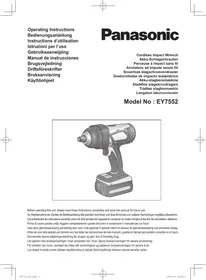


| Product type | Cordless impact drill |
| Brand | PANASONIC |
| Model | EY-7552 |
| Power supply | Li-ion 18 V DC battery (3.6 V x 10 cells) |
| Overall length | 214 mm |
| Weight (with battery) | 2.6 kg |
| No load speed | 0 - 1550 min⁻¹ |
| Maximum torque | 470 N·m |
| Impacts per minute | 0 - 2400 min⁻¹ |
| Tightening capacity (standard bolt) | M12 - M20 |
| Tightening capacity (high tensile bolt) | M12 - M18 |
| Compatible battery type | EY9L50, EY9L51 (Li-ion) |
| Compatible charger | EY0L81, EY0L82 |
| Charging time (EY9L50 with EY0L81) | Usable: 50 min, Full: 65 min |
| Charging time (EY9L51 with EY0L81) | Usable: 65 min, Full: 80 min |
| Charger weight | 0.93 kg |
| Safety | Switch lock, overheat protection, mandatory use of specific Panasonic battery |
| Maintenance | Clean with a dry, clean cloth. Do not use water, solvent, or volatile cleaner. |
| Main functions | Impact drilling, screwdriving, forward/reverse rotation, variable speed control, battery level indicator, overheat indicator |
Frequently Asked Questions - EY-7552 PANASONIC
User questions about EY-7552 PANASONIC
0 question about this device. Answer the ones you know or ask your own.
Ask a new question about this device
Download the instructions for your Power tool in PDF format for free! Find your manual EY-7552 - PANASONIC and take your electronic device back in hand. On this page are published all the documents necessary for the use of your device. EY-7552 by PANASONIC.
USER MANUAL EY-7552 PANASONIC
Cordless Impact Wrench
Before operating this unit, please read these instructions completely and save this manual for future use.
Original instructions: English. Translation of the original instructions: Other languages.
Read the "Safety Instructions" booklet and the following before using.
I. ADDITIONAL SAFETY RULES
1) Wear ear protectors when using the tool for extended periods. 2) Be aware that this tool is always in an operating condition, since it does not have to be plugged into an electrical outlet. 3) When screwing or driving into walls, floors, etc., "live" electrical wires may be encountered. DO NOT TOUCH THE HEX QUICK CHUCK OR ANY FRONT METAL PARTS OF THE TOOL! Hold the tool only by the plastic handle to prevent electric shock in case you screw or drive into a "live" wire. 4) Do NOT operate the Forward/Reverse lever when the main switch is on. The battery will discharge rapidly and damage to the unit may occur. 5) During charging, the charger may become slightly warm. This is normal.
Do NOT charge the battery for a long period.
6) When storing or carrying the tool, set the Forward/Reverse lever to the center position (switch lock). 7) Do not strain the tool by holding the speed control trigger halfway (speed control mode) so that the motor stops.
| Symbol | Meaning |
| V | Volts |
| --- | Direct current |
| n0 | No load speed |
| ... min-1 | Revolutions or reciprocations per minutes |
| Ah | Electrical capacity of battery pack |
| Read the operating instructions before use. | |
| For indoor use only. | |
WARNING:
- Do not use other than the Panasonic battery packs that are designed for use with this rechargeable tool.
- Panasonic is not responsible for any damage or accident caused by the use of recycled or counterfeit battery pack.
- Do not dispose of the battery pack in a fire, or expose it to excessive heat.
- Do not drive the likes of nails into the battery pack, subject it to shocks, dismantle it, or attempt to modify it.
- Do not allow metal objects to touch the battery pack terminals.
- Do not carry or store the battery pack in the same container as nails or similar metal objects.
- Do not charge the battery pack in a high-temperature location, such as next to a fire or in direct sunlight. Otherwise, the battery may overheat, catch fire, or explode.
- Never use other than the dedicated charger to charge the battery pack. Otherwise, the battery may leak, overheat, or explode.
- After removing the battery pack from the tool or the charger, always reattach the pack cover. Otherwise, the battery contacts could be shorted, leading to a risk of fire.
- When the Battery Pack Has Deteriorated, Replace It with a New One. Continued use of a damaged battery pack may result in heat generation, ignition or battery rupture.
II. ASSEMBLY
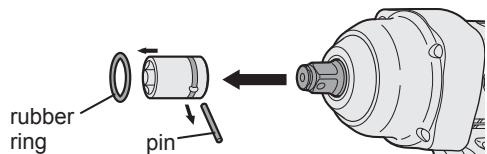
Attaching or Removing Socket
- Attaching Socket
1) Remove the rubber ring and pin.
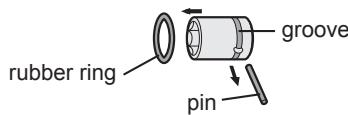
2) Attach the socket putting each holes.
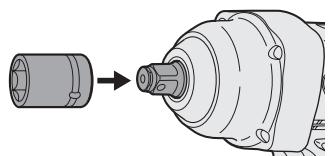
3) Attach the rubber ring and pin in reverse order of 1).
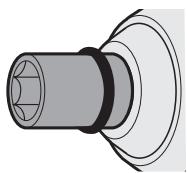
NOTE:
Attach socket firmly by using pin and rubber ring.
Retainer ring is only for temporary fixing.
- Removing Socket
1) Remove the rubber ring and pin.
Attaching or Removing Battery Pack
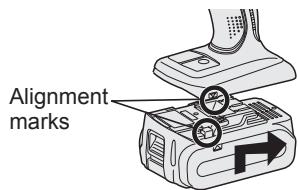
- To connect the battery pack:
Align the highlighted marker points and attach the battery pack.
- Slide the battery pack until it locks into position.
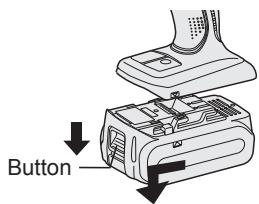
- To remove the battery pack:
Push the button and slide the battery pack forward.
III. OPERATION
WARNING!
- Do not inhale any smoke emitted from the tool or battery pack as it may be harmful.
[Main unit]
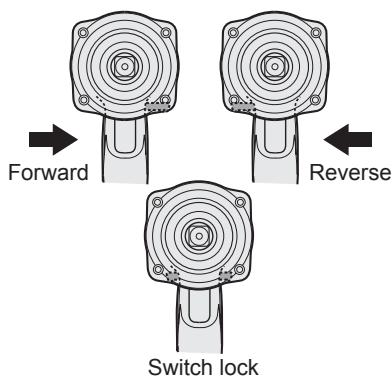
Switch and Forward/Reverse Lever Operation
CAUTION:
To prevent damage, do not operate the Forward/Reverse lever until the socket comes to a complete stop.
Forward Rotation Switch Operation
- Push the lever for forward rotation.
- Depress the trigger switch slightly to start the tool slowly.
- The speed increases with the amount of depression of the trigger for efficient tightening of bolts. The brake operates and the socket stops immediately when the trigger is released.
- After use, set the lever to its center position (switch lock).
Reverse Rotation Switch Operation
- Push the lever for reverse rotation. Check the direction of rotation before use.
- Depress the trigger switch slightly to start the tool slowly.
- After use, set the lever to its center position (switch lock).
CAUTION:
- To eliminate excessive temperature increase of the tool surface, do not operate the tool continuously using two or more battery packs. Tool needs cool off time before switching to another pack.
Variable Speed Control Trigger
To set the center of a hole, pull the trigger slightly to start the socket rotation slowly. The more the speed control trigger is pulled, the higher the speed becomes.
CAUTION:
When operating the tool by depressing the trigger, there may be a momentary lag before rotation starts. This does not signal a malfunction.
- This lag occurs as the tool's circuitry starts up when the trigger is pulled for the first time after installing a new battery pack or after the tool has not been used for at least 1 minute. Rotation will start without any lag during second and subsequent operations.
Indication panel
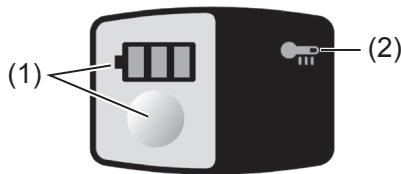
(1) Battery level indicator and button
- Press the battery level button.
The battery level indicator shows the battery level for approximately 10 seconds.
NOTE:
The indicator will not show the battery level even if the button is pushed in the following cases.
- The main unit is powered off.
- Just after attaching the battery pack.
- The main unit or battery level button has not been operated for approximately one minute. Push the battery level button again after depressing the trigger switch.
- The battery temperature is high. Stop the operation and wait until the battery temperature is low.
| Indicator | Battery status | |
| 3 lamps illuminated | Charged enough | |
| 2 lamps illuminated | Approx. 50% remaining | |
| One lamp illuminated | Battery level is low. Need to be charged soon | |
| One lamp flashing | Empty Need to be charged immediately | |
The battery level indication is just a guide.
The indication may change due to the condition of the battery or ambient temperature.
(2) Overheat warning lamp


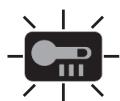
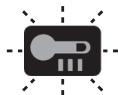
Off
(normal) operation
Illuminated:
Overheat (motor)
Flashing:
Overheat (battery)
Indicates operation has been halted due to motor or battery overheating.
To protect the motor or battery, be sure to note the following when carrying out this operation.
- If the motor or battery becomes hot, the protection function will be activated and the motor or battery will stop operating. The overheat warning lamp on the indication panel illuminates or flashes when this feature is active.
- If the overheating protection feature activates, allow the tool to cool thoroughly (at least 30 minutes). The tool is ready for use when the overheat warning lamp goes out.
- Avoid using the tool in a way that causes the overheating protection feature to activate repeatedly.
- If the tool is operated continuously under high-load conditions or if it is used in hot-temperature conditions (such as during summer), the overheating protection feature may activate frequently.
- If the tool is used in cold-temperature conditions (such as during winter) or if it is frequently stopped during use, the overheating protection feature may not activate.
Recommended Grip
Use the grip to hold and operate the driver with one hand. If the job requires additional force, you can push against the rear end of the driver with your other hand.
[Battery Pack] For Appropriate Use of Battery Pack Li-ion Battery Pack
- For optimum battery life, store the Li-ion battery pack following use without charging it.
- When charging the battery pack, confirm that the terminals on the battery charger are free of foreign substances such as dust and water etc. Clean the terminals before charging the battery pack if any foreign substances are found on the terminals.
The life of the battery pack terminals may be affected by foreign substances such as dust and water etc. during operation.
- When battery pack is not in use, keep it away from other metal objects like: paper clips, coins, keys, nails, screws, or other small metal objects that can make a connection from one terminal to another. Shorting the battery terminals together may cause sparks, burns or a fire.
- When operating the battery pack, make sure the work place is well ventilated.
- When the battery pack is removed from the main unit of the tool, replace the battery pack cover immediately in order to prevent dust or dirt from contaminating the battery terminals and causing a short circuit.
![PANASONIC EY-7552 - [Battery Pack] For Appropriate Use of Battery Pack Li-ion Battery Pack - 1](/content/2019/11/105311/images/b78686ad6d561f1515ca1dc7146ecdd1c0834f322ac0705138d1fcfecac17c1b.jpg)
Battery Pack Life
The rechargeable batteries have a limited life. If the operation time becomes extremely short after recharging, replace the battery pack with a new one.
Battery Recycling
ATTENTION:
For environmental protection and recycling of materials, be sure that it is disposed of at an officially assigned location, if there is one in your country.
Recommendations for use
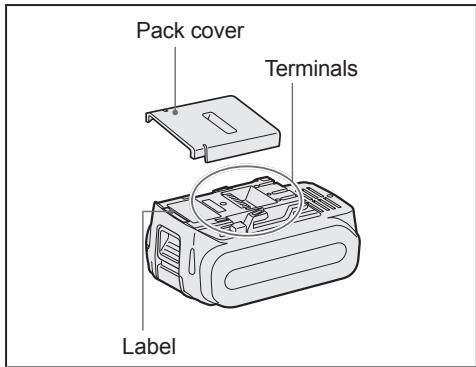
Be sure to use the Pack cover
- When the battery pack is not being used, store the battery in a way that foreign substances such as dust and water etc. do not contaminate the terminals. Be sure to attach the battery pack cover to protect the battery terminals.
- When charging the battery pack, confirm that the terminals on the battery charger are free of foreign substances such as dust and water etc. Clean the terminals before charging the battery pack if any foreign substances are found on the terminals.
The life of the battery pack terminals may be affected by foreign substances such as dust and water etc. during operation.
CAUTION:
To protect the motor or battery, be sure to note the following when carrying out operation.
- If the motor and battery become hot, the protection function will be activated and the motor and battery will stop operating.
For safe use
- The battery pack is designed to be installed by proceeding two steps for safety. Make sure the battery pack is installed properly to the main unit before use.
- If the battery pack is not connected firmly when the switch is switched on, the overheat warning lamp and the battery low warning lamp will flash to indicate that safe operation is not possible, and the main unit will not rotate normally. Connect the battery pack into the unit of the tool until the red or yellow label disappears.
[Battery Charger] Charging
CAUTION:
- The charger is designed to operate on standard domestic electrical power only as stated in the rating plate. Charge only on the voltage indicated on the rating plate of unit. e.g. 230V / 50Hz.
- Do not attempt to use it on any other voltage or frequency rating!
- If the temperature of the battery pack falls approximately below -10°C (14°F), charging will automatically stop to prevent degradation of the battery.
- The ambient temperature range is between 0°C (32°F) and 40°C (104°F). If the battery pack is used when the battery temperature is below 0°C (32°F), the tool may fail to function properly.
- Use the charger at temperatures between 0°C and 40°C, and charge the battery at a temperature similar to that of the battery itself. (There should be no more than a 15°C difference between the temperatures of the battery and the charging location.)
- When charging a cool battery pack (below 0°C (32°F)) in a warm place, leave the battery pack at the place and wait for more than one hour to warm up the battery to the level of the ambient temperature. Cool down the charger when charging more than two battery packs consecutively.
- Do not insert your fingers into contact hole, when holding charger or any other occasions.
CAUTION:
To prevent the risk of fire or damage to the battery charger.
- Do not cover vent holes on the charger and the battery pack.
- Unplug the charger when not in use.
NOTE:
Your battery pack is not fully charged at the time of purchase. Be sure to charge the battery before use.
How to charge
- Plug the charger into the AC outlet.
NOTE:
Sparks may be produced when the plug is inserted into the AC power supply, but this is not a problem in terms of safety.
- Connect the battery pack firmly into the charger.
1. Line up the alignment marks and place the battery onto the dock on the charger. 2. Slide forward in the direction of the arrow.
Alignment marks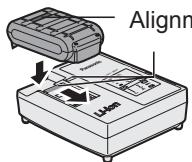
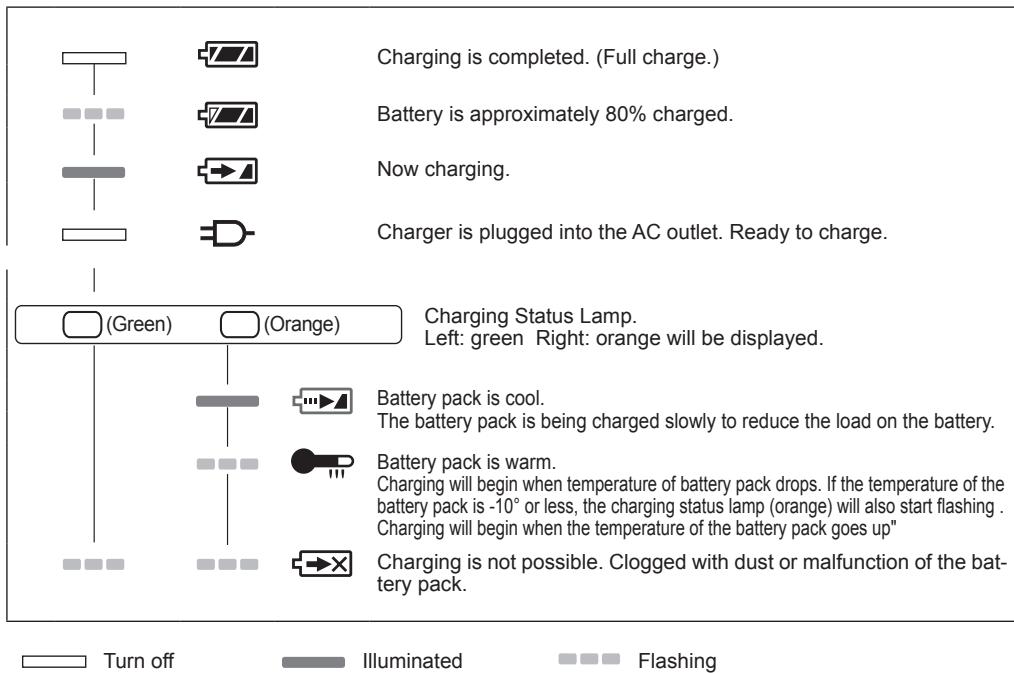
- During charging, the charging lamp will be illuminated.
When charging is completed, an internal electronic switch will automatically be triggered to prevent overcharging.
- Charging will not start if the battery pack is warm (for example, immediately after heavy-duty operation).
The orange standby lamp will flash until the battery cools down.
Charging will then begin automatically.
- The charge lamp (green) will flash slowly once the battery is approximately 80% charged.
- When charging is completed, the charging lamp in green color will turn off.
- If the temperature of the battery pack is 0°C or less, charging takes longer to fully charge the battery pack than the standard charging time.
Even when the battery is fully charged, it will have approximately 50% of the power of a fully charged battery at normal operating temperature.
- Consult an authorized dealer if the charging lamp (green) does not turn off.
- If a fully charged battery pack is inserted into the charger again, the charging lamp lights up. After several minutes, the charging lamp in green color will turn off.
- Remove the battery pack while the battery pack release button is held up.
Battery pack release button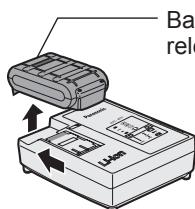
LAMP INDICATIONS
Information for Users on Collection and Disposal of Old Equipment and used Batteries

These symbols on the products, packaging, and/or accompanying documents mean that used electrical and electronic products and batteries should not be mixed with general household waste.
For proper treatment, recovery and recycling of old products and used batteries, please take them to applicable collection points, in accordance with your national legislation and the Directives 2002/96/EC and 2006/66/EC.
By disposing of these products and batteries correctly, you will help to save valuable resources and prevent any potential negative effects on human health and the environment which could otherwise arise from inappropriate waste handling.
For more information about collection and recycling of old products and batteries, please contact your local municipality, your waste disposal service or the point of sale where you purchased the items.
Penalties may be applicable for incorrect disposal of this waste, in accordance with national legislation.
For business users in the European Union
If you wish to discard electrical and electronic equipment, please contact your dealer or supplier for further information.
[Information on Disposal in other Countries outside the European Union]
These symbols are only valid in the European Union. If you wish to discard these items, please contact your local authorities or dealer and ask for the correct method of disposal.
IV. MAINTENANCE
- Use only a dry, soft cloth for wiping the unit. Do not use a damp cloth, thinner, benzine, or other volatile solvents for cleaning.
- In the event that the inside of the tool or battery pack is exposed to water, drain and allow to dry as soon as possible. Carefully remove any dust or iron filings that collect inside the tool. If you experience any problems operating the tool, consult with a repair shop.
V. TIGHTENING TORQUE
The power required for tightening a bolt will vary, according to bolt material and size, as well as the material being bolted. Choose the length of tightening time accordingly.
Reference values are provided below. (They may vary according to tightening conditions.)
Factors Affecting Tightening Torque
The tightening torque is affected by a wide variety of factors including the followings. After tightening, always check the torque with a torque wrench.
1) Voltage
When the battery pack becomes nearly discharged, the voltage decreases and the tightening torque drops.
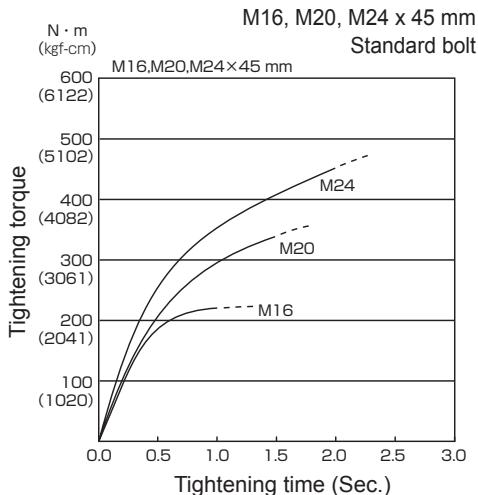
M16, M20, M24 x 45 mm
High tensile bolt
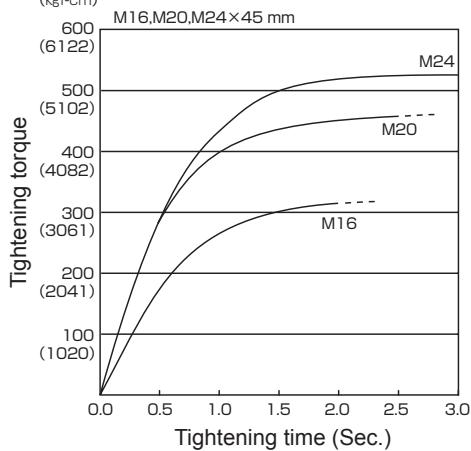
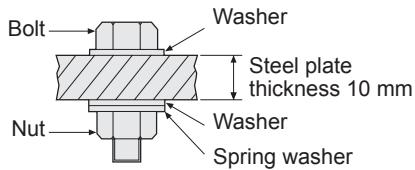
Tightening conditions
- The following bolts are used. Standard bolts: Strength type 4.8 High tensile type 12.9
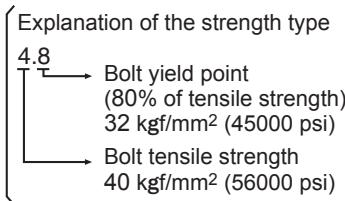
2) Tightening time
Longer tightening time results in increased tightening torque. Excessive tightening, however, adds no value and reduces the life of the tool.
3) Different bolt diameters
The size of the bolt diameter affects the tightening torque.
Generally, as the bolt diameter increases, tightening torque rises.
4) Tightening conditions
- Tightening torque will vary, even with the same bolt, according to grade, length, and torque coefficient (the fixed coefficient indicated by the manufacturer upon production).
- Tightening torque will vary, even with the same bolting material (e.g. steel), according to the surface finish.
- Torque is greatly reduced when the bolt and nut start turning together.
5) Socket play
Torque is lowered as the six-sided configuration of the socket of the wrong size is used to tighten a bolt.
6) Switch (Variable speed control trigger)
Torque is lowered if the unit is used with the switch not fully depressed.
7) Effect of Connecting Adaptor
The tightening torque will be lowered through the use of a universal joint or a connecting adaptor.
VI ACCESSORIES
Use only suitable size of socket.
VII. APPENDIX
MAXIMUM RECOMMENDED CAPACITIES
| Model | EY7552 |
| Bolt fastening | Standard bolt : M12 - M20 High tensile bolt : M12 - M18 |
WARRANTY SUPPLEMENT
The breakdown and damage caused by usage consistent for a long time (e.g.: factory work on the assembly line, etc.) is out of warranty.
VIII. SPECIFICATIONS
MAIN UNIT
| Model | EY7552 |
| Motor voltage | 18 V DC |
| No load speed | 0 - 1550 min-1 |
| Maximum torque | 470 N·m |
| Impact per minute | 0 - 2400 min-1 |
| Overall length | 214 mm |
| Weight (with battery pack: EY9L50) | 2.6 kg |
| Weight (with battery pack: EY9L51) | |
| Noise,Vibration | See the included sheet |
BATTERY PACK
| Model | EY9L50 | EY9L51 |
| Storage battery | Li-ion Battery | |
| Battery voltage | 18 V DC (3.6 V x 10 cells) | |
BATTERY CHARGER
| Model | EY0L81 | |
| Electrical rating | See the rating plate on the bottom of the charger | |
| Weight | 0.93 kg | |
| Charging time | EY9L50 | EY9L51 |
| Usable: 50 min | Usable: 65 min | |
| Full: 65 min | Full: 80 min | |
| Model | EY0L82 | |
| Electrical rating | See the rating plate on the bottom of the charger | |
| Weight | 0.93 kg | |
| Charging time | EY9L50 | EY9L51 |
| Usable: 40 min | Usable: 55 min | |
| Full: 55 min | Full: 70 min | |
NOTE: This chart may include models that are not available in your area.
Please refer to the latest general catalogue.
NOTE: For the dealer name and address, please see the included warranty card.
ONLY FOR U.K.
ELECTRICAL PLUG INFORMATION
FOR YOUR SAFETY PLEASE READ THE FOLLOWING TEXT CAREFULLY
This appliance is supplied with a moulded three pin mains plug for your safety and convenience.
A 5 amp fuse is fitted in this plug.
Should the fuse need to be replaced please ensure that the replacement fuse has a rating of 5 amp and that it is approved by ASTA or BSI to BS1362.
Check for the ASTA mark or the BSI mark on the body of the fuse.
If the plug contains a removable fuse cover you must ensure that it is refitted when the fuse is replaced.
If you lose the fuse cover the plug must not be used until a replacement cover is obtained.
A replacement fuse cover can be purchased from your local Panasonic Dealer.
IF THE FITTED MOULDED PLUG IS UNSUITABLE FOR THE SOCKET OUTLET IN YOUR HOME THEN THE FUSE SHOULD BE REMOVED AND THE PLUG CUT OFF AND DISPOSED OF SAFELY.
THERE IS A DANGER OF SEVERE ELECTRICAL SHOCK IF THE CUT OFF PLUG IS INSERTED INTO ANY 13 AMP SOCKET.
If a new plug is to be fitted please observe the wiring code as shown below.
If in any doubt please consult a qualified electrician.
IMPORTANT:
The wires in this mains lead are coloured in accordance with the following code:
Blue: Neutral
Brown: Live
As the colours of the wire in the mains lead of this appliance may not correspond with the coloured markings identifying the terminals in your plug, proceed as follows.
The wire which is coloured BLUE must be connected to the terminal in the plug which is marked with the letter N or coloured BLACK.
The wire which is coloured BROWN must be connected to the terminal in the plug which is marked with the letter L or coloured RED.
Under no circumstances should either of these wires be connected to the earth terminal of the three pin plug, marked with the letter E or the Earth Symbol 1/÷ .
How to replace the fuse: Open the fuse compartment with a screwdriver and replace the fuse and fuse cover if it is removable.
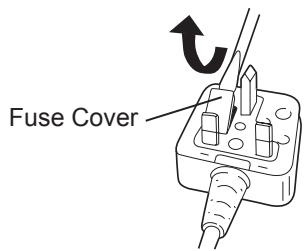
This apparatus was produced to BS800.
Blinking: Overheating (battery)
Li-ion battery pack
Illuminated: Overheat (motor)
Flashing: Overheat (battery)
Indicates operation has
been halted due to motor
or battery overheating.
Off (normal operation)
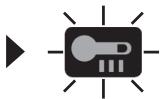
Illuminated: Overheat (motor)
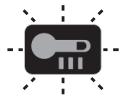
Flashing: Overheat (battery)
Indicates operation has been halted due to motor or battery overheating.
To protect the motor or battery, pay attention to the following when performing this work.
Off (normal operation)
Illuminated: Overheat (motor)
Flashing: Overheat (battery)
Indicates operation has been halted due to motor or battery overheating.
VIII. TECHNICAL DATA
MAIN DEVICE
- ADDITIONAL SAFETY RULES
- WARNING
- ASSEMBLY
- ATTACHING OR REMOVING SOCKET
- NOTE
- ATTACHING OR REMOVING BATTERY PACK
- OPERATION
- [MAIN UNIT]
- SWITCH AND FORWARD/REVERSE LEVER OPERATION
- CAUTION
- FORWARD ROTATION SWITCH OPERATION
- REVERSE ROTATION SWITCH OPERATION
- VARIABLE SPEED CONTROL TRIGGER
- INDICATION PANEL
- BATTERY LEVEL INDICATOR AND BUTTON
- OVERHEAT WARNING LAMP
- RECOMMENDED GRIP
- [BATTERY PACK] FOR APPROPRIATE USE OF BATTERY PACK LI-ION BATTERY PACK
- BATTERY PACK LIFE
- BATTERY RECYCLING
- ATTENTION
- RECOMMENDATIONS FOR USE
- BE SURE TO USE THE PACK COVER
- FOR SAFE USE
- [BATTERY CHARGER] CHARGING
- HOW TO CHARGE
- LAMP INDICATIONS
- INFORMATION FOR USERS ON COLLECTION AND DISPOSAL OF OLD EQUIPMENT AND USED BATTERIES
- FOR BUSINESS USERS IN THE EUROPEAN UNION
- [INFORMATION ON DISPOSAL IN OTHER COUNTRIES OUTSIDE THE EUROPEAN UNION]
- MAINTENANCE
- TIGHTENING TORQUE
- FACTORS AFFECTING TIGHTENING TORQUE
- VI ACCESSORIES
- APPENDIX
- WARRANTY SUPPLEMENT
- SPECIFICATIONS
- MAIN UNIT
- BATTERY PACK
- BATTERY CHARGER
- ONLY FOR U.K
- ELECTRICAL PLUG INFORMATION
- FOR YOUR SAFETY PLEASE READ THE FOLLOWING TEXT CAREFULLY
- IMPORTANT
- LI-ION BATTERY PACK
- TECHNICAL DATA
Brand : PANASONIC
Model : EY-7552
Category : Power tool