
EW3004E2 - Sphygmomanometer PANASONIC - Free user manual and instructions
Find the device manual for free EW3004E2 PANASONIC in PDF.


| Product Type | Wrist Blood Pressure Monitor |
| Brand | Panasonic |
| Model | EW3004E2 |
| Measurement Method | Oscillometric (Fuzzy Logic technology) |
| Blood Pressure Measurement Range | 0 – 280 mmHg |
| Blood Pressure Accuracy | ±3 mmHg |
| Pulse Measurement Range | 30 – 160 beats/min |
| Pulse Accuracy | ±5% |
| Compatible Wrist Circumference | 12.5 – 22.0 cm |
| Power Supply | 2 alkaline LR03/AAA 1.5 V batteries |
| Battery Life | Approximately 300 measurements (3 measurements/day for ~4 months) |
| Memory | Up to 42 days of measurements (automatic recording) |
| Auto Power Off | Approximately 5 minutes after measurement |
| Hypertension Indicator | Flashing values if SYS ≥ 140 mmHg or DIA ≥ 90 mmHg |
| Error Detection | Display 'E' in case of movement, incorrect positioning, or excessive pressure |
| Device Weight | 95 g (without batteries) |
| Operating Conditions | +10°C to +40°C, relative humidity 30% – 85% |
| Maintenance | Clean with a soft cloth and soapy water; do not use solvents |
| Standards | CE 0197, compliant with EN 1060-1/3, ANSI/AAMI SP10, EN 60601-1-2 |
| Recommended Recalibration | Every 3 years (see calibration seal) |
Frequently Asked Questions - EW3004E2 PANASONIC
User questions about EW3004E2 PANASONIC
0 question about this device. Answer the ones you know or ask your own.
Ask a new question about this device
Download the instructions for your Sphygmomanometer in PDF format for free! Find your manual EW3004E2 - PANASONIC and take your electronic device back in hand. On this page are published all the documents necessary for the use of your device. EW3004E2 by PANASONIC.
USER MANUAL EW3004E2 PANASONIC
Wrist Blood Pressure Monitor
Operating Instructions
EW3004
EU Representative:
Panasonic Marketing Europe GmbH
Hagenauer Straße 43 D-65203, Wiesbaden, Germany
Legal Manufacturer:
Matsushita Electric Works, Ltd.
33 Okamachi, Hikone, Shiga 522-8520, Japan
Panasonic
Wrist Blood Pressure Monitor
Operating instructions
EW3004

Before operating this device, please read these instructions completely and save this manual for future use.
Panasonic improves blood pressure assessment
Points of interest and information concerning blood pressure and high blood pressure

Dear customer, congratulation to the purchase of Panasonic blood pressure watch.
For more than a decade, Matsushita has been providing blood pressure measuring device to our customers in Europe. The product you have purchased has passed our strict quality control, and we hope that this can help you manage your daily blood pressure.
We wish you all the best for your health.
Thanks to modern medical technology measuring blood pressure is nowadays very easy to handle. The user-friendliness makes measuring a lot easier, but very often a mistake can occur when assessing the measured values. In the majority of cases it is not the whole blood pressure picture that is taken into account but only a single measurement. The result of this is that more than 70% of all hypertension sufferers are insufficiently treated or not treated at all (Source: World Health Organisation (WHO)). Now Panasonic revolutionizes the treatment of high blood pressure.

Blood pressure is not a fixed parameter!
The blood pressure fluctuations of this example of a day profile show why a single value is not suitable for diagnosis and therapy.
For people with high blood pressure a fluctuation of up to 50mmHg within the run of a day can occur.
The treatment of high blood pressure is one of the most successful forms of treatment in modern medicine. This applies not only when preventing complications due to high blood pressure, but also with regard to treating damage following a stroke or heart attack.
Recent studies have proven beyond all doubt that:
- high blood pressure can be successfully lowered in patients of every age and
- blood pressure should be stabilized at a low level.
The findings of major recent studies have made it necessary to adjust the formerly acceptable limits (the World Health Organization (WHO), 1999). In other words, the traditional limit of 160/95 mmHg as the borderline between normal and high blood pressure has now been reduced. Consequently, the normal values have been "lowered" by WHO, the German Hypertension Society and the American Hypertension Committee.
Upper value (SYS.) 140 mmHg Lower value (DIA.) 90 mmHg
Blood pressure exceeding both or either of these limits is considered hypertension.
The values should be confirmed by repeated measurements, though.
A pathologically high blood pressure is now defined as follows:
Systolic value of 140mmHg or more and/or a diastolic value of 90mmHg or more provided that these values are repeatedly obtained under standard conditions, i.e. at rest (measured at three different times on two different days).
This definition applies regardless of age. What formerly constituted a borderline area with systolic values between 140 and 159mmHg and diastolic values between 90 and 94mmHg is no longer considered to be a "grey area", but is quite clearly classed as high blood pressure. This consequently means that medical treatment is required for blood pressure values in excess of 140/90mmHg .
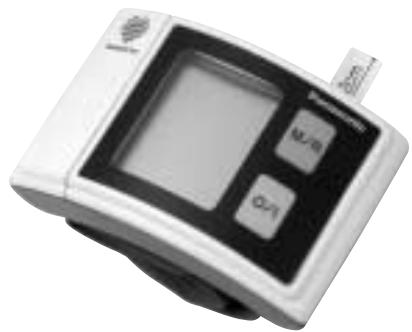
Diagram of the device
GB

Display symbols

Measurement in progress

Memory

e.g.: Wrist has been moved/ Cuff not positioned correctly

Average

Replace batteries
Batteries
Panasonic alkaline batteries (LR03/AAA/Micro) can be used for approximately 300 measurements (approximately 4 months, 3 times a day) at an ambient temperature of 22^ at 170mmHg for a wrist circumference of 17~cm . (The supplied batteries are included for trial purposes only. Accordingly, there is no guarantee regarding the length of their useful lives.)
- Battery life may be shortened if the ambient temperature is low.
- The number of measurements that can be taken with a set of batteries will be drastically reduced if batteries other than alkaline batteries are used. Use only alkaline batteries.
- Please replace both batteries at the same time and ensure that they are of the same type and make.
- Please remove the batteries from the device when not using it for extended periods of time as batteries can leak and damage the device.
Inserting/replacing batteries
Fitting the pressure cuff

Only use alkaline batteries.
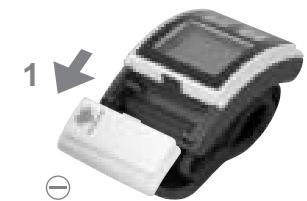


- Slide the battery cover open as shown in the diagram.
- Insert the two batteries making sure that they are aligned correctly (+ / - )
- Slide the battery cover shut until it clicks.
Batteries must be replaced when...
The replace batteries symbol appears on the display. Note: If rechargeable batteries are being used, the product may stop without prior warning when the batteries are exhausted.
Please help protect our environment by respecting national and/or local recycling regulations when disposing of the device and the batteries at the end of their useful lives.


Blood pressure is measured at your left wrist. It is not necessary to roll up your sleeve or to remove any clothing.


Wrist centerline
-
Use the 2 cm gauge to correctly position the device on your wrist.
-
Fold the 2 cm gauge vertically along the dotted line.
-
The gauge can be removed once you become familiar with positioning the device.
-
Place the device on the inside of your wrist.
-
Place the device directly in contact with the skin.
- The device can be used by people with a wrist circumference of 12.5 22.0 ~cm .
approx. 2cm
It should be approx. 2 cm below the base of the wrist; your wrist should be relaxed and your palm facing up.

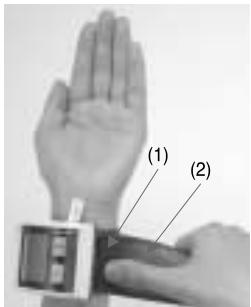
- Hold the cuff with your thumb as shown in the diagram and then fold back the hook and loop fastener and secure it.
(1) Hold the cuff down with your thumb.
(2) Firmly wrap and fasten using the hoop and loop fastener. A loosely applied pressure cuff will result in high blood readings. Pull up on the fastener, without twisting it, to remove the unit from your wrist.
Obtaining accurate measurements
GB
Always take your blood pressure at the same time while sitting in the same position and using the same wrist.
It is recommended to check your blood pressure at least twice a day. It is best in the morning before breakfast and in the evening after work.
- Relax and take a comfortable position on a chair for about 5 minutes before you take the measurement.
- Avoid to do any heavy work or sport for approx. 1 hour before the measurement.
- Avoid to eat, drink (coffee, alcohol) or smoke cigarette for approx. 1 hour before the measurement.
Always rest for four to five minutes before taking your blood pressure.
Taking measurements while sitting down
- Place your elbow on the table.
- Align the device with the level of your heart.
- Open and relax your hand with the palm facing up.
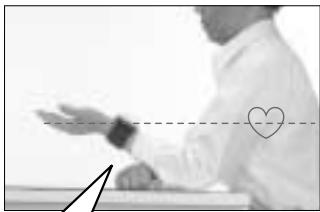

When sitting down to take your blood pressure, place the hand with the device over the other hand, which should be clenched slightly as shown above.
Be careful not to touch cuff during measurement.
Relax your hand and allow the wrist to droop slightly as shown below.
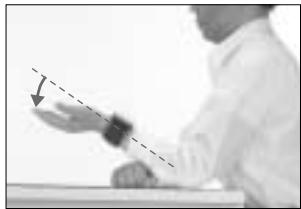
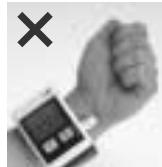
Do not take measurements in the positions shown below as they will be inaccurate.
Do not bend your wrist inward.
Do not clench your fist.


If the device is placed at a height lower than the heart then the resulting readings may be higher than your actual blood pressure.
If the device is placed at a height higher than the heart then the resulting readings may be lower than your actual blood pressure.
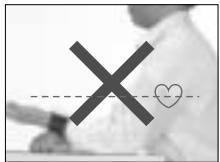

If you lean forward while taking measurements then the resulting readings may not be accurate.

To obtain accurate readings, the following actions should also be avoided during measurements.
- Do not touch the device.
- Do not change position or move your wrist or fingers.
- Do not talk.
[CAUTION]
Keep away from cellular telephones and other sources of electromagnetic radiation. Failure to do so could result in malfunctioning.
Measuring your blood pressure
GB
Sit still and relax while measurements are being taken.


-
Press the On/Off and Start button.
-
The display will flash for approx. 2 seconds.
Inflation will then begin automatically.
As measurements are being taken during pressurization, the frequency of the "beep" indicating pulse rate and the rate of pressurization may change. This is perfectly normal.
-
Place the slightly clenched fist of your other hand under the arm to which the device is attached. (See "Obtaining accurate measurements" on pages 30 and 31.)
-
The heart mark will begin to flash (with sound) during pressurization when the pulse is detected.
- When measurements have been completed, the device beeps and blood pressure and pulse rate are displayed.
- Pressure will automatically be released from the pressure cuff.
- If your blood pressure is considered to be in the hypertensive range, then the readings on the display will flash for approx. 6 seconds.
- The mark will flash. (Please see Page 34 for details regarding how to record readings.)
-
The pulse is estimated over the period of a minute based on the pulse rate recorded when measurements were being taken.
-
Press the On/Off and Start button to turn off the device.
-
If you wish to make another measurement, switch off and wait for 5 minutes before performing another one.
- If you forget to switch the device off, it will do so automatically after approx. 5 minutes.
Interpreting blood pressure readings
Blood pressure readings are interpreted in accordance with World Health Organization (WHO) and International Society of Hypertension (ISH) Guidelines for the Management of Hypertension. If your blood pressure is considered to be in the hypertensive range then the readings on the device will flash for approx. six seconds.


- When the blood pressure measurements obtained are in the hypertensive range the readings on the display will be flashed for approx. six seconds.
Systolic blood pressure ≥140 mmHg
Diastolic blood pressure ≥90 mmHg
(Only when measurement has been completed.)
When an error occurs during measurement

An "E" will appear on the display to indicate that measurement was unsuccessful and should be performed again.
Before performing another measurement, always press the On/Off and Start button to turn off the device and sit quietly for 5 minutes before attempting to carry out the measurement again.
Obtaining accurate readings
After measuring your blood pressure, wait quietly for four to five minutes before attempting to measure it again. In many cases the second reading will be more accurate that the first one because you are more relaxed and your blood pressure will have come down slightly. This is especially true for people who are easily stressed. The lower of these readings is normally used.
Saving and recalling data

Saving readings
- All data is retained even when the batteries go flat or are changed.

(After approx. one second.)
- After measurement has been completed the M mark will flash.
Press the Memory/Recall button.
-
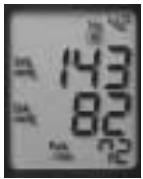
Saving complete.
-
Up to 42 sets of readings can be stored in memory and each is assigned a number. When the limit is reached, any new readings are recorded over existing readings starting with the oldest ones. The data numbers will also be changed.
- It is not possible to save readings when measurement has not been carried out successfully (i.e. when an “E” is displayed). As nothing will be recorded the data number will not be changed.
- Readings can, however, be saved when the "E" mark is displayed for the pulse rate.
Recalling Stored Data
Readings can be recalled after being saved without having to first turn the device on.


(After approx. one second.)
-
Press the Memory/Recall button.
-
The average of all recorded readings will be displayed.
- The Avg mark will be displayed.
- If, for example, 42 sets of readings have been saved in the memory then the average of those 42 sets of readings will be displayed. If only one set of readings has been saved then the Avg. mark will not be displayed.
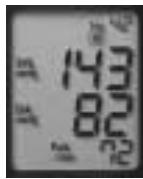
- Press the Memory/Recall button again to display the most recent reading.
Each time you press the Memory/Recall button another set of readings will be displayed, starting with the next most recent readings.
- Nothing will be displayed when no readings have been saved.
- Press the On/Off and Start button to turn off the device.
The device will turn off automatically after 30 seconds if you forget to turn it off.
Deleting all data stored in the memory
(1) Use the Memory/Recall button to access saved data.
(2) Press the Memory/Recall button again and hold it down for more than three seconds to delete all data.
- It is not possible to delete individual readings.
(3) When all data has been deleted the M mark and NIG will be displayed.
Care and maintenance
For your safety

Storing the device

- Fold the end of the pressure cuff in the direction of the arrow.
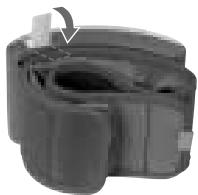
- Unfold the 2cm gauge so that it is straight in order to make it easy to store the device in the case.

- Next, fold the pressure cuff in on itself and secure it on loop fastener.
- Place the device in the storage case.
Always follow your physician's instruction when taking medication.
Please consult your doctor as to the most appropriate time to measure your blood pressure if you are receiving medication.
People with cardiac pacemakers, cardiac arrhythmia, vascular constriction or liver disorders as well as diabetics should consult their doctor before measuring their blood pressure themselves, since different values may be measured in such cases. The same also applies during pregnancy.
The Diagnostec is no toy for children!
In case you measure your child's blood pressure, always consult your doctor since the data cannot be compared with the standard adult's data.
Always remove your watch or jewellery from your wrist before using your new Diagnostec. This will prevent damage to the inside of the cuff and reduce the risk of inaccurate measurement.
Do not switch on the Diagnostec until the cuff has been secured around your wrist. The cuff might get damaged by excess pressure built up, if the device is not secured to the wrist.
Caring for the device
Troubleshooting

Please do not attempt to disassemble, repair or modify the device.
This may cause fire or cause the device to malfunction. It may also lead to injury.
Please do not fold the pressure cuff back against itself.
Always use the pressure cuff on your wrist and nowhere else.
- Either of these actions may cause the device to malfunction.
Do not use excessive force on the device.
Do not drop the device.
Measurements may be impaired if the device is used close to televisions, microwave ovens, X-ray equipment or other devices with strong electrical fields.
Please measure your blood pressure at a sufficient distance from such devices or switch them off.
The cuff may lose some of its elasticity at temperatures below 0^ . If the device is exposed to such extreme temperatures, it is a good idea to leave it until it warms up to room temperature before taking the next measurement.
As a basic principle, the device should not be exposed to extreme conditions (cold, heat, humidity, dust).
Do not allow dust or other foreign objects to enter the device as this may cause it to malfunction.
Cleaning the device
- Do not use anything other than a cloth with warm water and a little soapy to wipe the device.
- Do not use thinners, benzene, or alcohol on the device as this may cause discoloration and cracks.
- Cuff can not be washed.
Storage
- Avoid exposing the device to high temperatures, high humidity and direct sunlight as this can cause the device to malfunction.
Long-term storage
- Remove the batteries before storing the device for long periods of time.
Failure to do so may result in the batteries leaking, which may cause the device to malfunction.
| Display | Symptom prior to error display | Solution |
| A flashing “E” is displayed. | Pressure has exceeded 280 mmHg. (The device repressurizes repeatedly.) | Are you carrying out measurement properly and in the correct position? (Please see page 30~31.) |
| Pressure has suddenly dropped. | ||
| Heart mark ∠ flashed only a couple of times or not at all. | Have you positioned the pressure cuff correctly? (Please see page 29.) | |
| Pressure cuff does not inflate. |
Troubleshooting (cont.)
Measurement accuracy

| Symptom | Possible cause |
| The SYS or DIA is high. | ·The pressure cuff is positioned too low. (Please see page 30~31.) ·The pressure cuff is not wrapped around the wrist properly. (Please see page 29.) ·The person is moving or talking when the measurement is being carried out. (Please see page 30~31.) |
| The SYS or DIA is low. | ·The position of the pressure cuff is too high. (Please see page 30~31.) ·The person is moving or talking when the measurement is being carried out. (Please see page 30~31.) |
| Blood pressure is abnormally high or low. | ·The posture of the person is different each time measurements are carried out. (Please see page 30~31.) |
| Measurements are different from those taken by a doctor. Measurements are different each time. | ·The person is slightly tense when with the healthcare professional, causing the measurements to be different. ·Relax for ten minutes and then carry out the measurement again. |
| Measurements are different from those obtained using an upper arm type blood pressure meter. | ·There may be major differences in blood pressure recorded at the wrist and on the upper arm for people with peripheral circulatory problems. |
If the meter still appears to provide unusual or erroneous readings, consult your physician. If the meter does not appear to be functioning properly, contact an authorized service center.
General
This blood pressure measurement device complies with the European regulations (EU council directive 93/42/EEC dated June 14, 1993) and bears the CE mark "CE 0197". The quality of the device has been verified and it conforms to the following standards:
EN 1060-1 (Dec. 1995) Non-invasive blood pressure measuring equipment General requirement
EN 1060-3 (Sep. 1997) Non-invasive blood pressure measuring equipment Supplementary requirements for electromechanical blood pressure measuring systems
ANSI/AAMI SP10 (1992) Electronic or automated sphygmomanometers Overall system efficacy Auscultatory method as the reference standard
EN 60601-1-2 (Nov. 2001) Electromagnetic compatibility and safety for medical electrical equipment
The CE mark serves to facilitate the free movement of goods between the member countries of the EU.
Panasonic ensures accurate measurement
The seal confirms that each Diagnostec has been checked for accurate measurement at the Matsushita plant. It is recommended that the device be recalibrated every 3 years starting with the year printed on the seal.
CALIBRATED UNTIL

When the device has been repaired or the seal has been rendered illegible, the accuracy of the device should be assumed to be inaccurate. In such cases, it is recommended that the device be submitted for recalibration.
Technical data
EW 3004
Warning function
Method of measurement: (oscillometric)
Measuring range:
Measuring accuracy:
Leakage of pneumatic system: Inflation/deflation system:
Wrist circumference:
Batteries: (Control sign for battery change)
Automatic switch-off: Reference method for clinical trials: Weight:
Storage and transport conditions: Operating conditions:
Flashing figures on the display signal Intelligent measuring technology (FUZZY LOGIC)
Pressure: 0-280 mmHg
The device is vented automatically at pressures exceeding 280 mmHg and an error message is shown.
Pulse: 30-160 beats per minute
Pressure: ±3 mmHg
Pulse rate: ±5 %
≤ 6 mmHg/min
Automatic measurement during inflation, and rapid deflation
12.5-22.0 cm (4 7/8-8 5/8 inches)
2 × 1.5V alkaline (LR03/AAA/Micro)
Battery symbol appears when the batteries have to be replaced.
Approx. 5 minutes after measurement
Auscultatory measurement 95 g (without batteries)
- 20^ to +60^ , 10% to 95% RH
+10°C to +40°C, 30% to 85% RH
EW3004 was proven clinically by sequential comparison with auculatatory measurement. The waiting period before EW3004 evaluation requires 1.5-2 minutes, and before auscultatory measurement of 0.5-1 minute.
Panasonic
+10°C a +40°C, 30% a 85% HR
YcTaHOBka MaHXeTbI IJIa N3MepeHnKpOBrHOro DaBJIeHn

IcnoIb3yIte TOnIbKO IeNoOuHnbIe 6aTapeN.

1.CdBnHbTe KpbIuKy OTJeHeHna 6aTapeKak nok3aHo Ha pncyHke.

- UctaHOBtne IBe 6aTapeu n y6eHntecb B co6JIIOHeHm INx NOJIaRHOCTn (+/-).

- 3aKpoIe KpbIuKy OTdJIeHn6batapeTak, YTObI OHa3aUeJKNHynaCb.
BatapeIdoJXHbI6bITb3aMeHeHbBCneDyOuNXcLyAax:
KOrdaHaDnCnneeNoBnEaTcCmBOn 3aMeHb6aTapei.
PpimeaHaHe: npu nCnoB3OBAHN pO3apKaEmbIX aKKyMnyIaTOPOB,
ycTrooCTBO MoKeT pKePaNTb pa0To 6e3 ppeBaPntelbHoro
npedynpeXdaIoUero CnHaJa o pa3paJe 6aTapei.
Pn yTnIIm3aunm OTCnykmbwero yCtpoiCTBa nn 6aTaepen NOMHNTe O Heo6xOJIMOCr CoXpaHEHH OKpykaIOUe CpeDb n CObIHOaTe HaOnHOJIbHbIe I/IIIN MeCTHbIe HOpMaTINBbIe Tpe6OBaHnI NO yTnIIm3aunm OTXODOB.


KpoBraHoe daBHeHne n3MepeTcRa HebOM 3aIaCTbe. Bam HeT HeoXoIMMoCTn 3aKaTaBbTa pyKaB INI ChImaTb KaKyO-Ni6o OeJy.


JIINHNAOCN3aNACTBa
1.ИспοльзуITEинДиКаТОВ 2СМДЯnpавиьНOrO PACNoJOx经HyCTpoIcTbA Ha 3aJIrCTbe.
Pa3MeCTIte INDnKaTOp B 2cM BePTNKaJIbHO BIOJIb NHyKTpHoi JINHIN.
-Посл.TORO,Кak Bbl HayuNTecb
правиьно pa3MeUaTb yCTpoIcTBO,
Bbl MOKTe YdaJIbTu INHnIKaTOp.
2.YctahOBnTe yCTpoIcTBO Ha BHYTpEHHc CTOpOHe 3aHACTb.
- YCTPOICTBO IONJHNO HAXOIMTBCA B HENOCpeIcTBeHHOM KOHTaKTe C KOKJE.
YCTPOIcTBMOKETNCIOb3OBaTbCAJIIOBmCOKpyXHOCbTO3aIrCTbO 12,5do22,0cm.
OKOJIO 2cm
UcTpoIcTBo doJnKHO paCOnaRaTbCa npNbIeNtEnbHo Ha 2 CM HIXKE OCHOBAHIN 3aNACTb. 3aNCTbe doJnKHO bItb PaccIaBHeO n I aLoHb DoJnKHa 6bTb HapabLeHa BBePx.
He cTb6aIteBaIe 3aIaCTbe BHTpb.

He crnbaiTe naIbci b Kynak.
EcnB BO Bpemr
m3MEpeHNI Bbl
hAKIOHNTecb BnpePe,
peyTstatb m3MEpeHNI
MOYt 6bItb HcOTHbIM.

Длп получени точьх пoka3ан BO Времи n3мерени следует n3бeraТслedyошux DeiCTBn:
- PπuKaCaTbCa K yCtPoIcTBy.
- MeHATb IIOLOXeHne, IBNrA Tb 3aIaCTbeM INIINaJIbUaMn.
Pa3roBapnBaTb.
[OCTOPOXKHO]
CoxpaHHeNc N Bbl3OB DaHHbIX n3 NaMaTn

CoxpaheHne nokaahn
- Bce daHbIe coXpaHIOrTaB nAmTn, daKe npu pa3PAnke nn 13BLeueHnn 6aTapei.

- После заевшени Изөрөний на дүлүee Бүдүмогтбснвов [M].
HaxmTe KhoNky PAmTb/Bbl3OB n3 PAmTn.
(ПиблзИтелно черes OndHy sekyну.)

- Coxpanenpeyntata3abepseho
-Прибор можетхан'tь в памгтп do 42 pe3ультыов, кадому n3 KOТOPbIX писваньаeTCСВОHOMeP. Пи заллени пamгт, HOБbie NOKa3AHNЯ 3aINcblBaOTcHa MeCTO CTapbIX, HauHnA C CambIX CTapbIX NOkA3aHn. Homepa daHHbx TAKKe n3MeHЯOTcR.
- Пиошибке в Измеренгийх (нанример, кога на дисп lee поьлесс симьол "E") pe3ультаты тaknx Измерени He могут 6ытс coхранны. Homeдадньх He Измehntс, ТAK КАК NOKAЗань He 6удт 3aпиcaHbl.
*PnI NOBHeHn Ha nCnPiee CmMbOla Oun6Kn "E" IJy N3MepeHn nyIbCa, pe3yIbTaTbI N3MepeHn DaBHeHn BCE Xe MoYr 6bITb 3aHeceHb B nAmTb.
Bb3OB daHHbIX, 3aHeceHHbIX B nAMrTb
Iocne coxpanen, pe3yntaTbI n3MepeHn MOrY 6blTb Bbl3BaHbl n3 pamrtn 6e3 nepBOHaayalbHOrO BKlIOUeHn yCTpoiCTBa.

He 3aTnBaIe MaXkety camy Ha ce6e.
IcnoJIb3yIe MaHKeTy ToJIbKO Ha 3aIaCTbe, Hn Ha KaKnx DpyrNx YacTEx Tena.
-Пибoe,и3уka3aHHbIX HINKe DeiCTBn,MOKET npuBecTu K NOBpeJdeHIO yctpoIcTba.
He npinaraTe n3linuHnx ycInn K yctpoiCTBy.
He poHnTe yCTpoNCTBO.
IcnoB3ObaHne np6opa pRdOM c TeLEBn3OpamM, MKNpOBONHObblm neaam, peHTREHOBCKIM O6OpyDobAHMe HIN dpyrMMo6OpyDobAHMe C cnHbIMMaHnTHbIMNoJAMM, MoKet PnPBecT N nOlyeHHo HeoCTOBepHbIXpe3ynbTAoB.
ПобODиTe I3МepeHnI KpOBrHOrO IaBJIeHnI Ha IOCTaTOUHOM paCCTOHRN O TAKINx yCTpoiCTB ИИ NbIKJIOnuHTe INx HA BpEry I3MepeHnI.
ПиТeMнepaTypax Hnke 0eC MaHxeta MoKet YactNHy OYtpaNTb CBOHO 3nactNHyOCTb.ЕслСУТРО CTPOI NOДБePraEcTc BOЗDEIcTBIO TAKIX TEmpeaTp,прд BынOLнEHNeM N3МePehN JENaTeNbHO DaTb EMy HarpeTbCSd KOMNHATOH TempepaTybI.
Kak npabnIO, yCTpoIcTBo He DOnJXHO NOpBepraTbC B03dEINCTBIO 3KCTpeMaJIbHbIX YcNOBNI OKpyKaIOUe CpeDbI (XONOa, TEPNa, BNArN, nblN).
He donyckaTe nonaHaHn Iblnn KauKx-Jn6o HOpOaHbIX npedMeTOB BHTpb yCTpoiCTBa. 3To MoKeT npIBeCTN K eRo HeuCnpaBHOcTn.
UcTka yctpoiCTBa
-ДячNTKN yctpoiCTBa nCNoJIb3yIte TOnbKO TkaHb, CMOueHHyO B Cnla6OMMbIbHOMpactBope.
He nCnoJb3yeTe pactBopnteH, 6eH3nH nIIN cInpt IyIa YIcTKn yCTpoIcTBA, TAK KAK 3TO MOKET npIBeCTN K OBeCzBeyuBaHNIO NOBpeXdEHNIO KOpNyCa.
MaHxeta He NpIeXkT CTnPke.
XpaHeHne
- ɪЗбэрαιэ Воздөйствян Ha пибор Вьсokих Temператур, Bьсokоь Вьжкстун To pямьix солпсчылүчeyн, тak KAK 3TO MOK ket BьзВаТь nolomkny пибopa.
ДиNTeIbHoe xpaHHeHne
- PeredДлгельнхран electваизbleкпги з Heroбатер. HecobdIoHeHne 3TOrTOpeBOBaHnMOKET npBbctN K yTeYke 6 batapen n noCleNyOuSeI nonOMKe npMOba.
YcIOBnA3KcNpyatauIN:
HaKaunBaHnI N 6bIcTpbI C6pO B03dyxA
2x1,5B,ueiouHbIe (LR03/AAA/Micro)
CnBb05aTepen noBnBETc npn heo60xmoCTn 3ameHb 6tap
Пибштейногуpeз 5MHHTNOCIN3MepenHn
MetoconocTablenia
AускунытacnoHHbIe n3MepeHnA
95 r (6e3 6aTapei)
YcnoBxaHHeHnI
OT-20°C Φo+60°C, OTHOCHTeJIbHaI
BnaXHOCTbOT 10%do95%
OT + 10 °C IDO + 40 °C, OTHOCHTeNbHa
BnaXHOCTbOT 30 % 85%

- Operating Instructions
- Panasonic
- Panasonic improves blood pressure assessment
- Points of interest and information concerning blood pressure and high blood pressure
- Blood pressure is not a fixed parameter!
- Recent studies have proven beyond all doubt that:
- Upper value (SYS.) 140 mmHg Lower value (DIA.) 90 mmHg
- Diagram of the device
- Display symbols
- Batteries
- Inserting/replacing batteries
- Fitting the pressure cuff
- Batteries must be replaced when...
- Obtaining accurate measurements
- Always take your blood pressure at the same time while sitting in the same position and using the same wrist.
- Taking measurements while sitting down
- [CAUTION]
- Measuring your blood pressure
- Interpreting blood pressure readings
- When an error occurs during measurement
- Obtaining accurate readings
- Saving and recalling data
- Saving readings
- Recalling Stored Data
- Deleting all data stored in the memory
- Care and maintenance
- For your safety
- Storing the device
- Caring for the device
- Troubleshooting
- Cleaning the device
- Storage
- Long-term storage
- Troubleshooting (cont.)
- Measurement accuracy
- General
- Panasonic ensures accurate measurement
- Technical data
- EW 3004
- YcTaHOBka MaHXeTbI IJIa N3MepeHnKpOBrHOro DaBJIeHn
- BatapeIdoJXHbI6bITb3aMeHeHbBCneDyOuNXcLyAax:
- [OCTOPOXKHO]
- CoxpaHHeNc N Bbl3OB DaHHbIX n3 NaMaTn
- CoxpaheHne nokaahn
- Bb3OB daHHbIX, 3aHeceHHbIX B nAMrTb
Brand : PANASONIC
Model : EW3004E2
Category : Sphygmomanometer