
EW-BW10 - Sphygmomanometer PANASONIC - Free user manual and instructions
Find the device manual for free EW-BW10 PANASONIC in PDF.


| Product Type | Blood Pressure Monitor |
| Brand | Panasonic |
| Model | EW-BW10 |
| Measurement Method | Oscillometric |
| Cuff Size | 22–32 cm (standard arm circumference) |
| Display | Digital LCD |
| Memory Capacity | Up to 30 readings per user |
| Power Source | 4 AAA batteries (included) or optional AC adapter |
| Battery Life | Approximately 300 measurements |
| Auto Shut-Off | Yes, after 1 minute of inactivity |
| Irregular Heartbeat Detection | Yes |
| Blood Pressure Classification | WHO blood pressure classification indicator |
| Measurement Range | Systolic: 60–260 mmHg, Diastolic: 40–200 mmHg, Pulse: 40–200 bpm |
| Accuracy | ±3 mmHg for blood pressure, ±5% for pulse |
| Dimensions | Approx. 140 mm x 60 mm x 30 mm |
| Weight | Approx. 250 g (without batteries) |
| Cleaning | Wipe with a soft, dry cloth; do not use abrasive cleaners |
| Storage Conditions | Temperature: -20°C to 60°C, Humidity: 10% to 90% RH |
| Accessories Included | Arm cuff, 4 AAA batteries, instruction manual, storage case |
| Warranty | 2 years from date of purchase (excluding batteries and cuff) |
Frequently Asked Questions - EW-BW10 PANASONIC
User questions about EW-BW10 PANASONIC
0 question about this device. Answer the ones you know or ask your own.
Ask a new question about this device
Download the instructions for your Sphygmomanometer in PDF format for free! Find your manual EW-BW10 - PANASONIC and take your electronic device back in hand. On this page are published all the documents necessary for the use of your device. EW-BW10 by PANASONIC.
USER MANUAL EW-BW10 PANASONIC
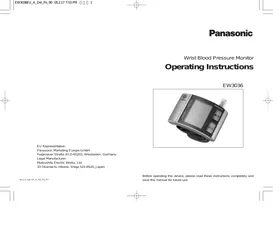
Operating instructions
Mode d'emploi
Istruzioni d'uso
Wrist Blood Pressure Monitor
REF Model No. EW-BW10

EU Representative / Mandataire
Panasonic Marketing Europe GmbH
Hagenauer Straße 43 D-65203, Wiesbaden, Germany

Legal Manufacturer / Fabricant
Panasonic Electric Works Co., Ltd.
33 Okamachi, Hikone, Shiga 522-8520, Japan

W9030BW10801
First issue date: 2010-00-00
B No.1
Before operating this device, please read these instructions completely and save this manual for future use.
Panasonic Wrist Blood Pressure Monitor Model EW-BW10 is a device intended to measure systolic and diastolic blood pressure and pulse rate of an adult individual by using a pressurized cuff on the wrist. The device is designed for people who have an intention of measuring blood pressure value periodically by self measurement and not intended for continuous BP measurement (e.g. 24h measurement).
In case the device repeatedly detects irregularities, please consult your doctor.
People with cardiac pacemakers, cardiac arrhythmia, vascular constriction, liver disorders or diabetics should consult their doctor as different values may be measured in such cases. The same also applies during pregnancy.
Contact health professionals if prehypertensive or hypertensive values are indicated.
2
Français
Panasonic improves blood pressure assessment
Dear customer, congratulation on the purchase of this Panasonic blood pressure monitor.
Since 1992, Panasonic has been providing blood pressure measuring devices to our customers in Europe. The product you have purchased has passed our strict quality control, and shall help you manage your daily blood pressure.
We wish you all the best for your health.
Thanks to modern medical technology measuring blood pressure has now become uncomplicated. The user-friendliness makes measuring a lot easier, but very often a mistake can occur when assessing the measured values. In the majority of cases it is not the whole blood pressure picture that is taken into account but only a single measurement.
The result of this is that more than 70 % of all hypertension sufferers are insufficiently treated or not treated at all (Source: World Health Organization (WHO)).
Now Panasonic revolutionizes the treatment of high blood pressure.
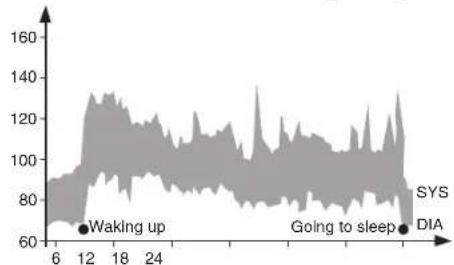
Blood pressure is not a fixed parameter!
The blood pressure fluctuations of this example of a day profile show why a single value is not suitable for diagnosis and therapy.
For people with high blood pressure, a fluctuation of up to 50 mmHg within the course of a day can occur.
Points of interest and information concerning blood pressure and high blood pressure
The treatment of high blood pressure is one of the most successful forms of treatment in modern medicine. This applies not only when preventing complications due to high blood pressure, but also with regard to treating damage following a stroke or heart attack.
Recent studies have proven beyond all doubt that:
- high blood pressure can be successfully lowered in patients of every age and
- blood pressure should be stabilized at a low level.
The findings of major recent studies have made it necessary to adjust the formerly acceptable limits (the World Health Organization (WHO), 1999). In other words, the traditional limit of 160/95 mmHg as the borderline between normal and high blood pressure has now been reduced. Consequently, the normal values have been "lowered" by WHO, the German Hypertension Society and the American Hypertension Committee.
Upper value (SYS.) 140 mmHg Lower value (DIA.) 90 mmHg
Blood pressure exceeding both or either of these limits is considered hypertension.
The values should be confirmed by repeated measurements.
A pathologically high blood pressure is now defined as follows: Systolic value of 140 mmHg or more and/or a diastolic value of 90 mmHg or more—provided that these values are repeatedly obtained under standard conditions, i.e. at rest (measured at three different times on two different days).
This definition applies regardless of age. What formerly constituted a borderline area with systolic values between 140 and 159 mmHg and diastolic values between 90 and 94 mmHg is no longer considered to be a "grey area", but is quite clearly classed as high blood pressure. This consequently means that medical treatment is required for blood pressure values in excess of 140/90 mmHg.
About blood pressure
Blood pressure is the pressure of blood against the blood vessel walls.
Systolic blood pressure![graph TD A["Heart is contracting."] --> B["Blood is pumped out."] B --> C["Pressure against the blood vessel wall will rise."] C --> D["Maximum blood pressure"] style A fill:#f9f,stroke:#333 style D fill:#ccf,stroke:#333](/content/2026/06/1316640/images/69c756905e75960732adb7ea81c451863fd3e96e589806173b6fba7d0cd4d36a.jpg)
Diastolic blood pressure![graph TD A["Heart is dilating."] --> B["Blood is flowing back in."] B --> C["Pressure against the blood vessel wall will drop."] C --> D["Minimum blood pressure"] E["Dilation"] --> A](/content/2026/06/1316640/images/a5d25caaa3f2e71c9c4e2b9624d46fb2933b756f20f509bfbdc19df2cf0ec0dd.jpg)
Diagram of the device
* Only use alkaline batteries.
Body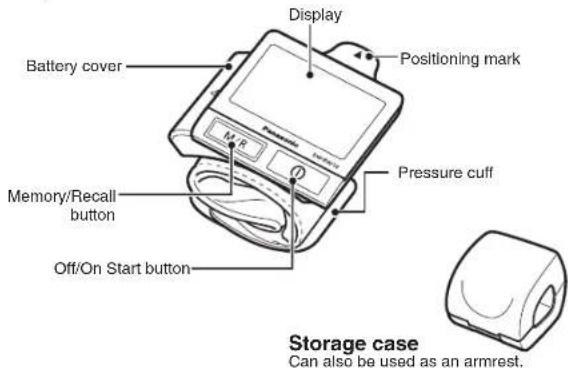
This product includes:
- Main unit
- Storage case
- Batteries
- Operating Instructions
- Guarantee card * Specifications of the product or parts may be changed without prior notice.
Inserting/replacing batteries
*Always use alkaline batteries. (2 AAA-size LR03 alkaline batteries) - When replacing batteries, always use 2 fresh alkaline batteries of the same type from the same manufacturer, and replace them simultaneously.

- Remove the device from the storage case.
Insert the batteries.
(1) Slide the battery cover open as shown in the diagram. (2) Insert the two batteries making sure that they are aligned correctly (+/-).
- Slide the battery cover shut until it clicks.

Replace batteries when:

- The "low battery" indicator is displayed.
- No display appears even if the Off/On Start button is pressed.
CAUTION:
• Always follow the cautions printed on the batteries. - Check the polarities of the batteries and install them correctly. - Remove exhausted batteries promptly. - If the product will not be used for a long time, remove the batteries. - Batteries should be used before their expiration date.
Use after the expiration date may result in injury or staining of the surrounding area due to generation of heat, bursting, or leakage.
For Batteries
- The frequency of use for batteries is approximately 300 measurements (3 times per day) with fresh Panasonic alkaline batteries (AAA-size LR03 alkaline batteries). (Measurement conditions: Room temperature 23°C; Pressurized to 170 mmHg; Wrist circumference: 17 cm)
- If batteries other than alkaline batteries are used, or if batteries are used in a cold room, and when measuring a person with high blood pressure, battery life may be dramatically shorter. *Use alkaline batteries. (Panasonic Oxyride batteries can also be used.)
- Be sure to replace batteries once a year to prevent battery leakage.
Please help protect our environment by respecting national and/or local recycling regulations when disposing of the device and the batteries at the end of their useful lives.

Fitting the pressure cuff
Blood pressure is measured at your left wrist. It is not necessary to roll up your sleeve or to remove any clothing.

- Place the device on the inside of your wrist.
- Place the device directly in contact with the skin.
- The device can be used by people with a wrist circumference of 12.5–22.0 cm.
Fitting the pressure cuff (cont.)
Base of the wrist

Wrap the pressure cuff so that the positioning mark will be at the center of the wrist.
- Firmly wrap and fasten using the hoop and loop fastener.
- A loosely applied pressure cuff will result in high blood readings or incapable measurement.
- Press fastener softly to avoid the peel off.
Do not remove the hoop and loop fastener by twisting it off. Be sure to peel it in an horizontal direction in alignment with the cuff
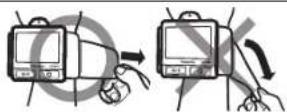
Fit as shown in the figure.

The cuff can be used on either wrist. However, the difference in blood pressure between the left and right wrists may be around 10 mmHg, so be sure to always use the same wrist for measurements.
Obtaining accurate measurements
Always take your blood pressure at the same time while sitting in the same position and using the same wrist.
It is recommended to check your blood pressure at least twice a day. It is best in the morning before breakfast and in the evening after work.
In the following situations, accurate measurements cannot be taken.
- Within 1 hour after eating or drinking alcohol
- Immediately after drinking coffee or tea, or smoking • In a moving vehicle
- Immediately after exercising or taking a bath (Wait at least 20 minutes and take a measurement while staying quiet.)
- In cold places (Take measurements at room temperatures around 20 °C.)
- When you need to urinate
(Wait several minutes after urinating before taking measurements.)
Always rest for four to five minutes before taking your blood pressure.
Taking measurements while sitting down
- Place your elbow on the table.
- Align the device with the level of your heart.
- Open and relax your hand with the palm facing up.

Obtaining accurate measurements (cont.)
Do not take measurements in the positions shown below as they will be inaccurate.


Do not bend your wrist inward. Do not clench your fist.
If the device is placed at a height lower than the heart then the resulting readings may be higher than your actual blood pressure.
If the device is placed at a height higher than the heart then the resulting readings may be lower than your actual blood pressure.
If you lean forward while taking measurements then the resulting readings may not be accurate.


To obtain accurate readings, the following actions should also be avoided during measurements.
- Do not touch the device.
- Do not change position or move your wrist or fingers.
- Do not talk.
[CAUTION]
Keep away from cellular telephones and other sources of electromagnetic radiation during measurements.
Failure to do so could result in blood pressure monitor malfunctioning.
Measuring your blood pressure


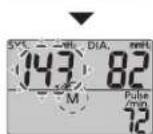

- Place the arm to which the device is attached on top of the storage case. (See "Obtaining accurate measurements" on pages en8 and en9.)
- Press the Off/On Start button.
- The display will be lit up for approx. 2 seconds. - Inflation will then begin automatically.
As measurements are being taken during pressurization, operating sounds and the rate of pressurization may change. This is perfectly normal.
• The heart mark will begin to flash during pressurization when the pulse is detected.
- When measurements have been completed, blood pressure and pulse rate are displayed.
- Pressure will automatically be released from the pressure cuff.
- If your blood pressure is considered to be in the hypertensive range, then the readings on the display will flash for approx. 6 seconds.
- The M mark will flash. (Please see en15 for details regarding how to record readings.) • The pulse is estimated over the period of a minute based on the pulse rate recorded when measurements were being taken.
- Press the Off/On Start button to turn off the device.
- If you forget to switch the device off, it will do so automatically after approx. 5 minutes.
Measuring your blood pressure (cont.)
Interpreting blood pressure readings
Blood pressure readings are interpreted in accordance with World Health Organization (WHO) and International Society of Hypertension (ISH) Guidelines for the Management of Hypertension. If your blood pressure is considered to be in the hypertensive range then the readings on the device will flash for approx. six seconds.

85 90 Diastolic (mmHg) *1 1999 World Health Organization-International Society of Hypertension Guidelines for the Management of Hypertension
- Blood pressure readings will flash for approx. 6 seconds when in the high blood pressure range.
Systolic blood pressure: 140 mmHg and over Diastolic blood pressure: 90 mmHg and over (Only when measurement is complete)
When an error occurs during measurement
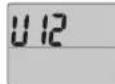
A UW appear on the display to indicate that measurement was unsuccessful and should be performed again.
Before performing another measurement, always press the Off/On Start button to turn off the device and sit quietly for 5 minutes before attempting to carry out the measurement again.
Obtaining accurate readings
After measuring your blood pressure, wait quietly for four to five minutes before attempting to measure it again. In many cases the second reading will be more accurate than the first one because you are more relaxed and your blood pressure will have come down slightly. This is especially true for people who are easily stressed. The lower of these readings is normally used.
Movement detection function
If movement is detected while measurement is being carried out and more pressure is applied by the pressure cuff, the Vmax will be displayed.
- Please carry out blood pressure measurement again if the mark flashes or is lit.
- If the hand or wrist to which the pressure cuff is attached is moved while measurement is being carried out (e.g. wrist is bent suddenly), in some cases correct measurements may not be obtained.
- When movement has been detected during measurement, the mark flashes when the blood pressure reading obtained during that measurement is displayed. (If this reading is saved, the Vlast will be lit up whenever it is recalled.)
| Movement Mark Explanation | |
 Flashing Flashing | Movement has been detected.The hand or wrist has been bent suddenly.The muscles in the hand or wrist have been tensed.The hand or wrist has been moved, etc.With proper posture, please take the measurement again after measurement has been completed(Please see pages en8 and en9). |
 Lit Lit | Movement has been detected that will significantly affect the reading.Significant movement has been detected.Movement has been detected repeatedly.Significant hand or wrist movement has been detected, etc.Please take the measurement again (A u 12 will appear on the display).* AU vll also appear on the display in the following cases:When the pressure cuff hook-and-loop fastener has become loose, etc. |
* This function is designed to help you to take measurements accurately. Even if the Movement mark is not displayed, we recommend that measurements be taken 2–3 times in a comfortable position in order to obtain an accurate reading.
Irregular pulse function
If the pulse rate varies by more than ±25 % from the average while a measurement is being taken, when measurement is completed the ▼□□□□ mark will be displayed.
- The 📂 will light up after approximately 6 seconds of blinking when the measurement is completed.
- If the 2A is lit, please take the measurement again.
- In some cases, if the pulse rate fluctuates greatly while a measurement is being taken, it may be impossible to obtain an accurate reading.


- If you save a reading where an irregular pulse was recorded, the mark will be displayed when you recall that reading.
Even if the ▼▲▲▲ is displayed, this doesn't mean whether or not the pulse is, in fact, irregular.
This function is designed to act as a guide to help you to obtain accurate readings (Please see pages en8 and en9).
Even if the ▼□□x is not displayed, we recommend that you take measurements 2–3 times at rest.
If the 7.4.4.4k is frequently displayed, please consult a health professional for your health condition.
Don't try to interpret readings or attempt to treat any condition yourself.
Always follow the guidance of a health professional.
English en14
Saving and recalling data
Saving Readings
- All data is retained even when the batteries go flat or are changed.
- The Mark will flash after measurement has been completed.
Press the Memory/Recall button.
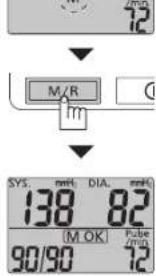
2. Saving complete.
- Up to 90 sets of readings can be stored in memory and each is assigned a number. When the limit is reached, any new readings are recorded over existing readings starting with the oldest ones. The data numbers will also be changed.
- It is not possible to save readings when measurement has not been carried out successfully (i.e. when a 12 is displayed). As nothing will be recorded, the data number will not be changed. * When the mark is displayed for the pulse rate, readings can be saved.
Recalling Stored Data
Readings can be recalled after being saved without having to first turn the device on.

1. Press the Memory/Recall button.
• The average of all recorded readings will be displayed. • The Amark will be displayed. - If, for example, 90 sets of readings have been saved in the memory, then the average of those 90 sets of readings will be displayed. If only one set of readings has been saved, then the Avg. mark will not be displayed.
2. Press the Memory/Recall button again to display the most recent reading.
• Each time you press the Memory/Recall button, another set of readings will be displayed, starting with the next most recent readings.
3. Press the Off/On Start button to turn off the device.
The device will turn off automatically after 30 seconds if you forget to turn it off.
Deleting all data stored in the memory
(1) Recall stored data. (2) Press the Memory/Recall button again and hold it down for more than three seconds to delete all data. * It is not possible to delete individual readings. (3) When all data has been deleted, the Mark and will be displayed.
Care and maintenance
Storing the device
- Fold the end of the pressure cuff in the direction of the arrow.
- Next, fold the pressure cuff in on itself and secure it on the loop fastener.
Place the device in the storage case.*

Battery cover side
Explanation of rating plate symbols
| Read the operating instructions carefully before use. | |
| Protection against electric shock Type BF applied part (Blood pressure monitor) | |
| ... | DC |
For your safety
This blood pressure monitor shall be used for the self-measurement of your blood pressure.
Always follow your physician's instructions when taking medication.
Please consult your doctor as to the most appropriate time to measure your blood pressure if you are receiving medication.
People with cardiac pacemakers, cardiac arrhythmia, vascular constriction, or liver disorders, as well as diabetics, should consult their doctor before measuring their blood pressure themselves, since different values may be measured in such cases. The same also applies during pregnancy.
The Diagnostec is no toy for children!
In case you measure your child's blood pressure, always consult your doctor since the data cannot be compared with the standard adult's data.
Always remove your watch or jewellery from your wrist before using your new Diagnostec. This will prevent damage to the inside of the cuff and reduce the risk of inaccurate measurement.
Do not switch on the Diagnostec until the cuff has been secured around your wrist. The cuff might get damaged by excess pressure built up if the device is not secured to the wrist.
Caring for the device
Please do not attempt to disassemble, repair or modify the device.
This may cause fire or cause the device to malfunction. It may also lead to injury.
Please do not fold the pressure cuff back against itself.
Always use the pressure cuff on your wrist and nowhere else.
Either of these actions may cause the device to malfunction.
Do not use excessive force on the device.
Do not drop the device.
Measurements may be impaired if the device is used close to televisions, microwave ovens, X-ray equipment or other devices with strong electrical fields.
Please measure your blood pressure at a sufficient distance from such devices or switch them off.
The cuff may lose some of its elasticity at temperatures below 0 °C. If the device is exposed to such extreme temperatures, it is a good idea to leave it until it warms up to room temperature before taking the next measurement.
As a basic principle, the device should not be exposed to extreme conditions (cold, heat, humidity, dust).
Do not allow dust or other foreign objects to enter the device as this may cause it to malfunction.
Cleaning the device
Do not use anything other than a cloth with warm water and a little soapy to wipe the device.
Do not use thinner, benzine, or alcohol on the device as this may cause discoloration and cracks.
- Cuff cannot be washed.
Storage
- Avoid exposing the device to high temperatures, high humidity, and direct sunlight, as this can cause the device to malfunction.
Long-term storage
- Remove the batteries before storing the device for long periods of time. Failure to do so may result in battery leakage, which may cause the device to malfunction.
Troubleshooting
| Display Status before error Cause and solution | ||
| U01is displayed. | The indication disappears in the middle of the operation.(the mark is displayed.) | Batteries are exhausted.(Please see page en5.) |
| U12is displayed. | Pressurization to more than 280 mmHg was performed.(Cuff pressurizes several times.) | Were measurements taken according to the proper procedure and in the correct posture?(Please see pages en8–en9.) |
| Pressure decreased suddenly. | Is the cuff wrapped properly?(Please see page en7.) | |
| The heart mark ♥ blinked only a few times or not at all. | ||
| Cuff does not inflate. | ||
| Your hand or wrist moved. | Has the unit detected movement?(Please see page en13.) | |
| F01is displayed. | Failure of the main unit | Take it to the store where it was purchased for testing and repairs. |
| Symptom Possible cause | |
| The SYS or DIA is high. | The pressure cuff is positioned too low.(Please see pages en6-en9.)The pressure cuff is not wrapped around the wrist properly.(Please see pages en6-en9.)The person is moving or talking when the measurement is being carried out.(Please see pages en6-en9.) |
| The SYS or DIA is low. | The position of the pressure cuff is too high.(Please see pages en6-en9.)The person is moving or talking when the measurement is being carried out.(Please see pages en6-en9.) |
Troubleshooting (cont.)
| Symptom Possible cause | |
| Blood pressure is abnormally high or low. | The posture of the person is different each time measurements are carried out.(Please see pages en6-en9.) |
| Measurements are different from those taken by a doctor.Measurements are different each time. | The person is slightly tense when with the healthcare professional, causing the measurements to be different.Relax for ten minutes and then carry out the measurement again. |
| Measurements are different from those obtained using an upper arm type blood pressure meter. | There may be major differences in blood pressure recorded at the wrist and on the upper arm for people with peripheral circulatory problems. |
| Varying sounds and pressurization speeds occur during inflation of the cuff. | Changes in operating sounds and pressurization speeds are normal and occur due to the fact that measurements are being made as the cuff is being inflated. |
| The mark flashes when readings are being taken. | There was a significant fluctuation in pulse when readings were being taken.(Please see page en14.) |
| The mark flashes when readings are being taken. | Your hand or wrist moved.(Please see page en13.) |
| The mark flashes even though I did not move my hand or wrist. | In some cases this will be displayed when you have tensed the muscles in your hand. Relax the muscles in your hand and take the reading again.(Please see page en13.) |
If the meter still appears to provide unusual or erroneous readings, consult your physician. If the meter does not appear to be functioning properly, contact an authorized service center.
Measurement accuracy
General
This blood pressure measurement device complies with the European regulations (EU council directive 93/42/EEC dated June 14, 1993) and bears the CE mark "CE 0197". The quality of the device has been verified and it conforms to the following standards:
EN 1060-1 (Dec. 1995) + A1 Non-invasive sphygmomanometers General requirement
EN 1060-3 (Sep. 1997) + A1 Non-invasive sphygmomanometers Supplementary requirements for electromechanical blood pressure measuring systems
EN1060-4 (Sep. 2004) Non-invasive sphygmomanometers. Test procedures to determine the overall system accuracy of automated non-invasive sphygmomanometers.
EN 60601-1-2 (Nov. 2001) + A1 Electromagnetic compatibility and safety for medical electrical equipment.
EN 60601-1 (Aug. 1990) + A1 + A2 Medical electrical equipment Part 1: General requirements for safety.
The CE mark serves to facilitate the free movement of goods between the member countries of the EU.
Panasonic ensures accurate measurement.
The seal confirms that each Diagnostec has been checked for accurate measurement at the Panasonic plant. It is recommended that the device be recalibrated after 3 years starting with the year printed on the seal. If you purchased the device less than 3 years before the year printed on the seal you can use the date of purchase. It is then recommended that the device be recalibrated after 3 years starting with the year of purchase.
When the device has been repaired or the seal has been rendered illegible, the accuracy of the device should be assumed to be inaccurate. In such cases, it is recommended that the device be submitted for recalibration.
CALIBRATED UNTIL
2013
CE0197
English en22
Technical data EW-BW10
Warning function: Flashing figures on the display signal.
Method of measurement: Oscillometric system.
Measuring range: Pressure: 0–280 mmHg
The device is vented automatically at pressures exceeding 280 mmHg and an error message is shown.
Pulse: 30–160 beats per minute
Measuring accuracy: Pressure: ± 3 mmHg
Pulse rate: ± 5 %
Leakage of pneumatic system: ≤ 6 mmHg/min
Inflation/deflation system: Automatic measurement during
inflation, and rapid deflation
Wrist circumference: 12.5–22.0 cm
Batteries: 2× 1.5 V alkaline (LR03/AAA/Micro)
(Control sign for battery change) Battery symbol appears when the
batteries have to be replaced.
Automatic switch-off: Approx. 5 minutes after measurement
Reference method for clinical trials: Auscultatory measurement
Weight: 110 g (without batteries)
Storage and transport conditions: -10 °C to +60 °C, 10 % to 95 % RH
Operating conditions: +10 °C to +40 °C, 30% to 85% RH
Protection against electric shock: Internally powered equipment, Type BF applied part
EW-BW10 was proven clinically by sequential comparison with
auscultatory measurement. The waiting period before EW-BW10 evaluation requires 1.5–2 minutes, and before auscultatory measurement, 0.5–1 minute.
Information for Users on Collection and Disposal of Old Equipment and Used Batteries


These symbols on the products, packaging, and/or accompanying documents mean that used electrical and electronic products and batteries should not be mixed with general household waste.
For proper treatment, recovery, and recycling of old products and used batteries, please take them to applicable collection points, in accordance with your national legislation and the Directives 2002/96/EC and 2006/66/EC.

By disposing of these products and batteries correctly, you will help to save valuable resources and prevent any potential negative effects on human health and the environment which could otherwise arise from inappropriate waste handling.
For more information about collection and recycling of old products and batteries, please contact your local municipality, your waste disposal service, or the point of sale where you purchased the items.
Penalties may be applicable for incorrect disposal of this waste, in accordance with national legislation.
For business users in the European Union
If you wish to discard electrical and electronic equipment,
please contact your dealer or supplier for further information.
[Information on Disposal in Other Countries Outside the European Union]
These symbols are only valid in the European Union. If you wish to discard these items, please contact your local authorities or dealer and ask for the correct method of disposal.
Note for the battery symbol (bottom two symbol examples):
This symbol might be used in combination with a chemical symbol. In this case it complies with the requirement set by the Directive for the chemical involved.
EMC Information of the model EW-BW10
The model EW-BW10 needs special precautions regarding EMC and needs to be used according to the following EMC information. Portable and mobile RF communications equipment can affect the model EW-BW10.
Accessories:
WARNING: There are no accessories recommended by the manufacturer for use with the model EW-BW10. The use of accessories other than those recommended by the manufacturer may result in increased emissions or decreased immunity of the model EW-BW10.
WARNING:
EW-BW10 should not be used adjacent to or stacked with other equipment. If adjacent or stacked use is necessary, the model EW-BW10 should be observed to verify normal operation in the configuration in which it will be used.
| Guidance and manufacturer's declaration - electromagnetic emissions | ||
| The model EW-BW10 is intended for use in the electromagnetic environment specified below. The customer or the user of the model EW-BW10 should assure that it is used in such an environment. | ||
| Emission test Compliance Electromagnetic environment – guidance | ||
| RF emissionsCISPR 11 | Group 1 The | model EW- BW10 uses RF energy only for its internal function. Therefore,its RF emissions are very low and are not likely to cause any interference in nearby electronic equipment. |
| RF emissionsCISPR 11 | Class B The | model EW- BW10 is suitable use in all establishments, including domestic establishments and those directly connected to the public low-voltage power supply network that supplies buildings used for domestic purposes. The Harmonic emissions and the voltage fluctuations/flicker emissions are not applicable because the model EW-BW10 is powered by built-in batteries. |
| Harmonic emissionsIEC 61000-3-2 | Not applicable | |
| Voltage fluctuations/flicker emissionsIEC 61000-3-3 | Not applicable | |
| Guidance and manufacturer's declaration - electromagnetic immunity | |||
| The model EW-BW10 is intended for use in the electromagnetic environment specified below. The customer or the user of the model EW-BW10 should assure that it is used in such an environment | |||
| Immunity test | IEC 60601 test level | Compliance level | Electromagnetic environment - guidance |
| Electrostatic discharge (ESD) IEC 61000-4-2 | 6 kV contact8 kV air | 6 kV contact8 kV air | Floors should be wood, concrete or ceramic tile. If floors are covered with synthetic material, the relative humidity should be at least 30 %. |
| Electrical fast transient/burst IEC 61000-4-4 | 2 kV for power supply lines1 kV for input/output lines | Not applicable | Not applicable because the model EW-BW10 is powered by built-in batteries and has no external cables. |
| Surge IEC 61000-4-5 | 1 kV for differential mode2 kV common mode | Not applicable | Not applicable because the model EW-BW10 is powered by built-in batteries. |
| Voltage dips, short interruptions and voltage variations on power supply input lines IEC 61000-4-11 | <5 % UT (>95 % dip in UT) for 0,5 cycle40 % UT (60 % dip In UT) for 5 cycles70 % UT (30 % dip In UT) for 25 cycles<5 % UT (>95 % dip in UT) for 5 cycle | Not applicable | Not applicable because the model EW-BW10 is powered by built-in batteries. |
| Power frequency (50/60 Hz) magnetic field IEC61000-4-8 | 3 A/m 3 A/m Power frequency magnetic fields should be at levels characteristic of a typical location in a typical commercial or hospital environment | ||
| Note: Ur is the a.c. mains voltage prior to application of the test level | |||
| Guidance and manufacturer's declaration – electromagnetic immunity | |||
| The model EW-BW10 is intended for use in the electromagnetic environment specified below. The customer or the user of the model EW-BW10 should assure that it is used in such an environment | |||
| Immunity test | IEC 60601 test level | Compliance level | Electromagnetic environment – guidance |
| Conducted RF IEC 61000-4-6Radiated RF IEC 61000-4-3 | 3 Vrms150 kHz to80 MHz3 V/m80 MHz to2,5 GHz | Not applicable3 V/m | Portable and mobile RF communications equipment should be used no closer to any part of the model EW-BW10, including cables, than the recommended separation distance calculated from the equation applicable to the frequency of the transmitter.Recommended separation distanceNot applicable because the model EW-BW10 is powered by built-in batteries and has no external cables.d = 1,2 √P 80 MHz to 800 MHzd = 2,3 √P 800 MHz to 2.5 GHzwhere P is the maximum output power rating of the transmitter in watts (W) according to the transmitter manufacturer and d is the recommended separation distance in meters (m).Field strength from fixed RF transmitters, as determined by an electromagnetic site survey, a should be less than the compliance level in each frequency range. b Interference may occur in the vicinity of equipment marked with the following symbol:[IMAGE] |
| NOTE 1: At 80 MHz and 800 MHz, the higher frequency range applies.NOTE 2: These guidelines may not apply in all situations. Electromagnetic propagation is affected by absorption and reflection from structures, objects and people. | |||
Guidance and manufacturer's declaration – electromagnetic immunity
a) Field strengths from fixed transmitters, such as base stations for radio (cellular/cordless) telephones and land mobile radios, amateur radio, AM and FM radio broadcast and TV broadcast cannot be predicted theoretically with accuracy. To assess the electromagnetic environment due to fixed RF transmitters, an electromagnetic site survey should be considered. If the measured field strength in the location in which the model EW-BW10 is used exceeds the applicable RF compliance level above, the model EW-BW10 should be observed to verify normal operation. If abnormal performance is observed, additional measures may be necessary, such as reorienting or relocating the model EW-BW10. b) Over the frequency range 150 kHz to 80 MHz, field strengths should be less than 3 V/m.
| Recommended separation distance between portable and mobile RF communications equipment and the model EW-BW10 | |||
| The model EW-BW10 is intended for use in an electromagnetic environment in which radiated RF disturbances are controlled. The customer or the user of the model EW-BW10 can help prevent electromagnetic interference by maintaining a minimum distance between portable and mobile RF communications equipment (transmitters) and the model EW-BW10 as recommended below, according to the maximum output power of the communications equipment. | |||
| Rated maximum output power of transmitter W | Separation distance according to frequency of transmitter m | ||
| 150 kHz to 80 MHz Not applicable | 80 MHz to 800 MHz d = 1,2 √P | 800 MHz to 2,5 GHz d = 2,3 √P | |
| 0,01 Not applicable 0,12 0,23 | |||
| 0,1 Not applicable 0,38 0,73 | |||
| 1 Not applicable 1,2 2,3 | |||
| 10 Not applicable 3,8 7,3 | |||
| 100 Not applicable 12 23 | |||
| For transmitters rated at a maximum output power not listed above, the recommended separation distance d in meters (m) can be estimated using the equation applicable to the frequency of the transmitter, where P is the maximum output power rating of the transmitter in watts (W) according to the transmitter manufacturerNOTE 1: At 80 MHz and 800 MHz, the separation distance for the higher frequency range applies.NOTE 2: These guidelines may not apply in all situations. Electromagnetic propagation is affected by absorption and reflection from structures, objects and people. | |||


- FRANÇAIS
- PANASONIC IMPROVES BLOOD PRESSURE ASSESSMENT
- POINTS OF INTEREST AND INFORMATION CONCERNING BLOOD PRESSURE AND HIGH BLOOD PRESSURE
- UPPER VALUE (SYS.) 140 MMHG LOWER VALUE (DIA.) 90 MMHG
- ABOUT BLOOD PRESSURE
- DIAGRAM OF THE DEVICE
- INSERTING/REPLACING BATTERIES
- FITTING THE PRESSURE CUFF
- FITTING THE PRESSURE CUFF (CONT.)
- OBTAINING ACCURATE MEASUREMENTS
- OBTAINING ACCURATE MEASUREMENTS (CONT.)
- [CAUTION]
- MEASURING YOUR BLOOD PRESSURE
- MEASURING YOUR BLOOD PRESSURE (CONT.)
- INTERPRETING BLOOD PRESSURE READINGS
- WHEN AN ERROR OCCURS DURING MEASUREMENT
- OBTAINING ACCURATE READINGS
- MOVEMENT DETECTION FUNCTION
- IRREGULAR PULSE FUNCTION
- SAVING AND RECALLING DATA
- SAVING READINGS
- SAVING COMPLETE
- RECALLING STORED DATA
- PRESS THE MEMORY/RECALL BUTTON
- PRESS THE MEMORY/RECALL BUTTON AGAIN TO DISPLAY THE MOST RECENT READING
- PRESS THE OFF/ON START BUTTON TO TURN OFF THE DEVICE
- DELETING ALL DATA STORED IN THE MEMORY
- CARE AND MAINTENANCE
- FOR YOUR SAFETY
- CARING FOR THE DEVICE
- MEASUREMENT ACCURACY
- GENERAL
- PANASONIC ENSURES ACCURATE MEASUREMENT
- TECHNICAL DATA EW-BW
- EMC INFORMATION OF THE MODEL EW-BW
- ACCESSORIES
- WARNING
- GUIDANCE AND MANUFACTURER'S DECLARATION – ELECTROMAGNETIC IMMUNITY
Brand : PANASONIC
Model : EW-BW10
Category : Sphygmomanometer