KGU64361X - KGU64361X - Réfrigérateur combiné ELECTROLUX - Notice d'utilisation et mode d'emploi gratuit
Retrouvez gratuitement la notice de l'appareil KGU64361X - KGU64361X ELECTROLUX au format PDF.



| Type d'appareil | Plaque de cuisson |
| Nombre de foyers | 4 |
| Type de foyer | Non précisé |
| Commande | Non précisé |
| Matériau de la surface | Non précisé |
| Dimensions (L x P) | Non précisé |
| Puissance totale | Non précisé |
| Sécurité | Non précisé |
| Type d'installation | Encastrable |
| Type d'énergie | Non précisé |
| Fonctions spéciales | Non précisé |
| Couleur | Non précisé |
| Poids | Non précisé |
| Garantie | Non précisé |
| Accessoires inclus | Non précisé |
FOIRE AUX QUESTIONS - KGU64361X - KGU64361X ELECTROLUX
Questions des utilisateurs sur KGU64361X - KGU64361X ELECTROLUX
0 question sur cet appareil. Repondez a celles que vous connaissez ou posez la votre.
Poser une nouvelle question sur cet appareil
Téléchargez la notice de votre Réfrigérateur combiné au format PDF gratuitement ! Retrouvez votre notice KGU64361X - KGU64361X - ELECTROLUX et reprennez votre appareil électronique en main. Sur cette page sont publiés tous les documents nécessaires à l'utilisation de votre appareil KGU64361X - KGU64361X de la marque ELECTROLUX.
MODE D'EMPLOI KGU64361X - KGU64361X ELECTROLUX
EN Hob
DE Kochfeld
User Manual 2
Benutzerinformation 20
Get the most out of your appliance

For quick access to manuals, how-to guides, support and more through our photo registration visit electrolux.com/register
CONTENTS
- SAFETY INFORMATION......2
- SAFETY INSTRUCTIONS......4
- INSTALLATION....7
- PRODUCT DESCRIPTION.... 11
- DAILY USE....11
- HINTS AND TIPS.... 12
- CARE AND CLEANING....14
- TROUBLESHOOTING....16
- TECHNICAL DATA....17
- ENERGY EFFICIENCY.... 18
WE'RE THINKING OF YOU
Thank you for purchasing an Electrolux appliance. You've chosen a product that brings with it decades of professional experience and innovation. Ingenious and stylish, it has been designed with you in mind. So whenever you use it, you can be safe in the knowledge that you'll get great results every time.
Welcome to Electrolux.
Visit our website for:

Get usage advice, brochures, trouble shooter, service information:
www.electrolux.com/webselfservice

Register your product for better service:
www.registerelectrolux.com

Buy Accessories, Consumables and Original spare parts for your appliance:
www.electrolux.com/shop
CUSTOMER CARE AND SERVICE
Always use original spare parts.
When contacting our Authorised Service Centre, ensure that you have the following data available: Model, PNC, Serial Number.
The information can be found on the rating plate.
⚠ Warning / Caution-Safety information
i General information and tips
Environmental information
Subject to change without notice.
1. ⚠️ SAFETY INFORMATION
Before the installation and use of the appliance, carefully read the supplied instructions. The manufacturer is not responsible for any injuries or damages that are the result of incorrect installation or usage. Always keep the
instructions in a safe and accessible location for future reference.
1.1 Children and vulnerable people safety
- This appliance can be used by children aged from 8 years and above and persons with reduced physical, sensory or mental capabilities or lack of experience and knowledge if they have been given supervision or instruction concerning the use of the appliance in a safe way and understand the hazards involved.
- Children between 3 and 8 years of age and persons with very extensive and complex disabilities shall be kept away from the appliance unless continuously supervised.
- Children of less than 3 years of age should be kept away from the appliance unless continuously supervised.
- Do not let children play with the appliance.
- Keep all packaging away from children and dispose of it appropriately.
- Keep children and pets away from the appliance when it operates or when it cools down. Accessible parts are hot.
- If the appliance has a child safety device, it should be activated.
- Children shall not carry out cleaning and user maintenance of the appliance without supervision.
1.2 General Safety
- WARNING: The appliance and its accessible parts become hot during use. Care should be taken to avoid touching heating elements.
- Do not operate the appliance by means of an external timer or separate remote-control system.
-
WARNING: Unattended cooking on a hob with fat or oil can be dangerous and may result in fire.
-
NEVER try to extinguish a fire with water, but switch off the appliance and then cover flame e.g. with a lid or a fire blanket.
- CAUTION: The cooking process has to be supervised. A short term cooking process has to be supervised continuously.
- WARNING: Danger of fire: Do not store items on the cooking surfaces.
- Metallic objects such as knives, forks, spoons and lids should not be placed on the hob surface since they can get hot.
- Do not use the appliance before installing it in the built-in structure.
- Do not use a steam cleaner to clean the appliance.
- If the supply cord is damaged, it must be replaced by the manufacturer, an authorized Service or similarly qualified persons in order to avoid a hazard.
- Where the appliance is directly connected to the power supply, an all-pole isolating switch with a contact gap is required. Complete disconnection in compliance with the conditions specified in overvoltage category III must be guaranteed. The earth cable is excluded from this.
- When you route the mains cable, make sure that the cable doesn't come into direct contact (for example using insulating sleeving) with parts that can reach temperatures of more than 50°C above room temperature.
- WARNING: Use only hob guards designed by the manufacturer of the cooking appliance or indicated by the manufacturer of the appliance in the instructions for use as suitable or hob guards incorporated in the appliance. The use of inappropriate guards can cause accidents.
2. SAFETY INSTRUCTIONS
This appliance is suitable for the
following markets: IT
2.1 Installation

WARNING!
Only a qualified person must install this appliance.

WARNING!
Risk of injury or damage to the appliance.
- Remove all the packaging.
- Do not install or use a damaged appliance.
- Follow the installation instructions supplied with the appliance.
- Keep the minimum distance from other appliances and units.
- Always take care when moving the appliance as it is heavy. Always use safety gloves and enclosed footwear.
- Seal the cut surfaces with a sealant to prevent moisture to cause swelling.
- Protect the bottom of the appliance from steam and moisture.
- Do not install the appliance adjacent to a door or under a window. This prevents hot cookware falling from the appliance when the door or the window is opened.
- If the appliance is installed above drawers make sure that the space, between the bottom of the appliance and the upper drawer, is sufficient for air circulation.
- The bottom of the appliance can get hot. Make sure to install a non-combustible separation panel under the appliance to prevent access to the bottom.
2.2 Electrical Connection

WARNING!
Risk of fire and electric shock.
- All electrical connections should be made by a qualified electrician.
• The appliance must be earthed. - Before carrying out any operation make sure that the appliance is disconnected from the power supply.
-
Make sure that the parameters on the rating plate are compatible with the electrical ratings of the mains power supply.
-
Make sure the appliance is installed correctly. Loose and incorrect electricity mains cable or plug (if applicable) can make the terminal become too hot.
- Use the correct electricity mains cable.
- Do not let the electricity mains cable tangle.
- Make sure that a shock protection is installed.
- Use the strain relief clamp on the cable.
- Make sure the mains cable or plug (if applicable) does not touch the hot appliance or hot cookware, when you connect the appliance to the near sockets.
- Do not use multi-plug adapters and extension cables.
- Make sure not to cause damage to the mains plug (if applicable) or to the mains cable. Contact our Authorised Service Centre or an electrician to change a damaged mains cable.
- The shock protection of live and insulated parts must be fastened in such a way that it cannot be removed without tools.
- Connect the mains plug to the mains socket only at the end of the installation. Make sure that there is access to the mains plug after the installation.
- If the mains socket is loose, do not connect the mains plug.
- Do not pull the mains cable to disconnect the appliance. Always pull the mains plug.
- Use only correct isolation devices: line protecting cut-outs, fuses (screw type fuses removed from the holder), earth leakage trips and contactors.
- The electrical installation must have an isolation device which lets you disconnect the appliance from the mains at all poles. The isolation device must have a contact opening width of minimum 3 mm.
2.3 Gas connection
- All gas connections should be made by a qualified person.
- Before installation, make sure that the local distribution conditions (nature of
the gas and gas pressure) and the adjustment of the appliance are compatible.
- Make sure that there is air circulation around the appliance.
- The information about the gas supply is on the rating plate.
- This appliance is not connected to a device, which evacuates the products of combustion. Make sure to connect the appliance according to current installation regulations. Pay attention to requirements regarding adequate ventilation.
2.4 Use

WARNING!
Risk of injury, burns and electric shock.
- Remove all the packaging, labelling and protective film (if applicable) before first use.
- This appliance is for household use only.
- Do not change the specification of this appliance.
• Make sure that the ventilation openings are not blocked. - Do not let the appliance stay unattended during operation.
- Set the cooking zone to "off" after each use.
- Do not put cutlery or saucepan lids on the cooking zones. They can become hot.
- Do not operate the appliance with wet hands or when it has contact with water.
- Do not use the appliance as a work surface or as a storage surface.
- When you place food into hot oil, it may splash.

WARNING!
Risk of fire and explosion
- Fats and oil when heated can release flammable vapours. Keep flames or heated objects away from fats and oils when you cook with them.
- The vapours that very hot oil releases can cause spontaneous combustion.
• Used oil, that can contain food remnants, can cause fire at a lower
temperature than oil used for the first time.
- Do not put flammable products or items that are wet with flammable products in, near or on the appliance.

WARNING!
Risk of damage to the appliance.
- Do not keep hot cookware on the control panel.
- Do not let cookware to boil dry.
- Be careful not to let objects or cookware fall on the appliance. The surface can be damaged.
- Do not activate the cooking zones with empty cookware or without cookware.
- Do not put aluminium foil on the appliance.
- Use only stable cookware with the correct shape and diameter larger than the dimensions of the burners.
• Make sure cookware is centrally positioned on the burners. - Do not use large cookware that overlap the edges of the appliance. This can cause damage to the worktop surface.
- Make sure the flame does not go out when you quickly turn the knob from the maximum to the minimum position.
- Use only the accessories supplied with the appliance.
- Do not install a flame diffuser on the burner.
- The use of a gas cooking appliance results in the production of heat and moisture. Provide good ventilation in the room where the appliance is installed.
- Prolonged intensive use of the appliance may call for additional ventilation, for example opening of a window, or more effective ventilation, for example increasing the level of mechanical ventilation where present.
- This appliance is for cooking purposes only. It must not be used for other purposes, for example room heating.
- Do not let acid liquids, for example vinegar, lemon juice or limescale
remover, touch the hob. This can cause matt patches.
- Discoloration of the enamel or stainless steel has no effect on the performance of the appliance.
2.5 Care and cleaning

WARNING!
Do not remove the buttons, knobs or gaskets from the control panel. Water may get inside the appliance and cause damage.
- Clean the appliance regularly to prevent the deterioration of the surface material.
- Deactivate the appliance and let it cool down before you clean it.
- Disconnect the appliance from the electrical supply before maintenance.
- Do not use water spray and steam to clean the appliance.
- Clean the appliance with a moist soft cloth. Only use neutral detergents. Do
3. INSTALLATION

WARNING!
Refer to Safety chapters.
3.1 Before the installation
Before you install the hob, write down the information bellow from the rating plate. The rating plate is on the bottom of the hob.
Model ......
PNC
Serial number ....
not use any abrasive products, abrasive cleaning pads, solvents or metal objects.
- Do not clean the burners in the dishwasher.
2.6 Service
• To repair the appliance contact an Authorised Service Centre.
• Use original spare parts only.
2.7 Disposal

WARNING!
Risk of injury or suffocation.
- Contact your municipal authority for information on how to discard the appliance correctly.
- Disconnect the appliance from the mains supply.
- Cut off the mains electrical cable close to the appliance and dispose of it.
- Flat the external gas pipes.
3.2 Gas Connection

WARNING!
The following instructions about installation, maintenance and ventilation must be carried out by qualified personnel in compliance with the regulation in force (UNI-CIG 7129 - 7131). Make sure that the kitchen is well ventilated: keep natural ventilation holes open (at least 100 cm ^2 ) or install a mechanical extractor hood.
Choose fixed connections or use a flexible pipe in stainless steel in compliance with the regulation in force. If you use flexible metallic pipes, be careful they do not come in touch with mobile parts or they are not squeezed. Also be careful when the hob is put together with an oven.

Make sure that the gas supply pressure of the appliance obeys the recommended values.
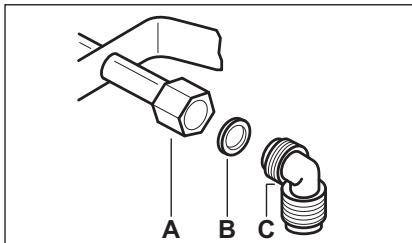
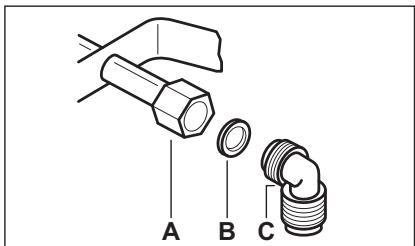
If the supplied pressure has not the specified value, it is necessary to assemble a proper pressure regulator in compliance with the standard UNI EN 88. For Liquid Gas (LPG) the use of pressure regulator is allowed only if they are in compliance with UNI EN 12864. The adjustable connection is fixed to the comprehensive ramp by means of a threaded nut G 1/2". Screw the parts without force, adjust the connection in the necessary direction and tighten everything.
text_image
A B CA. End of shaft with nut
B. Washer supplied with the appliance
C. Elbow supplied with the appliance
Rigid connection:
Carry out connection by using metal rigid pipes (copper with mechanical end) (UNI-CIG 7129).
Flexible connection:
Use a flexible pipe in stainless steel (UNI-CIG 9891) with a maximum length 2 m.

WARNING!
When installation is complete, make sure that the seal of each pipe fitting is correct. Use a soapy solution, not a flame!
3.3 Injectors replacement
- Remove the pan supports.
- Remove the caps and crowns of the burner.
- With a socket spanner 7 remove the injectors and replace them with the
ones which are necessary for the type of gas you use (see table in "Technical Data" chapter).
- Assemble the parts, follow the same procedure backwards.
- Replace the rating plate (it is near the gas supply pipe) with the one for the new type of gas supply. You can find this plate in the package supplied with the appliance.
If the supply gas pressure is changeable or different from the necessary pressure, you must fit an applicable pressure adjuster on the gas supply pipe.
3.4 Adjustment of minimum level
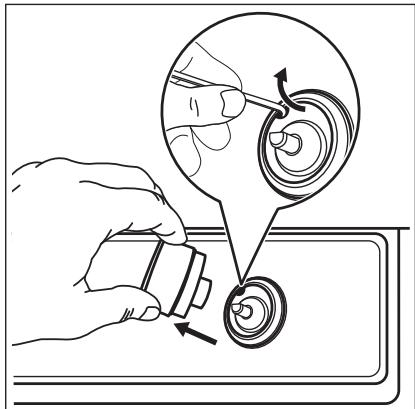
To adjust the minimum level of the burners:
- Light the burner.
- Turn the knob on the minimum position.
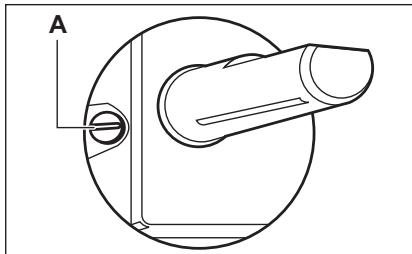
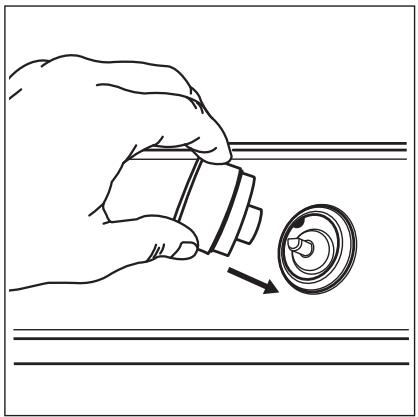
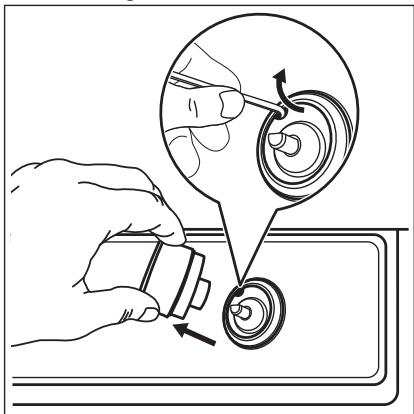
- Remove the knob and the gasket.
natural_image
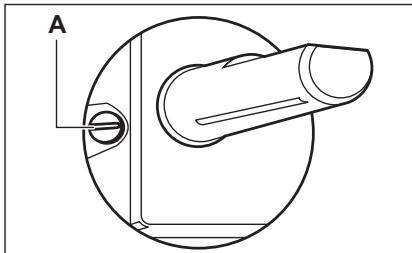
Illustration of a hand turning a button into a circular component with arrows indicating rotation (no text or symbols)- With a thin screwdriver, adjust the bypass screw position (A).
natural_image
Technical line drawing of a mechanical component with a circular base and cylindrical shaft (no text or symbols)- If you change:
• from natural gas G20 20 mbar to liquid gas, fully tighten the bypass screw in.
- from liquid gas to natural gas G20 20 mbar, undo the bypass screw approximately 1/4 of a turn (1/2 of a turn for Multi Crown burner).
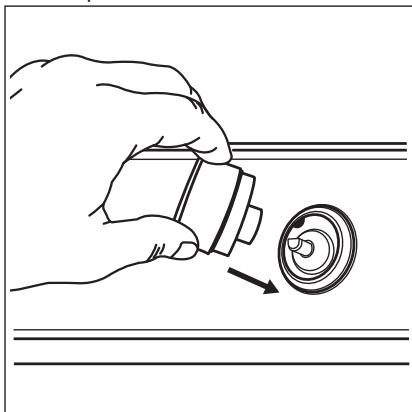
6. Reassemble the gasket and the knob.
natural_image
Line drawing of a hand holding a cylindrical object with an arrow pointing to it, against a horizontal line background (no text or symbols)
WARNING!
Make sure the flame does not go out when you quickly turn the knob from the maximum position to the minimum position.
3.5 Electrical connection
- Make sure that the rated voltage and type of power on the rating plate agree with the voltage and the power of the local power supply.
- This appliance is supplied with a mains cable. It has to be supplied with a correct plug which can hold the load that the rating plate rates. Make sure that you install the plug in a correct socket.
• Always use a correctly installed shockproof socket. - Make sure that there is an access to the mains plug after the installation.
- Do not pull the mains cable to disconnect the appliance. Always pull the mains plug.
- There is a risk of fire when the appliance is in connection with an extension cable, an adapter or a multiple connection. Make sure that
the ground connection agrees with the standards and regulations.
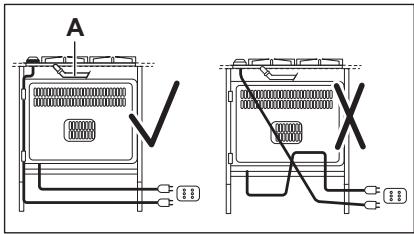
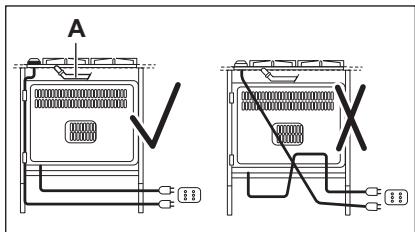
- Do not let the power cable to heat up to a temperature higher than 90^ C. To prevent contact between the cable and the appliance below the hob use the clamps which are on the side of the cabinet.
text_image
A ✓ XA. Rigid copper pipe or flexible pipe of stainless steel
3.6 Connection cable
To replace the connection cable use only the special cable or its equivalent. The cable type is: H03V2V2-F T90.
Make sure that the cable section is applicable to the voltage and the working temperature. The yellow / green earth wire must be approximately 2 cm longer than the brown (or black) phase wire.
3.7 Assembly
natural_image
Diagram showing three steps of a mechanical assembly: top-down, front-down, and back-up (no text or symbols present)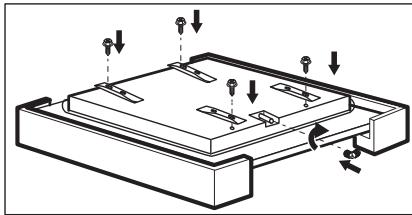
natural_image
Technical diagram of a mechanical assembly with multiple components and directional arrows (no text or labels)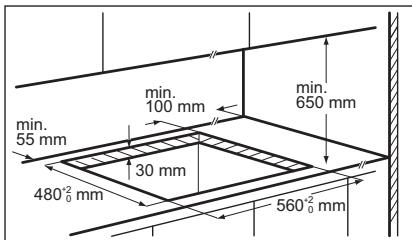
text_image
min. 55 mm 480°₀ mm 30 mm 100 mm min. 650 mm 560°₀ mm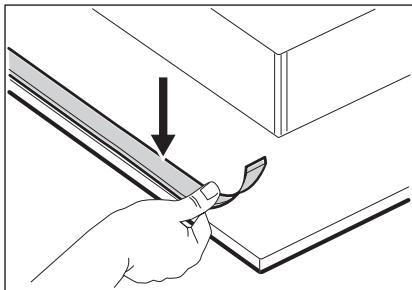
natural_image
Illustration of a hand using a tool to cut or apply a piece of wood, with an arrow indicating the process (no text or symbols present)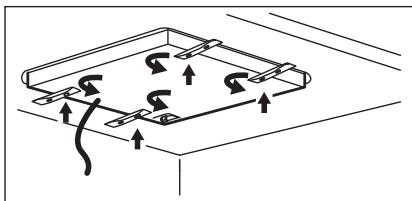
natural_image
Pure electrical circuit lines without any symbols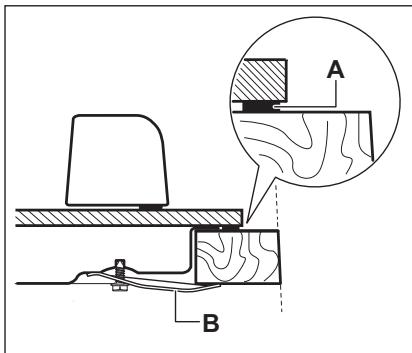
text_image
A BA) supplied seal
B) supplied brackets
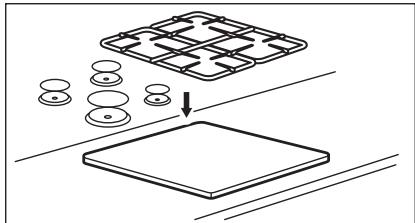
natural_image
Diagram showing a grid structure being processed into a flat panel, with no text or symbols present.
CAUTION!
Install the appliance only on a worktop with flat surface.
3.8 Installing hob under the hood

If you install the hob under a hood, please see the installation instructions of the hood for the minimum distance between the appliances.
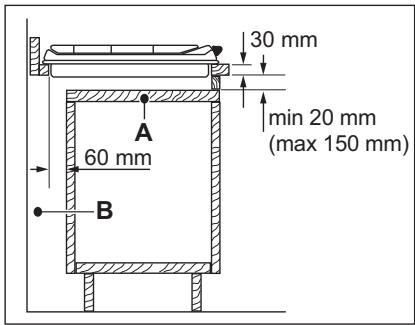
3.9 Possibilities for insertion
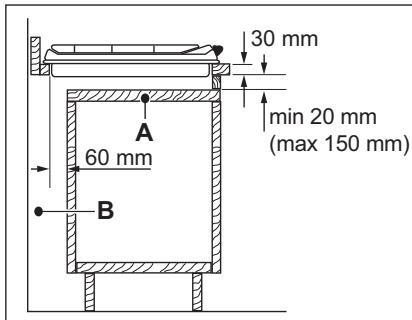
The panel installed below the hob must be easy to remove and let an easy access in case a technical assistance intervention is necessary.
Kitchen unit with door
text_image
30 mm min 20 mm (max 150 mm) A 60 mm BA. Removable panel
B. Space for connections
Kitchen unit with oven
The electrical connection of the hob and the oven must be installed separately for safety reasons and to let easy remove oven from the unit.
4. PRODUCT DESCRIPTION
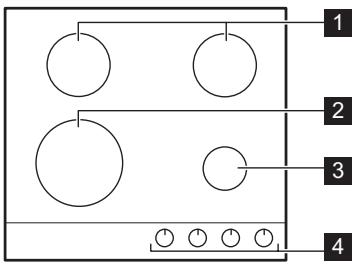
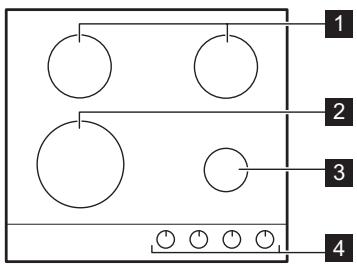
4.1 Cooking surface layout
flowchart
graph TD
    A[" "] --> B[" "]
    C[" "] --> D[" "]
    E[" "] --> F[" "]
    G[" "] --> H[" "]
    I[" "] --> J[" "]
    K[" "] --> L[" "]
    M[" "] --> N[" "]
    O[" "] --> P[" "]
    Q[" "] --> R[" "]
    S[" "] --> T[" "]
    U[" "] --> V[" "]
    W[" "] --> X[" "]
    Y[" "] --> Z[" "]
1 Semi-rapid burner
2 Multi Crown burner
3 Auxiliary burner
4 Control knobs
4.2 Control knob
| Symbol | Description |
| no gas supply / off position | |
| [2308] | ignition position / maximum gas supply |
| Symbol | Description |
| 1 | minimum gas supply |
| 1 - 9 | power levels |
5. DAILY USE

WARNING!
Refer to Safety chapters.
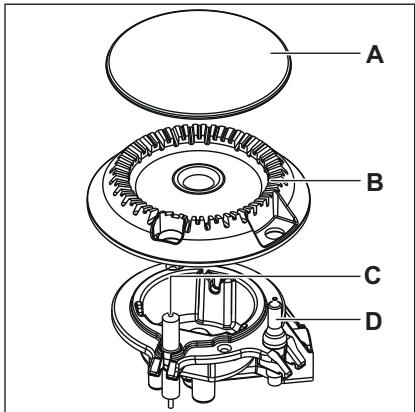
5.1 Burner overview
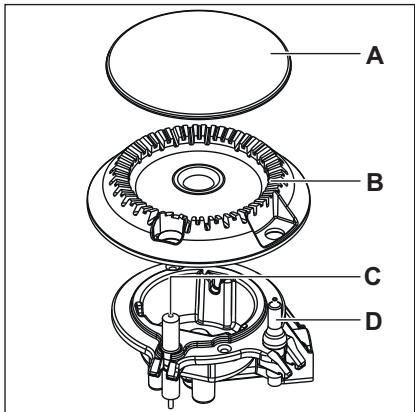
text_image
A B C D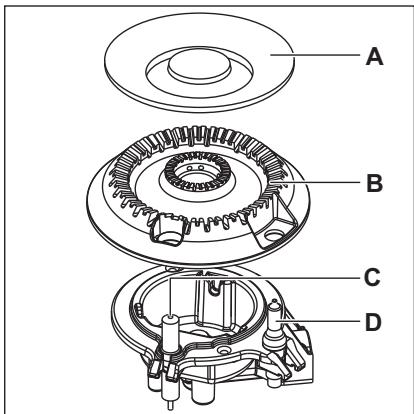
text_image
A B C DA. Burner cap
B. Burner crown
C. Ignition candle
D. Thermocouple
5.2 Ignition of the burner

Always light the burner before you put on the cookware.

WARNING!
Be very careful when you use open fire in the kitchen environment. The manufacturer declines any responsibility in case of the flame misuse.
- Push the control knob down and turn it counterclockwise to the maximum gas supply position (☆).
- Keep the control knob pushed for equal or less than 10 seconds. This lets the thermocouple warm up. If not, the gas supply is interrupted.
- Adjust the flame after it is regular.

If after some tries the burner does not light, check if the crown and its cap are in correct positions.

WARNING!
Do not keep the control knob pushed for more than 15 seconds. If the burner does not light after 15 seconds, release the control knob, turn it into off position and try to light the burner again after minimum 1 minute.
6. HINTS AND TIPS

WARNING!
Refer to Safety chapters.
6.1 Cookware

CAUTION!
Do not use cast iron pans, clay or earthenware pots, grill or toaster plates. The stainless steel can become tarnished if it is too much heated.

CAUTION!
In the absence of electricity you can ignite the burner without electrical device; in this case approach the burner with a flame, turn the control knob counterclockwise to maximum gas supply position and push it down. Keep the control knob pushed for equal or less than 10 seconds to let the thermocouple warm up.

If the burner accidentally goes out, turn the control knob to the off position and try to light the burner again after minimum 1 minute.

The spark generator can start automatically when you switch on the mains, after installation or a power cut. It is normal.
5.3 Turning the burner off
To put the flame out, turn the knob to the off position ●.

WARNING!
Always turn the flame down or switch it off before you remove the pans from the burner.

WARNING!
Do not put the same pan on two burners.

WARNING!
Do not put unstable or damaged pots on the burner to prevent spills and injuries.

CAUTION!
Make sure that the bottoms of pots do not stand too close to the control knob, otherwise the flame heats the control knob up.

CAUTION!
Make sure that pot handles are not above the front edge of the cooktop.

CAUTION!
Make sure that the pots are placed centrally on the burner in order to get the maximum stability and a lower gas consumption.
6.2 Diameters of cookware

Use cookware with diameters applicable to the size of burners.
| Burner | Diameter of cookware (mm) |
| Multi Crown | 180 - 260 |
| Semi-rapid | 120 - 220 |
| Auxiliary | 80 - 180 |
6.3 Suggested recipes
| Food categories | Recipes | Burner type | Power level |
| Sauces - Dressing | Bechamel | Auxiliary | 2-4 |
| Tomato sauce | Semi-rapid | 1-5 | |
| Pasta - Rice - other Cereals | Mushrooms rice | Multi Crown | 1-5 |
| Couscous | Rapid | 1-6 | |
| Ravioli | Auxiliary | 6-9 | |
| Soup - Legumes | Vegetable soup | Semi-rapid | 2-7 |
| Mushrooms and potatoes soup | Semi-rapid | 1-5 | |
| Fish soup | Multi Crown | 1-4 | |
| Meat | Beef meatballs | Multi Crown | 1-6 |
| Fillet of pork roast | Multi Crown | 4-9 | |
| Beef burger gratin | Auxiliary | 1-5 | |
| Fish | Sepia with peas | Multi Crown | 1-5 |
| Roasted tuna steak | Rapid | 5-8 | |
| Eggs based meals | Omelette | Multi Crown | 1-5 |
| Vegetables | Mushrooms with seasonings | Semi-rapid | 2-6 |
| Caponata with vegetables | Multi Crown | 4-8 | |
| Frozen spinach with butter | Rapid | 1-4 | |
| Fried dishes | French fries | Multi Crown | 5-9 |
| Donuts | Multi Crown | 3-7 | |
| Snacks cooked with pan | Roasting nuts | Semi-rapid | 2-5 |
| Croutons of bread | Multi Crown | 2-7 | |
| Pancakes | Semi-rapid | 3-9 | |
| Desserts | Caramel | Auxiliary | 1-5 |
| Custard | Auxiliary | 1-5 | |
| Panna cotta | Auxiliary | 1-5 |

All recipes for approximately 4 portions.

The settings suggested in the cooking table should only serve as guidelines and be adjusted depending on the rawness of food, its weight and quantity as well as on the type of gas used and the material of the cookware used to prepare the dish.

For an optimal delicate cooking use the auxiliary burner.
7. CARE AND CLEANING

WARNING!
Refer to Safety chapters.
7.1 General information
- Clean the hob after each use.
- Always use cookware with a clean base.
- Scratches or dark stains on the surface have no effect on how the hob operates.
- Use a special cleaner suitable for the surface of the hob.
Stainless steel
- Wash stainless steel parts with water, and then dry them with a soft cloth.
- To remove burnt food, fat and stubborn stains let them soak in a small amount of mild detergent for a few minutes before cleaning.
- Use cleaning products designed specifically for cleaning stainless steel in order to protect the steel surfaces.
- Do not use cleaning products containing corrosive chemicals such as chlorides, do not clean the surface
with disinfectants, stain or rust removers and immersion cleaners.
7.2 Pan supports
The pan supports are not resistant to washing in a dishwasher. They must be washed by hand.
- Remove the pan supports to easily clean the hob.
Be very careful when you replace the pan supports to prevent the hob top from damage.
- The enamel coating occasionally can have rough edges, so be careful when you wash the pan supports by hand and dry them. If necessary, remove stubborn stains with a paste cleaner.
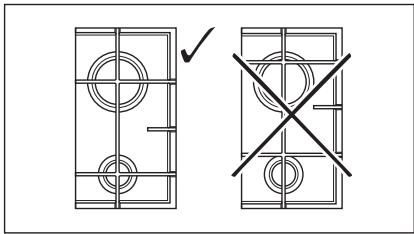
- After you clean the pan supports, make sure that they are in correct positions.
- For the burner to operate correctly, make sure that the arms of the pan supports are aligned with the centre of the burner.
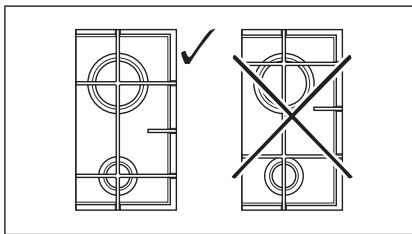
natural_image
Two technical diagrams showing circular components with crosshair marks, one with a checkmark and the other without (no text or symbols)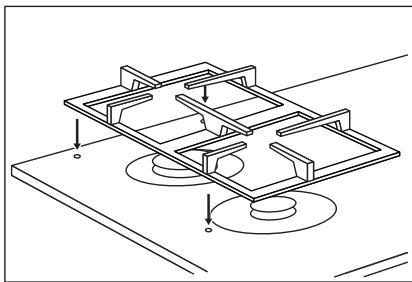
natural_image
Isometric line drawing of a structural framework with circular components and directional arrows (no text or symbols)7.3 Removing pan supports
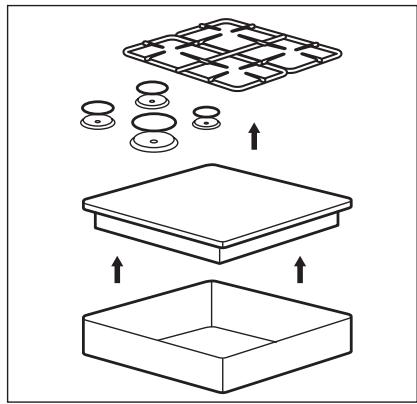
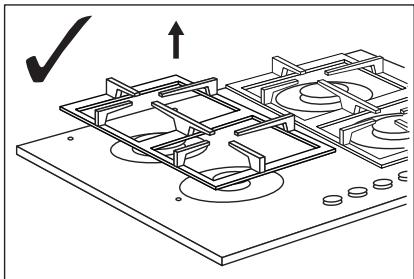
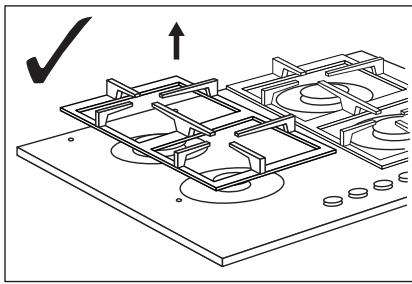
To keep the pan supports in the correct position, they are put on metal pins installed in the rear and lateral sides of the hob. For easier cleaning, pan supports can be removed from the hob. Lift up the pan supports keeping them in horizontal position as shown in the graphic.
Do not lift the pan supports at an angle, as this will put strain on the metal pins. This can cause damage to the pins and cause them to break.
natural_image
Isometric diagram of a mechanical assembly with no visible text, numbers, or symbols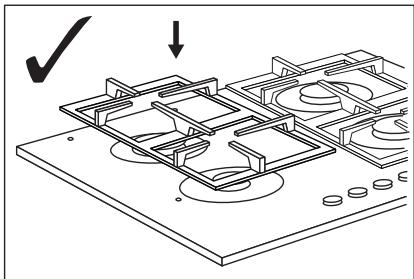
natural_image
Isometric diagram of a mechanical assembly with no visible text or symbols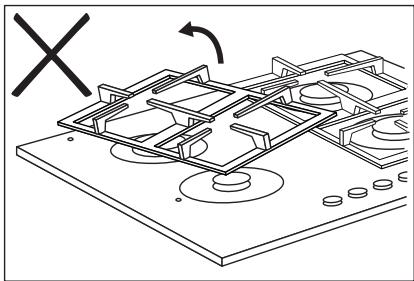
natural_image
Technical line drawing of a mechanical assembly with no visible text or symbolsThe shape of pan supports and the amount of burners can be different in other models of the appliance.
7.4 Cleaning the hob
- Remove immediately: melted plastic, plastic foil, sugar and food with sugar, otherwise, the dirt can cause damage to the hob. Take care to avoid burns.
- Remove when the hob is sufficiently cool: limescale rings, water rings, fat stains, shiny metallic discoloration. Clean the hob with a moist cloth and a non-abrasive detergent. After cleaning, wipe the hob dry with a soft cloth.
- To clean the enamelled parts, caps and crowns, wash them with warm soapy water and dry them carefully before you put them back on.
7.5 Cleaning the spark plug
This feature is obtained through a ceramic ignition candle with a metal
electrode. Keep these components well clean to prevent difficult lighting and check that the burner crown holes are not obstructed.
7.6 Periodic maintenance
Speak to your local Authorised Service Centre periodically to check the conditions of the gas supply pipe and the pressure adjuster, if fitted.
8. TROUBLESHOOTING

WARNING!
Refer to Safety chapters.
8.1 What to do if...
| Problem | Possible cause | Remedy |
| There is no spark when you try to activate the spark generator. | The hob is not connected to an electrical supply or it is connected incorrectly. | Check if the hob is correctly connected to the electrical supply. |
| The fuse is blown. | Make sure that the fuse is the cause of the malfunction. If the fuse is blown again and again, contact a qualified electrician. | |
| Burner cap and crown are placed incorrectly. | Place the burner cap and crown correctly. | |
| The flame extinguishes immediately after ignition. | Thermocouple is not heated up sufficiently. | After lightning the flame, keep the knob pushed for equal or less than 10 seconds. |
| The flame ring is uneven. | Burner crown is blocked with food residues. | Make sure that the injector is not blocked and the burner crown is clean. |
8.2 If you cannot find a solution...
If you cannot find a solution to the problem yourself, contact your dealer or an Authorised Service Centre. Give the data from the rating plate. Make sure,
you operated the hob correctly. If not the servicing by a service technician or dealer will not be free of charge, also during the warranty period. The instructions about the Service Centre and conditions of guarantee are in the guarantee booklet.
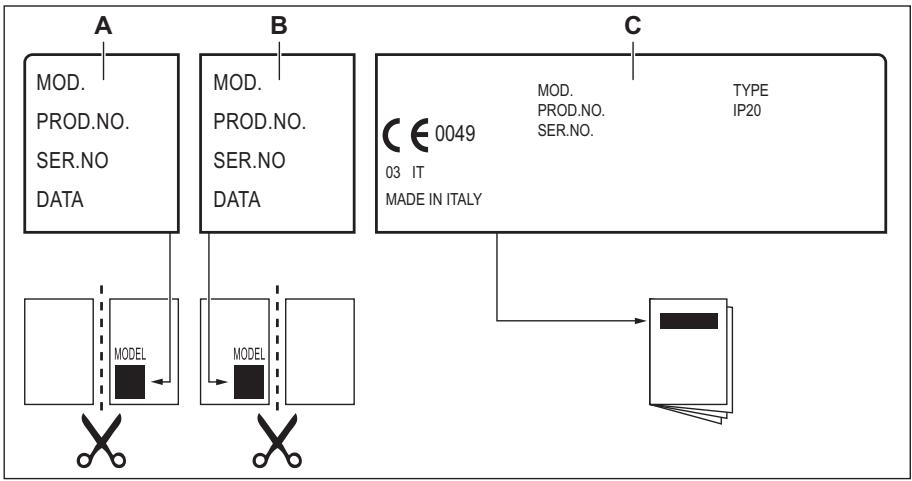
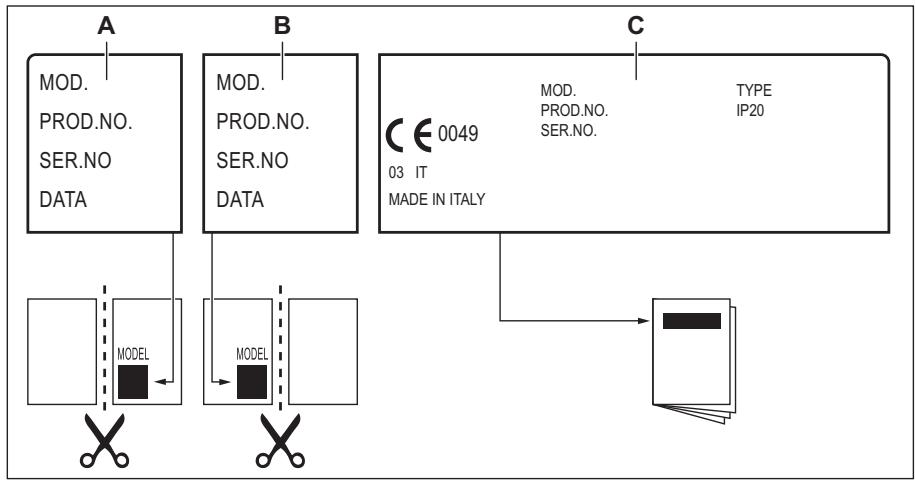
8.3 Labels supplied with the accessories bag
Stick the adhesive labels as indicated below:
flowchart
graph TD
    A["MOD. PROD.NO. SER.NO DATA"] --> B["MODEL"]
    B --> C["MODEL"]
    C --> D["MODEL"]
    D --> E["CODE 0049 03 IT MADE IN ITALY"]
    E --> F["TYPE IP20"]
    style A fill:#f9f,stroke:#333
    style B fill:#f9f,stroke:#333
    style C fill:#ccf,stroke:#333
    style D fill:#ccf,stroke:#333
    style E fill:#cff,stroke:#333
    style F fill:#ffc,stroke:#333
A. Stick it on Guarantee Card and send this part (if applicable).
B. Stick it on Guarantee Card and keep this part (if applicable).
C. Stick it on instruction booklet.
9. TECHNICAL DATA
9.1 Hob dimensions
| Width | 595 mm |
| Depth | 525 mm |
9.2 Bypass diameters
| BURNER | ∅ BYPASS 1/100 mm |
| Multi Crown | 57 |
| Semi-rapid | 35 |
| Auxiliary | 28 |
9.3 Other technical data
| TOTAL POW-ER: | Gas original: | G20 (2H) 20 mbar | 8,7 kW |
| Gas replace-ment: | G30 (3+) 28-30 mbar | 629 g/h | |
| G31 (3+) 37 mbar | 618 g/h | ||
| Electric supply: | 220-240 V ~ 50-60 Hz | ||
| Appliance cat-gory: | II2H3+ | ||
| Gas connec-tion: | G 1/2" | ||
| Appliance class: | 3 | ||
9.4 Gas burners for NATURAL GAS G20 20 mbar
| BURNER | NORMAL POWERkW | MINIMUM POWERkW | INJECTOR MARK |
| Multi Crown | 4,0 | 1,4 | 146 |
| Semi-rapid | 1,85 | 0,6 | 92 |
| Auxiliary | 1,0 | 0,33 | 70 |
9.5 Gas burners for LPG G30/G31 28-30/37 mbar
| BURNER | NORMAL POWER kW | MINIMUM POWER kW | INJECTOR MARK | NOMINAL GAS FLOW g/h | |
| G30 28-30 mbar | G31 37 mbar | ||||
| Multi Crown | 3,65 | 1,4 | 095 | 265 | 261 |
| Semi-rapid | 2,0 | 0,6 | 71 | 145 | 143 |
| Auxiliary | 1,0 | 0,33 | 50 | 73 | 71 |
10. ENERGY EFFICIENCY
10.1 Product information according to EU 66/2014
| Model identification | KGU64361X |
| Type of hob | Built-in hob |
| Number of gas burners | 4 |
| Energy efficiency per gas burner (EE gas burner) | Left rear - Semi-rapid | 59.9% |
| Right rear - Semi-rapid | 59.9% | |
| Left front - Multi Crown | 59.4% | |
| Right front - Auxiliary | not applicable | |
| Energy efficiency for the gas hob (EE gas hob) | 59.7% |
EN 30-2-1: Domestic cooking appliances burning gas - Part 2-1 : Rational use of energy - General
10.2 Energy saving
- Before use, make sure that the burners and pan supports are assembled correctly.
- Use cookware with diameters applicable to the size of burners.
• Center the pot on the burner. - When you heat up water, use only the amount you need.
• If it is possible, always put the lids on the cookware. - When the liquid starts to boil, turn down the flame to barely simmer the liquid.
- If it is possible, use a pressure cooker. Refer to its user manual.
11. ENVIRONMENTAL CONCERNS
Recycle materials with the symbol 📊. Put the packaging in relevant containers to recycle it. Help protect the environment and human health by recycling waste of electrical and electronic appliances. Do not dispose of
appliances marked with the symbol 📄 with the household waste. Return the product to your local recycling facility or contact your municipal office.
INHALTSVERZEICHNIS
- SICHERHEITSHINWEISE....20
- SICHERHEITSANWEISUNGEN.... 23
- MONTAGE....26
- GERÄTEBESCHREIBUNG.... 30
- TÄGLICHER GEBRAUCH....31
- TIPPS UND HINWEISE....32
- REINIGUNG UND PFLEGE.... 34
- FEHLERSUCHE....36
- TECHNISCHE DATEN.... 38
- ENERGIEEFFIZIENZ....39
WIR DENKEN AN SIE
Vielen Dank, dass Sie sich für ein Gerät von Electrolux entschieden haben. Sie haben ein Produkt gewählt, hinter dem jahrzehntelange professionelle Erfahrung und Innovation stehen. Bei der Entwicklung dieses großartigen und eleganten Geräts haben wir an Sie gedacht. So haben Sie bei jedem Gebrauch die Gewissheit, dass Sie stets großartige Ergebnisse erzielen werden. Willkommen bei Electrolux.
Besuchen Sie uns auf unserer Website, um:

Sich Anwendungshinweise, Prospekte, Fehlerbehebungs- und Service-Informationen zu holen:
www.electrolux.com/webselfservice

Ihr Produkt für einen besseren Service zu registrieren:
www.registerelectrolux.com

Zubehör, Verbrauchsmaterial und Original-Ersatzteile für Ihr Gerät zu kaufen: www.electrolux.com/shop
REPARATUR- UND KUNDENDIENST
Bitte verwenden Sie ausschließlich Original-Ersatzteile für Ihre Produkte. Halten Sie folgende Angaben bereit, wenn Sie sich an den Kundendienst wenden: Modell, Produktnummer (PNC), Seriennummer. Diese Informationen finden Sie auf dem Typenschild.
⚠️ Warnungs-/Sicherheitshinweise
i Allgemeine Informationen und Empfehlungen
Informationen zum Umweltschutz
Änderungen vorbehalten.
1. ⚠ SICHERHEITSHINWEISE
Lesen Sie vor der Montage und dem Gebrauch des Geräts zuerst die Gebrauchsanleitung. Bei Verletzungen oder Schäden infolge nicht ordnungsgemäßer Montage
oder Verwendung des Geräts übernimmt der Hersteller keine Haftung. Bewahren Sie die Anleitung immer an einem sicheren und zugänglichen Ort zum späteren Nachschlagen auf.
1.1 Sicherheit von Kindern und schutzbedürftigen Personen
- Das Gerät kann von Kindern ab 8 Jahren und Personen mit eingeschränkten physischen, sensorischen oder geistigen Fähigkeiten oder mit mangelnder Erfahrung und/oder mangelndem Wissen nur dann verwendet werden, wenn sie durch eine für ihre Sicherheit zuständige Person beaufsichtigt werden oder in die sichere Verwendung des Geräts eingewiesen wurden und die mit dem Gerät verbundenen Gefahren verstanden haben.
- Kinder zwischen 3 und 8 Jahren und Personen mit schweren Behinderungen oder Mehrfachbehinderung müssen vom Gerät ferngehalten werden, wenn sie nicht ständig beaufsichtigt werden.
- Halten Sie Kinder unter 3 Jahren vom Gerät fern, wenn sie nicht ständig beaufsichtigt werden.
- Kinder dürfen nicht mit dem Gerät spielen.
- Halten Sie sämtliches Verpackungsmaterial von Kindern fern und entsorgen Sie es auf angemessene Weise.
- Halten Sie Kinder und Haustiere während des Betriebs oder der Abkühlphase vom Gerät fern. Berührbare Teile sind heiß.
- Falls Ihr Gerät mit einer Kindersicherung ausgestattet ist, empfehlen wir, diese einzuschalten.
- Kinder dürfen keine Reinigung und Wartung ohne Beaufsichtigung durchführen.
1.2 Allgemeine Sicherheit
- WARNUNG: Das Gerät und die zugänglichen Geräteteile werden während des Betriebs heiß. Seien
Sie vorsichtig und berühren Sie niemals die Heizelemente.
- Schalten Sie das Gerät nicht über eine externe Zeitschaltuhr oder eine separate Fernsteuerung ein.
- WARNUNG: Kochen mit Fett oder Öl auf einem unbeaufsichtigten Kochfeld ist gefährlich und kann zu einem Brand führen.
- Versuchen Sie NIEMALS, ein Feuer mit Wasser zu löschen, sondern schalten Sie das Gerät aus und decken Sie die Flamme ab, z.B. mit einem Deckel oder einer Feuerlöschdecke.
- VORSICHT: Der Kochvorgang muss überwacht werden. Ein kurzer Kochvorgang muss kontinuierlich überwacht werden.
- WARNUNG: Brandgefahr: Legen Sie keine Gegenstände auf dem Kochfeld ab.
- Legen Sie keine Metallgegenstände wie Messer, Gabeln, Löffel oder Topfdeckel auf die Oberfläche des Kochfelds, da diese heiß werden können.
- Verwenden Sie ds Gerät nicht, bevor es in den Einbauschrank gesetzt wird.
- Reinigen Sie das Gerät nicht mit einem Dampfstrahlreiniger.
- Wenn das Netzkabel beschädigt ist, muss es vom Hersteller, seinem autorisierten Kundenservice oder einer gleichermaßen qualifizierten Person ausgetauscht werden, um Gefahrenquellen zu vermeiden.
- Ist das Gerät direkt an die Stromversorgung angeschlossen, wird ein allpoliger Netztrennschalter mit einem Kontaktabstand benötigt. Es muss eine vollständige Trennung entsprechend der Überspannungskategorie III gewährleistet sein. Dies gilt nicht für das Erdungskabel.
- Wenn Sie das Netzkabel verlegen, achten Sie darauf, dass es keinen direkten Kontakt mit Teilen hat, die Temperaturen erreichen können, die mehr als 50 °C
über der Raumtemperatur liegen. (Verwenden Sie ansonsten Isolierschläuche).
- WARNUNG: Verwenden Sie nur Schutzabdeckungen des Herstellers des Kochgeräts, von ihm in der Bedienungsanleitung als geeignete und empfohlene Schutzabdeckungen oder die im Gerät enthaltene Schutzabdeckung. Es besteht Unfallgefahr durch die Verwendung ungeeigneter Schutzabdeckungen.
2. SICHERHEITSANWEISUNGEN
Dieses Gerät ist für folgende Märkte geeignet: IT
2.1 Montage

WARNUNG!
Die Montage des Geräts darf nur von einer qualifizierten Fachkraft durchgeführt werden.

WARNUNG!
Verletzungsgefahr sowie Risiko von Schäden am Gerät.
- Entfernen Sie das gesamte Verpackungsmaterial.
- Montieren Sie ein beschädigtes Gerät nicht und benutzen Sie es nicht.
- Halten Sie sich an die mitgelieferte Montageanleitung.
• Die Mindestabstände zu anderen Geräten und Küchenmöbeln sind einzuhalten. - Seien Sie beim Umsetzen des Gerätes vorsichtig, da es sehr schwer ist. Tragen Sie stets Sicherheitshandschuhe und festes Schuhwerk.
- Dichten Sie die Ausschnittskanten mit einem Dichtungsmittel ab, um ein Aufquellen durch Feuchtigkeit zu verhindern.
- Schützen Sie die Geräteunterseite vor Dampf und Feuchtigkeit.
- Installieren Sie das Gerät nicht direkt neben einer Tür oder unter einem Fenster. So kann heißes Kochgeschirr nicht herunterfallen,
wenn die Tür oder das Fenster geöffnet wird.
- Wird das Gerät über Schubladen eingebaut, achten Sie darauf, dass zwischen dem Geräteboden und der oberen Schublade ein ausreichender Abstand für die Luftzirkulation vorhanden ist.
- Der Boden des Geräts kann heiß werden. Achten Sie darauf eine feuerfeste Trennplatte unter dem Gerät anzubringen, damit der Boden nicht zugänglich ist.
2.2 Elektrischer Anschluss

WARNUNG!
Brand- und Stromschlaggefahr.
- Alle elektrischen Anschlüsse sind von einem geprüften Elektriker vorzunehmen.
• Das Gerät muss geerdet sein. - Vor der Durchführung jeglicher Arbeiten muss das Gerät von der elektrischen Stromversorgung getrennt werden.
- Stellen Sie sicher, dass die Daten auf dem Typenschild mit den elektrischen Nennwerten der Netzspannung übereinstimmen.
- Vergewissern Sie sich, dass das Gerät ordnungsgemäß installiert ist. Lockere und unsachgemäße Kabel oder Stecker (falls vorhanden) können die Klemme überhitzen.
- Stellen Sie sicher, dass Sie das richtige Kabel für den elektrischen Netzanschluss verwenden.
- Achten Sie darauf, dass das Netzkabel nicht lose hängt oder sich verheddert.
- Sorgen Sie dafür, dass ein Berührungsschutz installiert wird.
- Verwenden Sie die Zugentlastung für das Kabel.
- Stellen Sie beim elektrischen Anschluss des Gerätes sicher, dass das Netzkabel oder ggf. der Netzstecker nicht mit dem heißen Gerät oder heißem Kochgeschirr in Berührung kommt.
- Verwenden Sie keine Mehrfachsteckdosen oder Verlängerungskabel.
- Achten Sie darauf, Netzstecker (falls vorhanden) und Netzkabel nicht zu beschädigen. Wenden Sie sich zum Austausch eines beschädigten Netzkabels an unseren autorisierten Kundendienst oder eine Elektrofachkraft.
- Alle Teile, die gegen direktes Berühren schützen, sowie die isolierten Teile müssen so befestigt werden, dass sie nicht ohne Werkzeug entfernt werden können.
- Stecken Sie den Netzstecker erst nach Abschluss der Montage in die Steckdose. Stellen Sie sicher, dass der Netzstecker nach der Montage noch zugänglich ist.
- Falls die Steckdose lose ist, schließen Sie den Netzstecker nicht an.
- Ziehen Sie nicht am Netzkabel, wenn Sie das Gerät von der Stromversorgung trennen möchten. Ziehen Sie stets am Netzstecker.
- Verwenden Sie nur geeignete Trenneinrichtungen: Überlastschalter, Sicherungen (Schraubsicherungen müssen aus dem Halter entfernt werden können), Fehlerstromschutzschalter und Schütze.
- Die elektrische Installation muss eine Trenneinrichtung aufweisen, mit der Sie das Gerät allpolig von der Stromversorgung trennen können. Die Trenneinrichtung muss mit einer Kontaktöffnungsbreite von mindestens 3 mm ausgeführt sein.
2.3 Gasanschluss
- Der Gasanschluss muss von einer Fachkraft ausgeführt werden.
- Vergewissern Sie sich vor der Montage des Geräts, dass das von Ihrem Gaswerk gelieferte Gas (Gasart und Gasdruck) mit der Einstellung des Geräts kompatibel ist.
- Stellen Sie sicher, dass die Luft um das Gerät zirkulieren kann.
• Informationen über die Gasversorgung finden Sie auf dem Typenschild. - Das Gerät darf nicht an einen Abzug für Verbrennungsprodukte angeschlossen werden. Das Gerät muss gemäß der aktuell geltenden Installationsbestimmungen angeschlossen werden. Halten Sie die Bestimmungen hinsichtlich der Belüftung ein.
2.4 Gebrauch

WARNUNG!
Verletzungs-, Verbrennungs- und Stromschlaggefahr.
- Entfernen Sie vor dem ersten Gebrauch das gesamte Verpackungsmaterial, die Aufkleber und Schutzfolie (falls vorhanden).
- Dieses Gerät ist ausschließlich zur Verwendung im Haushalt bestimmt.
- Nehmen Sie keine technischen Änderungen am Gerät vor.
• Die Lüftungsöffnungen dürfen nicht abgedeckt werden. - Lassen Sie das Gerät bei Betrieb nicht unbeaufsichtigt.
- Schalten Sie die Kochzonen nach jedem Gebrauch aus.
- Legen Sie kein Besteck und keine Topfdeckel auf die Kochzonen. Anderenfalls werden sie sehr heiß.
- Bedienen Sie das Gerät nicht mit feuchten oder nassen Händen oder wenn es mit Wasser in Kontakt gekommen ist.
- Benutzen Sie das Gerät nicht als Arbeits- oder Abstellfläche.
- Wenn Sie Nahrungsmittel in heißes Öl geben, kann dieses spritzen.

WARNUNG!
Brand- und Explosionsgefahr
- Erhitzte Öle und Fette können brennbare Dämpfe freisetzen. Halten Sie Flammen und erhitzte Gegenstände beim Kochen mit Fetten und Ölen von diesen fern.
• Die von sehr heißem Öl freigesetzten Dämpfe können eine Selbstzündung verursachen. - Bereits verwendetes Öl kann Lebensmittelreste enthalten und schon bei niedrigeren Temperaturen eher einen Brand verursachen als frisches Öl.
- Laden Sie keine entflammbaren Produkte oder Gegenstände, die mit entflammbaren Produkten benetzt sind, in das Gerät und stellen Sie solche nicht in die Nähe oder auf das Gerät.

WARNUNG!
Risiko von Schäden am Gerät.
- Stellen Sie kein heißes Kochgeschirr auf das Bedienfeld.
- Lassen Sie das Kochgeschirr nicht leerkochen.
- Lassen Sie keine Gegenstände oder Kochgeschirr auf das Gerät fallen. Die Oberfläche könnte beschädigt werden.
- Schalten Sie die Kochzonen niemals ein, wenn sich kein Kochgeschirr darauf befindet, oder wenn das Kochgeschirr leer ist.
- Legen Sie keine Alufolie auf das Gerät.
- Verwenden Sie nur standfestes Kochgeschirr mit der richtigen Form und einem Durchmesser, der größer als der der Brenner ist.
- Achten Sie darauf das Kochgeschirr mittig auf die Brenner zu stellen.
- Verwenden Sie kein großes Kochgeschirr, das über die Kanten des Geräts herausragt. Dies kann zu Schäden an der Arbeitsfläche führen.
- Vergewissern Sie sich, dass die Flamme nicht erlischt, wenn Sie den Einstellknopf schnell von der
höchsten zur niedrigsten Stufe drehen.
- Verwenden Sie ausschließlich das mit dem Gerät gelieferte Zubehör.
- Setzen Sie keinen Wärmeverteiler auf den Brenner.
- Beim Gebrauch eines Gaskochfelds entsteht Wärme und Feuchtigkeit. Sorgen Sie für eine ausreichende Belüftung in dem Raum, in dem das Gerät aufgestellt ist.
- Bei längerer Benutzung des Gerätes kann eine zusätzliche Belüftung erforderlich werden, zum Beispiel durch Öffnen eines Fensters oder die Erhöhung der Absaugleistung der Abzugshaube, falls vorhanden.
- Dieses Gerät ist nur zum Kochen bestimmt. Jeder andere Gebrauch ist als bestimmungsfremd anzusehen, zum Beispiel das Beheizen eines Raums.
- Lassen Sie keine säurehaltigen Flüssigkeiten wie Essig, Zitronensaft oder kalklösende Reinigungsmittel mit dem Kochfeld in Berührung kommen. Diese könnten matte Flecken verursachen.
- Verfärbungen der Email- oder Edelstahlbeschichtung haben keine Auswirkung auf die Leistung des Geräts.
2.5 Reinigung und Pflege

WARNUNG!
Entfernen Sie nicht die Tasten, Knöpfe oder Dichtungen vom Bedienfeld. Wasser könnte in das Gerät gelangen und es beschädigen.
- Reinigen Sie das Gerät regelmäßig, um eine Verschlechterung des Oberflächenmaterials zu verhindern.
- Schalten Sie das Gerät vor dem Reinigen aus und lassen Sie es abkühlen.
- Trennen Sie das Gerät vor Wartungsarbeiten von der Spannungsversorgung.
- Reinigen Sie das Gerät nicht mit Wasserspray oder Dampf.
- Reinigen Sie das Gerät mit einem weichen, feuchten Tuch. Verwenden
Sie ausschließlich Neutralreiniger. Benutzen Sie keine Scheuermittel, scheuernde Reinigungsschwämmchen, Lösungsmittel oder Metallgegenstände.
- Reinigen Sie die Brenner nicht im Geschirrspüler.
2.6 Service
- Wenden Sie sich zur Reparatur des Geräts an einen autorisierten Kundendienst.
- Verwenden Sie ausschließlich Originalersatzteile.
2.7 Entsorgung

WARNUNG!
Verletzungs- und
Erstickungsgefahr.
3. MONTAGE

WARNUNG!
Siehe Kapitel
Sicherheitshinweise.
3.1 Vor der Montage
Notieren Sie vor der Montage des Kochfelds folgende Daten, die Sie auf dem Typenschild finden. Das Typenschild ist auf dem Boden des Kochfelds angebracht.
Modell ......
Produktnummer
(PNC)
Seriennummer ......
- Für Informationen zur ordnungsgemäßen Entsorgung des Geräts wenden Sie sich an die zuständige kommunale Behörde vor Ort.
- Trennen Sie das Gerät von der Stromversorgung.
- Schneiden Sie das Netzkabel in der Nähe des Geräts ab, und entsorgen Sie es.
- Drücken Sie die äußeren Gasrohre flach.
3.2 Gasanschluss

WARNUNG!
Die in nachstehender Anleitung beschriebenen Installations- und Wartungsarbeiten sowie die Belüftung müssen von Fachpersonal unter Beachtung der geltenden Bestimmungen (UNI-CIG 7129 - 7131) ausgeführt werden. Stellen Sie sicher, dass die Küche gut belüftet ist: Halten Sie natürliche Belüftungsöffnungen von mindestens 100 cm² offen oder installieren Sie eine mechanische Abzugshaube.
Je nach geltenden Bestimmungen kann der Anschluss fest oder durch Verwendung eines flexiblen Edelstahlrohrs erfolgen. Bei Verwendung flexibler Metallrohre muss darauf geachtet werden, dass sie nicht mit beweglichen Teilen in Kontakt kommen oder eingeklemmt werden können. Wenn das Kochfeld mit einem Backofen installiert wird, muss ebenfalls vorsichtig vorgegangen werden.
Achten Sie darauf, dass der Gasdruck des Geräts den empfohlenen Werten entspricht.
Entspricht der gelieferte Druck nicht dem angegebenen Wert, muss ein geeigneter Druckregler gemäß der Norm UNI EN 88 installiert werden. Im Fall von Flüssiggas (LPG) ist die Verwendung eines Druckreglers nur erlaubt, wenn er der Norm UNI EN 12864 entspricht. Das verstellbare Anschlussstück wird an dem Gasanschluss mit einer G 1/2" Gewindemutter befestigt. Verschrauben Sie die Teile ohne Kraftanwendung, bringen Sie das Anschlussstück in die benötigte Richtung und schrauben Sie alle Teile fest.
text_image
A B CA. Schaftende mit Mutter
B. Mitgelieferte Beilagscheibe
C. Mitgelieferter Rohrbogen
Fester Anschluss:
Führen Sie den Anschluss mit festen Metallrohren (Kupfer mit mechanischem Endstück) aus (UNI-CIG 7129).
Flexibler Anschluss:
Verwenden Sie ein flexibles Edelstahlrohr (UNI-CIG 9891) mit einer maximalen Länge von 2 m.

WARNUNG!
Überprüfen Sie nach der Installation, ob alle Anschlussstücke dicht sind. Verwenden Sie eine Seifenlösung und keine Flamme!
3.3 Austauschen der Düsen
- Nehmen Sie die Topfträger ab.
-
Nehmen Sie Brennerdeckel und Brennerkronen ab.
-
Entfernen Sie die Düsen mit einem Steckschlüssel 7 und ersetzen Sie sie durch für die verwendete Gasart geeignete Düsen (siehe Tabelle im Abschnitt „Technische Daten“).
- Bringen Sie die Teile wieder an. Führen Sie dazu die obigen Schritte in umgekehrter Reihenfolge aus.
- Ersetzen Sie das Typenschild (in der Nähe der Gasversorgungsleitung) durch das Typenschild für die neue Gasart. Das Typenschild ist im Beipack des Geräts enthalten.
Wenn der Gasdruck der Gasversorgung schwankt oder nicht dem erforderlichen Druckwert entspricht, muss ein geeigneter Druckregler im Gaszufuhrrohr montiert werden.
3.4 Einstellen der niedrigsten Stufe
So stellen Sie die niedrigste Stufe der Brenner ein:
- Zünden Sie den Brenner.
- Drehen Sie den Knopf auf die niedrigste Stufe.
- Entfernen Sie den Knopf und die Dichtung.
natural_image
Illustration of a hand using a tool to adjust a circular component, with an inset showing the mechanism (no text or symbols present)- Stellen Sie mit einem kleinen Schraubendreher die Bypass-Schraube (A) ein.
natural_image
Technical line drawing of a mechanical component with a circular base and cylindrical shaft (no text or symbols)5. Bei Umstellung:
- Von Erdgas G20 20 mbar auf Flüssiggas, ziehen Sie die Bypass-Schraube bis zum Anschlag an.
- Von Flüssiggas auf Erdgas G20 20 mbar, drehen Sie die Bypass-Schraube um ca. 1/4 Umdrehung (1/2 Umdrehung für den Multikronen-Brenner zurück.
6. Bringen Sie die Dichtung und den Knopf wieder an.
natural_image
Illustration of a hand holding a cylindrical object with an arrow pointing to it, next to horizontal lines (no text or symbols)
WARNUNG!
Vergewissern Sie sich, dass die Flamme nicht erlischt, wenn Sie den Einstellknopf schnell von der höchsten zur niedrigsten Stufe drehen.
3.5 Elektroanschluss
- Vergewissern Sie sich, dass die Netzspannung und -frequenz in Ihrer Region mit den auf dem Typenschild angegebenen Anschlusswerten übereinstimmen.
- Das Gerät wird mit einem Netzkabel geliefert. Dazu muss ein passender Stecker verwendet werden, der für die
auf dem Typenschild angegebene Gesamtstromaufnahme ausgelegt ist. Achten Sie darauf, den Stecker in eine passende Steckdose zu stecken.
- Schließen Sie das Gerät nur an eine ordnungsgemäß installierte Schutzkontaktsteckdose an.
- Stellen Sie sicher, dass der Netzstecker nach der Montage noch zugänglich ist.
- Ziehen Sie nicht am Netzkabel, wenn Sie das Gerät von der Stromversorgung trennen möchten. Ziehen Sie stets am Netzstecker.
- Es besteht Brandgefahr, wenn das Gerät mit einem Verlängerungskabel, Adapter oder an eine Mehrfachsteckdose angeschlossen wird. Stellen Sie sicher, dass die Erdverbindung den Normen und Vorschriften entspricht.
- Das Netzkabel darf nicht heißer als 90 °C werden.
Um einen Kontakt des Kabels mit dem Gerät unter dem Kochfeld zu vermeiden, verwenden Sie die Haken auf den Seiten des Gehäuses.
text_image
A XA. Festes Kupferrohr oder flexibles Edelstahlrohr
3.6 Anschlusskabel
Ersetzen Sie das Anschlusskabel ausschließlich durch das spezielle Kabel oder ein gleichwertiges Kabel. Kabeltyp: H03V2V2-F T90.
Vergewissern Sie sich, dass der Kabelquerschnitt für die Spannung und Betriebstemperatur geeignet ist. Der gelb-grüne Erdleiter muss ca. 2 cm länger als der braune (bzw. schwarze) Phasenleiter sein.
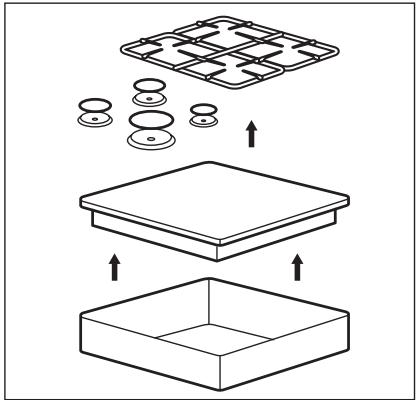
3.7 Montage
natural_image
Diagram showing three steps of a mechanical assembly: top-down view, front-down view, and bottom-down view (no text or symbols)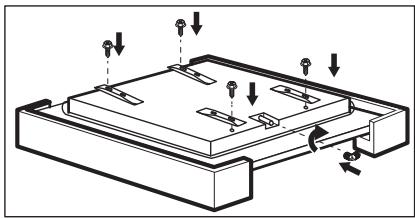
natural_image
Technical diagram of a mechanical assembly with multiple components and directional arrows (no text or labels)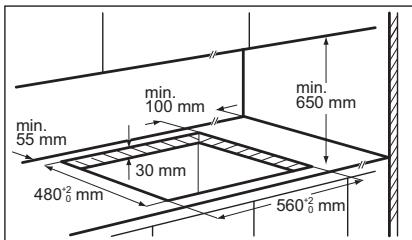
text_image
min. 55 mm 480°²₀ mm 30 mm 100 mm 650 mm 560°²₀ mm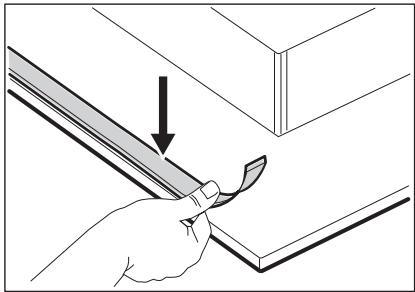
natural_image
Illustration of a hand using a tool to cut or apply a piece of wood or metal, with no text or symbols present.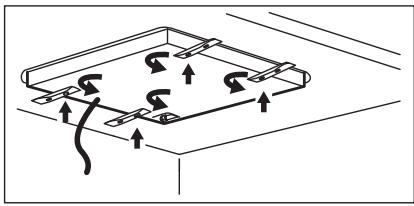
natural_image
Pure electrical circuit lines without any symbols6.
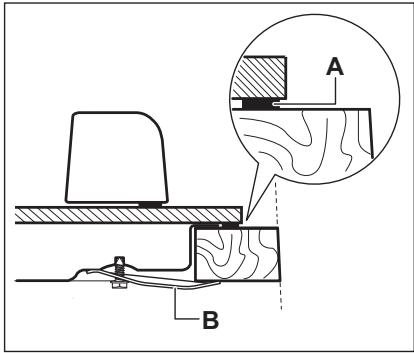
text_image
Technical diagram showing a mechanical assembly with labeled components A and B, including a magnified inset view.A) Mitgelieferte Dichtung
B) Mitgelieferte Klammern
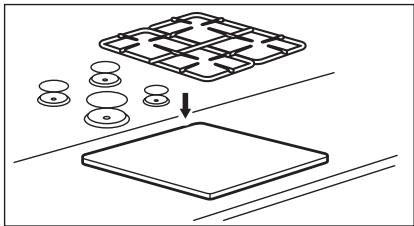
natural_image
Diagram showing a grid structure being processed into a flat plate, with no text or symbols present.
VORSICHT!
Montieren Sie das Gerät nur in einer flachen Arbeitsplatte.
3.8 Montage des Kochfelds unter der Dunstabzugshaube

Wird das Kochfeld unter einer Abzugshaube montiert, sehen Sie in der Montageanleitung der Abzugshaube nach, welcher Mindestabstand zwischen den Geräten eingehalten werden muss.
3.9 Einbaumöglichkeiten
Die unter dem Kochfeld eingebaute Platte muss sich leicht entfernen lassen und einen einfachen Zugang ermöglichen, falls eine Reparatur erforderlich wird.
Küchenschrank mit Tür
text_image
30 mm min 20 mm (max 150 mm) A 60 mm B4. GERÄTEBESCHREIBUNG
4.1 Kochfeldanordnung
flowchart
graph TD
    A[" "] --> B[" "]
    C[" "] --> D[" "]
    E[" "] --> F[" "]
    G[" "] --> H[" "]
    I[" "] --> J[" "]
    K[" "] --> L[" "]
    M[" "] --> N[" "]
    O[" "] --> P[" "]
    Q[" "] --> R[" "]
    S[" "] --> T[" "]
    U[" "] --> V[" "]
    W[" "] --> X[" "]
    Y[" "] --> Z[" "]
4.2 Einstellknopf
| Symbol | Beschreibung |
| [BTY4] | Keine Gaszufuhr/Aus-Position |
 | Zündstellung/maximale Gaszufuhr |
A. Entfernbare Platte
B. Raum für Anschlüsse
Küchenschrank mit Backofen
Kochfeld und Backofen müssen aus Sicherheitsgründen über separate elektrische Anschlüsse verfügen. Der Backofen muss sich leicht aus dem Küchenschrank entfernen lassen.
1 Normalbrenner
2 Multikronen-Brenner
3 Hilfsbrenner
4 Einstellknöpfe
| Symbol | Beschreibung |
| 1 | minimale Gaszufuhr |
| 1 - 9 | Leistungsstufen |
5. TÄGLICHER GEBRAUCH

WARNUNG!
Siehe Kapitel Sicherheitshinweise.
5.1 Brennerübersicht
text_image
A B C D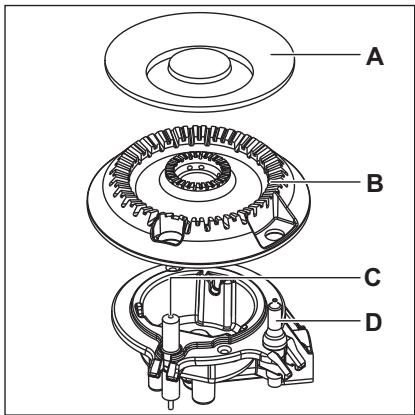
text_image
A B C DA. Brennerdeckel
B. Brennerkrone
C. Zündkerze
D. Thermoelement
5.2 Zünden des Brenners

Zünden Sie den Brenner stets vor dem Aufsetzen des Kochgeschirrs.

WARNUNG!
Seien Sie bei der Verwendung von offenem Feuer in der Küche besonders vorsichtig. Der Hersteller übernimmt bei Missachtung der Sicherheitsbestimmungen beim Umgang mit offenem Feuer keinerlei Haftung.
-
Drücken Sie den Einstellknopf hinein und drehen Sie ihn gegen den Uhrzeigersinn auf die Position für die maximale Gaszufuhr (★).
-
Halten Sie den Einstellknopf bis zu 10 Sekunden lang gedrückt. In dieser Zeit wird das Thermoelement erwärmt. Andernfalls wird die Gaszufuhr unterbrochen.
-
Stellen Sie die Flamme ein, sobald sie ruhig brennt.

Falls sich der Brenner nach einigen Versuchen nicht zünden lässt, überprüfen Sie, ob die Brennerkrone und der zugehörige Brennerdeckel korrekt sitzen.

WARNUNG!
Halten Sie den Knopf nicht länger als 15 Sekunden gedrückt. Sollte der Brenner nach 15 Sekunden nicht zünden, lassen Sie den Knopf los, und drehen Sie ihn in die Aus-Position. Warten Sie dann mindestens eine Minute, bevor Sie den Brenner erneut zünden.

VORSICHT!
Wenn kein Strom zur Verfügung steht, können Sie den Brenner auch ohne Strom zünden. Bringen Sie eine Flamme in die Nähe des Brenners, drehen Sie den entsprechenden Knopf entgegen dem Uhrzeigersinn auf die höchste Stufe und drücken Sie ihn dann hinein. Halten Sie den Einstellknopf höchstens 10 Sekunden gedrückt, um das Thermoelement zu erwärmen.

Sollte der Brenner zufällig ausgehen, drehen Sie den Knopf in die Aus-Position und versuchen Sie ihn nach einer Minute erneut zu zünden.
6. TIPPS UND HINWEISE

WARNUNG!
Siehe Kapitel Sicherheitshinweise.
6.1 Kochgeschirr

VORSICHT!
Verwenden Sie kein Kochgeschirr aus Gusseisen, Ton oder Steingut und keine Grill- oder Sandwichplatten. Edelstahl kann bei zu starker Erhitzung anlaufen.

WARNUNG!
Kochen Sie nicht mit einem Kochgeschirrteil auf zwei Brennern gleichzeitig.

WARNUNG!
Stellen Sie keine beschädigten Töpfe oder solche, die nicht standfest sind, auf den Brenner, um ein Verschütten und Verletzungen zu vermeiden.

Nach dem Einschalten der Stromversorgung, nach der Installation oder nach einem Stromausfall wird der Funkengenerator möglicherweise automatisch eingeschaltet. Das ist normal.
5.3 Abschalten des Brenners
Drehen Sie zum Abschalten des Brenners den Knopf in die Aus-Position
•

WARNUNG!
Bevor Sie das Kochgeschirr vom Brenner nehmen, drehen Sie die Flamme herunter oder drehen Sie sie ganz ab.

VORSICHT!
Achten Sie darauf, dass sich die Topfböden nicht zu nahe am Einstellknopf befinden, da anderenfalls die Flamme den Einstellknopf erhitzen könnte.

VORSICHT!
Achten Sie darauf, dass die Topfgriffe nicht über den vorderen Rand des Kochfelds hinausragen.

VORSICHT!
Stellen Sie zur Reduzierung des Gasverbrauchs und im Interesse einer größeren Stabilität die Töpfe mittig auf den Brenner.
6.2 Durchmesser des Kochgeschirrs

Verwenden Sie nur Kochgeschirr mit einem Durchmesser, der der Größe der Brenner entspricht.
| Brenner | Durchmesser des Kochgeschirrs (mm) |
| Multikronen-Brenner | 180 - 260 |
| Brenner | Durchmesser des Kochgeschirrs (mm) |
| Normalbrenner | 120 - 220 |
| Hilfsbrenner | 80 - 180 |
6.3 Empfohlene Rezepte
| Speisekategorien | Rezepte | Brennertyp | Kochstufe |
| Soßen - Dressings | Béchamel | Hilfsbrenner | 2-4 |
| Tomatensoße | Normalbrenner | 1-5 | |
| Pasta - Reis - andere Getreidesorten | Pilzreis | Multikronen-Brenner | 1-5 |
| Couscous | Starkbrenner | 1-6 | |
| Ravioli | Hilfsbrenner | 6-9 | |
| Suppe - Hülsenfrüchte | Gemüsesuppe | Normalbrenner | 2-7 |
| Pilz- und Kartoffelsuppe | Normalbrenner | 1-5 | |
| Fischsuppe | Multikronen-Brenner | 1-4 | |
| Fleisch | Rinderhackfleischbällchen | Multikronen-Brenner | 1-6 |
| Schweinebratenfilet | Multikronen-Brenner | 4-9 | |
| Rindfleisch-Burger-Gratin | Hilfsbrenner | 1-5 | |
| Fisch | Tintenfisch mit Erbsen | Multikronen-Brenner | 1-5 |
| Gebratenes Thun-fischsteak | Starkbrenner | 5-8 | |
| Eierspeisen | Omelett | Multikronen-Brenner | 1-5 |
| Gemüse | Pilze mit Gewürzen | Normalbrenner | 2-6 |
| Caponata mit Gemüse | Multikronen-Brenner | 4-8 | |
| Tiefkühl-Spinat mit Butter | Starkbrenner | 1-4 | |
| Frittierte Speisen | Pommes frites | Multikronen-Brenner | 5-9 |
| Donuts | Multikronen-Brenner | 3-7 | |
| In der Pfanne zubereitete Snacks | Rösten von Nüssen | Normalbrenner | 2-5 |
| Croutons aus Brot | Multikronen-Brenner | 2-7 | |
| Pfannkuchen | Normalbrenner | 3-9 | |
| Süßspeisen | Karamell | Hilfsbrenner | 1-5 |
| Eiercreme | Hilfsbrenner | 1-5 | |
| Panna Cotta | Hilfsbrenner | 1-5 |

Alle Rezepte für ca. 4 Portionen.

Die in der Kochtabelle vorgeschlagenen Einstellungen dienen nur als Richtwert und müssen je nach Rohzustand, Gewicht und Qualität der Lebensmittel sowie je nach der verwendeten Gasart und des verwendeteten Kochgeschirrmaterials angepasst werden.

Für ein optimalen schonenden Garvorgang verwenden Sie den Hilfsbrenner.
7. REINIGUNG UND PFLEGE

WARNUNG! Siehe Kapitel Sicherheitshinweise.
7.1 Allgemeine Informationen
- Reinigen Sie das Kochfeld nach jedem Gebrauch.
-
Verwenden Sie stets Kochgeschirr mit sauberen Böden.
-
Kratzer oder dunkle Flecken auf der Oberfläche beeinträchtigen die Funktionsfähigkeit des Kochfelds nicht.
- Verwenden Sie einen Spezialreiniger zur Reinigung der Kochfeldoberfläche.
Edelstahl
- Reinigen Sie Edelstahlteile mit Wasser und wischen Sie sie mit einem weichen Tuch trocken.
- Um eingebrannte Speisereste, Fett und hartnäckige Flecken zu entfernen, weichen Sie diese vor der Reinigung einige Minuten mit etwas mildem Reinigungsmittel ein.
- Verwenden Sie speziell für Edelstahl vorgesehene Reinigungsmittel, um die Stahloberflächen zu schützen.
- Verwenden Sie keine Reinigungsmittel, die ätzende Chemikalien enthalten, wie Chloride, reinigen Sie die Oberfläche nicht mit Desinfektionsmitteln, Fleck- oder Rostentfernern und Tauchreinigern.
7.2 Topfträger

Die Topfträger sind nicht spülmaschinenfest. Sie müssen von Hand gereinigt werden.
- Entfernen Sie die Topfträger, um die Reinigung des Kochfelds zu erleichtern.

Seien Sie beim Wiederaufsetzen der Topfträger vorsichtig, um Beschädigungen der Oberseite des Kochfelds zu vermeiden.
- Wenn Sie die Topfträger von Hand spülen und trocknen, seien Sie vorsichtig, da durch das Emaillieren gelegentlich raue Kanten entstehen können. Entfernen Sie hartnäckige Flecken gegebenenfalls mit einer Reinigungspaste.
- Vergewissern Sie sich, dass Sie die Topfträger nach der Reinigung wieder ordnungsgemäß eingesetzt haben.
- Damit der Brenner korrekt funktioniert, stellen Sie sicher, dass sich die Arme der Topfträger in der Mitte des Brenners befinden.
natural_image
Two technical diagrams showing cross-sectional views of circular components with no text or symbols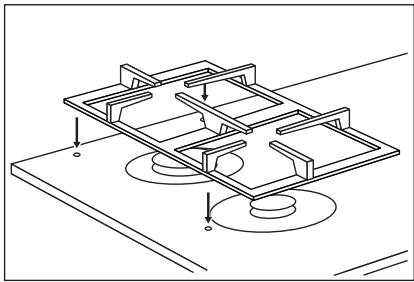
natural_image
Isometric line drawing of a structural framework with mounting holes and supports (no text or symbols)7.3 Abnehmen der Topfträger
Die Topfträger werden auf Metallstiften, die sich hinten und seitlich auf dem Kochfeld befinden, in Position gehalten. Um die Reinigung zu erleichtern, können die Topfträger abgenommen werden. Heben Sie die Topfträger in waagerechter Lage siehe Abbildung.

Nehmen Sie die Topfträger nicht in geneigter Position ab, da sonst die Metallstifte belastet werden. Die Stifte könnten beschädigt werden und abbrechen.
natural_image
Isometric line drawing of a mechanical assembly with no visible text or symbols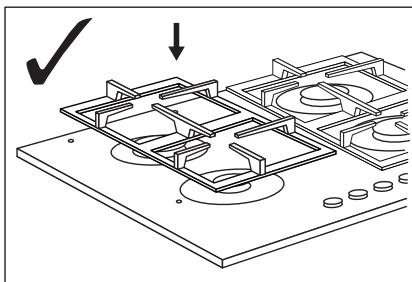
natural_image
Isometric line drawing of a gas stove assembly with checkmark and arrow annotations (no text or symbols)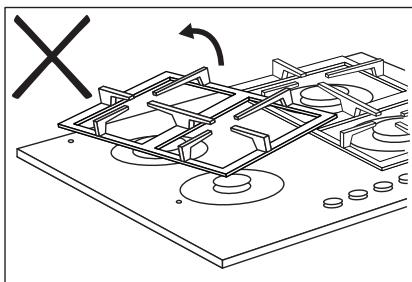
natural_image
Isometric line drawing of a mechanical assembly with no visible text or symbolsDie Form der Topfträger und die Brenneranzahl kann bei anderen Gerätemodellen variieren.
7.4 Reinigen des Kochfelds
- Folgendes muss sofort entfernt werden: Geschmolzener Kunststoff,
8. FEHLERSUCHE

WARNUNG!
Siehe Kapitel Sicherheitshinweise.
Plastikfolie, Zucker und zuckerhaltige Lebensmittel. Anderenfalls können die Verschmutzungen das Kochfeld beschädigen. Achten Sie darauf, dass sich niemand Verbrennungen zuzieht.
- Folgendes kann nach ausreichender Abkühlung des Kochfelds entfernt werden: Kalk- und Wasserränder, Fettspritzer und metallisch schimmernde Verfärbungen. Reinigen Sie das Kochfeld mit einem feuchten Tuch und nicht scheuernden Reinigungsmittel. Wischen Sie das Kochfeld nach der Reinigung mit einem weichen Tuch trocken.
- Reinigen Sie die emaillierten Teile, die Brennerdeckel und Brennerkronen mit warmen Seifenwasser und trocknen Sie diese sorgfältig ab, bevor Sie sie wieder einsetzen.
7.5 Reinigen der Zündkerze
Diese Funktion erfolgt über eine Keramikzündkerze mit Metallelektrode. Halten Sie zur Vermeidung von Zündschwierigkeiten diese Bauteile immer sauber; kontrollieren Sie außerdem, ob die Düsen der Brennerkrone verstopft sind.
7.6 Regelmäßige Wartung
Lassen Sie regelmäßig vom Ihrem autorisierten Kundendienst den Zustand des Gasversorgungsrohrs und, falls installiert, die Funktionstüchtigkeit des Druckreglers überprüfen.
8.1 Was tun, wenn...
| Störung | Mögliche Ursache | Abhilfe |
| Es wird kein Funke erzeugt, wenn Sie versuchen, den Funkenerzeuger zu verwenden. | Das Kochfeld ist nicht oder nicht ordnungsgemäß an die Spannungsversorgung angeschlossen. | Prüfen Sie, ob das Kochfeld ordnungsgemäß an die Spannungsversorgung angeschlossen ist. |
| Die Sicherung ist durchgebrannt. | Vergewissern Sie sich, dass die Sicherung der Grund für die Störung ist. Brennt die Sicherung wiederholt durch, wenden Sie sich an eine zugelassene Elektrofachkraft. | |
| Brennerdeckel und Brennerkrone sitzen nicht richtig. | Bringen Sie die Brennerkrone und den Brennerdeckel in die richtige Position. | |
| Die Flamme erlischt gleich nach der Zündung wieder. | Das Thermoelement ist nicht ausreichend erwärmt. | Halten Sie den Knopf nach dem Entzünden etwa 10 Sekunden lang gedrückt. |
| Der Flammenring ist ungleichmäßig. | Die Brennerkrone ist mit Speiseresten verstopft. | Sorgen Sie dafür, dass die Düse nicht blockiert und die Brennerkrone sauber ist. |
8.2 Wenn Sie das Problem nicht lösen können...
Wenn Sie das Problem nicht selbst lösen können, wenden Sie sich an Ihren Händler oder einen autorisierten Kundendienst. Geben Sie die Daten, die Sie auf dem Typenschild finden, an. Vergewissern Sie sich, dass Sie das Kochfeld korrekt bedient haben. Wenn
Sie das Gerät falsch bedient haben, fällt auch während der Garantiezeit für die Reparatur durch einen Techniker oder Händler eine Gebühr an. Die Informationen zum Kundendienst und die Garantiebedingungen finden Sie im Garantieheft.
8.3 Im Zubehörbeutel mitgelieferte Aufkleber
Bringen Sie die Aufkleber, wie unten gezeigt, an:
flowchart
graph TD
    A["MOD. PROD.NO. SER.NO DATA"] --> B["MODEL"]
    B --> C["MODEL"]
    C --> D["MODEL"]
    D --> E["MODEL"]
    E --> F["CODE 0049 03 IT MADE IN ITALY"]
    F --> G["TYPE IP20"]
    G --> H["Output File"]
A. Kleben Sie ihn auf die Garantiekarte und verschicken Sie diesen Teil (falls vorhanden).
B. Kleben Sie ihn auf die Garantiekarte und behalten Sie diesen Teil (falls vorhanden).
C. Kleben Sie ihn auf die Gebrauchsanleitung.
9. TECHNISCHE DATEN
9.1 Abmessungen des Kochfelds
| Breite | 595 mm |
| Tiefe | 525 mm |
9.2 Bypassdurchmesser
| BRENNER | ∅ BYPASS 1/100 mm |
| Multikronen-Brenner | 57 |
| Normalbrenner | 35 |
| Hilfsbrenner | 28 |
9.3 Sonstige technische Daten
| GESAMTLEIS-TUNG: | Gas - Original: | G20 (2H) 20 mbar | 8,7 kW |
| Gas - Ersatz: | G30 (3+) 28-30 mbar | 629 g/h | |
| G31 (3+) 37 mbar | 618 g/h | ||
| Netzanschluss: | 220 - 240 V ~ 50 - 60 Hz | ||
| Gerätekategorie: | II2H3+ | ||
| Gasanschluss: | G 1/2" | ||
| Geräteklasse: | 3 | ||
9.4 Gasbrenner für ERDGAS G20 20 mbar
| BRENNER | NORMALLEIS-TUNG kW | MINDESTLEIS-TUNG kW | INJEKTORMARKE |
| Multikronen-Bren-ner | 4,0 | 1,4 | 146 |
| Normalbrenner | 1,85 | 0,6 | 92 |
| Hilfsbrenner | 1,0 | 0,33 | 70 |
9.5 Gasbrenner für LPG G30/G31 28-30/37 mbar
| BRENNER | NORMAL-LEISTUNG kW | MINDEST-LEISTUNG kW | INJEKTOR-MARKE | NENNGASDURCHFLUSS g/h | |
| G30 28-30 mbar | G31 37 mbar | ||||
| Multikro-nen-Bren-ner | 3,65 | 1,4 | 095 | 265 | 261 |
| Normal-brenner | 2,0 | 0,6 | 71 | 145 | 143 |
| Hilfsbrenner | 1,0 | 0,33 | 50 | 73 | 71 |
10. ENERGIEEFFIZIENZ
10.1 Produktinformationen gemäß EU 66/2014
| Modellidentifikation | KGU64361X |
| Kochfeldtyp | Einbau-Kochfeld |
| Anzahl der Gasbrenner | 4 |
| Energieeffizienz pro Gasbrenner (EE gas burner) | Hinten links - Normalbrenner | 59.9% |
| Hinten rechts – Normalbrenner | 59.9% | |
| Vorne links - Multikronen-Brenner | 59.4% | |
| Vorne rechts – Hilfsbrenner | nicht zutreffend | |
| Energieeffizienz des Gaskochfelds (EE gas hob) | 59.7% |
EN 30-2-1: Haushalt-Kochgeräte für gasförmige Brennstoffe - Teil 2-1: Rationelle Energienutzung - Allgemeines
10.2 Energie sparen
- Achten Sie vor dem Gebrauch darauf, dass die Brenner und Topfträger richtig zusammengebaut sind.
- Verwenden Sie nur Kochgeschirr mit einem Durchmesser, der der Größe der Brenner entspricht.
- Stellen Sie den Topf mittig auf den Brenner.
- Wenn Sie Wasser erwärmen, verwenden Sie nur die benötigte Menge.
- Decken Sie Kochgeschirr, wenn möglich, mit einem Deckel ab.
- Drehen Sie, sobald die Flüssigkeit zu kochen beginnt, die Flamme so weit zurück, dass die Flüssigkeit nur leicht köchelt.
- Verwenden Sie nach Möglichkeit einen Dampfkochtopf. Beachten Sie seine Bedienungsanleitung.
11. UMWELTTIPPS
Recyceln Sie Materialien mit dem
Symbol 📊. Entsorgen Sie die Verpackung in den entsprechenden Recyclingbehältern. Recyclen Sie zum Umwelt- und Gesundheitsschutz elektrische und elektronische Geräte.
Entsorgen Sie Geräte mit diesem Symbol
nicht mit dem Hausmüll. Bringen Sie das Gerät zu Ihrer örtlichen Sammelstelle oder wenden Sie sich an Ihr Gemeindeamt.