
F91 - Montre CITIZEN WATCH - Notice d'utilisation et mode d'emploi gratuit
Retrouvez gratuitement la notice de l'appareil F91 CITIZEN WATCH au format PDF.


| Marque | CITIZEN |
| Modèle | F91 |
| Type de produit | Montre à quartz analogique à génération thermoélectrique |
| Calibre | F910 |
| Type de mouvement | Quartz analogique |
| Précision | ±15 secondes par mois en moyenne (à température normale de 5°C à 35°C) |
| Température d'utilisation | -10°C à +60°C |
| Autonomie (pleine charge) | Environ 6 mois |
| Autonomie (après passage en mouvement 2 secondes) | Environ 11 jours |
| Alimentation | Génération thermoélectrique + batterie secondaire |
| Affichage | Aiguilles heures, minutes, secondes ; guichet date |
| Fonctions supplémentaires | Génération thermoélectrique, avertissement charge insuffisante, avertissement réglage heure, prévention surcharge |
| Indication de génération | Mouvement à 1 seconde (génération) ou 10 secondes (non-génération) |
| Entretien | Nettoyer avec un chiffon doux ; pour bracelet métal/plastique/caoutchouc, laver à l'eau savonneuse ; éviter solvants |
| Précautions | Éviter champs magnétiques, chocs, températures extrêmes, produits chimiques ; ne pas ouvrir le dos |
| Pièces détachées | Batterie secondaire (spécifiée) |
| Dimensions (estimation) | Environ 45 mm de diamètre (taille standard pour montre-bracelet) |
| Poids (estimation) | Environ 50 g |
FOIRE AUX QUESTIONS - F91 CITIZEN WATCH
Questions des utilisateurs sur F91 CITIZEN WATCH
0 question sur cet appareil. Repondez a celles que vous connaissez ou posez la votre.
Poser une nouvelle question sur cet appareil
Téléchargez la notice de votre Montre au format PDF gratuitement ! Retrouvez votre notice F91 - CITIZEN WATCH et reprennez votre appareil électronique en main. Sur cette page sont publiés tous les documents nécessaires à l'utilisation de votre appareil F91 de la marque CITIZEN WATCH.
MODE D'EMPLOI F91 CITIZEN WATCH
Français
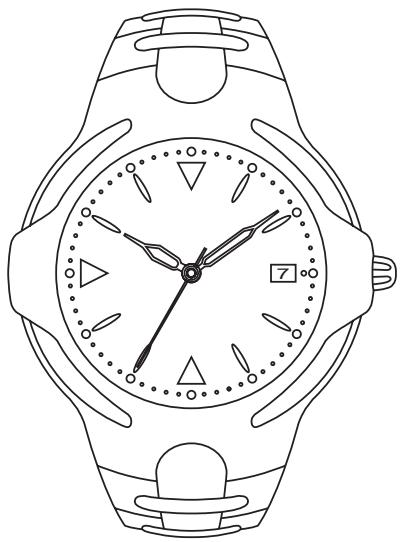
Veuillez vous assurer de charger complètement la montre avant utilisation.
Vérifiez que l'aiguille des secondes de la montre se déplace par intervalles d'une seconde lorsqu'elle est portée au poignet.
Si elle se déplace par intervalles de deux secondes, cela signifie que la montre n'est pas suffisamment chargée.
Chargez la montre en la portant de sorte que le dos de la montre soit en contact direct avec votre poignet en permanence jusqu'à ce que l'aiguille des secondes revienne à un mouvement par intervalles d'une seconde. Cette montre est dotée d'une fonction de prévention de surcharge qui élimine tout risque de surcharge, quelle que soit la durée de charge.
Lorsque l'aiguille des secondes se déplace par à-coups de deux secondes, cela indique que la montre s'est arrêtée en raison d'une charge insuffisante. Dans ce cas, chargez complètement la montre et réglez l'heure avant de l'utiliser à nouveau.
SOMMAIRE
- Caractéristiques principales 3
- Pour une génération d'énergie correcte 4
- Mécanisme de génération d'énergie
- Distinction entre les modes de génération et de non-génération d'énergie
- Référence générale pour les temps de charge Conseils pour une génération d'énergie efficace
- Précautions pendant la génération d'énergie
- Ne pas ouvrir le dos de la montre inutilement
- Réglage de l'heure et du calendrier 8
- Réglage de l'heure
- Réglage du calendrier
- Fonctions caractéristiques 12
- Fonctions d'avertissement 14
Fonction d'avertissement de charge insuffisante Fonction d'avertissement de réglage de l'heure
- Batterie secondaire 16
- Manipulation de la batterie secondaire
- Utiliser uniquement la batterie spécifiée
- En cas de non-utilisation prolongée
- Précautions 17
- Spécifications 23
1. Caractéristiques principales
Cette montre est une montre à quartz analogique équipée d'une fonction de génération thermoélectrique qui fait fonctionner la montre en convertissant la chaleur corporelle (énergie thermique), produite lorsque la montre est portée au poignet, en énergie électrique.
L'énergie est générée lorsque la montre est portée au poignet et que l'aiguille des secondes se déplace à intervalles de 1 seconde. Lorsque la montre est retirée du poignet, l'aiguille des secondes se déplace à intervalles de 10 secondes, indiquant que l'énergie n'est pas générée.
Lorsqu'elle est complètement chargée, la montre fonctionne en continu pendant environ six mois sans recharge. Pour recharger complètement la montre après qu'elle se soit arrêtée en raison d'une charge insuffisante, il faut environ 15 jours (charge continue). Pour garantir une utilité optimale, assurez-vous que la montre est toujours suffisamment chargée.
Cette montre utilise une batterie secondaire pour stocker l'énergie électrique générée. Cette batterie secondaire est totalement exempte de mercure ou d'autres substances dangereuses. Elle ne doit pas être remplacée périodiquement comme les piles de montres conventionnelles, car elle peut être chargée et déchargée de manière répétée.
2. Pour une génération d'énergie correcte
[Mécanisme de génération d'énergie]
Lorsque cette montre est portée au poignet, la chaleur corporelle provenant du contact avec la peau chauffe le dos de la montre. Cette chaleur est libérée dans l'air depuis la surface de la montre, et la différence de température entre le dos et la surface de la montre entraîne un dispositif de génération thermoélectrique qui génère de l'énergie électrique. Performances de génération d'énergie
![CITIZEN WATCH F91 - [Mécanisme de génération d'énergie] - 1](/content/2025/01/176749/images/a85432dd98e39b80a57996275aa4b1a1897cef5734fdd63ff49d4c2a37123659.jpg)
varient considérablement selon la température de l'air, les différences individuelles de température corporelle et la manière dont la montre est portée. L'environnement d'utilisation standard de cette montre est défini comme le port de la montre de sorte que le dos soit en contact direct avec le poignet à une température de l'air d'environ 25 °C (77 °F) et une température corporelle (température de surface du poignet) de 32 °C (89,6 °F).
Les performances de génération d'énergie augmentent à mesure que la différence de température entre le dos et la surface de la montre devient plus grande, et diminuent à mesure que la différence de température devient plus petite. L'énergie n'est plus générée lorsque la
température de surface de la montre et la température du dos sont égales ou lorsque la température de surface dépasse celle du dos. La montre ne peut pas générer suffisamment d'énergie si la surface de la montre est couverte par des vêtements ou d'autres objets. Il est recommandé de porter la montre de manière à libérer la chaleur de la surface de la montre autant que possible.
[Distinction entre les modes de génération d'énergie et de non-génération d'énergie]
Lorsque la génération d'énergie s'est arrêtée en raison du retrait de la montre du poignet, l'aiguille des secondes se déplace à intervalles de 10 secondes, indiquant que l'énergie n'est pas générée. Lorsque la génération d'énergie reprend en mettant la montre au poignet ou en réchauffant le dos avec les doigts, l'aiguille des secondes revient à un mouvement à intervalle de 1 seconde.
[Référence générale pour les temps de charge]
Portez la montre au poignet au moins 5 heures par jour pour assurer une journée de charge au moment du mouvement à intervalle de 1 seconde. Si la montre s'arrête en raison d'une charge insuffisante, une charge complète en utilisant le mouvement à intervalle de 1 seconde prendra environ 50 jours, à condition que la montre soit portée 8 heures par jour. Cependant, assurez-vous d'attacher la montre au poignet de la manière correcte, car la façon dont la montre est attachée affectera grandement le temps requis pour la charge. Il est recommandé de porter la montre quotidiennement pour stocker une quantité suffisante d'énergie électrique et augmenter la quantité de charge retenue par la montre.
[Conseils pour une génération d'énergie efficace]
- Portez la montre de sorte que le dos soit fermement contre votre poignet.
- Portez la montre de sorte que la chaleur soit libérée de la surface de la montre.
- Ne laissez pas la montre être couverte par des vêtements (manches, gants, vêtements d'hiver, etc.).
- Essayez de porter la montre pendant de longues périodes.
- Laisser l'air souffler sur la surface supérieure de la montre pendant que vous la portez pour abaisser la température de surface facilite la génération d'énergie.
ATTENTION
[Précautions pendant la génération d'énergie]
Chauffer entièrement la montre dissipe la différence de température entre le fond du boîtier et la surface de la montre, empêchant ainsi la production d'électricité.
- Ne pas chauffer la surface de la montre en la touchant avec la main.
- Ne pas chauffer la montre avec un appareil de chauffage ou de cuisson.
- Ne pas tenter de chauffer la montre avec une flamme nue provenant d'une cuisinière à gaz, d'un briquet ou d'un autre dispositif de chauffage.
- Ne pas tenter de chauffer la montre avec de l'air chaud provenant d'un sèche-cheveux ou d'un autre appareil.
- Ne pas chauffer la surface de la montre avec la lumière directe du soleil.
- Laisser la montre dans des endroits à température élevée peut entraîner une détérioration de la fonction de génération thermoélectrique.
- Ne pas laisser la montre dans des endroits où la température devient élevée [60°C (140°F) ou plus], comme sur le tableau de bord d'une voiture.
ATTENTION
[Ne pas ouvrir inutilement le fond du boîtier de la montre]
Ne jamais ouvrir le fond du boîtier de la montre. Cela pourrait empêcher la montre de se charger, la faire s'arrêter ou entraîner un défaut d'étanchéité.
3. Réglage de l'heure et du calendrier
Si la montre s'est arrêtée en raison d'une charge insuffisante ou si l'aiguille des secondes se déplace par intervalles de 2 secondes lors du réglage de l'heure, remettez d'abord la montre en mouvement à intervalles de 1 seconde avant de régler l'heure en la chargeant en vous référant à la section intitulée « Pour une génération d'énergie correcte ». Si la couronne est de type à vis, dévissez-la avant l'opération. Assurez-vous de revisser la couronne après les réglages.
[Réglage de l'heure]
- Tirez la couronne deux fois jusqu'à la position de correction de l'heure lorsque l'aiguille des secondes atteint la position 0 seconde.
- Tournez la couronne pour régler l'heure.
![CITIZEN WATCH F91 - [Réglage de l'heure] - 1](/content/2025/01/176749/images/b975da221e4186749347d79f4ab412f12eab48b8535d598ddde444ed1ec8d6ad.jpg)
- La date change à 0 h. Veillez à ne pas confondre AM et PM lors du réglage de l'heure.
- L'indication de la date commence à changer vers 21 h et se termine vers 1 h.
- Un réglage plus précis de l'heure peut être obtenu en avançant l'aiguille des minutes de 4 à 5 minutes par rapport à l'heure exacte, puis en la reculant jusqu'au réglage correct.
- Remettez la couronne dans sa position normale en synchronisation avec le signal téléphonique. L'aiguille des secondes se mettra à tourner et la montre commencera à fonctionner à partir de l'heure exacte.
- Tirez la couronne deux fois jusqu'à la position de correction de l'heure lorsque l'aiguille des secondes atteint la position 0 seconde.
- Tournez la couronne pour régler l'heure.
- Remettez la couronne dans sa position d'origine en synchronisation avec le signal téléphonique. L'aiguille des secondes se mettra à tourner et la montre commencera à fonctionner à partir de l'heure exacte.
Attention
Si la couronne est tirée jusqu'à la position de correction de l'heure lorsque l'aiguille des secondes se trouve à une position autre que 0, 10, 20, 30, 40 ou 50 secondes, ou si l'aiguille des secondes ne s'arrête pas aux positions d'arrêt par intervalles de 10 secondes en raison de l'influence de l'électricité statique ou de chocs physiques, effectuez la procédure suivante pour régler à nouveau l'heure correcte.
- Tirez la couronne deux fois jusqu'à la position de correction de l'heure lorsque l'aiguille des secondes se trouve entre 51 et 59 secondes.
- Enfoncez la couronne dans sa position normale. L'aiguille des secondes se déplace par intervalles de 1 seconde pendant 10 secondes seulement.
- Dans la condition de mouvement par intervalles de 10 secondes (condition de non-génération d'énergie) uniquement, le mouvement par intervalles de 1 seconde aura lieu pendant 10 secondes après avoir enfoncé la couronne.
- Tirez à nouveau la couronne deux fois jusqu'à la position de réglage de l'heure lorsque l'aiguille des secondes atteint la position 0 seconde.
- Reportez-vous à , et réglez l'heure.
- Tirez la couronne une fois jusqu'à la position de correction du calendrier.
- En tournant la couronne vers la gauche, faites correspondre la date du jour.
- Une rotation à vide se produira si la couronne est tournée vers la droite.
- Si la date est réglée alors que l'indication de l'heure est entre 21 h et 1 h, la date peut ne pas changer même le lendemain.
- Cette montre utilise un système de date sur 31 jours. Pour les mois de 30 jours et février, la couronne doit être actionnée pour corriger la date le premier du mois suivant.
- Remettez la couronne en position normale.
4. Fonctions caractéristiques
L'affichage de cette montre change suite à l'activation des fonctions d'avertissement décrites ci-dessous lorsque la montre est insuffisamment chargée.
Lorsque l'heure est réglée alors que la montre est complètement chargée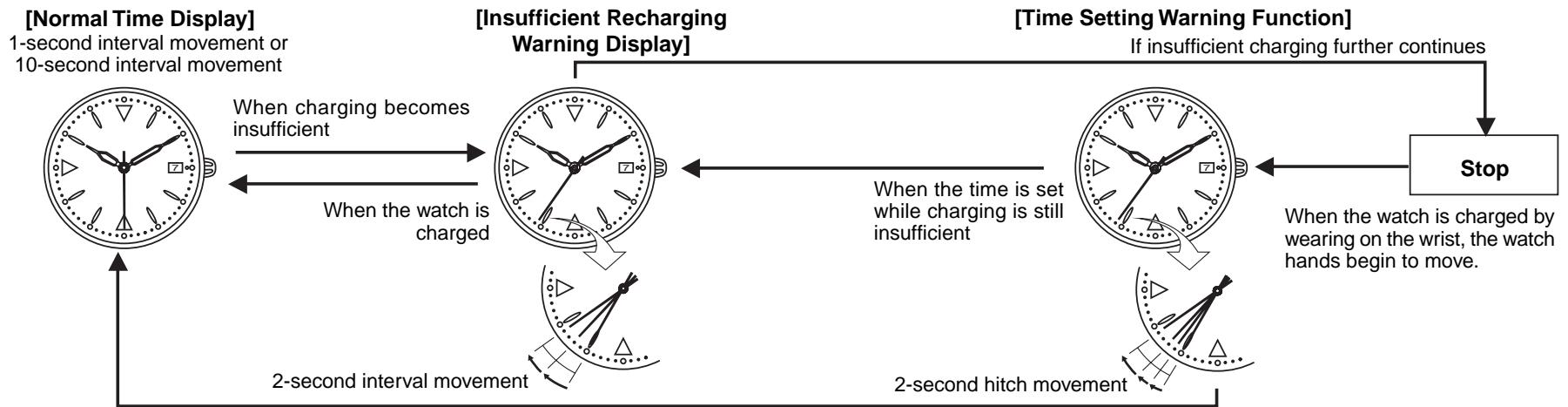
5. Fonctions d'avertissement
L'affichage de cette montre change lorsque les fonctions d'avertissement décrites ci-dessous sont activées en raison d'une charge insuffisante de la montre. La montre ne passe pas au mouvement à intervalles de 10 secondes même si l'énergie n'est pas générée pendant que l'une de ces fonctions est activée.
[Fonction d'avertissement de charge insuffisante]
Lorsque l'aiguille des secondes se déplace à intervalles de 2 secondes (elle avance de deux graduations à la fois toutes les 2 secondes), cela indique que la montre est insuffisamment chargée.
Mouvement à intervalles de 2 secondes![CITIZEN WATCH F91 - [Fonction d'avertissement de charge insuffisante] - 1](/content/2025/01/176749/images/dc28182f26bd98b72a20d3c8c09e5e121b155a918df5603a353519f7b169580c.jpg)
Bien que la montre continue de fonctionner normalement à ce moment-là, si environ 11 jours s'écoulent après le début du mouvement à intervalles de 2 secondes, la montre s'arrête. Lorsque cela se produit, rechargez la montre en la portant au poignet jusqu'à ce qu'elle revienne à un mouvement normal à intervalles de 1 seconde.
Si la charge est interrompue peu après le retour de la montre à un mouvement à intervalles de 1 seconde, elle repassera à un mouvement à intervalles de 2 secondes quelques minutes plus tard.
[Fonction d'avertissement de réglage de l'heure]
Bien que les aiguilles de la montre commencent à bouger lorsque la montre a été rechargée après s'être arrêtée en raison d'une charge insuffisante, comme l'heure est
Mouvement saccadé à intervalles de 2 secondes![CITIZEN WATCH F91 - [Fonction d'avertissement de réglage de l'heure] - 1](/content/2025/01/176749/images/a2f9fd8932d0f45bc3efefc8c16404c5823c3f3d4cac0fa8bb81125c6163a699.jpg)
incorrecte, l'aiguille des secondes effectue un mouvement saccadé à intervalles de 2 secondes (elle avance de manière irrégulière toutes les 2 secondes) indiquant que l'heure est incorrecte.
Lorsque cela se produit, rechargez la montre en la portant au poignet après l'avoir réglée à l'heure correcte.
Lorsque l'heure est réglée, le mouvement saccadé à intervalles de 2 secondes est annulé et la montre revient à l'affichage normal de l'heure ou à la fonction d'avertissement de charge insuffisante. En cas de mouvement saccadé à intervalles de 2 secondes, changez la montre jusqu'à ce qu'elle revienne à des mouvements à intervalles de 1 seconde.
6. Batterie secondaire
AVERTISSEMENT Manipulation de la batterie secondaire
Ne tentez jamais de retirer la batterie secondaire de la montre. Si la batterie secondaire doit absolument être retirée, rangez-la hors de portée des jeunes enfants pour éviter toute ingestion accidentelle. Si la batterie secondaire venait à être avalée, consultez immédiatement un médecin et sollicitez une assistance médicale.
AVERTISSEMENT : Utiliser uniquement la batterie spécifiée
N'utilisez jamais une batterie autre que la batterie secondaire spécifiée pour cette montre. Bien que la montre soit conçue pour ne pas fonctionner si un autre type de batterie est installé, si un autre type de batterie, comme une pile argent, est utilisé de force et que la montre est chargée avec cette batterie, il existe un risque de rupture de la batterie, entraînant des dommages à la montre et des blessures. Assurez-vous toujours d'utiliser uniquement la batterie spécifiée lors du remplacement de la batterie secondaire de cette montre.
[En cas de non-utilisation pendant une longue période]
Il est recommandé de ranger la montre avec la couronne tirée en position de réglage de l'heure pour économiser l'énergie électrique. Cela permet de réduire la
consommation de courant et de prolonger la durée d'utilisation de la montre sans charge. Lors de l'utilisation de la montre après stockage, assurez-vous de d'abord régler l'heure après une charge complète et le retour au mouvement à intervalle de 1 seconde.
7. Précautions
ATTENTION : Performance d'étanchéité à l'eau
Il existe plusieurs types de montres étanches, comme indiqué dans le tableau suivant. Pour une utilisation correcte dans les limites de conception de la montre, confirmez le niveau d'étanchéité de votre montre, comme indiqué sur le cadran et le boîtier, et consultez le tableau.
- Étanchéité à l'eau pour un usage quotidien (jusqu'à 3 atmosphères) : Ce type de montre résiste à une exposition mineure à l'eau. Par exemple, vous pouvez porter la montre en vous lavant le visage ; cependant, elle n'est pas conçue pour une utilisation sous l'eau.
- Étanchéité à l'eau améliorée pour un usage quotidien (jusqu'à 5 atmosphères) : Ce type de montre résiste à une exposition modérée à l'eau. Vous pouvez porter la montre en nageant ; cependant, elle n'est pas conçue pour une utilisation en plongée libre.
- Étanchéité à l'eau améliorée pour un usage quotidien (jusqu'à 10/20 atmosphères) : Ce type de montre peut être utilisé pour la plongée libre ; cependant, elle n'est pas conçue pour la plongée sous-marine ou la plongée saturée utilisant de l'hélium.
(L'unité "bar" est approximativement égale à 1 atmosphère.)
| Indication | Specification | Minor exposure to water (washing face, rain, etc.) | Moderate exposure to water (washing, kitchen work, swimming, etc.) | Marine sports (skin diving) | Scuba diving (with air tank) | Operation of the crown with moisture visible | |
| Dial | Case (caseback) | ||||||
| WATER RESIST or no indication | WATER RESIST(ANT) | Water-resistant to 3 atmospheres | OK | NO | NO | NO | NO |
| WR 50 or WATER RESIST 50 | WATER RESIST(ANT) 5 bar or WATER RESIST (ANT) | Water-resistant to 5 atmospheres | OK | OK | NO | NO | NO |
| WR 100/200 or WATER RESIST 100/200 | WATER RESIST(ANT) 10/20 bar or WATER RESIST (ANT) | Water-resistant to 10/20 atmospheres | OK | OK | OK | NO | NO |
- WATER RESIST(ANT) xx bar peut également être indiqué comme W.R. xx bar.
ATTENTION
- Veillez à utiliser la montre avec la couronne enfoncée (position normale). Si votre montre est dotée d'une couronne à vis, assurez-vous de la visser complètement.
- N'actionnez PAS la couronne avec des doigts mouillés ou lorsque la montre est mouillée. L'eau peut pénétrer dans la montre et compromettre son étanchéité.
- Si la montre est utilisée dans l'eau de mer, rincez-la à l'eau douce après utilisation et essuyez-la avec un chiffon sec.
- Si de l'humidité a pénétré dans la montre, ou si l'intérieur du verre est embué et ne devient pas clair en un jour, apportez immédiatement la montre à votre revendeur ou au centre de service Citizen pour réparation. Laisser la montre dans un tel état permettra à la corrosion de se former à l'intérieur.
- Si de l'eau de mer pénètre dans la montre, placez la montre dans une boîte ou un sac en plastique et apportez-la immédiatement pour réparation. Sinon, la pression à l'intérieur de la montre augmentera et des pièces (verre, couronne, etc.) pourraient se détacher.
ATTENTION Gardez votre montre propre
- Laisser de la poussière et de la saleté s'accumuler entre le boîtier et la couronne peut rendre difficile l'extraction de la couronne. Tournez la couronne en position normale de temps en temps pour desserrer la poussière et la saleté, puis brossez-les.
- La poussière et la saleté ont tendance à se déposer dans les interstices du dos du boîtier ou du bracelet. La poussière et la saleté déposées peuvent provoquer de la corrosion et tacher vos vêtements. Nettoyez la montre de temps en temps.
Nettoyage de la montre
- Utilisez un chiffon doux pour essuyer la saleté, la transpiration et l'eau du boîtier et du verre.
- Utilisez un chiffon doux et sec pour essuyer la transpiration et la saleté du bracelet en cuir.
- Pour nettoyer un bracelet en métal, en plastique ou en caoutchouc, lavez la saleté avec du savon doux et de l'eau. Utilisez une brosse douce pour enlever la poussière et la saleté coincées dans les interstices du bracelet en métal. Si votre montre n'est pas étanche, apportez-la à votre revendeur.
REMARQUE : évitez d'utiliser des solvants (diluant, benzine, etc.), car ils peuvent ternir la finition.
ATTENTION Environnement d'utilisation
- Utilisez la montre dans la plage de température de fonctionnement spécifiée dans le manuel d'instructions.
L'utilisation de la montre à des températures hors de la plage spécifiée peut entraîner une détérioration des fonctions, voire l'arrêt de la montre.
- N'utilisez PAS la montre dans des endroits où elle est exposée à des températures élevées, comme dans un sauna.
Cela peut provoquer une brûlure de la peau.
- Ne laissez PAS la montre dans un endroit exposé à des températures élevées, comme la boîte à gants ou le tableau de bord d'une voiture.
Cela peut entraîner une détérioration de la montre, comme la déformation des pièces en plastique.
- Ne placez PAS la montre à proximité d'un aimant. La précision du chronométrage sera compromise si vous placez la montre près d'équipements de santé magnétiques tels qu'un collier magnétique, une fermeture magnétique de porte de réfrigérateur, une fermeture de sac à main ou l'écouteur d'un téléphone mobile. Si cela se produit, éloignez la montre de l'aimant et réglez à nouveau l'heure.
- Ne placez PAS la montre à proximité d'appareils électroménagers qui génèrent de l'électricité statique. La précision du chronométrage peut être compromise si la montre est exposée à une forte électricité statique, comme celle émise par un écran de télévision.
- Ne soumettez PAS la montre à un choc violent, comme la faire tomber sur un sol dur.
- Évitez d'utiliser la montre dans un environnement où elle pourrait être exposée à des produits chimiques ou à des gaz corrosifs. Si des solvants, tels que le diluant et la benzine, ou des substances contenant de tels solvants entrent en contact avec la montre, une décoloration, une fusion, des fissures, etc. peuvent en résulter. Si la montre entre en contact avec le mercure utilisé dans les thermomètres, le boîtier, le bracelet ou d'autres pièces peuvent se décolorer.
8. Spécifications
- Numéro de calibre : F910
- Type : montre à quartz à génération thermoélectrique
- Précision : ±15 secondes par mois en moyenne (lorsqu'elle est portée à des températures normales de +5°C à +35°C / 41°F à 95°F)
- Plage de température de fonctionnement : -10°C à +60°C / 14°F à 140°F
- Fonctions d'affichage : Heure (heures, minutes, secondes), Calendrier
- Fonctions supplémentaires :
Fonction de génération thermoélectrique, Fonction d'avertissement de recharge insuffisante, Fonction d'avertissement de réglage de l'heure, Fonction de prévention de surcharge
- Durée de fonctionnement continu :
De la charge complète à l'arrêt : environ 6 mois - Mouvement à intervalle de 2 secondes jusqu'à l'arrêt : environ 11 jours
- Pile utilisée : Pile secondaire, 1 pièce.


- FRANÇAIS
- VEUILLEZ VOUS ASSURER DE CHARGER COMPLÈTEMENT LA MONTRE AVANT UTILISATION
- SOMMAIRE
- CARACTÉRISTIQUES PRINCIPALES
- POUR UNE GÉNÉRATION D'ÉNERGIE CORRECTE
- [MÉCANISME DE GÉNÉRATION D'ÉNERGIE]
- [DISTINCTION ENTRE LES MODES DE GÉNÉRATION D'ÉNERGIE ET DE NON-GÉNÉRATION D'ÉNERGIE]
- [RÉFÉRENCE GÉNÉRALE POUR LES TEMPS DE CHARGE]
- [CONSEILS POUR UNE GÉNÉRATION D'ÉNERGIE EFFICACE]
- ATTENTION
- [PRÉCAUTIONS PENDANT LA GÉNÉRATION D'ÉNERGIE]
- [NE PAS OUVRIR INUTILEMENT LE FOND DU BOÎTIER DE LA MONTRE]
- RÉGLAGE DE L'HEURE ET DU CALENDRIER
- [RÉGLAGE DE L'HEURE]
- FONCTIONS CARACTÉRISTIQUES
- FONCTIONS D'AVERTISSEMENT
- [FONCTION D'AVERTISSEMENT DE CHARGE INSUFFISANTE]
- [FONCTION D'AVERTISSEMENT DE RÉGLAGE DE L'HEURE]
- BATTERIE SECONDAIRE
- AVERTISSEMENT MANIPULATION DE LA BATTERIE SECONDAIRE
- AVERTISSEMENT : UTILISER UNIQUEMENT LA BATTERIE SPÉCIFIÉE
- [EN CAS DE NON-UTILISATION PENDANT UNE LONGUE PÉRIODE]
- PRÉCAUTIONS
- ATTENTION : PERFORMANCE D'ÉTANCHÉITÉ À L'EAU
- ATTENTION GARDEZ VOTRE MONTRE PROPRE
- NETTOYAGE DE LA MONTRE
- ATTENTION ENVIRONNEMENT D'UTILISATION
- SPÉCIFICATIONS
Marque : CITIZEN WATCH
Modèle : F91
Catégorie : Montre