
MW 651 - Four à micro-ondes DELONGHI - Notice d'utilisation et mode d'emploi gratuit
Retrouvez gratuitement la notice de l'appareil MW 651 DELONGHI au format PDF.


| Type de produit | Four à micro-ondes combiné avec gril |
| Marque | De'Longhi |
| Modèle | MW 651 |
| Capacité | 23 litres (modèle standard) ; également disponible en 17 litres |
| Dimensions extérieures (L x P x H) | 520 x 305 x 400 mm (pour modèle 23 L) |
| Dimensions intérieures (L x P x H) | 322 x 218 x 331 mm (pour modèle 23 L) |
| Poids net | 19 kg (pour modèle 23 L) |
| Puissance micro-ondes | 750 W (maximum) |
| Puissance gril | Environ 1000 W (non spécifié précisément) |
| Diamètre du plateau tournant | 31 cm (pour modèle 23 L) |
| Éclairage intérieur | 25 W |
| Fonctions principales | Micro-ondes seul, gril seul, micro-ondes + gril (3 niveaux combinés : combi 1, 2, 3) |
| Niveaux de puissance micro-ondes | 5 niveaux (160 W, 260 W, 400 W, 560 W, 700 W pour modèle 17 L ; 180 W, 300 W, 450 W, 720 W, 900 W pour modèle 23 L) |
| Minuterie | Mécanique jusqu'à 30 minutes, arrêt automatique avec signal sonore |
| Accessoires fournis | Plateau tournant, support de plateau, grille métallique |
| Sécurité | Arrêt automatique en fin de cuisson, interrupteurs de sécurité de porte, protection contre la surchauffe (ne pas faire fonctionner à vide) |
| Entretien et nettoyage | Nettoyer avec un chiffon doux et du savon neutre ; ne pas utiliser de produits abrasifs ; nettoyer régulièrement les orifices d'aération |
| Pièces détachées et réparabilité | Plateau tournant et support remplaçables ; ampoule intérieure remplaçable par un service agréé |
| Alimentation électrique | 230 V ~ 50 Hz, prise de courant avec mise à la terre, fusible 13 A (Royaume-Uni) |
| Informations générales | Conforme aux directives CEE 89/336 et 92/31 sur la compatibilité électromagnétique |
FOIRE AUX QUESTIONS - MW 651 DELONGHI
Questions des utilisateurs sur MW 651 DELONGHI
0 question sur cet appareil. Repondez a celles que vous connaissez ou posez la votre.
Poser une nouvelle question sur cet appareil
Téléchargez la notice de votre Four à micro-ondes au format PDF gratuitement ! Retrouvez votre notice MW 651 - DELONGHI et reprennez votre appareil électronique en main. Sur cette page sont publiés tous les documents nécessaires à l'utilisation de votre appareil MW 651 de la marque DELONGHI.
MODE D'EMPLOI MW 651 DELONGHI

HOW TO GET THE BEST RESULTS FROM YOUR OVEN
| What do I want to do? | What function should I choose? | 17 Lt | 23 Lt | Use Instr. page | Amt. & time chart page | ||
| Defrost | Microwave only | 160W | 180W | 2728 | 29 | ||
| Keep food warm | Microwave only | 260W | 300W | 2728 | |||
| FMelt butter and soften cheese | Microwave only | 400W | 450W | 2728 | 31 |  | |
| Heat pastry goods | 560W | 720W | 33 | 33 | MICROWAVE | ||
| Making boiled vegetables | 27 | ||||||
| Cooking fish | 32 | 32 | |||||
| Cooking rice, making soup | Microwave only | 700W | 900W | 323333 | 3231 | ||
| Heating foods already cooked | 3033 | ||||||
| Cooking fruit | |||||||
| Grill hamburgers, chops, frankfurters, sausages, toast, etc. in a “traditional” way | Grill only | 34 | 35 |  | |||
| microwave + grill function | |||||||
| Cooking vegetables au gratin | combi - 1 | 230W | 300W |  | |||
| Making lasagne or pasta oven dishes | combi - 2 | 350W | 450W | 3637 | 37 | ||
| Making all types of roasts, poultry, skewered meats, etc. | combi - 3 | 470W | 600W | ||||
TECHNICAL DATA
MODEL WITH A 23-LITRE CAVITY
Outer measurements (LxDxH) 520x305x400
Inner measurements (LxDxH) 322x218x331
Approximate weight
Turntable diameter
Oven light
19 kg.
31 cm
25 W
MODEL WITH A 17-LITRE CAVITY
Outer measurements (LxDxH) 450x290x380
Inner measurements (LxDxH) 285x205x280
Approximate weight 17 kg.
Turntable diameter 27 cm
Oven light 25 W
BOTH MODELS
For additional information, refer to the rating plate on the appliance.
This equipment is in compliance with EEC Directives 89/336 and 92/31 related to Electromagnetic Compatibility.
OUTPUT POWER
In this oven the maximum power yielded by the microwaves is 750W. This value is shown on the data plate placed on the back of the appliance, under the heading MICRO OUTPUT.
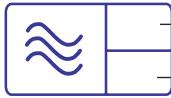
In some models the maximum power yielded in WATTS, is also indicated in the symbol on the side, shown on the door.
(ONLY FOR U.K.) The letter indicates the heating category to which your oven belongs: some chilled food pre-cooked frozen or chilled give heating instructions corresponding to the various categories. Follow those instructions related to the category indicated for your oven.
The levels of intermediate power available are shown on this page. This information will be useful for you to consult the prescription pads for microwaves currently on sale.
22
IMPORTANT SAFEGUARDS
Read carefully these instructions and keep for future reference
1) WARNING: If the door or door seals are damaged, the oven must not be operated until it has been repaired by a competent person (trained by the manufacturer or by its Customer Service).
2) WARNING: It is hazardous for anyone other than a competent person to carry out any service or repair operation which involves the removal of a cover which gives protection against exposure to microwave energy.
3) WARNING: Liquids and other foods must not be heated in sealed containers since they are liable to explode. Eggs in their shell and whole hard-boiled eggs should not be heated in microwave ovens since they may explode even after microwave heating has ended.
4) WARNING: Only allow children to use the oven without supervision when adequate instructions have been given so that the child is able to use the oven in a safe way and understands the hazards of improper use.

natural_image
Cartoon illustration of a microwave oven with two eggs and a crying face, no text or symbols present5) Do not attempt to operate the oven with the door open by tampering with the safety devices.
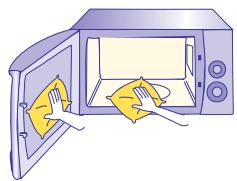
6) Do not operate the oven if objects for any kind get stuck between the front panel of the oven and the door. Always keep the inside of the door (E) clean, using a damp cloth and non-abrasive detergents. Do not allow dirt or remains of food to accumulate between the front panel of the oven on the door.
natural_image
Illustration of a microwave oven with hands cleaning a yellow cloth (no text or symbols)7) If the supply cable has been damaged, it must be replaced by the manufacturer or the technical service centre or by a qualified person so as to avoid all risks.
8) If smoke is observed, switch off or unplug the appliance and KEEP THE DOOR CLOSED in order to stifle any flames.
9) Only use utensils that are suitable for use in microwave ovens. In order to avoid overheating and the consequent risk of fire, it is advisable to supervise the oven
when cooking food in disposable containers made of plastic, cardboard or other inflammable materials, and when heating small quantities of food.
10) Never place the turntable in water after it has been heated for a long time. The high thermal shock resulting would break the turntable.
11) When cooking "Only MICROWAVE" and "COMBINED WITH MICROWAVE", you absolutely must not pre-heat the oven (without foodstuffs in it) and you must not operate it when it is empty, because you might cause sparking.
12) Before using this oven, check to be certain that the utensil and containers chosen are suitable for microwave oven use (see the section on "Glassware and Similar Items").
13) During the use the appliance becomes hot. Do not touch the heating elements inside the oven.
14) When heating liquids (water, coffee, milk, etc.) it is possible that the contents may suddenly start to boil and spill violently as a result of delayed boiling, causing scalding. To avoid this happening, you should place a heat-resistant plastic spoon or a glass rod in the container before starting to heat liquids. Anyway, care shall be taken when handling the container.
15) Do not heat spirit with a high alcohol content, nor large quantities of oil, as these could catch fire!
16) The contents of feeding bottles and baby food jars shall be stirred or shaken and the temperature shall be checked before consumption in order to avoid burns. It is also advisable to stir or shake the food in order to ensure that it has an even temperature.

When using commercially available bottle sterilisers, before turning the oven on, ALWAYS make sure the container is filled with the quantity of water indicated by the manufacturer.
N.B. When the oven is used for the first time it is possible that, for a period of approx. 10 minutes, it may produce a "new" smell and a small amount of smoke. This is only a result of protective substances applied to the heating element. Ventilate the room during this operation.
ELECTRICAL CONNECTIONS
Connect this equipment only to electrical outlets having a capacity of at least 10A.
Before using this oven, check to make certain that the electrical network is the same as that indicated on the equipment's data plate and that the electrical
outlet is connected to an efficient grounding (earth) terminal. The manufacturer shall not be responsible in any manner whatsoever for harm or damage caused by failure to observe this norm.
• Electrical Connection for UK only .....see page 39
INSTALLATION
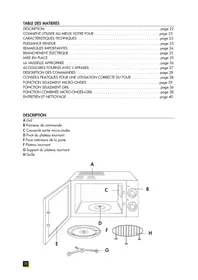
1) After having removed the oven from its box, check to make certain that the turntable spindle (D) is correctly fitted into its housing. Place the turntable support (G) in the middle of the cooking chamber and set the turntable (F) on top of it. The spindle (D) must be inserted in the related turntable housing.
2) Check to make certain that this equipment has not been damaged in transport and check especially to see if the door opens and closes correctly.
3) Set the oven on a flat, steady surface at least 85 cm. above the floor and out of the reach of small children, because when the oven is operating its door can get very hot.
4) After having placed the oven on its work level, make sure that there is still a free space of at
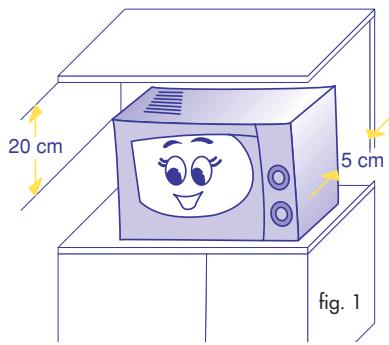
least 5 cm. between the over surfaces and the side as well as back walls, and a free space of at least 20 cm. above the oven (see Fig. 1). Also check to make sure the feed cord is not touching the appliance's rear wall, because the wall itself can get very hot while the grill is being used.
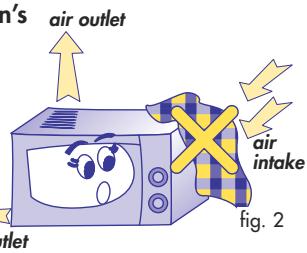
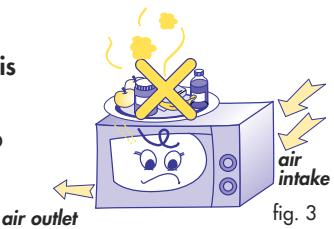
5) Do not block the air intake. In particular, do not set anything atop the oven and check to be certain that the air outlet slots (located above, under and in the back of the oven) are ALWAYS FREE from obstruction (see Figs. 2 and 3).
G L A S S W A R E A N D S I M I L A R I T E M S
You can make use of all types of containers made of glass (preferably Pyrex), ceramics, porcelain and glazed pottery as long as they do not have decorations or metal parts (gilded borders, handles, feet). Heat resistant plastic containers can also be used, but only for "Microwave Only" cooking. If you are still doubtful about using a particular container, you can perform a simple test. Place the empty container in the oven for 30 seconds at maximum power ("Microwave Only" function). If the container is still cold or only slightly warm, it is suitable for microwave cooking. If it is very hot or gives out sparks, it is not suitable. For short heating periods, you may use paper napkins, cardboard trays and plastic "throwaway" plates as a base. As far as shape and size are concerned, it is absolutely essential that containers be such as to allow the turntable to rotate. In order to use large-size rectangular
containers (which may not be able to rotate inside the cooking cavity), you can remove the spindle (D) from its housing to prevent the turntable (F) moving. Bear in mind that to be assured of good results when carrying this out you must stir the food and turn the container around several times during the cooking process. Containers made of metal, wood, recycled kitchen paper, cane and plate glass are not suitable for use in microwave ovens. The metal rack supplied with your microwave have been fully tested for safe use. You should remember, too, that since microwaves heat the food and not the glassware, earthenware or similar containers for that food, it is possible to cook such foods in the serving dish and thereby avoid the problem of having to clean pans later. If the oven is used in its grill only functions, any type of oven container may be used (see chart).
| Glass | Cera-mics | Porce-lain | Earthen-ware | Plastic for micro-waves | Paper cups* | Paper plates* | Pyrex | Card-board * | Metal contain-ers | Glass-ware with metal parts | Special roasting paper | |
| Microwave only | YES | YES | YES | YES | YES | YES | YES | YES | YES | NO | NO | YES |
| Grill only | NO | YES | YES | YES | NO | NO | NO | YES | NO | YES | YES | YES |
| microwave + grill | NO | YES | YES | YES | NO | NO | NO | YES | NO | NO | NO | YES |
* If the cooking time required is too long, there is a possibility of fire.
DESCRIPTION OF CONTROLS
ACCESSORIES PROVIDED
WIRE RACK

Grill only or Microwave only function: For all types of grilling.
TURNTABLE
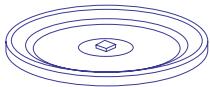
The turntable is used for all the functions.
ADVICE ON USING YOUR OVEN CORRECTLY
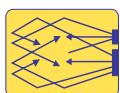
Microwaves consist of electromagnetic radiation found in nature under the form of light waves (e.g., sunlight). Inside the oven, these waves penetrate food from all directions and heat up the water, fatty and sugar molecules.
Heat is produced very quickly only in the food itself, whereas the container being used warms up indirectly by means of heat given off by the heated food. This prevents food from sticking to its container, so you can use very little fatty sub-
stance or, in some cases, no fat at all during the cooking process.
Therefore cooking in a microwave oven is considered to be healthy and good for one's diet.
And in contrast to traditional methods, cooking in a microwave foodstuffs are less dehydrated, lose less of their nutritional value, and retain more of their original flavour.
Basic rules for correct cooking with a microwave oven
1) In order to set cooking times correctly, remember (in referring to the charts on the following pages) that when you increase the amount of foodstuffs the cooking temperature must likewise be proportionately increased and vice-versa. It is important to respect the "standing" times: standing time means that period during which the food must be left to "rest" after being cooked so as to allow an even greater spreading of the temperature within. The temperature of meat, for example, will rise about 5^ - 8^ C. (approx. 9^ - 15^ F.) during the standing time. Standing times may be observed either inside or outside the oven.
2) One of the main things you must do is stir the food several times while it is being cooked. This helps make the temperature distribution more uniform and thus shortens the cooking time.
3) It is also advisable to turn the foodstuff over during its cooking process: this applies especially for meat, whether it is in large pieces (roasts, whole chickens, etc.) or small (chicken breasts, etc.).
4) Foods having a skin, shell or peel (e.g., apples, potatoes, tomatoes, frankfurters, fish) must be pierced with a fork in several points so as to permit steam to escape and to prevent those items from exploding (see Fig. 4).
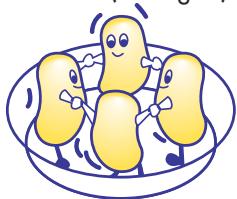
5) If you are preparing a large number of portions of the same food item (e.g., boiled potatoes), place those portions in a Pyrex dish in order to have them cook in a uniform manner (see Fig. 5):
6) The lower the temperature at which a foodstuff is placed in a microwave oven, the longer the cooking time required. Food having a room temperature will cook more quickly than food having a refrigerator temperature.
7) Always do your cooking by placing the food container in the centre of the turntable.
8) It is perfectly normal for condensation to form inside the oven and near the air outlet. To reduce such condensation, cover the foodstuffs with clear-sheet, wax paper, a glass lid or simply an overturned plate. Then, too, foods having a water content (e.g., greens and vegetables) cook better when covered. The covering of food also helps keep the oven clean on the inside. Use clear-sheet made expressly for microwave ovens.

natural_image
Cartoon illustration of five yellow, rounded objects resembling a mushroom or onion on a plate (no text or symbols)MICROWAVE-ONLY FUNCTION
This function is suitable for:
- Keeping food hot ....page 28
- Defrosting . . . . . . . . . . . . . . . . . . . . . . . . . . . . . . . . . . . . . . . . . . . . . . . page 28
-
Heating ....page 30
-
Cooking stew, white meats, fruit, vegetables, rice, soup and fish . . . . . . . . . . . . . . . . . . . . . . . . . . . . . . . . . . . . . . . . . . . . . . . . . . 32
- To brown the foods, to bake pastry and fruit .......page 34
MICROWAVE
TURNING THE OVEN ON USING ONLY THE MICROWAVE FUNCTION

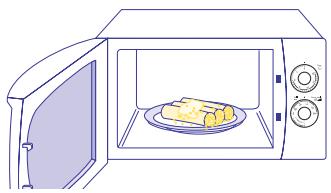
Place the food in a container suitable for microwave cooking and place it in the centre of the turntable
N.B: You do not have to pre-heat the oven.
natural_image
Line drawing of a microwave oven with a plate inside and a door open (no text or symbols)
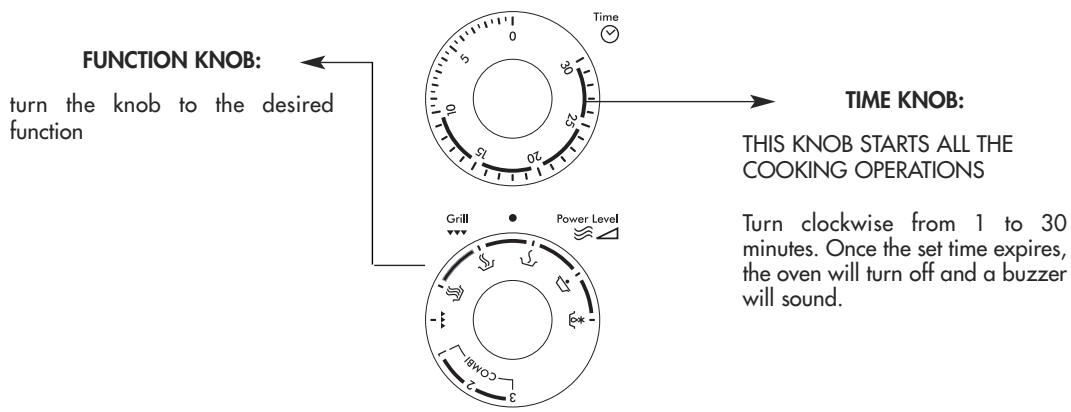
Select the desired power level by turning the function knob to one of the 5 symbols denoting the microwave output power.
N.B.: if the knob is turned to the ▼▼▼ symbol or one of the following 3 symbols, the grill will also operate.

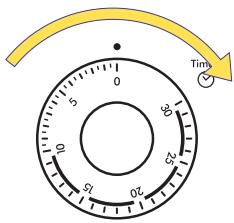
Set the cooking time you want by turning the Time knob in a clockwise direction.

Once the set cooking time has expired, a buzzer will sound to signal that your food is ready

You can interrupt operations any time you wish simply by turning the Time knob to the "0" position. You can also change the cooking time (while the foodstuff is being cooked) simply by turning this same knob forward or backward. You can check on the situation while the cooking is in progress by opening the door and examining the food. That move will interrupt the oven's operations, but they will begin again once the door has been closed.

MICROWAVE
USING THE MICROWAVE-ONLY FUNCTION TO KEEP FOOD HOT
- Turn the function knob to the ⏻ position and set the desired time on the timer knob.
- This function enables you to keep food hot, whether that food be just cooked or re-heated, without having it get dry or stick to its container.
- You can leave foods in their cooking container if they are covered.
USING THE MICROWAVE-ONLY FUNCTION FOR DEFROSTING
- Turn the function knob to the ⚙ position and set the desired time on the timer knob.
- Foods frozen in bags or plastic sheeting or in their packaging may be placed directly in the oven, as long as they have no metal parts (e.g., bands or closure rivets).
- Certain foods, such as greens, vegetables and fish, do not generally require defrosting before you begin cooking them.
- Stewed foods and meats as well as meat sauces defrost better and quicker if they are stirred from time to time, turned over or broken cup.
- While defrosting, meat and fish lose their liquid content. It is recommended, therefore, that you defrost such items in a tray or basin.
- It is advisable to separate each individual piece of meat from its bag before putting it in the freezer. This will help you save valuable time will preparing foods.
- Be careful about following the timings printed on frozen products, because they are guideline and may not always be correct. It is best to use defrosting times slightly less than those indicated. The time needed for defrosting will vary in terms of the degree to which the food has been frozen.
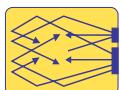
Defrosting times
MICROWAVE
| Type | Quantity | Function knob | Cooking time | Notes | Standing time (minutes) | |
| 17 Lt. 700 W | 23 Lt. 900 W | |||||
| MEAT | ||||||
| Roasts (pork, beef, veal, etc.) | 1 kg | 29 - 32 | 26 - 29 | 20 | ||
| 200 gr | " | 10 - 12 | 7 - 9 | 5 | ||
| Steaks, cutlets, meat slices | 500 gr | " | 18 - 20 | 15 - 17 | 10 | |
| Stew, goulash | 500 gr | " | 14 - 16 | 11 - 13 | (*) | 15 |
| Ground meat | 250 gr | " | 11 - 13 | 8 - 10 | 10 | |
| Hamburger | 200 gr | " | 11 - 13 | 8 - 10 | 10 | |
| Sausages | 300 gr | " | 13 - 15 | 10 - 12 | 10 | |
| POULTRY | 1,5 kg | " | 34 - 37 | 31 - 34 | At the end of the rest period, wash under hot water to remove possible ice | 20 |
| Duck, turkey | 1,5 kg | " | 34 - 37 | 31 - 34 | 20 | |
| Whole chickens | 500 gr | " | 19 - 21 | 16 - 18 | 10 | |
| Cut-up chicken | 300 gr | " | 18 - 20 | 15 - 17 | 10 | |
| Chicken breasts | ||||||
| VEGETABLES | 500 gr | " | 22 - 24 | 19 - 21 | 5 | |
| Cubed eggplant | 500 gr | " | 21 - 23 | 18 - 20 | 5 | |
| Cut-up peppers | 500 gr | " | 18 - 20 | 15 - 17 | 5 | |
| Shelled peas | 300 gr | " | 14 - 16 | 11 - 13 | 5 | |
| Artichoke hearts | 500 gr | " | 19 - 21 | 16 - 18 | 5 | |
| Pieces of asparagus | 500 gr | " | 21 - 23 | 18 - 20 | To assist defrosting, separate the vegetables every so often. | 5 |
| Cut-up green beans | 500 gr | " | 20 - 22 | 17 - 19 | 5 | |
| Whole broccoli | 500 gr | " | 20 - 22 | 17 - 19 | 5 | |
| Brussels sprouts | 500 gr | " | 19 - 21 | 16 - 18 | 5 | |
| Cut-up carrots | 450 gr | " | 18 - 20 | 15 - 17 | 5 | |
| Cauliflower tops | 300 gr | " | 13 - 15 | 10 - 12 | 5 | |
| Mixed vegetables | 300 gr | " | 14 - 16 | 11 - 13 | 5 | |
| Cut-up spinach | ||||||
| FISH | 300 gr | " | 14 - 16 | 11 - 13 | 7 | |
| Filleted fish | 400 gr | " | 15 - 17 | 12 - 14 | 7 | |
| Cut-up fish | 500 gr | " | 18 - 20 | 15 - 17 | 7 | |
| Whole fish | 400 gr | " | 15 - 17 | 12 - 14 | 7 | |
| Prawn, shrimps | ||||||
| DAIRY PRODUCTS | 250 gr | " | 10 - 12 | 7 - 9 | Remove the aluminium paper and metal pieces. | 10 |
| Butter | ||||||
| Cheese | 250 gr | " | 11 - 13 | 8 - 10 | Partially defrosted. Needs the standing time. | 15 |
| Cream | 200 ml | " | 13 - 15 | 10 - 12 | Cream is to be removed from its container and put on a plate. | 5 |
| BREAD PRODUCTS | ||||||
| 2 average-size rolls | 150 gr | " | 2 - 3 | 1 - 2 | 3 | |
| 4 average-size rolls | 300 gr | " | 6 - 7 | 5 - 7 | Put the bread directly on the turntable | 3 |
| Sliced home-style bread | 250 gr | " | 6 - 7 | 5 - 7 | 3 | |
| Whole-wheat bread | 250 gr | " | 6 - 7 | 5 - 7 | 3 | |
| FRUIT | ||||||
| Strawberries, prunes, cherries, currants, apricots | 500 gr | " | 13 - 14 | 10 - 12 | Mix 2 or 3 times | 10 |
| Raspberries | 300 gr | " | 9 - 10 | 6 - 7 | Mix 2 or 3 times | 10 |
| Blackberries | 250 gr | " | 7 - 8 | 4 - 5 | Mix 2 or 3 times | 6 |
(*) These indications are suitable for carrying out the minced meat defrosting test in accordance with IEC regulation 705, par. 18.3. Turn the load upside-down halfway through the time set. The load should rest directly on the rotating plate. Further indications, also regarding other performance tests in accordance with IEC regulation 705, are shown in the table on page 2

MICROWAVE
USING THE MICROWAVE-ONLY FUNCTION FOR RE-HEATING
Heating food in a microwave oven is much quicker and energy efficient than traditional methods.
• We recommend that you heat foodstuffs (especially if they are frozen) to a temperature of at least
70°C. (it must be piping hot!). Leave to stand for a few minutes as you will not be able to eat that food immediately because it will be too hot.
- This will ensure that any possible bacteria present in food will have been killed.
• To heat pre-cooked or frozen foods, follow these rules:
- remove the food from its metal containers;
- cover it with plastic wrap (the clear-film type suitable for microwave ovens) or wax paper; in this way, all the food's natural flavour will be preserved and the oven will stay cleaner; you may also cover the food with an upside-down plate;
- if possible, stir or turn the food over frequently so as to speed up the heating process and keep the heat uniform at the same time;
-
follow the cooking times listed with great caution; remember that under certain conditions the timings given must be lengthened
-
Frozen foods must be defrosted before the heating process begins. The lower the food's initial temperature, the longer the time needed for heating.
- Foodstuffs and drinks may be heated briefly in paper or plastic containers. In any event, however, such containers may become misshapen if the heating time is too long.
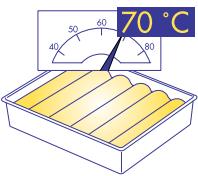
Heating times
| Type | Quantity | Function knob | Cooking time | Notes | |
| 17 Lt. 700 W | 23 Lt. 900 W | ||||
| SOFTENING FOOD | |||||
| Chocolate/icing | 100 gr | ### | 3 - 4 | 1 - 2 | Put on a plate. Mix the icing once. |
| Butter | 50 -70 gr | ### | 0'.7"-0'.12" | 0'.5"-0'.10" | |
| CHILLED FOOD (INITIAL TEMP. 5/8°C) UP TO 20/30°C | |||||
| Yoghurt | 125 gr | " | 0'.10"-0'.15" | 0'.7"-0'.12" | Remove metal foil. Heat the baby's bottle without the teat and mix it immediately after heating to make the temperature uniform. Check the temperature of the contents before use. With milk at room temperature the heating time is lower. To avoid risk of fire when using dried milk please stir evenly. Please use already sterilized milk. |
| Baby's bottle | 240 gr | " | 0'.15"-0'.20" | 0'.10"-0'.15" | |
| CHILLED PRECOOKED FOOD (INITIAL TEMP. 5/8°C) UP TO APPROX. 70°C | |||||
| Packet of lasagne or of pasta with filling | 400 gr | " | 5 - 7 | 3 - 5 | Packets of any kind of commercially available pre-cooked food, to be heated to a temp. of 70°C. Remove the food from any rice metal packets and put it directly onto the plate from which it is to be eaten. For best results, always cover the food. |
| Packet of meat with and/or vegetables | 400 gr | " | 5 - 7 | 3 - 5 | |
| Packet of fish and/or vegetables | 300 gr | " | 4 - 6 | 2 - 4 | |
| Plate of meat and/or vegetables | 400 gr | " | 6 - 8 | 4 - 6 | Portions of any kind of already cooked food, to heat to a temp. of 70°C. The food is placed directly onto the plate from which it is to be eaten and is always covered either with a transparent film or with an upturned plate. |
| plate of pasta, cannelloni or lasagne | 400 gr | " | 6 - 8 | 4 - 6 | |
| Plate of fish and/or rice | 300 gr | " | 5 - 7 | 3 - 5 | |

MICROWAVE
FROZEN FOOD TO REHEAT/COOK (INITIAL TEMP. -18°/-20°C) UP TO APPROX. 70°C
| Packet of lasagne or of pasta with filling | 400 gr | " | 7 - 9 | 5 - 7 | Packets of any kind of commercially available pre-cooked frozen food, to be heated to a temp. of 70^ directly in its packet. Remove the food from any metal containers and put it directly onto the plate from which it is to be eaten, increasing cooking time by a few minutes. |
| Packet of meat with rice and/or vegetables | 400 gr | " | 7 - 9 | 5 - 7 | |
| Packet of fish and/or pre-cooked vegetables | 300 gr | " | 5 - 7 | 3 - 5 | |
| Packet of fish and/or raw vegetables | 300 gr | " | 7 - 9 | 5 - 7 | Remove the raw food from the packets and place it in a container suitable for microwaves and cover. |
| Portion of meat and/or vegetables | 400 gr | " | 8 - 10 | 6 - 8 | Portions of any kind of already cooked frozen food, to be heated to a temperature of 70^ . Place the frozen food in the plate from which it is to be eaten and cover it with another upturned plate or pyrex dish. Check that it is hot in the centre; where possible, mix the food. |
| Portion of pasta, cannelloni or lasagne | 400 gr | " | 8 - 10 | 6 - 8 | |
| Portion of fish and/or rice | 300 gr | " | 7 - 9 | 5 - 7 |
CHILLED DRINKS (INITIAL TEMP. 5°/8°C) UP TO APPROX. 70°C
| 1 cup of water | 180 cc | " | 1'.30"-2 | 1-1'.30" | All the drinks should be mixed after being heated to make the temperature uniform. For the broth we recommend covering it with an upturned plate. |
| 1 cup of milk | 150 cc | " | 1-1'.30" | 0'.30"-1 | |
| 1 cup of coffee | 100 cc | " | 1-1'.30" | 0'.30"-1 | |
| 1 plate of broth | 300 cc | " | 3 - 4 | 2 - 3 |
DRINKS AT ROOM TEMPERATURE (INITIAL TEMP. 20°/30°C) UP TO APPROX. 70°C
| 1 cup of water | 180 cc | " | 1-1'.30" | 0'.30"-1 | All the drinks should be mixed after being heated to make the temperature uniform. For the broth we recommend covering it with an upturned plate. |
| 1 cup of milk | 150 cc | " | 0'.30"-1 | 0'.15"-0'.45" | |
| 1 cup of coffee | 100 cc | " | 0'.30"-1 | 0'.15"-0'.45" | |
| 1 plate of broth | 300 cc | " | 2 - 3 | 1 - 2 |

MICROWAVE
USING THE MICROWAVE-ONLY FUNCTION FOR COOKING
MEATS
When using the microwave-only function to cook meat, you should cover the meat with plastic wrap made for microwave oven use; in this way, the heat is distributed better and you will prevent the loss of juices that often leads to dried-up and stringy meat. This oven function is suitable for making stews, goulash, chicken breasts, etc. To prepare roasts and skewered meat dishes (among others), you must use the combined function.
FISH
In a microwave oven, fish can be prepared very quickly and with excellent results. You can season it with a little oil or butter (or not season it at all, if you so prefer). Cover the fish with clear-sheet. The skin is to be slit, of course, and filleted fish must be placed in a uniform fashion. We recommend that you not use this oven to cook fish which has been dipped in egg batter.
GREENS AND VEGETABLES
Greens and vegetables cooked in a microwave oven retain more of their colour and nutritional value than when cooked in traditional ovens. Before cooking greens and vegetables, wash and clean them.
Larger-sized varieties of this category are to be cut up into uniform pieces.
Per every 500 gr. of greens or vegetables add about 5 teaspoons of water (fibre-type vegetables need more water). Greens and vegetables must always be covered with plastic wrap.
Stir greens and vegetables at least once at the halfway point. Add a little salt only at the end.
Cooking times
| Type | Quantity | Function knob | Cooking time | Notes | Standing time (minutes) | |
| 17 Lt. 700 W | 23 Lt. 900 W | |||||
| FISH | ||||||
| • Filleted | 300 gr | , | 9 - 11 | 7 - 9 | Cover with plastic wrap | 2 |
| • Slices | 300 gr | " | 11 - 13 | 9 - 11 | Cover with plastic wrap | 2 |
| • Whole | 500 gr | " | 12 - 14 | 10 - 12 | Cover with plastic wrap | 2 |
| • Whole | 250 gr | " | 9 - 11 | 7 - 9 | Cover with plastic wrap | 2 |
| • Cut-up fish | 400 gr | " | 11 - 13 | 9 - 11 | Cover with plastic wrap | 2 |
| • Crayfish | 500 gr | " | 11 - 13 | 9 - 11 | Cover with plastic wrap | 2 |
| GREENS AND VEGETABLES | ||||||
| • Asparagus | 500 gr | , | 11 - 12 | 9 - 10 | Cut into 2-cm. pieces | 4 |
| • Artichokes | 300 gr | " | 12 - 13 | 10 - 11 | It would be better to use artichoke bottoms. | 4 |
| • Green beans | 500 gr | " | 13 - 14 | 11 - 12 | Cut into pieces | 4 |
| • Broccoli | 500 gr | " | 9 - 10 | 7 - 8 | Separate into individual "florets" | 4 |
| • Brussels sprouts | 500 gr | " | 9 - 10 | 7 - 8 | Leave whole | 4 |
| • White cabbage | 500 gr | " | 9 - 10 | 7 - 8 | Cut into strips | 4 |
| • Red cabbage | 500 gr | " | 9 - 10 | 7 - 8 | Cut into strips | 4 |
| • Carrots | 500 gr | " | 11 - 12 | 9 - 10 | Cut into same-size pieces | 4 |
| • Cauliflower | 500 gr | " | 13 - 14 | 11 - 12 | Separate into stalks | 4 |
| • Celery | 500 gr | " | 9 - 10 | 7 - 8 | Separate into pieces | 4 |
| • Eggplant | 500 gr | " | 8 - 9 | 6 - 7 | Cut into cubes | 4 |
| • Leek | 500 gr | " | 8 - 9 | 6 - 7 | Cut into strips | 4 |
| • Mushrooms | 500 gr | " | 8 - 9 | 6 - 7 | Leave whole No water is needed. | 4 |
| • Onions | 250 gr | " | 7 - 8 | 5 - 6 | Whole, but of the same size. No water is needed. | 4 |
| • Spinach | 300 gr | " | 8 - 9 | 6 - 7 | Cover after having washed and drained the leaves. | 4 |
| • Peas | 500 gr | " | 12 - 13 | 10 - 11 | 4 | |
| • Fennel | 500 gr | " | 14 - 15 | 12 - 13 | Cut into quarters | 4 |
| • Peppers | 500 gr | " | 11 - 12 | 9 - 10 | Cut into pieces | 4 |
| • Potatoes | 500 gr | " | 10 - 11 | 8 - 9 | Cut into same-size pieces | 4 |
| • Zucchini | 500 gr | " | 9 - 10 | 7 - 8 | Cut into slices | 4 |
| MEATS | ||||||
| • Stew | 1,5 kg | , | 42 - 47 | 40 - 45 | Cook covered and stir 2 or 3 times. | 10 |
| • Chicken breasts | 500 gr | " | 20 - 22 | 18 - 20 | Turn over at the halfway point (*) | 3 |
| • Meat loaf | 900 gr | " | 22 - 24 | 20 - 22 | 5 | |
(*) These indications are suitable for carrying out the minced meat cooking test in accordance with IEC regulation 705, test C. Cover the container with a transparent film for microwave oven, perforated in several places. Further instructions, also with regard to other performance tests in accordance with IEC regulation 705, are shown in the table on page 2.
SOUPS AND RICE
- Soups or broth usually require a smaller amount of liquid because the evaporation in microwave ovens is rather limited. Because it is a dehydrating agent, salt must be added only when the cooking is finished or during the standing time.
- It is correct to say that the temperature required for cooking rice in a microwave oven (as is true also for pasta) is more or less the same as that needed to cook this foodstuff over a burner on a regular stove. The advantage of preparing a risotto dish in a microwave oven lies in the fact that you do not have to stir the rice constantly (two or three times is enough).
The ingredients are placed in a container suitable for microwave ovens and covered with plastic wrap (for about 300 gr. of rice, you need 750 gr. of broth with the oven programmed at top power for about 12 to 15 minutes). In addition, the rice will not stick to the bottom of its container and, since it can be cooked in a tureen or some other such receptacle to be brought to the table, you will not have to transfer that rice to a serving plate.
FRUIT AND BAKED GOODS
Baked goods rise (at lower oven power) much more than then do with regular baking. Since no crust is formed, it is better to garnish the surface portions with cream or icing (e.g., chocolate); in addition, you must keep the item being baked fully covered, because such foodstuffs tend to dry out more quickly than those baked in a regular oven. Fruit is to be pierced if cooked with its peel on and is to be kept covered: it is essential that you adhere to the standing time (3 to 5 minutes).
Cooking times for baked goods and fruit
| Type/quantity | Function knob | Cooking time | Standing time (minutes) | Observations and advice | |
| 17 Lt. 700 W | 23 Lt. 900 W | ||||
| Nut cake (700 gr) | 13 - 17 | 18 - 23 | 5 | May be used in combination with any cream whatsoever | |
| Viennese torte (850 gr) | " | 17 - 21 | 22 - 27 | 5 | To be filled with jam or jelly. |
| Pineapple cake (800 gr) | " | 15 - 19 | 20 - 25 | 5 | The pineapple slices can be laid on the bottom of the pin plate or cut into pieces and mixed into the dough. |
| Apple cake (1000 gr) | " | 17 - 21 | 22 - 27 | 5 | The apples are spread on top as a decorative effect. |
| Coffee cake (750 gr) | " | 13 - 17 | 18 - 23 | 5 | Excellent when filled with cream. |
| Zabaione | 1',30'' - 3 | 4 - 6 | 3 | Mix with a whisk every 30 seconds | |
| Cooked pears (300 gr) | 3 - 5 | 6 - 8 | 3 | The pears are to be cut into quarters. | |
| Cooked apples (300 gr) | " | 4 - 6 | 7 - 10 | 3 | The apples are to be cut into pieces. |
| Egg custard (750 gr) | 18 - 20 | 16 - 18 | 5 | These indications are suitable for carrying out the cooking test in accordance with IEC regulation 705, par. 17.3, test A and test B respectively. Further instructions, also with regard to other performance tests in accordance with IEC regulation 705, are shown in the table on page 2 | |
| Sponge cake (475 gr) | " | 8 - 10 | 6 - 8 | 5 | |

GRILL-ONLY FUNCTION
This function is suitable for:
• All types of traditional grilling (e.g., chops,
hamburgers, frankfurters, toast, etc.)....pag. 35
TURNING THE OVEN ON WITH THE GRILL-ONLY FUNCTION

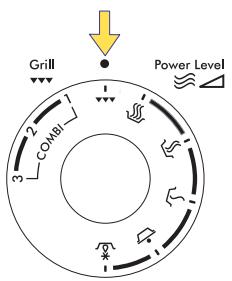
Turn the function knob to
the ▼▼▼ position
position.

Place the food in the oven
on the grill, resting it on
the turntable. During
grilling, the turntable will
collect any fat that may
drip.

natural_image
Line drawing of a microwave oven with open door and side-mounted dish (no text or symbols)
Set the desired cooking
time by turning the Time
knob. The food should be
turned over half way
through cooking.
Once the set cooking time
has expired, a buzzer
will sound to signal that
your food is ready.

You can interrupt operations any time you wish simply by turning the Time knob to the "0" position. You can also change the cooking time (while the foodstuff is being cooked) simply by turning this same knob forward or backward. You can check on the situation while the cooking is in progress by opening the door and examining the food. That move will interrupt the oven's operations, but they will begin again once the door has been closed.
USING THE OVEN-GRILL-ONLY FUNCTION FOR GRILLING
By using this function, you can make all kinds of delicious grilled dishes.
Never preheat the oven.
All dishes being prepared must be turned over at the halfway point, to achieve even browning.
When opening the door to check the progress of the cooking, the top part is very hot: always use oven gloves. The door must always be closed again before continuing.
Cooking times
| Type | Quantity | Function knob | Cooking time | Notes | |
| 17 Lt. 700 W | 23 Lt. 900 W | ||||
| • Veal or pork chops | 3 | ▼▼▼ | 22 - 27 | 25 - 30 | Turn over after 10 minutes. |
| • Sausages | 3 | " | 28 - 32 | 30 - 35 | Must always be pierced. If particularly fatty, the sausages should be cut in half.Turn over after 15 minutes. |
| • Hamburger | 3 | " | 28 - 32 | 30 - 35 | Turn over after 15 minutes. |
| • Toasted bread | 4 fette | " | 8 - 9 | 10 - 11 | Trim the crusts carefully. Turn over after 4-5 minutes. |

MICROWAVE-AND-GRILL SEQUENCE
This function is suitable for:
• Cooking lasagne or pasta oven dishes vegetables au gratin
• Cooking all types of roasts, poultry, skewered meats, etc.
pag. 37
STARTING THE OVEN IN THE COMBINED MICROWAVE + GRILLFUNCTION

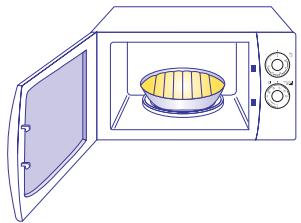
Put the foodstuff in a container made specially for microwave cooking and place it in the centre of the turntable.
natural_image
Line drawing of a microwave oven with lid and control knobs (no text or symbols)
Select one of the 3 "combi" positions by turning the function knob.

flowchart
graph TD
    A["Power Level"] --> B["Grill"]
    B --> C["COMBI"]
    C --> D["Directional Arrow"]
    D --> E["Arrow to Center"]
    style A fill:#f9f,stroke:#333
    style B fill:#ccf,stroke:#333
    style C fill:#cfc,stroke:#333
    style D fill:#fcc,stroke:#333
    style E fill:#ffc,stroke:#333

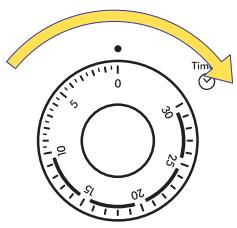
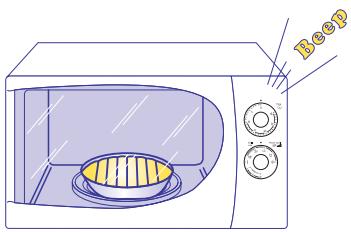
Set the desired cooking time by turning the Time knob clockwise.
Once the set time has expired, a beep will indicate that the coating stage has been completed.
natural_image
Illustration of a microwave oven with a dish inside and a side-mounted fan on top (no text or symbols)You can interrupt operations any time you wish simply by turning the Time knob to the "0" position. You can also change the cooking time (while the foodstuff is being cooked) simply by turning this same knob forward or backward. You can check on the situation while the cooking is in progress by opening the door and examining the food. That move will interrupt the oven's operations, but they will begin again once the door has been closed.
USING THE MICROWAVE-AND-GRILL SEQUENCE FUNCTION FOR COOKING
This setting is ideal for microwave cooking as well as for browning foodstuffs and giving them an au gratin coating. You must, however, keep the following in mind:
• the oven is never to be pre-heated;
• do not spunkle with seasonings (just use 1/2 glass of water to keep the meat soft);
• turn over roasts and large pieces of meat half way through cooking.
- to check the situation while cooking is in progress, open the oven door. This will stop the microwave and grill functions: in this case, however, oven gloves should be used, as the top surface is very hot. To resume the cooking, simply close the oven door.
Cooking times
| Type | Quantity | Function knob | Cooking time | Notes | Standing time (minutes) | |
| 17 Lt. 700 W | 23 Lt. 900 W | |||||
| Gnocchi alla romana | 600 gr | combi 1 | 25 | 20 | Avoid excessive melting. | 5 |
| Lasagne | 1100 gr | combi 2 | 40 | 35 | Times listed are for uncooked pasta. | 5 |
| Well-seasoned macaronii | 1500 gr | combi 1 | 25 | 20 | The pasta should first be partly boiled. | 5 |
| Cauliflower in bechamel sauce | 1000 gr | combi 2 | 30 | 25 | Times listed are for raw cauliflower. | 5 |
| Tomatoes au gratin | 800 gr | combi 1 | 25 | 20 | The tomatoes should all be of the same size. | 5 |
| Stuffed peppers | 1400 gr | combi 2 | 30 | 25 | Short wide peppers are best | 5 |
| Aubergine alla parmigiana | 1300 gr | combi 1 | 25 | 20 | The aubergine may first be fried or grilled. | 5 |
| Potatoes au gratin | 1100 gr | combi 3 | 40 | 30 | Times listed are for uncooked potatoes. (*) | |
| Roasts (pork, beef) | 1000 gr | combi 2 | 50 | 45 | Leave a little fat around the meat to keep it moist. Turn at the halfway point | 10 |
| Meat loafThese instructions do not refer to test C of IEC regulation 705 which is represented in the table on page 2 and 32 | 800 gr | combi 2 | 35 | 30 | Turn at the halfway point | 10 |
| Whole chicken | 1200 gr | combi 3 | 65 | 55 | Puncture the skin with a fork. Turn at the halfway point (**) | 10 |
| Skewered meat | 600 gr | combi 3 | 35 | 30 | Turn at the halfway point | 10 |
| Lamb | 1000 gr | combi 3 | 60 | 50 | Turn at the halfway point | 10 |
| Turkey (pieces) | 1000 gr | combi 3 | 55 | 45 | Turn at the halfway point | 10 |
| Duck | 1000 gr | combi 3 | 60 | 50 | Turn at the halfway point. | 10 |
(*) These indications are suitable for carrying out the cooking test in accordance with IEC regulation 705, par. 17.3 Test D. Further indications, also regarding other performance tests in accordance with IEC regulation 705, are shown in the table on page 2
(**)These indications are suitable for carrying out the cooking test in accordance with IEC regulation 705, par. 17.3 Test F. Further indications, also regarding other performance tests in accordance with IEC regulation 705, are shown in the table on page 2
CLEANING AND MAINTENANCE
Before beginning any cleaning or maintenance, always pull this oven's plug from the electrical outlet and wait for the oven itself to cool down completely
Cleaning
To maintain your appliance in the best condition, the door and the inside and outside of the oven should be cleaned regularly, using a soft cloth and neutral soap or liquid detergent. Always keep the microwave outlet cover (C) free of fat or splashed grease.
Never use abrasive detergents, steel wool or sharp metal utensils. In addition, when cleaning the outside of the oven, be careful not to let water or liquid detergent seep into the air outlet and steam slots located atop the appliance.
We likewise recommend that you do not use alcohol, abrasive detergents or ammonia-based detergents to clean the inside and outside door surfaces.
To ensure perfect closing, always keep the inside of the door clean, and do not let dirt and food residue get caught between the door and the oven's façade.
Clean the air inlet holes located on the back of the oven regularly so that no dust or dirt will build up over time to obstruct those holes.
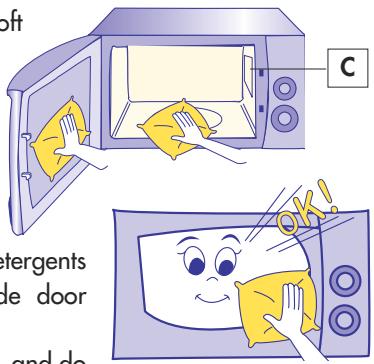

From time to time, it will be necessary to remove the turntable (H) and its support (I) and clean them, just as it will be necessary to clean the bottom of the oven.
Wash the turntable and its support in warm soapy water with neutral soap. These parts may also be cleaned in a dishwasher.
Do not place the turntable in cold water after the oven has been hot for a long time. The strong thermal shock could cause the turntable to break.
The turntable's motor is sealed tight. When you are cleaning the bottom of the oven, however, be careful not to let water seep under the turntable spindle (D).
If something seems not to be working just right .....
If you should discover a flaw or defect, contact a Service Centre authorised by the manufacturer. In any case, before calling our technicians, you should carry out the following simple checks:
| p r o b l e m | c a u s e / r e m e d y |
| The oven is not working | The door is not properly closed.The plug is not properly inserted in the electric outlet.The outlet is not supplying power (check the building's fuse box).The Time knob has not been set correctly |
| Condensation on the cooking rack and inside the oven. | When foods containing water are being cooked, it is completely normal for the steam generated within the oven to escape and to condense either inside the oven or on the cooking rack. |
| Sparks inside the oven. | When using the microwave-only and combined functions, do not turn the oven on unless there is already food inside it.When cooking by microwaves, do not use metal containers, bags, or packages with metal clips. |
| The food is not heating sufficiently | Select the correct power level or increase the cooking time.The food was not completely defrosted before being cooked. |
| The food is burning | Use the correct cooking method or lower the cooking time. |
| The food is not cooking evenly | Stir the food while it is being cooked. Remember that foodstuffs cook better when cut into uniform pieces.The turntable is blocked (check that the spindle D is correctly positioned). |
In case oven-light is burned, you may continue to use the oven anyway. To replace the light, contact authorised Assistance.
ELECTRICAL CONNECTION (U.K. ONLY)
A) If your appliance comes fitted with a plug, it will incorporate a 13 Amp fuse. If it does not fit your socket, the plug should be cut off from the mains lead, and an appropriate plug fitted, as below.
WARNING: Very carefully dispose of the cut off plug after removing the fuse: do not insert in a 13 Amp socket elsewhere in the house as this could cause a shock hazard.
With alternative plugs not incorporating a fuse, the circuit must be protected by a 15 Amp fuse.
WARNING - THIS APPLIANCE MUST BE EARTHED IMPORTANT
The wires in the mains lead are coloured in accordance with the following code:
Green and yellow:
Blue:
Brown:
Earth
Neutral
Live

If the plug is a moulded-on type, the fuse cover must be re-fitted when changing the fuse using a 13 Amp Asta approved fuse to BS 1362. In the event of losing the fuse cover, the plug must NOT be used until a replacement fuse cover can be obtained from your nearest electrical dealer. The colour of the correct replacement fuse cover is that as marked on the base of the plug.
B) If your appliance is not fitted with a plug, please follow the instructions provided below:
As the colours of the wires in the mains lead may not correspond with the coloured markings identifying the terminals in your plug, proceed as follows:
The green and yellow wire must be connected to the terminal in the plug marked with the letter E or the earth symbol 12 or coloured green or green and yellow.
The blue wire must be connected to the terminal marked with the letter N or coloured black.
The brown wire must be connected to the terminal marked with the letter L or coloured red.
- TECHNICAL DATA
- MODEL WITH A 23-LITRE CAVITY
- MODEL WITH A 17-LITRE CAVITY
- BOTH MODELS
- OUTPUT POWER
- IMPORTANT SAFEGUARDS
- Read carefully these instructions and keep for future reference
- ELECTRICAL CONNECTIONS
- INSTALLATION
- G L A S S W A R E A N D S I M I L A R I T E M S
- DESCRIPTION OF CONTROLS
- ACCESSORIES PROVIDED
- ADVICE ON USING YOUR OVEN CORRECTLY
- Basic rules for correct cooking with a microwave oven
- MICROWAVE-ONLY FUNCTION
- This function is suitable for:
- TURNING THE OVEN ON USING ONLY THE MICROWAVE FUNCTION
- USING THE MICROWAVE-ONLY FUNCTION TO KEEP FOOD HOT
- USING THE MICROWAVE-ONLY FUNCTION FOR DEFROSTING
- USING THE MICROWAVE-ONLY FUNCTION FOR RE-HEATING
- USING THE MICROWAVE-ONLY FUNCTION FOR COOKING
- MEATS
- FISH
- GREENS AND VEGETABLES
- SOUPS AND RICE
- FRUIT AND BAKED GOODS
- GRILL-ONLY FUNCTION
- TURNING THE OVEN ON WITH THE GRILL-ONLY FUNCTION
- USING THE OVEN-GRILL-ONLY FUNCTION FOR GRILLING
- Never preheat the oven.
- MICROWAVE-AND-GRILL SEQUENCE
- STARTING THE OVEN IN THE COMBINED MICROWAVE + GRILLFUNCTION
- USING THE MICROWAVE-AND-GRILL SEQUENCE FUNCTION FOR COOKING
- CLEANING AND MAINTENANCE
- Cleaning
- If something seems not to be working just right .....
- ELECTRICAL CONNECTION (U.K. ONLY)
- WARNING - THIS APPLIANCE MUST BE EARTHED IMPORTANT
Marque : DELONGHI
Modèle : MW 651
Catégorie : Four à micro-ondes