
F330/WHITE - Friteuse DELONGHI - Notice d'utilisation et mode d'emploi gratuit
Retrouvez gratuitement la notice de l'appareil F330/WHITE DELONGHI au format PDF.



| Marque | DELONGHI |
| Modèle | F330/WHITE |
| Type de produit | Friteuse électrique domestique |
| Capacité d'huile | 1,3 litre (ou 1,2 kg de graisse solide) |
| Capacité maximale d'aliments | 0,7 kg de pommes de terre fraîches |
| Alimentation électrique | 220-240 V, 10 A minimum, avec mise à la terre |
| Puissance | Environ 1800 W (estimation) |
| Thermostat | Réglage de température de 150°C à 190°C |
| Voyant lumineux | Témoin de chauffe (s'éteint à température atteinte) |
| Minuteur | Modèle électronique avec affichage et alarme sonore (selon version) |
| Matériau de la cuve | Acier ou antiadhésif selon version |
| Filtration d'huile | Système de filtration avec filtre fourni, tube de vidange sur certains modèles |
| Filtre anti-odeur | Filtres à charbon remplaçables dans le couvercle |
| Dimensions (L x P x H) | Environ 35 x 30 x 25 cm (estimation) |
| Poids | Environ 3,5 kg (estimation) |
| Entretien et nettoyage | Cuve et panier lavables à l'eau chaude savonneuse ; ne pas immerger l'appareil |
| Sécurité | Dispositif de sécurité thermique en cas de fonctionnement à vide ; ne pas déplacer avec de l'huile chaude |
| Pièces détachées et réparabilité | Filtres, panier, tube de vidange (selon modèle) disponibles auprès du service après-vente |
| Informations générales | Usage domestique uniquement ; ne pas utiliser d'huile en dessous du niveau minimum |
FOIRE AUX QUESTIONS - F330/WHITE DELONGHI
Questions des utilisateurs sur F330/WHITE DELONGHI
0 question sur cet appareil. Repondez a celles que vous connaissez ou posez la votre.
Poser une nouvelle question sur cet appareil
Téléchargez la notice de votre Friteuse au format PDF gratuitement ! Retrouvez votre notice F330/WHITE - DELONGHI et reprennez votre appareil électronique en main. Sur cette page sont publiés tous les documents nécessaires à l'utilisation de votre appareil F330/WHITE de la marque DELONGHI.
MODE D'EMPLOI F330/WHITE DELONGHI
IMPORTANT

- Lisez attentivement cette notice avant d'installer et d'utiliser l'appareil. C'est la seule façon d'obtenir les meilleurs résultats et une sécurité maximale pour l'utilisateur.
- Comme pour tout appareil électrique, bien que les instructions visent à couvrir autant d'éventualités que possible, la prudence et le bon sens doivent être appliqués lors de l'utilisation de votre friteuse, en particulier à proximité de jeunes enfants.
- Cet appareil a été conçu pour frire des aliments exclusivement pour un usage domestique. Il ne doit pas être utilisé à d'autres fins et ne doit en aucun cas être modifié ou altéré.
- Ne mettez pas l'appareil en marche s'il est endommagé (par exemple après une chute).
- Avant utilisation, vérifiez que la tension d'alimentation correspond à la valeur indiquée sur la plaque signalétique de l'appareil.
- Branchez l'appareil uniquement sur des prises électriques d'une capacité minimale de 10 A et correctement mises à la terre. (Si la prise et la fiche de l'appareil sont incompatibles, faites remplacer la prise par une prise plus adaptée par un technicien qualifié).
- Ne placez pas l'appareil à proximité de sources de chaleur.
- N'immergez pas la friteuse dans l'eau. L'infiltration d'eau peut provoquer des chocs électriques. Pendant le fonctionnement, l'appareil est chaud. NE LAISSEZ PAS L'APPAREIL À LA PORTÉE DES ENFANTS.
- L'huile chaude peut provoquer de graves brûlures. Ne déplacez pas la friteuse lorsque l'huile est chaude.
- Pour déplacer l'appareil, utilisez les poignées de levage spéciales "V". (Ne soulevez jamais l'appareil par la poignée du panier).
- La friteuse ne doit être allumée qu'après avoir été remplie d'huile ou de graisse. Si elle est chauffée à vide, un dispositif de sécurité thermique se déclenche et l'empêche de fonctionner. Dans ce cas, contactez notre centre de service agréé le plus proche pour
remplacer le dispositif.
- Si la friteuse fuit de l'huile, contactez le centre de service technique ou le personnel autorisé par le fabricant. Avant la première utilisation de la friteuse, nettoyez soigneusement le bol, le panier et le couvercle avec de l'eau chaude et du détergent à vaisselle (retirez les filtres). De plus, faites passer de l'eau chaude et du détergent à vaisselle dans le tube de vidange d'huile, puis séchez soigneusement.
- Les matériaux et objets susceptibles d'entrer en contact avec les denrées alimentaires sont conformes à la directive CEE.
- Pendant le fonctionnement, le tube de vidange d'huile doit toujours être maintenu fermé et rangé dans le compartiment prévu à cet effet.
- Lors de la première utilisation, l'appareil peut dégager de la fumée. C'est normal et cela disparaît en quelques minutes. La pièce doit être ventilée.
- Les enfants et les personnes incapables ne doivent pas utiliser cet appareil sans une surveillance attentive.
- Il ne faut pas laisser les enfants jouer avec cet appareil.
- Ne laissez pas le cordon pendre sur le bord du plan de travail où il pourrait être attrapé par des enfants ou s'emmêler avec l'utilisateur. N'utilisez pas de rallonge. Si le cordon d'alimentation doit être remplacé, utilisez uniquement
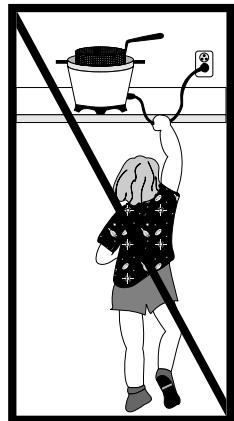
un câble H05VVF à trois conducteurs de 1 mm². Le cordon de remplacement doit être conforme à la législation de sécurité en vigueur et avoir le même diamètre que l'original.
DESCRIPTION DE L'APPAREIL
A. Panier avec poignée métallique (pas sur tous les modèles) B. Poignée métallique du panier (pas sur tous les modèles) C. Glissière de verrouillage de la poignée (pas sur tous les modèles) D. Panier avec poignée en plastique (pas sur tous les modèles) E. Poignée pliante en plastique du panier (pas sur tous les modèles) F. Glissière de la poignée (pas sur tous les modèles) G. Crochet du couvercle du filtre H. Couvercle du filtre I. Poignée d'ouverture du couvercle L. Couvercle M. Orifice de contrôle du filtre
N. Affichage de la minuterie (pas sur tous les modèles) O. Bouton de la minuterie (pas sur tous les modèles) P. Trappe du compartiment du tube de vidange (pas sur tous les modèles) Q. Tube de vidange d'huile (pas sur tous les modèles) R. Bouchon du tube de vidange (pas sur tous les modèles) S. Voyant lumineux T. Thermostat et bouton MARCHE/ARRÊT U. Pied V. Poignée de levage de l'appareil Z. Enrouleur de cordon
MODE D'EMPLOI
- Retirez l'appareil de son emballage.
- Avant utilisation, vérifiez que la tension d'alimentation correspond à la valeur indiquée sur la plaque signalétique de l'appareil.
- Avant utilisation, lavez la cuve, le couvercle (retirez les filtres) et le panier à l'eau chaude, puis séchez soigneusement la cuve.
- N'allumez jamais la friteuse avant d'avoir ajouté de l'huile ou de la matière grasse. Si la friteuse fonctionne sans huile ni matière grasse, un dispositif de sécurité thermique arrête le fonctionnement de l'appareil. Dans ce cas, contactez l'un de nos centres de service agréés avant de réutiliser l'appareil.
REMPLISSAGE AVEC DE L'HUILE OU DE LA MATIÈRE GRASSE
- Ouvrez le couvercle "L" en le soulevant par la poignée "I" dans le sens de la flèche 1, puis soulevez-le dans le sens de la flèche 2 (voir Fig. 1) et retirez les accessoires.
- Versez 1,3 litre d'huile dans le récipient (ou 1,2 kg de matière grasse).
AVERTISSEMENT
Le niveau d'huile doit toujours se situer entre les limites maximale et minimale indiquées sur le bol.
N'utilisez pas la friteuse lorsque le niveau d'huile est en dessous de la marque "min" : le dispositif de sécurité thermique peut se déclencher ; pour le remplacer, contactez l'un de nos centres de service.
Pour de meilleurs résultats, utilisez une huile de bonne qualité. Évitez de mélanger différents types d'huile. Si vous utilisez des morceaux de matière grasse solide, coupez-les en petits morceaux afin que la friteuse ne chauffe pas dans les premières minutes sans une couverture uniforme de matière grasse. La température doit être réglée à 150 °C jusqu'à ce que la matière grasse soit complètement fondue. La température requise peut ensuite être réglée.
DÉMARRAGE DE LA FRITURE
- Placez les aliments à frire dans le panier, sans le remplir excessivement (max 0,7 kg de pommes de terre fraîches). Pour une friture plus uniforme, les aliments doivent être concentrés surtout autour du périmètre du
panier, en laissant moins d'aliments au centre. Retirez la glace des aliments surgelés (voir : friture d'aliments surgelés).
- Fermez le couvercle en appuyant légèrement vers le bas jusqu'à ce qu'il s'enclenche avec un "clic".
- Réglez le bouton du thermostat "T" sur la température souhaitée (Fig. 2). Lorsque la température réglée est atteinte, le voyant "S" s'éteint.
- Dès que le voyant s'éteint, abaissez lentement le panier dans l'huile
Procédez comme suit pour les modèles équipés de :
Panier à poignée métallique
- Assurez-vous que le curseur de verrouillage de la poignée est en position arrière.
- Fixez la poignée "B" au panier "A" (Fig. 3) et déplacez le curseur de verrouillage de la poignée aussi loin que possible vers l'avant (Fig. 4). Avant de descendre le panier dans l'huile ou de le soulever, vérifiez toujours que le curseur de la poignée est en position avant.
- Fermez ensuite le couvercle, après avoir retiré la poignée du panier.
Poignée pliante en plastique du panier
- Dépliez la poignée du panier "E" jusqu'à ce qu'elle s'enclenche (pos. 2, Fig. 5).
- Tournez la poignée du panier "E" vers le haut jusqu'à ce que le curseur de la poignée "F" s'enclenche (pos. 3, Fig. 6).
- Fermez ensuite le couvercle. Pour abaisser la poignée, déplacez le curseur "F" vers l'arrière et tournez-le vers le bas. Il est normal que des gouttes de condensation se forment autour de la poignée du panier lorsque l'appareil fonctionne.
- Il est tout à fait normal qu'une quantité importante de vapeur chaude s'échappe du couvercle du filtre "H" immédiatement après cette opération.
SUR LES MODÈLES ÉQUIPÉS DE LA MINUTERIE ÉLECTRONIQUE
Réglez le temps de cuisson en appuyant sur le bouton "O" ; l'afficheur "N" indiquera les minutes réglées.
Les chiffres commenceront à clignoter immédiatement après, indiquant que le temps de cuisson a commencé. La dernière minute sera affichée en secondes.
En cas d'erreur, un nouveau temps de cuisson peut être réglé en maintenant le bouton enfoncé pendant plus de 2 secondes. L'affichage sera réinitialisé ; puis répétez le processus.
La minuterie indique la fin du temps de cuisson par deux séries de bips espacées d'environ 20 secondes.
Pour couper le signal sonore, appuyez sur le bouton de la minuterie "O".
AVERTISSEMENT : la minuterie ne coupe pas l'appareil.
Remplacement des piles de la minuterie
- Retirez la minuterie de son compartiment (Fig. 7).
- Tournez le couvercle du compartiment à piles (Fig. 8) dans le sens inverse des aiguilles d'une montre jusqu'à ce qu'il se libère.
- Remplacez la pile par une autre du même type. Remontez la minuterie.
Si l'appareil doit être remplacé ou jeté, la pile doit être retirée et éliminée conformément aux lois en vigueur, car elle représente un danger pour l'environnement.
APRÈS LA FRITURE
Lorsque le temps de cuisson réglé est écoulé, soulevez le panier et vérifiez que les aliments ont atteint la couleur souhaitée. Pour les modèles équipés d'une poignée métallique, fixez la poignée au panier (Fig. 3) et faites glisser le curseur de verrouillage "C" vers l'avant.
Si les aliments sont complètement cuits, éteignez l'appareil en tournant le bouton du thermostat sur "OFF",
jusqu'à ce que l'interrupteur "clique"
Laissez l'excès d'huile s'égoutter en laissant le panier dans la friteuse, en position relevée.
Remarque : lors d'une cuisson en deux phases (par exemple : pommes de terre), soulevez le panier à la fin de la première phase, attendez que le voyant s'éteigne à nouveau, puis replongez le panier dans l'huile (voir les tableaux ci-après).
FILTRAGE DE L'HUILE OU DE LA GRAISSE
Cette opération doit être effectuée après chaque friture, surtout lorsque les aliments ont été enrobés de chapelure ou de farine. Les particules d'aliments ont tendance à brûler si elles restent dans le liquide, ce qui provoque une détérioration beaucoup plus rapide de l'huile ou de la matière grasse.
Vérifiez que l'huile est suffisamment refroidie (attendez environ deux heures).
Déplacez la friteuse vers le bord du plan de travail (Fig. 9). Pour éviter que l'appareil ne tombe pendant la filtration de l'huile, assurez-vous que les pieds « U » restent toujours sur le plan de travail (Fig. 9).
MODÈLES ÉQUIPÉS D'UN TUYAU DE VIDANGE D'HUILE
Procédez comme suit :
- Retirez le panier.
- Ouvrez le volet « P » (comme indiqué sur la Fig. 10) et sortez le tuyau de vidange d'huile « Q ».
- Retirez le bouchon « R » (comme indiqué sur la Fig. 10) et en même temps pincez le tuyau entre deux doigts pour empêcher le liquide de s'écouler jusqu'à ce que l'extrémité du tuyau soit placée dans un récipient.
- Laissez le liquide s'écouler dans un récipient (Fig. 11), en veillant à ce qu'il ne se renverse pas. Ne videz jamais la friteuse en l'inclinant ou en la retournant (Fig. 12).
- Retirez tout dépôt de la cuve à l'aide d'une éponge ou de papier absorbant.
- Remettez le tuyau dans son compartiment, après avoir remis le bouchon, puis fermez le volet.
- Accrochez le panier au bord de la cuve et placez le filtre fourni au fond du panier (Fig. 13). Les filtres sont disponibles auprès de votre revendeur ou de notre centre de service.
- Versez ensuite l'huile et la matière grasse très lentement dans la friteuse, jusqu'à ce qu'elle passe à travers le filtre (Fig. 14). N.B. : L'huile filtrée peut être conservée dans la friteuse. Toutefois, si une longue période s'écoule entre les cuissons, l'huile doit être stockée dans un récipient hermétique, afin d'éviter qu'elle ne se détériore.
Il est conseillé de conserver l'huile utilisée pour la friture du poisson séparément de celle utilisée pour d'autres aliments. Si vous utilisez du saindoux ou de la graisse, assurez-vous qu'elle ne refroidisse pas trop, sinon elle se solidifiera.
MODÈLES SANS TUYAU DE VIDANGE D'HUILE
Procédez comme suit :
- Après avoir retiré le couvercle (Fig. 15), videz la cuve comme indiqué sur la Fig. 16.
- Accrochez le panier au bord de la cuve et placez le filtre fourni au fond du panier (Fig. 13). Les filtres sont disponibles auprès de votre revendeur ou de notre service après-vente.
- Versez ensuite l'huile et la graisse très lentement dans la friteuse, jusqu'à ce qu'elle recouvre le filtre (Fig. 14). N.B. : L'huile filtrée peut être conservée dans la friteuse. Toutefois, si un long intervalle s'écoule entre les cuissons, l'huile doit être stockée dans un récipient hermétique pour éviter qu'elle ne se détériore. Il est conseillé de conserver séparément l'huile utilisée pour frire le poisson de celle utilisée pour d'autres aliments.
Si vous utilisez du saindoux ou de la graisse, assurez-vous qu'elle ne refroidisse pas trop, sinon elle se solidifiera.
REMPLACEMENT DES FILTRES ANTI-ODEURS
Avec le temps, les filtres anti-odeurs logés à l'intérieur du couvercle perdent leur efficacité. Un changement de couleur du filtre, visible à travers le trou "A" de la fig. 17 sur le côté interne du couvercle, indique que le filtre doit être remplacé. Pour le remplacer, retirez le cache-filtre en plastique "H" (fig. 18) en appuyant sur le crochet "G" dans le sens de la flèche 1, puis soulevez-le dans le sens de la flèche 2. Remplacez les filtres.
N.B. : Le filtre blanc doit reposer sur la partie métallique (Fig. 19) et la zone colorée doit être orientée vers le haut (vers le filtre noir).
Remontez le cache-filtre en veillant à insérer correctement les crochets avant (comme indiqué sur la Fig. 15).
Ne faites pas fonctionner l'appareil avec des filtres usés, car cela pourrait provoquer de mauvaises odeurs et obstruer la vapeur.
NETTOYAGE
Avant le nettoyage, débranchez toujours l'appareil de la prise électrique.
- N'immergez jamais la friteuse dans l'eau et ne la passez pas sous le robinet. L'infiltration d'eau peut provoquer des courts-circuits et des chocs électriques.
Après avoir laissé refroidir l'huile pendant environ 2 heures, videz l'huile ou la graisse comme décrit précédemment dans le paragraphe "Filtrage de l'huile ou de la graisse".
Retirez le couvercle en le soulevant délicatement (Fig. 15).
Ne pas immerger le couvercle dans l'eau avant d'avoir retiré les filtres.
Pour nettoyer la cuve, procéder comme suit :
- Laver la cuve à l'eau chaude et au détergent pour vaisselle, puis rincer soigneusement et sécher. Pour les modèles équipés d'un tube de vidange d'huile, il peut être utile de placer la friteuse sur le plan de travail de l'évier, le tube de vidange d'huile à l'intérieur de l'évier. Dans cette position, un pichet d'eau savonneuse chaude et une brosse douce peuvent être utilisés pour nettoyer la cuve de la friteuse : l'eau sale s'écoulera directement dans l'évier (Fig. 20).
- Pour nettoyer l'intérieur du tube de vidange d'huile, utiliser la brosse fournie (Fig. 21). Ne pas utiliser la brosse avant d'avoir retiré le tube.
- Le panier doit être nettoyé régulièrement, en prenant soin d'éliminer tout dépôt.
- Sécher l'extérieur de la friteuse à l'aide d'un chiffon doux et humide, pour éliminer les éclaboussures et les gouttes d'huile ou de condensation.
- Nettoyer et sécher le joint, pour éviter qu'il ne colle à la cuve de la friteuse lorsque l'appareil n'est pas utilisé.
- Après le lavage, sécher soigneusement. Éliminer toute eau résiduelle du fond de la cuve et, surtout, de l'intérieur du tube de vidange d'huile. Cela évitera les éclaboussures dangereuses d'huile chaude pendant le fonctionnement.
- Le panier et ses poignées peuvent être lavés au lave-vaisselle.
MODÈLE AVEC CUVE ANTIADHÉSIVE
Pour nettoyer la cuve antiadhésive, utiliser un chiffon doux et un détergent neutre ; ne jamais utiliser de détergents abrasifs.
CONSEILS DE CUISSON
DURÉE DE VIE DE L'HUILE OU DE LA GRAISSE
L'huile ou la graisse ne doit jamais descendre en dessous du niveau minimum. De temps en temps, elle doit être remplacée complètement. La durée de vie de l'huile ou de la graisse dépend de ce qui est frit.
Les aliments panés, par exemple, salissent plus l'huile que la friture simple.
Comme pour tous les types de friteuses, l'huile se détériore si elle est réchauffée plusieurs fois ! Par conséquent, même si elle est utilisée et filtrée correctement, elle doit être remplacée complètement assez souvent.
L'huile doit être entièrement changée toutes les 5 à 8 utilisations, ou dans les circonstances suivantes :
- odeurs désagréables
- fumée lors de la friture, l'huile devient sombre
COMMENT FRIR CORRECTEMENT
- Il est important de respecter la température recommandée pour chaque recette. Si la température est trop basse, les aliments frits absorbent l'huile. Si la température est trop élevée, une croûte se forme rapidement à l'extérieur tandis que l'intérieur reste cru.
- Les aliments à frire ne doivent être immergés que lorsque l'huile a atteint la bonne température, c'est-à-dire lorsque le voyant s'éteint.
- Ne remplissez pas trop le panier. Cela provoquerait une chute soudaine de la température de l'huile, ce qui donnerait des fritures trop grasses et non uniformément cuites.
- Lors de la friture de petites quantités d'aliments, la température de l'huile doit être réglée plus bas que la température indiquée pour éviter que l'huile ne bout trop violemment.
- Vérifiez que les aliments sont finement tranchés et d'épaisseur uniforme, car les aliments trop épais cuisent mal à l'intérieur, malgré leur aspect cuit, tandis que les aliments d'épaisseur uniforme atteignent le point de cuisson idéal en même temps.
- Séchez complètement les aliments avant de les immerger dans l'huile ou la graisse, car les aliments humides deviennent détrempés après la cuisson (surtout les pommes de terre). Les aliments à forte teneur en eau (poisson, viande, légumes) doivent être enrobés de chapelure ou de farine, en veillant à retirer l'excédent de chapelure ou de farine avant de les immerger dans l'huile.
FRITURE D'ALIMENTS NON SURGELÉS
| Type of food | Maximum quantity | Temperature °C | Time in minutes | |
| CHIPS | half portion | 350 | 190 | \(1^{st}\ phase\ 4-5\)2ndphase 1-2 |
| full portion | 700 | 190 | \(1^{st}\ phase\ 9-10\)2ndphase 2-3 | |
| FISH | Calamari | 250 | 160 | 6-7 |
| Canestrelli | 250 | 160 | 6-7 | |
| Scampi tails | 250 | 160 | 5-6 | |
| Sardines | 250 | 170 | 6-7 | |
| Squid | 250 | 160 | 6-7 | |
| Sole (1) | 130 | 160 | 5-6 | |
| MEAT | Beef cutlets (1) | 120 | 160 | 5-7 |
| Chicken cutlets (2) | 240 | 180 | 4-6 | |
| Chicken drumsticks (2) | 300 | 180 | 20-25 | |
| Meat balls (6) | 250 | 160 | 4-6 | |
| VEGETABLES | Artichokes | 150 | 150 | 5-6 |
| Cauliflower | 200 | 160 | 4-5 | |
| Mushrooms | 200 | 150 | 4-5 | |
| Aubergines (2 slices) | 50 | 170 | 3-4 | |
| Courgettes | 150 | 160 | 5-6 | |
Veuillez noter que les temps et températures de cuisson sont approximatifs et doivent être ajustés en fonction de la quantité d'aliments et des goûts personnels.
FRITURE D'ALIMENTS SURGELÉS
- Les aliments surgelés ont des températures très basses. Par conséquent, ils provoquent inévitablement une baisse considérable de la température de l'huile ou de la graisse. Pour de meilleurs résultats, ne dépassez pas les quantités recommandées dans le tableau suivant.
- Les aliments surgelés sont souvent recouverts de cristaux de glace qui doivent être retirés avant la cuisson. Cela peut être fait en secouant le panier. Ensuite, abaissez le panier très lentement dans l'huile de friture, pour éviter que l'huile ne se remette à bouillir.
Les temps de cuisson sont approximatifs et doivent être adaptés en fonction de la température initiale des aliments à frire et de la température recommandée par le producteur d'aliments surgelés.
| Food | Maximum quantity | Temperature °C | Time in minutes | |
| CHIPS | 200 (*) | 190 | 1stphase 2-4 | |
| 2ndphase 1-2 | ||||
| POTATO CROQUETTES | 350 | 190 | 6-7 | |
| FISH | Cod fingers (6) | 150 | 190 | 4-5 |
| Shrimps | 150 | 190 | 4-5 | |
| MEAT | Chicken cutlets (n. 1) | 120 | 190 | 3-5 |
(*) C'est la quantité recommandée pour obtenir une excellente friture. Il est naturellement possible de frire une plus grande quantité de frites, mais il faut garder à l'esprit que dans ce cas, elles seront un peu plus grasses en raison de la chute soudaine de la température de l'huile au moment de l'immersion.
ANOMALIES DE FONCTIONNEMENT
| FAULT | CAUSE | REMEDY |
| Bad smell | The anti- odour filter is saturated. The oil has deteriorated. The cooking liquid is unsuitable. | Replace the filters. Replace the oil or fat. Use good quality sunflower or vegetable oil. |
| The oil overflows | The oil has deteriorated and causes too much foam. You have immersed food which is not sufficiently dry in the hot oil. The basket has been immersed too quickly. The oil level in the deep fryer is over the maximum limit. | Replace the oil or fat. Dry the food well. Immerse slowly. Reduce the amount of oil in the bowl. |
| Food does not brown during cooking | The oil temperature is too low. The basket is overloaded. | Set a higher temperature. Reduce the amount of food. |
| The oil does not heat up | The deep fryer has been used without oil in the bowl, tripping the thermal safety device. | Contact the Service Centre (the device should be replaced). |


- IMPORTANT
- REMPLACER LE DISPOSITIF
- DESCRIPTION DE L'APPAREIL
- MODE D'EMPLOI
- REMPLISSAGE AVEC DE L'HUILE OU DE LA MATIÈRE GRASSE
- AVERTISSEMENT
- DÉMARRAGE DE LA FRITURE
- PANIER À POIGNÉE MÉTALLIQUE
- POIGNÉE PLIANTE EN PLASTIQUE DU PANIER
- SUR LES MODÈLES ÉQUIPÉS DE LA MINUTERIE ÉLECTRONIQUE
- REMPLACEMENT DES PILES DE LA MINUTERIE
- APRÈS LA FRITURE
- FILTRAGE DE L'HUILE OU DE LA GRAISSE
- MODÈLES ÉQUIPÉS D'UN TUYAU DE VIDANGE D'HUILE
- MODÈLES SANS TUYAU DE VIDANGE D'HUILE
- REMPLACEMENT DES FILTRES ANTI-ODEURS
- NETTOYAGE
- MODÈLE AVEC CUVE ANTIADHÉSIVE
- CONSEILS DE CUISSON
- DURÉE DE VIE DE L'HUILE OU DE LA GRAISSE
- COMMENT FRIR CORRECTEMENT
- FRITURE D'ALIMENTS SURGELÉS
Marque : DELONGHI
Modèle : F330/WHITE
Catégorie : Friteuse