M15 HD - Audio Amplifier NAD - Free user manual and instructions
Find the device manual for free M15 HD NAD in PDF.


User questions about M15 HD NAD
0 question about this device. Answer the ones you know or ask your own.
Ask a new question about this device
Download the instructions for your Audio Amplifier in PDF format for free! Find your manual M15 HD - NAD and take your electronic device back in hand. On this page are published all the documents necessary for the use of your device. M15 HD by NAD.
USER MANUAL M15 HD NAD
- Read instructions - All the safety and operating instructions should be read before the product is operated.
- Retain instructions - The safety and operating instructions should be retained for future reference.
- HeedWarnings - All warnings on the product and in the operating instructions should be adhered to.
- Follow Instructions - All operating and use instructions should be followed.
- Cleaning - Unplug this product from the wall outlet before cleaning. Do not use liquid cleaners or aerosol cleaners. Use a damp cloth for cleaning.
- Attachments - Do not use attachments not recommended by the product manufacturer as they may cause hazards.
- Water and Moisture - Do not use this product near water-for example, near a bath tub, wash bowl, kitchen sink, or laundry tub; in a wet basement; or near a swimming pool; and the like.
- Accessories - Do not place this product on an unstable cart, stand, tripod, bracket, or table. The product may fall, causing serious injury to a child or adult and serious damage to the product. Use only with a cart, stand, tripod, bracket, or table recommended by the manufacturer, or sold with the product. Any mounting of the product should follow the manufacturer's instructions, and should use a mounting accessory recommended by the manufacturer.
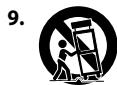
Cart - A product and cart combination should be moved with care. Quick stops, excessive force, and uneven surfaces may cause the product and cart combination to overturn.
- Ventilation - Slots and openings in the cabinet are provided for ventilation to ensure reliable operation of the product and to protect it from overheating. These openings must not be blocked or covered. The openings should never be blocked by placing the product on a bed, sofa, rug, or other similar surface. This product should not be placed in a built-in installation such as a bookcase or rack unless proper ventilation is provided or the manufacturer's instructions have been adhered to.
- Power Sources - This product should be operated only from the type of power source indicated on the marking label and connected to a MAINS socket outlet with a protective earthing connection. If you are not sure of the type of power supply to your home, consult your product dealer or local power company.
- Power-Cord Protection - Power-supply cords should be routed so that they are not likely to be walked on or pinched by items placed upon or against them, paying particular attention to cords at plugs, convenience receptacles, and the point where they exit from the product.
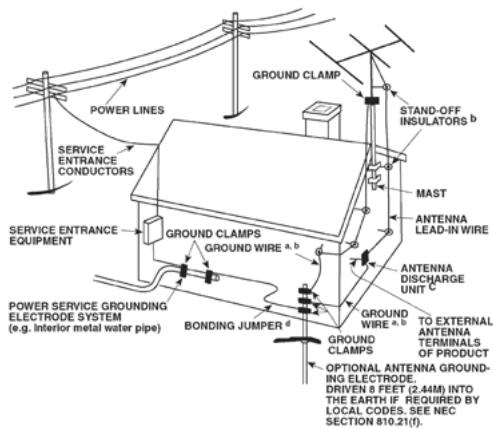
13.Mains Plug - Where the mains plug or an appliance coupler is used as the disconnect device, the disconnect device shall remain readily operable. - Outdoor Antenna Grounding - If an outside antenna or cable system is connected to the product, be sure the antenna or cable system is grounded so as to provide some protection against voltage surges and built-up static charges. Article 810 of the National Electrical Code, ANSI/NFPA 70, provides information with regard to proper grounding of the mast and supporting structure, grounding of the lead-in wire to an antenna discharge unit, size of grounding conductors, location of antenna discharge unit, connection to grounding electrodes, and requirements for the grounding electrode.
NOTE TO CATV SYSTEM INSTALLER
This reminder is provided to call the CATV system installer's attention to Section 820-40 of the NEC which provides guidelines for proper grounding and, in particular, specifies that the cable ground shall be connected to the grounding system of the building, as close to the point of cable entry as practical.
- Lightning - For added protection for this product during a lightning storm, or when it is left unattended and unused for long periods of time, unplug it from the wall outlet and disconnect the antenna or cable system. This will prevent damage to the product due to lightning and power-line surges.
- Power Lines - An outside antenna system should not be located in the vicinity of overhead power lines or other electric light or power circuits, or where it can fall into such power lines or circuits. When installing an outside antenna system, extreme care should be taken to keep from touching such power lines or circuits as contact with them might be fatal.
- Overloading - Do not overload wall outlets, extension cords, or integral convenience receptacles as this can result in a risk of fire or electric shock.
- Flame Sources - No naked flame sources, such as lighted candles, should be placed on the product.
- Object and Liquid Entry - Never push objects of any kind into this product through openings as they may touch dangerous voltage points or short-out parts that could result in a fire or electric shock. Never spill liquid of any kind on the product.
- Headphones - Excessive sound pressure form earphones and headphones can cause hearing loss.
- Damage Requiring Service - Unplug this product from the wall outlet and refer servicing to qualified service personnel under the following conditions:
a. When the power-supply cord or plug is damaged.
b. If liquid has been spilled, or objects have fallen into the product.
c. If the product has been exposed to rain or water.
d. If the product does not operate normally by following the operating instructions. Adjust only those controls that are covered by the operating instructions as an improper adjustment of other controls may result in damage and will often require extensive work by a qualified technician to restore the product to its normal operation.
e. If the product has been dropped or damaged in any way.
f. When the product exhibits a distinct change in performance—this indicates a need for service.
-
Replacement Parts - When replacement parts are required, be sure the service technician has used replacement parts specified by the manufacturer or have the same characteristics as the original part. Unauthorized substitutions may result in fire, electric shock, or other hazards.
-
Battery Disposal - When disposing of used batteries, please comply with governmental regulations or environmental public instruction's rules that apply in your country or area.
- Safety Check - Upon completion of any service or repairs to this product, ask the service technician to perform safety checks to determine that the product is in proper operating condition.
- Wall or Ceiling Mounting - The product should be mounted to a wall or ceiling only as recommended by the manufacturer.
WARNING

The lightning flash with arrowhead symbol, within an equilateral triangle, is intended to alert the user to the presence of uninsulated "dangerous voltage" within the product's enclosure that may be of sufficient magnitude to constitute a risk of electric shock to persons

The exclamation point within an equilateral triangle is intended to alert the user to the presence of important operating and maintenance (servicing) instructions in the literature accompanying the appliance.
WARNING: TO REDUCE THE RISK OF FIRE OR ELECTRIC SHOCK, DO NOT EXPOSE THIS APPARATUS TO RAIN OR MOISTURE AND OBJECTS FILLED WITH LIQUIDS, SUCH AS VASES, SHOULD NOT BE PLACED ON THIS APPARATUS.
THE EQUIPMENT MUST BE CONNECTED TO AN EARTHED MAINS SOCKET-OUTLET.
CAUTION REGARDING PLACEMENT
To maintain proper ventilation, be sure to leave a space around the unit (from the largest outer dimensions including projections) than is equal to, or greater than shown below.
Left and Right Panels: 10 cm
Rear Panel: 10 cm
Top Panel: 50 cm
IMPORTANT INFORMATION TO UK CUSTOMERS
DO NOT cut off the mains plug from this equipment. If the plug fitted is not suitable for the power points in your home or the cable is too short to reach a power point, then obtain an appropriate safety approved extension lead or consult your dealer. If nonetheless, the mains plug is cut off, REMOVE THE FUSE and dispose of the PLUG immediately, to avoid possible shock hazard by inadvertent connection to the mains supply. If this product is not provided with a mains plug, or one has to be fitted, then follow the instructions given below:
IMPORTANT
DO NOT make any connection to the larger terminal which is marked with the letter 'E' or by the safety earth symbol or colored GREEN or GREEN AND YELLOW. The wires in the mains lead on this product are colored in accordance with the following code:
BLUE-NEUTRAL
BROWN-LIVE
As these colors may not correspond with the colored markings identifying the terminals in your plug, proceed as follows:
- The BLUE wire must be connected to the terminal marked with the letter 'N' or colored BLACK.
- The BROWN wire must be connected to the terminal marked with the letter 'L' or colored RED
- When replacing the fuse, only a correctly rated and approved type should be used, and be sure to re-fit the fuse cover.
IF IN DOUBT CONSULT A COMPETENT ELECTRICIAN.

This product is manufactured to comply with the radio interference requirements of EEC DIRECTIVE 2004/108/EC.
NOTES ON ENVIRONMENTAL PROTECTION

At the end of its useful life, this product must not be disposed of with regular household waste but must be returned to a collection point for the recycling of electrical and electronic equipment. The symbol on the product, user's manual and packaging point this out.
The materials can be reused in accordance with their markings. Through re-use, recycling of raw materials, or other forms of recycling of old products, you are making an important contribution to the protection of our environment.
Your local administrative office can advise you of the responsible waste disposal point.
RECORD YOUR MODEL NUMBER (NOW, WHILE YOU CAN SEE IT)
The model and serial number of your new M15 HD are located on the back of the cabinet. For your future convenience, we suggest that you record these numbers here:
Model number:
Serial number:
TABLE OF CONTENTS
IMPORTANT SAFETY INSTRUCTIONS 2
INTRODUCTION
ABOUT THE M15 HD. 5 E.A.R.S. AND DIGITAL SURROUND 5
EASE OF USE 5
INTEGRATION 5
ZONE. 5
RS 232.5
UPGRADABILITY 5
ABOUT THE HTRM SYSTEM REMOTE CONTROL. 5
GETTING STARTED 6
WHAT'S IN THE BOX 6
CHOOSING A LOCATION 6
QUICK START 6
IDENTIFICATION OF CONTROLS
FRONT PANEL. 7
REAR PANEL 8
OPERATION
USING THE M15 HD - MAIN MENU 11
ABOUT THE ON-SCREEN DISPLAY (OSD) 11
MAIN MENU 11
LISTENING MODE 11
ADJUSTING LISTENING MODES 12
DSP OPTIONS 13
TONE CONTROLS 14
PICTURE CONTROLS. 14
ZONE CONTROLS. 15
USING THE M15 HD - SETUP MENU 16
SETUP MENU 16
VIDEO SETUP 16
SOURCE SETUP 17
SOURCE SETUP (NORMAL VIEW) 17
SOURCE SETUP (TABLE VIEW). 19
iPod SETUP 19
SPEAKER SETUP 20
SPEAKER CONFIGURATION 20
SPEAKER LEVELS. 21
SPEAKER DISTANCE 22
ADJUSTING THE VOLUME 22
ADJUSTING CHANNEL LEVELS'ON THE FLY'. 22
ZONE SETUP 23
TRIGGER SETUP 23
LISTENING MODE SETUP 24
DOLBY SETUP. 25
DTS SETUP 25
DTS SURROUND MODES 26
ENHANCED STEREO 26
DISPLAY SETUP 27
A/V PRESETS 27
LISTENING TO YOUR iPod PLAYER. 31
NAD IPD 2. 32
USING THE HTRM REMOTE CONTROL 33
IDENTIFICATION OF CONTROLS 33
INTRODUCTION 33
GETTING FAMILIAR WITH THE HTRM. 33
NAVIGATION OF THE HTRM CONTROLS 34
HTRM SETUP MENU 34
BATTERY 34
BACK LIGHT SENSITIVITY (B LIGHT) 34
LIBRARY 35
LEARN 35
PUNCH-THROUGH (Pun Thr). 36
COPY 37
DELETE 38
RENAME. 38
MACRO. 38
RESET 39
USING THE ZR 5 REMOTE CONTROL 40
REFERENCE
TROUBLESHOOTING 41
SPECIFICATIONS 42
THANK YOU FOR CHOOSING NAD.
The M15 HD AV Surround Sound Preamplifier is a technologically advanced and highly capable product — yet we have invested great effort in making it simple and easy to use. The M15 HD delivers a range of genuinely useful options for surround sound and stereo listening alike, using powerful digital signal processing and superbly accurate digital-audio circuitry. However, we have also been careful to ensure that the M15 HD is as musically transparent, faithful to every video detail and spatially accurate as possible, incorporating much of what we've learned from a quarter-century's experience designing audio, video and home-theater components. As with all our products, NAD's "Music First" design philosophy guided the M15 HD's design, such that it can confidently promise you both state-of-the-art surround home-theater and audiophile-quality music listening for years to come.
We encourage you to take a few minutes now to read right through this manual. Investing a little time here at the outset might save you a good deal of time later, and is by far the best way to ensure that you make the most of your investment in the M15 HD, and get the most from this powerful and flexible home-theater component.
One more thing: We urge you to register your M15 HD ownership on the NAD Worldwide Web site:
http://NADelectronics.com/warranty
For warranty information contact your local distributor.
Though the M15 HD is among the most technically sophisticated AV Surround Sound Preamplifier, we worked hard to make it one of the most musically transparent home-theater components available as well; this is what we mean by NAD's "Music First" design philosophy. Here are just few examples:
- High-performance components used throughout the M15 HD's analog audio circuits maximize quality from all sources, including multi-channel analog sources such as DVD-Audio and SACD.
Audio pre-out jacks make potential expansion as flexible as possible..
Zone pre-amp and video feed with assignable 12 V DC trigger control. - An RS-232 port for advanced zone control and software update through a Windows® compatible PC.
- Gold-surfaced connectors are employed throughout to ensure maximum signal integrity.
E.A.R.S. AND DIGITAL SURROUND
A key element of the M15 HD's unique musical aptitude is NAD's proprietary Enhanced Ambience Recovery System (EARS). In sharp contrast to many "ambience-synthesis" music-surround modes, EARS exploits the M15 HD's substantial DSP power to route the ambient content that is "encrypted" in virtually all natural-acoustic recordings to the appropriate main, center and surround speakers, without resorting to artificially generated reflections or regeneration. EARS' natural ambience yields a subtle but exceptionally effective surround mode that naturally enhances the spatial presentation in a fashion suitable for serious music listening.
Dolby Pro Logic IIx Music and DTS Neo: 6 Music modes can also create enjoyable experience from 2-channel sources.
On the digital side, the M15 HD combines extraordinarily high-speed DSP processing employing one of the most advanced high-speed DSP "engines" available, with fully 24-bit, 192kHz -sampling-capable D/A converters for all channels. A single, high-precision master clock synchronizes all digital circuits to eliminate the timing errors ("jitter") that otherwise compromise sonics. The result is legitimately state-of-the-art surround decoding from Dolby Digital and DTS sources, and 6.1/7.1-channel reproduction, with genuinely superior sound quality in all modes.
EASE OF USE
Despite the effort NAD has invested in the M15 HD's sonic performance, we expended no less in making it powerfully easy to use. Its design is uniquely simple for so sophisticated a component, and the HTRM universal remote control is equally understandable, as are the M15 HD's own front-panel and on-screen displays. Its simple yet powerful system of "presets" permits you to fine-tune your listening setup for different conditions, sources, or listeners, and to recall these multiple parameters with a single key press.
INTEGRATION
The M15 HD offers extensive, flexible system-integration options through its configurable DC trigger outputs and input, and its standard-protocol IR communications links. The DC trigger outputs can be assigned to either Local and/or Zone locations.
ZONE
The M15 HD is equipped with three configurable Zones that make full use of video and pre-amp level audio outputs. The ZR 5 remote control will allow you complete access to Zone 2 applications including access to volume On/Off and all sources inputs. Zone 3 and Zone 4 could be configured and managed at the appropriate Zone OSD menu using the corresponding keys on the HTRM remote control.
RS 232
Flexible system configuration is possible with the RS-232 interface and NAD's proprietary Windows® compatible software. We are also certified partners with AMX and Crestron and fully support these external devices.
This interface allows complete remote control of the M15 HD from any remote location via the PC. Complete remote control functionality is available to the user by interface software. See your NAD audio specialist for further information.
UPGRADABILITY
The M15 HD permits flexible system growth via individually accessible pre-out and main-in jacks for all channels. We have made the more likely scenario of software upgrades easy to accomplish via the high speed RS-232 port on the rear panel of the M15 HD. Owners who register their M15 HD on our international web site www.NADelectronics.com will be advised of updates. Some of these may be free of charge, and some may require royalty payments depending on the type of upgrade. The advanced user will be able to perform these upgrades by downloading files from our web site, via e-mail and installing them by connecting the M15 HD to a PC. Alternatively the dealer from whom you purchased your M15 HD should be able to assist in performing these upgrades.
ABOUT THE HTRM SYSTEM REMOTE CONTROL
Packed with your M15 HD is the NAD HTRM remote control, a full-system remote especially designed for easy use and understanding. Be sure to read the section "Using the HTRM Remote Control," to familiarize yourself with the remote's layout and operations before proceeding to setup your M15 HD. You may opt to use your HTRM as your primary way to command your entire A-V system. The HTRM can be employed to operate additional NAD or other-brand components such as a DVD/CD player, television, satellite/HDTV tuner, VCR, or virtually anything else that operates via standard infrared remote.
WHAT'S IN THE BOX
Packed with your M15 HD you will find
- A removable AC cable (if you wish, any IEC-standard AC cable of suitable wattage may be substituted)
The HTRM remote control with 4 (four) AA batteries
The ZR 5 zone remote control with 3V CR2025 battery
This owner's manual
SAVE THE PACKAGING
Please save the box and all of the packaging in which your M15 HD arrived. Should you move or otherwise need to transport your M15 HD, this is by far the safest container in which to do so. We've seen too many otherwise perfect components damaged in transit for lack of a proper shipping carton, so please: Save that box!
CHOOSING A LOCATION
Choose a location that is well ventilated (with at least several inches to both sides and behind), and that will provide a clear line of sight, within 25 feet/8 meters, between the M15 HD's front panel and your primary listening/viewing position—this will ensure reliable infrared remote control communications. The M15 HD generates a modest amount of heat, but nothing that should trouble adjacent components.
It is perfectly possible to stack the M15 HD on top of other components, but the reverse usually should be avoided.
QUICK START
Packed with your M15 HD is a Quick Start Guide that will guide you through typical setup configurations in combination with your ancillary devices. The Quick Start Guide also features the contents of your M15 HD package as well as start up procedures.
The M15 HD is defaulted to the following settings:
| Source | Audio Input | Video Input |
| Source 1 | HDMI 1 / Audio 1 IN | HDMI 1 |
| Source 2 | Optical 2 IN/ Audio 2 IN | Component Video 2 IN |
| Source 3 | Coaxial 3 IN/ Audio 3 IN | Video 3 IN |
| iPod | Audio 4 IN | S-Video 4 IN |
| Source 5 | Optical 1 IN/ Audio 5 IN | Component Video 1 IN |
| Source 6 | Coaxial 2 IN/ Audio 6 IN | S-Video 2 IN |
| Source 7 | 7.1 Input | Component Video 3 IN |
| Source 8 | Audio 7 IN | Video 1 IN |
| Source 9 | HDMI 2 | HDMI 2 |
For Video output, select the highest video quality format available on your TV/Monitor and utilize this for your Monitor OUT connection from the M15 HD to the TV/Monitor. In most cases, this would be HDMI but for other TV/Monitor without HDMI input, the best connection in order of best video quality would be Component Video, S-Video and Composite video input.
To modify the above default settings and for a better understanding of source setting and combinations, please refer to the section on 'Source Setup' of the Setup Menu discussion.
NOTE
Digital input will always take precedence over analog audio input even if both are present.
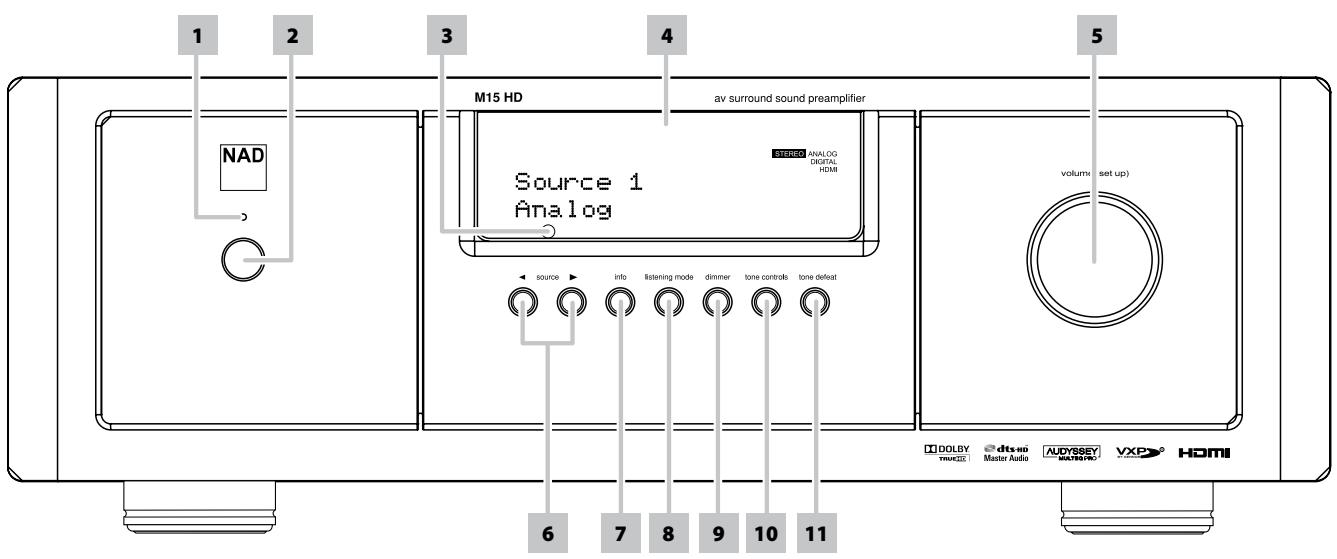
1 STANDBY LED: This indicator will light up amber when the M15 HD is in standby state. When the M15 HD main or zones are in the ON state, this indicator will illuminate blue. In the unlikely event that the M15 HD switches to protection state, then this indicator will illuminate red. When infrared command from the HTRM is received, this indicator will also flash momentarily.
2 STANDBY BUTTON: Press this button or the HTRM remote's [ON] button to switch ON the M15 HD. The Standby LED indicator will turn from amber to blue and illuminate the VFD. Pressing the standby button again turns the unit back to standby mode.
The M15 HD can also be switched ON from standby mode by pressing any of the front panel buttons. When both Main and Zones are ON, press and hold this button for more than five seconds to place them at standby mode.
NOTES
- The rear panel POWER switch must be in the ON position for the Standby button to activate.
- If Auto Trigger IN at Trigger Setup menu is assigned to "Main" or "All" and the TRIGGER switch is set to "AUTO" mode, the standby button in the front panel as well as the corresponding ON/OFF function keys in the HTRM remote control will be disabled effectively handling this function to an external controller. Switch TRIGGER to "OFF" to maintain normal power ON/OFF function procedures. See section also about "Trigger Setup" under the "Setup Menu" discussions.
3 REMOTE SENSOR: Point the HTRM remote control at the remote sensor and press the buttons. Do not expose the remote sensor of the M15 HD to a strong light source such as direct sunlight or illumination. If you do so, you may not be able to operate the M15 HD with the remote control.
Distance: About 23ft (7m) from the front of the remote sensor.
Angle: About 30^ in each direction of the front of the remote sensor.
4 VACUUM FLUORESCENT DISPLAY (VFD): Displays visual information about the current settings like the active Source, volume level, listening mode, audio format, iPod-related display information and other related indicators. Refer also to the item about DISPLAY SETUP under the USING THE M15 HD - SETUP MENU segment of the OPERATION section.
5 VOLUME: Use this control to adjust the overall loudness of the signal output at AUDIO PRE-OUT. The default volume level is -20dB. The VOLUME knob is also used to increment/decrement other adjustable parameters like Tone Controls.
6 SOURCE[</>]: Press these buttons to toggle through the input selections - Source 1-9. Refer also to the item about SOURCE SETUP under the USING THE M15 HD - SETUP MENU segment of the OPERATION section.
7 INFO: Repeatedly toggle this button to display both at the Vacuum Fluorescent Display (VFD) and On-Screen Display (OSD) the following - Current Source, Volume level, Listening mode, Audio Source Format, Audio Codec, Video Mode and active Zones with their corresponding Source Inputs.
8 LISTENING MODE: Toggle to select through the various Listening mode options. Depending on the format of the currently selected input (digital or analog, stereo or multichannel), various listening modes are available. Refer also to the item about LISTENING MODE under the USING THE M15 HD - MAIN MENU segment of the OPERATION section.
9 DIMMER: Toggle to either reduce or restore normal VFD brightness.
10 TONE CONTROLS: Press to adjust TREBLE control using the VOLUME knob over a ± 10dB range. Press again to adjust BASS control and a third time for DIALOG control. See also section about "Tone Controls" under "Main Menu" discussions.
11 TONE DEFEAT: Tone Controls are enabled or disabled by pressing this button. Tone controls are bypassed at "Tone Defeat" while at "Tone Active," the tone controls are enabled again. See also section about "Tone Controls" under "Main Menu" discussions.
REAR PANEL
ATTENTION!
Please make sure that the M15 HD is powered off or unplugged before making any connections. It is also advisable to power down or unplug all associated components while making or breaking any signal or AC power connections.
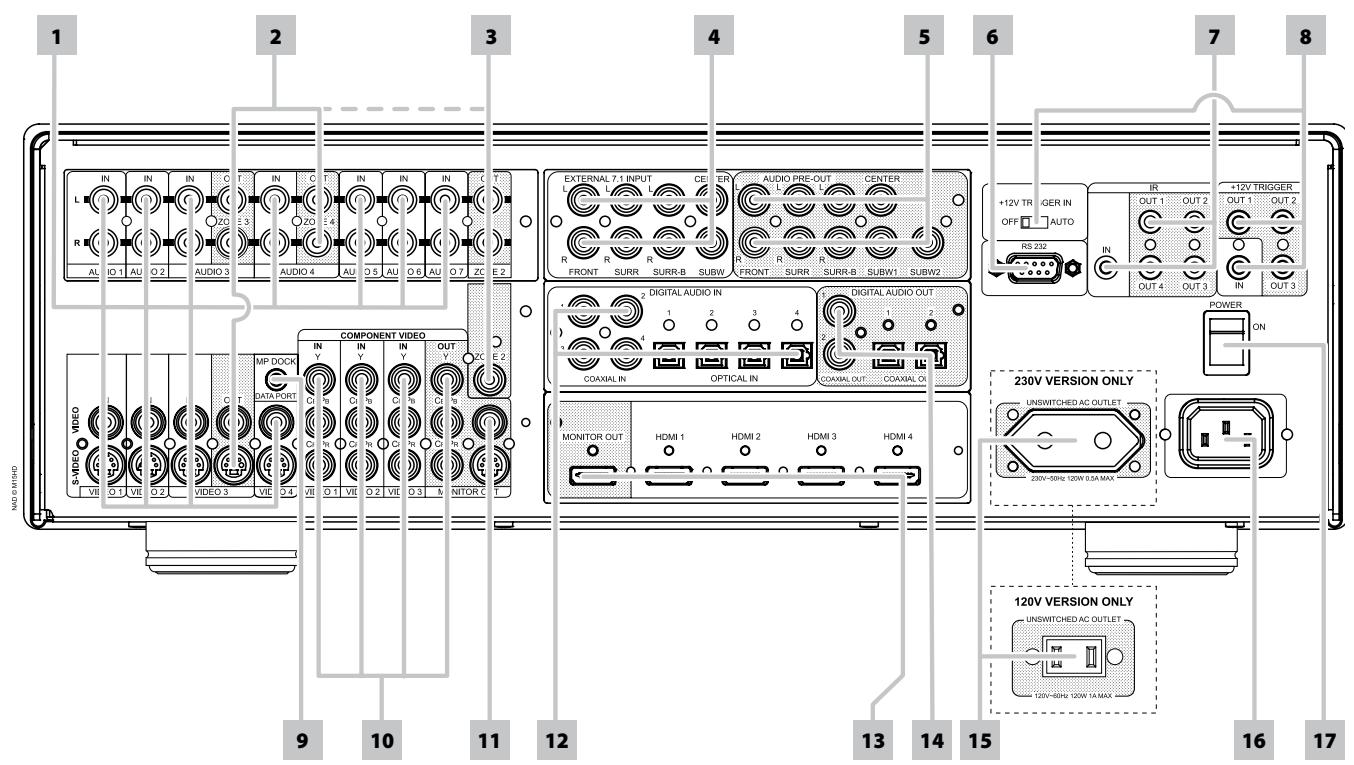
1 AUDIO 1-7 IN/VIDEO 1-4 IN/S-VIDEO 1-4 IN: These comprise the M15 HD's principal input. Connect S-Video, composite video, and analog stereo audio input ports to source components such as DVD players and HDTV/satellite tuners.
AUDIO 3-4 IN/VIDEO 3-4 IN/S-VIDEO 3-4 IN may be used with recording components such as videocassette or DVD-recorders by connecting these components' record-output to the corresponding M15 HD AUDIO 3 IN/VIDEO 3 IN/S-VIDEO 3 IN or AUDIO 4 IN/VIDEO 4 IN/S-VIDEO 4 IN jacks. AUDIO 3 IN/VIDEO 3 IN/S-VIDEO 3 IN or AUDIO 4 IN/VIDEO 4 IN/S-VIDEO 4 IN may freely be used for play-only components, in which case their corresponding OUT jacks would remain unconnected. Refer also to AUDIO 3 OUT/VIDEO 3 OUT/S-VIDEO 3 OUT, AUDIO 4 OUT discussion below.
AUDIO 6 and 7 are ideal for the connection of the analog output of line-level audio sources like a CD player or Stereo tuner.
Connect the M15 HD's AUDIO 3 OUT/VIDEO 3 OUT/S-VIDEO 3 OUT or AUDIO 4 OUT ports to the analog audio/video input of recording components such as cassette deck, DVD recorder or an outboard audio/video processor. Connect the M15 HD's AUDIO 3 IN/VIDEO 3 IN/S-VIDEO 3 IN or AUDIO 4 IN/VIDEO 4 IN/S-VIDEO 4 IN ports to the component's corresponding output.
The signal present at these M15 HD AUDIO/VIDEO OUT jacks is determined by the source last selected via the front panel Source keys or the HTRM's input select keys with the exception of Source 3 or Source 4. There will be no output at AUDIO 3 OUT/VIDEO 3 OUT/S-VIDEO 3 OUT when Source 3 (AUDIO 3 IN/VIDEO 3 IN/SVIDEO 3 IN) is selected. Likewise, there will be no output at AUDIO 4 OUT when Source 4 (AUDIO 4 IN/VIDEO 4 IN/SVIDEO 4 IN) is the active source input. This prevents feedback through the recording component thereby preventing possible damage to your speakers.
When configured, AUDIO 3 OUT/VIDEO 3 OUT/S-VIDEO 3 OUT and AUDIO 4 OUT are the same assigned ports for Zone 3 and Zone 4 respectively. See also Zone output description below.
3 ZONE 2, ZONE 3, ZONE 4: Sends zone selected audio and video output sources to the corresponding audio and video input of another separate zone. Use high quality patch cables to reduce noise pickup over long distance runs. For a better understanding of zone settings, study below the section about "Zone Controls" of the "Main Menu" discussion as well as the item about "Zone Setup" under the "Setup Menu" literatures.
NOTE
The ZR 5 remote control will only control Zone 2 applications. Zone 3 and Zone 4 could be configured and managed at the appropriate Zone OSD menu using the corresponding keys on the HTRM remote control.
4 7.1 CH INPUT: Connect to the corresponding analog audio outputs of a multichannel source component such as a DVD-Audio or multichannel-SACD player or external multichannel decoder (disc copy protected formats only allow analog signal transfer). Typically, these sources will produce 5.1-channel output, in which case the Surround Back jacks are left unconnected. The signals present at these jacks may be heard by selecting Source 7 (External 7.1 audio input is defaulted to this Source).
There is no bass-management or other processing (other than master-volume control) available to this 7.1 channel input. While the multi-channel audio output of a BD player or DVD player can be connected to these jacks, using the M15 HD's own Dolby Digital and DTS decoding and digital-analog converters via a digital connection will usually produce superior results.
5 AUDIO PRE-OUT: Connect FRONT L, FRONT R, CENTER, SURR R, SURR L, SURR-BL and SURR-BR to the corresponding channel input of a power amplifier or amplifiers driving the applicable speakers.
Unlike the full range channels, there is no power amplifier built-in to the M15 HD for a subwoofer. Connect the SUBW 1 or SUBW 2 output or both to powered ("active") subwoofer or to power amplifier channels driving a passive system.
6 RS-232: Connect this interface via RS-232 serial cable (not supplied) to any Windows® compatible PC to allow remote control of the M15 HD through NAD's proprietary PC software or other compatible external controllers. Please log on to www.nadelectronics.com/software for the latest PC interface control software. NAD is a certified partner of AMX and Crestron and fully supports these external devices. See your NAD audio specialist for more information.
7 IR IN/OUT: These mini-jacks accept and output remote-controlled codes in electrical format, using industry-standard protocols, for use with "IR-repeater" and multi-room systems and related technologies.
IR IN: This input is connected to the output of an IR (infrared) repeater (Xantech or similar) or the IR output of another component to allow control of the M15 HD from a remote location.
IR OUT 1, IR OUT 2, IR OUT 3, IR OUT 4: IR OUT 1, IR OUT 2, IR OUT 3 and IR OUT 4 have dual-features – they can act as an infrared command repeater or as stand alone IR OUT. As a stand alone IR OUT, connect IR OUT 1 (or IR OUT 2-4) to the IR IN of an ancillary equipment. Direct the ancillary equipment's own remote control to the M15 HD's infrared receiver to command or control the linked unit.
Connect the M15 HD's IR IN to the IR OUT of an ancillary equipment. Connect also the M15 HD's IR OUT 1, IR OUT 2, IR OUT 3 or IR OUT 4 to another equipment with IR IN feature. With this setup, the M15 HD acts as an "IR-repeater" allowing the equipment connected to the M15 HD's IR IN control or command of the other equipment linked to the M15 HD's IR OUT 1, IR OUT 2, IR OUT 3 or IR OUT 4.
All NAD products with IR IN/IR OUT features are fully compatible with the M15 HD. For non-NAD models, please check with your other product's service specialists as to their compatibility to the M15 HD's IR features.
8 +12V TRIGGER IN (OFF/AUTO): When at AUTO position, the M15 HD selects the 12V Trigger Input to turn ON (if so assigned at the "Trigger Setup" menu) and at the same time disables the HTRM and front panel's ON/OFF function. When at OFF position, the trigger input is disabled.
+12V TRIGGER OUT: There are three configurable +12V TRIGGER OUTPUT. Use a 3.5mm mini-jack connector to pass +12 volts at a maximum current of 50 milliamps to auxiliary equipment such as a multichannel amplifier or subwoofer. The center conductor (hot) of the 3.5mm jack is the control signal. The outside conductor (shield) is the ground return-path.
+12V TRIGGER IN accepts 12V Trigger output of compatible components such as power controllers and home automation devices.
See discussion on "Trigger Setup" at the "Setup Menu" literature for guidelines on how to configure TRIGGER IN/OUT.
WARNING
If Auto Trigger IN at Trigger Setup menu is assigned to "Main" or "All" and the TRIGGER switch is set to "AUTO" mode, the standby button in the front panel as well as the corresponding ON/OFF function keys in the HTRM remote control will be disabled effectively handling this function to an external controller. Switch TRIGGER to "OFF" to maintain normal power ON/OFF function procedures.
9 MP DOCK: The M15 HD is equipped with a data port in the rear panel where an optional NAD IPD 1 (NAD IPD 1 Dock for iPod), NAD IPD 2 and later variants can be plugged in. Connect the "MP DOCK (DATA PORT)" jack of the M15 HD to the corresponding "DATA PORT" socket of the optional NAD IPD model. Refer also to the section about LISTENING TO YOUR iPod PLAYER under the OPERATION main heading.
NOTE
The external "NAD IPD Dock for iPod" (NAD IPD) model is not supplied with your M15 HD.
10 COMPONENTVIDEO 1-3 IN,COMPONENTVIDEO OUT:Connect the Component Video IN 1-3 input to the Component Video output of compatible source components, typically a DVD/BD player and terrestrial or satellite HDTV tuner. Connect Component Video OUT to the Component Video input of a compatible video monitor/TV. Be sure to observe consistency in connecting the Y/Pb/Pr jacks to the corresponding source/Input. The routing of the component video input is fully configurable via the Setup Menu. The M15 HD's component video input and output are fully wideband and compatible with allowable HDTV formats.
11. Monitor (S-VIDEO,VIDEO): Connect to the video input of a monitor/television using quality dual-RCA and/or S-Video cables designed for video signals. In general, the S-Video connection is superior and should be used if your TV/monitor provides the corresponding input.
12 DIGITAL AUDIO IN (OPTICAL 1-4, COAXIAL 1-4): Connect to the optical or coaxial S/PDIF-format digital output of sources such as CD or DVD/BD players, HDTV or satellite tuners and other components. Coaxial and Optical digital input association is configurable via the Setup Menu.
REAR PANEL
13 HDMI (HDMI 1-4, HDMI MONITOR OUT): Connect HDMI inputs to the HDMI OUT connectors of source components such as DVD/BD player or HDTV satellite/cable box. Connect the HDMI Monitor OUT to a HDTV or projector with HDMI input.
WARNING
Before connecting and disconnecting any HDMI cables, both the M15 HD and the ancillary source must be powered OFF and unplugged from the AC outlet. Failure to observe this practice may cause permanent damage to all equipment connected via HDMI sockets.
14 DIGITAL AUDIO OUT (OPTICAL 1-2, COAXIAL 1-2): Connect the optical or coaxial digital OUT ports to the corresponding S/PDIF digital input of a recording component such as a CD recorder, DAT deck, computer soundcard or other digital processors.
15 UNSWITCHED AC OUTLET: With M15 HD switched ON or at standby mode, mains power is always available at this outlet. This outlet can be used for components which may require continuous supply of AC mains; some tuners require uninterrupted mains supply to retain preset memory, for instance. The total draw of all devices connected to this outlet must not exceed 120 watts. Mains power at this outlet can be shut down by switching OFF the M15 HD via the rear panel POWER switch.
16 AC MAINS INPUT: The M15 HD comes supplied with a separate AC Mains cable. Before connecting the cable to a live wall socket, ensure that it is firmly connected to the M15 HD's AC Mains input socket first. Connect only to the prescribed AC Outlet, i.e., 120V 60 Hz (for 120V version models of M15 HD only) or 230V 50 Hz (for 230V version models M15 HD only). Always disconnect the AC Mains cable plug from the live wall socket first, before disconnecting the cable from the M15 HD Mains input socket.
17 POWER:The POWER switch supplies the master AC mains power for the M15 HD. When this switch is at ON position, the M15 HD is in standby mode as shown by the amber status condition of the standby LED. If you intend not to use the M15 HD for long periods of time (such as when on vacation), switch the POWER switch to the OFF position. When the POWER switch is at OFF position, the front panel standby button, HTRM remote control or ZR 5 cannot activate the M15 HD.
ABOUT THE ON-SCREEN DISPLAY (OSD)
The M15 HD employs a simple, self-explanatory system of on-screen display "menus" that will appear on the connected video monitor/TV. These are required during the setup process (and are useful in day-to-day operation), so be sure to connect the monitor/TV before proceeding with setup.
DISPLAY THE OSD
Press either or ENTER buttons of the HTRM remote control or front panel to display the M15 HD's Main Menu on your video monitor/TV. If the OSD does not appear, check your MONITOR OUT connections.
NAVIGATING THE OSD AND MAKING CHANGES
To navigate through the OSD menu options, please do the following using the HTRM or corresponding front panel buttons:
1 Press to select a menu item. Use / keys or in some cases, ENTER, to move up or down the Menu selections. Repeatedly press to advance or go further into sub-menus of a desired menu item.
2 Use / keys to set or change the parameter value (setting) of a menu item.
3 Press to save the settings or changes done on the current menu or sub-menu. Pressing will also return the user to the previous menu or exit from a particular menu.
MAIN MENU
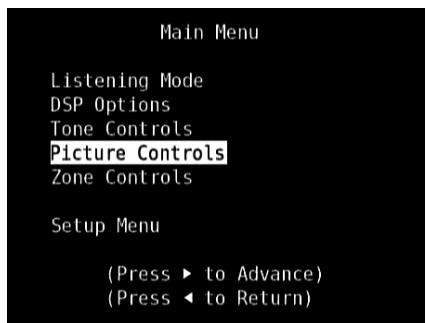
The Main Menu contains the menu options for 'Listening Mode', 'DSP Options', 'Tone Controls', 'Picture Controls', 'Zone Controls' and access to 'Setup Menu'.
To navigate through these Main Menu options and their sub-menu selections, please refer to and follow the directions stated in the sections 'Display the OSD' and 'Navigating the OSD and Making Changes'.
NOTE
The individual configurations set forth at 'Listening Mode', 'DSP Options', 'Tone Controls' and 'Picture Controls' are carried over whenever they are enabled during A/V Preset setting. Please see the section 'AV Presets' for reference.
LISTENING MODE
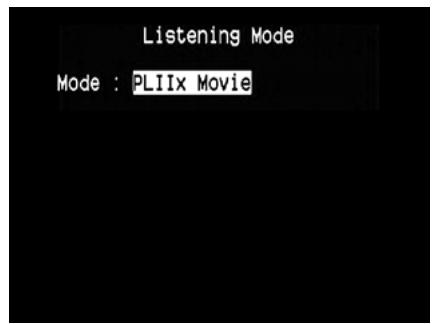
The M15 HD offers distinct listening modes, tailored for different types of recording or program material. With a two-channel (Stereo) source, the following listening modes can be selected:
IMPORTANT NOTICE
The M15 HD is an AV Surround Sound Preamplifier and therefore has no speakers. The mention of "Speaker(s)" in this manual refers to the speakers of your external amplifier as interfaced with the M15 HD.
STEREO
All output is directed to the front left/right channels. Low frequencies are directed to the subwoofer if one is present in the Speaker settings. Select 'Stereo' when you wish to listen to a stereo (or monaural) production, such as music CD or FM broadcast, without surround enhancement. Stereo recordings whether in PCM/digital or analog form and whether surround-encoded or not encoded, are reproduced as recorded. Multi-channel digital recordings (Dolby Digital and DTS) are reproduced in "Stereo Downmix" mode via the front left/right channels only as Lt/Rt (left/right-total) signals.
DIRECT
The analog or digital sources are automatically played in their native formats. All the source's audio channels are reproduced directly. This mode recreates the original sound most faithfully thereby producing outstandingly high quality audio.
PROLOGIC
Two-channel recordings, whether stereo or surround-encoded, are reproduced with Dolby Pro Logic surround processing, yielding output to front left/right, center and discrete left/right surround channels (assuming these are present in the current 'Speaker Configuration'). The surround channel is monophonic, but it is reproduced in both surround speakers.
Dolby Pro Logic IIx processes both stereo and 5.1 signals into a 6.1 or 7.1 channel output. At Dolby Pro Logic IIx, you can choose PLIIx Movie or PLIIx Music modes to tailor your listening experience to the source material. Dolby Pro Logic IIx surround processing yields more stable imaging and full bandwidth sound to the rear channels in Movie mode offering sound that is more similar to Dolby Digital decoding. For two channel signals, Pro Logic IIx Music mode also features three additional user controls - Dimension, Center Width, and Panorama. See also section about 'Adjusting Listening Modes' below.
The following chart shows the channels available assuming they are enabled in the 'Speaker Configuration' menu:
| Listening Mode Two-Channel Sources | Active Decoded Output Channels | |
| 6.1 Speaker System | 7.1 Speaker System | |
| Dolby Pro Logic IIx Music Dolby Pro Logic IIx Movie | Front (left & right), Center, Surround (left & right), Back Surround, Subwoofer | Front (left & right), Center, Surround (left & right) and Back Surround (left and right) and subwoofer |
DTS NEO: 6
Two-channel recordings, whether stereo or surround-encoded, are reproduced with Neo: 6 surround with output to front left/right, center and discrete left/right surround channels plus subwoofer (assuming these are present in the current 'Speaker Configuration'). The M15 HD provides two DTS Neo: 6 variations - NEO:6 Cinema and NEO:6 Music. See also section about 'Adjusting Listening Modes' below.
EARS
Two-channel recordings, whether stereo or surround-encoded, are reproduced with proprietary NAD surround processing with signals output to the front left/right, center and discrete left/right surround channels, plus subwoofer (assuming these are present in the current 'Speaker Configuration'). EARS does not employ the surround back speakers (if any).
EARS extracts the natural ambience present in nearly all well-produced stereo recordings. It does not synthesize any ambience or other sonic elements and thus remains truer to the sound of the original musical performance than most other music-surround options.
Select EARS for listening to stereo music recordings and broadcasts. EARS produces a subtle but highly natural and believable ambience from nearly all "natural-acoustic" stereo recordings. Typically, these include classical, jazz, and folk genres as well as numerous examples from others. Its virtues include realistic, stable "front-stage" sonic imaging and spacious but unexaggerated ambient "virtual acoustics" that remain faithful to the original recording.
ENHANCED STEREO
All recordings are reproduced in stereo via the maximum speaker complement configured in the current 'Speaker Configuration'.Enhanced stereo can be useful for maximum volume from all channels or for multi-speaker background music (cocktail party) listening. For this mode, Front, Center, Surround and Back speakers can be turned ON/OFF as desired.
ANALOG BYPASS
All analog signals remain in the analog domain without analog-to-digital conversions. At Analog Bypass, the DSP circuitry is bypassed but full tone control functions remain. 'Bass management' or Speaker settings are also not in effect as these are DSP functions.
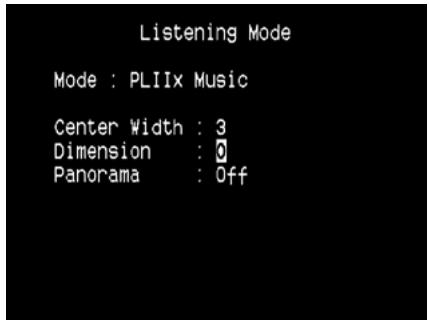
ADJUSTING LISTENING MODES
Several of the M15 HD's listening modes have one or more selectable variations and adjustable parameters that you can modify to suit you system or personal preferences. At Listening Mode menu, use a combination of ENTER and / keys to navigate and effect desired settings.
NOTE
Listening Mode parameter changes are maintained when you change listening modes. You may also save a modified Listening Mode for easy recall by saving it to a Preset (See 'A/V Presets' below under Setup Menu discussions).
PRO LOGIC IIx
PLIIx MOVIE is optimized for film soundtracks.
PLIIx MUSIC for music recordings
Center Width (0 to 7): Modifies the "hard-centeredness" of the center image, by gradually mixing mono center content to the Front left/right speakers as well. A setting of 0 retains the center-channel-only default while a setting of 7 yields a fully phantom center channel.
Dimension (-7 to +7): Adjusts front-rear emphasis of the surround effect independently from the relative channel levels.
Panorama (On/Off): Adds a "wraparound" effect by extending some stereo content into the surround channels.
NOTE
Pro Logic IIx mode will decode as Pro Logic II mode when the BACK surround speakers are set to "OFF" from "Speaker Configurations" menu. See also section about "Speaker Configurations" under "Speaker Setup" of the Setup Menu.
DTS NEO: 6
NEO: 6 Cinema is optimized for film soundtracks.
NEO: 6 Music for music recordings
Center Gain (0 to 0.5): Adjust for better center image in relation to the surround sound channels.
DSP OPTIONS
| DSP Options | |
| Lip Sync Delay : Oms | |
| ADC Rate : 96k | |
| Audyssey MultEQ : NAD | |
| Audyssey Dyn EQ : On | |
| Audyssey Dyn Volume : Medium |
The following signal processing parameters can be setup under the DSP (Digital Signal Processing) Options menu.
IMPORTANT NOTICE
The M15 HD is an AV Surround Sound Preamplifier and therefore has no speakers. The mention of "Speaker(s)" in this manual refers to the speakers of your external amplifier as interfaced with the M15 HD.
LIP SYNC DELAY
DSP Options has the feature 'Lip Sync Delay' whose function is to match any delay that may occur in the picture relative to the audio.
By varying 'Lip Sync Delay' from 0ms to 120ms, one can delay the audio output in order to synchronize it with the video image.
ADC (ANALOG-TO-DIGITAL CONVERTER) RATE
An analog audio input is converted to digital signal by making use of M15 HD's superb circuitry called analog-to-digital converter (ADC).
Using this ADC Rate feature, the sampling rate of the resulting digital audio signal (available at the digital output ports) can be converted into three levels - 48K, 96K and 192K. Make sure that the associated equipment will be able to handle the applicable digital audio signal level.
AUDYSSEY MultEQ
Audyssey MultEQ will get enabled only after successfully installing and configuring MultEQ Pro room equalization. To get your M15 HD installed with MultEQ Pro application, contact your NAD dealer or a registered Audyssey professional installer for more details.
Audyssey MultEQ can be set to the following levels
Audyssey: Audyssey developed target curve.
Flat: This setting is appropriate for very small or highly treated rooms in which the listener is seated quite close to the loudspeakers. MultEQ filters are used in the same way as the Audyssey curve, but it does not apply a high frequency roll-off.
NAD: Ideal "in room" response developed by NAD engineers along with Audyssey Engineers.
Off: MultEQ filters are not used or no measurement process at all.
NOTES
- "AUDYSSEY" and a lit box icon to the left of "AUDYSSEY" are illuminated at the VFD if NAD, Audyssey or Flat is selected. If "Off" is selected, "AUDYSSEY" and the box icon will not be illuminated.
- If NAD or Flat is selected and changes are done at the "Tone Controls", "Speaker Configuration", "Speaker Levels" and "Speaker Distance" settings, "AUDYSSEY" and a lit box icon to the right of "AUDYSSEY" are illuminated at the VFD.
- Audyssey MultEQ options can also be directly selected or changed using HTRM's AUDYSSEY button with DEVICE SELECTOR set to AMP mode. Toggle AUDYSSEY button to select "Audyssey MultEQ" and then use the [ / ] to select through the Audyssey MultEQ options. Press AUDYSSEY again to save the selected option and at the same time move on to the next menu setting or exit the menu setting altogether.
AUDYSSEY DYN EQ (AUDYSSEY DYNAMIC EQ)
Audyssey Dynamic EQ solves the problem of deteriorating sound quality as volume is decreased by taking into account human perception and room acoustics. By carefully combining information from incoming source levels with actual output sound levels in the room, Odyssey Dynamic EQ delivers unprecedented sound reproduction at all volume levels.
Audyssey Dynamic EQ selects the correct frequency response and surround volume levels moment-by-moment. The resulting bass response, octave-to-octave balance and surround impression remained the same despite changes in volume.
Audyssey Dynamic EQ is designed to work in conjunction with Audyssey MultEQ. Dynamic EQ determines the proper loudness compensation based on the sound pressure level measurements MultEQ provides. Audyssey Dynamic EQ working in tandem with Audyssey MultEQ provides the right listening conditions for every listener at any volume level.
On: Activate Audyssey Dynamic EQ function.
Off: Defeat Audyssey Dynamic EQ function.
NOTE
Audyssey Dynamic EQ and Audyssey Dynamic Volume (see below) can be directly selected or changed using HTRM's AUDYSSEY button with DEVICE SELECTOR set to AMP mode. Toggle AUDYSSEY button to select "Dyn EQ" or "Dyn Vol" and then use the [▲/▼] to select through their respective options. Press AUDYSSEY again to save the setting and at the same time move on to the next option or exit the menu setting altogether.
Offset : Adding a Volume Offset will have the effect of reducing the amount of boost applied by Dynamic EQ, for any given volume setting. As a consequence, the amount of overall digital attenuation required is also reduced. For example, with the Offset set to 10dB, and a volume setting of -30dB, the loudness curve selected will be for a volume level of -20dB.
The offset level can be set from 0dB to 15dB.
AUDYSSEY DYNAMIC VOLUME
Audyssey Dynamic Volume delivers consistent volume playback levels, anticipating sudden spikes and dips in volume and compensating for them in real time. Audyssey Dynamic Volume monitors the volume of program material moment-by-moment, maintaining the desired listening level for all content while optimizing the dynamic range to preserve the impact.
Audyssey Dynamic Volume includes Audyssey Dynamic EQ, which compensates for deteriorating sound quality as volume is decreased by taking into account human perception and room acoustics. These two technologies enable the full frequency response of the source at its original level to be reproduced at any listening level. Even at lower listening volumes, Dynamic Volume ensures that the richness and dynamics of the response are maintained.
Audyssey Dynamic Volume can be set to the following levels
Light: Provide the least adjustment to the loudest or softest sound level.
Medium: Setting that prevents loud and soft sound from being much louder than their respective average sound levels.
Heavy: Affect volume the most by causing all sound to be of equal loudness.
NOTE
Audyssey Dynamic EQ must be set to "On" to activate Audyssey Dynamic Volume. If Audyssey Dynamic EQ is set "Off", Audyssey Dynamic Volume will also remain "Off".
IMPORTANT NOTICE
If Audyssey Auto Calibration is not set up, the relative balance of your system's loudspeakers has to be manually adjusted (with the aid of a SPL meter) for Audyssey Dynamic Volume and Audyssey Dynamic EQ to be effective. If the speakers are not properly calibrated, the corresponding Audyssey Dynamic Volume and Audyssey Dynamic EQ responses could be distorted. Refer also to the item about "USING SPL METER" in the SPEAKER LEVELS section below.
TONE CONTROLS
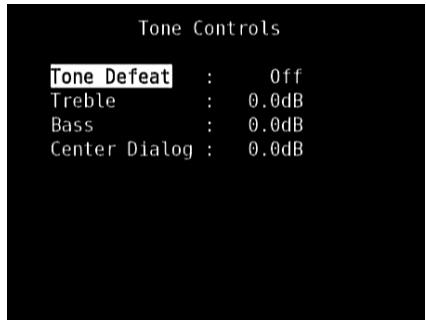
The M15 HD has three Tone Control levels – Treble, Bass and Center Dialog. Bass and Treble controls only affect the low bass and high treble leaving the critical midrange frequencies free of coloration. The Center Dialog ('Dialog' in the VFD) control boosts the 'presence' of the midrange region improving intelligibility of speech.
These controls allow one to tweak on-the-fly, the frequency response of the source during playback. The control setting could be adjusted by navigating through the Tone Controls' OSD menu via a combination of ENTER and / keys. The same can be managed directly by pressing the front panel's 'TONE CONTROLS' button and then rotating the Volume knob to select desired setting.
Maximum and minimum values for all three Tone Control levels are +/- 10 dB.
'Tone Defeat' gives one the choice of varying or completely bypassing the tone control section of the M15 HD. If 'Off' ('Tone Active' in the VFD) is selected, the Tone Control circuits are active.
Select 'On' ('Tone Defeat' in the VFD) to bypass the Tone Controls effectively defeating the effect of the tone control circuits.
NOTE
Tone Control options can be directly selected or changed using HTRM's TONE button with DEVICE SELECTOR set to AMP mode. Toggle TONE button to select "Treble", "Bass" or "Dialog" and then use the [ / ] to adjust their respective levels. Press TONE again to save the settings and at the same time move on to the next parameter or exit the parameter setting altogether.
PICTURE CONTROLS
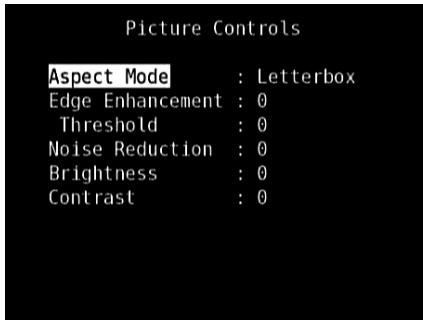
Picture Controls allow video adjustments of the source material or source components to suit one's preference. Set the following levels or settings according to desired level of preference.
ASPECT MODE
The Aspect Mode allows one the choice of adjusting the video output configuration of the M15 HD.
Letterbox: Original aspect ratio is maintained, preserving the original image's proportions. The unused areas of the screen are left blank.
Zoom: Video display zooms in to the image or scene, cutting off portions that do not fit. Any unused areas of the screen are left blank (i.e., black band).
Stretch: Image or scene is stretched sideways. Any unused areas of the screen are left blank (i.e., black band).
IMPORTANT NOTICE
There is no visible or discernable change in the video display for any of the above three aspect modes if the "Aspect Ratio" of both the source component and the M15 HD's Video Setup settings (see discussion about "Aspect Ratio" under "Video Setup" menu at "Setup Menu") are exactly the same.
EDGE ENHANCEMENT
Fine details of an image's hard edges are enhanced without adding ringing or halos. Select the level upon which the detected area will be enhanced.
Threshold: Adjusts the sensitivity of the edge detection mechanism. A lower threshold results in more subtle boundaries of color being identified as edges. A threshold that is too low may result in some small parts of surface textures, film grain or noise being incorrectly identified as being an edge.
NOISE REDUCTION
This setting addresses video distortion like video noise and blocking artifacts.
Adjust bright areas (white level) of the video display.
BRIGHTNESS
Adjust overall brightness of the video display.
NOTE
Picture controls options can also be directly recalled and adjusted by pressing the numerical "0" key of the HTRM with DEVICE SELECTOR set to AMP. Use the [ I] keys to select through the settings of a particular option or adjust the levels.
ZONE CONTROLS
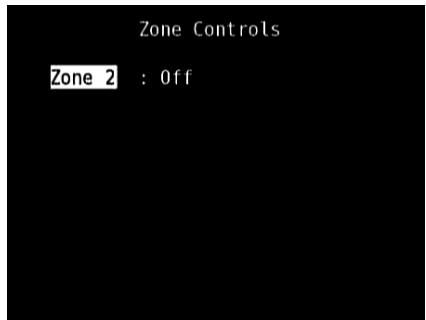
Depending on the settings made at the separate 'Zone Setup' menu under the 'Setup Menu' section discussion, the applicable Zone can be configured and managed via this 'Zone Controls' window.
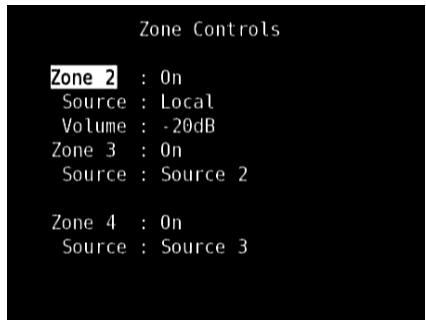
Select 'On' to activate the applicable Zone. When activated, the Source input for the particular Zone can be allocated by selecting through the following inputs - All enabled Sources and Local.
With Zone 2, Zone 3 or Zone 4 set to "On", Zone 2, Zone 3 or Zone 4 and their associated sources will always be enabled regardless of the main Zone's activity.
Select 'Local' as your selected Zone's Source input if you wish to enjoy the same source as the main Zone and allow simultaneous listening, but with full separate volume levels (Zone 2 only).
If a Zone is set to 'Off', it is deactivated or powered off.
'Volume' refers to the adjustable secondary Zone 2 Volume level that can be increased or decreased using the buttons of the HTRM.
When a Zone is activated, a corresponding Zone number is illuminated at the VFD. Zone 2 is always available to be configured at 'Zone Controls' menu. For Zone 3 and Zone 4 to become available at the 'Zone Controls' window, their corresponding 'Mode' in the 'Zone Setup' menu under the 'Setup Menu' section should be set to 'Zone (Audio Only)'
NOTES
- The ZR 5 remote control will only control Zone 2 applications. Zone 3 and Zone 4 could be configured and managed at the appropriate Zone OSD menu using the corresponding keys on the HTRM remote control.
- "Zone 4" is audio only and not associated with any video input sources.
USING THE M15 HD - SETUP MENU
SETUP MENU
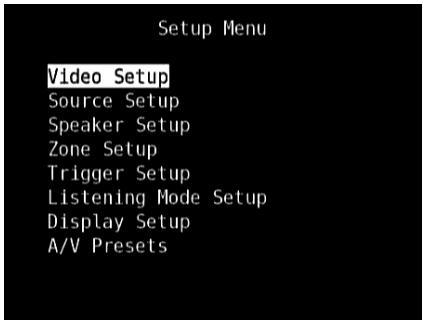
The Setup Menu allows one to customize the operation of the M15 HD to the ancillary equipment used in one's specific AV system. Unless your system exactly matches the factory defaults as shown in the accompanying Quick Start Guide, you will need to use the setup menu to configure the inputs of the M15 HD.
At Setup Menu, the following are configurable – Video Setup, Source Setup, Speaker Setup, Zone Setup, Trigger Setup, Listening Mode Setup, Display Setup and A/V Presets.
To access and navigate through Setup Menu and its sub-menu selections, please refer to and follow the directions stated in the sections 'Display the OSD' and 'Navigating the OSD and Making Changes.'
VIDEO SETUP
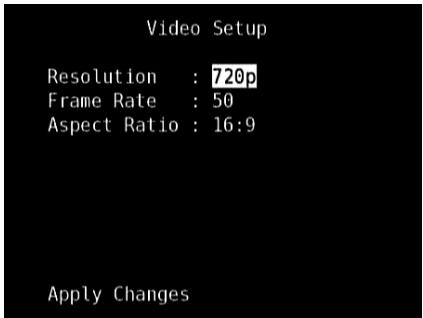
This menu allows you to set the display resolution of the M15 HD along with corresponding frame rate and aspect ratio.
Resolution: The M15 HD has the excellent ability to upconvert standard definition video contents to high definition video signal. Depending upon your TV/Monitor's resolution capabilities, select the applicable resolution settings - Auto, 480i, 480p, 576i, 576p, 720p, 1080i and 1080p.When "Auto" is selected, the M15 HD automatically selects the connected TV/Monitor's highest compatible resolution.
Note that if the display is connected to Composite or S-Video Monitor OUT, the video output resolution must be set to 480i or 576i to view content.
Frame Rate: The frame rate is the number of times per second that a screen image is refreshed. Depending upon your area and video resolution capability of your TV/Monitor, the following "Frame Rate" options are available (Note that frame rate is output resolution dependent; not all frame rate settings are selectable for the various resolution levels).
50Hz: Setting normally for Europe and most of Asia. For resolution settings 576i and 576p, 50Hz is the only available option.
60Hz: Setting normally for North America. For resolution settings 480i and 480p, 60Hz is the only available option.
24Hz: Select to deliver film-like motion characteristics. "24Hz" is selectable only at 1080p resolution setting.
Aspect Ratio: Select a picture size matching the aspect ratio of your TV/Monitor.
4:3: Select "4:3" when a standard 4:3 TV is connected. "4:3" is not selectable when the resolution is set to higher than 480i, 480p, 576i or 576p.
16:9: Select "16:9" when a 16:9 wide TV is connected. "16:9" is the only available option when the resolution is set to 720p, 1080i or 1080p.
After making changes in "Resolution", "Frame Rate" or "Aspect Ratio", scroll down to "Apply Changes" and press [▶] to implement the settings. A new OSD prompt will appear as below
Press the [▶] to apply the new resolution or [▲] to return to the current resolution. If [▶] is selected, you will be prompted again to another OSD prompt as below
Press [▶] to save the new resolution or [▲] to cancel the change in resolution. If you do not press either [▶] or [▲] and let the timer elapse, the new resolution will not be implemented and the current resolution setting remains.
IMPORTANT NOTE
If you inadvertently selected a resolution setting (like 1080p) that your TV/Monitor does not support, the video display will go blank. To restore video display, press and hold both front panel buttons LISTENING MODE and TONE DEFEAT and then release both buttons - the VFD and OSD will both show "Video Reset". Both the "Picture Controls" and "Video Setup" settings will be restored to their factory defaults after Video Reset.
NOTES
- When using component video output, a standard definition video can be upscaled only up to 1080i.
- When the "Resolution" is set to "Auto", "Frame Rate" and "Aspect Ratio" will not be available as options.
SOURCE SETUP
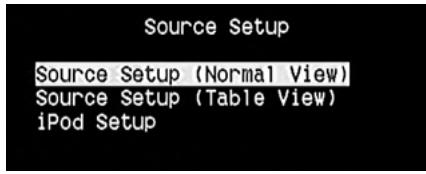
From Setup Menu, pressing will direct you to the Source Setup menu wherein you could adjust, allocate or change the settings of the following - Source Setup (Normal View), Source Setup (Table View) and iPod Setup.
SOURCE SETUP (NORMAL VIEW)
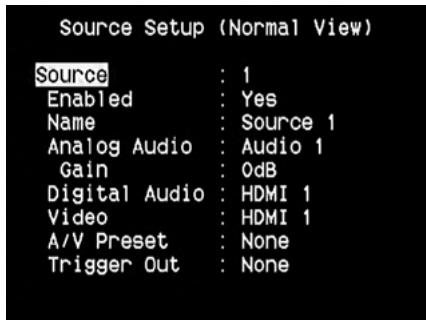
The Source Setup (Normal View) menu makes it possible to set, allocate or change the following settings.
SOURCE
The M15 HD is equipped with nine configurable Sources. The settings for each Source are dependent on the configurations set forth in the parameters for that particular Source window.
To change or toggle through the Sources, scroll to 'Source', press▶ button and then ENTER or / to move up or down the Source selections.
NOTE
Source 4 is defaulted to iPod. For Source 4 to be changed and allocated for other inputs, go to 'iPod Setup' menu under the 'Source Setup' menu. At iPod Setup menu, set 'Enabled' to 'No' – you can now assign Source 4 to other inputs or settings as desired.
ENABLED
One can enable/disable a Source via this option. This is particularly useful if only few Sources are used and one directly selects the Source from the front panel, bypassing unused sources.
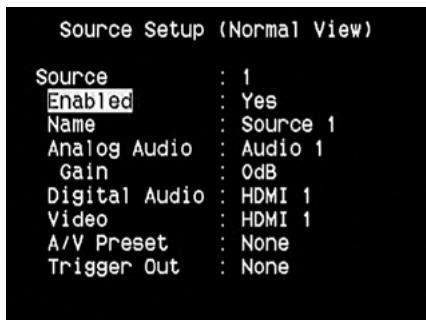
To enable or disable a particular Source, scroll to 'Enabled' and press / keys to select 'Yes' or 'No'.
NAME
A new Name maybe assigned to a Source label. For example, if your DVD player is attached to 'Source 1', it is possible to rename 'Source 1' to 'DVD Player.'
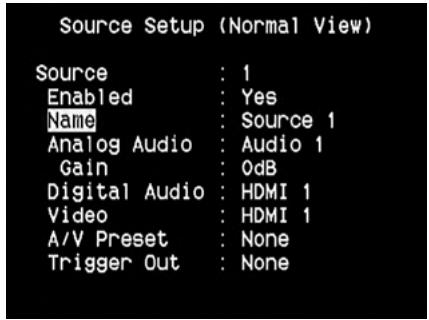
In order to rename the Source label, scroll to 'Name' and press to go the character. Then, press / to pick through the alphanumeric selections.
Press to move to the next character and at the same time save the changes done on the current character. The name can be as long as twelve characters.
The new Name will be shown in the VFD as well as on the OSD.
ANALOG AUDIO
The M15 HD has eight analog audio inputs including 7.1 input. These analog inputs - Audio 1 - 7 and 7.1 Input can be variably assigned to each Source.
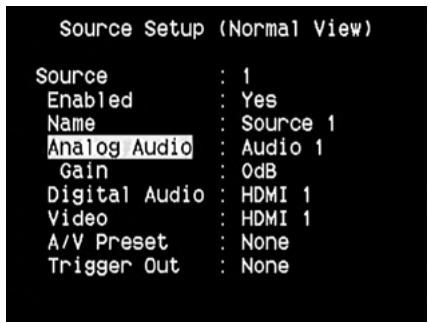
Scroll to 'Analog Audio' and then press and then / to select and assign an analog audio input to the particular Source. There are three choices - Audio, 7.1 Input or Off.
When 'Audio' is chosen, press and then / keys to select and assign the desired audio input - 1 to 7.
Select '7.1 Input' to choose the audio signal fed to '7.1 Channel Input.'If 'Off' is selected, no incoming analog audio signal is selected by the particular Source.
NOTE
An incoming digital signal present at the assigned digital input will always take precedence over the assigned analog audio input, even if both are present. To maintain the analog audio input for the particular Source, select 'Off' at the 'Digital Audio' setting of the same 'Source' menu.
USING THE M15 HD - SETUP MENU
GAIN
Gain adjustment allows all sources to play back at the same volume so you don't need to adjust the volume every time a new source is selected. It is generally preferable to reduce the level of the loudest source rather than making louder the softer sources.
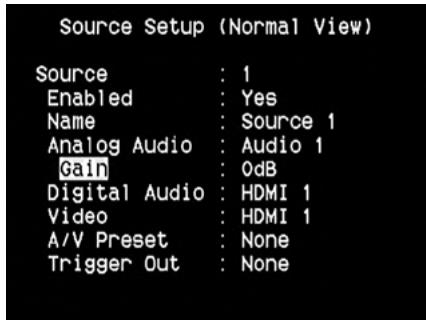
Scroll to 'Gain', press and then / to step through the desired level from -12dB to 12dB.
DIGITAL AUDIO
To take advantage of the M15 HD's high performance surround and digital audio circuitry, it is advisable that its Digital Audio inputs are selected.
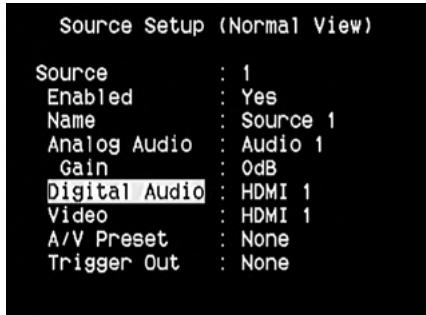
There are three types of Digital Audio input for the M15 HD. These are HDMI, Optical and Coaxial digital inputs. A fourth option is 'Off' whereby no incoming digital audio signal is selected by the particular Source.
The desired digital audio input for a particular Source can be selected by scrolling to 'Digital Audio', press and then / to step through the desired digital input source. After finalizing the desired type of Digital Audio input, press and then / again to select the specific Digital Audio input.
There are twelve Digital Audio inputs selectable for the M15 HD. They are the following
HDMI HDMI 1, HDMI 2, HDMI 3, HDMI 4
Optical Optical 1, Optical 2, Optical 3, Optical 4
Coaxial Coaxial 1, Coaxial 2, Coaxial 3, Coaxial 4
NOTE
An incoming digital signal present at the assigned digital input will always take precedence over the assigned analog audio input, even if both are present. To maintain the analog audio input for the particular Source, select 'Off' at the 'Digital Audio' setting of the same 'Source' menu.
VIDEO
There are four types of video input a particular Source could be assigned. These are HDMI, Component, S-Video and Video inputs. A fifth option is 'Off' wherein the particular Source is prompted not to select any Video input.
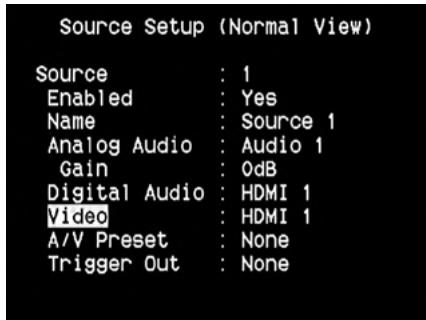
Navigate through the Video input selections by pressing and then / to step through the selections. The following are the assignable Video inputs
HDMI HDMI 1, HDMI 2, HDMI 3, HDMI 4
Component Video Component 1, Component 2, Component 3
S-Video S-Video 1, S-Video 2, S-Video 3, S-Video 4
Video Video 1, Video 2, Video 3, Video 4
VIDEO FORMAT CONVERSION
The M15 HD is equipped with a Video Format Converter. This allows for a simplified video connection between the M15 HD and your TV Monitor when using multiple video formats such as Composite (CVBS), S-Video, and Component (YUV). This format change is accomplished by encoding the analog video signal into a digital signal using a very high quality digital encoder to maintain the best possible picture quality.
Once in digital format, the video input signal could also be available at the other Monitor output jacks including HDMI MONITOR OUT. Thus, you do not have to necessarily assign the video output of a composite video input signal to MONITOR OUT (Composite video). The composite video input signal can be viewed also at HDMI MONITOR OUT at a resolution setting dependent upon your TV/Monitor's resolution capability. Some TV/Monitors will automatically display the video signal at 480p/576p if they are not capable of displaying 480i/576i.
If your TV/Monitor does not have HDMI input, select the highest quality video format available on your TV/Monitor and utilize this as M15 HD's preferred Monitor OUT. In most cases, this will be Component Video, but on some older TVs, S-Video maybe the best quality connection.
Refer also to the item above about "VIDEO SETUP".
A/V PRESET
A particular Source can be assigned a stored Preset. The parameters set up in the selected Preset number will be adopted into the particular Source it is assigned (Please refer to the separate section on 'A/V Presets' for further understanding of Preset settings).
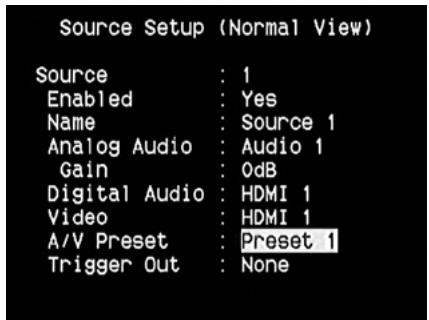
Scrolling to 'A/V Preset' and by pressing and then / keys, a Source could be assigned a Preset number ranging from Preset 1 to 5.
If it is desired not to assign the particular Source a Preset setting, select 'None'.
TRIGGEROUT
The Trigger Out for a particular Source is dependent on the configurations done in a separate menu on Trigger Setup (See 'Trigger Setup'below). If all three available Trigger outputs are assigned to 'Source Setup'in the separate 'Trigger Setup'window, a particular Source can have the following Trigger Out combinations
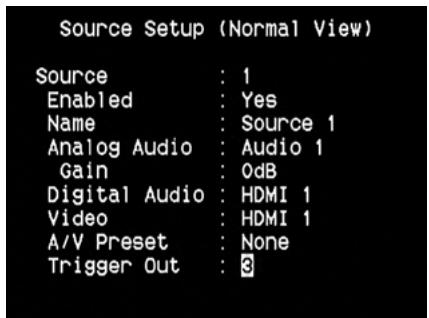
Trigger Out 1 2 1 + 2 3 1 + 3 2 + 3 1 + 2 + 3
These combinations are dependent on the assignment of 'Source Setup' for 'Trigger 1 Out, Trigger 2 Out or Trigger 3 Out' at the Trigger Setup menu. Another option is 'None' whereby the particular Source is not assigned any Trigger Out.
For 'Trigger Out' to become enabled and assignable at 'Source Setup (Normal View)' menu, make sure to carry out or note the following beforehand
- In the separate 'Trigger Setup' menu, assign 'Trigger 1 Out, Trigger 2 Out or Trigger 3 Out' to 'Source Setup'.
- 'Trigger Out' will not appear as an option at the Source Setup (Normal View) menu if at the separate 'Trigger Setup' menu, 'Trigger 1 Out, Trigger 2 Out or Trigger 3 Out' are all assigned to 'Main, Zone 2, Zone 3, Zone 4, Zone 2+3+4, Main + Zone 2, Main + Zone 3, Main + Zone 4 or Main + Zone 234'; with not even one 'Trigger Out' port allocated to 'Source Setup'.
SOURCE SETUP (TABLE VIEW)
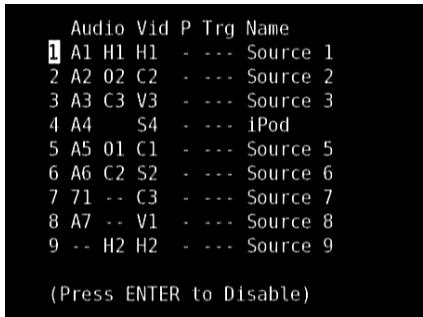
The Source Setup (Table View) reflects the settings made in the Source Setup (Normal View) menu. All the Source settings are summarized and displayed in tabulated form in the Source Setup (Table View).
Navigating through the Source Setup (Table View) via a combination of and then / keys, one will have the benefit of directly changing the settings for 'Audio, Video, Preset, Trigger and Source Name' without going back to the Source Setup (Normal View) menu.
iPod SETUP
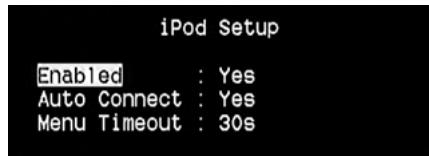
The iPod Setup menu allows you to preset the following associated settings when iPod is the selected source:
Enabled: Select 'Yes' to enable iPod as a Source or 'No' to disable it.
Auto Connect: Select 'Yes' to automatically enable and connect the iPod player docked in the linked NAD iPod docking station when Source 4 (the default iPod source allocation in the M15 HD) is selected. Select 'No' if you do not want for the iPod connection automatically connected.
Menu Timeout: Set the time for the OSD to revert to the 'Now Playing' display when the iPod menu has been left idle (no scrolling or navigation being done) for the specified time out time. For the 'Now Playing' OSD to be shown, there should be a song paused or being played before going to the iPod menu. You can set the 'Menu Timeout' between the range 5s to 60s at 5s increments. If you do not want for the menu to timeout, select 'Off'.
USING THE M15 HD - SETUP MENU
SPEAKER SETUP
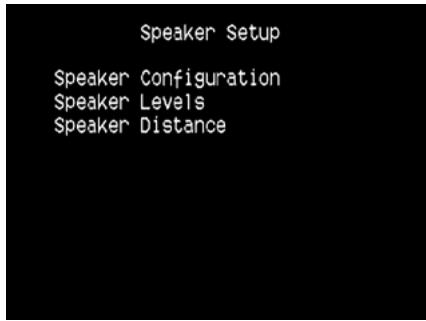
After connecting all ancillary sources and other combinations, the Speaker Setup menu will guide you on how to manage and setup your speakers in order to achieve optimum sound acoustics in your listening environment.
The following are the Speaker Setup Menu sections.
IMPORTANTNOTICES
- M15 HD is Audyssey Installer-Ready and thus has the capability to deliver the highest quality sound possible with MultEQ Pro room equalization. To get your M15 HD installed with MultEQ Pro application, contact your NAD dealer or a registered Audyssey professional installer for more details.
- The M15 HD is an AV Surround Sound Preamplifier and therefore has no speakers. The mention of "Speaker(s)" in this manual refers to the speakers of your external amplifier as interfaced with the M15 HD.
Every surround-sound system requires "bass-management" to direct low-frequency content from any or all channels to the speakers best able to reproduce it. For this function to operate correctly, it is important that you correctly identify your speakers' capabilities. We use the terms "Small" and "Large" (and "Off") but note that physical size may be irrelevant.
- A "Small" speaker is any model, regardless of physical size, that lacks significant deep-bass response, that is, below about 200Hz .
- A "Large" speaker is any full-range model; that is, one with deep-bass response
- An "Off" speaker is one that is not present in your system. For example, you might not have any surround-back speakers installed; in that case, you would set the 'Surround' setup item to "Off".
Depending on the relationship between speakers, the possible selections for each speaker are as follows:
| Front L/R | Center | Surround L/R | Back | Subwoofer 1/2 |
| LARGE | LARGE | LARGE | LARGE | ON or OFF |
| SMALL | ||||
| OFF | ||||
| SMALL | LARGE | |||
| SMALL | ||||
| OFF | ||||
| OFF | OFF | |||
| SMALL | LARGE | LARGE | ||
| SMALL | ||||
| OFF | ||||
| SMALL | LARGE | |||
| SMALL | ||||
| OFF | ||||
| OFF | OFF | |||
| OFF | LARGE | LARGE | ||
| SMALL | ||||
| OFF | ||||
| SMALL | LARGE | |||
| SMALL | ||||
| OFF | ||||
| OFF | OFF | |||
| SMALL | SMALL | SMALL | SMALL | ON |
| OFF | ||||
| OFF | OFF | |||
| OFF | SMALL | SMALL | ||
| OFF | ||||
| OFF | OFF |
The Speaker Configuration is "global"; that is, it remains in force with all inputs and in all listening modes. However, speaker settings are part of the M15 HD's Preset system. Consequently, multiple speaker settings can be stored for easy recall as different types of recordings or listening modes require.
Speaker Configuration can be managed and adjusted by pressing a combination of and then / keys. Set 'Front,"Center, and 'Surround' to "Large,""Small" or "Off" as your subsystem's speakers require.
The 'Back' speakers can either be one or two speakers. Set 'Back' to either 1 or 2 speakers as per availability. Set 'Subwoofer' to "On" or "Off," selecting "On" only if you have a subwoofer connected to the M15 HD's SUBW1 or SUBW2 output jack.
ENHANCED BASS
When the subwoofer is set to ON and "Front" is set to "Large", Enhanced Bass is also available. Normally, with speakers set to "Large" the subwoofer is not active. The Enhanced Bass option allows full range operation of the speakers with the additional bass contribution of the subwoofer. This feature is particularly useful when one wants to experience maximum bass output. Please note that due to acoustic cancellation effects, the bass response may be uneven when using this setting
You can set Subwoofer to "On" even with "Large" front speakers, in which case bass content from any channels set to "Small" will be routed to both the subwoofer and to the front speakers; LFE-channel signal will pass only to the sub. In most subwoofer-equipped systems, setting front speakers to "Small" is usually the better option.
All the speakers' low frequency content can be directly adjusted within the range 40Hz to 200Hz.
NOTE
The configurations set forth at 'Speaker Setup' are carried over whenever it is enabled during A/V Preset setting. Please see also the section 'AV Presets' for reference.
SPEAKER LEVELS
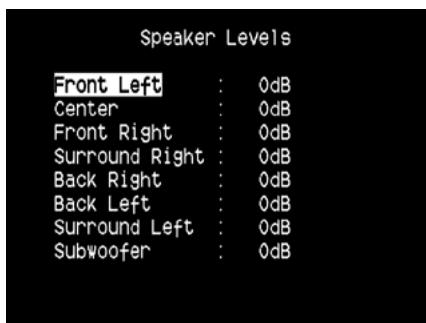
Adjusting the relative balance of your system's loudspeakers ensures that surround-sound recordings, whether music or film, will present the balance of effects, music, and dialog that the artists intended. Additionally, if your system incorporates a subwoofer it establishes a correct relationship between the volume of the subwoofer and the other speakers, and thus of low-frequencies (bass) to other sonic elements.
USING AN SPL METER
It is quite practical to perform the M15 HD level setup routines "by ear," and careful work will produce acceptably accurate results. However, the use of an inexpensive sound-pressure level (SPL) meter, such as Radio Shack part number 33-2050, makes this task easier, more accurate and more repeatable. Ownership of such a meter could prove a valuable audio tool.
The SPL meter should be placed at the primary listening position, at approximately the height of the seated listener's head. A tripod is helpful but with a little duct tape almost anything — a pole lamp, music-stand, or ladder-backed chair, for example — can do as well. Just be sure that no large acoustically reflective surfaces obstruct or are near the microphone element.
Orient the meter with its microphone (usually at one end) pointing straight up toward the ceiling (not toward the speakers) and ensure that "C" weighting scale is selected. Set the meter to display 75 dB SPL. On Radio Shack meters, this necessitates either setting the meter to its 80 dB range and taking your readings at the -5 point or selecting the 70 dB range and reading at the +5 point.
SETTING SPEAKER LEVELS AT TEST MODE
While at 'Speaker Levels' menu, press the HTRM remote's 'Test' key activating the M15 HD's Speaker Levels balancing test signal. You will hear a "surf" sound as you step through your speakers ('test' appears to the right side of the current speaker), beginning with the Front Left. If you do not hear the test signal, check your speaker connections or your 'Speaker Setup' OSD menu settings.
Use the remote's / keys to adjust the loudness of the noise output from the currently playing channel to the required level (it's usually simplest to begin with the Front Left). As you cycle the test signal around the speakers, the OSD will highlight the currently playing channel. The "level offset" reading on the right will change by 1 dB increments; ± 12 dB adjustment is available. Press 'ENTER' to adjust the next speaker.
NOTE
If you are balancing levels "by ear", choose one speaker—usually the center—as a reference and adjust each of the others in turn to "sound as loud" as the reference. Be sure that you remain in the primary listening position while balancing all channels.
To produce the same SPL meter reading (or subjective loudness), use the remote's
/ keys to adjust each speaker.
NOTES
All speakers must be in their final locations before level-setting.
- Your subwoofer (if any) should be set with its integral crossover defeated, or if undefeatable, set to its highest-possible frequency if you are using the M15 HD's Subwoofer output. Final subwoofer-level adjustment "byear," using music and film sound material, is frequently useful.
- Due to the effects of room acoustics, matched-pair speakers (front; surround; back) will not always calibrate to exactly the same level offset readings.
You can exit 'Test' mode at any time by pressing key, bringing you back to 'Speaker Setup' menu. You can also press the 'TEST' key to discontinue the 'Test' mode.
USING THE M15 HD - SETUP MENU
SPEAKER DISTANCE
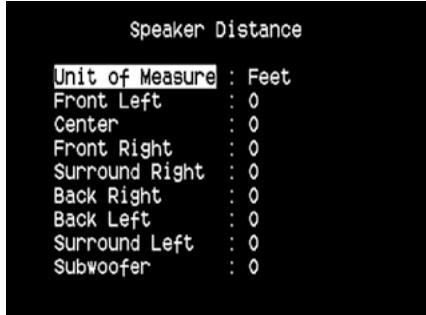
Your system's speaker distance settings are a subtle but important refinement of your setup. Informing the M15 HD of the loudspeaker-to-listener dimensions of each speaker automatically imposes the correct delays, optimizing imaging, intelligibility and surround-sound ambience. Enter your dimensions with precision within about 1 foot (30 cm).
SETTING SPEAKER DISTANCE
While at 'Speaker Distance' menu, use the / keys to individually set Front Left, Center, Front Right, Surround Right, Back Right, Back Left, Surround Left and Subwoofer to the distance measuring from your principal listening position to the front surface of their corresponding loudspeakers. Distance can be set up to 30 feet or 9.1 meters Distance can be displayed as feet or meters selectable at the 'Unit of Measure' item.
ADJUSTING THE VOLUME
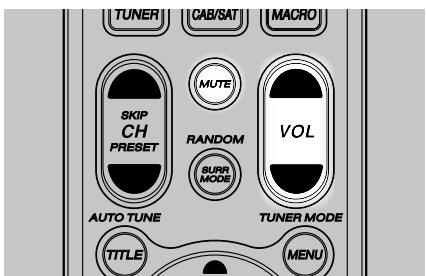
In addition to the Volume knob, use the HTRM's VOL / to adjust
"master volume" of the M15 HD raising or lowering the channels altogether. A momentary keypress will change the master volume by 1 dB increments. If you hold down VOL / , the master-volume change will "run-on" until the key is released.
Since recordings vary considerably in overall average level, there is no imperative to listen at any particular master-volume setting. A setting of -20 dB may sound "as loud" from one CD or DVD as -10 dB does from another.
The M15 HD will power-up from Standby mode at whatever master volume setting was last used; however, if the prior setting was greater than -20 dB, the M15 HD will power up at -20 dB. This prevents inadvertently beginning a session at excessive volume.
MUTING THE SOUND
Use the HTRM's 'Mute' key to silence all channels completely. Muting is always available regardless of the source or listening mode selections.
NOTES
- Changing input or listening-mode selections does not release muting.
- Adjusting the volume level via the HTRM or the front panel volume knob will automatically release the mute function.
ADJUSTING CHANNEL LEVELS 'ON THE FLY'
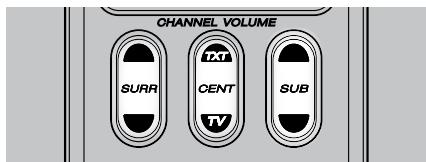
You can make changes to the relative levels of center, surround and subwoofer outputs without having to go into the 'Speaker Levels' menu. This is very convenient in circumstances like increasing (or tone down) a film's dialog level by raising (lowering) the center channel or reducing excessive deep bass (or enhance deep bass) by lowering (raising) the subwoofer level.
Use the HTRM's 'SURR','CENT' and 'SUB' keys for direct-access level adjustment of these channels over a range of ± 6 dB.
The surround back channels (if any) adjust in lockstep with the surround channels.
NOTE
Level settings adjusted 'On the Fly' are added or subtracted to the setup levels established at the M15 HD level-calibration routine as invoked by the HTRM 'Test' key. However, selecting any Preset will revert the channel levels to those stored in the preset. It will also take M15 HD off the levels set via Audyssey Auto Calibration.
ZONE SETUP
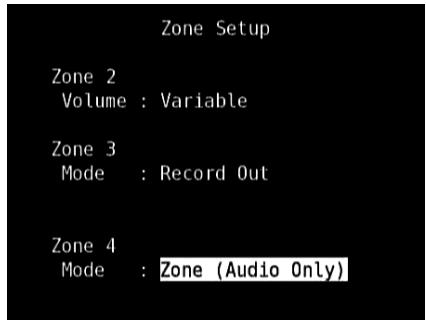
The Zone feature allows one to simultaneously experience in different zones of the house multiple sound and applicable video sources from all enabled Sources.
The M15 HD has three configurable Zones - Zone 2, Zone 3 and Zone 4. Use a combination of or ENTER and / keys to navigate through the Zone Setup menu parameters.
VOLUME
Zone 2 have Fixed and Variable volume control. When set to 'Variable' and while at the 'Zone Controls' menu OSD, the Zone 2 Volume level can be adjusted using the HTRM's / or directly via ZR 5's VOL / .
On the other hand, if Volume is set to 'Fixed', the Zone 2 Volume is set to a preset dB level and thereafter the Zone's volume can be varied via the volume control of the separate amplifier it is fed into.
MODE
Zone 3 and Zone 4 can be configured into two modes – Record Out and Zone (Audio Only). If the selected mode is Record Out, the audio and applicable video signal of the assigned Source are directly sent out to the applicable Audio/Video Output (See Item 2. AUDIO 3 OUT/VIDEO 3 OUT/S-VIDEO 3 OUT, AUDIO 4 OUT/VIDEO 4 OUT/SVIDEO 4 OUT of REAR PANEL discussion.) When Zone 3 or Zone 4 is set to 'Record Out' mode, they will not be available at the 'Zone Controls' section of the Main Menu window.
'Record Out' setting is ideal for making recordings with a VCR or other similar devices. This setting is also used for multi-zone installations using passive 'impedance matching' volume controls. See your NAD dealer for specific information about integrating your M15 HD into a multi-room audio distribution system.
If "Zone (Audio Only)" is the selected mode for Zone 3 and/or Zone 4, Zone 3 and/or Zone 4 will be enabled at the separate "Zone Controls" menu option at the Main Menu.
Refer also to the "ZONE CONTROLS" section of "OPERATION - USING THE M15 HD - MAIN MENU".
TRIGGER SETUP
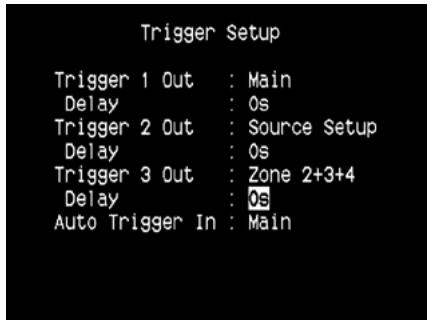
The M15 HD features three configurable +12V DC Trigger Output that can be used to activate a component or system it is fed into. A Trigger Input is also available to turn on the applicable link it is associated to. Use a combination of or ENTER and / keys to navigate through the Trigger Setup menu parameters.
TRIGGER OUT
Triggers are low voltage signals used to turn on/off other compliant devices. The M15 HD's three +12V DC Trigger Outputs (Trigger 1 Out, Trigger 2 Out and Trigger 3 Out) are dependent on which mode they are associated with. There are six choices where +12V DC output can be assigned and these are - Main, Zone 2, Zone 3, Zone 4, Zone 2+3+4 and Source Setup.
Main: +12V DC is available at the assigned Trigger Out when the M15 HD is at powered state.
Zone 2, Zone 3, Zone 4, Zone 2 + 3 + 4 : When the applicable Zone is at powered state, +12V DC is available at the assigned Trigger Out.
Source Setup: If Trigger Output is linked to 'Source Setup', +12V DC is available at Trigger Out whenever the particularly assigned Source is selected. Please see also separate discussion about 'Trigger Out' under the Source Setup (Normal) section.
DELAY
The availability of +12V DC at Trigger Out can be regulated. If it is desired that +12V DC is available without delay the moment Trigger Out is linked to its assigned setting, set Delay to 0s. Otherwise, one can select through a delay time of 1s to 15s.
AUTO TRIGGER IN
Auto Trigger IN allows external system controllers to toggle the associated section of the M15 HD from 'Standby' to 'On' and vice versa. When the TRIGGER switch at the rear panel is set to AUTO, a +12V DC input at Trigger IN will power ON the section where Trigger IN is assigned,
Main: From standby mode, the M15 HD is powered ON when +12V DC is applied at Trigger IN.
Zone 2, Zone 3, Zone 4: Applicable Zone is turned ON whenever +12V DC is present at Trigger IN.
All: Main, Zone 2, Zone 3 and Zone 4 as described above will all be activated given a +12V DC input at Trigger IN.
WARNING
If Auto Trigger IN at Trigger Setup menu is assigned to 'Main' or 'All' and the TRIGGER switch is set to 'AUTO' mode, the Standby button in the front panel as well as the corresponding ON/OFF function keys in the HTRM remote control will be disabled effectively handing this function to an external controller. Switch TRIGGER to 'OFF' to maintain normal power ON/OFF function procedures.
See also item "8. +12 V TRIGGER (OFF/AUTO), TRIGGER OUT, TRIGGER IN" of REAR PANEL discussion as well as the "Trigger Out" discussion under "Source Setup (Normal View)".
USING THE M15 HD - SETUP MENU
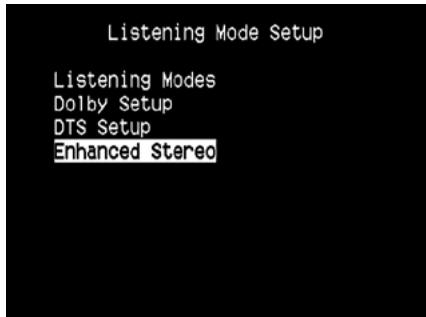
LISTENING MODE SETUP
The M15 HD has various listening mode options and is mostly configurable. These are provided to reproduce a variety of sound effects depending upon the content of the source to be played. Use a combination of or ENTER and keys to configure the following settings.
LISTENING MODES
The audio format as detected by the selected Source can be automatically configured and processed through the following options:
DOLBY
Dolby Digital is the multi-channel digital signal format developed in the Dolby laboratories. Discs bearing the Dolby Digital (double-D symbol) logo were recorded with up to 5.1 channels of digital signals, reproducing a much better sound quality, with dynamic and spatial sound sensations that are much better than in the previous Dolby Surround.
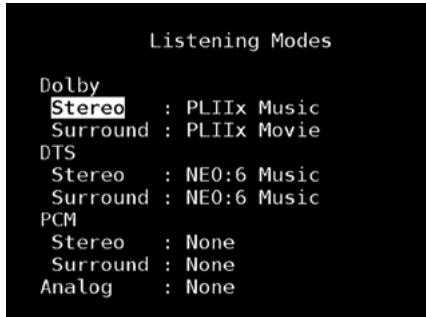
A Dolby Digital audio input can be configured relative to its format as follows
Stereo: If the detected audio is of Dolby stereo format, you can default it to one of the following settings – Pro Logic, PLIIx Movie, PLIIx Music or None.
Surround: If the detected audio is of Dolby Surround format, you can default it to one of the following settings -Surround EX, PLIIx Movie, and PLIIx Music, Stereo Downmix or None.
None: If 'None' is selected, the Dolby Digital signal will be defaulted to the 'Stereo' or 'Surround' settings set forth at the 'PCM' option. See discussion below about 'PCM'.
DOLBY DIGITAL PLUS
Dolby Digital Plus is the next-generation audio technology for all high-definition programming and media. It combines the efficiency to meet future broadcast demands with the power and flexibility to realize the full audio potential expected in the upcoming high-definition era.
Dolby Digital Plus delivers multi-channel audio programs of up to 7.1 channels and supports multiple programs in a single encoded bitstream with the maximum bit rate potential of up to 6 Mbps and the maximum bit rate performance of up to 3 Mbps on HD DVD and 1.7 Mbps on Blu-ray Disc. It outputs Dolby Digital bitstreams for playback on existing Dolby Digital systems. Dolby Digital Plus can accurately reproduce the sound originally intended by directors and producers.
It also features multi-channel sound with discrete channel output, interactive mixing and streaming capability in advanced systems.
Supported by High-Definition Media Interface (HDMI), a single-cable digital connection is possible for high-definition audio and video.
DOLBY TrueHD
Dolby TrueHD is a lossless encoding technology developed for high-definition optical discs in the upcoming era. Dolby TrueHD delivers tantalizing sound that is bit-for-bit identical to the studio master, unlocking the true high-definition entertainment experience on high-definition optical discs in the next generation. When coupled with high-definition video, Dolby TrueHD offers an unprecedented home theater experience with stunning sound and high-definition picture.
It supports bit rates of up to 18 Mbps and records up to 8 full-range channels individually with 24-bit/96 kHz audio. It also features extensive metadata including dialogue normalization and dynamic range control. Supported by High-Definition Media Interface (HDMI), a single-cable digital connection is possible for high-definition audio and video. HD DVD and Blu-ray Disc standards currently limit their maximum number of audio channels to eight, whereas Dolby Digital Plus and Dolby TrueHD support more than eight audio channels. Note that the M15 HD only supports 7.1 channel.
DOLBY DIGITAL EX
Using a Matrix decoder, this method creates the back channel (sometimes also called the "surround center") by means of signals on the left and right surround channels recorded in Dolby Digital 5.1, reproduction being provided in Surround 6.1. This method should be selected with sources bearing the "Dolby Digital (double-D symbol)-EX" symbol, recorded in Dolby Digital Surround EX.
With this additional channel you will experience improved dynamics and a better sensation of movement within the sound field. If media sources recorded in Dolby Digital EX are decoded with a Digital EX decoder, the format is detected automatically, and the Dolby Digital EX mode is selected. However, some media sources recorded in Dolby Digital EX can be detected as simple Dolby Digital media sources. In this case Dolby Digital EX should be selected manually.
NOTE
Please refer to the section 'Listening Mode' at the Main Menu discussions for a description of Pro Logic, PLIIx Movie, PLIIx Music and Stereo Downmix modes.
DTS
The Digital Theater System Digital Surround (simply called DTS) is a multi-channel digital signal format that can process higher data rates than with Dolby Digital. Although both Dolby Digital and DTS are 5.1 channel media formats, discs bearing the "DTS" symbol are thought to provide better sound quality due to the lower audio compression required. It also offers a broader dynamic, producing magnificent sound quality.
A DTS audio input can be configured relative to its format as follows
Stereo: If the detected audio is of DTS format, you can default it to one of the following settings – NEO:6 Cinema, NEO:6 Music or None.
Surround: If the detected audio is of DTS Surround format, you can default it to one of the following settings – NEO:6 Cinema, NEO:6 Music, Stereo Downmix or None.
None: If 'None' is selected, the DTS signal will be defaulted to the 'Stereo' or 'Surround' settings set forth at the 'PCM' option. See discussion below about 'PCM'.
NOTE
Please refer to the section 'Listening Mode' at the Main Menu discussions for a description of Stereo Downmix and DTS Neo:6 surround modes.
PCM
PCM (Pulse Code Modulation) is the digital representation of a standard audio signal converted with little or no compression. If 'None' is selected for any of the Dolby or DTS settings, this 'PCM' section will default the audio signal as follows
Stereo: The detected stereo audio format will be configured into one of the following options - Pro Logic, PLIIx Movie, PLIIx Music, NEO:6 Cinema, NEO:6 Music EARS, Enhanced Stereo or None.
Surround: The detected surround audio format will be configured into one of the following options -PLIIx Movie, PLIIx Music, NEO:6 Music, NEO:6 Cinema, Stereo Downmix or None.
ANALOG
If the audio input is an analog signal, the following are the surround modes the input can be defaulted - Pro Logic, PLIIx Movie, PLIIx Music, NEO: 6 Cinema, NEO: 6 Music, EARS, Enhanced Stereo, Analog Bypass and None.
NOTE
All these Listening Modes for 'Dolby Digital', DTS' 'PCM and 'Analog' can be directly changed by pressing the 'Listening Mode' button on the front panel or through the 'Listening Mode' option at the Main Menu window. The chosen audio format will be reflected back to the appropriate setting at the 'Listening Mode Setup.'
DOLBY SETUP
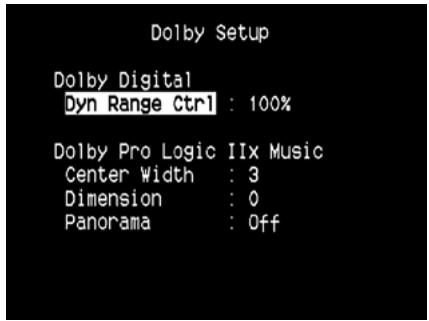
Under this menu, the Dolby Digital's Dynamic Range Control can be adjusted as well as the settings for Dolby Digital Pro Logic IIx Music.
Dyn Range Ctrl: You can select the effective dynamic range (subjective range from soft to loud) for playback of Dolby Digital soundtracks. For fully cinematic effect, always select 100% , the default. Settings of 75% , 50% , and 25% progressively reduce dynamic range, making soft sounds comparatively louder while limiting the peak loudness of loud ones.
The 25% setting will yield the least dynamic range and is best for late-night sessions or other times when you wish to retain maximum dialog intelligibility while minimizing overall volume levels.
Dolby Pro Logic IIx Music: Please refer to the same description of 'PLIIx Music' under the 'ADJUSTING LISTENING MODES' segment of the 'OPERATION - USING THE M15 HD - MAIN MENU'.
DTS SETUP
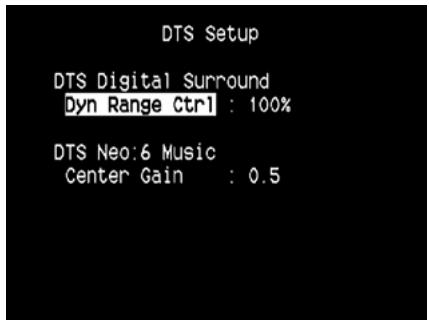
Under this menu, the Dynamic Range Control of DTS Digital Surround can be adjusted as well as the settings for DTS Neo: 6 Music.
Dyn Range Ctrl : This is the same configurable Dynamic Range Control feature as described above at Dolby Setup, the only difference being the soundtrack is now in DTS format.
DTS Neo: 6 Music : Please refer to the same description of 'NEO 6: Music' under the 'ADJUSTING LISTENING MODES' segment of the 'OPERATION - USING THE M15 HD - MAIN MENU'.
USING THE M15 HD - SETUP MENU
DTS SURROUND MODES
The following are further descriptions about the DTS surround modes.
DTS-HD MASTER AUDIO
DTS-HD Master Audio is a technology that delivers master audio sources recorded in a professional studio to listeners without any loss of data, preserving audio quality. DTS-HD Master Audio adopts variable data transfer rates, facilitating data transfer to the maximum rate of 24.5 Mbps in the Blu-ray disc format, 18.0 Mbps in the HD-DVD format, which by far exceeds that of a standard DVD. These high data transfer rates enable lossless transmission of 96 kHz/24-bit 7.1-channel audio sources without deteriorating the quality of the original sound. DTS-HD Master Audio is an irreplaceable technology that can reproduce sound faithfully as intended by the creator of music or movies.
DTS - ES EXTENDED SURROUND (DTS ES)
This is a new multi-channel digital format which greatly improves the 360^ spatial sensation of the Surround impression thanks to the greater space expansion of the surround signals, providing high compatibility with the conventional DTS format.
In addition to the 5.1 channels, the expanded DTS-ES Surround also offers the back surround (also sometimes called the "surround centre") in reproduction, providing a total of 6.1 channels. The expanded DTS-ES Surround includes two formats, with two different methods of surround signal recording, as follows:
DTS-ESTM DISCRETE 6.1
Since the signals of the 6.1 Surround channels (including the back channel) are completely independent, it is possible to achieve the sensation that the acoustic image is moving about freely among the background sounds, 360 degrees surrounding the listener.
Although maximum quality is achieved with sound tracks recorded using this system and reproduced using the DTS-ES decoder, when played with a conventional DTS decoder, the back surround channel is automatically downmixed in the surround right and surround left channels of the surround system, in such a way that none of the signal components are lost.
DTS-ESTM MATRIX 6.1
In this format, the additional signals of the back channel receive a matrix encoding and are inputted into the right and left surround channels. During reproduction they are decoded to the right, left and back surround channels.
Since this bit-stream format is 100% compatible with conventional DTS signals, the DTS-ES Matrix 6.1 format effect can also be achieved from sources with DTS-ES 5.1 signals.
Naturally, it is also possible to reproduce from a DTS 5.1 channel decoder, signals recorded in DTS-ES 6.1.
When a DTS-ES decoder processes a discrete DTS-ES 6.1 or in Matrix 6.1, these formats are automatically detected and the Optimum Surround mode is selected. However, some DTS-ES Matrix 6.1 sources may be detected as DTS. In this case the DTS-ES Matrix mode should be selected manually in order to reproduce them.
DTS NEO: 6^TM SURROUND
This mode applies the conventional 2-channel signals such as digital PCM or analog stereo signals to the high precision digital matrix decoder used for DTS-ES Matrix 6.1 to achieve 6.1-channel surround playback. DTS Neo: 6 surround includes two modes for selecting the optimum decoding of the signal sources:
DTS NEO: 6 CINEMA : This method is ideal for the reproduction of movies. The decoding takes place by emphasizing the separation in order to achieve the same atmosphere with 2-channel, as with 6.1-channel sources.
DTS NEO: 6 MUSIC: Mainly recommended for music reproduction. The right and left front channels do not pass through the decoder and are reproduced directly so there is no loss in sound quality, and the effects of the right surround, left surround, central and back surround channels add a natural sensation of expansion of the sound field.
ENHANCED STEREO
Please refer to the same description of 'ENHANCED STEREO' under the 'LISTENING MODES' segment of the 'OPERATION - USING THE M15 HD - MAIN MENU'.
DISPLAY SETUP
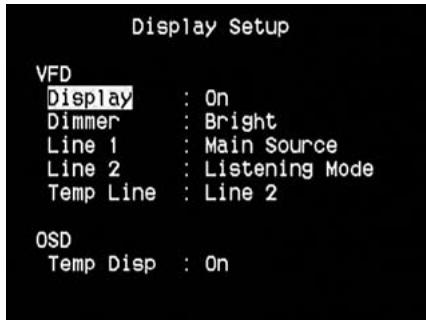
The Vacuum Fluorescent Display (VFD) and On-Screen Display (OSD) can be shown in various ways by navigating through the parameters at the 'Display Setup' menu. Use a combination of or ENTER and / keys to step through the 'Display Setup' menu items.
NOTE
The configurations set forth at 'Display Setup' are carried over whenever it is enabled during A/V Preset setting. Please see also the section below about 'AV Presets.'
Display: Select 'On'to display all applicable data or characters at the VFD. Nothing will be shown at VFD if 'Temp' is selected. At 'Temp' setting however, whenever any of the front panel controls or their corresponding keys in the remote control is activated, the appropriate VFD characters will be shown temporarily and then fade away. Note that if any of the Zones are at powered state, they will be continually shown at VFD even at 'Temp' setting.
Dimmer : If it is desired to reduce the brightness of the VFD, set Dimmer to 'Dim'. Otherwise, select 'Bright' to return to normal VFD brightness.
Line 1, Line 2: The VFD shows two main lines of data or characters. Line 2 is the line of data or characters located at the lower bottom of the VFD while directly above it is Line 1. For both lines, one can select which display could be shown by choosing through the following
Main Source : Shows the active Source.
Volume: Current Volume level is shown.
Listening Mode : Selected Listening Mode is shown.
Audio Src Format : Shows the active Source's detected audio format.
Audio Codec: Displays the detected audio stream format like Analog, PCM Surround, Dolby TrueHD, DTS-HD Master Audio and other formats.
Video Mode: Show the video resolution of the active input source. Details shown include the video resolution with frame rate. For a better understanding of these video details, consult with your NAD Audio Specialist or your distributor's technical department.
Zone 2-Zone 3-Zone 4 Source :The assigned Source for the applicable Zone is shown.
Off: Select 'Off' if it is desired not to show any data at the applicable Line.
Temp Line : Choose between Line 1 and Line 2 as the desired line where VFD will be temporarily shown if 'Temp' is selected at 'Display' option as described above.
ON-SCREEN DISPLAY (OSD)
Temp Disp: This applies to the OSD that is temporarily shown at video out whenever any of the front panel controls or their corresponding keys in the remote control is activated. Set to 'On' if it is desired to show the applicable OSD at the monitor/TV; otherwise, select 'Off'.
A/V PRESETS
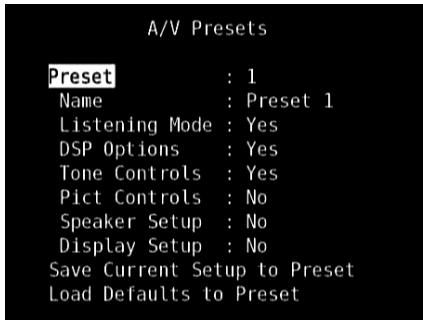
The M15 HD's simple but powerfully flexible system of 'Presets' allows you to customize virtually every aspect of your audio-video playback, and recall them with a single key-press. The parameters 'Listening Mode', 'DSP Options', 'Tone Controls' and 'Picture Controls' accessible via the 'Main Menu' together with 'Speaker Setup and Display Setup' configurable through 'Setup Menu' are stored together as a Single Preset.
You might create one Preset optimized for pop music and another for classical. One more Preset can be set up to recall each family member's favorite setting or one for fully cinematic home-theater playback and yet another one for late-night movies, with each Preset fine-tuned to a particular scenario or preference.
CREATING PRESETS
Creating a Preset consists simply of storing a complete set of the parameters set forth in the 'Listening Mode,"DSP Options, Tone Controls' and 'Picture Controls' accessible via the 'Main Menu' together with 'Speaker Setup and Display Setup' configurable through 'Setup Menu.' Scroll to 'A/V Presets' using the / keys to save a collection of said parameter settings to a Preset. Select a Preset number and by a combination of pressing the / keys, you can selectively include in the particular Preset any of the above-mentioned parameter settings by choosing 'Yes'. If you decide not to include in the particular Preset a certain parameter setting, select 'No'.
Now in order to save the settings chosen for the particular Preset number, scroll down to 'Save Current Setup to Preset' and press the key. If you chose to load instead the default settings, scroll down to 'Load Defaults to Preset' and press the key to restore the default settings.
In addition to the parameter settings, the Preset label itself can be assigned a new name. This new Name will be shown in the VFD as well as on the OSD.
To rename the Preset label, scroll to 'Name' and press to go the character.
Then, press / to pick and select through the alphanumeric selections.
Press to move to the next character or back to the previous character and at the same time save the changes done on the current character.
NOTE
The selected Preset remains in force until you select a different Preset.
USING THE M15 HD - SETUP MENU
SAMPLE PROCEDURE FOR SETTING UP A/V PRESETS
1 Setup first your preferred settings for the following options (access them through their respective menu page).
Listening Mode: Stereo
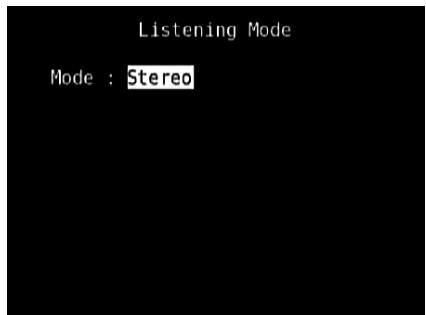
DSP Options: 5ms
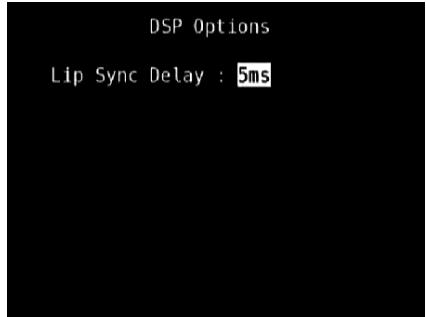
Tone Controls: Tone Defeat: On
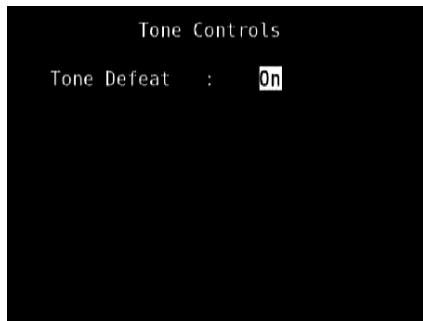
Display Setup: Set "Line 2" to "Listening Mode"
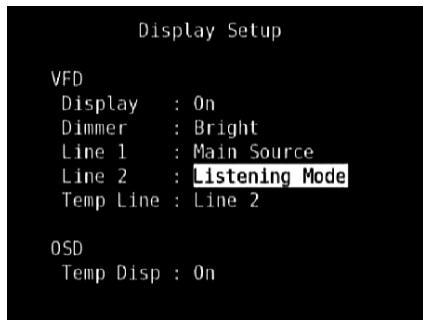
Picture Controls: Aspect Mode - Letterbox
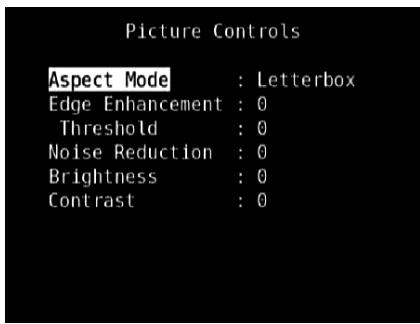
Speaker Setup: from the Speaker Setup menu, go to "Speaker Configuration" sub-menu and change "Subwoofer" from "On" to "Off": "Front" becomes "Large"
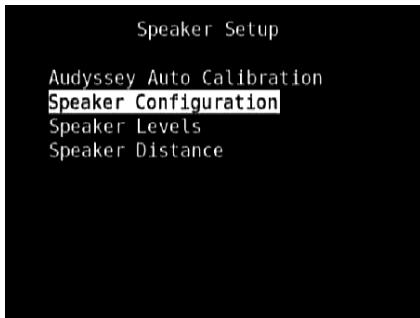
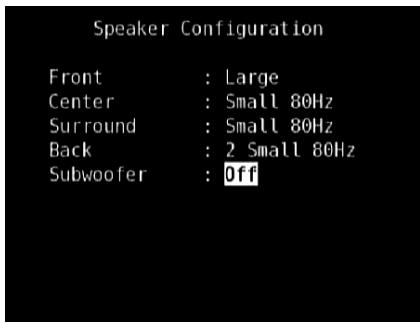
2 With the above settings, scroll to "A/V Presets" from the SETUP MENU page. Use [▶] to access "A/V Presets" menu.
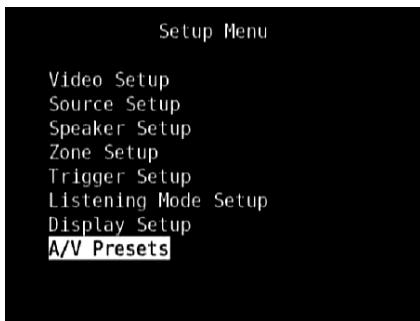
3 At "A/V Presets" page, set "Preset: 1" to the following conditions - use [/] to select "Yes" or "No" and press [ENTER] to confirm selection and move on to the next setting
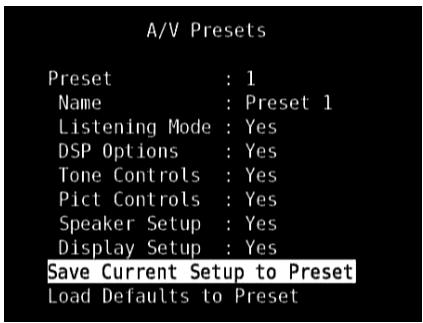
While at "Save Current Setup to Preset" menu line, use [▶] to save the above settings to Preset 1. Below OSD will be shown, affirming that the above settings are now saved to "Preset 1".
When you recall "Preset 1" using the remote control (for HTRM, "A/V PSET" + "1"), the above preset values allocated at "Preset 1" (preset settings as shown in the OSD captures at Step 1) will be recalled and effected at the current source.
4 Now, repeat again Step 1 above but this time with the following settings
Listening Mode: PLlX Music
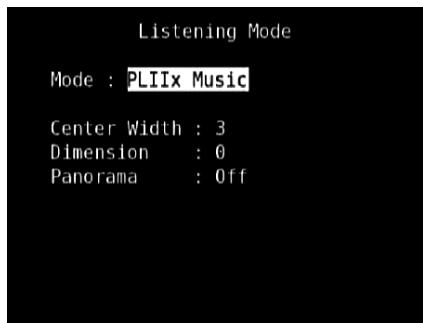
DSP Options: 0ms
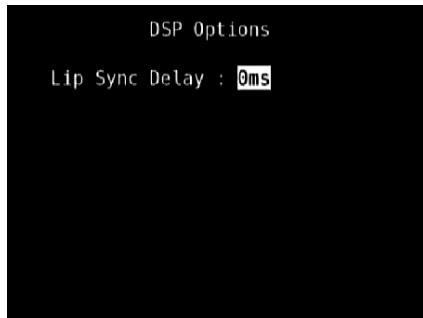
Tone Controls: Tone Defeat: Off
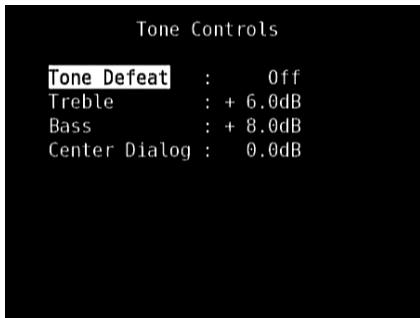
Display Setup: Set "Line 2" to "Volume"
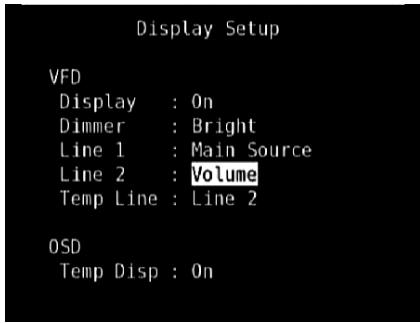
Picture Controls: Aspect Mode - Stretch
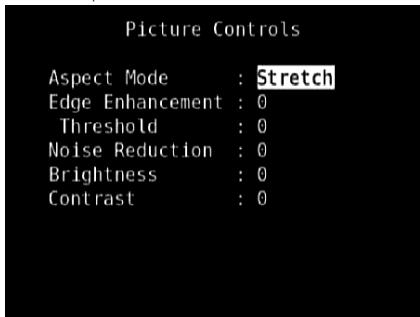
5 With the above settings, scroll to "A/V Presets" from the SETUP MENU page. Use [▶] to access "A/V Presets" menu.
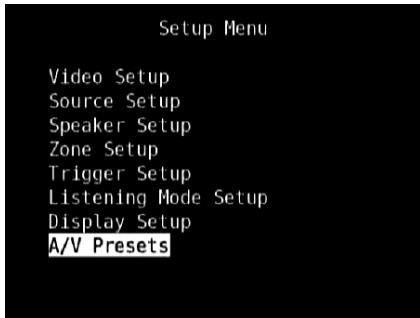
USING THE M15 HD - SETUP MENU
6 At "A/V Presets" page, set "Preset: 2" to the following conditions - use [/] to select "Yes" or "No" and press [ENTER] to confirm selection and move to the next setting
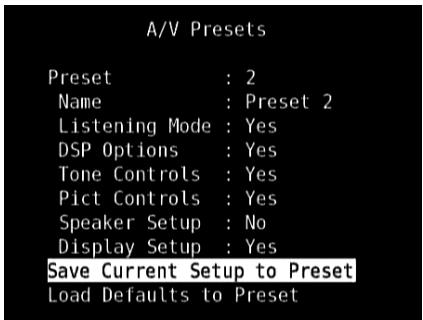
While at "Save Current Setup to Preset" menu line, use [ ] to save the settings above to "Preset 2". When you recall "Preset 2" using the remote control (for HTRM, "A/V PSET" + "2"), the above preset values allocated at "Preset 2" (preset settings as shown in the OSD captures at Step 4) will be recalled and effected at the current source.
Note that "Speaker Setup" is set to "No". At this condition, there will be no "Speaker Setup" values that will be effected at "Preset 2". The "Speaker Setup" settings that will be applied at "Preset 2" will be the last or current "Speaker Setup" settings which in this sample are the same "Speaker Setup" settings shown above in Step 1.
7 You can setup up to 5 Presets. These same Presets can also be associated/defaulted to each Source in the "Source Setup (Normal View)" window as below
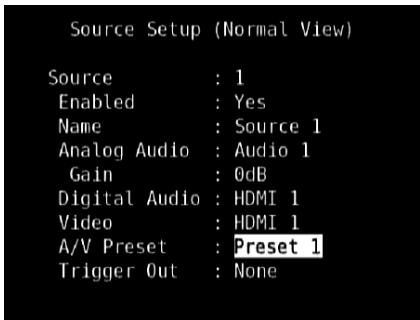
In the above example, "Preset 1" settings are allocated for Source 1. Whenever Source 1 is accessed, the "Preset 1" settings will be applied to Source 1. You can still manually override the assigned Preset allocation in a specific Source with another Preset setting/number by way of pressing the appropriate remote control buttons.
RECALLING PRESETS
You may recall a Preset at any time using the HTRM remote control. Press the HTRM's A/V PSET key and then the numeric key 1-5 corresponding to the desired preset number. The newly recalled Preset will then manifest or replace the previous Preset (if any).
The M15 HD is equipped with a data port in the rear panel where an optional "NAD IPD Dock for iPod" (NAD IPD) can be plugged in. With the NAD IPD linking the M15 HD with your own iPod player, you can enjoy listening to your favorite tracks and playlists as well as view applicable still image and video playback.
You can control your iPod player using the assigned buttons in the M15 HD front panel. And with the corresponding HTRM remote control function keys, you can select the materials stored in your iPod for playback as well as access many of its functions even from across the room. The optional NAD IPD also charges your iPod player while it is connected to the M15 HD.
NOTES
- "NAD IPD Dock for iPod" (NAD IPD) currently has two versions - the NAD IPD 1 and NAD IPD 2. These two NAD IPD models and later variants are compatible with the M15 HD.
- NAD IPD and iPod player are not supplied with your M15 HD.
- iPod player functions, features and playback capabilities accessible through M15 HD may vary depending on your iPod player model.
- When using the HTRM to control the iPod functions, make sure that the Device Selector is set to "AMP."
CONNECTING THE OPTIONAL NAD IPD AND iPod PLAYER TO THE M15 HD
Make sure that all the devices are unplugged before making the connections.
1 Connect the NAD IPD's DATA PORT to the corresponding "MP DOCK" data port of the M15 HD.
2 Connect also the NAD IPD's S-video out and audio out to the M15 HD Audio 4 / S-Video 4 input (the default iPod source allocation in the M15 HD). You can also connect both audio and video out connectors to any available assignable input of the M15 HD.
3 Dock your iPod player into the NAD IPD.
NAVIGATING THE iPod PLAYER'S FUNCTIONS AND FEATURES
After linking together your iPod player, NAD IPD and the M15 HD, you can now plug them IN to their applicable power sources.
1 With your M15 HD, iPod player and NAD IPD all at power ON state, select SOURCE 4 of your M15 HD. Your iPod player will show in its display the NAD logo and below it "OK to disconnect." On the other hand, the M15 HD VFD will show in the upper line "iPod Menu" and the lower line "Playlists". The lower line will vary depending on the current menu selected.
At the same time, the M15 HD OSD will display the whole iPod Menu selections like Playlists, Artists, Albums, Songs, Podcasts, Genres, Composers and Audiobooks.
2 Navigate through the iPod menu selections using a combination of the [ / / ] buttons.
NOTES
- The iPod player's click wheel and controls will not operate when it is properly connected to the M15 HD via the NAD docking station.
- To exit from the iPod Menu at Source 4, press [+] bringing you to 'Menu Select' OSD. Follow the instructions as shown.
CONTROL FEATURES AND SETTINGS
The following control functions and settings are selectable or enabled using the front panel and HTRM remote control buttons. Since the HTRM will be the primary controller in most cases, we will focus on remote-controlled operations.
Note that other NAD IPD models, like the NAD IPD 2, have their own remote controls. The controls below also apply to the corresponding buttons of the remote controls of such applicable NAD IPD models.
ENTER
Press [ENTER] to go "iPod Settings' menu where you can setup the following options:
Shuffle: Select [Shuffle] to enable random playback of either [Songs] or [Albums] lists. To turn off shuffle mode, select [Off].
Repeat: Select [One] for repeated playback of the current song. Select [All] for repeated playback of your entire list under [Songs] selection.
Audiobook Speed: The playback speed of your audiobook can be varied according to your preference. During audiobook playback, adjust the reading speed to [Normal], [Fast] or [Slow].
DISP
During playback, toggle [DISP] key of HTRM to show in the M15 HD VFD upper line the Song title, Artist Name and Album title. If there are no information available, the display will show "No Song," "No Artist" or "No Album" as applicable. Aside from these information, the lower line will display the current title's track number allocation and time elapsed.
The equivalent front panel key for [DISP] is [INFO].
/ NAVIGATION BUTTONS
During playback mode, press [▲] to skip forward to the next song or [▼] to skip back to the previous song. For quicker scrolling up or down the list, press and hold [▲/▼].
While at menu options or selection lists, toggle [ / ] to go up or down the options or lists.
/ SKIP/CH/PRESET
Press HTRM's [▲/▼ SKIP/CH/PRESET] to scroll up and down the Songs list one page or at least 8 titles at a time. Press and hold [▲/▼ SKIP/CH/PRESET] to quickly scroll through the song titles. During fast scrolling, the first letter of the song is displayed on the bottom right corner of the OSD as the title changes.
SCAN[←/→] / PAUSE [II]/PLAY [▶]
Press PAUSE [■] during playback to stop playback temporarily. Resume play by pressing PAUSE [■] again or PLAY [▶].
During playback or PAUSE mode, press [SCAN /▶] for fast forward or backward scanning of current song.
The NAD IPD 2 has its own remote control - the DR 1. For you to control the NAD IPD 2 using the DR 1, you have to go to "iPod Setup" menu (please refer to the item about "iPod Setup" under the "USING THE M15 HD - SETUP MENU" segment of OPERATION section) and then set "Auto Connect" to "No". With this setting, you can then use the DR 1 to control your iPod player docked in the NAD IPD 2. Note that if you set "Auto Connect" to "No" while at Source 4, you have to change source and then return to Source 4 for the changed setting to take effect.
When using the DR 1 to command your iPod player docked in the NAD IPD 2, you have to refer to your iPod player's own display screen to make full use of its feature; there is no OSD at this condition. However, any time you press HTRM's [▶] or front panel's [TUNE▶], the "Menu Select" OSD comes up. If you select "IPod Menu" at this "Menu Select" option, the NAD IPD 2 gets manually connected. The control of the NAD IPD 2 will then again be done through the M15 HD using the applicable front panel control buttons or HTRM buttons while referring to the OSD; the NAD IPD 2 will not respond to any DR 1 commands at this stage.
In addition to the above commands common to the DR 1, below are the descriptions of the other DR 1 control buttons.
LIGHT
Press [LIGHT] to turn ON the backlight of your iPod player if it is at idle mode.
MENU
Press [MENU] to return to previous option or menu selection
ENTER
Press [ENTER] to select an option or start playback.
(REPEAT)
Toggle to initiate repeat mode as follows - repeat one song, repeat all songs or cancel repeat mode
空 (RANDOM)
Toggle to initiate playback in random order. There are three random modes - Shuffle Song, Shuffle Album or Shuffle Off.
TO VIEW VIDEOS OR PHOTOS LOADED IN YOUR iPod
Videos or photos uploaded in your iPod can be viewed directly via the M15 HD. The following are the steps
1 Make sure that the [TV Out] setting of your iPod's Video Settings menu is at [On] mode and appropriate [TV Signal] is chosen.
2 Video or photo file selections and playback procedures are managed directly from your iPod player and not through the M15 HD. You must exit completely from the M15 HD's Setup Menu or Menu Select OSD for you to be able to navigate through your iPod player's video or photo menu options. A more direct way is by going to the 'IPod Setup' menu and set 'Enabled' to [No].
3 With the NAD IPD's S-VIDEO OUT and AUDIO OUT ports connected to the M15 HD's AUDIO 4 / S-VIDEO 4 input or to any other assignable input, you can now directly enjoy via M15 HD your video or photo file selections as uploaded in your iPod. Make sure that you select the correct 'Source Number' of the M15 HD.
NOTE
For other navigation functions, please refer to your iPod player's owner's manual. Depending on the iPod player model, some other functions maybe controlled using the applicable M15 HD navigation controls.
iPod is a trademark of Apple, Inc., registered in the U.S. and other countries.
IDENTIFICATION OF CONTROLS
- Top section features ON/OFF buttons and back-light LCD display.
- Upper section has eight DEVICE SELECTOR keys including one programmable CUSTOM DEVICE SELECTOR key and an additional MACRO button function key.
- The upper middle section with channel, volume, MUTE, and surround mode buttons.
- Middle section has DVD, BD, CD, TUNER and OSD navigation buttons.
- Lower middle section has number buttons 0 to 9, A/V PSET, SPEAKER and CD functions, DVD/BD SETUP, and TEST and DELAY buttons.
- Lower section has DVD, BD and CD transport buttons, audio function keys as well as DVD resolution button.
- Bottom section with CHANNEL VOLUME trimming buttons.
INTRODUCTION
The HTRM is like having eight virtual remote controls in one. The eight DEVICE SELECTOR keys can be used to switch between the different virtual remote controls or devices.
When the HTRM is idle, the name of the currently selected device will be shown on the first line of the LCD display. Whenever a function key is pressed, the name of that function will be shown on the second line of the LCD display. The second line will be cleared again shortly after releasing the function key.
HIGHLIGHTS
Controls up to 8 Devices.
2-line LCD display indicates selected Device (DVD) and sent Command ("PLAY", for example).
- Preprogrammed with all NAD remote commands including Zone 2.
- Learning function - learns up to 360 commands from other remotes.
- Macro operations - program up to 52 Macros with as many as 64 commands each to automate commonly used command sequences.
- Punch Though Operations permit easy access to commonly used functions without reselecting a device.
Full illumination with light sensor and adjustable time out for easy operation in low light conditions.
- Can generate IR signals with a carrier frequency up to 500kHz (B&O compatible).
- Mini USB PC Interface allows programming from a Personal Computer.
The HTRM is already preprogrammed with a full complement of NAD commands on its AMP DEVICE SELECTOR page, and with library commands to operate most NAD DVD, CD and TUNER components on the corresponding DEVICE SELECTOR keys. These default commands are permanent: Even if you teach the HTRM new commands to take their place, the underlying library commands remain in place and can easily be recalled should you add an NAD component to your system later.
GETTING FAMILIAR WITH THE HTRM
The HTRM is divided into three main sections. The LCD display section at the top of the handset, the DEVICE SELECTOR, and the remaining 44 Control keys.
Eight DEVICE SELECTOR keys at the top; AMP, TV, CUSTOM, CD, DVD, BD, TUNER, and CABLE/SAT determine which component the remaining 44 control keys will operate. A DEVICE SELECTOR key determines what component the HTRM will command; with factory defaults, it does not perform any function on the M15 HD. The DEVICE SELECTOR keys are organized into three vertical rows of 3 buttons each; the row on the left are all Audio devices, the row in the center are all Video devices.
Both the DEVICE SELECTOR and function keys can "learn" control codes from virtually any infrared remote controller, allowing you to teach the codes of your equipment, regardless of brand, to the HTRM. All of the function keys on the AMP DEVICE SELECTOR are preprogrammed to control NAD amplifiers, preamplifiers, and receivers. (The HTRM can also command many other NAD components, from its DVD, BD, CD, TUNER and TV pages.)
Since HTRM Control keys can perform different functions, depending on the selected DEVICE SELECTOR key, the HTRM uses color coding to indicate the function of the function keys when different device keys are chosen. Thus, the colour of the DEVICE SELECTOR key-labeling corresponds to the labeling of the function keys (similar to a calculator).

USING THE HTRM REMOTE CONTROL
For example, the grey AMP DEVICE SELECTOR key label corresponds to the grey input-select labeling adjacent to the numeric keys: When the HTRM's AMP DEVICE SELECTOR page is active, these keys select the amplifier, preamplifier or receiver inputs. Similarly, the red DVD DEVICE SELECTOR key label corresponds to several red labels, the green TV DEVICE SELECTOR key to green labels, and so on.
NAVIGATION OF THE HTRM CONTROLS
DEVICE SELECTOR KEYS
Simply pressing a DEVICE SELECTOR key will change the active device on the HTRM. At this time, no IR commands will be transmitted. The name of the selected device will be shown on the first line of the LCD display.
NOTE
Any IR command can be associated with a DEVICE SELECTOR key during "Copy" and "Learn" modes. Once the associated function is assigned to the DEVICE SELECTOR key, pressing and holding the DEVICE SELECTOR key for more than two seconds will send the associated command in addition to the HTRM switching its active device.
MACRO KEYS
A macro can be associated with every key on the HTRM except for the MACRO button itself. A total of 52 macros can be stored. To execute a macro:
- Press the MACRO key. The first line of the LCD display will show "MACRO." Within five seconds, press the key the macro is associated with.
- While the macro is executing a small "M" will be shown in the top right of the LCD display.
Refer also to the "MACRO" item below of the "HTRM SETUP MENU" section for information on how to setup macros.
FUNCTION KEYS
There are 44 dedicated function keys on the HTRM. When you press a function key, the name of the function will be shown on the second line of the LCD display while the command is being transmitted.
A/V PSET KEY
In the default configuration of the HTRM, the A/V PSET key acts as a shift function when the AMP device is selected. Pressing the A/V PSET key once will cause "Preset" to be displayed on the first line of the LCD display. If within five seconds you then press a digit (0 - 9), the function for the corresponding A/V Preset will be transmitted.
NOTE
The HTRM is a universal-type remote control; some NAD models may not have more than 5 AV presets.
SOFTWARE VERSION NUMBER
Press simultaneously the ON + TEST buttons for five seconds to display version numbers.
SETUP MENU
Press and hold the SETUP and ENTER keys for five seconds to enter the Setup Menu. You cannot enter the setup menu if the remote is currently displaying "Low Batt." This feature prevents the setup from becoming corrupted under low battery conditions. Please refer to "HTRM SETUP MENU" section below for the overall structure and basic operation of the Setup Menu.
HTRM SETUP MENU
- Press and hold SETUP + ENTER for 5 seconds to enter setup menu.
- The MACRO key is a cancel function in all setup modes unless otherwise noted.
- You can exit menus by selecting "Exit" or pressing the MACRO key.
- Use [/] cursor keys to select different menu
- For options which can be changed, the Right and Left keys are used to cycle through the available options. Left and Right arrows will be shown on the display to indicate when an option can be changed.
- Press ENTER to select a menu option or confirm a value.
While a setup menu page is being executed, the corresponding first letter of the selected setup feature (i.e. "L" when "Library" is the selected SETUP) is shown in the upper right corner of the display.
The following are the SETUP menu parameters.
BATTERY
Instead of waiting until the "Low Batt" warning is displayed, you can check the current battery level using this option. This option will show a bar graph representing the current battery level. When the batteries are new, the bar graph will show 8 bars. Once the bar graph reaches close to zero, the "Low Batt" warning will start to show.
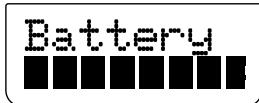
LOW BATTERY WARNING
If the HTRM senses the batteries are low, it will show "Low Batt" on the second line of the LCD display whenever the remote is idle. When this occurs the batteries should be replaced with new ones immediately.
BACK LIGHT SENSITIVITY (B LIGHT)
The HTRM is equipped with a backlight to increase visibility of the HTRM in low light conditions. The HTRM also includes a light sensor. By default, if you press any key on the remote and it senses a low light condition, the backlight will turn on. It will then turn off again five seconds after no key has been pressed. The behavior and timeout for the backlight can be adjusted.
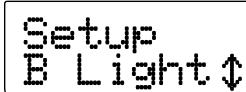
TIMEOUT: The backlight timeout can be set from 0 - 20 seconds. This is the length of time the backlight stays ON after releasing the last key.
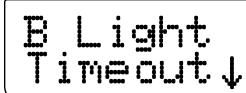
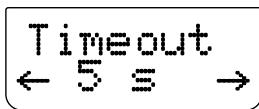
USING THE HTRM REMOTE CONTROL
MODE: The following backlight modes are available:
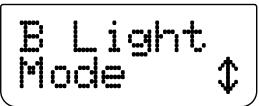
- Off: The backlight will never come ON.
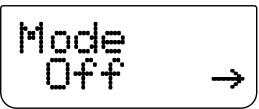
- Sense: The backlight will only come ON if the light sensor detects low light conditions. See also "SENSE LEVEL" discussion below.
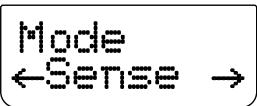
- On: The backlight will come ON any time a key is pressed.
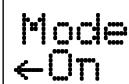
SENSE LEVEL (Sen Lvl): The point where the backlight comes ON in a darkened room. To set this level, go to a dim area where you think the backlight should be activated given such a dark environment condition. Then, press [ENTER] at "B Light - Sen Lvl" menu. The display will show the current sensitivity level. An example is below
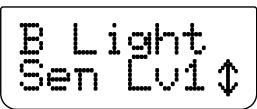
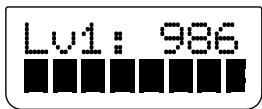
If such sensitivity level is alright with you, press [ENTER].
Select "YES" to complete the setting of the sensitivity level.
LIBRARY
The HTRM can store a different library of default NAD codes for each of its DEVICE SELECTOR "pages." If the original default library does not control your NAD CD player, DVD player, or other component, follow the procedure below to change the library code. Please refer as well to the table below for a list of uploaded NAD Library Codes.
Example: Load NAD DVD Player T 585 library codes to HTRM's "DVD" device.
1 Press [DVD] in the DEVICE SELECTOR page.
2 Press and hold [TUNER (10+/SETUP)] and [ENTER] buttons. Use [▼] to scroll to "Library".
3 Press [ENTER].
4 The library code for NAD T585 is "600". Use [<] to toggle to "600". Press [ENTER].
5 Use [ / ] to select between "No" (desired library code is not uploaded) and "Yes" (desired library code is uploaded and saved to the applicable device page.
NOTE
Instead of scrolling through the library list, you can also key-in directly the library code based on the list of Library Codes below.
| LIBRARY CODE | NAD PRODUCT DESCRIPTION | LIBRARY CODE | NAD PRODUCT DESCRIPTION |
| 100 | Receiver/Processor (Discrete ON/OFF) | 300 | Tuner |
| 101 | Receiver/Processor (Toggle ON/OFF) | 301 | L75, L76 Tuner |
| 102 | S170 | 302 | L70 Tuner |
| 103 | L75 | 303 | L53 Tuner |
| 104 | Second Zone Commands (Zone 2) | 304 | L73 Tuner |
| 3112 | Zone 3 | 305 | C425 |
| 4112 | Zone 4 | 306 | C445 |
| 105 | L70 | 307 | Txx5 Series Tuner |
| 106 | L76 | 400 | Tape Deck B |
| 107 | 118 | 401 | TAPE Deck A |
| 108 | L53 | 500 | TV 280 |
| 109 | L73 | 501 | MR13 |
| 110 | Stereo Receiver / Amplifier | 502 | MR20 |
| 111 | Stereo Second Zone | 503 | PMR45 |
| 112 | Txx5 Series | 600 | T535, T562, T585, M55 |
| 200 | CD Player | 601 | T550, L55 |
| 201 | CD Player (old) | 602 | T512, T531, T532, T571, T572 |
| 202 | 5170, 5240, 5340 | 603 | L70, L73 DVD |
| 203 | 5325 | 604 | L56 |
| 204 | 5060 | 605 | T513, T514, T515, T517, T524, T533, T534 |
| 205 | M5 | 606 | L53 DVD |
LEARN
This function allows you to learn IR commands from another remote.
Example: Learning "MENU" function from a TV remote control into the MENU button of HTRM's TV device. Begin by positioning the HTRM "nose-to-nose" with the source remote so that the two devices' infrared windows are about 2 inches apart.
1 Press [TV] in the DEVICE SELECTOR page.
2 Press and hold [TUNER (10+/SETUP)] and [ENTER] buttons. Use [▼] to scroll to "Learn".
USING THE HTRM REMOTE CONTROL
3 Press [ENTER].
4 Press [MENU] button of HTRM - [MENU] button of the HTRM is where the corresponding [MENU] function key of the TV remote control will be learned.
5 Press and hold the corresponding [MENU] button of the TV remote control until "Success" is shown in the display. (Refer also to "MODE" discussion below).
6 "Success" will be shown in the display if the [MENU] function key is successfully "learned." You can now release the [MENU] button of the TV remote control.
7 Wait until "Success" is extinguished from the display to complete the process.
NOTE
"Failed" will be shown in the lower line display if the "learning" of the desired function key is unsuccessful. Repeat Step 3 - 7 again until "learning" of the desired key is successful.
MODE
There are three modes on how a function key can be learned. Press and hold [TUNER (10+/SETUP)] and [ENTER] buttons. Use [] to scroll to "Learn". Press [ENTER] and then [] to scroll to "Mode". The following are the three modes:
Normal: This is the regular learning mode. A function key is learned until "Success" is shown in the display. The example above is at "Normal" learn mode.
2 Pass: Some remote controls use an IR (infrared) "toggle bit". This means that if you press the same key twice in a row, the IR signal toggles between two different variations of the same command.
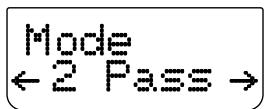
At "2 Pass" mode, step 5 and onwards of the above example would be as follows (the same Steps 1 - 4 of the above example applies)
5 Press and hold the corresponding [MENU] button of the TV remote control.
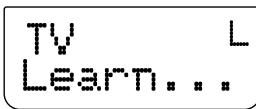
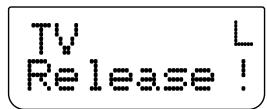
6 Release [MENU] button.
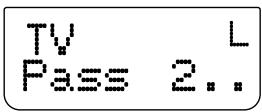
7 "Pass 2" means that you have to press [MENU] button again. Press until "Success" is shown in the display.
8 "Success" will be shown in the display if the [MENU] function key is successfully "learned." You can now release the [MENU] button of the TV remote control.
9 Wait until "Success" is extinguished from the display to complete the process.
Narrow: Some remote controls use very narrow pulses of IR. If you cannot get your remote to work using the normal or 2 Pass modes, you may want to try this mode. The same example above for "Normal" mode applies to "Narrow" mode.
PUNCH-THROUGH (Pun Thr)
The HTRM's "Punch through" function allows you to retain a function key from one DEVICE SELECTOR "page" to another.
Example: Punch-through "SURR MODE" key to the "DVD" page.
1 Press [DVD] in the DEVICE SELECTOR page.
2 Press and hold [TUNER (10+/SETUP)] and [ENTER] buttons. Use [▼] to scroll to "Pun Thr".
3 Press [ENTER].
4 Press [SURR MODE] button - this is the function key that will be punched through.
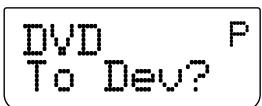
5 Press the [AMP] button in the DEVICE SELECTOR page.
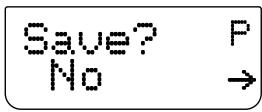
6 Use [ / ] to select between "No" (desired punch-through key will not be saved) and "Yes" (desired punch-through key will be saved and process is completed).
NOTE
The HTRM's [VOL] keys are pre-programmed as "punched-through" for all Device Select pages: [VOL] will operate the NAD's master-volume regardless of the currently selected device. The [SURR], [CENT] and [SUB] CHANNEL VOLUME controls similarly are pre-programmed as punched-through.
PUNCH-THROUGH MACRO
A stored macro command can also be "punched-through."This provides a way to execute a macro with a single keys press.
Example: Punch-through macro command stored at [0] to the [RTN] key of [BD] page.
1 Press [BD] in the DEVICE SELECTOR page.
2 Press and hold [TUNER (10+/SETUP)] and [ENTER] buttons. Use [] to scroll to "Pun Thr".
3 Press [ENTER].
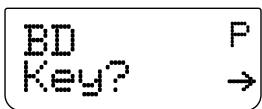
4 Press [RTN] button.
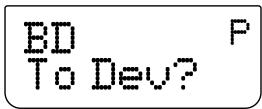
5 Press the [MACRO] button in the DEVICE SELECTOR page.
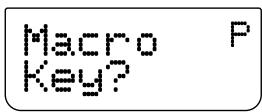
6 Press [0] button – this is the key where the macro command is associated.
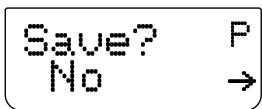
7 "Save" and "No?" are shown in the display. Use [ / ] to select between "No" (desired punch-through macro command will not be saved) and "Yes" (desired punch-through macro command will be saved and process is completed).
EXECUTE PUNCHED-THROUGH MACRO
To recall the punched-through macro command as above example, press [BD] in the DEVICE SELECTOR page and then press [RTN] – the macro command will then be executed.
Refer also to the "MACRO" section below for information on how to setup macros.
COPY
This function allows you to copy functions from one key to another.
Example: Copy "PAUSE" [II] command from DVD page to the AMP [III] button.
1 Press [AMP] in the DEVICE SELECTOR page.
2 Press and hold [TUNER (10+/SETUP)] and [ENTER] buttons. Use [] to scroll to "Copy".
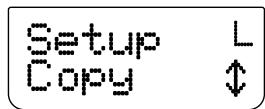
3 Press [ENTER].
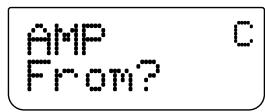
4 Press [DVD] from DEVICE SELECTOR page.
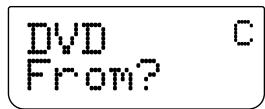
5 Press [II] button - this is the function key that will be copied.
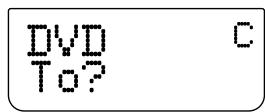
6 Press [AMP] from DEVICE SELECTOR page.
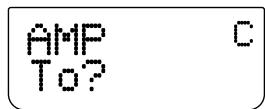
7 Press [II] button - this is the button where the function will be copied.
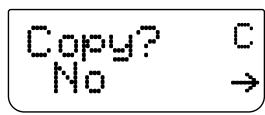
8 Use [ / ] to select between "No" (desired function key will not be copied) and "Yes" (desired function key will not be copied and process is completed).
NOTE
The copy and punch-through functions are similar. However, if you copy a command and then subsequently delete, or over-write the original (source-key) command, the copied-to key's command remains unchanged. If you punch-through to a command and then delete or over-write the original key, the punched-through functions also change accordingly.
USING THE HTRM REMOTE CONTROL
DELETE
Each key can have several functions types stored. However, only the highest priority type will be active. When you delete a function, a lower priority function type may become active. To completely erase the functionality of a key, you may need to execute the Delete function multiple times. For example; if you delete a learned command, a lower priority command may become active. The order of priority for each function type is:
1 Punch Through
2 Learned
3 Copied Library Command
4 Default Library Command
Example: Delete punch-through "SURR MODE" function key from DVD page (refer to PUNCH-THROUGH example above).
1 Press [DVD] in the DEVICE SELECTOR page.
2 Press and hold [TUNER (10+/SETUP)] and [ENTER] buttons. Use [] to scroll to "Delete".
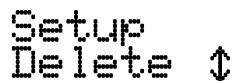
3 Press [ENTER].
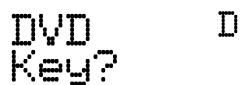
4 Press [SURR MODE] button.
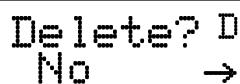
5 Use [ / ] to select between "No" (desired function key will not be deleted) and "Yes" (desired function key is deleted and process is completed).
RENAME
All keys can be renamed except MACRO key.
Example: Rename "Input 1" key of "AMP" page to "DVD".
1 Press [AMP] in the DEVICE SELECTOR page.
2 Press and hold [TUNER (10+/SETUP)] and [ENTER] buttons. Use [▼] to scroll to "Rename".

3 Press [ENTER].
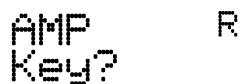
4 Press [1] button.
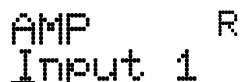
5 Use [ / ] buttons to select the first character of the name ("D"from the alphabetical list).
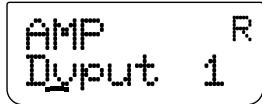
6 Press [▶] button to select the character and correspondingly move forward to the next position. (Press [▲] to go back to the previous character). Repeat this process for each character in sequence.
7 Since "DVD" is only three characters and "Input 1" is six character spaces, overlap the remaining characters with a space. Space or blank can also be selected using [/] buttons - scroll up to the blank character.
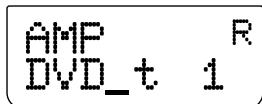
Press [ENTER] when you have finished the renaming sequence.
9 Display shows "Save" and "No" - use [ / ] to select between "No" (new name will not saved) and "Yes" (new name will be saved and process is completed).
MACRO
A "macro" command is a series of two or more remote codes issued automatically from a single keypress. You might use a macro to automate a simple command sequence, such as, "Turn on the DVD player and then press "play." Or you might compose an elaborate macro to power up an entire system, select a source, choose a Listening Mode, and begin playback—again, all from a single keypress. The HTRM can store one macro to all its function keys except MACRO.
Macros will be executed with the same timing as they were recorded. The length of time each command is sent will also correspond to the same length of time the key will be held down while recording.
Example: Record a Macro to the [0] key to turn ON the NAD M15 HD, Select [Input 1], turn ON the NAD T515 DVD Player, and commence disc playback of the connected Input 1 device (as in the NAD T515 DVD player):
1 Press [AMP] in the DEVICE SELECTOR page.
2 Press and hold [TUNER (10+/SETUP)] and [ENTER] buttons. Use [▼] to scroll to "Macro".
3 Press [ENTER].
4 Display shows "Macro" and "Key?" - press [0].
5 Press [AMP], [ON], [1], [DVD], [ON] and [ ] (Play). The length of time each command is entered will also correspond to the same time sequence the macro command is executed.
6 Press [MACRO] to end the sequence.
7 Use [ / ] to select between "No" (macro command will not be saved) and "Yes" (macro command will be saved and process is completed).
USING THE HTRM REMOTE CONTROL
EXECUTING MACRO
To execute the above macro example, press [MACRO] and then [0].
The corresponding macro will run; the display will show each step/ command as the macro is executed. Pressing any other HTRM key while a macro is executing will abort the macro.
By default, when a macro is executed, the currently selected device will be returned to what it was before the macro was executed. However, if the very last button pressed while recording a macro is a DEVICE SELECTOR key, the device will be changed at the end of executing the macro.
RESET
Selecting this option and answering "Yes" to both confirmations will reset all HTRM options to the factory default. All user configurations, macros, and custom device programming will be erased.
1 Press [AMP] in the DEVICE SELECTOR page.
2 Press and hold [TUNER (10+/SETUP)] and [ENTER] buttons. Use [] to scroll to "Reset."
3 Press [ENTER].
4 Use [ / ] to select between "No" (HTRM will not be reset) and "Yes" (HTRM will be reset to its factory defaults). When you select "Yes", another prompt display will be shown.
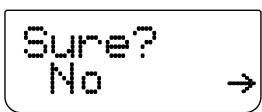
5 Select "Yes" to reset the HTRM and complete the process.
USB INTERFACE
The HTRM allows one to upload and download the configuration through a Windows® PC and NAD's Proprietary HTRM programming software. Use a USB A male to mini USB B male 5-pin cable (not supplied) between your Windows® PC and the HTRM. See illustration below on how to connect a USB A male to mini USB B male 5-pin cable to the HTRM.
NOTE
Please log onto www.nadelectronics.com for the latest HTRM interface control software. Your custom installer or dealer can assist you in the proper setup and configuration of the mini USB interface and software.
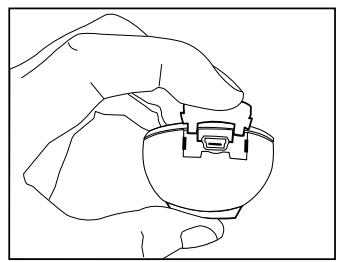
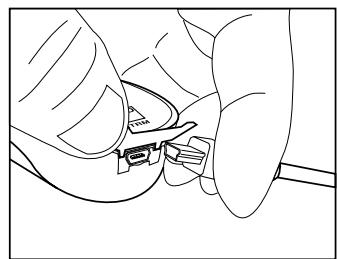
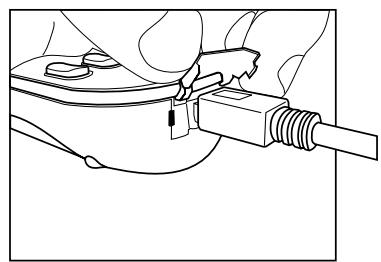
USING THE HTRM REMOTE CONTROL
BATTERY INSTALLATION
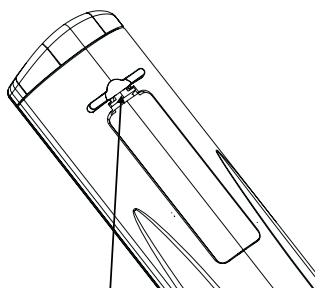
Press in and lift tab to remove battery cover out from recess
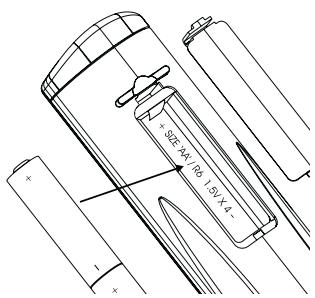
Place batteries into opening. Ensure the correct polarity is observed
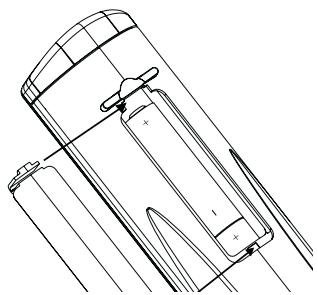
Press battery cover into place until it clicks closed
SLEEP MODE
The Sleep Mode timer will switch the M15 HD to Standby mode automatically after a preset number of minutes. Pressing the HTRM's SLEEP button once will display the setting of the sleep time increment. Pressing the HTRM's SLEEP button a second time within a 3-second period will change the sleep time increment in 15-minute intervals, after which time the M15 HD will automatically switch into Standby mode.
To adjust the sleep delay, press the HTRM's SLEEP button twice; first to display the sleep time increment, and a second time to change the sleep time increment. The sleep time increment and a "SLEEP" icon will continuously display on the M15 HD's front panel Vacuum Fluorescent Display (VFD). Each consecutive press increases the sleep time in 15-minute increments from 15 to 90 minutes. To cancel the sleep mode, continue pressing the HTRM's SLEEP button until "SLEEP OFF" displays on the VFD. Switching the M15 HD to standby from either the HTRM's OFF or the M15 HD's STANDBY button will also cancel the sleep mode
USING THE ZR 5 REMOTE CONTROL
The ZR 5 is a discrete compact remote for controlling the applicable Zone 2 features of the M15 HD. Irrespective of the main room/zone settings, the ZR 5 allows full separate control of the Zone 2 source selection among other applicable features.
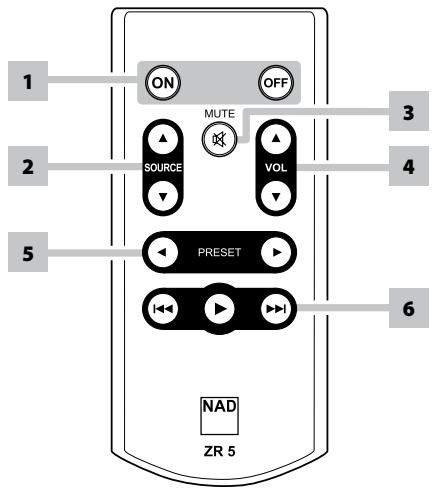
1 ON/OFF: Switch ON/OFF the Zone feature.
2 SOURCE[▲/▼]: Select the active input of the NAD M15 HD that will be sent out to the corresponding rear panel ZONE 2 output port.
3 MUTE: Temporarily switch OFF or restore the Zone Volume level.
4 VOLUME [/] : Increase or decrease the loudness level of selected Zone source. This is possible only if the VOLUME setting of ZONE 2 is set to VARIABLE.
5 PRESET [</▶]: Step up or down between stored radio presets. This control button is possible if the selected Zone is "TUNER" and the active tuner section has stored presets. This control button is not applicable to M15 HD.
6 The following CD Player Zone buttons can control a compatible CD Player. The CD Player has to be powered ON and disc loaded.
SKIP [1]: Go to the beginning of a track/file or previous track/file.
SKIP [▶▶]: Go to the next track/file.
[▶]: Start playback.
NOTE
The ZR 5 remote control will only control Zone 2 applications. Zone 3 and Zone 4 could be configured and managed at the appropriate Zone OSD menu using the corresponding keys on the HTRM remote control. The HTRM's "CUSTOM" device is also defaulted to Zone 2 remote control codes.
| CONDITION | POSSIBLE CAUSES | POSSIBLE SOLUTIONS |
| No sound from all channels. | • AC power unplugged. | • Check AC cable connection and outlet. |
| • Power not switched on. | ||
| • Outlet has no power. | ||
| No sound from some channels. | • Faulty/missing cables. | • Check cables. |
| • 'Speaker Configuration' channel (s) set to "OFF". | • Check 'Speaker Configuration' menu. | |
| • Power-amp connections faulty. | • Check power amplifier and cabling. | |
| No sound from surround channels. | • No surround listening mode is engaged. | • Select appropriate listening mode. |
| • Surround-channels set to "OFF" on 'Speaker Configuration' menu. | • Correct 'Speaker Configuration' or 'Speaker Levels' settings. | |
| • Surround-channels level set too low on 'Speaker Levels' menu. | ||
| No sound from Subwoofer. | • Subwoofer is off, not powered or improperly connected. | • Power-up subwoofer, check Sub's AC outlet or check connections. |
| • Subwoofer set to "OFF" on 'Speaker Configuration' menu. | • Correct 'Speaker Configuration' or 'Speaker Levels' settings. | |
| • Sub level set too low on 'Speaker Levels' menu. | ||
| No sound from Center channel. | • Source is a 2/0 (etc.). Dolby Digital or DTS recording without center channel. | • Play a known 5.1-channel recording or select Dolby Pro Logic IIx Music mode. |
| • Center set to "OFF" on 'Speaker Configuration' menu. | • Correct 'Speaker Configuration' or 'Speaker Levels' settings. | |
| • Center level set too low on 'Speaker Levels' menu. | ||
| No Dolby Digital/DTS. | • Source's digital output is not connected to a M15 HD digital input. | • Check connections. |
| • Source component not configured for multichannel digital output. | • Check source component setup. | |
| No video display. | • Resolution setting is not supported by the TV/Monitor. | • To restore video display, press and hold both front panel buttons LISTENING MODE and TONE DEFEAT and then release both buttons. |
| M15 HD does not respond to HTRM remote. | • Batteries are flat or incorrectly inserted. | • Check batteries. |
| • IR transmitter window on remote or IR A/V Receiver window on M15 HD is obstructed. | • Check IR windows and ensure clear line-of-sight from remote to M15 HD. | |
| • M15 HD front panel is in very bright sunlight or ambient light. | • Reduce sunlight/room lighting. | |
| M15 HD does not respond to front panel commands or remote control. | • Microprocessor error. | • Power-down the M15 HD via the rear panel Power switch and unplug it from the AC outlet. |
| • M15 HD may have over heated. | • Wait five minutes, re-connect and power up. | |
| • 12V TRIGGER IN/OUT is set to AUTO position. | • Switch 12V TRIGGER IN/OUT to OFF position. |
Factory defaults for 120V version only : Press simultaneously Source + Tone Defeat
Factory defaults for 230V version only: Press simultaneously Source + Tone Defeat
SPECIFICATIONS
OVERALL SPECIFICATIONS LINE LEVEL INPUT
DIMENSION AND WEIGHT
| Input impedance (R and C) | 56 kΩ + 220 pF |
| Input sensitivity | 40 mV (ref. 500 mV out) |
| Maximum input signal | >8 Vrms |
| Signal/Noise ratio, A-weighted | >90 dB (ref. 500 mV in 500 mV out, volume set to unity gain) |
| >80 dB (ref. 2 V out, Volume maximum) | |
| Channel Separation | >70 dB (ref. 1 kHz/10 kHz) |
| Frequency response | ±0.3 dB (ref. 20 Hz - 20 kHz, Tone Active) |
| ±0.3 dB (ref. 20 Hz - 20 kHz, Tone Defeat) | |
| Frequency response (subwoofer out) | 10 - 200Hz (ref. -3 dB) |
OUTPUT
Maximum output level >8 Vrms into 600 Ω
THD (CCIF IMD, DIM 100) <0.005% (ref. 20 Hz - 20 kHz, 2 V out)
TONE CONTROLS
Treib ±10 dB at 10 kHz (ref. 2V in 2V out)
Bass ±10 dB at 100 Hz (ref. 2V in 2V out)
POWER CONSUMPTION
Normal operation 80W
Standby mode < 1W
Unit dimensions (W x H x D) 435 x 145 x 385 mm (Gross*)
Net weight 13.1 kg
Shipping weight 22 kg
-
- Gross dimension includes feet, volume knob and extended rear panel terminals.
Specifications are subject to change without notice. For updated documentation and features, please log onto www.NADelectronics.com for the latest information about M15 HD.
Manufactured under license under U.S. Patent #: 5,451,942; 5,956,674; 5,974,380;5,978,762; 6,226,616; 6,487,535; 7,212,872; 7,333,929; 7,392,195; 7,272,567 & other U.S. and worldwide patents issued & pending. DTS is a registered trademark and the DTS logos, Symbol, DTS-HD and DTS-HD Master Audio are trademarks of DTS, Inc. © 1996-2008 DTS, Inc. All Rights Reserved.
Manufactured under license from Dolby Laboratories.
"Dolby", "Pro Logic", and the double-D symbol are registered trademarks of Dolby Laboratories.
HDMI, the HDMI logo and High-Definition Multimedia Interface are trademarks or registered trademarks of HDMI Licensing LLC.
Manufactured under license from Audyssey Laboratories. U.S. and foreign patents pending. Audyssey MultEQ XT is a trade-mark of Audyssey Laboratories.
This product incorporates copyright protection technology that is protected by method claims of certain U.S. patents and other intellectual property rights owned by Macrovision Corporation and other rights owners. Use of this copyright protection technology must be authorized by Macrovision Corporation, and is intended for home and other limited viewing uses only unless otherwise authorized by Macrovision Corporation. Reverse engineering or disassembly is prohibited.
www.NADelectronics.com
©2009 NAD ELECTRONICS INTERNATIONAL A DIVISION OF LENBROOK INDUSTRIES LIMITED
All rights reserved. NAD and the NAD logo are trademarks of NAD Electronics International, a division of Lenbrook Industries Limited. No part of this publication may be reproduced, stored or transmitted in any form without the written permission of NAD Electronics International.
- NOTE TO CATV SYSTEM INSTALLER
- WARNING
- WARNING: TO REDUCE THE RISK OF FIRE OR ELECTRIC SHOCK, DO NOT EXPOSE THIS APPARATUS TO RAIN OR MOISTURE AND OBJECTS FILLED WITH LIQUIDS, SUCH AS VASES, SHOULD NOT BE PLACED ON THIS APPARATUS.
- CAUTION REGARDING PLACEMENT
- IMPORTANT INFORMATION TO UK CUSTOMERS
- IMPORTANT
- IF IN DOUBT CONSULT A COMPETENT ELECTRICIAN.
- NOTES ON ENVIRONMENTAL PROTECTION
- RECORD YOUR MODEL NUMBER (NOW, WHILE YOU CAN SEE IT)
- TABLE OF CONTENTS
- IMPORTANT SAFETY INSTRUCTIONS 2
- INTRODUCTION
- IDENTIFICATION OF CONTROLS
- OPERATION
- REFERENCE
- THANK YOU FOR CHOOSING NAD.
- http://NADelectronics.com/warranty
- E.A.R.S. AND DIGITAL SURROUND
- EASE OF USE
- INTEGRATION
- ZONE
- RS 232
- UPGRADABILITY
- ABOUT THE HTRM SYSTEM REMOTE CONTROL
- WHAT'S IN THE BOX
- SAVE THE PACKAGING
- CHOOSING A LOCATION
- QUICK START
- NOTE
- NOTES
- REAR PANEL
- ATTENTION!
- ABOUT THE ON-SCREEN DISPLAY (OSD)
- DISPLAY THE OSD
- NAVIGATING THE OSD AND MAKING CHANGES
- MAIN MENU
- LISTENING MODE
- IMPORTANT NOTICE
- STEREO
- DIRECT
- PROLOGIC
- DTS NEO: 6
- EARS
- ENHANCED STEREO
- ANALOG BYPASS
- PRO LOGIC IIx
- DSP OPTIONS
- LIP SYNC DELAY
- ADC (ANALOG-TO-DIGITAL CONVERTER) RATE
- AUDYSSEY MultEQ
- AUDYSSEY DYN EQ (AUDYSSEY DYNAMIC EQ)
- AUDYSSEY DYNAMIC VOLUME
- TONE CONTROLS
- PICTURE CONTROLS
- ASPECT MODE
- EDGE ENHANCEMENT
- NOISE REDUCTION
- BRIGHTNESS
- ZONE CONTROLS
- USING THE M15 HD - SETUP MENU
- SETUP MENU
- VIDEO SETUP
- IMPORTANT NOTE
- SOURCE SETUP
- SOURCE SETUP (NORMAL VIEW)
- SOURCE
- ENABLED
- NAME
- ANALOG AUDIO
- GAIN
- DIGITAL AUDIO
- VIDEO
- VIDEO FORMAT CONVERSION
- A/V PRESET
- TRIGGEROUT
- SOURCE SETUP (TABLE VIEW)
- iPod SETUP
- SPEAKER SETUP
- IMPORTANTNOTICES
- ENHANCED BASS
- SPEAKER LEVELS
- USING AN SPL METER
- SETTING SPEAKER LEVELS AT TEST MODE
- SPEAKER DISTANCE
- SETTING SPEAKER DISTANCE
- ADJUSTING THE VOLUME
- MUTING THE SOUND
- ADJUSTING CHANNEL LEVELS 'ON THE FLY'
- ZONE SETUP
- VOLUME
- MODE
- TRIGGER SETUP
- TRIGGER OUT
- DELAY
- AUTO TRIGGER IN
- LISTENING MODES
- DOLBY
- DOLBY DIGITAL PLUS
- DOLBY TrueHD
- DOLBY DIGITAL EX
- DTS
- PCM
- ANALOG
- DOLBY SETUP
- DTS SETUP
- DTS SURROUND MODES
- DTS-HD MASTER AUDIO
- DTS - ES EXTENDED SURROUND (DTS ES)
- DTS-ESTM DISCRETE 6.1
- DTS-ESTM MATRIX 6.1
- DTS NEO: 6TM SURROUND
- DISPLAY SETUP
- ON-SCREEN DISPLAY (OSD)
- A/V PRESETS
- CREATING PRESETS
- SAMPLE PROCEDURE FOR SETTING UP A/V PRESETS
- RECALLING PRESETS
- CONNECTING THE OPTIONAL NAD IPD AND iPod PLAYER TO THE M15 HD
- NAVIGATING THE iPod PLAYER'S FUNCTIONS AND FEATURES
- CONTROL FEATURES AND SETTINGS
- ENTER
- DISP
- / NAVIGATION BUTTONS
- / SKIP/CH/PRESET
- SCAN[←/→] / PAUSE [II]/PLAY [▶]
- LIGHT
- MENU
- ↔ (REPEAT)
- 空 (RANDOM)
- TO VIEW VIDEOS OR PHOTOS LOADED IN YOUR iPod
- HIGHLIGHTS
- GETTING FAMILIAR WITH THE HTRM
- USING THE HTRM REMOTE CONTROL
- NAVIGATION OF THE HTRM CONTROLS
- DEVICE SELECTOR KEYS
- MACRO KEYS
- FUNCTION KEYS
- A/V PSET KEY
- SOFTWARE VERSION NUMBER
- HTRM SETUP MENU
- BATTERY
- LOW BATTERY WARNING
- BACK LIGHT SENSITIVITY (B LIGHT)
- LIBRARY
- LEARN
- PUNCH-THROUGH (Pun Thr)
- PUNCH-THROUGH MACRO
- EXECUTE PUNCHED-THROUGH MACRO
- COPY
- DELETE
- RENAME
- MACRO
- EXECUTING MACRO
- RESET
- USB INTERFACE
- BATTERY INSTALLATION
- SLEEP MODE
- USING THE ZR 5 REMOTE CONTROL
- SPECIFICATIONS
- OUTPUT
- POWER CONSUMPTION
- ©2009 NAD ELECTRONICS INTERNATIONAL A DIVISION OF LENBROOK INDUSTRIES LIMITED
Brand : NAD
Model : M15 HD
Category : Audio Amplifier