
M4 - Audio Amplifier NAD - Free user manual and instructions
Find the device manual for free M4 NAD in PDF.


| Product type | Digital audio tuner (AM/FM/DAB/XM) |
| Brand | NAD |
| Model | M4 |
| Dimensions (W x H x D) | 435 x 100 x 300 mm (net) |
| Net weight | 8.8 kg (120 V version) / 8.9 kg (230 V version) |
| Power supply | AC, 50/60 Hz, with detachable IEC cord |
| FM frequency ranges | 87.5 – 108.5 MHz (step 0.0125 MHz) |
| AM frequency ranges | 530 – 1710 kHz (120 V) / 531 – 1602 kHz (230 V) |
| DAB (230 V version) | Band III (174-240 MHz) and L-band (1452-1492 MHz) |
| XM (120 V version) | XM Ready support (with optional module) |
| Number of presets | 40 (mix AM/FM/DAB/XM) |
| Display | VFD (fluorescent display) with dimming |
| Audio outputs | Stereo analog (RCA) and digital optical/coaxial (230 V version) |
| Antenna inputs | FM (75 ohms), AM (loop), DAB (230 V version) |
| Remote control | Infrared with AA batteries (supplied) |
| Remote control range | Approximately 7 m (23 ft) with 30° angle |
| Special functions | RDS (FM), DRC (DAB), FM Mute, Blend, Sleep, user name for presets |
| Connectivity | IR input, 12 V trigger input, RS-232 |
| Ventilation | Clearance: 10 cm on sides and rear, 50 cm above |
| Maintenance and cleaning | Unplug before cleaning; use a damp cloth |
| Safety | Do not expose to water or moisture; do not block ventilation openings |
| Spare parts and repairability | Use spare parts specified by the manufacturer; call a qualified technician |
| General information | Warranty: visit NAD website for registration; shipping weight: 14.2 kg (120 V) / 14.5 kg (230 V) |
Frequently Asked Questions - M4 NAD
User questions about M4 NAD
0 question about this device. Answer the ones you know or ask your own.
Ask a new question about this device
Download the instructions for your Audio Amplifier in PDF format for free! Find your manual M4 - NAD and take your electronic device back in hand. On this page are published all the documents necessary for the use of your device. M4 by NAD.
USER MANUAL M4 NAD
Owner's Manual
- Read instructions - All the safety and operating instructions should be read before the product is operated.
- Retain instructions - The safety and operating instructions should be retained for future reference.
- Heed Warnings - All warnings on the product and in the operating instructions should be adhered to.
- Follow Instructions - All operating and use instructions should be followed.
- Cleaning - Unplug this product from the wall outlet before cleaning. Do not use liquid cleaners or aerosol cleaners. Use a damp cloth for cleaning.
- Attachments - Do not use attachments not recommended by the product manufacturer as they may cause hazards.
- Water and Moisture - Do not use this product near water-for example, near a bath tub, wash bowl, kitchen sink, or laundry tub; in a wet basement; or near a swimming pool; and the like.
- Accessories - Do not place this product on an unstable cart, stand, tripod, bracket, or table. The product may fall, causing serious injury to a child or adult and serious damage to the product. Use only with a cart, stand, tripod, bracket, or table recommended by the manufacturer, or sold with the product. Any mounting of the product should follow the manufacturer's instructions, and should use a mounting accessory recommended by the manufacturer.
- Cart - A product and cart combination should be moved with care. Quick stops, excessive force, and uneven surfaces may cause the product and cart combination to overturn.
- Ventilation - Slots and openings in the cabinet are provided for ventilation to ensure reliable operation of the product and to protect it from overheating. These openings must not be blocked or covered. The openings should never be blocked by placing the product on a bed, sofa, rug, or other similar surface. This product should not be placed in a built-in installation such as a bookcase or rack unless proper ventilation is provided or the manufacturer's instructions have been adhered to.
- Power Sources - This product should be operated only from the type of power source indicated on the marking label and connected to a MAINS socket outlet with a protective earthing connection. If you are not sure of the type of power supply to your home, consult your product dealer or local power company.
- Power-Cord Protection - Power-supply cords should be routed so that they are not likely to be walked on or pinched by items placed upon or against them, paying particular attention to cords at plugs, convenience receptacles, and the point where they exit from the product.
- Mains Plug - Where the mains plug or an appliance coupler is used as the disconnect device, the disconnect device shall remain readily operable.
- Outdoor Antenna Grounding - If an outside antenna or cable system is connected to the product, be sure the antenna or cable system is grounded so as to provide some protection against voltage surges and built-up static charges. Article 810 of the National Electrical Code, ANSI/NFPA 70, provides information with regard to proper grounding of the mast and supporting structure, grounding of the lead-in wire to an antenna discharge unit, size of grounding conductors, location of antenna discharge unit, connection to grounding electrodes, and requirements for the grounding electrode.
NOTE TO CATV SYSTEM INSTALLER
This reminder is provided to call the CATV system installer's attention to Section 820-40 of the NEC which provides guidelines for proper grounding and, in particular, specifies that the cable ground shall be connected to the grounding system of the building, as close to the point of cable entry as practical.
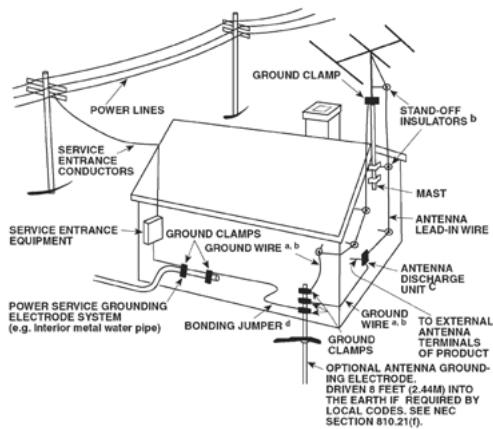
- Lightning - For added protection for this product during a lightning storm, or when it is left unattended and unused for long periods of time, unplug it from the wall outlet and disconnect the antenna or cable system. This will prevent damage to the product due to lightning and power-line surges.
- Power Lines - An outside antenna system should not be located in the vicinity of overhead power lines or other electric light or power circuits, or where it can fall into such power lines or circuits. When installing an outside antenna system, extreme care should be taken to keep from touching such power lines or circuits as contact with them might be fatal.
- Overloading - Do not overload wall outlets, extension cords, or integral convenience receptacles as this can result in a risk of fire or electric shock.
- Flame Sources - No naked flame sources, such as lighted candles, should be placed on the product.
- Object and Liquid Entry - Never push objects of any kind into this product through openings as they may touch dangerous voltage points or short-out parts that could result in a fire or electric shock. Never spill liquid of any kind on the product.
- Headphones - Excessive sound pressure form earphones and headphones can cause hearing loss.
- Damage Requiring Service - Unplug this product from the wall outlet and refer servicing to qualified service personnel under the following conditions:
a. When the power-supply cord or plug is damaged.
b. If liquid has been spilled, or objects have fallen into the product.
c. If the product has been exposed to rain or water.
d. If the product does not operate normally by following the operating instructions. Adjust only those controls that are covered by the operating instructions as an improper adjustment of other controls may result in damage and will often require extensive work by a qualified technician to restore the product to its normal operation.
e. If the product has been dropped or damaged in any way.
f. When the product exhibits a distinct change in performance—this indicates a need for service.
-
Replacement Parts - When replacement parts are required, be sure the service technician has used replacement parts specified by the manufacturer or have the same characteristics as the original part. Unauthorized substitutions may result in fire, electric shock, or other hazards.
-
Battery Disposal - When disposing of used batteries, please comply with governmental regulations or environmental public instruction's rules that apply in your country or area.
- Safety Check - Upon completion of any service or repairs to this product, ask the service technician to perform safety checks to determine that the product is in proper operating condition.
- Wall or Ceiling Mounting - The product should be mounted to a wall or ceiling only as recommended by the manufacturer.
WARNING

The lightning flash with arrowhead symbol, within an equilateral triangle, is intended to alert the user to the presence of uninsulated “dangerous voltage” within the product’s enclosure that may be of sufficient magnitude to constitute a risk of electric shock to persons

The exclamation point within an equilateral triangle is intended to alert the user to the presence of important operating and maintenance (servicing) instructions in the literature accompanying the appliance.
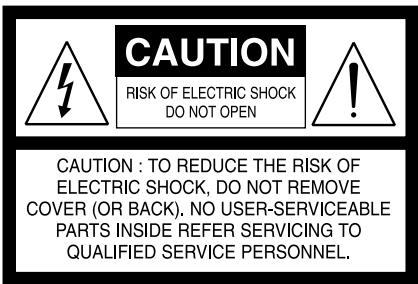
WARNING: TO REDUCE THE RISK OF FIRE OR ELECTRIC SHOCK, DO NOT EXPOSE THIS APPARATUS TO RAIN OR MOISTURE AND OBJECTS FILLED WITH LIQUIDS, SUCH AS VASES, SHOULD NOT BE PLACED ON THIS APPARATUS.
THE EQUIPMENT MUST BE CONNECTED TO AN EARTHED MAINS SOCKET-OUTLET.
CAUTION REGARDING PLACEMENT
To maintain proper ventilation, be sure to leave a space around the unit (from the largest outer dimensions including projections) than is equal to, or greater than shown below.
Left and Right Panels: 10 cm
Rear Panel: 10 cm
Top Panel: 50 cm
IMPORTANT INFORMATION TO UK CUSTOMERS
DO NOT cut off the mains plug from this equipment. If the plug fitted is not suitable for the power points in your home or the cable is too short to reach a power point, then obtain an appropriate safety approved extension lead or consult your dealer. If nonetheless, the mains plug is cut off, REMOVE THE FUSE and dispose of the PLUG immediately, to avoid possible shock hazard by inadvertent connection to the mains supply. If this product is not provided with a mains plug, or one has to be fitted, then follow the instructions given below:
IMPORTANT
DO NOT make any connection to the larger terminal which is marked with the letter 'E' or by the safety earth symbol or colored GREEN or GREEN AND YELLOW. The wires in the mains lead on this product are colored in accordance with the following code:
BLUE - NEUTRAL
BROWN - LIVE
As these colors may not correspond with the colored markings identifying the terminals in your plug, proceed as follows:
- The BLUE wire must be connected to the terminal marked with the letter 'N' or colored BLACK.
- The BROWN wire must be connected to the terminal marked with the letter 'L' or colored RED
- When replacing the fuse, only a correctly rated and approved type should be used, and be sure to re-fit the fuse cover.
IF IN DOUBT CONSULT A COMPETENT ELECTRICIAN.
CE This product is manufactured to comply with the radio interference requirements of EEC DIRECTIVE 2004/108/EC.
NOTES ON ENVIRONMENTAL PROTECTION

At the end of its useful life, this product must not be disposed of with regular household waste but must be returned to a collection point for the recycling of electrical and electronic equipment. The symbol on the product, user's manual and packaging point this out.
The materials can be reused in accordance with their markings. Through re-use, recycling of raw materials, or other forms of recycling of old products, you are making an important contribution to the protection of our environment.
Your local administrative office can advise you of the responsible waste disposal point.
RECORD YOUR MODEL NUMBER (NOW, WHILE YOU CAN SEE IT)
The model and serial number of your new M 4 are located on the back of the cabinet. For your future convenience, we suggest that you record these numbers here:
Model number:
Serial number:....
TABLE OF CONTENTS
IMPORTANT SAFETY INSTRUCTIONS ......2
INTRODUCTION
GETTING STARTED 5
WHAT'S IN THE BOX 5
CHOOSING A LOCATION 5
ABOUT M4 5
IDENTIFICATION OF CONTROLS
FRONT PANEL....6
REAR PANEL 7
M4 REMOTE CONTROL 8
OPERATION
LISTENING TO AM/FM RADIO....9
ABOUT ANTENNAS....9
TUNING STATIONS....9
CHOOSING FM MUTE MODE 10
ABOUT RDS 10
LISTENING TO XM RADIO....11
ABOUT XM RADIO (120V VERSION ONLY).... 11
LISTENING TO DAB RADIO....12
ABOUT DAB RADIO (230V VERSION ONLY).... 12
DAB ANTENNA ASSEMBLY 12
DAB OPERATION 12
SERVICE LIST 12
DAB MODE....13
STATION ORDER....13
DRC VALUE 13
MANUAL SCAN....13
PRUNE LIST....13
RESET 13
INFORMATION SETTINGS.... 14
REFERENCE
TROUBLESHOOTING ....15
SPECIFICATIONS....16
THANK YOU FOR CHOOSING NAD.
The M4 Tuner is a technologically advanced and highly capable product — yet we have invested great effort in making it simple and easy to use. We have been careful to ensure that the M4 is as musically transparent and spatially accurate as possible, incorporating much of what we've learned from a quarter century's experience designing audio and home-theater components. As with all our products, NAD's "Music First" design philosophy guided the M4's design, such that it can confidently promise you both state-of-the-art and audiophile-quality music listening for years to come.
We encourage you to take a few minutes now to read right through this manual. Investing a little time here at the outset might save you a good deal of time later, and is by far the best way to ensure that you make the most of your investment in the M4, and get the most from this powerful and flexible audio component.
One more thing: We urge you to register your M4 ownership on the NAD Worldwide Web site:
http://NADelectronics.com/warranty
For warranty information contact your local distributor.
WHAT'S IN THE BOX
Packed with your M4 you will find
• An AM loop antenna.
• A FM ribbon-wire antenna with balun.
• A DAB antenna (230V version only)
• The M4 remote control with 2 (two) AA batteries.
• This owner's manual.
- A removable AC cable (if you wish, any IEC-standard AC cable of suitable wattage may be substituted).
SAVE THE PACKAGING
Please save the box and all of the packaging in which your M4 arrived. Should you move or otherwise need to transport your M4, this is by far the safest container in which to do so. We've seen too many otherwise perfect components damaged in transit for lack of a proper shipping carton, so please: Save that box!
CHOOSING A LOCATION
Choose a location that is well ventilated (with at least several inches to both sides and behind), and that will provide a clear line of sight, within 23 feet/7 meters, between the M4's front panel and your primary listening/viewing position—this will ensure reliable infrared remote control communications. The M4 generates a modest amount of heat, but nothing that should trouble adjacent components. It is especially important that sufficient ventilation be provided. If you are contemplating on locating the M4 within a cabinet or other furniture, consult your NAD audio/video specialist for advice on providing adequate airflow.
ABOUT M4
The M4 Tuner is equipped with DAB (230V version only), XM-input (for 120V version only) and RDS (Radio Data System), bringing a wide range of information to radio listeners. These are in addition to the normal AM/FM band reception.
Now in use in many countries, RDS is a system for transmitting station identification, a description of the station's program type, indication of national, regional or local programs and the correct time. RDS also allows you to search for favorite program types.
The M4 is "XM Ready" which means that with the addition of separately sold XM Mini-Tuner CPC-9000 and XM Mini-Tuner Home Dock, it has everything you need to listen to live XM.
Until now, analogue radio signals such as FM or AM have been subject to numerous kinds of interference on their way from the transmitter to your radio. These problems were caused by mountains, high-rise buildings and weather conditions. With DAB (Digital Audio Broadcast), you can now receive CD-like quality radio programs without any annoying interference and signal distortion.
FRONT PANEL
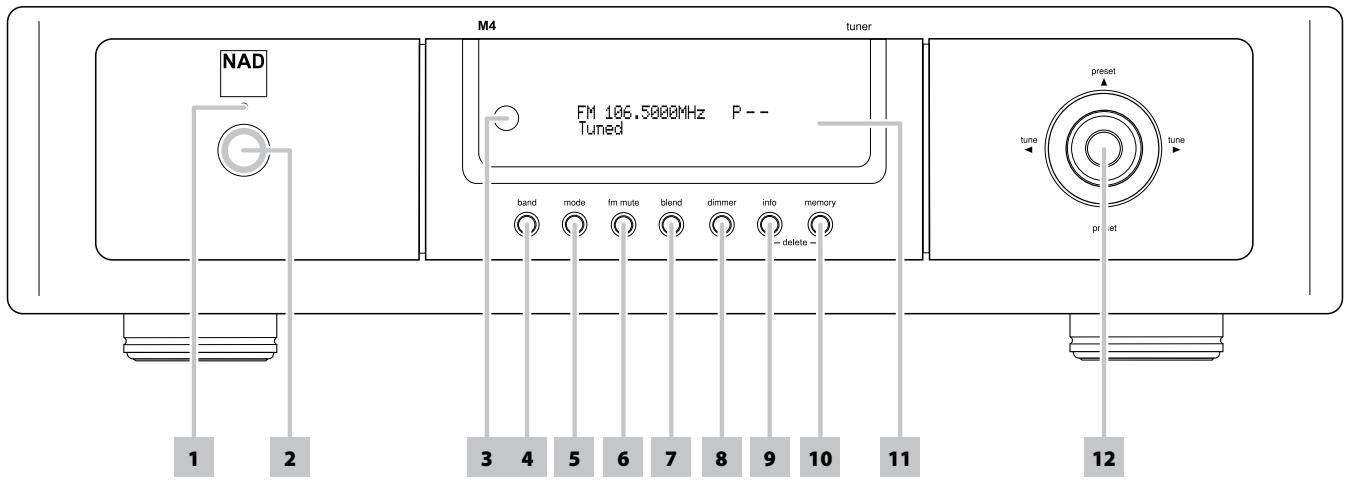
1 LED INDICATOR: This indicator will light up amber when the M4 is in standby state. When the M4 is at ON state, this indicator will illuminate blue.
2 POWER BUTTON: Press this button or the remote's [ON] button to turn ON the M4. The LED indicator will turn from amber to blue and illuminate the VFD. Pressing the power button again turns the unit back to standby mode.
The M4 can also be switched ON from standby mode by pressing any of the front panel buttons.
NOTE
The rear panel POWER switch must be in the ON position for the Power button to activate.
3 REMOTE SENSOR: Point the M4 remote control at the remote sensor and press the buttons. Do not expose the remote sensor of the remote control to a strong light source such as direct sunlight or illumination. If you do so, you may not be able to operate M4 with the remote control.
Distance: About 23 ft (7 m) from the front of the remote sensor Angle: About 30° in each direction of the front of the remote sensor
4 BAND: Toggle this button to select AM, FM, DAB (230V version only) or XM (120V version only) tuner functions.
5 MODE: In DAB (230V version only) or XM (120V version only) radio, this button enables the digital radio menus in conjunction with the Navigation button and Enter buttons.
6 FM MUTE: In FM mode, this button will toggle between FM Mute On and FM Mute Off. Select FM Mute Off for stations that have too much interference or are too weak. When engaged "FM Mute On" is shown at the lower line of the VFD; "FM Mute Off" when not active.
The "FM Mute On" or "FM Mute Off" status can be stored for individual presets.
7 BLEND: The NAD BLEND feature will allow you to reduce the amount noise and hiss but still retain some level of stereo separation, instead of mono. The "blend" button toggles between engaging and disengaging the BLEND feature. When engaged "Blend On" is shown at the lower line of the VFD; "Blend Off" when not active.
The "Blend On" or "Blend Off" status can be stored for individual presets.
8 DIMMER: Toggle to either reduce or restore normal VFD brightness.
9 INFO: Toggle this button for the lower line of the VFD to show various settings, conditions, status and other information relevant to the currently tuned station or broadcast.
In combination with MEMORY button, press and hold INFO button and then press and release MEMORY button – current stored preset setting will be erased. Refer also to the item on SETTING RADIO PRESETS at the LISTENING TO AM/FM RADIO section of the OPERATION page.
10 MEMORY: Press this button to store tuned AM, FM and digital radio stations to the M4's 40 preset-memory locations. One can store a mix of any AM, FM and digital radio stations to the 40 available presets.
In combination with INFO button, press and hold MEMORY button and then press and release INFO button – current stored preset setting will be erased. Refer also to the item on SETTING RADIO PRESETS at the LISTENING TO AM/FM RADIO section of the OPERATION page.
11 VACUUM FLUORESCENT DISPLAY (VFD): Provide visual information on the settings, conditions, status and other information relevant to the currently tuned station or broadcast.
12 NAVIGATION and ENTER buttons: These buttons are used to Tune Forward [▶] and Tune Backward [◀], Preset Forward [▲] and Preset Backward [▼] as well as navigation of DAB (230V version only), XM (120V version only) tuner functions. The middle round button is designated as "ENTER" button; this is normally pressed to complete a selection, procedure, sequence or other applicable functions. Toggle [ENTER] button to switch between "Preset" and "Tune" mode (see the lower line of the VFD).
Using the [ENTER] button, the signal strength of a tuned station can be displayed in the VFD. Press and hold [ENTER] button to display the signal strength; press [ENTER] again to resume normal display.
ATTENTION!
Please make sure that the M4 is powered off or unplugged before making any connections. It is also advisable to power-down or unplug all associated components while making or breaking any signal or AC power connections.
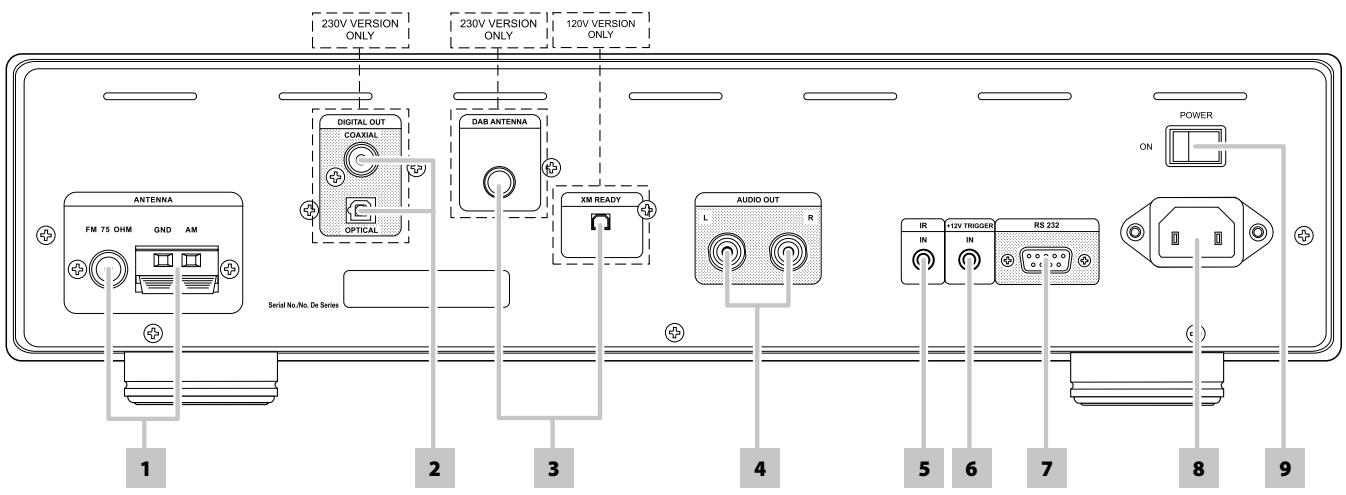
1 FM, AM ANTENNA TERMINAL: The supplied wire "dipole" FM antenna will connect to the FM connector using the supplied "balun" adapter. It will usually work best when mounted on a vertical surface such as a wall, with arms fully outstretched forming a horizontal "T" perpendicular to the origin point of the signal.
Connect the supplied AM loop antenna to these terminals. If an external AM antenna is used, make connections to the AM and GND terminals in accordance with the instructions supplied with the antenna. Refer also to the item on ASSEMBLING THE LOOP ANTENNA at the LISTENING TO AM/FM RADIO section of the OPERATION page.
2 DIGITAL AUDIO OUT - OPTICAL, COAXIAL (230V version only):
Connect the optical or coaxial digital OUT port to the corresponding S/PDIF digital input of a compatible device such as amplifiers, receivers, computer soundcard or other digital processors.
3 DAB ANTENNA TERMINAL (230V version only): Connect the other end of the supplied DAB antenna into this socket. Make sure that compatible connectors are used to ensure excellent reception. With DAB, you can receive CD-like quality programs without any annoying interference and signal distortion.
XM MODULE INPUT (120V version only): Connect XM radio cable to this socket. Follow the instructions that came with your XM radio. With XM radio, there are more than 100 channels of music, news, sports, comedy, talk and entertainment. You will find that the coverage is continent wide. The music quality is digital with many commercial-free music channels.
NOTE
- Questions? Visit www.xmradio.com Listeners can subscribe by visiting XM on the Web at www.xmradio.com or by calling (at the time of printing this manual) XM's Listener Care at (800) 853 9696. Be ready with your Radio ID that can be found on the radio by selecting Channel 0.
4 AUDIO OUT: Connect to the corresponding analog audio input of an amplifier, receiver or stereo system.
5 IR IN: This input is connected to the output of an IR (infrared) repeater (Xantech or similar) or the IR output of another component to allow control of the M4 from a remote location.
6 +12V TRIGGER IN: This input allows the M4 to be switched remotely to standby and ON by ancillary equipment, such as an amplifier, preamp, AV processor, etc. The controlling device must be equipped with a 12 V trigger output to use this feature. Connect this +12V-trigger input to the remote component's corresponding +12V DC output jack using a mono cable with 3.5mm male plug.
WARNING
If the male plug of the mono cable (with or without +12V DC) is connected to M4's +12V TRIGGER IN, the Power button in the front panel as well as the corresponding ON/OFF function keys in the remote control will be disabled. Unplug the mono cable to maintain normal power ON/OFF function procedures.
7 RS-232: Connect this interface via RS-232 serial cable (not supplied) to any Windows® compatible PC to allow remote control of the M4 through NAD's proprietary PC software or other compatible external controllers. NAD is a certified partner of AMX and Crestron and fully supports these external devices. See your NAD audio specialist for more information.
8 AC POWER INLET: Connect to the supplied IEC-standard removable AC power cord or a compatible cord.
9 POWER SWITCH: The POWER switch supplies the master AC mains power for the M4. When this switch is at ON position, the M4 is in standby mode as shown by the amber status condition of the LED indicator. At this condition, the M4 can be powered ON by pressing the POWER button on the front panel or [ON] key of M 4 remote control.
In combination with +12V TRIGGER IN, this POWER switch must be at ON position for the M4 to be powered ON via a +12V DC input at +12V TRIGGER IN.
If you intend not to use the M4 for long periods of time, set the POWER switch to the OFF position.
M4 REMOTE CONTROL
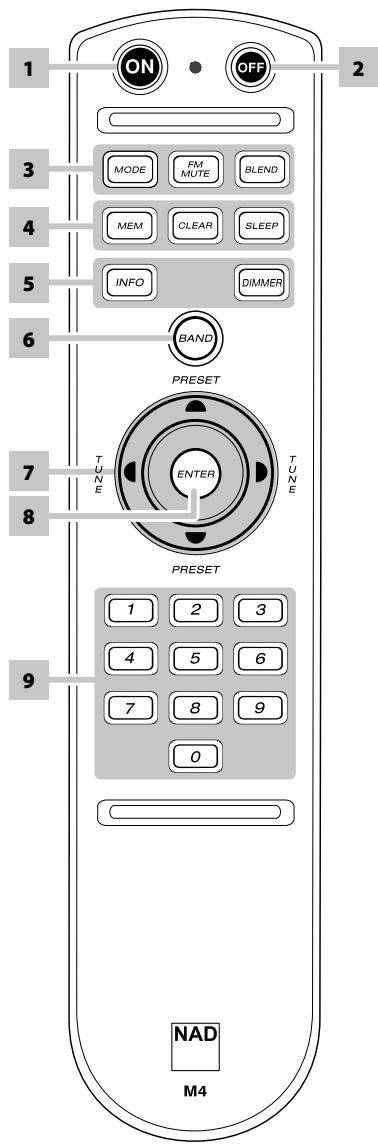
1 ON: Power ON M 4.
2 OFF: Power OFF M 4.
3 MODE: Enable DAB or XM menu.
FM MUTE : Engage FM Mute On or FM Mute Off.
BLEND : Reduce the amount of noise and hiss while retaining some level of stereo separation.
4 MEM: Store tuned AM, FM and digital radio stations.
CLEAR : Clear all characters during user preset naming process.
SLEEP: Switch off tuner after a preset number of minutes. Each consecutive press will reduce the sleep time in preset increments until sleep mode is cancelled as shown in the front panel display.
5 DIMMER: Toggle to either reduce or restore normal VFD brightness.
INFO : Repeatedly pressing this button will show information as supplied by the current radio station
6 BAND : Select AM, FM, DAB or XM tuner functions.
7 [▲/▼/◄/►]: Tune Forward [►] and Tune Backward [◄], Preset Forward [▲] and Preset Backward [▼]; navigation of DAB or XM tuner functions.
8 ENTER: Complete a selection, procedure, sequence or other applicable functions.
9 0-9 number buttons : Direct-entry of frequency channel or preset number.
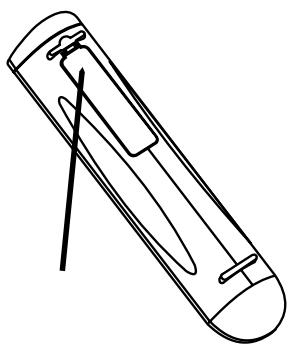
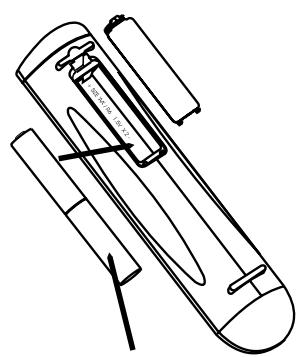
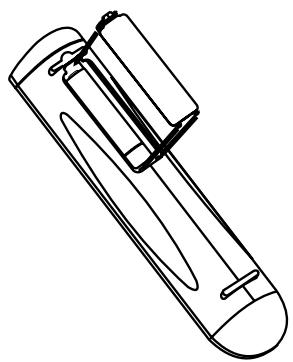
BATTERY ASSEMBLY
natural_image
Line drawing of a pen-like object with a stand and handle (no text or symbols)Press in and lift tab to remove battery cover out of recess.
natural_image
Technical line drawing of a mechanical device with no visible text or symbolsPress batteries into opening. Ensure correct fitting is observed.
natural_image
Line drawing of a pen or stylus with a handle and spout (no text or symbols)Replace battery cover by aligning and inserting the two tabs into the holes. Press battery cover into place until 'clicks' closed.
The M4's internal AM/FM tuner offers very high quality sound from radio broadcasts. The reception and sound quality will always be dependent to a degree however on the type of antenna(s) used as well as proximity to the broadcast origin, geography and weather conditions.
ABOUT ANTENNAS
The supplied ribbon-wire FM antenna can be connected to the rear-panel FM-antenna input using the included "balun" adapter and should be fully extended to form a "T". This folded-dipole antenna will usually work best when oriented vertically, with the arms of its "T" fully outstretched and arranged perpendicular to the origin of the desired broadcast. There are no "rules" however, and experimenting freely with antenna placement and orientation may yield the clearest sound and lowest background noise.
In areas of poor FM reception, an exterior FM antenna can improve performance dramatically. If radio listening is important to you, consider consulting an antenna installation professional to optimize your system.
The supplied AM "loop" antenna will usually provide adequate reception. However, an exterior AM antenna can be used to improve reception. Consult an antenna professional for more information.
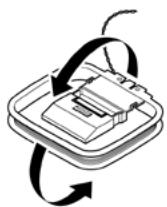
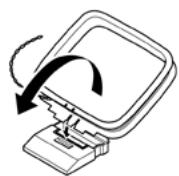
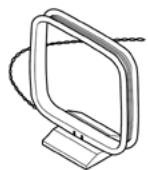
ASSEMBLING THE LOOP ANTENNA
1 Rotate the outer frame of the antenna.
2 Insert the bottom edge of the outer frame into the groove on the stand.
3 Extend the antenna cord.
SELECTING BAND
Press the [BAND] button on the front panel or on the remote control. Each subsequent press of either key will toggle the unit among AM, FM and XM (or DAB) radio.
TUNING STATIONS
1 Toggle [TUNE ◀/▶] on the front panel or remote control to step up or down between AM or FM frequencies.
2 Press and release [TUNE ◀/▶] to search up or down - the M4's tuner will stop at the next sufficiently strong signal it encounters. Pressing the [TUNE ◀/▶] during the search process will stop the search.
Using the [ENTER] button, the signal strength of a tuned station can be displayed in the VFD. Press and hold [ENTER] button to display the signal strength; press [ENTER] again to resume normal display.
DIRECT TUNING
If you know your desired station's frequency allocation, you can tune directly to the station.
1 Toggle [ENTER] button to switch between "Preset" and "Tune" mode (see the lower line of the VFD). Select "Tune" mode.
2 Using the numeric keys of the remote control, key-in the frequency allocation of the station and then, press [ENTER].
SETTING RADIO PRESETS
The M4 can store a mix of your 40 favorite AM, FM and digital radio for immediate recall.
1 To store a radio preset, first tune the desired frequency (see above), then press the front panel [MEMORY] key.
2 Press the PRESET [▲/▼] keys to select a 'Preset Free' number to be assigned.
3 Then, press the [MEMORY] key once again to save the station to the particular Preset number and displaying 'P__' (the two blank spaces will correspond to the preset stored number that could be from '01' to the maximum of '40') on the VFD.
4 Press PRESET [▲/▼] on the front panel to step up or down between presets. Press and hold PRESET [▲/▼] to "scroll" continuously up or down. Stop or release the PRESET [▲/▼] key while scrolling to select a desired Preset number – the stored station will be recalled after a brief delay or press ENTER to tune immediately to the selected Preset number. The M4 remote's 'PRESET' keys work similarly.
The Radio Presets can be stored using the same keys on the front panel or remote control.
LISTENING TO AM/FM RADIO
DIRECT RECALL OF A PRESET
You can directly recall a desired Preset number.
1 Toggle [ENTER] button to switch between "Preset" and "Tune" mode (see the lower line of the VFD). Select "Preset" mode.
2 Using the numeric keys of the remote control, key-in directly your desired Preset number and then, press [ENTER].
DELETE A PRESET
1 Select the Preset number to be deleted.
2 Press and hold [INFO] button and then press and release MEMORY button – current stored preset setting will be erased.
The Radio Preset can only be deleted using the front panel buttons.
CHOOSING FM MUTE MODE
The front-panel "fm mute" button is a dual-purpose control. In the normal position ("FM Mute On" is displayed in the lower line of the VFD), only the stations with a strong signal can be listened to, and the noise between stations is muted.
Pressing the "fm mute" button again ("FM Mute Off" is displayed in the lower line of the VFD) allows distant and potentially noisy stations to be received. Noise is reduced if the FM station signal level is less than the FM Stereo threshold (since mono FM is inherently less noise-prone) though at the sacrifice of the stereo effect.
NOTE
One can store the same channel in two preset locations - one with "FM Mute Off" and another with "FM Mute On".
ABOUT USER NAMES
You can assign an eight character "User Name" to each radio preset, which will show in the front-panel readout whenever that preset is recalled.
ENTERING USER NAMES
To name a radio preset "NEWS," follow the procedure as below (The buttons mentioned apply to the front panel's buttons.
1 Recall the desired radio preset.
2 Then, press the [MEMORY] button once and then within five (5) seconds, press the [INFO] button - the readout shows a blinking box.
3 Use the PRESET [▲/▼] buttons to select the first character of the name ("N" from the alphabetical list).
4 Press [TUNE ▶] button to select the character and correspondingly move forward to the next position. (Press TUNE [◀] to go back to the previous character). Repeat this process for each character in sequence.
5 Press the MEMORY key again or [ENTER] to store the User Name and exit the text-entry mode.
ABOUT RDS
The Radio Data System (RDS) permits sending small amounts of digital information using conventional FM radio broadcasts. The M4 supports two RDS modes, station-name (PS mode) and radio-text (RT mode). Not every FM station incorporates RDS in its broadcast signal. In most areas you will find from one to several RDS-enabled stations, but it is by no means impossible that your favorite stations will not be broadcasting RDS data.
VIEW RDS TEXT
When an RDS-enabled FM broadcast is tuned, after a brief delay the lower line of the VFD will show its station-name (PS) text: "ROCK101," for example.
Toggle the front-panel [INFO] key to scroll among other MODE settings for the station's radio-text (RT) readout, if any, which might scroll song or artist name or any other text of the station's choosing.
ABOUT XM RADIO (120V VERSION ONLY)
The M4 is "XM Ready" which means that with the addition of separately sold XM Mini-Tuner CPC-9000 and XM Mini-Tuner Home Dock, it has everything you need to listen to live XM. Everything else is built right in. Just subscribe to the XM service and your M4 will be ready to receive XM content.
NOTES
• Questions? Visit www.xmradio.com
Listeners can subscribe by visiting XM on the Web at www.xmradio.com or by calling (at the time of printing this manual) XM's Listener Care at (800) 853 9696. Be ready with your Radio ID that can be found on the radio by selecting Channel 0.
- Check with your NAD audio specialist for other versions of XM Mini-Tuner compatible with M4.
CONNECTING THE XM ANTENNA
1 Plug the end of the XM antenna into the corresponding XM antenna port on the rear panel of the M4.
2 Press and hold "MODE" button on the front panel to check the current XM channel's signal strength as shown in the VFD and OSD. Press "MODE" again to exit signal strength check.
Refer also to your XM radio's guide on how to install the XM antenna for optimum signal reception.
TUNING STATIONS
There are three ways to tune to the XM channel you wish to listen. Use either the front panel buttons or remote control keys for the following procedures.
1 Manual Tuning: Toggle the [◀/▶] buttons to step up or down each available XM channel. Press and hold [◀/▶] for faster scanning of XM channels. Press [ENTER] or release [◀/▶] buttons to select desired XM channel.
2 Direct Channel Call: Toggle [ENTER] button to switch between "Preset" and "Tune" mode (see the lower line of the VFD). Select "Tune" mode. Using the numeric keypads of the remote control, key-in directly the desired available channel number and it will be automatically tuned.
3 Category: Toggle "MODE" until "Cat" and a corresponding category is displayed on the VFD. "Cat" stands for the categories channels are grouped into – i.e., Country, Rock, Jazz & Blues, etc. Toggle [▲/▼] buttons to step up or down the available categories.
After selecting the desired category, use the same steps as that of XM Manual Tuning. Tuning will only be limited to within the selected category. Toggle the [▲/▼] buttons to choose another category and then tune again.
VIEW XM INFORMATION
Toggle 'INFO' button to display the XM information of the selected channel such as the artist name, song title, category or any other text as supplied for the channel.
PRESETS
The procedure for storing XM channels is the same method as stated in the section "Setting Radio Presets" under "Listening to AM / FM Radio."
For immediate recall of stored XM presets, press [PRESET ▲/▼] keys to step up or down the stored presets that can be a combination of AM, FM and XM channels.
NOTE
If you are at Category tuning mode, toggle [MODE] to exit from Category mode first; then you can directly recall the Presets by pressing [PRESET ▲/▼] keys.
LISTENING TO DAB RADIO
ABOUT DAB RADIO (230V VERSION ONLY)
Until now, analogue radio signals such as FM or AM have been subject to numerous kinds of interference on their way from the transmitter to your radio. These problems were caused by mountains, high-rise buildings and weather conditions. With Digital Audio Broadcast (DAB), you can now receive CD-like quality radio programs without any annoying interference and signal distortion. DAB broadcasts use digital signals rather than traditional analogue transmissions, thus providing clear high quality reception. You get far more robust reception and virtually hiss or crackle free sound with DAB as long as you are within a good coverage area.
With DAB, the listener can scroll through a list of available stations - then instantly tune to the station of his choice. There is no need either to remember channel frequencies. All broadcasts are selected by simply selecting the service name.
The M4 makes it possible for you to enjoy listening to DAB broadcasts. Connect the other end of the supplied DAB antenna into the DAB antenna terminal and start enjoying the CD-like quality sound and expansive content selection available with DAB.
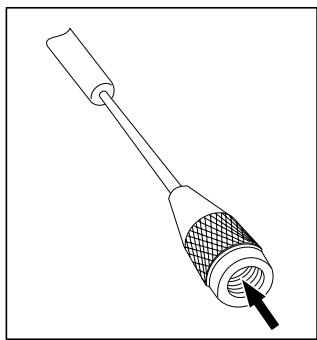
DAB ANTENNA ASSEMBLY
1 Connect the antenna to its base.
natural_image
Line drawing of a mechanical connector with a pointed tip and textured body (no text or symbols)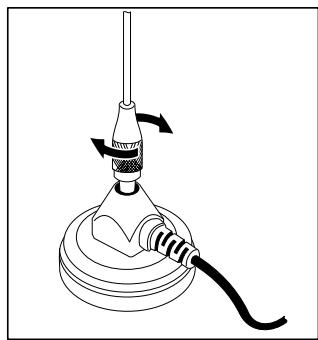
natural_image
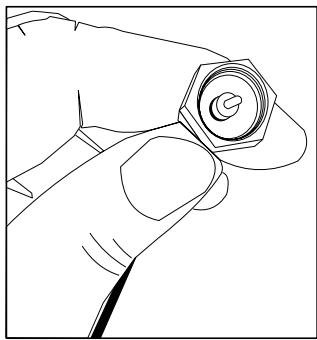
Line drawing of a laboratory alcohol lamp with a rotating handle and base, no text or symbols present2 Plug-in the antenna connector to the M4 DAB antenna terminal.
natural_image
Line drawing of a hand holding a hexagonal nut (no text or symbols)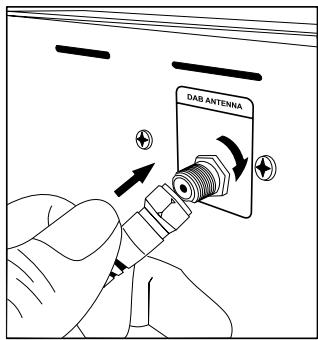
NOTES
• Make sure that both connections above are secured by rotating and fixing firmly the part being connected into the corresponding terminal.
- Do not place the antenna base close to any magnetic media as the antenna base has magnetic component also.
DAB OPERATION
With the supplied DAB antenna already connected to the M4, you can now carry out the M4 to receive DAB broadcasts. Use either the front panel buttons or remote control keys for the following procedures.
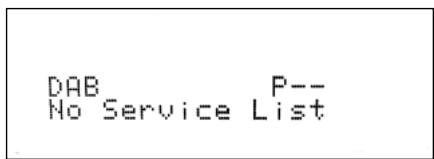
1 Toggle [BAND] button until DAB mode. The VFD will show "No Service List" indicating that there are no scanned DAB broadcast services yet. This is the default mode of the DAB mode.
2 To tune to DAB broadcast services, press [MODE] and then toggle the front panel's [TUNE ◀/▶] to select either "Full Scan" or "Local Scan." Press [ENTER].
FULL SCAN will enable the scanning of the full range of digital frequencies (Band III and L-Band).
LOCAL SCAN performs local scanning of available DAB services in your area. Check with your dealer or visit www.WorldDAB.org to check the applicable digital transmission frequencies in your area.
3 Upon selecting either "Full Scan" or "Local Scan," automatic scanning will be performed. This sequence cannot be interrupted. During the sequence, the following message will be visible in the VFD.
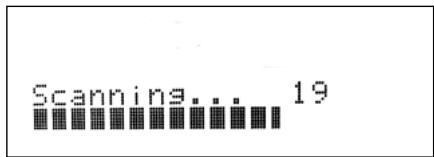
The bars show the progress of the sequence. When scanning is completed, the last number shown on the right side of the VFD corresponds to the total number of DAB broadcast stations found. Then, the first station is tuned in (See "Alphanumeric" section below to understand the order or arrangement of stations).
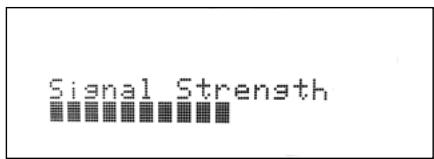
4 The strength of the incoming signal can be shown on the VFD by pressing the [ENTER] button. The more segments visible in the lower display line, the stronger the signal. By changing the position of the antenna, you can increase the signal strength. You can also opt for an external antenna. Consult an antenna professional for more information.
NOTE
"No Service List" will also be shown in the VFD when no stations are found after the scanning process. If this occurs, check the connection and position of the DAB antenna or call your local DAB broadcast providers for coverage information.
SERVICE LIST
Follow the steps below to select through the DAB service stations found.
1 At DAB mode, press [TUNE ◀/▶] to step through the list of available stations as shown in the lower display line of the VFD.
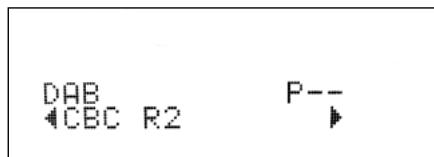
2 Press [ENTER] to select the desired station.
LISTENING TO DAB RADIO
DAB MODE
Aside from "Full Scan" and "Local Scan" as already described above, pressing the [MODE] button will also present you with other options namely – Station Order, DRC, Manual Scan, Prune List and Reset
STATION ORDER
Use "Station Order" to sort the sequence of the listed stations. There are three orders – Alphanumeric, Ensemble and Active.
1 While listening to a DAB broadcast, press front panel's [MODE] button and then [TUNE ◀/▶] to select "Station Order." Press [ENTER].
2 Toggle [TUNE ◀/▶] to select through "Alphanumeric," "Ensemble" and "Active."
3 Press [ENTER] to select desired station order.
ALPHANUMERIC
This is the default setting. Stations are arranged by numbers first and then alphabetically by letters.
ENSEMBLE
Digital radio is broadcast as groups of data called ensemble. Each ensemble contains a number of stations, transmitted at a set frequency. When "Ensemble" is selected as the mode of station order, the radio stations are arranged in the order of their ensemble names.
NOTE
Ensemble is also interchangeably termed as "multiplex" by other broadcast providers.
ACTIVE
Active stations are listed at the top of the channel list. Those channels that are in list but have no service in the area will be displayed last in the channel list.
DRC VALUE
The level of compression of stations can be set to eliminate the differences in dynamic range or sound level between radio stations. Popular music would normally be more compressed than classical music, resulting in possible different audio levels when changing from one station to the other. Setting the DRC to "0" means no compression, "1/2" indicates medium compression and "1" shows maximum compression. No compression is recommended, especially for classical music.
1 While listening to a DAB broadcast, press front panel's [MODE] button and then [TUNE ◀/▶] to select "DRC." Press [ENTER].
2 Toggle [TUNE ◀/▶] to select through "DRC 0," "DRC 1/2" and "DRC 1."
3 Press [ENTER] to select desired DRC level.
MANUAL SCAN
This option allows you to directly tune to a desired channel and include it in the service list (if not yet available at the time). You can also use manual scan to assist you in positioning the DAB antenna for best reception of the desired channel.
1 While listening to a DAB broadcast, press front panel's [MODE] button and then [TUNE ◀/▶] to select "Manual Scan." Press [ENTER]. The current channel and frequency are shown in the upper line of the VFD. The "bars" at the lower line of the VFD indicate the signal strength level of the current channel.
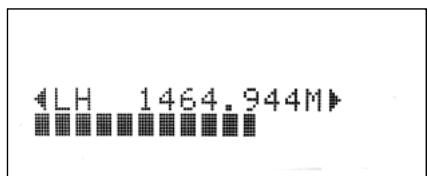
2 To select other channels, toggle [TUNE ◀/▶] to step through the channel list. Release [TUNE ◀/▶] when you have arrived at your desired channel. Channel and frequency are shown in the upper line of the VFD. The "bars" at the lower line of the VFD indicate the signal strength level of the current channel. To improve the reception of the selected channel, adjust or reposition the DAB antenna until the best reception is indicated.
3 Press [ENTER] to tune the selected channel.
NOTE
The number of ensembles and stations that could be scanned will vary depending on your location.
PRUNE LIST
There maybe situations wherein certain stations become inactive. The "Prune List" option enables the deletion of these inactive stations in the service list.
1 While listening to a DAB broadcast, press front panel's [MODE] button and then [TUNE ◀/▶] to select "Prune List."
2 Press [ENTER]. Any inactive stations are automatically deleted.
RESET
The "Reset" option allows the DAB section of the M4 to be reset to its factory default settings.
1 While listening to a DAB broadcast, press front panel's [MODE] button and then [TUNE ◀/▶] to select "Prune List."
2 Press [ENTER]. "Reset? No" will be shown in the lower line of the VFD. Press [TUNE ◀/▶] to switch to "Reset? Yes" option.
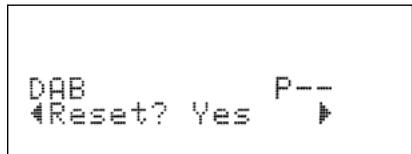
3 To select "Reset? No" or "Reset? Yes," press [ENTER] while at the desired option. Selecting "Reset? Yes" will cause the DAB section to be reset to its factory default settings.
LISTENING TO DAB RADIO
INFORMATION SETTINGS
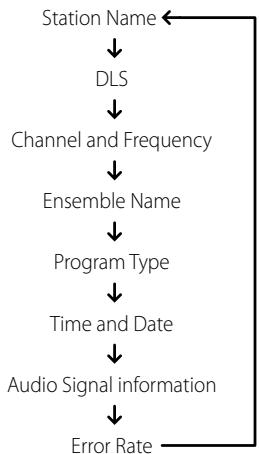
While listening to a DAB broadcast, the type of information displayed in the lower line of the VFD can be varied. Toggle front panel's [INFO] button to step through the following display options:
flowchart
graph TD
    A["Station Name"] --> B["DLS"]
    B --> C["Channel and Frequency"]
    C --> D["Ensemble Name"]
    D --> E["Program Type"]
    E --> F["Time and Date"]
    F --> G["Audio Signal information"]
    G --> H["Error Rate"]
STATION NAME
The name or identification of the DAB broadcast station is shown. This is the default display.
DLS
Dynamic Label Segment (DLS) is the scrolling text supplied by the broadcasting station. It may contain information on music titles or details regarding the program or station.
CHANNEL AND FREQUENCY
The channel and frequency of the currently tuned DAB broadcast are displayed.
ENSEMBLE NAME
The name of the ensemble that is broadcasting the program is displayed.
PROGRAM TYPE
This is a description of the type of broadcast supplied by the station, such as Pop, Rock, Drama and the like.
TIME AND DATE
The current time and date as supplied by the DAB station are displayed.
AUDIO SIGNAL INFORMATION
Displays the bit rate and audio type (stereo, mono or joint stereo) as transmitted by the DAB broadcast provider. These are set by the broadcaster to suit the type and quality of material being transmitted.
ERROR RATE
This displays the digital error rate (0 to 99) of the currently tuned channel - the lower the figure, the better the quality of the received broadcast.
| CONDITION | POSSIBLE CAUSES | POSSIBLE SOLUTIONS |
| No power. | ·The power cord is disconnected. | ·Plug the power cord into the wall outlet securely. |
| No sound. | ·Power AC lead unplugged or power not switched ON. | ·Check AC lead. |
| ·Signal leads incorrectly connected. | ·Check connections to amplifier. | |
| ·Station not selected or weak signal with FM Mute on | ·Re-tune or switch off FM Mute. | |
| Noisy reception, hiss. | ·Weak signal. | ·Check station tuning. Adjust or replace antenna. |
| Display shows “No Service List”. | ·DAB antenna not connected properly. | ·Check the connection and position of the DAB antenna. |
| ·No DAB coverage in the area. | ·Call your local DAB broadcast providers for coverage information. | |
| Reception with whistling, buzzing noise. | ·Interference from other computers, games consoles. | ·Check station tuning. Switch off or move the source of electrical noise. |
| No rds information. | ·Station signal too weak. | ·Check station tuning. Adjust or replace antenna. |
| ·Station not transmitting RDS data. | ·Tune to an RDS station that supports station-name (PS mode) and radio-text (RT mode). | |
| M4 does not respond to remote control. | ·Batteries are flat or incorrectly inserted. | ·Check batteries. |
| ·IR transmitter window on remote or IR receiver window on M4 is obstructed. | ·Check IR windows and ensure clear line-of-sight from remote to M4. | |
| ·M4 front panel is in very bright sunlight or ambient light. | ·Reduce sunlight/room lighting. |
SPECIFICATIONS
FM SECTION
| Tuning Range | 87.5000 MHz – 108.5000 MHz (0.0125 MHz steps) |
| Usable Sensitivity (98 MHz) | 13 dBμ |
| Signal/Noise Ratio | 72 dB (60 dBμ IHF-WTD Mono) |
| 66 dB (60 dBμ IHF-WTD Stereo) | |
| Frequency Response | ±1.0 dB (20 Hz - 15 kHz, 60 dBμ) |
| Channel Separation (60 dBμ) | 33 dB (30 Hz) |
| 42 dB (1 kHz) | |
| 32 dB (10 kHz) | |
| Capture Ratio (40 dBμ) | 3 dB |
| AM Suppression | 65 dB (60 dBμ, 100% Mod. FM, 30% Mod. AM) |
| Image Rejection (119.4 MHz) | 85 dB |
| I.F. Rejection (10.7 MHz) | 78 dB |
| Pilot Suppression (60 dBμ) | 60 dB |
| Total Harmonic Distortion* | 0.25% (Mono) |
| 0.35% (Stereo) | |
| Auto Search (Sensitivity On) | 24 dBμ |
| Auto Search (Sensitivity Off) | 15 dBμ |
| RDS Decode Sensitivity | 26 dBμ |
AM SECTION
| Tuning Range | 530 kHz – 1710 kHz (120V version only, 10 kHz steps) |
| 531 kHz – 1602 kHz (230V version only, 9 kHz steps) | |
| Usable Sensitivity (999/1000 kHz) | 30 dBμ |
| S/N Ratio (5 mV in) | 38 dB |
| Total Harmonic Distortion (5 mV in) | 3% |
| IF Rejection (450 kHz) | 36 dB |
| Image Rejection (F+2xIF) | 28 dB |
| Selectivity | 17 dB |
| Loop Sensitivity (20dB S/N) | 66 dB (999 /1000 kHz) |
| 66 dB (603/600 kHz) | |
| 66 dB (1404/1400 kHz) | |
| Frequency response (100 - 2.3 kHz, 5 mV) | ±6 dB |
| Audio Output | 130 mV ±20 mV |
DAB SECTION (230V VERSION ONLY)
BAND III
| Tuning Range | 174 -240 MHz |
| Maximum input signal | -10 dBm |
| Usable Sensitivity | -100 dBm typical |
| Far-off Selectivity | 40 dB |
| Adjacent Channel rejection | 40 dB |
| Total Harmonic Distortion | 0.01% |
| S/N Ratio (2 Vrms) | 100 dB |
| Frequency Response | ±0.3 dB (10 Hz – 20 kHz) |
L BAND
| Tuning Range | 1452 – 1492 MHz |
| Maximum input signal | -16 dBm |
| Usable Sensitivity | -97 dBm typical |
| Far-off Selectivity | 40 dB |
| Adjacent Channel rejection | 40 dB |
| Total Harmonic Distortion | 0.01% |
| S/N Ratio (2 Vrms) | 100 dB |
| Frequency Response | ±0.3 dB (10 Hz – 20 kHz) |
PHYSICAL SPECIFICATIONS
| Dimensions (W x H x D) Net | 435 x 100 x 300 mm |
| Gross | 435 x 115 x 312 mm |
| Net weight | 8.8 kg (120V version only) |
| 8.9 kg (230V version only) | |
| Shipping weight | 14.2 kg (120V version only) |
| 14.5 kg (230V version only) |
Note: Gross dimensions include feet, extended buttons and rear panel terminals.
* (60 dBμ, L=R 75 kHz 120V version only; 40 kHz Dev 230V version only)
Specifications are subject to change without notice. For updated documentation and features, please log onto www.NADElectronics.com for the latest information about M4.

www.NADelectronics.com
©2008 NAD ELECTRONICS INTERNATIONAL
A DIVISION OF LENBROOK INDUSTRIES LIMITED
- NOTE TO CATV SYSTEM INSTALLER
- WARNING
- CAUTION REGARDING PLACEMENT
- IMPORTANT INFORMATION TO UK CUSTOMERS
- IMPORTANT
- IF IN DOUBT CONSULT A COMPETENT ELECTRICIAN.
- NOTES ON ENVIRONMENTAL PROTECTION
- RECORD YOUR MODEL NUMBER (NOW, WHILE YOU CAN SEE IT)
- TABLE OF CONTENTS
- IMPORTANT SAFETY INSTRUCTIONS ......2
- INTRODUCTION
- IDENTIFICATION OF CONTROLS
- OPERATION
- REFERENCE
- THANK YOU FOR CHOOSING NAD.
- http://NADelectronics.com/warranty
- WHAT'S IN THE BOX
- SAVE THE PACKAGING
- CHOOSING A LOCATION
- ABOUT M4
- FRONT PANEL
- NOTE
- ATTENTION!
- DIGITAL AUDIO OUT - OPTICAL, COAXIAL (230V version only):
- M4 REMOTE CONTROL
- ABOUT ANTENNAS
- ASSEMBLING THE LOOP ANTENNA
- SELECTING BAND
- TUNING STATIONS
- DIRECT TUNING
- SETTING RADIO PRESETS
- LISTENING TO AM/FM RADIO
- DIRECT RECALL OF A PRESET
- DELETE A PRESET
- CHOOSING FM MUTE MODE
- ABOUT USER NAMES
- ENTERING USER NAMES
- ABOUT RDS
- VIEW RDS TEXT
- ABOUT XM RADIO (120V VERSION ONLY)
- NOTES
- CONNECTING THE XM ANTENNA
- VIEW XM INFORMATION
- PRESETS
- LISTENING TO DAB RADIO
- ABOUT DAB RADIO (230V VERSION ONLY)
- DAB ANTENNA ASSEMBLY
- DAB OPERATION
- SERVICE LIST
- DAB MODE
- STATION ORDER
- ALPHANUMERIC
- ENSEMBLE
- ACTIVE
- DRC VALUE
- MANUAL SCAN
- PRUNE LIST
- RESET
- INFORMATION SETTINGS
- STATION NAME
- DLS
- CHANNEL AND FREQUENCY
- ENSEMBLE NAME
- PROGRAM TYPE
- TIME AND DATE
- AUDIO SIGNAL INFORMATION
- ERROR RATE
- SPECIFICATIONS
Brand : NAD
Model : M4
Category : Audio Amplifier