
PARKWAY SG - Car seat BRITAX - Free user manual and instructions
Find the device manual for free PARKWAY SG BRITAX in PDF.


User questions about PARKWAY SG BRITAX
0 question about this device. Answer the ones you know or ask your own.
Ask a new question about this device
Download the instructions for your Car seat in PDF format for free! Find your manual PARKWAY SG - BRITAX and take your electronic device back in hand. On this page are published all the documents necessary for the use of your device. PARKWAY SG by BRITAX.
USER MANUAL PARKWAY SG BRITAX
text_image
PLEASE READ INSTRUCTIONS STORE UNDER BASE
text_image
BritaxSafety Information....2
Warnings 2
Important Notes......4
Certification 5
Registration....5
Child Size: Height and Weight Limitations.... 6
When Using Backrest....6
When Using without Backrest.... 7
Vehicle Compatibility 8
Vehicle Buckle Position....9
Vehicle Seat Belts....10
Incompatible Vehicle Seat Belts 11
Child Seat Features.... 12
Using the Child Seat 14
Attaching the Backrest 14
Removing the Backrest.... 15
Adjusting the Backrest 16
Adjusting Head Restraint Height 17
SecureGuard 18
Adjusting SecureGuard Fit.... 18
Using the Retractable Cup Holders 19
Positioning the Booster Seat 20
Positioning and Securing Your Child with Backrest...... 20
Positioning and Securing Your Child without Backrest...... 22
Care and Maintenance.... 24
Cover Removal 24
Removing the Backrest Cover 24
Removing the Head Restraint Cover 24
Removing the Armrest Covers.... 24
Removing the Seat Cover 25
Cleaning the Cover.... 25
Replacing the Cover 25
Cleaning the Shell 25
Warranty 26
- Use only with children who weigh between 40 and 120 lbs (18.1 and 54.4 kg) and whose height is between 38 and 63 inches (96.5 and 160 cm).
- Use only the vehicle's lap and shoulder belt system when restraining a child in this booster seat.
- Secure this child restraint with a vehicle belt.
- Follow all instructions on this child restraint and in the written instructions located under the base of the seat.
- Register your child restraint with the manufacturer.
- Use this booster seat forward-facing only.
- DO NOT use this booster seat as a backless booster unless it is used in a seating position with a vehicle head restraint.
- DO NOT use this booster seat as a backless booster unless proper vehicle belt placement can be achieved.
- This booster seat must not be used in the home, in boats, or in other non-certified applications.
- Secure this booster seat with a vehicle seat belt even when it is not occupied. In a crash, an unsecured booster seat may injure vehicle occupants.
-
This booster seat is not compatible with Lower Anchors and Tethers for Children (LATCH).
-
DO NOT use this booster seat with two-point vehicle belts (lap belt only or shoulder belt only). Your child could be seriously injured in the event of a crash.
- Based on crash statistics, the National Highway Traffic Safety Administration (NHTSA) recommends that parents select the rear seat as the safest location for a properly positioned booster seat. Please study the section on Vehicle Seat Belts in this booklet to ensure the child's safety. If in doubt about installing this booster seat, consult the vehicle owner's manual.
- DO NOT use any part of this booster seat with other seat cushions or backrests.
- The use of non-Britax covers, inserts, toys, accessories or tightening devices is not approved by Britax. Their use could cause this booster seat not to perform as intended.
- To prevent injury due to deterioration, discontinue use of a booster seat that is older than six years or has been in a severe crash.
- The primary protection for occupants of a vehicle in a collision is the structure of the vehicle itself; a booster seat will not protect a child when the vehicle is seriously impacted. However, correctly installed, a booster seat will substantially improve the chances for survival in most crashes. Make sure that all users fully understand the correct ways to use this booster seat in a vehicle.
Important Notes
- The NHTSA and the American Academy of Pediatrics recommends that children should remain in a child seat with a 5-point harness until reaching the maximum weight or height allowed.
- Cover the booster seat when the vehicle is parked in direct sunlight. Parts of the booster seat could become hot enough to burn a child.
- Store the booster seat in a safe place when it is not being used. Avoid placing heavy objects on top of the booster seat.
- DO NOT leave children alone in a vehicle, even for a short time.
- DO NOT, except as described in this booklet, attempt to disassemble any part of the booster seat or change the way the vehicle's seat belts are used.
- DO NOT leave loose objects, e.g. books, bags, etc., in the back of a vehicle. In the event of a sudden stop, loose objects will keep moving, potentially causing serious injuries.
- DO NOT leave folding vehicle seats unsecured. In the event of a sudden stop, a loose seat back could cause the booster seat not to perform as intended.
- DO NOT allow children to play with this booster seat.
- DO NOT use anything to raise the booster seat off the vehicle seat. In a crash, this could cause the booster seat not to perform as intended.
Certification
This child restraint system conforms to all applicable Federal motor vehicle safety standards. This Restraint is Not Certified for Use in Aircraft.
Registration
Child restraints could be recalled for safety reasons. You must register this restraint to be reached in a recall. Send your name, address, e-mail address if available, and the restraint's model number and manufacturing date to Britax Child Safety, Inc. 13501 South Ridge Drive Charlotte, NC 28273 or call 1-888-4BRITAX or register on line at www.BritaxUSA.com/registration. For recall information, call the US Government's Auto Safety Hotline at 1-888-327-4236.
Serial Number:
Batch Number:
Date of Manufacture: ____
Child Size: Height and Weight Limitations
When Using Backrest
Only use forward-facing with children:
• who weigh between 40 and 120 lbs (18.1 and 54.4 kg) and
• who are between 38 and 63 in. (96.5 and 160 cm) in height and
- when the top of the child’s ears are below the top of the
head restraint (Fig. A) and
- when the shoulder belt lies across the center of the child's chest and is positioned at or above the child's shoulder through the shoulder belt guide and
- when the lap belt is routed under the armrests, through the SecureGuard, across the child's upper thighs.
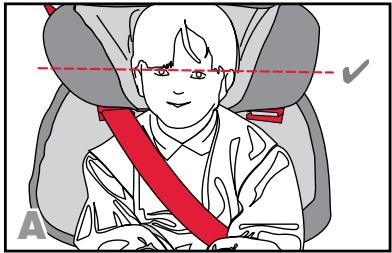
natural_image
Illustration of a person wearing a car seatbelt with a red belt, no text or symbols present
WARNING! DO NOT use the booster seat with the
backrest if any of the following apply:
- the child weighs less than 40 lbs (18.1 kg) or
- the child weighs more than 120 lbs (54.4 kg) or
- the child is less than 38 in. (96.5 cm) in height or
- the child exceeds 63 in. (160 cm) in height or
- the top of the ears are above the top of the fully raised head restraint (Fig. B).
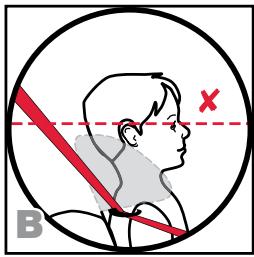
text_image
B XWhen Using without Backrest
Only use forward-facing with children:
• who weigh between 40 and 120 lbs (18.1 and 54.4 kg) and
• who are between 38 and 63 in. (96.5 and 160 cm) in height and
- when the top of the child's ears are below the top of the vehicle head restraint and
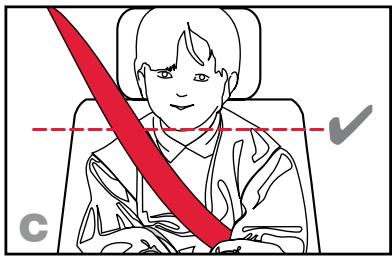
- when the shoulder belt lies across the center of the child's chest and is positioned at or above the child's shoulder (Fig. C) and
- when the lap belt is routed under the armrests, through the SecureGuard, across the child's upper thighs.
text_image
C
WARNING! DO NOT use the booster seat without
the backrest if any of the following apply:
• the child weighs less than 40 lbs (18.1 kg) or
• the child weighs more than 120 lbs (54.4 kg) or
- the child is less than 38 in. (96.5 cm) in height or
- the child exceeds 63 in. (160 cm) in height or
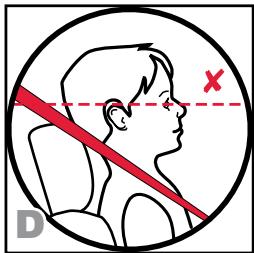
- the top of the ears are above the top of the fully raised vehicle head restraint (Fig. D) or
- proper vehicle seat belt positioning cannot be achieved across the child's shoulder and upper thighs.
text_image
D
WARNING!
Based on crash statistics, the National
Highway Traffic Safety Administration (NHTSA) recommends that parents select the back seat as the safest location for a properly positioned booster seat.
DO NOT place a booster seat on the front seat with an air bag unless it is deactivated. DEATH or SERIOUS INJURY can occur. See your vehicle owner's manual for booster seat positioning instructions. The back seat is the safest place for children 12 and under.
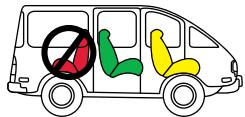
This booster seat must only be used in forward-facing vehicle seats. Side-facing or rear-facing seats CANNOT be used. For questions about positioning the booster seat consult the vehicle owner's manual.
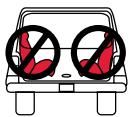
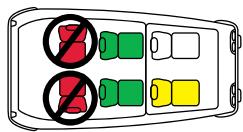
Some vehicles have no seating positions which are compatible with this booster seat or any other child seat. See diagram below.
text_image
Diagram of a van with colored seat positions and a red prohibition symbol, likely indicating vehicle safety or absence.
WARNING!
The back seat is the safest place for children 12 and under.
text_image
Diagram of a device control panel with red and yellow prohibition symbols indicating no protection or disapproval.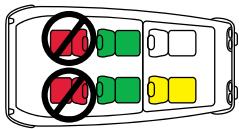
text_image
Diagram of a device control panel with red and green buttons and no symbols indicating prohibition or absence.Vehicle Buckle Position

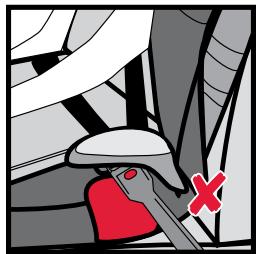
WARNING! The position of the vehicle seat belt is able to be able to be adversely affected by the stability of the booster seat.
If the buckle lies near the incorrect position (✗) when the vehicle seat belt is tightened, try fitting the booster seat in another seating position OR consult your vehicle owner's manual to see if you can lower the vehicle buckle position by twisting the vehicle buckle stalk.
If it is not possible to achieve the correct position (√) for the buckle, then another seating position or child seat MUST be used.
natural_image
Mechanical diagram showing a red belt buckle securing a car seatbelt with a red X mark (no text or symbols)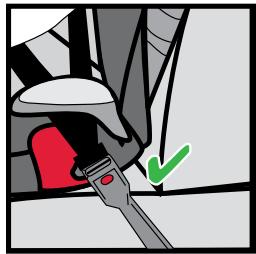
natural_image
Illustration of a car seatbelt buckle being inserted, with a green checkmark indicating the lock (no text or symbols present)Vehicle Seat Belts
IMPORTANT: Vehicle seats and vehicle seat belts differ from vehicle to vehicle. Refer to your vehicle owner's manual for specific information about vehicle seat belts and their use with child seats. This booster seat can fit securely in most vehicles using existing vehicle seat belts. However, some vehicles do not have seating positions which are compatible with this booster seat or any other child seat. If in doubt, contact the vehicle manufacturer for assistance.
To protect your child in a crash, you must use this booster seat with vehicle seat belts that are compatible. This booster seat can only be used with three-point (shoulder and lap) vehicle seat belts. The vehicle owner's manual will have information on the types of vehicle seat belts in your vehicle. If your vehicle seat belt type is identified on page 11 as incompatible, select another seating position.
Incompatible Vehicle Seat Belts
WARNING! The following types of vehicle seat belts are NOT compatible with this booster seat:
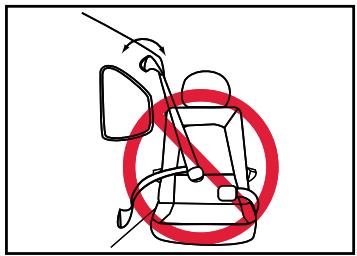
natural_image
Diagram of a car with a red prohibition symbol (no text or labels)1 Vehicle seat belts with top or bottom anchor points on the vehicle door.
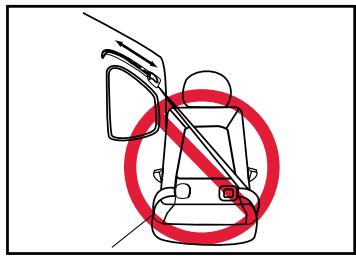
text_image
Diagram showing a car seatbelt with a red prohibition symbol, indicating no vehicle restriction.2 Motorized, automatic vehicle seat belts
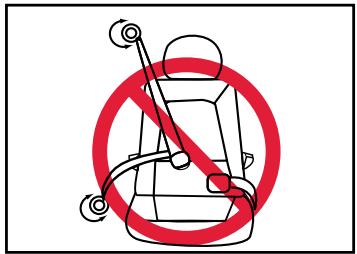
text_image
Prohibition sign with red prohibition symbol and car silhouette, indicating no traffic or parking restriction3 Lap-shoulder belts that have a separate retractor each for the lap and shoulder parts.
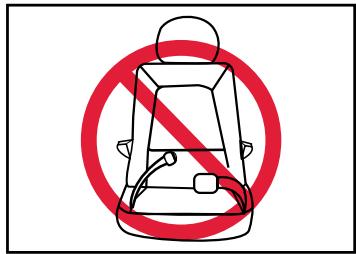
text_image
Prohibition sign showing a car seat with a red diagonal line indicating no restriction4 Lap belts of any kind.
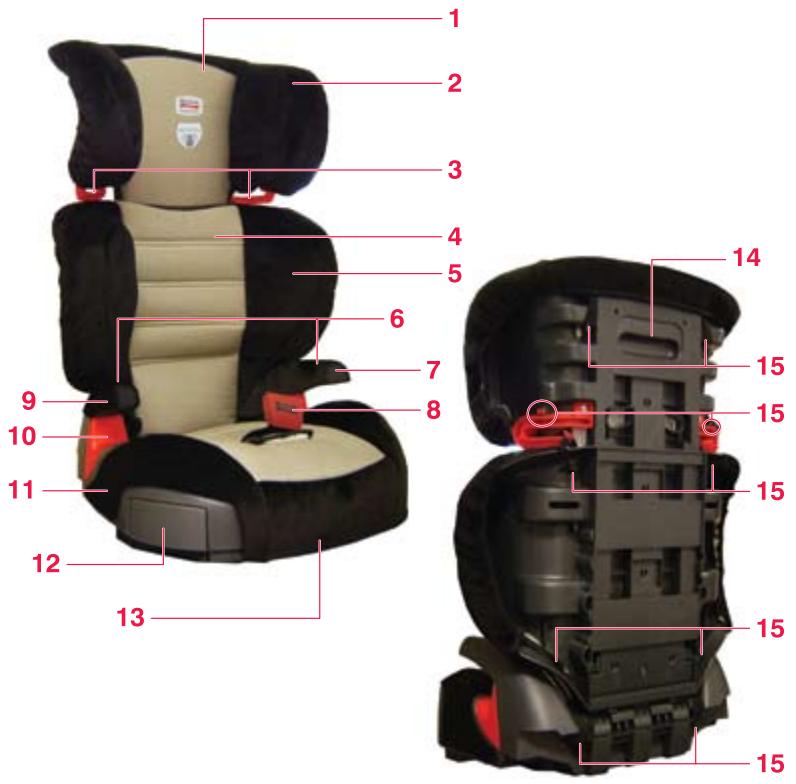
text_image
1 2 3 4 5 6 7 8 9 10 11 12 13 14 15 15 15 15 151 Head Restraint 9 Right Armrest Cover
2 Head Restraint Cover 10 Base Belt Guide
3 Shoulder Belt Guides 11 Base Cover
4 Backrest 12 Cup/Snack Holders
5 Backrest Cover 13 Base
6 Armrests 14 Head Restraint Height Adjuster
7 Left Armrest Cover 15 Elastic Retainers
8 SecureGuard Clip
* Appearance of actual product may vary from images in this user guide.
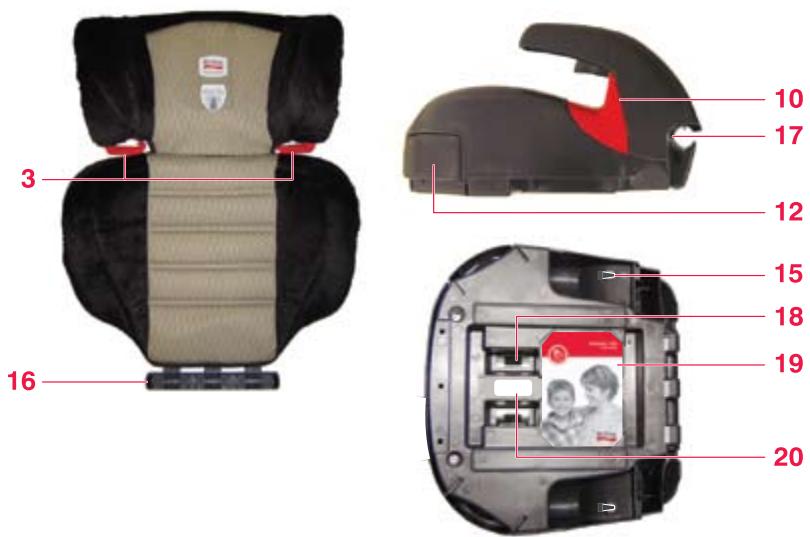
text_image
3 16 10 17 12 15 18 19 20* Base shown without cover for clarity.
16 Backrest Hinge Cylinder
17 Base Hinge Slot
18 SecureGuard Adjuster
19 User Guide Storage Slot
20 Serial Number and Manufactured Date Label
* Appearance of actual product may vary from images in this user guide.
Before you use the Parkway SG booster seat for the first time, you will have to complete the assembly steps below.
Attaching the Backrest
IMPORTANT: Keep fingers away from moving parts to avoid potential injury.
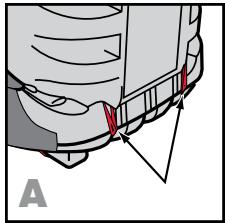
1 Detach the elastic loops of the base cover and armrest covers from the back of the booster seat base (Fig. A).
2 Place the base on a flat surface. From the child's left side of the booster seat, align the backrest hinge cylinder with the hinge slot on the base.
3 Push the backrest hinge all the way into the base hinge slot (Fig. B).
IMPORTANT: DO NOT rotate the backrest until the cylinder has been completely inserted into the base hinge slot. Rotating the backrest before it has been completely inserted may result in damage to the booster seat.
4 Rotate the backrest up until it doesn't rotate into the flat position under its own weight (Fig. C).
5 Attach the elastic loops of the base cover and armrest covers to the elastic retainers on the back of the booster seat (Fig. D).
natural_image
Diagram of a vehicle's roof structure with no visible text or symbols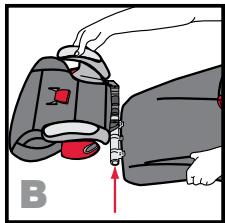
natural_image
Illustration of a hand holding a device with a red arrow pointing to it, labeled 'B' (no text or symbols on the device itself)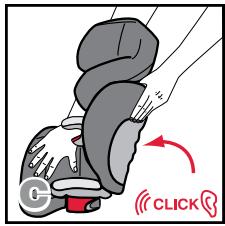
text_image
CLICK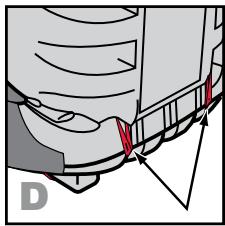
natural_image
Diagram of a boat hull with red markers indicating structural elements (no text or labels)Removing the Backrest
1 Place the booster seat on a flat surface.
2 Detach the seat cover and armrest covers from the base by unhooking the elastic loops from the elastic retainers on the back of the base (Fig. E).
3 Push the backrest down until it lies flat (Fig. F).
4 Slide the backrest from the child's left side of the base (Fig. G).
5 Attach the elastic loops of the base cover and armrest covers to the elastic retainers on the back of the base (Fig. H).
NOTE: Store the backrest in a safe place.
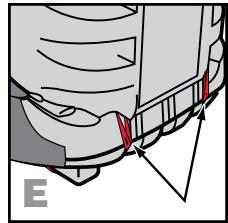
natural_image
Diagram of a mechanical or architectural component with red markings, no visible text or symbols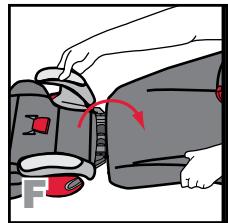
natural_image
Illustration of a person adjusting a device with arrows indicating motion (no text or symbols)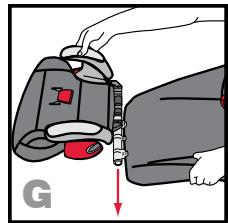
natural_image
Illustration of a hand holding a medical device with a red arrow pointing to it, no text or symbols present.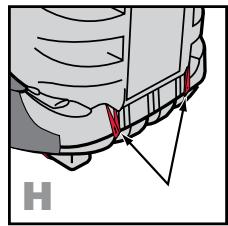
natural_image
Diagram of a mechanical component with red annotation lines and label 'H' (no readable text or symbols)Adjusting the Backrest

WARNING!
Reclining the vehicle seat back may adversely affect the position of the vehicle seat belt across the child and may result in death or serious injury in a crash. Refer to your vehicle owner's manual for information on adjusting the vehicle seat back with child seats.
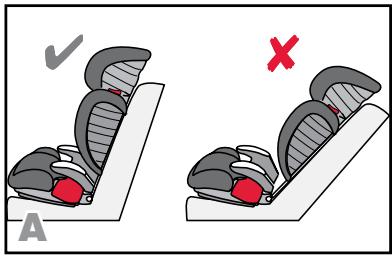
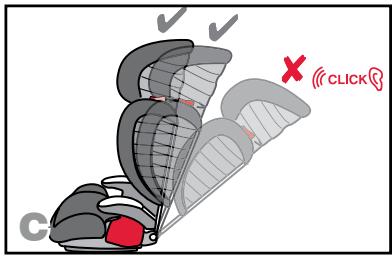
The backrest should be adjusted to the upright angle of the vehicle seat back (Fig. A).
1 Place the booster seat on the vehicle seat.
2 Push the backrest until it rests against the vehicle seat back (Fig. B). If the vehicle seat back is adjustable, move it to the upright position.
text_image
✓ A ✗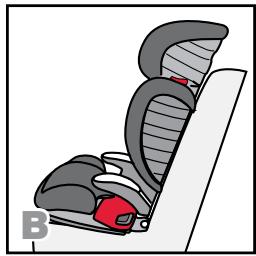
natural_image
Illustration of a car seat assembly with black and gray seats and red buttons (no text or symbols)IMPORTANT: Do not recline the backrest past the allowable adjustable range (Fig. C).
text_image
✓ ✓ X CLICK CAdjusting Head Restraint Height
The head restraint can be adjusted and locked into different positions. Choose the position best suited to your child's safety. See page 6.
Tip: Check the fit with child seated in booster seat. Ensure that the shoulder belt guides are even with, or just above, the child's shoulder. See page 6.
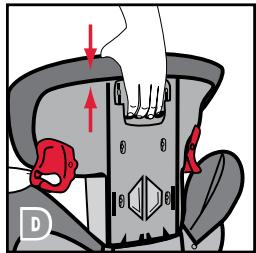
2 Slide head restraint up or down to the desired level (Fig. E).
3 Release the adjustment handle. Repeat this process until the shoulder belt rests comfortably across the center of the child's chest when positioned through the shoulder belt guide (Fig. F).
4 Ensure the head restraint has locked into place.
1 Squeeze and hold the height adjustment handle to adjust the head restraint (Fig. D).
natural_image
Illustration of a hand pressing down on a mechanical component with red arrows indicating motion (no text or symbols)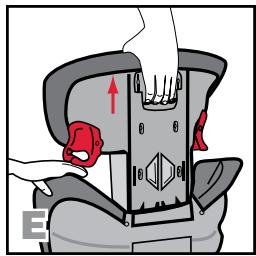
natural_image
Diagram of a mechanical device with red arrows indicating force or movement, no visible text or symbols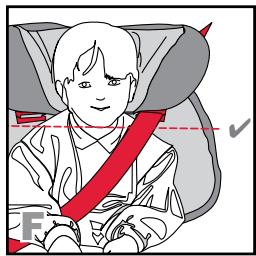
natural_image
Illustration of a person wearing a seatbelt with a red belt and checkmark (no text or symbols)SecureGuard
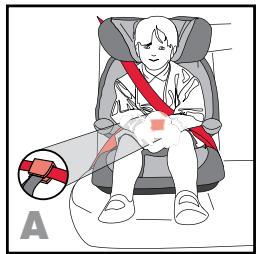
Britax recommends using the SecureGuard to achieve best vehicle seat belt placement. The SecureGuard clip should hold the lap part of the vehicle seat belt in place. The SecureGuard clip should be adjusted to keep the lap part of the vehicle seat belt positioned low across your child's upper thighs (Fig. A). Ensure the bottom edge of the SecureGuard clip is level with your child's upper thighs, however, the clip itself should not press into your child's upper thighs.
IMPORTANT: The lap part of the vehicle seat belt must not rest on the child's abdomen.
Adjusting SecureGuard Fit To Shorten:
1 Locate the SecureGuard adjuster under the base. See page 13.
2 Pull the SecureGuard adjuster away from the base.
3 Feed the webbing through the SecureGuard adjuster (Fig. B).
4 Pull the end of the SecureGuard adjuster webbing to tighten (Fig. C).
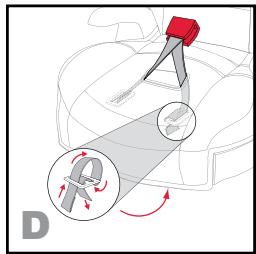
To Lengthen:
1 Locate the SecureGuard adjuster under the base. See page 13.
2 Pull the SecureGuard adjuster away from the base.
natural_image
Illustration of a child in a car seat with a red belt and a close-up of the seatbelt (no text or symbols)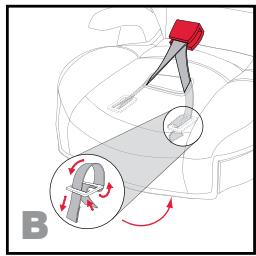
text_image
B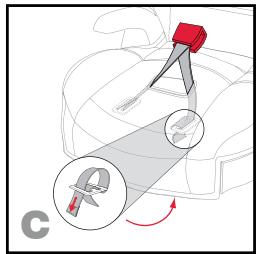
text_image
C3 Feed the end of the SecureGuard adjuster webbing through the SecureGuard adjuster (Fig. D).
4 Pull the webbing to remove slack from the SecureGuard adjuster.
5 Move the SecureGuard clip to the center of the SecureGuard webbing.
text_image
Diagram illustrating car gear shift mechanism with labeled components and directional arrowsThe lower edge of the SecureGuard clip should be level with the child's upper thighs once they have been secured in the booster seat.
Using the Retractable Cup Holders
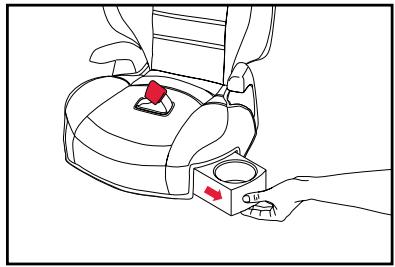
natural_image
Line drawing of a car seatbelt mechanism with a hand adjusting the button (no text or symbols)Pull the cup holder out from the booster base to use.
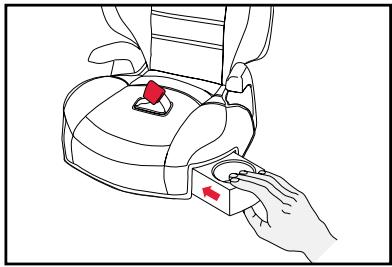
natural_image
Line drawing of a car seatbelt with a hand adjusting the seatbelt (no text or symbols)Push the cup holder into the booster base to store.
IMPORTANT:
• DO NOT use with hot liquids.
- DO NOT step on or put excess weight on the cup holder.
Positioning and Securing Your Child with Backrest

WARNING!
- DO NOT use a lap belt only to secure the child. Always use a lap and shoulder belt with this booster seat.
- Ensure the lap part of the vehicle seat belt sits low across the child's upper thighs and that the shoulder part does not contact the child's neck.
- Never route the shoulder part of the vehicle seat belt under the child's arm or behind their back.
- An improperly positioned vehicle seat belt can allow the lap part to ride up into the abdomen and cause serious injury in the event of a crash.
Note: Before using the booster seat for the first time, you will need to complete the assembly instructions on page 14.
1 Place the booster seat on the vehicle seat.
2 Push the backrest until it rests against the vehicle seat back (Fig. A). If the vehicle seat back is adjustable, move it to the normal upright position.
Note: If needed, adjust or remove the vehicle's head restraint to allow the backrest to lie flat against the vehicle's seat back.
3 Have your child sit in the booster seat and check the head restraint for proper height adjustment (Fig. B).
Note: Adjust the head restraint so when seated, the top of the child's ears are below the top of the head restraint and the vehicle shoulder belt will be appropriately positioned at or above the child's shoulder through the shoulder belt guide.
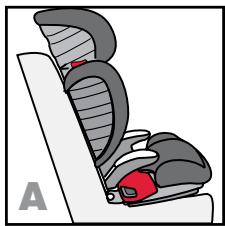
natural_image
Illustration of a car seat with black and red seats, labeled 'A' (no text or symbols on the diagram itself)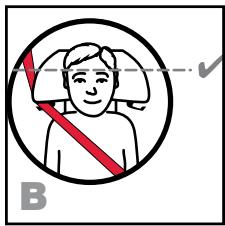
text_image
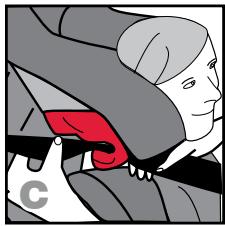
B4 Pull the vehicle seat belt out and route the shoulder part of the vehicle seat belt through the upper belt guide (Fig. C).
5 Route the lap part of the vehicle seat belt under both armrests, over your child's upper thighs and over both base belt guides (Fig. D).
6 Verify that the vehicle seat belt is not twisted and then fasten the vehicle seat belt across the child (Fig. E).
* The lap part of the vehicle seat belt should rest low on the child's upper thighs.
7 Route the lap part of the vehicle seat belt through the SecureGuard clip (Fig. F).
* Ensure the bottom edge of the SecureGuard clip is level with your child's upper thighs.
8 Remove slack from the vehicle seat belt.
* Proper positioning is achieved when the vehicle seat belt's shoulder part crosses the chest and center of the child's collar bone.
9 Verify secure installation.
Check that the:
√ Vehicle seat belt is not twisted.
√ Vehicle seat belt is securely fastened.
√ Shoulder part of the vehicle seat belt is routed through the shoulder belt guide.
√ Lap part of the vehicle seat belt is routed through the SecureGuard clip.
√ Vehicle seat belt is properly positioned low across the child's upper thighs and does not contact the child's neck.
natural_image
Illustration of a person wearing a hooded garment with a red zipper, partially covered by another person's arm (no text or symbols visible)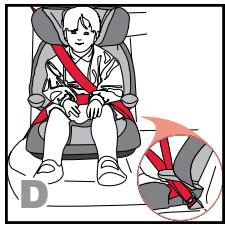
natural_image
Illustration of a child wearing a car seatbelt with red straps, showing seatbelt insertion (no text or symbols)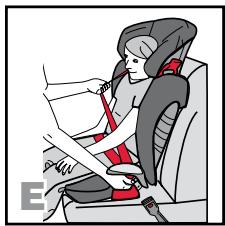
natural_image
Illustration of a child wearing a seatbelt and using a bandage device (no text or symbols visible)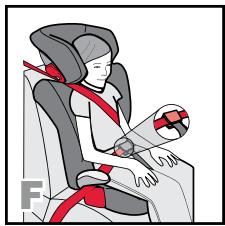
natural_image
Illustration of a child wearing a car seatbelt and red belt, seated with hands placed on the seat (no text or symbols present)Positioning and Securing Your Child without Backrest

WARNING!
- DO NOT use a lap belt only to secure the child. Always use a lap and shoulder belt with this booster seat.
- DO NOT use this booster seat without the backrest unless the booster seat will be properly installed in a vehicle seat with a head restraint.
- ONLY use this booster seat without the backrest if proper vehicle seat belt positioning can be achieved—when the vehicle seat belt's shoulder part crosses the chest and center of the child's collar bone. Ensure the lap part of the vehicle seat belt sits low across the child's upper thighs and that the shoulder part does not contact the child's neck.
- Never route the shoulder part of the vehicle seat belt under the child's arm or behind their back.
- Use the red belt guides on the child seat to ensure proper fit.
- An improperly positioned vehicle seat belt can allow the lap part to ride up into the abdomen and cause serious injury in the event of a crash.
Note: Before using the booster seat without the backrest, you may need to complete the removal instructions on page 15.
1 Place the booster seat base on the vehicle seat.
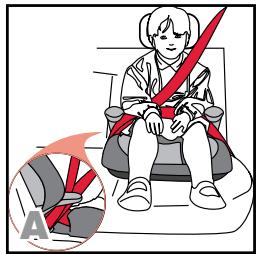
2 Pull the vehicle seat belt from the retractor, positioning the lap belt under both armrests and over both red belt guides (Fig. A).
natural_image
Illustration of a child sitting in a seat with a red diagonal band, showing seatbelt and seatbelt (no text or symbols)3 Verify that the vehicle seat belt is not twisted and then fasten across the child.
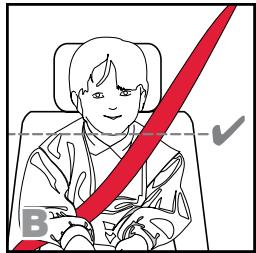
4 Adjust the vehicle seat belt's shoulder part so that it crosses the chest and center of the child's collar bone (Fig. B).
5 Route the lap part of the vehicle seat belt through the SecureGuard clip (Fig. C).
* Ensure the bottom edge of the SecureGuard clip is level with your child's upper thighs.
6 Remove slack from the vehicle seat belt.
* Proper positioning is achieved when the vehicle seat belt's shoulder part crosses the chest and center of the child's collar bone.
7 Verify secure installation.
Check that the:
√ Vehicle seat belt is not twisted.
√ Vehicle seat belt is securely fastened.
√ Lap part of the vehicle seat belt is routed through the SecureGuard clip.
√ Vehicle seat belt is properly positioned low across the child's upper thighs and does not contact the child's neck.
text_image
Diagram showing a person in a seat with a red diagonal line and checkmark, labeled 'B' at the bottom left.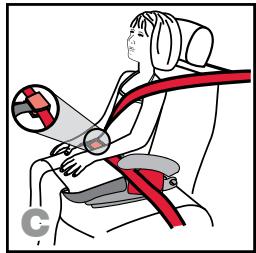
natural_image
Illustration of a person seated in a car seat with a red belt and seatbelt (no text or symbols)Cover Removal
Removing the Backrest Cover
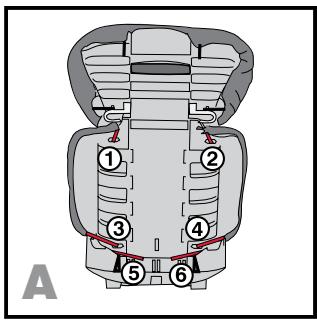
1 Detach the elastic loops (6 total) from the backrest (Fig. A).
2 Remove the backrest cover.
NOTE: Be careful not to damage the EPS foam.
Removing the Head Restraint Cover
1 Detach the elastic loops (6 total) from the backrest (Fig. B).
2 Remove the head restraint cover.
Removing the Armrest Covers
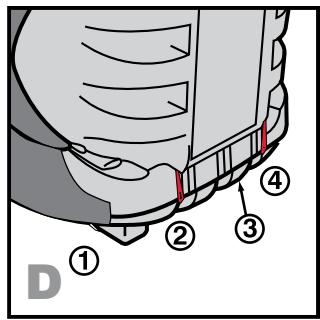
1 Detach the elastic loops (2 total) of each armrest cover from the booster seat base (Fig. C).
2 Remove the armrest covers.
NOTE: The armrest covers are not interchangeable.
text_image
A ① ② ③ ④ ⑤ ⑥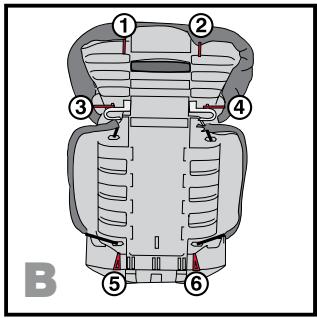
text_image
① ② ③ ④ ⑤ ⑥ B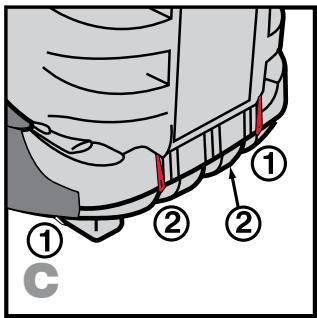
text_image
① ② ② CRemoving the Seat Cover
1 Detach the elastic loops (4 total) from the booster seat base (Fig. D).
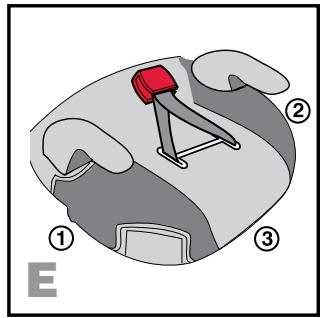
2 Slide the plastic retainer flaps (3 total) from the front and sides of the booster seat base (Fig. E).
3 Remove the booster seat cover.
text_image
D ① ② ③ ④Cleaning the Cover
- HAND WASH, using cold water and mild soap.
• LINE DRY, to prevent cover from shrinking. - DO NOT: Bleach, machine wash, or machine dry.
text_image
① ② ③ EReplacing the Cover
To replace the cover, reverse the steps of each section.
Cleaning the Shell
- SPONGE CLEAN, using warm water and mild soap.
- TOWEL DRY
- DO NOT: Use solvents, abrasive cleaners, or disassemble the booster seat in any way, except as instructed.
This booster seat was manufactured by Britax. Britax Child Safety, Inc. (“Britax”) warrants this product to the original retail purchaser as follows:
LIMITED WARRANTY
This booster seat is warranted against defective materials or workmanship for one year from the date of original purchase. Proof of purchase is required. The exclusive remedy for this warranty is that Britax will, at its option, provide repair or replacement components for this product or replace the product. Britax reserves the right to discontinue or change fabrics, parts, models or products, or to make substitutions.
To make a claim under this warranty, contact Britax Consumer Services at 1-888-427-4829 or write to us using the address on the back cover of this booklet. Proof of purchase is required.
PLEASE COMPLETE AND MAIL THE OWNER REGISTRATION CARD WITHIN (30) DAYS OF PURCHASE OR VISIT WWW.BRITAXUSA.COM/REGISTRATION.
WARRANTY LIMITATIONS
This warranty does not include damages that arise from negligence, misuse or use not in accordance with the product instruction.
The use of non-Britax Child Safety, Inc. covers, inserts, toys, accessories, or tightening devices is not approved by Britax. Their use could cause this child seat to fail Federal Safety Standards or not perform as intended in a crash. Their use automatically voids the Britax warranty.
LIMITATION OF DAMAGES
The warranty and remedies as set forth above are exclusive and in lieu of all others, oral or written, express or implied. In no event will Britax, or the retailer selling this product, be liable for any damages, including incidental or consequential damages, or loss of use arising out of the use or inability to use this product.
LIMITATIONS OF WARRANTIES AND OTHER WARRANTY TERMS AND STATE LAWS
Any implied warranties, including implied warranties of merchantability and fitness for a particular purpose, shall be limited to the duration and terms of the express written warranty. Some states do not allow limitations on how long an implied warranty lasts or the exclusion or limitation of incidental or consequential damages, so the above limitations may not apply. This warranty gives you specific legal rights, and you may have other rights, which vary from state to state. Neither Britax, nor the retailer selling this product, authorizes any person to create for it any other warranty, obligation, or liability in connection with this product.

natural_image
Solid blue background with no text, symbols, or discernible features.Printed in China
Britax Child Safety, Inc.
13501 South Ridge Drive
Charlotte, NC 28273
USA
A Britax Childcare Group
Limited company
Tel.: 1-888-427-4829
www.BritaxUSA.com