200-012 - Compressor Meec Tools - Free user manual and instructions
Find the device manual for free 200-012 Meec Tools in PDF.


| Brand | Meec Tools |
| Model | 200-012 |
| Product Type | Compressor (oil-lubricated) |
| Rated Voltage | 230 V ~ 50 Hz |
| Rated Speed | 2850 rpm |
| Max Working Pressure | 8 bar |
| Power Consumption | 0.75 kW |
| Tank Volume | 8 litres |
| Theoretical Suction Capacity | 50 l/min |
| Sound Power Level | 97 dB(A) |
| Weight | 15 kg |
| Protection Rating | IP20 |
| Lubrication | Oil (SAE 15W/40 or equivalent) |
| Oil Change Interval | First after 100 hours, then every 500 hours |
| Motor Protection | Yes, with reset button |
| Pressure Relief Valve | Pre-set at max pressure, do not adjust |
| Intake Filter Cleaning | Every 300 hours (weekly) |
| Drain Valve Cleaning | Daily |
| Pressure Vessel Inspection | Weekly |
| Operating Temperature Range | 5°C to 40°C |
| Recommended Extension Cable Cross Section | Up to 10 m: 1.5 mm²; up to 20 m: 2.5 mm² |
| Includes Rubber Feet | Yes |
| Safety Equipment Required | Ear protection, eye protection, dust mask if needed |
| Intended Use | Compressed air for tools and paint spraying |
Frequently Asked Questions - 200-012 Meec Tools
User questions about 200-012 Meec Tools
0 question about this device. Answer the ones you know or ask your own.
Ask a new question about this device
Download the instructions for your Compressor in PDF format for free! Find your manual 200-012 - Meec Tools and take your electronic device back in hand. On this page are published all the documents necessary for the use of your device. 200-012 by Meec Tools.
USER MANUAL 200-012 Meec Tools
natural_image
Industrial air compressor with black and silver casing, no visible text or symbolsSV Bruksanvisning i original
NO Bruksanvisning i original
EN Operating instructions in original
SVENSKA 4
Uppackning 5
Safety instructions for work with compressed air and paint spraying.... 28
Follow the safety instructions when spray painting! 28
Operating pressure vessels in conformance with the pressure vessel safety act 29
Symbols 29
Intended use 30
Non-intended uses....30
Electrical connection 31
Recommended cable cross sections 31
Fitting the rubber feet.... 31
Fitting the air filter 31
Explanation of compressed air fitting.... 31
Unpacking 31
Switching on and off 31
Use of compressed air units and tools.... 32
Pressure vessel volume (litres) and theoretical suction capacity l/min 32
Motor protection switch 32
Regular maintenance....32
Condensation water 32
Pressure relief valve 33
Check the oil level regularly....33
Changing the oil 33
Cleaning the intake filter 33
Corrosion must be prevented 33
SÄKERHETSANVISNINGAR
natural_image
Simple line drawing of a mechanical component with a base and handle (no text or symbols)natural_image
Close-up of a mechanical component with labeled part 1 (no visible text or symbols)natural_image
Simple line drawing of a tool interacting with a surface (no text or symbols)natural_image
Simple line drawing of a mechanical component with a base and mounting hole (no text or symbols)Read these instructions carefully before use!
WARNING! Always take basic safety precautions (including the following) when using the unit tools to reduce the risk of fire, electric shock and personal injury. Please read these instructions carefully before use.
- Keep the work area clean. Cluttered work areas increase the risk of accidents and injuries.
- Pay attention to the work environment.
- Do not expose the compressor to rain.
- Do not use in damp or wet places.
- Make sure the work area is well lit.
- Do not use in explosive environments, such as in the vicinity of flammable liquids, gases or dust.
- Protect against the risk of electric shock. Avoid body contact with earthed surfaces such as pipes, radiators, cookers and refrigerators. There is an increased risk of electric shock if your body is earthed.
- Keep onlookers at a safe distance. Keep unauthorised persons, particularly children, away from the workplace. Do not allow them to touch the compressor or the power cord.
- Store the compressor in a safe place when not in use. When the compressor is not being used, store it in a dry place, high up or locked away, well out of the reach of children.
• Do not overload the compressor. It is better and safer to work within the quoted power range.
• Use the correct tool for the planned work. - Do not force small tools or accessories to perform jobs that require a powerful tool.
- Use the tool only for its intended purpose.
- Wear appropriate clothing. Do not wear loose-fitting clothing or jewellery. They can get caught in moving parts.
Wear non-slip shoes when working outdoors.
Wear a hair net if you have long hair. - Use personal protective equipment.
- Wear eye protection.
- Wear a dust mask if the work generates dust.
- Use the power cord only for its intended purpose. Never pull the power plug out of the socket by the cord.
- Do not overreach. Always maintain a firm footing and good balance.
- Look after the compressor.
ENGLISH
WARNING! The use of accessories or attachments other than those recommended in these Operating Instructions can result in personal injury.
- Repairs must only be carried out by qualified personnel. This unit has been manufactured in compliance with current safety standards and requirements. Repairs may only be carried out by qualified personnel using identical spare parts. Improper repairs may pose a risk of injury/death or damage to property.
- Wear ear protection.
- Do not touch hot parts. To avoid burning yourself, do not touch cords, the motor or any other parts of the unit.
- Safety system to monitor and control the compressor. The unit can only be restarted by intentional activation of the pressure switch. Automatic restart is possible when the compressor has cooled down after use.
- Keep these Safety Instructions in a safe place.
Unpacking
- Inspect the unit and all accessories for transit damage. Any transit damage must be reported immediately to the carrier.
- Unpack the compressor close to where it will be used.
- Avoid long air lines and long supply lines (extensions).
• Make sure the intake air is dry and free from dust. - Do not use in damp or wet places.
• Only use the unit in suitable surroundings (well ventilated, ambient temperature 5°C to 40°C). - The area must be free from dust, acids, vapours, explosive or flammable gases.
- The unit must be used in dry surroundings. It must not be used in places where it may come into contact with water.
Safety instructions for work with compressed air and paint spraying
- The compressor and lines reach high temperatures while operational. These will cause burns if touched.
- The gases or vapours drawn in by the compressor must be kept free from additives that can result in fire or explosions in the compressor.
- When disconnecting the hose, firmly hold the hose connector to prevent injuries when the hose jumps back.
- Wear eye protection when using the blow gun. Foreign objects and parts that are blown away can easily cause personal injuries.
- Do not use the blow gun to blow air at people or to clean clothes on the body.
ENGLISH
Operating pressure vessels in conformance with the pressure vessel safety act
- An operator of a pressure vessel is required to keep the pressure vessel in good working order, to operate it properly, to supervise its use, to carry out essential maintenance and repair work immediately and to introduce essential safety measures according to requirements.
- In some cases, the supervisory authorities may order essential safeguards.
- A pressure vessel must not be operated if it has any defects that constitute a danger to employees or third parties.
- The pressure vessel must be inspected regularly for damage, e.g. rust. If there are any signs of damage, contact an authorised service centre.
Symbols

Read these instructions before using the tool.

Wear ear protection.

Risk of burns.

Electrical safety.
ENGLISH
TECHNICAL DATA
| Rated voltage | 230 V ~ 50 Hz |
| Speed | 2850 rpm |
| Max working pressure | 8 bar |
| Lubrication | Oil |
| Protection rating | IP20 |
| Power consumption | 0.75 kW |
| Tank volume | 8 l |
| Sound power level, LwA | 97 dB(A) |
| Weight | 15 kg |
Wear hearing protection!
The declared vibration value, which has been measured by a standardised test method, can be used to compare different tools with each other and for a preliminary assessment of exposure.
WARNING!
The actual vibration level when using power tools may differ from the specified maximum value, depending on how the tool is used. It is therefore necessary to determine which safety precautions are required to protect the user, based on an estimate of exposure in actual operating conditions (taking into account all stages of the work cycle, e.g. the time when the tool is switched off and when it is idling, in addition to the start-up time).
DESCRIPTION
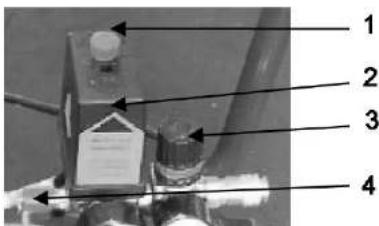
- ON/OFF button
- Pressure switch
- Pressure reducer
- Pressure relief valve
- Pressure gauge (reading the set pressure)
- Manometer (tank pressure)
ENGLISH
- Follow the instructions for maintenance and safety in this manual. Even if you wear protective glasses and other protective gear, you may get tiny particles of dust or dirt in your eyes or on your face.
- Always pay attention to what you are doing. Keep other people at a safe distance from where you are working.
• If the compressor or air pressure line becomes damaged, contact your dealer to have it repaired. - If the compressor emits a strange noise, unplug it immediately and contact your dealer.
Electrical connection
The compressor is equipped with a power cord with an earthed plug. This can be connected to an earthed socket (230 V/50 Hz) protected by a 16 amp breaker. Long supply lines and extension cables, cable reels, etc. cause voltage drops and can prevent the motor from starting. It can be difficult to start the motor at temperatures below 0°C. The use of over-long extension cables with a cross section that is too small will result in loss of voltage. This can make it difficult to start the motor and increases the load on the motor. If possible, always plug the motor cable directly into the socket and preferably use longer air hoses.
Recommended cable cross sections
Lengths up to approx. 10 m = 1.5 mm ^2 . Lengths up to approx. 20 m = 2.5 mm ^2 .
natural_image
Simple line drawing of a mechanical component with a base and pin (no text or symbols)Fitting the rubber feet
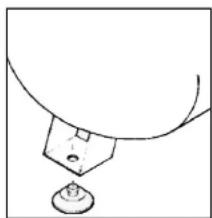
The rubber feet provided must be fitted onto the compressor as illustrated.

ENGLISH
Use of compressed air units and tools
Check the air consumption data from each manufacturer. Check that your compressor capacity is adequate.
Pressure vessel volume (litres) and theoretical suction capacity l/min
8 litres/50 l/min.
Motor protection switch
The compressor is equipped with a motor protection switch which is located on the compressor body. Excessive current to the motor causes the protector to trip and the power supply automatically shuts off. The cause must first be determined and then the machine must be disconnected from the power outlet to eliminate the risk of electric shock. Leave to cool for five minutes. Then press the reset button to enable the machine to start.
MAINTENANCE
| List | Inspection | Action | Inspection interval |
| Pressure relief valve | Check that the pressure relief valve is working by pulling the red knob. | The pressure relief valve has been set at the maximum permitted pressure for the vessel. Do NOT adjust the pressure relief valve or remove its seal. | Daily |
| Pressure vessel | Inspect all visible problems. | A pressure vessel must not be operated if it has any defects that constitute a danger to employees or third parties. The pressure vessel must be inspected regularly for damage, e.g. rust. If there are any signs of damage, contact an authorised service centre. | Weekly |
| Drain valve | Inspect all visible problems. | The drain valve must be cleaned and dust and dirt removed. | Daily |
| Intake filter | The intake filter must be cleaned at least every 300 | The filter can be removed. Small amounts of dirt can be removed | Weekly |
ENGLISH
Pressure relief valve
The pressure relief valve has been set at the maximum permitted pressure for the vessel. Do NOT adjust the pressure relief valve or remove its seal.
Check the oil level regularly
You must be able to see that the oil level in the sight glass is between the red oil level check mark and the top edge of the oil sight glass.
Changing the oil
Recommended oil: SAE 15W/40 or equivalent
The oil must be changed for the first time after 100 hours of operation. Thereafter the oil should be drained and refilled after every 500 hours of operation.
- Switch off the motor and pull the power plug out of the socket.
- After letting off any air pressure, you can remove the oil sight glass' oil drain plug on the crankcase guard, drain all oil and then refit the screw.
- Fill with oil via the oil filler hole on the crankcase guard.
- If any oil remains inside, tilt the compressor slightly.
- When the oil has drained out, tighten the oil drain screw/sight glass again.
- Fill with new oil until it reaches the red mark on the sight glass.
- Then fit the oil filler plug back into place.
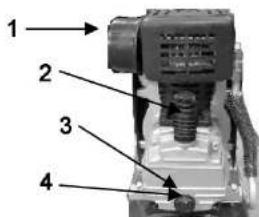
- Filter
- Oil fill plug
- Oil drain screw
- Sight glass
Dispose of the used oil according to applicable requirements and regulations.
ENGLISH
compressor, or in surroundings that have a high level of humidity, or in adverse conditions (poor ventilation, corrosive agents,...) the inspections should be made every 3 months. The actual wall thickness of the tank after corrosion should not be smaller than 2mm for the shell and 2mm for the heads.

EC DECLARATION OF CONFORMITY EG FÖRSÄKRAN OM ÖVERENSSTÄMMELSE EF SAMSVARSERKLÆRING DEKLARACJA ZGODNOŚCI WE

Jula AB, Box 363, SE-532 24 SKARA, SWEDEN
Machinery Directive 2006/42/EC
EN 60204-1:2006+A1:2009; EN 1012-1:2010, EN 12100:2010
Electromagnetic Compatibility 2004/108/EC
EN 61000-3-2:2006+A1+A2, EN 61000-3-3:2008
EN 61000-6-1:2007, EN 61000-6-3:2007+A11
- SVENSKA 4
- SÄKERHETSANVISNINGAR
- Read these instructions carefully before use!
- ENGLISH
- Unpacking
- Safety instructions for work with compressed air and paint spraying
- Operating pressure vessels in conformance with the pressure vessel safety act
- Symbols
- Wear hearing protection!
- WARNING!
- DESCRIPTION
- Electrical connection
- Recommended cable cross sections
- Fitting the rubber feet
- Use of compressed air units and tools
- Pressure vessel volume (litres) and theoretical suction capacity l/min
- Motor protection switch
- Pressure relief valve
- Check the oil level regularly
- Changing the oil
Brand : Meec Tools
Model : 200-012
Category : Compressor