HWK152200WD - Kettle Hanseatic - Free user manual and instructions
Find the device manual for free HWK152200WD Hanseatic in PDF.


| Product Type | Electric Kettle |
| Model | HWK152200WD |
| Brand | Hanseatic |
| Capacity | 1.5 liters |
| Power Consumption | 1850–2200 W |
| Power Supply | 220–240 V ~ 50/60 Hz |
| Protection Class | I |
| Cable Length | 76 cm |
| Weight (without water) | Approx. 1.05 kg |
| Dimensions (approx.) | 24 x 20 x 15 cm |
| Material | Stainless steel / Plastic |
| Features | Automatic shut-off, boil-dry protection, overheat protection, concealed heating element |
| Control | One-button operation with LED indicator |
| Lid | Push-button open, lockable |
| Base | 360° swivel base with cord storage |
| Cleaning and Maintenance | Wipe exterior with damp cloth; descale with citric acid solution as needed |
| Safety | Auto shut-off, boil-dry protection, overheat protection, cool-touch handle |
| Spare Parts Availability | Contact manufacturer or service agent |
| Order Number | 18310962 |
Frequently Asked Questions - HWK152200WD Hanseatic
User questions about HWK152200WD Hanseatic
0 question about this device. Answer the ones you know or ask your own.
Ask a new question about this device
Download the instructions for your Kettle in PDF format for free! Find your manual HWK152200WD - Hanseatic and take your electronic device back in hand. On this page are published all the documents necessary for the use of your device. HWK152200WD by Hanseatic.
USER MANUAL HWK152200WD Hanseatic
natural_image
Line drawing of a simple water kettle with lid and handle (no text or symbols)Gebrauchsanleitung
Wasserkocher
Inhaltsverzeichnis
Begriffs- und
natural_image
Line drawing of a simple water heater with a lid and power plug, shown in two views (no text or symbols)Article no.: 18310962
Reproduction, even of
excerpts, is not per- mitted!
HWK152200WD
natural_image
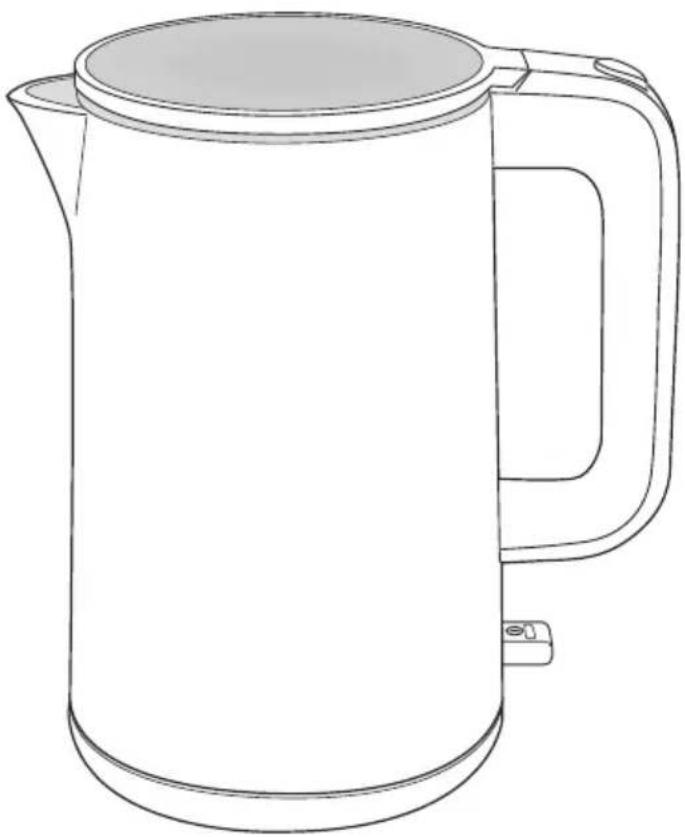
Line drawing of a simple water kettle with lid and handle (no text or symbols)User manual
Kettle
Table of contents
Explanation of terms and
symbols.....EN-3
Explanation of terms ..... EN-3
Explanation of symbols . . . . EN-3
Safety ...... EN-4
Intended use ..... EN-4
Safety notices ..... EN-5
Delivery....EN-12
Package contents ..... EN-12
Check the delivery ..... EN-12
Control elements.....EN-13
Commissioning and
operation....EN-14
Choose a suitable location EN-14
Before getting started . . . . EN-14
First use....EN-15
Heating water.....EN-15
Aborting the heating
process.....EN-16
Pouring the water. . . . . . . EN-17
Overheat protection ..... EN-17
Cleaning and maintenance..EN-18
Cleaning.....EN-18
Decalcification ..... EN-19
Storing ..... EN-19
Troubleshooting table ..... EN-20
Service ...... EN-21
General customer service . EN-21
Spare parts ..... EN-21
Waste avoidance, free
return and disposal ..... EN-22
Waste prevention ..... EN-22
Free return of old electrical appliances. . . . . EN-22
Disposal....EN-23
Packaging ..... EN-24
Technical specifications .... EN-26
Explanation of terms and symbols
Please read through the safety instructions and this user manual carefully before using the appli- ance. This is the only way you can use all the functions relia- bly and safely.
Be absolutely sure to also observe the national regulations in your country, which are also valid in addition to the regulations specified in this user manual.
Keep all safety notices and instructions for future reference. Give all safety notices and instructions to the next user of the appliance.
Explanation of terms
The following signal terms can be found in this user manual:

WARNING
This signal term indicates a hazard with a medium level of risk which, if not avoided, could result in death or serious injury.

CAUTION
This singal term indicates a hazard with a low level of risk which, if not avoided, could result in minor or moderate injury.

NOTICE
This signal term warns against possible damage to property.
Explanation of symbols
The following symbols can be found in this user manual:

This symbol refers to useful additional information.
Safety
Intended use
This appliance is designed to heat domestic quantities of water.
The kettle may be operated only with the associated base. The use of any other base is forbidden. The base must not be used with another appliance.
The appliance is designed for use in private households at room temperature and is not designed for commercial use or shared use (e.g.: use by several parties in a block of flats).
The appliance is not suitable for use outdoors or on non-stationary sites (e.g. ships).
The appliance must not be put inside a cupboard when in use.
Persons who are unable to operate the appliance safely due to their physical, sensory or mental abilities or lack of knowledge must be supervised during use.
No technical changes may be made to the appliance.
If the supply cord is damaged, it must be replaced by the manufacturer, its service agent or similarly qualified persons in order to avoid a hazard.
Use the appliance exclusively as described in this user manual. Any other use is deemed improper and may result in damage to property or even personal injury.
The manufacturer accepts no liability for damage caused by improper use.
Safety notices
In this chapter you will find general safety notices which you must always observe for your own protection and that of third parties. Please also observe the warning notices in the individual chapters on operation, cleaning, etc.
Risks to children and certain groups of individuals

WARNING
Risk of suffocation for children!
Children can become entangled in the packaging film and suffocate.
■ Do not allow children play with the packaging film.
Risk of scalding!
If the mains cord is within reach of young children, they could pull down the appliance and suffer serious scalding.
■ Set up the appliance such that neither the appliance
nor the mains cord can be reached by young children.

CAUTION
Risk of injury!
Children and certain groups of people have a higher risk of being injured when handling the appliance.
■ This appliance can be used by children aged from 8 years and above if they have been given supervision concerning use of the appliance in a safe way and if they understand the hazards involved.
■ Appliances can be used by persons with reduced physical, sensory or mental capabilities or lack of experience and knowledge if they have been given supervision or instruction concerning use of the appliance in a safe way and understand the hazards involved.
■ Children shall not play with the appliance.
■ Cleaning and user maintenance shall not be made by children unless they are older than 8 and supervised.
- Keep the appliance and its cord out of reach of children aged less than 8 years.
Risks in handling household electrical appliances

WARNING
Risk of electric shock! Touching live parts may result in severe injury or death.
■ Connect the appliance only if the socket voltage matches the requirements indicated on the type plate.
■ Only use the appliance in doors. Do not use in wet rooms or in the rain.
■ If the supply cord is damaged, it must be replaced by the manufacturer, its service agent or similarly qualified persons in order to avoid a hazard.
■ Do not start up or continue operating the appliance if it is visibly damaged, e.g. the supply cord is defective, it makes strange noises, or smoke appears.
In these cases, pull the mains plug out of the socket or switch off/unscrew the fuse and have the appliance repaired (see “Service” on page EN-21).
■ Note that the appliance is only to be used with the stand provided.
- Avoid spillage on the -connector.
■ Do not use the base for any purpose other than in conjunction with the appliance.
■ Note that the appliance must not be immersed in water.
■ Check the appliance regularly for damage.
■ The appliance corresponds to protection class I and may only be connected to a socket with a protective conductor that has been
installed properly. Ensure that the voltage is correct when connecting it. More detailed information about this can be found on the nameplate.
■ We recommend using a pulse-sensitive fault current switch (residual current operated circuit-breaker).
- Keep the appliance, mains plug and mains connection cable away from naked flames and hot surfaces. The insulation of the supply cord may melt.
■ Do not kink or pinch the mains connection cable, lay it over sharp edges or use it to carry the appliance.
■ Never pull the mains plug out of the socket by the mains connection cable. Always hold the mains plug itself.
■ Never touch the mains plug with wet hands.
■ Never immerse the mains plug and mains connection
cable in water or any other liquids.
■ Disconnect the mains plug from the socket when the appliance is not in use, in the event of a fault and before cleaning or maintenance.
■ Do not put any objects in or through the housing openings and also make sure that children cannot insert any objects through them.
■ Never clean the appliance with a high-pressure cleaner or steam cleaner.
■ Only parts corresponding to the original appliance specifications may be used for repairs.
■ Investigations and repairs to the appliance may only be carried out by authorised specialists, such as our service department.
■ Unauthorised repairs to the appliance can cause property damage and personal injury, and invalidate liability and warranty claims.
Never try to repair the appliance yourself.

CAUTION
Fire hazard!
Improper handling of the appliance can lead to fire.
■ Connect the appliance only to a properly installed and earthed electric socket. Do not connect to a multi-socket extension cable or a multi-socket plug.
■ Do not operate the appliance with an external timer or a separate remote control system.

NOTICE
Risk of damage to property! Improper handling of the appliance may cause damage.
■ Do not use sharp objects to unpack the appliance.
When cleaning, please note:
■ Under no circumstances should sharp, coarse, sodi-
um carbonate-based, acidic, solvent-based or abrasive cleaning agents be used. All-purpose cleaners with a neutral pH are recommended.
■ The door seals can be damaged by unsuitable cleaning agents. Use care products only on the outer surfaces.
■ Use only soft cloths for cleaning.
■ Ensure that water or any other liquid does not enter the electrical components.
Risks associated with using kettles

WARNING
Risk of short circuit!
Water which penetrates into the appliance may cause nort-circuiting.
■ Make sure that water is never spilled over the contact pin of the base.
■ Do not immerse the appliance itself, the mains cable,
the mains plug or the base in water or other liquids.
■ Never position the appliance in such a way that it can fall into a bathtub or sink.
■ Never reach in to retrieve an electrical appliance if it has fallen into water. In such a case, immediately unplug the mains plug from the socket.

CAUTION
Risk of scalding/burns!
Hot steam is emitted during use.
■ Hot steam may escape when fresh water is added shortly after a boiling cycle. Therefore, allow a cool-down period of approx. 30 seconds after each boil.
- Avoid any contact with the hot steam. Particular caution is required - during boiling; - when refilling the appliance;
- when the lid is open.
■ Do not remove the lid while the water is boiling.
Note that if the kettle is over - filled, boiling water may be ejected..
■ Do not fill the appliance above the MAX mark (1.5□l).
If the appliance falls over, contact with hot water can lead to scalding.
■ Do not allow the mains connection cable to hang over the edge of the work - top on which the appliance is standing.
■ Do not position the appliance on the edge of the worktop.
Health hazard!
Improper use of the appli -ance can lead to damage to health.
■ Always throw away the first two batches of boiled water from the new appliance for hygiene reasons.
■ During first use, after des-caling and after having not used the appliance for a prolonged period of time, fill the water tank completely, heat it up and throw the water away.

NOTICE
Risk of damage to property! Improper handling of the appliance may result in damage.
■ Never expose the appliance to high temperatures (heating etc.) or weather (rain etc.).
■ Do not expose the appliance to temperatures below 0 °C for prolonged periods. Residual water that may have frozen could damage the appliance. If the appliance is used at temperatures of less than +5 °C and over +40 °C it may lead to faults in the electronics.
■ Only use the appliance if it is on a flat, stable and non-sensitive surface.
■ Never operate the appliance when empty. Always fill the kettle with water up to at least the MIN mark.
■ Only fill it with fresh, cold water and do not fill the kettle with other liquids.
■ Never immerse the appliance in water or any other liquids to clean it.
■ Do not put the appliance or individual parts of the appliance in a dishwasher.
■ Do not use a steam clean er to clean it. This can cause short-circuiting and could damage the appliance.
■ Do not use any -sol vent-based, abrasive or scouring cleaners (e.g. oven or grill spray) or cleaning utensils such as pot sponges or similar. These could scratch the surfaces.
■ Do not use any abrasive cleaners (scouring or thinning agents) to clean the appliance and accessories.
They could damage the surface of the appliance.
Risk of damage to nearby furniture
! NOTICE
Risk of damage to property! Surface coatings on furniture sometimes contain chemical additives that can eat away at the rubber feet of the appliance. This may cause residue to accumulate on the surface of the furniture.
■ Place a heat-resistant and waterproof pad underneath the appliance.
Upper kitchen cupboards or similar can be damaged by escaping steam.
■ Do not set up the appliance under kitchen cupboards.
Delivery
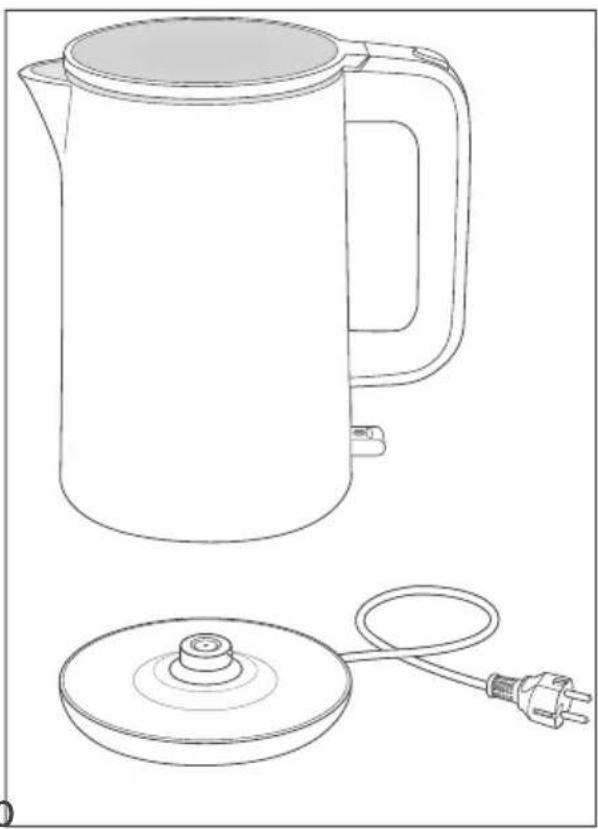
Package contents
- Kettle
- Base with mains connection cable and mains plug
- User manual
Check the delivery

WARNING
Risk of electric shock!
Touching live parts may result in severe injury or death.
■ Never use a damaged-appliance.
natural_image
Line drawing of a simple water heater with a lid and power plug, shown in two views (no text or symbols)- Unpack the appliance. Do not use sharp or pointed objects to do this. Carefully remove all parts of the packaging, plastic profiles, tape and foam padding.
- Check that the delivery is complete.
- Check whether the appliance was damaged during transit.
- If the delivery is incomplete or the appliance has been damaged during transport, please contact our service department (see page EN-21).
If you have sufficient space, we recommend retaining the packaging, at least during the warranty period. If the appliance has to be sent in for repair or brought to one of the repair service points, the appliance will only be adequately protected in the original packaging.
Control elements
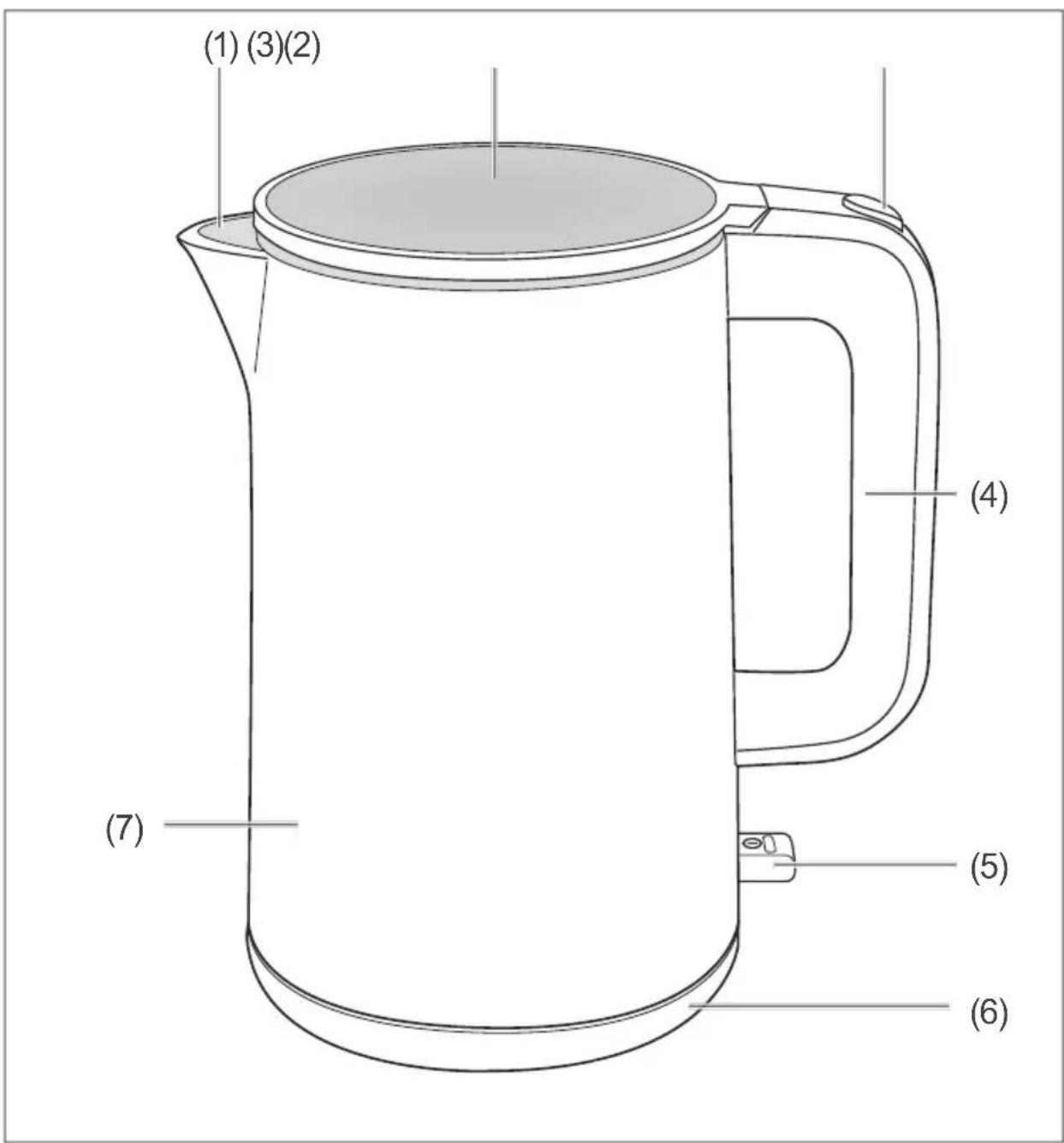
(1) Spout
(2) Lid
(3) Open button for the lid
(4) Handle
(5) On/Off button
(6) Base
(7) Kettle
Commissioning and operation
Choose a suitable location

CAUTION
Fire hazard!
Improper handling of the appliance can lead to fire.
■ Do not place the appliance directly on or next to a stove or any other heat source.
Risk of scalding/burns!
If the appliance falls over, contact with hot water can lead to scalding.

NOTICE
Risk of damage to property! Upper kitchen cupboards or similar can be damaged by escaping steam.
■ Do not set up the appliance under kitchen cupboards.
- Position the appliance on a solid, level and non-sensitive surface. Place the appliance where there is sufficient space above it for the lid to be opened.
■ Do not allow the main connection cable to hang over the edge of the work-top on which the appliance is standing.
■ Do not position the appliance on the edge of the worktop.
■ Set up the appliance in such a way that it is out of the reach of children.
Before getting started
- Read the “Safety” chapter from page EN-4.
First use
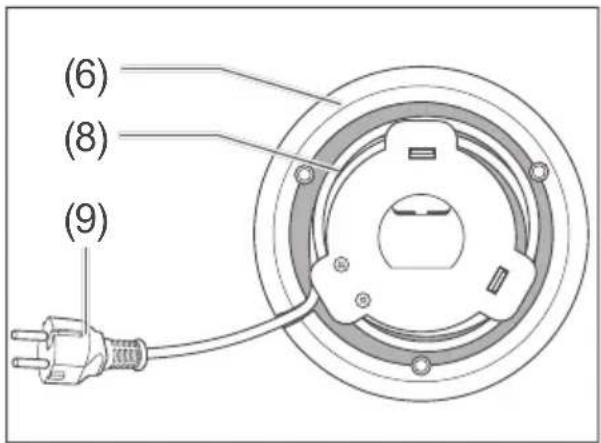
- Unwind the mains connection cable (8) on the underside of the base (6) to the desired length and insert the mains plug (9) into a properly installed and easily accessible earthed socket.
- To remove all production residues, boil a full kettle twice and then pour away the hot water. Proceed as described in the following chapters.
Heating water

WARNING
Risk of scalding!
If the kettle is overfilled or the lid is open, hot water may spurt out when the liquid boils and cause scalding.
■ Do not fill the kettle above the MAX mark (1.5 l).
■ Ensure that the lid is closed during operation.
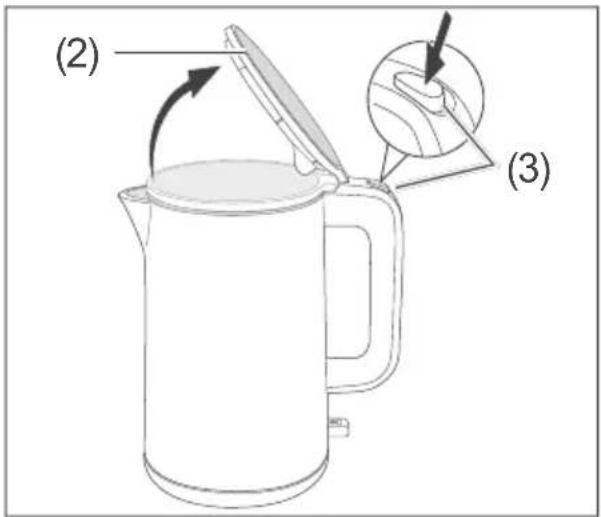
- To open the lid (2), press the open button (3).
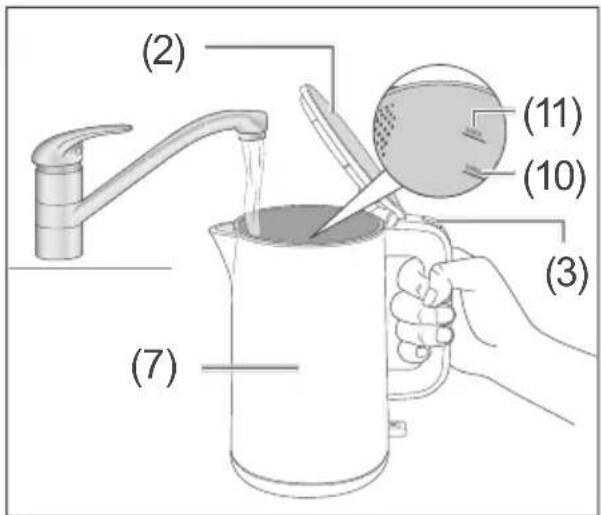
- Fill the kettle (7) with fresh cold tap water until the water level lies between the MIN (10) and MAX (11) marks.
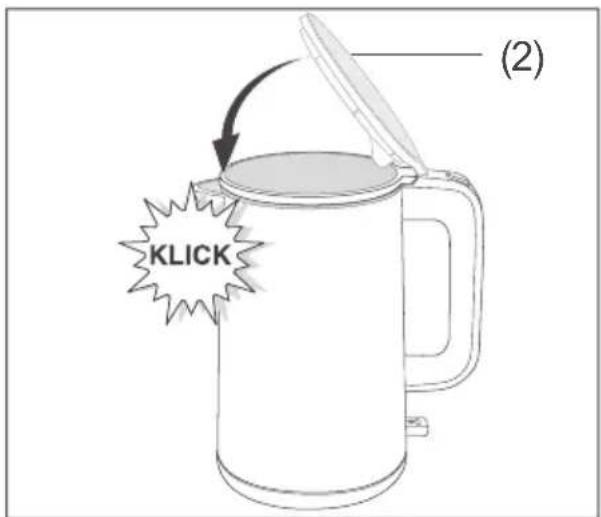
- Push the lid (2) closed until you hear it "CLICK" audibly into place.
- Place the filled kettle (7) on the base (6).
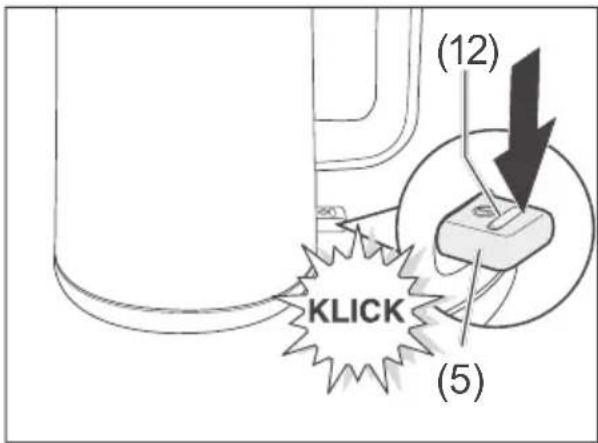
- Press the On/Off button (5) until it locks into the "On" position with an audible "CLICK". The indicator LED (12) will light up, and the heating will begin.
Once the water has heated up to boiling temperature, the appliance switches off automatically and the On/Off button (5) returns to the "Off" position.
Aborting the heating process
There are two ways to stop a heating process:
- Press the On/Off button (5) lightly upwards until it locks into the "Off" position with a "CLICK".
The indicator LED (12) goes out. The heating process is stopped.
- Remove the kettle (7) from the base (6).
The On/Off button (5) clicks back to the upper "Off" position; the indicator LED (12) goes out.
Overheat protection
If the appliance is accidentally switched on without water or with too little water, a built-in safety feature will switch the appliance off.
After a cool-down period of approx. 10 minutes, the appliance will be ready for operation again.
Pouring the water
- Remove the kettle (7) by the handle (4) from the base (6).
- With the lid closed (2), pour the heated water through the spout (1) and into your chosen container.
If you wish to heat more water, allow the appliance to cool off for approx. 30 seconds.
If you do not want to heat more water, pull the mains plug out of the socket.

To avoid premature limes-scale build-up on the inner kettle wall, we recommend that you empty the kettle completely each time you boil water.
Cleaning and maintenance
Cleaning

WARNING
Risk of electric shock!
Improper use of the appli- ance may lead to serious inju- ry or death.
■ Always pull the mains plug out of the socket prior to cleaning and maintenance.

CAUTION
Risk of burns!
The kettle becomes hot during use. Touching the hot interior can lead to burns.
■ Allow the appliance to cool completely prior to cleaning it.

NOTICE
Risk of damage!
Improper cleaning can cause short-circuiting and damage the appliance.
■ The appliance and individual appliance parts must never be
- immersed in water or other liquids,
- put in a dishwasher,
- steam cleaned.
Improper use of cleaning products or cleaning utensils can scratch the surfaces or cause chemical damage.
■ Do not use any -sol vent-based, abrasive and scouring cleaners (e.g. oven cleaners or grill sprays) or cleaning utensils such as pot sponges.
■ Do not use abrasive cleansers (scouring agents or thinning agents) to clean the appliance.
- Disconnect the mains plug from the socket.
- Let the kettle cool down completely.
- Wipe the appliance surface with a lightly moistened cloth. Use a small amount of washing-up liquid for stubborn soiling.
- Wipe the underside of the kettle with a dry cloth.
- Make sure that the electrical contacts on the underside of the kettle and on the base do not become wet.
- Rinse the inside of the kettle with fresh tap water.
- Thoroughly dry all parts after cleaning.
Decalcification

WARNING
Health hazard!
Improper use of the appli- ance can lead to damage to health.
■ Heat and pour away least one full batch of water after descaling.
Depending on water hardness, limescale may form inside the kettle. You must descale the appliance if the inner walls or the hotplate on the base of the kettle show visible limescale deposits.
- Mix 12 a liter of water with 2 tablespoons of citric acid.
- Allow the mixture to come to the boil.
- Dispose of the mixture. Do not pour it into an enamelled sink.
- Rinse the kettle out thoroughly with cold water.
- Thoroughly dry all parts after cleaning.
- Heat a complete jugful and then tip the water away.
Storing
- If you are not going to use the kettle for an extended period, store it carefully.
• Make sure that the kettle is disconnected from the mains and is completely dry. - Store the kettle in a cool, dry place.
at Make sure that the kettle is out of the reach of children.
Troubleshooting table
Malfunctions can occur in all electrical appliances. This does not necessarily mean there is a defect in the appliance. For this reason, please check the tables to see if you can correct the malfunction.

WARNING
Risk of electric shock in case of improper repair!
- Never attempt to repair the appliance yourself. You can put your own and future users’ lives in danger. Only authorised specialists are allowed to carry out this repair work.
| Problem Possible cause Solutions, tips | ||
| The water does not become hot. | On/Off button (5) not pressed. | Press the On/Off button (5) once to start the heating. |
| Mains plug is loose. | Check that the mains plug is firmly inserted into the socket. | |
| The socket is defective. | Try the appliance with a different socket. | |
| Check fuses and/or circuit breakers. | ||
| Mains connection cable is defective. | Check the mains connection cable for damage. Contact our service department, where necessary (see page EN-21). | |
| Appliance does not switch off automatically. | Lid is not closed or the buttons are dirty. | Close the lid, clean the appliance surface. |
Service
Please note!
You are responsible for the condition of the appliance and its proper use in the household.
Damage resulting from non-compliance with this manual cannot be recognised.
In order for us to help you quickly, please tell us:
| Name of appliance Order number | |
| hanseatic Kettle HWK152200WD 18310962 |
General customer service
Please contact your mail order company's product advice center if you have questions, complaints or accessory orders.
Spare parts
Customers in Germany
– Please contact Hermes Fulfilment GmbH:
Tel. (057 32) 99 66 00
Monday–Thursday 8 a.m.–3 p.m., Friday 8 a.m.–2 p.m.
Customers in Austria
- Please contact your mail order company's customer service center or product advice center.
Waste avoidance, free return and disposal
Waste prevention
According to the provisions of Directive 2008/98/EC, waste prevention measures always take priority over waste management.
For electrical and electronic devices, waste prevention measures include extending the lifespan of defective devices through repair and reselling used working appliances instead of disposing of them.
Please help us reduce waste and contact our customer service if your product is faulty.
More information can be found in the brochure “Waste Prevention Programme - of the German Government with the Involvement of the Federal States”.
for deliveries made to a private household. For distance selling, the option of having old electrical equipment collected for free applies only in the case of purchase of new electrical equipment with heat exchangers (e.g. refrigerators, dehumidifiers), screens and display devices with a screen surface > 100 cm ^2 , and large devices with at least one of its external dimensions measuring more than 50 cm.
In addition, consumers may return up to three old electrical appliances of the same type to a distributor's collection point for free, without having to purchase a new electrical appliance. In this case, however, the old appliances' external dimensions may not exceed 25 cm.
Free return of old electrical appliances
Upon purchasing a new electrical appliance of the same type with essentially the same function, consumers may return an old electrical appliance to a distributor obliged to take back old appliances, at no extra cost for the consumers. This option also exists
Disposal
Disposing of old electrical devices in an environmentally-friendly manner
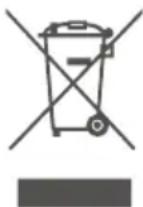
Electrical appliances contain harmful substances as well as valuable resources.
Every consumer is therefore required by law to dispose of old electrical appliances at an authorised collection or return point. They will thus be made available for environmentally-sound, resource-saving recycling.
You can dispose of old electrical appliances free of charge at your local recycling center.
Please contact your dealer directly for more information about this topic.
Don't forget to erase data!
If necessary, each consumer is responsible for erasing personal data from electrical and electronic equipment.
Single-use and rechargeable batteries, lamps and bulbs
If necessary, old single-use and rechargeable batteries that are not encased by an old electrical appliance, as well as lamps/bulbs that can be removed from an old electrical appliance without being destroyed, must be removed and disposed of separately before you return the appliance.
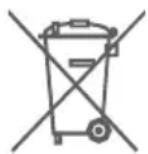
This symbol means that single-use and rechargeable batteries must not be disposed of with other household waste.
Consumers are required by law to bring all single-use and rechargeable batteries, regardless of whether they contain harmful substances*) or not, to a collection point operated by their communal authority or borough or to a retailer, so that they can be disposed of in an environmentally friendly manner and so that valuable resources (e.g. cobalt, nickel or copper) can be recovered.
Single-use and rechargeable batteries can be returned free of charge.
Some of the possible contents (e.g. mercury, cadmium and lead) are toxic and, if improperly disposed of, can have adverse effects on the environment. Heavy metals, for instance, can have detrimental health effects on humans, animals and plants and accumulate in the environment and food chain, and then enter the body indirectly through the consumption of food.
There is a high risk of fire with old lithium batteries. Special care must therefore be taken to properly dispose of old lithium batteries and rechargeable batteries. Improper disposal can also lead to internal and external short circuits due to thermal effects (heat) or mechanical damage. A short circuit can lead to a fire or an explosion and have serious consequences for people and the environment. It is therefore important to tape off the terminals of lithium batteries and rechargeable batteries before disposing of them to prevent an external short circuit. Single-use and rechargeable batteries that are not built into the device should be removed before disposal and then disposed of separately.
Please only dispose of single-use and rechargeable batteries in a discharged state!
If possible, use rechargeable batteries in place of disposable batteries.
*) labelled with:
Cd = Cadmium
Hg = Mercury
Pb = Lead
Packaging

Our packaging is made of environmentally friendly, recyclable materials:
- Outer packaging made of cardboard
- Moulded parts made of foamed, CFC-free polystyrene (PS)
– Films and bags made of polyethylene (PE)
– Tension bands made of polypropylene (PP)
- Saving energy also protects against excessive global warming. Your new appliance uses little energy due to its environmentally friendly insulation and technology.

If you have sufficient space, we recommend retaining the packaging,
at least during the warranty period. If the appliance needs to be sent out for repairs, only the original packaging will provide sufficient protection.
If you would like to dispose of the packaging, please dispose of it in an environmentally friendly way.
Technical specifications
| Manufacturer hanseatic | |
| Name of appliance Kettle | |
| Model HWK152200WD | |
| Output in W 1850-2200 | |
| Supply voltage in V~ 50–60 Hz 220-240 | |
| Protection class I | |
| Capacity in I 1.5 | |
| Cable length incl. mains plug in cm 76 | |
| Weight (without water) in kg, approx. 1.05 | |
| Order number 18310962 |


- Inhaltsverzeichnis
- Table of contents
- Explanation of terms and symbols
- Explanation of terms
- WARNING
- CAUTION
- NOTICE
- Explanation of symbols
- Safety
- Intended use
- Safety notices
- Risks to children and certain groups of individuals
- Risks in handling household electrical appliances
- Risks associated with using kettles
- Risk of damage to nearby furniture
- ! NOTICE
- Delivery
- Package contents
- Check the delivery
- Control elements
- Commissioning and operation
- Choose a suitable location
- Before getting started
- First use
- Heating water
- Aborting the heating process
- Overheat protection
- Pouring the water
- Cleaning and maintenance
- Cleaning
- Decalcification
- Storing
- Troubleshooting table
- Service
- General customer service
- Spare parts
- Customers in Germany
- Customers in Austria
- Waste avoidance, free return and disposal
- Waste prevention
- Free return of old electrical appliances
- Disposal
- Disposing of old electrical devices in an environmentally-friendly manner
- Don't forget to erase data!
- Single-use and rechargeable batteries, lamps and bulbs
- Packaging
- Technical specifications
Brand : Hanseatic
Model : HWK152200WD
Category : Kettle