WK8235SNL - Kettle Hanseatic - Free user manual and instructions
Find the device manual for free WK8235SNL Hanseatic in PDF.


| Product Type | Electric Kettle |
| Brand | Hanseatic |
| Model | WK8235SNL |
| Capacity | 1.7 L |
| Power Supply | 220-240 V, 50/60 Hz |
| Power Consumption | 2200-2400 W |
| Dimensions (W x D x H) | 220 x 180 x 250 mm |
| Weight | 1.1 kg |
| Material | Stainless Steel and Plastic |
| Cord Length | 0.75 m |
| Automatic Shut-Off | Yes |
| Boil-Dry Protection | Yes |
| Removable Filter | Yes (lime filter) |
| Lid Opening | Push-button |
| Base Type | 360° swivel base |
| Indicator Light | Yes |
| Water Level Window | Yes |
| Cleaning | Descaling with vinegar or citric acid recommended |
| Safety Features | Overheat protection, boil-dry protection |
| Repairability | Replaceable filter and lid; other parts not user-serviceable |
Frequently Asked Questions - WK8235SNL Hanseatic
User questions about WK8235SNL Hanseatic
0 question about this device. Answer the ones you know or ask your own.
Ask a new question about this device
Download the instructions for your Kettle in PDF format for free! Find your manual WK8235SNL - Hanseatic and take your electronic device back in hand. On this page are published all the documents necessary for the use of your device. WK8235SNL by Hanseatic.
USER MANUAL WK8235SNL Hanseatic
natural_image
Illustration of a Samsung water heater with an electric plug connected to its side (no text or symbols on the device itself)Gebrauchsanleitung
Anleitung/Version:
196270 DE 20180328
natural_image
Exterior view of a modern stainless steel water heater with black handle and control panel (no visible text or symbols)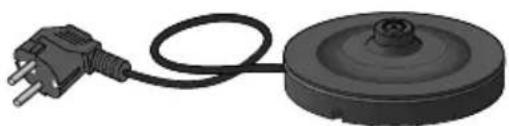
natural_image
Illustration of a black electrical plug connected to a circular power strip (no text or symbols)Lieferumfang
natural_image
Illustration of a hand holding a small water heater with a base, showing its internal components and a cable (no text or symbols present)natural_image
Illustration of a hand holding a Panasonic water heater with its lid and cord, no text or symbols presentnatural_image
Illustration of a faucet with liquid being poured into a filter component (no text or symbols)natural_image
Illustration of a Samsung water heater with an electric plug connected to its side (no text or symbols on the device itself)User manual
Manual/version:
196270 GB 20180328
Order no.: 61929830
Reproduction, even
of excerpts, is not
permitted!
Kettle
Table of contents
Table of contents ..... GB-2
Delivery. GB-3
Package contents ..... GB-3
Check the delivery ..... GB-3
Appliance parts. . . . . . . GB-4
Safety GB-5
Intended use . . . . . . . . GB-5
Explanation of terms . . . GB-5
Safety notices . . . . . . . GB-5
Start-up. . . . . . . . . . . . GB-12
Unpacking the appliance . . . . . . . . . GB-12
Choose a suitable location . . . . . . . . . GB-12
Operation GB-13
Heating water. . . . . . . GB-13
Overheating protection GB-15
Aborting the heating process . . . . . . . . . . GB-15
Pouring out water..... GB-16
Cleaning and maintenance. . . . . . . . GB-17
Cleaning the kettle. . . . GB-17
Decalcification .... GB-18
Cleaning the sieve . . . . GB-18
Troubleshooting table . . . GB-20
Service GB-21
Advice, order and complaint . . . . . . . . . GB-21
Spare parts . . . . . . . . GB-21
Environmental protection GB-22
Disposing of old electrical devices in an environ mentally-friendly manner ..... GB-22
Packaging .... GB-22
Technical specifications . GB-23
Delivery
natural_image
Exterior view of a modern stainless steel water heater with black handle and control panel (no visible text or symbols)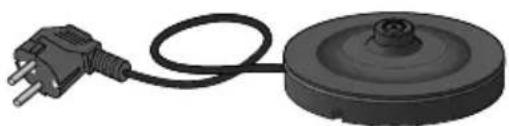
natural_image
Illustration of a black electrical plug connected to a circular power strip (no text or symbols)Package contents
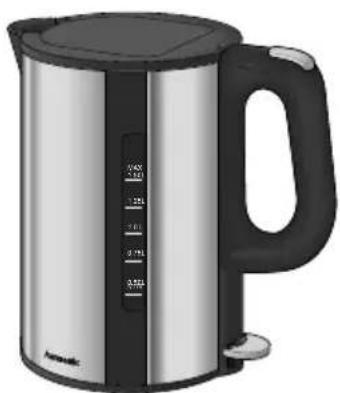
- Kettle
- Base with mains cable and mains plug
- User manual
Check the delivery
- Unpack the appliance.
- Check the delivery.
- If the delivery is incomplete or the appliance has been damaged during transit, please contact our service department (see page GB-21).
WARNING!
Risk of electric shock!
■ Never use a damaged appliance.

Before using the appli- ance, please first read through the safety instructions and user manual carefully. This is the only way you can use all the functions reliably and safely. Be absolutely sure to also observe the national regulations in your country, which are also valid in addition to the regulations specified in this user manual.
Keep all safety notices and instructions for future reference. Pass all safety notices and instructions on to the subsequent user of the appliance.
Appliance parts
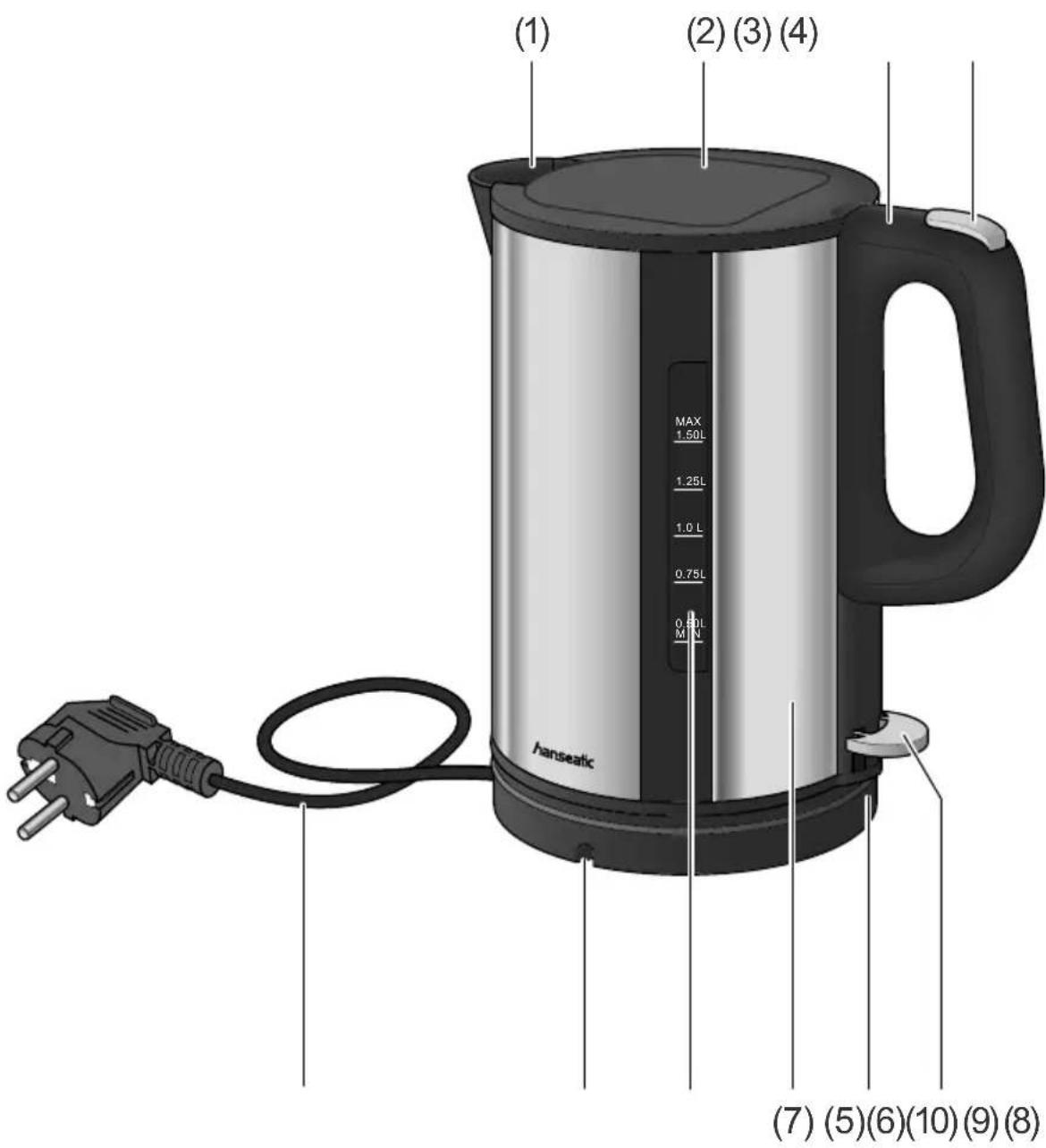
(1) Spout
(2) Cover
(3) Handle
(4) Lid opener
(5) On/Off switch
(6) Base with contact pin
(7) Water tank
(8) Fill level indicator
(9) Cable feed-through
(10) Connector cable including mains plug
Safety
Intended use
The kettle is only designed to heat quantities of water which are ordinarily used in households.
The appliance is designed for use in private households and is not designed for commercial use or multiple use (e.g. use by several parties in a block of flats).
Use the appliance exclusively as described in this user manual. Any other use is deemed improper and may result in damage to property or even personal injury. The manufacturer accepts no liability for damage caused by improper use.
Explanation of terms
The following symbols can be found in this user manual.

WARNING
This symbol indicates a hazard with a medium level of risk which, if not avoided, could result in death or serious injury.

CAUTION
This symbol indicates a hazard with a low level of risk which, if not avoided, could result in minor or moderate injury.

NOTICE
This symbol warns against possible damage to property.

This symbol refers to useful additional information.
Safety notices
In this chapter you will find general safety notices which you must always observe for your own protection and that
of third parties. Please also observe the warning notices in the individual chapters on operation, cleaning, etc.

WARNING
Risks in handling household electrical appliances
Risk of electric shock! Touching live parts may result in severe injury or death.
- Only connect the appliance if the mains voltage on the plug corresponds to the detail given on the type plate. - The appliance corresponds to protection class I and may only be connected to a plug with a protective conductor that has been installed properly. Do not connect to a multiple socket outlet, power strip, timer or to a separate remote-controlled system for distance monitoring and control.
- Do not operate or continue to operate the appliance – if it has visible damage, e.g. the mains cable is defective.
- if it starts smoking or there is a smell of burning. - it makes unfamiliar noises. In this case, you should pull the mains plug out of the socket and have the appliance repaired (see „Service“ auf Seite GB-21).
If the appliance's mains cable is damaged, the manufacturer, its customer service team or a person with similar qualifications must replace it.
■ Investigations and repairs to the appliance may only be carried out by authorised specialists, such as our service department (see page GB-21). Unauthorised repairs to the appliance can cause property damage and personal injury, and invalidate liability and warranty claims. Never try to repair a defective or suspected defective appliance yourself.
■ Only parts corresponding to the original appliance specifications may be used for repairs. This appliance contains electrical and mechanical
parts which are essential for protection against potential sources of danger.
■ Only use the kettle with the original base.
■ Always pull the mains plug out of the socket prior to cleaning and maintenance.
■ Ensure that children do not place any objects into the appliance.
- Keep the appliance, the mains plug and the mains cable away from open flames and hot surfaces.
■ Ensure that the mains cable does not come into contact with hot parts.
■ Do not kink or clamp the mains cable. This can result in a break in the cable.
■ Never pull the mains plug out of the socket by the mains cable, always hold the mains plug itself.
■ Never use the mains cable as a carrying handle.
■ Never touch the mains plug with wet hands.
■ Never submerge the device and base in water.
■ Make sure that water is never spilled over the contact pin on the base.
■ Only use the appliance indoors. Do not use in wet rooms or in the rain.
■ Never store the appliance in such a way that it can fall into a bathtub or sink.
■ Never touch an electrical appliance if it has fallen into water. In such a case, immediately unplug the mains plug from the socket.
■ Do not immerse the appliance itself or the mains cable or mains plug or base (socket) in water or other liquids.
■ Thoroughly dry all parts after cleaning.
Risks associated with handling household appliances which heat up Fire hazard!
The appliance will become very hot during operation. Flammable objects placed close to the appliance may ignite easily.
■ Do not position the appliance near to fl ammable objects such as curtains.
■ Never place the appliance on or near hot surfaces e.g. hotplates on a stove, ovens etc.
■ Do not cover the appliance, e.g. with cloths or similar
Risks caused by hot liquids and steam
Risk of scalding!
While using the kettle, hot steam will come out which can lead to scalding.
■ Avoid any contact with the hot steam during the heating process, when refi lling the water tank and when the lid is open.
Particularly ensure that you keep your face away from it.
■ Do not open the cover during operation.
■ Allow the hot device to cool for at least 5 minutes prior to filling with cold water.
If the water tank is over-fi lled or if the lid is open, hot water can spurt out during boiling. This can lead to scalding.
■ Do not fill the water tank past the MAX mark.
■ Ensure that the lid is closed during operation.
If the appliance falls down, contact with hot water can lead to scalding.
■ Do not place the water tank on the edge of the worktop.
■ Do not allow the mains cable to hang down over the worktop.
Drinking hot water can lead to scalding.
■ Allow freshly heated water to cool prior to drinking.
Health hazard
Health hazard!
Improper use of the appli- ance can lead to damage to health.
■ Always throw away the first batch of boiled water from a new kettle for hygiene reasons.
■ During first use, after decalcification and after having not used the appliance for a prolonged period of time, fi ll the water tank completely, heat it up and throw the water away.
Risks to children
Risk of suffocation!
Children can become entangled in the packaging fi lm and suffocate.
■ Do not allow children to play with the packaging fi lm.

CAUTION
Risks for certain groups of people
Danger to children and people with impaired physical, sensory or mental abilities! Children often fail to recognise hazards or underestimate them.
■ This appliance may be used by children aged eight years and above, as well as by persons with reduced physical, sensory or mental capacities or those lacking experience and/or knowledge, if they are supervised or have been instructed in how to safely use the appliance and have understood the dangers associated with operating it.
■ Children must not be allowed to play with the appliance.
- Keep the appliance and its connection cables away from children aged eight years and under.
■ Do not leave the appliance unsupervised while in operation.
■ Cleaning and user maintenance may not be per-
formed by children unless they are at least eight years old and under supervision.
Risks associated with using kettles
Risk of burns!
The device will become very hot during operation and also remains hot for some time after switching it off.
Touching the hot appliance can lead to burns.
■ The appliance will remain hot for some time after switching off.
■ Only touch the device by the handle.
■ Allow the appliance to cool completely prior to cleaning it.
! NOTICE
Risk of damage!
Improper handling of the appliance may result in damage.
■ Never expose the appliance to high temperatures (heating etc.) or weather (rain etc.).
■ Do not expose the appliance to temperatures below 0 °C for prolonged periods. Residual water that may have frozen could damage the appliance.
If the appliance is used at temperatures of less than +5 °C and over +40 °C it may lead to faults in the electronics.
■ Only use the appliance if it is on a flat, stable and non-sensitive surface.
■ Never operate the appliance when empty.
■ Only fi ll it with fresh, cold drinking water; do not fi ll it with other liquids in the water tank.
■ Please keep in mind that the surface coats of furniture sometimes contain chemical additives that may corrode the rubber feet of the device. This
may cause residue to accumulate on the surface of the furniture. You must therefore place a heat- and water-resistant layer beneath the appliance.
■ Do not set up the appliance under kitchen cupboards. They could be damaged by the steam that is emitted.
■ Do not use sharp objects to unpack the appliance.
■ Never immerse the device in water in order to clean it.
■ Do not put the appliance or individual parts of the appliance in a dishwasher.
■ Do not use a steam cleaner to clean it. This can cause short-circuiting and could damage the appliance.
■ Do not use any solvent-based, abrasive or scouring cleaners (e.g. oven or grill spray) or cleaning utensils such as pot scourers or similar. They could damage the surfaces.
Start-up
Unpacking the appliance

NOTICE
Risk of damage! Improper handling of the appliance may result in dam- age. ■ Do not use sharp objects to unpack the appliance.
- Unpack the kettle.
- Carefully remove all parts of the packaging, plastic profiles, adhesive tape and foam padding.
Choose a suitable location
- Position the kettle on a solid, level, non-sensitive surface.
- Do not position the kettle under an overhead cupboard.
- Position the kettle in such a way that there is enough space above it to open the lid.
- Do not place the kettle directly on or next to a stove or another heat source.
- Set up the kettle in such a way that it is out of the reach of children.
Operation

WARNING
Health hazard!
Improper use of the appli- ance can lead to damage to health.
■ Always throw away the first batch of boiled water from a new kettle for hygiene reasons.
■ During first use, after decalcification and after having not used the appliance for a prolonged period of time, fi ll the water tank completely, heat it up and throw the water away.
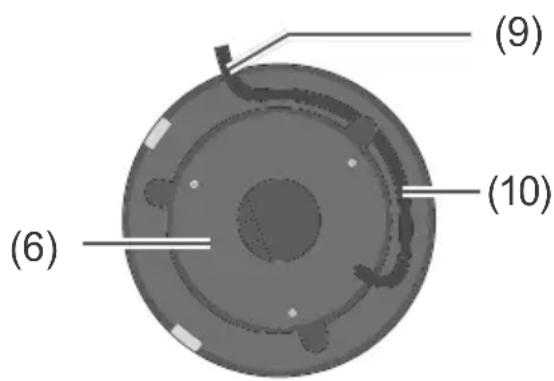
- Wind up the mains cable (10) on the underside of the base (6) until you have achieved the desired length and slot it through one of the cable bushings (9) out of the base.
Heating water

WARNING
Risk of scalding!
If the water tank is over-fi lled or if the lid is open, hot water can spurt out during boiling.
This can lead to scalding.
■ Do not fill the water tank past the MAX mark.
■ Ensure that the lid is closed during operation.
Risk of burns!
The appliance will become very hot during operation.
Touching the hot appliance can lead to burns.
■ Only touch the device by the handle.

NOTICE
Risk of damage!
Operating the appliance with too little water can damage it.
■ Only operate the kettle when the water level is at MIN as a minimum.
- Connect the mains plug to a properly installed and easily accessible socket.
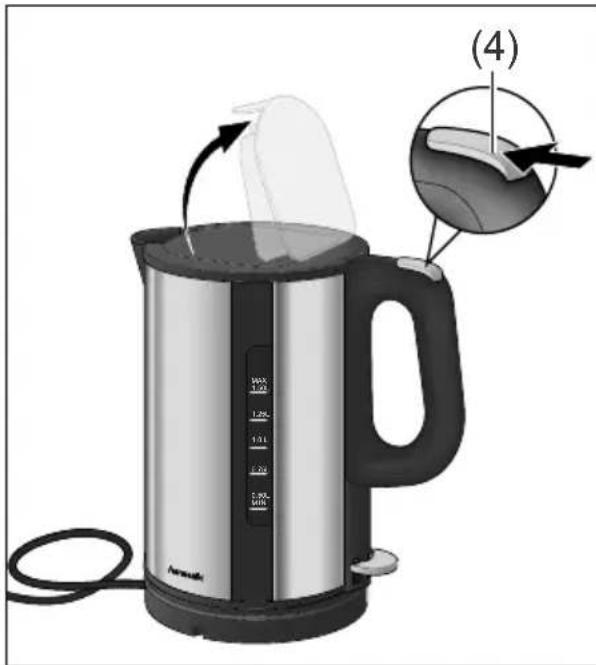
- Depress the lid opener (4) to open the lid.
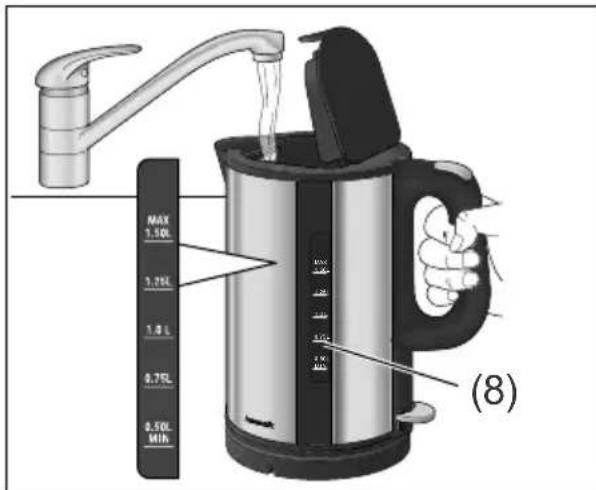
- Fill the kettle with fresh, cold tap water.
Pay attention to the fill level indicator when filling the kettle (8).
Fill the kettle with a minimum of 0.5 litres and a maximum of 1.5 litres (1.5 litres for first use).
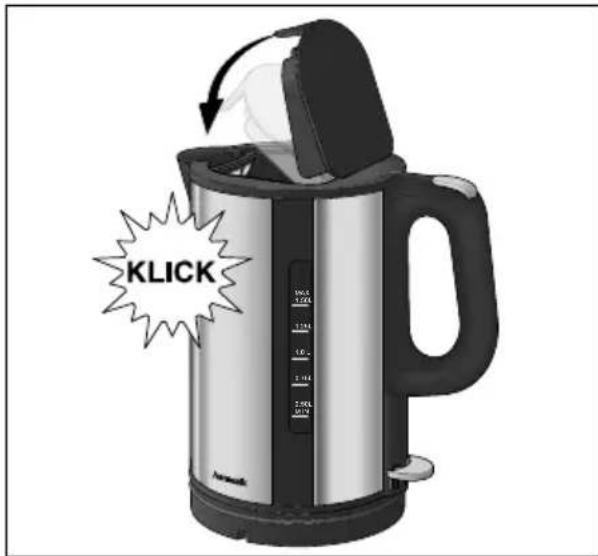
- Push the lid closed until you hear it snap shut.
natural_image
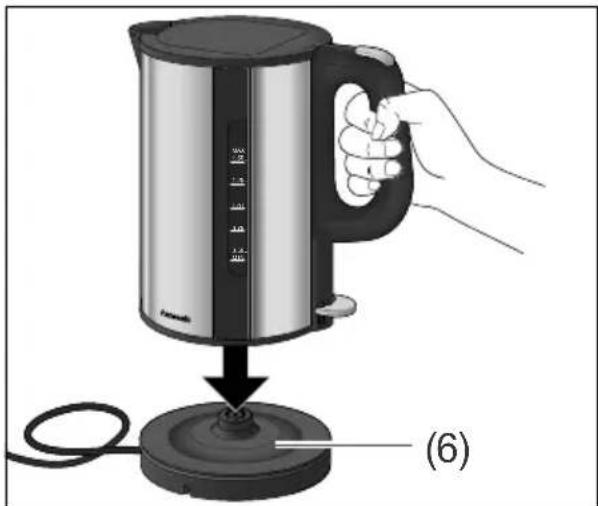
Illustration of a hand holding a small water heater with a base, showing its internal components and a cable (no text or symbols)- Place the water tank on the base (6).
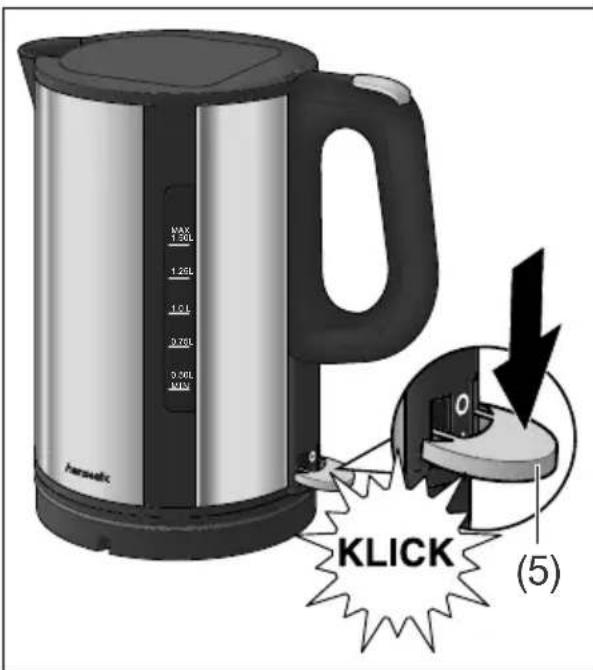
- To switch it on press the On/Off switch (5) down until it clicks into place.
The water will begin to heat. The fill level indicator (8) will illuminate.
The kettle will automatically switch off when boiling point is reached. The On/Off switch will spring back to its original position and the fill level indicator light will go out.
Overheating protection
The kettle has its own integrated temperature regulator which protects the heating element from overheating in case you accidentally switch on the kettle without water or if the heating element is calcified.
If the temperature regulator of the kettle has switched off you should allow the kettle to cool off for 15–20 minutes and decalcify it too before filling it with cold water and switching it on.
Aborting the heating process
If you do not require boiling water, if you just need warm or hot water, you can terminate the boiling process early.
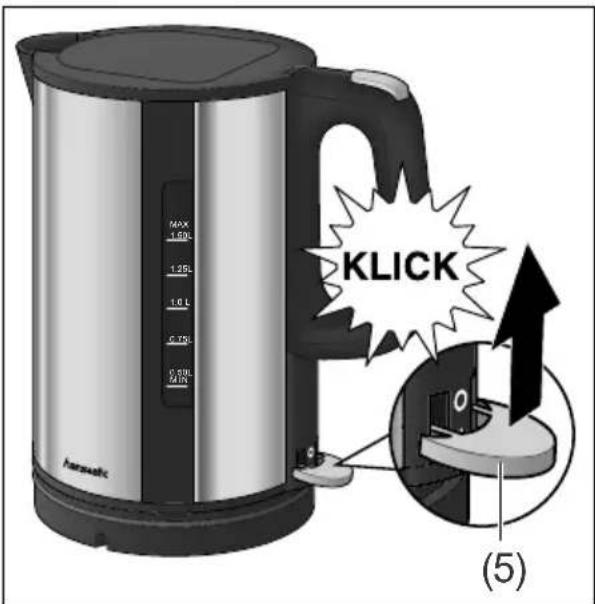
- To switch the kettle off, push the On/Off switch upwards back to its original position. The heating process will terminate, and the fill level indicator will switch off.
Pouring out water
natural_image
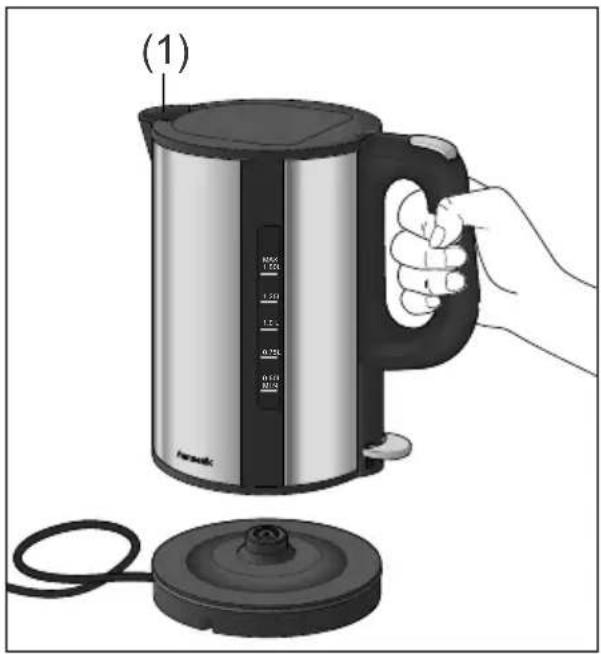
Illustration of a hand holding a Panasonic water heater with a separate electrical socket underneath (no text or symbols)- Remove the kettle from the base using the handle.
-
Pour the boiling water with the lid closed through the spout (1) into the required container.
-
If you want to heat more water, allow the device to cool off for 30 seconds prior to cooling.
- If you do not want to heat more water, pull the mains plug out of the socket.
i Empty the kettle after each use. Otherwise, the kettle will calcify more quickly and the water will become murky if not used for an extended period.
Cleaning and maintenance
Cleaning the kettle

WARNING
Risk of electric shock! Improper use of the appli- ance may lead to serious injury or death.
■ Always pull the mains plug out of the socket prior to cleaning and maintenance.
■ Never immerse the device in water in order to clean it.
■ Do not use a steam cleaner to clean it.

CAUTION
Risk of burns!
The appliance will become very hot during operation.
Touching the hot appliance can lead to burns.
■ Allow the appliance to cool completely prior to cleaning it.

NOTICE
Risk of damage!
Improper cleaning can cause short-circuiting and damage the appliance.
■ Do not put the appliance or individual parts of the appliance in a dishwasher.
Improper use of cleaning products or cleaning utensils can scratch the surfaces or cause chemical damage.
■ Do not use any solvent-based, abrasive or scouring cleaners (e.g. oven or grill spray) or cleaning utensils such as scouring pads or similar.
■ Do not use abrasive cleansers (scouring agents or thinning agents) to clean the appliance.
- Disconnect the mains plug from the socket.
- Allow the appliance to cool completely.
- Wipe the appliance surface off with a lightly moistened cloth. Use a small amount of washing-up liquid for stubborn soiling. Ensure that the electrical
contacts on the underside of the kettle, on the base and the On/Off switch do not become wet.
- Wash the inside of the water tank with normal dishwater and then rinse the water tank out thoroughly with clear water.
- Thoroughly dry all parts after cleaning.
Decalcification
Depending on the hardness of the water, lime residue may form inside the water tank. You must decalcify the appliance if the inner walls or the hotplates on the base of the water tank show visible lime deposits.
- Mix 0.5 litres of water with 2 tablespoons of vinegar essence.
- Pour this mixture into the water tank.
- Allow the mixture to come to the boil.
- Then allow the mixture to take effect briefly.
- Dispose of the mixture. Do not pour it into an enamel-covered sink.
- Rinse the water tank out thoroughly with cold water.
- Thoroughly dry all parts after cleaning.
- Heat one or two complete tankfuls and then tip the water away.
Cleaning the sieve
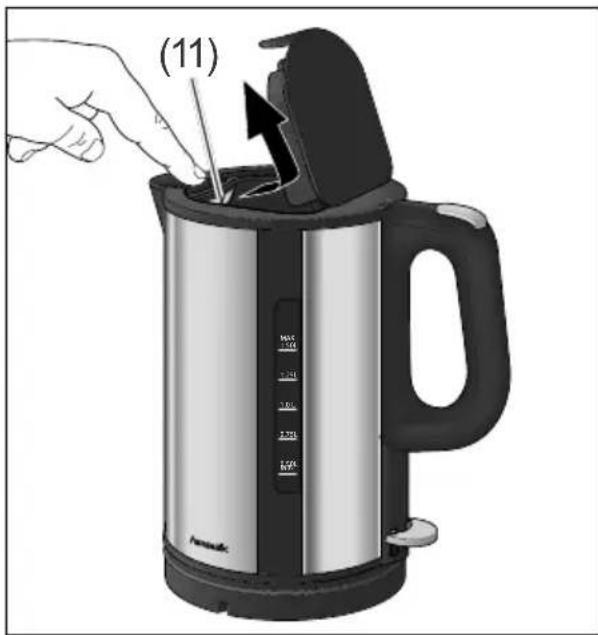
- There is a sieve (11) in the spout (1).
Open the lid and push the sieve by hand into the water tank. Remove the sieve.
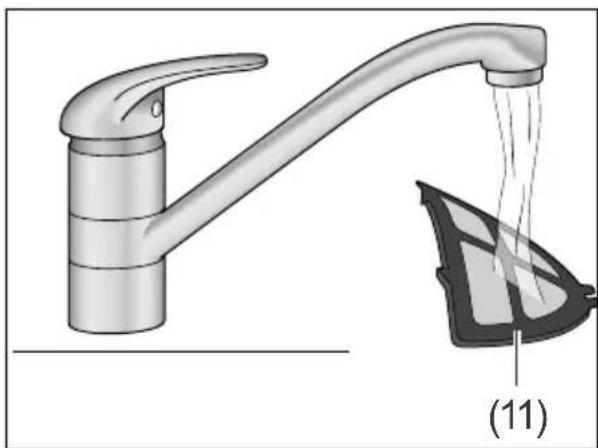
natural_image
Illustration of a faucet with liquid being poured into a fan (no text or symbols)- Clean the sieve under warm running water.
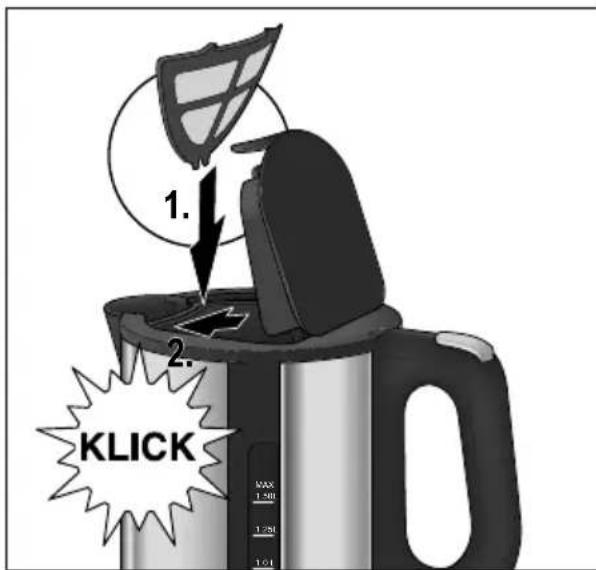
- Position the sieve with the tip facing downwards again.
- Push the upper part of the sieve in the direction of the spout until the sieve audibly clicks into place.
Troubleshooting table
Malfunctions can occur in all electrical appliances. This does not necessarily mean there is a defect in the appliance. For this reason, please check the tables to see if you can correct the malfunction.

WARNING
Risk of electric shock in case of improper repair!
Never try to repair a defective or suspected defective appliance yourself. You can put your own and future users' lives in danger. Only authorised specialists are allowed to carry out this repair work.
| Problem Possible | cause Solutions, tips | |
| The water does not become hot. | The On/Off switch has not been activated. | Switch the appliance on. |
| Mains plug is loose. Check that the mains plug is firmly inserted into the socket. | ||
| The socket is defective. Try the appliance with a different socket. | ||
Service
In order for us to help you quickly, please tell us:
| Name of appliance Model Order | number | |
| hanseatic Kettle WK8325SN 61 | 929830 |
Advice, order and complaint
Please contact your mail order company's customer service centre if
– the delivery is incomplete,
– the appliance is damaged during transport,
– you have questions about your appliance,
- If a fault cannot be rectified using the troubleshooting table,
– you would like to order further accessories.
Spare parts
Customers in Germany
- Please contact the company Hermes Fulfilment GmbH:
– Tel. 0049 (0) 57 32 99 66 00
Mon-Thurs 8 am to 3 pm, Friday 8 am to 2 pm
Customers in Austria
- Please contact your mail order company's customer service centre or product advice centre.
Please note:
You are responsible for the condition of the appliance and its proper use in the household. Damage resulting from non-compliance with this manual unfortunately cannot be recognised.
Environmental protection
Disposing of old electrical devices in an environ mentally-friendly manner
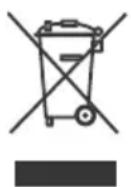
Electrical appliances contain harmful substances as well as valuable resources.
Every consumer is therefore required by law to dispose of old electrical appliances at an authorised collection or return point. They will thus be made available for environmentally-sound, resource-saving recycling.
You can dispose of old electrical appliances free of charge at your local recycling centre.
Please contact your dealer directly for more information about this topic.
Packaging

Our packaging is made of environmentally-friendly, recyclable materials:
– Outer packaging made of cardboard
- Moulded parts made of foamed, CFC-free polystyrene (PS)
– Films and bags made of poly-ethylene (PE)
– Tension bands made of polypropylene (PP).
If you would like to dispose of the packaging, please dispose of it in an environmentally friendly way.
Technical specifications
| Brand | hanseatic |
| Name of appliance Kettle | |
| Model | WK8325SN |
| Power consumption | 1,850 – 2,200 W |
| Supply voltage 220–240 V~ / 50 Hz | |
| Protection class I | |
| Capacity 1.5 l | |
| Cable length 70 cm | |
| Weight (without water) approx. 1.2 kg | |
| Order number | 61929830 |


- Lieferumfang
- Table of contents
- Delivery
- Package contents
- Check the delivery
- WARNING!
- Appliance parts
- Safety
- Intended use
- Explanation of terms
- WARNING
- CAUTION
- NOTICE
- Safety notices
- Risks in handling household electrical appliances
- Health hazard
- Risks to children
- Risks for certain groups of people
- Risks associated with using kettles
- ! NOTICE
- Start-up
- Unpacking the appliance
- Choose a suitable location
- Operation
- Heating water
- Overheating protection
- Aborting the heating process
- Pouring out water
- Cleaning and maintenance
- Cleaning the kettle
- Decalcification
- Cleaning the sieve
- Troubleshooting table
- Service
- Advice, order and complaint
- Spare parts
- Customers in Germany
- Customers in Austria
- Please note:
- Environmental protection
- Disposing of old electrical devices in an environ mentally-friendly manner
- Packaging
- Technical specifications
Brand : Hanseatic
Model : WK8235SNL
Category : Kettle