
TI 7624 - Hob SCHOLTES - Free user manual and instructions
Find the device manual for free TI 7624 SCHOLTES in PDF.



| Product type | Induction hob |
| Brand | SCHOLTES |
| Model | TI 7624 |
| Number of cooking zones | 4 |
| Type of cooking zones | Induction |
| Maximum total power | 7200 W |
| Power supply | 230-240 V single-phase or 400 V three-phase (depending on configuration) |
| Booster function | Yes, up to 3000 W on rear zones |
| Programmable timer | Yes, from 1 to 99 minutes |
| Control lock | Yes |
| Pan detection | Yes |
| Residual heat indicators | Yes |
| Overheat safety | Yes, automatic shutdown |
| Error sound signal | Yes |
| Dimensions (W x D x H) - estimate | 77 x 51 x 5 cm |
| Weight - estimate | 10 kg |
| Cleaning | Ceramic glass cleaner, scraper, damp sponge |
| Repairability | Contact authorized technical service |
Frequently Asked Questions - TI 7624 SCHOLTES
User questions about TI 7624 SCHOLTES
0 question about this device. Answer the ones you know or ask your own.
Ask a new question about this device
Download the instructions for your Hob in PDF format for free! Find your manual TI 7624 - SCHOLTES and take your electronic device back in hand. On this page are published all the documents necessary for the use of your device. TI 7624 by SCHOLTES.
USER MANUAL TI 7624 SCHOLTES
natural_image
Circular pattern composed of evenly spaced black petal-like shapes on white background (no text or symbols)Scholtès
text_image
Blu Marrone Verde / Giallo Neutre N Phase L TerreElectrical connections
Description of the appliance, 15
Control panel
Start-up and use, 16-17
Switching on the hob
Switching on the cooking zones
Booster function
Switching off the cooking zones
Programming the cooking time
Control panel lock
Practical advice on using the appliance
Safety devices
Precautions and tips, 18
General safety
Disposal
Maintenance and care, 19
Switching the appliance off
Cleaning the appliance
Removing the hob
Technical description of models, 20

natural_image
Circular arrangement of black oval shapes on white background (no text or symbols)Scholtès
GB
! Before operating your new appliance please read this instruction booklet carefully. It contains important information for safe use, installation and care of the appliance.
! Please keep these operating instructions for future reference. Pass them on to possible new owners of the appliance.
Positioning
! Keep packaging material out of the reach of children. It can become a choking or suffocation hazard (see Precautions and tips).
! The appliance must be installed by a qualified person according to the instructions provided. Incorrect installation may damage property or cause harm to people or animals.
Fitting the appliance
Use the appropriate cabinet to ensure that the appliance functions properly.
- The supporting surface must be heat-resistant up to a temperature of around 100^ C
- if the appliance is to be installed above an oven, the oven must have a forced ventilation cooling system
- avoid installing the hob above a dishwasher: if this cannot be avoided, place a separation device at a static distance between the two appliances
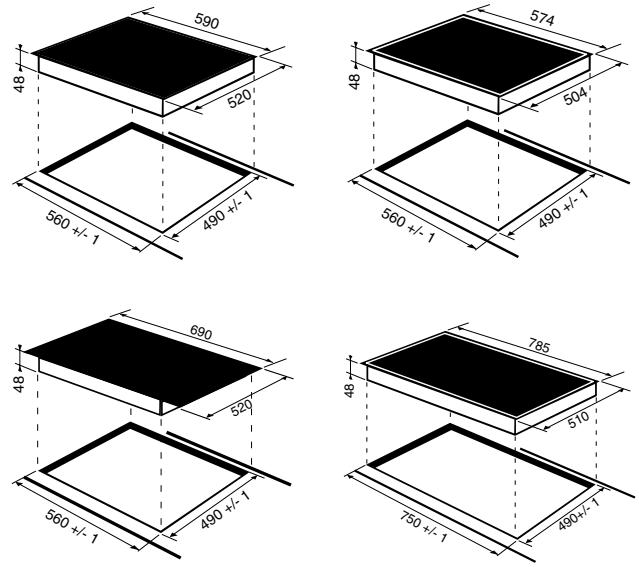
- depending on the hob you want to install the cabinet must have the following dimensions (see figure):
Ventilation
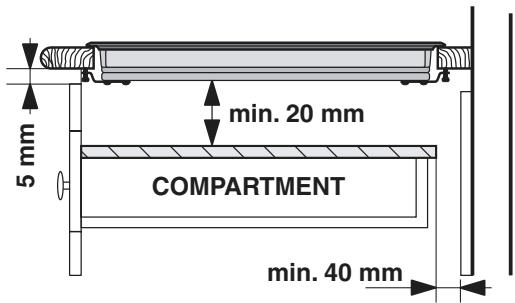
To allow adequate ventilation and to avoid overheating of the surrounding surfaces the hob should be positioned:
- At a minimum of 40 mm from the back panel and 600 mm from any other vertical surfaces.
- maintaining a minimum distance of 20 mm between the installation cavity and the cabinet underneath.
text_image
5 mm min. 20 mm COMPARTMENT min. 40 mm
text_image
5 mm min. 20 mm FAN-ASSISTED OVEN min. 40 mmFixing
The appliance must be installed on a perfectly level supporting surface. Any deformities caused by improper fixing could change the features and the operation of the hob.

text_image
FRONT SIDE OF HOB SUPPORTING SURFACE 30 40 UNDERSIDE OF HOB h WortapThe thickness of the supporting surface should be taken into account when choosing screws for the fixing hooks:
• thickness of 30 mm: 23 mm screws
• thickness of 40 mm: 13 mm screws
Fix the appliance as follows:
- Use short flat-bottomed screws to fix the 4 alignment springs in the holes provided in the centre of each side of the hob.
- Insert the hob in the cavity, make sure it is in a central position and push down on the whole perimeter until the hob is stuck to the supporting surface.
- for hobs with raised sides: after inserting the hob into its cavity, insert the 4 fixing hooks (each has its own pin) into the lower edges of the hob, using the long pointed screws to fix it in place, until the glass is stuck to the supporting surface.
! The screws for the alignment springs must remain accessible.
! In order to adhere to safety standards, the appliance must not come into contact with electrical parts once it has been installed.
! All parts that ensure the safe operation of the appliance must not be removable without the aid of a tool.
Electrical connection
! The electrical connection of the hob and any built-in oven must be carried out separately, both for safety purposes and to make extracting the oven easier.
Terminal board
UNDERSIDE OF HOB

natural_image
Technical diagram showing a mechanical assembly with a zoomed-in view of a component (no text or labels present)On the lower part of the appliance there is a connection box for the different types of electricity supply (the picture is only an indication and is not an exact representation of the purchased model).
Single-phase connection
! The cable provided should only be used for this type of installation.
Mains supply characteristics:
Voltage and mains frequency
- 230/240V 1+N \~ 50 Hz
- 230V 2 \~ 50 Hz
Blue Brown Green/Yellow

text_image
N Neutral Live L EarthIf the hob has a supply cable fitted, connect it to the mains, using the colours as a guide (see diagram).
If the hob does not have a supply cable fitted, proceed as follows:
- Use the supply cable provided (where applicable) or a suitable supply cable, H05VV-F or higher, with the right dimensions (cable section: 2.5 mm).
- To open the terminal board, insert a screwdriver into the side tabs of the cover (see Terminal board picture).
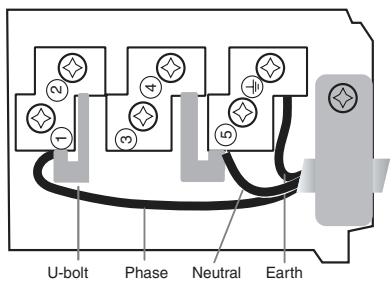
- The terminal board is designed for single-phase connection: make sure the connection supports between springs 1 and 2 and those between 4 and 5 are in the right position (see Single-phase picture).
- Position the wires according to the following diagram and table and connect the appliance by tightening all the screws for the springs as much as possible.
| Voltage and mains frequency | Electrical connections | Terminal board |
| 230/240V 1+N ~ 50 Hz | Single-phase | |
| 230V 2 ~ 50 Hz |
text_image
U-bolt Phase Neutral Earthconnection support
Single-phase
- Secure the power supply cable by fastening the clamp screw then put the cover back on.
Other types of connection
! The cable provided is not suitable for the following types of installation.
If the mains supply corresponds with one of the following:
Voltage and mains frequency
- 400V 2 - N \~ 50 Hz
- 230V 3 \~ 50 Hz
- 230V 2 + 2 - N \~ 50 Hz
proceed as follows:
- Use a suitable supply cable, H05RR-F or higher, with the right dimensions (cable section: 1.5 mm).
- To open the terminal board, insert a screwdriver into the side tabs of the cover (see Terminal board picture).
- Loosen the cable clamp screw and the terminal board screws according to the type of connection required and position the connection supports as shown in the following table and diagrams.
- Position the wires according to the following table and diagrams and connect the appliance by tightening all the screws for the springs as much as possible.
| Voltage and mains frequency | Electrical connections | Terminal board | |||||
| 400V 2-N ~ 50 Hz | Three-phase 400 2+N | ||||||
| 230V 3 ~ 50 Hz | Three-phase 230 | ||||||
| 230V 2+2-N ~ 50 Hz | Two-phase | ||||||
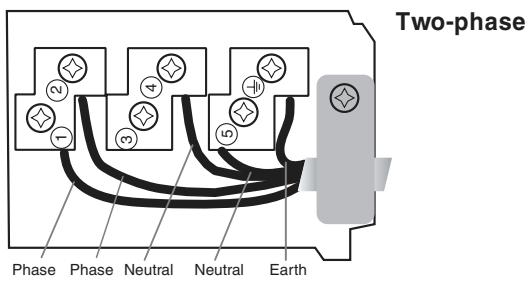
text_image
Two-phase Phase Phase Neutral Neutral Earth- Secure the power supply cable by fastening the clamp screw then put the cover back on.
Connecting the supply cable to the mains
If the appliance is being connected directly to the mains an omnipolar circuit-breaker must be installed with a minimum opening of 3 mm between contacts.
! The installer must ensure that the correct electrical connection has been made and that it is compliant with safety regulations.
Before connecting to the power supply, make sure that:
- The appliance is earthed and the plug is compliant with the law.
- The socket can withstand the maximum power of the appliance, which is indicated on the attached data plate.
- The power supply voltage is in the range between the values indicated on the data plate.
- The socket is compatible with the plug of the appliance. If the socket is incompatible with the plug, ask an authorised technician to replace it. Do not use extension cords or multiple sockets.
! Once the appliance has been installed, the power supply cable and the electrical socket must be easily accessible.
! The cable must not be bent or compressed.
! The cable must be checked regularly and replaced by authorised technicians only.
! The manufacturer declines any liability should these safety measures not be observed.

text_image
Three-phase 400 2+N Phase Phase U-bolt connection support Neutral Earth
text_image
Three-phase 230 Phase Phase Phase Earth U-bolt connection supportControl panel
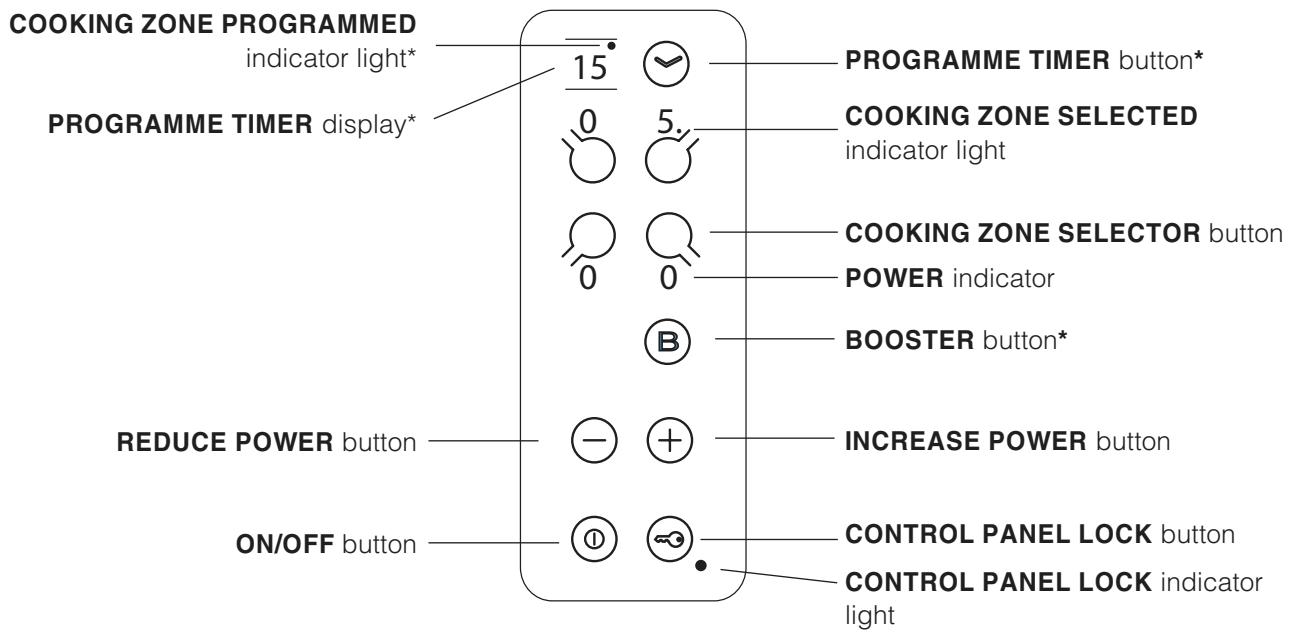
text_image
COOKING ZONE PROGRAMMED indicator light* PROGRAMME TIMER display* 15 0 5 PROGRAMME TIMER button* COOKING ZONE SELECTED indicator light COOKING ZONE SELECTOR button POWER indicator BOOSTER button* REDUCE POWER button INCREASE POWER button ON/OFF button CONTROL PANEL LOCK button CONTROL PANEL LOCK indicator light- PROGRAMME TIMER display shows the programme chosen (see Start-up and use).
- PROGRAMME TIMER button controls the programmes for each cooking zone (see Start-up and use).
- COOKING ZONE PROGRAMMED indicator light shows that a particular cooking zone has been programmed (see Start-up and use).
• ON/OFF button switches the appliance on and off. - CONTROL PANEL LOCK button prevents accidental changes to the hob settings (see Start-up and use).
-
CONTROL PANEL LOCK indicator light shows the control panel has been locked (see Start-up and use).
-
BOOSTER button switches on the booster function - 3000W - of the cooking zone (see Start-up and use).
- COOKING ZONE SELECTED indicator light shows that a particular cooking zone has been selected and so various controls may be used.
- COOKING ZONE SELECTOR button can be used to select the required cooking zone.
- POWER indicator provides a visual display for the current heat level.
- INCREASE POWER button switches on the hotplate and controls the power (see Start-up and use).
- REDUCE POWER button controls the power and switches off the hotplate (see Start-up and use).
! The glue applied on the gaskets leaves traces of grease on the glass. Before using the appliance, we recommend you remove these with a special non-abrasive cleaning product. During the first few hours of use there may be a smell of rubber which will disappear very quickly.
! A few seconds after the hob is connected to the electricity supply, a buzzer will sound. The hob may now be switched on.
Switching on the hob
To switch the hob on, press and hold the Ⓞ button for about a second.
Switching on the cooking zones
Each cooking zone is controlled by a device consisting of two buttons (- and +).
- Press the “+” button to activate the hotplate, then set the power to the level required using the “-” and “+” buttons.
- To set the power to maximum, hold down the “-” button briefly.
Booster function\*
The booster function for the rear cooking zones may be used to shorten heating-up times. It is activated by pressing the Ⓑ button. “P” appears on the power indicator display. This function boosts the power of the relevant zone to 3000W. It stops automatically after 4 minutes. Until the booster of one of the rear zones is activated, the front zones have a maximum power of 600 W (e.g. if the left rear hotplate booster is activated, the power of the left front hotplate decreases).
! Oval cooking zones*: may be used with the booster only if the whole oval is activated.
! Do not put two small pans on the oval cooking zones.
Switching off the cooking zones
- Press the “-”button: the power of the cooking zone will progressively decrease until it is switched off.
- Alternatively, the “-” and “+” buttons may be pressed simultaneously. This immediately returns the power setting to 0 and the cooking zone switches off.
Programming the cooking duration\*
! All the cooking zones may be programmed for a length of time between 1 and 99 minutes.
- Select the cooking zone with the corresponding button.
- Set the temperature.
- Press the √ button.
- Set the cooking time using the “-” and “+” buttons.
- Confirm the settings by pressing the √ button.
The timer begins counting down immediately. A buzzer sounds for about 1 minute and the cooking zone switches off when the set programme has finished.
Repeat the above procedure for each hotplate you wish to programme.
Control panel lock
When the hob is switched on, it is possible to lock the oven controls to avoid accidental changes to the settings (by children, during cleaning, etc.). Press the ⏻ button to lock the control panel and the indicator light above the button will be lit. To use any of the controls (e.g. to stop cooking), you must switch off this function: press the ⏻ button for a few moments, the indicator light will switch off and the lock function is removed.
Switching off the hob
Press the Ⓓ button to switch the appliance off. If the control panel lock is on, the controls will continue to be locked even after the hob is switched on again. In order to switch the hob on again, you must first remove the lock function.
* Only available on certain models.
Practical advice on using the appliance
! Use cookware made from materials that are compatible with the induction principle (ferromagnetic material). We especially recommend pans made from: cast iron, coated steel or special stainless steel adapted for induction. Us ea magnet to test the compatibility of the cookware.

text_image
SUITABLE Cast iron Enamelled steel Special stainless steel UNSUITABLE Copper, Aluminium, Glass, Earthenware, Ceramic, non magnetic Stainless steelIn addition, to obtain the best results from your hob:
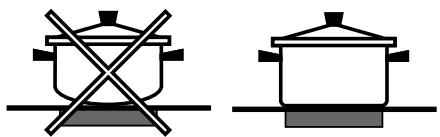
- Use pans with a thick, flat base to fully utilise the cooking zone.
natural_image
Two identical cooking pots with crossed x's symbols on their bases, no text or labels present.- Always use pans with a diameter that is large enough to cover the hotplate fully, in order to use all the available heat.
natural_image
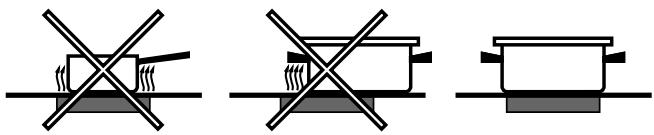
Three schematic diagrams showing crossed-out electrical or mechanical components, no text or symbols present- Make sure that the base of the cookware is always dry and clean, to fully utilise and extend the life of both the cooking zones and cookware.
- Avoid using the same cookware that has been used on gas burners: the heat concentration on gas burners may deform the base of the pan, causing it not to fit correctly.
Safety devices
Pan sensor
Each cooking zone is fitted with a pan sensor device. The hotplate only emits heat when a pan with suitable measurements for the cooking zone is placed on it. If the indicator light is flashing, it may indicate:
- an incompatible pan
• a pan that is too small
• the pan has been taken away
Residual heat indicators
While the temperature of the cooking zone remains above 60^ C, even after the programme has finished, the residual heat indicators placed near the relevant cooking zone remain lit to prevent the risk of burns.
Overheating protection
If the electronic elements overheat, the hob switches off automatically and “—” appears on the display. When the temperature has reached an appropriate level, this message disappears and the hob may be used again.
Safety switch
The appliance has a safety switch that automatically switches off the cooking zones when they have been in operation for a certain amount of time at a given power level. When the safety switch has been triggered, the display shows “0”.
For example: the right rear hotplate is set to 5 and will switch off after 3 hours of continuous operation, while the front left hotplate is set to 2 and will switch off after 10 hours.
Buzzer
This can indicate several irregularities:
- an object (a pan, cutlery, etc.) has been placed on the control panel for more than 10 seconds
- something has been spilt on the control panel
- a button has been pressed for too long All the above can cause the buzzer to sound. Remove the cause of the malfunction to stop the buzzer. The control panel locks automatically in these situations: to unlock it press the button [key icon], the settings will have been maintained. If the cause of the problem is not removed, the buzzer will keep sounding and the hob will switch off.
! This appliance has been designed and manufactured in compliance with international safety standards. The following warnings are provided for safety reasons and must be read carefully.
CE This appliance conforms to the following European Economic Community directives:
- 73/23/EEC of 19/02/73 (Low Voltage) and subsequent amendments
- 89/336/EEC of 03/05/89 (Electromagnetic Compatibility) and subsequent amendments
- 93/68/EEC of 22/07/93 and subsequent amendments
- 2002/96/EC
General safety
! Make sure that the air inlet behind the fan grille is never obstructed. The built-in hob should, in fact, be provided with suitable ventilation for the cooling of the electronic components used in the appliance.
! We advise against the installation of an induction hob above an under-the-counter refrigerator (heat) or above a washing machine (vibrations). In fact, there would be insufficient space for the ventilation of electronic components.
- This appliance was designed for domestic use inside the home and is not intended for commercial or industrial use.
- The appliance must not be installed outdoors, even in covered areas. It is extremely dangerous to leave the appliance exposed to rain and storms.
- Do not touch the appliance with bare feet or with wet or damp hands and feet.
- The appliance must be used by adults only, to cook food according to the instructions in this manual. Do not use the hob as a worktop or chopping board.
- The glass ceramic hob is resistant to mechanical shocks, but it may crack (or even break) if hit with a sharp object such as a tool. If this happens, disconnect the appliance from the electricity mains immediately and contact a Service Centre.
- If the surface of the hob is cracked, switch off the appliance to prevent electric shocks from occurring.
- Ensure that power supply cables of other electrical appliances do not come into contact with the hot parts of the hob.
- Remember that the temperature of the cooking zones remains relatively high for at least thirty minutes after they have been switched off. An indicator light provides a warning when residual heat is present (see Start-up and use).
- Keep any object that could melt away from the hob, for example plastic and aluminium objects, or
products with a high sugar content. Keep plastic and aluminium film and packaging away from the hob: if placed on surfaces that are still hot, they may cause serious damage to the hob.
- Always make sure pan handles are turned towards the centre of the hob in order to avoid accidental burns.
- When unplugging the appliance always pull the plug from the mains socket, do not pull on the cable.
- Never carry out any cleaning or maintenance work without having unplugged the plug from the mains.
- Do not place metal objects (knives, spoons, pan lids, etc.) on the hob as they may become hot.
- For the attention of wearers of pacemakers or other active implants:
The hob complies with all current standards on electromagnetic interference.
Your induction hob is therefore perfectly in keeping with legal requirements (89/336/CEE directives). It is designed not to create interference on any other electrical apparatus being used on condition that the apparatus in question also complies with this legislation.
Your induction hob generates short-range magnetic fields.
To avoid any interference between your induction hob and a pacemaker, the latter must be designed to comply with relevant regulations.
In this respect, we can only guarantee our own product conformity. Please consult the pacemaker manufacturer or your doctor concerning its conformity or any possible incompatibility.
Disposal
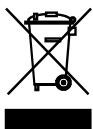
- When disposing of packaging material: observe local legislation so that the packaging may be reused.
- The European Directive 2002/96/EC on Waste Electrical and Electronic Equipment (WEEE), requires that old household electrical appliances must not be disposed of in the normal unsorted municipal waste stream. Old appliances must be collected separately in order to optimise the recovery and recycling of the materials they contain and reduce the impact on human health and the environment. The crossed out “wheeled bin” symbol on the product reminds you of your obligation, that when you dispose of the appliance it must be separately collected.
Consumers should contact their local authority or retailer for information concerning the correct disposal of their old appliance.
Switching the appliance off
Disconnect your appliance from the electricity supply before carrying out any work on it.
Cleaning the appliance
! Do not use abrasive or corrosive detergents (for example, spray cans for cleaning barbecues and ovens), stain removers, anti-rust products, powder detergents or sponges with abrasive surfaces: these may scratch the surface.
! Never use steam cleaners or pressure cleaners on the appliance.
- It is usually enough to wash the hob with a damp sponge and dry it with absorbent kitchen roll.
- If the hob is particularly dirty, rub with a special glass ceramic cleaning product, rinse and dry.
- To remove more stubborn dirt, use the scraper provided. Remove spills as soon as possible, without waiting for the appliance to cool, to avoid residues forming crusty deposits. You can obtain excellent results by using a rust-proof steel wire sponge - specifically designed for glass ceramic surfaces - soaked in soapy water.
! The scraper provided is sharp: be careful when using it.
- If plastic or sugary substances are accidentally melted on the hob, remove them immediately with the scraper, while the surface is still hot.
- Once it is clean, the hob may be treated with a special maintenance and protection product: the invisible film left by this product protects the surface from drips during cooking. This should be done while the appliance is warm or cold.
- Always remember to rinse the appliance with clean water and dry the hob thoroughly: residues can become encrusted during cooking.
Stainless steel frame (only for models with outer frame)
Rust-proof steel can be marked by hard water that has been left on the surface for a long time, or by cleaning products containing phosphorus. After cleaning, it is advisable to rinse the surface well and dry it thoroughly. If water is spilt on the surface, dry it quickly and thoroughly.
Removing the hob
If it is necessary to remove the hob:
- loosen the screws fixing the alignment springs on each side
- loosen the screws holding the fixing hooks in each corner
- take the hob out of its installation cavity
! Do not attempt to repair the appliance yourself. If the appliance breaks down, contact a Service Centre.
Technical description of cooking zones
GB
The induction system is the quickest existing way of cooking. Unlike traditional hotplates where the cooking zone heats up, with the induction system heat is generated directly inside ferromagnetic based pans.
| HOBS | TI 8624TI 8624 400 | TI 7624TI 7624 400 |
| Cooking zones | Wattage | Wattage |
| Back right | IO 1200/2400 W – B 3000 W | ID 2400 W – B 3000 W |
| Front right | I 1200 W – 600 W se* | I 1200 W – 600 W se* |
| Front left | ID 2400 W – B 3000 W | IO 1200/2400 W – B 3000 W |
| Back left | I 1200 W – 600 W se* | I 1200 W – 600 W se * |
| Maximum total wattage | 7200 | 7200 |
| HOBS | TI 6523 | TI 6514TI 6514 400 |
| Cooking zones | Wattage | Wattage |
| Back right | I 1200 W – 600 W se* | ID 1800 W – B 3000 W |
| Front right | IO 1200/2400 W – B 3000 W | I 1200 W – 600 W se* |
| Front left | I 1800 W | |
| Back left | ID 1800 W – B 3000 W | I 1200 W |
| Maximum total wattage | 6600 W | 6600 W |
Key:
I = single induction cooking zone
OI = oval induction cooking zone
DI = double induction cooking zone
B = booster: the power of the cooking zone may be boosted to 3000W
* = the maximum power is limited to 600 W until the booster is activated for the appropriate rear cooking zone (see Start-up and use).

Italiano, 1

English, 11

Français, 21

Nederlands, 31

Deutsch, 41

Português, 51

Español, 61
TI 8624
TI 8624 400
TI 7624
TI 7624 400
TI 6514
TI 6514 400
TI 6523
Sommaire
Installation, 22-24
Positionnement
natural_image
Circular arrangement of black oval shapes on white background (no text or symbols)Scholtès
FR
natural_image
Technical diagram showing a mechanical assembly with a magnified inset view (no text or labels)text_image
Electrical wiring diagram showing multiple connection points with symbols and connections, likely for a power or circuit layout.Triphasé 400 2+N

flowchart
graph TD
    A["Phase"] --> B["Phase"]
    B --> C["Cavalier"]
    C --> D["Neutre"]
    D --> E["Terre"]
    F["Terminal"] --> G["Line"]
    H["Diode 1"] --> I["Diode 2"]
    J["Diode 3"] --> K["Diode 4"]
    L["Diode 5"] --> M["Diode 6"]
Triphasé 230
Phase Phase Cavalier Phase Terre
Tableau de bord

text_image
Voyants FOYER PROGRAMME* Afficheur MINUTEUR* 15 0 5. Touches MINUTEUR* Voyants FOYER SELECTIONNE Touche SELECTION FOYER Indicateur de PUISSANCE B Touche BOOSTER* Touche DIMINUTION DE PUISSANCE Touche AUGMENTATION DE PUISSANCE Touche VERROUILLAGE DES COMMANDES Touche ON/OFF 1 2 3 4 5 6 7 8 9 10 11 12 13 14 15 16-93/68/CEE du 22/07/93 et modifications successives.
-2002/96/EC
Sécurité générale
Description technique des foyers
FR
I = foyer à induction simple
IO = foyer à induction ovale
ID = foyer à induction double
natural_image
Circular pattern composed of evenly spaced black petal-like shapes on white background (no text or symbols)Scholtès
NL
natural_image
Technical diagram showing a mechanical assembly with a zoomed-in detail view (no text or labels)text_image
Electrical wiring diagram showing connections between numbered components with symbols and lines
m = 311
natural_image
Circular arrangement of black oval shapes on white background (no text or symbols)Scholtès
DE
natural_image
Technical diagram showing a mechanical assembly with a zoomed-in view of a component (no text or labels)text_image
Blu Marrone Verde / Giallo Neutre Phase Terre N LAcender as zonas de cozedura
Função booster
Desligar as zonas de cozedura
natural_image
Circular pattern composed of evenly spaced black oval shapes on white background (no text or symbols)Scholtès
PT
Acender as zonas de cozedura
Desligar as zonas de cozedura
natural_image
Two identical cooking pots with crossed x's symbols on their bases, no text or labels present.natural_image
Three schematic symbols showing crossed-out electrical contacts on a heating element, with no text or labels present.natural_image
Circular arrangement of black oval shapes on white background (no text or symbols)Scholtès