
B 40 L CS F - Hob SCHOLTES - Free user manual and instructions
Find the device manual for free B 40 L CS F SCHOLTES in PDF.



| Product type | Built-in gas hob |
| Brand | SCHOLTES |
| Model | B 40 L CS F |
| Number of burners | 3 |
| Rapid burner | ⌀ 100 mm, 3.00 kW |
| Semi-rapid burner | ⌀ 75 mm, 1.65 kW |
| Auxiliary burner | ⌀ 55 mm, 1.00 kW |
| Total power | 5.65 kW |
| Power supply | 220-240 V ~ 50/60 Hz |
| Gas type | Natural gas (G20/G25) or liquefied gas (G30/G31) |
| Ignition | Automatic via spark plug |
| Safety | Safety thermocouple on each burner |
| Surface material | Stainless steel and enamel |
| Dimensions (W × D × H) | Approximately 580 × 510 × 82 mm (depending on class) |
| Weight | Approximately 10 kg |
| Power cable | H05RR-F 3×0.75 mm², length ~1 m |
| Gas connection | Swivel connection 12 G male |
| Gas adaptability | Interchangeable injectors, bypass adjustment |
| Cleaning | Warm water and mild detergent, avoid abrasives |
| Installation | Built-in, class 1 or 3 depending on edge height |
| Standards | CE, compliance with Low Voltage, EMC, Gas directives |
Frequently Asked Questions - B 40 L CS F SCHOLTES
User questions about B 40 L CS F SCHOLTES
0 question about this device. Answer the ones you know or ask your own.
Ask a new question about this device
Download the instructions for your Hob in PDF format for free! Find your manual B 40 L CS F - SCHOLTES and take your electronic device back in hand. On this page are published all the documents necessary for the use of your device. B 40 L CS F by SCHOLTES.
USER MANUAL B 40 L CS F SCHOLTES
natural_image
Three identical line drawings of cooking pots with crossed x marks, no text or symbols present
natural_image
Simple line drawing of a heating furnace with cooling tower and stove (no text or symbols)natural_image
Simple line drawing of a house with steam rising from a stove inside, showing airflow and ventilation (no text or symbols)natural_image
Diagram of a door frame and vertical structure with an arrow indicating rotation or movement (no text or symbols)fig.5
natural_image
Line drawing of a pipe fitting with a hexagonal nut and threaded end (no text or symbols)fig.7

natural_image
Illustration of a hand using a tool to test a component on a circular base (no text or symbols present)fig.8

natural_image
Mechanical assembly diagram showing a cylindrical component inserted into a base plate (no text or symbols)fig.9
Instructions for use, 14
Cleaning and maintenance, 15
Instructions for the installer, 16
Hobs installation, 17
Gas supply connection, 18
Electrical connection, 19
Burners and nozzles specifications, 20
B 40 L/CS... F

Scholtès
Congratulations!
You have just purchased an electrical household appliance that has been made using advanced technology and quality materials. As time passes, you will appreciate its practicality and safety, which are constant features of our production.
THESE INSTRUCTIONS ARE ONLY VALID FOR THE COUNTRIES OF DESTINATION WHOSE SYMBOLS ARE SHOWN IN THE BOOKLET AND ON THE APPLIANCE RATING PLATE.
- This appliance has been designed for private, non-professional use in normal dwellings.
- Carefully read the recommendations in this instruction booklet, as they give important advice regarding safe installation, use and maintenance. Keep this booklet in a safe place for further reference when required.
- After removing the packaging, check that the appliance is intact. If in doubt, do not use the appliance and contact professionally qualified personnel.
- All installation and adjustment operations should be carried out by qualified engineers in accordance with current regulations. Specific directions are given in the “installation instructions” paragraph.
- Periodically check the condition of the gas connection pipe and have it replaced by a qualified technician as soon as it shows any signs of wear or anomaly.
-
Under no circumstances should the user replace the power supply cable or the gas connection pipe of this appliance. In the event of damage or the necessity for replacement, only contact an authorised service centre.
-
Before connecting the appliance, make sure that the data on the rating plate (situated on the bottom part of the appliance and on the last page of the booklet) correspond to those of the mains electricity and gas supplies.
- Check that the capacity of the electrical system and the power outlets are suitable for the maximum power of the appliance, indicated on the rating plate. If in doubt, consult a professionally qualified technician.
- Do not leave the appliance plugged in if it is not in use. Switch off the main switch and gas supply when you are not using the hob.
- The gas burners and pan supports remain heated for a long time after use. Take care not to touch them.
- To avoid accidental spillage do not use cookware with uneven or deformed bottoms on the burner.
- Never use flammable liquids such as alcohol or gasoline, etc. near the appliance when it is in use.
- Do not use steam cleaners to clean your oven.
- Do not use cookware with edges which reach beyond the perimeter of the appliance.
- Do not let children play with the appliance.
- The appliance should not be operated by people (including children) with reduced physical, sensory or mental capacities, by inexperienced individuals or by anyone who is not familiar with the product. These individuals should, at the very least, be supervised by someone who assumes responsibility for their safety or receive preliminary instructions relating to the operation of the appliance.
Disposal of old electrical appliances
The European Directive 2002/96/EC on Waste Electrical and Electronic Equipment (WEEE), requires that old household electrical appliances must not be disposed of in the normal unsorted municipal waste stream. Old appliances must be collected separately in order to optimise the recovery and recycling of the materials they contain and reduce the impact on human health and the environment. The crossed out “wheeled bin” symbol on the product reminds you of your obligation, that when you dispose of the appliance it must be separately collected.
Consumers should contact their local authority or retailer for information concerning the correct disposal of their old appliance.

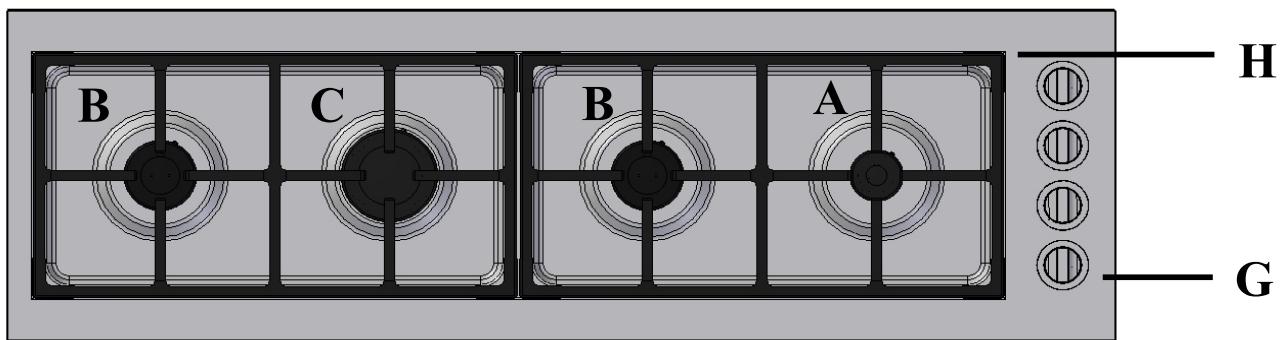

A Auxiliary burner
B Semi-rapid gas burner
C Rapid gas-burner
E Ignitor for gas burners
F Safety device Activates if the flame accidentally goes out (spills, drafts, etc.), interrupting the delivery of gas to the burner.
G Control knobs for gas burners
H Pan supports
Adjusting the flame level
The flame level is adjusted by pressing the control knob and turning it anticlockwise to the following positions:
Black circle = off ●
full flame
small flame


The symbols near the knobs show the position of the relative burner on the hob. The burners are fitted with automatic ignition and thermocouple safety device, which automatically cuts off the gas from the burner in a few seconds if the flame accidentally goes out during operation.
To ignite a burner, proceed as follows:
- turn the relative knob counter-clockwise until the pointer is on the high-flame symbol;
- press the knob down fully to activate the automatic gas ignition;
- keep the knob pressed down for about 10 seconds with the flame lit to allow the safety thermocouple to be heated;
- release the knob, checking that the flame is stable. If it is not, repeat the operation.
For minimum power, turn the knob towards the low flame symbol. Intermediate positions are possible by putting the knob anywhere between the high and the low flame symbol.
To turn off the burner, turn the knob clockwise to the off position "●".
Important:
- Do not activate the automatic ignition device for more than 15 consecutive seconds.
- Difficulty in ignition is sometimes due to air inside the gas duct.
- If a burner flame accidentally goes out, the gas continues to exit for a few moments before the safety device activates. Turn the control knob to the off position and do not attempt ignition again for at least 1 minute, thereby letting the gas disperse, which could otherwise be a danger.
- When the appliance is not in operation, check that the knobs are in the off position "●". The main gas supply cut-off cock should also be closed.
Using the burners
To obtain maximum efficiency from the burners, it is advisable to only use pans with a diameter suitable for the burner being used, so that the flame does not extend beyond the pan base (see following table).
When a liquid starts boiling, it is advisable to turn the flame down just enough to keep the liquid simmering.
| Burner | ø Cookware diameter (cm) |
| A. Auxiliary | 6 – 14 |
| B. Semi-Rapid | 15 – 22 |
| C. Rapid | 21 – 26 |
Since the burner is equipped with a safety device "F", after lighting the burner keep the knob pressed in for about 6 seconds to allow the device which keeps the flame lit automatically to heat up.
To turn off a burner, turn the knob clockwise until it stops (it should be on the “●” setting).
To obtain the best results with the cooktop, several fundamental rules should be followed while cooking or preparing food. Use cookware with a flat bottom to make certain that the pot sets properly on the cooking area.


Note When there is no electricity supply, the burners can be lit with a match after turning the control knob to the flame position.
To turn on one of the burners, place a lighted match or lighter near the burner, press the knob all the way in and turn it anticlockwise to the "High" setting.
To ensure long life of the appliance, it is essential to carry out a thorough general clean frequently, taking into account that:
- The appliance should be disconnected from the mains supply before starting cleaning operations.
- Avoid cleaning appliance parts when they are still warm.
- The enamelled or chromed or glass parts must be washed with warm water without using abrasive powders or corrosive substances which could ruin them.
- The steel parts, especially in areas with the screen-printed symbols, should not be cleaned with diluents or abrasive detergents; preferably use just a soft cloth moistened with warm water and liquid detergent for washing dishes (wipe the cloth over the steel in the same direction as the satin-finish).
Denatured alcohol may be used to remove stubborn dirt. Stainless steel can be stained if it remains in contact with agressive detergents (containing phosphorus) or water with a high lime content. After washing the stainless steel parts they should be rinsed and dried with a soft cloth (washleather).
- After cleaning, some special treatments are available to bring back the shine to steel and to prevent it from yellowing; for this purpose, we recommend you use the specific “special cream detergent for steel care” available from our Assistance Centres.
- Avoid leaving acid liquids (vinegar, lemon juice, aggressive detergents, etc.) on enamelled or painted parts.
- The removable parts of the burners should be washed frequently with warm water and soap, making sure to remove caked-on substance. Check that the gas outlet slits are not clogged. Dry the burners carefully before using them again.
- Frequently clean the end part of the automatic glow plugs of the hob.
• do not use steam cleaners to clean your oven.
Greasing the taps
As time passes, a tap may lock or become difficult to turn. In this case it will be necessary to clean inside and replace the grease.
This procedure must be performed by a technician authorized by the manufacturer.
The following instructions are provided for qualified installers so that they may accomplish installation, adjustment and technical maintenance operations correctly and in compliance with current regulations and standards.
Important: the hob should be disconnected from the mains electricity supply before any adjustment, maintenance, etc. is carried out. Maximum caution should be used whenever it is necessary to keep the appliance connected to the electricity supply.
The hobs have the following technical characteristics:
-Category II 2H3+
- Class 1: all models whose edges are higher than/equal to 82 mm (see following page, fig. 4, detail H3).
- Class 3: all models whose edges are lower than/equal to 82 mm (see following page, fig. 4, detail H1 and H2).
Positioning
This appliance may only be installed and operated in permanently ventilated rooms in compliance with provisions laid down by current regulations and standards. The following requirements must be observed:
- The appliance must discharge combustion products into a special hood, which must be connected to a chimney, flue pipe or directly to the outside (Fig.1).
- If it is impossible to fit a hood, the use of an electric fan is permitted, either installed on a window or on an external wall, which must be switched on at the same time as the appliance.

natural_image
Simple line drawing of a heating room with a stove, air vent, and cooling unit (no text or symbols)Fig.1
In a chimney stack or branched flue (exclusively for cooking appliances)

natural_image
Simple line drawing of a house interior with a stove, air ducts, and cooling pipes (no text or symbols)Directly to the outside
Kitchen ventilation
The air flow into the room where the appliance is installed must equal the quantity of air that is required for regular combustion of the gas and for ventilating the same room.
Air must be taken in naturally through permanent apertures made in the outside walls of the room or through single or branching collective ventilation ducts in compliance with the standards in force. The air must be taken directly from the outside, from an area far from sources of pollution.
The ventilation aperture must have the following characteristics (Fig.2A):
- total free cross section of passage of at least 6cm2 for every kW of rated heating capacity of the appliance, with a minimum of 100cm2 (the heating capacity is indicated on the rating plate);
- it must be made in such a way that the aperture, both on the inside and outside of the wall, cannot be obstructed;
- it must be protected, e.g. with grills, wire mesh, etc. in such a way that the above-mentioned free section is not reduced;
- it must be situated as near to floor level as possible.
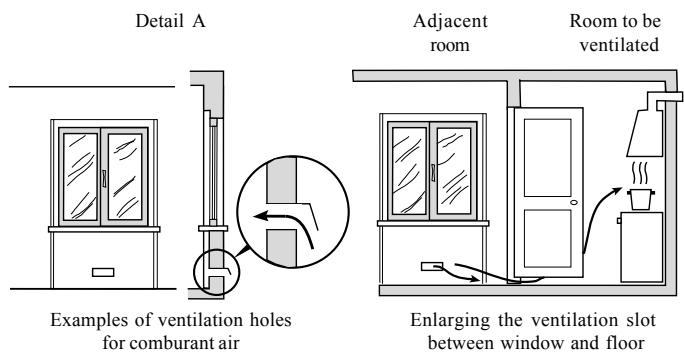
Fig. 2A
Fig. 2B
The air inflow may also be obtained from an adjoining room, provided the latter is not a bedroom or a room where there is a risk of fire, such as garages, mews, fuel stores, etc. and is ventilated in compliance with the standards in force.
Air from the adjoining room to the one to be ventilated may be made to freely pass through permanent apertures with a cross section at least equal to that indicated above. These apertures may also be obtained by increasing the gap between the door and the floor (Fig.2B). If an electric fan is used for extracting the combustion products, the ventilation aperture must be increased in relation to its maximum performance. The electric fan should have a sufficient capacity to guarantee an hourly exchange of air equal to 3-5 times the volume of the kitchen. Prolonged, intensive use of the appliance may require extra ventilation, e.g. an open window or a more efficient ventilation system by increasing the extraction power of the electric fan if installed. Liquid petroleum gas descends towards the floor as it is heavier than air. Apertures in the outside walls in rooms containing LPG cylinders should therefore be at floor level, in order to allow any gas from leaks to be expelled. Do not store LPG cylinders (even when empty) in basements/rooms below ground level; it is advisable to keep only the cylinder in use in the room at any one time and connected far from heat sources which could raise its temperature to above 50 °C.
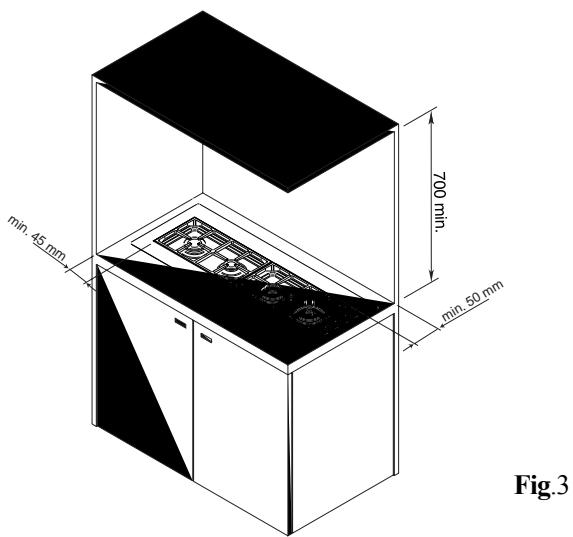
Make sure you take all the necessary precautions to guarantee proper installation in compliance with the applicable norms in force regarding accident-prevention for electrical connection. For the correct operation of the appliance when built into the cabinet, it is vital that the minimum distances illustrated in Fig. 3 be respected. The hob features a type Y degree of protection against overheating in compliance with norms. All surfaces adjacent to the cabinet and the back panel should be made of materials resistant to a temperature of 65irc C.
Securing the appliance to the cabinet
There are three different groups of appliance as far as installation is concerned:
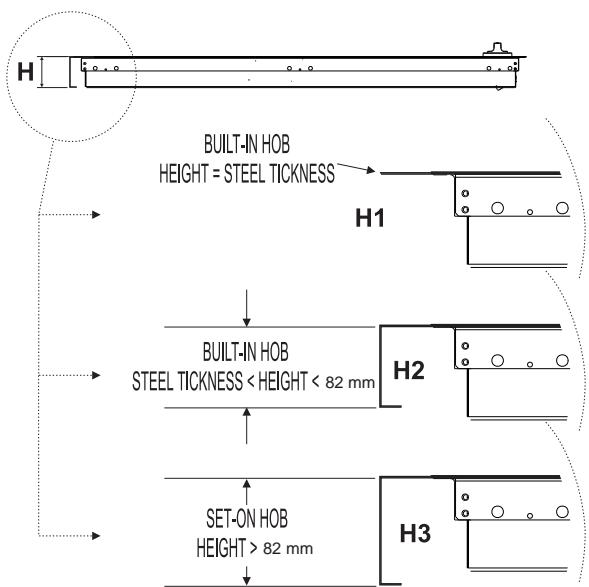
Fig.4
1- Built-in hobs to be slotted in (Class 3 - see figure 4, detail H1). In this case it is necessary to make a hole in the worktop whose measurements match those of the hob. The measurement at the side should be reduced by 2 cm so as to ensure that 1 cm of the perimeter of the hob overlaps with and rests on top of the supporting surface. To slot in the hob flush with the worktop, the cut-out on this supporting surface must be lowered (see figure 5), so that both the edge of the hob and the seal "X" under it can be positioned there. Before fitting the hob to the worktop, position the seal provided along the perimeter of the hob, as illustrated in figure 5.
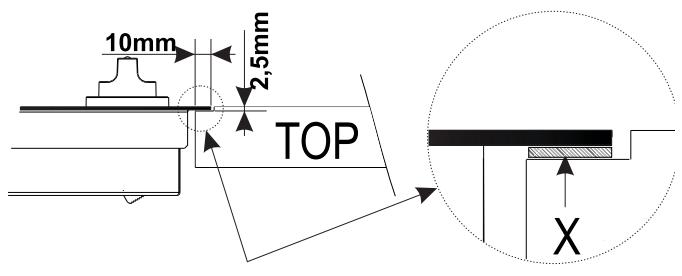
fig.5
2-Built-in hobs (Class 3) with edges lower than 82 mm (see figure 4, detail H2). To install this type of hob, a hole large enough to accommodate the whole lower casing of the appliance must be made on the worktop intended to be under the hob. Remember to leave a gap of at least 1 cm between the lower casing and the worktop around the whole perimeter of the appliance (the underside of the casing can, however, touch the surface below it).
3-Sit-on hobs (Class 1) with edges higher than 82 mm (see figure 4, detail H3). In this case, the lower casing of the hob does not protrude further than the edge of the appliance. Even when the hob is resting on the worktop, it will suffice to leave space for the gas supply tube and electricity supply cable.
The appliance must be fixed to the kitchen cabinets using suitable fixing accessories (these are provided) which may vary according to the type of installation required and the proportions of the appliance.
N.B.: to make maintenance operations more efficient, the area around the hob must be easily accessible after it has been installed (i.e. there are no completely shut-off elements).
Gas supply connection
Gas supply connection
- Check that the appliance is set for the type of gas available and then connect it to the mains gas piping or the gas cylinder in compliance with current regulations and standards.
- This appliance is designed and set to work with the gas indicated on the label situated on the actual hob. If the gas supply is other than the type for which the appliance has been set, proceed with replacing the corresponding nozzles (provided), following instructions given in the paragraph “Adaptation to different types of gas”.
- For trouble-free operation, suitable use of energy and longer life of the appliance, make sure that the supply pressure complies with the values indicated in the table 1 "burners and nozzles specifications, otherwise install a special pressure regulator on the supply pipe in compliance with current standards and regulations.
- Connect in such a way that the appliance is subjected to no strain whatsoever.
Either a rigid metal pipe with fittings in compliance with the standards in force must be used for connecting to the nipple union (threaded 12 "G male fitting) situated at the rear of the appliance to the right (Fig.7), or flexible steel pipe in compliance with the standards in force, which must not exceed 2000 mm in length. Should it be necessary to turn the fitting, the gasket (supplied with the appliance) must be replaced. Upon completion of installation, check the gas circuit, the internal connections and the taps for leaks using a soapy solution (never a flame). Also check that the connecting pipe cannot come into contact with moving parts which could damage or crush it. Make sure that the natural gas pipe is adequate for a sufficient supply to the appliance when all the burners are lit
Important: A pressure regulator, in compliance with the standards in force, must be inserted when connecting to a liquid gas supply (in a cylinder).
Adaptation to a different type of gas
If the hob is to be converted for use with a type of gas other than that for which it was set in the factory (indicated on the label to be found on the hob), the burner nozzles should be replaced as follows:
- Remove the pan supports and the burners.
- Unscrew the nozzles “A” (Fig.8) using a 7 mm socket wrench and replace them with the ones which have a diameter suitable for the type of gas to be used, according to the table 1 "burners and nozzles specifications).
- On completing the operation, replace the old rating label with the one showing the new type of gas; the sticker is available from our Service Centres.
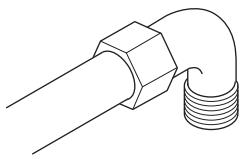
fig.7

natural_image
Illustration of a hand using a tool to press or install a component on a base, with no visible text or symbols.fig.8

natural_image
Mechanical assembly diagram showing a cylindrical component inserted into a base plate (no text or symbols)fig.9
Regulation of Air Supply to the Burner
The burners do not need a primary air regulator.
Minimum Regulation
- Turn the gas valve to minimum.
- Remove the tap knob and turn the adjusting screw, situated inside of the tap stem (Fig.9), using a screwdriver (loosening the screw increases the height of the flame, tightening decreases it).
N.B.: In the case of liquid gas, the regulation screw must be fully screwed in (clockwise).
- Make sure that, when the knob is turned rapidly high to low, the flame does not go out.
- In the event of a malfunction on appliances with the security device (thermocouple) when the gas supply is set at minimum, increase the minimum supply levels using the regulator screw.
Once the adjustment has been made, apply sealing wax, or a suitable substitute, to the old seals on the by-pass.
THE APPLIANCE MUST BE EARTHED
The hobs are designed to work with alternating current at the supply voltage and frequency indicated on the rating plate (situated under the hob or at the end of the instruction booklet). Make sure that the local supply voltage corresponds to the voltage indicated on the rating plate.
Connecting the supply cable to the mains electricity supply
For models supplied without a plug, fit a standard plug, suitable for the load indicated on the rating plate, onto the cable and connect to a suitable socket.
To connect directly to the mains supply, a double-pole switch with a contact separation of at least 3 mm suitable for the load and complying with current standards and regulations, must be fitted between the appliance and the mains supply outlet. The yellow-green earth wire must not be interrupted by the switch. The supply cable must be in such a position that no part of it can reach a temperature of 50 °C above room temperature. For installation above a built-under oven, the hob and the oven must be connected separately to the electricity supply both for safety reasons and for easy removal of the oven if necessary. Do not use adapters or shunts as they could cause heating or burning.
Before connecting to the power supply, make sure that:
- the limiter valve and the domestic system can withstand the load from the appliance (see rating plate);
- the supply system is efficiently earthed according to standards and laws in force;
- the socket or double-pole switch are easily accessible when the appliance is installed.
Important: the wires in the mains lead are coloured in accordance with the following code:
| Green & Yellow | -Earth |
| Blue | -Neutral |
| Brown | -Live |
As the colours of the wires in the mains lead may not correspond with the coloured markings identifying the terminals in your plug, proceed as follows:
Connect the Green & Yellow wire to terminal marked "E" or
or coloured Green or Green & Yellow. Connect the Brown wire to the terminal marked “L” or coloured Red. Connect the Blue wire to the terminal marked “N” or coloured Black.
FAILURE TO OBSERVE THE ACCIDENT-PREVENTION REGULATIONS RELIEVES THE MANUFACTURER OF ALL LIABILITY.
Replacing the cable
Use a rubber cable of the type H05RR-F with a suitable cross section 3 x 0.75 mm 2 . The yellow-green earth wire must be 2-3 cm longer than the other wires.
Burners and nozzles specifications
| Table 1 | Liquid gas | Natural gas | |||||||
| BURNER | Diameter (mm) | Thermal power kW (H.s.*) | By-pass 1/100 (mm) | Injector 1/100 (mm) | Flow * g/h | Injector 1/100 (mm) | Flow* l/h G20 | ||
| Nomin. | Reduc. | G30 | G31 | ||||||
| C.Rapid | 100 | 3.00 | 0.7 | 40 | 86 | 218 | 214 | 116 | 286 |
| B. Semi-rapid | 75 | 1.65 | 0.4 | 30 | 64 | 120 | 118 | 96 | 157 |
| A. Auxiliary | 55 | 1.00 | 0.4 | 30 | 50 | 73 | 71 | 71 | 95 |
| Supply pressure | Nominal Minimum Maximum | 28-30 20 35 | 37 25 45 | 20 17 25 | |||||
* At 15°C and 1013 mbar-dry gas
Propane G31 H.s. = 50,37 MJ/kg
Butane G30 H.s. = 49,47 MJ/kg
Methane G20 H.s. = 37,78 MJ/m³
CE
This appliance conforms with the following European Economic Community directives:
- 2006/95/EEC of 12/12/06 (Low Voltage) and subsequent modifications;
- 2004/108/EEC of 15/12/04 (Electromagnetic Compatibility) and subsequent modifications;
- 2009/142/EEC of 30/11/09 (Gas) and subsequent modifications;
- 93/68/EEC of 22/07/93 and subsequent modifications.
- 2002/96/EC and subsequent modifications.

Italien, 1

English, 11

Français, 21

Nederlands, 31

Deutsch, 41
B 40 L/CS... F
Sommaire
Avertissements, 22

The Ground Truth image displays a single, solid horizontal line. According to Rule 2 (UNDERSCORE & LINE RULES), this is a stylistic or background line, not a placeholder underscore. Therefore, the OCR result must ignore it and output nothing or only meaningful text. The provided OCR content is "____", which consists of four underscores. This is an incorrect interpretation of the line as a placeholder, violating the rule that stylistic lines must be ignored. The OCR has hallucinated underscores where none should exist based on the GT's visual context. Hence, the OCR result is inconsistent with the Ground Truth.


natural_image
Three identical line drawings of cooking pots with crossed x marks, no text or symbols present
natural_image
Simple line drawing of a heating furnace with cooling tower and stove (no text or symbols)natural_image
Simple line drawing of a house interior with a stove, air ducts, and cooling pipes (no text or symbols)fig.5
natural_image
Illustration of a hand using a Bunsen burner to press down a component, with a circular base and mounting base (no text or symbols)fig.8

natural_image
Mechanical assembly diagram showing a cylindrical component inserted into a base plate (no text or symbols)fig.9
natural_image
Three identical line-drawn cooking pots with crossed handles, arranged horizontally (no text or symbols)
natural_image
Simple line drawing of a heating furnace with cooling tower and steam rising (no text or symbols)natural_image
Simple line drawing of a house interior with steam rising from the chimney to a stove (no text or symbols)Meteen naar buiten
natural_image
Line drawing of a pipe fitting with a hexagonal bolt and threaded end (no text or symbols)Afb.7

natural_image
Illustration of a hand using a tool to press or adjust a component on a base (no text or symbols present)Afb.8

natural_image
Mechanical assembly diagram showing a cylindrical component inserted into a base plate (no text or symbols)Afb.9
natural_image
Three identical line-drawn cooking pots with crossed x-axes, no text or symbols present
natural_image
Simple line drawing of a house interior with a stove, air ducts, and ventilation system (no text or symbols)natural_image
Simple line drawing of a house interior with a stove, air ducts, and ventilation system (no text or symbols)natural_image
Line drawing of a pipe fitting with a hexagonal nut and threaded end (no text or symbols)Abb.7

natural_image
Illustration of a hand using a Bunsen burner to test a test sample on a circular component (no text or symbols present)Abb.8

natural_image
Mechanical assembly diagram showing a cylindrical component inserted into a base plate (no text or symbols)Abb.9
ES IST UNERLÄSSLICH, DAS GERÄT ZU ERDEN.
- Congratulations!
- THESE INSTRUCTIONS ARE ONLY VALID FOR THE COUNTRIES OF DESTINATION WHOSE SYMBOLS ARE SHOWN IN THE BOOKLET AND ON THE APPLIANCE RATING PLATE.
- Disposal of old electrical appliances
- Adjusting the flame level
- Important:
- Using the burners
- Greasing the taps
- -Category II 2H3+
- Positioning
- Kitchen ventilation
- Gas supply connection
- Adaptation to a different type of gas
- Regulation of Air Supply to the Burner
- Minimum Regulation
- THE APPLIANCE MUST BE EARTHED
- Connecting the supply cable to the mains electricity supply
- Replacing the cable
- Burners and nozzles specifications
- CE
- This appliance conforms with the following European Economic Community directives:
- Sommaire
Brand : SCHOLTES
Model : B 40 L CS F
Category : Hob