
PDMH 4500 A2 - Drill PARKSIDE - Free user manual and instructions
Find the device manual for free PDMH 4500 A2 PARKSIDE in PDF.


| Product Type | Pneumatic Chisel Hammer |
| Model | Parkside PDMH 4500 A2 |
| Max. Permitted Operating Pressure | 6.3 bar |
| Air Consumption at 4.0/6.3 bar | approx. 250 / approx. 460 l/min |
| Chisel Mounting (Hexagon) | 10.2 mm |
| Stroke | 44 mm |
| Blow Rate | 4500 min⁻¹ |
| Recommended Hose Diameter (Internal) | 10 mm |
| Weight | approx. 1.05 kg |
| Sound Pressure Level (LₚA) | 84 dB(A) (K=3 dB) |
| Sound Power Level (LₜA) | 95 dB(A) (K=3 dB) |
| Vibration Emission Value (aₕ) | 9.5 m/s² (K=1.44 m/s²) |
| Included Accessories | 5 chisels (flat, pointed, rivet parting, parting, spot-weld parting), tensioning spring, nipple, special compressed air oil |
| Lubrication | Special compressed air oil (mist oiler or manual 3-5 drops before use) |
| Compliance | EN ISO 11148-4 |
| Warranty | 3 years (excluding wear parts, commercial use) |
Frequently Asked Questions - PDMH 4500 A2 PARKSIDE
User questions about PDMH 4500 A2 PARKSIDE
0 question about this device. Answer the ones you know or ask your own.
Ask a new question about this device
Download the instructions for your Drill in PDF format for free! Find your manual PDMH 4500 A2 - PARKSIDE and take your electronic device back in hand. On this page are published all the documents necessary for the use of your device. PDMH 4500 A2 by PARKSIDE.
USER MANUAL PDMH 4500 A2 PARKSIDE
Operation and Safety Notes Original operating instructions
SE
TRYCKLUFTSMEJSELHAMMARE
Before reading, unfold the page containing the illustrations and familiarise yourself with all functions of the device.
FI
GB/IE Operation and Safety Notes Page 5
| FIKäyttö-jaturvaohjeetSivu16 | |||
| SEBruksanvisningochsäkerhetsanvisningarSidan26 | |||
| DKBrugs-ogsikkerhedsanvisninger | Side | 36 | |
| DE/AT/CH Bedienungs- und Sicherheitshinweise | Seite | 47 | |
1
2
-3-


flowchart
graph TD
    A["3. Pinning"] --> B["2. Screwed"]
    B --> C["1. Screwer"]
    C --> D["2. Welding"]
-4-
GB/IE
Table of contents
- Introduction......7
- Safety regulations....7
- Layout and items supplied....10
- Proper use....10
- Technical data....10
- Before starting the equipment....11
- Maintenance and care 12
- Excluded from the guarantee are 12
- Cleaning and ordering of spare parts.... 13
- Storage 13
- Disposal and recycling.... 13
- Declaration of conformity.... 14
- Warranty certificate.... 15
The reprinting or reproduction by any other means, in whole or in part, of documentation and papers accompanying products is permitted only with the express consent of the iSC GmbH.
Subject to technical changes
-5-
GB/IE
Caution - Read the operating instructions to reduce the risk of inquiry

Wearear-muffs. The impact of noise can cause damage to hearing.

Wear safety goggles. Sparks generated during working or splinters, chips and dust emitted by the device can cause loss of sight.
-6-
GB/IE
1. Introduction
Congratulations on your new purchase. You have decided in favor of a high-quality product. The operating instructions are a part of this product. They contain information of importance for your safety, for the use of the product and for its disposal. Before you use the product, acquaint yourself with all the information concerning its operation and safety. Use the product only as described and only for the listed areas of application. If you hand on the product to other people, give them all the documentation as well.
2. Safety regulations
Caution!
Read all safety regulations and instructions.
Any errors made in following the safety regulations and instructions may result in an electric shock, fire and/or serious injury.
Keep all safety regulations and instructions in a safe place for future use.
Protect yourself and your environment from accidents by taking the appropriate precautionary measures.
2.1 General safety rules
- To avoid multiple dangers, the safety information must be read and understood before installing, operating, repairing, servicing, replacing accessory parts on and working near the non-rotating, hammer-action machine. If not, severe physical injuries may result.
- The non-rotating, hammer-action machine should be configured, adjusted and used only by qualified and trained operators.
- The equipment is not allowed to be modified. Modifications will reduce the effectiveness of the safety measures and increase the risk of injury.
• Never use damaged equipment. - Use and service the equipment as recommended in the operating instructions. This will help you to minimize dust, gas, noise and
vibrations.
- Keep children away from air tools.
- Do not use the equipment in idling mode. This will prevent the chisel being catapulted out of the machine out of control.
- Use the consumables and mounted tools in the way described in the operating instructions. This will help you to minimize dust, gas, noise and vibrations.
- The equipment must be serviced in regular intervals in order to check that the rated values and markings demanded of the particular component by ISO 11148 are legible on the equipment. Employees/users must contact the manufacturer for replacement labels if they are required.
2.2 Hazards due to catapulted parts
- Disconnect the compressed air coupling and depressurize the equipment before you service, repair or transport the equipment and before you change the chisel.
- Beware of fragments of the workpiece, accessory parts or the plugged-in chisel being catapulted away at high speed when carrying out chiseling work.
- Always wear impact-resistant safety goggles. The degree of protection should be assessed separately for each job.
- Wear a helmet during overhead work. Also consider the dangers which falling pieces of the workpiece can pose for other persons.
- Make sure that the workpiece is fixed securely.
• Make sure that the chisel which you are using is fastened securely. - Use only a suitable tensioning spring (5) (supplied). Replace the tensioning spring if it is worn, broken or bent. This will help to prevent injuries.
- Hold the mounted chisel against the workpiece before you activate the equipment.
- Use only the recommended lubricant (see section 7. Maintenance and care).
- Never touch the chisel during and after working with the equipment. Fingers and hands may be injured. The chisel can become hot.
GB/IE
2.3 Dangers during operation
• Using this equipment can cause bruises, grazes, cuts and burns. Wear gloves.
- Users and maintenance personnel must be physically capable of handling the size, weight and power of the equipment.
- Unexpected movements of the equipment or fracturing of the chisel can cause serious accidents. It is important therefore to always stand squarely and solidly so that you can keep control of the equipment and maintain your posture even if the equipment makes unexpected movements.
- Let go of the trigger lever (2) if the air supply is interrupted.
- Wear the necessary protective clothing, in particular impact-proof safety goggles, ear muffs and safety gloves, when working with the chisel hammer.
2.4 Dangers due to repetitive movements
- Working with the chisel hammer can result in disorders in the hands, arms, shoulders, neck and other parts of the body.
- When using the equipment, be sure to adopt a comfortable posture and change your posture repeatedly in order to avoid physical complaints.
- Stop using the equipment if you experience numbness, tingling, pain or whitening of the skin on your fingers or hands, and consult a doctor.
2.5 Dangers due to accessories
- Important: Disconnect the equipment from the compressed air supply before you carry out any maintenance or cleaning work.
- Only use accessories and consumables of a size and type recommended by the manufacturer.
- Do not use the chisel as a hand tool. The chisels were designed specially for use with a chisel hammer.
- Use only sharp chisels. Blunt chisels need higher pressure, can break and will increase vibrations.
- Do not cool hot tools in water. This may result in damage.
• Do not use the chisel as a levering tool.
- Never touch the chisel during and after working with the equipment. Fingers and hands may be injured. The chisel can become hot.
- Do not use any defective items of equipment. Replace defective parts. This will help to prevent injuries.
2.6 Dangers at the workplace
- Slipping, stumbling and falling are the main reasons for injuries at the workplace. Beware of slippery surfaces which result from using the equipment and also beware of tripping over the air hose.
- Beware of hidden dangers such as electric cables or gas and water pipes.
- This equipment is not insulated against contact with an electric cable. It is vital to avoid all contact with electric cables. The equipment is not suitable for use in explosive atmospheres.
- The equipment is not suitable for use in explosive atmospheres. Sparks may be created when you work with this equipment. It is important therefore that you never work with this equipment near combustible materials, liquids or gases.
2.7 Dangers due to dust and vapors
- The risk assessment should include consideration of the dust which is created during the use of the machine and the dust which already exists and may be whirled up during use.
- Depending on the material you wish to process, dusts and gases may arise that are a health hazard for the user (for example causing cancer, birth defects, asthma and / or dermatitis).
• Make sure that escaping air whirls up as little dust as possible. - Wear a suitable protective dust mask which complies with the particular case of application and the generally applicable safety rules.
- The non-rotating, hammer-action machine must be operated and serviced in accordance with the recommendations presented in this manual in order to reduce the release of dust and vapor to a minimum.
• The exhaust air must be directed away such
GB/IE
that the whirling up of dust in a dust-filled environment is reduced to a minimum.
- If any dust or vapor is created, the priority must be to control them at their point of release.
- All the machine's built-in parts and accessories which are designed to collect, extract or suppress air-borne dust or vapor should be used and serviced correctly in accordance with the manufacturer's instructions.
- You must select, service and replace the consumables and plug-in tools in accordance with the recommendations presented in this manual in order to prevent the development of dust or vapor being intensified unnecessarily.
2.8 Dangers due to noise
- Noise can cause permanent damage to your hearing. Unprotected exposure to high levels of noise can result in loss of hearing and other problems such as tinnitus (ringing, buzzing, whistling or droning noises in your ears). Wear ear-muffs.
- To keep noise and vibration levels as low as possible, follow the maintenance and operating instructions in the manual. For example, vibration-damping material used as an intermediate layer when working on sheet metal can also reduce noise.
- It is absolutely essential to carry out a risk assessment with regard to these dangers and to implement appropriate control mechanisms.
- The non-rotating, hammer-action machine must be operated and serviced in accordance with the recommendations presented in this manual in order to prevent the noise level being increased unnecessarily.
- You must select, service and replace the consumables and plug-in tools in accordance with the recommendations presented in this manual in order to prevent the noise level being increased unnecessarily.
2.9 Dangers due to vibrations
- Vibrations can injure the nerves and cause blood circulation disorders in your hands and arms.
- Wear warm clothing when you work in cold surroundings. Keep your hands warm and dry.
- Stop using the equipment if you experience numbness, tingling, pain or whitening of the skin on your fingers or hands, and consult a doctor.
- Do not hold the plug-in tool with your free hand as this will lead to a higher vibration load.
- Hold the equipment with a light but secure grip, noting the reaction forces which arise in the process. The risk of disorders caused by vibrations is always greater with a tight grip.
2.10 Additional safety information for pneumatic machines
• Compressed air can cause serious injuries.
- Disconnect the compressed air coupling and depressurize the equipment before you service, repair or transport the equipment and before you change the chisel.
- Never direct compressed air at yourself or at any other persons.
- Whipping hoses may cause serious injuries. You must always make sure therefore that the hoses and their fasteners are undamaged and have not become disconnected.
- When you release the quick-lock coupling, hold the hose securely in your hand and never use defective connectors. This will help to prevent injuries caused by a whipping compressed air hose.
• Do not let cold air flow over your hands.
- Do not use any quick-lock couplings at the air inlet. Use hose connections with a hardened steel thread (or a material with comparable resistance to vibrations).
- If universal rotary couplings (claw couplings) are used, lock pins must be installed and a retention system for compressed air hoses used in order to protect against possible faulty connections ("hose to tool" or "hose to hose").
GB/IE
- Do not exceed the maximum permissible operating pressure.
- Do not carry compressed air tools by their hoses.
Keep this safety information in a safe place.
3. Layout and items supplied
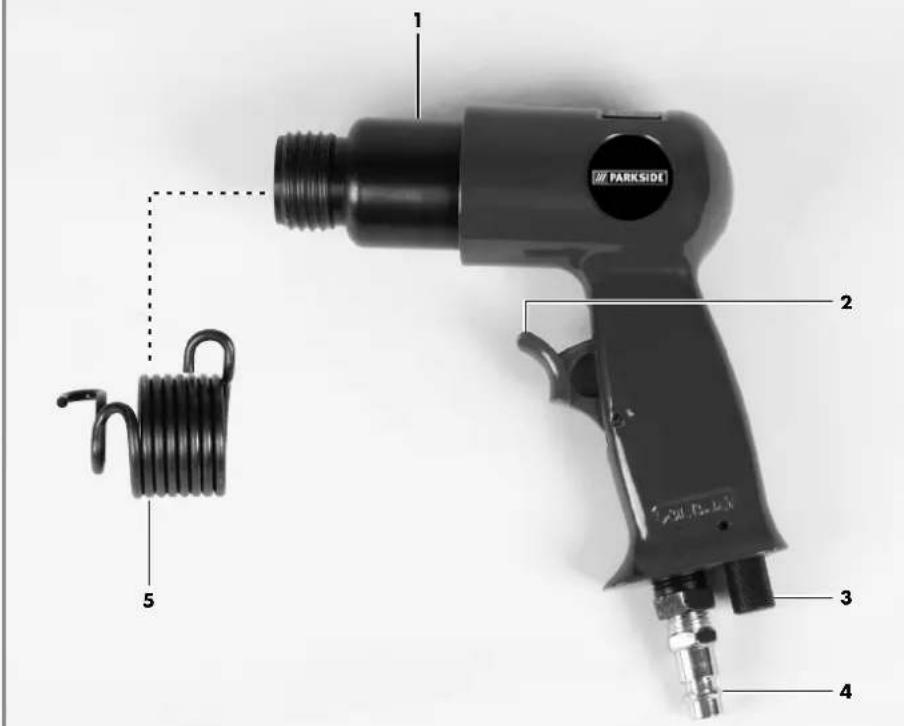
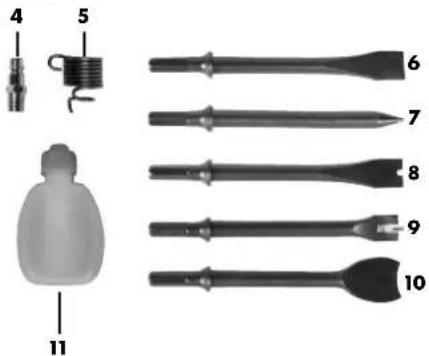
3.1 Layout (Fig. 1/2)
- Cylinder
- Trigger lever
- Air regulation screw
- Nipple
- Tensioning spring
- Flat chisel (universal chisel)
- Pointed chisel
- Rivet parting chisel
- Parting chisel (sheet-metal chisel)
- Spot-weld parting chisel
- Special compressed air oil
3.2 Items supplied
- Open the packaging and take out the equipment with care.
- Remove the packaging material and any packaging and/or transportation braces (if available).
• Check to see if all items are supplied. - Inspect the equipment and accessories for transport damage.
- If possible, please keep the packaging until the end of the guarantee period.
Important!
The equipment and packaging material are not toys. Do not let children play with plastic bags, foils or small parts. There is a danger of swallowing or suffocating!
• Air chisel hammer
- Nipple
• Tensioningspring
• Chisel set (5 chisels)
• Special compressed air oil
• Original operating instructions
4. Properuse
The chisel hammer is a pneumatically operated tool for versatile use. It is suitable for example for making slits, for removing tiles or plaster, for making holes through masonry, for cutting sheet metal and for removing bolts or rivets. The equipment is designed for indoors use only.
The exhaust air escapes from the housing to the front.
The equipment is to be used only for its prescribed purpose. Any other use is deemed to be a case of misuse. The user/operator and not the manufacturer will be liable for any damage or injuries of any kind caused as a result of this.
Please note that our equipment has not been designed for use in commercial, trade or industrial applications. Our warranty will be voided if the equipment is used in commercial, trade or industrial businesses or for equivalent purposes.
Only allow repairs and services to be carried out by authorized professional repair shops.
Remember.
Too small a diameter of the hose and too long a hose line will result in loss of power.
5. Technical data
Max. permitted operating pressure: ....6.3 bar Air consumption at
4.0/6.3 bar .... approx. 250/approx. 460 l/min
Chisel mounting (hexagon): 10.2 mm
Stroke: 44 mm
Blow rate: 4,500 min ^-1
Recommended hose diameter: 10 mm
Weight: approx. 1.05 kg
GB/IE
Sound and vibration
Sound and vibration values were measured in accordance with ISO 15744 and ISO 28927-10.
L_nA sound pressure level .....84 dB(A)
K_pA uncertainty 3 dB
L_WA sound power level .....95 dB(A)
K_WA uncertainty 3 dB
Wear ear-muffs.
The impact of noise can cause damage to hearing.
Vibrations
Vibration emission value a_h=9.5 m/s^2
K uncertainty = 1.44 m/s ^2
Warning!
The specified vibration value was established in accordance with a standardized testing method. It may change depending on how the equipment is used and may exceed the specified value in exceptional circumstances.
The specified vibration value can be used to compare the equipment with another tool.
The specified vibration value can be used for initial assessment of a harmful effect.
Keep the noise emissions and vibrations to a minimum.
- Only use appliances which are in perfect working order.
• Service and clean the appliance regularly. - Adapt your working style to suit the appliance.
• Do not overload the appliance. - Have the appliance serviced whenever necessary.
• Switch the appliance off when it is not in use.
• Wear protective gloves.
Residual risks
Even if you use the equipment in accordance with the instructions, certain residual risks cannot be eliminated. The following hazards may arise in connection with the equipment's construction and layout:
- Lung damage if no suitable protective dust mask is used.
- Damage to hearing if no suitable ear protection is used.
- Health damage caused by hand-arm vibrations if the equipment is used over a prolonged period or is not properly guided and maintained.
Airsupply:
Via a compressed air source with pressure setting function, e.g. a compressor. Before starting up, please also read section 7 "Care and maintenance".
Performance values of the compressor:
The compressor used should have a tank volume of at least 50 liters and a motor rating of approx. 2.2 kW.
Setting values for work with the suction spray gun:
Set a maximum working pressure of 6.3 bar at your compressed air supply.
6. Before starting the equipment
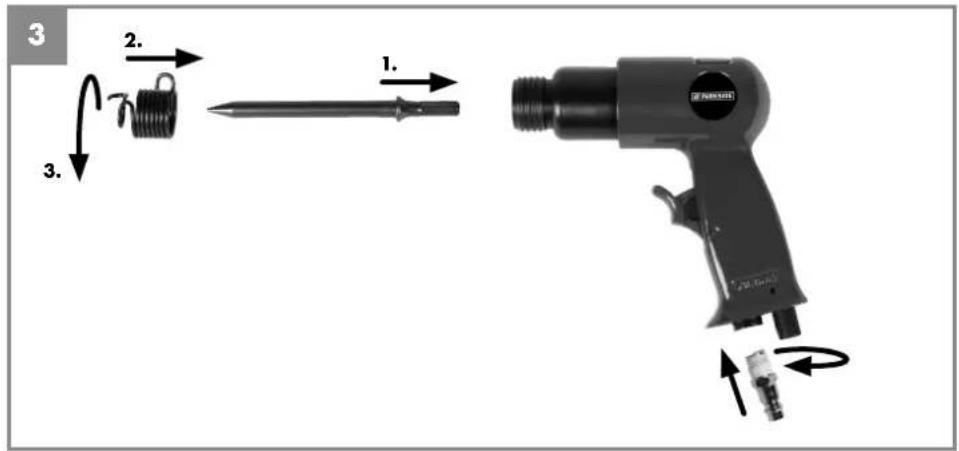
Fig.3
Screw the supplied nipple (4) into the air connection after you have wound 2-3 layers of sealing tape around the thread. Plug the required chisel into the hexagon mount of the chisel hammer. Slip the tensioning spring (5) over the chisel. Turn the tensioning spring onto the thread of the cylinder (1) as far as the stop. As you do this, hold the tensioning spring by the front arm.
Connect the chisel hammer to a compressor or compressed air network with matching power. Do this with a fl exible compressed air hose
GB/IE
(∅ 10 mm internal) with quick-lock coupling. Make sure that the air regulation screw (3) is adjusted so that air can flow through. Move the chisel hammer towards the object you want to work on. Actuate the trigger lever (2) to start the chisel hammer.
Check the equipment and the mounted tool each time before use. This also includes checking the speed and the level of vibrations.
To change the chisel you must first disconnect the equipment from the compressed air source. Turn the tensioning spring off the cylinder of the chisel hammer by holding it by its rear arm. The chisel can now be changed as described above. The chisel shaft should be lubricated with a little normal lubricating grease from time to time.
7. Maintenance and care
Important: Disconnect the equipment from the compressed air supply before you carry out any maintenance or cleaning work.
Personal safety equipment such as gloves and a protective dust mask must also be worn when you carry out servicing or cleaning work on the machine in order to prevent danger from dust deposits.
Compliance with the maintenance instructions listed here will help this quality product provide you with a long service life and trouble-free operation. Clean the equipment thoroughly and immediately each time after it has been used.
Regular lubrication is essential for your chisel hammer to work properly for a prolonged period of time. Use only special compressed air oil as supplied. Special compressed air oil is also available from your dealer.
Note: Use environmentally friendly compressed air oil if you want to operate the equipment outside the workshop.
The following lubrication options are available:
7.1 Lubrication by mist oiler
Connect a complete conditioning unit with mist oiler between the compressed air source and the chisel hammer. A conditioning unit is available from your dealer. It is not included in the scope of this delivery.
7.2 Lubrication by hand
Each time before using the compressed air tool insert 3-5 drops of special compressed air oil into the compressed air connection. If the compressed air tool has not been used for several days you must insert 5-10 drops of special compressed air oil into the compressed air connection before switching on. Store your compressed air tool only in a dry room.
7.3 Other maintenance
There are no parts inside the equipment which require additional maintenance.
8. Excluded from the guarantee are
- Wearparts
- Damage caused by too much operating pressure.
• Damage caused by non-conditioned compressed air. - Damage caused by improper use or unauthorized intervention.
GB/IE
9. Cleaning and ordering of spare parts
Important: Disconnect the equipment from the compressed air supply before you carry out any maintenance or cleaning work.
Personal safety equipment such as gloves and a protective dust mask must also be worn when you carry out servicing or cleaning work on the machine in order to prevent danger from dust deposits.
9.1 Cleaning
- Keep all safety devices, air vents and the motor housing free of dirt and dust as far as possible. Wipe the equipment with a clean cloth or blow it with compressed air at low pressure.
• We recommend that you clean the device immediately each time you have finished using it. - Clean the equipment regularly with a moist cloth and some soft soap. Do not use cleaning agents or solvents; these could attack the plastic parts of the equipment. Ensure that no water can seep into the device.
9.2 Ordering replacement parts:
Please quote the following data when ordering replacement parts:
• Type of machine
• Article number of the machine
• Identification number of the machine
For our latest prices and information please go to www.isc-gmbh.info
10.Storage
Store the equipment and accessories out of children's reach in a dark and dry place at above freezing temperature. The ideal storage temperature is between 5 and 30^ . Store the equipment in its original packaging.
11. Disposal and recycling
The unit is supplied in packaging to prevent its being damaged in transit. This packaging is raw material and can therefore be reused or can be returned to the raw material system. The unit and its accessories are made of various types of material, such as metal and plastic. Defective components must be disposed of as special waste. Ask your dealer or your local council. The equipment must be disposed of in a way which does not result in any danger for persons and the environment.
12. Declaration of conformity
87/404/EC_2009/105/EC
2005/32/EC_2009/125/EC
2006/95/EC
2006/28/EC
2004/108/EC
2004/22/EC
□1999/5/EC
□97/23/EC
□90/396/EC_2009/142/EC
89/686/EC_96/58/EC
2011/65/EC
X 2006/42/EC
Annex IV
Notified Body:
Notified Body No.:
Reg. No.
2000/14/EC_2005/88/EC
Annex V
Annex VI
Noise measured: L_ A = dB(A) ; guaranteed L_ A = dB(A)
P = KW; L/∅ = cm
Notified Body:
2004/26/EC
Emission No.:
Standard references: EN ISO 11148-4
Subject to change without notice
Archive-File/Record: NAPR007678
Documents registrar: Siegfried Rolder
Wiesenweg 22, D-94405 Landau/Isar
GB/IE
13.Warranty certifi cate
Dear Customer,
All of our products undergo strict quality checks to ensure that they reach you in perfect condition. In the unlikely event that your device develops a fault, please contact our service department at the address shown on this guarantee card. Of course, if you would prefer to call us then we are also happy to offer our assistance under the service number printed below. Please note the following terms under which guarantee claims can be made:
- These guarantee terms cover additional guarantee rights and do not affect your statutory warranty rights. We do not charge you for this guarantee.
- Our guarantee only covers problems caused by material or manufacturing defects, and it is restricted to the rectification of these defects or replacement of the device. Please note that our devices have not been designed for use in commercial, trade or industrial applications. Consequently, the guarantee is invalidated if the equipment is used in commercial, trade or industrial applications or for other equivalent activities. The following are also excluded from our guarantee: compensation for transport damage, damage caused by failure to comply with the installation/assembly instructions or damage caused by unprofessional installation, failure to comply with the operating instructions (e.g. connection to the wrong mains voltage or current type), misuse or inappropriate use (such as overloading of the device or use of non-approved tools or accessories), failure to comply with the maintenance and safety regulations, ingress of foreign bodies into the device (e.g. sand, stones or dust), effects of force or external influences (e.g. damage caused by the device being dropped) and normal wear resulting from proper operation of the device. This applies in particular to rechargeable batteries for which we nevertheless issue a guarantee period of 12 months. The guarantee is rendered null and void if any attempt is made to tamper with the device.
- The guarantee is valid for a period of 3 years starting from the purchase date of the device. Guarantee claims should be submitted before the end of the guarantee period within two weeks of the defect being noticed. No guarantee claims will be accepted after the end of the guarantee period. The original guarantee period remains applicable to the device even if repairs are carried out or parts are replaced. In such cases, the work performed or parts fitted will not result in an extension of the guarantee period, and no new guarantee will become active for the work performed or parts fitted. This also applies when an on-site service is used.
- In order to assert your guarantee claim, please send your defective device postage-free to the address shown below. Please enclose either the original or a copy of your sales receipt or another dated proof of purchase. Please keep your sales receipt in a safe place, as it is your proof of purchase. It would help us if you could describe the nature of the problem in as much detail as possible. If the defect is covered by our guarantee then your device will either be repaired immediately and returned to you, or we will send you a new device.
Of course, we are also happy offer a chargeable repair service for any defects which are not covered by the scope of this guarantee or for units which are no longer covered. To take advantage of this service, please send the device to our service address.
Einhell UK Ltd
Morpeth Wharf
Twelve Quays
Birkenhead, Wirral
CH41 1LF
Tel. 0151 6491500, Fax 0151 6491501
IAN 89573
FI
Sisällysluettelo
87/404/EC_2009/105/EC
2005/32/EC_2009/125/EC
2006/95/EC
2006/28/EC
2004/108/EC
2004/22/EC
□1999/5/EC
□97/23/EC
□90/396/EC_2009/142/EC
89/686/EC_96/58/EC
2011/65/EC
X 2006/42/EC
Annex IV
Notified Body:
Notified Body No.:
Reg. No.
□2000/14/EC_2005/88/EC
Annex V
Annex VI
Noise measured: L_= dB (A); guaranteed L_= dB (A)
P = KW; L/∅ = cm
Notified Body:
2004/26/EC
Emission No.:
Standard references: EN ISO 11148-4
Subject to change without notice
Archive-File/Record: NAPR007678
Documents registrar: Siegfried Rolder
Wiesenweg 22, D-94405 Landau/Isar
13.Takuutodistus
Arvoisa asiakas,
2.3 Faror under drift
87/404/EC_2009/105/EC
2005/32/EC_2009/125/EC
2006/95/EC
2006/28/EC
2004/108/EC
2004/22/EC
□1999/5/EC
□97/23/EC
□90/396/EC_2009/142/EC
89/686/EC_96/58/EC
2011/65/EC
□Annex IV
Notified Body:
Notified Body No.:
Reg. No.
Annex V
Annex VI
Noise measured: L_ A = dB(A) ; guaranteed L_ A = dB(A)
P = KW; L/∅ = cm
Notified Body:
Emission No.:
X 2006/42/EC
2000/14/EC\_2005/88/EC
2004/26/EC
Standard references: EN ISO 11148-4
Subject to change without notice
Archive-File/Record: NAPR007678
Documents registrar: Siegfried Rolder
Wiesenweg 22, D-94405 Landau/Isar
SE
13. Garantibevis
Bästa kund,
87/404/EC_2009/105/EC
2005/32/EC_2009/125/EC
2006/95/EC
2006/28/EC
2004/108/EC
2004/22/EC
□1999/5/EC
□97/23/EC
□90/396/EC_2009/142/EC
89/686/EC_96/58/EC
2011/65/EC
□ Annex IV
Notified Body:
Notified Body No.:
Reg. No.
□2000/14/EC_2005/88/EC
Annex V
Annex VI
Noise measured: L_ = dB (A) ; guaranteed L_ = dB (A)
P = KW; L/∅ = cm
Notified Body:
2004/26/EC
Emission No.:
X 2006/42/EC
Standard references: EN ISO 11148-4
Subject to change without notice
Archive-File/Record: NAPR007678
Documents registrar: Siegfried Rolder
Wiesenweg 22, D-94405 Landau/Isar
DK
13. Garantibevis
Kære kunde!
87/404/EC_2009/105/EC
2005/32/EC_2009/125/EC
2006/95/EC
2006/28/EC
2004/108/EC
2004/22/EC
□1999/5/EC
□97/23/EC
□90/396/EC_2009/142/EC
89/686/EC_96/58/EC
2011/65/EC
X 2006/42/EC
Annex IV
Notified Body:
Notified Body No.:
Reg. No.:
2000/14/EC_2005/88/EC
Annex V
Annex VI
Noise measured: L_ A = dB(A) ; guaranteed L_ A = dB(A)
P = KW; L/∅ = cm
Notified Body:
2004/26/EC
Emission No.:
Standard references: EN ISO 11148-4
Subject to change without notice
Archive-File/Record: NAPR007678
Documents registrar: Siegfried Rolder
Wiesenweg 22, D-94405 Landau/Isar
DE/AT/CH
13. Garantieurkunde
- TRYCKLUFTSMEJSELHAMMARE
- FI
- GB/IE
- Table of contents
- Introduction
- Safety regulations
- Caution!
- Read all safety regulations and instructions.
- Keep all safety regulations and instructions in a safe place for future use.
- General safety rules
- Hazards due to catapulted parts
- Dangers during operation
- Dangers due to repetitive movements
- Dangers due to accessories
- Dangers at the workplace
- Dangers due to dust and vapors
- Dangers due to noise
- Dangers due to vibrations
- Additional safety information for pneumatic machines
- Keep this safety information in a safe place.
- Layout and items supplied
- Layout (Fig. 1/2)
- Items supplied
- Important!
- The equipment and packaging material are not toys. Do not let children play with plastic bags, foils or small parts. There is a danger of swallowing or suffocating!
- Properuse
- Remember.
- Too small a diameter of the hose and too long a hose line will result in loss of power.
- Technical data
- Sound and vibration
- Wear ear-muffs.
- Vibrations
- Warning!
- Keep the noise emissions and vibrations to a minimum.
- Residual risks
- Airsupply:
- Performance values of the compressor:
- Setting values for work with the suction spray gun:
- Before starting the equipment
- Fig.3
- Maintenance and care
- Lubrication by mist oiler
- Lubrication by hand
- Other maintenance
- Excluded from the guarantee are
- Cleaning and ordering of spare parts
- Cleaning
- Ordering replacement parts:
- 10.Storage
- Disposal and recycling
- Declaration of conformity
- Standard references: EN ISO 11148-4
- 13.Warranty certifi cate
- Einhell UK Ltd
- Sisällysluettelo
- 13.Takuutodistus
- Arvoisa asiakas,
- Faror under drift
- X 2006/42/EC
- 2000/14/EC\_2005/88/EC
- 2004/26/EC
- SE
- Garantibevis
- DK
- Kære kunde!
- DE/AT/CH
- Garantieurkunde
Brand : PARKSIDE
Model : PDMH 4500 A2
Category : Drill