
Avance Collection HD9149 - Food processor PHILIPS - Free user manual and instructions
Find the device manual for free Avance Collection HD9149 PHILIPS in PDF.


| Brand | Philips |
| Model | Avance Collection HD9149 |
| Product type | Multifunction food processor |
| Power | 1000 W |
| Bowl capacity | 3.5 L |
| Number of speeds | 8 speeds + pulse |
| Functions | Chopping, slicing, grating, kneading, blending, emulsifying |
| Included accessories | Chopping blade, slicing/grating discs, dough hook, whisk, integrated scale |
| Bowl material | Stainless steel |
| Dimensions (L x D x H) | 40 x 25 x 30 cm |
| Weight | 5.5 kg |
| Power supply | 220-240 V, 50-60 Hz |
| Cable length | 1.2 m |
| Safety | Safety lock on bowl and lid, automatic shut-off in case of overload |
| Maintenance | Bowl and accessories dishwasher safe |
| Cleaning | Wipe the motor unit with a damp cloth |
| Spare parts | Available on the Philips website |
| Repairability | Repairability index: 8.2/10 |
| Warranty | 2 years |
Frequently Asked Questions - Avance Collection HD9149 PHILIPS
User questions about Avance Collection HD9149 PHILIPS
0 question about this device. Answer the ones you know or ask your own.
Ask a new question about this device
Download the instructions for your Food processor in PDF format for free! Find your manual Avance Collection HD9149 - PHILIPS and take your electronic device back in hand. On this page are published all the documents necessary for the use of your device. Avance Collection HD9149 by PHILIPS.
USER MANUAL Avance Collection HD9149 PHILIPS
natural_image
Black Philips digital kitchen appliance with three-tiered steamer and digital display (no visible text or symbols)
natural_image
Diagram of three open panels with grid patterns and directional arrows indicating rotation or movement (no text or symbols)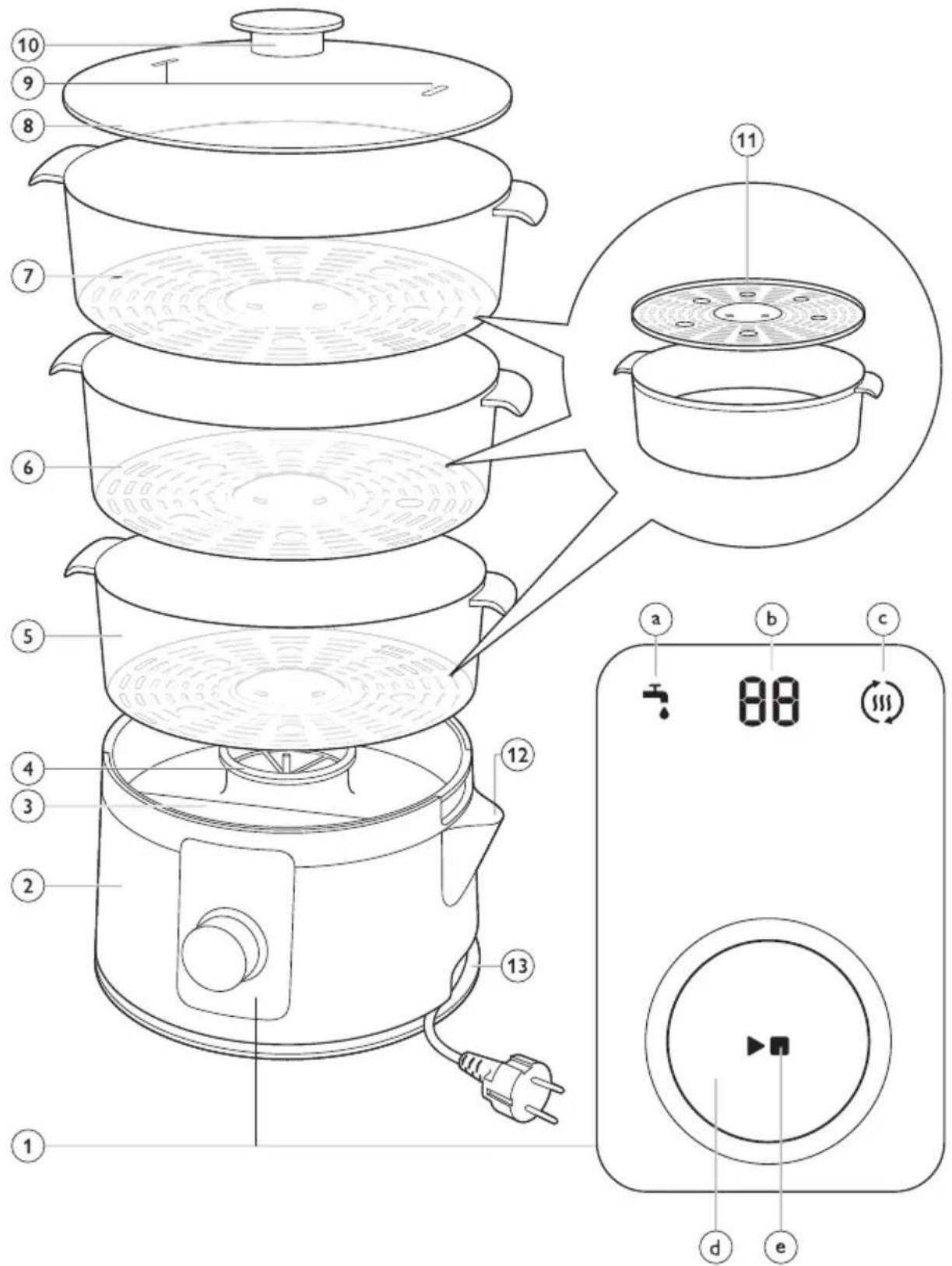
ENGLISH 6
DANSK 15
DEUTSCH 24
SUOMI 35
FRANÇAIS 44
ITALIANO 55
NEDERLANDS 65
NORSK 75
SVENSKA 84
Introduction
Congratulations on your purchase and welcome to Philips! To fully benefit from the support that Philips offers, register your product at www.philips.com/welcome.
General description (Fig. 1)
1 Control panel
- a 'Water tank empty' light
- b Timer indication
- c 'Keep-warm' light
- d Timer adjustment knob with light ring
- e Start/stop and pause button
2 Base with water tank
3 Drip tray
4 Aroma infuser
5 Small steaming basket (1)
6 Medium steaming basket (2)
7 Large steaming basket (3)
8 Lid
9 Steam vents
10 Lid handle
11 Removable bottom
12 Water refill spout
13 Cord storage facility
Not shown: soup bowl (specific types only)
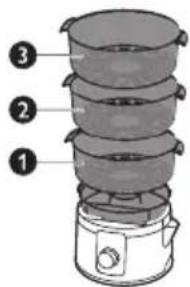
Note: The steaming baskets are numbered from 1 to 3. You find the numbers of the steaming baskets on their handles. You can stack any larger basket on top of a smaller basket, but the baskets fit best if you stack them in logical ascending order: the smallest basket (1) first, then the medium basket (2) and then the large basket (3).
Note for specific types only: The soup bowl can best be used in combination with the large basket (3).
Note: Always use the drip tray under the steaming baskets and only use steaming baskets that are filled with food.
Important
Read this user manual carefully before you use the appliance and save it for future reference.
Danger
- Never immerse the base in water or rinse it under the tap.
Warning
- Check if the voltage indicated on the appliance corresponds to the local mains voltage before you connect the appliance.
- Only connect the appliance to an earthed wall socket. Always make sure the plug is inserted firmly into the socket.
- This appliance is not intended to be operated by means of an external timer or a separate remote-control system.
- Do not use the appliance if the plug, the mains cord or the appliance itself is damaged.
- If the mains cord is damaged, you must have it replaced by Philips, a service centre authorised by Philips or similarly qualified persons in order to avoid a hazard.
- This appliance is not intended for use by persons (including children) with reduced physical, sensory or mental capabilities, or lack of experience and knowledge, unless they have been given supervision or instruction concerning use of the appliance by a person responsible for their safety.
- Children should be supervised to ensure that they do not play with the appliance.
- Keep the mains cord out of the reach of children. Do not let the mains cord hang over the edge of the table or worktop on which the appliance stands.
- Keep the mains cord away from hot surfaces.
- Always fully unwind the mains cord from the reel in the base before you plug in the appliance.
- Never steam frozen meat, poultry or seafood. Always thaw these ingredients completely before you steam them.
- Never use the food steamer without the drip tray, otherwise hot water may splash out of the appliance.
- Only use the steaming baskets and soup bowl (specific types only) in combination with the original base.
Caution
- This appliance is intended for normal household use only. It is not intended for use in environments such as staff kitchens of shops, offices, farms or other work environments. Nor is it intended to be used by clients in hotels, motels, bed and breakfasts and other residential environments.
- If the appliance is used improperly or for professional or semi-professional purposes or if it is not used according to the instructions in the user manual, the guarantee becomes invalid and Philips refuses any liability for damage caused.
- Never use any accessories or parts from other manufacturers or that Philips does not specifically recommend. If you use such accessories or parts, your guarantee becomes invalid.
- Do not expose the base of the appliance to high temperatures, hot gas, steam or damp heat from other sources than the steamer itself. Do not place the food steamer on or near an operating or still hot stove or cooker.
- Do not place the operating appliance near or underneath objects that would be damaged by steam, such as walls and cupboards.
- Do not operate the appliance in the presence of explosive and/or flammable fumes.
- Place the food steamer on a stable, horizontal and level surface and make sure there is at least 10cm free space around it to prevent overheating.
- Always place the removable bottoms into the steaming baskets from the top. To position the bottoms correctly, first lower one side into the basket and then the other side, until the bottom snaps into place ('click'). Make sure the bump in the bottom faces upwards. (Fig. 2)
- Beware of the hot steam that comes out of the food steamer during steaming, in the keep-warm mode or when you remove the lid. When you check food, always use kitchen utensils with long handles.
- Do not reach over the food steamer while it is operating.
- Do not touch the hot surfaces of the appliance. Always use oven mitts when you handle hot parts of the appliance.
- Do not move the food steamer while it is operating.
- Always remove the lid carefully and away from you. Let condensation drip off the lid into the food steamer to avoid scalding.
- Always hold the steaming basket by the handles when the food is hot.
- Do not empty the water tank through the water refill spout. To empty the water tank tilt the base backwards and pour the water from the back of the base (Fig. 3).
- Always unplug the appliance and let it cool down before you clean it.
ENGLISH8
Automatic shut-off
The appliance is equipped with automatic shut-off. The appliance switches off automatically if you do not press a button within 2 minutes after plugging in the appliance. The appliance also switches off automatically after the set steaming time (including keep-warm time) has elapsed.
Boil-dry protection
This food steamer is equipped with boil-dry protection. The boil-dry protection automatically switches off the heating element when there is no water in the water tank or if the water runs out during use. Fill the water tank with cold water up to the MAX indication to use the appliance again.
Electromagnetic fields (EMF)
This Philips appliance complies with all standards regarding electromagnetic fields (EMF). If handled properly and according to the instructions in this user manual, the appliance is safe to use based on scientific evidence available today.
Before first use
1 Thoroughly clean the parts that come into contact with food before you use the appliance for the first time (see chapter ‘Cleaning and maintenance’).
2 Wipe the inside of the water tank with a damp cloth.
Preparing for use
1 Put the appliance on a stable, horizontal and level surface.
2 Fully unwind the mains cord from the reel in the base before you plug in the appliance.
3 Fill the water tank with water up to the MAX indication (Fig. 4).
When the water tank is filled up to the MAX indication, the steamer can steam for approx. 60 minutes.
Do not fill the water tank beyond the MAX indication.
Only fill the water tank with water. Never put seasoning, oil, or other substances in the water tank.
4 Place the drip tray on the water tank in the base (Fig. 5).
Note: Never use the appliance without the drip tray and do not pour water, seasoning, oil or other substances in the drip tray.
5 Place the Aroma Infuser on the drip tray if you want to add extra flavour to the food to be steamed. (Fig. 6)
- Fill the Aroma Infuser with fresh or dried herbs.
- For suggested herbs or spices for various types of food, see the food steaming table in chapter 'Food table and steaming tips'.
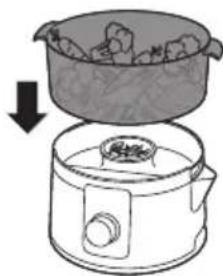
6 Put the food to be steamed in one or more steaming baskets. Specific types only: You can also use the soup bowl. (Fig. 7)
- Always place the removable bottoms into the steaming baskets from the top. To position the bottoms correctly, first lower one side into the basket and then the other side, until the bottom snaps into place ('click'). Make sure the bump in the bottom faces upwards (Fig. 2).
- Do not put too much food in the steaming baskets. Leave some space between the pieces of food and evenly distribute the food over the bottom of the basket.
- Place larger pieces of food and food that requires a longer steaming time in the bottommost steaming basket (1).
-
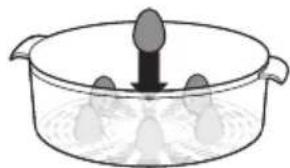
Put eggs on the egg holders to steam eggs conveniently (Fig. 8).
-
You can use the soup bowl (specific types only) to make soup or pudding, to cook rice, to poach fish, to prepare vegetables in sauce and to cook marinated food. You can also use a lightweight bowl that fits inside the steaming baskets to prepare these ingredients. In this case, make sure that there is some free space around the bowl to allow proper steam circulation inside the steamer.
- Specific types only: The soup bowl is intended for preparing soup, other liquid food and fish. When you want to use the soup bowl, put it in the large steaming basket (3) (Fig. 9).
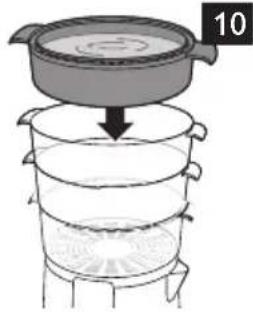
- Specific types only: When you take out the removable bottom from the large steaming basket (3) to create a larger basket with the medium steaming basket (2) underneath, you can still place the soup bowl to prepare fish, rice or soup on top (Fig. 10).
- To steam large-sized foods (e.g. whole chickens, corn cobs), you can remove the removable bottoms from the medium steaming basket (2) and the large steaming basket (3) to create one large basket.
Note: The maximum capacity of the steaming baskets is 1kg.
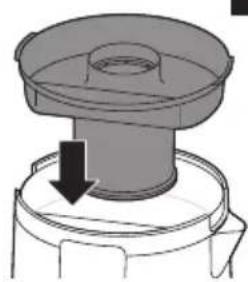
7 Put one or more steaming baskets on the drip tray. Place the baskets properly and make sure they do not wobble (Fig. 11).
- You do not have to use all 3 steaming baskets.
- The steaming baskets are numbered from 1 to 3. You find the numbers of the steaming baskets on their handles. You can stack any larger basket on top of a smaller basket, but the baskets fit best if you stack them in logical ascending order: the smallest basket (1) first, then the medium basket (2) and then the large basket (3). Always use the drip tray under the steaming baskets and only use steaming baskets that are filled with food (Fig. 12).
- When you take out the removable bottom from the medium steaming basket (2) to create a larger basket with the small steaming basket (1) underneath, you can still place the large steaming basket (3) on top.
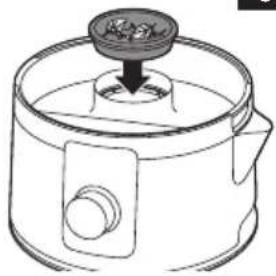
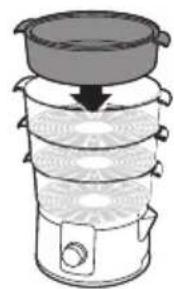
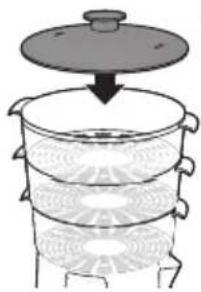
8 Put the lid on the top steaming basket (Fig. 13).
Note: If the lid is not or not correctly placed on the steaming basket, the food does not get steamed properly.
Using the appliance
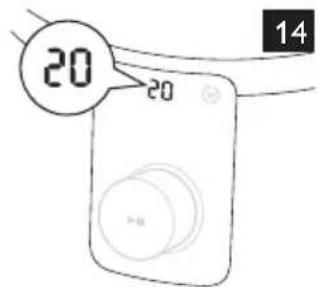
1 Put the plug in the wall socket.
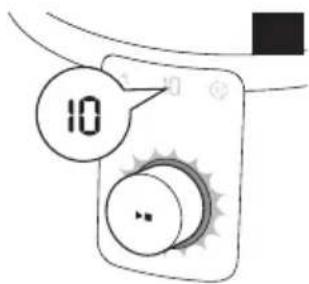
The light ring goes on and the default steaming time (20 minutes) appears on the control panel (Fig. 14).
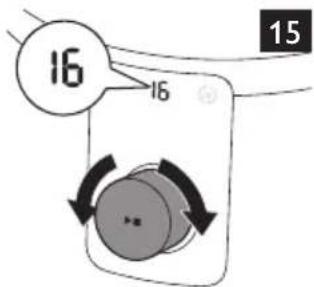
2 Turn the timer adjustment knob to the left or right to select the required steaming time (Fig. 15).
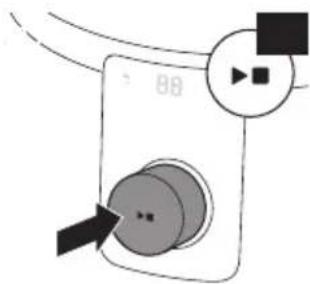
3 Press the start/stop button to start steaming (Fig. 16).
The steaming process starts. The light ring flashes slowly and the timer counts down the set steaming time (Fig. 17).
Note: If you steam large quantities of food, stir the food halfway through the steaming process with a kitchen utensil with a long handle. Make sure you wear oven mitts.
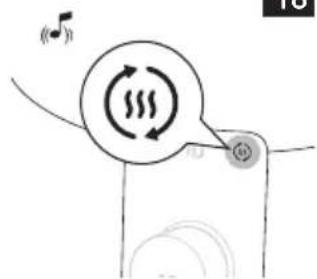
When the set steaming time has elapsed, the appliance beeps 5 times and then automatically switches to the keep-warm mode (see section 'keep-warm mode'). (Fig. 18)
4 After use, carefully remove the lid.
Beware of hot steam that comes out of the appliance when you remove the lid.
Note: To prevent burns, wear oven mitts when you remove the lid. Remove the lid slowly and away from you. Let condensation drip off the lid into the steaming basket.
Note: Use a kitchen utensil with long handles to remove the food from the steaming baskets.
ENGLISH10
5 When you remove a steaming basket, let condensation drip off the basket in the underlying steaming basket or the drip tray.
6 Remove the plug from the wall socket and let the steamer cool down completely before you remove the drip tray.
7 Empty the water tank after each use by tilting the base backwards and pouring the water from the back of the base (Fig. 3).
Be careful when you remove the drip tray and empty the water tank, because the water in both of them may still be hot, even if the other parts of the appliance have cooled down already.
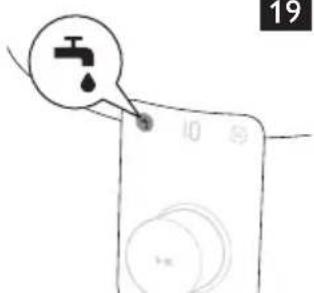
Note: If the water runs out during steaming, the 'water tank empty' light and the light ring start flashing to indicate that you need to refill the water tank (Fig. 19).
Note: If you want to steam more food and need more water, you can add small quantities of water through the water refill spout to refill the water tank.
Note: The appliance automatically goes into the standby mode if it has not been used for 2 minutes. Press the start/stop button to activate the control panel again.
Keep-warm mode
After steaming, the steamer automatically switches to the keep-warm mode and the keep-warm light goes on.
The keep-warm mode keeps the food warm for 20 minutes.
- If you want to keep the food warm longer than 20 minutes, turn the timer adjustment knob to the left or right to adjust the keep-warm time.
- If you want to deactivate the keep-warm mode when it is active, press the start /stop button.
Cleaning and maintenance
Never use scouring pads, abrasive cleaning agents or aggressive liquids such as petrol or acetone to clean the appliance.
1 Remove the plug from the wall socket and let the appliance cool down.
2 Clean the outside of the base with a moist cloth.
Never immerse the base in water, nor rinse it under the tap.
Do not clean the base in the dishwasher.
3 Clean the water tank with a cloth soaked in warm water with some washing-up liquid. Then wipe the water tank with a clean moist cloth.
4 Clean the lid in warm water by hand with some washing-up liquid.
5 Take out the removable bottoms from the steaming baskets. Clean the steaming baskets, the removable bottoms, the Aroma Infuser, the drip tray and the soup bowl (specific types only) by hand in warm water with some washing-up liquid. You can also clean these parts in the dishwasher, using a short cycle and a low temperature.
Repeated cleaning of the steaming baskets in a dishwasher may result in a slight dulling of these parts.
Descaling
You have to descale the appliance when scale is visible in the water tank. It is important that you descale the food steamer regularly to maintain optimal performance.
1 Fill the water tank with white vinegar (8% acetic acid) up to the MAX indication.
Do not use any other kind of descaler.
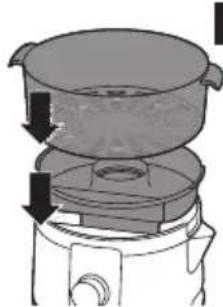
2 Put the drip tray and the small steaming basket (1) on the base properly (Fig. 20).
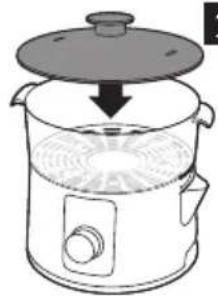
3 Put the lid on top of the small steaming basket (Fig. 21).
4 Put the plug in the wall socket.
5 Press the start/stop button to let the appliance operate for 20 minutes (Fig. 16).
If the vinegar starts to boil over the edge of the base, unplug the appliance and reduce the amount of vinegar.
6 When the appliance beeps, unplug the appliance and let the vinegar cool down completely. Then empty the water tank.
7 Rinse the water tank with cold water several times.
Note: Repeat the procedure if there is still some scale in the water tank.
Storage
1 Make sure all parts are clean and dry before you store the appliance (see chapter ‘Cleaning and maintenance’).
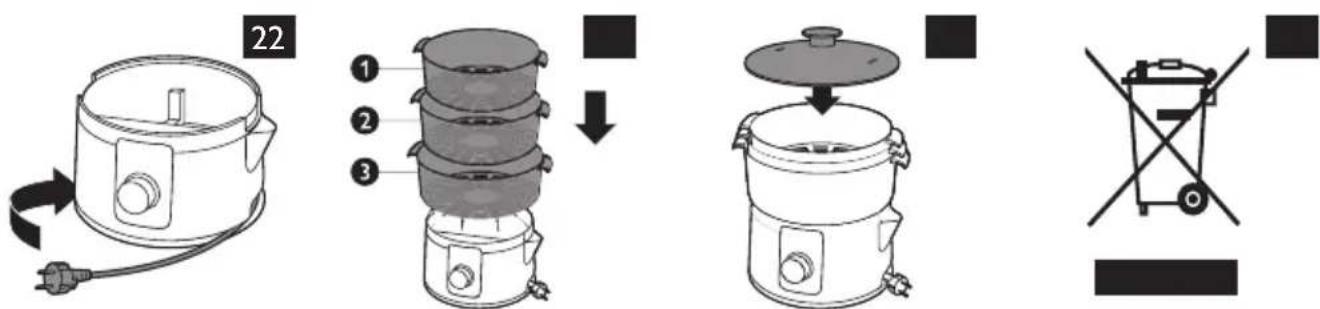
2 To store the mains cord, wind it round the reel in the base (Fig. 22).
3 Place the drip tray on the base (Fig. 5).
4 Make sure the removable bottoms are in place in the steaming baskets.
5 Place the large steaming basket (3) on the drip tray. Place the medium steaming basket (2) in the large steaming basket (3). Place the small steaming basket (1) in the medium steaming basket (2) (Fig. 23).
6 Specific types only: Place the soup bowl in the small steaming basket.
7 Place the lid on the soup bowl (specific types only) or on the small steaming basket (Fig. 24).
Guarantee and service
If you need service or information or if you have a problem, please visit the Philips website at www.philips.com/support or contact the Philips Consumer Care Centre in your country. You find its phone number in the worldwide guarantee leaflet. If there is no Consumer Care Centre in your country, go to your local Philips dealer.
Environment
- Do not throw away the appliance with the normal household waste at the end of its life, but hand it in at an official collection point for recycling. By doing this, you help to preserve the environment (Fig. 25).
Troubleshooting
This chapter summarises the most common problems you could encounter with the appliance. If you are unable to solve the problem with the information below, visit www.philips.com/support for a list of frequently asked questions or contact the Consumer Care Centre in your country.
Problem Possible cause Solution
| The steamer does not work. | The steamer is not plugged in. Put the plug in the wall socket. | |
| There is no water in the water tank. | Fill the water tank. | |
| You have not pressed the start/stop button yet. | Press the start/stop button | |
| Not all the food is cooked. | Some pieces of food in the steamer are larger and/or require a longer steaming time than others. | Set a longer steaming time by turning the timer adjustment knob to the right. |
| Put larger pieces of food and food that requires a longer steaming time in the small steaming basket (1) and start steaming some time before you add the other baskets. | ||
| You put too much food in the steaming baskets. | Do not overload the steaming baskets. Cut the food into small pieces and put the smallest pieces on top. | |
| Leave some space between the pieces of food and evenly distribute the food over the bottom of the basket. | ||
| The appliance does not heat up properly. | You have not descaled the appliance regularly. | Descale the appliance. See chapter 'Cleaning and maintenance'. |
| Water splashes out of the water tank during steaming. | You have put too much water in the water tank. | Remove excess water from the water tank. Make sure that the water does not exceed the MAX indication. |
| The 'water tank empty' light goes on even though there is enough water in the water tank. | There is too much scale on the heating element. | Descale the water tank. See section 'Descaling' in chapter 'Cleaning and maintenance'. |
| The Aroma Infuser has limited or no effect. | You did not put enough herbs in the Aroma Infuser. | Put more herbs in the Aroma Infuser. |
| You did not put the right types of herbs in the Aroma Infuser. | Put herbs with a strong aroma in the Aroma Infuser. See the food steaming table in chapter 'Food table and steaming tips'. | |
| You ate the food quite a long time after you had prepared it. | Eat the food right after you have prepared it. | |
| There is foam on the water in the water tank or in the drip tray. | Foam may develop when proteins end up in the water in the water tank or when residues of cleaning agents stay behind in the water tank. | Clean the water tank. See chapter 'Cleaning and maintenance. |
Food table and steaming tips
- For recipes, please see the recipe booklet or visit our website www.philips.com/kitchen.
- The steaming times mentioned in the table below are only an indication. Steaming times may vary depending on the size of the food pieces, the spaces between the food in the steaming basket, the amount of food in the basket, the freshness of the food and your personal preference.
Food steaming table
| Food to be steamed | Amount Steaming time (min) | Suggested herbs/spices for Aroma Infuser | |
| Asparagus 500g 15-20 Thyme, basil, lemon | |||
| Baby corn 200g 5-8 Chives, chilli, paprika | |||
| Green beans 500g 15-20 Parsley, lemon, garlic | |||
| Broccoli 400g 20 Garlic, crushed red chilli, tarragon | |||
| Carrots 500g 20 Parsley, dry mustard, chives | |||
| Cauliflower florets 400g 20 Rosemary, basil, tarragon | |||
| Celeriac (in cubes) 300g 15-20 Cumin, white pepper, chilli | |||
| Chicken leg | 1pc | 25 | Black pepper, lemon, paprika |
| Comcob | 500g 30-40 Parsley, garlic, chives | ||
| Courgette (sliced) | 500g 10 Dill, sage, rosemary | ||
| Couscous | 150g + 250ml water | 10-15 Cumin, coriander, cloves | |
| Eggs | 6pcs | 12-15 - | |
| Fruit | 500g/4pcs 10-15 Cinnamon, lemon, cloves | ||
| Peas (frozen) | 400g 20-25 Rosemary, cumin, parsley | ||
| Potatoes | 400g 25-30 Parsley, chives, garlic | ||
| Prawns | 200g | 5 | Curry powder, saffron, lemon |
| Puddings | 4 bowls | 20 Cinnamon, cloves, vanilla | |
| Rice | 150g + 300ml water | 35 | Pandan, parsley, cumin |
| 250g + 500ml water | 35 Pandan, parsley, cumin | ||
| Salmon | 450g | 12-15 min. | Dill, parsley, basil |
| White fish | 450g | 10-15 | Dry mustard, allspice, marjoram |
Tips for steaming food
Aroma infuser
- Rosemary, thyme, coriander, basil, dill, curry and tarragon are some of the herbs and spices that you can put in the Aroma Infuser. You can combine them with garlic, caraway or horseradish to enhance flavour without adding salt. We advise you to use 1/2 to 3tsps of dried herbs or spices. Use more if you use fresh herbs or spices.
- For more tips about herbs, spices and liquids to use in the Aroma Infuser, see the food steaming table above.
ENGLISH14
- Putting a little oil on the food improves the effect of the Aroma Infuser and also gives the food a fuller taste.
- For the best result, chop the herbs into fine pieces and fill the aroma infuser evenly.
- For the best taste, we advise you to eat your food immediately after preparing it.
- Do not pour liquids in the aroma infuser.
Vegetables and fruits
- Cut off thick stems from cauliflower, broccoli and cabbage.
- Steam leafy, green vegetables for the shortest possible time, because they lose colour easily.
- Do not thaw frozen vegetables before you steam them.
Meat, poultry, seafood and eggs
- Tender pieces of meat with a little fat are most suitable for steaming.
-
Wash meat properly and dab it dry, so that as little juice as possible drips out.
-
Always place meat, poultry, fish or eggs below other food types, to prevent dripping of juices.
- Puncture eggs before you put them in the steamer.
- Never steam frozen meat, poultry or seafood. Always let frozen meat, poultry or seafood thaw completely before you put it in the steamer.
Sweet deserts
- Add some cinnamon to desserts to enhance sweetness instead of adding more sugar.
General tips
- Specific types only: To prepare rice, you have to add water to the rice in the soup bowl. For the amounts, see the food steaming table above.
- When you have finished cooking rice, switch off the appliance, stir the rice and leave it in the bowl with the lid on it for 5 minutes. This gives and even better result.
- You can use the soup bowl (specific types only) to make soup or pudding, to cook rice, to poach fish, to prepare vegetables in sauce and to cook marinated food. You can also use a lightweight bowl that fits inside the steaming baskets to prepare these ingredients. In this case, make sure that there is some free space around the bowl to allow proper steam circulation inside the steamer.
- Leave some space between the pieces of food and evenly distribute the food over the bottom of the basket.
- If the steaming basket is very full, stir the food halfway through the steaming process.
- Small amounts of food require a shorter steaming time than large amounts.
- If you only use one steaming basket, the food requires a shorter steaming time than when you use 2 or 3 steaming baskets.
- If you use more than one steaming basket, let the food cook 5-10 minutes longer.
- Food is ready more quickly in the small steaming basket (1) than in the steaming baskets on top.
- Make sure that the food is well done before you eat. This is particularly important for meat like pork, minced beef and chicken.
- You can add food or baskets filled with food during the steaming process. If an ingredient needs a shorter steaming time, add it later.
- Food continues to be steamed for some time when the steamer switches to the keep-warm mode. If the food is already very well done, remove it from the steamer when the steaming process ends and the appliance switches to keep-warm mode.
- If the food is not done, set a longer steaming time. You may need to put some more water in the water tank.
- The steamer can be used to warm up ready-made soup in the soup bowl (specific types only) or a lightweight bowl that fits inside the steaming baskets. Heating up 250ml soup takes approx. 10 minutes.
Introduktion
natural_image
Illustration of a steamer being placed on a pan with a downward arrow indicating cooling (no text or symbols)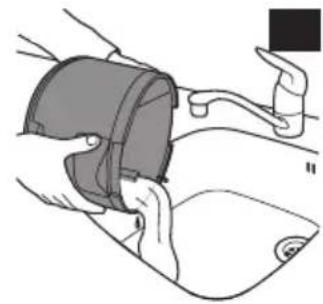
natural_image
Illustration of a hand holding a medical device attached to a car intake canal (no text or symbols visible)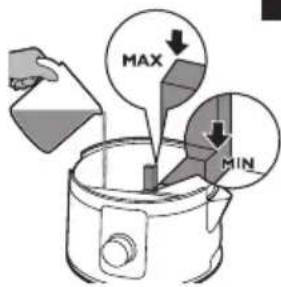
The image is too blurry to recognize any text content.
natural_image
Mechanical component diagram showing a cylindrical assembly with a downward arrow indicating force or motion (no text or symbols)6
natural_image
Line drawing of a cooking pot with a lid and handle, no text or symbols present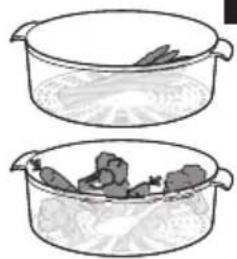
natural_image
Two identical illustrations of a cooking pot with food items inside, no text or symbols present.7
natural_image
Simple line drawing of a pot with a flame inside, no text or symbols present8
natural_image
Diagram of a multi-tiered storage or filtration device with a lid, showing layered structure and flow direction (no text or symbols)9
natural_image
Illustration of a cooking process showing a pan with food being added to a steamer (no text or symbols present)The image is too blurry to recognize any text content.
The image is too blurry to recognize any text content.
natural_image
Diagram of a cooking process showing a lid pouring into a multi-tiered steamer (no text or symbols)The image is too blurry to recognize any text content.
18
19
natural_image
Diagram of a cooking pot with arrows indicating downward motion, no text or symbols present20
natural_image
Line drawing of a cooking pot with a lid and downward arrow indicating cooling (no text or symbols)21
natural_image
Diagram showing three open panels with grid patterns and curved arrows indicating rotation or movement (no text or symbols)