
CR 18DV - Service après-vente HITACHI - Free user manual and instructions
Find the device manual for free CR 18DV HITACHI in PDF.


| Product Type | Cordless Drill/Driver |
| Model | CR 18DV |
| Brand | Hitachi (now Metabo HPT) |
| Power Source | 18V Li-ion Battery |
| Chuck Type | Keyless, 1/2 inch (13 mm) capacity |
| Speed Settings | Variable speed trigger, two-speed gearbox (0-350 / 0-1,400 RPM) |
| Torque | Max 300 in-lbs (approx) |
| Clutch | Adjustable, 22+1 positions |
| Weight | 3.5 lbs (1.6 kg) with battery |
| Dimensions (L x H) | 9.4 x 8.2 inches (239 x 208 mm) |
| Battery Compatibility | Hitachi 18V slide-type batteries (BCL1815, BCL1830, etc.) |
| Charging Time | Approx. 45 min for 1.5 Ah battery |
| Main Functions | Drilling in wood, metal, plastic; screwdriving |
| Maintenance | Clean vents, keep chuck clean, store in dry place |
| Safety Features | Trigger lock-off button, electric brake |
| Spare Parts Availability | Chuck, battery, charger, brushes, switch available |
| User Manual Languages | EN, DA, FI, NO, SV, and others via online translation request |
| Warranty | Standard 1-3 years depending on region |
| Included Accessories | One battery, charger, belt clip, bit holder (check package) |
Frequently Asked Questions - CR 18DV HITACHI
User questions about CR 18DV HITACHI
0 question about this device. Answer the ones you know or ask your own.
Ask a new question about this device
Download the instructions for your Service après-vente in PDF format for free! Find your manual CR 18DV - HITACHI and take your electronic device back in hand. On this page are published all the documents necessary for the use of your device. CR 18DV by HITACHI.
USER MANUAL CR 18DV HITACHI
natural_image
Line drawing of a mechanical tool with a saw and handle assembly (no text or symbols)Read through carefully and understand these instructions before use.
Bruksanvisning
Brugsanvisning
Bruksanvisning
Käyttöohjeet
Handling Instructions
1
2
3
4
5
6
7
8
natural_image
Illustration of a hand holding a mechanical tool with a handle and a numbered label (10), no text or symbols present.9
10
natural_image
Illustration of hands using a tool to adjust or install a mechanical component, no text or symbols present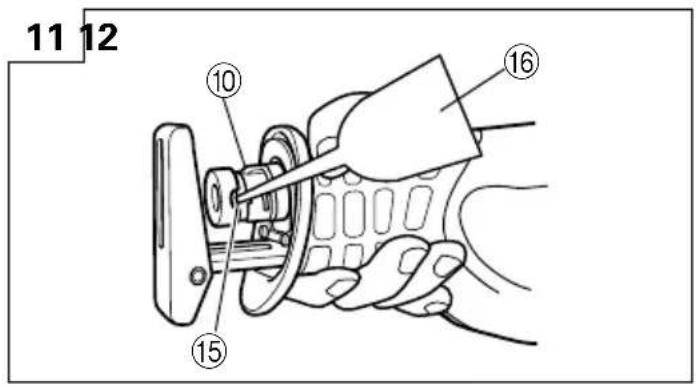
natural_image
Line drawing of hands using a tool to cut a cylindrical object into a mechanical component (no text or symbols)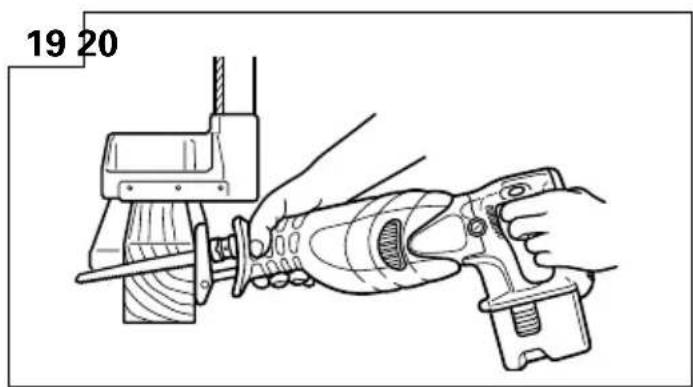
natural_image
Line drawing of hands using a tool to cut a saw (no text or symbols present)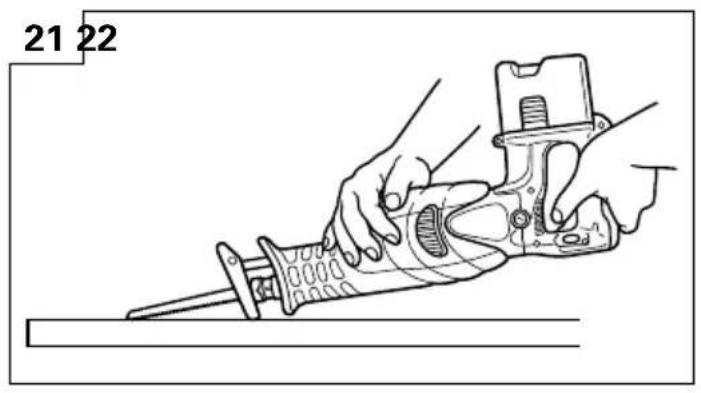
natural_image
Line drawing of hands using a saw tool to cut a component (no text or symbols)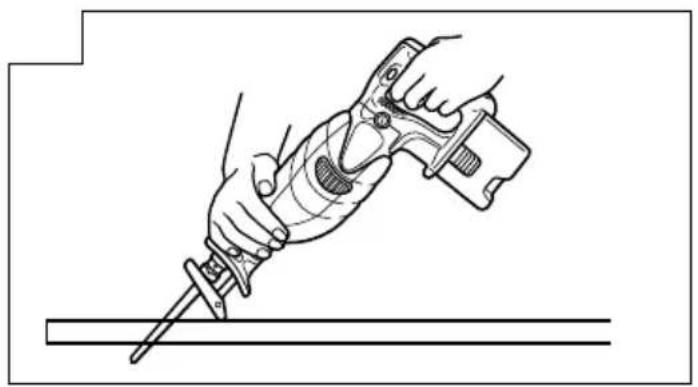
natural_image
Line drawing of a hand using a sawtooth tool to cut a surface (no text or symbols present)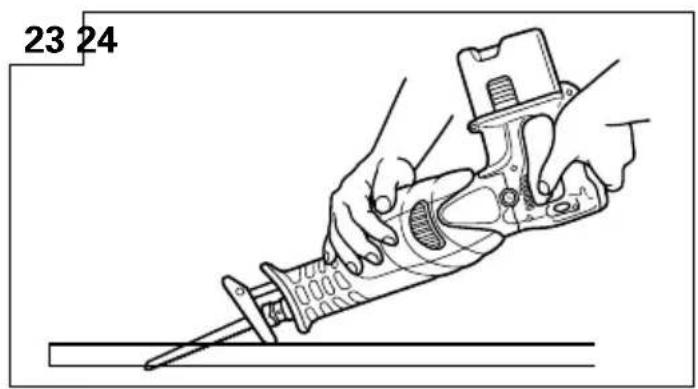
natural_image
Line drawing of hands using a sawtooth tool to cut a cylindrical object (no text or symbols present)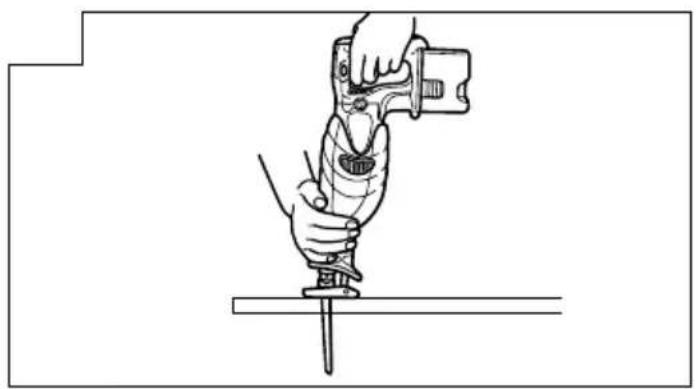
natural_image
Line drawing of a hand using a power tool to lift a screwdriver (no text or symbols)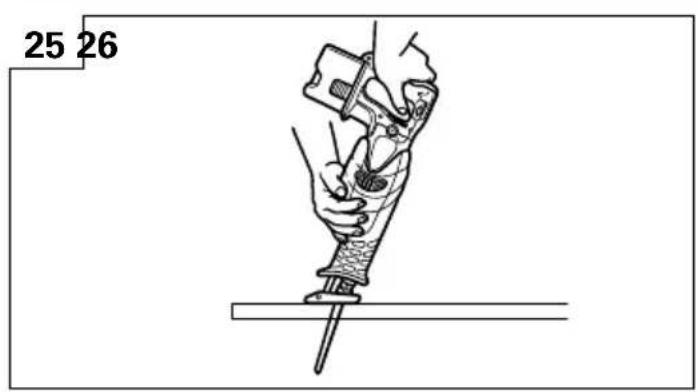
natural_image
Line drawing of hands using a tool to adjust or install a device (no text or symbols present)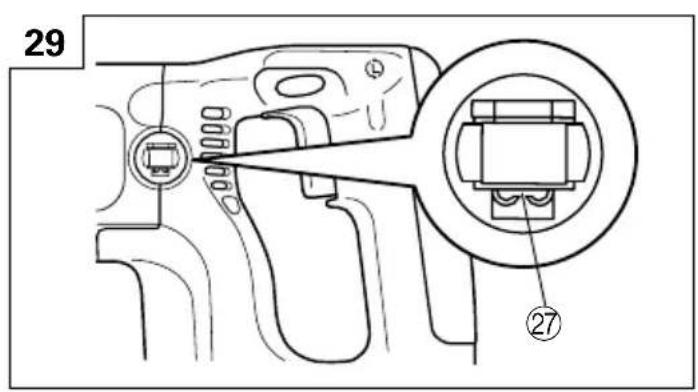
natural_image
Technical line drawing of a mechanical component (no text or symbols)- Sågblad
(1) Sågblad Nr. 1 (10) Sågblad Nr. 101
(2) Sågblad Nr. 2 (11) Sågblad Nr. 102
(3) Sågblad Nr. 3 (12) Sågblad Nr. 103
(4) Sågblad Nr. 4 (13) Sågblad Nr. 104
(5) Sågblad Nr. 5 (14) Sågblad Nr. 105
(6) Sågblad Nr. 8 (15) Sågblad Nr. 106
(7) Sågblad Nr. 9 (16) Sågblad Nr. 107
(8) Sågblad Nr. 95 (17) Sågblad Nr. 108
(9) Sågblad Nr. 96 (18) Sågblad Nr. 121
(19) Sågblad Nr. 131
(20) Sågblad Nr. 132
natural_image
Technical line drawing of a mechanical component (no text or symbols)2. Klinger
natural_image
Technical line drawing of a mechanical component with no visible text or symbols- Sagblad
VEDLIKEHOLD OG INSPEKSJON AV SAGBLADETS MONTERING
Tabell 5: Bimetallblad
VEDLIKEHOLD OG KONTROLL
MERK:
natural_image
Technical line drawing of a mechanical component with no visible text or symbols- Terä
(1) Nr. 1 terä
(2) Nr. 2 terä
(3) Nr. 3 terä
(4) Nr. 4 terä
(5) Nr. 5 terä
(10) Nr. 101 terä
(11) Nr. 102 terä
(12) Nr. 103 terä
(13) Nr. 104 terä
(14) Nr. 105 terä
(6) Nr. 8 terä
(15) Nr. 106 terä
(7) Nr. 9 terä
(16) Nr. 107 terä
(8) Nr. 95 terä
(17) Nr. 108 terä
(9) Nr. 96 terä
(18) Nr. 121 terä
(19) Nr. 131 terä
(20) Nr. 132 terä
- Keep work area clean. Cluttered areas and benches invite accidents.
- Avoid dangerous environment. Don't expose power tools and charger to rain. Don't use power tools and charger in damp or wet locations. And keep work area well lit. Never use power tools and charger near flammable or explosive materials. Do not use tool and charger in presence of flammable liquids or gases.
- Keep children away. All visitors should be kept safe distance from work area.
- Store idle tools and charger. When not in use, tools and charger should be stored in dry, high or locked-up place-out of reach of children. Store tools and charger in a palce where the temperature is less than 40^ C.
- Don't force tool. It will do the job better and safer at the rate for which it was designed.
- Use right tool. Don't force small tool or attachment to do the job of a heavy duty tool.
- Wear proper apparel. Do not wear loose clothing or jewelry. They can be caught in moving parts. Rubber gloves and non-skid footwear are recommended when working outdoor.
- Use eye protection with most tools. Also use face or dust mask if cutting operation is dusty.
- Don't abuse cord. Never carry charger by cord or yank it to disconnect from receptacle. Keep cord from heat, oil and sharp edges.
- Secure work. Use clamps or a vise to hold work. It's safer than using your hand and it frees both hands to operate tool.
- Don't overreach. Keep proper footing and balance at all times.
- Maintain tools with care. Keep tools sharp at all times, and clean for best and safest performance. Follow instructions for lubricating and changing accessories.
- When the charger is not in use, or when being maintained and inspected, disconnect its power cord from the AC outlet.
- Remove chuck wrenches and wrenches. Form habit of checking to see that wrenches are removed from tool before turning it on.
- Avoid accidental starting. Don't carry tool with finger on switch.
- To avoid danger, always use only the specified charger.
- Use only original HITACHI replacement parts.
- Do not use power tools for applications other than those specified in the Handling Instructions.
- To avoid personal injury, use only the accessories or attachment recommended in these handling instructions or in the HITACHI catalog.
- If the supply cord of this charger is damaged, the charger must be returned to the HITACHI authorized service center for the cord to be replaced. Let only the authorized service center do the repairing. The Manufacturer will not be responsible for any damages or injuries caused by repair by the unauthorized persons or by mishandling of the tool.
- To ensure the designed operational integrity of power tools and charger, do not remove installed covers or screws.
- Always use the charger at the voltage specified on the nameplate.
-
Do not touch movable parts or accessories unless the battery has been removed.
-
Always charge the battery before use.
- Never use a battery other than that specified. Do not connect a usual dry cell, a rechargeable battery other than that specified or a car battery to the power tool.
- Do not use any transformer that has a booster.
- Do not charge the battery from an engine electric generator or DC power supply.
- Always charge indoors. Because the charger and battery heat slightly during charging, charge the battery in a place not exposed to direct sunlight; where the humidity is low and the ventilation good.
- When working in a high place, pay attention to the activities below to make sure there are no people below.
- Use the exploded assembly drawing on this handling instructions only for authorized servicing.
PRECAUTIONS ON USING CORDLESS RECIPROCATING SAW
- Always charge the battery at a temperature of 0–40°C. A lower temperature than these specified ranges will result in overcharging which will shorten the battery life. The battery cannot be charged at a temperature higher than 40°C. The most suitable temperature for charging is that of 20–25°C.
- Do not use the charger continuously.
When one charging is completed, leave the charger for about 15 minutes before the next charging of battery. - Do not allow foreign matter to enter the hole for connecting the rechargeable battery.
- Never disassemble the rechargeable battery and charger.
- Never short-circuit the rechargeable battery. Short-chircuiting the battery will cause a great electric current and overheat. It results in burn or damage to the battery.
- Do not dispose of the battery in fire.
If the battery is burnt, it may explode. - When using this unit continuously, the unit may overheat, leading to damage in the motor and switch. Please leave it without using it for approximately 15 minutes.
- Do not insert object into the air ventilation slots of the charger.
Inserting metal objects or inflammables into the charger air ventilation slots will result in electrical shock hazard or damaged charger. - Using an exhausted battery will damage the charger.
- Prior to cutting into walls, ceilings or floors, ensure there are no electric cables or conduits inside.
- Bring the battery to the shop from which it was purchased as soon as the post-charging battery life becomes too short for practical use. Do not dispose of the exhausted battery.
- Wear earplugs to protect your ears during operation.
- Do not touch the blade during or immediately after operation. The blade becomes very hot during operation and could cause serious burns.
- Always hold the body handle and front cover of the power tool firmly. Otherwise the counterforce produced may result in inaccurate and even dangerous operation.
- Remove the battery from tool or place the switch in the locked or off position before making any adjustments, changing accessories, or storing the tools.
SPECIFICATIONS
POWER TOOL
| Model CR18DV | ||
| No-Load Speed 0 – 2100 min | -1 | |
| Stroke 28 mm | ||
| Capacity Mild Steel Pipe: O.D. 90 mm | Vinyl Chloride Pipe: O.D. 90 mmWood: Depth 90 mmMild Steel Plate: Thickness 10 mm | |
| Rechargeable battery | EB1820 Ni-Cd battery, 18 V (2.0 Ah 15 cells) | |
| EB1830H Ni-MH battery, 18 V (3.0 Ah 15 cells) | ||
| Weight 3.9 kg | ||
CHARGER
| Model | UC24YFA |
| Charging voltage | 7.2 – 24 V |
| Weight | 0.6 kg |
STANDARD ACCESSORIES
| CR18DV | 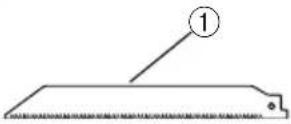 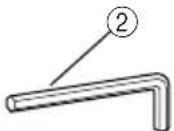 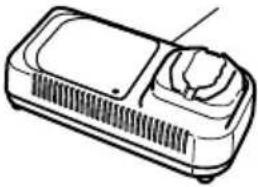 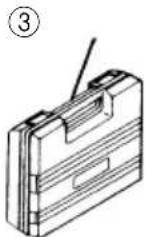 |
| 1 Blade (No. 103)....12 Hexagonal bar wrench....13 Charger (UC24YFA)....14 Plastic case....1 |
Standard accessories are subject to change without notice.
OPTIONAL ACCESSORIES (sold separately)
- Battery (EB1820, EB1830H)
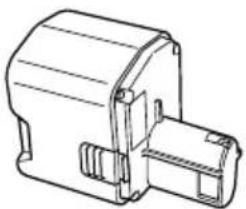
natural_image
Technical line drawing of a mechanical component with no visible text or symbols- Blades
(1) No. 1 Blade (10) No. 101 Blade
(2) No. 2 Blade (11) No. 102 Blade
(3) No. 3 Blade (12) No. 103 Blade
(4) No. 4 Blade (13) No. 104 Blade
(5) No. 5 Blade (14) No. 105 Blade
(6) No. 8 Blade (15) No. 106 Blade
(7) No. 9 Blade (16) No. 107 Blade
(8) No. 95 Blade (17) No. 108 Blade
(9) No. 96 Blade (18) No. 121 Blade
(19) No. 131 Blade
(20) No. 132 Blade
○ (1) – (9): HCS Blades (HCS: Highspeed Carbon Steel)
○ (10) - (20): BI-METAL Blades
Refer to Table 4, 5 and 6 for use of the blades.
Optional accessories are subject to change without notice.
APPLICATIONS
○ Cutting pipe and angle steel.
○ Cutting various lumbers.
○ Cutting mild steel plates, aluminum plates, and copper plates.
○ Cutting synthetic resins, such as phenol resin and vinyl chloride.
For details refer to the section entitled "SELECTION OF BLADES".
BATTERY REMOVAL/INSTALLATION
CAUTION
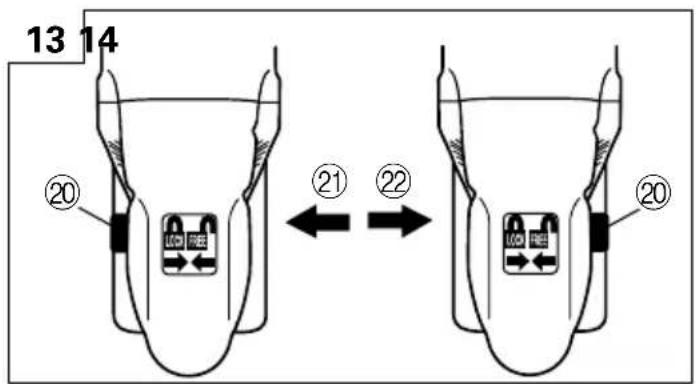
Be sure to keep the switch turned off and the lock-off button moved to right position (lock position). (See Fig. 13)
1. Battery removal
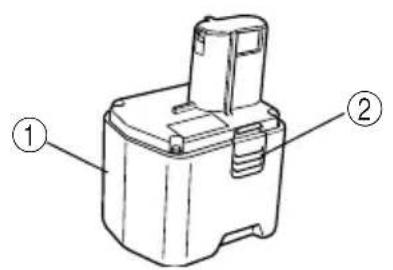
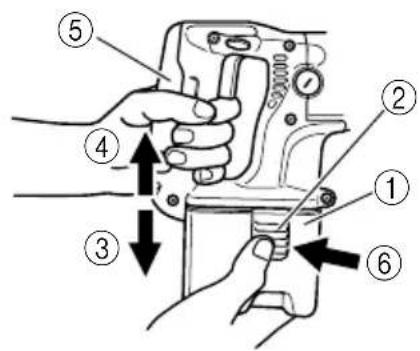
Hold the handle tightly and push the battery latches to remove the battery (see Figs. 1 and 2).
CAUTION
Never short-circuit the battery.
2. Battery installation
Insert the battery while observing its polarities (see Fig. 2).
CHARGING
Before using the Cordless Reciprocating Saw, charge the battery as follows.
-
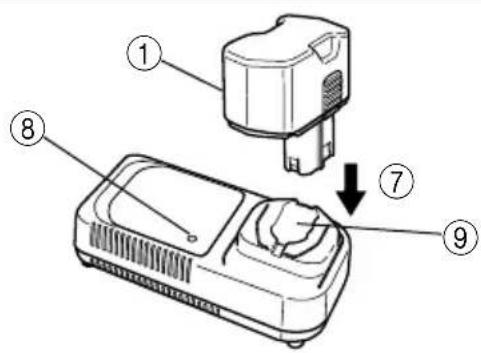
Connect the charger's power cord to a receptacle. When the power cord is connected, the charger's pilot lamp will blink in red. (At 1-second intervals).
-
Insert the battery into the charger.
Firmly insert the battery into the charger till it contacts the bottom of the charger and checking the polarities as shown in Fig. 3.
- Charging
When inserting a battery in the charger, charging will commence and the pilot lamp will light up continuously in red.
When the battery becomes fully recharged, the pilot lamp will blink in red. (At 1-second intervals.) (See Table 1)
(1) Pilot lamp indication
The indications of the pilot lamp are shown in Table 1, according to the condition of the charger or the rechargeable battery.
Table 1
| Indications of the pilot lamp | |||
| Before charging | Blinks (RED) | Lights for 0.5 seconds. Does not light for 0.5 seconds. (off for 0.5 seconds) | |
| While charging | Lights (RED) | Lights continuously | |
| Charging complete | Blinks (RED) | Lights for 0.5 seconds. Does not light for 0.5 seconds. (off for 0.5 seconds) | |
| Charging impossible | Flickers (RED) | Lights for 0.1 seconds. Does not light for 0.1 seconds. (off for 0.1 seconds) | Malfunction in the battery or the charger |
| Charging impossible | Lights (GREEN) | Lights continuously | The battery temperature is high, making recharging impossible. |
(2) Regarding the temperatures of the rechargeable battery.
The temperatures for rechargeable batteries are as shown in the table 2, and batteries that have become hot should be cooled for a while before being recharged.
Table 2
| Battery type which the battery | Temperatures at battery can be recharged |
| EB1820 | -5°C - 60°C |
| EB1830H | 0°C - 45°C |
(3) Regarding recharging time
Depending on the type of battery, the recharging time will become as shown in Table 3.
Table 3 Recharging time (At 20°C)
| Battery type Recharging time | |
| EB1820 Approx. 50 | min. |
| EB1830H Approx. 70 | min. |
NOTE
The recharging time may vary according to temperature and power source voltage.
-
Disconnect the charger's power cord from the receptacle.
-
Hold the charger firmly and pull out the battery.
NOTE
After operation, pull out batteries from the charger first, and then keep the batteries properly.
Regarding electric discharge in case of new batteries, etc.
As the internal chemical substance of new batteries and batteries that have not been used for an extended period is not activated, the electric discharge might be short when using them the first and second time. This is a temporary phenomenon, and normal time required for recharging will be restored by recharging the batteries 2 – 3 times.
How to make the batteries perform longer.
(1) Recharge the batteries before they become completely exhausted.
When you feel that the power of the tool becomes weaker, stop using the tool and recharge its battery. If you continue to use the tool and exhaust the electric current, the battery may be damaged and its life will become shorter.
(2) Avoid recharging at high temperatures.
A rechargeable battery will be hot immediately after use. If such a battery is recharged immediately after use, its internal chemical substance will deteriorate, and the battery life will be shortened. Leave the battery and recharge it after it has been cooled for a while.
CAUTION
○If the battery is charged while it is heated because it has been left for a long time in a location subject to direct sunlight or because the batetery has just been used, the pilot lamp of the charger lights up green. In such a case, first let the battery cool, then start charging.
When the pilot lamp flickers in red quickly (at 0.2-second intervals), check for and take out any foreign objects in the charger's battery installation hole. If there are no foreign objects, it is probable that the battery or charger is malfunctioning. Take it to your authorized Service Center.
○Since the built-in micro computer takes about 3 seconds to confirm that the battery being charged with UC24YFA is taken out, wait for a minimum of 3 seconds before reinserting it to continue charging. If the battery is reinserted within 3 seconds, the battery may not be properly charged.
PRIOR TO OPERATION
1. Mounting the blade
This unit employs a detachable mechanism that enables mounting and removal of saw blades without the use of a wrench or other tools.
(1) Turn on and off the switching trigger several times so that the holder sleeve can jump out of the front cover completely. Thereafter, turn off the switch and remove the battery. (Fig. 4)
CAUTION
Be absolutely sure to keep the switch turned off and the battery removed to prevent any accident.
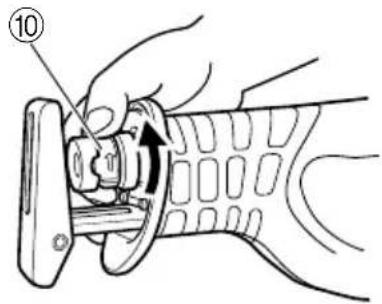
(2) Turn the holder sleeve in the direction of the arrow mark shown in Fig. 5 marked on the holder sleeve. If you turn the holder sleeve halfway you will be able to secure it automatically. (Fig. 5)
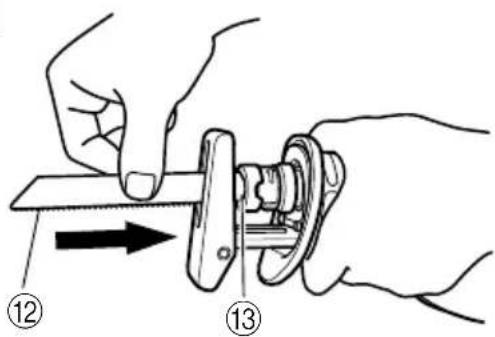
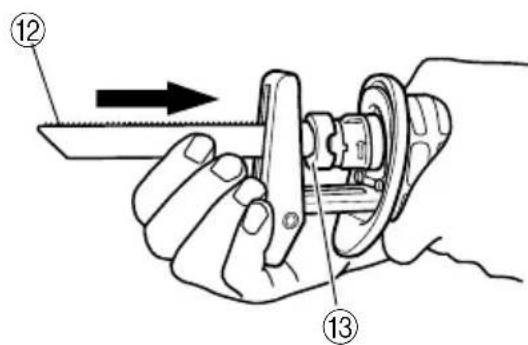
(3) Insert the saw blade all the way into the small slit of the plunger tip. You can mount this blade either in the upward or downward direction. (Fig. 6, Fig. 7)
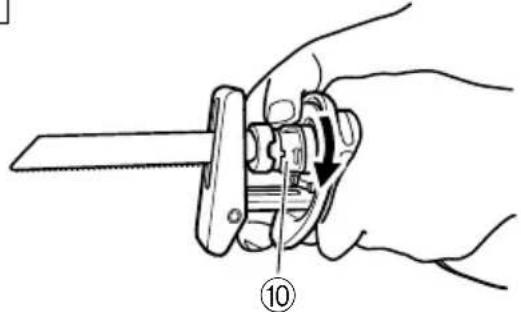
(4) Pull the holder sleeve back slightly in the direction of the arrow mark shown in Fig. 8 (in the direction opposite to the arrow marked on the holder sleeve). When you do this, the spring force will return the holder sleeve to the correct position automatically. There is no need to fasten the holder sleeve at this time. (Fig. 8)
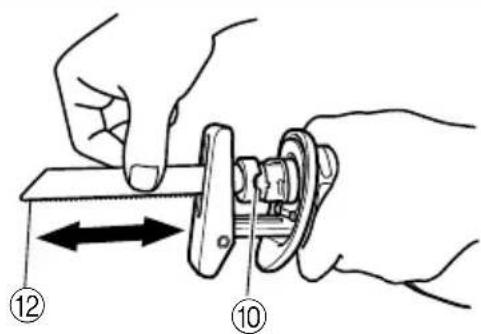
(5) Pull the back of the saw blade two or three times by hand and check that the blade is securely mounted. When pulling the blade, you will know it is properly mounted if it clicks and the holder sleeve moves slightly. (Fig. 9)
CAUTION
When pulling the saw blade, be absolutely sure to pull it from the back. Pulling other parts of the blade will result in an injury.
2. Dismounting the blade
(1) Turn on and off the switching trigger several times so that the holder sleeve can jump out of the front cover completely. Thereafter, turn off the switch and remove the battery. (Fig. 4)
CAUTION
Be absolutely sure to keep the switch turned off and the battery removed to prevent any accident.
(2) After you have turned the holder sleeve in the direction of the arrow mark shown in Fig. 5 and secured it, turn the blade so it faces downward. The blade should fall out by itself. If the blade doesn't fall out, pull it out by hand.
CAUTION
Never touch the saw blade immediately after use. The metal is hot and can easily burn your skin.
WHEN THE BLADE IS BROKEN
Even when the saw blade is broken and remains inside the small slit of the plunger, it should fall out if you turn the holder sleeve in the direction of the arrow mark, secure the holder sleeve, and face the blade downward. If it doesn't fall out itself, take it out using the procedures explained below.
(1) If a part of the broken saw blade is sticking out of the small slit of the plunger, pull out the protruding part and take the blade out.
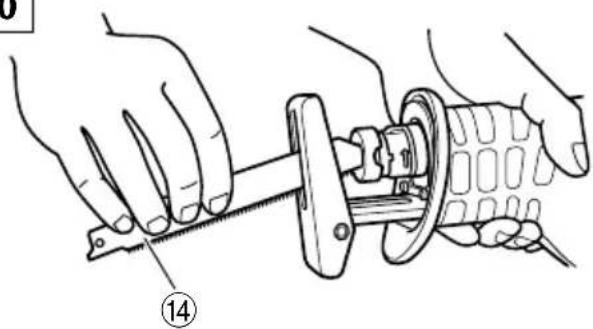
(2) If the broken saw blade is hidden inside the small slit, hook the broken blade using a tip of another saw blade and take it out. (Fig. 10)
MAINTENANCE AND INSPECTION OF SAW BLADE MOUNT
(1) After use, blow away sawdust, earth, sand, moisture, etc., with air or brush them away with a brush, etc., to ensure that the blade mount can function smoothly.
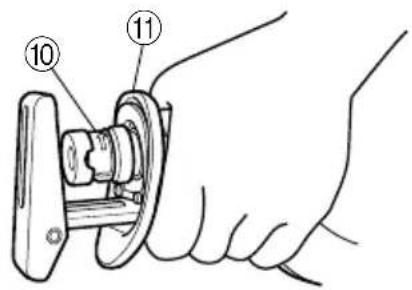
(2) Periodically lubricate the saw blade mount with machine oil through the small slit at a state where the holder sleeve is turned in the direction of the arrow mark shown in Fig. 5. (Fig. 11)
NOTE:
○If the saw blade mount is used without proper cleaning and lubrication, the rotation of the holder sleeve may be hampered by sawdust and particles of dust, disabling you to remove the saw blade with your fingers.
In such a case, hold the periphery of the holder sleeve lightly using a pair of pliers and the like, and turn the holder sleeve to left and right little by little.
After the saw blade has been successfully removed, be absolutely sure to clean it up with air, etc., carry out proper lubrication, and then check and see if the saw blade mount can function smoothly.
3. Moving the base
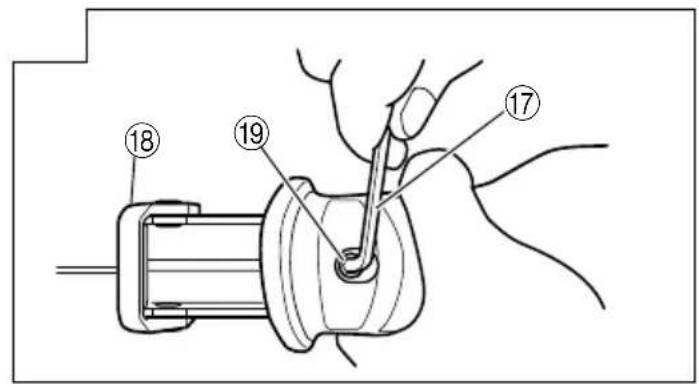
Loosen the set screw and move the base forward, as shown in Fig. 12. Tighten the set screw slightly, ensure the base does not move back and forth, and firmly tighten the set screw. Ensure that the base does not contact the blade.
- Confirm that the battery is mounted correctly.
HOW TO USE
CAUTION
○Do not carry tools with your finger on the switch. A sudden startup can result in an unexpected injury.
○Be careful not to let sawdust, earth, moisture, etc., enter the inside of the machine through the plunger section during operation. If sawdust and the like accumulate in the plunger section, always clean it before use. (refer to Fig. 4)
○Do not remove the front cover.
Be sure to hold the body from the top of the front cover. (refer to Fig. 4)
○During use, press the base against the material while cutting.
Vibration can damage the saw blade if the base is not pressed firmly against the workpiece.
Furthermore, a tip of the saw blade can sometimes contact the inner wall of the pipe, damaging the saw blade.
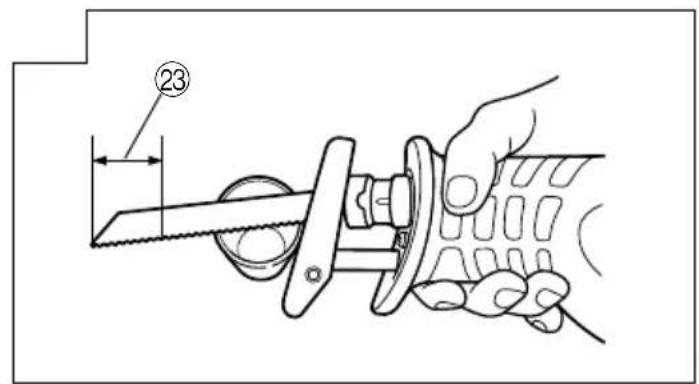
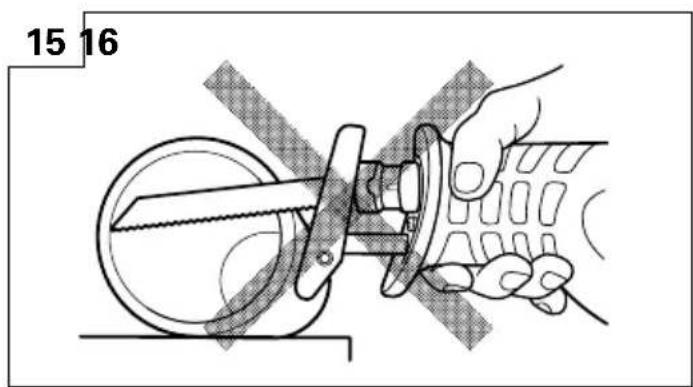
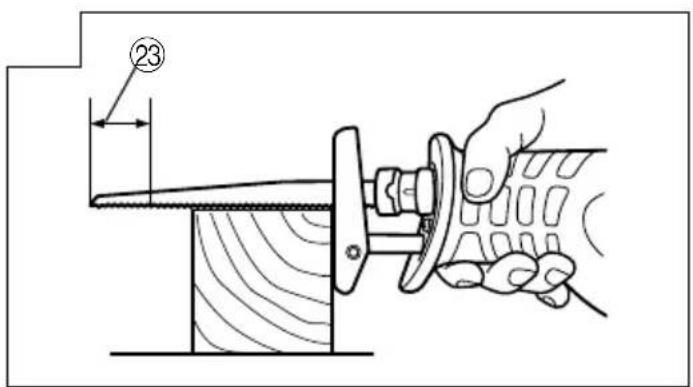
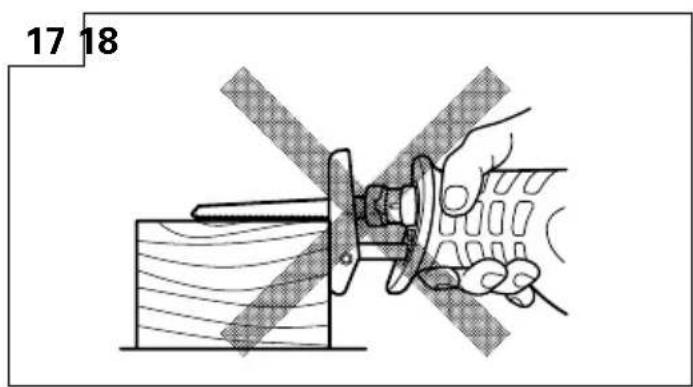
○Select a saw blade of the most appropriate length. Ideally, the length protruding from the base of the saw blade after subtracting the stroke quantity should be larger than the material (see Fig. 14 and Fig. 16).
If you cut a large pipe, large block of wood, etc., that exceeds the cutting capacity of a blade; there is a risk that the blade may contact with the inner wall of the pipe, wood, etc., resulting in damage. (Fig. 15, Fig. 17)
1. Switch operation
(1) Lock-off button
The tool is equipped with a lock-off button. To activate the trigger lock, move the button to the right positon. Move the button to the left to operate the tool. (Fig. 13)
Always lock the switch when carrying or storing the tool eliminate unintentional starting.
(2) Trigger switch
This tool is equipped with a variable speed controlled trigger switch. The tool can be turned "ON" or "OFF" by squeezing or releasing the trigger. The blade plunger stroke rate can be adjusted from the minimum to maximum nameplate stroke rate by the pressure you apply to the trigger. Apply more pressure to increase the speed and release pressure to decrease speed.
2. Cutting metallic materials
CAUTION
○Press the base firmly against the workpiece.
○Never apply any unreasonable force to the saw blade when cutting. Doing so can easily break the blade.
○The motor can be locked sometimes, depending on the combination of the material to be cut and the blade. Whenever the motor gets locked, switch it off immediately.
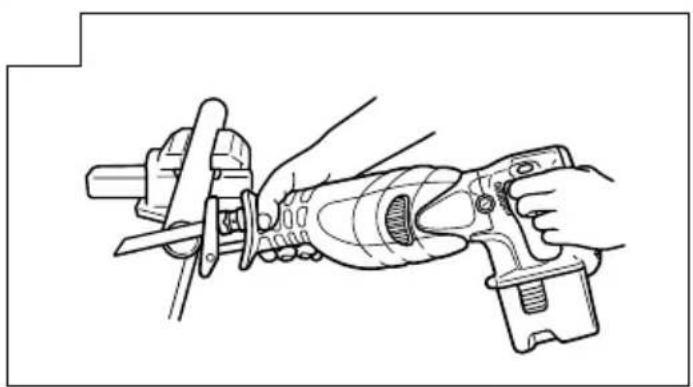
(1) Fasten a workpiece firmly before operation. (Fig. 18)
(2) When cutting metallic materials, use proper machine oil (turbine oil, etc.). When not using liquid machine oil, apply grease over the workpiece.
CAUTION
The service life of the saw blade will be drastically shortened if you don't use machine oil.
3. Cutting lumber
When cutting lumber, make sure that the workpiece is fastened firmly before beginning. (Fig. 19)
CAUTION
Never apply any unreasonable force to the saw blade when cutting. Also remember to press the base against the lumber firmly.
4. Sawing curved lines
We recommend that you use the BI-METAL blade mentioned in Table 5 (Page 11) for the saw blade since it is tough and hardly breaks.
CAUTION
Delay the feed speed when cutting the material into small circular arcs. An unreasonably fast feed may break the blade.
5. Plunge cutting
With this tool, you can perform plunge cutting on plywood panels and thin board materials. You can carry out pocket cutting quite easily with the saw blade installed in reverse as illustrated in Fig. 21, Fig. 23, and Fig. 25. Use the saw blade that is as short and thick as possible. We recommend for this purpose that you use BI-METAL Blade No. 132 mentioned in Page 11, Table 5. Be sure to use caution during the cutting operation and observe the following procedures.
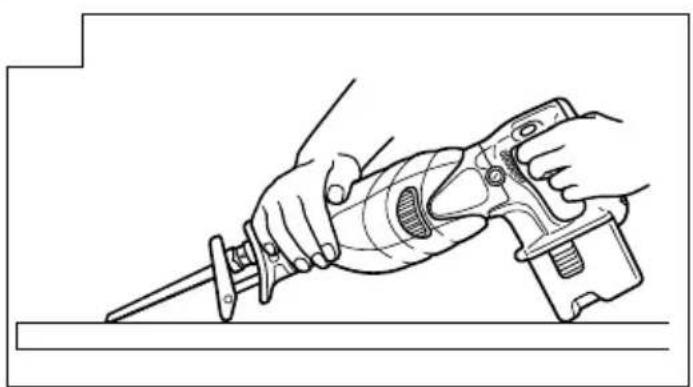
(1) Press the lower part (or the upper part) of the base against the material. Pull the switch trigger while keeping the tip of the saw blade apart from the material. (Fig. 20, Fig. 21)
(2) Raise the handle slowly and cut in with the saw blade little by little. (Fig. 22, Fig. 23)
(3) Hold the body firmly until the saw blade completely cuts into the material. (Fig. 24, Fig. 25)
CAUTION
○Avoid plunge cutting for metallic materials. This can easily damage the blade.
Never pull the switch trigger while the tip of the saw blade is pressed against the material. If you do so, the blade can easily be damaged when it collides with the material.
○Make absolutely sure that you cut slowly while holding the body firmly. If you apply any unreasonable force to the saw blade during the cutting operation, the blade can easily be damaged.
NOTE
The use of the battery EB1830H in a cold condition (below 0 degree Centigrade) can sometimes result in the weakened cutting torque and reduced amount of work. This, however, is a temporary phenomenon, and returns to normal when the battery warms up.
SELECTION OF BLADES
To ensure maximum operating efficiency and results, it is very important to select the appropriate blade best suited to the type and thickness of the material to be cut. NOTE:
Dimensions of the workpiece mentioned in the table represent the dimensions when the mounting position of the base is set nearest to the body of the Cordless Reciprocating Saw. Caution must be exercised since dimensions of the workpiece will become smaller if the base is mounted far away from the body of the Cordless Reciprocating Saw.
1. Selection of HCS blades
The blade number of HCS blades in Table 4 is engraved in the vicinity of the mounting position of each blade. Select appropriate blades by referring to Tables 4 and 6 below.
Table 4: HCS blades
| Blade No. | Thickness Uses | (mm) |
| No. 1 | For cutting steel pipe less than 100 mm in diameter | 2.5 – 6 |
| No. 2 | For cutting steel pipe less than 30 mm in diameter | 2.5 – 6 |
| No. 3 | For cutting steel pipe less than 30 mm in diameter | Below 3.5 |
| No. 4 | For cutting and roughing lumber 50 – 70 | |
| No. 5 | For cutting and roughing lumber Below 30 | |
| No. 8 | For cutting vinyl chloride pipe less than 100 mm in diameter | 2.5 – 15 |
| For cutting and roughing lumber Below 100 | ||
| No. 9 | For cutting mild steel pipe less than 100 mm in diameter when 2.5 – 6 used with cut off guide | |
| No. 95 | For cutting stainless steel pipe less than 100 mm in diameter | Below 2.5 |
| No. 96 | For cutting stainless steel pipe less than 30 mm in diameter | Below 2.5 |
NOTE
No. 1 – No. 96 HCS blades are sold separately as optional accessories.
2. Selection of BI-METAL blades
The BI-METAL blade numbers in Table 5 are described on the packages of special accessories. Select appropriate blades by referring to Table 5 and 6 below.
Table 5: BI-METAL blades
| Blade No. | Uses | Thickness (mm) |
| No. 101 | For cutting steel and stainless pipes less than 60 mm in outer diameter | 2.5 – 6 |
| No. 102 | For cutting steel and stainless pipes less than 100 mm in outer diameter | 2.5 – 6 |
| No. 103 | For cutting steel and stainless pipes less than 60 mm in outer diameter | 2.5 – 6 |
| Blade No. | Uses | Thickness (mm) |
| No. 104 | For cutting steel and stainless pipes less than 100 mm in outer diameter | 2.5 – 6 |
| No. 105 | For cutting steel and stainless pipes less than 60 mm in outer diameter | 2.5 – 6 |
| No. 106 | For cutting steel and stainless pipes less than 100 mm in outer diameter | 2.5 – 6 |
| No. 107 | For cutting steel and stainless pipes less than 60 mm in outer diameter | Below 3.5 |
| No. 108 | For cutting steel and stainless pipes less than 100 mm in outer diameter | Below 3.5 |
| No. 121 | For cutting and roughing lumber | 100 |
| No. 131 | For cutting and roughing lumber | 100 |
| No. 132 | For cutting and roughing lumber | 100 |
NOTE
Nos. 101 – No. 132 BI-METAL blades are sold separately as optional accessories.
3. Selection of blades for other materials
Table 6
| Material M to be cut quality (mm) | Material Thickness | Blade No. | |
| Iron plate M | Mild steel 2.5 – 10 plate 102, 103, | No. 1, 2, 101, 104, | 105, 106, 131 |
| Below 3.5 | No. 3, 107, 108 | ||
| Nonferrous metal | Aluminium, 5 – Copper and Brass | 20 No. 1, 2, | 101, 102, 103, 104, 105, 106, 131, 132 |
| Below 5 | No. 3, 107, 108 | ||
| Systhetic resin | Phenol resin, Melamine resin, etc. | 10 – 50 | No. 1, 2, 4, 101, 102, 103, 104, 131, 132 |
| 5 – 30 No. | 3, 5, 8, 105, 106, 107, 108 | ||
| Vinyl chloride, Acrylic resin, etc. | 10 – 60 | No. 1, 2, 4, 101, 102, 103, 104, 131, 132 | |
| 5 – 30 No. | 3, 5, 8, 105, 106, 107, 108 |
MAINTENANCE AND INSPECTION
CAUTION
Be sure to turned off the switch and remove the battery before maintenance and inspection.
1. Inspecting the blade
Continued use of a dull or damaged blade will result in reduced cutting efficiency and may cause overloading of the motor. Replace the blade with a new one as soon as excessive abrasion is noted.
2. Inspecting the mounting screws:
Regularly inspect all mounting screws and ensure that they are properly tightened. Should any of the screws be loose, retighten them immediately. Failure to do so could result in serious hazard.
3. Maintenance of the motor
The motor unit winding is the very "heart" of the power tool. Exercise due care to ensure the winding does not become damaged and/or wet with oil or water.
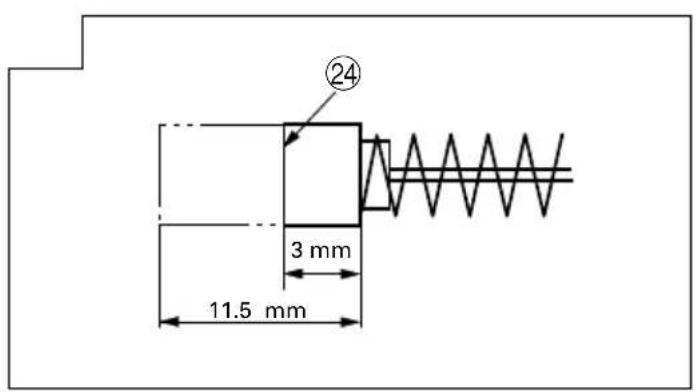
4. Inspecting the carbon brushes (Fig. 26)
The motor employs carbon brushes which are consumable parts. Since and excessively worn carbon brush can result in motor trouble, replace the carbon brush with new ones when it becomes worn to or near the "wear limit". In addition, always keep carbon brushes clean and ensure that they slide freely within the brush holders
NOTE:
When replacing the carbon brush with a new one, be sure to use the Hitachi Carbon Brush Code No. 999058.
5. Replacing carbon brushes
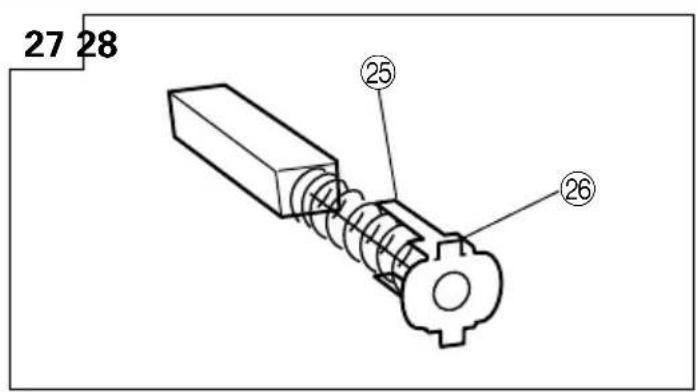
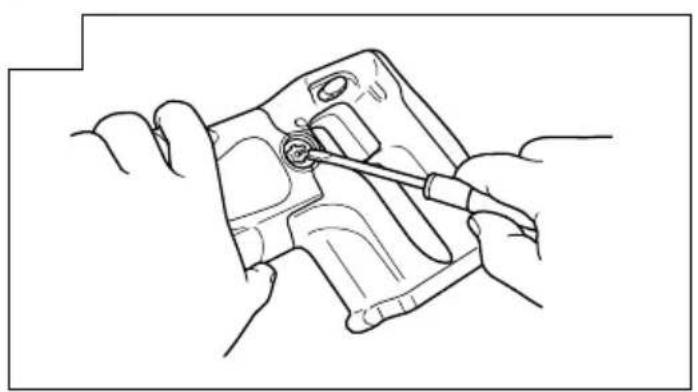
Take out the carbon brush by first removing the brush cap and then hooking the protrusion of the carbon brush with a flat head screw driver, etc., as shown in Fig. 28.
When installing the carbon brush, choose the direction so that the nail of the carbon brush agrees with the contact portion outside the brush tube. Then push it in with a finger as illustrated in Fig. 29. Lastly, install the brush cap.
CAUTION:
Be absolutely sure to insert the nail of the carbon brush into the contact portion outside the brush tube. (You can insert whichever one of the two nails provided.)
Caution must be exercised since any error in this operation can result in the deformed nail of the carbon brush and may cause motor trouble at an early stage.
6. Cleaning of the outside
When the Cordless Reciprocating Saw is stained, wipe with a soft dry cloth or a cloth moistened with soapy water. Do not use chloric solvents, gasoline or paint thinner, as they melt plastics.
7. Storage
Store the Cordless Reciprocating Saw in a place in which the temperature is less than 40^ C, and out of reach of children.
8. Service parts list
A : Item No.
B : Code No.
C: No. Used
D : Remarks
CAUTION:
Repair, modification and inspection of Hitachi Power Tools must be carried out by an Hitachi Authorized Service Center.
This Parts List will be helpful if presented with the tool to the Hitachi Authorized Service Center when requesting repair or other maintenance.
In the operation and maintenance of power tools, the safety regulations and standards prescribed in each country must be observed.
MODIFICATIONS:
Hitachi Power Tools are constantly being improved and modified to incorporate the latest technological advancements.
Accordingly, some parts (i.e. code numbers and/or design) may be changed without prior notice.
NOTE
Due to HITACHI's continuing program of research and development, the specifications herein are subject to change without prior notice.
Information concerning airborne noise and vibration
The measured values were determined according to EN50144.
The typical A-weighted sound pressure level: 80 dB (A) Wear ear protection.
The typical weighted root mean square acceleration value: 10.6 m/s ^2
| Item No. | Part Name |
| 40 N | NEEDLE ROLLER H-7108 |
| 41 B | BALANCE WEIGHT |
| 42 G | EAR |
| 43 | RETAINING RING (E-TYPE) FOR D10 SHAFT |
| 44 B | ALL BEARING 6001VVCMPS2L |
| 45 B | EARING COVER (A) |
| 46 A | RMATURE ASS'Y DC 24V |
| 47 B | ALL BEARING 608VVC2PS2L |
| 48 F | AN GUIDE |
| 49 M | GNET |
| 50 M | GNET |
| 51 W | ASHER (B) |
| 52 H | OUSING |
| 53 N | AME PLATE |
| 54 B | RUSH HOLDER (B) |
| 55 F | ERRITE CORE |
| 56 DC | SPEED CONTROL SWITCH |
| 57 H | HANDLE (A).(B) SET |
| 58 O | AUTION LABEL |
| 59 T | APPING SCREW (W/FLANGE) D4 × 30 |
| 60 GR | PIP COVER |
| 61 T | APPING SCREW (W/FLANGE) D4 × 25 |
| 62 H | ITACHI LABEL |
| 63 BR | USH CAP |
| 64 C | ARBON BRUSH |
| 65 BR | USH HOLDER (A) |
| 66 P | USHING BUTTON |
| 67 HE | SINK |
| 68 | MACHINE SCREW (W/WASHERS) M3 × 12 |
| 69 T | APPING SCREW |
| 70 H | OLDER SPRING |
| 71 TERMINAL | |
| 72 TERMINAL PIECE | |
| 73 TERMINAL | |
| 74 B | BATTERY EB 2420 |
| 501 SABER SAW BLADES NO.103 150L P.14 | |
| 502 HEX. BAR WRENCH 4MM | |
| 503 CASE (PLASTIC) | |
| 504 CHARGER (MODEL UC 24YFA) | |
| Item No. | Part Name |
| 1 H | OLDER PIN |
| 2 S | PRING (B) |
| 3 H | OLDER SLEEVE (A) |
| 4 H | OLDER SLEEVE (B) |
| 5 S | STEEL BALL D4.76 |
| 6 H | OLDER SLEEVE (C) |
| 7 G | UIDE WASHER |
| 8 D | UST WASHER |
| 9 SPRING (A) | |
| 10 W | ASHER (E) |
| 11 THRUST BEARING | |
| 12 WASHER (D) | |
| 13 | RETAINING RING (E-TYPE)FOR D14 SHAFT |
| 14 PLUNGER | |
| 15 PACKING WASHER | |
| 16 FELT PACKING | |
| 17 Q-RING (1AP-12) | |
| 18 METAL | |
| 19 | HEX. SOCKET HD. BOLT(W/SP.WASHER) M5 × 16 |
| 20 UPPER COVER ASS'Y | |
| 21 BASE | |
| 22 | MACHINE SCREW (W/SP. WASHER)M4 × 12 |
| 23 COVER PLATE | |
| 24 FRONT COVER | |
| 25 SEAL LOCK FLAT HD. SCREW M4 × 12 | |
| 26 BEARING COVER (B) | |
| 27 BALL BEARING 6901ZZCMPS2L | |
| 28 SPINDLE | |
| 29 METAL (B) | |
| 30 | HEX. SOCKET HD. BOLT (W/FLANGE)M5 × 12 |
| 31 | TAPPING SCREW (W/SP. WASHER)D5 × 30 |
| 32 GEAR COVER ASS'Y | |
| 33 | SEAL LOCK HEX.SOCKETFLAT HD. BOLT M5 × 12 |
| 34 | NYLOCK HEX. SOCKET FLAT HD. BOLTM6 × 16 |
| 35 SEAL PACKING | |
| 36 PACKING (B) | |
| 37 CONNECTOR HOLDER | |
| 38 CONNECTOR | |
| 39 CONNECTING PIECE (A) | |
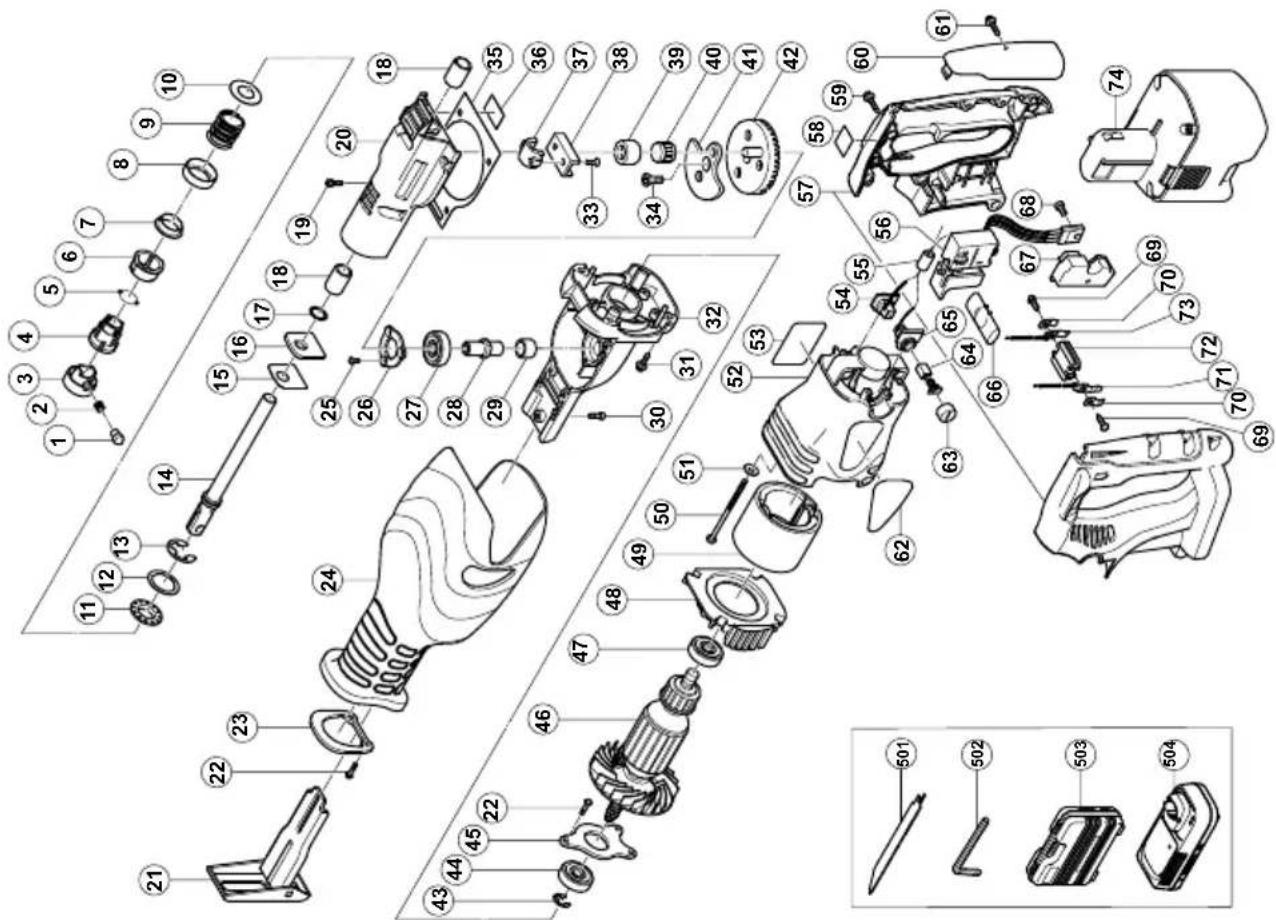
| Svenska | Suomi | ||
| EF-DEKLARATION BETRÄFFANDE LIKFORMIGHETVi tillkännagiver med eget ansvar att denna produkt överensstämmer med standard eller standardiserat dokumentEN50144, HD400 och/eller EN55014-2 i enlighet med råddirektiven 89/336/E∅S och/eller 98/37/E∅S.Denna deklaration gäller för CE-märkningen på produkten. | EY-ILMOITUS YHDENMUKAISUUDESTAYksinomaisella vastuudella vakuutamme, että tämä tuote vastaa normeja tai normitettuja dokumentteja EN50144, HD400 ja/tai EN55014-2 yhteisön ohjeiden 89/336/ETY ja/tai 98/37/ETY mukaisesti.Tämä ilmoitus sovelletaan tuotekohtaiseen CE-merkintään. | ||
| Dansk | English | ||
| EF-DEKLARATION OM ENSARTETHEDVi eklærer os fuldstændige ansvarlige for, at dette produkt modsvarer gældende standard eller de standardiserede dokumenter EN50144, HD400 og/eller EN55014-2 i overensstemmelse med EF-direktiver 89/336/E∅F og/eller 98/37/E∅F.Denne erklæring gælder produkter, der er mærket med CE. | EC DECLARATION OF CONFORMITYWe declare under our sole responsibility that this product is in conformity with standards or standardized documents EN50144, HD400 and/or EN55014-2 in accordance with Council Directives 89/336/EEC and/or 98/37/EEC.This declaration is applicable to the product affixed CE marking. | ||
| Norsk | |||
| EF's ERKLÆRING OM OVERENSSTEMMELSEVierklærerherved at vi påtar oss eneansvaret for at dette produktet er i overensstermmelse med normer eller standardiserte dokumenter EN 50144, HD400 og/eller EN55014-2 i samsvar med Rådsdirektiver 89/336/E∅S og/eller 98/37/E∅S.Denne erklæringen gjelder produktets påklistrede CE-merking. | |||
Hitachi Power Tools Europe GmbH  Siemensring 34, 47877 Willich, F. R. Germany 30. 8. 2002Hitachi Koki Co., Ltd.Shinagawa Intercity Tower A, 15-1, Konan 2-chome Siemensring 34, 47877 Willich, F. R. Germany 30. 8. 2002Hitachi Koki Co., Ltd.Shinagawa Intercity Tower A, 15-1, Konan 2-chome 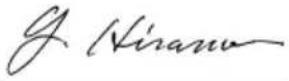 Minato-ku, Tokyo, Japan Y. Hirano (EMO) Minato-ku, Tokyo, Japan Y. Hirano (EMO) | |||
Hitachi Koki Co., Ltd.
- Klinger
- VEDLIKEHOLD OG INSPEKSJON AV SAGBLADETS MONTERING
- VEDLIKEHOLD OG KONTROLL
- MERK:
- PRECAUTIONS ON USING CORDLESS RECIPROCATING SAW
- SPECIFICATIONS
- OPTIONAL ACCESSORIES (sold separately)
- APPLICATIONS
- BATTERY REMOVAL/INSTALLATION
- CAUTION
- Battery removal
- Battery installation
- CHARGING
- NOTE
- Regarding electric discharge in case of new batteries, etc.
- How to make the batteries perform longer.
- PRIOR TO OPERATION
- Mounting the blade
- Dismounting the blade
- WHEN THE BLADE IS BROKEN
- MAINTENANCE AND INSPECTION OF SAW BLADE MOUNT
- NOTE:
- Moving the base
- HOW TO USE
- Switch operation
- Cutting metallic materials
- Cutting lumber
- Sawing curved lines
- Plunge cutting
- SELECTION OF BLADES
- Selection of HCS blades
- Selection of BI-METAL blades
- Selection of blades for other materials
- MAINTENANCE AND INSPECTION
- Inspecting the blade
- Inspecting the mounting screws:
- Maintenance of the motor
- Inspecting the carbon brushes (Fig. 26)
- Replacing carbon brushes
- CAUTION:
- Cleaning of the outside
- Storage
- Service parts list
- MODIFICATIONS:
- Information concerning airborne noise and vibration
- Hitachi Koki Co., Ltd.
Brand : HITACHI
Model : CR 18DV
Category : Service après-vente